AI Summary Powered by PixelBrainy
Real estate success depends on speed, trust, and the ability to connect with clients instantly. As digital behavior evolves, buyers now expect immediate information, interactive experiences, and personalized communication at every stage of their property journey. This shift has opened the door to one of the most powerful innovations in the industry today: AI Avatars for Real Estate.
In simple terms, an AI avatar acts as a virtual agent, property guide, or brand spokesperson that can engage your audience 24 hours a day. This technology is becoming a game changer for brokers, developers, and property marketers who want to improve their client experience and automate repetitive communication. With AI Avatar Development for Real Estate, businesses can present listings, answer questions, and qualify leads instantly.
This guide explores everything you need to know about Real Estate AI Avatar Development, including how it works, why it matters, and how to build an AI avatar for real estate that aligns with your brand. Whether you are a broker seeking more leads, a property developer wanting higher engagement for project launches, or a real estate agency wanting to modernize its website, this technology can help you make a powerful impact.
By the end of this guide, you will clearly understand the process of creating an AI avatar for real estate, the tools required, best practices, real-world examples, and what it takes to make an AI avatar for real estate that boosts conversions and creates memorable experiences for your clients.

AI avatar development for real estate is the process of creating digital humans or virtual agents who can interact with buyers, renters, investors, and website visitors just like a real real estate professional. These avatars use artificial intelligence, natural language processing, and video or 3D animations to communicate in a humanlike manner.
A real estate AI avatar can speak, guide viewers through property details, answer questions, schedule appointments, and explain investment opportunities. Unlike traditional chatbots, AI avatars add a dynamic, visual, and more engaging layer to online interaction. They also help real estate brands become more memorable and trustworthy by providing a familiar virtual face for the company.
The real estate industry is entering a stage where digital communication, AI-driven interactions, and automation are becoming central to how clients explore properties and make decisions. For many brokers and developers, investing in building an AI Avatar for real estate is no longer just an optional upgrade but a strategic move that reinforces their ability to operate in a technology-led market.
The rapid expansion of AI adoption in property businesses highlights this shift. The AI in real estate market was valued at USD 2.91 billion in 2024 and is projected to reach USD 41.5 billion by 2033, reflecting how deeply AI is becoming integrated into property transactions and customer interactions.
At the same time, digital human and avatar-based technologies are accelerating. The AI avatar industry is expected to grow from USD 0.80 billion in 2025 to USD 5.93 billion by 2032, proving that the concept of humanlike digital representatives is rapidly gaining global adoption across multiple industries, including real estate.
These market signals show a clear direction. Real estate companies that begin the development of AI avatar for real estate today are positioning themselves ahead of a major industry shift. The ability to build an AI Avatar for real estate is not only about adopting new technology; it is about preparing the brand for how clients will expect information, guidance, and communication to be delivered in the coming years.
By focusing on real estate AI avatar development, property businesses establish a modern communication identity that aligns with future digital behavior. It becomes easier to maintain consistent messaging, build a recognizable digital presence, and create an interaction model that fits both current and upcoming digital expectations. In an industry where trust, clarity, and presentation matter, the decision to invest early in AI avatar technology helps ensure the brand evolves with the market instead of reacting to it later.
AI avatars are reshaping how real estate brands communicate, present properties and guide prospects throughout the sales journey. They bring a new layer of interactivity to digital experiences by combining humanlike communication with automation.
This transformation is helping property businesses create more structured, more engaging and more personalized online interactions for buyers and investors.
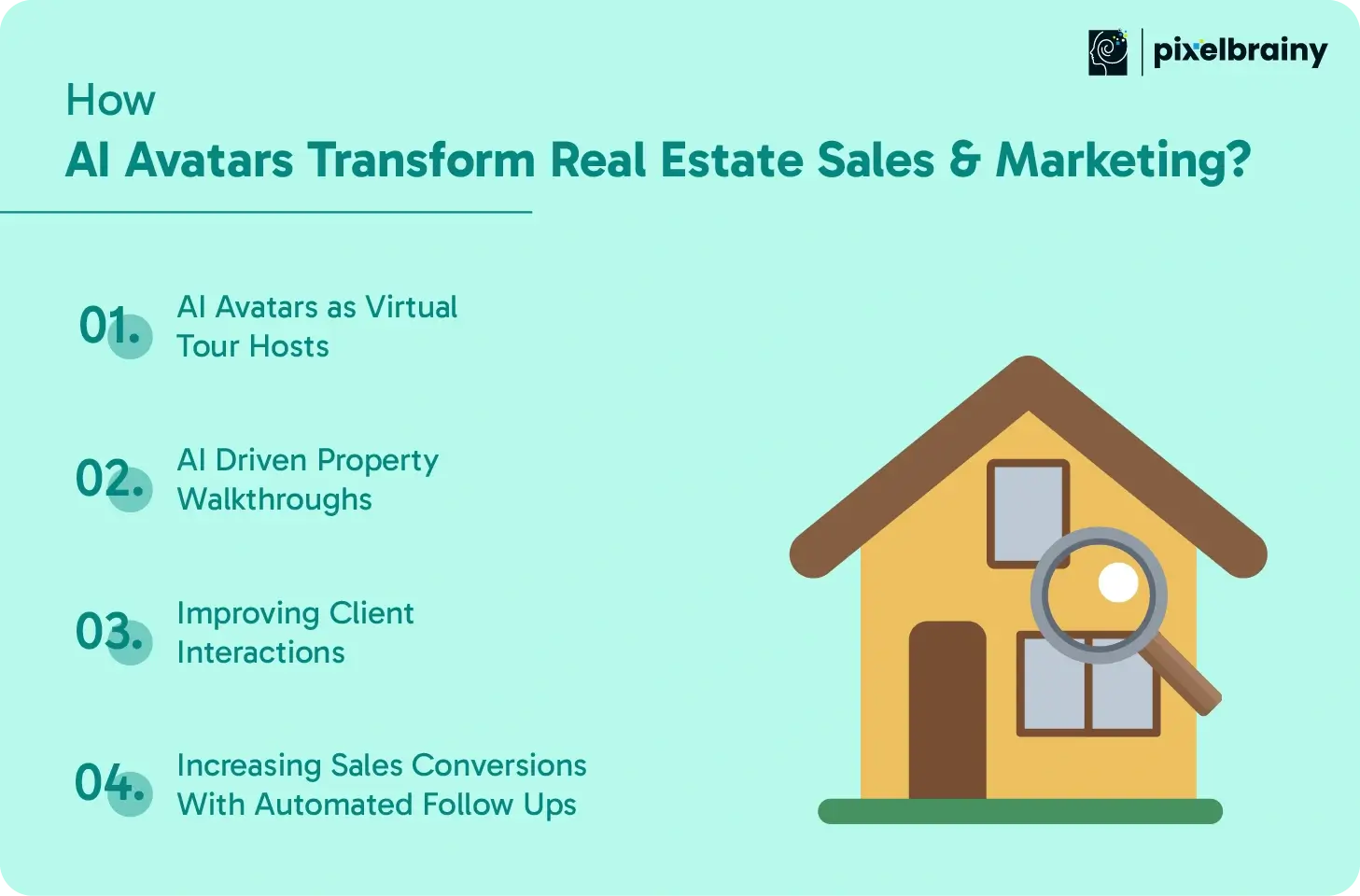
AI avatars can serve as virtual tour hosts who welcome visitors and introduce properties in a guided, professional manner.
They replace static images and text with a dynamic digital presenter who explains the project story, highlights key features and helps prospects understand what makes a property special.
By hosting the tour, the avatar creates an experience similar to having a real agent present.
This makes it easier for potential buyers to stay engaged and absorb the information they need without getting lost or overwhelmed.
With AI driven walkthroughs, buyers can navigate a property while receiving real time explanations from the avatar.
As users move through different rooms or spaces, the avatar provides insights about layout, finishes, amenities and the lifestyle the property supports.
This feels more interactive and informative than traditional 3D tours.
It also helps bridge the gap for under construction properties by presenting visuals and descriptions that make it easier for buyers to imagine the final product.
Modern real estate clients value immediate responses and accessible information.
AI avatars improve these interactions by being available at any time to clarify details, guide visitors or answer questions without waiting for human assistance.
This constant availability builds a smooth digital communication flow.
It also reduces the friction buyers experience when trying to understand property details or next steps in the sales journey.
Sales conversion depends heavily on timely and consistent follow ups.
AI avatars support this by automatically sending messages, updates and reminders after a visitor engages with a listing or tour.
These automated follow ups help maintain interest and momentum.
They ensure no lead is forgotten and keep prospects connected to the property until they are ready to take the next step.
With these advancements, AI avatars are emerging as essential tools for real estate companies aiming to elevate both engagement and sales performance.
As more property buyers shift toward digital-first interactions, real estate companies are turning to AI Avatar Development for Real Estate to modernize the way they present properties and communicate with clients.
The following use cases highlight how Developing an AI Avatar for Real Estate enhances both sales and customer experience, making it one of the most powerful digital tools in the industry today.
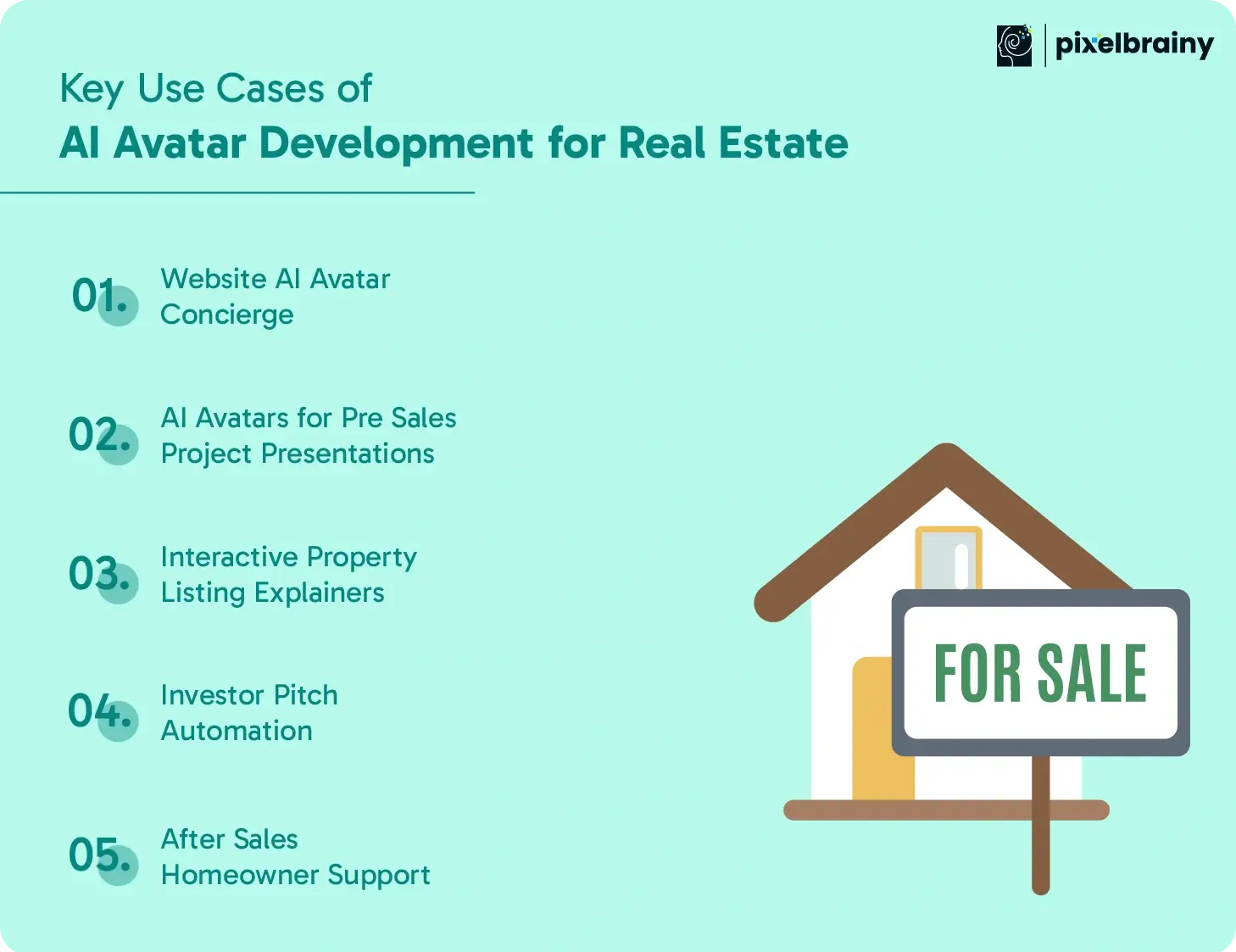
One of the top use cases of AI avatar development for real estate is adding an AI avatar concierge to the website. This avatar acts as a digital assistant who guides visitors, answers questions and helps users explore properties more efficiently. When businesses build an AI Avatar for Real Estate websites, they replace static navigation with a dynamic, humanlike guide.
For example, a property seeker visiting a developer’s website can ask the avatar to show only 2 BHK units or filter options within a specific budget. The avatar instantly displays relevant properties, making the digital experience more welcoming and intuitive.
During pre launch and pre sales phases, clarity and presentation quality are crucial. Real Estate AI Avatar development allows developers to create digital presenters who can deliver project introductions in a polished and engaging format. These avatars narrate the story of the project, highlight amenities and explain the lifestyle vision behind the development.
Imagine a luxury project launch where the avatar presents the master plan, location benefits and upcoming infrastructure developments. This creates consistency and ensures every viewer receives the same high quality presentation, regardless of when or where they watch it.
A major advantage of developing an AI Avatar for Real Estate listings is the ability to provide clear explanations for each property. When buyers view a listing, the avatar can appear to explain layout details, premium features, nearby amenities and overall value.
For example, if a buyer clicks on a villa listing, the avatar can walk them through room sizes, special architectural features or community highlights. This turns static listings into a guided, interactive experience and helps buyers understand key selling points immediately.
Investor presentations often require detailed explanations, financial clarity and well structured data. AI Avatar Development for Real Estate allows companies to automate investor pitches with avatars capable of narrating ROI projections, rental yield insights and market trends.
An investor evaluating a commercial tower, for instance, can watch the avatar explain market demand, expected lease values and projected growth. Every pitch remains accurate and consistent, making it easier for investors to absorb essential information.
Another top use case of AI avatar development for real estate is post purchase support. Once a homeowner moves in, the avatar can guide them through maintenance steps, onboarding instructions, community rules or warranty coverage.
A buyer who needs help understanding appliance warranties or the move in process can ask the avatar for a simple explanation. This reduces workload on support desks and gives homeowners immediate access to reliable information.
These use cases demonstrate why building an AI avatar for real estate has become essential for modern property brands aiming to elevate engagement and communication.
When companies invest in AI Avatar Development for Real Estate, they can choose from multiple avatar formats depending on their brand, audience and marketing strategy.
The following are the most widely used types of AI avatars for real estate, each supporting a different style of communication and digital experience.
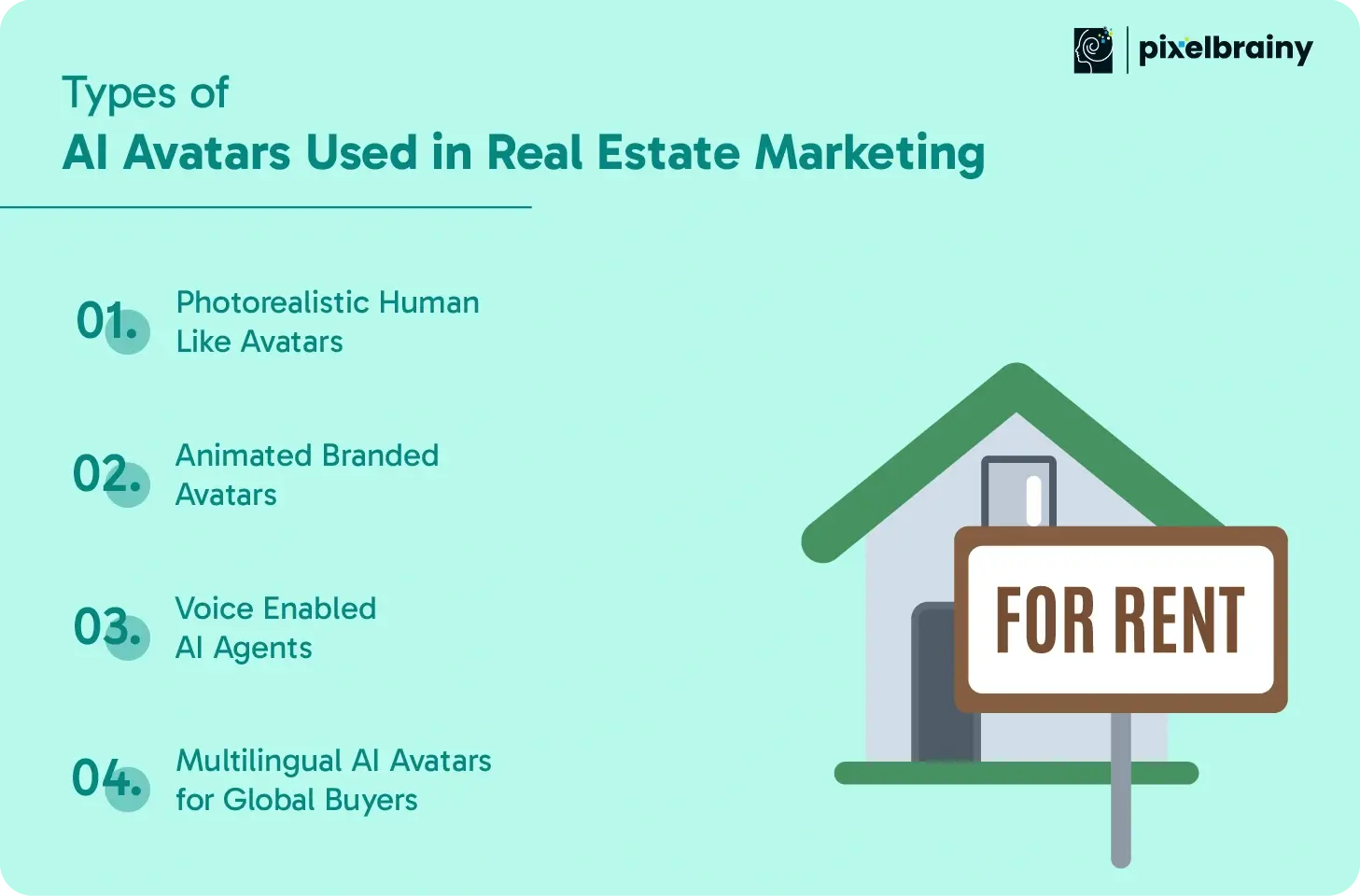
Photorealistic avatars are the closest digital alternative to a real human agent. These avatars are commonly chosen when brands want a professional, premium look that builds trust instantly.
In Real Estate AI Avatar Development, this type works well for property tours, high value listings and luxury projects because the avatar mirrors natural expressions and body language.
For example, a developer showcasing premium waterfront villas can use a photorealistic avatar to introduce the project, making the experience feel like a real consultant guiding the buyer.
Animated avatars are stylized digital characters created to match a company’s branding, colors and tone. They are ideal when businesses want a friendly, approachable or playful communication style. This type of avatar is widely used by companies developing an AI avatar for real estate campaigns targeting young buyers, rental audiences or first time homeowners.
For example, a real estate brand selling starter homes may use a cheerful animated avatar to explain benefits, simplify processes or present community features.
Voice enabled avatars are audio driven agents that communicate using natural language processing. Instead of appearing visually, they function as virtual voice assistants on websites or apps.
Many companies choose this format when they want to build an AI Avatar for Real Estate platforms that prioritize quick, hands free, conversational inquiries.
A buyer can simply ask questions like “Show me 3 bedroom apartments in the city center” and the voice enabled agent provides instant, spoken guidance.
Multilingual avatars are becoming essential in modern AI Avatar Development for Real Estate because property buyers often come from international markets. These avatars switch languages instantly and deliver clear, culturally appropriate communication.
For example, a developer promoting an investment property to overseas buyers can use a multilingual avatar that offers explanations in English, Arabic, Mandarin or Spanish, making the sales journey smooth and accessible for global clients.
Together, these types of AI avatars show how real estate AI avatar development can be tailored to different audiences, communication styles and marketing goals.

For brokers, property developers and real estate agencies, the process of creating an AI avatar for real estate is not just a technical task. It is a strategic journey that shapes how the brand communicates, guides buyers and builds trust in a digital environment.
Whether you work with top AI development companies or collaborate with AI real estate software development companies, each step requires thoughtful planning to ensure the avatar reflects your project identity, sales process and audience expectations.
The roadmap below explains how developing an AI avatar for real estate works from start to finish, with the goal behind every stage clearly defined for real estate professionals.
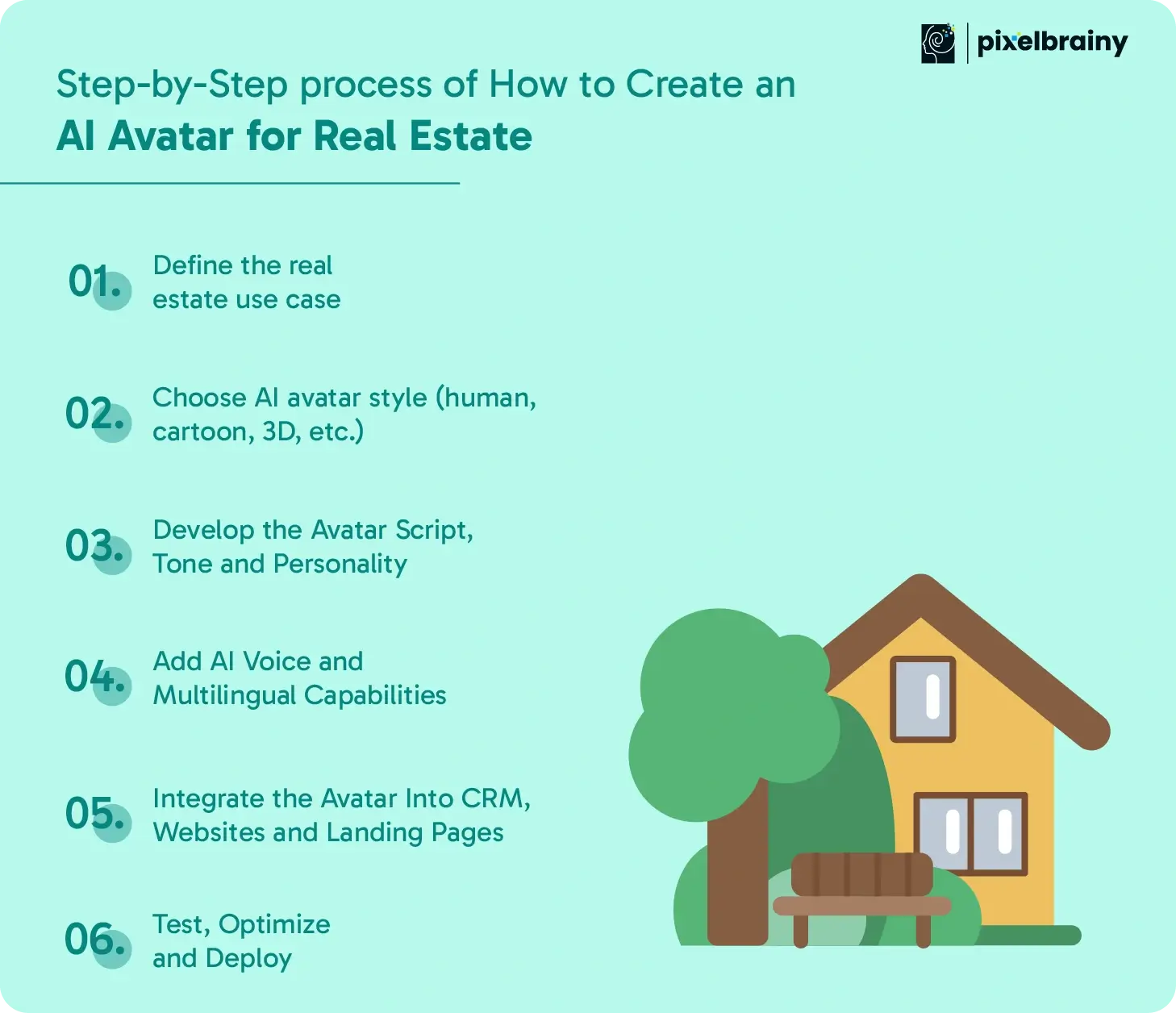
Goal of this step: Understand the purpose and role of the avatar within your sales and marketing ecosystem.
Every successful project begins by identifying the real estate use case. This step involves determining why the avatar is being created and how it will support your business. The use case may include website assistance, property presentations, lead qualification, investor briefings, project storytelling or buyer support.
By clarifying the purpose early, you set the direction for the entire real estate AI avatar development process. For example, if the aim is to guide users through a property website, the avatar needs conversational abilities and navigation support. If the goal is investor communication, the avatar must deliver structured financial explanations with accuracy. Defining the use case ensures you build an avatar that serves real business needs, not just a digital feature.
Goal of this step: Select an avatar format that matches your brand identity and audience expectations.
Selecting the avatar style is a critical creative decision in developing an AI avatar for real estate. The avatar can be photorealistic, animated, stylized, 3D modeled or minimal voice only. Each format delivers a different experience, and the right choice depends on your target audience and project type.
A luxury developer may choose a photorealistic avatar that reflects professionalism and trust. A youth oriented rental brand may prefer a friendly animated avatar. A global marketing campaign may opt for a 3D avatar that feels modern and visually striking. This decision shapes the personality, interaction depth and visual impact of the avatar, helping you create something that fits naturally with your marketing presence.
Goal of this step: Create a communication style that reflects your brand and resonates with your audience.
Once the avatar style is selected, the next step is crafting its personality. This includes defining how the avatar speaks, the tone it uses and the conversational flow it follows. The script should explain property features, handle common questions and guide clients through their journey with clarity.
In this stage of to build an AI avatar for real estate, it is essential to maintain consistency with your brand voice. For example, a luxury developer might use a polished, professional tone, while a residential housing brand may adopt a warm and friendly style. Script development ensures your avatar communicates effectively and supports the buyer’s decision making process at every interaction point.
Goal of this step: Enhance user engagement by enabling the avatar to communicate naturally across different languages.
Voice integration is an important step in AI avatar development for real estate because it brings the digital representative to life. You can choose between natural AI generated voices or custom voice cloning. This makes interactions smoother, more relatable and more humanlike.
For real estate businesses with international audiences, multilingual support is essential. Adding language options like English, Spanish, Arabic or Mandarin ensures your avatar can guide global buyers without communication barriers. This step makes your avatar more inclusive, scalable and ready for diverse markets.
Goal of this step: Connect the avatar to your digital infrastructure for seamless lead capture and follow through.
After building the avatar, it must be integrated into your digital platforms. This includes your website, landing pages, virtual tour systems or CRM. Integration allows the avatar to capture leads, record conversations, schedule appointments and pass information to your sales team.
For example, when a buyer asks about available units, the avatar can send the details directly to your CRM for follow up. This step transforms the avatar from a simple visual tool into an operational component of your sales ecosystem, ensuring no leads are missed and every interaction is tracked.
Goal of this step: Ensure the avatar performs smoothly, accurately and consistently before public launch.
Before launching your avatar, extensive testing is needed. This includes testing voice accuracy, script flow, visual animation and user interactions. The goal is to ensure everything functions smoothly and reliably for real estate clients.
Once testing is complete, your avatar can be deployed across your marketing channels. After launch, you should continue monitoring performance, improving conversation flows and optimizing responses based on real user behavior. This ongoing refinement ensures your avatar becomes smarter and more effective over time.
These steps make it clear that building an AI avatar for real estate is a strategic process designed to elevate how brokers, developers and agencies communicate in a digital first marketplace.
Also Read: Top 12+ AI Real Estate Software Development Companies in USA
Developing an AI avatar for real estate requires a combination of technical systems, creative decisions and backend infrastructure. Each component plays a specific role in shaping how the avatar looks, communicates and supports the property buying journey. Real estate companies that understand these elements are better prepared to build an avatar that feels professional, reliable and aligned with their brand.
The foundation of real estate AI avatar development begins with designing the avatar’s appearance. This includes choosing its facial features, clothing style, body proportions and overall presence. A photorealistic avatar may be used for premium projects or brokerage teams that want a professional digital representative. An animated or stylized avatar may fit better for rental markets, youth focused campaigns or brand forward agencies.
The design phase ensures the avatar visually represents the brand’s personality, whether the goal is sophistication, friendliness or innovation.
One of the most important components is the conversational engine. This is where the avatar learns what to say and how to respond. Scripts must be created for property introductions, FAQs, price discussions, neighborhood explanations and general guidance. Dialogue flow determines how smooth the conversation feels and how naturally the avatar transitions between topics.
This component transforms the avatar from a visual figure into a functional digital guide capable of supporting real estate clients throughout their journey.
Voice technology brings emotional depth and clarity to interactions. Integrating a natural sounding AI voice allows the avatar to communicate with confidence, warmth or professionalism depending on the brand tone.
Real estate companies that serve international audiences often include multilingual voices so the avatar can speak multiple languages. This is especially valuable for property developers targeting foreign buyers or NRIs who require communication in their preferred language.
Beyond appearance, the avatar must behave like a believable digital person. This involves precise lip synchronization, natural head movements and expressive gestures. These animations help the avatar feel more human and reduce the stiffness that often appears in basic digital assistants.
The smoother the expression and movement, the more comfortable clients feel engaging with the avatar, especially in high interest scenarios like virtual tours or investment discussions.
To deliver accurate responses, the avatar must be connected to verified property data, project information and internal knowledge bases. This ensures it can reference unit availability, pricing structures, specifications, location benefits and procedural guidelines reliably.
Information mapping helps ensure that the avatar always presents updated and consistent details, which is crucial in a field where accuracy influences trust and decision making.
A functional real estate AI avatar must be integrated with a CRM system so that every client interaction is captured. This component allows the avatar to collect buyer preferences, log questions, track interest levels and send information to the sales team for follow up.
CRM integration transforms the avatar from a standalone presenter into a sales enablement tool that supports pipeline growth and improves operational efficiency.
Personalization helps the avatar adjust its responses based on client behavior, budget range, property needs or browsing patterns. Behavioral logic ensures that a buyer searching for luxury villas receives different guidance than a user exploring rental apartments.
This component increases relevance and ensures that the avatar interacts with each person in a meaningful, context aware way.
Once built, the avatar must be deployable across websites, landing pages, virtual tour interfaces, kiosks, mobile apps and presentation systems. A well developed avatar uses a deployment framework that ensures compatibility across all these platforms without losing quality or performance.
This is especially important for developers who want their avatar to appear during physical events, digital launches or international marketing campaigns.
By combining these core elements, real estate teams can build an AI avatar that operates as a seamless extension of their brand and sales strategy.
Creating a high performing AI avatar for real estate requires a combination of design tools, AI engines, integration platforms and deployment systems. These technologies work together to ensure the avatar looks realistic, speaks naturally and performs reliably across all real estate interactions.
Below is a clear table summarizing the core categories of tools needed for real estate AI avatar development, followed by detailed explanations for each.
| Category | Purpose | Examples of What They Enable |
| Avatar Design Tools | Visual creation of humanlike or animated avatars | Photorealistic modeling, animated character creation, brand customization |
| AI Speech and Voice Engines | Natural voice generation and language support | Humanlike narration, multilingual communication, voice cloning |
| Conversational AI Platforms | Dialogue creation, response generation and interaction logic | Real time Q&A, guided tours, property explanations |
| Animation and Motion Systems | Facial animation, gestures and body movement | Lip sync, expressions, smooth presentation behavior |
| CRM and Lead Management Integrations | Connecting avatar interactions to sales workflows | Lead capture, automated routing, CRM syncing |
| Real Estate Data and Content Systems | Feeding accurate project information to the avatar | Pricing, unit availability, location insights, FAQs |
| Deployment and Hosting Platforms | Delivering the avatar across digital touchpoints | Website embedding, mobile compatibility, landing page integration |
These tools and platforms work together to create a fully functional real estate AI avatar that delivers accuracy, interactivity and a premium digital experience.
Developing an effective AI avatar for real estate requires a thoughtful approach that blends technology, user experience and property-specific communication. The following best practices help real estate companies create avatars that are engaging, accurate and genuinely useful to buyers, investors and homeowners.
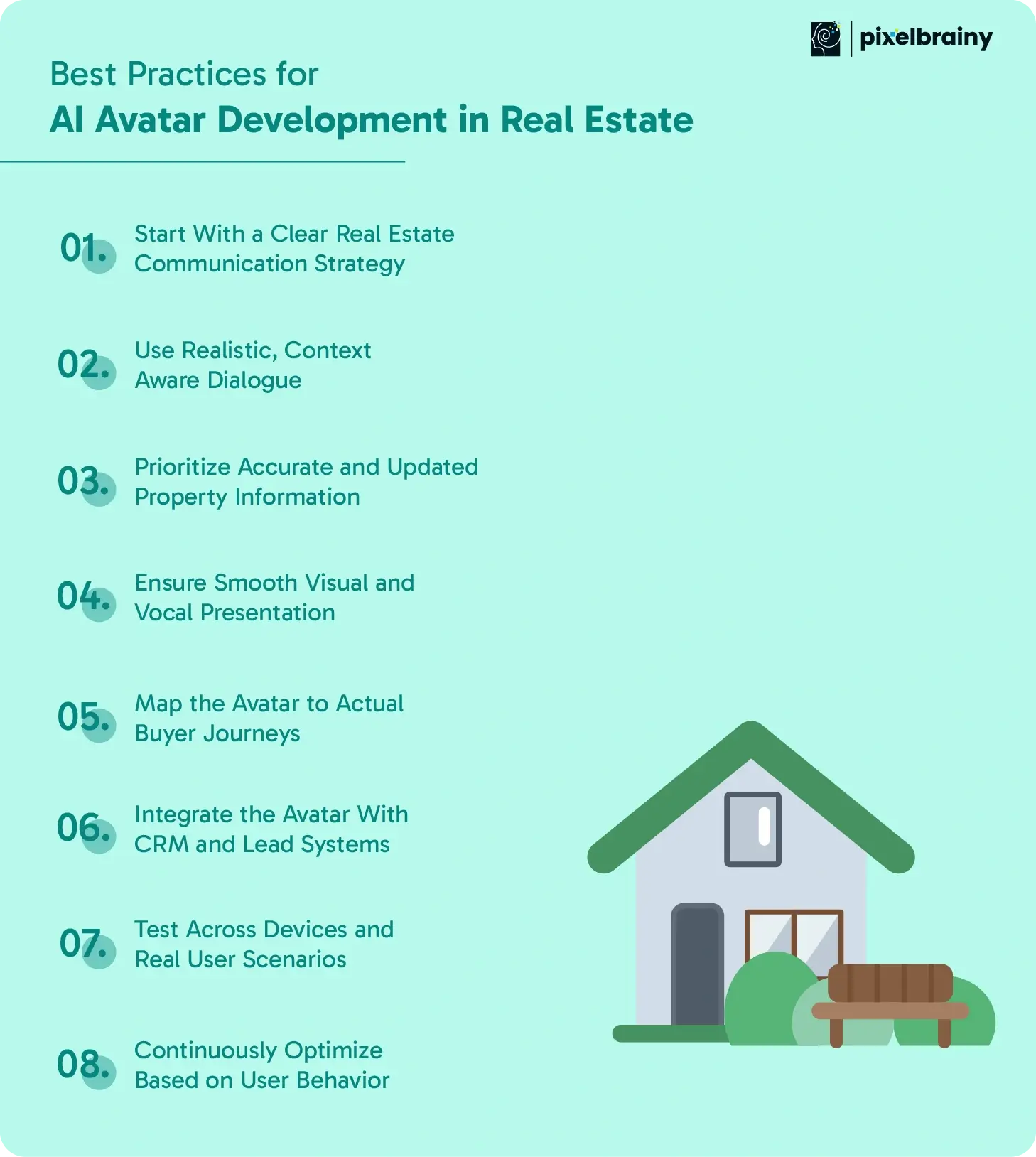
Before development begins, the brand must define how the avatar will communicate with prospects. This includes identifying the tone, target audience and key message themes. Luxury buyers may expect a polished and formal communication style, while rental seekers may prefer a friendly and simple approach. A defined communication strategy ensures the avatar feels aligned with your brand and your audience’s expectations.
The avatar must be trained with scripts and responses that reflect the nuances of real estate communication. This includes understanding project features, pricing structures, timelines, nearby amenities and common buyer concerns. Context aware dialogue allows the avatar to respond intelligently rather than relying on generic or robotic answers.
An AI avatar is only as strong as the data behind it. To maintain trust and credibility, the avatar must rely on accurate pricing, updated unit availability and verified project content. Real estate teams should routinely update the data sources feeding the avatar to prevent outdated or incorrect responses.
Buyers engage more positively when the avatar looks natural and speaks clearly. Investing in high quality animation, expressive gestures and natural voice generation ensures the avatar feels humanlike and relatable. For markets with multilingual buyers, offering multiple language options increases inclusivity and user satisfaction.
The avatar should guide users logically based on where they are in the buying process. A first time visitor may need an overview of available projects, while an investor may want ROI details or rental yields. Mapping the avatar’s responses to real buyer pathways creates a seamless and intuitive experience.
When connected to a CRM, the avatar becomes a valuable sales tool. All interactions should be logged, including user preferences, property interests and follow up triggers. This allows sales teams to review avatar-generated leads and respond meaningfully, improving overall conversions.
Real estate clients use websites, mobile devices, tablets and virtual tour systems. The avatar must perform consistently across all platforms. Testing multiple user scenarios helps identify issues with navigation, responsiveness, voice clarity or interaction flow before launch.
Once the avatar is live, real user interactions reveal new patterns and opportunities for improvement. Regular optimization ensures the avatar stays relevant, learns new responses and adapts to new project updates or market changes. This ongoing refinement keeps the avatar valuable long after deployment.
By following these best practices, real estate companies can develop AI avatars that deliver trustworthy communication, engaging experiences and long term value across every stage of the property journey.

AI avatars are already being used by forward thinking real estate brands, developers and property tech companies to transform how clients explore properties, request information and make purchase decisions.
These real world examples show how digital human technology is becoming a practical tool across residential, commercial and luxury markets.
Several luxury property developers now use photorealistic AI avatars as digital sales hosts for high end residential projects. These avatars appear on project microsites and guide visitors through amenities, location advantages and unit details.
For example, a premium high rise developer in Dubai uses a lifelike avatar to welcome buyers, share project videos and explain floor plans. This helps global investors explore the property without waiting for a human consultant.
Large rental communities and property management firms in the United States use AI avatar assistants to automate leasing inquiries. These avatars handle questions about availability, rent pricing, pet policies, lease duration and property tours.
One rental platform uses an animated avatar as its primary leasing assistant, enabling prospective tenants to get immediate answers, book tours and access community information at any time.
Some real estate listing platforms have started integrating AI avatars that guide users while browsing properties. The avatar recommends listings, explains neighborhood insights and helps filter options based on preferences.
For instance, a major Asian property portal uses a multilingual AI avatar to assist users in English, Chinese and Malay. The avatar improves search efficiency and enhances user engagement across diverse audiences.
Developers promoting off plan or under construction projects often rely on visual storytelling. AI avatars provide consistent, polished presentations that explain project concepts, future infrastructure and master plans.
A real estate brand in Singapore uses a 3D avatar presenter for all project launches, ensuring every potential buyer receives a detailed and clear overview of the upcoming development.
Many agencies now use AI avatars as website concierges who greet visitors, answer initial questions and collect lead information.
One brokerage in Canada uses a friendly avatar on the homepage to help users find listings, understand buying steps and connect with agents. This ensures that every website visitor receives assistance without navigating alone.
Developers attracting global investors use AI avatars that speak multiple languages to present investment opportunities.
A commercial real estate group in Europe uses a multilingual AI avatar to explain ROI projections, tax benefits and long term value in English, Spanish and Arabic. This expands access for international buyers who prefer localized communication.
These real world examples show that AI avatars are already reshaping how real estate companies present properties, guide clients and deliver personalized digital experiences.
Building an AI avatar for real estate can significantly enhance digital engagement, but the development process comes with its own set of challenges. Real estate businesses must understand these obstacles to ensure the avatar performs reliably, communicates accurately and truly supports the buyer journey. Below are the most common challenges along with practical ways to overcome them.
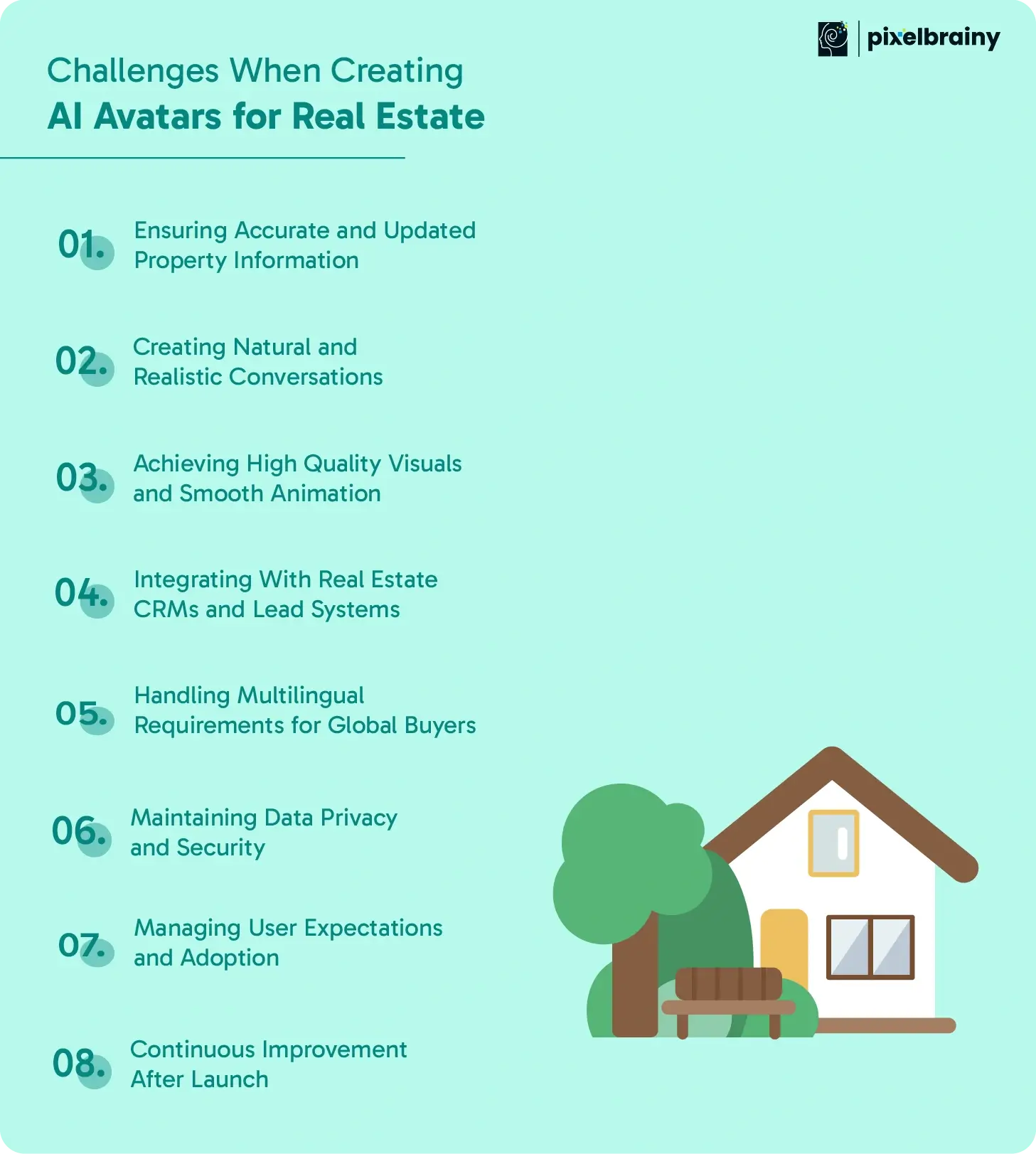
One of the biggest challenges is keeping the avatar informed with the latest property data. Real estate details such as pricing, availability, amenities and deadlines change frequently. If the avatar provides outdated information, it can undermine trust and negatively affect buyer decisions.
How to overcome: Connect the avatar to a live property database or CMS where updates happen automatically. Assign an internal team member to review and verify data feeding the avatar. Consistent syncing ensures the avatar always delivers correct and reliable information.
Real estate conversations are complex. Buyers ask specific questions about location, payment plans, legal terms and construction updates. A generic AI model may struggle to respond accurately or contextually, making interactions feel robotic.
How to overcome: Develop a real estate focused conversational system trained on project FAQs, sales scripts and customer scenarios. Incorporate NLP tuning, scenario based dialogues and intent recognition. This helps the avatar respond naturally and confidently in property related discussions.
Poor animation or unnatural facial movements can make the avatar look unpolished. This affects user trust, especially in luxury or investment focused real estate markets where presentation quality matters.
How to overcome: Use advanced avatar design tools, facial tracking systems and professional grade animation workflows. Test the avatar across devices to ensure smooth performance. Attention to visual detail creates a more lifelike and trustworthy digital presence.
A common challenge is connecting the avatar to CRM platforms such as Salesforce, HubSpot or custom property ERPs. Without proper integration, leads may not be captured or routed to agents promptly.
How to overcome: Use API based integrations or middleware systems that link avatar interactions with CRM workflows. Ensure all conversations, preferences and buyer information automatically sync with your sales teams. This makes the avatar a true part of the sales pipeline.
Real estate companies targeting international investors must offer multilingual communication. However, creating natural conversations across different languages can be technically complex.
How to overcome: Integrate multilingual speech models and region specific vocabulary. Train the avatar using localized scripts and culturally adapted communication styles. This ensures that international buyers receive accurate and fluent assistance in their preferred language.
AI avatars interact with clients, collect inquiries and sometimes handle sensitive information. A lack of secure data handling can expose the business to security risks.
How to overcome: Use encrypted data pipelines, secure connection protocols and privacy compliant systems. Ensure the avatar follows data protection regulations and stores only approved information. Proper governance protects both clients and the real estate brand.
Some users may not immediately trust or understand how to interact with an AI avatar. This can lead to reduced engagement or abandoned conversations.
How to overcome: Use onboarding prompts, tooltips and clear instructions when users first interact with the avatar. Demonstrate its capabilities and guide users through simple questions. As buyers experience its usefulness, adoption increases naturally.
AI avatars need ongoing refinement as new projects launch, client questions evolve and market trends shift. Without continuous updates, the avatar may become outdated.
How to overcome: Implement a monitoring system that tracks user behavior, conversation patterns and common questions. Update scripts, logic and data regularly. This keeps the avatar fresh, intelligent and increasingly valuable over time.
By understanding these challenges and applying the right solutions, real estate companies can develop AI avatars that are accurate, engaging and fully aligned with the expectations of modern buyers.
The future of AI avatar development for real estate is rapidly evolving as property buyers move toward digital-first interactions and virtual decision making. What began as simple on-screen guides is now transforming into a new category of intelligent, immersive and personalized digital agents that will shape the next generation of real estate marketing and sales.
Future AI avatars will be capable of tailoring conversations to each user’s preferences, search behavior and financial profile. Instead of giving the same information to everyone, the avatar will understand buyer intent, lifestyle needs and investment goals, then adjust its presentation automatically. For example, a family buyer may receive detailed school information while an investor may see rental demand analytics. This level of personalization will make digital interactions feel closer to one-to-one human consultations.
As virtual reality and mixed reality technology continues to grow, AI avatars will guide users inside fully immersive environments. Instead of watching a standard video, buyers will walk through properties in VR while the avatar explains layouts, upgrades and design concepts in real time.
This evolution will significantly reduce the need for physical site visits, especially for international buyers.
AI avatars will become more capable of handling complete buyer journeys from introduction to decision support. They will schedule visits, send personalized follow ups, recommend financing options and provide documentation.
Although they will not replace human agents, they will take over the repetitive, information-heavy tasks, allowing sales teams to focus on serious buyers and closing deals.
Future avatars will not only answer questions but will also provide data-driven recommendations. By combining property information with predictive AI, avatars will help buyers understand future appreciation potential, rental yield projections and neighborhood growth patterns.
This transforms the avatar into a knowledge-powered advisor rather than just a digital presenter.
Real estate AI avatars will no longer be limited to websites. They will appear across mobile apps, smart kiosks, virtual tour platforms, digital billboards, WhatsApp and social channels.
Clients will interact with the same avatar from anywhere, maintaining a consistent communication experience across all touchpoints.
Advancements in emotional AI will allow avatars to detect buyer sentiment through speech patterns and interaction behavior. They will adjust tone, pacing and presentation style to create more empathetic and meaningful engagement.
This humanlike responsiveness will be especially valuable in high-stakes real estate conversations.
As developers increasingly target international investors, multilingual AI avatars will support global audiences instantly. Instead of hiring multilingual teams or local agents, companies will rely on avatars that speak multiple languages with native-level fluency.
This will open new markets for developers and simplify cross-border property transactions.
The future of AI avatars in real estate points toward smarter, more immersive and deeply personalized digital agents that will redefine how properties are presented, explored and purchased in the years ahead.
Real estate companies looking to adopt digital human technology need more than a generic AI vendor. They need an AI Avatar Development Company that understands how people explore properties, how developers communicate their project vision and how buyers make decisions online. This is where PixelBrainy stands apart.
PixelBrainy does not simply offer AI avatar development services for real estate. It delivers tailored, high-performance digital agents designed to solve real communication gaps in the property sector. From guiding buyers through pre-sales experiences to supporting investors with multilingual presentations, PixelBrainy builds avatars that strengthen brand credibility and elevate the client journey across every touchpoint.
Many AI providers build generic avatars. PixelBrainy builds avatars that understand the language of real estate. Every project starts with an in-depth understanding of your audience, property categories, pricing models, project stories and sales workflow.
This ensures the avatar speaks confidently about your projects, responds accurately to inquiries and delivers the clarity buyers expect in high-value property interactions.
PixelBrainy creates avatars that reflect who you are as a real estate brand. Whether the goal is to make an AI avatar for real estate businesses targeting luxury buyers or to support large-scale residential projects, each avatar is crafted with custom expressions, voice options, tone and appearance.
Your avatar will not look generic. It will look like your digital representative.
PixelBrainy has extensive experience in real estate AI avatar development, ranging from virtual sales presenters to interactive listing explainers. The team builds avatars capable of handling data-driven conversations, showcasing property features, guiding virtual walkthroughs and supporting early-stage investors.
PixelBrainy ensures that the avatar integrates smoothly into websites, CRM systems, landing pages, virtual tour platforms and digital sales funnels. This allows the avatar to capture leads, log conversations and support sales teams automatically, without disrupting your existing tech ecosystem.
In one confidential project for a luxury developer, PixelBrainy created an AI avatar that acted as a digital pre-sales presenter. The avatar introduced the project vision, explained unit categories and provided location intelligence to global buyers.
The impact was significant: longer virtual tour engagement times, higher-quality inquiries and a measurable improvement in project visibility across international audiences.
PixelBrainy guides you through the full process of creating an AI avatar for real estate, from concept and design to deployment and continuous optimization. The goal is not just to deliver an avatar but to build a long-term digital asset that keeps evolving with your projects.
For real estate brands seeking a high-impact, future-ready AI avatar experience, PixelBrainy delivers the vision, expertise and technology needed to turn digital engagement into measurable business growth.

AI avatars are transforming real estate by making property exploration faster, clearer and more interactive. They help brokers, developers and agencies engage buyers with consistent, accurate and humanlike communication across websites, virtual tours and digital sales funnels. As the industry moves toward digital-first decision making, the ability to build an AI avatar for real estate has become a strategic necessity rather than an optional upgrade. Real estate brands that embrace AI avatar development today gain stronger client trust, higher engagement and a competitive edge in both local and global markets.
With the right approach and a skilled development partner, AI avatars can streamline presentations, support investor communication and elevate every touchpoint of the buyer journey.
Ready to create an AI avatar for your real estate business? Book an appointment with PixelBrainy today.
An AI avatar uses visual presence, voice interaction and humanlike expressions, while a chatbot relies only on text. This makes AI avatars far more engaging for property walkthroughs, presentations and buyer conversations.
Yes. AI avatars can be customized in appearance, tone, voice style and communication behavior, allowing them to reflect your brand identity whether you target luxury buyers, rental seekers or commercial investors.
Absolutely. Property data, pricing, availability and project details change often, so regular updates ensure the avatar provides accurate and credible information to buyers.
Costs vary depending on avatar style, features, languages and integrations. Basic avatars are cost-effective, while advanced photorealistic or multilingual avatars require a higher investment.
Yes. AI avatars can speak multiple languages, guide virtual tours and provide project insights to global buyers who cannot visit sites physically.
Typical development timelines range from 3 to 8 weeks depending on complexity, customization needs, integration requirements and the number of features included.

About The Author
Sagar Bhatnagar
Sagar Sahay Bhatnagar brings over a decade of IT industry experience to his role as Marketing Head at PixelBrainy. He's known for his knack in devising creative marketing strategies that boost brand visibility and market influence. Sagar's strategic thinking, coupled with his innovative vision and focus on results, sets him apart. His track record of successful campaigns proves his ability to utilize digital platforms effectively for impactful marketing efforts. With a genuine passion for both technology and marketing, Sagar continuously pushes PixelBrainy's marketing initiatives to greater success.

Working with the PixelBrainy team has been a highly positive experience. They understand the design requirements and create beautiful UX elements to meet the application needs. The dev team did an excellent job bringing my vision to life. We discussed usability and flow. Sagar worked with his team to design the database and begin coding. Working with Sagar was easy. He has the knowledge to create robust apps, including multi-language support, Google and Apple ID login options, Ad-enabled integrations, Stripe payment processing, and a Web Admin site for maintaining support data. I'm extremely satisfied with the services provided, the quality of the final product, and the professionalism of the entire process. I highly recommend them for Android and iOS Mobile Application Design and Development.

Great experience working with them. Had a lot of feedback and I found that unlike most contractors they were bugging me for updates instead of the other way around. They were extremely time conscience and great at communicating! All work was done extremely high quality and if not on time, early! They were always proactive when it comes to communication and the work is great/above par always. Very flexible and a great team to work with! Goes above and beyond to present us with multiple options and always provides quality. Amazing work per usual with Chitra. If you have UI/UX or branding design needs I recommend you go to them! Will likely work with them in the future as well, definitely recommended!

PixelBrainy is a joy to work with and is a great partner when thinking through branding, logo, and website layout. I appreciate that they spend time going into the "why" behind their decisions to help inform me and others about industry best practices and their expertise.

I hired them to design our software apps. Things I really like about them are excellent communication skills, they answer all project suggestions and collaborate right away, and their input on design and colors is amazing. This project was complex and needed patience and creativity. The team is amazing to do business with. I will be using them long-term. Glad to see there are some good people out there. I was afraid to try and outsource my project to someone but I am glad I met them! I really can't say enough. They went above and beyond on this project. I am very happy with everything they have done to make my business stand out from the competition.

It was great working with PixelBrainy and the team. They were very responsive and really owned the project. We'll definitely work with them again!

I recently worked with the PixelBrainy team on a project and I was blown away by their communication skills. They were prompt, clear, and articulate in all of our interactions. They listened and provided valuable feedback and suggestions to help make the project a success. They also kept me updated throughout the entire process, which made the experience stress-free and enjoyable.

PixelBrainy is very good at what it does. The team also presents themselves very professionally and takes care of their side of things very well. I could fully trust them taking up the design work in a timely and organised manner and their attention to detail saved us lots of effort and time. This particular project was quite intense and the team showed that they function very well under pressure. Very much looking forward to working with her again!

It's always an absolute pleasure working with them. They completed all of my requests quickly and followed every note I had for them to a T, which made our process go smoothly from start to finish. Everything was completed fast and following all of the guidelines. And I would recommend their services to anyone. If you need any design work done in the future, PixelBrainy should be your first call!

They took ownership of our requirements and designed and proposed multiple beautiful variants. The team is self-motivated, requires minimum supervision, committed to see-through designs with quality and delivering them on time. We would definitely love to work with PixelBrainy again when we have any requirements.

PixelBrainy was a big help with our SaaS application. We've been hard at work with a new UI/UX and they provided a lot of help with the designs. If you're looking for assistance with your website, software, or mobile application designs, PixelBrainy and the team is a great recommendation.

PixelBrainy designers are amazing. They are responsive, talented, and always willing to help craft the design until it matches your vision. I would recommend them and plan to continue them for my future projects and more!!!

They were awesome! Did a good job fast, and good communication. Will work with them again. Thank you

Creative, detail-oriented, and talented designers who take direction well and implement changes quickly and accurately. They consistently over-delivered for us.

PixelBrainy team is very talented and creative. Great designers and a pleasure to work with. PixelBrainy is an excellent communicator and I look forward to working with them again.

PixelBrainy has a very talented design team. Their work is excellent and they are very responsive. I enjoy working with them and hope to continue on all of our future projects.


Transform your ideas into reality with us.
Across these industries, each engagement brings unique challenges, from early-stage product development to scaling complex systems, helping us build a practical understanding of real-world product environments.