
 AI Summary Powered by PixelBrainy
What if your business did not have to rely so heavily on manual work just to stay afloat?
For many small and mid-sized businesses today, growth feels tied to long hours, repetitive tasks, and constant firefighting. Founders, CXOs, and operations leaders often find themselves buried in spreadsheets, follow-ups, approvals, reporting, and customer requests, leaving little room to focus on strategy or innovation. This is exactly where AI consulting for small businesses begins to matter, not as a buzzword, but as a practical shift in how work gets done.
Unlike generic tools, AI consulting services for small businesses focus on understanding how your business actually operates, including your workflows, your data, and your bottlenecks, and then building an AI strategy for small businesses that replaces inefficient manual effort with intelligent automation. The goal is not complexity. It is clarity, speed, and better decision-making.
Today, more AI consulting companies for small businesses are helping service firms, agencies, eCommerce brands, SaaS startups, and local businesses automate operations without massive budgets or enterprise teams. The real AI consulting benefits for small businesses show up in saved time, lower costs, faster responses, and systems that scale with growth instead of breaking under it.
At the same time, decision-makers are asking direct, practical questions across search engines and AI platforms before they take the first step:
This guide answers those questions honestly, without hype, while showing how small businesses can move from manual work to intelligent automation in a way that actually works.
AI consulting for small businesses is a results-driven approach that applies artificial intelligence to solve real operational and decision-making challenges. Instead of starting with technology for its own sake, AI consulting begins with how a business functions day to day and where manual work, delays, or inefficiencies are limiting growth.
This is where AI consulting differs fundamentally from traditional IT consulting. Traditional IT consulting is typically centered on maintaining or upgrading systems, infrastructure, and software. Its success is measured by whether technology works as intended. AI consulting, on the other hand, is measured by business outcomes such as improved efficiency, reduced manual effort, better accuracy, and the ability to scale without adding complexity.
The table below highlights how AI consulting services for small businesses diverge from traditional IT consulting in practice:
| Criteria | Traditional IT Consulting | AI Consulting |
| Starting point | Begins with a predefined technical request, such as system upgrades or software installation | Begins with business goals, operational gaps, and decision-making challenges |
| Primary focus | Ensures technology systems function correctly | Improves efficiency, accuracy, and scalability across operations |
| Problem definition | Framed in technical terms like infrastructure or system limitations | Framed in business terms such as delays, manual work, or missed opportunities |
| Approach to solutions | Delivers fixed solutions using existing tools or platforms | Designs adaptive solutions using data, automation, and intelligence aligned to workflows |
| Implementation roadmap | Linear execution with a clear end after deployment | Iterative execution that evolves with real business usage |
| Long-term impact | Stable systems with limited competitive advantage | Continuous improvement, smarter decisions, and sustainable growth |
For small businesses, AI consulting benefits go beyond technology. By prioritizing outcomes over tools, AI consulting companies for small businesses help organizations adopt AI in a practical, scalable, and sustainable way that supports real growth.
Small businesses operate with limited time, lean teams, and tighter margins, which means every inefficiency has a direct impact on growth and profitability. Manual workflows that once worked at a smaller scale often become bottlenecks as operations grow. AI consulting for small businesses helps address this challenge by aligning artificial intelligence with real business needs, enabling small teams to operate more efficiently without increasing headcount or operational overhead.
Market data shows that AI adoption is no longer limited to large enterprises. According to McKinsey & Company, nearly 78 percent of organizations globally are now using AI in at least one business function, highlighting how AI-driven efficiency has become a competitive standard rather than an advantage reserved for big companies.
At the same time, small businesses face growing pressure from rising customer expectations and faster-moving competitors. Gartner predicts that organizations adopting AI-driven process automation will see operational efficiency improvements of up to 30 percent in the coming years, underscoring the importance of structured adoption rather than ad-hoc experimentation.
This is where AI consulting services for small businesses play a critical role. By focusing on outcomes instead of tools, AI consultants help businesses design a clear AI strategy for small businesses, prioritize high-impact use cases, and achieve measurable results. The long-term AI consulting benefits for small businesses include lower costs, faster execution, and scalable operations that are better prepared for future growth.
Small businesses often struggle with operational inefficiencies that develop as they grow. What begins as manageable manual work quickly turns into bottlenecks, delays, and rising costs. With a clear AI strategy for small businesses, supported by AI consulting for small businesses, these challenges can be addressed in a structured and sustainable way.
Through small business AI consulting, these repetitive workflows are identified and automated using AI-driven tools. This helps business leaders understand how to automate small business operations with AI while improving productivity without adding headcount.
AI consulting for small businesses enables the use of intelligent chatbots, automated response systems, and AI-assisted ticket management. These solutions improve response times, ensure consistent communication, and allow human agents to focus on complex customer issues.
With a strong AI strategy for small businesses, consultants help centralize data and apply AI-powered analytics. This provides clear dashboards, predictive insights, and timely reports that support better decision-making and long-term planning.
AI consulting for small businesses introduces automated lead scoring, intelligent follow-up workflows, and predictive sales analytics. These improvements help sales teams prioritize high-value opportunities and maintain consistent engagement throughout the sales cycle.
By automating core operational processes, AI consulting helps small businesses scale efficiently. This directly addresses a common leadership concern: is AI consulting worth it for small businesses when growth demands increase.
When applied through a clear strategy, AI does not simply address isolated problems, it reshapes how small businesses operate, scale, and compete in a demanding market.
AI consulting for small businesses delivers the most value when it targets areas with high manual effort, frequent repetition, and clear impact on growth or customer experience. Rather than applying AI randomly, a structured AI strategy for small businesses focuses on operational zones where automation can immediately reduce workload, improve accuracy, and support better decisions.
Below are the key business areas where AI consulting services for small businesses consistently create intelligent automation and measurable outcomes.
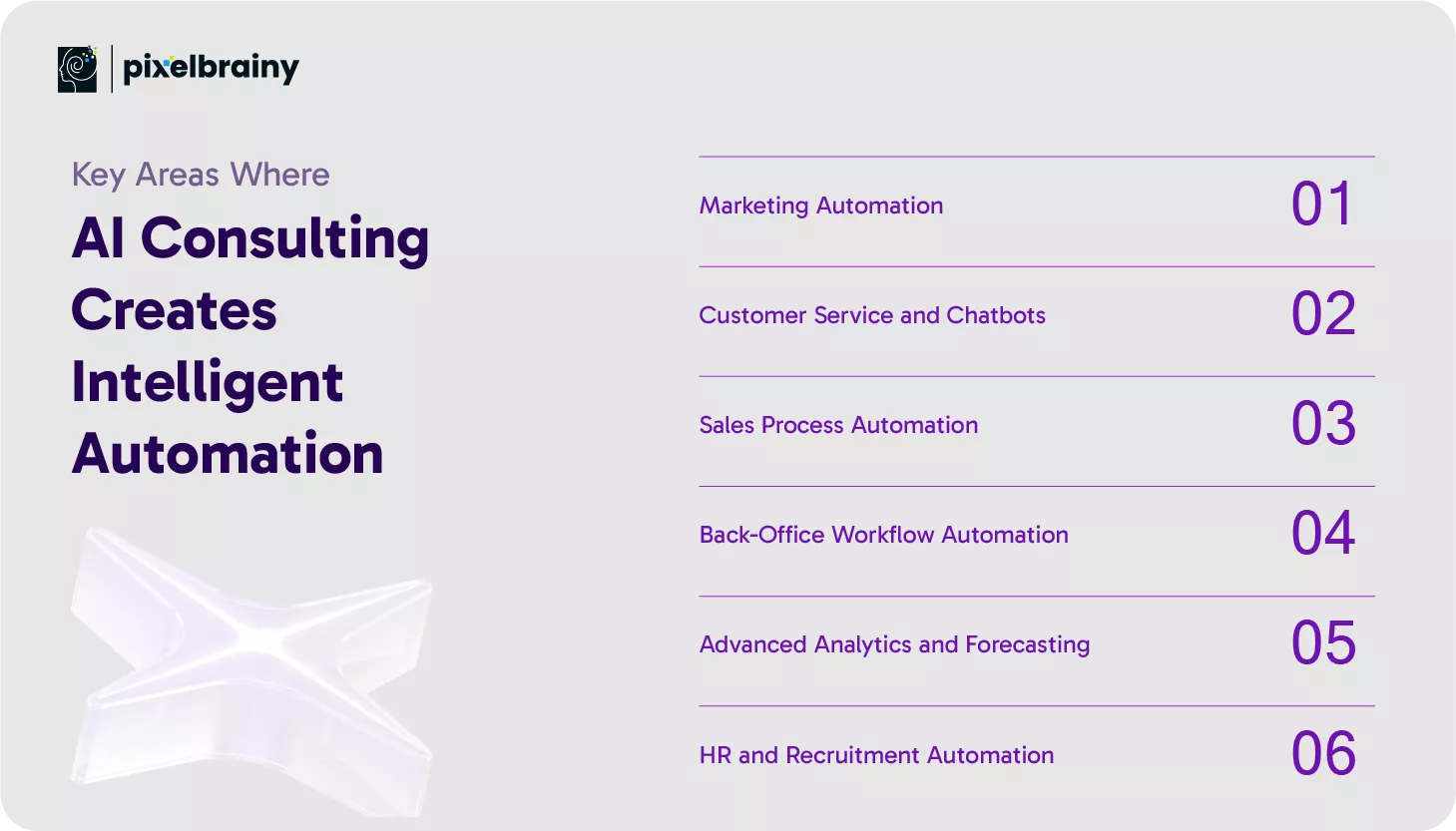
Typical manual tasks: Small businesses often rely on manual campaign planning, email scheduling, content creation, performance tracking, and lead segmentation. Marketing teams spend hours pulling reports, updating CRM records, and responding late to prospects.
AI solution examples: AI consulting companies for small businesses design marketing automation systems that use AI to personalize campaigns, generate content drafts, segment audiences in real time, and optimize email timing based on engagement data. AI-powered tools can also analyze campaign performance and automatically adjust messaging or budgets.
Business impact: Marketing becomes more consistent, data-driven, and scalable. Teams spend less time on repetitive work and more time refining strategy, resulting in higher conversion rates and better ROI without increasing marketing headcount.
Typical manual tasks: Customer service teams manually respond to repetitive questions, route tickets, follow up on unresolved issues, and search internal systems for answers. This leads to slow response times and inconsistent customer experiences.
AI solution examples: Through AI consulting, businesses implement intelligent chatbots, AI-driven ticket routing, and automated response systems trained on company knowledge. These systems handle common inquiries, prioritize urgent cases, and assist agents with suggested responses.
Business impact: Customers receive faster, more consistent support while human agents focus on complex issues. This improves customer satisfaction, reduces support costs, and allows businesses to offer extended support hours without additional staffing.
Typical manual tasks: Sales teams manually qualify leads, send follow-up emails, update CRM records, schedule meetings, and track deal progress. Important opportunities are often lost due to delayed or inconsistent follow-ups.
AI solution examples: AI consulting services for small businesses introduce AI-driven lead scoring, automated follow-up sequences, meeting scheduling assistants, and CRM automation. AI systems analyze customer behavior to prioritize high-intent leads and recommend next actions.
Business impact: Sales cycles become shorter and more predictable. Teams close more deals with less effort, while leadership gains clearer visibility into pipeline health and revenue forecasts.
Typical manual tasks: Administrative teams handle data entry, invoice processing, approvals, document management, and internal reporting manually. These tasks are time-consuming and prone to errors.
AI solution examples: AI consultants automate back-office workflows using intelligent document processing, automated approvals, and system integrations. AI can extract data from documents, validate information, and route tasks automatically across tools.
Business impact: Operations run faster and more accurately. Businesses reduce errors, improve compliance, and free employees from low-value tasks, allowing them to focus on higher-impact work.
Typical manual tasks: Many small businesses rely on spreadsheets and static reports to analyze performance. Forecasting is often based on intuition rather than data, making planning unreliable.
AI solution examples: AI consulting companies for small businesses implement predictive analytics, real-time dashboards, and AI-driven forecasting models. These systems analyze historical and real-time data to predict demand, revenue, and operational risks.
Business impact: Decision-makers gain clearer insights and confidence in planning. Businesses respond faster to market changes, optimize resources, and reduce uncertainty in strategic decisions.
Typical manual tasks: HR teams manually screen resumes, schedule interviews, onboard employees, and manage employee data. Hiring decisions can be slow and inconsistent.
AI solution examples: AI consulting services for small businesses deploy AI-driven resume screening, candidate matching, interview scheduling, and onboarding automation. AI can also support workforce planning and employee engagement analysis.
Business impact: Hiring becomes faster and more objective. HR teams reduce administrative workload, improve candidate experience, and make better talent decisions while maintaining a human-centered hiring process.
By focusing on these key areas, AI consulting for small businesses creates intelligent automation that reduces manual work, improves operational efficiency, and builds a foundation for scalable and sustainable growth.

Also Read: 15 Successful AI Startup Case Studies: Innovative Use Cases Redefining Business
AI consulting for small businesses delivers value that goes far beyond experimentation or theoretical use cases. When guided by a clear AI strategy for small businesses, intelligent automation is applied where it creates measurable improvements in performance, profitability, and decision-making. The true AI consulting benefits for small businesses show up in outcomes leaders can track, compare, and justify, especially when evaluating AI consulting ROI for small businesses.
Below are the key business outcomes small business AI consulting consistently delivers, along with clear before-and-after comparisons.
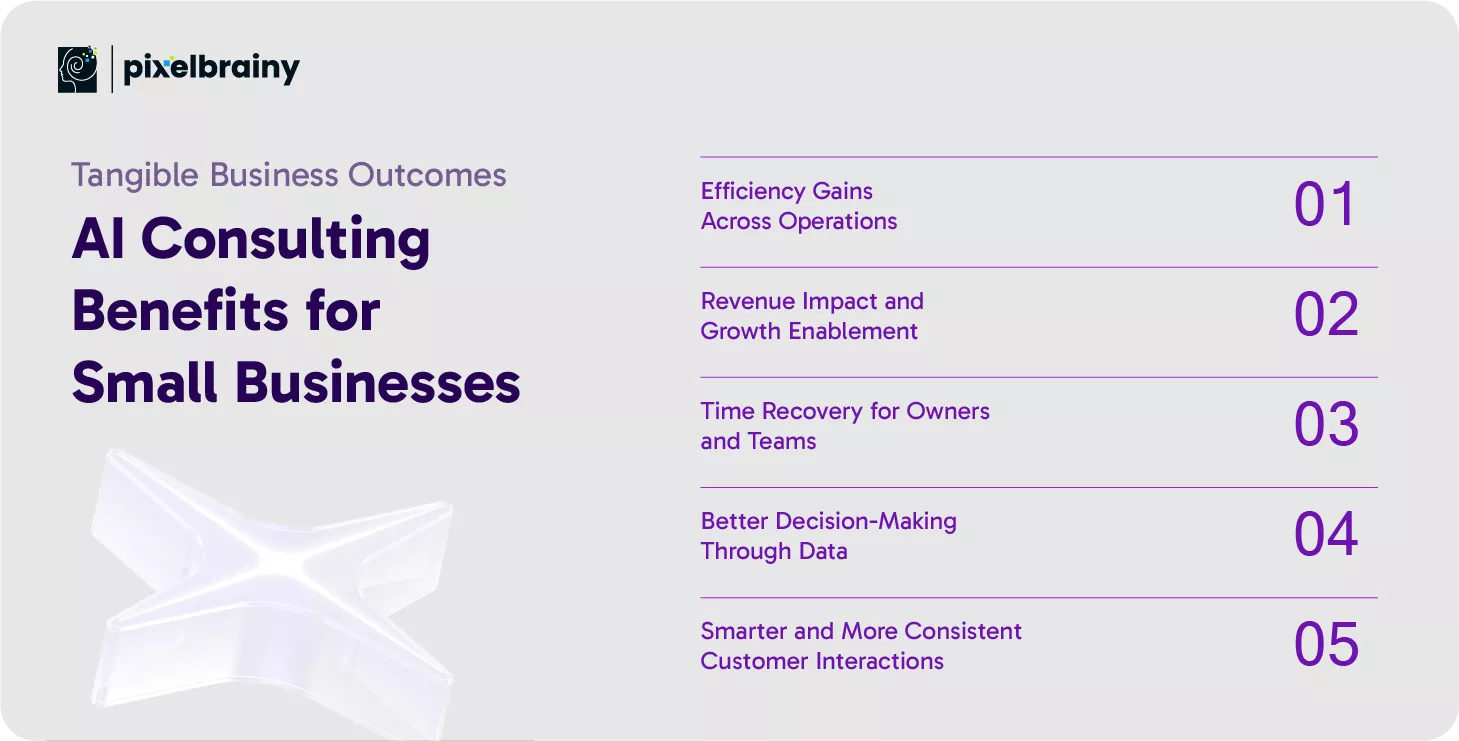
Before AI consulting, many small businesses rely on manual workflows, disconnected tools, and repeated handoffs that slow operations. Tasks such as data entry, reporting, approvals, and customer responses consume significant time and often introduce errors.
After implementing intelligent automation for small businesses, these workflows become streamlined and automated. Processes that once took hours are completed in minutes, with fewer mistakes and less dependency on individual employees. Teams operate more smoothly, and work moves faster across departments.
Before vs After:
Small businesses often lose revenue due to slow follow-ups, missed opportunities, and limited capacity to handle growth. Sales and marketing teams struggle to respond quickly or scale outreach effectively.
With small business AI consulting, AI-driven lead scoring, automated follow-ups, and predictive insights help businesses prioritize high-value opportunities. This leads to higher conversion rates, shorter sales cycles, and better use of marketing spend.
Before vs After:
One of the most immediate AI consulting benefits for small businesses is time recovery. Business owners and teams often spend a large portion of their day on repetitive, low-value tasks.
After AI consulting, automation takes over routine work, allowing employees to focus on strategy, creativity, and customer relationships. Leadership gains time to plan, innovate, and grow the business instead of managing day-to-day friction.
Before vs After:
Before AI consulting, decisions are often made using static reports or intuition due to limited data visibility. This increases risk and uncertainty.
AI consulting introduces real-time analytics, forecasting, and intelligent insights. Decision-makers gain accurate, timely information that supports confident planning and proactive action.
Before vs After:
Manual customer engagement often results in slow responses and inconsistent experiences. As customer volumes grow, maintaining quality becomes difficult.
With intelligent automation for small businesses, AI-driven customer support, personalized messaging, and automated follow-ups ensure faster, more consistent interactions. Customers receive better service while teams maintain quality at scale.
Before vs After:
Together, these outcomes define the real AI consulting ROI for small businesses. When implemented with a clear strategy, AI consulting transforms operations, unlocks growth, and builds long-term competitive advantage without adding complexity or headcount.
For small businesses, AI consulting is most effective when strategy and execution evolve together. Unlike large enterprises that separate planning, development, and deployment into rigid phases, AI consulting for small businesses requires a tightly connected approach. Advisory guidance and hands-on execution happen in parallel, ensuring that recommendations are grounded in real operational constraints.
A well-defined AI consulting roadmap for small businesses helps leaders understand not only what to automate, but why, when, and how. This structured yet flexible process enables intelligent automation for small businesses without disrupting daily operations or overwhelming small teams.
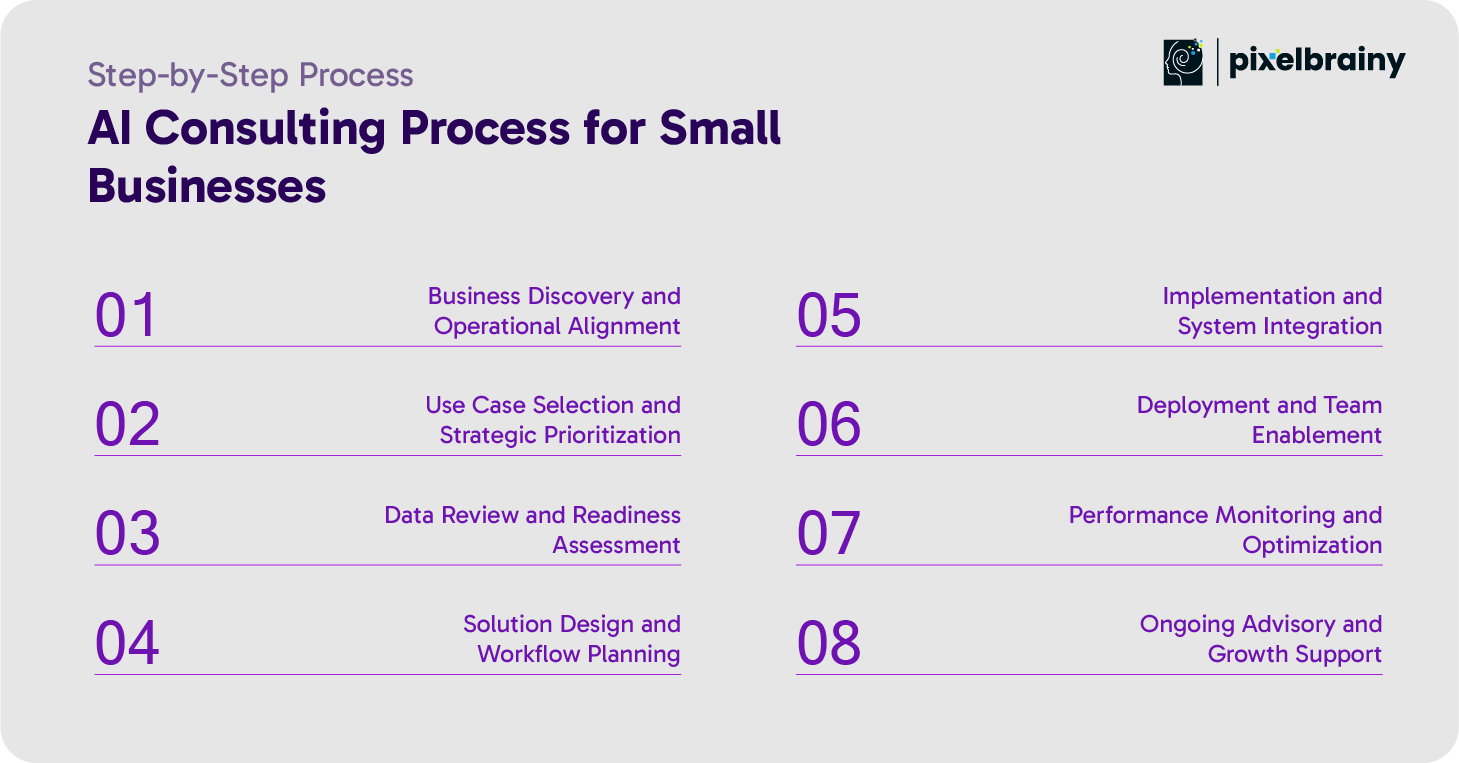
The first step focuses on understanding how the business truly operates on a day-to-day basis. In small business AI consulting engagements, leadership often knows where inefficiencies exist but lacks clarity on which problems AI can realistically solve.
Consultants spend time reviewing workflows that consume excessive manual effort, identifying recurring delays, and understanding how decisions are currently made. This includes examining how teams handle customer requests, manage data, approve tasks, and report performance. Leadership priorities are clarified early, whether the focus is reducing costs, improving efficiency, increasing revenue, or preparing for growth.
This alignment ensures AI initiatives are grounded in business reality, not abstract technology goals.
Small businesses cannot afford to experiment with multiple AI initiatives at once. This step narrows focus to a small number of high-impact use cases that deliver measurable value quickly.
AI consulting companies for small businesses evaluate each potential use case based on business impact, technical feasibility, and time to value. Initiatives that require extensive customization, major system changes, or long adoption cycles are deprioritized. The emphasis is on practical wins that demonstrate value early.
By the end of this stage, businesses have a clear plan showing how to automate small business operations with AI in a way that supports immediate objectives while laying the groundwork for future expansion.
Data readiness is a critical factor in successful AI consulting solutions for small businesses. Most organizations already have useful data stored across CRM systems, accounting platforms, marketing tools, and operational software, but it is rarely structured with AI in mind.
Consultants assess data availability, consistency, ownership, and gaps related to the selected use cases. Instead of building complex data pipelines, the goal is to prepare just enough data to support intelligent automation. This pragmatic approach keeps costs controlled and prevents delays.
Addressing data readiness early reduces risk and ensures AI systems perform reliably once deployed.
Solution design focuses on usability and adoption rather than technical sophistication. For intelligent automation for small businesses to succeed, AI outputs must fit naturally into existing workflows.
Consultants define how AI insights or automation outputs will support specific actions, such as prioritizing leads, routing customer inquiries, or approving invoices. Workflows are designed to complement current tools rather than replace them entirely.
Clear success metrics are established at this stage, tied directly to business outcomes like time saved, error reduction, or improved response times. This ensures the AI solution remains aligned with real operational needs.
Implementation transforms strategy into working systems. AI models, automation logic, and integrations are developed around the prioritized use cases and connected to existing software platforms.
In small business environments, reliability and stability matter more than speed. Solutions are tested using real business data and scenarios to ensure accuracy and consistency. Integration issues are resolved before broader rollout to avoid disruptions to ongoing operations.
This careful approach builds trust and ensures the system performs as expected from day one.
Deployment is introduced gradually to ensure teams are comfortable with new workflows. Small businesses cannot absorb large changes all at once, so AI solutions are rolled out in manageable phases.
Employees are guided on how AI supports their roles by reducing manual work and improving decision-making, not replacing human judgment. Consultants provide practical examples, documentation, and support to encourage adoption and address resistance.
This step is essential for turning AI from a technical system into a trusted operational tool.
For small businesses, success is measured through outcomes rather than technical metrics. After deployment, consultants track performance indicators such as time saved, process speed, accuracy, and cost efficiency.
Usage patterns are analyzed to identify opportunities for refinement. AI models and workflows are adjusted to improve results and adapt to changing business needs. This ongoing optimization ensures intelligent automation continues delivering value over time.
AI consulting for small businesses does not end after initial deployment. As businesses grow and operations evolve, ongoing advisory support helps leaders make informed decisions about expanding, refining, or pausing AI initiatives.
Consultants periodically review performance, assess alignment with business direction, and identify new opportunities that match the company’s maturity. This ensures AI investments remain practical, scalable, and aligned with long-term goals.
This step-by-step execution model reflects how small business AI consulting works in practice, combining strategy, implementation, and continuous improvement to deliver sustainable intelligent automation without unnecessary complexity.
One of the first questions founders and CXOs ask is straightforward: How much does AI consulting cost for small businesses, and is it actually worth the investment? Unlike enterprise-scale AI programs, small business AI consulting is designed to be practical, modular, and cost-controlled. The goal is to deliver measurable value without requiring large upfront commitments.
Most AI consulting companies for small businesses price their services on an hourly, project-based, or phased engagement model. On average, the cost of AI consulting for small businesses typically falls in the range of $50 to $150 per hour, depending on the complexity of the work, industry requirements, and level of customization involved.
Hourly consulting is often used for discovery, strategy, and advisory work. Project-based pricing is common for implementation and automation initiatives, while phased engagements allow businesses to start small and expand as results are proven.
| Engagement Type | Typical Cost Range | Best Use Case |
| Hourly consulting | $50–$150 per hour | Strategy sessions, assessments, roadmap planning |
| Small pilot project | $3,000–$8,000 | Single workflow automation or AI proof of concept |
| Multi-process automation | $8,000–$25,000 | Sales, marketing, or operations automation |
| Ongoing advisory support | $1,000–$4,000 per month | Optimization, scaling, and strategic guidance |
For businesses asking “Is AI consulting affordable for small companies?”, the answer is yes, when the scope is clearly defined and aligned with high-impact outcomes.
The most cost-effective approach is to start with a focused use case rather than a full transformation. Many small businesses achieve strong results by automating one repetitive process, such as lead follow-ups, customer support responses, or internal reporting.
By leveraging existing tools, data, and workflows, AI consultants reduce development effort and avoid unnecessary complexity. This approach minimizes risk and delivers faster returns while building confidence for future initiatives.
When evaluating What is the ROI of AI consulting for small businesses?, leaders should focus on operational impact rather than abstract metrics. ROI often appears in the form of time savings, reduced costs, increased revenue, and improved decision quality.
Common ROI outcomes include:
| Metric | Before AI Consulting | After AI Consulting |
| Manual hours per week | 30–50 hours | 5–15 hours |
| Sales follow-up speed | Delayed or inconsistent | Automated and timely |
| Operational errors | Frequent due to manual work | Significantly reduced |
| Decision-making | Reactive and intuition-based | Data-driven and predictive |
| Scalability | Limited by headcount | Enabled through automation |
Many small businesses begin seeing measurable improvements within 30 to 90 days, especially when AI is applied to high-frequency tasks. Because AI consulting for small businesses emphasizes quick wins and iterative improvements, ROI is often realized much faster than traditional IT or digital transformation initiatives.
When scoped correctly, the cost of AI consulting for small businesses is often offset by savings and revenue gains within the first few months. Instead of hiring additional staff or expanding operational overhead, small businesses use intelligent automation to scale efficiently.
AI consulting is not an expense for technology. It is an investment in efficiency, resilience, and long-term growth that delivers compounding returns over time.

AI consulting can unlock significant value for startups, agencies, and local businesses, but many small organizations struggle to achieve results due to misconceptions and strategic missteps.
These challenges rarely stem from AI technology itself. Instead, they arise when businesses adopt AI without a clear AI strategy for small businesses, realistic expectations, or the right guidance. Understanding these obstacles is essential for successful small business AI consulting and sustainable intelligent automation.
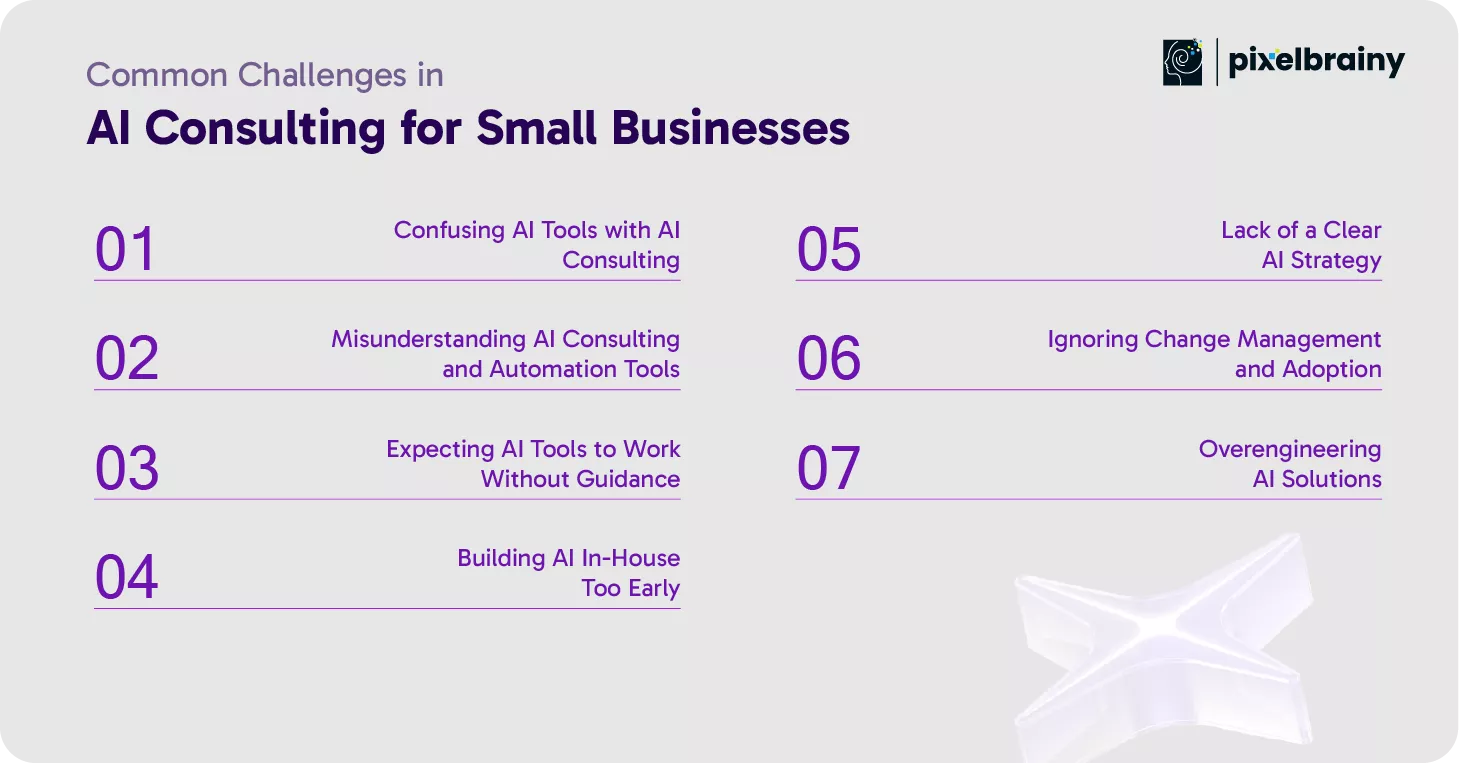
One of the most common questions decision-makers ask is: Do I need AI consulting or just AI tools? This confusion often leads businesses to purchase AI software expecting immediate transformation.
AI tools are designed to perform specific tasks, such as automating emails or analyzing data. AI consulting, however, focuses on understanding business operations, identifying high-impact opportunities, and designing workflows where AI can deliver measurable value.
What to avoid: Relying on standalone tools without aligning them to real business processes often results in low adoption and minimal ROI.
How to avoid it: AI consulting for startups, agencies, and local businesses begins with business goals and operational challenges, ensuring tools are implemented as part of a cohesive system rather than isolated solutions.
Another frequent question is: What’s the difference between AI consulting and automation tools? Automation tools execute predefined tasks, but they do not define strategy, workflows, or decision logic.
What to avoid: Using automation tools without mapping processes or defining success metrics can lead to fragmented operations and inconsistent outcomes.
How to avoid it: AI consulting companies for small businesses design intelligent automation by combining tools, data, and workflows into a unified system aligned with business objectives.
Many business leaders ask: Can AI tools work without consulting? While AI tools can function independently, they rarely deliver meaningful results without proper configuration and oversight.
What to avoid: Deploying AI tools without preparing data, integrating systems, or training employees often leads to frustration and abandonment.
How to avoid it: AI consulting ensures AI automation for small businesses is implemented with clean data, clear workflows, and defined usage guidelines, enabling reliable and consistent outcomes.
A common dilemma is: Should I build AI in-house or hire a consultant? For most small businesses, in-house AI development is expensive, time-consuming, and risky due to limited expertise.
What to avoid: Hiring technical staff or building custom AI solutions before validating use cases and ROI.
How to avoid it: AI consulting helps validate opportunities and prove value quickly, allowing businesses to make informed decisions about internal investment later.
Without a defined AI strategy for small businesses, AI initiatives often become disconnected experiments rather than drivers of growth.
What to avoid: Implementing AI without clear goals tied to efficiency, revenue, or customer experience.
How to avoid it: Small business AI consulting aligns AI initiatives with measurable business outcomes and ensures every automation supports broader strategic objectives.
Small teams often resist AI due to fear of job loss or uncertainty about new workflows.
What to avoid: Rolling out AI solutions without explaining how they support employees and improve daily work.
How to avoid it: Effective AI consulting introduces intelligent automation for small businesses gradually, using training, examples, and support to build trust and adoption.
Small businesses sometimes pursue overly complex AI systems that exceed their operational needs.
What to avoid: Building advanced models or custom platforms when simpler automation would deliver the same value.
How to avoid it: AI solutions for small businesses should focus on simplicity, usability, and fast ROI, scaling only when necessary.
The most common mistakes in AI consulting are strategic, not technical. By understanding the difference between AI tools and consulting, aligning AI initiatives with real business goals, and adopting a phased approach, AI consulting for startups, AI consulting for agencies, and AI consulting for local businesses can achieve intelligent automation that is practical, scalable, and sustainable.
Choosing the right AI consulting partner is a critical step for small businesses planning to adopt intelligent automation. The success of AI consulting for small businesses depends not just on technology, but on the partner’s ability to understand your business, align AI initiatives with goals, and deliver practical, measurable outcomes.
A reliable AI consulting partner focuses on business outcomes before recommending technology. Conversations should center on how AI can improve operations, reduce costs, or support growth.
What to look for:
AI consulting for startups, agencies, and local businesses requires practical experience with lean teams and constrained budgets.
What to look for:
Effective small business AI consulting includes strategy, implementation, and post-launch optimization.
What to look for:
A trustworthy AI consulting partner defines success in measurable business terms.
What to look for:
AI initiatives fail without employee buy-in, especially in small teams.
What to look for:
Small businesses need predictable costs and clear deliverables.
What to look for:
The right AI consulting partner acts as a long-term advisor, not just a technology vendor. By evaluating partners against these criteria, small businesses can confidently choose AI consulting support that delivers real value and long-term growth.
Small businesses rarely struggle with a lack of ideas. They struggle with time, bandwidth, and systems that were never designed to scale. PixelBrainy LLC works with this reality in mind. As an experienced AI consulting company in the USA, the team focuses on helping small businesses move away from manual, fragmented operations and toward intelligent systems that actually support growth.
What makes PixelBrainy different is its emphasis on small business AI consulting, not enterprise-style overengineering. Every engagement starts by understanding how the business runs today, where effort is being wasted, and which improvements will deliver the fastest return. PixelBrainy designs AI solutions for small businesses that integrate with existing tools, fit lean teams, and remain easy to maintain. The result is practical automation that employees trust and leadership can measure.
For business owners looking to hire an AI consultant for small business transformation, PixelBrainy offers both strategic clarity and hands-on execution. The focus remains on real-world outcomes such as reduced manual work, faster response times, improved accuracy, and scalable operations. These are the tangible AI consulting benefits for small businesses that matter when budgets are tight and expectations are high.
Business context: A U.S.-based service company with a small internal team was experiencing rapid growth, but daily operations were becoming increasingly inefficient. Sales follow-ups were inconsistent, customer inquiries were delayed, and leadership relied on manual reports to track performance. Hiring additional staff was not a sustainable option.
Challenges identified:
AI consulting approach: PixelBrainy LLC conducted a focused operational assessment to identify where automation could create immediate impact. Instead of a full system overhaul, the solution centered on intelligent automation layered on top of existing tools. AI-driven workflows were introduced for lead follow-ups, customer inquiry routing, and automated reporting.
Outcomes achieved:
Long-term value: The business established a foundation for scalable growth, with AI systems that could expand alongside operations. Leadership gained confidence in data-driven decisions, while employees were able to focus on higher-value work.
PixelBrainy LLC continues to help small businesses adopt AI in a way that is practical, sustainable, and aligned with real operational needs, making it a trusted AI consulting partner for companies ready to move beyond manual work.

From the discussion above, it is clear that AI consulting for small businesses is no longer about experimenting with new technology. It is about building smarter, more efficient operations that reduce manual work and support sustainable growth. When guided by the right AI strategy for small businesses, intelligent automation helps teams work faster, make better decisions, and scale without increasing complexity or costs.
The real value of small business AI consulting lies in its ability to deliver measurable outcomes, whether that means saving time, improving customer experiences, or increasing operational visibility. With the right partner, AI solutions for small businesses become practical tools that evolve alongside the business, not rigid systems that limit flexibility.
If your business is ready to move from manual processes to intelligent automation, now is the right time to take the next step. Book an appointment with our AI consulting team to discuss how tailored AI solutions can support your business goals and deliver lasting results.
The best starting point is identifying tasks that are repetitive, time-consuming, and prone to human error. Processes such as lead follow-ups, customer inquiries, reporting, and internal approvals usually deliver the fastest results. AI consulting helps small businesses prioritize automation based on impact, feasibility, and ROI rather than guesswork.
Yes. Many small businesses operate with fragmented systems. AI consulting focuses on integrating existing tools and data sources rather than replacing them. The goal is to create intelligent workflows that connect systems and reduce manual handoffs without requiring a complete technology overhaul.
Not necessarily. Well-designed AI solutions are built to fit into current workflows. Most AI consulting engagements introduce automation gradually, allowing teams to adapt while maintaining productivity. The focus is on supporting employees, not forcing disruptive operational changes.
AI consulting is often most valuable for small and early-stage teams because it helps them scale efficiently. By automating routine work early, businesses avoid operational bottlenecks as they grow. Even small teams can benefit from targeted, cost-effective AI implementations.
Many small businesses see measurable improvements within 30 to 90 days, especially when automation targets high-frequency tasks. Faster response times, reduced manual work, and clearer reporting are often the first visible outcomes.
AI consulting does not end at deployment. Ongoing monitoring, optimization, and strategic guidance ensure AI systems continue to deliver value as business needs evolve. This long-term approach helps small businesses grow with confidence and avoid stagnation.

About The Author
Sagar Bhatnagar
Sagar Sahay Bhatnagar brings over a decade of IT industry experience to his role as Marketing Head at PixelBrainy. He's known for his knack in devising creative marketing strategies that boost brand visibility and market influence. Sagar's strategic thinking, coupled with his innovative vision and focus on results, sets him apart. His track record of successful campaigns proves his ability to utilize digital platforms effectively for impactful marketing efforts. With a genuine passion for both technology and marketing, Sagar continuously pushes PixelBrainy's marketing initiatives to greater success.

Transform your ideas into reality with us.
Working with the PixelBrainy team has been a highly positive experience. They understand the design requirements and create beautiful UX elements to meet the application needs. The dev team did an excellent job bringing my vision to life. We discussed usability and flow. Sagar worked with his team to design the database and begin coding. Working with Sagar was easy. He has the knowledge to create robust apps, including multi-language support, Google and Apple ID login options, Ad-enabled integrations, Stripe payment processing, and a Web Admin site for maintaining support data. I'm extremely satisfied with the services provided, the quality of the final product, and the professionalism of the entire process. I highly recommend them for Android and iOS Mobile Application Design and Development.

Great experience working with them. Had a lot of feedback and I found that unlike most contractors they were bugging me for updates instead of the other way around. They were extremely time conscience and great at communicating! All work was done extremely high quality and if not on time, early! They were always proactive when it comes to communication and the work is great/above par always. Very flexible and a great team to work with! Goes above and beyond to present us with multiple options and always provides quality. Amazing work per usual with Chitra. If you have UI/UX or branding design needs I recommend you go to them! Will likely work with them in the future as well, definitely recommended!

PixelBrainy is a joy to work with and is a great partner when thinking through branding, logo, and website layout. I appreciate that they spend time going into the "why" behind their decisions to help inform me and others about industry best practices and their expertise.

I hired them to design our software apps. Things I really like about them are excellent communication skills, they answer all project suggestions and collaborate right away, and their input on design and colors is amazing. This project was complex and needed patience and creativity. The team is amazing to do business with. I will be using them long-term. Glad to see there are some good people out there. I was afraid to try and outsource my project to someone but I am glad I met them! I really can't say enough. They went above and beyond on this project. I am very happy with everything they have done to make my business stand out from the competition.

It was great working with PixelBrainy and the team. They were very responsive and really owned the project. We'll definitely work with them again!

I recently worked with the PixelBrainy team on a project and I was blown away by their communication skills. They were prompt, clear, and articulate in all of our interactions. They listened and provided valuable feedback and suggestions to help make the project a success. They also kept me updated throughout the entire process, which made the experience stress-free and enjoyable.

PixelBrainy is very good at what it does. The team also presents themselves very professionally and takes care of their side of things very well. I could fully trust them taking up the design work in a timely and organised manner and their attention to detail saved us lots of effort and time. This particular project was quite intense and the team showed that they function very well under pressure. Very much looking forward to working with her again!

It's always an absolute pleasure working with them. They completed all of my requests quickly and followed every note I had for them to a T, which made our process go smoothly from start to finish. Everything was completed fast and following all of the guidelines. And I would recommend their services to anyone. If you need any design work done in the future, PixelBrainy should be your first call!

They took ownership of our requirements and designed and proposed multiple beautiful variants. The team is self-motivated, requires minimum supervision, committed to see-through designs with quality and delivering them on time. We would definitely love to work with PixelBrainy again when we have any requirements.

PixelBrainy was a big help with our SaaS application. We've been hard at work with a new UI/UX and they provided a lot of help with the designs. If you're looking for assistance with your website, software, or mobile application designs, PixelBrainy and the team is a great recommendation.

PixelBrainy designers are amazing. They are responsive, talented, and always willing to help craft the design until it matches your vision. I would recommend them and plan to continue them for my future projects and more!!!

They were awesome! Did a good job fast, and good communication. Will work with them again. Thank you

Creative, detail-oriented, and talented designers who take direction well and implement changes quickly and accurately. They consistently over-delivered for us.

PixelBrainy team is very talented and creative. Great designers and a pleasure to work with. PixelBrainy is an excellent communicator and I look forward to working with them again.

PixelBrainy has a very talented design team. Their work is excellent and they are very responsive. I enjoy working with them and hope to continue on all of our future projects.


