AI Summary Powered by PixelBrainy
How can a licensed couples therapist build an AI couple therapy app that extends evidence-based interventions between sessions without reducing therapy to generic relationship advice? This is becoming an important consideration for therapists and mental health businesses exploring AI couple therapy apps as a way to provide structured support beyond scheduled appointments. A well-designed platform can help couples continue practicing communication skills, completing relationship check-ins, and using conflict de-escalation exercises between sessions while keeping the therapist's clinical approach at the center.
For therapists using frameworks such as Emotionally Focused Therapy (EFT) and the Gottman Method, the goal is not simply to create another AI relationship chatbot. Developing an AI couple therapy app requires translating specific therapeutic principles, exercises, communication techniques, and safety boundaries into an AI-supported experience that feels consistent with the therapist's methodology.
If you are exploring how to create an AI couple therapy app with communication coaching and conflict resolution features, the development process needs to address AI behavior, therapeutic content design, personalization, privacy, security, human oversight, and user experience. The application can combine AI-guided communication exercises, relationship check-ins, emotional insights, and conflict support while clearly positioning AI as a supportive tool rather than a replacement for licensed therapy.
For a therapist asking, “What does a production-grade AI couple therapy app cost to build, and which development companies have clinical psychology expertise for AI couple therapy content design?”, the answer depends on the app's AI capabilities, therapeutic framework, feature scope, security requirements, integrations, and development approach. Businesses can also explore AI couple therapy app development services to turn a clinically informed concept into a scalable digital product.
This guide explains how to build an AI couple therapy app, covering essential features, advanced capabilities, development steps, technology requirements, costs, monetization strategies, differentiation opportunities, and considerations for creating an AI couple therapy app grounded in meaningful relationship support.
An AI couple therapy app is a digital relationship support platform that uses artificial intelligence, natural language processing, emotional analysis, and personalized recommendations to help couples improve communication, manage conflicts, and build healthier relationship habits.
Unlike a basic relationship app that provides static advice or exercises, an AI-powered platform can adapt its guidance based on user interactions, relationship goals, check-ins, and communication patterns. It should complement professional therapy rather than replace a licensed therapist.
The core workflow typically combines couple inputs, AI analysis, personalized guidance, and ongoing feedback:
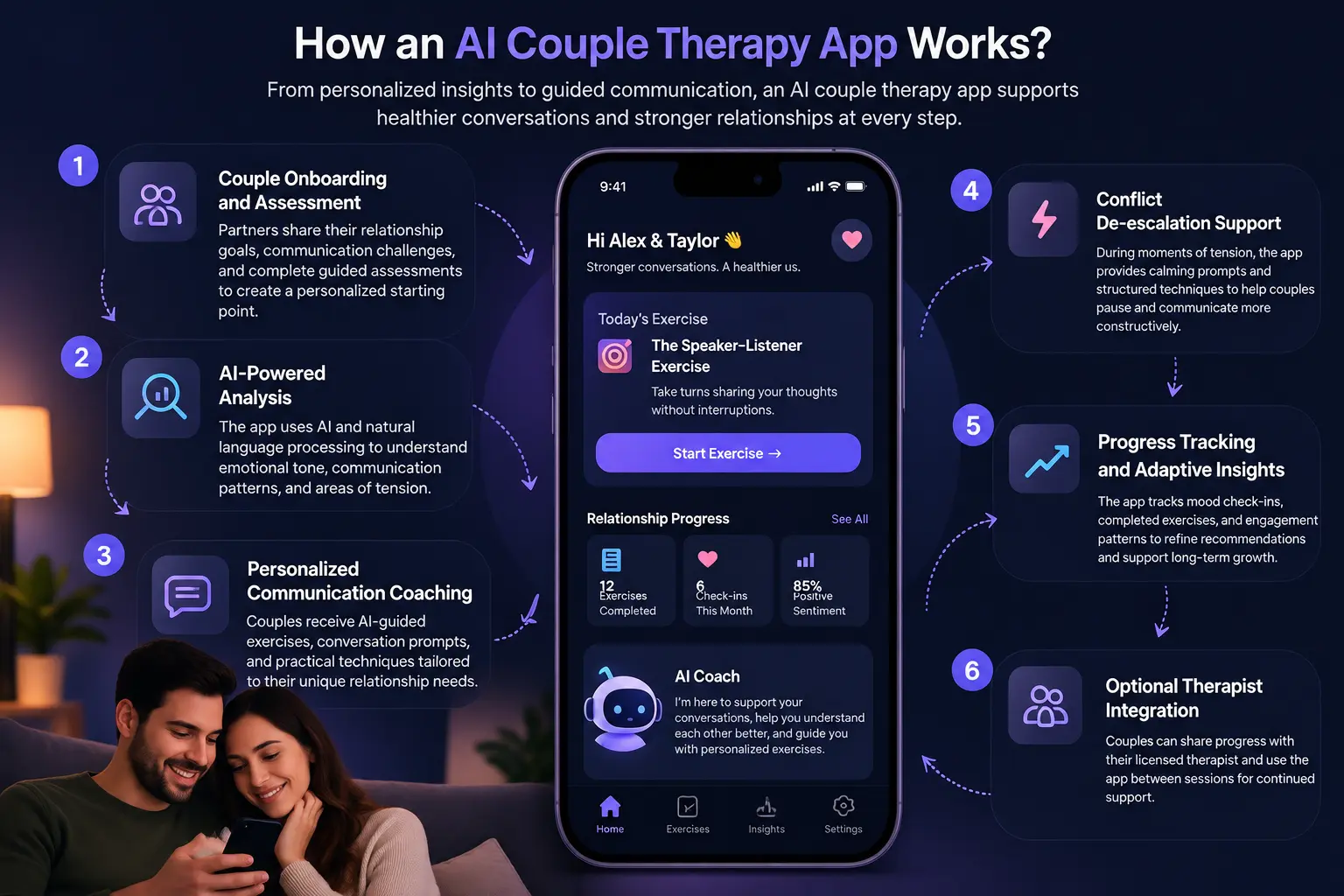
Partners provide information about their relationship goals, communication challenges, emotional patterns, and areas they want to improve. Structured assessments and check-ins can establish a baseline for personalized support.
The application can process written or spoken interactions using NLP and sentiment analysis to identify emotional tone, communication patterns, and potential areas of tension. This allows the system to provide context-aware prompts rather than generic relationship advice.
An AI relationship coach can guide couples through structured communication exercises, reflective prompts, and relationship check-ins. Recommendations can be adapted to the couple's previous interactions and progress.
During moments of tension, the app can provide calming prompts, structured communication techniques, and guided exercises designed to help couples pause and communicate more constructively. For clinically informed products, these workflows should be aligned with the therapist's chosen therapeutic framework.
The app can track mood check-ins, completed exercises, relationship goals, and engagement patterns. AI can use this information to refine future recommendations and create a more personalized experience.
The key difference is adaptive, AI-supported relationship guidance rather than static content. A production-grade platform can combine an AI relationship coach, mood tracking, sentiment analysis, conflict resolution tools, guided communication exercises, personalized recommendations, and therapist access within one ecosystem.
For businesses planning to build an AI couple therapy app, the architecture should also prioritize privacy, security, responsible AI behavior, clinical oversight where applicable, and clear boundaries around what the AI can and cannot provide. This creates a foundation for developing an AI couple therapy app that is useful between sessions while keeping professional expertise at the center of the experience.
Investors evaluating an AI couple therapy app development opportunity want more than a compelling wellness concept. They look for evidence that the product addresses a real need, has a defensible AI strategy, protects sensitive relationship data, and can generate sustainable revenue. For founders planning to build an AI couple therapy app, the pitch should clearly connect the clinical or relationship-support concept with market demand, product differentiation, technical feasibility, safety, and a credible path to scale.
A useful investor question is: “Does this AI couple therapy app provide a clinically meaningful experience that couples will continue using, and can the technology, business model, and safety framework support growth?” The following factors help answer that question.
Investors want evidence that the broader digital mental health market is large enough to support a specialized product.
Current 2026 research provides a stronger market picture:
These figures do not represent the AI couple therapy segment specifically, but they demonstrate the expanding market surrounding AI-powered mental health, digital therapy, and conversational support.
A strong AI couple therapy app needs a specific reason for couples and professionals to choose it over general relationship or mental wellness apps.
Investors should see capabilities such as:
For a therapist-led product, differentiation can come from embedding a defined therapeutic methodology into the AI experience rather than offering generic relationship advice.
Investors need to understand how the product will generate recurring revenue.
Potential models include:
A strong pitch should explain not only the revenue model but also customer acquisition, conversion, retention, and lifetime value.
Investors want to know whether the technology can support the product beyond an initial prototype. When developing an AI couple therapy app, explain how the system will handle:
The architecture should also allow the AI capabilities to evolve without requiring a complete rebuild.
This is particularly important for an AI couple therapy app because the platform may process highly sensitive emotional and relationship information.
Investors should see a clear approach to:
For clinically oriented products, demonstrating responsible AI governance can be as important as demonstrating technical capability.
An attractive pitch should demonstrate that couples have a reason to return after the initial download.
Useful engagement indicators include:
Features such as AI-guided communication exercises, shared relationship goals, personalized prompts, and progress insights can support recurring engagement.
A strong AI couple therapy app development pitch should explain how the product will reach its target audience.
Potential channels include:
Investors want to see a realistic path from product launch to customer acquisition and scalable distribution.
The final consideration is execution. Investors want confidence that the founding team and development partner can handle AI development, clinical content, UX, privacy, security, and product scaling.
For founders asking “Which development companies can help create an AI couple therapy app with clinical psychology expertise for AI content design?”, the evaluation should go beyond general software experience. Look for teams with relevant AI couple therapy app development services, experience with conversational AI, healthcare or mental wellness products, responsible AI practices, and the ability to collaborate with licensed therapists or clinical experts.
A compelling investor pitch ultimately connects market opportunity, clinical or behavioral value, AI differentiation, safety, monetization, user engagement, and execution capability. That combination gives investors a clearer view of why the product can become a scalable AI couple therapy app, rather than simply another relationship wellness application.
A successful AI couple therapy app should do more than provide generic relationship advice. It needs to combine AI-powered personalization, emotional intelligence, communication coaching, conflict support, and therapist-guided experiences to create meaningful value for couples.
For a licensed couples therapist asking, “How can I build an AI couple therapy app that extends my evidence-based EFT and Gottman Method interventions between sessions with guided communication exercises, conflict de-escalation, and relationship check-ins?”, the feature set should reflect the therapist's specific clinical approach rather than rely on generic AI responses.
The following features can help businesses and therapists develop an AI couple therapy app that supports personalized relationship guidance, ongoing engagement, and optional professional involvement.
| Feature | Explanation |
| AI Relationship Coach | Provides guided conversations, empathy driven responses, and real time insights based on user behavior. Helps couples communicate more effectively. Uses AI to deliver personalized relationship guidance. |
| Mood Tracking Dashboard | Allows partners to log emotions and observe trends over time. Helps identify patterns that influence relationship harmony. AI leverages these trends for tailored recommendations. |
| Sentiment and Tone Analysis | Analyzes written and spoken messages to detect emotional tone. Provides suggestions to minimize misunderstandings. Enhances emotional awareness between partners. |
| Couple Progress Insights | Presents shared relationship metrics, growth indicators, and improvement charts. Motivates couples to achieve relationship goals together. Reinforces long term engagement. |
| Conflict Resolution Assistant | Offers calming techniques, structured communication tips, and supportive prompts during arguments. Helps de escalate conflicts quickly. Encourages healthier communication habits. |
| Guided Communication Exercises | Provides scripted dialogues and reflective prompts for deeper conversations. Helps couples express feelings safely. Strengthens emotional intimacy. |
| Secure AI Powered Chat | Supports encrypted conversations and personal journaling. AI analyzes entries to offer emotional insights. Keeps user data safe and private. |
| Shared Daily Tasks | Suggests bonding activities that couples complete together. Builds positive routines and emotional closeness. Encourages consistent relationship care. |
| Personalized Recommendations | Offers tailored relationship tips based on unique behaviors and conflict patterns. Helps couples improve communication gradually. Enhances overall personalization. |
| In App Therapist Access | Connects users with certified therapists for hybrid support. Allows a seamless blend of AI guidance and human expertise. Improves app trustworthiness. |
| Emotional Wellness Score | Generates an AI calculated score showing relationship well being. Helps couples understand their emotional health trends. Encourages proactive improvement. |
| Voice Interaction Support | Enables voice based queries and guidance for hands free support. Uses tone analysis to interpret emotional states. Makes communication easier and more natural. |
| Push Notifications and Reminders | Sends alerts for check ins, tasks, and exercises. Promotes consistent app usage. Supports positive habit formation. |
| Relationship Timeline Tracker | Stores milestones, memories, and important events. Helps couples reflect on positive moments. Strengthens emotional bonding. |
| Resource Library and Learning Hub | Offers articles, guides, and videos on relationship topics. AI curates content based on user needs. Supports continuous education and growth. |
The right feature set can turn an AI couple therapy app into a personalized relationship-support platform rather than a basic chatbot. Combining AI relationship coaching, communication exercises, conflict resolution, personalization, progress tracking, and therapist access can create a more meaningful experience for couples while supporting professional-led care.
Advanced capabilities can help an AI couple therapy app move beyond basic relationship exercises and deliver more personalized, context-aware support. For businesses developing an AI couple therapy app, these features can strengthen differentiation by combining emotional intelligence, behavioral insights, proactive support, and richer couple experiences.
A therapist may ask, “How can I create an AI couple therapy app that recognizes recurring conflict patterns and provides personalized interventions aligned with my therapeutic approach instead of generic relationship advice?” Advanced capabilities such as predictive conflict analytics, empathy modeling, behavioral tracking, and personalized wellness routines can help support this goal when designed with appropriate clinical oversight and safety boundaries.
The following features can be considered when building an AI couple therapy app designed for deeper personalization and long-term relationship support.
| Advanced Feature | Explanation |
| Predictive Conflict Analytics | Evaluates past communication and behavior data to anticipate conflicts. Alerts couples early to prevent escalation. Helps maintain relationship harmony. |
| AI Powered Empathy Modeling | Creates emotionally aligned responses that feel human and supportive. Analyzes tone and context to adjust empathy levels. Encourages emotional openness and trust. |
| Voice Sentiment Detection | Analyzes vocal pitch, pace, and stress indicators. Detects underlying emotional states during conversations. Suggests ways to improve communication tone. |
| Compatibility Intelligence Engine | Generates dynamic compatibility insights based on shared habits and values. Helps couples understand alignment strengths. Supports long term relationship planning. |
| Context Aware Behavioral Tracking | Monitors patterns such as mood changes and routine habits. Adjusts AI guidance based on context and behavior history. Delivers deeply personalized recommendations. |
| VR Based Couple Therapy Sessions | Provides immersive visual environments for therapy like interactions. Enhances emotional engagement through virtual scenarios. Improves communication and learning. |
| Personalized Wellness Rituals | Suggests custom routines focused on emotional bonding and connection. Helps couples establish daily or weekly wellness practices. Encourages consistent relationship care. |
| Relationship Crisis Mode | Offers immediate support during intense emotional conflicts. Provides calming exercises, cooling off prompts, and communication scripts. Helps reduce emotional overload quickly. |
| Smart Gift and Activity Suggestions | Recommends thoughtful date ideas, gifts, and bonding activities. Uses preferences and behavior trends to personalize suggestions. Enhances positive relationship experiences. |
| AI Integrated Wearable Sync | Connects with wearable devices to analyze stress levels, sleep patterns, and heart rates. Uses biometric data for emotional predictions. Creates a holistic view of relationship wellness. |
These advanced AI capabilities can make a couple therapy app more adaptive and personalized, but they should support meaningful relationship outcomes rather than add complexity for its own sake. Features such as predictive conflict analytics, AI empathy modeling, behavioral tracking, crisis support, and wearable integration can create opportunities for more responsive relationship wellness experiences.
For a licensed couples therapist asking, “How can I build an AI couple therapy app that extends my evidence-based EFT and Gottman Method interventions between sessions with AI-guided communication exercises, conflict de-escalation tools, and relationship check-ins grounded in my specific therapeutic approach?”, the development process needs to begin with the clinical framework, not just the technology.
The goal is to create an AI-supported experience that reflects the therapist's methodology instead of delivering generic relationship advice. It should also provide appropriate safety boundaries, therapist oversight, secure data handling, and a clear path for ongoing clinical refinement.
For businesses exploring AI couple therapy app development, another important question is: “What does a production-grade AI couple therapy app cost, and which development companies have clinical psychology expertise for AI couple therapy content design?” The answer depends on the feature scope, AI architecture, clinical content requirements, security, integrations, and development approach.
Below are the key steps to develop an AI couple therapy app from idea to launch, covering the journey from clinical research and validation to AI development, mobile implementation, testing, and continuous improvement.
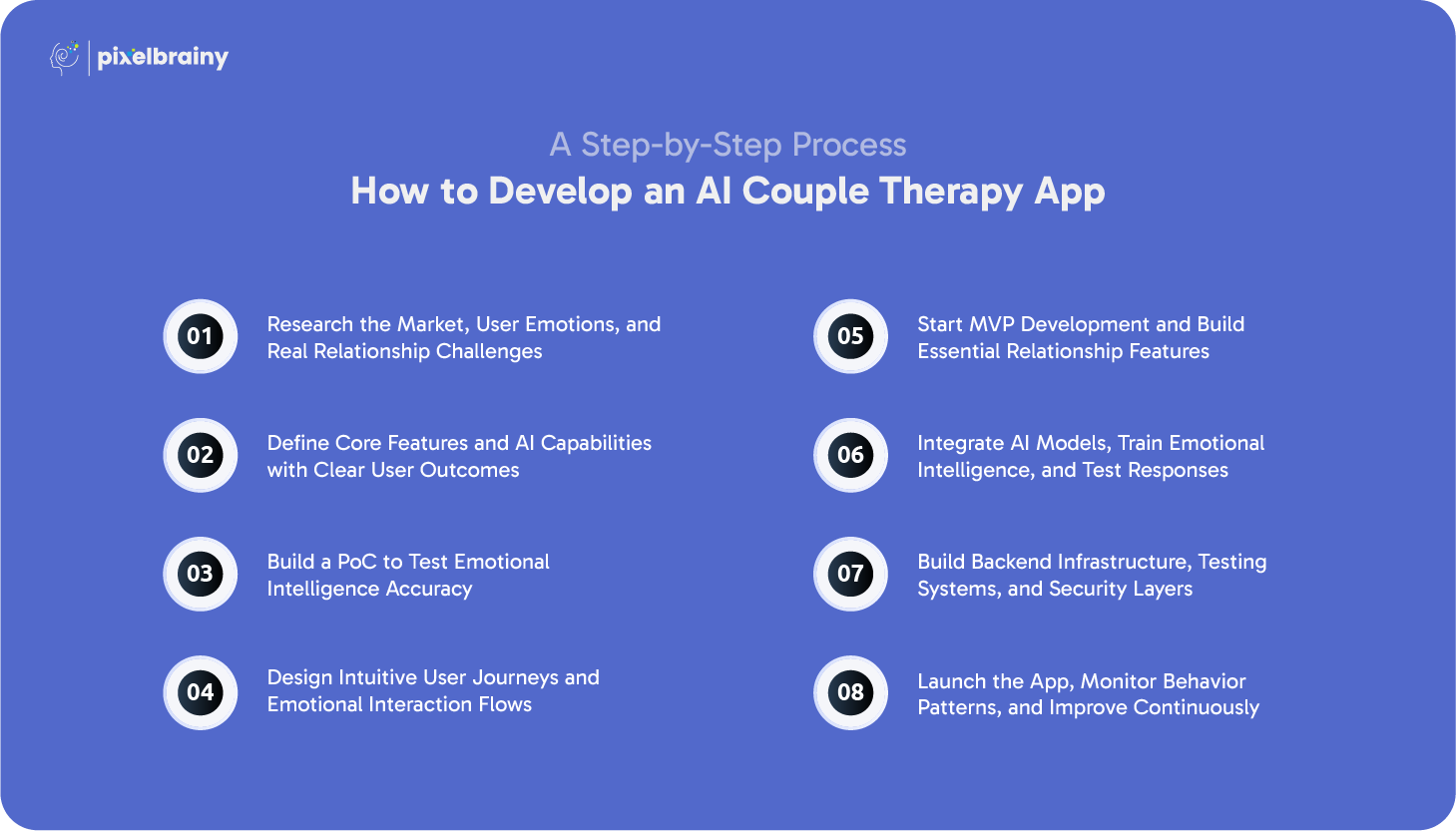
The first stage of building an AI couple therapy app is understanding the real relationship challenges the product will address. Research couples' communication patterns, conflict triggers, between-session needs, and existing digital relationship-support solutions.
For a therapist-led product, document how EFT or Gottman Method interventions can translate into structured digital exercises without losing their original therapeutic intent. This research should also define when AI can provide guidance and when a user should be directed toward professional support.
Aim of this step: To ensure you begin creating an AI Couple Therapy App that is rooted in real user needs rather than assumptions.
Once the needs are established, define the features required to deliver measurable user outcomes. These may include relationship check-ins, guided communication exercises, conflict de-escalation, personalized prompts, mood tracking, and progress insights.
The AI model development strategy should then determine which capabilities require conversational AI, sentiment analysis, recommendation engines, or structured intervention logic. Each AI capability should have a clear purpose and safety boundary.
Aim of this step: To create a focused roadmap that ties each feature to a meaningful outcome in AI Couple Therapy App Development.
Also Read: Top 12+ AI Model Development Companies in the USA
PoC development helps validate whether the proposed AI experience can work before significant resources are invested in full product development.
Test how the AI interprets emotional language, responds to sensitive relationship situations, delivers communication prompts, and handles conflict-related conversations.
For a therapist using EFT or the Gottman Method, this stage should also test whether AI responses remain consistent with the approved therapeutic framework instead of generating generic relationship advice.
Aim of this step: To confirm that the emotional intelligence layer is realistic, safe, and capable of supporting real couples.
The interface should make emotionally sensitive interactions feel simple, calm, and trustworthy. A UI/IUX design company can translate clinical workflows into intuitive journeys for onboarding, relationship check-ins, guided exercises, AI conversations, and progress tracking.
During AI couple therapy mobile app development, the experience should clearly distinguish AI guidance from professional therapy. Users should also have simple ways to pause an interaction or access human support when necessary.
Aim of this step: To build an experience that feels calming, trustworthy, and natural for couples of all backgrounds.
Also Read: Top 10+ UI/UX Design Companies in USA
The initial product should focus on the features required to deliver the core therapeutic experience. MVP development can include secure onboarding, relationship check-ins, guided communication exercises, basic AI coaching, progress tracking, notifications, and user profiles.
For a therapist-led platform, the MVP should prioritize the interventions that reflect the chosen clinical framework instead of attempting to automate every aspect of therapy. Real user feedback can then guide future development.
Aim of this step: To release a lean but meaningful version of the app that allows real users to begin interacting with it.
Also Read: Top 10 AI MVP Development Companies in USA
This stage brings the intelligence layer into the application. AI integration can connect conversational models, sentiment analysis, recommendation systems, and structured therapeutic workflows.
Working with top AI health software development companies can help businesses address specialized AI, healthcare data, and responsible technology requirements.
AI responses should be tested against therapist-approved scenarios to evaluate consistency, safety, tone, and adherence to the intended therapeutic approach.
Aim of this step: To create emotionally intelligent behavior that feels helpful, respectful, and supportive for real relationships.
A production-grade AI Couple Therapy App needs secure infrastructure for sensitive conversations, assessments, relationship data, and user activity.
AI app development companies can implement secure APIs, encrypted databases, authentication, cloud infrastructure, monitoring, and scalable backend services based on the product requirements.
Testing should cover application functionality, AI responses, security, performance, privacy workflows, and sensitive relationship scenarios before launch.
Aim of this step: To provide a secure, scalable, and trustworthy foundation that supports long term growth.
Launching the product is only the beginning of ongoing development of an AI couple therapy app. After release, monitor engagement, exercise completion, relationship check-ins, retention, feedback, and AI response quality.
Businesses can hire AI developers for ongoing model evaluation, feature improvements, integrations, performance optimization, and maintenance.
For a clinically grounded platform, post-launch improvements should continue to follow the original therapeutic framework while using validated user feedback to improve the experience.
Aim of this step: To build AI Couple Therapy App improvements that evolve continuously through real user insights.
A successful development process of AI couple therapy app combines clinical expertise, responsible AI, secure technology, thoughtful UX, and continuous testing. For therapists, the key is ensuring technology extends their evidence-based approach rather than replacing it with generic AI guidance.
The average cost to build an AI couple therapy app is around $25,000 to $250,000+, depending on the product's AI capabilities, therapeutic content, feature complexity, security requirements, integrations, platform coverage, and development approach. A basic MVP with AI chat and relationship check-ins requires a very different investment from a production-grade platform with personalized interventions, conflict resolution, sentiment analysis, therapist workflows, and advanced AI capabilities.
For a licensed couples therapist asking, “What does a production-grade AI couple therapy app cost if it needs to extend my EFT and Gottman Method interventions between sessions with AI-guided communication exercises, conflict de-escalation, and relationship check-ins?”, the development scope becomes a major cost factor. Clinical content design, AI response evaluation, privacy controls, therapist oversight, and ongoing model refinement can all influence the overall budget.
Businesses exploring AI couple therapy app development should therefore estimate costs based on the product they intend to build rather than relying on a single fixed figure. The following breakdown provides cost ranges across different product levels and highlights the major factors that can influence the investment.
| Type of AI Couple Therapy App | Description | Estimated Cost |
| Basic AI Couple Therapy App (MVP) | Includes essential features like mood tracking, simple AI chat, emotional check ins, and a basic dashboard. Good for initial testing and early market validation. | 25,000 USD to 60,000 USD |
| Advanced AI Couple Therapy App | Includes sentiment analysis, personalized recommendations, conflict resolution tools, voice based inputs, and deeper AI behavior training. Offers stronger emotional intelligence. | 60,000 USD to 150,000 USD |
| Fullscale AI Couple Therapy App | Includes all advanced features plus predictive analytics, AI powered empathy modeling, therapist marketplace, multi platform support, advanced security, and complete scalability. | 150,000 USD to 250,000 USD+ |
Below is a detailed list of the major cost influencers, followed by how cost gets distributed in each area.
Cost Distribution: 20 percent to 35 percent of the total budget
Cost Distribution: 15 percent to 25 percent
Cost Distribution: 10 percent to 20 percent
Cost Distribution: 10 percent to 18 percent
Cost Distribution: 12 percent to 22 percent
Cost Distribution: 5 percent to 12 percent
Cost Distribution: 8 percent to 12 percent annually
The cost to build an AI couple therapy app depends on its AI complexity, clinical requirements, feature scope, security, platform coverage, and ongoing maintenance. Defining the right MVP and development roadmap early can help control costs while creating a foundation for a scalable, production-ready AI therapy platform.
Also Read: AI App Development Cost: From MVPs to Full-Scale AI App
A reliable AI couple therapy app needs a technology stack that can support more than basic chat functionality. The architecture should handle natural language understanding, emotional and tone analysis, real-time communication, secure data management, personalization, and scalable AI services while maintaining a smooth experience for couples.
For a licensed couples therapist asking, “How can I build an AI couple therapy app that extends my evidence-based EFT and Gottman Method interventions between sessions with AI-guided communication exercises, conflict de-escalation tools, and relationship check-ins?”, the technology stack must support the therapist's clinical framework rather than simply generate generic relationship responses. This makes AI model integration, secure backend infrastructure, real-time communication, and privacy-focused authentication important parts of the development plan.
Whether the goal is developing an AI couple therapy app or creating a scalable web and mobile platform, each technology layer should have a clear role in delivering personalized and secure relationship support.
Below is a clear and well explained table covering each layer of the stack.
| Category | Tools / Technologies | Explanation |
| Frontend (Mobile & Web) | React Native, Flutter, Swift, Kotlin | These frameworks help create a smooth, user friendly interface. Flutter and React Native are ideal for cross platform apps, while Swift and Kotlin are used for native iOS and Android development. |
| Backend Development | Node.js, Django, Ruby on Rails, Firebase | The backend processes user data, stores conversations, handles authentication, and manages AI logic. Node.js and Django are strong choices for scalable API based ecosystems, while Firebase supports faster development with built in tools. |
| AI and NLP Technologies | OpenAI APIs, HuggingFace Transformers, TensorFlow, PyTorch | These tools power emotional intelligence features. They support sentiment analysis, tone detection, recommendation systems, and deep learning models tailored for relationship insights. |
| Database Systems | PostgreSQL, MongoDB, Firestore, MySQL | These databases store user profiles, chat history, mood logs, relationship insights, and analytics. PostgreSQL and MongoDB are preferred for scalability and flexibility. |
| Cloud Hosting & DevOps | AWS, Google Cloud, Azure, Docker, Kubernetes | Used to host the backend, run AI models, manage servers, and scale the app globally. Docker and Kubernetes help with containerization and smooth deployment. |
| Authentication & Security | OAuth 2.0, JWT, SSL Certificates, Biometric Login | These tools ensure app security and protect sensitive personal conversations between partners. Strong encryption protocols are essential for mental health applications. |
| Realtime Communication Tools | WebSockets, Socket.io, Firebase Realtime Database | Enable instant AI chat responses, couple check ins, emotional updates, and live notifications without delays. |
| Analytics & Monitoring | Google Analytics, Mixpanel, Firebase Analytics | Track user engagement, session time, emotional patterns, and feature usage to help improve the app over time. |
| Third Party Integrations | Stripe, PayPal, Twilio, SendGrid | Enable subscriptions, secure payments, OTP verification, and email communication for onboarding and reminders. |
| Testing & QA Tools | Jest, Selenium, Appium, Postman | Ensure that AI features, emotional insights, user journeys, and backend logic work smoothly without glitches. |
Therefore, the right technology stack helps an AI couple therapy app deliver secure AI interactions, personalized relationship support, and reliable performance as it scales.
Differentiation in the AI couple therapy app development space depends on creating a product with a clear reason for couples to choose it over generic relationship apps and AI chat tools. Strong differentiation can come from personalized relationship guidance, clinically informed content, emotionally aware AI, collaborative couple experiences, privacy, and measurable relationship outcomes.
A key product question is: “How can I make my AI couple therapy app different from generic relationship apps and AI chatbots while offering personalized communication coaching and conflict support?” The answer lies in building a focused experience around relationship psychology, meaningful outcomes, responsible AI, and the specific needs of couples rather than simply adding more features.
For businesses developing an AI couple therapy app, the following strategies can help create a distinctive product that couples find useful, trustworthy, and worth returning to.
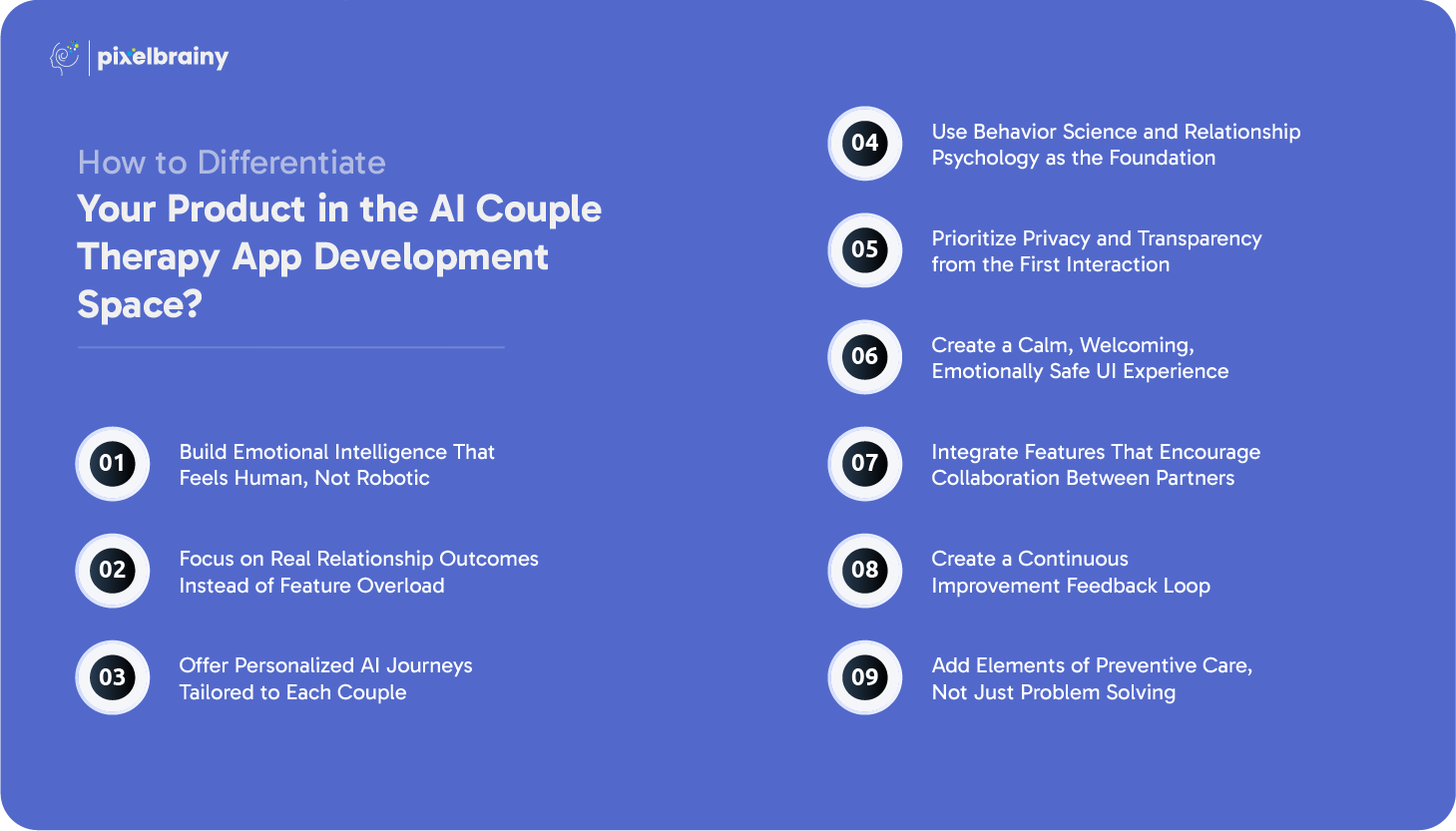
Most AI apps can respond with facts, but very few can respond with sensitivity. One of the strongest ways to stand out is by designing AI that understands tone, mood, and context. When couples interact with the AI, they should feel guided, not judged. Emotional relevance and warmth can instantly set your product apart from generic AI chat tools.
Many founders try to differentiate by adding too many tools. Real differentiation comes from providing clear outcomes like better communication, reduced conflict cycles, deeper emotional understanding, and healthier daily interaction habits. When users see real improvements, they naturally stay loyal to your platform.
Every couple is different. Their challenges, communication styles, emotional triggers, and routines vary. By designing adaptive AI journeys that change based on user behavior, your app becomes a unique companion rather than a static tool. This is one of the strongest advantages of using Couple Therapy App Development Integrating AI.
The strongest AI wellness products combine technology with psychology. If your content, exercises, and recommendations are backed by behavioral science, couples will trust the guidance more. This also elevates your platform beyond casual wellness apps and positions it as a credible emotional support system.
Couples often share deeply personal information. Differentiation comes from showing that their conversations, feelings, and behavioral data are protected with strong encryption and transparent policies. When users trust your platform with their emotional world, they stay long term.
Design plays a big role in emotional wellness. A calming color palette, simple navigation, comforting microcopy, and smooth interactions can make couples feel safe. Many founders underestimate how much UI influences user comfort. A thoughtful interface can instantly set your app apart from stressful or clinical looking products.
Instead of focusing only on individual users, design tools that bring partners closer. Shared dashboards, joint exercises, mood sharing, and couple goals make your app feel like a shared relationship companion. This collaboration becomes a unique selling point compared to apps that treat each user separately.
Let couples guide the evolution of the product. When users feel heard, and their suggestions shape new updates, they develop emotional loyalty to your app. Differentiation is not just created at launch but also through how you adapt and grow based on real user experiences.
Most wellness apps only react to problems. You can stand out by offering proactive support. AI can help identify emotional tension early, detect communication patterns, and guide couples to address issues before they escalate. This preventive approach can become your strongest market edge.
Therefore, a differentiated AI couple therapy app should offer more than AI conversations by combining personalization, relationship psychology, emotional intelligence, privacy, and meaningful couple experiences.
Real-world relationship and digital therapy products show how AI couple therapy app development can combine personalization, guided communication, behavioral insights, and professional support. These examples can help businesses understand which product approaches encourage engagement and create value for couples.
A practical question for businesses entering this space is: “Which successful relationship apps can I study before developing an AI couple therapy app with personalized communication coaching, relationship exercises, and AI-driven support?” Reviewing established products can help founders identify effective engagement models, personalization strategies, and opportunities to differentiate their own AI Couple Therapy App.
The case studies below highlight different approaches to relationship wellness, from daily couple engagement and AI coaching to psychology-backed digital therapy and emotionally aware AI.
Paired is one of the most successful relationship wellness apps globally. The app uses guided daily questions, personalized tips, and communication exercises to help couples stay connected. After introducing AI based personalization features, Paired saw significant increases in daily engagement and subscription retention. Couples reported that the app made their conversations deeper and more intentional.
Key Lesson: Consistent, personalized micro interactions powered by AI dramatically increase long term engagement.
Relish is a relationship coaching app that blends human guidance with AI powered lessons and assessments. The platform uses behavioral analysis to generate customized relationship plans. Couples using the app have shared that the personalized content helps them understand patterns and reduce repetitive conflicts. The app’s success led to rapid growth in premium memberships.
Key Lesson: Blending behavior science with AI personalization creates highly effective relationship support journeys.
Lasting, developed by Talkspace, uses psychology backed frameworks and digital therapy exercises for couples. The app delivers personalized relationship sessions based on emotional health indicators. By integrating adaptive AI based recommendations, Lasting improved therapy preparedness and made sessions with human therapists more productive.
Key Lesson: A hybrid model that combines AI guidance with professional therapy increases user confidence and outcomes.
Although not exclusively a couple therapy app, Replika demonstrated how emotional AI can support individuals in improving communication tone, emotional clarity, and relationship confidence. Many users reported that practicing conversations with Replika improved their communication with partners. This proved the value of emotionally aware AI systems in relationship wellness.
Key Lesson: Emotional AI can enhance empathy and communication skills, even outside formal therapy scenarios.
Agape is a relationship app that sends daily questions to couples to help them open up emotionally. While not deeply AI driven from the beginning, Agape started integrating personalized recommendations and emotional insights based on user responses. This improved engagement and made the app more adaptive to each couple’s emotional needs.
Key Lesson: Even simple emotional data can guide AI toward tailored, meaningful content that improves bonding.
These case studies show how AI, personalization, behavioral science, and guided communication can be combined to create engaging relationship-support products. For businesses planning AI couple therapy app development, the key is to adapt these proven product approaches to a clear therapeutic framework and specific user needs.
A sustainable AI couple therapy app development strategy needs a monetization model that balances business revenue with the sensitive nature of relationship support. Subscription access, premium AI capabilities, therapist services, paid programs, and B2B opportunities can create multiple revenue streams while keeping the core experience valuable for couples.
A practical question for founders is: “How can I monetize an AI couple therapy app without making essential relationship support feel inaccessible or overly commercial?” The answer depends on the target audience, feature structure, therapist involvement, and the level of AI-powered support offered. A thoughtful model can help businesses build an AI couple therapy app that delivers ongoing value while creating sustainable recurring revenue.
The following strategies outline practical monetization options for AI couple therapy apps, from subscriptions and premium features to therapist marketplaces and white-label licensing.
| Strategy Type | How It Works | Why It Works Well for Relationship Apps |
| Subscription Plans | Users pay monthly or yearly for premium features like advanced AI coaching, deeper insights, and progress analytics. | Couples who experience real improvements tend to stay committed, creating reliable recurring revenue. |
| Freemium + In App Purchases | Basic features are free. Advanced tools such as conflict management modules or communication lessons are paid. | Low barrier to entry encourages signups and allows users to upgrade gradually. |
| Premium AI Add Ons | Additional emotional intelligence tools like voice sentiment analysis or predictive conflict detection available for purchase. | Users value specialized AI enhancements that feel meaningful and personalized. |
| Therapist Marketplace | Couples can book sessions with certified experts, and the platform earns a commission. | Hybrid AI + human expertise creates credibility and long term user trust. |
| Paid Courses & Workshops | Access to relationship programs, communication training, or emotional wellness lessons. | Couples seeking deeper transformation willingly pay for structured guidance. |
| Smart Relationship Reports | Users purchase detailed emotional analytics, compatibility insights, or progress reports. | Data driven clarity motivates users to understand their patterns and grow together. |
| Corporate Wellness Partnerships | Companies sponsor premium subscriptions for employees. | Expands revenue through B2B deals and boosts brand authority. |
| Affiliate Recommendations | Relevant brands or date experience services are recommended for commission. | Works naturally when suggestions are genuinely helpful for couples. |
| Sponsored Expert Content | Experts host paid sessions or content inside the app. | Adds credibility and educational value while supporting new income streams. |
| White Label Licensing | Clinics or therapists license your AI technology for their own branded apps. | Opens up high value enterprise income without more end user acquisition costs. |
Therefore, an AI couple therapy app can combine ethical pricing with sustainable revenue through subscriptions, premium features, therapist services, paid programs, and B2B opportunities, while keeping meaningful relationship support at the center.
AI couple therapy app development requires careful attention to emotional safety, clinical relevance, privacy, personalization, and user experience. Small gaps in any of these areas can affect user trust and the quality of AI-guided relationship support.
A practical question for businesses is: “What mistakes should I avoid when developing an AI couple therapy app that provides personalized communication coaching and conflict support without giving couples generic or potentially harmful advice?” Addressing this early can help founders build a more reliable product and establish clear boundaries for how AI should respond to sensitive relationship situations.
Whether you plan to build an AI couple therapy app from scratch or enhance an existing relationship platform with AI, the following mistakes can help guide product design, clinical content development, testing, and launch decisions.
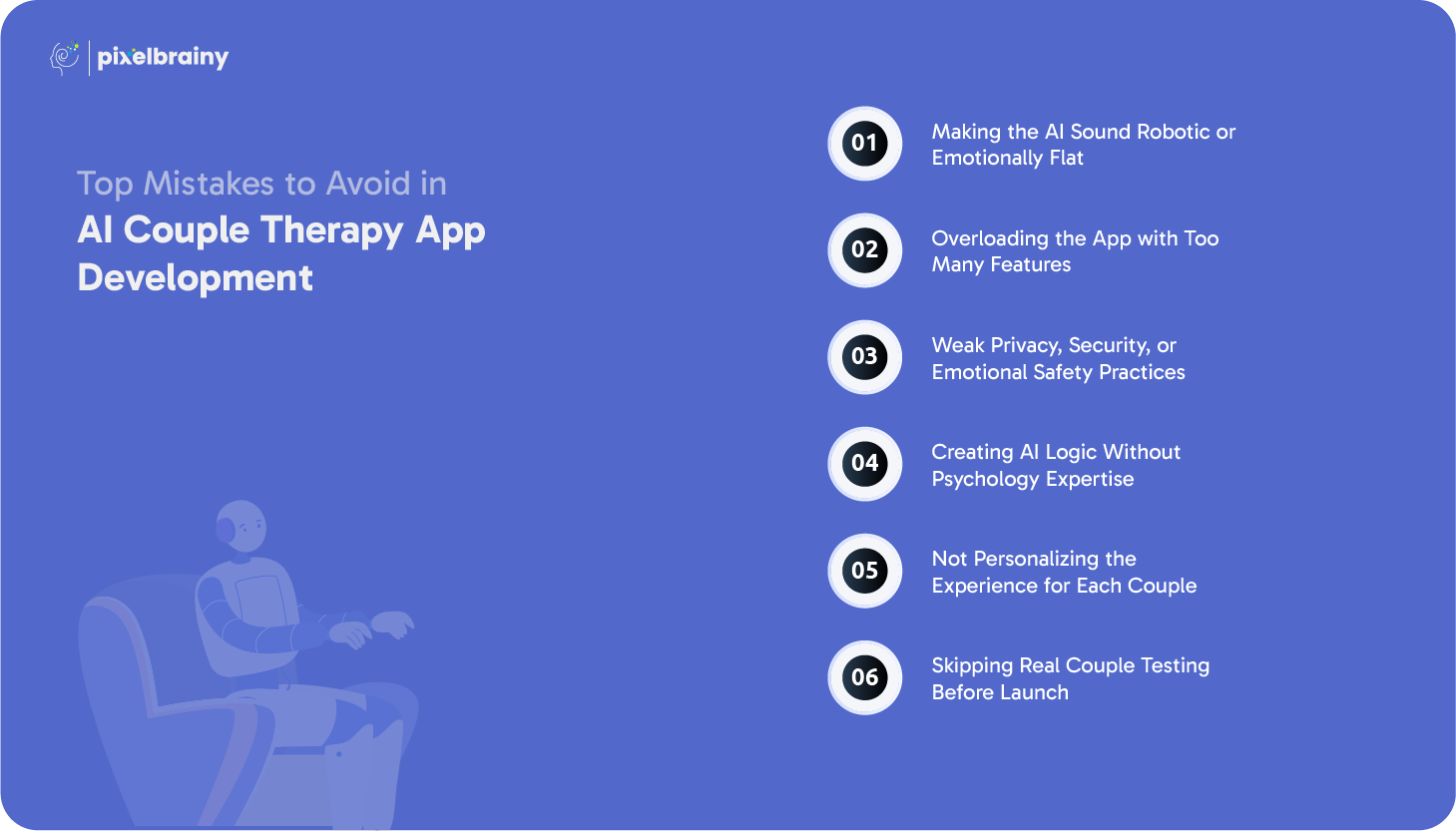
When the AI lacks warmth, empathy, or natural language flow, couples immediately feel disconnected. The goal is to create an AI that supports users emotionally, not one that feels scripted or mechanical.
Avoid this mistake by:
Trying to add every possible tool often leads to confusion, clutter, and poor user experience. Couples want clarity and simplicity, not a maze of options they never use.
Avoid this mistake by:
Relationship data is among the most sensitive information a user can share. Any sign of weak security instantly breaks trust and harms the app’s credibility.
Avoid this mistake by:
AI cannot guide couples effectively if it is not grounded in relationship science. Without expert input, responses can feel generic, irrelevant, or potentially harmful.
Avoid this mistake by:
Every relationship is unique, and generic advice rarely creates impact. Lack of personalization makes the experience feel detached and easy to abandon.
Avoid this mistake by:
Internal testing cannot replicate how actual couples communicate, disagree, or express emotions. Real world testing is essential for accuracy and emotional sensitivity.
Avoid this mistake by:
Therefore, avoiding these mistakes helps create an AI couple therapy app that is more empathetic, secure, personalized, clinically informed, and trustworthy for couples.
The future of AI Couple Therapy App Development is full of meaningful possibilities. As AI becomes more emotionally aware, privacy systems grow stronger, and relationship wellness gains global focus, the next generation of couple therapy apps will feel more human, more supportive, and more intelligent than ever before. Below are the most promising predictions and opportunities shaping the future of how couples will use AI to grow and connect.
Future AI systems will evolve into highly sensitive emotional companions that can understand tone, facial expressions, voice stress, and non verbal cues. This will help couples receive guidance that feels natural and genuinely empathetic.
What to expect:
Instead of generic advice, couples will receive adaptive pathways that change based on their communication style, mood patterns, shared habits, and progress. AI will curate tailored daily routines, bonding activities, and conflict resolution plans.
What to expect:
The next generation of apps will use wearable data like heart rate, sleep cycles, stress levels, and breathing patterns to understand emotional states. This creates opportunities for proactive support.
What to expect:
A powerful future trend is the blend of AI coaching with certified therapists. AI will handle daily guidance, while human professionals guide deeper sessions, creating a rich support ecosystem.
What to expect:
AI will become more proactive. Instead of helping couples during arguments, it will gently warn them when communication patterns suggest upcoming tension.
What to expect:
Immersive technologies will play a major role. VR based environments may simulate calming spaces, guided therapy rooms, or emotional exercises couples complete together.
What to expect:
As emotional wellness becomes mainstream, the demand for AI powered couple therapy solutions will surge. This creates opportunities for new apps, integrations, and specialized niches.
What to expect:
The future of AI Couple Therapy App Development promises deeper empathy, smarter personalization, and transformative tools that help couples grow together in more meaningful and supportive ways.
Building a truly meaningful AI Couple Therapy App is not just about technical engineering. It is about understanding human emotions, communication patterns, relationship psychology, and the delicate balance between guidance and empathy. PixelBrainy approaches this with a deeply human centered mindset, combining emotional intelligence with advanced technology to make AI Couple Therapy App solutions that feel supportive, safe, and personal.
As an AI development company with strong capabilities in AI healthcare software development, PixelBrainy specializes in creating emotionally intelligent digital experiences that help couples communicate better, resolve conflicts, and build deeper connections. Our goal is to design AI systems that respect emotional nuance and deliver real value, not robotic responses.
Below is a detailed look at how PixelBrainy approaches Couple Therapy App Development integrating AI, along with a brief highlight of a confidential project we successfully delivered.
PixelBrainy begins every project by understanding emotional behavior, not code. We work closely with relationship experts, psychologists, and communication specialists to shape the emotional tone of the AI.
Our approach includes:
This foundation allows us to begin developing AI Couple Therapy App experiences that feel natural and comforting rather than clinical.
No two couples communicate the same way. PixelBrainy develops adaptive AI systems that learn from user interactions and adjust guidance accordingly.
We focus on:
This makes the final product more personalized, responsive, and emotionally aware.
Emotional wellness requires a design ecosystem that feels safe and welcoming. PixelBrainy’s designers collaborate closely with psychologists to create a UI that reduces stress rather than adds to it.
Our UX practice includes:
This ensures that to make AI Couple Therapy App solutions genuinely accessible, design plays as much of a role as technology.
Couples share some of their most personal emotions and conversations inside these apps. PixelBrainy prioritizes privacy from the very first planning session.
Our privacy principles include:
User trust is earned, and PixelBrainy protects it with strong, ethical engineering practices.
When couples are stressed, they need immediate help. PixelBrainy builds real time emotional assistance tools that offer guidance during conflicts or emotional lows.
Examples of what we build:
These tools help support couples at the most crucial moments.
PixelBrainy believes AI should support therapists, not replace them. We create hybrid ecosystems where AI enhances the experience while professionals provide the deeper support.
We support:
This creates a more complete wellness solution for couples.
PixelBrainy recently completed a large scale project for a global wellness organization focused on improving communication between partners. While the client name remains confidential, the result was a fully functioning AI relationship coach that included mood tracking, personalized emotional insights, conflict support, and shared relationship progress analytics.
The transformation was significant:
This project showcases PixelBrainy’s ability to deliver complex, emotionally intelligent AI ecosystems at scale.
PixelBrainy builds human centered, emotionally intelligent AI solutions that help couples understand each other better, making the journey of developing AI Couple Therapy App products both meaningful and deeply impactful.
The opportunity to build an AI couple therapy app is growing as couples and therapists look for more personalized support between sessions. A successful product should combine AI-powered communication coaching, relationship insights, guided exercises, and secure technology while keeping the underlying therapeutic approach at the center.
For businesses exploring AI couple therapy app development, the focus should be on creating an experience that is clinically informed, emotionally responsive, and genuinely useful for couples. From defining the right AI capabilities to developing secure infrastructure and testing real-world interactions, every stage can influence the product's quality and long-term adoption.
PixelBrainy helps businesses turn AI couple therapy concepts into human-centered digital wellness solutions with the technology, AI capabilities, and product expertise needed for development.
Ready to build your AI Couple Therapy App? Book an appointment with PixelBrainy today.
To build an AI couple therapy app, define the therapeutic framework, communication workflows, conflict-support features, AI capabilities, safety boundaries, and personalization requirements before development. This creates a clear foundation for AI-guided relationship support.
The steps to develop an AI couple therapy app from idea to launch typically include market research, feature planning, PoC validation, UX design, MVP development, AI integration, security testing, launch, and continuous optimization.
The AI couple therapy app development cost can range from approximately $25,000 to $250,000+, depending on AI complexity, features, clinical content, security, integrations, platform coverage, and maintenance requirements.
To create an AI couple therapy app with more relevant guidance, the AI should be grounded in a defined therapeutic framework. Clinical content, communication exercises, prompts, and response guidelines should be developed around the intended therapeutic approach.
AI couple therapy mobile app development can use technologies such as React Native or Flutter for mobile interfaces, Node.js or Django for backend services, cloud infrastructure, secure databases, NLP models, sentiment analysis, and AI recommendation systems.
To develop an AI couple therapy app for therapist-led care, businesses can combine AI-guided exercises, relationship check-ins, progress insights, secure therapist access, and personalized recommendations while keeping professional oversight within the product experience.
When developing an AI couple therapy app, businesses can consider subscriptions, freemium plans, premium AI features, therapist services, paid courses, corporate wellness partnerships, and white-label licensing.
When evaluating AI couple therapy app development services, look for experience in conversational AI, healthcare or wellness applications, privacy and security, AI personalization, and clinical content collaboration. The development partner should also understand how to translate therapeutic frameworks into safe AI-supported experiences.

About The Author
Sagar Bhatnagar
Sagar Sahay Bhatnagar brings over a decade of IT industry experience to his role as Marketing Head at PixelBrainy. He's known for his knack in devising creative marketing strategies that boost brand visibility and market influence. Sagar's strategic thinking, coupled with his innovative vision and focus on results, sets him apart. His track record of successful campaigns proves his ability to utilize digital platforms effectively for impactful marketing efforts. With a genuine passion for both technology and marketing, Sagar continuously pushes PixelBrainy's marketing initiatives to greater success.
Working with the PixelBrainy team has been a highly positive experience. They understand the design requirements and create beautiful UX elements to meet the application needs. The dev team did an excellent job bringing my vision to life. We discussed usability and flow. Sagar worked with his team to design the database and begin coding. Working with Sagar was easy. He has the knowledge to create robust apps, including multi-language support, Google and Apple ID login options, Ad-enabled integrations, Stripe payment processing, and a Web Admin site for maintaining support data. I'm extremely satisfied with the services provided, the quality of the final product, and the professionalism of the entire process. I highly recommend them for Android and iOS Mobile Application Design and Development.

Great experience working with them. Had a lot of feedback and I found that unlike most contractors they were bugging me for updates instead of the other way around. They were extremely time conscience and great at communicating! All work was done extremely high quality and if not on time, early! They were always proactive when it comes to communication and the work is great/above par always. Very flexible and a great team to work with! Goes above and beyond to present us with multiple options and always provides quality. Amazing work per usual with Chitra. If you have UI/UX or branding design needs I recommend you go to them! Will likely work with them in the future as well, definitely recommended!

PixelBrainy is a joy to work with and is a great partner when thinking through branding, logo, and website layout. I appreciate that they spend time going into the "why" behind their decisions to help inform me and others about industry best practices and their expertise.

I hired them to design our software apps. Things I really like about them are excellent communication skills, they answer all project suggestions and collaborate right away, and their input on design and colors is amazing. This project was complex and needed patience and creativity. The team is amazing to do business with. I will be using them long-term. Glad to see there are some good people out there. I was afraid to try and outsource my project to someone but I am glad I met them! I really can't say enough. They went above and beyond on this project. I am very happy with everything they have done to make my business stand out from the competition.

It was great working with PixelBrainy and the team. They were very responsive and really owned the project. We'll definitely work with them again!

I recently worked with the PixelBrainy team on a project and I was blown away by their communication skills. They were prompt, clear, and articulate in all of our interactions. They listened and provided valuable feedback and suggestions to help make the project a success. They also kept me updated throughout the entire process, which made the experience stress-free and enjoyable.

PixelBrainy is very good at what it does. The team also presents themselves very professionally and takes care of their side of things very well. I could fully trust them taking up the design work in a timely and organised manner and their attention to detail saved us lots of effort and time. This particular project was quite intense and the team showed that they function very well under pressure. Very much looking forward to working with her again!

It's always an absolute pleasure working with them. They completed all of my requests quickly and followed every note I had for them to a T, which made our process go smoothly from start to finish. Everything was completed fast and following all of the guidelines. And I would recommend their services to anyone. If you need any design work done in the future, PixelBrainy should be your first call!

They took ownership of our requirements and designed and proposed multiple beautiful variants. The team is self-motivated, requires minimum supervision, committed to see-through designs with quality and delivering them on time. We would definitely love to work with PixelBrainy again when we have any requirements.

PixelBrainy was a big help with our SaaS application. We've been hard at work with a new UI/UX and they provided a lot of help with the designs. If you're looking for assistance with your website, software, or mobile application designs, PixelBrainy and the team is a great recommendation.

PixelBrainy designers are amazing. They are responsive, talented, and always willing to help craft the design until it matches your vision. I would recommend them and plan to continue them for my future projects and more!!!

They were awesome! Did a good job fast, and good communication. Will work with them again. Thank you

Creative, detail-oriented, and talented designers who take direction well and implement changes quickly and accurately. They consistently over-delivered for us.

PixelBrainy team is very talented and creative. Great designers and a pleasure to work with. PixelBrainy is an excellent communicator and I look forward to working with them again.

PixelBrainy has a very talented design team. Their work is excellent and they are very responsive. I enjoy working with them and hope to continue on all of our future projects.

Transform your ideas into reality with us.
Across these industries, each engagement brings unique challenges, from early-stage product development to scaling complex systems, helping us build a practical understanding of real-world product environments.