
 AI Summary Powered by PixelBrainy
What if retail crypto investors could access the same market intelligence as institutional traders without an institutional budget or dedicated research team?
This opportunity is driving interest in AI cryptocurrency apps, which combine artificial intelligence, real-time market data, blockchain analytics, and predictive modeling to help investors understand market movements and make informed decisions. For fintech founders, developing an AI-powered cryptocurrency intelligence platform offers an opportunity to deliver sophisticated research through an accessible, user-friendly experience.
According to Crypto.com Research's Crypto Market Sizing Report H1 2026, global cryptocurrency ownership reached an estimated 774 million people in June 2026, up 4.5% from 741 million in December 2025. This expanding user base creates opportunities for platforms that simplify complex market information, although commercial success still depends on customer demand, product differentiation, and reliable data.
AI cryptocurrency app development combines capabilities such as social media and news sentiment analysis, on-chain transaction monitoring, technical indicators, anomaly detection, portfolio intelligence, and AI-generated trade signals with transparent reasoning. Instead of simply displaying cryptocurrency prices, these applications can explain market trends, identify emerging patterns, and highlight potential risks using multiple data sources.
For fintech founders exploring cryptocurrency app development with AI, the primary challenge is building a reliable intelligence platform within a manageable startup budget. Development costs depend on whether the product focuses on market research, personalized portfolio insights, predictive analytics, exchange integrations, or automated trading. Each capability introduces different technical, security, infrastructure, and regulatory requirements.
Understanding how to create an AI crypto app with real time market analysis starts with defining the minimum viable product (MVP), selecting appropriate AI models, integrating dependable market and blockchain data, and establishing measurable performance criteria. Founders must also plan for ongoing maintenance, data licensing, and model evaluation.
This guide explores custom AI cryptocurrency app development, including essential features, advanced capabilities, technology stacks, development steps, cost estimates, monetization strategies, and implementation challenges. It helps fintech startups evaluate the investment required to build a scalable crypto intelligence platform that makes sophisticated market analysis more transparent and accessible to retail investors.

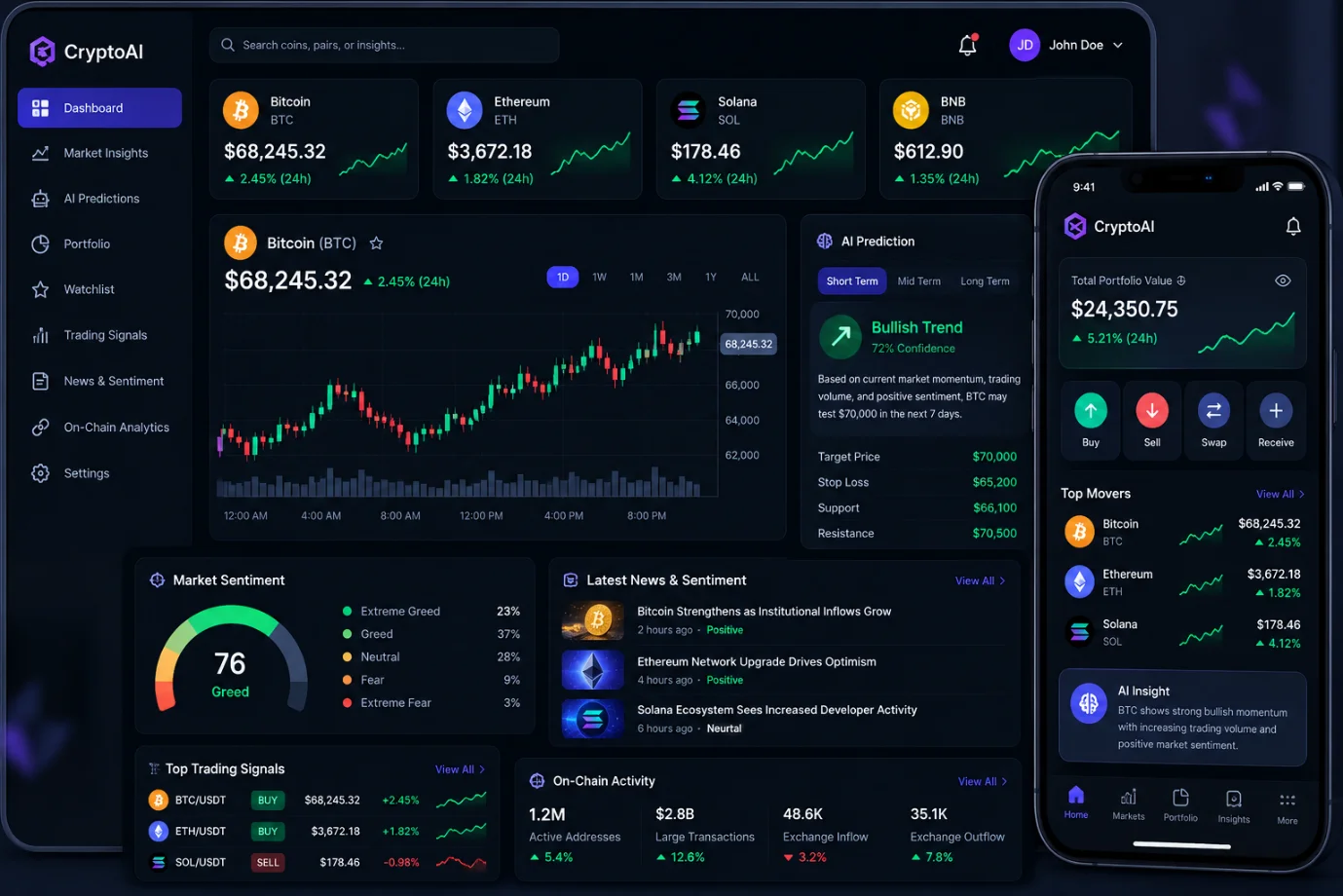
An AI cryptocurrency app is a software application that uses artificial intelligence (AI), machine learning (ML), real-time market data, and blockchain analytics to help users understand cryptocurrency market trends, identify potential trading opportunities, and evaluate investment risks. Unlike traditional crypto apps that primarily display prices, charts, and transaction histories, AI-powered applications analyze multiple data sources to generate insights, detect unusual activity, and explain market behavior.
For fintech founders, AI cryptocurrency app development involves building an intelligent platform that transforms complex financial and blockchain data into understandable, data-driven insights for retail investors and traders.
An AI cryptocurrency app typically follows five key steps to deliver market intelligence.
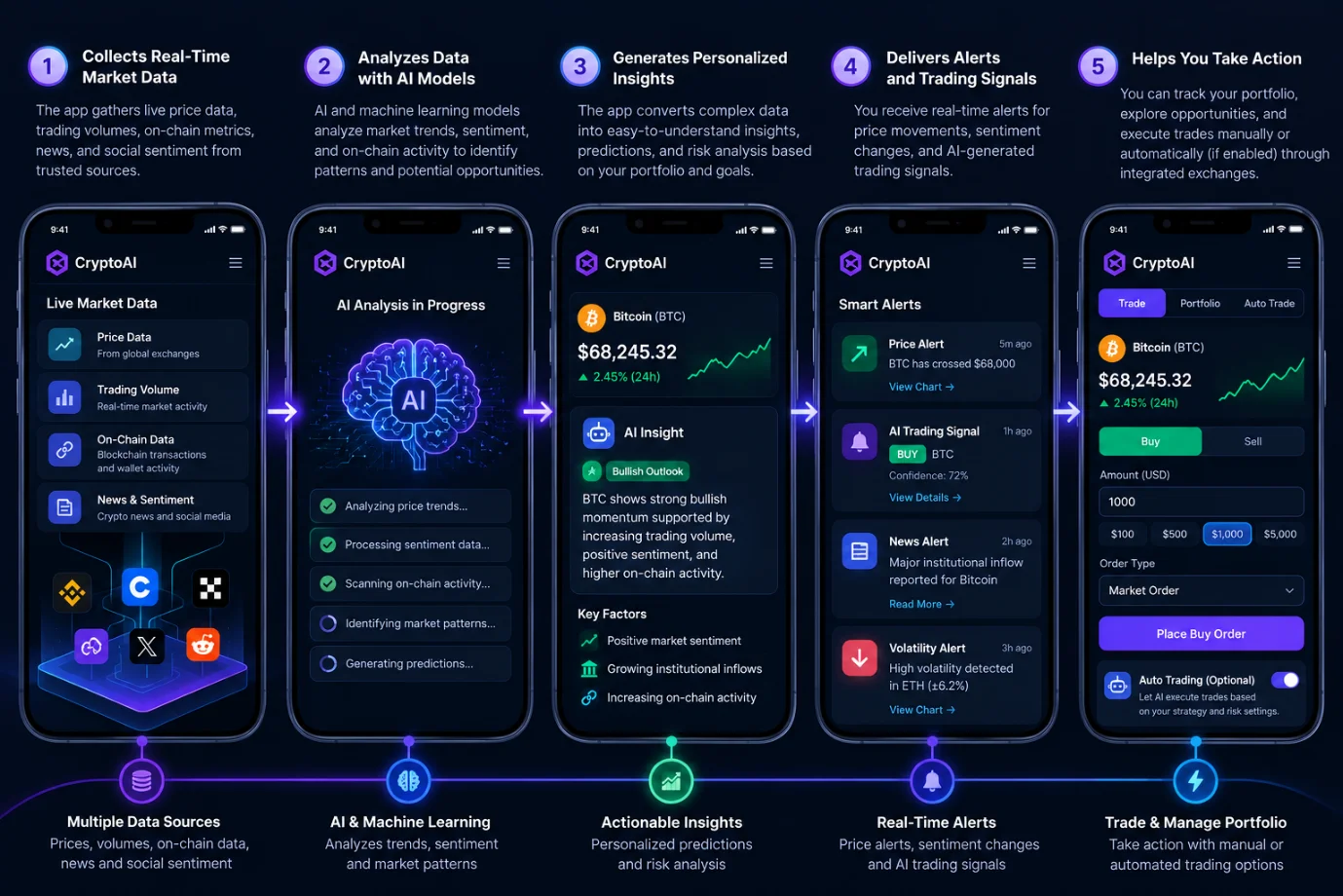
The application collects cryptocurrency prices, trading volumes, order book information, blockchain transactions, wallet movements, and derivatives metrics through exchange APIs, blockchain data providers, and market data services. News feeds and permitted social media data provide additional context for sentiment analysis.
Collected information is cleaned, organized, and standardized before analysis. The system removes duplicate news, identifies missing records, aligns timestamps, and validates data quality to reduce misleading conclusions caused by inconsistent sources.
Machine learning models, natural language processing (NLP), and statistical algorithms evaluate price movements, social sentiment, news developments, and on-chain activity. These models can identify unusual market patterns, classify sentiment, and estimate potential market scenarios.
The application combines relevant indicators to generate bullish, bearish, or neutral market assessments. Instead of displaying an unexplained recommendation, it can show supporting evidence, conflicting signals, historical comparisons, relevant time horizons, and potential risks. Predictions remain uncertain and should not be presented as guaranteed outcomes.
Users receive market summaries, asset-specific notifications, watchlist updates, and portfolio insights based on their preferences. Continuous monitoring helps identify meaningful changes as new data becomes available.
Suppose Bitcoin's price rises alongside increasing positive news sentiment and declining exchange reserves. An AI cryptocurrency app can examine these indicators together, compare them with trading volume and derivatives activity, and explain whether the available evidence supports a bullish market assessment. It can also highlight contradictory signals, such as rising leverage or weakening liquidity.
This integrated approach helps investors understand market conditions rather than relying on a single indicator.
Therefore, an AI cryptocurrency app combines real-time data, AI-driven analysis, and explainable insights to make crypto market intelligence more accessible. For startups, the objective of cryptocurrency app development with AI is to deliver reliable, transparent, and scalable decision-support tools without promising guaranteed trading profits.
The growing complexity of cryptocurrency markets is creating opportunities for fintech founders to develop AI-powered platforms that help investors interpret market data, track blockchain activity, and evaluate trading opportunities. Investing in AI cryptocurrency app development allows startups to build specialized financial intelligence products for retail investors, active traders, and professional research teams.
According to Crypto.com Research's H1 2026 report, global cryptocurrency ownership reached an estimated 774 million people in June 2026, representing 4.5% growth during the first half of the year. This expanding market, alongside increasing demand for data-driven financial tools, creates a compelling opportunity for startups to explore AI-powered crypto intelligence.
The expanding cryptocurrency user base creates a potential market for applications that simplify complex financial information. Founders can target investors who need market research, sentiment tracking, and on-chain analytics in one platform instead of relying on multiple disconnected tools.
Retail investors increasingly need ways to interpret large volumes of market information. AI-powered sentiment analysis, wallet activity monitoring, and explainable trade signals can help startups package sophisticated analytical capabilities into accessible subscription products.
According to Chainalysis's 2026 Global Crypto Adoption Index, global on-chain economic activity reached approximately $9.4 trillion in the 12 months ending June 30, 2026. This scale of activity creates opportunities to develop analytics products that interpret transaction patterns, asset flows, and blockchain ecosystem movements.
AI models can help process market news, classify sentiment, summarize research, and identify unusual activity. Startups can build differentiated products around these capabilities without necessarily developing every AI model from scratch.
AI crypto platforms can monetize through premium subscriptions, professional research dashboards, API access, enterprise licensing, and white-label solutions. Founders can test different pricing tiers based on customer demand and the cost of delivering reliable intelligence.
Institutional participation, tokenization, stablecoin activity, and evolving digital asset infrastructure create opportunities for specialized analytics products. The OECD's Asia Capital Markets Report 2026 discusses these developments alongside market interconnectedness and consumer protection risks.
For fintech founders, the opportunity lies in identifying a specific intelligence gap and building a commercially viable product around it. A focused AI cryptocurrency platform can establish its market position by combining reliable data, transparent analysis, and a clearly defined customer need.
What type of AI cryptocurrency app should a fintech startup develop to meet the needs of today's crypto investors? The answer depends on the problems your target audience faces, the market data they need, and the level of intelligence or automation your platform will provide.
AI cryptocurrency app development covers several product categories, from market intelligence and sentiment analysis to on-chain analytics, trading signals, portfolio management, and automated trading. Each type serves a different purpose, requires specific technologies, and involves different development costs. Understanding these categories helps founders choose the right product scope and prioritize features according to business objectives.

AI crypto market intelligence apps combine cryptocurrency prices, trading volumes, market trends, news, and AI-generated insights in a unified dashboard. They help investors understand current market conditions and evaluate the factors influencing price movements.
Key features:
Best for: Fintech startups building subscription-based intelligence platforms for retail investors, active traders, and crypto researchers.
AI crypto sentiment analysis apps use natural language processing (NLP) and machine learning to evaluate cryptocurrency news, public social media discussions, and community activity. They identify changes in market sentiment and emerging narratives that may influence investor attention.
Key features:
Best for: Investors and traders who want to understand market sentiment alongside price movements and trading activity.
AI-powered on-chain analytics applications analyze blockchain transactions, wallet activity, exchange flows, and protocol interactions. They can identify unusual transaction patterns and changes in network activity that warrant further investigation.
Key features:
Best for: Advanced retail investors, blockchain researchers, and professional analytics businesses seeking deeper insights into on-chain activity.
AI crypto trading signal apps combine technical indicators, historical prices, trading volumes, sentiment data, and machine learning models to identify potential trading opportunities.
Key features:
Best for: Active traders seeking structured, data-driven decision support. Signals should communicate uncertainty and must not be presented as guaranteed predictions.
AI cryptocurrency portfolio management apps analyze asset allocation, portfolio concentration, historical performance, volatility, and exposure to market risks. They can help investors understand how individual holdings contribute to overall portfolio behavior.
Key features:
Best for: Retail investors managing cryptocurrency holdings across multiple assets, wallets, or exchange accounts.
AI crypto trading bot applications connect trading strategies to cryptocurrency exchange APIs to automate order placement and trade management. Depending on the implementation, they may use predefined rules, quantitative models, or machine learning predictions.
Key features:
Best for: Businesses targeting automated trading users that can address execution risks, API security, monitoring requirements, and applicable regulatory obligations.
AI crypto research assistants use conversational AI and retrieval-augmented generation (RAG) to answer questions about cryptocurrencies, tokenomics, blockchain protocols, and market developments using relevant source material.
Key features:
Best for: Retail investors and researchers who want to investigate complex cryptocurrency topics without manually searching multiple information sources.
Therefore selecting the right application type allows fintech founders to align their development investment with a specific market need. Whether the goal is sentiment tracking, blockchain intelligence, portfolio analysis, or automated trading, successful AI cryptocurrency app development depends on reliable data, transparent analytical methods, appropriate security controls, and a clear value proposition for the intended users.
Why are fintech startups investing in AI cryptocurrency app development, and how can artificial intelligence create a competitive advantage in the crypto market? By combining real-time market data, machine learning, sentiment analysis, and blockchain intelligence, businesses can develop applications that help investors interpret market movements and make more informed decisions.
For fintech founders, the benefits of developing an AI cryptocurrency app extend beyond automating research. These platforms can improve market analysis, deliver personalized insights, strengthen risk monitoring, and create new revenue opportunities. The following are eight key benefits of building an AI-powered cryptocurrency application.
AI cryptocurrency apps can process large volumes of market data, news articles, and social media discussions faster than manual research workflows. They can summarize breaking developments, identify emerging narratives, and detect unusual changes in trading activity.
For example, investors can receive an AI-generated market report highlighting important Bitcoin developments instead of manually reviewing multiple sources.
How can AI help crypto investors make better trading decisions? By combining technical indicators, market sentiment, liquidity metrics, and on-chain activity, an AI cryptocurrency app can provide a broader view of market conditions.
AI-generated trade signals can explain which indicators support a bullish or bearish assessment and which suggest caution. This helps users evaluate multiple sources of evidence rather than relying on a single indicator. AI cannot guarantee profitable trades, but it can support more structured decision-making.
Explainable AI helps users understand why an application generates a particular market assessment or trading signal.
For example, a platform might identify positive news sentiment and increasing spot volume as bullish indicators while highlighting elevated funding rates as a potential risk. Showing supporting evidence, timestamps, and conflicting indicators helps users evaluate the reasoning behind each signal.
AI can customize dashboards, alerts, and research summaries according to users' watchlists, selected assets, experience levels, and preferred time horizons.
Beginners can receive simplified market explanations, while experienced traders can access detailed liquidity metrics, derivatives data, and historical signal comparisons. This makes the application more relevant to different investor segments.
Cryptocurrency markets operate 24/7, making continuous monitoring an important feature of AI-powered crypto applications.
Automated systems can track price movements, sentiment changes, large blockchain transfers, and volatility spikes. Users receive alerts when selected conditions occur, helping them stay informed without constantly checking multiple platforms.
AI automates repetitive tasks such as news classification, market report generation, indicator comparisons, and data summarization. A shared analytics engine can serve multiple users without requiring analysts to prepare every report manually.
This helps startups expand their user base while managing research workloads and infrastructure costs.
AI cryptocurrency app development creates opportunities for subscription-based products, premium trading signals, advanced market research, portfolio analytics, and developer APIs.
Founders can offer basic insights through a free plan and charge for advanced analytics, historical data, customized alerts, and higher usage limits. These options support recurring revenue and flexible pricing strategies.
AI-powered analytics can identify portfolio concentration, unusual transaction patterns, deteriorating liquidity, excessive leverage indicators, and sudden volatility changes.
These insights help investors recognize potential risk factors before making decisions. However, anomaly detection does not prove fraud, and AI cannot eliminate market uncertainty or guarantee protection against losses.
By combining real-time analytics, explainable AI, personalized intelligence, and continuous monitoring, fintech startups can build cryptocurrency applications that address genuine investor needs. The strongest products use these capabilities to improve the quality of market research while establishing user trust and sustainable business growth.
Also Read: Top 15 AI Trading Tools in 2026: Features, Benefits & Expert Picks

Building a competitive AI cryptocurrency app requires the right combination of market data, artificial intelligence, blockchain analytics, and user-focused functionality. For fintech founders, selecting essential features early helps control development costs, define the minimum viable product (MVP), and ensure the platform addresses real investor needs.
The core features of AI cryptocurrency app development should enable users to monitor prices, analyze market sentiment, understand blockchain activity, and evaluate AI-generated trading signals through a secure, intuitive interface.
Which features should an AI cryptocurrency app include to deliver real-time market intelligence and meet retail investors' expectations? The answer depends on the product's scope, but most startup-scale crypto intelligence platforms need reliable data integrations, transparent AI analysis, personalized monitoring, and secure account management as their foundation.
The following table outlines 15 essential AI cryptocurrency app features, explaining their purpose and importance for a market-ready application.
| Must-Have Feature | Description and Importance |
|---|---|
| Real-Time Cryptocurrency Price Tracking | Displays current cryptocurrency prices, percentage changes, trading volumes, and market capitalization using integrated data APIs. Accurate timestamps and data freshness indicators help investors understand market movements without relying on outdated information. |
| Interactive Market Charts | Provides interactive price charts with historical timeframes, volume indicators, and standard technical overlays. Investors can examine price movements, compare market conditions, and identify potential trends through an accessible visual interface. |
| AI-Powered Sentiment Analysis | Uses natural language processing to analyze permitted news articles and public social media discussions. The feature classifies sentiment, identifies emerging narratives, and tracks changes in market attention for selected cryptocurrencies. |
| Cryptocurrency News Aggregation | Collects relevant cryptocurrency news from authorized sources and organizes articles by asset, topic, and publication time. Source links, timestamps, and duplicate filtering help users review developments without repeatedly searching multiple websites. |
| On-Chain Data Monitoring | Tracks essential blockchain metrics, including transaction activity, active addresses, exchange flows, and large transfers where supported. These indicators provide additional context for understanding network activity and potential changes in market behavior. |
| AI-Generated Market Signals | Combines selected technical indicators, sentiment measurements, and market data to generate bullish, bearish, or neutral assessments. Each signal should disclose its time horizon, supporting evidence, conflicting indicators, and relevant limitations. |
| Explainable AI Insights | Explains why the platform generated a particular market assessment by presenting relevant indicators, source-linked evidence, and timestamps. Transparent explanations help users evaluate AI outputs instead of treating recommendations as unquestionable financial advice. |
| Personalized Watchlists | Allows users to save preferred cryptocurrencies and organize assets according to their interests. Watchlists connect directly with relevant prices, sentiment readings, market summaries, and alerts to create a more focused research experience. |
| Smart Price and Market Alerts | Sends notifications when selected price thresholds, sentiment changes, or predefined market conditions occur. Configurable alert frequency, cooldown periods, and delivery preferences help users receive relevant updates without unnecessary notification overload. |
| Cryptocurrency Search and Filtering | Enables users to search supported assets and filter results by market capitalization, trading volume, price movement, and available categories. Effective discovery tools make it easier to research cryptocurrencies across a growing asset catalog. |
| User Registration and Authentication | Supports secure account creation, login, password recovery, and appropriate session management. Additional authentication safeguards and role-based permissions help protect personal information and restrict unauthorized access to sensitive account functions. |
| Portfolio Tracking | Allows users to record cryptocurrency holdings manually or import supported balances through read-only exchange integrations. The feature calculates portfolio allocation, asset values, and historical performance while clearly communicating data coverage and limitations. |
| Risk Indicators and Volatility Metrics | Presents relevant volatility measurements, portfolio concentration indicators, and available liquidity or leverage metrics. These indicators help users recognize changing market conditions and potential exposure without implying that risks can be eliminated. |
| Subscription and Payment Management | Supports free and paid plans, subscription upgrades, billing history, and access controls for premium features. Integration with a suitable payment provider helps monetize advanced analytics while maintaining transparent pricing and renewal information. |
| Admin Dashboard and System Monitoring | Gives authorized administrators tools to monitor data feeds, API failures, user activity, alert delivery, and system health. Operational dashboards help teams investigate issues, maintain service reliability, and control infrastructure usage as adoption grows. |
Implementing these essential features creates a strong foundation for AI cryptocurrency app development, allowing startups to deliver reliable market intelligence, maintain user trust, and expand their capabilities as customer needs evolve.
After you have finalized your core features and validated your AI cryptocurrency app MVP, you can plan the next development phase around advanced capabilities that improve analytical depth, product differentiation, and scalability. These enhancements can help fintech startups serve experienced traders, sophisticated retail investors, and institutional customers without overcomplicating the initial release.
Advanced AI cryptocurrency app development may involve predictive analytics, automated strategy testing, wallet intelligence, conversational research, and portfolio risk modeling. The right combination depends on your target audience, available data, technical resources, and long-term business objectives.
Which advanced features should you add to an AI cryptocurrency app to deliver more sophisticated market intelligence and stand out from competing crypto analytics platforms? Prioritize features that solve validated customer problems, produce measurable analytical value, and justify their additional development and operating costs.
The following table explains 10 advanced features to consider when expanding your cryptocurrency intelligence platform.
| Advanced Feature | Description and Business Value |
|---|---|
| AI-Powered Predictive Market Analytics | Uses machine learning models to estimate potential price movements, volatility changes, or market scenarios from historical prices, trading volumes, and other indicators. Out-of-sample validation and probability calibration help users understand forecast uncertainty rather than interpret predictions as guaranteed outcomes. |
| Advanced Multi-Source Sentiment Intelligence | Combines news sentiment, social discussions, market narratives, and selected engagement metrics to identify emerging cryptocurrency trends. Source weighting, spam detection, and historical comparisons help distinguish meaningful sentiment changes from artificial activity or temporary online hype. |
| Whale Tracking and Wallet Intelligence | Monitors large blockchain transfers, labeled wallet activity, and changes in selected entity balances. Historical comparisons and contextual analysis help users investigate potentially significant movements without incorrectly assuming that every large transaction represents buying or selling. |
| AI-Powered Portfolio Risk Modeling | Evaluates portfolio concentration, volatility, asset correlations, and exposure to related market factors. Scenario simulations help users explore how different market conditions could affect their holdings, although model estimates cannot eliminate investment uncertainty or guarantee protection against losses. |
| Strategy Backtesting and Paper Trading | Allows users to test trading strategies against historical market data and simulate decisions using current market feeds without risking real capital. Reliable testing accounts for fees, slippage, liquidity constraints, look-ahead bias, and changing market conditions. |
| Conversational AI Crypto Research Assistant | Uses conversational AI and retrieval-augmented generation to answer questions about assets, blockchain protocols, market developments, and historical indicators. Source-linked responses, timestamps, and evidence retrieval help users investigate complex topics while reducing unsupported or fabricated AI answers. |
| Cross-Chain Analytics and Entity Resolution | Analyzes supported blockchain networks to identify related transaction patterns, protocol activity, and potential connections between wallet addresses. Reliable entity resolution requires appropriate data sources and careful uncertainty handling because wallet ownership and cross-chain relationships are not always publicly verifiable. |
| Automated Trading and Smart Order Execution | Connects validated trading strategies with supported exchange APIs to manage order placement and execution. Advanced controls can include position limits, slippage thresholds, order monitoring, and emergency stops, alongside additional security and regulatory reviews before live deployment. |
| AI-Powered Anomaly and Manipulation Detection | Identifies unusual trading volumes, coordinated social activity, abnormal wallet movements, and deviations from historical market behavior. These alerts help analysts investigate suspicious patterns, but statistical anomalies should not be presented as definitive proof of manipulation or fraud. |
| Developer APIs and Institutional Analytics | Provides structured market indicators, sentiment metrics, signal metadata, and selected on-chain analytics through authenticated APIs and professional dashboards. Usage metering, documentation, access controls, historical data support, and service monitoring help turn internal analytics capabilities into potential B2B revenue streams. |
Introducing these advanced capabilities in stages allows fintech founders to expand analytical depth without compromising the reliability of their core product. A strategic approach to advanced AI cryptocurrency app development helps businesses deliver measurable value, maintain transparent AI reasoning, and build a scalable platform that meets evolving investor expectations.
Building an AI cryptocurrency app from idea to launch requires a structured development process that combines product planning, market data integration, artificial intelligence, cybersecurity, and regulatory compliance. For fintech founders, the objective is to create a reliable platform that delivers real-time crypto intelligence while meeting user expectations and the legal requirements of its target markets.
The steps to develop an AI cryptocurrency app from idea to launch should cover business validation, technical architecture, data pipelines, AI model development, interface design, compliance infrastructure, testing, and deployment. Each stage establishes the foundation for the next, helping startups manage development costs and avoid expensive architectural changes.
A critical consideration is regulatory readiness. How can a US-based AI crypto startup implement KYC verification, AML transaction monitoring, FinCEN registration, and potential New York BitLicense requirements while building its application? The answer starts with defining the exact services the platform will provide. A research-only application may face different obligations from a business that exchanges, transmits, or holds customer cryptocurrency. FinCEN registration and state licensing are legal obligations where applicable, not simply software features.
The following eight steps explain how to build an AI cryptocurrency app from scratch, including the compliance architecture needed for a US-focused fintech product.

Start by defining the purpose of your application, target users, supported cryptocurrencies, and revenue model. Decide whether you will offer market intelligence only, personalized investment insights, exchange connectivity, or automated trading.
Document essential requirements, including real-time data access, AI-generated signals, user accounts, subscription management, and security controls.
For US-focused products, identify whether the planned activities could constitute money transmission, virtual currency exchange, custody, or another regulated service. This distinction influences compliance requirements, development costs, and launch timelines.
Deliverable: A product requirements document, target audience definition, and initial regulatory assessment.
Before committing to full development, validate the product concept through user interviews, competitor research, and technical feasibility testing. Consider PoC development to test whether your chosen data sources can support sentiment analysis, on-chain monitoring, and explainable market signals.
An initial AI consultation can help clarify model selection, architecture, infrastructure, and regulatory dependencies. Evaluate the capabilities of top AI app development companies based on relevant fintech experience, security practices, technical expertise, and transparent project estimates.
Deliverable: A validated product concept, technical proof of concept, preliminary budget, and feasibility report.
Also Read: Top 10 AI Consulting Companies in USA
Design a modular architecture covering the frontend, backend, data pipelines, AI services, databases, authentication, and compliance integrations. For US operations, obtain legal advice to determine whether federal MSB registration, state money transmission licenses, or a New York BitLicense may apply.
FinCEN registration is generally required for businesses that qualify as MSBs, subject to applicable exceptions. New York separately regulates specified virtual currency business activities. Review the official FinCEN MSB registration guidance and New York DFS virtual currency licensing requirements.
Deliverable: System architecture, jurisdiction-specific compliance matrix, and regulatory implementation plan.
Integrate reliable cryptocurrency price feeds, blockchain APIs, historical market datasets, and authorized news or social media sources. Establish data validation, timestamp normalization, duplicate removal, and monitoring for missing or delayed records.
For compliance infrastructure, connect appropriate identity verification providers, sanctions screening services, and blockchain analytics tools where required by the business model. Define how transaction records, identity verification results, risk alerts, and investigation evidence will be stored and accessed securely.
Deliverable: Working data pipelines, documented data sources, and integration specifications for market analytics and applicable compliance controls.
Begin with transparent quantitative indicators and established machine learning methods before introducing more complex predictive systems. AI model development may include sentiment classification, anomaly detection, signal scoring, and forecasting, depending on the validated product scope.
During AI integration, connect model outputs to the backend through controlled APIs. Record model versions, input timestamps, supporting evidence, and relevant uncertainty. Separately, design AML transaction monitoring rules to flag suspicious patterns for review. AI risk scores should support, not replace, required compliance decisions and human investigations.
Deliverable: Tested analytical models, explainable signal outputs, and documented model evaluation criteria.
Develop a clear interface that makes complex financial information understandable. Work with a UI/UX design company to structure market dashboards, watchlists, sentiment indicators, research summaries, alerts, and account settings around user needs.
For compliance-related workflows, design secure onboarding, identity verification, additional information requests, account restrictions, and review notifications. Avoid exposing sensitive investigation details to unauthorized users. Ensure risk disclosures are readable and distinguish verified market data from AI-generated interpretations.
Deliverable: Approved interface designs, interactive prototypes, and user journeys for market intelligence and compliance workflows.
Proceed with MVP development, implementing essential dashboards, data integrations, AI insights, authentication, subscription functionality, and monitoring. If the business model requires KYC, integrate identity verification and record verification status, timestamps, and review outcomes securely.
Where applicable, implement risk-based customer due diligence, sanctions screening, AML monitoring, case management, and suspicious activity reporting workflows. MSBs must maintain an appropriate written AML program with designated compliance responsibility, internal controls, staff training, and independent review. FinCEN registration alone does not satisfy these obligations. If needed, hire AI developers with experience in secure financial applications and data-intensive systems.
Deliverable: A working MVP with tested security controls and the compliance functionality required for the approved business model.
Also Read: Top 10 AI MVP Development Companies in USA
Before launch, conduct functional, security, performance, and AI evaluation testing. Validate market data freshness, signal explanations, authentication, access permissions, alert delivery, and recovery procedures.
Test KYC exception handling, AML alert generation, investigation workflows, audit trails, and reporting procedures with appropriate compliance personnel. If New York licensing applies, confirm the necessary authorization before offering regulated services to New York users. The New York DFS BitLicense guidance explains applicable licensing pathways and application requirements.
Teams evaluating top AI trading software development companies should also assess their ability to support secure deployment, monitoring, and ongoing maintenance.
Deliverable: A launch-ready application, test reports, documented compliance procedures, and a post-launch monitoring plan.
Building an AI cryptocurrency app successfully requires aligning product development, AI validation, and regulatory compliance from the beginning, so the platform can scale without compromising security, transparency, or operational readiness.
Also Read: How to Build AI Crypto Trading Bot: Features, Steps and Challenges

The cost to develop an AI cryptocurrency app ranges from $25,000 to $350,000+, depending on features, AI complexity, data integrations, security, and regulatory requirements. A basic crypto analytics app costs less than an AI-powered exchange with smart order routing, automated trading, and portfolio rebalancing.
For fintech founders, the development budget depends on the platform's functionality. Market intelligence apps primarily require data integrations and AI analytics, while trading platforms need additional exchange connectivity, order management, and risk controls.
What is the development pricing of an AI cryptocurrency app, and how does an AI-powered exchange compare with a standard crypto exchange? The answer depends on the level of AI customization, execution complexity, and infrastructure required.
The following are illustrative 2026 development estimates, not fixed vendor quotations.
| Application Type | Estimated Cost | Key Features |
|---|---|---|
| Basic AI Cryptocurrency App | $25,000 to $60,000 | Price tracking, market dashboards, basic sentiment analysis, AI summaries, watchlists, and alerts. |
| Advanced AI Cryptocurrency App Platform | $60,000 to $150,000 | Custom AI models, on-chain analytics, explainable trading signals, portfolio analytics, and backtesting. |
| Institutional-Grade AI Cryptocurrency App | $150,000 to $350,000+ | Advanced analytics, extensive data pipelines, exchange integrations, enhanced security, and sophisticated trading infrastructure. |
| Development Component | Estimated Cost |
|---|---|
| Business analysis and planning | $2,000 to $8,000 |
| UI/UX design | $3,000 to $12,000 |
| Backend and API development | $8,000 to $30,000 |
| Market and blockchain integrations | $5,000 to $25,000 |
| AI model development and integration | $5,000 to $40,000 |
| Frontend development | $5,000 to $25,000 |
| Testing, security, and deployment | $4,000 to $20,000 |
These component ranges may overlap and should not be added together as a fixed quotation.
Beyond development, founders must budget for cloud hosting, AI inference, data subscriptions, security monitoring, and maintenance. Exchanges may also incur liquidity, custody, transaction processing, and compliance expenses.
Ultimately, a focused AI cryptocurrency app MVP can validate demand before you invest in the greater infrastructure, security, and operational complexity of a full AI-powered exchange.
Building a successful AI cryptocurrency app requires a technology stack that supports real-time market data, AI-powered analytics, blockchain integration, secure user management, and scalable infrastructure. For fintech startups, the right combination of tools helps control development costs, improve analytical accuracy, and support future product expansion.
Which AI tools and technologies are required to develop an AI cryptocurrency app with real-time market analysis, predictive insights, and blockchain analytics? The answer depends on the application's purpose, data requirements, AI capabilities, and trading functionality. A crypto market intelligence platform may prioritize machine learning, sentiment analysis, and data visualization, while an AI-powered exchange also needs trading APIs, order management, and advanced security controls.
The following table outlines commonly used technologies for developing an AI cryptocurrency app, along with their primary roles and practical applications.
| Technology Layer | Recommended Tools and Technologies | Purpose and Application |
|---|---|---|
| Frontend Development | React.js, Next.js, TypeScript | Build responsive dashboards, interactive crypto charts, watchlists, portfolio views, and AI-generated market insights for web users. |
| Mobile App Development | Flutter, React Native, Swift, Kotlin | Develop cross-platform or native mobile applications with real-time price updates, personalized alerts, portfolio tracking, and AI research features. |
| Backend Development | Python, FastAPI, Node.js, NestJS | Handle business logic, user requests, market data processing, AI service integration, authentication, and communication between frontend and backend systems. |
| AI and Machine Learning | PyTorch, TensorFlow, scikit-learn | Develop models for market pattern recognition, volatility estimation, anomaly detection, sentiment classification, and other analytical use cases. |
| Large Language Models | OpenAI API, Hugging Face Transformers | Generate market summaries, explain analytical signals, summarize crypto news, and support conversational research experiences. Model outputs should be validated against reliable data. |
| Data Processing | Apache Kafka, Apache Spark, Pandas | Process streaming market feeds, historical price data, news, and blockchain activity to support timely analytics and large-scale data processing. |
| Cryptocurrency Market Data | CoinGecko API, CoinMarketCap API, exchange APIs | Retrieve cryptocurrency prices, trading volumes, historical market information, and exchange-specific data. Commercial usage limits and licensing terms should be reviewed. |
| Blockchain Data and On-Chain Analytics | Alchemy, QuickNode, The Graph | Access blockchain nodes, transaction information, smart contract data, and indexed on-chain activity for wallet intelligence and network analysis. |
| Sentiment Analysis | Hugging Face models, FinBERT, custom NLP pipelines | Analyze relevant news, public commentary, and other permitted text sources to estimate market sentiment and identify changes in investor attention. |
| Database Management | PostgreSQL, TimescaleDB, MongoDB | Store user accounts, watchlists, portfolio records, market time series, and application data. Database selection depends on data structure and query requirements. |
| Caching and Real-Time Updates | Redis, WebSockets | Cache frequently requested information and deliver live price changes, alerts, and dashboard updates with lower latency. |
| Cloud Infrastructure | AWS, Microsoft Azure, Google Cloud | Host application services, deploy AI workloads, manage storage, and scale infrastructure as user activity and data volume increase. |
| MLOps and Model Monitoring | MLflow, Docker, Kubernetes | Track model versions, manage deployments, monitor performance, and support reliable updates to AI services as market conditions change. |
| Security and Authentication | OAuth 2.0, OpenID Connect, AWS KMS or equivalent key management | Protect user accounts, manage access permissions, and secure sensitive application data. Exchange or custody products may require additional controls for transaction signing and key protection. |
| Testing and Deployment | Pytest, Jest, GitHub Actions | Automate testing, validate API integrations, detect regressions, and streamline deployment of frontend, backend, and AI components. |
| Analytics and Monitoring | Prometheus, Grafana, OpenTelemetry | Monitor service health, API latency, data pipeline failures, model performance, and infrastructure usage to help maintain platform reliability. |
A well-planned technology stack enables AI cryptocurrency app development to deliver reliable market intelligence today while providing the security, scalability, and flexibility needed for future growth.
A profitable AI cryptocurrency app needs a business model that aligns its features with customer needs, market demand, and long-term operating costs. For fintech startups targeting retail crypto investors, monetization opportunities include AI-powered market intelligence, premium analytics, portfolio insights, and trading tools.
Which business models are most effective for monetizing an AI cryptocurrency app? Six popular options include subscription-based access, freemium services, API licensing, enterprise SaaS, transaction-based fees, and white-label solutions. Each model offers distinct revenue opportunities based on the app's functionality and target audience.
A subscription model generates recurring revenue by charging users for premium AI cryptocurrency app features. It suits platforms that provide continuous market intelligence, advanced analytics, and personalized investor insights.
The freemium model offers essential cryptocurrency tools for free while reserving advanced AI capabilities for paying users. It helps startups attract users, demonstrate product value, and convert engaged investors into subscribers.
An API licensing model allows other businesses to integrate AI cryptocurrency analytics into their own applications. Instead of serving only individual investors, the platform monetizes its data processing and intelligence through developer-friendly interfaces.
Enterprise SaaS serves organizations that need advanced cryptocurrency research, portfolio intelligence, and risk analysis. It is suitable for businesses that require customized workflows, team access, and specialized reporting.
A transaction-based model generates revenue through eligible trading commissions or transaction-related fees. It is more suitable for AI cryptocurrency platforms that facilitate trading rather than provide market analysis alone.
White-label solutions allow businesses to license an existing AI cryptocurrency platform and offer it under their own branding. This approach can help companies enter the crypto analytics market without developing every component from scratch.
The right AI cryptocurrency app business model combines customer demand, valuable AI-powered features, and sustainable revenue generation to support long-term business growth.
AI cryptocurrency app development presents technical, security, and regulatory challenges that can affect data accuracy, AI performance, user trust, and scalability. Fintech startups must address these risks to deliver reliable market insights and protect investors.
How can fintech startups overcome the biggest challenges of AI cryptocurrency app development? The six key challenges are data quality, AI model reliability, market volatility, cybersecurity, regulatory compliance, and infrastructure scalability.

AI crypto apps rely on accurate cryptocurrency prices, trading volumes, news, and blockchain data. Delayed or inconsistent information can lead to misleading insights.
How to solve it:
AI models can analyze sentiment and identify market patterns, but changing conditions and biased training data can reduce accuracy. Generative AI may also produce unsupported explanations.
How to solve it:
Sudden price movements, liquidity changes, and unexpected news can make AI-generated insights outdated quickly, increasing investment risk.
How to solve it:
AI cryptocurrency apps may handle personal information, portfolio data, and exchange API credentials. Security weaknesses can expose users to account breaches or unauthorized transactions.
How to solve it:
Regulatory obligations depend on the app's activities and target markets. A research platform may face different requirements from an exchange or a service that holds customer funds.
How to solve it:
For US operations, consult the official FinCEN regulatory resources and New York virtual currency guidance to assess potentially applicable requirements.
Growing user numbers and increasing AI workloads can cause slow dashboards, delayed alerts, higher infrastructure costs, and service interruptions.
How to solve it:
Overcoming these challenges helps fintech startups deliver secure, scalable, and reliable AI cryptocurrency apps that provide trustworthy market intelligence and support long-term growth.

Businesses entering the cryptocurrency market need a technology partner that understands artificial intelligence, blockchain data, financial analytics, and secure application architecture. PixelBrainy helps crypto founders and fintech startups transform product ideas into scalable digital solutions designed around investor needs, business objectives, and evolving market requirements.
For businesses looking for a best AI trading software development company in USA, PixelBrainy offers technology expertise to support crypto analytics platforms, AI-powered trading tools, and customized fintech applications.
In one confidential project, our team worked on a cryptocurrency intelligence solution designed to simplify market research for retail investors. The platform concept brought together market data, sentiment indicators, interactive dashboards, and AI-generated insights in a unified interface.
Key project components included:
The project illustrates how a focused product architecture can bring multiple analytical capabilities together. Specific client details and confidential business information remain undisclosed.
If your goal is to develop AI cryptocurrency app capabilities for market analysis, automated workflows, or portfolio intelligence, our team can help define the appropriate technology stack and development roadmap. We also support businesses planning to create AI cryptocurrency app solutions through cryptocurrency app development integrating AI, with features tailored to their intended users and operational requirements.
Ready to turn your crypto product idea into a scalable solution? Connect with PixelBrainy to discuss your AI cryptocurrency app development project.
AI cryptocurrency app development is creating new opportunities for fintech startups and crypto founders to deliver smarter market intelligence, data-driven insights, and personalized investor experiences. From real-time price tracking and sentiment analysis to predictive analytics and automated trading, artificial intelligence can help transform complex cryptocurrency data into meaningful insights.
However, launching a successful platform requires more than advanced AI features. Businesses must prioritize reliable data sources, model accuracy, cybersecurity, regulatory compliance, and scalable infrastructure. Understanding development costs, selecting the right technology stack, and choosing a sustainable business model are equally important for long-term growth.
For startups planning to develop an AI cryptocurrency app, a phased approach that begins with a focused MVP can validate market demand before expanding into advanced capabilities. Partnering with an experienced development team like PixelBrainy can help translate your business vision into a practical, market-ready solution.
Ready to turn your crypto app idea into reality? Book an appointment with PixelBrainy to discuss your AI cryptocurrency app development goals.
An AI cryptocurrency app uses artificial intelligence to analyze market data, assess sentiment, identify patterns, and generate insights. Depending on its features, it can support portfolio monitoring, risk analysis, price alerts, and automated trading workflows. AI assists decisions but cannot guarantee profitable outcomes.
The cost to build an AI cryptocurrency app in 2026 typically ranges from $25,000 to $350,000+, depending on functionality, AI complexity, integrations, security, and compliance requirements. Advanced exchanges with automated trading, custom models, and sophisticated infrastructure can cost considerably more.
AI cryptocurrency app development typically takes three to six months for a focused MVP and six to twelve months or longer for advanced platforms. Timelines depend on feature complexity, data integrations, AI model development, security testing, regulatory requirements, and team experience.
US compliance requirements depend on whether an app provides analytics, facilitates trading, transfers funds, or holds customer assets. Depending on its activities, a business may need FinCEN registration, state licenses, KYC/AML controls, and privacy safeguards. Obtain qualified legal advice before launch.
A BitLicense is not automatically required for every AI cryptocurrency app. New York licensing requirements depend on whether the business conducts regulated virtual currency activities. Analytics-only services may be treated differently from exchanges or custodial platforms. Consult New York DFS guidance and legal counsel.
AI crypto prediction models can use historical prices, trading volumes, order book data, cryptocurrency news, social sentiment, blockchain transactions, and wallet activity. Reliable APIs and data providers supply these inputs. Data quality, licensing, preprocessing, and timely updates influence model performance and analytical reliability.
AI cryptocurrency price prediction accuracy varies by model, asset, timeframe, market conditions, and evaluation method. No model consistently predicts every market movement. Reliable development requires out-of-sample testing, realistic backtesting, transaction cost analysis, and continuous monitoring rather than relying on unverified accuracy claims.
Yes, an AI cryptocurrency app can execute trades through exchange APIs when supported and legally permitted. Development requires secure API credentials, user authorization, order validation, risk limits, execution monitoring, and failure handling. Regulatory obligations depend on the service structure and jurisdictions served.
An AI crypto intelligence app analyzes prices, sentiment, blockchain activity, and market trends to inform users. An AI crypto exchange additionally supports trading infrastructure, order management, liquidity integrations, and transaction security. Exchanges generally require greater engineering investment and potentially more extensive regulatory compliance.
PixelBrainy helps businesses plan and develop customized AI cryptocurrency applications around their product goals, data requirements, and target audiences. Its development approach can encompass AI integration, market analytics, backend engineering, and scalable architecture. Project scope, technical capabilities, timelines, and deliverables should be discussed directly with the team.

About The Author
Sagar Bhatnagar
Sagar Sahay Bhatnagar brings over a decade of IT industry experience to his role as Marketing Head at PixelBrainy. He's known for his knack in devising creative marketing strategies that boost brand visibility and market influence. Sagar's strategic thinking, coupled with his innovative vision and focus on results, sets him apart. His track record of successful campaigns proves his ability to utilize digital platforms effectively for impactful marketing efforts. With a genuine passion for both technology and marketing, Sagar continuously pushes PixelBrainy's marketing initiatives to greater success.

Working with PixelBrainy has been a great experience. They took our vision for an AI-powered platform and turned it into a fully functional product. What impressed me most was their strong understanding of both design and development, and their ability to handle complex requirements with ease. The team was responsive, cooperative, and always open to feedback. They kept things organized, communicated clearly, and delivered quality work on time. I highly recommend PixelBrainy to anyone looking for a skilled and reliable development partner.

Working with the PixelBrainy team has been a highly positive experience. They understand the design requirements and create beautiful UX elements to meet the application needs. The dev team did an excellent job bringing my vision to life. We discussed usability and flow. Sagar worked with his team to design the database and begin coding. Working with Sagar was easy. He has the knowledge to create robust apps, including multi-language support, Google and Apple ID login options, Ad-enabled integrations, Stripe payment processing, and a Web Admin site for maintaining support data. I'm extremely satisfied with the services provided, the quality of the final product, and the professionalism of the entire process. I highly recommend them for Android and iOS Mobile Application Design and Development.

Great experience working with them. Had a lot of feedback and I found that unlike most contractors they were bugging me for updates instead of the other way around. They were extremely time conscience and great at communicating! All work was done extremely high quality and if not on time, early! They were always proactive when it comes to communication and the work is great/above par always. Very flexible and a great team to work with! Goes above and beyond to present us with multiple options and always provides quality. Amazing work per usual with Chitra. If you have UI/UX or branding design needs I recommend you go to them! Will likely work with them in the future as well, definitely recommended!

PixelBrainy is a joy to work with and is a great partner when thinking through branding, logo, and website layout. I appreciate that they spend time going into the "why" behind their decisions to help inform me and others about industry best practices and their expertise.

I hired them to design our software apps. Things I really like about them are excellent communication skills, they answer all project suggestions and collaborate right away, and their input on design and colors is amazing. This project was complex and needed patience and creativity. The team is amazing to do business with. I will be using them long-term. Glad to see there are some good people out there. I was afraid to try and outsource my project to someone but I am glad I met them! I really can't say enough. They went above and beyond on this project. I am very happy with everything they have done to make my business stand out from the competition.

It was great working with PixelBrainy and the team. They were very responsive and really owned the project. We'll definitely work with them again!

I recently worked with the PixelBrainy team on a project and I was blown away by their communication skills. They were prompt, clear, and articulate in all of our interactions. They listened and provided valuable feedback and suggestions to help make the project a success. They also kept me updated throughout the entire process, which made the experience stress-free and enjoyable.

PixelBrainy is very good at what it does. The team also presents themselves very professionally and takes care of their side of things very well. I could fully trust them taking up the design work in a timely and organised manner and their attention to detail saved us lots of effort and time. This particular project was quite intense and the team showed that they function very well under pressure. Very much looking forward to working with her again!

It's always an absolute pleasure working with them. They completed all of my requests quickly and followed every note I had for them to a T, which made our process go smoothly from start to finish. Everything was completed fast and following all of the guidelines. And I would recommend their services to anyone. If you need any design work done in the future, PixelBrainy should be your first call!

They took ownership of our requirements and designed and proposed multiple beautiful variants. The team is self-motivated, requires minimum supervision, committed to see-through designs with quality and delivering them on time. We would definitely love to work with PixelBrainy again when we have any requirements.

PixelBrainy was a big help with our SaaS application. We've been hard at work with a new UI/UX and they provided a lot of help with the designs. If you're looking for assistance with your website, software, or mobile application designs, PixelBrainy and the team is a great recommendation.

PixelBrainy designers are amazing. They are responsive, talented, and always willing to help craft the design until it matches your vision. I would recommend them and plan to continue them for my future projects and more!!!

They were awesome! Did a good job fast, and good communication. Will work with them again. Thank you

Creative, detail-oriented, and talented designers who take direction well and implement changes quickly and accurately. They consistently over-delivered for us.

PixelBrainy team is very talented and creative. Great designers and a pleasure to work with. PixelBrainy is an excellent communicator and I look forward to working with them again.

PixelBrainy has a very talented design team. Their work is excellent and they are very responsive. I enjoy working with them and hope to continue on all of our future projects.


Transform your ideas into reality with us.
Across these industries, each engagement brings unique challenges, from early-stage product development to scaling complex systems, helping us build a practical understanding of real-world product environments.