AI Summary Powered by PixelBrainy
Can AI trading tools in 2026 uncover signals that institutional research teams miss, or are they simply repackaging the same information already available through Bloomberg Terminal and FactSet?
The answer increasingly depends on how deeply an AI trading platform can combine institutional equity analysis, earnings intelligence, alternative data, predictive analytics, and API-driven workflows. Modern AI trading tools can process large volumes of financial information, identify relationships across datasets, summarize company fundamentals, monitor market signals, and support research workflows at a speed that would be difficult to replicate manually. The global AI trading platform market is projected to reach USD 16.2 billion in 2026 and grow to USD 33.5 billion by 2030, reflecting rising adoption of AI across trading and investment workflows.
For an institutional investment team asking, “Which are the top AI trading tools in 2026 that can go beyond Bloomberg and FactSet with institutional-grade equity analysis, earnings surprise prediction, API access, and alternative data integration?”, the evaluation criteria are very different from those used by retail traders. The priority is not simply automated trade execution or basic AI-generated signals. Institutional teams need research depth, proprietary or differentiated datasets, integration flexibility, historical data, model transparency, and infrastructure that can fit existing quantitative and fundamental research systems.
This guide examines the best AI trading tools in 2026 across these capabilities, including platforms designed for equity research, algorithmic analysis, predictive modeling, alternative data, portfolio intelligence, and automated workflows. It also compares their features, benefits, limitations, pricing approaches, and suitability for different trading and investment requirements, helping institutional and professional investors identify tools that can complement existing research infrastructure rather than merely duplicate it.
What is driving institutional investors, hedge funds, and active traders to adopt AI trading tools in 2026 when platforms such as Bloomberg Terminal and FactSet already provide extensive market intelligence?
The answer is increasingly tied to the depth, speed, and flexibility of AI-driven research. Modern AI tools for traders are moving beyond basic stock screeners and automated trade signals to support equity research, earnings analysis, alternative data processing, sentiment analysis, predictive modeling, portfolio analytics, and quantitative workflows. Instead of replacing established financial platforms, many AI systems are being evaluated for their ability to uncover additional signals and automate research tasks that traditional workflows cannot handle efficiently.
Institutional investors are increasingly exploring alternative data integration to find information that may provide an edge beyond conventional financial datasets. AI can process sources such as news, web activity, sentiment, transaction patterns, satellite data, app usage, and other structured or unstructured datasets at scale.
For hedge funds and quantitative teams, the value of an AI trading tool depends on whether it can transform these datasets into differentiated investment signals rather than simply reproduce widely available market information.
AI trading platforms can analyze financial statements, earnings transcripts, company disclosures, estimates, and market data much faster than traditional manual research processes. This is particularly relevant for teams looking for earnings surprise prediction, changes in management sentiment, fundamental anomalies, and signals that may warrant deeper analyst investigation.
The strongest platforms combine multiple data sources instead of relying on a single indicator or prediction model.
For professional investors, the question is no longer simply “What is the best AI trading tool?” It is also “Can this AI trading platform integrate with our existing research and trading infrastructure?”
API access, data export, custom workflows, model integration, historical datasets, and compatibility with quantitative systems can determine whether an AI solution becomes useful at institutional scale. This makes API-enabled AI trading tools particularly relevant for hedge funds, asset managers, proprietary trading firms, and quantitative research teams.
AI trading is no longer limited to automated bots that execute predefined strategies. Modern artificial intelligence tools for trading can support the broader investment lifecycle, including idea generation, market monitoring, fundamental research, signal discovery, portfolio analysis, risk assessment, and strategy development.
This expansion is one reason institutional teams are evaluating AI alongside their existing financial research platforms.
A critical question for institutional investors is whether an AI trading tool can generate unique and actionable insights rather than summarize information that the market already knows.
For a hedge fund evaluating the top AI trading tools in 2026, the strongest candidates should therefore be assessed on data differentiation, analytical depth, predictive capabilities, alternative data coverage, API accessibility, scalability, and integration with existing research infrastructure.
Ultimately, the growth of AI trading tools is being driven not simply by automation, but by the potential to turn large and diverse datasets into faster, deeper, and more differentiated investment research.
What should a hedge fund evaluate when comparing AI trading tools in 2026 for institutional equity research, earnings analysis, alternative data, and integration with an existing investment research stack? The answer goes beyond the number of features or the popularity of a platform. The right AI trading tool should match the trader’s strategy, asset coverage, level of automation, technical requirements, budget, and research workflow.
For professional investors, AI tools for traders should also be assessed for analytical depth, data quality, API access, integration capabilities, scalability, and the ability to support proprietary research. Retail traders may prioritize ease of use and automation, while institutional teams may need customizable workflows, alternative data, advanced analytics, and greater control over how AI-generated insights are incorporated into investment decisions.
The following factors can help traders compare the best AI trading tools, artificial intelligence tools for trading, and smart trading platforms based on their actual requirements rather than relying only on feature counts or marketing claims.
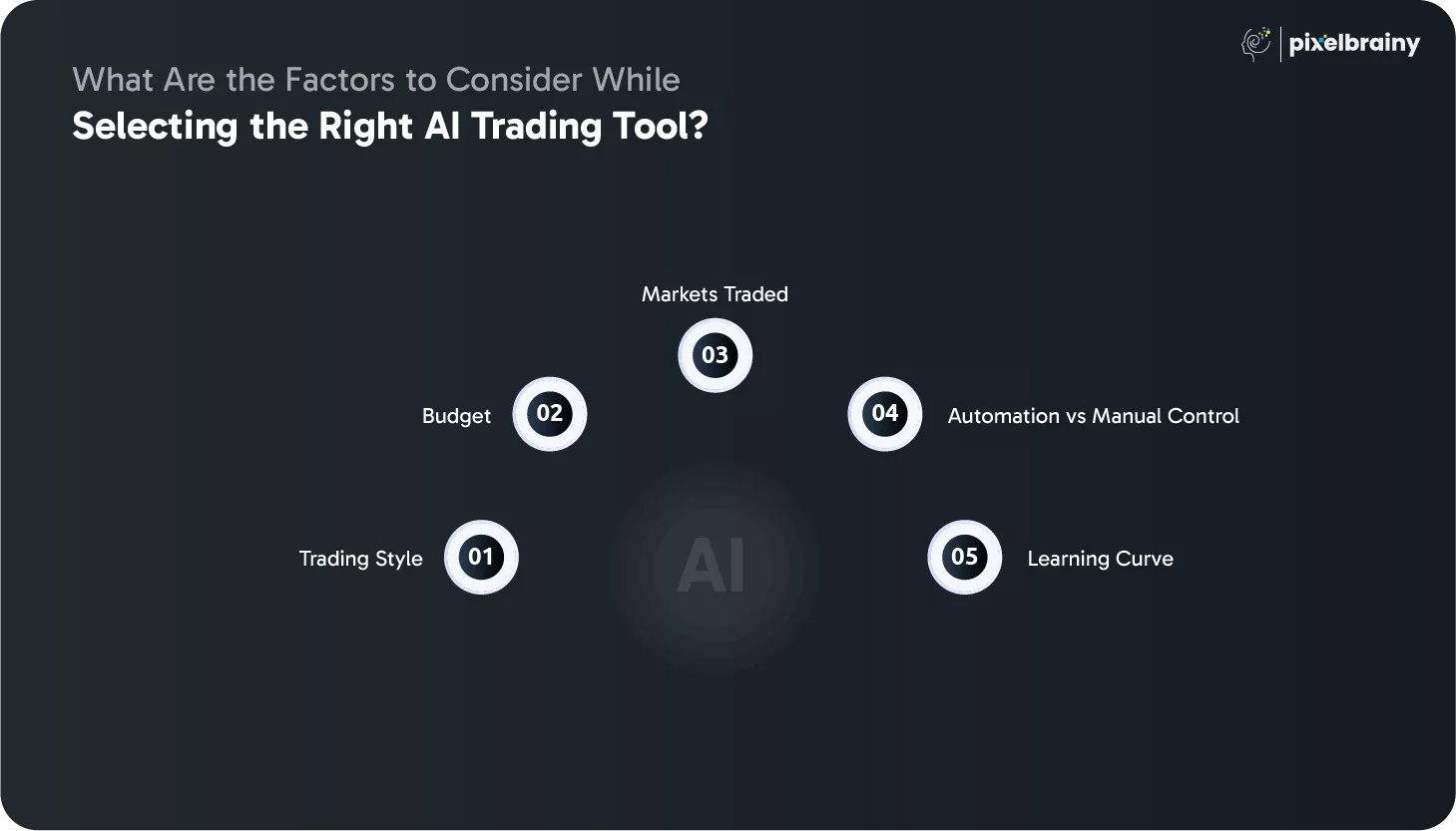
Every trader approaches the market differently, and the effectiveness of an AI platform depends heavily on how well it aligns with your strategy. AI trading tools designed for high-frequency strategies may not suit long-term investors, while portfolio-focused platforms might lack features needed by active traders.
Matching the tool with your trading style ensures that the AI enhances your decision-making rather than complicating it.
Pricing structures vary widely among AI trading tools for beginners and advanced users. Some platforms offer free entry-level versions, while others require monthly subscriptions for advanced analytics and automation features.
Understanding budget requirements helps traders balance affordability with access to advanced tools.
Artificial intelligence tools for trading differ in their market coverage, and not every platform supports all asset classes. Traders working across multiple markets should verify compatibility before committing to a platform.
Market compatibility plays a key role in ensuring the AI tool fits your investment strategy.
AI trading platforms vary between fully automated systems and decision-support tools that assist traders without executing trades automatically.
Understanding your preferred level of control helps identify the safest AI trading tools for your risk tolerance.
The complexity of AI tools varies significantly. Beginners often benefit from platforms designed with simplicity in mind, while advanced traders may prefer deeper customization options.
Ease of learning directly impacts how quickly traders can implement artificial intelligence tools for trading effectively.
A structured evaluation helps traders identify AI tools for trading that fit their specific objectives, whether the priority is day trading, long-term investing, algorithmic strategies, portfolio management, or institutional research. For teams comparing AI trading tools vs manual trading workflows, the strongest platform is the one that adds measurable research or execution value while fitting existing processes, data requirements, and technical infrastructure.

Also Read: AI Trading Agent Development: Benefits and Features
Looking for AI trading tools that can do more than generate basic buy and sell signals? In 2026, traders and investment teams are using AI to analyze market data, identify patterns, automate research, test strategies, and support faster investment decisions.
The growing range of AI tools for traders now covers very different needs. Some platforms focus on stock screening and technical analysis, while others support algorithmic trading, portfolio management, crypto automation, quantitative research, or API-based strategy development. This means there is no single best AI trading tool for every trader or investment workflow.
For a professional research team asking, “Which AI trading tools can provide deeper equity analysis, earnings insights, alternative data capabilities, and API access beyond our existing financial research platforms?”, factors such as data coverage, analytical capabilities, integration options, customization, automation, and scalability become particularly important.
The following list brings together 15 AI trading tools in 2026, covering different trading styles, asset classes, and levels of automation. Each platform is reviewed based on its key features, benefits, limitations, ideal users, and pricing approach to help traders and investment teams understand where each tool fits within an AI-powered trading workflow.
The goal is not simply to identify popular platforms, but to make it easier to compare AI trading tools for stock market trading, automated crypto trading AI tools, AI tools for day trading, algorithmic trading platforms, and other artificial intelligence tools for trading based on practical use cases.
Trade Ideas is widely recognized as one of the best AI trading tools for stock market traders looking for advanced analytics and real-time opportunity scanning. The platform uses sophisticated artificial intelligence algorithms to analyze thousands of stocks simultaneously, helping traders detect emerging patterns, momentum shifts, and potential breakout opportunities. Designed to support both beginners and experienced investors, Trade Ideas provides data-driven insights that reduce reliance on manual chart analysis. Its AI engine continuously learns from market behavior, making it a powerful solution within the growing world of AI tools for trading and automated strategy development.
Key Features:
Benefits:
Pros:
Cons:
Best For:
Pricing: Trade Ideas operates on a subscription-based pricing model, with multiple tiers offering different levels of AI functionality, automation features, and data access.
TrendSpider is a powerful AI-driven technical analysis platform designed to automate many of the time-consuming tasks involved in chart analysis. By using artificial intelligence and machine learning algorithms, the platform helps traders identify trends, support and resistance levels, and key trading signals without manually drawing indicators. TrendSpider is especially popular among traders who rely heavily on technical analysis because it combines automation with advanced visualization tools, allowing users to interpret market data more efficiently. As one of the leading AI trading tools in the world of AI tools for trading, it helps bridge the gap between traditional charting methods and modern data-driven trading strategies.
Key Features:
Benefits:
Pros:
Cons:
Best For:
Pricing: TrendSpider offers paid subscription plans with different feature levels, including advanced automation tools, backtesting capabilities, and premium charting features.
Kavout is an AI-powered investment platform that uses advanced machine learning models to evaluate stocks, rank investment opportunities, and generate data-driven insights for traders and investors. Designed to simplify stock analysis, Kavout analyzes large volumes of financial data, technical indicators, and market trends to produce AI-generated scores that help users quickly identify potential opportunities. As one of the leading AI trading tools within the growing world of AI tools for trading, Kavout focuses on making complex market data easier to understand, which makes it especially attractive for users exploring beginner-friendly artificial intelligence tools for trading.
Key Features:
Benefits:
Pros:
Cons:
Best For:
Pricing: Kavout follows a freemium model, offering basic features for free while advanced analytics, deeper insights, and premium capabilities are available through paid plans.
Tickeron is an AI-powered trading tool that specializes in pattern recognition and predictive analytics to help traders identify potential trading setups with greater accuracy. Using advanced artificial intelligence algorithms, the platform scans large volumes of market data to detect chart patterns, trends, and statistical signals that may indicate future price movements. Tickeron aims to simplify technical analysis by automating tasks that traditionally require extensive manual research, making it a valuable addition to the growing list of AI trading tools for stock market trading. The platform combines AI-generated insights with visual analysis tools, helping traders make more informed decisions while reducing the time spent analyzing charts manually.
Key Features:
Benefits:
Pros:
Cons:
Best For:
Pricing: Tickeron offers both free and paid plans. Free access includes basic AI features, while premium subscriptions unlock advanced analytics, automation tools, and deeper market insights.
Also Read: How to Develop AI Trading Software: A Step-by-Step Guide
QuantConnect is a powerful algorithmic trading tool designed for traders and developers who want to build, test, and deploy custom AI-driven trading strategies. Unlike many traditional smart trading tools that rely on prebuilt templates, QuantConnect provides a robust coding environment that allows users to create personalized algorithms using advanced data analysis and machine learning techniques. The platform operates on a cloud-based infrastructure, enabling users to backtest strategies against historical market data and optimize performance before live deployment. As one of the leading AI tools for traders in the evolving world of AI tools for trading, QuantConnect bridges the gap between quantitative research and real-world execution, making it popular among algorithmic traders seeking flexibility and scalability.
Key Features:
Benefits:
Pros:
Cons:
Best For:
Pricing: QuantConnect offers a free tier with core features, while premium plans provide additional computing resources, advanced data access, and enhanced deployment capabilities.
MetaTrader is one of the most widely used trading tool globally, and when combined with AI plugins and expert advisors (EAs), it transforms into a powerful AI forex trading tool capable of advanced automation and strategy execution. Originally designed for forex trading, MetaTrader supports algorithmic trading through customizable scripts, allowing traders to integrate artificial intelligence models for market analysis, signal generation, and automated execution. The flexibility of the platform makes it highly adaptable, enabling traders to build personalized trading systems using smart trading tools that align with specific strategies. With the addition of AI-based indicators and automation tools, MetaTrader continues to remain relevant in the rapidly evolving world of AI tools for trading.
Key Features:
Benefits:
Pros:
Cons:
Best For:
Pricing: The MetaTrader platform itself is typically free through brokers, but advanced AI plugins, expert advisors, and premium indicators may involve additional costs depending on the provider.
TradingView is one of the most popular charting tool in the world, and its growing ecosystem of AI-driven scripts and community-built indicators makes it a powerful option among modern smart trading tools. While TradingView itself is primarily known for advanced charting and technical analysis, its AI-enhanced indicators and automated scripts allow traders to integrate machine learning insights into their workflows. Traders can access a wide range of AI-based tools created by developers and analysts, helping them identify patterns, generate signals, and analyze market trends more efficiently. As part of the evolving world of AI tools for trading, TradingView bridges traditional technical analysis with intelligent automation, making it valuable for both beginners and experienced traders.
Key Features:
Benefits:
Pros:
Cons:
Best For:
Pricing: TradingView follows a freemium pricing model. Basic features are available for free, while premium plans unlock advanced charting tools, additional indicators, and enhanced automation capabilities.
CryptoHopper is one of the leading automated crypto trading AI tools designed to help traders automate their strategies and manage cryptocurrency portfolios more efficiently. The platform combines artificial intelligence with customizable automation features, allowing users to execute trades based on predefined rules, market signals, or AI-driven strategies. CryptoHopper supports multiple cryptocurrency exchanges, enabling traders to monitor and manage their portfolios from a single dashboard. As part of the expanding world of AI tools for trading, CryptoHopper focuses on simplifying automation while providing advanced capabilities for users who want to explore data-driven crypto trading without constant manual monitoring.
Key Features:
Benefits:
Pros:
Cons:
Best For:
Pricing: CryptoHopper offers paid subscription tiers with varying levels of automation, strategy features, and exchange integrations depending on the plan selected.
3Commas is a popular platform that provides automated trading tools designed to simplify crypto portfolio management and improve trading efficiency through smart automation features. The platform integrates with multiple cryptocurrency exchanges, allowing traders to execute strategies, manage portfolios, and monitor performance from a single interface. As one of the leading automated crypto trading AI tools in the world of AI tools for trading, 3Commas focuses on helping users automate repetitive trading tasks while maintaining control over risk management and execution strategies. Its intuitive design makes it accessible for beginners while offering enough flexibility for experienced traders exploring AI trading tools vs manual trading approaches.
Key Features:
Benefits:
Pros:
Cons:
Best For:
Pricing: 3Commas operates on paid subscription plans, with different tiers offering varying levels of automation features, analytics tools, and exchange integrations.
Pionex is a cryptocurrency exchange that stands out by offering built-in trading bots directly within its platform, eliminating the need for external automation tools. Unlike many traditional exchanges that require third-party integrations for automated trading, Pionex provides ready-to-use bots designed to help traders automate strategies with minimal setup. This approach makes it one of the most accessible automated crypto trading AI tools for beginners who want to explore smart trading tools without complex technical configurations. By combining exchange functionality with AI-driven automation, Pionex simplifies the trading process while allowing users to benefit from algorithmic strategies that operate continuously.
Key Features:
Benefits:
Pros:
Cons:
Best For:
Pricing: Pionex offers free access to built-in trading bots, while standard exchange trading fees apply depending on transaction volume and market activity.
SignalStack is an automation platform designed to bridge the gap between trading signals and real-time trade execution. Instead of manually placing trades based on alerts or market notifications, SignalStack allows users to automatically convert trading signals into executed orders through integrated workflows. This makes it a valuable addition to the growing world of AI tools for trading, especially for traders who rely on multiple signal sources or algorithmic strategies. By connecting charting platforms, signal providers, and brokerage accounts, SignalStack helps streamline trading operations and reduces the delays often associated with manual execution. Its flexible architecture makes it particularly useful for advanced traders looking to optimize automation without building a system from scratch.
Key Features:
Benefits:
Pros:
Cons:
Best For:
Pricing: SignalStack operates on a paid pricing model, with subscription plans depending on automation features, integrations, and workflow complexity.
Alpaca Markets is a developer-focused trading tool that provides API-based access to financial markets, enabling traders and developers to build custom AI-driven trading strategies. Unlike traditional trading platforms that rely primarily on manual interfaces, Alpaca focuses on programmatic trading through powerful APIs, making it one of the leading artificial intelligence tools for trading among algorithmic traders. With commission-free stock trading and flexible integration capabilities, Alpaca allows users to create automated systems that analyze market data, generate signals, and execute trades in real time. As part of the expanding world of AI tools for traders in 2026, Alpaca supports innovation by offering the infrastructure needed to build personalized automated trading solutions.
Key Features:
Benefits:
Pros:
Cons:
Best For:
Pricing: Alpaca offers free API access with certain conditions, while additional services or advanced infrastructure may involve costs depending on usage and integrations.
Composer.trade is a no-code trading tool designed to help users build automated investment strategies using artificial intelligence without requiring programming skills. The platform focuses on accessibility, allowing traders to create, test, and deploy algorithmic strategies through an intuitive visual interface rather than complex coding environments. As one of the emerging AI trading tools for beginners in the world of AI tools for trading, Composer.trade simplifies the process of creating automated strategies by combining data-driven insights with easy-to-use automation workflows. It enables users to experiment with different investment models, rebalance portfolios automatically, and implement systematic trading approaches that reduce reliance on manual decision-making.
Key Features:
Benefits:
Pros:
Cons:
Best For:
Pricing: Composer.trade operates on a subscription-based pricing model, with different tiers offering varying levels of automation features, strategy customization, and portfolio management capabilities.
Zignaly is a crypto trading tool that combines AI-driven signals with copy trading functionality, allowing users to automate strategies by following experienced traders or predefined signal providers. Designed to simplify the trading process, Zignaly focuses on passive investment approaches where users can allocate funds to automated strategies without constantly monitoring the market. As part of the evolving world of AI tools for trading, the platform integrates automation with community-based insights, enabling traders to explore data-driven opportunities while benefiting from shared expertise. Its flexible structure makes it appealing for users looking to transition from manual trading toward automated crypto trading AI tools.
Key Features:
Benefits:
Pros:
Cons:
Best For:
Pricing: Zignaly follows a freemium pricing model, offering basic features at no cost while advanced tools and premium strategies may require paid upgrades.
Coinrule is a rule-based automation tool designed to help crypto traders create and execute automated trading strategies without requiring programming skills. The platform focuses on simplicity and accessibility, allowing users to build trading rules using predefined conditions and logical triggers rather than complex coding environments. As one of the popular automated crypto trading AI tools in the evolving world of AI tools for trading, Coinrule enables traders to automate repetitive tasks such as entry and exit strategies, risk management, and portfolio adjustments. Its user-friendly interface makes it especially appealing to beginners who want to explore smart trading tools while gradually transitioning from manual trading toward AI-assisted automation.
Key Features:
Benefits:
Pros:
Cons:
Best For:
Pricing: Coinrule offers both free and paid plans. Free access provides basic automation features, while premium subscriptions unlock advanced templates, additional rules, and enhanced automation capabilities.
Together, these AI trading tools cover a range of needs, from market analysis and predictive insights to automated execution and algorithmic strategy development. The right platform depends on the depth of analysis, data access, integration capabilities, and level of automation required.
Also Read: How Much Does AI Trading Agent Development Cost?
How do the best AI trading tools in 2026 compare when traders need to balance market coverage, automation, pricing, and practical trading workflows? The answer depends on whether the priority is AI-powered market analysis, algorithmic trading, automated execution, portfolio management, or developer-focused API access.
For traders comparing AI tools for traders, the differences can be significant. Some platforms focus on stock research and technical analysis, while others support automated crypto trading, forex strategies, multi-asset workflows, or advanced algorithmic development. The comparison below makes it easier to evaluate AI trading tools for stock market trading, AI tools for day trading, automated crypto trading AI tools, and smart trading tools based on their automation level, supported markets, intended users, and pricing approach.
| Tool | Market | Automation Level | Best For | Pricing |
| Trade Ideas | Stocks | High | Day traders | Paid subscription |
| TrendSpider | Stocks | Medium | Technical traders | Paid subscription |
| Kavout | Stocks | Medium | Beginners, long-term investors | Freemium |
| Tickeron | Stocks | Medium | Swing traders | Free + Paid |
| QuantConnect | Multi-asset | Advanced | Algo traders, developers | Free tier + Paid |
| MetaTrader (AI plugins) | Forex, Multi | High | Forex traders, algo traders | Free platform + Paid add-ons |
| TradingView AI Indicators | Multi-asset | Medium | Technical traders | Freemium |
| CryptoHopper | Crypto | High | Automated crypto traders | Paid subscription |
| 3Commas | Crypto | High | Crypto portfolio automation | Paid plans |
| Pionex | Crypto | High | Crypto beginners | Free bots + trading fees |
| SignalStack | Multi-asset | Advanced | Advanced automation users | Paid |
| Alpaca Markets | Stocks | Advanced | Developers, API traders | Free API with conditions |
| Composer.trade | Stocks | Medium | Beginners, no-code users | Subscription |
| Zignaly | Crypto | High | Passive crypto investors | Freemium |
| Coinrule | Crypto | Medium | Beginners | Free + Paid |
| Stoic AI | Crypto | High | Long-term crypto investors | Paid |
| BlackBoxStocks | Stocks | Medium | Active traders | Paid |
| StockHero | Stocks, Crypto | Medium | Beginners | Paid |
| TradeSanta | Crypto | High | Automated crypto trading | Subscription |
| Numerai | Multi-asset | Advanced | Data scientists | Free participation |
This comparison gives traders a practical view of how leading AI trading tools differ across markets, automation, and pricing. It can also help assess whether an AI-powered workflow offers advantages over AI trading tools vs manual trading approaches for specific trading goals.
What should traders look for when comparing AI trading tools in 2026 beyond basic signals and automated execution? The answer depends on how effectively a platform combines AI-driven analysis, predictive capabilities, automation, market coverage, usability, and overall value. For traders evaluating the best AI trading tools, these factors help distinguish platforms that offer practical trading support from those with limited AI functionality.
This evaluation considers the needs behind real searches such as, “Which AI trading tools are worth using for market analysis, automated strategies, and faster trading decisions?” The criteria cover AI tools for traders, AI tools for day trading, AI trading tools for stock market trading, automated crypto trading AI tools, smart trading tools, and free vs paid AI trading tools, while also considering the different requirements of beginners, active traders, developers, and experienced investors.
One of the primary factors considered was how effectively each platform uses artificial intelligence to support trading decisions.
Tools were evaluated based on:
Platforms that demonstrated strong AI functionality and practical real-world application were prioritized.
Since many readers are exploring AI trading tools for beginners, usability was an important consideration.
Smart trading tools that balance advanced features with accessibility ranked higher.
Different traders focus on different markets, so versatility played a key role.
Leading AI trading tools that support multiple markets received additional weight.
Automation quality is a defining feature when selecting AI trading tools.
Tools that offered structured automation while maintaining user control were preferred.
Understanding free vs paid AI trading tools helps traders make informed decisions.
Platforms offering strong functionality across different pricing levels were included.
By evaluating AI capabilities, usability, market support, automation, risk management, and pricing, this methodology provides a consistent basis for comparing the featured AI trading tools. These criteria also make it easier to understand which platforms offer the right balance of functionality and practical value for different trading workflows.
What are the practical benefits of using AI trading tools when markets move faster than traders can manually analyze data and signals? AI-powered platforms can help process market information, identify patterns, automate repetitive tasks, and support more consistent trading workflows. Their value extends across AI tools for traders, AI tools for day trading, AI trading tools for stock market trading, automated crypto trading AI tools, and artificial intelligence tools for trading.
For traders asking, “Can AI trading tools help me analyze markets faster, automate strategies, and reduce emotional decisions without giving up control?”, the benefits go beyond simple trade automation. Depending on the platform, these tools can support real-time analysis, strategy testing, portfolio monitoring, automated execution, and data-driven decision-making. This makes them relevant for beginners exploring AI trading tools for beginners as well as experienced traders comparing AI trading tools vs manual trading approaches.
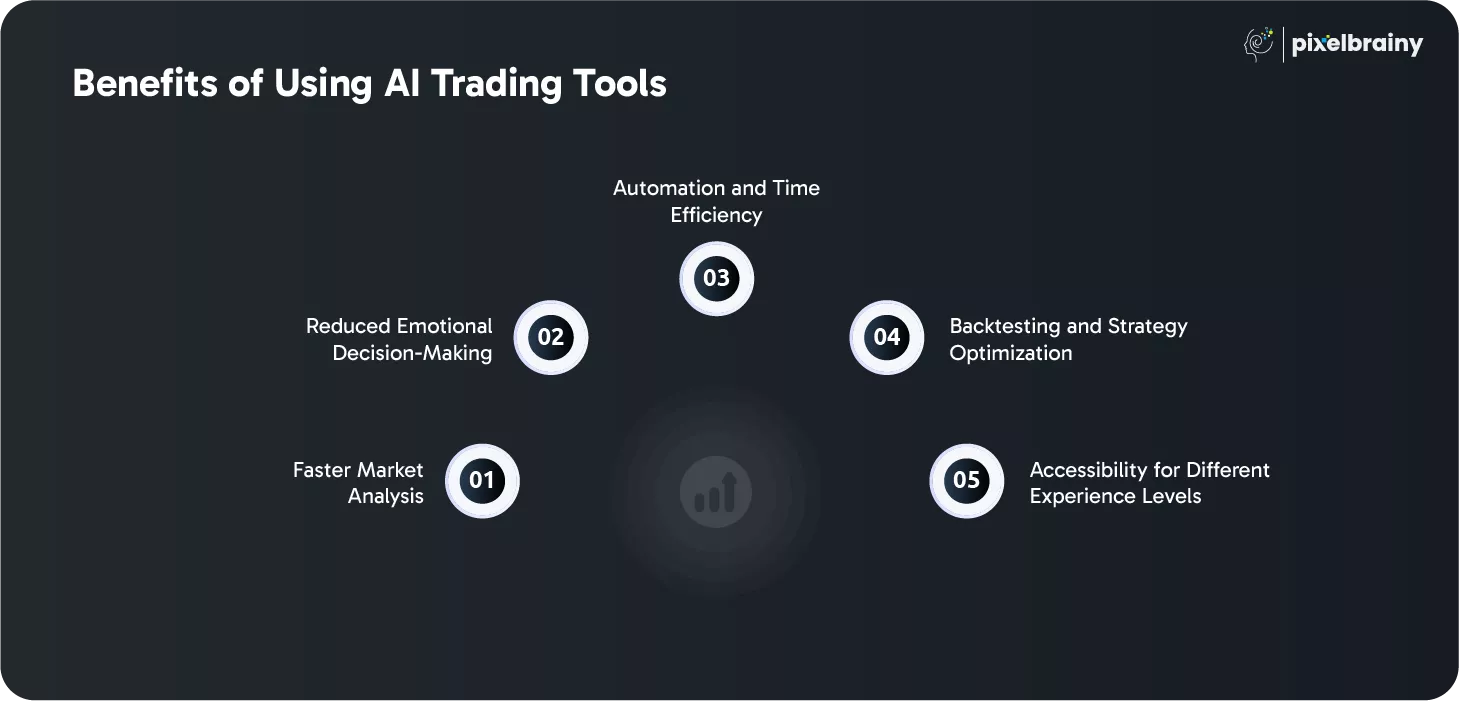
One of the biggest benefits of AI trading tools is the ability to analyze massive amounts of market data in real time.
This makes AI tools especially valuable for active traders and those using AI tools for day trading.
Emotions often influence trading decisions, leading to impulsive actions.
This is one reason many traders compare AI trading tools vs manual trading workflows.
Automation allows traders to focus on strategy rather than constant monitoring.
Many smart trading tools allow users to test strategies before deploying real capital.
Modern platforms make AI accessible to a wider audience.
AI trading tools can improve trading workflows by combining faster analysis, automation, backtesting, and disciplined execution. The right benefits depend on the platform’s capabilities and how effectively traders integrate AI tools for trading into their existing strategies and risk-management processes.
Also Read: AI Trading Assistant Development: From Concept to Market
Can AI trading tools deliver reliable trading decisions in changing market conditions, or can their limitations create new risks for traders? While AI tools for traders can improve market analysis, automation, and strategy execution, they do not eliminate market uncertainty or guarantee profitable outcomes.
For traders asking, “What are the risks of using AI trading tools for automated trading, stock analysis, or crypto strategies?”, the answer depends on factors such as market volatility, data quality, model performance, automation settings, technical complexity, and cost. Understanding these limitations is especially important when comparing AI trading tools vs manual trading, evaluating automated trading AI tools, or considering advanced artificial intelligence tools for trading.
Below are the key risks and limitations every trader should understand before relying heavily on automated trading AI tools or advanced artificial intelligence tools for trading.
Even the best AI trading tools operate based on historical patterns and statistical modeling. Financial markets are influenced by human behavior, unexpected news events, and changing economic conditions that cannot always be anticipated by algorithms. Sudden volatility or rare market scenarios may reduce the effectiveness of automated strategies, which is why continuous monitoring remains important.
Automated trading AI tools can execute trades efficiently, but they cannot replace a trader’s understanding of risk, market structure, or overall strategy. Over-reliance on automation may lead to situations where outdated strategies continue running without adjustment. Viewing AI trading tools vs manual trading as complementary approaches allows traders to maintain better control over outcomes.
Artificial intelligence tools for trading rely heavily on accurate data and well-designed algorithms. If data sources are incomplete or delayed, the quality of insights may suffer. Some AI models may also perform well in backtesting but struggle in live market environments due to changing conditions.
Although many platforms are designed as AI trading tools for beginners, advanced tools often require time to understand. Setting up automation workflows, configuring strategies, or integrating external tools can involve technical steps that require patience and learning.
Comparing free vs paid AI trading tools is essential before making long-term commitments. Subscription fees, premium analytics, and additional integrations can increase costs over time, so traders should evaluate whether features justify the investment.
AI trading tools can support faster and more structured trading workflows, but they should not replace risk management or informed decision-making. Understanding data limitations, market uncertainty, automation risks, technical complexity, and costs helps traders use AI tools for trading more responsibly and realistically.
Should an institutional trading team build a custom AI trading tool or use a ready-made platform for faster deployment? The answer depends on the level of customization, data integration, automation, strategy control, technical resources, and scalability required. While ready-made AI tools for traders provide faster access to built-in analytics and automation, custom solutions can be designed around proprietary strategies, data sources, execution logic, and existing trading infrastructure.
For teams asking, “Is a custom AI trading tool better than a ready-made platform for integrating proprietary data, automating strategies, and maintaining control over our trading workflow?”, the key difference is flexibility versus deployment speed. This comparison covers how AI trading tools, smart trading tools, artificial intelligence tools for trading, AI tools for day trading, and automated crypto trading AI tools differ when it comes to customization, integration, ownership, cost, and scalability.
Custom AI trading tools are tailor-made solutions designed specifically for individual traders, institutions, or businesses. These tools are built using artificial intelligence models that analyze market data, automate strategies, and integrate with specific workflows or brokerage systems. Developers or AI specialists usually create custom platforms to meet precise trading requirements.
Custom solutions provide full control over strategy logic, automation workflows, and risk management features. Traders who rely heavily on algorithmic strategies or proprietary models often prefer custom AI systems because they allow deeper personalization compared to standard smart trading tools.
Key advantages include:
However, custom development may require technical expertise, higher initial costs, and ongoing maintenance.
Ready-made AI trading tools are prebuilt platforms designed for quick access and ease of use. These solutions come with built-in automation features, AI-driven signals, and user-friendly interfaces that allow traders to start using artificial intelligence tools for trading without building systems from scratch.
Many of the best AI trading tools available today fall into this category, offering features such as automated crypto trading AI tools, AI tools for day trading, and AI trading tools for stock market trading.
Key advantages include:
The trade-off is reduced flexibility compared to custom-built solutions.
| Feature | Custom AI Trading Tool | Ready-Made AI Trading Tool |
| Customization Level | Fully customizable strategies and workflows | Limited customization within platform features |
| Technical Skill Required | High (coding or developer involvement) | Low to medium, often no coding required |
| Setup Time | Longer development and testing period | Quick setup and immediate use |
| Automation Flexibility | Advanced and fully controlled | Predefined automation options |
| Market Integration | Custom integrations possible | Depends on supported brokers/exchanges |
| Cost Structure | Higher upfront development cost | Subscription-based or freemium models |
| Best For | Algo traders, institutions, developers | Beginners, retail traders, quick deployment |
| Strategy Ownership | Fully proprietary | Platform-dependent strategies |
| Scalability | Highly scalable | Limited by platform capabilities |
| Maintenance | Requires ongoing updates and management | Managed by platform provider |
The choice between a custom AI trading tool and a ready-made AI trading platform ultimately depends on the required level of control, integration, automation, and scalability. Ready-made tools can support faster adoption, while custom AI trading software can provide greater flexibility for proprietary strategies and specialized institutional workflows.
What will AI trading tools look like as traders demand deeper analysis, alternative data, adaptive strategies, and more intelligent automation? The next generation of AI tools for traders is expected to move beyond basic signals and rule-based execution toward systems that can process broader datasets, adapt to changing market conditions, and support more personalized trading workflows.
For investors asking, “How will AI trading tools evolve to deliver better market intelligence, alternative data analysis, and personalized strategies without removing human control?”, the focus is shifting toward adaptive models, richer data integration, no-code strategy development, and closer collaboration between traders and AI. These developments could influence AI trading tools for stock market trading, AI tools for day trading, automated trading AI tools, artificial intelligence tools for trading, and smart trading tools across different markets.
Future AI trading platforms are expected to evolve into adaptive systems that continuously learn from market behavior. Instead of relying only on fixed strategies, automated trading AI tools may adjust parameters dynamically based on volatility, liquidity, and macroeconomic signals. This shift could make trading systems more responsive and reduce the need for constant manual adjustments.
The future of artificial intelligence tools for trading involves analyzing more than just price charts.
AI models are increasingly incorporating alternative data such as:
This broader data integration allows traders to gain deeper insights into market sentiment and potential price movements.
Accessibility is expected to improve significantly as platforms introduce no-code automation and AI-assisted strategy builders. Traders who previously lacked technical skills will be able to create automated workflows through visual interfaces, making AI trading tools for beginners more powerful and easier to use.
Future smart trading tools may provide tailored insights based on user behavior, risk tolerance, and trading goals. Instead of generic signals, AI systems could generate personalized recommendations aligned with individual investment strategies.
While automation will continue to grow, the future likely involves collaboration between traders and AI rather than complete replacement. AI trading tools vs manual trading approaches will merge, combining algorithmic efficiency with human intuition and strategic thinking.
The future of AI trading is likely to center on adaptive intelligence, alternative data, personalized strategies, and human-AI collaboration rather than automation alone. As these capabilities mature, AI trading tools can become more valuable decision-support systems while keeping traders in control of strategy and risk.
Also Read: How to Develop an AI Forex Trading Bot: From Strategy Design to Live Market Deployment
What if your trading team needs an AI system built around proprietary strategies, alternative data, custom analytics, and existing trading infrastructure rather than another off-the-shelf platform? For hedge funds, investment firms, fintech companies, and professional traders, a custom AI trading solution can provide greater control over how market data is processed, strategies are modeled, and trading workflows are automated.
PixelBrainy LLC is an AI trading software development company that helps businesses develop custom AI-powered trading solutions based on their specific technical and trading requirements. Instead of forcing proprietary strategies into the limitations of a ready-made platform, custom development can bring together AI models, market data, analytics, APIs, automation, and risk-management workflows within a purpose-built system.
A trading system should reflect the strategy and data infrastructure it supports. PixelBrainy can help design custom AI trading software around specific requirements such as:
This approach gives trading teams greater control over their models, workflows, data pipelines, and execution logic than many ready-made AI trading tools can provide.
Custom development can support different trading environments rather than being limited to one predefined platform. PixelBrainy can develop AI trading solutions for:
The architecture can also be designed around the team's existing research, execution, and data infrastructure.
For professional trading teams, integration is often as important as the AI model itself. A custom solution can connect with existing APIs, market-data providers, brokerages, exchanges, research systems, databases, and internal applications.
This can help create a unified workflow where data flows from collection and analysis through signal generation, risk checks, and execution without requiring the team to replace its entire technology stack.
As trading strategies evolve, the underlying technology needs to support additional models, datasets, markets, and users. PixelBrainy approaches custom AI trading software with modular architecture so capabilities can be expanded as requirements grow.
This can include high-volume data processing, machine learning pipelines, real-time analytics, API integrations, cloud infrastructure, and monitoring components.
Developing an AI trading platform requires more than adding an AI model to a trading interface. It involves translating trading requirements into technical architecture, data pipelines, model workflows, integrations, testing, deployment, and ongoing improvements.
As an AI trading software development company, PixelBrainy can support this process from initial strategy and architecture through development and deployment. This makes custom development particularly relevant for organizations that need an AI trading system aligned with proprietary strategies, specialized datasets, and existing investment infrastructure.
For teams that have outgrown the capabilities of ready-made AI tools for traders, custom development provides an opportunity to build around their own requirements instead of adapting their workflow to a third-party platform. PixelBrainy focuses on creating AI trading software that combines custom strategy logic, data integration, predictive analytics, automation, APIs, and scalable architecture into a solution designed for the organization's specific trading workflow.
Ready to build a custom AI trading platform around your strategies and data? Partner with PixelBrainy to turn your trading concept into production-ready AI trading software.

AI trading tools are becoming increasingly useful for market analysis, strategy development, automation, and data-driven decision-making. The top AI trading tools in 2026 now span stock analysis, algorithmic trading, crypto automation, portfolio intelligence, predictive analytics, and API-based workflows, giving traders and investment teams more options than traditional manual approaches alone.
The right solution depends on the depth of analysis, market coverage, automation requirements, data sources, integration needs, and level of control required. Ready-made platforms can provide faster deployment, while custom AI trading software can be better suited to organizations that need proprietary strategies, alternative data integration, specialized analytics, or deeper integration with existing trading infrastructure.
For hedge funds, investment firms, and professional trading teams looking beyond standard platforms, custom development can provide greater flexibility to build AI capabilities around specific research and trading workflows.
Ready to build an AI trading solution tailored to your strategies and infrastructure? Book an Appointment with PixelBrainy to discuss your AI trading software requirements.
The best AI trading tools for institutional equity research should provide more than basic trading signals. Professional teams may prioritize advanced equity analysis, earnings intelligence, alternative data integration, predictive analytics, historical datasets, and API access that can connect with existing research infrastructure.
AI trading tools can analyze financial statements, earnings history, estimates, market data, news, and other datasets to identify patterns associated with potential earnings surprises. However, earnings surprise prediction remains probabilistic and should be evaluated alongside fundamental research and risk management.
Platforms designed for algorithmic and institutional workflows may provide APIs for accessing market data, generating signals, executing trades, or connecting AI models with existing systems. API availability and capabilities vary by platform, so teams should assess documentation, data access, execution support, and integration requirements before adoption.
Alternative data can give AI trading systems access to information beyond conventional price and financial datasets. Depending on the platform, this may include news sentiment, social signals, on-chain data, economic indicators, or other specialized datasets that can support differentiated research and signal generation.
AI tools for day trading can help with real-time market scanning, pattern detection, technical analysis, alerts, and automated or semi-automated execution. Their usefulness depends on data quality, execution speed, strategy design, and how effectively the trader manages risk.
AI trading tools can process large datasets, monitor markets continuously, and execute predefined strategies consistently, while manual trading allows greater human judgment and contextual interpretation. For many workflows, AI trading tools vs manual trading is better viewed as a combination of automated analysis and human oversight rather than an either-or decision.
A ready-made AI trading platform can provide faster deployment, while custom AI trading software may be more appropriate when a hedge fund needs proprietary strategy logic, alternative data integration, specialized analytics, API connectivity, or control over its trading infrastructure. The decision depends on the firm's technical requirements, budget, and scalability needs.
AI trading tool costs vary significantly by platform, market, features, data access, automation level, and API requirements. Some offer free or freemium access, while advanced platforms may use paid subscriptions or customized enterprise pricing. Comparing the functionality provided against the total cost is more useful than evaluating subscription price alone.

About The Author
Sagar Bhatnagar
Sagar Sahay Bhatnagar brings over a decade of IT industry experience to his role as Marketing Head at PixelBrainy. He's known for his knack in devising creative marketing strategies that boost brand visibility and market influence. Sagar's strategic thinking, coupled with his innovative vision and focus on results, sets him apart. His track record of successful campaigns proves his ability to utilize digital platforms effectively for impactful marketing efforts. With a genuine passion for both technology and marketing, Sagar continuously pushes PixelBrainy's marketing initiatives to greater success.

Working with the PixelBrainy team has been a highly positive experience. They understand the design requirements and create beautiful UX elements to meet the application needs. The dev team did an excellent job bringing my vision to life. We discussed usability and flow. Sagar worked with his team to design the database and begin coding. Working with Sagar was easy. He has the knowledge to create robust apps, including multi-language support, Google and Apple ID login options, Ad-enabled integrations, Stripe payment processing, and a Web Admin site for maintaining support data. I'm extremely satisfied with the services provided, the quality of the final product, and the professionalism of the entire process. I highly recommend them for Android and iOS Mobile Application Design and Development.

Great experience working with them. Had a lot of feedback and I found that unlike most contractors they were bugging me for updates instead of the other way around. They were extremely time conscience and great at communicating! All work was done extremely high quality and if not on time, early! They were always proactive when it comes to communication and the work is great/above par always. Very flexible and a great team to work with! Goes above and beyond to present us with multiple options and always provides quality. Amazing work per usual with Chitra. If you have UI/UX or branding design needs I recommend you go to them! Will likely work with them in the future as well, definitely recommended!

PixelBrainy is a joy to work with and is a great partner when thinking through branding, logo, and website layout. I appreciate that they spend time going into the "why" behind their decisions to help inform me and others about industry best practices and their expertise.

I hired them to design our software apps. Things I really like about them are excellent communication skills, they answer all project suggestions and collaborate right away, and their input on design and colors is amazing. This project was complex and needed patience and creativity. The team is amazing to do business with. I will be using them long-term. Glad to see there are some good people out there. I was afraid to try and outsource my project to someone but I am glad I met them! I really can't say enough. They went above and beyond on this project. I am very happy with everything they have done to make my business stand out from the competition.

It was great working with PixelBrainy and the team. They were very responsive and really owned the project. We'll definitely work with them again!

I recently worked with the PixelBrainy team on a project and I was blown away by their communication skills. They were prompt, clear, and articulate in all of our interactions. They listened and provided valuable feedback and suggestions to help make the project a success. They also kept me updated throughout the entire process, which made the experience stress-free and enjoyable.

PixelBrainy is very good at what it does. The team also presents themselves very professionally and takes care of their side of things very well. I could fully trust them taking up the design work in a timely and organised manner and their attention to detail saved us lots of effort and time. This particular project was quite intense and the team showed that they function very well under pressure. Very much looking forward to working with her again!

It's always an absolute pleasure working with them. They completed all of my requests quickly and followed every note I had for them to a T, which made our process go smoothly from start to finish. Everything was completed fast and following all of the guidelines. And I would recommend their services to anyone. If you need any design work done in the future, PixelBrainy should be your first call!

They took ownership of our requirements and designed and proposed multiple beautiful variants. The team is self-motivated, requires minimum supervision, committed to see-through designs with quality and delivering them on time. We would definitely love to work with PixelBrainy again when we have any requirements.

PixelBrainy was a big help with our SaaS application. We've been hard at work with a new UI/UX and they provided a lot of help with the designs. If you're looking for assistance with your website, software, or mobile application designs, PixelBrainy and the team is a great recommendation.

PixelBrainy designers are amazing. They are responsive, talented, and always willing to help craft the design until it matches your vision. I would recommend them and plan to continue them for my future projects and more!!!

They were awesome! Did a good job fast, and good communication. Will work with them again. Thank you

Creative, detail-oriented, and talented designers who take direction well and implement changes quickly and accurately. They consistently over-delivered for us.

PixelBrainy team is very talented and creative. Great designers and a pleasure to work with. PixelBrainy is an excellent communicator and I look forward to working with them again.

PixelBrainy has a very talented design team. Their work is excellent and they are very responsive. I enjoy working with them and hope to continue on all of our future projects.


Transform your ideas into reality with us.
Across these industries, each engagement brings unique challenges, from early-stage product development to scaling complex systems, helping us build a practical understanding of real-world product environments.