AI Summary Powered by PixelBrainy
In 2026, organizations are looking for employee wellness solutions that can connect personalized support with measurable workforce outcomes. This demand is accelerating AI employee wellness app development, particularly among employers, HR teams, benefits providers, and healthtech businesses building data-driven wellness programs.
Consider an employee benefits brokerage firm planning a proprietary AI wellness app for employees as a value-added service for its corporate clients. Instead of offering another generic wellness platform, the firm wants its solution to connect with the health insurance plans it manages, understand workforce wellness patterns, and generate population-level analytics. These insights could help corporate clients identify health trends, improve wellness program engagement, and evaluate opportunities to manage healthcare claims costs over time.
This type of employee wellness app development requires more than a mobile interface and a collection of wellness resources. The platform may need insurance and benefits integrations, secure health-data management, AI-powered personalization, population health analytics, employee engagement tools, administrative dashboards, and scalable cloud infrastructure. Compliance, data governance, integration complexity, and AI capabilities can also have a direct impact on the cost to develop an AI wellness app.
AI can support this ecosystem by analyzing permitted data patterns, identifying engagement trends, delivering personalized wellness recommendations, and helping HR teams understand workforce-level insights. Depending on the use case, an AI wellness app can support mental wellbeing, fitness, nutrition, stress management, preventive wellness, and personalized health engagement.
This guide explores the core considerations involved in AI employee wellness app development, including essential features, benefits, technology stack, development process, cost factors, monetization strategies, advanced technologies, and implementation challenges.
Whether you are a benefits broker, HR technology provider, or business planning to build an AI wellness app, this guide will help you understand the development requirements and investment involved in creating a secure, scalable, and business-focused platform.
For HR leaders and benefits providers, the business case for an AI employee wellness app is increasingly tied to personalization, workforce engagement, actionable analytics, and the ability to scale wellness programs across diverse employee populations. AI can help organizations move from broad wellness offerings toward experiences that respond to individual preferences and workforce-level patterns.
Here are the key reasons to consider investing in AI employee wellness app development:
AI wellness apps are all about personalization, making them more effective in engaging employees. Traditional wellness programs usually follow a one-size-fits-all approach, but AI has the potential to create customized wellness plans that align with every employee’s unique requirements.
Employee wellbeing can influence attendance, energy, engagement, and workplace performance. AI-powered wellness platforms can help organizations identify behavioral trends and deliver timely, preventive support.
The financial case for AI wellness app development becomes stronger when wellness initiatives are connected to measurable outcomes such as participation, preventive care engagement, absenteeism, and healthcare utilization.
The global corporate wellness solutions market is estimated at $100.91 billion in 2026 and is projected to reach $144.37 billion by 2030, growing at a 9.4% CAGR.
AI wellness platforms can transform permitted workforce data into actionable, aggregated insights for HR and benefits teams.
Employees increasingly expect convenient digital experiences for managing different aspects of their wellbeing.
The global wellness apps market is projected to reach $15.3 billion in 2026 and $26.2 billion by 2030, representing a 14.9% CAGR from 2025 to 2030. North America accounted for 36.3% of the market in 2024.
A proprietary employee wellness app can become an extension of an organization's employee experience and benefits strategy.
For benefits brokers, HR technology providers, and employers, AI can create differentiation through personalization, analytics, and scalable digital delivery.
The global workplace wellness market is expected to grow from $57.97 billion in 2025 to $79.37 billion by 2030 at a 6.4% CAGR, with rising integration of AI-based wellness tools identified among the forecast-period trends.
For a benefits brokerage firm planning an AI wellness platform with insurance integration and population health analytics, the opportunity is not simply to digitize wellness programs. It is to create a scalable product that connects employee engagement with measurable client outcomes.
The value of a custom AI employee wellness app becomes clearer when its impact is measured across both business operations and employee experiences. For employers and benefits providers, AI can support personalized wellness at scale, connect relevant HR and benefits data, identify engagement patterns, and generate actionable workforce insights. For employees, it can deliver more relevant guidance, convenient mental wellness support, and personalized tools that fit their individual goals.
This is especially valuable for an employee benefits brokerage firm offering a proprietary wellness platform to corporate clients. By combining AI personalization with HR and insurance integrations, the platform can support individual employee engagement while also producing aggregated population-level insights that help clients evaluate wellness initiatives and healthcare cost trends.
Below, we will explore the key benefits of building an app for employee wellness integrating AI,, including how businesses can improve workforce engagement, operational efficiency, personalization, and data-driven decision-making while employees receive more accessible and relevant wellness support.
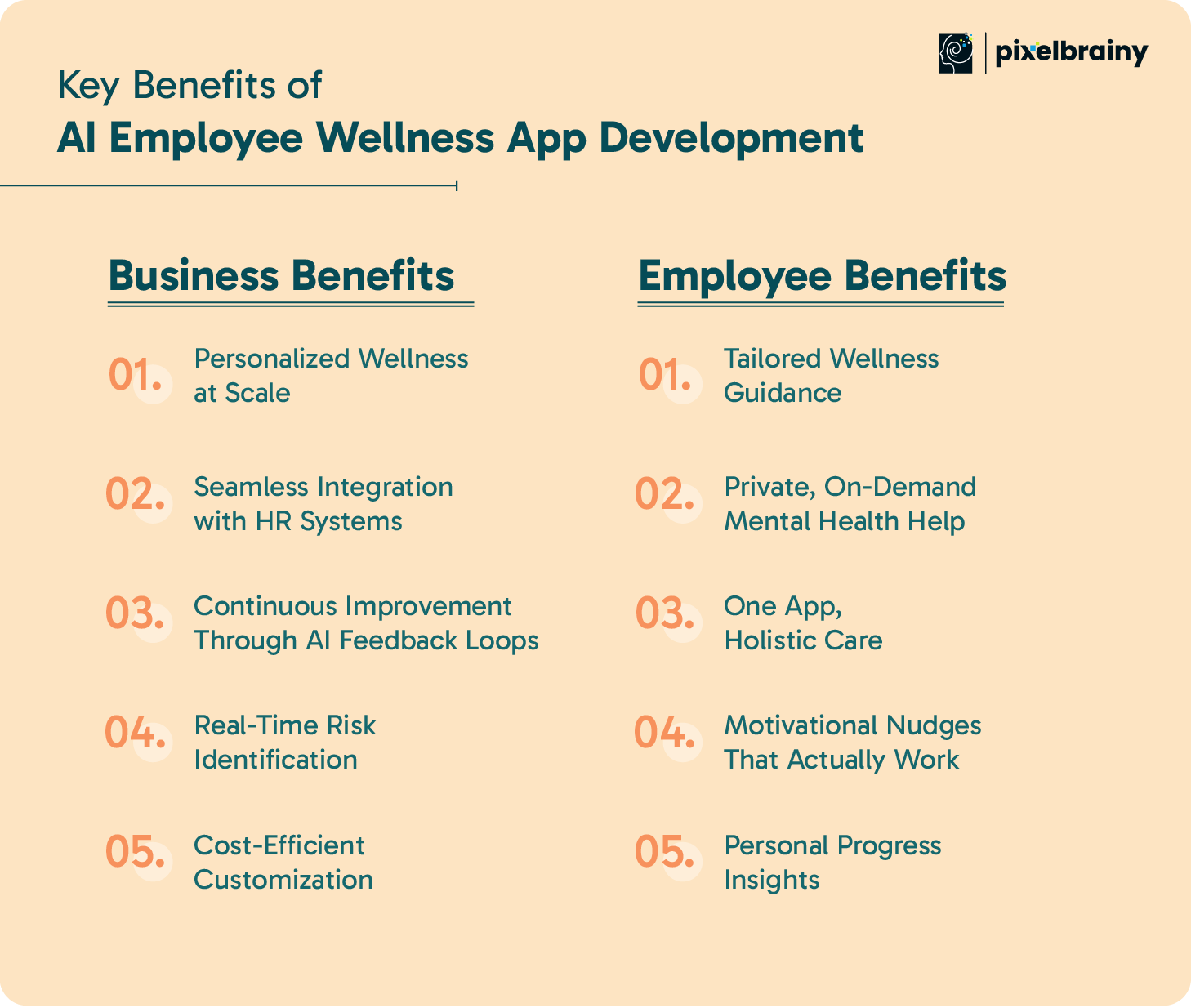
Unlike traditional programs, custom AI wellness apps adjust in real time, offering personalized wellness experiences with no additional human effort.
Modern AI wellness platforms can flawlessly integrate with HR tools like performance trackers or attendance systems.
AI doesn’t just automate; it learns.
AI can flag warning signs, like frequent late logins and skipped breaks, that may imply declining wellness.
Building a mental health AI app no longer demands a massive budget.
Employees get wellness support that unwinds with them based on their preferences, activity, and stress levels. Whether adjusting a workout plan or suggesting a mindfulness break, the app responds in real time.
With built-in tools like an AI chatbot for mental health, employees can get support anytime with no need to speak to someone directly. This way, it promotes early intervention and decreases stigma.
Rather than juggling numerous platforms, AI wellness apps offer a single place for mental, physical, and lifestyle support. From hydration reminders to sleep tracking and emotional check-ins, this app is an all-in-one intelligent system.
AI knows when engagement sinks and sends timely and relevant reminders without annoying users. It helps them stay on track without feeling micromanaged.
Employees can view their progress, trends, and milestones. These insights authorize them to take control of their health journey, one habit at a time.
A well-designed AI employee wellness app can create value at both levels: personalized support for employees and actionable workforce intelligence for businesses and benefits providers.
A successful AI employee wellness app needs features that serve two priorities at once: delivering personalized, accessible wellness support to employees and giving organizations meaningful, privacy-conscious insights into workforce wellbeing. For benefits brokers and employers, the right feature set can also connect wellness programs with HR systems, wearable data, and population-level analytics without exposing individual employee health information unnecessarily.
For an organization planning to offer an AI wellness platform to corporate clients, features such as adaptive recommendations, mental health support, wearable integrations, predictive analytics, and secure data management can create a more valuable experience than basic fitness tracking alone. The feature selection should also reflect the intended use case, compliance requirements, employee demographics, and the level of personalization expected.
Here are the essential AI wellness app features to consider when planning AI employee wellness app development:
| Feature | Description |
| AI-Powered Mood and Emotion Tracking | It uses AI to monitor emotional patterns and detect early signs of stress or disengagement |
| Mental Health Chatbot Support | Provides 24/7 private mental health assistance using conversational AI |
| Personalized Wellness Recommendations | Delivers adaptive suggestions based on employee behavior, preferences, and goals |
| Integration with Wearables and Fitness Trackers | Connects with devices like Fitbit or Apple Watch to track steps, sleep, heart rate, etc |
| Stress and Burnout Prediction Models | Uses machine learning to identify early indicators of burnout risk |
| Daily Health Check-ins and Surveys | AI-curated prompts to monitor well-being and adjust plans dynamically |
| Sleep Tracking and Improvement Suggestions | Tracks sleep patterns and offers personalized recommendations |
| Nutrition and Hydration Tracking | It lets users log meals/water and get health-boosting suggestions |
| Gamified Wellness Challenges | Adds motivation through AI-personalized challenges and team competitions |
| Virtual Wellness Coaching Sessions | Offers expert or AI-guided coaching in fitness, mindfulness, and more |
| Real-Time Analytics Dashboard for HR | Gives HR actionable insights into overall team wellness (aggregate only) |
| Employee Progress and Goal Tracking | Tracks individual milestones, habits, and goal completion |
| Social Features for Peer Support | Enables moderated forums, group challenges, and support circles |
| Mindfulness and Meditation Content | Offers guided sessions and tools to boost focus and reduce anxiety |
| Secure Data Storage with Compliance | Ensures HIPAA/GDPR compliance with encrypted, secure data handling |
Therefore selecting the right employee wellness app features helps balance personalized employee support with secure, actionable organizational insights, creating a stronger foundation for a scalable AI wellness platform.
Creating an AI employee wellness app requires more than combining wellness content with artificial intelligence. The development process should connect employee needs, business objectives, AI capabilities, data privacy, usability, and measurable wellness outcomes from the beginning.
For example, imagine a startup developing a wellness platform for mid-sized companies that want personalized stress management, fitness guidance, mental wellness support, and aggregated workforce analytics. The team must decide which AI capabilities belong in the first release, what employee data can be used, how the platform will integrate with existing HR systems, and how success will be measured.
The following eight steps explain the steps to build AI employee wellness app from idea to launch, covering everything from research and requirements to deployment and continuous improvement.
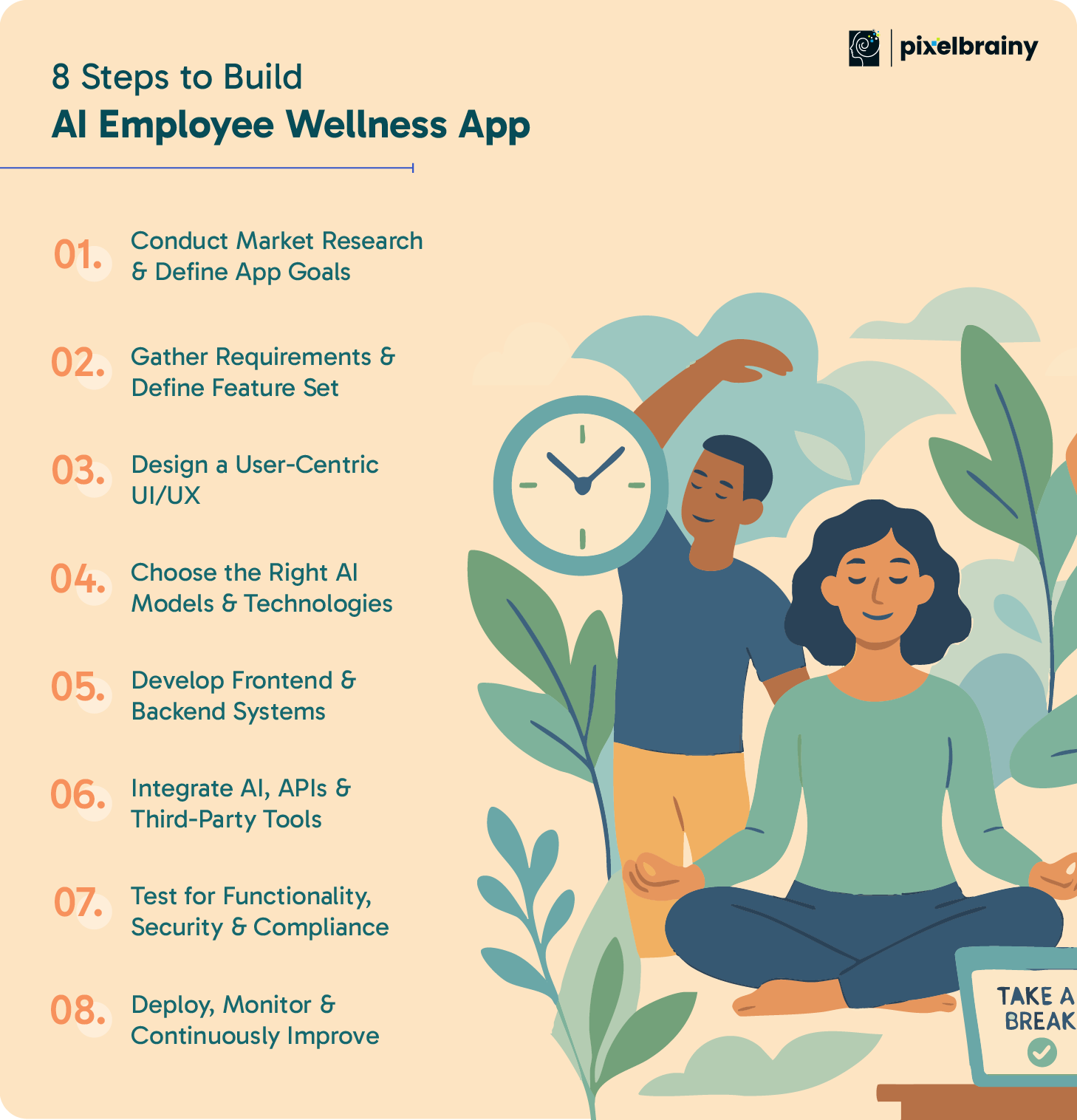
Start by understanding the wellness challenges your target employees and business customers actually face. Research competing employee wellness platforms, employee expectations, industry trends, and gaps in existing solutions.
Define whether your primary objective is improving wellness engagement, supporting mental health, encouraging healthier habits, reducing burnout risks, or providing organizations with aggregated workforce insights. Clear goals will influence your AI capabilities, feature priorities, technology architecture, and development budget.
If you are planning AI employee wellness app development for startups, avoid trying to solve every wellness problem at once. Identify one strong use case, define measurable outcomes, and establish the target audience before moving into product planning.
Once the goals are clear, translate them into functional and technical requirements. Determine which features employees need and which capabilities HR teams or administrators require.
Your initial feature set may include AI-powered wellness recommendations, mood check-ins, mental wellness resources, habit tracking, personalized challenges, wearable integrations, notifications, progress dashboards, and aggregated analytics.
Involve employees, HR professionals, benefits teams, and other relevant stakeholders during requirement gathering. Their feedback can reveal usability concerns and privacy expectations that may not be visible from a business perspective.
For startups, prioritizing features at this stage also helps establish a practical MVP instead of investing heavily in capabilities that users may not need.
Employee wellness applications need an interface that feels simple, welcoming, accessible, and trustworthy. Employees should be able to complete check-ins, view recommendations, track goals, and access wellness resources without navigating complicated workflows.
Create wireframes, user journeys, interactive prototypes, and accessibility-focused layouts before development begins. Personalization should also be reflected in the experience, allowing users to control preferences, notifications, wellness goals, and the type of content they receive.
Working with a specialized UI/UX design company can help establish a consistent design system across employee, HR, and administrator experiences while keeping the interface intuitive across mobile and web platforms.
The AI architecture should be selected according to the actual wellness use cases rather than simply adding AI because it is commercially attractive. NLP can support conversational wellness assistants, recommendation models can personalize content, and predictive analytics can identify patterns in engagement or wellness-related data.
During AI model development, evaluate factors such as accuracy, explainability, privacy, inference costs, scalability, and the sensitivity of the information being processed. Avoid presenting AI outputs as medical diagnoses unless the product has been specifically designed, validated, and regulated for that purpose.
A focused AI consultation can help determine which models and approaches are appropriate for the intended users, data, integrations, and business objectives.
With the requirements and architecture established, developers can begin creating the employee-facing application and backend infrastructure.
The frontend should provide responsive experiences for activities such as wellness check-ins, personalized recommendations, goal tracking, content discovery, and notifications. The backend should securely manage user profiles, wellness preferences, application logic, analytics, integrations, and AI services.
Build the architecture with scalability in mind so the platform can support additional organizations, employees, features, and integrations without requiring a complete rebuild. Strong authentication, authorization, encryption, logging, and access controls should be incorporated from the beginning.
For organizations planning to create an AI employee wellness app, this foundation directly affects performance, security, maintenance, and future expansion.
The next stage connects the application with the external technologies required to deliver its intended experience. Depending on the product scope, this may include wearable devices, fitness platforms, HRMS systems, employee benefits platforms, calendars, communication tools, content services, and AI APIs.
During AI integration, establish clear rules for what information can be collected, processed, stored, and shared. Data synchronization should be reliable, while permission controls should allow employees to understand and manage their data choices.
If the platform serves corporate clients, integrations should also support aggregated reporting without unnecessarily exposing individual employee information. This approach can improve trust while giving organizations useful workforce-level insights.
Testing should cover much more than whether buttons and screens work correctly. Conduct functional, performance, usability, security, integration, and AI response testing across supported devices and workflows.
Evaluate whether recommendations are relevant, whether conversational features respond appropriately, and whether analytics remain accurate when data changes. Security testing should examine authentication, authorization, encryption, APIs, data storage, and potential vulnerabilities.
Compliance requirements should be assessed according to the application's intended use, location, data types, and integrations. Conducting PoC development before full-scale implementation can also help validate technically complex AI functionality and identify risks before they become expensive development problems.
Launch the platform in controlled stages rather than immediately rolling it out to every employee or corporate client. Begin with a pilot group, monitor engagement, collect user feedback, and evaluate whether the application is achieving its defined objectives.
Track metrics such as active users, feature adoption, wellness-content engagement, retention, recommendation interactions, and organizational-level program participation. Use these insights to prioritize future improvements.
Post-launch optimization may include improving AI recommendations, adding new wellness programs, introducing integrations, refining dashboards, and expanding personalization. This continuous approach allows AI employee wellness app development to evolve alongside employee expectations and business requirements.
Whether you work with top AI app development companies or AI product development companies, select a partner that can support the complete lifecycle from architecture and development to optimization and scaling.
Following a structured development process of AI employee wellness app helps transform an initial wellness concept into a secure, scalable, and measurable product that serves both employees and organizations.
Also Read: A Comprehensive Guide To AI Mobile App Development
What is the cost to develop AI wellness app? You can’t know the exact app development pricing as it depends on numerous aspects (we will discuss ahead in this section).
On average, the cost to develop AI wellness app in 2026 typically ranges from $20,000 to $200,000+. This broad range reflects the scope, complexity, and customization level your organization may need.
Below is a thorough analysis to help you estimate your potential investment:
| App Type | Estimated Cost Range |
| Basic MVP | $20,000 – $50,000 |
| Mid-Level Platform | $50,000 – $120,000 |
| Enterprise-Grade Solution | $120,000 – $200,000+ |
Note: The above cost estimates are based on standard market rates for AI employee wellness app development in 2026. Actual pricing may vary depending on numerous factors (discussed below). For a tailored quote, it’s best to consult custom AI wellness app developers at PixelBrainy.
The more advanced your features, such as AI-powered burnout prediction, mood tracking, or real-time analytics, the higher the development effort and cost. Every extra capability demands additional design, coding, and testing.
Custom AI needs expert training, quality data, and ongoing optimization. Pre-built models can lower costs, but creating proprietary algorithms increases precision and price.
A polished, intuitive user interface ensures high employee engagement. Investing in engaging design upfront bypasses friction later and increases daily usage rates.
Syncing with wearables, calendars, HR systems, or Slack needs API work and testing. The more integrations you want, the more backend logic and support are required.
Protecting employee health data suggests adhering to HIPAA, GDPR, or SOC 2 standards. Secure architecture and routine audits contribute to the development timeline and cost.
US-based firms provide high-quality output with robust business understanding, but at a premium. Offshore developers may provide cost advantages, but deep communication and QA may require tighter supervision.
Cost-Saving Tips:
Also Read: AI App Development Cost: From MVPs to Full-Scale AI App
Selecting the right technology stack is an important part of AI employee wellness app development because the chosen tools influence how effectively the platform can handle personalization, predictive analytics, conversational interactions, behavior tracking, and secure data processing.
For a wellness platform serving employees and corporate clients, the technology stack should support both AI functionality and enterprise requirements. Machine learning frameworks can power predictive wellness models, NLP tools can support conversational experiences, analytics platforms can help identify engagement trends, and cloud infrastructure can provide the scalability required as the employee population grows.
Security also needs to be considered at the technology-selection stage. Employee wellness platforms may process sensitive information, so authentication, access control, secrets management, encryption, and appropriate compliance safeguards should be built into the architecture rather than added after development.
Below is a practical overview of the tools and frameworks commonly considered when planning an AI wellness app development project, covering AI and machine learning, NLP, analytics, infrastructure, and data security.
| Tool/Framework | Use Case in Wellness Apps |
| TensorFlow | Open-source ML framework used for emotion detection, health prediction, and natural language processing |
| PyTorch | Preferred for custom AI model development due to flexibility and faster experimentation |
| scikit-learn | Ideal for building predictive models such as stress or burnout likelihood |
| Keras | Simplifies neural network training for wellness recommendation engines |
| Tool/Framework | Use Case in Wellness Apps |
| spaCy | Enables chatbots to understand user input and mood context |
| Transformers (Hugging Face) | Used in mental health chatbots for sentiment analysis and therapeutic response generation |
| Dialogflow / Rasa | Powers conversational AI to guide employees through mental health resources or mindfulness tips |
| Tool/Framework | Use Case in Wellness Apps |
| Google Analytics / Mixpanel | Track user engagement, feature usage, and wellness activity trends |
| Power BI / Tableau | Create real-time HR dashboards to visualize employee progress and overall wellness impact |
| Firebase Analytics | Monitor user retention, crashes, and session time for mobile wellness apps |
| Tool/Framework | Use Case in Wellness Apps |
| AWS SageMaker | Train, deploy, and manage AI models securely and at scale |
| Google Cloud AI | Provides pre-trained models for sentiment detection and personalization |
| Azure Machine Learning | Enterprise-grade platform for AI lifecycle management and integration with corporate IT systems |
| Tool/Framework | Use Case in Wellness Apps |
| OAuth 2.0 / JWT | Secure authentication for employee logins and data access |
| AWS Cognito / Auth0 | Ensures HIPAA and GDPR-compliant identity management |
| Vault by HashiCorp | Manages secrets, tokens, and sensitive data securely |
The right combination of AI frameworks, analytics tools, cloud infrastructure, and security technologies creates a strong technical foundation for a scalable and privacy-conscious employee wellness platform.
An AI employee wellness app can generate revenue by serving employers, benefits providers, wellness organizations, and employees through flexible pricing structures. The right monetization strategy should match your target customers, employee population, feature depth, and level of enterprise customization.
For example, a benefits brokerage firm offering a proprietary wellness platform to corporate clients may prefer per-employee licensing or enterprise subscriptions, while a wellness startup may use a freemium model to build an initial user base before introducing premium AI capabilities. A white-label model can also create an additional revenue opportunity for providers that want to offer branded wellness solutions to multiple organizations.
Below are five scalable monetization strategies to consider for custom AI employee wellness app development:
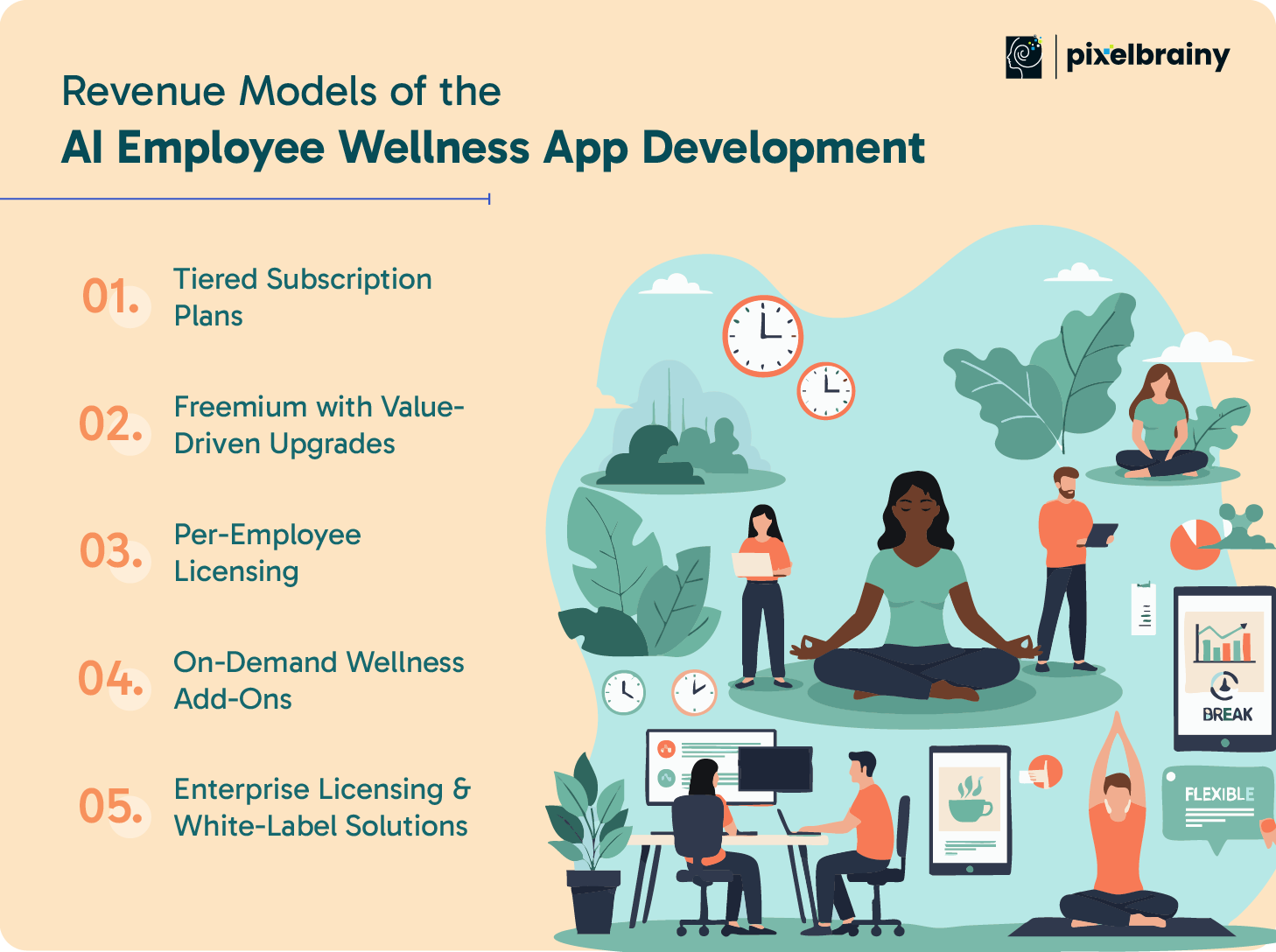
Charge companies on a recurring monthly or annual basis, providing feature-rich tiers like starter, growth, and enterprise. This structure is perfect for recurring revenue and permits HR teams to select a plan based on wellness goals, team size, and integration needs.
Give users access to basic features, like daily health check-ins or mood tracking, at no cost. Next, offer premium features, such as AI-driven mental health coaching, advanced analytics, or custom goal setting as a paid upgrade.
Bill companies depend on the number of active users enrolled in the wellness program. It is a clear, scalable model mostly chosen by mid-size to large organizations aiming for ROI per headcount.
Monetize with pick-and-choose features, like mindfulness bundles, personal coaching sessions, or AI-curated fitness plans. It works well for firms that want flexible add-ons without committing to full-scale subscriptions.
Offer bulk licensing and white-label options for large enterprises or wellness providers. Incorporate custom branding, compliance support (HIPAA, SOC 2), dedicated AI integrations, and a private HR dashboard for full control.
A well-planned monetization strategy can turn an AI wellness platform into a scalable recurring-revenue product while giving corporate customers flexibility in how they adopt and expand its capabilities.
An AI employee wellness app can bring personalization, analytics, and proactive wellness support to the workplace, but its development also involves challenges around sensitive data, AI reliability, enterprise integrations, engagement, and regulatory requirements. Addressing these areas early helps create a platform that employees can trust and organizations can deploy confidently.
For example, a benefits provider offering an AI wellness platform to multiple corporate clients must protect employee information while still providing useful population-level insights. The architecture should therefore separate individual-level data from aggregated reporting and establish clear controls over what employers can access.
Here are the key challenges and practical solutions to consider during AI employee wellness app development:
Addressing these challenges from the architecture and planning stages can help create an AI employee wellness app that is secure, reliable, engaging, and suitable for enterprise deployment.
Your employee wellness platform should do more than collect wellness data or display generic health content. It should personalize employee experiences, generate meaningful workforce insights, integrate with your existing business ecosystem, and scale as your client or employee base grows. That requires a development partner that understands both AI product engineering and the practical requirements of enterprise wellness platforms.
PixelBrainy a leading AI app development company helps businesses turn these requirements into intelligent, scalable wellness products. From AI-powered mental wellness and personalized recommendations to wearable integrations, HR systems, employee engagement tools, and population-level analytics, our team can support the complete product lifecycle.
For an employee benefits brokerage, for example, the requirements may extend beyond a standard wellness app. You may need to connect insurance-related systems, provide corporate clients with aggregated wellness analytics, protect employee-level information, and deliver a branded experience that can serve multiple organizations. PixelBrainy can structure the product around these requirements while helping you prioritize features and manage development investment.
Client: Mid-sized IT company in New York with 300+ employees
Challenge: The client's existing wellness program had less than 15% employee engagement and provided limited personalization.
PixelBrainy focuses on building the right product before building every possible feature. We can help prioritize high-value functionality, select appropriate AI models, adopt modular architecture, and phase advanced capabilities after the initial MVP.
This approach helps businesses avoid unnecessary development expenses while maintaining a foundation for future integrations, additional wellness programs, and larger employee populations.
Our experience across AI healthcare solutions also supports projects that involve sensitive wellness data, personalization, analytics, and health-related integrations.
Real Query: If you are a benefits brokerage looking to offer an AI wellness platform to multiple corporate clients, PixelBrainy can help you evaluate the right combination of insurance integrations, population analytics, AI personalization, privacy controls, and scalable architecture without overbuilding the first version.
Ready to turn your wellness product idea into a scalable AI platform? Book a free strategy session with PixelBrainy.
As employee wellbeing becomes a greater priority for modern organizations, AI employee wellness app development is creating new opportunities to deliver personalized, proactive, and measurable support at scale. By combining AI-driven insights with wellness programs, businesses can better understand workforce needs while creating more engaging experiences for employees.
Whether you plan to enhance an existing platform with AI or create an AI employee wellness app from the ground up, the right strategy can help improve employee engagement, productivity, and retention while supporting long-term business goals.
If employee wellness app development is on your roadmap, now is the time to make your solution smarter, scalable, secure, and future-ready with AI.
Ready to explore your AI wellness app idea? Schedule a call with PixelBrainy today and discuss your requirements with our experts.
AI-powered apps go beyond basic tracking; they analyze behavior patterns, predict wellness risks, and offer real-time personalized insights. Unlike traditional tools, they continuously learn and adapt to user needs, making employee wellness app development smarter and more impactful.
By analyzing data from daily habits, mood inputs, wearable devices, and engagement trends, AI models generate tailored suggestions for mental health support, physical activity, sleep improvement, and stress reduction, all in real time.
AI employee wellness apps must comply with privacy and health standards like HIPAA, GDPR, and CCPA, depending on the data scope. Encryption, user consent, and secure data storage are essential during development.
Yes. AI models use behavioral signals such as reduced activity, irregular work patterns, and survey inputs to identify potential burnout or emotional distress early, helping HR teams intervene proactively.
Modern apps connect seamlessly with smartwatches, fitness trackers, and HRIS tools using APIs. This enables holistic monitoring and gives HR teams unified dashboards for wellness insights and workforce trends.
ROI can be measured through improved employee retention, reduced absenteeism, higher engagement levels, and cost savings from healthier teams. Real-time analytics dashboards provide measurable KPIs for ongoing evaluation.
Absolutely. With custom AI employee wellness app development, businesses can get fully branded, white-label platforms tailored to their workforce, including features, branding, and integration preferences.
Depending on features and complexity, the development timeline ranges from 3 to 6 months for MVPs and 6 to 12+ months for enterprise-grade solutions with deep AI integration and compliance layers.

About The Author
Sagar Bhatnagar
Sagar Sahay Bhatnagar brings over a decade of IT industry experience to his role as Marketing Head at PixelBrainy. He's known for his knack in devising creative marketing strategies that boost brand visibility and market influence. Sagar's strategic thinking, coupled with his innovative vision and focus on results, sets him apart. His track record of successful campaigns proves his ability to utilize digital platforms effectively for impactful marketing efforts. With a genuine passion for both technology and marketing, Sagar continuously pushes PixelBrainy's marketing initiatives to greater success.

Working with the PixelBrainy team has been a highly positive experience. They understand the design requirements and create beautiful UX elements to meet the application needs. The dev team did an excellent job bringing my vision to life. We discussed usability and flow. Sagar worked with his team to design the database and begin coding. Working with Sagar was easy. He has the knowledge to create robust apps, including multi-language support, Google and Apple ID login options, Ad-enabled integrations, Stripe payment processing, and a Web Admin site for maintaining support data. I'm extremely satisfied with the services provided, the quality of the final product, and the professionalism of the entire process. I highly recommend them for Android and iOS Mobile Application Design and Development.

Great experience working with them. Had a lot of feedback and I found that unlike most contractors they were bugging me for updates instead of the other way around. They were extremely time conscience and great at communicating! All work was done extremely high quality and if not on time, early! They were always proactive when it comes to communication and the work is great/above par always. Very flexible and a great team to work with! Goes above and beyond to present us with multiple options and always provides quality. Amazing work per usual with Chitra. If you have UI/UX or branding design needs I recommend you go to them! Will likely work with them in the future as well, definitely recommended!

PixelBrainy is a joy to work with and is a great partner when thinking through branding, logo, and website layout. I appreciate that they spend time going into the "why" behind their decisions to help inform me and others about industry best practices and their expertise.

I hired them to design our software apps. Things I really like about them are excellent communication skills, they answer all project suggestions and collaborate right away, and their input on design and colors is amazing. This project was complex and needed patience and creativity. The team is amazing to do business with. I will be using them long-term. Glad to see there are some good people out there. I was afraid to try and outsource my project to someone but I am glad I met them! I really can't say enough. They went above and beyond on this project. I am very happy with everything they have done to make my business stand out from the competition.

It was great working with PixelBrainy and the team. They were very responsive and really owned the project. We'll definitely work with them again!

I recently worked with the PixelBrainy team on a project and I was blown away by their communication skills. They were prompt, clear, and articulate in all of our interactions. They listened and provided valuable feedback and suggestions to help make the project a success. They also kept me updated throughout the entire process, which made the experience stress-free and enjoyable.

PixelBrainy is very good at what it does. The team also presents themselves very professionally and takes care of their side of things very well. I could fully trust them taking up the design work in a timely and organised manner and their attention to detail saved us lots of effort and time. This particular project was quite intense and the team showed that they function very well under pressure. Very much looking forward to working with her again!

It's always an absolute pleasure working with them. They completed all of my requests quickly and followed every note I had for them to a T, which made our process go smoothly from start to finish. Everything was completed fast and following all of the guidelines. And I would recommend their services to anyone. If you need any design work done in the future, PixelBrainy should be your first call!

They took ownership of our requirements and designed and proposed multiple beautiful variants. The team is self-motivated, requires minimum supervision, committed to see-through designs with quality and delivering them on time. We would definitely love to work with PixelBrainy again when we have any requirements.

PixelBrainy was a big help with our SaaS application. We've been hard at work with a new UI/UX and they provided a lot of help with the designs. If you're looking for assistance with your website, software, or mobile application designs, PixelBrainy and the team is a great recommendation.

PixelBrainy designers are amazing. They are responsive, talented, and always willing to help craft the design until it matches your vision. I would recommend them and plan to continue them for my future projects and more!!!

They were awesome! Did a good job fast, and good communication. Will work with them again. Thank you

Creative, detail-oriented, and talented designers who take direction well and implement changes quickly and accurately. They consistently over-delivered for us.

PixelBrainy team is very talented and creative. Great designers and a pleasure to work with. PixelBrainy is an excellent communicator and I look forward to working with them again.

PixelBrainy has a very talented design team. Their work is excellent and they are very responsive. I enjoy working with them and hope to continue on all of our future projects.

Transform your ideas into reality with us.
Across these industries, each engagement brings unique challenges, from early-stage product development to scaling complex systems, helping us build a practical understanding of real-world product environments.