AI Summary Powered by PixelBrainy
Patients are becoming more digital. Hospitals are becoming more crowded. Healthcare professionals are becoming more overwhelmed. This is the perfect moment for AI Healthcare Triage Software to step in and reshape patient intake, reduce bottlenecks, and support clinical decisions at scale.
AI Healthcare Triage Software development is now one of the fastest growing sectors in digital health transformation. As hospitals, clinics, and telemedicine platforms look for ways to streamline care, many are asking how to build AI Healthcare Triage Software that is reliable, compliant, and clinically useful. This guide gives healthcare leaders, product teams, software engineers, and health tech entrepreneurs a complete understanding of Healthcare Triage Software Development Integrating AI.
Whether you are building a patient-facing symptom checker, an automated intake assistant, or a clinical decision support solution, developing AI Healthcare Triage Software requires a structured approach. You must balance accuracy, usability, privacy, safety, and real time responsiveness. You must also understand the technology, workflows, and regulations that guide modern healthcare.
This guide also explores the essential steps to make Healthcare Triage Software Development with AI successful. From core features to advanced capabilities, from compliance to integration requirements, and from budgeting to choosing the right development partner, each section offers insights for teams who want to create meaningful impact.
If you are exploring AI triage solutions for your hospital or planning to build a large scale digital health product, this complete guide will help you move forward with confidence.
AI Healthcare Triage Software is a digital system that evaluates patient symptoms, gathers health information, and provides routing suggestions using artificial intelligence. It helps determine the urgency of a patient’s condition and directs them to the right care pathway. This may include emergency services, specialist consultation, primary care appointments, virtual care, or home self care instructions.
The software uses machine learning, natural language processing, and structured medical knowledge bases to interpret patient inputs. By automating the first stage of clinical assessment, AI triage systems reduce workload for medical teams and improve response times for patients.
According to a recent industry report, the global AI in healthcare market is projected to reach USD 208.2 billion by 2030, driven significantly by automated triage, clinical decision support, and digital intake systems.
This sharp rise of AI adoption reflects a global shift toward intelligent patient intake and smarter clinical workflows. Modern hospitals are moving quickly toward solutions that reduce pressure on frontline staff and increase patient throughput.
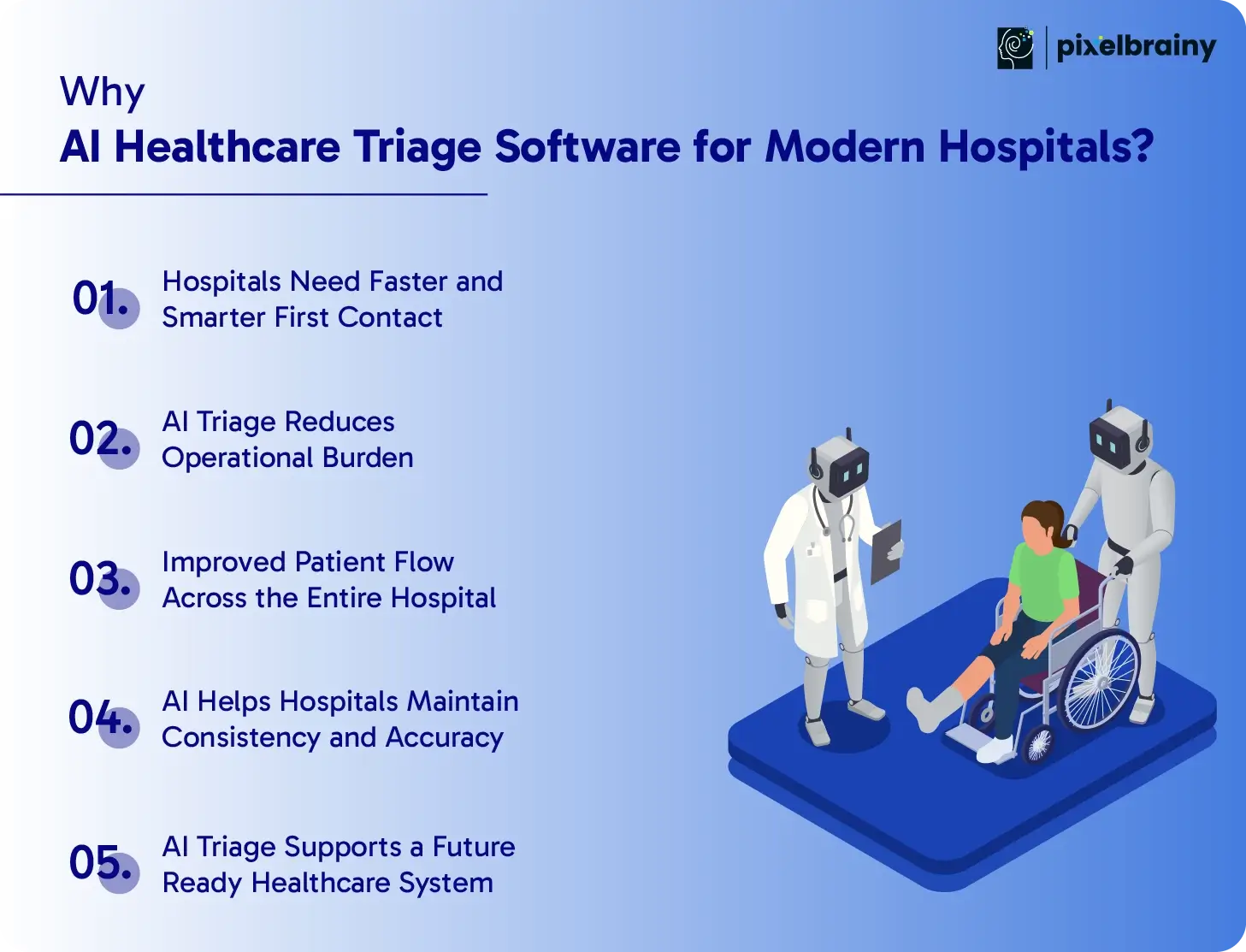
Every hospital has the same problem. Too many patients. Not enough staff. And unpredictable surges in demand.
By investing in AI Healthcare Triage Software Development hospitals gain an automated first line of assessment that helps:
This helps hospitals deliver care faster and with more consistency across departments.
Creating AI Healthcare Triage Software removes a significant amount of manual work from nurses and triage teams. Instead of spending valuable time on repetitive questions and documentation, staff can focus on complex cases that truly require human expertise.
Hospitals benefit through:
The building of AI Healthcare Triage Software is not just about symptom checking. It becomes part of a larger patient flow strategy. When connected to EHRs, scheduling systems, and telemedicine modules, triage becomes a continuous path instead of a standalone task.
This creates:
Human triage is affected by stress, fatigue, peak hours, and case volume. AI triage tools evaluate every patient with the same precision every time.
Hospitals that choose to make AI Healthcare Triage Software part of their workflow experience fewer assessment errors and more reliable risk scoring.
As digital health grows, hospitals must adapt. AI triage systems allow hospitals to scale without increasing staff at the same rate. This capability is essential for handling:
Thus, AI triage development empowers hospitals to streamline operations and build a resilient patient care ecosystem built for the future.
Hospitals planning on building AI Healthcare Triage Software need to focus on features that will remain relevant, scalable, and compliant in the fast changing digital health landscape.
The development of AI Healthcare Triage Software for 2026 demands functionality that improves accuracy, accelerates patient flow, and supports modern healthcare ecosystems. These must-have elements set the foundation for clinical reliability and long term usability.
| Feature | Explanation |
| AI Powered Symptom Assessment | The system should interpret patient symptoms with clinical accuracy. This supports faster decision making and reduces dependency on manual triage. |
| Dynamic Question Flow | Questions should adapt in real time based on user responses. This personalization leads to more meaningful assessments and eliminates redundant steps. |
| Real Time Risk Scoring | Instant risk evaluation helps prioritize critical patients. This improves response times and minimizes patient wait periods. |
| EHR and HIS Integration | Direct connection with hospital databases ensures seamless data sharing. It also helps clinicians access triage outcomes without extra steps. |
| Multilingual Support | Triaging patients in multiple languages maximizes accessibility. It supports diverse populations and reduces miscommunication. |
| Voice and Text Input Options | Allowing both voice and text makes the software more inclusive. It also improves usability for elderly and disabled patients. |
| Secure Patient Verification | Strong authentication methods protect sensitive medical data. This ensures compliance and builds patient trust. |
| Automated Triage Recommendations | The system should guide patients to the appropriate care path instantly. This leads to smoother transitions and clearer next steps. |
| Clinical Documentation Output | Triage results should be converted into structured documents. This reduces administrative work and helps clinicians stay organized. |
| Telehealth Compatible Routing | Integration with virtual care supports hybrid hospital models. It also prevents unnecessary physical visits. |
| Regulatory Compliance Framework | Built-in privacy and data protection controls are essential. They help meet HIPAA, GDPR, and regional requirements. |
| Comprehensive Triage Audit Trails | Complete logs make it easy to track decision accuracy and compliance. Hospitals can use this information for continuous improvement. |
| Customizable Triage Protocols | Hospitals can personalize the system based on internal policies. This ensures better alignment with clinical workflow. |
| Patient History Accessibility | Access to past records enriches triage accuracy. It helps generate assessments rooted in patient context. |
| High Volume Scalability | The system must handle traffic spikes without slowing down. This ensures reliability during emergencies or high demand seasons. |
These essential features ensure that the development of AI Healthcare Triage Software remains advanced, dependable, and ready for the evolving demands of 2026.
As healthcare evolves, organizations must explore deeper innovation while developing AI Healthcare Triage Software. The next generation of AI Healthcare Triage Software development using AI focuses on prediction, automation, intelligence, and continuous learning.
These advanced features enhance patient engagement, improve clinical decision making, and support hospital scalability.
| Feature | Explanation |
| Predictive Disease Modeling | AI can anticipate potential medical conditions based on early indicators. This supports preventive care and reduces escalation into severe cases. |
| Real Time Learning Models | Continuous learning improves system accuracy with every interaction. This ensures the triage engine becomes smarter and more reliable over time. |
| Remote Vitals Monitoring Integration | Wearables and IoT devices can provide heart rate, temperature, and oxygen data. These insights help create a more complete and accurate triage assessment. |
| Behavioral Health Triage Support | Advanced systems should include pathways for mental health concerns. This enables quick identification of high risk psychological situations. |
| AI Driven Patient Education | Personalized care instructions help patients understand their symptoms clearly. This guidance supports better self management and reduces unnecessary clinic visits. |
| Digital Biomarker Detection | AI can evaluate speech patterns, breathing sounds, or device interactions. These subtle biomarkers may reveal early signs of underlying conditions. |
| Multi Channel Triage Access | Patients should access triage through apps, web portals, kiosks, and telehealth platforms. This flexibility increases adoption and convenience. |
| Clinical Decision Support Integration | The system should offer physicians helpful recommendations based on triage data. This boosts diagnostic accuracy and reduces oversight risks. |
| Location Based Care Routing | Geo targeting identifies the nearest suitable care facility instantly. This ensures patients reach the right clinic or department faster. |
| Automated Follow Up Tracking | AI can monitor whether patients follow suggested care steps. This improves long term outcomes and maintains patient engagement. |
These advanced innovations transform AI Healthcare Triage Software development using AI into a powerful, predictive, and patient centered solution for modern healthcare.
Building intelligent triage solutions requires more than just software engineering. Hospitals need a process that blends clinical precision, AI reliability, user experience design, and regulatory discipline. Understanding what is the process to build AI Healthcare Triage Software helps healthcare organizations approach development with confidence, clarity, and long term scalability. Below is a refined breakdown of the complete lifecycle involved in AI Healthcare Triage Software Development, showing how an idea matures into a fully deployed hospital solution.
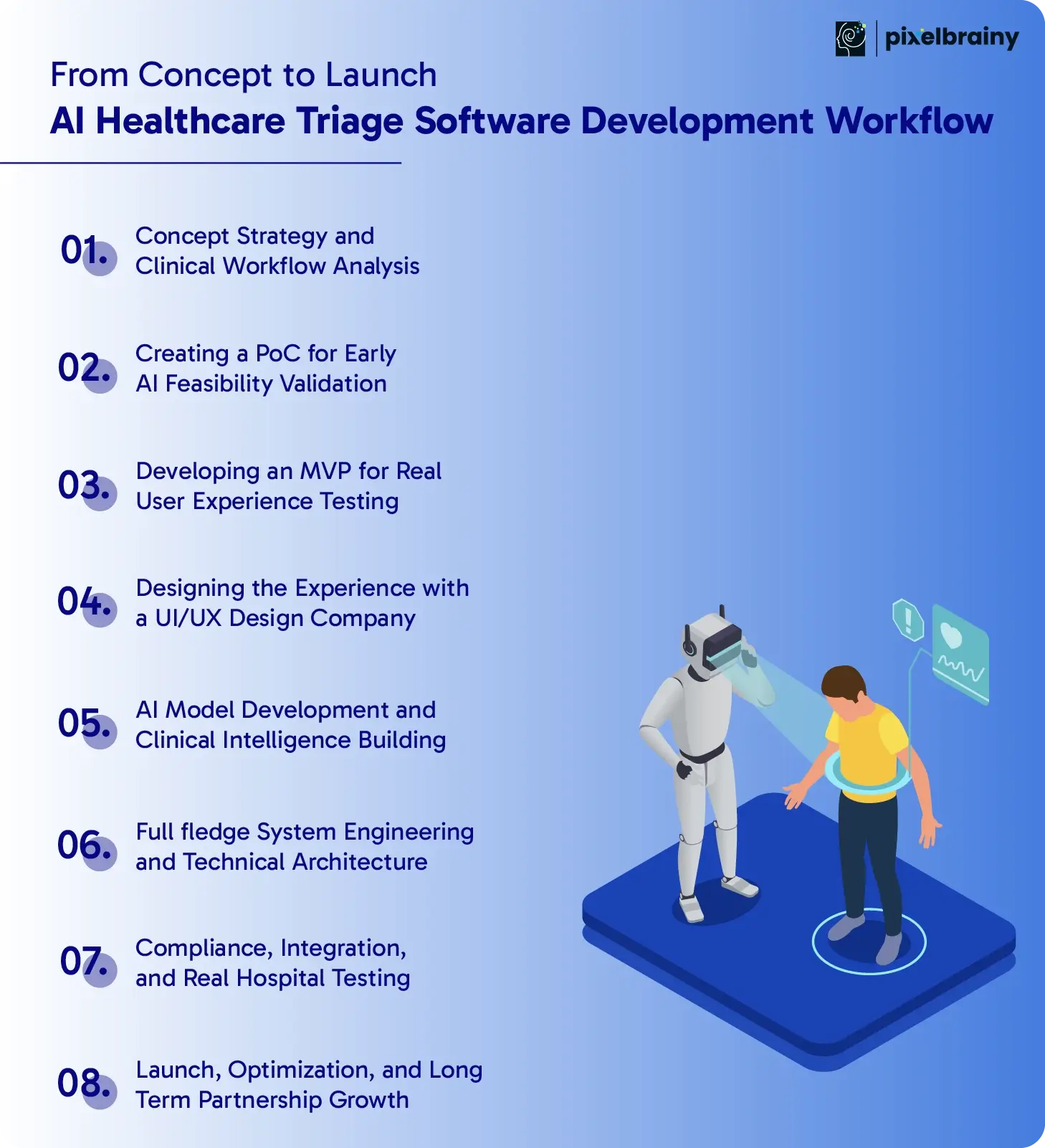
This stage lays the foundation for the development of AI Healthcare Triage Software by identifying real triage challenges, patient pain points, and hospital priorities. Teams analyze operational bottlenecks, evaluate current triage processes, and gather insights from clinicians, administrators, and patient feedback channels.
Aim of this step: To understand the clinical and operational problems the product must solve before developing AI Healthcare Triage Software.
Why it matters: Clear problem definition ensures the AI system focuses on improving safety, reducing delays, and supporting clinicians rather than adding complexity.
A PoC tests whether AI can accurately interpret symptoms, understand natural language inputs, and produce medically reliable insights. Engineers evaluate early algorithms, run sample datasets, and assess output consistency.
Aim of this step: To confirm that AI technology can support the core purpose of the solution before expanding further.
Why it matters: This prevents costly development mistakes and ensures that the underlying intelligence is strong enough to make AI Healthcare Triage Software viable.
The next phase introduces an MVP containing essential triage flows, limited question paths, and basic routing suggestions, developed in collaboration with top AI MVP development companies. Hospitals begin using this version to analyze patient interactions and collect feedback from clinical staff.
Aim of this step: To validate the core experience and identify improvements before scaling.
Why it matters: Real world feedback ensures the MVP aligns with patient behavior and clinical expectations, reducing risk in future scaling.
Also Read: How To Develop An MVP For Your Digital Product
A specialized UI/UX Design company structures user journeys, question flows, visual layouts, and interactive elements. Accessibility and clarity are prioritized to support users with varying ages, literacy levels, and health conditions.
Aim of this step: To create a patient friendly interface that supports smooth symptom reporting and decision clarity.
Why it matters: User experience can determine adoption rates, trust levels, and assessment accuracy, especially in stressful health scenarios.
Data scientists build machine learning models that understand symptoms, identify patterns, and estimate risk. At this stage, the team integrates real datasets, clinical knowledge, and medical guidelines to enhance triage safety.
Aim of this step: To develop the intelligence layer that powers symptom interpretation and risk scoring in AI Healthcare Triage Software development Integrating AI capabilities.
Why it matters: High quality AI is essential for clinical accuracy, reliability, fairness, and long term triage effectiveness.
The project transitions into a Full fledge platform that includes backend systems, APIs, databases, authentication, and real time processing workflows. The architecture is designed for scalability and speed.
Aim of this step: To build a complete system capable of handling operational demands in hospital environments.
Why it matters: Reliable engineering ensures the platform supports large patient volumes without delays, errors, or system interruptions.
To make AI Healthcare Triage Software usable inside hospitals, the platform must integrate with EHRs, hospital systems, and telehealth platforms. Security, privacy, and compliance checks ensure patient data remains protected.
Aim of this step: To ensure the system is legally valid, interoperable, and safe for real patient environments.
Why it matters: Without strong compliance and integration, even the most advanced AI platform cannot be deployed in clinical settings.
After deployment, hospitals receive staff training, onboarding support, and system monitoring dashboards. AI models evolve as they receive real usage data. Many organizations collaborate with top AI development companies in USA for ongoing improvements.
Aim of this step: To ensure long term sustainability, AI refinement, and smooth operational adoption.
Why it matters: Continuous improvement keeps the system accurate, compliant, and valuable, which is essential to make AI Healthcare Triage Software future ready.
A structured workflow ensures AI triage software moves from idea to impact with clinical accuracy and long term reliability.
The cost of building an AI Healthcare Triage Software solution can vary significantly depending on capabilities, integrations, data requirements, and overall development scope. Organizations investing in AI triage tools must consider both technical and clinical factors, since accurate decision making and compliance influence project complexity. Typical development costs range from 25,000 USD to 200,000 USD or more, depending on depth, intelligence, and scalability requirements.
The pricing also depends on the type of system being developed. Whether the goal is to create a Basic or MVP triage tool, a more robust mid level platform, or a highly advanced and fully automated enterprise grade system, each level requires different resources. Understanding these factors helps estimate budget, timeline, and technical effort more accurately.
The following key cost drivers shape the total investment:
Preparing medical datasets, running model training cycles, and performing accuracy validation is one of the most resource intensive components. The more advanced the AI capabilities, the higher the cost.
High quality patient journeys require structured interaction design, clinical clarity, and accessibility features. Professional design teams increase the usability and trustworthiness of the system.
Building scalable architecture, secure APIs, and data pipelines contributes significantly to overall pricing. Larger hospitals may require more complex infrastructure.
Connecting the triage platform with EHRs, scheduling systems, and hospital databases adds development time and cost. Advanced interoperability demands additional expertise.
Compliance with HIPAA, GDPR, and healthcare data standards increases the development effort, particularly around encryption, privacy, and audit trails.
Real environment validation, clinical workflow testing, and risk assessment reviews are essential for reliability and significantly affect the total budget.
AI models require continuous updates, retraining, and performance monitoring. This adds long term operational costs beyond initial development.
| Type of System | Description | Estimated Cost Range |
| Basic or MVP AI Healthcare Triage Software | Includes essential symptom input, basic AI interpretation, simple routing suggestions, and limited integrations. Suitable for early testing or startup validation. | 25,000 USD to 60,000 USD |
| Medium Level AI Healthcare Triage Software | Offers stronger AI accuracy, multiple workflows, user dashboards, real time risk scoring, multilingual support, and EHR connectivity. Ideal for clinics or mid sized hospitals. | 60,000 USD to 130,000 USD |
| Advanced AI Healthcare Triage Software | A Full fledge hospital ready solution with advanced AI models, predictive analytics, integrations with large EHR systems, high security, scalable infrastructure, and specialized clinical modules. | 130,000 USD to 200,000+ USD |
Understanding these cost components helps organizations plan realistic budgets and ensure their AI triage system delivers long term clinical and operational value.
Selecting the right tech stack is a critical decision that determines system performance, scalability, reliability, and long term adaptability. AI Healthcare Triage Software relies on multiple layers of technology, including AI frameworks, backend infrastructure, frontend interfaces, databases, and healthcare interoperability standards. The combination must support high traffic, real time responses, secure patient data handling, and seamless integration across hospital environments.
A strategic tech stack ensures that triage assessments are fast, accurate, and stable. Below is a structured breakdown of the essential technologies commonly used in AI triage systems.
| Technology Area | Suggested Tools | Explanation |
| AI and Machine Learning Frameworks | TensorFlow, PyTorch, Scikit-learn | These frameworks power symptom analysis, pattern detection, and risk scoring. They support model training, optimization, and continuous learning crucial for clinical accuracy. |
| Natural Language Processing Engines | spaCy, Hugging Face Transformers, NLTK | NLP engines interpret patient text or voice inputs. They help the system understand symptoms, context, intent, and medical terminology with higher precision. |
| Backend Development Technologies | Node.js, Python, Java, .NET | These backend technologies ensure stable server performance, triage logic execution, and secure API communication between systems and databases. |
| Frontend Development Frameworks | React, Vue.js, Angular | Frontend frameworks help create responsive and user friendly triage interfaces. They support smooth patient interactions, multilingual options, and accessibility features. |
| Databases and Storage Options | PostgreSQL, MongoDB, MySQL, Firebase | Databases store patient histories, triage results, AI logs, and routing information. Choosing the right one ensures fast retrieval, security, and scalability. |
| Cloud Hosting and Infrastructure | AWS, Google Cloud, Microsoft Azure | Cloud providers offer scalable environments, GPU instances for AI training, and built in security features essential for medical software. |
| Healthcare Interoperability Standards | FHIR, HL7, SMART on FHIR | These standards enable seamless communication with EHRs and hospital systems. They ensure triage data flows directly into clinical workflows without manual input. |
| Authentication and Security Tools | OAuth 2.0, JWT, SSO frameworks | Security layers protect patient identity and data access. Authentication tools help maintain compliance with healthcare privacy rules. |
| Testing and QA Tools | JUnit, Postman, Selenium, Cypress | These tools ensure system reliability, test triage logic, validate APIs, and maintain stable user experiences before deployment. |
| DevOps and Deployment Tools | Docker, Kubernetes, Jenkins | DevOps tools streamline deployment, manage scalable environments, and ensure uninterrupted availability during peak usage periods. |
Choosing the right tech stack ensures your AI triage platform remains fast, secure, scalable, and ready to integrate with evolving healthcare technologies.
Real-world implementations of AI triage systems provide valuable insight into how hospitals and digital health organizations benefit from modern intelligence driven triage workflows. These case studies demonstrate how different healthcare providers approached AI Healthcare Triage Software Development, what challenges they faced, and how the final solution improved clinical outcomes, reduced operational strain, and enhanced patient experience.
Each example highlights practical lessons that can guide future healthcare innovators.
Babylon Health offers an AI-driven symptom checker chatbot that allows patients to input symptoms, answer follow-up questions, and receive routing recommendations. According to their published case study, the chatbot has been reported to outperform a nurse and junior doctor in certain triage assessments.
What they did: The company created a digital triage layer for telemedicine intake, automating the first step of evaluation before human consultation.
Impact: Patients receive faster guidance, clinicians focus on higher-acuity cases, and the system supports large-scale remote triage.
Key lesson: Building AI Healthcare Triage Software as a front door to telehealth can significantly reduce low-value consultations and improve access.
C2-Ai’s Patient Tracking List (PTL) system used AI to review over 200 million records and assess risk among patients on waiting lists.
What they did: They integrated AI triage with administrative workflows to identify high-risk patients who should be prioritised for specialist referral or hospital admission.
Impact: The Trust observed reductions in non-attendances, improved prioritisation of critical cases, and better resource allocation.
Key lesson: Developing AI Healthcare Triage Software that connects with waiting-list management and secondary care workflows can broaden the triage concept beyond just emergency intake.
A cross-sectional study evaluated ChatGPT’s performance in triaging emergency department (ED) patients using the Emergency Severity Index (ESI). It found that ChatGPT showed a 76.6 % accuracy overall, and among high-acuity categories (ESI-1 & ESI-2) Cohen’s Kappa = 0.828.
What they did: Researchers input real patient data into ChatGPT and compared its triage classification to expert committee decisions in a tertiary hospital setting.
Impact: The results show promise for AI-based triage tools in high-urgency settings, though human oversight remains critical.
Key lesson: When developing AI Healthcare Triage Software, especially for acute care, rigorous validation against human standards is essential before full deployment.
An in-depth review of AI in ED triage described how machine learning models and structured algorithms helped hospitals manage patient inflow, improve resource management, and reduce delays.
What they did: Hospitals used AI triage models to classify patients at arrival, integrate vital signs and medical history, and decide prioritisation in EDs.
Impact: These implementations demonstrated improvements in speed and accuracy of triage, with fewer prolonged waits and better routing to care.
Key lesson: The building of AI Healthcare Triage Software must consider operational workflows (e.g., triage zones, staff roles, data flows) not just algorithmic design.
These real world examples show that AI triage solutions offer tangible benefits in efficiency, clinical workflow improvement, and patient experience—and that careful design, integration, and validation are the keys to success.
Also Read: 15 Successful AI Startup Case Studies: Innovative Use Cases Redefining Business
Regulatory compliance is one of the most critical pillars in AI Healthcare Triage Software Development. Since triage systems directly influence patient safety, clinical decisions, and medical data handling, they must meet strict regional and international regulations.
These requirements protect patients, guide hospitals, and ensure that every AI driven recommendation meets high standards of transparency, accuracy, and ethical responsibility. Failure to meet these standards can lead to unsafe outcomes, legal consequences, and loss of trust among healthcare providers and patients.
Below are the core regulatory pillars that guide the development of AI healthcare triage solutions.
HIPAA governs how patient information must be collected, stored, transmitted, and accessed. AI triage platforms must use encrypted data channels, strict user authentication, and controlled permissions. Audit logs and administrative safeguards are essential to protect sensitive health information and demonstrate compliance during reviews.
GDPR requires transparency, lawful use of personal health data, and clear patient consent. AI triage platforms must allow individuals to access, modify, or request deletion of their data. Developers must also define why data is required and ensure no unnecessary information is stored. This promotes privacy, accountability, and ethical data use across Europe.
If an AI triage system influences medical decisions or risk prioritization in the United States, it may fall under FDA classification as Software as a Medical Device. This requires formal clinical testing, evidence of safety and accuracy, and ongoing performance monitoring. FDA pathways help ensure that automated triage recommendations meet high clinical standards.
IEC 62304 outlines the required development lifecycle for medical software. It mandates formal planning, risk analysis, verification, validation, and documentation. Following these standards ensures the system is built consistently, monitored properly, and maintained responsibly through updates and model refinements.
Regulators increasingly demand that AI systems remain fair and unbiased. Developers must train models on diverse datasets, avoid reinforcing demographic disparities, and implement ongoing fairness monitoring. Ethical guidelines ensure that triage recommendations are accurate and equitable for all patient groups.
Focusing on these five core regulatory areas ensures AI triage systems remain safe, compliant, and clinically dependable throughout their lifecycle.
Building intelligent triage systems is a transformative step for modern healthcare, but the journey comes with technical, clinical, and regulatory complexities. Organizations planning AI Healthcare Triage Software Development must navigate these challenges with a strategic, well-structured approach.
Below are the major obstacles and the practical solutions that ensure safe, accurate, and scalable triage software.
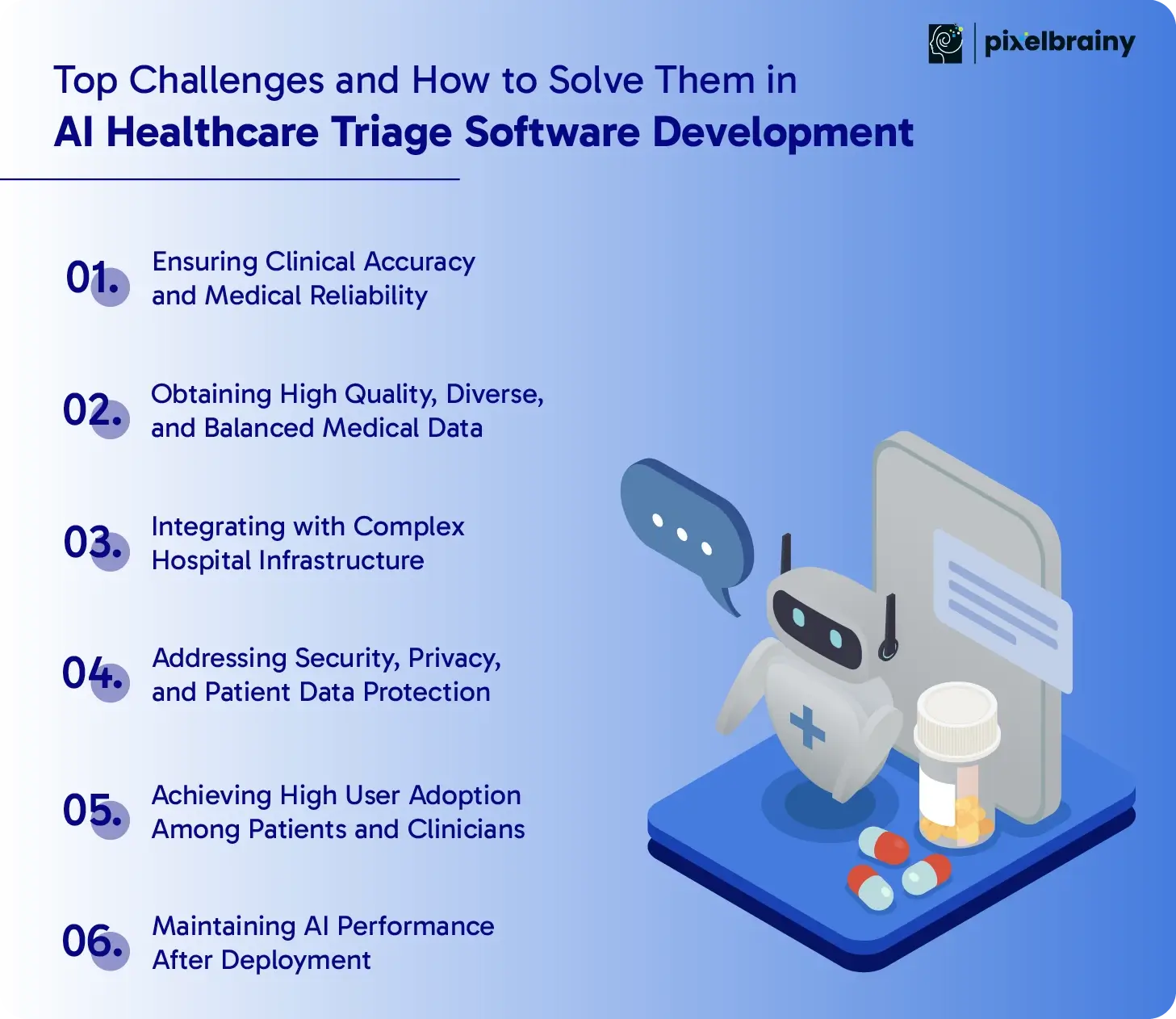
The Challenge: AI triage systems must accurately interpret symptoms, assess severity, and guide patients safely. Minor inaccuracies can lead to incorrect routing, delayed treatment, or unnecessary anxiety. Achieving medical precision requires robust datasets, verified medical logic, and real world validation.
The Solution: Partnering closely with clinicians during the development of AI Healthcare Triage Software ensures all symptom pathways are medically sound. Continuous model training using high quality datasets, combined with supervised evaluation, strengthens accuracy. Regular audits and clinical reviews help maintain performance as medical knowledge evolves.
The Challenge: AI models depend on large datasets, but healthcare data is often fragmented, unstructured, or biased toward certain demographics. This limits the system’s ability to serve diverse patient groups and may introduce unintended bias in outcomes.
The Solution: Organizations should invest in structured data cleaning, anonymization, and balancing. Collaborations with hospitals, research institutions, and privacy friendly data partners help create rich training datasets. Ongoing monitoring detects bias early and ensures the triage model performs consistently across all patient segments.
The Challenge: Hospitals rely on multiple systems such as EHRs, HIS platforms, telehealth modules, and scheduling systems. Integrating an AI triage platform into this environment can be technically demanding. Incompatibilities, outdated systems, and inconsistent data formats slow progress.
The Solution: Adopting industry standards such as FHIR and HL7 ensures smooth interoperability. Using scalable API layers, modular architecture, and integration ready workflows makes it easier to build Healthcare Triage Software Development using AI that fits seamlessly into existing hospital ecosystems. Early technical audits help identify integration risks.
The Challenge: Triage systems process sensitive health data. Any vulnerability exposes hospitals to legal risks, privacy breaches, and loss of trust. Healthcare organizations must comply with strict security regulations and implement strong privacy safeguards.
The Solution: Encryption, multi factor authentication, user access controls, and detailed audit logs form the foundation of secure triage platforms. Regular penetration testing, compliance checks, and threat monitoring strengthen protection. Designing security into the architecture from the start ensures long term resilience.
The Challenge: Even a highly accurate AI triage system can fail if users do not trust or understand it. Patients may be hesitant to share symptoms digitally, while clinicians may doubt automated recommendations.
The Solution: Transparent AI explanations, simple user flows, and human centered design build trust. Training sessions help clinicians understand how the triage system supports their work. Patient guidance, clear messaging, and intuitive design increase comfort and adoption.
The Challenge: Medical knowledge changes, new symptoms appear, and patient behavior evolves. AI models can become outdated without proactive updates, leading to inaccuracies over time.
The Solution: Implement continuous learning pipelines, regular data updates, and recurring clinical validation cycles. Performance monitoring dashboards help track model behavior and detect drift early. This ensures the triage system remains accurate, modern, and clinically relevant.
Solving these challenges with strategic planning and clinical collaboration ensures AI triage systems remain safe, powerful, and future ready for real world healthcare environments.
The future of AI driven triage is unfolding rapidly as hospitals, digital health platforms, and governments seek faster, safer, and more scalable ways to manage patient flow. With clinical workloads rising and patient expectations shifting toward digital care, AI triage systems are becoming essential infrastructure rather than optional tools.
The evolution of AI Healthcare Triage Software is moving toward deeper intelligence, higher personalization, and stronger clinical alignment. Below are the major trends shaping the next era of triage innovation.
Future AI triage systems will move beyond reactive symptom assessment and begin predicting risks before symptoms fully manifest. By analyzing trends from vitals, wearable devices, historical health records, and lifestyle data, the software will detect early warning signs of conditions such as heart complications, respiratory distress, or chronic disease flare ups. This shift will enable hospitals to focus on prevention instead of crisis response.
Next generation triage platforms will process not only text inputs but also speech, images, recorded breathing samples, and video based observations. AI will analyze facial cues, tone changes, and visual indicators to support more accurate assessments. Multi modal input will make triage more accessible for elderly patients, visually impaired users, and people who struggle with text based communication.
AI triage tools will evolve into central intelligence hubs that connect with EHRs, remote patient monitoring systems, telehealth platforms, specialist departments, and emergency services. This unified integration will turn triage into a continuous care journey rather than a single touchpoint. Real time data sharing will strengthen continuity of care across every department.
AI triage of the future will deliver personalized next step recommendations based on patient history, lifestyle, allergies, medication patterns, and previous diagnoses. Instead of generic instructions, patients will receive tailored guidance that reflects their unique clinical background. This personalization improves safety and empowers patients with clearer, more relevant instructions.
Governments and national health systems will deploy AI triage during outbreaks, seasonal illness surges, and public health emergencies. Centralized triage data will help authorities detect disease clusters, track symptom trends, and manage resource shortages early. This trend will transform triage into a population level health intelligence system.
As more hospitals adopt digital front doors for patient intake, AI triage will become the primary entry point for many care journeys. Patients will complete assessments before speaking with nurses or doctors. This trend supports hybrid care models, reduces emergency department congestion, and ensures clinicians focus on the most critical cases.
These future trends signal that AI triage systems will evolve from simple assessment tools to intelligent, predictive, and highly integrated pillars of modern healthcare.
Healthcare innovators choose PixelBrainy because we blend deep clinical understanding with advanced AI engineering. As an AI healthcare software development company in USA, we bring together data scientists, healthcare strategists, and UX specialists to create safe, scalable, and patient ready triage systems. Our approach ensures that every solution is grounded in medical logic and designed for real world use across hospitals, clinics, and digital health platforms.
PixelBrainy believes that triage software must feel reliable from the first interaction. This is why we collaborate directly with clinicians and patient experience teams to understand the decision pathways, terminology, and stress points that shape a triage journey. These insights allow healthcare providers to make AI Triage Software that feels clear, clinically aligned, and easy to adopt.
We also place strong emphasis on modern system architecture. Our triage engines integrate seamlessly with EHRs, scheduling systems, telehealth platforms, and remote monitoring tools, ensuring that triage becomes an essential part of the care continuum. This level of interoperability supports healthcare organizations that are creating AI Triage Software designed for long term scalability.
Instead of describing the project step by step, here is a clearer, snapshot style look at one of PixelBrainy’s recent triage deployments for a large, multi state healthcare network:
Project Objective: Transform a high volume call center based intake process into a digital triage system that could analyze symptoms, support multilingual users, and handle thousands of daily interactions.
What PixelBrainy Delivered: A fully custom AI triage engine trained on medically verified datasets, paired with a dynamic question flow system and an adaptive risk scoring model. The platform was integrated into the client’s telehealth environment and internal routing system.
Key Outcomes Observed: Significant reduction in call load, faster patient classification, increased patient engagement across diverse language groups, and a noticeable improvement in the accuracy of care routing.
Why It Matters: The results proved that AI driven triage solutions can reduce clinical pressure while improving patient clarity and access. Although the client name remains confidential, the measurable improvement highlights PixelBrainy’s capability to deliver transformative outcomes.
PixelBrainy continues to support this system through ongoing model updates, performance monitoring, and feature evolution. This long term partnership mindset ensures that every triage platform remains relevant, accurate, and aligned with modern healthcare needs.
Hope this guide has given you a clear and confident understanding of how AI is transforming modern healthcare through intelligent triage systems. From planning to deployment, every stage of AI Healthcare Triage Software Development requires strategic thinking, clinical alignment, and strong technical execution. As hospitals and digital health platforms continue to innovate, teams must focus on data quality, patient centric design, and scalable architecture to build solutions that deliver long term value.
Whether you are exploring ways to build Healthcare Triage Software Development using AI or planning the full development of AI Healthcare Triage Software, the opportunities for improving patient flow, reducing delays, and enhancing decision making have never been stronger. Partnering with experts ensures your AI triage platform remains safe, accurate, and future ready.
Book an appointment with PixelBrainy today to start your AI triage transformation.
AI Healthcare Triage Software is a digital system that analyzes patient symptoms, risk factors, and medical history to recommend the most appropriate care path. It uses artificial intelligence models, natural language processing, and clinical logic to guide patients or clinicians toward safe and accurate decisions.
Modern AI triage systems can reach high levels of accuracy, especially when trained on large, clinically validated datasets. They support clinicians by providing consistent assessments and reducing human error, but they are designed to complement medical professionals, not replace them.
Developing AI triage requires structured clinical data, symptom descriptions, patient demographics, historical outcomes, and medical guidelines. High quality and diverse datasets ensure fairness, accuracy, and reliability across different patient groups.
The timeline depends on complexity, integrations, and feature scope. A basic MVP may take 8 to 12 weeks, while a full enterprise ready system with advanced AI can require 4 to 8 months, including validation, compliance, and security testing.
Yes. When developed with strict compliance standards such as HIPAA, GDPR, and regional regulations, AI triage software ensures encrypted data storage, controlled access, and secure communication channels to protect patient information.
Absolutely. Modern triage platforms are designed to integrate with EHRs, HIS platforms, scheduling systems, and telehealth modules using interoperability standards like FHIR and HL7. This ensures a seamless flow of data across clinical workflows.

About The Author
Sagar Bhatnagar
Sagar Sahay Bhatnagar brings over a decade of IT industry experience to his role as Marketing Head at PixelBrainy. He's known for his knack in devising creative marketing strategies that boost brand visibility and market influence. Sagar's strategic thinking, coupled with his innovative vision and focus on results, sets him apart. His track record of successful campaigns proves his ability to utilize digital platforms effectively for impactful marketing efforts. With a genuine passion for both technology and marketing, Sagar continuously pushes PixelBrainy's marketing initiatives to greater success.

Working with the PixelBrainy team has been a highly positive experience. They understand the design requirements and create beautiful UX elements to meet the application needs. The dev team did an excellent job bringing my vision to life. We discussed usability and flow. Sagar worked with his team to design the database and begin coding. Working with Sagar was easy. He has the knowledge to create robust apps, including multi-language support, Google and Apple ID login options, Ad-enabled integrations, Stripe payment processing, and a Web Admin site for maintaining support data. I'm extremely satisfied with the services provided, the quality of the final product, and the professionalism of the entire process. I highly recommend them for Android and iOS Mobile Application Design and Development.

Great experience working with them. Had a lot of feedback and I found that unlike most contractors they were bugging me for updates instead of the other way around. They were extremely time conscience and great at communicating! All work was done extremely high quality and if not on time, early! They were always proactive when it comes to communication and the work is great/above par always. Very flexible and a great team to work with! Goes above and beyond to present us with multiple options and always provides quality. Amazing work per usual with Chitra. If you have UI/UX or branding design needs I recommend you go to them! Will likely work with them in the future as well, definitely recommended!

PixelBrainy is a joy to work with and is a great partner when thinking through branding, logo, and website layout. I appreciate that they spend time going into the "why" behind their decisions to help inform me and others about industry best practices and their expertise.

I hired them to design our software apps. Things I really like about them are excellent communication skills, they answer all project suggestions and collaborate right away, and their input on design and colors is amazing. This project was complex and needed patience and creativity. The team is amazing to do business with. I will be using them long-term. Glad to see there are some good people out there. I was afraid to try and outsource my project to someone but I am glad I met them! I really can't say enough. They went above and beyond on this project. I am very happy with everything they have done to make my business stand out from the competition.

It was great working with PixelBrainy and the team. They were very responsive and really owned the project. We'll definitely work with them again!

I recently worked with the PixelBrainy team on a project and I was blown away by their communication skills. They were prompt, clear, and articulate in all of our interactions. They listened and provided valuable feedback and suggestions to help make the project a success. They also kept me updated throughout the entire process, which made the experience stress-free and enjoyable.

PixelBrainy is very good at what it does. The team also presents themselves very professionally and takes care of their side of things very well. I could fully trust them taking up the design work in a timely and organised manner and their attention to detail saved us lots of effort and time. This particular project was quite intense and the team showed that they function very well under pressure. Very much looking forward to working with her again!

It's always an absolute pleasure working with them. They completed all of my requests quickly and followed every note I had for them to a T, which made our process go smoothly from start to finish. Everything was completed fast and following all of the guidelines. And I would recommend their services to anyone. If you need any design work done in the future, PixelBrainy should be your first call!

They took ownership of our requirements and designed and proposed multiple beautiful variants. The team is self-motivated, requires minimum supervision, committed to see-through designs with quality and delivering them on time. We would definitely love to work with PixelBrainy again when we have any requirements.

PixelBrainy was a big help with our SaaS application. We've been hard at work with a new UI/UX and they provided a lot of help with the designs. If you're looking for assistance with your website, software, or mobile application designs, PixelBrainy and the team is a great recommendation.

PixelBrainy designers are amazing. They are responsive, talented, and always willing to help craft the design until it matches your vision. I would recommend them and plan to continue them for my future projects and more!!!

They were awesome! Did a good job fast, and good communication. Will work with them again. Thank you

Creative, detail-oriented, and talented designers who take direction well and implement changes quickly and accurately. They consistently over-delivered for us.

PixelBrainy team is very talented and creative. Great designers and a pleasure to work with. PixelBrainy is an excellent communicator and I look forward to working with them again.

PixelBrainy has a very talented design team. Their work is excellent and they are very responsive. I enjoy working with them and hope to continue on all of our future projects.


Transform your ideas into reality with us.
Across these industries, each engagement brings unique challenges, from early-stage product development to scaling complex systems, helping us build a practical understanding of real-world product environments.