
 AI Summary Powered by PixelBrainy
According to McKinsey, nearly 70% of Fortune 500 software is more than two decades old. Even in 2026, some of the world's largest enterprises continue to depend on technologies built long before artificial intelligence became central to business strategy.
This reality has made AI integration with legacy systems one of the most pressing challenges for enterprise leaders today.
For CIOs, CTOs, digital transformation leaders, operations executives, and enterprise decision-makers, the pressure to adopt AI is growing rapidly. Organizations want to leverage AI to automate repetitive processes, improve customer experiences, generate predictive insights, and enable faster decision-making. However, achieving these goals becomes significantly more difficult when core business operations rely on aging technology infrastructures.
Legacy systems are simply older software applications and platforms that organizations continue to use because they support mission-critical functions. These may include ERP systems, mainframe applications, financial platforms, customer databases, and supply chain management tools. While they may lack the flexibility of modern technologies, they often remain stable, reliable, and deeply integrated into everyday operations.
The problem is that these systems can restrict innovation. Maintaining them consumes substantial portions of IT budgets, limits agility, and adds to growing technical debt. As enterprises accelerate their AI initiatives, outdated systems frequently become obstacles that delay implementation and increase complexity.
Many organizations are asking the same question: Our enterprise still runs on decade-old ERP and mainframe systems. How do we integrate AI into legacy systems without shutting down operations or rebuilding everything from scratch?
The good news is that replacing everything is not the only path forward. Successful enterprises are adopting practical approaches to legacy system AI integration that protect existing investments while enabling new AI capabilities. Through APIs, middleware solutions, phased modernization, and strategic planning, organizations are finding effective ways of integrating AI into legacy systems with minimal disruption to business continuity.
In this guide, you'll discover how to integrate AI with legacy systems through proven strategies, implementation frameworks, real-world use cases, ROI considerations, governance best practices, and expert insights designed specifically for enterprise teams.
If legacy systems are so old, why are some of the world's most successful enterprises still relying on them?
It is a question many executives ask when discussing digital transformation initiatives. The assumption is often simple: if newer technologies exist, replacing older systems should be the obvious choice. In reality, enterprise technology environments are far more complex.
Legacy systems refer to the software and infrastructure that organizations implemented years or even decades ago and continue to depend on today. These systems were typically developed before the cloud era and frequently include COBOL applications, SAP environments, Oracle databases, and mainframe platforms. They may not offer the flexibility or user experience of modern applications, but they remain deeply connected to the processes that keep businesses running.
Understanding why enterprises still use legacy systems starts with recognizing the value hidden beneath their age.
Most enterprise platforms have evolved over years of updates, customizations, and regulatory changes. They reflect how the business actually operates, from pricing models and approval hierarchies to supply chain rules and customer workflows. Recreating this logic in a new environment is rarely straightforward and often requires significant investment with uncertain outcomes.
Technology transitions are not just technical projects. They affect employees across departments. Finance teams, operations staff, customer service representatives, and managers have built expertise around existing systems. Retraining thousands of employees introduces costs, productivity challenges, and resistance to change.
For sectors such as banking, healthcare, and manufacturing, established systems support reporting standards, audit histories, and documented controls. When leaders ask, why can't enterprises just replace legacy systems with modern software, they often underestimate the compliance implications of altering validated processes.
Enterprise systems hold years of operational and transactional information. Migrating this data without errors is difficult. Even small discrepancies can impact reporting accuracy, customer trust, and decision-making.
This reality has shifted the modernization conversation.
For years, enterprises approached transformation through a rip-and-replace mindset. The goal was to retire everything old and rebuild from the ground up. While attractive in theory, these initiatives frequently exceeded budgets, extended timelines, and disrupted operations.
Today, many organizations favor an integrate-and-extend approach.
Instead of replacing critical systems outright, enterprises layer new capabilities onto existing infrastructure through legacy system AI integration. This strategy allows organizations to preserve stable operations while accelerating innovation.
Consider two different outcomes.
One global enterprise invested heavily in a large-scale migration program designed to replace its core technology stack. After repeated delays, escalating costs, and implementation challenges, several components had to be rolled back to avoid operational disruption.
Meanwhile, another enterprise pursued legacy software AI integration by connecting AI services to its existing ERP environment through APIs. In just eight weeks, the organization introduced predictive analytics and intelligent workflow automation without pausing business operations.
The lesson is clear. Transformation does not always require starting over.
For many organizations managing complex legacy software in enterprise IT, the smartest path forward is not replacement. It is modernising legacy systems with AI, enabling enterprises to innovate faster while protecting the systems, data, and expertise they have spent decades building.
The business case for AI is stronger than ever. Enterprises want to automate processes, improve forecasting, personalize customer experiences, and accelerate decision-making through intelligent systems. However, turning these ambitions into reality is often more difficult than selecting the right AI model.
The real challenge lies in connecting modern AI capabilities with infrastructure that was never designed to support them.
Many enterprise leaders share the same concern: Our legacy systems have no modern APIs and our data is siloed across departments. How do enterprise teams connect AI tools to outdated software that was never designed for AI?
The answer starts with understanding the barriers standing in the way. Successful implementation depends on identifying these obstacles early and designing practical strategies to overcome them. Here are the biggest challenges organizations face during AI integration with legacy systems for enterprise teams.
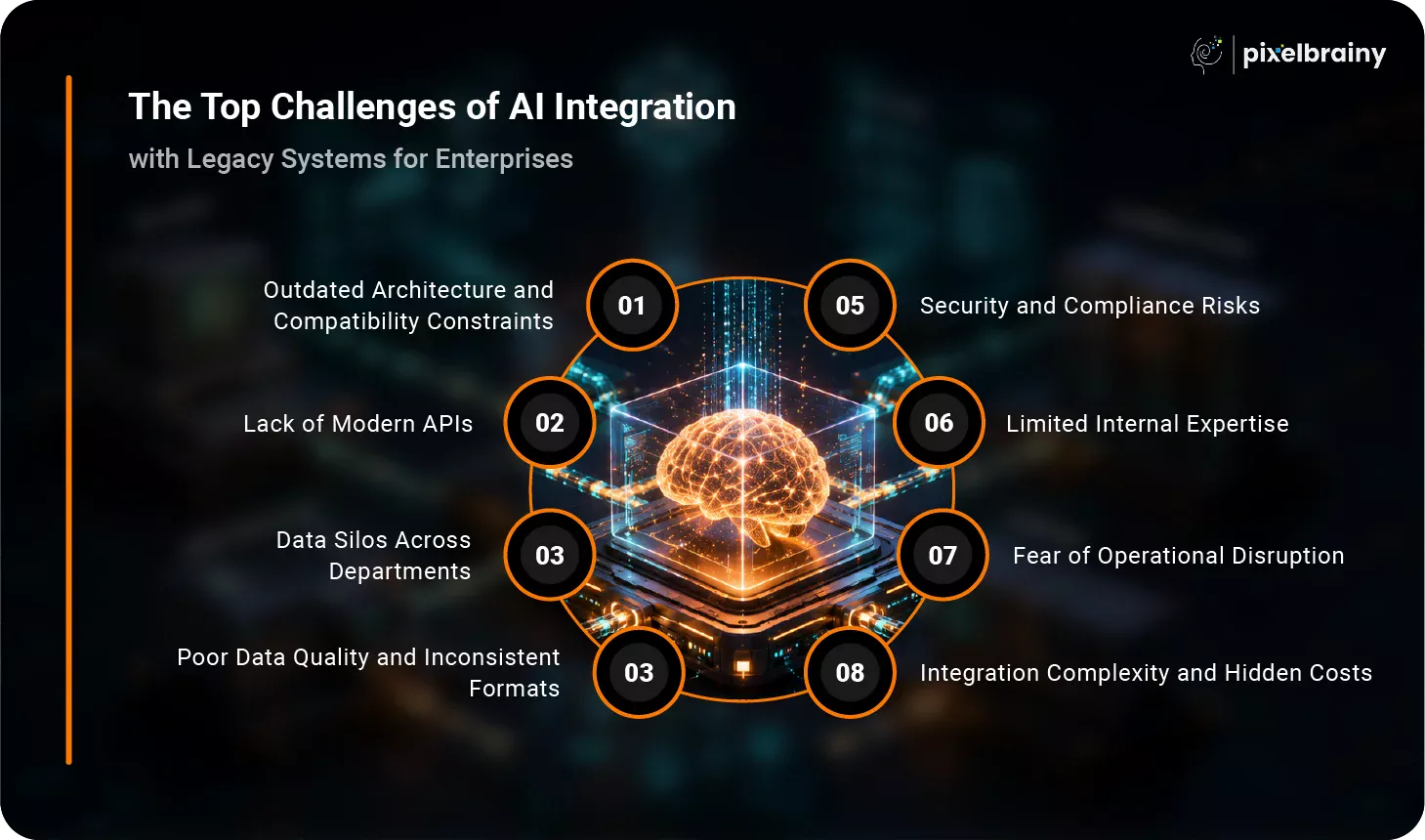
Most legacy platforms were built long before AI became a business priority. They often rely on closed architectures, proprietary protocols, and limited connectivity options. This creates significant issues around enterprise AI and legacy system compatibility, forcing organizations to invest additional time and resources into making older systems communicate with modern AI services.
Many enterprise applications simply do not expose APIs that AI tools can consume. Without standardized interfaces, extracting information or triggering actions becomes complicated. Organizations frequently depend on custom connectors, middleware layers, or even screen-based integrations to bridge the gap between old and new technologies.
AI systems are only as effective as the data they access. In many enterprises, information is scattered across finance applications, CRM platforms, supply chain systems, spreadsheets, and departmental databases. These disconnected data sources prevent AI from generating complete insights and reduce the accuracy of recommendations and predictions.
Years of manual entries, duplicate records, missing values, and inconsistent standards create serious challenges for AI initiatives. Before organizations can deploy intelligent capabilities, they often need extensive data cleansing and normalization efforts to ensure that models receive reliable and trustworthy inputs.
Integrating AI into environments that handle sensitive customer, financial, or healthcare information raises important governance concerns. Enterprises must maintain access controls, audit trails, data privacy standards, and regulatory obligations throughout the integration process. Failure to do so can introduce legal and reputational risks.
Traditional IT teams excel at maintaining existing systems, but they may have limited experience with machine learning platforms, data engineering, or AI deployment frameworks. The skills gap can delay projects, increase dependency on external consultants, and make long-term maintenance more difficult.
Legacy systems often support mission-critical operations that cannot tolerate downtime. Even minor implementation errors can affect transactions, customer service, inventory management, or financial reporting. This concern leads many organizations to postpone innovation because the perceived risks outweigh the expected benefits.
Enterprise modernization rarely involves a single application. Multiple systems, vendors, databases, and workflows must work together seamlessly. As a result, legacy software AI integration projects can become more complex than anticipated, introducing unexpected expenses related to testing, customization, infrastructure upgrades, and ongoing support.
Many organizations address these obstacles through AI integration with legacy systems using APIs and middleware, creating a flexible layer between existing applications and modern AI services without disrupting business continuity.
The enterprises that succeed with AI are not the ones without legacy systems. They are the ones that understand these challenges early and build a strategy designed to overcome them.
Enterprise leaders often assume there is only one path to modernization. Replace the old system, migrate everything, and start fresh. In reality, successful AI adoption rarely follows that model.
The better question is this: We have critical business processes running on outdated software that can't connect to modern AI tools. What is the safest approach to AI integration with legacy systems for a large enterprise team?
The answer depends on your existing architecture, business priorities, risk tolerance, compliance requirements, and implementation timelines.
Research published in an EAJournals study found that phased transformation initiatives demonstrated a 67.2% higher success rate compared to large-scale replacement programs. Rather than disrupting mission-critical operations, enterprises are increasingly choosing incremental approaches that deliver measurable value while minimizing risk.
Before exploring the four proven strategies, consider this comparison:
| Approach | Typical Timeline | Risk Level | Operational Disruption |
|---|---|---|---|
| Rip-and-replace modernization | 18 to 24 months | High | Significant |
| Phased AI integration | 6 to 12 weeks | Low | Minimal |
The following frameworks can help enterprise teams determine which approach aligns best with their goals.
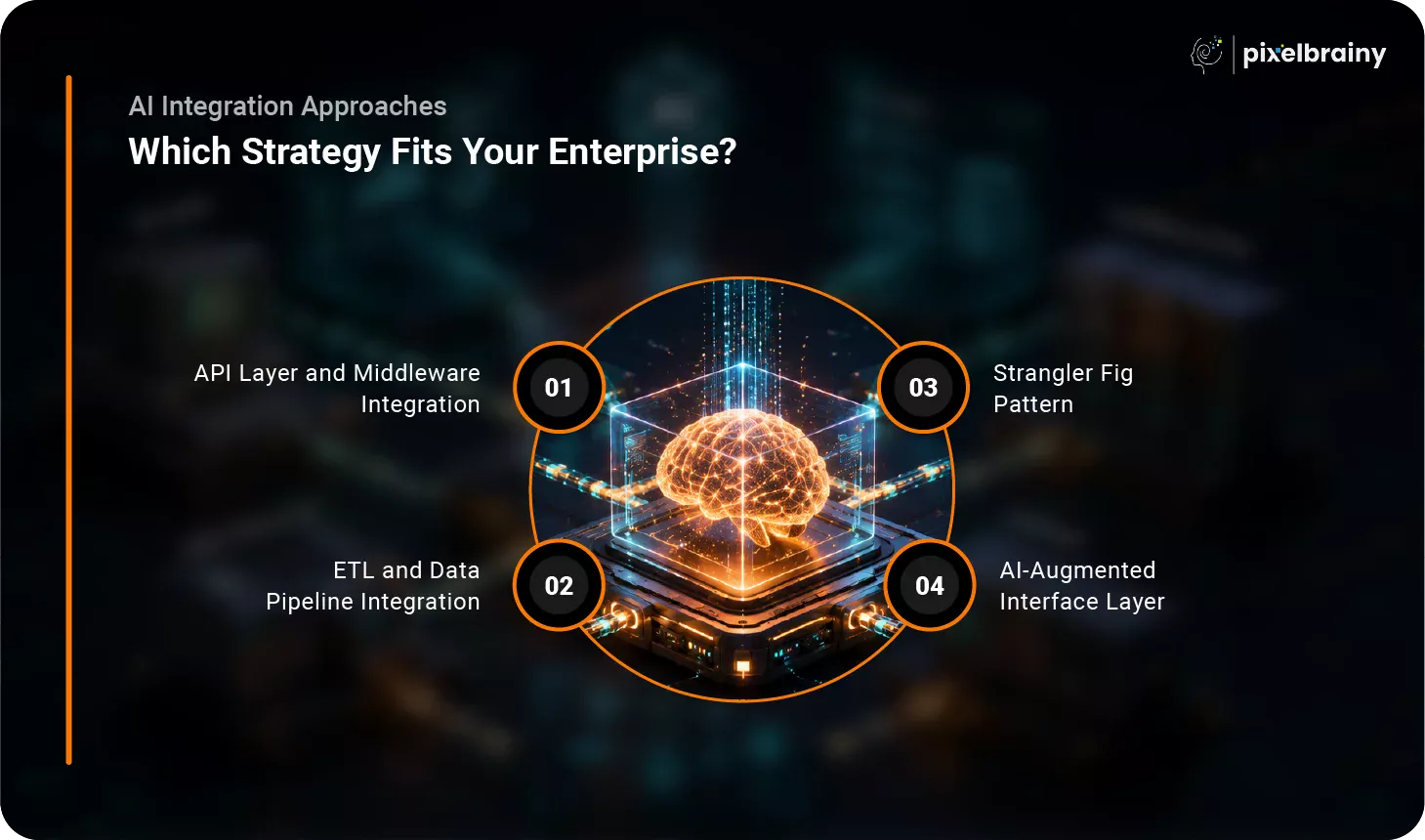
This approach creates a bridge between existing applications and AI services using APIs, middleware platforms, or integration hubs. Instead of modifying core systems, enterprises expose selected functions and data to AI applications through a secure intermediary layer.
This strategy is often considered the safest entry point for AI integration with legacy systems using APIs and middleware because it preserves existing investments while enabling modern capabilities.
In this model, organizations extract data from legacy environments, transform it into standardized formats, and load it into AI-ready repositories such as data warehouses or data lakes. AI models then operate on clean, consolidated datasets rather than directly interacting with production systems.
This approach is particularly effective when fragmented information prevents meaningful analysis across departments.
The Strangler Fig Pattern modernizes systems gradually by replacing specific functions with new AI-powered services over time. Instead of rebuilding everything at once, enterprises identify high-value processes and transition them incrementally to microservices.
Unlike aggressive replacement initiatives, this method minimizes disruption and supports continuous improvement.
This strategy adds intelligent experiences on top of existing systems without changing the underlying architecture. Examples include AI chatbots, natural language search, recommendation engines, intelligent dashboards, and virtual assistants.
For many organizations, this becomes the first step toward broader enterprise AI modernization strategies because it demonstrates value quickly with limited operational risk.
Many enterprises ultimately combine multiple approaches as part of a broader legacy systems modernization roadmap, beginning with low-risk initiatives and expanding as capabilities mature.
The most effective enterprise AI integration strategies are not those that replace everything overnight. They are the ones that align technology choices with business priorities, governance requirements, and the realities of operating complex environments.
In practice, successful legacy system modernization with AI is less about choosing a single framework and more about selecting the right approach at the right stage of your transformation journey.
For many executives, the biggest challenge is not deciding whether to adopt AI. It is determining where to begin.
A common concern raised in boardrooms today is: "I need to present an AI integration roadmap to our board but our core systems are 15 to 20 years old. What steps should enterprise teams follow to integrate AI with legacy systems without full replacement?"
The answer lies in following a structured, phased approach rather than attempting enterprise-wide transformation overnight. Traditional rip-and-replace programs often require 18 to 24 months, substantial budgets, and significant operational risk. In contrast, phased AI initiatives deliver measurable outcomes through smaller deployments, allowing organizations to learn, adapt, and scale with confidence.
The following framework outlines a proven AI integration process for enterprises that balances innovation with stability.
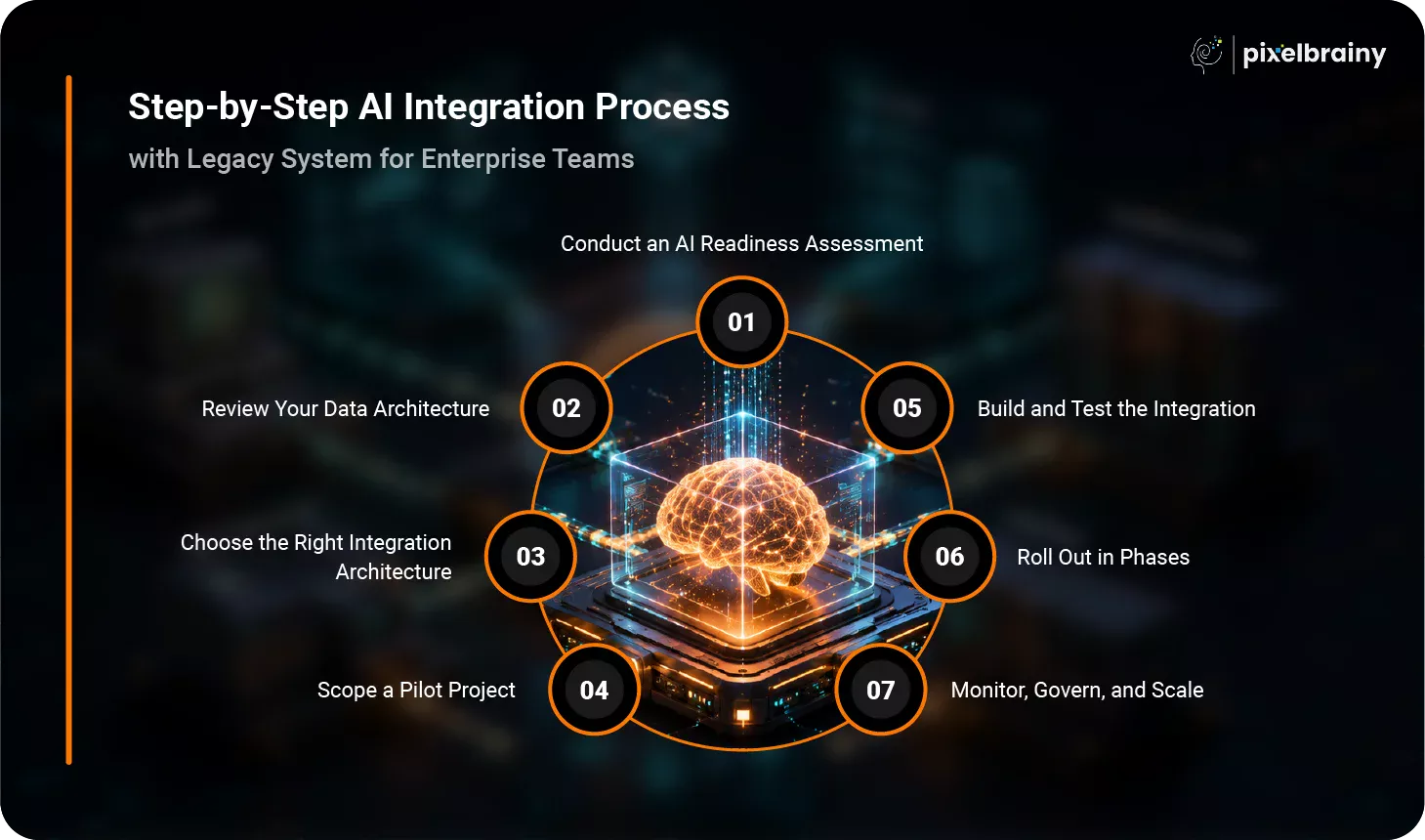
Before selecting tools or vendors, organizations must understand their current state. This AI readiness assessment for legacy enterprise systems evaluates existing applications, infrastructure maturity, data availability, integration capabilities, and organizational preparedness.
Teams should assess:
The goal is to identify opportunities and constraints before investment decisions are made.
AI initiatives succeed or fail based on data quality and accessibility.
Enterprise teams should identify data silos, document how information flows between systems, and prioritize datasets required for high-value use cases. This step often reveals duplicate records, inconsistent formats, and missing governance standards.
Enterprises that prioritize data architecture before AI integration experience 43.5% fewer post-implementation issues, highlighting the importance of establishing a strong data foundation before deployment.
Questions to address include:
Not every enterprise requires the same technical approach.
After evaluating system constraints and business priorities, organizations must determine how to integrate AI into legacy software using the architecture best suited to their environment.
Common options include:
The selected architecture should align with operational risk tolerance, timelines, and expected outcomes.
One of the most common mistakes organizations make is trying to transform everything at once.
Instead, select a single process with measurable business value. Examples include invoice processing, customer service assistance, predictive maintenance, or demand forecasting.
For enterprises pursuing AI integration with legacy ERP and mainframe systems, starting with a contained use case reduces complexity and builds confidence among stakeholders.
A successful pilot should have:
Once the pilot is defined, teams can begin implementation.
This phase involves developing middleware, connectors, APIs, or data pipelines that enable communication between legacy applications and AI services.
Testing should mirror real-world conditions as closely as possible by using production-like datasets and validating:
Rigorous testing minimizes surprises during deployment.
Successful enterprises rarely deploy AI across the organization simultaneously.
After validating pilot outcomes, implementation should expand incrementally by department, geography, business unit, or functional area.
This phased approach enables organizations to:
Compared with 18 to 24 month enterprise-wide replacement initiatives, phased rollouts often deliver visible results within weeks while maintaining business continuity.
Deployment is not the end of the journey.
As AI capabilities mature, organizations must establish ongoing governance frameworks to monitor performance, manage risks, and ensure regulatory compliance.
This includes:
As enterprises advance toward more autonomous capabilities, governance becomes especially important for agentic AI integration with legacy systems for enterprises, where intelligent agents increasingly participate in decision-making and workflows.
The most successful AI transformations are not built through massive system replacements. They are achieved through disciplined execution, starting small, learning quickly, and scaling strategically across the enterprise.
One of the biggest concerns enterprise leaders have is whether AI can deliver meaningful results without replacing the systems their organizations depend on every day.
A common question sounds like this: Our industry still relies on aging ERP platforms, mainframes, and custom applications. Are there real examples of enterprises successfully integrating AI with legacy systems without disrupting operations?
The answer is yes.
Across healthcare, finance, manufacturing, retail, and other sectors, organizations are proving that innovation does not require abandoning decades of technology investments. Instead, they are identifying high-value business processes and embedding AI into existing environments to improve efficiency, strengthen decision-making, and enhance customer experiences.
These real-world examples demonstrate how AI integration with legacy systems creates measurable outcomes while minimizing operational risk. They also highlight an important lesson for enterprise leaders: the best approach varies by industry, regulatory environment, and business objective.
Whether your organization is evaluating enterprise AI use cases for legacy systems or planning a broader transformation initiative, the examples below show how established enterprises are turning traditional infrastructure into intelligent business assets.
Healthcare organizations rely heavily on electronic health records, billing platforms, and laboratory systems that have evolved over many years. Replacing these environments can disrupt patient care and regulatory processes.
By integrating AI with these systems, providers can support clinical decision-making, identify patients at higher risk of complications, automate administrative tasks, and improve appointment scheduling efficiency.
Example: A hospital network connected AI models to its existing EHR platform to predict patient readmission risks and alert care teams proactively.
Business impact: Improved patient outcomes, lower administrative workload, and more efficient resource utilization.
Also Read: AI Compliance Software Development: A Complete Guide for Regulated Industries
Banks and financial institutions continue to operate on established transaction platforms and mainframe environments because of their stability and compliance history.
AI integration helps institutions detect fraud patterns, automate regulatory checks, improve credit assessments, and deliver personalized customer experiences.
Example: A retail bank introduced AI-driven fraud detection alongside its core banking platform without altering transaction processing systems.
Business impact: Reduced fraud exposure, faster decision-making, and enhanced customer trust.
Real estate firms often depend on long-standing CRM platforms and property management systems that store years of valuable customer and market data.
AI capabilities enable lead prioritization, property recommendations, market forecasting, and buyer behavior analysis.
Example: A real estate company integrated AI into its existing CRM to rank leads based on their likelihood to convert.
Business impact: Higher sales productivity, improved customer engagement, and better forecasting accuracy.
Also Read: Top AI Real Estate Software Development Companies in USA
Insurance companies manage extensive policy and claims histories through legacy administration systems that remain essential to daily operations.
AI can streamline claims reviews, improve underwriting decisions, identify fraudulent activities, and enhance customer retention efforts.
Example: An insurer deployed AI to analyze incoming claims and flag suspicious cases using its current policy infrastructure.
Business impact: Faster claims processing, lower operational costs, and improved risk management.
Also Read: Top 10 AI Insurance Claim Management Software Development Companies in USA
Sports betting operators process high transaction volumes through mature trading platforms where uptime and accuracy are business critical.
AI supports personalized recommendations, fraud monitoring, responsible gaming initiatives, and dynamic odds optimization.
Example: A sportsbook integrated AI recommendations into its existing platform to tailor betting suggestions based on user preferences.
Business impact: Increased customer engagement, stronger retention rates, and higher revenue opportunities.
Also Read: Top AI Sports Betting Software Development Companies in USA
Manufacturers frequently depend on legacy ERP systems, machine monitoring software, and production applications that coordinate daily operations.
AI integration enables predictive maintenance, quality control automation, production optimization, and demand forecasting.
Example: A manufacturing company connected AI models to equipment monitoring systems to anticipate maintenance requirements before failures occurred.
Business impact: Reduced downtime, improved productivity, and lower maintenance expenses.
Retailers and logistics providers often operate through established inventory, warehouse, and transportation management platforms.
AI enhances these environments through inventory optimization, route planning, customer personalization, and demand prediction.
Example: A logistics provider applied AI to its transportation systems to identify efficient delivery routes using operational data.
Business impact: Faster fulfillment cycles, lower transportation costs, and improved customer satisfaction.
Telecommunications companies manage large-scale infrastructures supported by legacy operational systems that require uninterrupted performance.
AI capabilities help predict outages, optimize network resources, automate support interactions, and identify service issues earlier.
Example: A telecom provider integrated AI monitoring into its existing network operations environment to detect anomalies proactively.
Business impact: Improved service quality, reduced support costs, and stronger customer experiences.
Energy providers depend on aging operational technologies that support critical public services and cannot tolerate prolonged disruption.
AI enables demand forecasting, equipment monitoring, anomaly detection, and maintenance planning.
Example: A utility company introduced AI analytics into its monitoring systems to identify potential equipment failures in advance.
Business impact: Greater operational reliability, lower maintenance risks, and improved planning accuracy.
Government agencies often rely on long-established systems responsible for records management and service delivery.
AI integration supports document processing, case prioritization, fraud prevention, and citizen self-service initiatives.
Example: A public agency deployed an AI-powered assistant within its existing service platform to improve response efficiency.
Business impact: Faster service delivery, reduced administrative burden, and improved citizen satisfaction.
These industry examples show that successful legacy modernization is rarely about replacing everything at once. It is about applying AI to the right use cases, at the right time, to generate measurable business value while preserving the systems that enterprises trust most.
For many enterprise leaders, technology feasibility is not the biggest obstacle to AI adoption. The real challenge is justifying the investment.
Board members, CFOs, and executive teams often ask the same question: "How can we build a strong business case for AI when our organization still relies on legacy systems? Will the returns justify the cost without forcing a complete technology replacement?"
The answer depends on shifting the conversation away from technology alone and focusing on measurable business outcomes.
Traditional modernization initiatives often require large upfront investments, multi-year timelines, and significant operational disruption. In contrast, a phased approach to AI integration with legacy systems allows enterprises to generate value incrementally while preserving existing technology investments. Instead of replacing stable systems, organizations can enhance them with targeted AI capabilities that solve specific business problems.
Before calculating returns, enterprise teams need a clear view of where investments are typically made.
The first phase involves evaluating existing infrastructure, identifying suitable use cases, assessing risks, and defining success metrics.
Typical expenses include:
Investment level: Low to moderate.
These costs vary depending on the chosen integration approach and technical complexity.
Expenses may include:
Investment level: Moderate.
Projects involving highly customized environments generally require greater effort than standard enterprise platforms.
Organizations may need additional resources to support AI workloads.
Examples include:
Investment level: Moderate to high.
The advantage is that these investments can often scale gradually alongside adoption.
Technology adoption succeeds when people embrace it.
Enterprises should budget for:
Investment level: Moderate.
Ignoring this category frequently undermines otherwise successful implementations.
The strongest ROI of AI integration with legacy systems comes from solving operational challenges that directly affect revenue, efficiency, and customer satisfaction.
Common value drivers include:
AI automates repetitive tasks, reduces manual workloads, and accelerates processing times.
Potential outcomes:
AI enables leaders to act on predictive insights instead of relying solely on historical reporting.
Potential outcomes:
Organizations can uncover new ways to increase profitability through personalization and optimization.
Potential outcomes:
AI strengthens the ability to identify anomalies and emerging threats.
Potential outcomes:
A compelling business case for AI integration with legacy systems connects technical initiatives directly to strategic priorities.
Executive teams should answer four questions:
Focus on a clearly defined business challenge such as claims processing delays, inventory inefficiencies, or customer service bottlenecks.
Define success using metrics such as:
Compare targeted AI initiatives against enterprise-wide replacement programs.
A phased deployment typically carries lower operational risk because it limits disruption and allows lessons learned from early pilots to shape future expansion.
Many organizations achieve initial benefits within weeks by focusing on high-impact processes rather than attempting large-scale transformation.
This creates momentum for broader adoption and strengthens executive confidence.
To illustrate the potential economics, consider a mid-sized enterprise automating invoice processing through AI while retaining its existing ERP system.
| Metric | Before AI | After AI |
|---|---|---|
| Invoice processing time | 12 minutes | 3 minutes |
| Manual review rate | 85% | 25% |
| Processing errors | High | Significantly reduced |
| Employee capacity | Limited | Increased |
| Time to initial value | Not applicable | 8 to 12 weeks |
Even modest improvements across high-volume processes can generate substantial returns over time.
The strongest financial outcomes rarely come from replacing everything at once.
Organizations asking, "How do we justify investing in AI when our core systems are decades old?" often discover that targeted initiatives deliver faster wins, lower implementation risk, and clearer evidence of value.
The most effective cost analysis of AI integration with legacy systems focuses on practical outcomes rather than technology trends. By prioritizing high-impact use cases, tracking measurable KPIs, and expanding gradually, enterprises can transform legacy environments into competitive advantages without incurring the costs and disruption of full-scale replacement.
The most persuasive AI investment story is not about spending less. It is about creating measurable business value from the systems your enterprise already trusts and depends on.
For many enterprises, the biggest barrier to AI adoption is not technology capability or budget. It is trust.
Leadership teams in regulated sectors frequently ask: "We are in financial services. How do we ensure AI integration with our legacy systems meets compliance?" Another common concern is equally important: "What security risks should we prepare for when integrating AI into our legacy enterprise infrastructure?"
These questions have become central to enterprise AI initiatives because legacy environments often contain decades of sensitive customer information, operational records, and business-critical workflows. Adding AI capabilities without proper controls can increase exposure to regulatory penalties, security incidents, and operational disruptions.
Research shows that 71.3% of AI integration projects experience operational disruptions, often due to inadequate planning around governance, security, and change management. Organizations that establish clear controls from the beginning are significantly better positioned to reduce risk while accelerating adoption.
This is why AI integration compliance for enterprises should be treated as a strategic priority rather than a final checklist item.
Legacy systems frequently store personally identifiable information such as customer records, financial data, medical histories, and employee details. As AI models access or process this information, organizations must ensure that every data exchange remains secure.
Data flowing between legacy applications, middleware layers, data pipelines, and AI services should be encrypted both in transit and at rest.
Key considerations include:
Failing to secure these flows increases the likelihood of breaches and compliance violations.
Emerging regulations are reshaping how enterprises deploy AI. Under the EU AI Act 2025 and 2026 requirements, organizations using AI in high-impact environments must demonstrate how decisions are made and maintain evidence supporting those outcomes.
This is especially important when AI interacts with lending decisions, insurance assessments, healthcare recommendations, recruitment processes, or other high-risk activities.
Organizations should establish:
Strong documentation helps organizations demonstrate accountability when regulators request explanations.
One of the most effective ways to address AI integration with legacy systems security risks and how to mitigate them is through a zero-trust approach.
Traditional perimeter-based security assumes that internal systems can generally be trusted. Zero trust operates differently by requiring verification at every interaction.
Before any AI capability connects to legacy infrastructure, enterprises should implement:
This approach limits unauthorized access and reduces the potential impact of compromised credentials.
AI can accelerate decisions, but it should not always make them independently.
The EU AI Act requires human oversight for certain high-risk use cases. Decisions involving financial approvals, insurance eligibility, medical recommendations, or regulatory actions often require manual validation before execution.
Organizations should define:
Human oversight strengthens confidence in AI systems while reducing the likelihood of harmful outcomes.
For regulated industries such as finance and healthcare, maintaining historical records is already a standard business requirement.
When AI capabilities are introduced, organizations must preserve audit trails connected to the existing system environment. Every recommendation, approval, override, and automated action should be traceable back to its source.
These records support:
Effective AI governance in legacy systems depends on maintaining visibility across both traditional applications and newly introduced AI components.
Security teams are often brought into AI projects after technical decisions have already been made. That approach creates unnecessary risk.
Instead, treat security, compliance, and governance as first-class requirements from the very beginning of the initiative. Include legal, risk, compliance, cybersecurity, and business stakeholders during planning, architecture selection, pilot development, and deployment reviews.
Building controls early is significantly less costly than retrofitting them after incidents occur.
The enterprises that integrate AI successfully are not those that move the fastest. They are the ones that build trust through strong governance, secure data practices, and compliance frameworks designed to evolve alongside innovation.
For many enterprise leaders, the challenge is not deciding whether to adopt AI. It is finding the right partner to make it happen.
A common question we hear is: "We are looking for an AI development company that specialises in integrating AI into legacy IT infrastructure. What should we look for when hiring an AI integration company for our legacy systems?"
The answer goes beyond technical expertise. Enterprise teams need a partner that understands legacy constraints, compliance obligations, operational realities, and the importance of delivering measurable value without disrupting critical business functions.
PixelBrainy was built with this challenge in mind.
Recognized among the emerging providers of AI integration services for enterprise legacy systems, PixelBrainy combines AI strategy, design thinking, and engineering execution to help enterprises modernize intelligently. Rather than recommending expensive replacement programs, our focus is on enabling organizations to unlock the value of AI using the systems they already trust.
Every organization has a different technology landscape. That is why we follow a structured approach designed to reduce risk and accelerate outcomes.
Our engagement begins with understanding your environment.
We evaluate legacy applications, data quality, integration capabilities, security posture, compliance requirements, and business objectives to identify the most practical opportunities for AI adoption.
This discovery phase helps prioritize initiatives that can deliver measurable impact quickly.
Based on the assessment findings, we recommend the most suitable integration strategy.
Depending on your systems and objectives, this may involve:
As an AI development company for legacy integration, we focus on selecting architectures that balance speed, scalability, and operational continuity.
Instead of transforming everything at once, we identify one high-value use case to validate outcomes.
Our teams define success metrics, build required connectors, and deliver an initial implementation within a 6 to 10 week timeframe, allowing enterprises to demonstrate value early and gain stakeholder confidence.
Once the pilot proves successful, capabilities are expanded gradually across functions, departments, or business units.
This phased approach minimizes disruption while enabling organizations to refine processes and strengthen adoption over time.
AI deployment does not end at launch.
PixelBrainy incorporates ongoing monitoring, governance frameworks, performance tracking, and compliance reviews into every engagement to ensure solutions remain secure, effective, and aligned with business objectives.
Many vendors recommend replacement because it simplifies implementation from their perspective. Our philosophy is different.
As an AI development partner for legacy system integration without full system replacement, we preserve your existing investments whenever possible.
Core systems continue to operate while new AI capabilities are introduced around them.
Enterprises operating in regulated sectors require more than technical expertise.
We build solutions with compliance considerations embedded into the process, supporting organizations across financial services, healthcare, manufacturing, and other industries where governance and auditability are essential.
Technology adoption succeeds when employees embrace it.
Our solutions are designed around existing workflows and user experiences, helping enterprise teams gain value without extensive retraining initiatives or major operational changes.
PixelBrainy has experience supporting organizations across multiple industry verticals, including healthcare, finance, manufacturing, real estate, retail, logistics, insurance, and emerging digital sectors.
As an enterprise AI integration company with legacy system expertise, we prioritize:
Organizations evaluating which companies provide AI integration services for legacy enterprise systems should look beyond technical capability alone. The right partner understands how to navigate complexity, reduce risk, and deliver business outcomes without compromising stability.
If your enterprise is exploring the next step in its AI journey, speak to our integration team to discuss your goals, challenges, and existing infrastructure.
Or, if you want to understand where the biggest opportunities exist within your current environment, schedule an AI readiness review with PixelBrainy and discover how AI can work with your legacy systems, not against them.
The path to enterprise AI adoption does not have to begin with tearing down the systems that have supported your business for years. As this guide has shown, successful AI integration with legacy systems is about making strategic decisions that balance innovation with operational stability.
From understanding why legacy platforms remain critical to exploring integration approaches, implementation frameworks, governance requirements, industry use cases, and ROI considerations, enterprises have more options than ever before. The most effective organizations focus on phased execution, clear business outcomes, and practical modernization rather than large-scale replacement initiatives.
Whether you are evaluating how to integrate AI with legacy systems, building a business case, or searching for the right AI development partner for legacy system integration, the goal remains the same: unlock the value of AI while preserving the systems, data, and expertise your organization already depends on.
The enterprises that gain a competitive advantage in the years ahead will not necessarily be those with the newest technology stacks. They will be the ones that modernize intelligently, reduce risk, and turn existing infrastructure into a foundation for future innovation.
Ready to explore what's possible for your organization? Schedule a call with PixelBrainy's AI integration experts and discover how your enterprise can adopt AI confidently without replacing the systems that keep your business running.
AI integration is not limited to Fortune 500 companies. Small and mid-sized enterprises can also introduce AI capabilities into their existing systems by starting with focused use cases such as customer support automation, reporting, document processing, or predictive analytics. The key is to prioritize initiatives that deliver measurable business value without requiring major infrastructure changes.
No. While cloud environments can simplify scalability, they are not a prerequisite for AI adoption. Many organizations successfully integrate AI with on-premise ERP systems, mainframes, and custom applications using middleware, APIs, and secure data pipelines. The right approach depends on your business goals, security requirements, and existing technology landscape.
Enterprises typically see quicker outcomes from use cases that improve existing workflows rather than transform entire business models. Examples include intelligent document processing, customer service assistants, fraud detection, predictive maintenance, demand forecasting, and automated reporting. These initiatives often require lower investment and provide visible results within a shorter timeframe.
Look for processes that are repetitive, time-consuming, high-volume, and tied to clear business outcomes. The ideal first project should have accessible data, limited operational risk, and measurable success metrics such as reduced processing time, improved accuracy, or lower costs. Early wins help build internal confidence and support future expansion.
Organizations can reduce dependency on a single provider by choosing open integration standards, modular architectures, and interoperable technologies. Establishing clear ownership of data, documentation, and integration assets also ensures greater flexibility if business requirements change or additional vendors are introduced later.
AI systems should not operate on a set-it-and-forget-it approach. Enterprises should establish periodic reviews based on business impact, regulatory requirements, and performance trends. Monitoring accuracy, data quality, user feedback, and changing market conditions helps ensure that AI models continue to deliver reliable and relevant outcomes over time.

About The Author
Sagar Bhatnagar
Sagar Sahay Bhatnagar brings over a decade of IT industry experience to his role as Marketing Head at PixelBrainy. He's known for his knack in devising creative marketing strategies that boost brand visibility and market influence. Sagar's strategic thinking, coupled with his innovative vision and focus on results, sets him apart. His track record of successful campaigns proves his ability to utilize digital platforms effectively for impactful marketing efforts. With a genuine passion for both technology and marketing, Sagar continuously pushes PixelBrainy's marketing initiatives to greater success.


Transform your ideas into reality with us.
Working with the PixelBrainy team has been a highly positive experience. They understand the design requirements and create beautiful UX elements to meet the application needs. The dev team did an excellent job bringing my vision to life. We discussed usability and flow. Sagar worked with his team to design the database and begin coding. Working with Sagar was easy. He has the knowledge to create robust apps, including multi-language support, Google and Apple ID login options, Ad-enabled integrations, Stripe payment processing, and a Web Admin site for maintaining support data. I'm extremely satisfied with the services provided, the quality of the final product, and the professionalism of the entire process. I highly recommend them for Android and iOS Mobile Application Design and Development.

Great experience working with them. Had a lot of feedback and I found that unlike most contractors they were bugging me for updates instead of the other way around. They were extremely time conscience and great at communicating! All work was done extremely high quality and if not on time, early! They were always proactive when it comes to communication and the work is great/above par always. Very flexible and a great team to work with! Goes above and beyond to present us with multiple options and always provides quality. Amazing work per usual with Chitra. If you have UI/UX or branding design needs I recommend you go to them! Will likely work with them in the future as well, definitely recommended!

PixelBrainy is a joy to work with and is a great partner when thinking through branding, logo, and website layout. I appreciate that they spend time going into the "why" behind their decisions to help inform me and others about industry best practices and their expertise.

I hired them to design our software apps. Things I really like about them are excellent communication skills, they answer all project suggestions and collaborate right away, and their input on design and colors is amazing. This project was complex and needed patience and creativity. The team is amazing to do business with. I will be using them long-term. Glad to see there are some good people out there. I was afraid to try and outsource my project to someone but I am glad I met them! I really can't say enough. They went above and beyond on this project. I am very happy with everything they have done to make my business stand out from the competition.

It was great working with PixelBrainy and the team. They were very responsive and really owned the project. We'll definitely work with them again!

I recently worked with the PixelBrainy team on a project and I was blown away by their communication skills. They were prompt, clear, and articulate in all of our interactions. They listened and provided valuable feedback and suggestions to help make the project a success. They also kept me updated throughout the entire process, which made the experience stress-free and enjoyable.

PixelBrainy is very good at what it does. The team also presents themselves very professionally and takes care of their side of things very well. I could fully trust them taking up the design work in a timely and organised manner and their attention to detail saved us lots of effort and time. This particular project was quite intense and the team showed that they function very well under pressure. Very much looking forward to working with her again!

It's always an absolute pleasure working with them. They completed all of my requests quickly and followed every note I had for them to a T, which made our process go smoothly from start to finish. Everything was completed fast and following all of the guidelines. And I would recommend their services to anyone. If you need any design work done in the future, PixelBrainy should be your first call!

They took ownership of our requirements and designed and proposed multiple beautiful variants. The team is self-motivated, requires minimum supervision, committed to see-through designs with quality and delivering them on time. We would definitely love to work with PixelBrainy again when we have any requirements.

PixelBrainy was a big help with our SaaS application. We've been hard at work with a new UI/UX and they provided a lot of help with the designs. If you're looking for assistance with your website, software, or mobile application designs, PixelBrainy and the team is a great recommendation.

PixelBrainy designers are amazing. They are responsive, talented, and always willing to help craft the design until it matches your vision. I would recommend them and plan to continue them for my future projects and more!!!

They were awesome! Did a good job fast, and good communication. Will work with them again. Thank you

Creative, detail-oriented, and talented designers who take direction well and implement changes quickly and accurately. They consistently over-delivered for us.

PixelBrainy team is very talented and creative. Great designers and a pleasure to work with. PixelBrainy is an excellent communicator and I look forward to working with them again.

PixelBrainy has a very talented design team. Their work is excellent and they are very responsive. I enjoy working with them and hope to continue on all of our future projects.


