AI Summary Powered by PixelBrainy
How can organizations adopt AI at scale without risking regulatory violations, legal penalties, or loss of trust?
As artificial intelligence becomes deeply embedded in business operations, regulated industries face a growing challenge. They must innovate with AI while strictly adhering to complex and evolving compliance requirements. This is where AI Compliance Software plays a critical role. From automating regulatory checks to ensuring transparency and audit readiness, compliance-driven AI systems are no longer optional for sectors operating under strict oversight, especially as AI Adoption Statistics for Compliance software continue to show rapid growth across regulated markets.
Industries such as banking, financial services, healthcare, insurance, pharmaceuticals, and government institutions handle sensitive data and high-risk decision-making. For these organizations, AI software development for compliance management ensures that AI models operate ethically, securely, and within regulatory boundaries. Without proper safeguards, even high-performing AI systems can trigger compliance failures, bias-related issues, or data privacy breaches.
The development of AI Compliance Software enables businesses to embed compliance directly into the AI lifecycle. Instead of treating regulations as an afterthought, organizations can proactively monitor risks, document decisions, and maintain accountability across AI systems. Whether you are exploring how to build an AI Compliance Software platform from scratch or modernizing existing compliance workflows, a structured approach is essential.
This guide is designed for CTOs, compliance officers, product managers, legal teams, and technology leaders seeking clarity on Compliance Software Development Integrating AI. It explains the foundations, features, costs, challenges, and best practices involved in creating an AI Compliance Software solution tailored for regulated industries.

AI Compliance Software is a specialized solution designed to help organizations ensure that their AI systems comply with regulatory, legal, ethical, and industry-specific standards. It combines artificial intelligence capabilities with compliance frameworks to monitor, manage, and validate AI-driven processes.
Unlike traditional compliance tools, AI compliance software focuses on the entire AI lifecycle. This includes data collection, model training, decision-making, deployment, and post-deployment monitoring. The goal is to ensure transparency, fairness, accountability, and auditability while minimizing regulatory risks.
AI compliance software development relies on a set of core principles that ensure AI systems operate within regulatory, ethical, and operational boundaries. These principles guide organizations in building AI solutions that are compliant by default, transparent in operation, and ready for regulatory scrutiny.
Compliance should be integrated into the software architecture from the very beginning. Instead of treating regulations as an afterthought, AI compliance software embeds regulatory rules, policies, and constraints directly into development workflows. This approach reduces compliance risks and ensures consistency across the AI lifecycle.
Transparency enables clear visibility into how AI systems make decisions. AI compliance software should provide insights into model logic, decision pathways, and data usage. This clarity supports regulatory reviews, internal audits, and stakeholder confidence, especially in high-risk AI applications.
Accountability ensures that AI systems remain under human control. AI compliance software establishes clear ownership, approval processes, and escalation paths. Human oversight mechanisms allow organizations to review, intervene, and take responsibility for AI-driven outcomes.
Strong data governance ensures that AI systems rely on accurate, lawful, and well-managed data. AI compliance software enforces data quality standards, tracks data sources, and monitors data usage to ensure alignment with regulatory and ethical requirements.
Protecting sensitive data is critical in regulated industries. AI compliance software must implement robust security controls, including encryption, access management, and secure infrastructure. These measures help prevent unauthorized access and safeguard personal and proprietary information.
Audit readiness ensures organizations can demonstrate compliance at any point in time. AI compliance software should maintain comprehensive documentation, logs, and reports that support internal reviews and regulatory audits. This ongoing preparedness reduces operational disruption and compliance risk.
By applying these principles consistently, organizations can develop AI compliance software that remains reliable, secure, and compliant throughout its operational lifecycle.
AI adoption is accelerating across regulated industries, but innovation without compliance creates serious operational and legal risks. Industries such as finance, healthcare, insurance, pharmaceuticals, and government operate under strict legal and ethical frameworks. In these sectors, AI systems directly influence sensitive and high-impact decisions, making compliance a critical requirement rather than an optional safeguard.
The growing regulatory pressure around AI is reflected in market trends. According to Future Market Insights, the enterprise AI governance and compliance market is projected to grow from USD 2.2 billion in 2025 to USD 9.5 billion by 2035, driven by increased regulatory oversight and enterprise demand for AI compliance solutions.
In regulated environments, AI systems are used to make or support decisions such as credit approvals, medical diagnoses, insurance underwriting, claims assessments, and public service eligibility. These decisions affect financial stability, personal health, legal rights, and access to essential services. Any error or lack of oversight in AI decision-making can result in serious consequences for individuals and organizations.
Without proper AI compliance software in place, organizations face risks including biased or discriminatory outcomes, lack of explainability, unauthorized data usage, and privacy violations. These failures can trigger regulatory penalties, legal action, forced system shutdowns, and long-term reputational damage.
Regulatory bodies are no longer satisfied with performance metrics alone. They expect organizations to clearly demonstrate how AI systems make decisions, how data is governed, and how accountability is enforced. This shift requires organizations to implement structured governance and documentation throughout the AI lifecycle.
AI compliance software allows organizations to embed governance, transparency, and accountability into AI systems. This enables businesses to innovate responsibly while maintaining regulatory alignment and operational confidence.
In regulated industries, AI compliance is essential to protect trust, reduce risk, and ensure that innovation aligns with legal and ethical responsibilities.
AI regulations are shaped by the risks and responsibilities unique to each industry. While the foundational principles of AI governance remain consistent, the way organizations build an AI Compliance Software differs significantly across sectors.
Factors such as data sensitivity, regulatory oversight, ethical obligations, and decision impact require industry-specific approaches to AI Compliance Software Development. To successfully develop an AI Compliance Software, businesses must tailor compliance mechanisms to their operational environment and regulatory landscape.
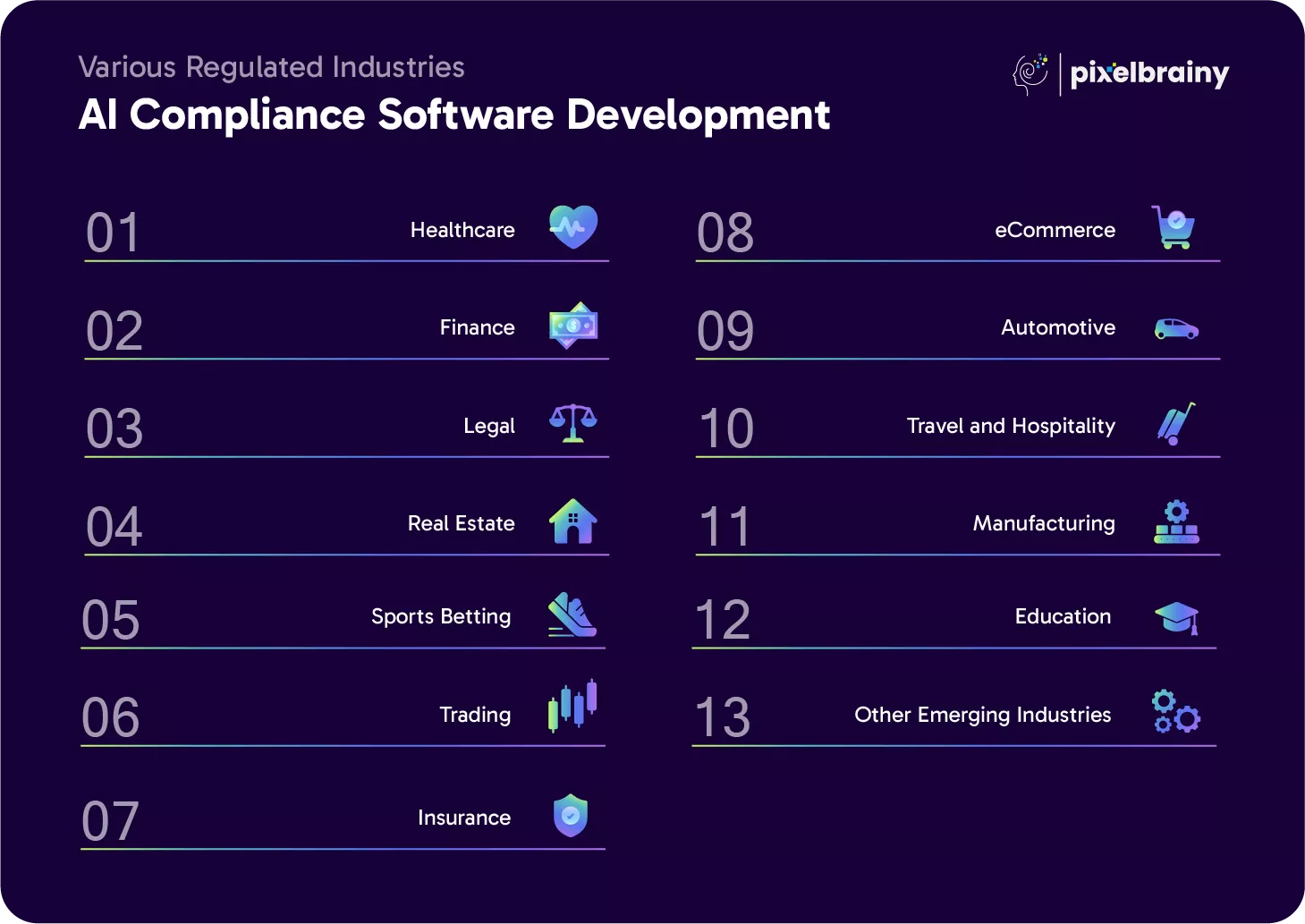
Healthcare organizations operate under some of the most stringent regulatory requirements due to the sensitive nature of patient data and the life-critical outcomes influenced by AI systems. When building an AI Compliance Software for healthcare, developers must ensure compliance with patient data privacy laws, clinical safety standards, and ethical guidelines. AI systems used in diagnostics, treatment planning, and patient monitoring must be transparent, explainable, and clinically validated.
In healthcare, AI compliance software must support strong data governance practices. This includes secure data storage, access controls, consent management, and detailed documentation of how data is used in AI models. Continuous monitoring is also essential to detect model drift or performance degradation that could compromise patient safety. The goal is to create AI systems that improve healthcare outcomes while maintaining regulatory trust and accountability.
Also Read: AI Medical Diagnosis App Development: Features & Cost
The financial sector relies heavily on AI for credit scoring, fraud detection, risk management, and customer analytics. Enterprise AI Compliance Software development for finance must address strict regulations related to fairness, transparency, and financial stability. AI-driven decisions can directly affect an individual’s access to credit or financial services, making explainability a critical requirement.
Financial compliance software must track how AI models are trained, how decisions are made, and how outcomes are monitored over time. It should also support real-time compliance checks and regulatory reporting. By integrating compliance into AI workflows, financial institutions can reduce regulatory risk while continuing to innovate in highly competitive markets.
Also Read: AI Fintech App Development Cost: Factors and Examples
Legal organizations are increasingly using AI for contract analysis, legal research, and case prediction. Developing an AI Compliance Software for legal services requires careful handling of confidential client information and adherence to professional and ethical standards. AI systems must be transparent enough to allow legal professionals to review and validate AI-generated insights.
AI compliance software in the legal sector must provide traceability and accountability for AI-assisted decisions. Documentation, audit trails, and data source tracking are essential to ensure compliance with legal obligations. These systems help law firms and legal departments maintain trust while leveraging AI to improve efficiency and accuracy.
Real estate companies use AI for property valuation, tenant screening, and market forecasting. AI Compliance Software Development for real estate must ensure compliance with fair housing laws, data privacy regulations, and anti-discrimination policies. Automated decision-making in tenant selection or pricing can raise regulatory concerns if not properly governed.
Building an AI compliance software for real estate involves implementing fairness checks, explainability tools, and audit mechanisms. These systems help ensure that AI-driven decisions are transparent, justifiable, and aligned with regulatory expectations. Compliance software also protects organizations from legal disputes and reputational damage.
Also Read: A Guide to Real Estate AI Software Development
Sports betting platforms operate in a highly regulated environment where fairness, integrity, and responsible gaming are paramount. Building an AI Compliance Software for sports betting requires real-time monitoring of betting patterns, fraud detection, and enforcement of jurisdiction-specific regulations.
AI compliance software must support continuous risk assessment and reporting to regulators. It should also include safeguards to prevent problem gambling and detect suspicious behavior. By embedding compliance into AI systems, betting operators can maintain regulatory approval and ensure fair play across platforms.
Also Read: Top Sports Betting App Development Companies in USA
AI plays a significant role in algorithmic trading and market analysis. Developing an AI Compliance Software for trading requires strict oversight to prevent market manipulation and ensure compliance with financial market regulations. AI systems must operate within predefined risk thresholds and be fully auditable.
Compliance software for trading environments must log AI-driven transactions, monitor trading behavior, and provide real-time alerts for regulatory breaches. This ensures that trading firms can demonstrate accountability and maintain trust with regulators and market participants.
Also Read: AI Trading Assistant Development: From Concept to Market
Insurance providers use AI for underwriting, claims processing, and fraud detection. AI Compliance Software Development for insurance focuses on ensuring fairness, transparency, and consumer protection. Automated decisions must be explainable to policyholders and regulators alike.
Building an AI compliance software for insurance involves implementing bias detection, decision review workflows, and compliance reporting tools. These systems help insurers balance efficiency with regulatory obligations while improving customer trust and satisfaction.
Also Read: How to Build an AI Chatbot for Insurance Agencies?
eCommerce platforms rely on AI for personalized recommendations, pricing strategies, and fraud prevention. Developing an AI Compliance Software for eCommerce requires compliance with consumer protection laws, data privacy regulations, and fair pricing practices.
AI compliance software ensures responsible use of customer data and transparent decision-making processes. It also helps organizations manage cross-border regulations as eCommerce platforms often operate globally. Compliance-driven AI systems build customer trust and reduce regulatory exposure.
Also Read: How to Build AI eCommerce Mobile App: Features, Steps and Cost
The automotive industry uses AI in autonomous vehicles, safety systems, and predictive maintenance. AI Compliance Software Development for automotive must address safety standards, liability concerns, and real-time system monitoring.
Building an AI compliance software in this sector requires rigorous testing, documentation, and traceability of AI decisions. Compliance software ensures that AI-driven vehicle systems meet regulatory safety requirements and operate reliably in real-world conditions.
Travel and hospitality companies use AI for pricing optimization, customer profiling, and operational efficiency. Developing an AI Compliance Software for travel and hospitality requires careful management of personal data and compliance with consumer rights regulations.
AI compliance software helps organizations ensure transparency in pricing, responsible data usage, and consistent service delivery. This is especially important in global operations where regulatory requirements vary by region.
Also Read: AI Travel Planner App Development: Features and Cost
Manufacturers apply AI to quality control, predictive maintenance, and supply chain optimization. AI Compliance Software Development for manufacturing focuses on safety, process accountability, and regulatory adherence.
Compliance software ensures that AI systems operate within industrial standards and provide traceable insights into automated decisions. This helps manufacturers maintain compliance while improving operational efficiency.
Educational institutions use AI for admissions, learning analytics, and student engagement. Building an AI Compliance Software for education requires protecting student data, ensuring fairness in assessments, and maintaining transparency.
AI compliance software supports ethical AI usage by enforcing data governance policies and explainability requirements. These systems help institutions adopt AI responsibly while safeguarding student rights.
Industries such as energy, logistics, telecommunications, and media are also adopting AI at scale. Enterprise AI Compliance Software development in these sectors must remain flexible to accommodate evolving regulations and operational risks.
By designing adaptable compliance frameworks, organizations can scale AI initiatives while remaining compliant as regulatory environments continue to change.
Industry-specific AI compliance software development enables organizations to innovate responsibly while meeting the unique regulatory demands of each sector.
AI compliance software plays a critical role in helping regulated organizations manage risk, meet regulatory requirements, and maintain transparency across AI-driven systems. By integrating compliance capabilities directly into AI workflows, businesses can automate oversight, reduce manual intervention, and ensure consistent adherence to regulatory standards throughout the AI lifecycle.
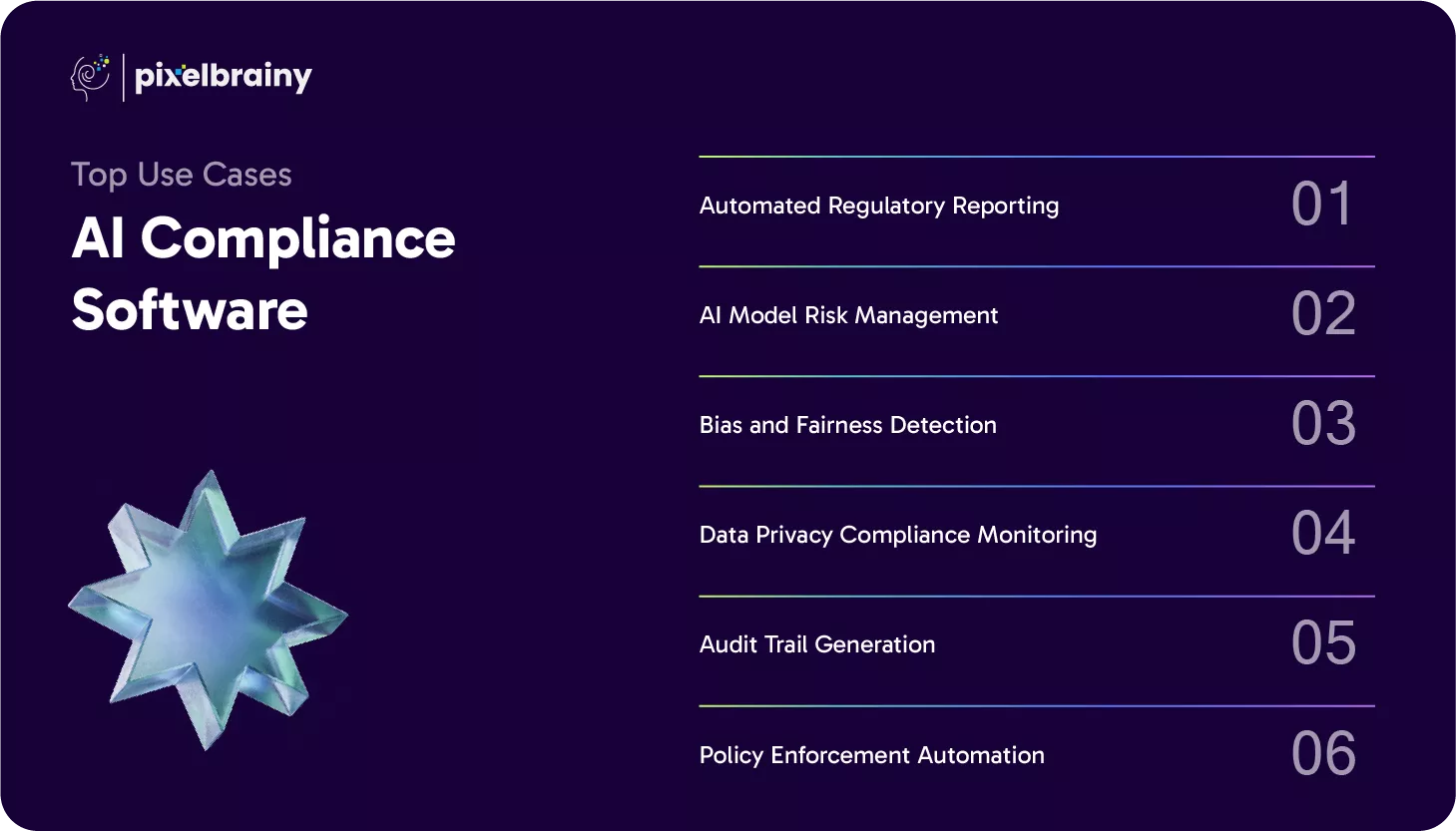
Automated regulatory reporting is one of the most valuable use cases of AI Compliance Software Development. Regulated organizations must regularly submit detailed compliance reports to authorities, which is traditionally time-consuming and error-prone. AI compliance software automates data collection, validation, and report generation, ensuring accuracy and consistency.
Key benefits include:
AI model risk management focuses on identifying, assessing, and mitigating risks associated with AI models. Building an AI Compliance Software enables organizations to monitor model behavior, performance, and compliance status throughout deployment and operation.
Key benefits include:
Bias and fairness detection is essential for ensuring ethical and compliant AI outcomes. Developing an AI Compliance Software allows organizations to evaluate AI models for bias across different data sets and demographic groups.
Key benefits include:
Data privacy compliance monitoring ensures that AI systems handle personal and sensitive data lawfully. Enterprise AI Compliance Software development helps organizations track how data is collected, processed, stored, and used across AI applications.
Key benefits include:
Audit trail generation enables organizations to maintain detailed records of AI system activities. AI Compliance Software Development ensures that every decision, model update, and data interaction is logged and traceable.
Key benefits include:
Policy enforcement automation ensures that organizational and regulatory policies are consistently applied across AI systems. Developing an AI Compliance Software enables automated enforcement of rules, thresholds, and approval workflows.
Key benefits include:
By addressing these critical use cases, AI compliance software enables organizations to scale AI initiatives confidently while maintaining regulatory alignment and operational integrity.
To successfully build and scale AI systems in regulated environments, organizations must embed compliance capabilities directly into their technology stack. Effective AI Compliance Software Development requires a strong foundation of core features that ensure transparency, accountability, security, and regulatory alignment throughout the AI lifecycle.
These features enable businesses to confidently develop an AI Compliance Software that supports both innovation and compliance management.
| Feature | Description |
| Regulatory Rules Engine | A regulatory rules engine allows organizations to encode industry-specific compliance requirements into AI workflows. It ensures that AI systems consistently operate within defined legal and regulatory boundaries. This feature simplifies compliance updates when regulations evolve. |
| Data Lineage Tracking | Data lineage tracking records where data originates, how it is processed, and how it is used by AI models. It supports transparency and ensures lawful data usage across AI systems. This feature is essential for audits and regulatory reviews. |
| Model Version Control | Model version control tracks changes to AI models over time. It enables teams to compare versions, roll back changes, and document model evolution. This improves accountability and regulatory traceability. |
| Explainability and Interpretability Tools | Explainability tools help stakeholders understand how AI decisions are made. They provide insights into model logic and outcomes. This feature supports regulatory demands for transparent AI decision-making. |
| Bias and Fairness Monitoring | Bias detection tools analyze AI outputs to identify discriminatory patterns. They help ensure fairness across demographic groups. This feature is critical for compliance with ethical and legal fairness standards. |
| Risk Assessment Dashboard | Risk dashboards provide real-time visibility into AI compliance risks. They help compliance teams identify issues early and take corrective action. This feature supports proactive risk management. |
| Audit Trail and Logging | Audit trail functionality records all AI activities, including decisions and data access. It ensures traceability and accountability. This feature simplifies internal audits and regulatory inspections. |
| Access Control and Role Management | Role-based access control limits who can view or modify AI systems. It ensures that sensitive data and models are protected. This feature supports security and compliance governance. |
| Data Privacy Management | Data privacy tools manage consent, anonymization, and lawful data processing. They ensure compliance with data protection regulations. This feature reduces privacy-related risks. |
| Human Oversight Mechanisms | Human-in-the-loop workflows enable manual review and intervention in AI decisions. They ensure accountability and responsible AI usage. This feature is critical in high-risk decision scenarios. |
| Compliance Reporting Module | Compliance reporting tools generate standardized reports for regulators and auditors. They reduce manual reporting efforts. This feature improves reporting accuracy and efficiency. |
| Continuous Monitoring System | Continuous monitoring tracks AI performance and compliance status post-deployment. It helps detect drift and anomalies. This feature ensures ongoing regulatory alignment. |
| Incident Management Tools | Incident management features help organizations respond to compliance breaches. They document incidents and corrective actions. This improves accountability and regulatory readiness. |
| Integration Capabilities | Integration tools connect AI compliance software with existing enterprise systems. They support seamless data flow and compliance alignment. This feature improves scalability and adoption. |
| Documentation Management | Documentation management centralizes compliance documents and policies. It ensures consistent record-keeping. This feature supports audit readiness and governance transparency. |
These must-have features form the foundation for building reliable, scalable, and regulation-ready AI compliance software across regulated industries.
As organizations mature their AI initiatives, basic compliance capabilities may no longer be sufficient. Advanced features help enterprises enhance automation, scalability, and governance as they build and operate enterprise AI systems.
When planning to make an AI Compliance Software future-ready, these advanced capabilities provide long-term regulatory resilience and operational efficiency.
| Advanced Feature | Description |
| Automated Regulatory Change Management | This feature tracks regulatory updates and maps them to AI compliance rules. It helps organizations stay compliant as regulations evolve. Automation reduces manual compliance updates. |
| Predictive Compliance Risk Analytics | Predictive analytics identify potential compliance risks before violations occur. They use historical data and AI models to forecast risk. This enables proactive compliance management. |
| AI Governance Workflow Automation | Governance workflows automate approvals, reviews, and compliance checkpoints. They standardize compliance processes across teams. This feature improves accountability and efficiency. |
| Cross-Model Compliance Intelligence | This feature provides insights across multiple AI models and systems. It enables centralized governance for large AI ecosystems. Enterprises gain better visibility and control. |
| Real-Time Compliance Alerts | Real-time alerts notify teams of compliance breaches or anomalies. They support faster response and mitigation. This feature reduces regulatory exposure. |
| Advanced Bias Mitigation Tools | Bias mitigation tools automatically adjust models to reduce unfair outcomes. They go beyond detection to corrective action. This enhances ethical AI compliance. |
| Regulatory Scenario Simulation | Simulation tools test AI behavior under different regulatory scenarios. They help organizations prepare for audits and regulatory changes. This improves readiness and resilience. |
| Multi-Jurisdiction Compliance Support | This feature manages compliance across regions and regulatory frameworks. It is critical for global enterprises. Organizations can scale AI internationally with confidence. |
| AI Model Certification Support | Certification tools help validate AI models against regulatory standards. They support internal and external certification processes. This builds trust with regulators and partners. |
| Explainability Automation at Scale | Automated explainability tools generate explanations across large AI deployments. They reduce manual effort while maintaining transparency. This supports enterprise-scale AI governance. |
Advanced AI compliance features enable enterprises to future-proof their AI systems while maintaining continuous regulatory alignment and governance excellence.
The development process of AI Compliance Software requires a structured and methodical approach to ensure regulatory alignment, system reliability, and long-term scalability. Organizations looking to understand how to develop an AI Compliance Software must balance compliance requirements, AI capabilities, and business objectives throughout the development lifecycle.
Below is a step-by-step approach to successfully build an AI Compliance Software that meets enterprise and regulatory expectations.
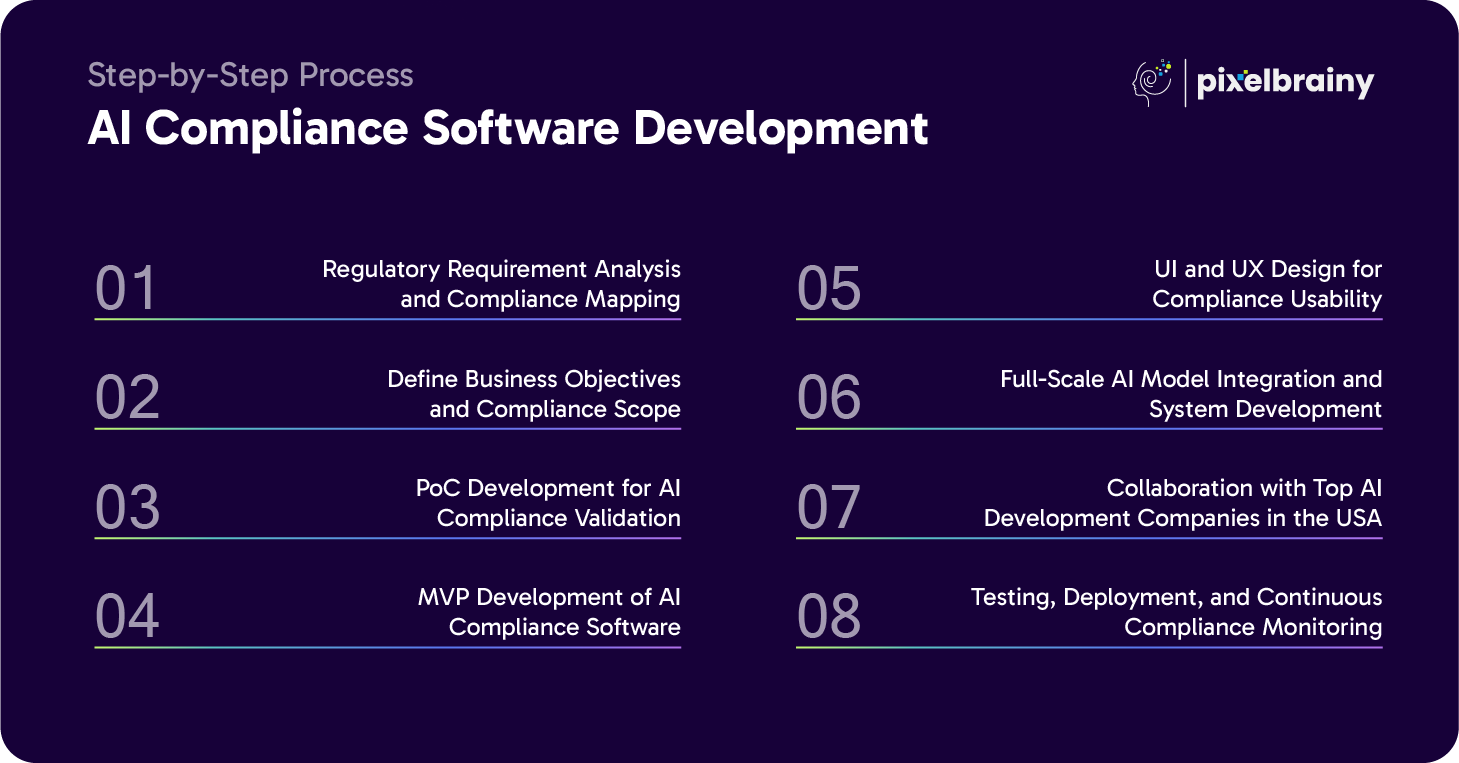
Goal: To clearly understand and document all applicable regulatory, legal, and industry-specific requirements.
The first step in AI Compliance Software development is identifying the regulations that apply to the target industry and region. This includes data protection laws, AI governance standards, and sector-specific compliance rules. Compliance mapping helps align these requirements with AI system workflows and business processes. A thorough regulatory assessment ensures that compliance considerations guide the entire creation of AI Compliance Software from the beginning.
Goal: To align AI compliance capabilities with organizational goals and risk priorities.
In this step, stakeholders define the purpose of the AI compliance software, the compliance risks it must address, and the AI systems it will govern. This includes determining whether the focus is risk management, reporting, bias detection, or governance automation. Clearly defining scope ensures that AI Software Development for Compliance Software delivers measurable business and compliance value.
Goal: To validate feasibility, compliance logic, and AI performance before full-scale development.
Proof of Concept development allows organizations to test core compliance workflows, AI models, and regulatory logic on a smaller scale. During PoC development, teams evaluate whether compliance rules can be effectively automated and monitored. This step reduces risk and provides confidence before investing in full AI Compliance Software development.
Goal: To deliver a functional and compliant product with essential features for early adoption.
MVP development focuses on building the minimum set of features required to meet compliance needs. This includes core capabilities such as audit logging, reporting, and basic governance controls. MVPs allow organizations to gather user feedback, validate workflows, and refine requirements while continuing to build an AI Compliance Software incrementally.
Goal: To ensure usability, clarity, and efficiency for compliance and operational teams.
Partnering with an experienced UI and UX design company helps create intuitive dashboards and workflows for compliance users. Well-designed interfaces improve visibility into AI decisions, risks, and reports. Strong UI and UX design enhances adoption and ensures that compliance teams can easily interact with the AI compliance software.
Goal: To integrate AI models, compliance engines, and enterprise systems into a unified platform.
This step involves integrating AI models, data pipelines, compliance rules engines, and monitoring tools. Developers ensure that AI systems operate within defined compliance constraints and that governance mechanisms are enforced consistently. This phase is central to building an AI Compliance Software that functions reliably at enterprise scale.
Goal: To leverage advanced expertise, best practices, and regulatory experience.
Working with top AI development companies in the USA provides access to experienced engineers, compliance specialists, and AI architects. These partners bring industry knowledge, accelerate development timelines, and help ensure regulatory alignment. Strategic collaboration strengthens the overall AI Compliance Software development process.
Goal: To ensure system reliability, regulatory readiness, and long-term compliance.
Before deployment, the AI compliance software undergoes rigorous testing for accuracy, security, and regulatory adherence. After deployment, continuous monitoring ensures ongoing compliance as regulations and AI models evolve. This final step supports sustainable operation and continuous improvement of the AI compliance platform.
Following a structured development process enables organizations to build AI compliance software that is secure, scalable, and aligned with evolving regulatory demands.

The cost of AI Compliance Software Development varies widely based on system complexity, regulatory scope, and enterprise requirements. Organizations planning to build an AI Compliance Software should budget anywhere between $30,000 to $300,000+, depending on whether they are developing a basic MVP or a full-scale enterprise platform.
Understanding cost structures helps businesses make informed investment decisions while balancing compliance needs and long-term scalability.
| Type | Estimated Cost | Timeline | What You Get |
| Basic AI Compliance Software (MVP) | $30,000 to $60,000 | 8 to 12 weeks | Core compliance workflows, basic audit logging, regulatory reporting, limited AI model monitoring, and foundational UI dashboards |
| Advanced AI Compliance Software | $70,000 to $150,000 | 3 to 5 months | Bias detection, explainability tools, data governance modules, continuous monitoring, scalable architecture, and improved UI and UX |
| Enterprise AI Compliance Software | $180,000 to $300,000+ | 6 to 9 months | End-to-end AI governance, multi-jurisdiction compliance, real-time risk analytics, enterprise integrations, advanced security, and regulatory-ready reporting |
Regulatory complexity is one of the largest contributors to the cost of AI Compliance Software Development. Industries that operate under multiple regulatory frameworks require custom compliance logic, additional validation workflows, and extensive documentation.
Supporting multiple regions or jurisdictions significantly increases development time and cost, often adding $15,000 to $50,000 depending on the number of regulatory frameworks involved. The more complex the regulatory environment, the higher the effort required to ensure continuous compliance.
The sophistication of AI models directly impacts the cost of compliance software. Advanced machine learning or deep learning models require explainability layers, fairness checks, and continuous performance monitoring.
Adding these controls increases development and testing effort. Depending on model complexity, this can raise costs by $10,000 to $40,000, particularly when explainability and risk assessment tools are required to meet regulatory standards.
Handling large volumes of sensitive or personal data requires strong data governance mechanisms, encryption, access controls, and audit logging. These safeguards increase both development and infrastructure costs.
Organizations working with highly sensitive data such as healthcare or financial records may see costs increase by $15,000 to $35,000 due to the need for advanced privacy and security features.
The number and complexity of features included in the AI compliance software significantly affect cost. Basic compliance reporting is relatively inexpensive, while real-time monitoring, predictive analytics, and governance automation require more development resources.
Expanding feature scope can increase overall cost by $20,000 to $60,000, particularly for enterprise-grade scalability and performance requirements.
Most organizations need their AI compliance software to integrate with existing platforms such as data warehouses, CRM systems, and regulatory tools. Each integration requires development, testing, and maintenance.
Integration efforts typically add $10,000 to $30,000 to the total cost, depending on system complexity and data flow requirements.
Starting with an MVP helps organizations validate compliance workflows and core features before committing to a full-scale solution. MVP development focuses on essential capabilities such as audit logging and basic reporting. This approach can reduce initial investment by 30 to 40 percent, allowing teams to gather feedback and refine requirements before scaling.
A modular architecture allows organizations to build AI compliance software in phases. Core compliance modules can be developed first, with advanced features added later. This strategy reduces rework and spreads costs over time. Modular development can lower long-term costs by 20 to 30 percent by avoiding unnecessary upfront investment.
Using existing AI governance libraries, compliance frameworks, and open-source tools can significantly reduce development effort. These frameworks provide tested components for explainability, bias detection, and audit logging. Leveraging prebuilt solutions can cut development costs by 15 to 25 percent while accelerating time to market.
Cloud platforms eliminate the need for expensive on-premise infrastructure and allow organizations to pay only for the resources they use. Cloud-based development reduces setup and maintenance costs and supports scalability. This approach can save 20 to 35 percent in infrastructure and operational expenses.
Working with experienced AI development partners reduces the risk of costly mistakes and rework. Specialized teams understand regulatory requirements and best practices, enabling faster and more accurate development. Partnering with experts can lower total project costs by 10 to 20 percent through improved efficiency and reduced compliance risk.
By understanding cost drivers and applying smart optimization strategies, organizations can invest in AI compliance software that delivers regulatory confidence, scalability, and long-term business value.
Selecting the right technology stack is critical for building secure, scalable, and regulation-ready AI systems. The development of AI Compliance Software requires a tech stack that supports data governance, AI model transparency, auditability, and enterprise integration.
An optimized stack ensures performance, compliance alignment, and long-term maintainability across regulated environments.
| Tech Layer | Technologies | Explanation |
| Programming Languages | Python, Java, TypeScript | Python is widely used for AI and compliance logic due to its extensive AI libraries. Java supports enterprise-grade security and scalability. TypeScript enables reliable front-end and backend development for compliance dashboards. |
| AI and Machine Learning Frameworks | TensorFlow, PyTorch, Scikit-learn | These frameworks support model development, training, validation, and explainability. They allow organizations to implement compliant AI models with monitoring and interpretability capabilities. |
| Explainability and Bias Tools | SHAP, LIME, Fairlearn | Explainability tools help interpret AI decisions, while fairness tools detect and mitigate bias. These technologies support regulatory transparency and ethical AI requirements. |
| Backend Frameworks | Spring Boot, Node.js, FastAPI | Backend frameworks enable secure APIs, business logic, and compliance workflows. They support scalable architecture and integration with enterprise systems. |
| Frontend Technologies | React.js, Angular, Vue.js | Frontend frameworks are used to build intuitive dashboards for compliance monitoring and reporting. They improve usability for compliance officers and stakeholders. |
| Data Storage and Databases | PostgreSQL, MongoDB, Snowflake | Structured and unstructured databases store compliance data, logs, and reports. These solutions support data integrity, scalability, and audit readiness. |
| Data Governance and Lineage Tools | Apache Atlas, Collibra | Data governance tools track data sources, usage, and transformations. They ensure transparency and compliance with data protection regulations. |
| Security and Privacy Tools | OAuth 2.0, Keycloak, HashiCorp Vault | Security tools manage authentication, authorization, encryption, and secret management. They protect sensitive data and support compliance with security standards. |
| Cloud Platforms | AWS, Microsoft Azure, Google Cloud | Cloud platforms provide scalable infrastructure, security services, and compliance certifications. They enable global deployment and cost-efficient operations. |
| Monitoring and Logging Tools | Prometheus, ELK Stack, Datadog | Monitoring tools track system performance, compliance events, and AI behavior. Logging ensures traceability and audit readiness. |
| CI and CD Pipelines | GitHub Actions, Jenkins, GitLab CI | Continuous integration and deployment pipelines support controlled updates, testing, and compliance checks during software releases. |
| Integration and API Management | REST APIs, GraphQL, MuleSoft | Integration tools enable seamless data exchange with enterprise systems and regulatory platforms. They support scalable and compliant system interoperability. |
A well-chosen tech stack ensures that AI compliance software is secure, scalable, and capable of meeting evolving regulatory and enterprise demands.
Developing compliant AI systems requires more than technical expertise. Successful AI Compliance Software Development depends on disciplined processes, strong governance, and early alignment with regulatory requirements. By following proven best practices, organizations can build AI compliance software that is reliable, transparent, and aligned with both business goals and regulatory expectations.
Compliance should be integrated into the earliest stages of the development of AI Compliance Software. Regulatory requirements, ethical standards, and risk controls must be considered during system design, data selection, and model development. This approach reduces rework, lowers long-term costs, and ensures that compliance remains consistent throughout the AI lifecycle.
Data is the foundation of AI systems, making governance a critical best practice. Organizations should implement policies for data quality, access control, consent management, and lawful data usage. Strong data governance ensures that AI models operate on accurate and compliant data, reducing privacy risks and supporting regulatory audits.
Transparency is essential when building AI systems for regulated industries. Building an AI Compliance Software should include explainability tools that allow stakeholders to understand how AI decisions are made. Clear explanations improve regulatory trust and help organizations justify AI-driven outcomes during audits or reviews.
AI compliance does not end at deployment. Continuous monitoring helps organizations track model performance, detect drift, and identify compliance risks in real time. Regular audits ensure that AI systems remain aligned with evolving regulations and internal governance policies.
Human oversight remains essential in AI-driven environments. Organizations should define clear roles, responsibilities, and escalation workflows for AI decisions. Human-in-the-loop mechanisms ensure accountability and allow intervention when AI behavior raises compliance or ethical concerns.
Effective AI Compliance Software development requires collaboration between AI engineers, compliance officers, legal teams, and business stakeholders. Cross-functional alignment ensures that technical solutions address real regulatory requirements and business risks. This collaboration improves system effectiveness and reduces compliance gaps.
Following these best practices enables organizations to develop AI compliance software that supports responsible innovation while meeting regulatory and ethical expectations.
While AI brings significant operational advantages, building compliant AI systems presents complex challenges. AI Compliance Software Development requires organizations to balance innovation with strict regulatory, ethical, and governance requirements. Understanding these challenges and addressing them early helps businesses build AI compliance software that is reliable, transparent, and regulation-ready.
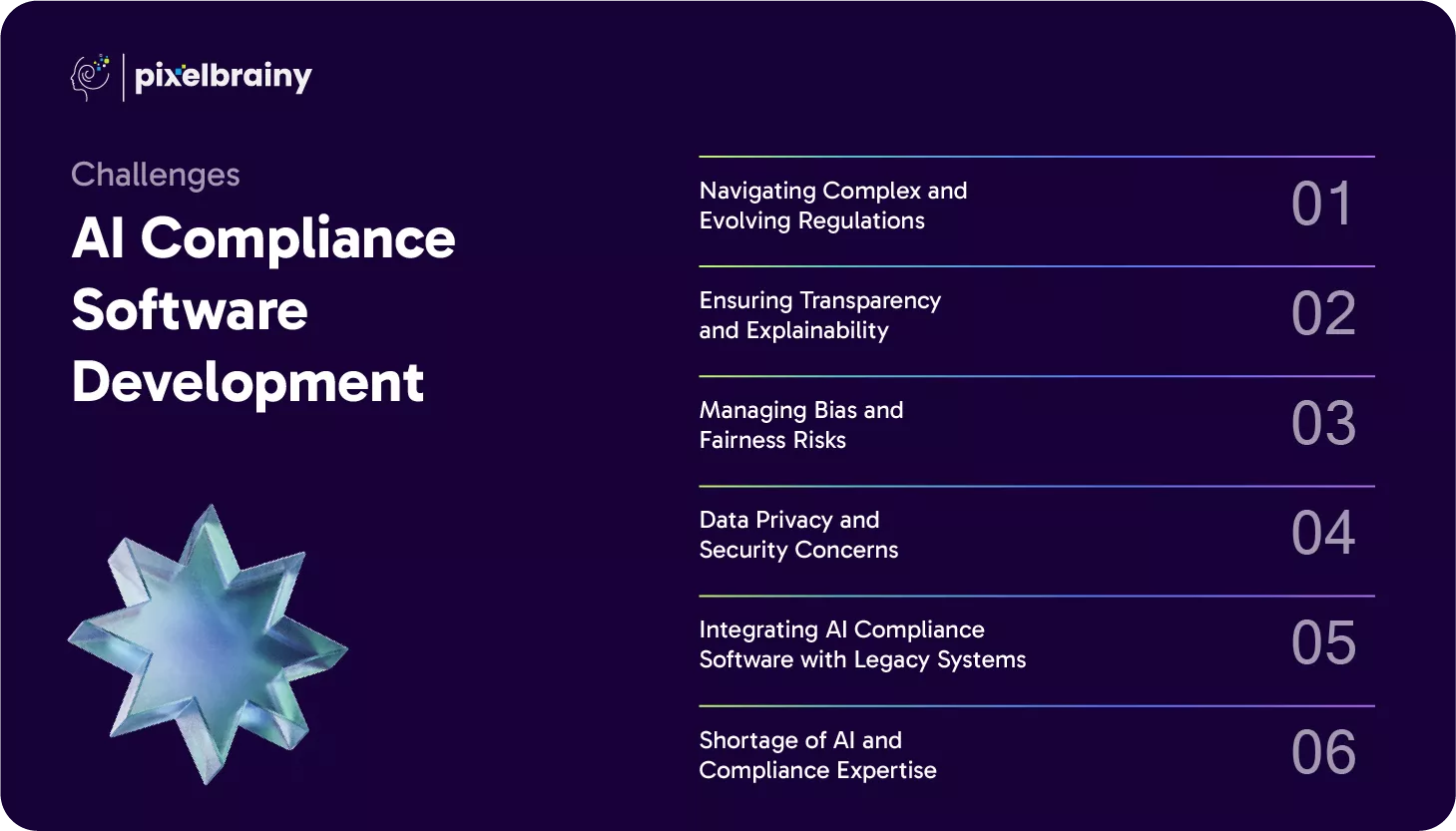
One of the biggest challenges in the development of AI Compliance Software is keeping up with constantly changing regulations across regions and industries. Regulatory ambiguity can make it difficult to design systems that remain compliant over time.
How to resolve it: Organizations should adopt modular compliance frameworks and maintain close collaboration with legal and compliance teams. Implementing automated regulatory updates and flexible rules engines helps systems adapt to evolving requirements.
Many AI models operate as complex systems that are difficult to interpret. This lack of transparency creates compliance risks in regulated industries where explainability is mandatory.
How to resolve it: Businesses should integrate explainability tools and model documentation processes during AI Compliance Software development. Selecting models that balance performance with interpretability improves regulatory acceptance and stakeholder trust.
Bias in AI models can lead to discriminatory outcomes and regulatory violations. Identifying and mitigating bias across data sets and models remains a significant challenge.
How to resolve it: Organizations should implement continuous bias monitoring, fairness testing, and corrective mechanisms. Regular audits and diverse data sampling help ensure ethical and compliant AI behavior.
AI systems often process sensitive personal or financial data, increasing exposure to privacy breaches and security risks. Non-compliance with data protection laws can result in severe penalties.
How to resolve it: Strong data governance, encryption, access controls, and privacy-by-design principles should be embedded into the creation of AI Compliance Software. Regular security assessments further reduce risk.
Many organizations rely on legacy infrastructure that may not support modern AI compliance requirements. Integration challenges can delay projects and increase costs.
How to resolve it: Using APIs, middleware, and modular architectures allows organizations to integrate compliance software without overhauling existing systems. This approach supports scalability and reduces disruption.
Building AI compliance solutions requires expertise in both AI technology and regulatory frameworks. Many organizations struggle to find teams with combined skill sets.
How to resolve it: Partnering with experienced AI development firms and investing in internal training helps bridge this gap. Cross-functional collaboration improves knowledge sharing and project outcomes.
Addressing these challenges with the right strategies enables organizations to build AI compliance software that balances innovation, governance, and regulatory confidence.
Choosing the right technology partner is critical when building compliance-focused AI systems. PixelBrainy LLC stands out as a trusted AI Development Company in USA, specializing in AI Compliance Software Development for regulated industries. With deep expertise in AI governance, regulatory frameworks, and enterprise software engineering, PixelBrainy helps organizations confidently design, deploy, and scale compliant AI solutions.
PixelBrainy LLC has extensive experience in Software Development for Compliance Management integrating AI. Our teams understand the regulatory challenges faced by industries such as finance, healthcare, insurance, and legal services. By combining AI engineering with compliance expertise, we ensure that every solution is designed to meet strict legal, ethical, and operational requirements from day one.
From strategy and architecture to deployment and monitoring, PixelBrainy offers complete support for developing an AI Compliance Software. Our services cover PoC development, MVP builds, enterprise-scale platforms, and continuous compliance optimization. This end-to-end approach ensures consistency, scalability, and long-term regulatory alignment.
Every organization has unique compliance needs. PixelBrainy specializes in AI App development for Compliance Software tailored to specific industries, regulations, and business goals. We focus on building flexible, modular solutions that evolve with changing regulatory landscapes while maintaining performance and security.
Compliance and security go hand in hand. Our approach to Compliance Software Development with AI includes strong data governance, explainability, audit readiness, and enterprise-grade security controls. We design systems that regulators can trust and compliance teams can easily manage.
Project Overview: PixelBrainy LLC partnered with a US-based financial services organization to build an AI-powered compliance management platform. The client needed a solution to monitor AI-driven credit risk models, ensure regulatory transparency, and automate compliance reporting.
Solution Delivered:
Business Impact:
This project highlights PixelBrainy’s ability to deliver secure and regulation-ready AI solutions for the USA market while maintaining strict client confidentiality.
PixelBrainy LLC offers dedicated teams and flexible engagement models for organizations looking to hire AI developers for creating an AI Compliance Software. Our developers bring expertise in AI governance, compliance automation, and enterprise system integration, ensuring faster delivery and lower compliance risk.
With proven expertise, industry-focused solutions, and a strong presence as an AI development company in the USA, PixelBrainy LLC is the ideal partner for building scalable, secure, and compliant AI software.

AI is rapidly transforming regulated industries, but innovation without compliance introduces significant risk. AI compliance software enables organizations to embed governance, transparency, and accountability directly into AI-driven systems, ensuring that regulatory requirements are met throughout the AI lifecycle.
By investing in structured AI compliance software development, businesses can reduce legal exposure, improve audit readiness, and build trust with regulators and customers. From data governance and explainability to continuous monitoring and reporting, compliant AI systems support responsible and scalable innovation across industries.
As regulations continue to evolve, organizations that adopt a compliance-first approach to AI will be better positioned to adapt, grow, and maintain competitive advantage. Choosing the right development strategy and technology partner is essential to achieving long-term success.
Ready to build a compliant AI solution? Book an appointment with our experts today to discuss your AI compliance software requirements and get started with confidence.
Organizations operating in regulated industries such as finance, healthcare, insurance, legal services, and government should invest in AI compliance software. Any business using AI for decision-making that impacts customers, data privacy, or legal outcomes can benefit from structured compliance controls.
Yes, modern AI compliance software is designed to integrate with existing AI models and enterprise systems. Through APIs and modular architecture, organizations can add compliance layers without rebuilding their AI infrastructure from scratch.
No, AI compliance software is valuable for startups and mid-sized companies as well. Many organizations begin with an MVP or PoC to manage compliance risks early and scale compliance capabilities as AI adoption grows.
The timeline depends on complexity and regulatory scope. A basic solution may take a few months, while enterprise-grade platforms with multi-region compliance and advanced governance features can take six months or longer.
AI compliance software does not replace human expertise. Instead, it augments compliance teams by automating monitoring, reporting, and risk detection, allowing professionals to focus on strategic oversight and decision-making.
Well-designed AI compliance software includes flexible rules engines and update mechanisms that allow organizations to adapt to regulatory changes. This ensures continued compliance without extensive redevelopment.
Organizations should look for partners with experience in regulated industries, strong AI governance knowledge, security expertise, and a proven track record in delivering compliant AI solutions at scale.

About The Author
Sagar Bhatnagar
Sagar Sahay Bhatnagar brings over a decade of IT industry experience to his role as Marketing Head at PixelBrainy. He's known for his knack in devising creative marketing strategies that boost brand visibility and market influence. Sagar's strategic thinking, coupled with his innovative vision and focus on results, sets him apart. His track record of successful campaigns proves his ability to utilize digital platforms effectively for impactful marketing efforts. With a genuine passion for both technology and marketing, Sagar continuously pushes PixelBrainy's marketing initiatives to greater success.

Working with the PixelBrainy team has been a highly positive experience. They understand the design requirements and create beautiful UX elements to meet the application needs. The dev team did an excellent job bringing my vision to life. We discussed usability and flow. Sagar worked with his team to design the database and begin coding. Working with Sagar was easy. He has the knowledge to create robust apps, including multi-language support, Google and Apple ID login options, Ad-enabled integrations, Stripe payment processing, and a Web Admin site for maintaining support data. I'm extremely satisfied with the services provided, the quality of the final product, and the professionalism of the entire process. I highly recommend them for Android and iOS Mobile Application Design and Development.

Great experience working with them. Had a lot of feedback and I found that unlike most contractors they were bugging me for updates instead of the other way around. They were extremely time conscience and great at communicating! All work was done extremely high quality and if not on time, early! They were always proactive when it comes to communication and the work is great/above par always. Very flexible and a great team to work with! Goes above and beyond to present us with multiple options and always provides quality. Amazing work per usual with Chitra. If you have UI/UX or branding design needs I recommend you go to them! Will likely work with them in the future as well, definitely recommended!

PixelBrainy is a joy to work with and is a great partner when thinking through branding, logo, and website layout. I appreciate that they spend time going into the "why" behind their decisions to help inform me and others about industry best practices and their expertise.

I hired them to design our software apps. Things I really like about them are excellent communication skills, they answer all project suggestions and collaborate right away, and their input on design and colors is amazing. This project was complex and needed patience and creativity. The team is amazing to do business with. I will be using them long-term. Glad to see there are some good people out there. I was afraid to try and outsource my project to someone but I am glad I met them! I really can't say enough. They went above and beyond on this project. I am very happy with everything they have done to make my business stand out from the competition.

It was great working with PixelBrainy and the team. They were very responsive and really owned the project. We'll definitely work with them again!

I recently worked with the PixelBrainy team on a project and I was blown away by their communication skills. They were prompt, clear, and articulate in all of our interactions. They listened and provided valuable feedback and suggestions to help make the project a success. They also kept me updated throughout the entire process, which made the experience stress-free and enjoyable.

PixelBrainy is very good at what it does. The team also presents themselves very professionally and takes care of their side of things very well. I could fully trust them taking up the design work in a timely and organised manner and their attention to detail saved us lots of effort and time. This particular project was quite intense and the team showed that they function very well under pressure. Very much looking forward to working with her again!

It's always an absolute pleasure working with them. They completed all of my requests quickly and followed every note I had for them to a T, which made our process go smoothly from start to finish. Everything was completed fast and following all of the guidelines. And I would recommend their services to anyone. If you need any design work done in the future, PixelBrainy should be your first call!

They took ownership of our requirements and designed and proposed multiple beautiful variants. The team is self-motivated, requires minimum supervision, committed to see-through designs with quality and delivering them on time. We would definitely love to work with PixelBrainy again when we have any requirements.

PixelBrainy was a big help with our SaaS application. We've been hard at work with a new UI/UX and they provided a lot of help with the designs. If you're looking for assistance with your website, software, or mobile application designs, PixelBrainy and the team is a great recommendation.

PixelBrainy designers are amazing. They are responsive, talented, and always willing to help craft the design until it matches your vision. I would recommend them and plan to continue them for my future projects and more!!!

They were awesome! Did a good job fast, and good communication. Will work with them again. Thank you

Creative, detail-oriented, and talented designers who take direction well and implement changes quickly and accurately. They consistently over-delivered for us.

PixelBrainy team is very talented and creative. Great designers and a pleasure to work with. PixelBrainy is an excellent communicator and I look forward to working with them again.

PixelBrainy has a very talented design team. Their work is excellent and they are very responsive. I enjoy working with them and hope to continue on all of our future projects.


Transform your ideas into reality with us.
Across these industries, each engagement brings unique challenges, from early-stage product development to scaling complex systems, helping us build a practical understanding of real-world product environments.