
 AI Summary Powered by PixelBrainy
Why are healthcare providers still spending countless hours on phone calls, fax submissions, insurance follow ups, and repetitive paperwork when AI can now automate prior authorization workflows in real time?
Imagine this scenario. A hospital administrator says, “We are running a multi-specialty hospital and our prior authorization process is completely manual and taking too long, can you suggest a company that can build an AI-based prior authorization software for us?” This question is becoming increasingly common across the healthcare industry as providers struggle with growing patient volumes, rising insurance complexities, and administrative burnout.
If your multi-specialty hospital is facing delayed approvals, increasing denial rates, overwhelmed administrative teams, and disconnected payer communication, you are not alone. Healthcare organizations worldwide are now investing in AI prior authorization software development to streamline operations, reduce manual workloads, and improve patient care outcomes.
Traditional authorization workflows create major operational inefficiencies. Physicians wait days for approvals. Patients experience delays in treatment. Revenue cycle teams spend hours handling repetitive documentation and payer follow ups. Most importantly, healthcare staff lose valuable time that should be dedicated to patient care.
This is exactly why hospitals are actively searching for a trusted technology partner to develop AI prior authorization decision engine platforms that integrate seamlessly with payer systems and EHR infrastructure. A modern prior authorization workflow automation system can automatically verify insurance eligibility, analyze medical necessity, generate payer specific documentation, predict denial risks, and accelerate approvals using AI powered automation.
According to Precedence Research, the global AI for healthcare payer market is projected to grow from USD 7.03 billion in 2026 to USD 46.67 billion by 2035, driven by increasing demand for AI powered healthcare administration and workflow automation.
If you are looking for a developer to automate prior authorization process using AI or planning to build a custom prior authorization tool for EHR system integration, this guide will help you understand the complete development process, key features, costs, technology stack, and implementation strategy.
AI prior authorization software is an intelligent healthcare automation solution designed to simplify, accelerate, and optimize the insurance approval process for medical treatments, procedures, medications, and diagnostic services.
In traditional healthcare environments, prior authorization involves manual paperwork, repeated payer communication, phone calls, fax submissions, and lengthy approval cycles. AI prior authorization software development eliminates these inefficiencies by using technologies like Artificial Intelligence, Machine Learning, Natural Language Processing (NLP), and workflow automation.
A modern prior authorization workflow automation system can automatically:
For hospitals and healthcare providers, these systems significantly reduce administrative burden while improving approval turnaround time and patient care delivery.
Many healthcare organizations now choose to develop AI prior authorization decision engine platforms that integrate directly with EHR systems such as Epic and Oracle Cerner to create a seamless authorization workflow across departments.
Whether you want to build a custom prior authorization tool for EHR system integration or hire a developer to automate prior authorization process using AI, the primary goal remains the same: reducing delays, minimizing denials, and improving operational efficiency through intelligent automation.
The prior authorization process in healthcare is a payer approval workflow used by insurance companies to determine whether a specific treatment, medication, procedure, or diagnostic test qualifies for coverage before the patient receives care.
The primary purpose of this process is to ensure that the recommended treatment is medically necessary and aligns with the insurer’s coverage guidelines. However, in many hospitals and clinics, the workflow is still highly manual, time consuming, and prone to delays.
Here is how the traditional prior authorization process typically works:
A doctor diagnoses the patient and recommends a procedure, medication, imaging test, surgery, or therapy plan.
The administrative or billing team checks the patient’s insurance coverage to determine whether prior authorization is required for the recommended treatment.
The healthcare provider gathers important documents such as:
The collected information is submitted to the insurance company through:
The insurance provider reviews the request based on:
In some cases, insurers may request additional documentation before making a final decision.
The payer either:
Once approved, the patient can proceed with treatment, and the billing process continues for reimbursement.
In an AI powered system, most of these tasks are automated through a prior authorization workflow automation system.
For example, AI can:
This is why many healthcare organizations now invest in AI prior authorization software development to improve operational speed, reduce staff workload, and minimize patient treatment delays.
Also Read: AI Claim Scrubber Management Software Development
Traditional prior authorization processes continue to create major operational and financial challenges for healthcare providers. Since most hospitals still rely on manual workflows, administrative teams often struggle with delays, repetitive paperwork, payer inconsistencies, and communication gaps.
Below are some of the biggest challenges healthcare organizations face with traditional prior authorization systems:
Manual prior authorization requires staff to spend hours handling phone calls, fax submissions, form filling, payer follow ups, and documentation collection. This repetitive workload increases administrative fatigue and contributes to staff burnout across hospitals and clinics.
Authorization approvals can take several days or even weeks. As a result, patients often experience delays in surgeries, diagnostic tests, medications, and treatment plans, directly impacting patient satisfaction and healthcare outcomes.
Many authorization requests are denied because of:
These denials increase rework and slow down reimbursement cycles.
Every insurance provider follows different prior authorization guidelines, submission formats, and approval requirements. Managing multiple payer workflows manually becomes extremely difficult for multi-specialty healthcare organizations.
Delayed or denied authorizations directly affect hospital revenue cycles. Claims may get rejected, reimbursement timelines increase, and financial performance suffers.
Traditional systems often lack centralized tracking. Staff members struggle to monitor authorization status, pending approvals, denial reasons, and follow up activities in real time.
Many hospitals still use disconnected systems that require duplicate data entry between EHR platforms and payer portals. This increases human errors and reduces workflow efficiency.
Manual workflows increase the risk of HIPAA violations, incomplete records, lost documents, and audit related issues.
These growing challenges are the primary reason healthcare organizations are now investing in AI prior authorization software development and intelligent prior authorization workflow automation systems to improve speed, accuracy, operational efficiency, and patient care delivery.
Healthcare providers are rapidly shifting toward intelligent automation to simplify insurance approval workflows and reduce operational inefficiencies. Manual authorization systems not only consume valuable staff time but also create delays, denials, and financial challenges for hospitals and clinics. This is why many healthcare organizations are investing in AI prior authorization software development to improve workflow speed, increase approval accuracy, and enhance patient care experiences.
Modern AI powered authorization platforms help hospitals automate repetitive tasks, streamline payer communication, improve compliance management, and optimize revenue cycle performance. Organizations that build prior authorization automation platform for health insurance operations gain a competitive advantage by reducing administrative burden and improving operational scalability.
Below are some of the biggest benefits healthcare organizations can achieve with AI driven prior authorization systems.
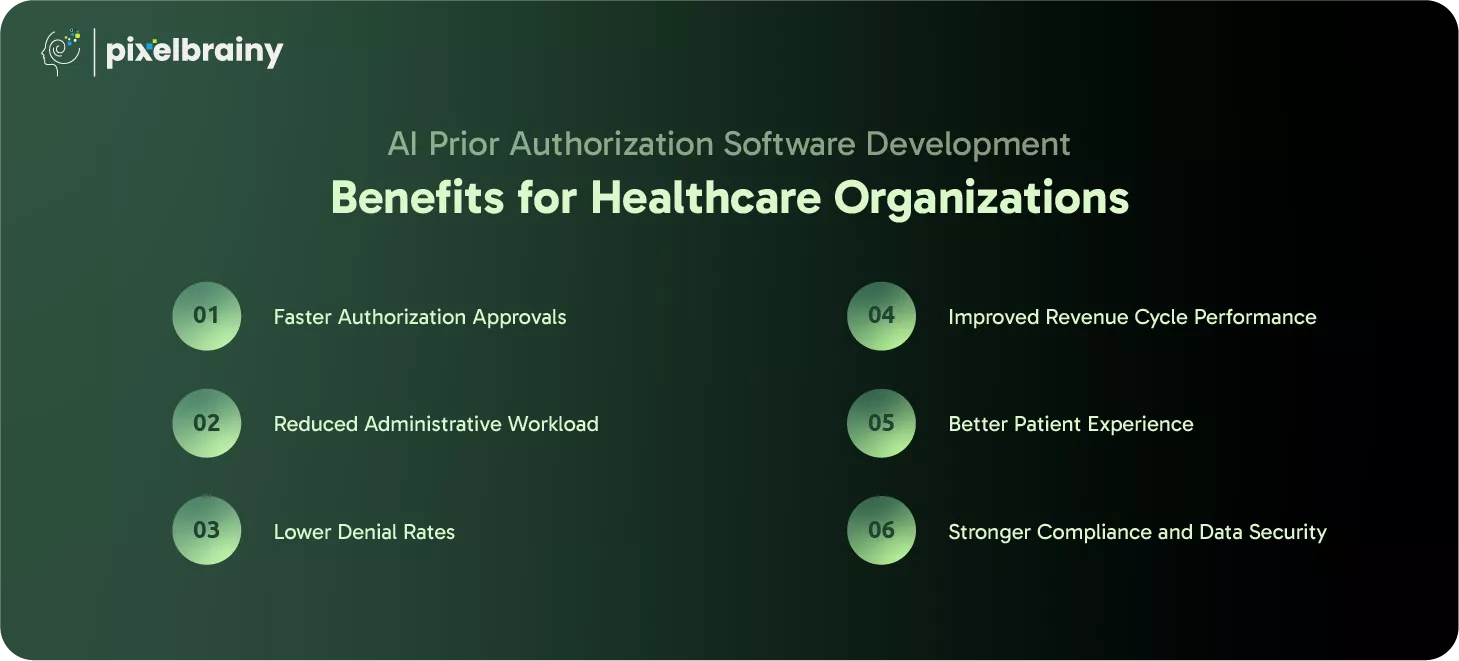
AI powered systems significantly reduce the time required for prior authorization approvals by automating repetitive administrative processes. Instead of manually reviewing payer requirements and filling out forms, AI tools can instantly verify insurance eligibility, analyze documentation, and generate authorization requests in real time.
This automation allows hospitals and healthcare providers to accelerate treatment approvals for patients while reducing delays in surgeries, medications, imaging, and specialty procedures. Faster approvals also improve patient satisfaction because patients no longer need to wait for extended periods before receiving care.
Organizations developing custom AI solutions for medical prior authorization can further optimize approval speed by integrating intelligent workflows directly into existing healthcare systems and payer networks.
Traditional prior authorization processes require staff to spend hours on documentation collection, phone calls, payer follow ups, and manual data entry. These repetitive tasks consume valuable administrative resources and contribute heavily to employee burnout.
AI powered automation reduces this burden by handling repetitive workflows automatically. The system can collect patient information from EHR platforms, validate payer requirements, track authorization status, and send notifications without requiring constant manual intervention.
As a result, healthcare teams can focus more on patient care and higher value operational responsibilities instead of spending most of their time managing paperwork and insurance communication. This also helps hospitals improve workforce productivity and reduce operational stress across departments.
One of the biggest advantages of AI based prior authorization systems is the ability to reduce claim denials and authorization rejections. AI engines can analyze payer rules, medical necessity requirements, coding standards, and documentation accuracy before a request is submitted.
The system identifies missing data, incomplete forms, or incorrect coding that may lead to denials. This proactive validation process improves submission quality and increases approval success rates.
By reducing denials, healthcare providers can avoid unnecessary delays, resubmission efforts, and reimbursement interruptions. Lower denial rates also improve financial stability and operational efficiency for hospitals handling large volumes of insurance authorizations across multiple specialties and payer networks.
Prior authorization delays often create major disruptions in hospital revenue cycles. Delayed approvals can postpone treatments, slow reimbursement timelines, and negatively impact cash flow management.
AI powered authorization systems help healthcare organizations accelerate the entire reimbursement process by ensuring that authorization requests are accurate, complete, and submitted quickly. Faster approvals lead to smoother claims processing and fewer payment delays.
Hospitals that focus on creating HIPAA-compliant AI prior authorization software solutions also benefit from stronger documentation management and reduced compliance related financial risks. With improved workflow efficiency and reduced rejection rates, healthcare organizations can achieve better financial performance while maintaining operational consistency.
Patients often become frustrated when treatment approvals take too long or when authorization issues delay important medical procedures. Long waiting periods can negatively affect patient trust, satisfaction, and overall healthcare experiences.
AI powered prior authorization software improves communication, speeds up approvals, and minimizes delays in care delivery. Patients receive quicker treatment access, faster updates, and more transparent authorization tracking throughout the process.
By automating payer communication and reducing manual bottlenecks, hospitals can provide a smoother and more efficient patient journey. Improved authorization efficiency also helps physicians deliver timely care without administrative interruptions affecting clinical workflows and patient outcomes.
Healthcare organizations must manage sensitive patient data while complying with strict regulatory standards such as HIPAA and healthcare data privacy requirements. Manual workflows increase the risk of documentation errors, lost records, and unauthorized access to patient information.
AI powered authorization systems improve compliance by maintaining centralized documentation, automated audit trails, role-based access controls, and secure data encryption protocols. These systems also reduce human error and standardize authorization workflows across departments.
Secure AI platforms help healthcare organizations maintain regulatory compliance while protecting patient information from security threats and operational vulnerabilities. This becomes especially important for large multi-specialty hospitals handling high volumes of authorization requests daily.
Overall, these benefits clearly show how AI powered prior authorization software helps healthcare organizations reduce administrative burden, accelerate approvals, improve patient experiences, strengthen compliance, and achieve more efficient operational and financial performance.
As healthcare organizations continue to modernize their administrative operations, many providers are actively exploring AI driven solutions to simplify insurance approval workflows. A common concern among hospitals today is: “Our doctors spend 6 hours a week on prior auth, is there an AI solution we can develop or implement?” The answer is yes. Healthcare providers can now create a prior authorization software using artificial intelligence to automate repetitive tasks, reduce delays, and improve operational efficiency.
Depending on the size of the organization, specialty requirements, workflow complexity, and integration needs, there are multiple types of AI powered prior authorization solutions available. Some hospitals prefer standalone platforms, while others invest in deeply integrated enterprise systems that connect directly with EHRs and payer networks.
Below are the major types of AI prior authorization software healthcare organizations can build or implement.
A standalone prior authorization platform is an independent system designed specifically to manage insurance authorization workflows from a centralized dashboard. This type of software is ideal for hospitals, specialty clinics, and healthcare groups that want a dedicated solution without heavily modifying their existing EHR infrastructure.
The platform typically handles eligibility verification, document management, payer communication, status tracking, and approval monitoring within a single interface. AI capabilities automate repetitive tasks such as form generation, medical necessity validation, and denial prediction.
Standalone systems are easier to deploy compared to fully customized enterprise solutions and can often integrate with multiple payer systems and healthcare applications through APIs. Many organizations choose this option when they need faster implementation and scalable workflow management.
This type of solution is directly integrated into Electronic Health Record systems such as Epic or Oracle Cerner. Instead of switching between multiple systems, healthcare providers can manage the entire authorization process directly within the EHR environment.
The software automatically extracts patient demographics, diagnosis codes, physician notes, lab results, and treatment plans from the EHR to generate authorization requests. This reduces duplicate data entry and improves workflow efficiency.
Hospitals looking to develop prior authorization workflow automation with AI often prefer EHR integrated systems because they streamline clinical operations and create a seamless experience for physicians, billing teams, and administrative staff.
An AI decision engine focuses primarily on intelligent analysis and predictive automation. This system uses machine learning algorithms and historical payer data to predict whether an authorization request is likely to be approved or denied before submission.
The platform can identify missing documentation, coding inconsistencies, or medical necessity gaps that may increase denial risk. Some advanced decision engines also recommend corrective actions to improve approval probability.
This type of solution is especially valuable for large healthcare organizations managing thousands of authorization requests each month. By reducing avoidable denials and resubmissions, hospitals can significantly improve operational efficiency and revenue cycle performance.
A multi payer authorization platform is designed for healthcare providers dealing with multiple insurance companies, each having different authorization requirements and workflows.
The system centralizes payer communication and standardizes submission processes across insurers. AI automation helps identify payer specific rules, document requirements, approval timelines, and authorization formats automatically.
This type of software reduces the complexity of managing various payer portals and manual communication channels. It also improves visibility by allowing staff to monitor authorization status across all insurance providers from a single dashboard.
Healthcare organizations building intelligent prior authorization systems for hospitals often prioritize multi payer functionality because it supports scalability and operational consistency across departments and specialties.
Some healthcare specialties have highly complex authorization requirements that require customized workflows and clinical documentation. Specialty specific software is designed specifically for fields such as oncology, cardiology, radiology, orthopedics, neurology, or pharmacy services.
For example, oncology prior authorization systems may require extensive treatment history validation and clinical pathway analysis, while radiology workflows may focus more on imaging criteria and utilization management guidelines.
Specialty focused platforms improve approval accuracy because they are tailored to the exact operational and clinical needs of a specific healthcare department. These systems often include AI powered templates, specialty coding support, and automated clinical evidence validation.
This type of platform combines prior authorization workflows with broader revenue cycle management operations. Instead of treating authorizations as a separate administrative task, the system integrates approvals directly into billing, claims processing, reimbursement tracking, and financial reporting workflows.
AI automation ensures that authorization status is continuously aligned with claims submission timelines, helping hospitals reduce reimbursement delays and prevent claim denials caused by missing approvals.
Organizations investing in development of AI prior authorization platform solutions often choose revenue cycle integration because it creates stronger operational visibility and improves overall financial performance across healthcare systems.
Choosing the right type of AI prior authorization software depends on your hospital’s workflow complexity, payer environment, specialty requirements, and long-term automation goals.
Healthcare organizations investing in AI powered automation must focus on features that improve efficiency, reduce administrative burden, and accelerate approval workflows. Whether you want to build custom AI prior authorization module capabilities for hospitals or launch a scalable healthcare startup, selecting the right features is critical for long term success.
Many healthcare entrepreneurs now ask, “I want to create a startup around AI prior authorization, what features should the software have?” The answer depends on workflow complexity, payer integration requirements, and automation goals. However, there are several core functionalities every intelligent authorization platform should include.
Modern healthcare providers increasingly rely on AI to handle prior authorization faster and with fewer errors while improving operational accuracy, compliance management, and patient care delivery. Below are the most important features to include while creating an AI prior authorization software solution.
| Feature | Description |
| Insurance Eligibility Verification | Automatically checks patient insurance coverage, active policies, payer requirements, and authorization eligibility in real time before treatment requests are submitted for approval processing. |
| Clinical Data Extraction | Uses NLP technology to extract diagnosis codes, physician notes, treatment plans, and medical records directly from EHR systems without manual data entry. |
| Automated Authorization Form Generation | Automatically generates payer specific authorization forms using extracted patient and clinical data, reducing paperwork errors and saving administrative processing time significantly. |
| AI Based Medical Necessity Validation | Evaluates treatment requests against payer guidelines and clinical criteria to determine whether procedures meet medical necessity requirements before submission. |
| Real Time Authorization Tracking | Enables staff to monitor authorization progress, approval timelines, pending requests, and payer responses through centralized real time tracking dashboards. |
| Denial Prediction Engine | Uses machine learning algorithms to identify high risk authorization requests and predict possible denials before payer submission occurs. |
| Multi Payer Workflow Management | Supports multiple insurance providers by organizing payer specific rules, documentation requirements, communication workflows, and submission standards from a single platform. |
| EHR Integration Support | Integrates directly with healthcare systems like Epic and Oracle Cerner for seamless clinical and administrative workflow synchronization. |
| Automated Notifications and Alerts | Sends real time notifications for pending approvals, expiring authorizations, missing documents, denied requests, and payer updates to relevant healthcare teams instantly. |
| Document Management System | Stores, organizes, retrieves, and secures authorization related documents including clinical notes, insurance forms, approval letters, and supporting medical records efficiently. |
| Appeals Management Workflow | Helps providers manage denied requests by organizing appeal documentation, tracking submission deadlines, and streamlining communication with insurance companies effectively. |
| Analytics and Reporting Dashboard | Provides actionable insights into approval rates, denial patterns, processing times, staff productivity, and operational performance through advanced reporting capabilities. |
| Role Based User Access | Restricts system access according to user roles, ensuring secure workflow management and controlled access to sensitive healthcare and patient information. |
| HIPAA Compliance and Security Controls | Supports encrypted data handling, audit logging, user authentication, and secure infrastructure requirements essential for building a HIPAA compliant AI prior authorization tool. |
| AI Powered Virtual Authorization Assistant | Supports administrative staff by answering workflow questions, guiding submissions, automating follow ups, and simplifying repetitive authorization tasks through conversational automation during AI prior authorization assistant development. |
These core features form the foundation of an efficient AI powered prior authorization system that improves workflow speed, reduces denials, and enhances healthcare operational performance.
As healthcare technology evolves, hospitals and healthcare startups are moving beyond basic workflow automation and exploring advanced AI driven capabilities. Modern providers no longer want simple authorization systems. They want intelligent platforms that can predict outcomes, automate decision making, and optimize payer communication in real time.
A common question many healthcare innovators ask is, “What AI advanced featured can be implement while developing prior authorization tool?” The answer lies in combining automation with predictive intelligence, conversational AI, analytics, and self-learning systems.
Organizations investing in AI software development for prior authorization are now focusing on next generation capabilities that improve operational scalability, patient experience, and clinical decision support. Below are some advanced features to consider when you build a prior authorization software using artificial intelligence.
| Advanced Feature | Description |
| AI Powered Appeal Letter Generator | Automatically creates payer specific appeal letters using clinical documentation, denial reasons, treatment history, and medical necessity evidence to accelerate reconsideration requests. |
| Predictive Approval Scoring | Assigns approval probability scores to authorization requests by analyzing payer behavior, historical trends, and clinical documentation quality before submission occurs. |
| Voice Enabled Authorization Assistant | Allows physicians and staff to submit authorization requests using voice commands, reducing manual typing and improving workflow accessibility across departments. |
| Conversational AI Chatbot | Provides real time support for staff and patients by answering authorization questions, tracking request status, and guiding users through submission workflows automatically. |
| Self Learning Workflow Engine | Continuously improves workflow efficiency by learning from payer responses, approval outcomes, denial patterns, and administrative interactions over time. |
| AI Powered Fraud Detection | Detects suspicious authorization activities, unusual claim patterns, duplicate submissions, and potential fraud risks using behavioral analytics and anomaly detection algorithms. |
| Smart Clinical Recommendation System | Suggests alternative treatments, payer preferred procedures, or optimized documentation strategies based on approval likelihood and historical authorization outcomes. |
| Real Time Payer Policy Intelligence | Automatically updates payer guidelines, documentation requirements, and authorization rules by monitoring insurer policy changes continuously across multiple providers. |
| Generative AI Medical Summary Creation | Generates concise clinical summaries from lengthy patient records to simplify documentation review and accelerate payer evaluation processes efficiently. |
| Predictive Workforce and Queue Management | Forecasts authorization workload volume, staffing requirements, approval bottlenecks, and processing delays to optimize operational planning and resource allocation effectively. |
These advanced features can help healthcare organizations create an automated prior authorization platform with AI that delivers smarter automation, stronger scalability, and better patient and provider experiences.
Healthcare organizations and startups are rapidly investing in AI prior authorization platform development to solve delays, denials, and administrative inefficiencies across the insurance approval process. Building a successful solution requires much more than adding automation features. It involves strategic planning, AI model engineering, healthcare interoperability, security compliance, and scalable workflow architecture.
Many entrepreneurs entering the healthcare technology space ask, “I am planning to build a startup that solves the prior authorization problem in US healthcare using AI, I have the idea but i need a technical team to build it, can you suggest what the product should look like and how to find the right developers?” The answer begins with understanding the complete development process of AI prior authorization software and partnering with experienced healthcare focused AI development companies that understand payer systems, compliance requirements, and EHR integrations.
Below is a complete breakdown of the steps to build AI-driven prior authorization software from scratch.
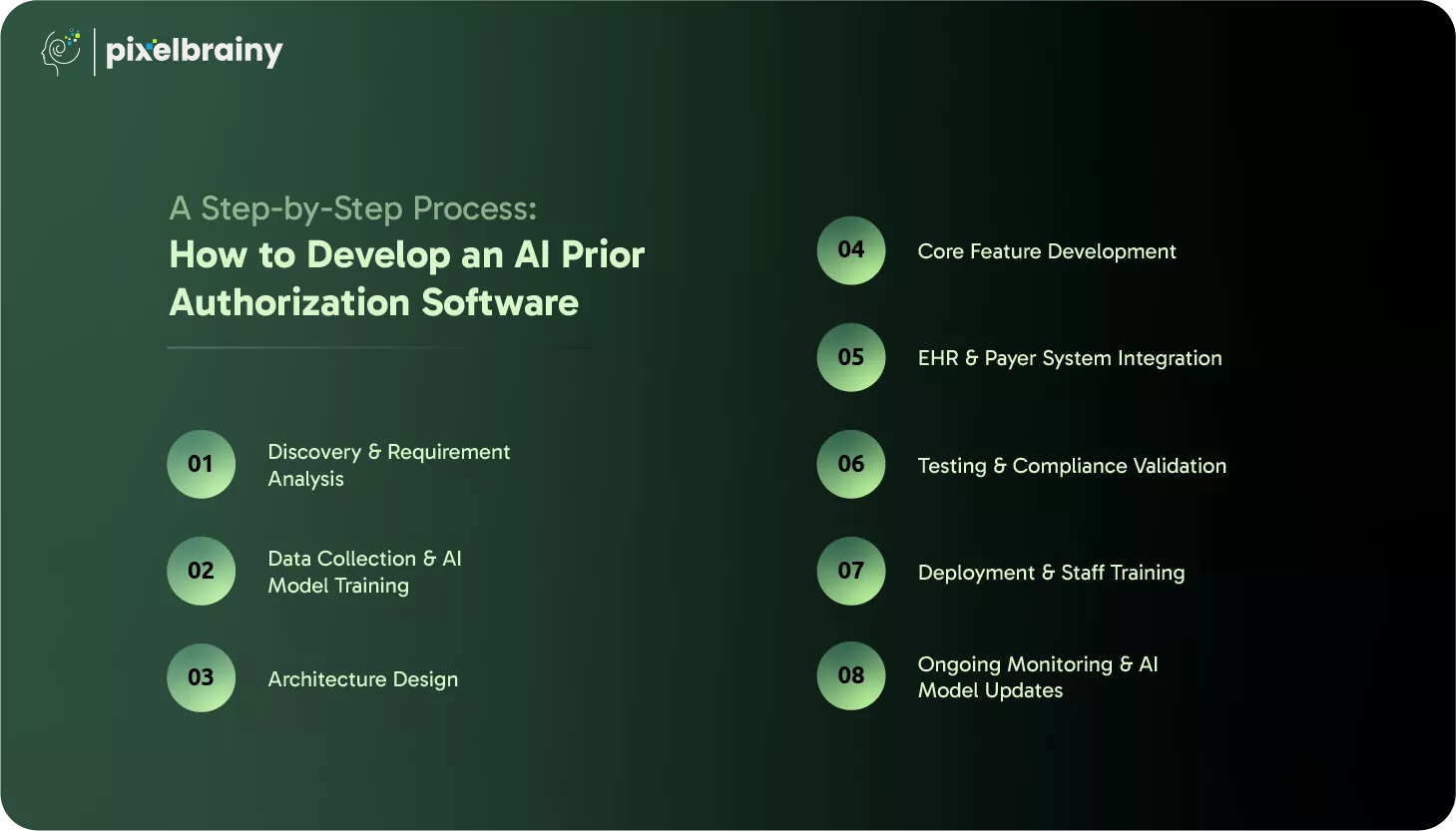
The first stage of developing AI prior authorization software solutions begins with understanding the operational environment of the healthcare organization. This includes analyzing existing authorization workflows, identifying bottlenecks, understanding payer communication challenges, and evaluating administrative inefficiencies.
The technical team works closely with physicians, billing departments, authorization coordinators, and hospital administrators to understand how prior authorizations are currently managed. During this phase, developers also study payer mixes, treatment approval timelines, denial patterns, and specialty specific workflow requirements.
In addition, the organization’s EHR systems, data sources, security standards, and integration requirements are reviewed carefully. This discovery stage helps define project scope, automation goals, workflow priorities, and technical feasibility before actual software development begins.
Artificial Intelligence systems require high quality healthcare data to function effectively. In this stage, the development team gathers historical authorization records, payer approval data, clinical documentation, treatment histories, insurance guidelines, denial reasons, and reimbursement outcomes.
The collected data is cleaned, structured, normalized, and prepared for machine learning model training. AI models are then trained to identify approval patterns, predict denials, validate medical necessity requirements, and automate documentation analysis.
Natural Language Processing models are also developed to extract information from physician notes, medical records, and treatment summaries. This stage is critical because the accuracy and reliability of the AI engine depend heavily on the quality of training data and continuous learning capabilities.
The architecture design phase focuses on building a secure, scalable, and interoperable system infrastructure for prior authorization technology development. Developers create the overall platform architecture while ensuring HIPAA compliance, data encryption, user authentication, and secure API communication.
The architecture typically includes cloud infrastructure, AI processing engines, payer integration modules, EHR connectivity layers, workflow automation services, analytics dashboards, and centralized document management systems. Microservices architecture is often preferred because it improves scalability and system flexibility.
During this phase, the team also plans database structures, system performance optimization, disaster recovery strategies, and interoperability standards such as HL7 and FHIR to support seamless healthcare data exchange across platforms.
This is the main engineering stage where developers begin building intelligent prior authorization software for hospitals and clinics. The technical team develops essential features such as eligibility verification, authorization form generation, denial prediction engines, payer rule management, and workflow automation modules.
AI powered decision systems are integrated to validate medical necessity requirements and analyze authorization risks before submission. NLP modules are developed to extract relevant clinical information directly from EHR records and physician notes automatically.
At this stage, many startups also begin PoC development to validate workflow efficiency and AI prediction capabilities before scaling the platform further. Strong backend development and intuitive frontend interfaces are equally important for ensuring usability across healthcare teams.
Healthcare interoperability is one of the most important aspects of AI prior authorization software development. In this phase, developers integrate the platform with EHR systems such as Epic, Oracle Cerner, and athenahealth.
The platform is also connected to payer systems, clearinghouses, and insurance portals through APIs and secure communication protocols. These integrations allow the software to automatically retrieve patient data, verify insurance eligibility, submit authorization requests, and receive approval updates in real time.
Efficient integration minimizes duplicate data entry, reduces administrative workload, and creates a seamless workflow experience for healthcare providers and administrative teams.
Before deployment, the software undergoes extensive quality assurance testing and compliance validation. The goal of this phase is to ensure workflow reliability, AI prediction accuracy, security protection, interoperability performance, and regulatory compliance.
Developers conduct functionality testing, integration testing, usability testing, API validation, and system stress testing to identify and resolve technical issues. AI models are also evaluated continuously to measure approval prediction accuracy and automation efficiency.
Healthcare applications must comply with HIPAA regulations and healthcare data privacy standards. Security testing includes penetration testing, vulnerability scanning, access control validation, and audit trail verification to ensure patient data protection across all workflows.
Once testing is complete, the software is deployed within the healthcare organization’s operational environment. Deployment may occur through cloud infrastructure, hybrid systems, or on premise healthcare servers depending on organizational requirements.
A successful launch also requires proper onboarding and workflow training for physicians, administrative staff, billing teams, and authorization coordinators. The system should include intuitive interfaces and user friendly workflows to simplify adoption.
Many organizations begin with MVP development to launch core functionality first and then expand advanced capabilities gradually based on user feedback and operational requirements. Proper training and support are essential for ensuring smooth implementation and long term workflow adoption.
Also Read: Top 10 AI MVP Development Companies in USA
AI powered prior authorization systems require continuous optimization after deployment. Insurance payer rules, clinical guidelines, healthcare regulations, and treatment authorization requirements frequently change over time.
The development team continuously monitors AI performance, workflow efficiency, denial patterns, approval timelines, and system reliability. Machine learning models are retrained regularly using updated authorization data and payer responses to maintain prediction accuracy.
Organizations also monitor analytics dashboards to identify workflow bottlenecks, operational inefficiencies, and emerging payer trends. Many hospitals partner with a top AI healthcare software development company or specialized UI/UX design company to continuously improve usability, automation performance, and user engagement after launch.
Following these steps carefully helps healthcare organizations build scalable, secure, and intelligent AI powered prior authorization software that improves operational efficiency, reduces denials, and accelerates patient care delivery.
Also Read: AI Claim Denial Management Software Development
The cost of building an AI prior authorization software depends on several factors such as platform complexity, AI capabilities, EHR integrations, payer connectivity, compliance requirements, cloud infrastructure, and customization needs.
A basic MVP with limited automation features will cost significantly less than a fully enterprise grade AI powered authorization platform designed for large hospitals or multi-specialty healthcare networks.
On average, the cost to build AI prior authorization management software ranges between $40,000 to $350,000+ depending on project scope and technical requirements.
Below is an estimated cost breakdown based on software complexity and feature requirements.
| Software Type | Estimated Cost | Description |
| Basic MVP Prior Authorization Software | $40,000 to $70,000 | Includes basic workflow automation, insurance verification, simple dashboards, authorization tracking, and limited EHR integration capabilities. |
| Mid-Level AI Prior Authorization Platform | $70,000 to $150,000 | Includes AI powered workflows, payer rule engines, denial prediction, document management, analytics dashboards, and API integrations. |
| Advanced Enterprise AI Authorization System | $150,000 to $250,000 | Includes advanced automation, NLP powered data extraction, multi payer management, EHR interoperability, compliance controls, and scalable infrastructure. |
| Custom Multi Hospital Prior Authorization Platform | $250,000 to $350,000+ | Includes enterprise architecture, advanced AI models, predictive analytics, real time payer integrations, custom workflows, and multi location deployment support. |
| Cost Factor | Impact on Pricing |
| AI Model Complexity | Advanced predictive AI models increase development and training costs. |
| EHR Integration Requirements | Integrating with systems like Epic or Oracle Cerner requires additional development effort. |
| Number of Payer Integrations | More insurance provider integrations increase API and workflow complexity. |
| HIPAA Compliance and Security | Security implementation, encryption, and compliance validation add to development costs. |
| Cloud Infrastructure | Scalable hosting environments impact long term operational expenses. |
| Custom Workflow Requirements | Specialty specific workflows require additional engineering and testing. |
| Analytics and Reporting Features | Advanced dashboards and reporting systems increase backend complexity. |
| Mobile Accessibility | Mobile apps and responsive platforms require extra frontend development. |
| Third Party API Integrations | Additional integrations increase infrastructure and maintenance costs. |
| Ongoing Maintenance and AI Updates | Continuous optimization and AI retraining require long term investment. |
The final cost of AI prior authorization software development ultimately depends on your automation goals, scalability requirements, healthcare workflows, and long-term product vision.
Choosing the right technology stack is one of the most important decisions when developing an AI powered prior authorization platform. The tech stack directly affects software scalability, AI performance, security, interoperability, compliance management, and long-term maintenance.
Many healthcare organizations ask, “We are a hospital and our prior authorization process is very slow, what AI solution should we build or buy?” The answer often depends on selecting technologies that support healthcare integrations, intelligent automation, and secure data processing.
Another common question among healthcare startups and enterprises is: which AI frameworks are best for building prior authorization software? The ideal stack usually combines modern frontend technologies, scalable backend infrastructure, AI frameworks, healthcare interoperability standards, and HIPAA compliant cloud services.
Below is a recommended tech stack for building AI powered prior authorization software.
| Technology Layer | Recommended Technologies | Explanation |
| Frontend Development | React.js, Angular, Vue.js | These frameworks help create responsive, user friendly dashboards and workflow interfaces for healthcare staff, administrators, and physicians. |
| Backend Development | Node.js, Python, Java Spring Boot | Backend technologies manage APIs, business logic, workflow automation, database communication, and system integrations efficiently. |
| AI & Machine Learning Frameworks | TensorFlow, PyTorch, Scikit-learn | These frameworks support predictive analytics, denial prediction, document classification, and AI driven authorization decision systems. |
| Natural Language Processing | Hugging Face Transformers, spaCy, OpenAI APIs | NLP tools extract clinical information from physician notes, medical records, and unstructured healthcare documentation automatically. |
| Database Management | PostgreSQL, MongoDB, Redis | Databases store patient records, payer data, authorization workflows, analytics, and real time processing information securely. |
| Cloud Infrastructure | AWS, Microsoft Azure, Google Cloud Platform | Cloud platforms provide scalability, security, backup management, AI services, and HIPAA compliant healthcare infrastructure support. |
| Healthcare Interoperability Standards | HL7, FHIR APIs, SMART on FHIR | These standards enable secure data exchange between EHR systems, payer platforms, and healthcare applications seamlessly. |
| API Integration Tools | REST APIs, GraphQL, MuleSoft | API technologies connect EHR systems, insurance portals, clearinghouses, and third party healthcare services efficiently. |
| Security & Authentication | OAuth 2.0, JWT Authentication, AES 256 Encryption | Security technologies protect patient data, enforce secure access, and support healthcare compliance requirements. |
| Workflow Automation Tools | Camunda, Apache Airflow, Temporal | Workflow engines automate authorization tasks, approval routing, notifications, and operational process management. |
| Analytics & Reporting | Power BI, Tableau, Apache Superset | Analytics tools help organizations track approval rates, denial trends, workflow performance, and operational KPIs. |
| DevOps & Deployment | Docker, Kubernetes, Jenkins | DevOps technologies support scalable deployment, system orchestration, continuous integration, and infrastructure management. |
| Monitoring & Logging | Prometheus, Grafana, ELK Stack | Monitoring tools track system performance, workflow errors, AI model accuracy, and application reliability continuously. |
| Mobile Development | Flutter, React Native | Mobile technologies support remote workflow access, approval tracking, and notifications for healthcare teams. |
| Compliance & Audit Management | Vanta, Drata, AWS Audit Manager | Compliance tools help healthcare organizations manage HIPAA audits, security assessments, and documentation tracking effectively. |
A well selected technology stack helps healthcare organizations build secure, scalable, and intelligent AI powered prior authorization platforms that improve operational efficiency and accelerate patient care delivery.
Developing AI powered prior authorization software offers enormous benefits for healthcare organizations, but the process also comes with several technical, operational, compliance, and workflow related challenges. Building an intelligent healthcare automation platform requires deep expertise in AI engineering, payer integrations, healthcare interoperability, data security, and workflow optimization.
Many healthcare organizations searching for healthcare technology partners often ask, “Give me a list of companies that can build custom AI prior authorization software for us” because creating these systems requires specialized experience in healthcare AI solutions, insurance workflow automation, and enterprise software development.
Understanding these development challenges early helps hospitals, startups, and healthcare enterprises reduce implementation risks and create more scalable, reliable, and future ready authorization systems.
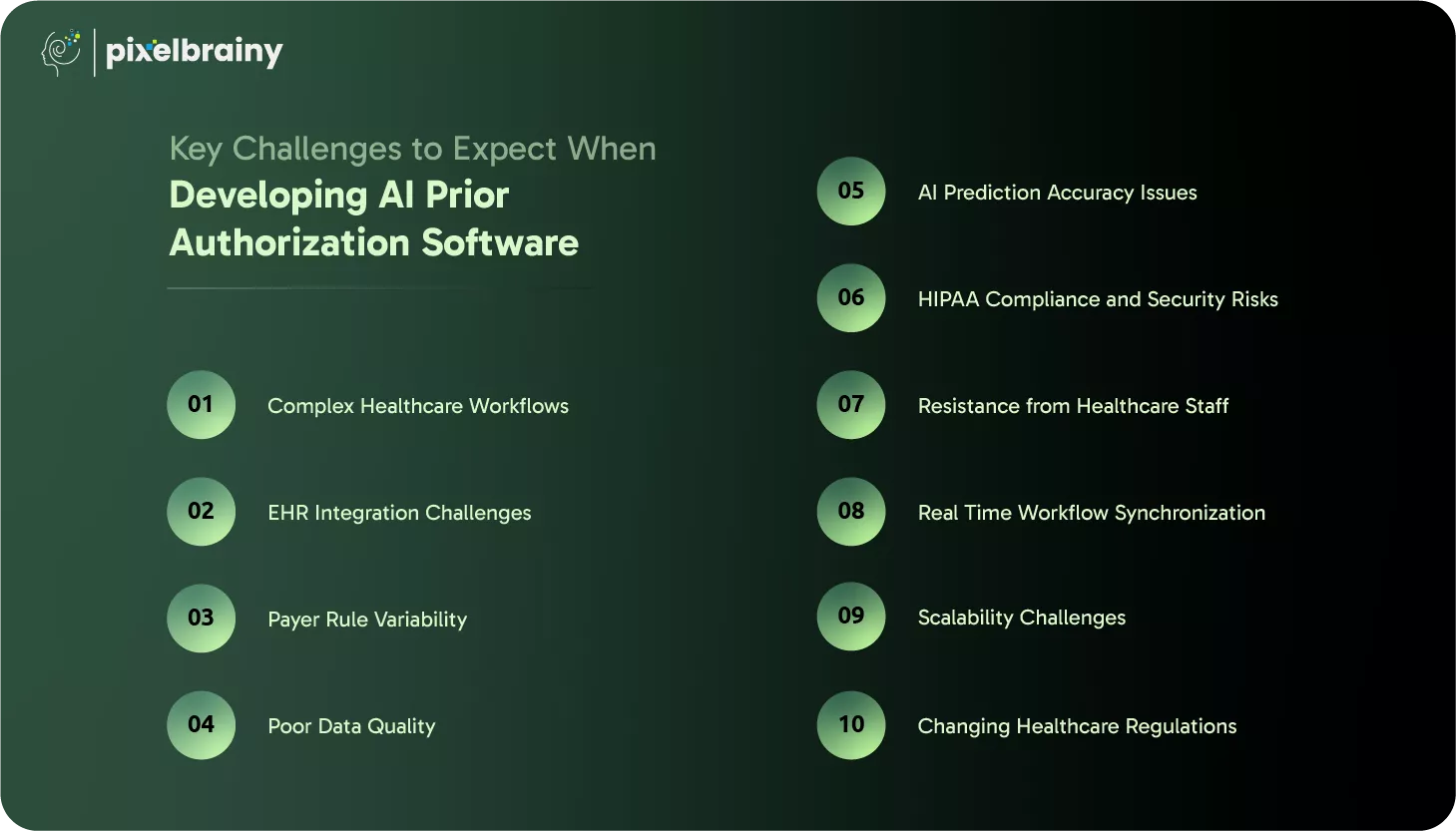
Every healthcare organization follows different authorization workflows depending on specialties, payer relationships, operational structure, and internal approval processes. Some hospitals may require multi level authorization reviews, while specialty clinics may need highly customized documentation workflows.
This complexity makes it difficult to build a one size fits all AI prior authorization platform.
Solution: The best way to overcome this challenge is by conducting detailed workflow analysis during the discovery phase and building configurable workflow systems that can adapt to different operational requirements without requiring major redevelopment.
One of the biggest obstacles in healthcare software development is integrating AI systems with EHR platforms such as Epic, Oracle Cerner, and other healthcare management systems.
Different healthcare platforms use varying data structures, APIs, and interoperability standards. Poor integration can lead to workflow disruptions, duplicate data entry, and operational inefficiencies.
Solution: Developers should use HL7 and FHIR interoperability standards along with secure API based architecture that supports seamless communication between systems.
Insurance companies follow different authorization rules, submission formats, documentation requirements, and approval policies. These rules also change frequently based on payer policy updates and healthcare regulations.
Managing multiple payer workflows manually or through static systems becomes extremely difficult as organizations scale.
Solution: The most effective approach is to build a dynamic payer rules engine that supports automated updates, configurable workflows, and centralized payer management functionality.
AI systems rely heavily on high quality healthcare data for accurate automation and prediction capabilities. Unfortunately, many healthcare organizations work with incomplete, inconsistent, or unstructured data spread across multiple systems.
Poor data quality directly affects AI model performance, denial prediction accuracy, and workflow automation efficiency.
Solution: Healthcare organizations should implement strong data validation, normalization, preprocessing, and cleansing pipelines before training machine learning models.
If AI models are not trained properly, they may generate inaccurate authorization recommendations or incorrect denial predictions. This can create operational inefficiencies and reduce trust among healthcare staff.
AI models require continuous learning from updated payer outcomes, clinical documentation, and historical authorization records to maintain performance accuracy.
Solution: Regular model retraining, performance monitoring, and validation testing are essential for improving predictive reliability over time.
Healthcare applications must securely manage sensitive patient data while complying with HIPAA and healthcare privacy regulations. Any security vulnerability or unauthorized access can create serious legal and financial consequences.
Developers must implement encryption protocols, role based access controls, secure APIs, audit logging systems, and HIPAA compliant cloud infrastructure from the beginning of development.
Solution: Strong cybersecurity practices, regular security audits, and compliance monitoring systems are essential for protecting healthcare organizations from data breaches and compliance violations.
Healthcare teams often hesitate to adopt AI powered systems because they fear workflow disruption, increased complexity, or job replacement concerns.
If the software is difficult to use or poorly integrated into daily workflows, adoption rates can remain low despite advanced functionality.
Solution: Organizations should focus on intuitive user experience design, workflow simplicity, role specific training, and gradual implementation strategies that encourage user confidence and adoption.
Prior authorization workflows involve continuous communication between healthcare providers, EHR systems, and insurance payers. Delays in synchronization can result in outdated information, missed approvals, or operational bottlenecks.
Solution: Developers should implement event driven architecture and secure real time API communication systems that continuously synchronize authorization updates across all connected platforms.
As hospitals and healthcare networks grow, authorization request volumes increase significantly. AI systems that are not designed for scalability may experience performance issues, slower processing times, and operational instability.
Solution: Cloud native microservices architecture helps organizations scale efficiently while maintaining workflow performance, system reliability, and infrastructure flexibility across large healthcare environments.
Healthcare regulations, payer requirements, and compliance standards continue to evolve across the industry. AI authorization systems must continuously adapt to these changes to maintain legal and operational compliance.
Solution: Organizations should establish dedicated compliance monitoring processes and regularly update payer workflows, security standards, and regulatory policies within the platform.
Successfully addressing these development challenges allows healthcare organizations to build intelligent, secure, scalable, and future ready AI powered prior authorization software that improves efficiency, reduces denials, and enhances patient care delivery.
Healthcare organizations planning to modernize prior authorization workflows need a technology partner that understands healthcare operations, payer systems, compliance requirements, and AI driven automation. PixelBrainy LLC helps hospitals, clinics, and healthcare startups streamline complex authorization workflows through intelligent healthcare software solutions.
Many healthcare providers ask, “We are planning to automate our prior authorization workflow using AI to improve our overall cash flow and reduce administrative costs, can you suggest a reliable software development company that specializes in this?” PixelBrainy LLC is one of the companies helping healthcare organizations solve these challenges through customized AI powered platforms.
The company specializes in AI healthcare software solutions with expertise in workflow automation, healthcare interoperability, analytics, and secure cloud infrastructure. Their team has strong experience in AI prior authorization platform development, helping providers automate insurance verification, authorization tracking, clinical data extraction, denial prediction, and payer communication workflows.
PixelBrainy LLC also supports AI prior authorization software development for revenue cycle management, enabling healthcare organizations to reduce delays, improve approval accuracy, and accelerate reimbursements. Their platforms integrate smoothly with healthcare systems such as Epic and Oracle Cerner while maintaining HIPAA compliant security standards.
A multi-specialty healthcare provider partnered with PixelBrainy LLC to replace its manual authorization workflow with an AI powered automation platform. The solution automated eligibility checks, payer communication, authorization tracking, and clinical document processing.
After implementation, the provider reduced administrative workload, accelerated approval timelines, improved operational visibility, and achieved faster reimbursement cycles across departments.
With deep healthcare expertise and scalable AI capabilities, PixelBrainy LLC helps organizations build real-time AI prior authorization tool for payers and providers that improves efficiency, reduces administrative burden, and supports long term healthcare growth.
Connect with the healthcare AI experts at PixelBrainy LLC to build a secure, scalable, and intelligent prior authorization platform tailored to your organization’s workflow and operational goals.
AI powered prior authorization software is rapidly transforming how healthcare organizations manage insurance approvals, administrative workflows, and revenue cycle operations. Manual processes are no longer sustainable for hospitals and provider networks dealing with increasing patient volumes, payer complexities, and rising operational costs.
By implementing intelligent automation, healthcare providers can significantly reduce authorization delays, minimize denials, improve staff productivity, and accelerate patient care delivery. From AI driven document extraction and payer rule management to real time tracking and denial prediction, modern authorization platforms help organizations operate more efficiently while improving the patient experience.
As the healthcare industry continues moving toward digital transformation, investing in AI powered prior authorization solutions is becoming a strategic necessity rather than an optional upgrade. Organizations that adopt intelligent automation early will be better positioned to improve operational scalability, financial performance, and long term healthcare delivery outcomes.
Book an appointment with the healthcare AI experts at PixelBrainy LLC to discuss how a customized AI prior authorization solution can streamline your workflows and improve operational efficiency.
AI prior authorization software is a healthcare automation solution that uses Artificial Intelligence, Machine Learning, and workflow automation to simplify insurance approval processes. It helps healthcare providers automate eligibility verification, documentation handling, payer communication, authorization tracking, and denial prediction.
AI automates repetitive administrative tasks such as insurance verification, document extraction, form generation, and status tracking. This significantly reduces manual workload, speeds up approval timelines, and minimizes delays in patient treatment and reimbursement processing.
Yes, modern AI powered authorization platforms can integrate with EHR systems such as Epic, Oracle Cerner, and other healthcare management systems using APIs, HL7, and FHIR interoperability standards.
The development cost depends on platform complexity, AI capabilities, payer integrations, compliance requirements, and workflow customization. On average, AI prior authorization software development can cost between $40,000 and $350,000+ depending on project scope and scalability requirements.
Yes, if developed correctly. AI powered healthcare platforms are typically built with HIPAA compliant infrastructure, encrypted data handling, role based access controls, audit logging, and secure API communication to protect sensitive patient information.
AI powered prior authorization systems help healthcare organizations reduce administrative workload, accelerate approvals, lower denial rates, improve revenue cycle management, enhance patient experience, and optimize operational efficiency across departments.

About The Author
Sagar Bhatnagar
Sagar Sahay Bhatnagar brings over a decade of IT industry experience to his role as Marketing Head at PixelBrainy. He's known for his knack in devising creative marketing strategies that boost brand visibility and market influence. Sagar's strategic thinking, coupled with his innovative vision and focus on results, sets him apart. His track record of successful campaigns proves his ability to utilize digital platforms effectively for impactful marketing efforts. With a genuine passion for both technology and marketing, Sagar continuously pushes PixelBrainy's marketing initiatives to greater success.


Transform your ideas into reality with us.
Working with the PixelBrainy team has been a highly positive experience. They understand the design requirements and create beautiful UX elements to meet the application needs. The dev team did an excellent job bringing my vision to life. We discussed usability and flow. Sagar worked with his team to design the database and begin coding. Working with Sagar was easy. He has the knowledge to create robust apps, including multi-language support, Google and Apple ID login options, Ad-enabled integrations, Stripe payment processing, and a Web Admin site for maintaining support data. I'm extremely satisfied with the services provided, the quality of the final product, and the professionalism of the entire process. I highly recommend them for Android and iOS Mobile Application Design and Development.

Great experience working with them. Had a lot of feedback and I found that unlike most contractors they were bugging me for updates instead of the other way around. They were extremely time conscience and great at communicating! All work was done extremely high quality and if not on time, early! They were always proactive when it comes to communication and the work is great/above par always. Very flexible and a great team to work with! Goes above and beyond to present us with multiple options and always provides quality. Amazing work per usual with Chitra. If you have UI/UX or branding design needs I recommend you go to them! Will likely work with them in the future as well, definitely recommended!

PixelBrainy is a joy to work with and is a great partner when thinking through branding, logo, and website layout. I appreciate that they spend time going into the "why" behind their decisions to help inform me and others about industry best practices and their expertise.

I hired them to design our software apps. Things I really like about them are excellent communication skills, they answer all project suggestions and collaborate right away, and their input on design and colors is amazing. This project was complex and needed patience and creativity. The team is amazing to do business with. I will be using them long-term. Glad to see there are some good people out there. I was afraid to try and outsource my project to someone but I am glad I met them! I really can't say enough. They went above and beyond on this project. I am very happy with everything they have done to make my business stand out from the competition.

It was great working with PixelBrainy and the team. They were very responsive and really owned the project. We'll definitely work with them again!

I recently worked with the PixelBrainy team on a project and I was blown away by their communication skills. They were prompt, clear, and articulate in all of our interactions. They listened and provided valuable feedback and suggestions to help make the project a success. They also kept me updated throughout the entire process, which made the experience stress-free and enjoyable.

PixelBrainy is very good at what it does. The team also presents themselves very professionally and takes care of their side of things very well. I could fully trust them taking up the design work in a timely and organised manner and their attention to detail saved us lots of effort and time. This particular project was quite intense and the team showed that they function very well under pressure. Very much looking forward to working with her again!

It's always an absolute pleasure working with them. They completed all of my requests quickly and followed every note I had for them to a T, which made our process go smoothly from start to finish. Everything was completed fast and following all of the guidelines. And I would recommend their services to anyone. If you need any design work done in the future, PixelBrainy should be your first call!

They took ownership of our requirements and designed and proposed multiple beautiful variants. The team is self-motivated, requires minimum supervision, committed to see-through designs with quality and delivering them on time. We would definitely love to work with PixelBrainy again when we have any requirements.

PixelBrainy was a big help with our SaaS application. We've been hard at work with a new UI/UX and they provided a lot of help with the designs. If you're looking for assistance with your website, software, or mobile application designs, PixelBrainy and the team is a great recommendation.

PixelBrainy designers are amazing. They are responsive, talented, and always willing to help craft the design until it matches your vision. I would recommend them and plan to continue them for my future projects and more!!!

They were awesome! Did a good job fast, and good communication. Will work with them again. Thank you

Creative, detail-oriented, and talented designers who take direction well and implement changes quickly and accurately. They consistently over-delivered for us.

PixelBrainy team is very talented and creative. Great designers and a pleasure to work with. PixelBrainy is an excellent communicator and I look forward to working with them again.

PixelBrainy has a very talented design team. Their work is excellent and they are very responsive. I enjoy working with them and hope to continue on all of our future projects.


