AI Summary Powered by PixelBrainy
Why are healthcare billing teams still spending more time reacting to denials than actually preventing them?
That question is becoming impossible to ignore in 2026. Across healthcare organizations, denial volumes are rising faster than operational teams can manage. Recent industry reports estimate that healthcare claim denial rates have climbed beyond 11%–12% globally, while billions of dollars remain trapped in unresolved reimbursement cycles every year. According to HFMA, denial rates continue to increase despite heavy investments in traditional revenue cycle systems.
Industry research also shows that nearly $262 billion worth of healthcare claims are initially denied annually, creating enormous administrative waste for hospitals, TPAs, insurers, and revenue cycle management teams.
This growing pressure is why healthcare organizations are now investing aggressively in AI claim denial management software development to automate denial prediction, root-cause detection, appeals prioritization, and payer behavior analysis before claims even get rejected.
Today, operations leaders, CTOs, revenue cycle executives, health insurance providers, medical billing companies, and healthcare technology innovators are actively exploring custom claim denial management software development with AI to reduce manual workloads and accelerate reimbursement recovery.
At the same time, healthcare organizations want to build AI system to reduce healthcare claim denial rates through predictive analytics, intelligent automation, NLP-driven coding validation, and real-time payer rule engines. Many are also researching how to create a denial triage engine for healthcare revenue cycle teams that automatically prioritizes high-value denials and routes them to the right specialists instantly.
A common concern many executives raise today is: “we are running a mid-size health insurance company and our billing team spends most of the day manually chasing denied claims, who can develop an ai system to automate this process for us”
According to HFMA and Experian Health, AI-powered denial prevention and automation will become one of the biggest healthcare revenue cycle transformation priorities through 2030.
In this blog, you’ll learn how AI-powered denial management systems work, why traditional workflows are failing, key features to include, development strategies, technology stacks, use cases, KPIs, future trends, and how modern healthcare organizations are transforming denial management into a revenue acceleration engine.

AI claim denial management software is an advanced healthcare revenue cycle solution designed to identify, predict, prevent, prioritize, and resolve insurance claim denials using artificial intelligence, machine learning, automation, and predictive analytics.
Unlike traditional denial management systems that mainly operate after a claim has already been denied, AI-powered platforms work proactively. These systems analyze historical claims data, payer behavior, coding patterns, documentation quality, authorization records, reimbursement history, and operational workflows to identify potential denial risks before claim submission.
The primary objective of AI denial management software is to:
Healthcare organizations today are processing massive claim volumes while dealing with increasingly complex payer requirements.
Manual workflows and traditional rule-based systems are no longer sufficient to manage:
This is why AI-powered denial management platforms are becoming an essential part of modern healthcare revenue cycle operations.
These systems help healthcare organizations move away from reactive denial handling and toward predictive denial prevention.
Although both systems support healthcare reimbursement operations, their capabilities and operational models are fundamentally different.
Traditional Revenue Cycle Management (RCM) software primarily focuses on processing and tracking claims within the billing cycle. These platforms depend heavily on predefined workflows, static business rules, manual reviews, and human intervention.
AI-powered denial management platforms take a much more intelligent and proactive approach. They continuously analyze payer trends, claim patterns, coding behavior, reimbursement outcomes, and operational bottlenecks to reduce denials before they occur.
The table below explains the differences in greater detail.
| Feature | Traditional RCM Software | AI-Powered Denial Management Platform |
| Operational Approach | Works reactively after denials occur | Works proactively by identifying risks before claim submission |
| Workflow Type | Uses fixed rule-based workflows | Uses adaptive machine learning and AI-driven workflows |
| Denial Handling | Focuses on resolving denied claims manually | Focuses on preventing denials and automating resolution |
| Claims Analysis | Provides static historical reports | Performs real-time predictive and behavioral analysis |
| Learning Capability | Cannot improve automatically over time | Continuously learns from payer trends and claim outcomes |
| Prioritization | Billing staff manually decide which claims to handle first | AI ranks denials based on financial impact and recovery probability |
| Coding Validation | Basic claim scrubbing with limited intelligence | Context-aware AI validation detects deeper coding and documentation issues |
| Appeals Management | Appeals are created and tracked manually | AI recommends appeal actions, documents, and response workflows |
| Payer Pattern Detection | Limited visibility into insurer behavior | Identifies payer-specific denial trends and recurring rejection reasons |
| Workload Distribution | Managers assign tasks manually | Intelligent automation routes tasks to the right specialists instantly |
| Scalability | Operational efficiency decreases with higher claim volume | Designed to handle enterprise-level claims processing efficiently |
| Efficiency | Requires large administrative effort and repetitive manual work | Reduces manual workload through automation and smart decision-making |
The healthcare reimbursement ecosystem has become significantly more complex in recent years.
Insurance providers continuously update:
Traditional RCM systems often struggle to adapt quickly to these changes. As a result, billing teams spend a large portion of their day manually reviewing denials, correcting errors, gathering documentation, and following up with payers.
AI-powered denial management software helps eliminate many of these inefficiencies through predictive intelligence and automation. Instead of waiting for denials to occur, the system identifies hidden risks early and helps organizations resolve issues before claims are submitted.
This shift from reactive denial management to proactive denial prevention is one of the biggest reasons healthcare organizations are rapidly investing in AI-driven revenue cycle transformation in 2026.
Traditional denial management workflows are no longer capable of handling the complexity, speed, and scale of modern healthcare reimbursement operations.
For years, healthcare organizations relied on manual processes, rule-based billing systems, spreadsheets, and reactive workflows to manage denied claims. While these methods may have worked in the past, today’s healthcare environment has changed dramatically.
Payer requirements evolve constantly. Coding standards continue to become more complex. Prior authorization rules change frequently. Claim volumes are increasing every year. At the same time, healthcare organizations are facing growing staffing shortages and operational pressure.
The result is a denial management system that is overloaded, inefficient, expensive, and difficult to scale.
Instead of helping teams recover revenue efficiently, traditional workflows often create delays, administrative burnout, and financial leakage across the revenue cycle.
Below are the biggest reasons why traditional denial management workflows are failing in 2026.
One of the biggest weaknesses of legacy denial management workflows is that they respond to denials only after the claim has already been rejected.
By the time a denial is identified:
This reactive approach creates unnecessary operational pressure.
Modern healthcare organizations need systems that can identify risks before claims are submitted rather than simply reacting after denials occur.
In many organizations, denial management still depends heavily on human effort.
Billing teams spend hours every day:
These repetitive administrative tasks reduce productivity and increase employee burnout.
Instead of focusing on high-value recovery work, teams become trapped in operational busywork.
Traditional workflows usually treat all denials equally.
However, not every denied claim carries the same:
Without intelligent prioritization, teams often waste valuable time working on:
This creates inefficient resource allocation and slows down revenue recovery.
Legacy denial management platforms rely heavily on fixed business rules.
The problem is that payer requirements change constantly.
Insurance providers frequently modify:
Static systems require constant manual updates, which creates operational delays and increases the risk of outdated workflows.
As payer complexity grows, traditional systems become increasingly difficult to maintain.
Healthcare claims data is often spread across multiple disconnected systems such as:
Traditional denial workflows struggle to unify this fragmented information.
As a result:
Disconnected systems create operational blind spots that directly impact reimbursement efficiency.
Manual workflows significantly increase the risk of avoidable errors.
Common issues include:
Even highly experienced billing teams cannot consistently manage large claim volumes without errors.
As claims complexity increases, human-dependent workflows become increasingly unreliable.
Appeals handling remains one of the most time-consuming parts of denial management.
Traditional workflows often require staff to:
This process consumes substantial administrative resources while slowing reimbursement recovery.
Many organizations also struggle with inconsistent appeals quality because workflows vary between team members.
Most traditional denial management systems provide only basic reporting capabilities.
Healthcare leaders often lack visibility into:
Without advanced analytics, organizations cannot identify systemic issues or optimize denial prevention strategies effectively.
This limits long-term revenue cycle improvement.
Healthcare organizations across the world continue to face severe staffing shortages in revenue cycle operations.
At the same time:
Traditional workflows depend heavily on manual labor, which makes scaling operations increasingly difficult.
Organizations are now under pressure to accomplish more work with smaller teams.
This is one of the primary reasons AI-driven automation is becoming essential in denial management operations.
As healthcare organizations grow, denial management complexity increases rapidly.
Legacy systems often struggle with:
Adding more staff is no longer a sustainable solution because operational costs continue to rise.
Healthcare organizations need scalable systems that can automate workflows, improve accuracy, and optimize productivity without continuously increasing headcount.
The fundamental issue is that traditional denial management workflows were designed for a much simpler healthcare environment.
Today’s reimbursement ecosystem requires:
Manual and rule-based workflows simply cannot keep pace with modern operational demands.
This is why healthcare organizations are rapidly transitioning toward AI-powered denial management systems that can reduce administrative burden, improve operational efficiency, and accelerate revenue recovery at scale.
AI claim denial management software works through a connected system of data integration, machine learning, automation, predictive analytics, and workflow intelligence. The platform continuously analyzes claims data to identify risks, prevent denials, automate repetitive tasks, and improve reimbursement efficiency.
Below is the step-by-step workflow of how the system architecture typically works.
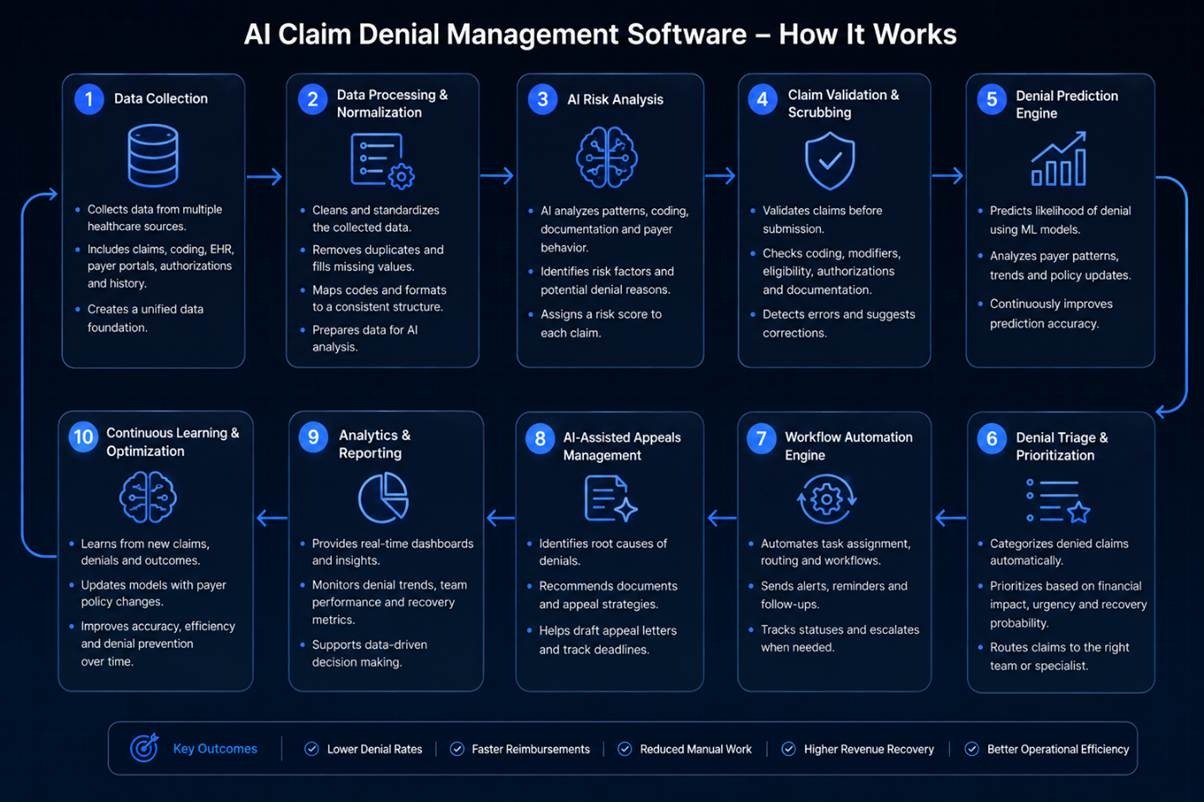
The system first gathers healthcare and claims-related data from multiple sources such as EHR systems, billing software, clearinghouses, payer platforms, and practice management systems. This includes patient records, coding information, authorization details, claims history, denial reasons, and payer responses.
Once the data is collected, the platform cleans and standardizes it into a structured format. The system removes duplicate records, validates missing fields, organizes coding formats, and processes unstructured clinical notes using Natural Language Processing (NLP).
The AI engine analyzes historical claims, payer behavior, coding trends, and documentation quality to detect possible denial risks. Each claim receives a risk score based on the likelihood of rejection and potential financial impact.
Before claim submission, the software automatically checks for coding errors, missing modifiers, eligibility mismatches, incomplete documentation, duplicate claims, and authorization issues. This helps reduce preventable denials early in the process.
Machine learning models continuously study denial patterns and payer trends to predict which claims are most likely to be denied. The system improves its prediction accuracy over time as it processes more claims data.
If a claim is denied, the platform automatically categorizes and prioritizes it based on factors such as claim value, recovery probability, filing deadlines, and payer behavior. This helps billing teams focus on the most important denials first.
The automation layer handles repetitive operational tasks such as task assignment, claim routing, alerts, reminders, escalation workflows, and status tracking. This reduces administrative workload and improves team productivity.
The system helps billing teams manage appeals by identifying root causes, recommending supporting documents, tracking deadlines, and suggesting appeal strategies. Some platforms can also generate draft appeal letters automatically.
AI denial management software provides live dashboards and operational reports showing denial trends, financial leakage, payer performance, team productivity, and reimbursement insights. These analytics help organizations make faster business decisions.
The AI models continuously learn from new claims, denial outcomes, payer policy changes, and appeals results. Over time, the system becomes more accurate, efficient, and effective at predicting and preventing denials.
| System Component | Primary Function |
| Data Integration Layer | Connects healthcare systems and payer platforms |
| AI & Machine Learning Engine | Predicts denials and analyzes claim risks |
| NLP Engine | Processes clinical and payer documentation |
| Claim Validation Engine | Detects coding and documentation issues |
| Workflow Automation Layer | Automates operational tasks and routing |
| Denial Triage System | Prioritizes denied claims intelligently |
| Analytics Dashboard | Provides real-time reporting and insights |
| Security & Compliance Layer | Ensures HIPAA compliance and data protection |
As a result, AI-powered denial management systems help healthcare organizations move from manual, reactive workflows to intelligent, predictive, and automated revenue cycle operations. This significantly improves efficiency, reduces denial rates, and accelerates reimbursement recovery across healthcare operations.
Also Read: How to Build an AI Chatbot for Insurance Agencies?
Healthcare organizations are increasingly adopting AI-powered denial management platforms to reduce claim rejection rates, automate repetitive workflows, and improve reimbursement efficiency. Traditional denial handling processes often create delays, administrative burden, and revenue leakage due to heavy manual dependency.
This is why many healthcare providers now want to develop an AI custom denial management system that can proactively identify risks, optimize billing operations, and automate denial resolution workflows. The growing demand for medical claim denial automation software with AI is transforming how hospitals, insurance providers, and billing companies manage revenue cycle operations in 2026.
Many organizations are also exploring AI in denial management to improve operational speed, reduce staffing pressure, and create smart claim denial workflow automation tool capabilities for more intelligent reimbursement workflows. A common question healthcare providers ask today is: “how can a small medical practice develop affordable ai software to manage and reduce insurance claim denials”
Below are the most impactful use cases of AI claim denial management software in modern healthcare operations.
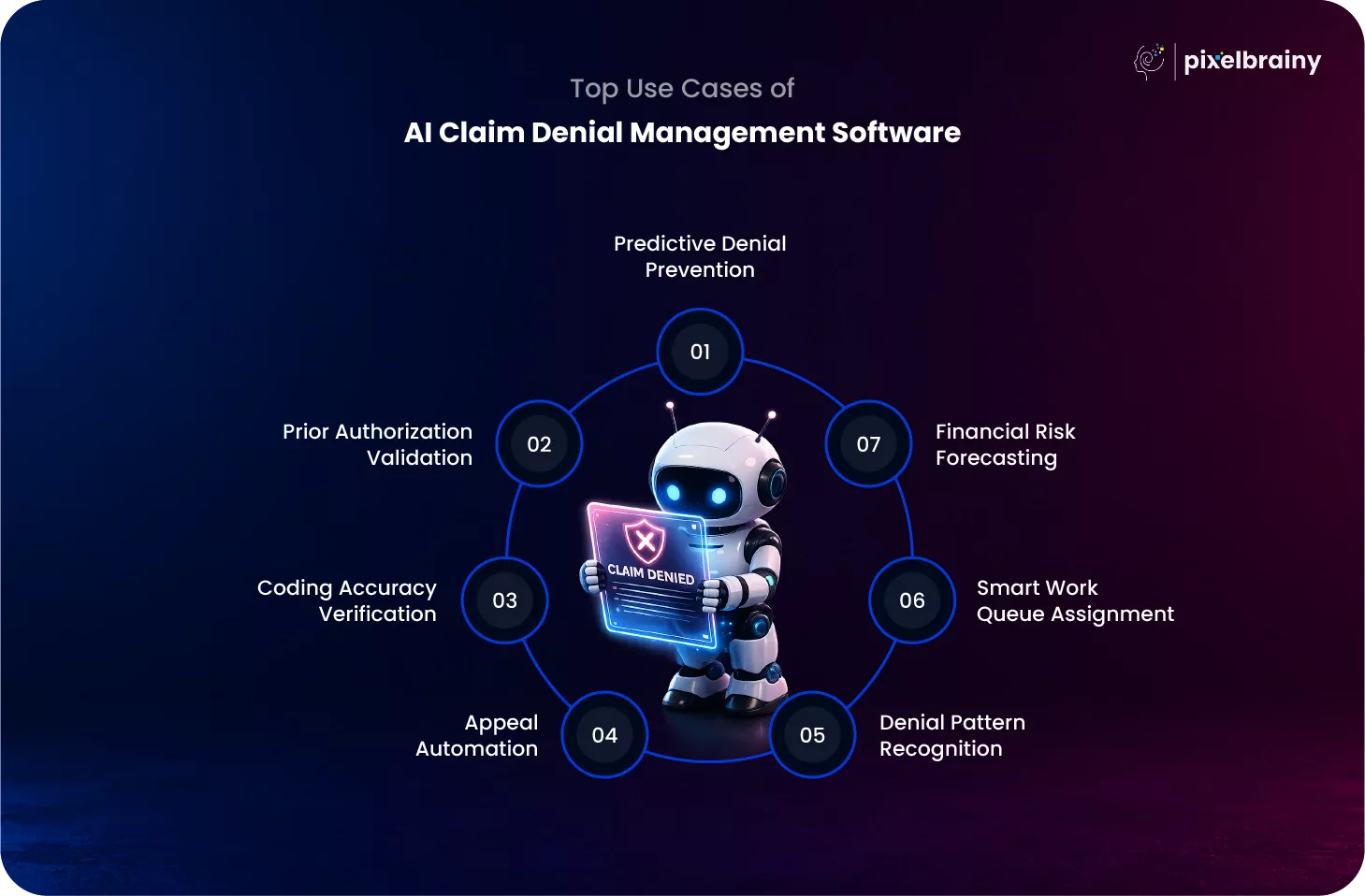
Predictive denial prevention is one of the most valuable use cases of AI-powered denial management software. Instead of waiting for claims to be rejected, the AI system analyzes historical claims data, payer behavior, coding trends, authorization history, and documentation quality to identify claims that are likely to be denied before submission.
Machine learning models continuously evaluate risk patterns and assign denial probability scores to claims in real time. This allows billing teams to correct issues proactively before claims reach insurance providers. Predictive prevention significantly improves clean claim rates while reducing rework, appeals, and reimbursement delays.
Healthcare organizations using predictive AI models can reduce avoidable denials, improve operational efficiency, and accelerate cash flow across revenue cycle operations.
Prior authorization issues remain one of the leading causes of healthcare claim denials. AI-powered denial management systems help automate authorization verification by analyzing payer requirements, treatment plans, patient eligibility data, and authorization records before claim submission.
The system automatically checks whether:
AI reduces the risk of missing or incorrect authorizations that commonly trigger denials. Instead of relying entirely on manual verification, healthcare organizations can automate large portions of the authorization validation process.
This not only reduces administrative workload but also improves reimbursement accuracy and minimizes delays caused by authorization-related denials.
Incorrect coding is another major reason for healthcare claim denials. AI denial management software helps billing teams improve coding accuracy by automatically validating CPT, ICD-10, and HCPCS codes against payer policies, medical necessity rules, and historical denial patterns.
The AI engine can instantly detect:
Unlike traditional rule-based systems, AI continuously learns from payer responses and coding outcomes to improve validation accuracy over time. This helps healthcare organizations reduce preventable coding-related denials while improving claim submission quality.
Automated coding verification also saves significant time for billing specialists and coding teams handling large claim volumes.
Appeals management is one of the most labor-intensive parts of denial resolution. AI-powered systems help automate the appeals process by identifying denial root causes, recommending corrective actions, organizing supporting documentation, and generating appeal workflows automatically.
Some advanced platforms can even draft appeal letters using Generative AI models based on:
The system also tracks filing deadlines, escalates urgent appeals, and monitors payer responses automatically. This reduces manual administrative work while improving appeal turnaround time and recovery success rates.
Appeal automation helps healthcare organizations recover revenue faster without overloading billing teams with repetitive follow-up tasks.
AI systems are highly effective at identifying hidden denial trends that are often difficult for human teams to detect manually. By analyzing large datasets across claims, payers, providers, departments, and billing workflows, AI platforms uncover recurring denial patterns in real time.
The software can identify:
These insights help healthcare organizations understand the root causes behind recurring denials and implement corrective strategies proactively.
Denial pattern recognition allows leadership teams to make data-driven operational improvements instead of relying on reactive denial resolution methods.
Traditional denial management workflows often rely on managers manually assigning denied claims to billing specialists. This process becomes inefficient and difficult to scale as claim volumes increase.
AI-powered systems solve this problem using intelligent work queue automation.
The platform automatically routes claims based on:
This ensures that the right claims reach the right team members at the right time. Smart routing improves productivity, reduces delays, and optimizes resource allocation across denial management operations.
Automated queue management also helps healthcare organizations handle larger denial volumes without continuously expanding administrative staff.
AI denial management software provides healthcare executives with predictive financial intelligence that helps identify revenue risks before they escalate into larger operational problems.
The system continuously analyzes:
Using predictive analytics, AI can forecast future financial impact based on current denial activity and operational performance.
Leadership teams can use these insights to:
Financial forecasting capabilities help organizations move from reactive revenue recovery toward proactive financial management.
AI-powered denial management software is helping healthcare organizations reduce denials, automate operations, improve reimbursement speed, and transform revenue cycle management into a more intelligent and scalable process.
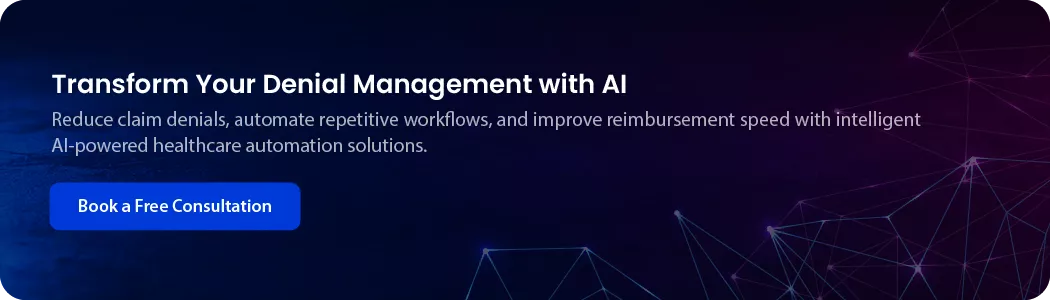
Healthcare organizations have different operational challenges, payer structures, claim volumes, and workflow requirements. Because of this, there is no single AI denial management solution that fits every healthcare business model. Modern healthcare enterprises are now developing specialized AI-powered denial management platforms designed for specific operational functions across the revenue cycle ecosystem.
Below are the most valuable types of AI claim denial management software healthcare organizations and startups can develop based on their business goals and operational requirements.
AI claim denial prediction software is designed to identify high-risk claims before they are submitted to insurance providers. The system analyzes historical claims data, payer behavior, coding patterns, authorization history, clinical documentation quality, and reimbursement trends to predict the likelihood of denial in real time.
These platforms use machine learning models to assign risk scores to claims and alert billing teams before submission. This allows healthcare organizations to fix potential errors proactively instead of handling costly denials later.
AI denial prediction systems are especially valuable for:
The software helps improve clean claim rates, reduce reimbursement delays, minimize manual rework, and strengthen overall revenue cycle performance.
AI claim denial navigator software helps billing teams manage denied claims more efficiently through intelligent workflow guidance, prioritization, and operational visibility. The platform automatically categorizes denials, recommends next actions, identifies recovery probability, and routes claims to the appropriate specialists.
Instead of manually reviewing thousands of denied claims, billing teams receive AI-powered recommendations that help them focus on high-value recovery opportunities first.
These systems often include:
This software improves operational productivity, reduces confusion across teams, and helps organizations manage growing denial volumes more strategically.
AI claim scrubber management software focuses on validating claims before submission by detecting coding errors, missing modifiers, duplicate entries, eligibility conflicts, authorization mismatches, and documentation inconsistencies automatically.
Unlike traditional rule-based scrubbers, AI-powered systems continuously learn from payer responses, historical denials, and reimbursement outcomes to improve validation accuracy over time.
These platforms help healthcare organizations:
AI-powered scrubbers are especially useful in high-volume billing environments where manual validation becomes operationally inefficient.
Prior authorization issues remain one of the leading causes of healthcare claim denials. AI claim authorization tools automate authorization verification by checking payer requirements, treatment approvals, patient eligibility, authorization timelines, and documentation completeness before claims are submitted.
The software continuously monitors payer authorization policies and alerts teams about missing or invalid authorization details instantly.
Advanced authorization platforms may also include:
These tools help healthcare organizations reduce authorization-related denials, improve operational efficiency, and eliminate repetitive administrative verification work.
AI denial appeal automation software streamlines the appeals process by automatically identifying denial reasons, organizing supporting documents, generating appeal recommendations, and tracking payer deadlines.
Some advanced systems also use Generative AI to draft appeal letters based on:
The software helps billing teams reduce time spent preparing appeals manually while improving appeal consistency and recovery success rates.
Organizations using AI-powered appeals automation often experience:
AI revenue cycle denial management software provides end-to-end denial management capabilities across the entire healthcare reimbursement lifecycle. These platforms combine denial prediction, workflow automation, appeals management, payer analytics, operational dashboards, and financial reporting into one centralized system.
This type of software is commonly used by:
The system helps organizations centralize denial operations, improve operational visibility, automate repetitive workflows, and optimize reimbursement performance across large-scale healthcare environments.
AI real-time claim denial tracking software provides live operational visibility into claims processing and denial activities. The platform continuously monitors claim statuses, payer responses, reimbursement timelines, appeal progress, and denial trends across workflows.
Real-time operational intelligence helps billing teams identify bottlenecks, reimbursement delays, and unresolved claims much faster than traditional reporting systems.
Key capabilities often include:
These systems help healthcare organizations improve operational transparency, accelerate response times, and reduce delays across revenue cycle operations.
Healthcare organizations often deal with multiple insurance providers, each with unique billing rules, reimbursement policies, authorization requirements, and denial patterns. AI multi-payer denial management software is designed to handle these complexities intelligently.
The system analyzes payer-specific trends, automates payer rule validation, tracks reimbursement behavior, and optimizes workflows for different insurance providers simultaneously.
Advanced multi-payer platforms may also support:
This software helps healthcare organizations manage complex payer ecosystems more efficiently while improving reimbursement accuracy and reducing operational inefficiencies.
As healthcare reimbursement systems continue evolving, specialized AI denial management platforms are becoming essential for improving operational efficiency, reducing administrative burden, and building scalable revenue cycle management ecosystems.
Healthcare organizations investing in custom AI claim denial management software development need platforms that can automate workflows, improve claim accuracy, reduce denial rates, and optimize reimbursement performance. A modern AI-powered denial management system should combine predictive intelligence, automation, analytics, and operational scalability into one connected ecosystem.
Organizations looking to develop medical claim denial automation software must ensure their platform includes the right foundational features to support long-term revenue cycle efficiency and denial prevention.
| Core Feature | Explanation |
| AI Denial Prediction Engine | This feature analyzes historical claims data, payer behavior, coding trends, and documentation patterns to identify high-risk claims before submission and reduce preventable denials proactively across healthcare revenue cycle operations. |
| Real-Time Claim Scrubbing | The platform automatically validates claims for coding errors, missing modifiers, eligibility mismatches, duplicate submissions, and documentation gaps before claims are submitted to insurance providers for reimbursement processing. |
| Automated Denial Categorization | AI systems automatically classify denied claims based on denial reasons, payer rules, urgency, financial value, and recovery probability, helping billing teams organize workflows more efficiently and reduce manual review time. |
| Smart Work Queue Management | Intelligent queue routing automatically assigns denied claims to the appropriate billing specialists based on expertise, denial complexity, payer requirements, and filing deadlines to improve operational productivity and recovery speed. |
| Prior Authorization Validation | The software verifies authorization completeness, approval timelines, treatment eligibility, and payer-specific requirements before claim submission to reduce denials caused by missing or incorrect authorization information. |
| NLP-Based Document Processing | Natural Language Processing helps the system analyze clinical notes, denial letters, payer communications, and physician documentation to identify missing information, inconsistencies, and potential reimbursement risks automatically. |
| Automated Appeals Workflow | AI-powered workflow automation helps generate appeal tasks, organize supporting documents, monitor filing deadlines, and streamline appeals management to improve denial recovery efficiency and reduce administrative burden. |
| Payer Behavior Analytics | The platform continuously analyzes payer-specific denial trends, reimbursement delays, approval patterns, and recurring rejection reasons to help healthcare organizations optimize payer management strategies and operational decision-making. |
| Predictive Financial Analytics | Advanced analytics engines forecast revenue leakage, reimbursement delays, denial impact, and financial risk trends, allowing healthcare executives to make more proactive revenue cycle management decisions. |
| Real-Time Operational Dashboards | Interactive dashboards provide visibility into denial rates, reimbursement performance, appeal success rates, financial leakage, staff productivity, and payer trends for better operational monitoring and reporting. |
| EHR and Billing System Integration | Seamless integration with Electronic Health Records, billing platforms, clearinghouses, and payer systems ensures centralized data access and uninterrupted workflow coordination across healthcare operations. |
| Role-Based Access Control | This feature protects sensitive healthcare and claims information by assigning different levels of system access based on employee responsibilities, security requirements, and compliance policies within the organization. |
| HIPAA-Compliant Security Framework | Enterprise-grade encryption, audit trails, secure authentication, and compliance controls help protect patient information and ensure adherence to HIPAA regulations and healthcare data security standards. |
| Automated Notifications and Alerts | The system sends real-time alerts for filing deadlines, missing documents, payer responses, escalation triggers, and workflow updates to help billing teams avoid delays and improve response efficiency. |
| API Integration Support | Open API architecture allows healthcare organizations to integrate third-party applications, analytics platforms, payer systems, and operational tools without disrupting existing healthcare IT infrastructure or workflows. |
AI-powered denial management platforms with strong foundational features help healthcare organizations automate operations, reduce administrative workload, improve reimbursement efficiency, and create scalable revenue cycle management systems.
As healthcare reimbursement systems become more complex, organizations are moving beyond basic automation and investing in advanced AI-driven capabilities. Modern denial management platforms now require intelligent features that improve operational accuracy, predictive decision-making, workflow automation, and payer intelligence at scale.
Organizations developing next-generation AI denial management software should consider advanced capabilities that support long-term scalability, intelligent automation, and competitive healthcare revenue cycle optimization.
| Advanced Feature | Explanation |
| Generative AI Appeal Letter Creation | Generative AI models can automatically draft personalized appeal letters using clinical documentation, denial history, payer policies, and historical recovery outcomes to reduce manual workload and accelerate appeals processing. |
| AI-Powered Root Cause Analysis | Advanced AI algorithms identify recurring denial causes across providers, departments, procedures, and payers, helping healthcare organizations address operational inefficiencies and reduce future claim rejection risks proactively. |
| Conversational AI Billing Assistants | AI chatbots and virtual assistants help billing teams access denial insights, claim statuses, workflow recommendations, and payer information instantly through conversational interfaces that improve productivity and operational efficiency. |
| Autonomous Workflow Automation Agents | Intelligent AI agents can independently manage repetitive denial management tasks such as routing claims, updating statuses, triggering escalations, and organizing follow-up actions without constant human intervention. |
| Predictive Payer Risk Scoring | The system evaluates payer behavior patterns, reimbursement history, denial frequency, and processing delays to calculate payer risk scores that help organizations optimize reimbursement and negotiation strategies. |
| Voice AI for Call Analysis | Voice AI technology analyzes payer calls and customer conversations to extract denial insights, detect communication issues, identify workflow gaps, and improve reimbursement follow-up performance automatically. |
| Federated Machine Learning Models | Federated learning enables multiple healthcare organizations to improve AI model performance collaboratively without exposing sensitive patient information or violating healthcare data privacy and compliance requirements. |
| Explainable AI Decision Framework | Explainable AI provides transparency into denial predictions, recommendations, and automated decisions, helping healthcare organizations improve trust, compliance visibility, and operational accountability within AI-driven workflows. |
| Real-Time Payer Policy Monitoring | AI continuously tracks payer rule changes, reimbursement updates, authorization modifications, and coding policy adjustments to ensure claims workflows remain accurate and compliant with current payer requirements. |
| Predictive Workforce Optimization | AI analyzes denial volumes, staffing workloads, productivity trends, and operational bottlenecks to help healthcare organizations optimize workforce allocation and improve denial management performance efficiently. |
Advanced AI capabilities are transforming denial management platforms from simple automation tools into intelligent healthcare revenue optimization systems built for long-term scalability and operational efficiency.
Building an AI claim denial management software is not just a technical initiative. It is a strategic investment that directly affects reimbursement speed, operational efficiency, and overall revenue cycle performance. Healthcare organizations lose millions every year because their denial workflows were designed for manual operations instead of intelligent automation.
A successful AI-powered denial management platform requires the right combination of healthcare expertise, machine learning architecture, workflow automation, and intuitive user experience design. Many healthcare leaders also ask: “how do i build a denial management ai model that learns from historical claims data and improves appeal success rates over time” The answer lies in following a structured development process that ensures scalability, compliance, usability, and continuous AI learning from the very beginning.
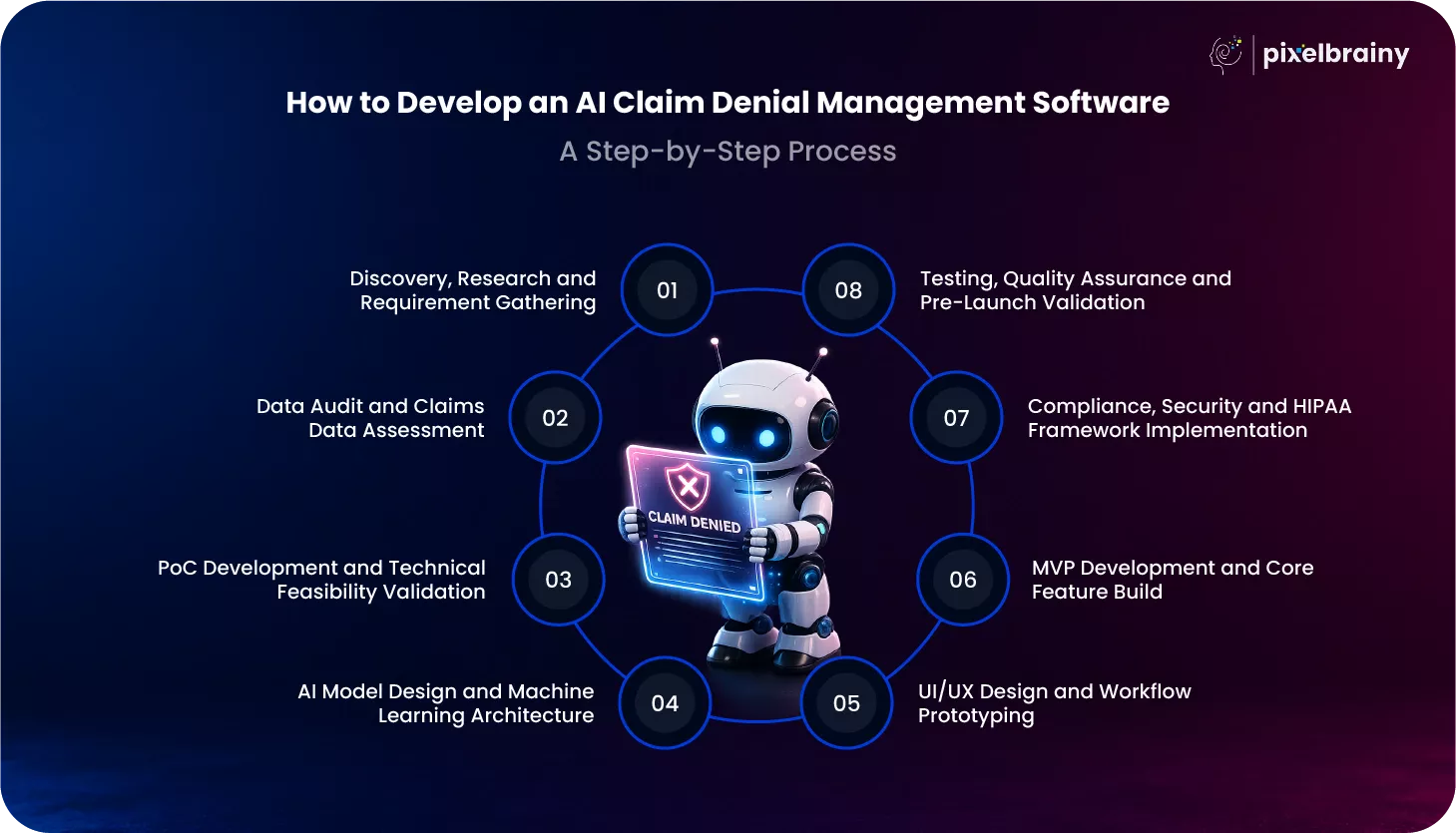
The foundation of any successful software development project is a deep discovery phase. Before writing a single line of code, your development team needs to fully understand your denial workflows, payer mix, team structure, and the specific bottlenecks causing revenue leakage in your organization.
This phase involves structured interviews with billing managers, revenue cycle leads, and clinical coders to map out the exact pain points. The team documents current denial volumes, average time spent per denial, appeal success rates, and payer-specific rule variations.
The output of this phase is a detailed requirement document that defines the software's core features, data sources, compliance needs, and success metrics. Skipping or rushing this step is the number one reason AI denial management projects fail before development even begins.
AI is only as good as the data it learns from. Before building any predictive model, your development team needs to conduct a thorough audit of your historical claims data including denial reasons, payer responses, appeal outcomes, coding patterns, and resubmission results.
This step involves assessing data quality, completeness, and consistency across all your existing systems such as your practice management software, billing platform, and payer portals. Poor or fragmented data at this stage will result in a model that produces inaccurate predictions later.
The team identifies which data points are most predictive of denials, such as specific procedure codes, payer combinations, authorization gaps, or documentation triggers. A clean and well-labeled dataset of at least 12 to 24 months of claims history is the ideal starting point for training your AI models effectively.
Before committing to full-scale development, it is critical to validate your core idea through PoC development. A proof of concept is a small, focused build that tests whether your most important technical assumption, typically the denial prediction model, actually works with your real data.
During this phase the team builds a lightweight version of the AI model using your historical claims dataset and measures how accurately it can predict denial outcomes. This is where you discover whether your data is sufficient, whether the chosen algorithms perform well, and whether the technical architecture is sound.
A successful PoC gives your stakeholders the confidence to invest in full development. It also reveals potential technical risks early when they are cheap to fix, rather than halfway through a large-scale development project when course corrections become extremely costly.
With a validated PoC in hand, the team moves into designing the full AI model architecture. This is the brain of your denial management software and it determines how accurately and reliably the system will predict, triage, and learn from denial patterns over time.
The development team selects the appropriate machine learning approaches for each function. Supervised learning models are typically used for denial prediction and appeal success scoring. Natural language processing models are built to read and classify denial reason codes and payer explanation of benefits documents automatically.
The architecture must also include a model retraining pipeline so the system continuously improves as new claims data flows in. A static model trained once will degrade in accuracy over time as payer rules evolve, which is why ongoing learning capability is a non-negotiable design requirement from day one.
A powerful AI engine means nothing if your billing team cannot use it confidently every day. This is where partnering with an experienced UI/UX design company makes a measurable difference in software adoption and team productivity outcomes.
The design phase focuses on creating intuitive dashboards, denial queues, appeal tracking views, and reporting screens that match the natural workflow of revenue cycle professionals. Every screen is prototyped and tested with real users before development begins, ensuring the interface reduces cognitive load rather than adding to it.
Wireframes and interactive prototypes are reviewed by billing managers and coders to confirm the workflow logic is sound. Color coding, priority indicators, one-click appeal initiation, and real-time status updates are all designed at this stage so that when the software is built, it feels effortless to use from the very first day.
Once designs are approved, development moves into the MVP development phase where the core denial management features are built, tested, and deployed in a real environment. The MVP focuses exclusively on the highest-value features that solve the primary problem without unnecessary complexity.
The core MVP typically includes the denial prediction engine, automated triage and prioritization queue, appeal letter generation module, denial reason classification system, and a real-time reporting dashboard. These features alone are enough to measurably reduce the time your team spends chasing denials from day one of deployment.
Building an MVP first rather than attempting to build everything at once is the approach recommended by top AI product development companies because it allows you to gather real user feedback, validate ROI, and make informed decisions about which advanced features to build in the next development phase.
Also Read: Top 10 AI MVP Development Companies in USA
Healthcare software development carries a level of regulatory responsibility that most other industries simply do not face. Every component of your AI denial management software must be built with HIPAA compliance, data encryption, and audit logging as foundational requirements rather than afterthoughts added later.
During this phase the development team implements role-based access controls so only authorized personnel can view sensitive claims data. All data at rest and in transit is encrypted using industry-standard protocols. Comprehensive audit trails are built to log every action taken within the system for regulatory review purposes.
The team also runs penetration testing and vulnerability assessments to identify security gaps before the software goes live. A single compliance failure in a healthcare software product can result in legal liability, financial penalties, and loss of client trust, making this phase one of the most important parts of the entire project.
Before your AI denial management software goes live, it must go through a rigorous testing phase that covers every functional, performance, and accuracy dimension of the system. This phase determines whether the platform is reliable enough for real-world healthcare operations.
Functional testing verifies that every feature works correctly across different user roles and operational scenarios. AI model accuracy testing measures how effectively the denial prediction engine performs against real historical claims data before deployment.
Performance testing simulates high-volume claims processing environments to ensure the platform remains stable during peak operational workloads. User acceptance testing also involves your billing teams directly so they can validate that the software solves real daily workflow problems before organization-wide launch.
These above development steps help healthcare organizations build scalable, intelligent, and compliant AI denial management software that improves reimbursement efficiency, reduces manual workload, and strengthens long-term revenue cycle performance.
Also Read: AI Medical Claims Processing Automation Software Development
Modern AI-powered denial management systems rely on a combination of machine learning frameworks, healthcare interoperability standards, cloud infrastructure, automation technologies, analytics platforms, and security frameworks to deliver scalable and intelligent revenue cycle operations.
Many healthcare organizations and insurance providers often ask: “what are the key technologies required to build an end-to-end ai claim denial management platform for insurance providers” The answer lies in selecting the right technology stack that supports predictive analytics, workflow automation, secure healthcare data processing, interoperability, and real-time operational intelligence.
The table below highlights the core AI tools and technologies commonly used in modern claim denial management software development.
| Technology Category | Tools & Technologies | Role in AI Claim Denial Management Software |
| Machine Learning Frameworks | TensorFlow, PyTorch, Scikit-learn | Used for denial prediction models, appeal success scoring, risk analysis, and continuous machine learning optimization across claims workflows. |
| Natural Language Processing (NLP) | OpenAI GPT, spaCy, BioBERT, NLTK | Helps process clinical notes, denial letters, payer responses, EOB documents, and unstructured healthcare data automatically. |
| Healthcare Interoperability Standards | HL7, FHIR APIs, X12 EDI | Enables secure data exchange between EHR systems, billing platforms, clearinghouses, and insurance payer systems. |
| Cloud Infrastructure Platforms | AWS HealthLake, Microsoft Azure Health Data Services, Google Cloud Healthcare API | Provides scalable, secure, and HIPAA-compliant infrastructure for storing, processing, and managing healthcare claims data. |
| Workflow Automation Technologies | UiPath, Automation Anywhere, Camunda, Apache Airflow | Automates repetitive denial management workflows such as routing, appeals tracking, notifications, and task assignment processes. |
| Data Warehousing & Analytics Platforms | Snowflake, Databricks, BigQuery, Redshift | Supports centralized healthcare data storage, reporting, operational analytics, and predictive financial analysis across denial operations. |
| API Integration Frameworks | REST APIs, GraphQL, MuleSoft, Postman | Allows seamless integration with third-party payer systems, EHRs, billing software, and operational healthcare applications. |
| Database Technologies | PostgreSQL, MongoDB, MySQL, Cassandra | Stores structured and unstructured healthcare claims data, denial histories, user activity logs, and reimbursement records securely. |
| AI Model Deployment Tools | MLflow, Kubeflow, Docker, Kubernetes | Helps deploy, monitor, scale, and retrain machine learning models efficiently in production healthcare environments. |
| Business Intelligence & Dashboard Tools | Power BI, Tableau, Looker, Grafana | Provides real-time denial analytics, operational reporting, payer insights, and revenue cycle performance visualization. |
| Identity & Access Management | OAuth 2.0, Okta, Azure Active Directory | Protects sensitive healthcare information through secure authentication, user access control, and identity management frameworks. |
| Cybersecurity & Compliance Technologies | AES Encryption, SOC 2, HIPAA Security Controls, SIEM Tools | Ensures healthcare compliance, data privacy, secure claims processing, and protection against cybersecurity risks. |
| Generative AI Technologies | OpenAI GPT Models, Claude, Gemini | Assists with automated appeal drafting, denial explanation summaries, workflow recommendations, and intelligent documentation generation. |
| Real-Time Messaging & Notification Systems | Kafka, RabbitMQ, Twilio, Firebase | Enables real-time alerts, workflow notifications, claim status updates, and operational communication across billing teams. |
| DevOps & CI/CD Technologies | Jenkins, GitHub Actions, GitLab CI/CD | Supports faster software deployment, automated testing, infrastructure management, and continuous product delivery workflows. |
That’s why choosing these right AI technologies and healthcare infrastructure is critical for building a scalable, secure, and intelligent claim denial management platform capable of handling modern healthcare reimbursement complexity.
Healthcare organizations planning to modernize their denial management operations often face one major decision: should they buy an existing denial management platform or invest in building a custom AI-powered solution tailored to their workflows?
The answer depends on several factors including operational complexity, payer relationships, scalability requirements, budget, compliance needs, and long-term business goals. While off-the-shelf denial management platforms offer faster deployment, many healthcare organizations eventually realize that generic systems cannot fully address their unique reimbursement challenges.
Custom AI denial management software gives organizations greater flexibility, deeper automation, stronger integration capabilities, and long-term competitive advantages. However, it also requires higher upfront investment, technical expertise, and a structured development strategy.
The comparison below explains both approaches in detail.
| Factor | Buy Existing AI Denial Management Software | Build Custom AI Denial Management Software |
| Deployment Speed | Faster implementation with ready-to-use features and workflows. | Requires longer development timelines due to custom architecture and feature development. |
| Initial Investment | Lower upfront cost with subscription-based pricing models. | Higher initial investment for design, development, testing, and infrastructure setup. |
| Customization Flexibility | Limited customization based on vendor capabilities and platform restrictions. | Fully customizable workflows, automation logic, AI models, and reporting systems. |
| Workflow Alignment | Generic workflows may not match organization-specific denial processes completely. | Designed specifically around your billing operations, payer mix, and revenue cycle structure. |
| AI Model Personalization | Uses shared or generalized AI models across multiple customers. | AI models are trained using your own historical claims data and denial patterns. |
| Integration Capabilities | Integration options may be restricted or require additional vendor support. | Custom APIs and integrations can connect deeply with existing healthcare systems. |
| Scalability | Scalability depends on vendor infrastructure and licensing limitations. | Architecture can be designed specifically for enterprise-scale growth and future expansion. |
| Compliance Control | Compliance standards are managed partially by the software vendor. | Full control over HIPAA compliance, security protocols, audit logging, and governance frameworks. |
| Operational Ownership | Vendor controls product roadmap, updates, and platform capabilities. | Organization retains complete ownership over features, workflows, and technology decisions. |
| Competitive Advantage | Similar features are available to competing healthcare organizations using the same platform. | Creates unique operational advantages through proprietary AI workflows and automation systems. |
| Long-Term Cost Efficiency | Subscription costs increase over time as users and claim volumes grow. | Higher initial investment but lower long-term dependency and licensing costs. |
| Innovation Flexibility | Adding new features depends on vendor development priorities. | Organizations can continuously evolve the platform based on changing operational needs. |
Purchasing an existing denial management solution may be the right choice for organizations that:
Off-the-shelf platforms can help organizations improve denial visibility and automate basic operational tasks quickly without lengthy development cycles.
However, these systems may become restrictive as operational complexity increases.
Healthcare organizations should consider building custom AI denial management software when:
Custom development becomes especially valuable for:
These organizations often require workflows and AI capabilities that generic platforms cannot fully support.
Some healthcare enterprises adopt a hybrid strategy by combining:
This approach helps organizations reduce development timelines while still gaining the flexibility of customized AI-driven workflows.
For example, a hospital may continue using its current billing platform while building custom AI engines for:
This allows gradual modernization without replacing the entire revenue cycle ecosystem.
Before choosing whether to build or buy, healthcare organizations should evaluate:
The answers to these questions usually determine which approach delivers the strongest long-term operational value.
Ultimately, the right build-vs-buy decision depends on your organization’s operational complexity, scalability goals, customization needs, and long-term vision for AI-driven revenue cycle transformation.
Most hospitals cannot afford to replace their entire healthcare infrastructure just to adopt AI-powered denial management capabilities. The smarter approach is integrating AI modules into existing Hospital Information Systems while keeping billing operations stable and uninterrupted.
A successful integration strategy for AI claim denial management software focuses on interoperability, phased deployment, workflow compatibility, data security, and seamless user adoption without disrupting current revenue cycle processes.
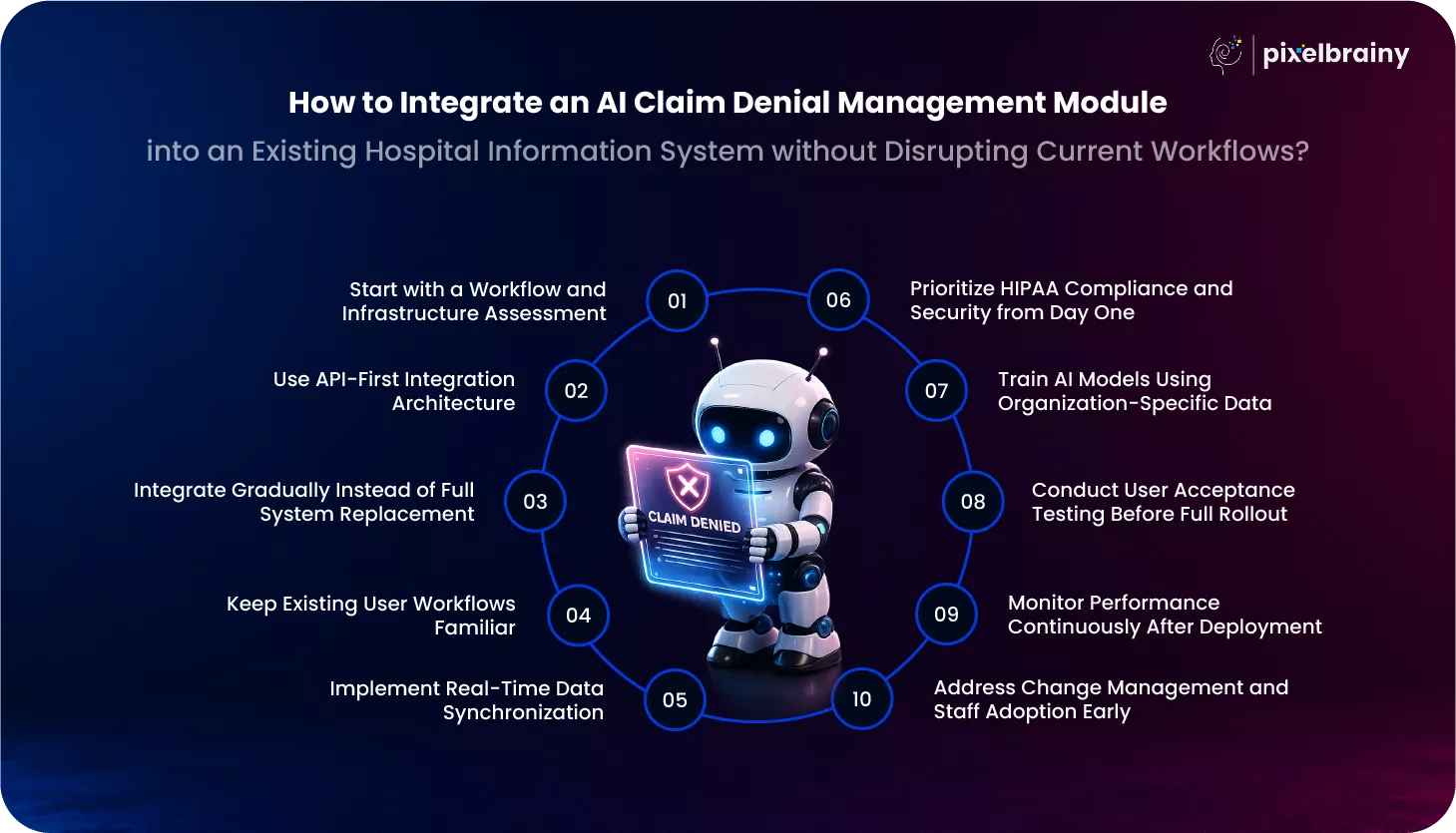
Before integration begins, healthcare organizations must evaluate their current systems, workflows, billing operations, and denial management processes carefully. This helps identify operational bottlenecks, integration opportunities, existing software dependencies, and how the AI module can fit naturally into current hospital workflows without causing disruptions.
API-first integration allows AI denial management modules to connect with EHR systems, billing software, clearinghouses, and payer platforms without replacing existing infrastructure. APIs help enable secure data exchange, real-time synchronization, and smooth interoperability while maintaining operational continuity across healthcare systems.
Healthcare organizations should avoid large-scale infrastructure replacement projects during AI adoption. A phased implementation strategy allows hospitals to introduce AI capabilities step by step, starting with denial prediction or appeals automation before expanding into broader revenue cycle operations gradually.
Billing teams already work within established operational processes and software interfaces daily. AI systems should enhance these workflows instead of forcing major behavioral changes. Familiar dashboards, embedded alerts, and background automation help improve adoption while reducing operational resistance from staff members.
AI denial management systems depend heavily on real-time healthcare data accuracy. Continuous synchronization between billing systems, EHR platforms, payer portals, and authorization databases ensures AI models always work with updated claims information, improving denial prediction accuracy and workflow reliability significantly.
Healthcare organizations must implement strong security controls during AI integration to protect sensitive patient and claims data. Encryption, secure authentication, audit logging, role-based access controls, and HIPAA-compliant infrastructure are essential requirements for maintaining regulatory compliance and cybersecurity protection throughout operations.
Every healthcare organization has unique payer relationships, coding patterns, workflows, and denial trends. Training AI models using internal historical claims data helps improve prediction accuracy, operational relevance, payer-specific intelligence, and long-term performance across denial management processes significantly.
Before organization-wide deployment, hospitals should involve billing specialists and operational teams in pilot testing programs. User acceptance testing helps validate workflow compatibility, identify usability issues, improve staff confidence, and ensure the platform solves real-world operational challenges effectively before launch.
AI denial management integration requires continuous monitoring even after deployment is complete. Healthcare organizations should regularly track denial reduction rates, reimbursement improvements, AI prediction accuracy, operational efficiency, and system reliability to optimize workflows and maintain long-term platform performance successfully.
Even highly advanced AI systems can fail if employees resist adoption. Healthcare organizations should provide proper onboarding, workflow training, operational guidance, and transparent communication to help billing teams understand how AI improves productivity instead of replacing human expertise entirely.
Seamless AI integration helps healthcare organizations modernize denial management operations while maintaining workflow stability, compliance, operational continuity, and staff productivity.
Healthcare organizations investing in AI-powered denial management systems must track the right KPIs to understand whether the platform is actually improving operational efficiency, reimbursement speed, and denial prevention outcomes. Measuring success through data-driven performance indicators helps organizations optimize workflows, improve ROI, and identify areas that still require operational improvement.
Organizations focused on developing HIPAA-compliant AI denial management software from scratch should define measurable success metrics from the beginning of the implementation process. Similarly, healthcare enterprises making AI-driven claim denial management software that cuts rework by 60% need performance benchmarks to evaluate whether the system is truly reducing administrative burden and improving financial recovery.
Below are the most important KPIs healthcare organizations should monitor after implementing AI denial management software.
Initial claim denial rate measures the percentage of claims rejected during first submission. This is one of the most important KPIs because it directly reflects how effectively the AI system prevents errors before claims reach insurance providers.
A decreasing denial rate usually indicates improvements in:
Lower denial rates help organizations reduce revenue delays and administrative workload significantly.
Clean claim rate tracks how many claims are processed successfully without requiring corrections, resubmissions, or manual intervention. A high clean claim rate is one of the clearest indicators that AI validation and predictive denial prevention systems are working effectively.
Improving clean claim rates helps healthcare organizations:
This KPI is critical for measuring long-term revenue cycle performance improvements.
This KPI measures how quickly denied claims are resolved after rejection. Traditional denial workflows often create long reimbursement delays because teams spend excessive time reviewing, routing, and appealing claims manually.
AI-powered automation helps reduce denial resolution time through:
Faster denial resolution directly improves reimbursement speed and operational productivity.
Appeal success rate measures the percentage of denied claims that are successfully recovered through the appeals process. This KPI helps organizations evaluate whether AI-powered appeal recommendations, documentation support, and workflow automation are improving recovery performance.
A higher appeal success rate indicates:
This KPI has a direct financial impact on revenue recovery performance.
One of the primary goals of AI denial management software is reducing repetitive administrative work. This KPI measures how much manual effort has been eliminated after AI implementation.
Healthcare organizations often track reductions in:
Organizations making AI-driven claim denial management software that cuts rework by 60% typically focus heavily on this metric to evaluate operational efficiency gains.
Days in Accounts Receivable measures how long organizations wait to receive payments from insurance providers. Long reimbursement cycles usually indicate workflow inefficiencies, unresolved denials, or delayed appeals processing.
AI-powered denial management systems help reduce A/R days by:
Lower A/R days improve financial stability and cash flow predictability significantly.
AI prediction accuracy evaluates how effectively machine learning models identify denial risks before claim submission. This KPI is critical because the overall performance of the denial management platform depends heavily on prediction quality.
The system’s prediction accuracy improves over time as the AI models continuously learn from:
Higher prediction accuracy leads to better denial prevention and stronger operational efficiency.
Tracking these KPIs consistently helps healthcare organizations optimize AI denial management performance, improve reimbursement outcomes, reduce administrative workload, and strengthen long-term revenue cycle efficiency.
Building an AI-powered denial management system is far more complex than developing a standard healthcare software platform. These systems must process massive claims datasets, integrate with multiple healthcare systems, comply with strict regulations, and continuously adapt to changing payer requirements without compromising operational accuracy.
While AI denial management software can significantly reduce administrative workload and improve reimbursement efficiency, organizations often face multiple technical, operational, and compliance-related challenges during development and implementation. Understanding these challenges early helps healthcare organizations build more scalable, accurate, and reliable systems.
Below are the biggest challenges healthcare organizations face while building AI denial management systems and the best ways to overcome them effectively.
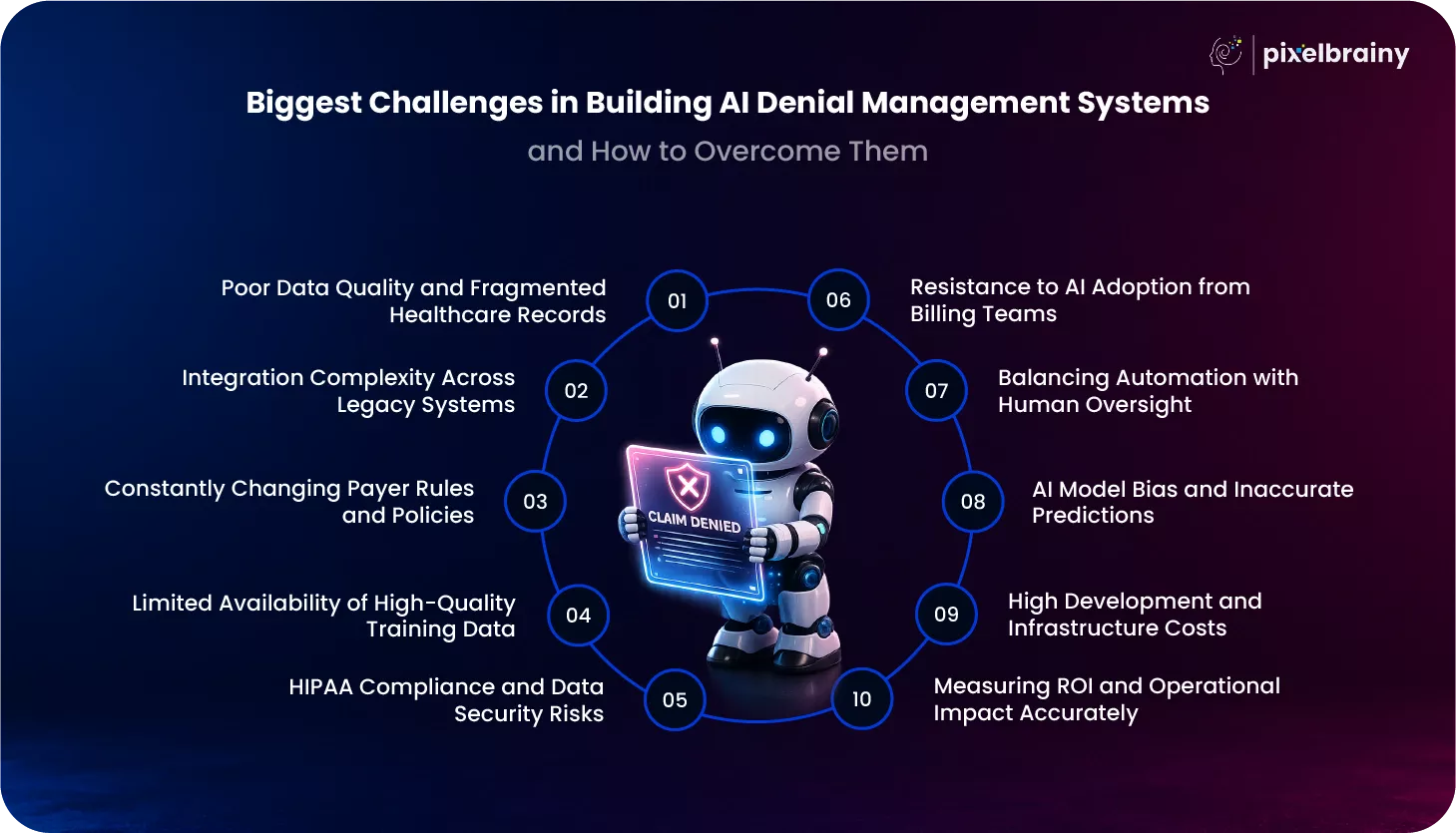
AI systems rely heavily on historical claims data for training and prediction accuracy. Unfortunately, many healthcare organizations operate with incomplete, inconsistent, or fragmented data spread across EHR systems, billing platforms, payer portals, and spreadsheets.
Poor-quality data can lead to:
To overcome this challenge, organizations should establish strong data governance practices, standardize healthcare data formats, clean historical records, and build centralized data management pipelines before AI development begins.
Most hospitals and healthcare organizations already use multiple legacy platforms for billing, patient management, coding, claims processing, and payer communication. Integrating AI denial management software into these disconnected environments can become technically complex.
Common integration issues include:
Organizations can reduce integration risks by adopting API-first architectures, FHIR standards, modular system design, and phased deployment strategies that minimize disruption to existing operations.
Insurance providers continuously update:
Static AI models quickly become outdated when payer policies evolve. If the system cannot adapt, denial prediction accuracy declines over time.
The best solution is implementing continuous learning pipelines that retrain AI models regularly using updated claims data, payer responses, and reimbursement trends to maintain operational accuracy.
Building effective AI models requires large volumes of properly labeled historical claims data. Many organizations lack structured datasets with accurate denial reasons, appeal outcomes, and payer-specific workflows.
Without sufficient training data, machine learning models struggle to:
Healthcare organizations should invest in data labeling, claims normalization, and long-term data collection strategies before scaling AI model development aggressively.
AI denial management systems process highly sensitive patient and financial information, making compliance and cybersecurity major concerns throughout development and deployment.
Security risks may include:
Organizations must build HIPAA compliance into the architecture from day one using:
Security should never be treated as a secondary feature.
Many billing professionals fear that AI systems may:
Poor user adoption can cause even technically strong platforms to fail operationally.
Healthcare organizations should overcome this challenge through:
The goal should be positioning AI as a productivity enhancement tool rather than a replacement for experienced billing professionals.
While automation improves efficiency, denial management still requires human judgment for:
Over-automation without oversight can create operational risks and inaccurate claim handling.
The most effective AI systems use hybrid operational models where AI handles repetitive tasks while humans manage strategic and high-complexity decisions.
Machine learning models can unintentionally develop bias if training datasets are incomplete, unbalanced, or historically flawed.
Biased models may:
Organizations should continuously monitor model performance, audit prediction outputs, and retrain systems using diverse and updated datasets to reduce bias and improve reliability.
Building enterprise-grade AI denial management software requires significant investment in:
Smaller healthcare organizations may struggle with budget limitations during implementation.
A phased MVP-first development strategy helps reduce financial risk by prioritizing high-impact features before expanding into advanced AI capabilities gradually.
Many organizations struggle to quantify the actual financial impact of AI denial management systems after deployment. Without proper KPIs, leadership teams cannot evaluate whether the investment is producing measurable improvements.
Healthcare organizations should define success metrics early, including:
Continuous performance monitoring is essential for long-term optimization.
AI claim denial management software is evolving rapidly as healthcare organizations continue searching for smarter ways to reduce reimbursement delays, automate operations, and improve revenue cycle efficiency. The next generation of denial management platforms will move far beyond basic automation and become highly intelligent systems capable of predictive decision-making, autonomous workflow management, and real-time operational optimization.
Below are the top future trends shaping the evolution of AI-powered claim denial management software.
Future denial management systems will increasingly use autonomous AI agents capable of handling repetitive operational tasks with minimal human intervention. These AI agents will automatically review claims, prioritize denials, initiate follow-ups, organize appeals workflows, and monitor payer responses in real time.
Instead of requiring billing teams to manage every operational step manually, AI agents will function like intelligent digital assistants that continuously optimize denial workflows in the background. This will significantly reduce administrative burden while improving operational speed and scalability.
Generative AI models are expected to play a major role in future denial management platforms. Advanced AI systems will automatically generate appeal letters, summarize denial reasons, organize supporting documentation, and recommend payer-specific response strategies using historical claims and reimbursement data.
These capabilities will help healthcare organizations accelerate appeal preparation while improving consistency and recovery success rates. Generative AI will also reduce the amount of repetitive administrative writing currently handled manually by billing and revenue cycle teams.
Current systems already predict denial risks before claim submission, but future platforms will become far more proactive and intelligent. AI engines will continuously monitor payer policy updates, coding changes, authorization requirements, and reimbursement patterns in real time to prevent denials dynamically.
Instead of relying only on historical data, next-generation systems will combine live operational intelligence with predictive analytics to stop claim errors instantly before they enter the reimbursement process.
As AI adoption increases across healthcare operations, organizations will demand greater transparency into how AI systems make decisions. Explainable AI frameworks will become essential for helping billing teams understand why claims were flagged, prioritized, or categorized in specific ways.
Future denial management platforms will provide clear reasoning behind AI recommendations, prediction scores, and workflow actions. This will improve user trust, operational accountability, compliance visibility, and regulatory confidence in AI-driven healthcare systems.
Future denial management software will become part of larger hyperautomation ecosystems that connect every stage of the healthcare revenue cycle. AI systems will integrate seamlessly with eligibility verification, prior authorization, coding validation, claims submission, payment posting, and reimbursement analytics workflows.
This interconnected automation environment will help healthcare organizations eliminate operational silos, reduce repetitive tasks, improve data flow, and create faster end-to-end reimbursement processes with minimal manual intervention.
These future AI trends will transform denial management software from reactive billing tools into intelligent healthcare revenue optimization platforms built for automation, predictive intelligence, and long-term operational scalability.
Healthcare organizations today are struggling with increasing denial volumes, payer complexity, reimbursement delays, and administrative overload. Most billing teams still spend hours manually reviewing denials, tracking payer responses, and managing repetitive follow-ups that slow down revenue recovery.
This is where PixelBrainy stands out as an experienced AI development company and AI insurance software solutions provider focused on building intelligent denial management systems tailored for modern healthcare and insurance operations.
Many founders entering the healthcare AI space often ask:
“I am a startup founder and i want to build an ai saas product for insurance claim denial management, can you suggest experienced software development companies in the usa who can be a technical co-founder or development partner”
PixelBrainy helps healthcare startups and enterprises build scalable AI-powered denial management platforms that automate repetitive workflows, improve denial prediction accuracy, optimize appeals management, and reduce manual operational burden.
The company focuses on combining:
Unlike traditional software vendors, PixelBrainy builds systems around real billing workflows so healthcare teams can adopt the platform easily without disrupting daily operations.
From AI MVP development and PoC validation to enterprise-scale deployment, the company supports the complete product lifecycle for healthcare organizations and startup founders looking to build scalable AI SaaS products in the insurance and revenue cycle management space.
So, if you are planning to modernize your denial management operations or build an AI-powered healthcare SaaS platform, connect with the experts at PixelBrainy to turn your vision into a scalable and revenue-focused AI solution.

AI-powered claim denial management is becoming an essential investment for healthcare organizations focused on improving reimbursement efficiency, reducing administrative burden, and strengthening revenue cycle performance. As payer requirements, claim volumes, and operational complexities continue increasing, healthcare providers and insurance organizations are adopting intelligent automation and predictive analytics to streamline denial management workflows more effectively.
From predictive denial prevention and automated appeals management to real-time reporting and smart workflow routing, AI-driven systems help billing teams improve clean claim rates, reduce manual rework, minimize revenue leakage, and accelerate financial recovery. These technologies also support better operational visibility, faster decision-making, and scalable revenue cycle operations across healthcare ecosystems.
Healthcare organizations that invest in AI-driven denial management today are building stronger, faster, and more efficient reimbursement operations for the future.
Ready to optimize your denial management process with AI-powered automation? Book an appointment with the experts at PixelBrainy and start building a smarter healthcare revenue cycle system today.
AI claim denial management software is an intelligent healthcare revenue cycle solution that uses artificial intelligence, machine learning, predictive analytics, and automation to identify, prevent, prioritize, and resolve insurance claim denials more efficiently.
AI helps reduce denial rates by analyzing historical claims data, payer behavior, coding patterns, authorization records, and documentation quality to identify potential claim issues before submission. This improves clean claim rates and minimizes manual rework.
Yes, modern AI denial management platforms can integrate with existing EHR systems, billing software, clearinghouses, and Hospital Information Systems using APIs, HL7, FHIR, and other healthcare interoperability standards without disrupting current workflows.
The development timeline depends on project complexity, integrations, AI capabilities, compliance requirements, and workflow customization. A basic MVP may take 3–5 months, while enterprise-grade AI denial management platforms can require 6–12 months or more.
Yes, properly developed AI denial management systems are designed with HIPAA-compliant security frameworks including encryption, role-based access control, audit logging, secure APIs, and healthcare data protection protocols to ensure patient information security.
The major benefits include reduced denial rates, faster reimbursements, lower administrative workload, automated appeals workflows, improved coding accuracy, better payer analytics, reduced operational costs, and higher revenue recovery efficiency
Yes, startups can build scalable AI SaaS platforms for denial management by partnering with experienced healthcare AI development companies that provide product strategy, MVP development, machine learning engineering, HIPAA compliance implementation, and scalable cloud infrastructure support.

About The Author
Sagar Bhatnagar
Sagar Sahay Bhatnagar brings over a decade of IT industry experience to his role as Marketing Head at PixelBrainy. He's known for his knack in devising creative marketing strategies that boost brand visibility and market influence. Sagar's strategic thinking, coupled with his innovative vision and focus on results, sets him apart. His track record of successful campaigns proves his ability to utilize digital platforms effectively for impactful marketing efforts. With a genuine passion for both technology and marketing, Sagar continuously pushes PixelBrainy's marketing initiatives to greater success.

Working with PixelBrainy has been a great experience. They took our vision for an AI-powered platform and turned it into a fully functional product. What impressed me most was their strong understanding of both design and development, and their ability to handle complex requirements with ease. The team was responsive, cooperative, and always open to feedback. They kept things organized, communicated clearly, and delivered quality work on time. I highly recommend PixelBrainy to anyone looking for a skilled and reliable development partner.

Working with the PixelBrainy team has been a highly positive experience. They understand the design requirements and create beautiful UX elements to meet the application needs. The dev team did an excellent job bringing my vision to life. We discussed usability and flow. Sagar worked with his team to design the database and begin coding. Working with Sagar was easy. He has the knowledge to create robust apps, including multi-language support, Google and Apple ID login options, Ad-enabled integrations, Stripe payment processing, and a Web Admin site for maintaining support data. I'm extremely satisfied with the services provided, the quality of the final product, and the professionalism of the entire process. I highly recommend them for Android and iOS Mobile Application Design and Development.

Great experience working with them. Had a lot of feedback and I found that unlike most contractors they were bugging me for updates instead of the other way around. They were extremely time conscience and great at communicating! All work was done extremely high quality and if not on time, early! They were always proactive when it comes to communication and the work is great/above par always. Very flexible and a great team to work with! Goes above and beyond to present us with multiple options and always provides quality. Amazing work per usual with Chitra. If you have UI/UX or branding design needs I recommend you go to them! Will likely work with them in the future as well, definitely recommended!

PixelBrainy is a joy to work with and is a great partner when thinking through branding, logo, and website layout. I appreciate that they spend time going into the "why" behind their decisions to help inform me and others about industry best practices and their expertise.

I hired them to design our software apps. Things I really like about them are excellent communication skills, they answer all project suggestions and collaborate right away, and their input on design and colors is amazing. This project was complex and needed patience and creativity. The team is amazing to do business with. I will be using them long-term. Glad to see there are some good people out there. I was afraid to try and outsource my project to someone but I am glad I met them! I really can't say enough. They went above and beyond on this project. I am very happy with everything they have done to make my business stand out from the competition.

It was great working with PixelBrainy and the team. They were very responsive and really owned the project. We'll definitely work with them again!

I recently worked with the PixelBrainy team on a project and I was blown away by their communication skills. They were prompt, clear, and articulate in all of our interactions. They listened and provided valuable feedback and suggestions to help make the project a success. They also kept me updated throughout the entire process, which made the experience stress-free and enjoyable.

PixelBrainy is very good at what it does. The team also presents themselves very professionally and takes care of their side of things very well. I could fully trust them taking up the design work in a timely and organised manner and their attention to detail saved us lots of effort and time. This particular project was quite intense and the team showed that they function very well under pressure. Very much looking forward to working with her again!

It's always an absolute pleasure working with them. They completed all of my requests quickly and followed every note I had for them to a T, which made our process go smoothly from start to finish. Everything was completed fast and following all of the guidelines. And I would recommend their services to anyone. If you need any design work done in the future, PixelBrainy should be your first call!

They took ownership of our requirements and designed and proposed multiple beautiful variants. The team is self-motivated, requires minimum supervision, committed to see-through designs with quality and delivering them on time. We would definitely love to work with PixelBrainy again when we have any requirements.

PixelBrainy was a big help with our SaaS application. We've been hard at work with a new UI/UX and they provided a lot of help with the designs. If you're looking for assistance with your website, software, or mobile application designs, PixelBrainy and the team is a great recommendation.

PixelBrainy designers are amazing. They are responsive, talented, and always willing to help craft the design until it matches your vision. I would recommend them and plan to continue them for my future projects and more!!!

They were awesome! Did a good job fast, and good communication. Will work with them again. Thank you

Creative, detail-oriented, and talented designers who take direction well and implement changes quickly and accurately. They consistently over-delivered for us.

PixelBrainy team is very talented and creative. Great designers and a pleasure to work with. PixelBrainy is an excellent communicator and I look forward to working with them again.

PixelBrainy has a very talented design team. Their work is excellent and they are very responsive. I enjoy working with them and hope to continue on all of our future projects.


Transform your ideas into reality with us.
Across these industries, each engagement brings unique challenges, from early-stage product development to scaling complex systems, helping us build a practical understanding of real-world product environments.