AI Summary Powered by PixelBrainy
Finding the right real estate agent can be difficult when buyers and sellers have different budgets, property types, locations, timelines, and expectations. Traditional agent directories often rely on basic filters, reviews, profiles, or visibility-based rankings. An AI Real Estate Agent Finder App takes this process further by using artificial intelligence, machine learning, behavioral analytics, and real estate data to identify agents who are genuinely relevant to each user's needs.
Imagine a PropTech entrepreneur preparing for seed funding with a clear goal: build an AI real estate agent finder app that improves on platforms such as Zillow and Realtor.com by matching buyers and sellers with agents based on demonstrated transaction performance in a specific neighborhood, property type, and price range. Instead of simply displaying agents who receive premium placement, the platform would analyze relevant performance data and generate more meaningful agent recommendations. The entrepreneur also needs an honest estimate of the investment required for a production-grade platform, including MLS transaction data integration, AI matching engine development, infrastructure, security, and ongoing data costs.
This scenario reflects the growing opportunity for AI in real estate and explains why businesses are exploring AI Real Estate Agent Finder App Development as a differentiated PropTech solution. A well-designed platform can automate agent discovery, improve lead quality, personalize recommendations, and help real estate professionals connect with higher-intent clients.
If you are planning to create an AI Real Estate Agent Finder App, this guide covers the complete development journey, including market opportunity, essential features, development process, technology stack, AI implementation, estimated development cost, challenges, monetization strategies, and business considerations.
Whether you want to build an AI Real Estate Agent Finder App from scratch, upgrade an existing agent directory, or create a scalable AI-powered real estate matchmaking platform, the following sections explain what it takes to turn the concept into a production-ready solution.

An AI Real Estate Agent Finder App is an intelligent platform that helps buyers, sellers, and renters find the most suitable real estate agents based on their specific requirements. Unlike a traditional agent directory that primarily displays profiles, ratings, or sponsored listings, an AI real estate agent matching app uses artificial intelligence, machine learning, behavioral data, and property-market insights to recommend agents who are more likely to fit a user's needs.
The core purpose of AI Real Estate Agent Finder App Development is to make agent discovery faster, more personalized, and data-driven. Users can enter details such as location, property type, budget, transaction goal, preferred communication style, and expected timeline. The AI matching engine then analyzes these requirements against agent profiles, transaction history, neighborhood expertise, availability, specialization, and performance data.
The typical workflow involves five key stages:
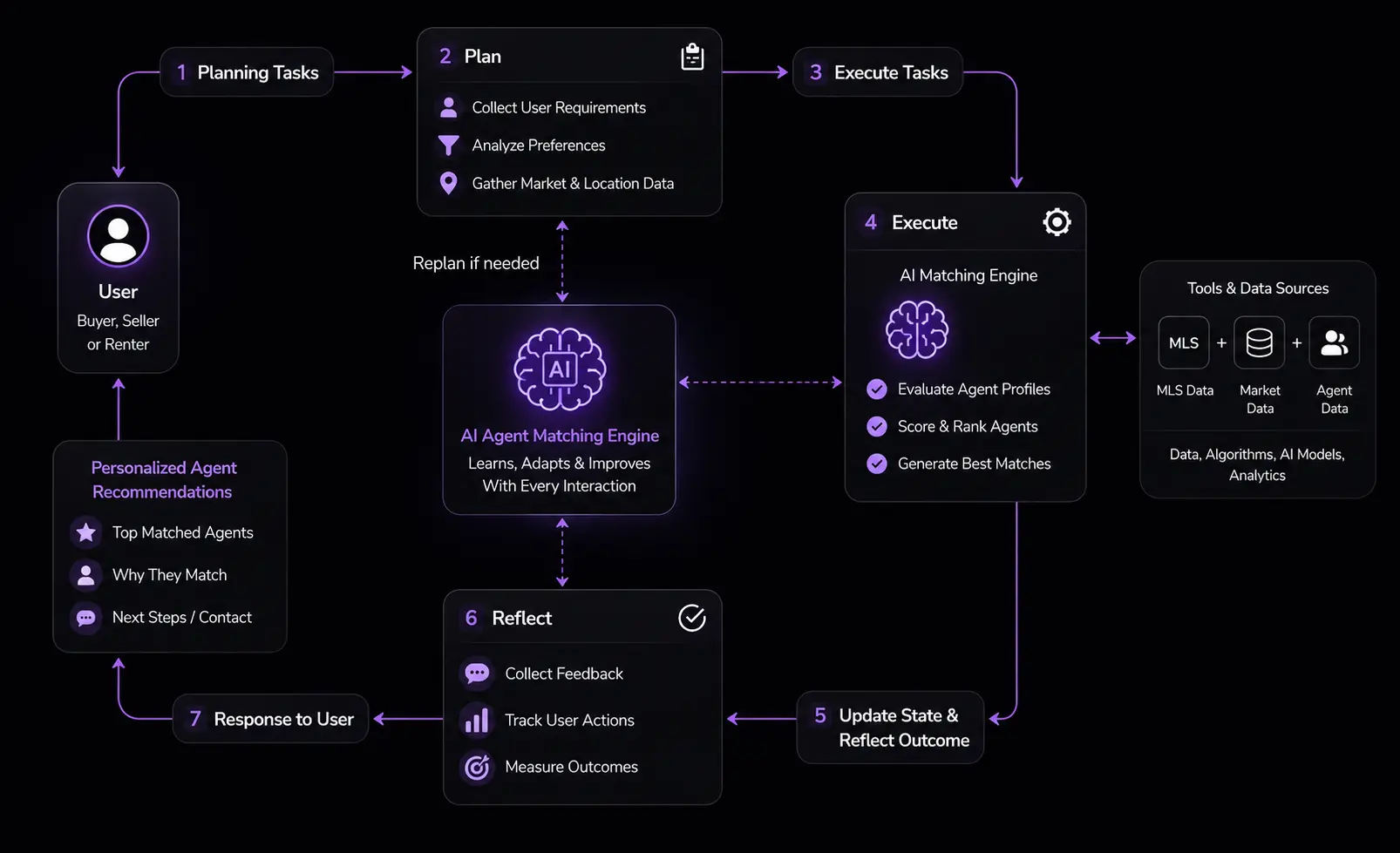
1. User Requirement Collection:
The app collects buyer, seller, or renter preferences through forms, conversational AI, or smart search interfaces.
2. Agent Data Analysis:
The system evaluates agent information such as location expertise, property specialization, price range, transaction history, reviews, response time, and availability.
3. AI-Powered Agent Matching:
Machine learning algorithms compare user requirements with agent characteristics and generate a personalized match score.
4. Personalized Recommendations:
The app presents the most relevant agents, explaining why each professional matches the user's property goals, market, budget, and preferences.
5. Continuous Learning:
As users search, shortlist agents, communicate, or complete transactions, the system can analyze behavioral signals to improve future recommendations.
For entrepreneurs exploring how to create an AI Real Estate Agent Finder App, this architecture provides a foundation for building a scalable AI real estate agent matching platform. With MLS and transaction data integration, recommendation algorithms, NLP-based conversations, and performance analytics, the platform can move beyond simple agent listings toward genuinely intelligent agent discovery.
Investing in AI real estate agent finder app development can help real estate companies, brokerages, and PropTech startups build a faster, more personalized, and scalable way to connect customers with the right agents. Instead of functioning as a simple agent directory, an AI-powered platform can analyze customer requirements, property preferences, location, budget, transaction type, and agent expertise to generate relevant matches.
The market opportunity is also substantial. The Business Research Company estimates that the global AI in real estate market will reach $404.9 billion in 2026, up from $301.58 billion in 2025, representing a 34.3% CAGR. It further projects the market to reach $1.3 trillion by 2030, growing at a 33.9% CAGR.
For businesses evaluating AI real estate app development, this growth creates several strong investment benefits:
An AI real estate agent finder can analyze multiple factors—including location, property type, budget, agent specialization, experience, availability, and customer preferences—to recommend suitable agents. This makes agent discovery more relevant than conventional search and filter systems.
AI can qualify prospects before assigning them to agents. Through conversational AI, the app can collect information about buying or selling intent, preferred location, budget, property requirements, and expected timeline. Agents can then receive leads that better match their expertise.
AI can automate repetitive processes such as lead qualification, appointment scheduling, follow-ups, notifications, and initial customer queries. This can reduce manual workload while allowing real estate teams to focus on qualified prospects and revenue-generating activities.
The business case for AI in real estate is becoming increasingly measurable. A June 2026 EY-Parthenon and CREDAI report found that GenAI could potentially deliver a 30–50% improvement in sales velocity for Indian real estate developers, along with approximately 30% faster product launches.
For an AI-powered real estate agent finder app, similar efficiency gains can come from faster lead qualification, intelligent agent allocation, automated communication, and quicker customer-agent connections.
An AI real estate agent matching app can support several monetization models, including:
This gives businesses flexibility to develop a revenue model based on their target market and platform scale.
AI can analyze customer behavior, agent performance, lead conversion rates, property preferences, location demand, and engagement patterns. These insights can help businesses improve lead distribution, marketing campaigns, agent rankings, and customer acquisition strategies.
A traditional agent-finding service often requires significant manual effort as the number of customers and agents increases. An AI-powered platform can automate matching, recommendations, lead routing, and communication, making it easier to expand into additional locations and property segments without increasing operational costs at the same rate.
Customers increasingly expect personalized digital experiences. Investing in AI real estate agent finder app development allows businesses to differentiate themselves through intelligent recommendations, faster responses, better agent matching, and automated customer journeys rather than competing solely on the size of their agent database.
With the global AI-in-real-estate market projected to grow rapidly and measurable efficiency benefits already emerging in real estate, investing in an AI real estate agent finder app in 2026 can create opportunities for stronger lead generation, lower operational costs, better matching, and diversified revenue.
For real estate businesses, AI agent matching is becoming a practical investment opportunity not just a technology upgrade.
A successful AI Real Estate Agent Finder App needs more than a searchable agent directory. It should combine intelligent matching, real estate data, personalization, communication, and performance insights to help users discover agents who genuinely fit their property goals. For businesses planning AI Real Estate Agent Finder App Development, the feature set should support both sides of the marketplace: users looking for the right professional and agents seeking qualified leads.
For example, a PropTech entrepreneur aiming to compete with established agent directories may want the platform to match users based on an agent's demonstrated transaction performance within a specific neighborhood, property type, and price range, rather than relying mainly on profile visibility or premium placement. Features such as AI-based agent matching, behavioral analysis, agent performance dashboards, smart search, and CRM integration can make this type of differentiation possible.
Whether you want to create an AI Real Estate Agent Finder App from scratch or enhance an existing platform, the following 15 features can provide the foundation for a scalable, personalized, and data-driven agent discovery experience.
From intelligent matching and behavioral personalization to real-time scheduling, analytics, and AI-powered lead scoring, these features help turn a conventional agent directory into a smarter real estate matchmaking platform.
| Feature | Purpose & Benefits |
| AI-Based Agent Matching | Uses machine learning to match users with the most suitable agents based on preferences, history, location, and agent performance. Improves user satisfaction and conversion rates. |
| Smart Search Filters | Allows users to filter agents by property type, location, budget range, language, or specialization. Helps users find the right agent faster and more accurately. |
| Behavioral Analysis Engine | Analyzes user behavior and preferences in real time to recommend agents or services. Enhances personalization and user engagement. |
| Agent Performance Dashboard | Displays agent metrics like success rate, average deal time, and client reviews. Builds transparency and trust with users. |
| In-App Messaging & Chatbots | Offers real-time communication and AI-driven chat support to answer common queries. Improves communication and response times. |
| Video Profile Integration | Enables agents to upload intro videos showcasing their style and approach. Helps users make more confident and informed decisions. |
| Voice Search & Smart Assistant | Allows users to use voice commands to search for agents or ask questions. Enhances accessibility and user convenience. |
| Real-Time Availability Scheduling | Lets users book appointments or consultations based on agent availability. Reduces back-and-forth and accelerates engagement. |
| CRM Integration for Agents | Helps agents manage leads, conversations, tasks, and follow-ups efficiently. Improves productivity and lead conversion rates. |
| AI-Powered Lead Scoring | Automatically ranks incoming leads based on quality and readiness to convert. Helps agents prioritize high-value opportunities. |
| Geo-Location Tracking | Shows agents near the user’s location and calculates proximity-based suggestions. Increases relevance of matches and local expertise. |
| Review & Rating System | Lets users review and rate agents after working with them. Builds credibility and trust through social proof. |
| Push Notifications | Notifies users of new agent matches, appointment reminders, and updates. Keeps users engaged and informed. |
| Multi-Language Support | Allows users to interact with the app in their preferred language. Expands accessibility and user reach. |
| Analytics & Reporting Dashboard | Provides insights into app performance, user behavior, and agent activity. Supports continuous improvement and data-driven decisions. |
Together, these features can help build an AI Real Estate Agent Finder App that delivers more relevant matches, stronger user trust, qualified leads, and a personalized experience across the real estate journey.
Turning an agent discovery idea into a production-ready platform requires more than adding an AI recommendation feature to an existing directory. The steps to build AI real estate agent finder app from idea to launch should cover market validation, AI strategy, product design, data preparation, development, testing, deployment, and continuous optimization.
For example, imagine a PropTech startup planning to launch in three metropolitan areas. The founders want their platform to recommend agents based on neighborhood-level transaction history, property specialization, price range, response behavior, and client preferences. They also want users to understand why a particular agent was recommended. This requires a carefully planned development process of AI real estate agent finder app, especially when MLS or transaction data and AI-based ranking are involved.
Whether you want to how to build AI real estate agent finder app from scratch, upgrade an existing agent directory, or create a scalable marketplace, the following eight steps provide a practical roadmap for AI real estate agent finder app development.

Start by identifying who will use the platform and what problems the current agent discovery process fails to solve. Research buyers, sellers, renters, investors, agents, and brokerages through interviews, surveys, competitor analysis, and market research. Examine how users search for agents, what influences their decisions, and which factors create trust.
Study competing platforms, regional property markets, agent specialization, transaction patterns, and user expectations. This research helps define the matching criteria your AI system should prioritize.
Why it matters: Strong research prevents unnecessary features and gives your product a clear market position before development begins.
After validating the concept, define the core functionality that will differentiate your platform. These may include AI agent matching, behavioral analysis, smart search, performance-based ranking, location intelligence, conversational assistance, and real-time availability.
Next, create a Proof of Concept to test whether the proposed AI matching logic can work with your available data. The PoC development phase can evaluate match scoring, data processing, recommendation logic, and API connectivity before full-scale investment.
Why it matters: A PoC identifies technical limitations early and reduces the risk of investing heavily in an unvalidated AI architecture.
Once the technical concept is validated, define the smallest useful product that can reach real users. Your MVP can include agent profiles, smart search, basic AI recommendations, location filters, user registration, messaging, and appointment requests.
The interface should make recommendations easy to understand. If an agent receives a high match score, users should be able to see relevant reasons such as neighborhood expertise, property specialization, transaction experience, or price-range alignment.
A specialized UI/UX design company can help create intuitive discovery flows while maintaining consistency across mobile and web experiences.
Why it matters: Focused MVP development lets you validate user demand before investing in advanced AI capabilities.
The technology architecture should support both current requirements and future expansion. A cross-platform frontend can use React or Flutter, while Node.js or Django can power backend services and APIs. Python can support machine learning workflows using frameworks such as PyTorch, TensorFlow, or Scikit-learn.
Cloud infrastructure can handle data processing, model deployment, authentication, analytics, and scaling. The architecture should also support MLS integrations, agent databases, recommendation APIs, and secure data storage.
Why it matters: The right technology foundation makes it easier to implement AI integration, handle growing datasets, and introduce advanced personalization later.
With the product architecture defined, development moves into full execution. Frontend developers build search, profiles, recommendations, messaging, and scheduling interfaces while backend engineers develop APIs, databases, authentication, and business logic.
At the same time, data engineers prepare agent, property, transaction, and behavioral datasets. AI engineers develop the recommendation and ranking models that determine which agents best match specific users.
This stage may also involve AI model development for match scoring, personalization, natural language search, or predictive lead qualification.
Why it matters: Coordinating product engineering, data engineering, and AI development ensures the platform works as one connected system rather than as separate features.
Also Read: Top 12+ AI Model Development Companies in the USA
Testing should cover more than conventional software functionality. Evaluate whether the AI consistently produces relevant agent recommendations and whether its ranking logic reflects the criteria defined during product planning.
Test different scenarios involving buyers, sellers, renters, property types, locations, budgets, and user preferences. Validate API responses, data quality, authentication, messaging, and application performance. Security testing should protect personal information, agent data, transaction records, and connected third-party services.
An AI consultation phase can also help identify gaps in model evaluation and responsible AI implementation.
Why it matters: Reliable testing improves recommendation quality, protects user trust, and reduces the risk of launching an unstable product.
After successful testing, launch the MVP through a controlled beta or limited-market release. Monitor important indicators such as search activity, recommendation clicks, agent profile views, match acceptance, appointment bookings, user retention, and drop-off rates.
Track how users respond to AI recommendations and collect feedback from both sides of the marketplace. Analytics can reveal whether users understand match explanations and whether recommended agents actually receive relevant leads.
Working with experienced top AI app development companies can help establish monitoring, deployment, analytics, and post-launch optimization processes.
Why it matters: Real-world usage provides evidence that can improve the product far more effectively than assumptions made before launch.
The final step is continuous improvement. Use real interaction data and feedback to refine recommendation models, improve search relevance, enhance agent profiles, and introduce features such as verified performance indicators, video introductions, appointment scheduling, and conversational AI.
As adoption increases, scale cloud infrastructure and data pipelines to support additional users, markets, and agent networks. Monetization can include agent subscriptions, qualified lead fees, premium tools, brokerage plans, advertising, or freemium packages.
Experienced AI real estate software development companies can support long-term optimization, infrastructure scaling, and feature expansion as the platform grows.
Why it matters: Continuous iteration turns an initial product into a competitive and sustainable real estate technology platform.
Following these steps helps businesses develop AI real estate agent finder app solutions that combine intelligent matchmaking, reliable data, strong UX, scalable architecture, and measurable business value from concept to launch.

If you are planning to develop an AI Real Estate Agent Finder App, the budget depends largely on what the platform needs to accomplish. A basic MVP with AI-powered agent matching and profile discovery will require far less investment than an enterprise platform with custom recommendation models, MLS transaction data, behavioral personalization, real-time analytics, and multiple third-party integrations.
For startups asking how much does it cost to build an AI real estate agent finder app, a practical development range is $20,000 to $250,000+. The final investment depends on the app's feature scope, AI sophistication, platform coverage, data requirements, design complexity, development team location, and post-launch support.
For example, a startup validating an agent-matching concept may begin with a focused MVP, while a PropTech company competing with established agent directories may need a production-grade system with AI-driven matching based on neighborhood expertise, property type, transaction history, price range, and user preferences.
The following cost estimates provide a practical starting point for understanding AI Real Estate Agent Finder App development cost across different development stages:
| Development Tier | Estimated Cost | What’s Included |
| MVP (Minimum Viable Product) | $20,000 – $50,000 | Core features: AI-based agent matching, profile viewing, basic filters, minimal design, limited AI training. |
| Full-Featured App (Mid-Level) | $50,000 – $120,000 | Advanced AI personalization, geo-filters, chat integration, dashboards, user reviews, scalable backend. |
| Enterprise-Grade App | $120,000 – $250,000+ | Full suite of features + custom AI models, high security, cross-platform, third-party integrations, admin controls, real-time analytics, and ongoing support. |
To understand the cost of AI Real Estate Agent Finder App development, here’s a breakdown of where your budget typically goes:
| Component | Cost Range | Description |
| UI/UX Design | $3,000 – $20,000 | Wireframes, branding, and responsive designs for web/mobile. |
| Frontend Development | $5,000 – $30,000 | User-facing features, real estate listings, filtering tools, agent profiles. |
| Backend Development | $7,000 – $40,000 | Server-side logic, databases, user management, API development. |
| AI Model Development & Training | $10,000 – $60,000 | Custom machine learning algorithms for agent recommendations, user behavior tracking, NLP-based searches. |
| Third-Party API Integration | $1,000 – $10,000 | Integration with map services, CRMs, payment gateways, chatbots, etc. |
| Testing & QA | $2,000 – $15,000 | Functional testing, AI output testing, device/browser compatibility. |
| Project Management | $3,000 – $12,000 | Agile sprint planning, communication, and quality tracking. |
| Deployment & Cloud Infrastructure | $2,000 – $15,000 | Hosting, database setup, load balancing, and monitoring tools. |
| Post-Launch Maintenance (annual) | $5,000 – $30,000 | Updates, security patches, performance optimizations. |
Key Factors Affecting the Cost:
A realistic AI real estate agent finder app development budget should account for both the initial build and recurring expenses such as AI model improvements, data licensing, cloud infrastructure, API usage, security, and maintenance. Planning these costs together helps you create a scalable product without underestimating the investment required for intelligent agent matching.
A reliable AI real estate agent finder app development strategy requires more than adding an AI model to a standard real estate application. The technology stack must support intelligent agent matching, real-time search, location-based discovery, secure user data, behavioral analytics, and continuous AI improvement. For a PropTech startup asking what technology is needed to build an AI real estate agent finder app, the right architecture should balance AI capabilities, performance, scalability, development cost, and future integrations.
The stack below covers the core technologies required across the frontend, backend, AI layer, databases, cloud infrastructure, communication, security, analytics, and deployment. It can support an MVP initially and scale toward a production-grade platform that uses agent performance data, user preferences, transaction insights, and behavioral signals to deliver more relevant agent recommendations.
| Parameter | Tools & Tech Stack | Purpose |
| Frontend Development | React Native, Flutter, Swift (iOS), Kotlin (Android) | Build a user-friendly interface for mobile/web platforms. |
| Backend Development | Node.js, Python, Django, Ruby on Rails | Handle server-side operations, APIs, and data exchange. Python is preferred for integrating AI logic seamlessly. |
| Database | PostgreSQL, MongoDB, Firebase Realtime DB | Store agent data, user profiles, location info, and preferences. |
| AI & Machine Learning | Python, TensorFlow, PyTorch, Scikit-learn, OpenAI API | Power smart agent-matching, user behavior prediction, and natural language search. Python is central for AI logic and model training. |
| Cloud & Hosting | AWS, Google Cloud, Microsoft Azure | Host backend servers, AI services, storage, and enable elastic scaling. |
| Geo-location & Maps | Google Maps API, Mapbox | Allow users to explore agents by area and visualize listings on maps. |
| Authentication & Security | Firebase Auth, OAuth 2.0, JWT | Secure user login, protect data privacy, and prevent unauthorized access. |
| Real-Time Communication | Twilio, Firebase Messaging, Sendbird | Enable in-app messaging, push notifications, and agent-client chat. |
| Analytics & Tracking | Google Analytics, Hotjar, Mixpanel | Monitor user behavior, feature usage, and improve AI accuracy. |
| Payment Integration | Stripe, Razorpay, PayPal | Handle in-app payments for premium services, agent boosts, etc. |
| DevOps & Deployment | Docker, Jenkins, GitHub Actions | Streamline development cycles, automate deployment, and manage infrastructure. |
| Testing & QA | Selenium, Appium, Jest, Postman | Ensure code quality, functionality, and app performance across devices. |
| Project Management | Jira, Trello, Asana | Coordinate teams, manage tasks, and track project progress. |
The right tech stack gives an AI real estate agent finder app the foundation to deliver accurate matchmaking today while remaining flexible enough to support advanced AI models, MLS integrations, personalization, and large-scale user growth tomorrow.
Building an AI Real Estate Agent Finder App involves more than implementing an agent directory with AI recommendations. The platform must process reliable real estate data, generate relevant matches, respond quickly, protect sensitive user information, and explain why a particular agent is recommended. These requirements can make AI Real Estate Agent Finder App development technically complex, particularly when the platform relies on MLS data, behavioral signals, location intelligence, and machine learning models.
For businesses planning to create an AI Real Estate Agent Finder App, identifying these challenges early can reduce development risks and prevent expensive changes after launch. A strong development strategy should address data quality, AI transparency, application performance, user trust, product scope, security, and regulatory requirements from the beginning.
Here are the key challenges to consider and practical approaches for overcoming them:

To make intelligent agent recommendations, your app needs access to reliable, real-time property and agent data. However, aggregating this data from multiple listing services (MLS), CRMs, or public APIs can be difficult and legally sensitive.
How to overcome: Partner with verified data providers, implement data scraping with compliance measures, and use APIs from trusted platforms like Zillow, Redfin, or Realtor.com. You can also enrich datasets through user input and proprietary sources.
One of the core elements of smart AI Real Estate Agent Finder App development is building models that can recommend the right agent based on user behavior, location, and preferences. The challenge is training AI to make decisions that are both useful and explainable to users.
How to overcome: Use Python-based libraries like TensorFlow or Scikit-learn to train models on clean, labeled datasets. Focus on transparency by offering “Why This Agent?” tooltips or matching score explanations, which builds trust with users.
Users expect instant results when browsing or matching with agents. Delays in search, chat, or map loading can ruin user experience and lead to app abandonment.
How to overcome: Use cloud-native tools like AWS Lambda or Firebase to process requests in real-time. Optimize your backend with caching mechanisms and serverless functions that ensure high availability and responsiveness.
Real estate is a personal decision, and people may be hesitant to trust algorithm-driven suggestions without transparency.
How to overcome: Provide social proof, agent ratings, and explainable AI suggestions. Let users adjust preferences and refine their own search to maintain a sense of control.
Trying to add every advanced feature early on—like video tours, blockchain verification, or predictive market insights—can overwhelm your MVP and slow down development.
How to overcome: Focus your MVP on key AI capabilities: smart agent matching, map filters, and messaging. Roll out advanced features in phases after validating user demand.
Real estate apps handle sensitive data—IDs, financial info, user locations—making them a prime target for breaches.
How to overcome: Use end-to-end encryption, two-factor authentication, and follow GDPR or CCPA compliance from the ground up. Also, secure your AI models to prevent data poisoning attacks.
By anticipating these hurdles during Real Estate Agent Finder App development, you can reduce risks, save time, and build a smarter, safer, and more scalable product.

Once your AI real estate agent finder app can consistently connect users with relevant agents, the next priority is creating a revenue model that supports sustainable growth. For a PropTech startup, monetization should not reduce the quality of AI recommendations or make users feel that paid agents automatically receive better matches. Instead, revenue strategies should reward agent participation, premium services, qualified leads, and valuable insights while keeping the core matching experience trustworthy.
The strongest approach is to combine multiple revenue streams rather than depend on a single source. Agent subscriptions, featured profiles, referral fees, advertising, premium AI tools, and data-driven insights can work together to create predictable recurring revenue.
This is especially important when AI in real estate is being used to differentiate an agent discovery platform from traditional directories. If your matching engine evaluates neighborhood expertise, transaction history, property type, price range, availability, and user preferences, monetization can be designed around the additional value your platform provides.
Below are six practical monetization strategies to consider when launching and scaling an AI-based real estate agent finder.

Real estate agents often struggle to stand out in competitive local markets. By offering them the opportunity to appear as a “Top Recommended Agent” or “Verified Expert” through a pay-to-boost feature, your app can generate recurring revenue.
These sponsored placements are based on the AI’s matching logic but highlight paying agents more prominently in user search results—without compromising quality. You can even rotate featured slots by category, location, or agent rating.
💰 A proven monetization model in many AI-powered marketplaces, great for visibility-hungry professionals.
Introduce a tiered membership model that unlocks exclusive tools and AI-powered insights. For example:
Using AI in real estate, these subscriptions can deliver more value than traditional CRM platforms, giving agents a real reason to upgrade.
💡 Recurring revenue + loyalty from agents = long-term app sustainability.
Every time a lead closes a transaction through your platform, you earn a commission (e.g., 5–10%) from the agent’s earnings. This monetization strategy aligns your business model with agent success, making it fair and scalable.
To track this efficiently, integrate with agents' CRM or use smart contract mechanisms that validate closed deals. This is especially useful in high-ticket real estate markets where a single deal can generate thousands in revenue.
📊 With this model, your AI-based real estate agent finder earns as agents earn.
Real estate is linked with dozens of complementary industries—mortgages, insurance, movers, decorators, etc. You can offer these businesses space within your app to display personalized ads based on user behavior and location.
For instance, a user looking for an agent in Miami might be shown offers from local mortgage consultants or moving services. Thanks to AI in real estate, these ads can be dynamically served based on user journey and profile.
🎯 A data-rich AI app offers unmatched targeting potential, creating high CPM ad slots.
The AI in your app collects valuable real estate user data—what users search for, what features convert, and which agents succeed the most. This anonymized data can be packaged and sold as insights to brokerages, market researchers, or investment firms.
Offer detailed market demand heatmaps, pricing trends, and agent performance metrics via dashboards or custom reports.
🧠 A scalable B2B revenue stream that leverages your AI infrastructure.
Start with a free version of the app to attract a large user base. Then, offer premium AI tools for those willing to pay:
These features can be unlocked through one-time purchases, in-app coins, or monthly upgrades.
🚀 Encourages growth while monetizing engaged users through advanced AI features.
A balanced monetization strategy can turn your AI agent matching platform into a scalable PropTech business while protecting user trust and the quality of AI-powered recommendations.
Turning an AI real estate agent finder concept into a production-ready platform requires more than standard app development. It requires a strong understanding of real estate workflows, agent performance data, AI matchmaking, user behavior, and scalable technology. PixelBrainy brings these capabilities together as a real estate AI software development company, helping PropTech startups, brokerages, and real estate businesses create intelligent platforms that deliver measurable business value.
Whether your goal is to develop AI Real Estate Agent Finder App capabilities for agent discovery, build an AI-powered marketplace, or improve an existing agent directory, our approach focuses on accurate matching, intuitive user experiences, secure data handling, and scalable architecture.
Client: Confidential multi-city real estate network in the United States
Business Challenge:
The client wanted to improve agent assignment accuracy and reduce lead drop-off. Its existing process relied heavily on basic location and availability filters, making it difficult to consistently connect buyers and sellers with agents suited to their specific needs.
PixelBrainy Solution:
PixelBrainy developed a full-stack AI Real Estate Agent Finder App using user behavior, intent signals, location data, and agent performance metrics to generate more relevant matches.
Key components included:
Results within 90 days:
The project demonstrates how AI solutions for real estate can improve both customer experience and operational efficiency when AI is connected to meaningful business data.
As a real estate AI software development company, PixelBrainy provides end-to-end expertise across product strategy, AI engineering, application development, integrations, deployment, and ongoing optimization.
A successful agent finder should do more than display a directory. It should help users understand why an agent is a relevant match while helping real estate businesses generate better-quality opportunities.
PixelBrainy helps turn that vision into a scalable AI-powered real estate product. Connect with our AI experts to discuss your agent matching platform, development scope, and technology roadmap.

Finding the right real estate agent can be transformed from a basic directory search into a personalized, data-driven experience with an AI Real Estate Agent Finder App. As this guide explains, successful AI Real Estate Agent Finder App Development requires more than an attractive interface. It involves intelligent agent matching, behavioral analysis, secure data integration, AI model development, scalable architecture, and continuous optimization.
From understanding the steps to build AI real estate agent finder app, essential features, technology stack, development costs, challenges, and monetization strategies, businesses can now plan a clearer path from concept to launch. For PropTech startups and real estate companies, the opportunity is to create an AI-powered platform that matches users with agents based on relevant preferences, expertise, location, performance, and transaction needs.
As a real estate AI software development company, PixelBrainy can help turn this vision into a scalable, user-focused solution.
Ready to build a smarter agent matching platform? Schedule a call with PixelBrainy today and discuss your AI real estate app idea with our experts.
The cost to develop an AI Real Estate Agent Finder App typically ranges from $20,000 to $250,000+, depending on the app's features, AI complexity, platform coverage, integrations, design, and development team. A basic MVP with AI agent matching can cost less, while an enterprise platform with custom AI models, MLS integrations, analytics, and real-time personalization requires a larger investment.
An AI-powered agent finder can evaluate factors such as location, property type, budget, user preferences, agent specialization, availability, reviews, and historical transaction performance. Machine learning models can then generate match scores and rank agents based on their relevance to each user's requirements.
Key features include AI-based agent matching, smart search filters, behavioral analysis, agent performance dashboards, in-app messaging, AI chatbots, appointment scheduling, reviews and ratings, geolocation, lead scoring, notifications, and analytics. The feature set can be expanded as the platform gains users and more behavioral data becomes available.
The typical development process starts with market research and requirements definition, followed by a proof of concept, MVP development, technology selection, AI integration, full-scale development, testing, deployment, and continuous optimization. Starting with an MVP allows businesses to validate agent matching and user demand before investing in advanced capabilities.
A basic MVP may take around 8 to 12 weeks, while a full-featured AI platform can require several months. The timeline depends on the number of platforms, AI model complexity, MLS or third-party integrations, customization requirements, testing, and security needs.
An intelligent matching system can use agent expertise, location, property type, price range, transaction history, availability, reviews, response time, and user preferences. With appropriate permissions and compliant data sources, transaction and behavioral data can make recommendations more relevant than simple directory-based searches.
Yes. MLS data, CRM platforms, mapping services, scheduling tools, communication systems, and other APIs can be integrated depending on their availability, licensing terms, technical requirements, and applicable regulations. These integrations can provide the data needed for more accurate agent profiles, matching, and lead management.
Common monetization models include agent subscriptions, featured listings, referral fees, premium AI features, advertising, and data insights services. A strong approach is to ensure monetization does not undermine the credibility of AI recommendations. Users should still receive relevant matches based on genuine requirements and performance signals.

About The Author
Sagar Bhatnagar
Sagar Sahay Bhatnagar brings over a decade of IT industry experience to his role as Marketing Head at PixelBrainy. He's known for his knack in devising creative marketing strategies that boost brand visibility and market influence. Sagar's strategic thinking, coupled with his innovative vision and focus on results, sets him apart. His track record of successful campaigns proves his ability to utilize digital platforms effectively for impactful marketing efforts. With a genuine passion for both technology and marketing, Sagar continuously pushes PixelBrainy's marketing initiatives to greater success.

Working with the PixelBrainy team has been a highly positive experience. They understand the design requirements and create beautiful UX elements to meet the application needs. The dev team did an excellent job bringing my vision to life. We discussed usability and flow. Sagar worked with his team to design the database and begin coding. Working with Sagar was easy. He has the knowledge to create robust apps, including multi-language support, Google and Apple ID login options, Ad-enabled integrations, Stripe payment processing, and a Web Admin site for maintaining support data. I'm extremely satisfied with the services provided, the quality of the final product, and the professionalism of the entire process. I highly recommend them for Android and iOS Mobile Application Design and Development.

Great experience working with them. Had a lot of feedback and I found that unlike most contractors they were bugging me for updates instead of the other way around. They were extremely time conscience and great at communicating! All work was done extremely high quality and if not on time, early! They were always proactive when it comes to communication and the work is great/above par always. Very flexible and a great team to work with! Goes above and beyond to present us with multiple options and always provides quality. Amazing work per usual with Chitra. If you have UI/UX or branding design needs I recommend you go to them! Will likely work with them in the future as well, definitely recommended!

PixelBrainy is a joy to work with and is a great partner when thinking through branding, logo, and website layout. I appreciate that they spend time going into the "why" behind their decisions to help inform me and others about industry best practices and their expertise.

I hired them to design our software apps. Things I really like about them are excellent communication skills, they answer all project suggestions and collaborate right away, and their input on design and colors is amazing. This project was complex and needed patience and creativity. The team is amazing to do business with. I will be using them long-term. Glad to see there are some good people out there. I was afraid to try and outsource my project to someone but I am glad I met them! I really can't say enough. They went above and beyond on this project. I am very happy with everything they have done to make my business stand out from the competition.

It was great working with PixelBrainy and the team. They were very responsive and really owned the project. We'll definitely work with them again!

I recently worked with the PixelBrainy team on a project and I was blown away by their communication skills. They were prompt, clear, and articulate in all of our interactions. They listened and provided valuable feedback and suggestions to help make the project a success. They also kept me updated throughout the entire process, which made the experience stress-free and enjoyable.

PixelBrainy is very good at what it does. The team also presents themselves very professionally and takes care of their side of things very well. I could fully trust them taking up the design work in a timely and organised manner and their attention to detail saved us lots of effort and time. This particular project was quite intense and the team showed that they function very well under pressure. Very much looking forward to working with her again!

It's always an absolute pleasure working with them. They completed all of my requests quickly and followed every note I had for them to a T, which made our process go smoothly from start to finish. Everything was completed fast and following all of the guidelines. And I would recommend their services to anyone. If you need any design work done in the future, PixelBrainy should be your first call!

They took ownership of our requirements and designed and proposed multiple beautiful variants. The team is self-motivated, requires minimum supervision, committed to see-through designs with quality and delivering them on time. We would definitely love to work with PixelBrainy again when we have any requirements.

PixelBrainy was a big help with our SaaS application. We've been hard at work with a new UI/UX and they provided a lot of help with the designs. If you're looking for assistance with your website, software, or mobile application designs, PixelBrainy and the team is a great recommendation.

PixelBrainy designers are amazing. They are responsive, talented, and always willing to help craft the design until it matches your vision. I would recommend them and plan to continue them for my future projects and more!!!

They were awesome! Did a good job fast, and good communication. Will work with them again. Thank you

Creative, detail-oriented, and talented designers who take direction well and implement changes quickly and accurately. They consistently over-delivered for us.

PixelBrainy team is very talented and creative. Great designers and a pleasure to work with. PixelBrainy is an excellent communicator and I look forward to working with them again.

PixelBrainy has a very talented design team. Their work is excellent and they are very responsive. I enjoy working with them and hope to continue on all of our future projects.


Transform your ideas into reality with us.
Across these industries, each engagement brings unique challenges, from early-stage product development to scaling complex systems, helping us build a practical understanding of real-world product environments.