AI Summary Powered by PixelBrainy
How can your sales team spend more time closing deals instead of repeating the same prospecting tasks every day?
For many B2B organizations, this question has become a strategic business priority rather than an operational concern. Sales teams are under constant pressure to generate qualified pipeline, personalize outreach, and engage prospects faster than competitors. Yet many sales development representatives still spend hours researching companies, identifying decision makers, writing similar emails, updating CRM records, and qualifying leads before meaningful conversations even begin. This growing gap between sales expectations and team productivity is one of the primary reasons businesses are investing in AI sales agent development.
Consider a realistic scenario. You are the VP of Sales at a B2B SaaS company with 35 account executives, and your sales development representatives spend nearly 70 percent of their working hours performing repetitive research and personalized outreach that follows almost the same workflow for every target account. Before presenting an investment proposal to your CFO, you need answers to practical questions. What is the realistic time to value after you build AI sales agent capabilities? Which SDR responsibilities can AI handle independently, and which still require experienced sales professionals? What measurable productivity improvements have similar B2B SaaS companies achieved after they develop AI powered sales agent solutions?
These are the questions decision makers are actively searching for before approving AI initiatives.
This comprehensive guide answers those questions while explaining how to create an AI sales agent, the complete development process of AI sales agent, essential features, technology stack, implementation costs, and common development challenges. Whether you want to make AI sales agent software from scratch or evaluate a custom enterprise solution, this article provides the practical insights, technical knowledge, and strategic guidance needed to make informed business decisions and maximize your return on AI investment.
Businesses looking to improve sales productivity often compare AI sales agent development with traditional sales automation. Although both technologies help streamline sales processes, they solve different business problems. Sales automation focuses on completing predefined tasks, while an AI sales agent combines data, intelligence, and decision making to execute sales activities with greater accuracy and personalization.
An AI sales agent is an intelligent software solution powered by technologies such as Large Language Models (LLMs), machine learning, natural language processing (NLP), and predictive analytics. It can research prospects, qualify leads, generate personalized emails, schedule meetings, summarize sales calls, update CRM records, and recommend the next best action based on customer behavior and historical data. Instead of following fixed instructions, an AI sales agent evaluates information in real time and adjusts its responses according to the buying journey.
Sales automation follows a completely different approach. It is designed to automate repetitive, rule-based activities such as sending scheduled emails, assigning leads, triggering workflows, or creating follow up reminders. Every action depends on predefined conditions created by users. If the workflow changes or customer behavior shifts, the automation cannot adapt unless someone manually updates the rules.
The differences become clearer in the comparison below.:
| Feature | AI Sales Agent | Sales Automation |
| Working Approach | Makes intelligent decisions before taking action | Executes predefined workflows |
| Customer Engagement | Delivers personalized interactions based on context | Sends standard messages based on fixed rules |
| Lead Qualification | Uses AI models to score and prioritize leads | Uses manually defined criteria |
| Learning Capability | Continuously improves from new data and interactions | Does not learn or optimize automatically |
| Decision Making | Understands customer intent and recommends next steps | Cannot interpret customer intent |
| Sales Activities | Handles research, outreach, follow ups, CRM updates, and meeting summaries | Automates repetitive administrative tasks |
| Business Value | Improves sales productivity and conversion rates | Reduces manual effort and saves time |
A simple example explains the difference. Imagine two prospects request a product demo on the same day. A sales automation platform adds both contacts to the same predefined email sequence. An AI sales agent first analyzes each company's industry, size, recent business activity, engagement history, and buying signals before deciding how to engage them. One prospect may receive an immediate meeting invitation because of strong purchase intent, while the other enters a personalized nurturing campaign until they are sales ready.
This ability to understand context, make informed decisions, and optimize every interaction explains why organizations increasingly build AI sales agent solutions instead of relying solely on automation. Companies that develop AI powered sales agent platforms gain more than operational efficiency. They equip their sales teams with an intelligent assistant that enhances customer engagement, accelerates pipeline growth, and contributes directly to revenue generation.
An AI sales agent works like a virtual sales development representative that operates around the clock. It continuously collects customer data, analyzes buying signals, and takes the most appropriate action at every stage of the sales journey. Instead of waiting for manual input, it uses artificial intelligence to determine who to engage, when to engage them, and how to maximize the chances of conversion.
The workflow below illustrates how an AI sales agent supports the complete sales process.
| Sales Stage | How an AI Sales Agent Works |
| Captures Lead Data | Collects prospect information from websites, CRM platforms, LinkedIn, marketing campaigns, emails, and third party databases to create a complete customer profile. |
| Understands Buyer Intent | Analyzes browsing behavior, content downloads, email engagement, and previous conversations to identify whether the prospect is researching, comparing solutions, or ready to buy. |
| Qualifies the Prospect | Evaluates factors such as company size, industry, job role, technology stack, budget indicators, and engagement level to prioritize high value opportunities. |
| Personalizes Communication | Creates customized emails, LinkedIn messages, and follow ups based on the prospect's business challenges instead of using generic templates. |
| Engages in Conversations | Responds to common questions, shares relevant resources, books meetings, and hands over complex discussions to sales representatives whenever human expertise is required. |
| Updates Sales Systems | Automatically records every interaction, updates CRM fields, creates follow up tasks, and maintains accurate pipeline data without manual effort. |
| Optimizes Future Actions | Learns from successful conversations, response rates, and closed deals to improve lead scoring, messaging, and sales recommendations over time. |
A Real-World Example:
Suppose a prospect from a growing SaaS company visits your pricing page multiple times, downloads an implementation guide, and opens three follow up emails within two days. A traditional automation platform simply triggers the next email in the sequence because the workflow is predefined.
An AI sales agent takes a more intelligent approach. It recognizes these activities as strong buying signals, researches the company's recent growth, identifies the likely decision maker, drafts a personalized outreach email, alerts the assigned account executive, and recommends scheduling a product demonstration. If the prospect replies with questions, the AI can answer routine queries instantly while escalating complex commercial discussions to the sales team.
This intelligent workflow is why businesses invest in AI sales agent development. Organizations that build AI sales agent solutions gain more than automation. They create an AI powered sales assistant that understands customer intent, delivers personalized engagement, reduces manual effort, and helps sales teams close opportunities faster.
The market for AI sales agent development has reached an inflection point. In 2026, three independent trends have converged to make AI sales agents one of the highest ROI investments for B2B companies. Rising SDR costs are increasing customer acquisition expenses, buyers expect hyper personalized engagement at scale, and agentic AI technology has finally matured enough to support autonomous sales execution.
For businesses planning to build AI sales agent in 2026, this combination creates a significant competitive advantage.
The traditional SDR model is becoming increasingly difficult to scale. Hiring, onboarding, and retaining skilled SDRs requires significant investment, with fully loaded annual costs in major US markets ranging between $80,000 and $120,000. Most teams also require 12 to 18 months before new hires reach full productivity, while annual turnover often exceeds 35%.
Even experienced SDRs typically manage 50 to 100 personalized outreach messages per day. An AI sales agent changes these economics by executing 1,000 to 10,000 personalized prospect interactions daily, enabling businesses to expand outbound capacity without proportional increases in hiring costs.
B2B buyers now receive hundreds of outreach messages every month, making generic email sequences increasingly ineffective. Personalization has become a revenue driver rather than a competitive advantage.
Organizations that develop AI sales agent solutions can automatically analyze CRM data, company news, buying intent, and digital behavior to generate relevant outreach for every prospect. Instead of forcing sales teams to choose between personalization and scale, AI delivers both simultaneously.
Until recently, autonomous sales agents were limited by technology. Today, Large Language Models, Retrieval Augmented Generation (RAG), multi agent orchestration, long term memory, voice AI, and real time intent data processing have made creating AI sales agent platforms commercially practical. Businesses can now deploy AI systems that research prospects, qualify leads, personalize outreach, schedule meetings, and continuously improve through every customer interaction.
The market growth reflects this shift. According to Grand View Research, the global AI in Sales market is expected to grow at a 22.2% CAGR, reaching USD 145.1 billion by 2033, while the AI Agents market is projected to expand at an even faster 49.6% CAGR as enterprises accelerate autonomous AI adoption.
Gartner also forecasts worldwide AI spending to reach approximately USD 2.6 trillion in 2026, demonstrating that AI has become a core enterprise investment rather than an emerging technology.
Businesses that invest in AI sales agent development today will be better positioned to scale revenue faster, lower customer acquisition costs, and outperform competitors in the AI-first sales era.
Not every business needs the same type of AI sales agent. The right solution depends on your sales process, buyer journey, revenue model, and customer lifecycle. For example, a B2B SaaS startup focused on outbound prospecting requires different AI capabilities than an enterprise business prioritizing customer expansion and renewals.
Understanding these agent types helps businesses make informed AI sales agent development decisions while avoiding unnecessary features and development costs.
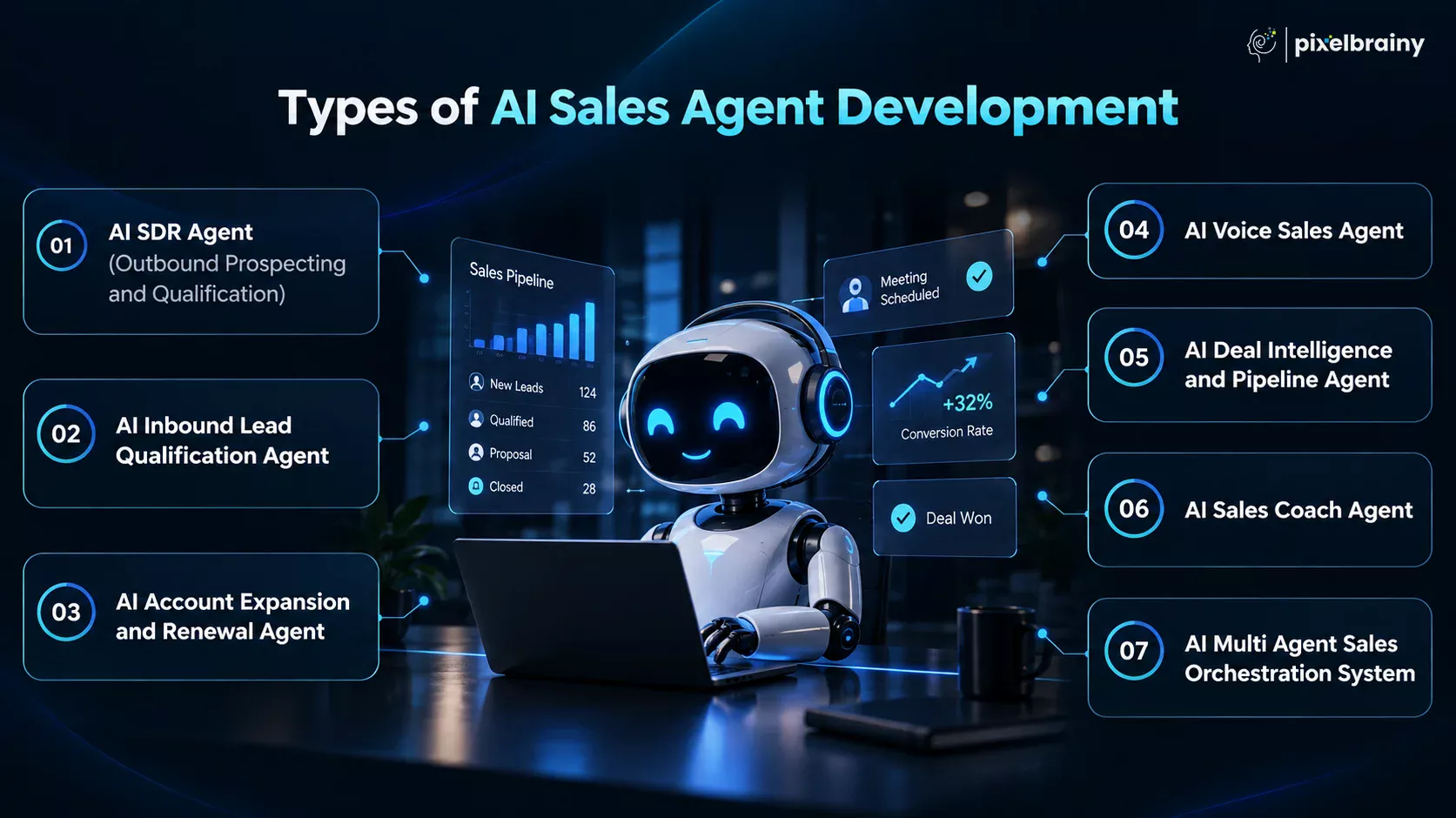
An AI SDR agent is the most widely adopted type of AI sales agent for outbound B2B sales. It automates the entire prospecting workflow, from identifying Ideal Customer Profile (ICP) accounts and researching prospects to generating personalized emails, LinkedIn outreach, follow up sequences, objection handling, and meeting scheduling. Businesses investing in AI SDR agent development can significantly increase outbound capacity without expanding SDR headcount.
Product Design Implication: Requires CRM integration, prospect data providers, email sequencing platforms, LinkedIn enrichment, buying intent signals, and scheduling tools to deliver end to end outbound automation.
An AI inbound lead qualification agent engages website visitors, chatbot users, demo requesters, and inbound inquiries in real time. It asks qualification questions, evaluates lead quality against predefined ICP criteria, answers common product questions, and instantly routes sales qualified leads to the appropriate account executive. Leads that are not sales ready are automatically nurtured with relevant content until they meet qualification thresholds.
Product Design Implication: Requires seamless integration with websites, chat platforms, CRM systems, marketing automation tools, and lead scoring models to ensure fast qualification and intelligent routing.
Instead of acquiring new customers, this AI agent focuses on maximizing revenue from existing accounts. It continuously monitors product usage, customer engagement, account health scores, support interactions, and purchasing behavior to identify upsell, cross sell, and renewal opportunities. Outreach is triggered by customer behavior rather than fixed renewal schedules, making conversations timelier and more relevant.
Product Design Implication: Requires deep integration with customer success platforms, product analytics, billing systems, subscription management tools, and CRM data to detect expansion opportunities accurately.
An AI voice sales agent conducts natural phone conversations with prospects using advanced voice AI technologies. It can make outbound calls, answer inbound inquiries, handle objections, qualify leads, collect information, and book meetings while maintaining conversational flow in real time. This type of agent is particularly valuable for businesses managing high volumes of warm leads generated through marketing campaigns.
Product Design Implication: Requires real time speech recognition, text to speech models, telephony APIs, conversation memory, low latency infrastructure, and compliance with regulations such as the TCPA for outbound calling in the United States.
This AI sales agent operates during the middle and later stages of the sales funnel. It continuously analyzes active opportunities, stakeholder engagement, competitor activity, sales conversations, and pipeline data to identify deals at risk. It then recommends next best actions, drafts follow up emails, and alerts sales representatives before opportunities begin to stall.
Product Design Implication: Requires CRM connectivity, sales engagement platforms, email intelligence, meeting transcripts, forecasting models, and revenue analytics to generate accurate deal insights.
An AI sales coach agent focuses on improving sales team performance rather than interacting directly with prospects. It reviews sales calls, email conversations, CRM activities, and historical deal data to identify winning sales behaviors, coaching opportunities, and performance gaps. Individual recommendations help underperforming representatives improve while capturing best practices from top performers across the organization.
Product Design Implication: Requires integrations with conversation intelligence platforms, call recording software, CRM systems, and AI analytics models capable of evaluating sales performance at scale.
The most advanced form of AI sales agent development combines multiple specialized AI agents into a coordinated ecosystem managed by a supervisor agent. Individual agents perform dedicated tasks such as prospect research, outreach generation, lead qualification, meeting scheduling, deal analysis, and customer expansion, while the supervisor agent manages workflow routing, context sharing, decision making, and human escalations throughout the buyer journey.
This architecture is becoming the preferred approach for enterprises seeking how to build scalable AI sales agent for enterprise revenue teams in 2026 because it delivers greater flexibility, accuracy, and operational efficiency than relying on a single AI agent.
Product Design Implication: Requires multi agent orchestration frameworks, shared memory architecture, workflow management, API integrations, governance controls, and robust escalation logic to coordinate specialized AI agents effectively.
Development Tip: The type of AI sales agent you choose determines the project's data requirements, compliance obligations, third party integrations, AI architecture, and human handoff strategy. Defining the right agent type before you build AI sales agent software significantly reduces development complexity and ensures the solution aligns with your sales objectives.
Before businesses build AI sales agent solutions, one of the most common questions decision makers ask is, "What measurable business value will we achieve?" This question is especially relevant for sales leaders preparing an investment proposal for executive stakeholders. For example, a VP of Sales managing a 35-member account executive team may want to know whether AI sales agent development can realistically reduce manual prospecting, improve SDR productivity, and deliver a faster return on investment than expanding the sales team.
The answer depends on how the AI agent is designed, but the benefits below consistently make AI sales agents one of the highest-impact investments for modern B2B organizations.
Sales professionals generate the highest value when they are building relationships and closing deals, not researching prospects or updating CRM records. Businesses that develop AI sales agent solutions automate repetitive sales activities, allowing SDRs and account executives to spend significantly more time engaging qualified prospects.
Key advantages include:
Modern buyers ignore generic sales emails. AI sales agents analyze company data, industry trends, buying signals, and previous interactions to create highly personalized communication for every prospect. This enables businesses to maintain quality personalization while expanding outbound campaigns.
Key advantages include:
One of the biggest challenges in outbound sales is responding quickly to high-intent prospects. AI sales agents qualify leads instantly using predefined ICP criteria, behavioral signals, and engagement history before routing sales-ready opportunities to the right representative.
Key advantages include:
Hiring, onboarding, and retaining SDRs requires considerable investment. Businesses that invest in AI sales agent development reduce operational costs by automating repetitive outbound activities while enabling existing sales teams to handle a significantly larger prospect volume.
Key advantages include:
Unlike traditional automation tools, AI sales agents continuously analyze customer interactions, pipeline activity, and buying signals to recommend the next best action. This helps sales teams make informed decisions instead of relying solely on intuition.
Key advantages include:
Prospects do not always engage during business hours, especially for global B2B companies. AI sales agents remain available around the clock to answer questions, qualify leads, schedule meetings, and maintain consistent engagement regardless of time zones.
Key advantages include:
Every customer interaction provides valuable learning data. As businesses build AI sales agent platforms, the system continuously refines lead scoring models, outreach strategies, conversation quality, and sales recommendations based on successful outcomes.
Key advantages include:
Many organizations evaluating AI sales agent development ask whether AI can deliver results faster than hiring additional SDRs. While recruiting, onboarding, and ramping new sales representatives can take several months, AI sales agents can begin automating prospect research, lead qualification, outreach, and meeting scheduling shortly after deployment and integration. This enables revenue teams to increase outbound capacity much sooner while existing sales representatives focus on closing opportunities.
Key advantages include:
The greatest advantage of AI sales agent development is not replacing human sales professionals. It is enabling them to sell more effectively by automating repetitive work, delivering intelligent insights, and creating a scalable sales engine that drives long-term revenue growth.
Before investing in AI sales agent development, business leaders often ask a practical question: "Which features are essential for building an AI sales agent that delivers measurable ROI instead of becoming another software expense?" This is particularly important for organizations planning to build AI sales agent solutions for outbound sales, lead qualification, or enterprise revenue operations.
For example, a VP of Sales preparing a budget proposal may want to understand which capabilities directly improve SDR productivity, automate repetitive sales tasks, and generate faster time to value. The answer lies in selecting features that align with your sales workflow, customer journey, and business objectives rather than implementing every available AI capability.
The following features form the foundation of any scalable and high performing AI sales agent and should be considered during the development process of AI sales agent.
| Core Feature | Description |
| Prospect Research Automation | A modern AI sales agent automatically researches companies, decision makers, funding events, technology stack, hiring trends, and business news before initiating outreach. This reduces manual research time and helps sales teams engage prospects with relevant and personalized conversations. |
| Intelligent Lead Qualification | AI evaluates prospects using predefined Ideal Customer Profile criteria, behavioral signals, company information, and engagement history to identify sales qualified leads. This allows businesses to prioritize high intent opportunities while reducing time spent on low quality prospects. |
| Personalized Outreach Generation | One of the most valuable features in AI sales agent development is generating highly personalized emails, LinkedIn messages, and follow ups using customer data, company insights, previous interactions, and buying signals instead of relying on static templates. |
| Multi Channel Communication | An AI sales agent should communicate across email, LinkedIn, website chat, SMS, and other supported channels while maintaining consistent messaging and customer context throughout the buying journey to improve engagement and response rates. |
| Conversation Intelligence | The AI understands customer intent, analyzes conversations, detects objections, identifies buying signals, and recommends appropriate responses. This enables more meaningful interactions and improves the overall customer experience throughout the sales process. |
| Automated Follow Up Management | Following up consistently is critical for successful sales. AI automatically schedules, personalizes, and sends follow up messages based on customer behavior, engagement levels, and previous conversations, ensuring that promising opportunities never go unnoticed. |
| CRM Synchronization | A high quality AI sales agent automatically updates CRM records, contact details, meeting notes, opportunity stages, and activity logs in real time, eliminating manual data entry while maintaining accurate pipeline visibility for sales managers. |
| Meeting Scheduling Automation | AI simplifies appointment booking by checking calendar availability, suggesting suitable meeting slots, managing confirmations, and sending reminders to both prospects and sales representatives without requiring manual coordination between participants. |
| Lead Scoring Engine | Using machine learning models, the AI continuously evaluates customer intent, engagement patterns, demographic information, and behavioral signals to assign dynamic lead scores that help sales teams prioritize opportunities with the highest conversion potential. |
| Sales Analytics Dashboard | An integrated analytics dashboard provides insights into outreach performance, response rates, pipeline health, conversion metrics, and sales productivity. These insights support data driven decisions and continuous optimization of sales strategies. |
| Product Knowledge Assistant | AI sales agents should understand product documentation, pricing, competitive differentiators, FAQs, and implementation details so they can answer routine customer questions accurately while escalating complex commercial discussions to human representatives when necessary. |
| Voice AI Integration | Businesses planning to develop AI sales agent solutions with calling capabilities can integrate voice AI for handling inbound inquiries, qualifying prospects, booking meetings, and managing natural phone conversations with real time speech recognition and response generation. |
| Human Handoff Workflow | Even the most advanced AI requires human involvement during complex negotiations. An effective AI sales agent recognizes escalation scenarios, transfers conversation history, and hands qualified opportunities to the appropriate sales representative without losing context. |
| Continuous Learning Engine | Every interaction helps improve AI performance. The system continuously learns from successful outreach campaigns, customer responses, sales conversations, and closed deals to optimize personalization, lead scoring, and future recommendations over time. |
| Enterprise Security and Compliance | Organizations that build AI sales agent platforms must include enterprise grade security, role-based access control, encrypted data handling, audit logs, and compliance with regulations such as GDPR, CCPA, and SOC 2 to protect sensitive customer information. |
That’s why choosing the right combination of features during AI sales agent development determines how effectively your solution scales, integrates with existing sales systems, and delivers long term business value.
Building an AI sales agent involves much more than connecting a Large Language Model to a chatbot interface. A successful solution requires a well-defined strategy, high-quality business data, the right AI architecture, seamless integrations, and continuous optimization after deployment. This is why the development process of AI sales agent should begin with business objectives rather than technology selection.
One of the most common questions from business leaders is, "How do we develop an AI sales agent from scratch that delivers measurable ROI instead of becoming another AI experiment?" This concern is especially valid for organizations planning to replace repetitive SDR activities such as prospect research, lead qualification, personalized outreach, and CRM updates. Whether your goal is building an AI sales agent for a growing B2B SaaS startup or an enterprise revenue team, following a structured development roadmap minimizes project risks, accelerates implementation, and ensures the AI agent aligns with your sales workflow.
The following eight-step framework explains how to develop an AI sales agent from scratch while creating a scalable solution that delivers long-term business value.
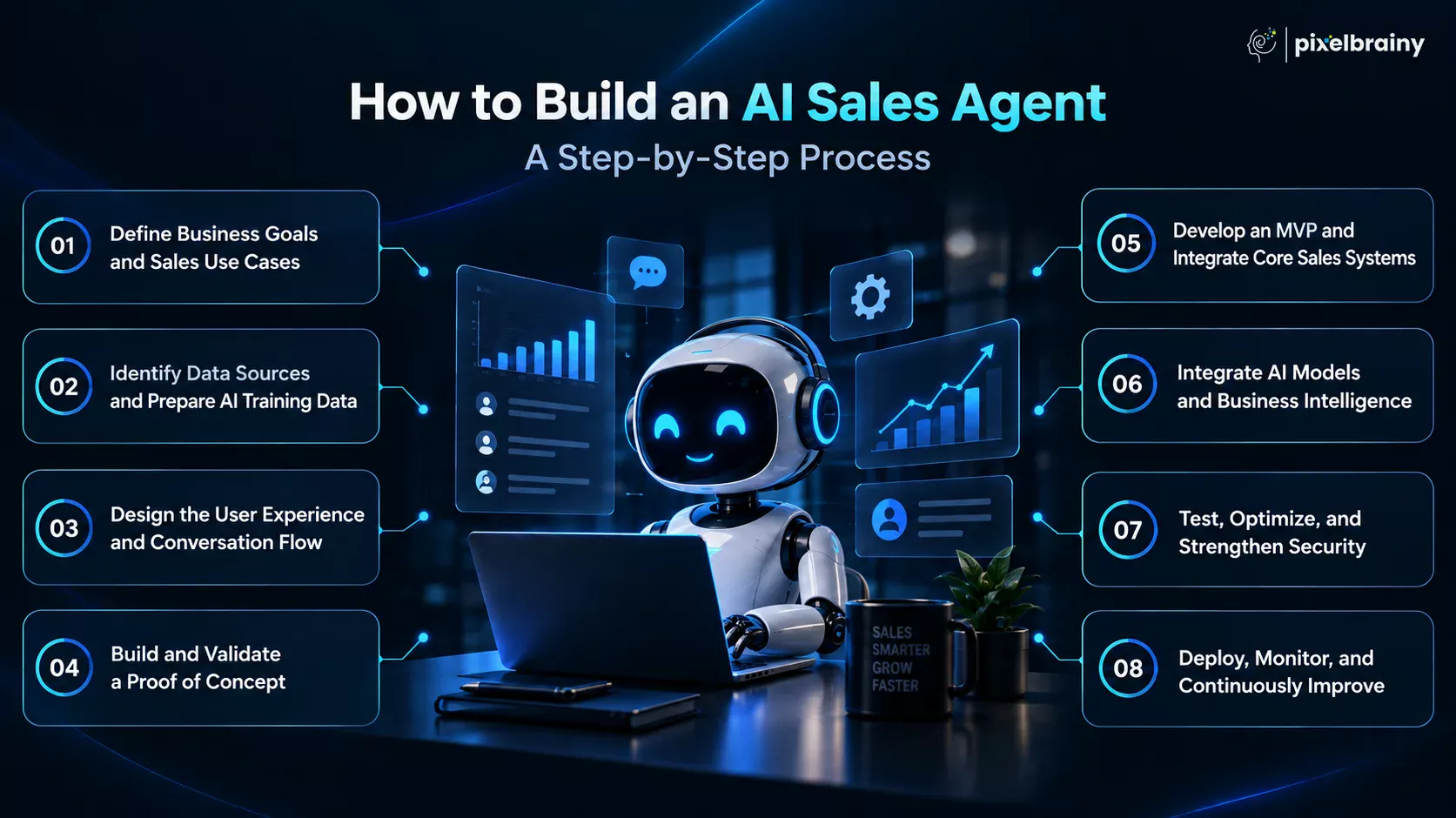
Every successful AI sales agent development project begins with identifying the exact business problem the AI will solve. Many companies make the mistake of adopting AI before defining measurable objectives, resulting in complex solutions that provide little operational value.
Start by mapping your existing sales process and identifying repetitive, time-consuming activities that reduce sales productivity. These may include prospect research, lead qualification, follow-up emails, CRM updates, meeting scheduling, or pipeline monitoring. Clearly define which responsibilities the AI agent should automate and which activities should remain under human supervision.
This discovery phase should also establish success metrics such as reduced SDR workload, faster lead response time, improved meeting booking rates, increased pipeline generation, or lower customer acquisition costs. Collaborating with an experienced AI consultation solutions provider during this stage helps align technical decisions with business outcomes before development begins.
The quality of an AI sales agent depends directly on the quality of the data it can access. Even the most advanced AI models cannot deliver accurate recommendations without complete, reliable, and well-structured business information.
During this stage, collect and organize data from CRM platforms, marketing automation tools, email systems, sales conversations, customer support interactions, product documentation, pricing information, knowledge bases, and website analytics. Historical sales data also helps AI recognize successful outreach patterns and qualification criteria.
Before building an AI sales agent, remove duplicate records, standardize customer information, and establish clear governance policies for sensitive business data. A clean data foundation significantly improves lead scoring accuracy, personalized communication, and AI decision-making throughout the sales process.
An AI sales agent should provide natural, intuitive, and context-aware interactions instead of behaving like a scripted chatbot. This requires careful planning of user journeys, conversation logic, escalation scenarios, and response strategies before development begins.
Design how prospects will interact with the AI across different channels, including email, chat, LinkedIn, or voice conversations. Define greeting flows, qualification questions, objection handling, follow-up logic, and human escalation points to create a seamless customer experience.
Working with an experienced UI/UX design company during this phase ensures the conversational experience remains intuitive for both prospects and internal sales teams. A well-designed interaction flow improves engagement, builds trust, and increases the likelihood of successful conversions.
Instead of developing every feature at once, organizations should first validate the technical feasibility of the proposed solution through a focused prototype. This minimizes development risks while confirming that the AI agent can successfully perform its primary responsibilities.
A PoC development phase typically focuses on one or two high-impact use cases, such as prospect qualification, personalized email generation, or CRM automation. During testing, evaluate response quality, data accuracy, AI reasoning, integration performance, and overall user experience before expanding functionality.
Validating the concept early allows development teams to identify technical limitations, refine workflows, improve AI prompts, and gather stakeholder feedback before committing to full-scale product development. It also provides business leaders with greater confidence in the expected return on investment before moving to production.
Once the proof of concept validates the business idea, the next step is MVP development. Instead of building every advanced capability at once, the Minimum Viable Product focuses on the core features required to solve the primary business problem. This approach reduces development costs, shortens the launch timeline, and enables businesses to collect real user feedback before expanding the platform.
A typical AI sales agent MVP includes lead qualification, personalized outreach generation, CRM synchronization, meeting scheduling, and basic sales analytics. At this stage, developers also integrate essential business systems such as Salesforce, HubSpot, Microsoft Dynamics, Google Workspace, Outlook, Slack, marketing automation platforms, and customer data sources. Building these integrations early ensures the AI agent becomes part of the existing sales ecosystem rather than another standalone application that creates additional work for the sales team.
The intelligence of an AI sales agent depends on selecting the right AI models and connecting them with business data. This stage focuses on enabling the AI to understand customer intent, generate personalized responses, analyze sales conversations, recommend next best actions, and make informed decisions throughout the sales cycle.
Modern AI sales agent development often combines Large Language Models (LLMs), Retrieval Augmented Generation (RAG), vector databases, machine learning models, and business rules to improve response quality and reduce hallucinations. Organizations also integrate third-party services such as CRM platforms, intent data providers, communication tools, and knowledge bases through reliable AI integrating services. These integrations allow the AI agent to access real-time business information instead of relying solely on pretrained knowledge, resulting in more accurate recommendations and higher quality customer interactions.
Before deploying the solution into production, comprehensive testing is essential to ensure reliability, accuracy, security, and compliance. An AI sales agent should be evaluated under real business scenarios to verify that it performs consistently across different customer interactions and sales workflows.
Testing includes validating lead qualification accuracy, personalization quality, CRM synchronization, API performance, conversation flows, response latency, and human handoff mechanisms. Security assessments should verify data encryption, role-based access controls, audit logging, and compliance with regulations such as GDPR and CCPA. Businesses should also perform prompt testing, bias evaluation, and hallucination checks to ensure the AI generates trustworthy responses. This phase significantly reduces operational risks and prepares the solution for enterprise deployment.
Launching an AI sales agent is not the end of the development process of AI sales agent. Continuous monitoring and optimization are essential to maintain performance as customer behavior, sales strategies, and business requirements evolve over time.
After deployment, monitor key performance indicators such as lead qualification accuracy, meeting booking rates, outreach response rates, customer satisfaction, conversion rates, and overall sales productivity. Analyze user feedback, identify conversation failures, refine prompts, retrain AI models, and introduce new capabilities based on evolving business needs. Many organizations also collaborate with top AI agent development companies for long-term optimization, feature enhancements, and ongoing technical support. Continuous improvement ensures the AI sales agent becomes smarter with every interaction and continues delivering measurable business value.
Following a structured development process enables businesses to create an AI sales agent that is scalable, secure, and capable of delivering long-term revenue growth instead of short-term automation gains.
Also Read: How To Build An AI Agent: A Step-by-Step Guide
One of the first questions business leaders ask before starting AI sales agent development is, "What is the cost to make an AI sales agent?" The answer depends on several factors, including the complexity of AI capabilities, the number of integrations, customization requirements, deployment architecture, and long-term scalability.
In 2026, the AI sales agent development cost typically ranges from $20,000 to $150,000+, with enterprise-grade platforms exceeding this range when advanced AI models, voice capabilities, multi-agent architecture, and custom workflows are involved. Instead of viewing development as a software expense, organizations should evaluate it as a long-term investment that improves sales productivity, reduces customer acquisition costs, and accelerates revenue growth.
The table below provides an estimated AI sales agent cost breakdown based on project scope.
| AI Sales Agent Type | Estimated Development Cost | What You Will Get |
| Basic AI Sales Agent | $20,000 – $40,000 | Lead qualification, basic chatbot, CRM integration, automated follow-ups, email generation, meeting scheduling, and simple analytics. Suitable for startups and small businesses. |
| Advanced AI Sales Agent | $40,000 – $90,000 | Personalized outreach, AI lead scoring, multi-channel communication, conversation intelligence, workflow automation, advanced CRM integration, analytics dashboard, and custom sales workflows. Ideal for growing B2B SaaS companies. |
| Enterprise AI Sales Agent | $90,000 – $150,000+ | Multi-agent architecture, voice AI, Retrieval Augmented Generation (RAG), predictive analytics, enterprise security, custom AI models, advanced integrations, compliance features, and scalable infrastructure for large organizations. |
The largest cost factor is the number and sophistication of AI capabilities included in the solution. A basic AI sales agent designed for lead qualification and automated email responses requires significantly less development effort than an enterprise platform capable of autonomous prospect research, voice conversations, predictive analytics, and multi-agent orchestration.
Estimated Cost Impact: $8,000 – $50,000+
A modern AI sales agent rarely operates independently. Integrating CRM systems, email platforms, calendars, marketing automation software, payment systems, communication tools, and customer databases increases development effort because every integration requires API development, testing, authentication, and ongoing maintenance.
Estimated Cost Impact: $5,000 – $25,000+
Organizations can either integrate existing Large Language Models or develop customized AI models trained on proprietary business knowledge. Custom AI training, prompt engineering, Retrieval Augmented Generation (RAG), vector databases, and model optimization significantly improve response quality but also increase development costs.
Estimated Cost Impact: $10,000 – $40,000+
An AI sales agent should provide a seamless experience for both sales teams and customers. Designing intuitive dashboards, conversation interfaces, workflow management panels, reporting screens, and mobile responsiveness requires dedicated UI/UX planning and user testing.
Estimated Cost Impact: $3,000 – $15,000
Enterprise AI applications require strong security measures such as encrypted data storage, role-based access control, audit logs, secure cloud deployment, and compliance with regulations including GDPR, CCPA, HIPAA, or SOC 2. These requirements become increasingly important for businesses handling sensitive customer information.
Estimated Cost Impact: $8,000 – $30,000+
Development costs do not end after deployment. Continuous monitoring, AI model optimization, prompt refinement, feature updates, bug fixes, infrastructure maintenance, and performance improvements ensure the AI sales agent remains accurate, secure, and aligned with evolving business requirements.
Estimated Cost Impact: 15%–20% of the initial development cost annually
The final AI sales agent development cost depends on the features you choose today and the business value you expect the solution to deliver tomorrow, making strategic planning the most important investment before development begins.
Also Read: AI Agent Development Cost ($10K-$100K+): Factors and Cost Optimization Tips
The performance of an AI sales agent depends on the technology stack behind it. Every component, from the programming language and AI model to cloud infrastructure and CRM integrations, plays a critical role in determining how accurately the agent understands customer intent, generates personalized responses, automates workflows, and scales with growing business demands. During the development of AI sales agent, using the right combination of tools helps reduce development time, improve security, and ensure seamless integration with existing sales systems.
One of the most common questions businesses ask before they build AI sales agent solutions is, "Which technologies are required to develop an AI sales agent that can automate prospect research, qualify leads, personalize outreach, and integrate with our CRM without affecting existing workflows?"
The answer depends on project complexity, business objectives, and deployment requirements. However, the technology stack below forms the foundation of most modern AI sales agent development projects and supports everything from intelligent conversations to enterprise scale automation.
| Technology Layer | Recommended Tools & Technologies | Role in AI Sales Agent Development |
| Programming Languages | Python, TypeScript, JavaScript, Java, Go | Build backend logic, AI workflows, APIs, automation scripts, and business processes. Python is widely preferred because of its extensive AI and machine learning ecosystem. |
| Large Language Models (LLMs) | OpenAI GPT, Claude, Gemini, Llama | Enable natural language understanding, personalized conversations, sales recommendations, lead qualification, content generation, and intelligent customer interactions. |
| AI Agent Frameworks | LangChain, LangGraph, CrewAI, AutoGen, Semantic Kernel | Support autonomous reasoning, workflow orchestration, memory management, multi agent collaboration, and tool integration required for advanced AI sales agents. |
| Machine Learning Frameworks | TensorFlow, PyTorch, Scikit-learn | Build predictive lead scoring models, customer behavior analysis, sales forecasting, recommendation engines, and performance optimization algorithms. |
| Vector Databases | Pinecone, Weaviate, Milvus, ChromaDB | Store embeddings and power Retrieval Augmented Generation (RAG) for accurate responses using business documents, CRM data, and internal knowledge bases. |
| Backend Frameworks | FastAPI, Django, Node.js, Spring Boot | Manage APIs, authentication, business logic, integrations, workflow execution, and communication between AI services and enterprise applications. |
| Frontend Technologies | React, Next.js, Angular, Vue.js | Develop interactive dashboards, chat interfaces, reporting modules, sales portals, and AI management panels with responsive user experiences. |
| CRM Platforms | Salesforce, HubSpot, Microsoft Dynamics 365, Zoho CRM | Synchronize customer records, opportunity stages, contact information, sales activities, and pipeline updates automatically. |
| Communication APIs | Twilio, SendGrid, Gmail API, Outlook API, Slack API | Enable email automation, SMS notifications, voice calls, meeting scheduling, and team collaboration within AI driven sales workflows. |
| Database Technologies | PostgreSQL, MySQL, MongoDB, Redis | Securely store customer profiles, AI conversation history, application data, workflow states, and business information required by the AI agent. |
| Cloud Infrastructure | AWS, Microsoft Azure, Google Cloud Platform | Provide scalable computing resources, AI deployment environments, storage, monitoring, security, and high availability for enterprise applications. |
| Security & Authentication | OAuth 2.0, JWT, Okta, Azure Active Directory | Protect customer data through secure authentication, authorization, encryption, role based access control, and enterprise identity management. |
| Monitoring & Analytics | LangSmith, Datadog, Grafana, Prometheus | Monitor AI performance, response quality, API health, latency, usage analytics, and system reliability for continuous optimization. |
| DevOps & Deployment | Docker, Kubernetes, GitHub Actions, Jenkins | Automate application deployment, version control, continuous integration, infrastructure scaling, and production environment management. |
| Testing & AI Evaluation | Promptfoo, DeepEval, MLflow, pytest | Test prompt quality, measure model accuracy, identify hallucinations, validate workflows, and ensure consistent AI performance before deployment. |
A carefully planned technology stack lays the foundation for building an AI sales agent that is intelligent, secure, scalable, and capable of delivering measurable business outcomes.
For many organizations, the biggest decision is not whether to adopt AI, but whether to build or buy an AI sales agent. Off the shelf AI sales tools offer a faster implementation path and lower upfront investment, making them attractive for businesses with standard sales workflows. However, companies looking to create a sustainable competitive advantage often discover that these platforms come with limitations in customization, integrations, scalability, data ownership, and AI capabilities. This is why more enterprises are investing in AI sales agent development to build solutions tailored to their unique sales process instead of adapting their business to generic software.
A common question from decision makers is, "Should we purchase an existing AI sales platform or invest in building an AI sales agent that aligns with our long-term revenue strategy?" The answer depends on your business objectives, operational complexity, and future growth plans. The comparison below highlights the key differences.
| Comparison Factor | Build a Custom AI Sales Agent | Buy an Off the Shelf AI Sales Tool |
| Business Fit | Designed around your unique sales workflow, buyer journey, and revenue process. | Limited to predefined workflows and product capabilities. |
| Customization | Complete flexibility to develop features, workflows, and AI capabilities according to business needs. | Customization options are restricted to vendor supported configurations. |
| Competitive Advantage | Creates proprietary AI capabilities that competitors cannot easily replicate. | Competitors using the same platform gain access to similar features. |
| CRM & System Integration | Seamlessly integrates with internal applications, CRM platforms, ERP systems, and proprietary databases. | Integration options depend on vendor support and available APIs. |
| Data Ownership | Full ownership of customer data, AI models, prompts, and business intelligence. | Customer data may be processed or stored within the vendor's ecosystem. |
| Scalability | Easily expands as new business requirements, products, and markets evolve. | Scaling is limited by vendor roadmaps, pricing plans, and platform capabilities. |
| AI Model Flexibility | Freedom to choose and upgrade Large Language Models, AI frameworks, and multi agent architectures. | AI models are determined by the software provider with limited control. |
| Security & Compliance | Security architecture can be customized to meet enterprise, industry, and regional compliance requirements. | Compliance features are limited to the standards supported by the vendor. |
| Long-Term Cost | Higher initial investment but greater long-term value and lower dependency on recurring subscription fees. | Lower upfront cost but recurring licensing expenses increase as users and features grow. |
| Innovation Speed | New features can be developed whenever business priorities change. | Businesses must wait for the vendor's product roadmap and release schedule. |
Purchasing an existing AI sales platform is often suitable for startups or small businesses with straightforward sales processes and limited technical resources.
It works best when you need to:
Custom AI sales agent development becomes the better choice when AI is expected to become a strategic business asset rather than just another productivity tool. Organizations with complex sales operations, proprietary workflows, or strict security requirements benefit significantly from developing their own solution.
A custom AI sales agent is ideal when you want to:
For example, a B2B SaaS company managing multiple sales teams, regional workflows, and enterprise customers may require an AI sales agent that analyzes proprietary customer data, monitors product usage, predicts expansion opportunities, and integrates deeply with internal systems. These capabilities are rarely available in generic AI sales platforms, making building an AI sales agent the more strategic long-term investment.
Custom AI sales agent development transforms AI from a software subscription into a proprietary business capability that strengthens your competitive advantage year after year.
Before investing in AI sales agent development, it is essential to study the products that have already validated the market. These platforms reveal what modern buyers expect, which AI capabilities deliver measurable business value, and where existing solutions still leave room for innovation.
For businesses asking how to develop AI sales agent like Salesforce Agentforce or HubSpot Breeze, the objective should not be to replicate these products feature by feature. Instead, analyze what makes them successful, identify their limitations, and use those insights to build AI sales agent solutions that align with your own sales process and competitive advantage.
This is especially relevant for RevOps teams evaluating whether to develop a proprietary AI sales agent or continue using commercial platforms after a pilot deployment.
Salesforce Agentforce is one of the most comprehensive enterprise AI sales platforms available today. Built directly into the Salesforce ecosystem, it enables AI agents to qualify leads, manage opportunities, answer customer questions, automate workflows, and assist sales representatives throughout the revenue cycle. Its biggest competitive advantage comes from deep integration with Salesforce CRM, allowing AI to make recommendations using real-time customer, pipeline, and account data.
Primary Users: Large enterprises already using Salesforce CRM.
Key Learning: The biggest strength of Agentforce is not its AI model. It is the seamless access to enterprise data. Businesses planning AI sales agent development should prioritize proprietary business context because AI performs significantly better when it understands customer history, sales activities, and organizational workflows.
HubSpot Breeze AI extends HubSpot's CRM and revenue platform with intelligent features that support lead qualification, content generation, conversation summaries, email writing, and customer engagement. Rather than functioning as a standalone AI application, Breeze operates across marketing, sales, and customer service to create a unified customer experience.
Primary Users: Startups, SMBs, and mid-sized businesses using HubSpot.
Key Learning: Businesses looking to develop AI sales agent solutions should design AI that connects every stage of the buyer journey instead of automating isolated sales tasks. Shared customer data produces better personalization and more consistent customer experiences.
Outreach AI focuses on improving sales execution after prospects enter the pipeline. The platform analyzes customer interactions, recommends next best actions, optimizes sales sequences, summarizes conversations, and helps representatives prioritize opportunities that require immediate attention. Instead of replacing sales teams, it strengthens their decision-making capabilities throughout the sales process.
Primary Users: Enterprise sales organizations and Revenue Operations teams.
Key Learning: AI should support the entire revenue lifecycle, not just outbound prospecting. Companies that build AI sales agent platforms should include pipeline intelligence, forecasting, and proactive sales recommendations alongside automation features.
Apollo AI has become a popular platform for startups and growing B2B businesses because it combines prospect discovery, contact enrichment, outreach automation, and AI-generated messaging within a single solution. Its extensive B2B database enables users to identify prospects quickly while generating personalized outreach campaigns at scale.
Primary Users: Startups, SMBs, and mid-market sales teams.
Key Learning: AI is most effective when combined with high-quality business data. Organizations planning AI sales agent development should invest in reliable customer and prospect data because personalization quality depends more on data than on the AI model itself.
Artisan Ava represents the latest generation of AI-native sales agents introduced during 2025 and 2026. Unlike traditional AI assistants, Ava operates as an autonomous AI Business Development Representative capable of researching prospects, generating personalized outreach, handling replies, qualifying leads, and booking meetings with minimal human intervention.
Its architecture incorporates multi-agent orchestration, real-time intent signals, workflow automation, and continuous learning, reflecting the newest advancements in agentic AI.
Primary Users: High-growth B2B SaaS companies and enterprise revenue teams.
Key Learning: The future of AI sales agent development is moving beyond AI assistants toward autonomous AI systems capable of completing complete sales workflows while collaborating with human sales professionals only when strategic intervention is required.
Studying these platforms also answers a common question raised by sales leaders after running a 90-day pilot with commercial AI tools. Many organizations notice that while outreach volume increases, meeting booking rates sometimes decline because AI-generated messages lack the personalization of experienced SDRs.
This is exactly where custom AI sales agents create value. By training AI on proprietary customer data, sales methodologies, and internal knowledge, businesses can achieve higher personalization quality while maintaining enterprise-scale automation.
The smartest way to build an AI sales agent is not to copy successful products, but to learn from their strengths and create a solution that reflects your own competitive advantage.
While the benefits of AI sales agent development are compelling, building a production-ready AI sales agent is not without challenges. Many organizations assume that integrating a Large Language Model is enough to create an intelligent sales assistant. In reality, developing a reliable AI sales agent requires high-quality data, robust integrations, secure infrastructure, continuous optimization, and well-defined governance.
Businesses planning to build AI sales agent solutions should identify these challenges early to avoid delays, unexpected costs, and poor user adoption. A structured development strategy ensures the AI agent delivers measurable business value instead of becoming another underutilized software investment.
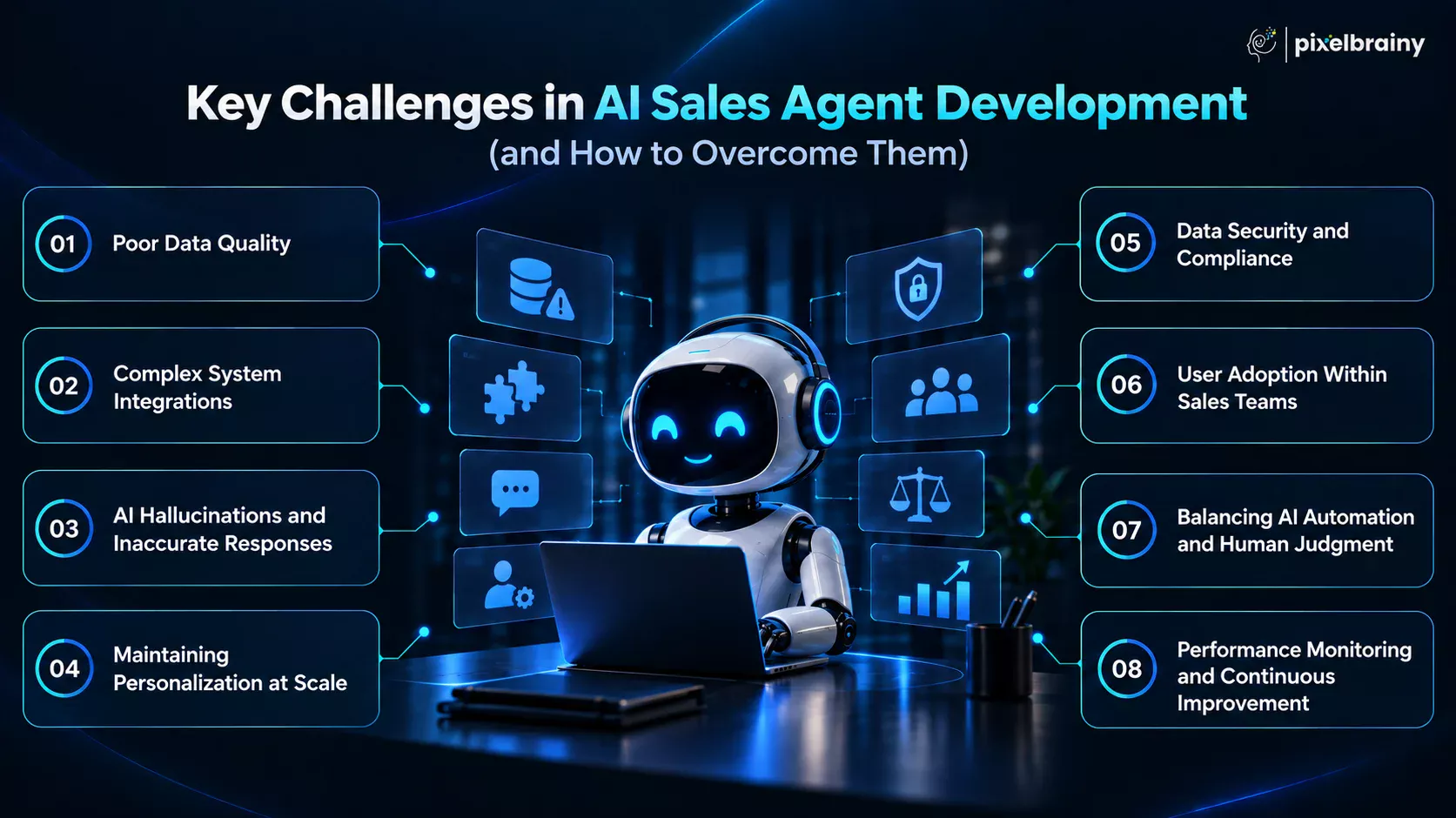
| Challenge | Why It Matters | How to Overcome It |
| Poor Data Quality | AI performs only as well as the data it receives. Incomplete CRM records, duplicate contacts, outdated prospect information, and inconsistent customer data reduce lead qualification accuracy and personalization quality. | Clean and standardize business data before development. Establish data governance policies and continuously monitor data quality across CRM and business systems. |
| Complex System Integrations | AI sales agents must connect with CRM platforms, email systems, calendars, marketing automation tools, and internal databases. Weak integrations create disconnected workflows and reduce automation efficiency. | Use well-documented APIs, middleware platforms, and scalable integration architecture to ensure seamless communication between all business applications. |
| AI Hallucinations and Inaccurate Responses | Large Language Models may occasionally generate incorrect or misleading information, creating risks during customer conversations and sales communications. | Implement Retrieval Augmented Generation (RAG), business knowledge bases, prompt engineering, response validation, and human approval workflows for critical interactions. |
| Maintaining Personalization at Scale | High outreach volume often results in generic messaging that reduces engagement and meeting booking rates, particularly in outbound B2B sales. | Combine CRM data, buying intent signals, company research, and customer history to generate context-aware, personalized communication instead of template-based outreach. |
| Data Security and Compliance | AI sales agents process sensitive customer and business information, making security and regulatory compliance essential for enterprise adoption. | Implement encryption, role-based access control, audit logs, secure cloud infrastructure, and compliance with regulations such as GDPR, CCPA, and SOC 2. |
| User Adoption Within Sales Teams | Sales representatives may hesitate to trust AI recommendations if the system is difficult to use or disrupts existing workflows. | Design AI as a collaborative assistant, provide user training, integrate with familiar sales tools, and demonstrate measurable productivity improvements. |
| Balancing AI Automation and Human Judgment | Not every customer interaction should be handled autonomously. High-value negotiations and strategic conversations still require experienced sales professionals. | Define clear escalation rules that transfer conversations to human representatives whenever complex negotiations or sensitive discussions arise. |
| Performance Monitoring and Continuous Improvement | Customer behavior, market conditions, and sales strategies evolve continuously. Static AI models gradually become less effective over time. | Regularly evaluate AI performance, retrain models, refine prompts, analyze conversation outcomes, and introduce new capabilities based on user feedback and business goals. |
One of the most common questions organizations ask before investing in AI sales agent development is, "Can an AI sales agent completely replace our SDR team?" The practical answer is no. The most successful implementations use AI to automate repetitive tasks such as prospect research, lead qualification, follow-ups, and CRM updates, while experienced sales professionals focus on relationship building, negotiations, and strategic decision making. This balanced approach delivers higher productivity without sacrificing customer experience.
Overcoming these challenges begins with a well-planned AI sales agent development strategy that combines intelligent automation with human expertise to create sustainable business value.
Finding the right development partner is often more important than selecting the right AI model. While many software vendors can integrate APIs or build chatbots, developing a production ready AI sales agent requires expertise in AI architecture, sales workflows, enterprise integrations, security, and continuous optimization. If you are searching for companies that develop AI sales agent solutions in the United States, PixelBrainy delivers end to end AI agent development services tailored to your business goals instead of offering one size fits all products.
One of the most common questions we receive from founders and revenue leaders is, "How do we develop an AI sales agent that fits our existing sales process instead of forcing our team to adapt to generic software?" At PixelBrainy, our approach begins with understanding your revenue model, customer journey, sales workflow, and business objectives. Every AI sales agent is designed around your internal processes so that the final solution becomes a competitive advantage rather than another standalone tool.
Our AI sales agent development process combines business strategy with advanced AI engineering to deliver intelligent, scalable, and secure solutions.
Unlike generic software providers, PixelBrainy develops AI sales agents that reflect your unique business logic, qualification process, customer journey, and growth strategy.
With PixelBrainy, you receive:
Success Story:
A rapidly growing B2B SaaS company based in North America approached PixelBrainy after struggling with an outbound sales team that spent nearly 70% of its time researching prospects and creating personalized outreach. The leadership team wanted to create an AI sales agent that could automate repetitive SDR activities without reducing personalization quality.
Our team developed a custom AI sales agent that integrated with the client's CRM, email platform, LinkedIn enrichment tools, and internal knowledge base. The solution automatically researched target accounts, qualified leads using predefined ICP criteria, generated personalized outreach, synchronized CRM records, and scheduled meetings for account executives.
Within four months of deployment, the company reduced manual prospect research by more than 65%, improved qualified meeting bookings by 42%, and enabled its existing SDR team to focus on strategic conversations rather than repetitive administrative work. The project demonstrated that a custom AI sales agent can deliver greater long-term value than relying solely on off the shelf automation tools.
Whether you are a startup looking to make an AI sales agent, a growing SaaS company planning how to develop an AI sales agent, or an enterprise seeking a fully customized AI revenue platform, PixelBrainy combines AI expertise, product engineering, and business consulting to deliver solutions that generate measurable business outcomes instead of just adding automation.
Ready to build a custom AI sales agent that fits your sales process and delivers measurable ROI? Connect with PixelBrainy, the trusted AI agent development company in the USA, and let's turn your AI sales vision into a competitive advantage.

The future of B2B sales belongs to businesses that combine human expertise with intelligent automation, and AI sales agent development is becoming the foundation of that transformation. From automating prospect research and lead qualification to delivering personalized outreach, pipeline intelligence, and customer engagement, AI sales agents help organizations improve productivity while enabling sales teams to focus on building meaningful relationships and closing high value deals.
Whether you want to build AI sales agent software for your startup or develop AI sales agent solutions for an enterprise revenue team, success depends on selecting the right strategy, technology stack, features, and development partner. As discussed throughout this guide, the development process of AI sales agent requires more than AI models. It requires deep business understanding, seamless integrations, secure architecture, and continuous optimization to create long-term business value. Companies that invest today will be better positioned to reduce operational costs, accelerate pipeline growth, and gain a lasting competitive advantage in the AI driven sales landscape.
Ready to Build Your AI Sales Agent?
If you're planning to create an AI sales agent tailored to your business goals, schedule a free strategy call with the AI experts at PixelBrainy. We'll evaluate your sales workflow, discuss your requirements, and help you build a scalable AI sales solution that delivers measurable business results.
The timeline for AI sales agent development depends on project complexity, integrations, and AI capabilities. A basic AI sales agent typically takes 6 to 10 weeks, while an enterprise solution with multi-agent workflows, CRM integrations, and custom AI models may require 4 to 8 months. Starting with an MVP helps accelerate time to market.
Yes. One of the biggest advantages of building an AI sales agent is its ability to integrate with existing platforms such as Salesforce, HubSpot, Microsoft Dynamics 365, Zoho CRM, Slack, Gmail, Outlook, and marketing automation tools. This ensures the AI works within your current sales workflow instead of replacing it.
The primary purpose of AI sales agent development is to augment sales teams rather than replace them. AI handles repetitive tasks such as prospect research, lead qualification, CRM updates, and follow-ups, while SDRs focus on relationship building, negotiations, and closing opportunities that require human judgment and strategic decision making.
A well-trained AI sales agent can achieve highly accurate lead qualification when it has access to quality CRM data, ICP definitions, customer behavior signals, and business knowledge. Regular model optimization, Retrieval Augmented Generation (RAG), and human feedback further improve qualification accuracy over time.
Before you develop AI sales agent solutions, define your sales objectives, identify repetitive workflows, organize CRM data, document qualification criteria, and determine which systems require integration. Clear business requirements and clean data significantly reduce development time while improving AI performance after deployment.
The answer depends on your long-term business goals. Off-the-shelf platforms are suitable for standard sales processes, while custom AI sales agent development provides greater flexibility, proprietary workflows, complete data ownership, deeper integrations, and a competitive advantage that cannot be replicated by businesses using the same software.
Although B2B SaaS companies are leading adopters, AI sales agent development also delivers strong results for healthcare, fintech, manufacturing, logistics, real estate, professional services, cybersecurity, and enterprise software businesses. Any organization with high-volume lead generation and complex sales processes can benefit from AI-powered sales automation.
When selecting a partner to build AI sales agent software, evaluate their experience with AI technologies, CRM integrations, enterprise security, multi-agent systems, and custom product development. The right development company should understand both AI engineering and modern B2B sales processes while delivering solutions tailored to your business goals rather than generic software.

About The Author
Sagar Bhatnagar
Sagar Sahay Bhatnagar brings over a decade of IT industry experience to his role as Marketing Head at PixelBrainy. He's known for his knack in devising creative marketing strategies that boost brand visibility and market influence. Sagar's strategic thinking, coupled with his innovative vision and focus on results, sets him apart. His track record of successful campaigns proves his ability to utilize digital platforms effectively for impactful marketing efforts. With a genuine passion for both technology and marketing, Sagar continuously pushes PixelBrainy's marketing initiatives to greater success.

Working with the PixelBrainy team has been a highly positive experience. They understand the design requirements and create beautiful UX elements to meet the application needs. The dev team did an excellent job bringing my vision to life. We discussed usability and flow. Sagar worked with his team to design the database and begin coding. Working with Sagar was easy. He has the knowledge to create robust apps, including multi-language support, Google and Apple ID login options, Ad-enabled integrations, Stripe payment processing, and a Web Admin site for maintaining support data. I'm extremely satisfied with the services provided, the quality of the final product, and the professionalism of the entire process. I highly recommend them for Android and iOS Mobile Application Design and Development.

Great experience working with them. Had a lot of feedback and I found that unlike most contractors they were bugging me for updates instead of the other way around. They were extremely time conscience and great at communicating! All work was done extremely high quality and if not on time, early! They were always proactive when it comes to communication and the work is great/above par always. Very flexible and a great team to work with! Goes above and beyond to present us with multiple options and always provides quality. Amazing work per usual with Chitra. If you have UI/UX or branding design needs I recommend you go to them! Will likely work with them in the future as well, definitely recommended!

PixelBrainy is a joy to work with and is a great partner when thinking through branding, logo, and website layout. I appreciate that they spend time going into the "why" behind their decisions to help inform me and others about industry best practices and their expertise.

I hired them to design our software apps. Things I really like about them are excellent communication skills, they answer all project suggestions and collaborate right away, and their input on design and colors is amazing. This project was complex and needed patience and creativity. The team is amazing to do business with. I will be using them long-term. Glad to see there are some good people out there. I was afraid to try and outsource my project to someone but I am glad I met them! I really can't say enough. They went above and beyond on this project. I am very happy with everything they have done to make my business stand out from the competition.

It was great working with PixelBrainy and the team. They were very responsive and really owned the project. We'll definitely work with them again!

I recently worked with the PixelBrainy team on a project and I was blown away by their communication skills. They were prompt, clear, and articulate in all of our interactions. They listened and provided valuable feedback and suggestions to help make the project a success. They also kept me updated throughout the entire process, which made the experience stress-free and enjoyable.

PixelBrainy is very good at what it does. The team also presents themselves very professionally and takes care of their side of things very well. I could fully trust them taking up the design work in a timely and organised manner and their attention to detail saved us lots of effort and time. This particular project was quite intense and the team showed that they function very well under pressure. Very much looking forward to working with her again!

It's always an absolute pleasure working with them. They completed all of my requests quickly and followed every note I had for them to a T, which made our process go smoothly from start to finish. Everything was completed fast and following all of the guidelines. And I would recommend their services to anyone. If you need any design work done in the future, PixelBrainy should be your first call!

They took ownership of our requirements and designed and proposed multiple beautiful variants. The team is self-motivated, requires minimum supervision, committed to see-through designs with quality and delivering them on time. We would definitely love to work with PixelBrainy again when we have any requirements.

PixelBrainy was a big help with our SaaS application. We've been hard at work with a new UI/UX and they provided a lot of help with the designs. If you're looking for assistance with your website, software, or mobile application designs, PixelBrainy and the team is a great recommendation.

PixelBrainy designers are amazing. They are responsive, talented, and always willing to help craft the design until it matches your vision. I would recommend them and plan to continue them for my future projects and more!!!

They were awesome! Did a good job fast, and good communication. Will work with them again. Thank you

Creative, detail-oriented, and talented designers who take direction well and implement changes quickly and accurately. They consistently over-delivered for us.

PixelBrainy team is very talented and creative. Great designers and a pleasure to work with. PixelBrainy is an excellent communicator and I look forward to working with them again.

PixelBrainy has a very talented design team. Their work is excellent and they are very responsive. I enjoy working with them and hope to continue on all of our future projects.


Transform your ideas into reality with us.
Across these industries, each engagement brings unique challenges, from early-stage product development to scaling complex systems, helping us build a practical understanding of real-world product environments.