AI Summary Powered by PixelBrainy
Are you a real estate business owner or tech decision-maker wondering how much does it cost to build a Real Estate AI chatbot? As AI-driven solutions continue to reshape the property industry, more agencies and brokerages are investing in smart chatbots to automate customer interactions, generate leads, and provide instant property recommendations.
But before jumping into development, understanding the Real Estate AI Chatbot Development Cost is crucial for smart decision-making.
From handling property inquiries to pre-screening buyers and syncing appointments, AI chatbots have become indispensable tools for modern real estate operations. However, the AI chatbot development cost for real estate isn’t fixed—it can vary significantly based on the scope of features, level of AI intelligence, customization, and third-party integrations involved.
Typical Cost & Timeline:
Failing to budget properly can result in overspending, limited functionality, or long-term maintenance issues. That’s why you need a clear understanding of the cost of Real Estate AI Chatbot development and how to plan for it.
In this blog, you’ll discover:
Whether you're planning your first AI chatbot or upgrading an existing one, this guide will help you make cost-effective, strategic choices for long-term success.
The way people buy and sell property is changing fast. As digital-first experiences become the norm, AI is leading the transformation. In fact, the global AI in real estate market is expected to grow from $2.9 billion in 2024 to $41.5 billion by 2033, according to Precedence Research. By 2026, over 85% of customer interactions in real estate are projected to be handled without a human agent, powered largely by AI chatbots.
That shift signals a massive opportunity. Forward-thinking businesses that invest in real estate AI chatbots now are gaining a competitive edge by automating lead generation, improving customer experience, and scaling operations while reducing costs.
Real estate is no longer just about properties—it’s about smarter, faster, and more human-like digital experiences. AI chatbots are quickly becoming the engine behind that evolution. Investing in one today means staying relevant tomorrow.
For real estate businesses—whether you're a brokerage, agency, or listing platform—AI chatbots offer a clear path to better customer engagement, faster lead conversion, and streamlined operations. But before diving into features and integrations, one critical factor must be addressed upfront: the developing cost of an AI chatbot for real estate.
Understanding the Real Estate AI Chatbot Development Cost is about more than just budgeting. It directly affects the quality, scalability, and long-term return on your investment. With the cost of real estate AI chatbot development varying widely based on features, technology stack, and customization, making cost-aware decisions early can define your project’s success.
Your available budget will guide which features you can include—from basic lead capture and FAQs to more advanced functionalities like property recommendation engines, voice support, or AI-powered NLP. Understanding the development cost upfront helps you prioritize high-ROI features and avoid overbuilding or underdelivering.
One of the biggest cost-related decisions is whether to build a custom AI chatbot from scratch or use an existing chatbot platform like Dialogflow, Tidio, or ManyChat. Custom solutions offer flexibility and deeper integrations but come with higher costs. Platform-based bots are faster and cheaper to deploy but may limit long-term scalability. Your budget plays a critical role in making this choice wisely.
Spending too little may result in a low-quality chatbot with poor engagement rates, while over-investing in unnecessary features can inflate costs with minimal return. A strategic budget ensures that your investment leads to measurable outcomes—like better lead conversion, shorter sales cycles, and reduced support workload.
A chatbot that doesn’t integrate smoothly with your CRM, MLS database, or calendar system can lead to extra development expenses later. Budgeting for integrations during planning ensures your chatbot works seamlessly with your existing tools—and can scale as your business grows.
When you have clarity on what contributes to the Real Estate AI Chatbot Development Cost, you’ll be better equipped to evaluate developer quotes, choose the right tech partner, and avoid hidden costs or scope creep. It gives you more control and confidence throughout the project.
In summary, the developing cost of an AI chatbot for real estate is not just a financial checkpoint—it’s a strategic lever. Smart budgeting allows you to align technology with business goals, reduce risk, and create a chatbot that not only works—but wins.
Also Read: How To Develop Custom AI Chatbot In 2025: Benefits, Types, And Cost

The Real Estate AI Chatbot Development Cost can vary significantly based on your project’s scope, goals, and technology choices. While prices can range from $10,000 to over $100,000, it’s important to understand where that money goes—and how to spend it wisely.
Whether you’re creating a basic lead generation bot or a fully intelligent, voice-enabled assistant with CRM and MLS integration, each feature and decision influences the cost to build a real estate AI chatbot.
Here’s a breakdown of the key factors that affect the creating cost of a Real Estate AI chatbot, with estimated pricing based on industry benchmarks.
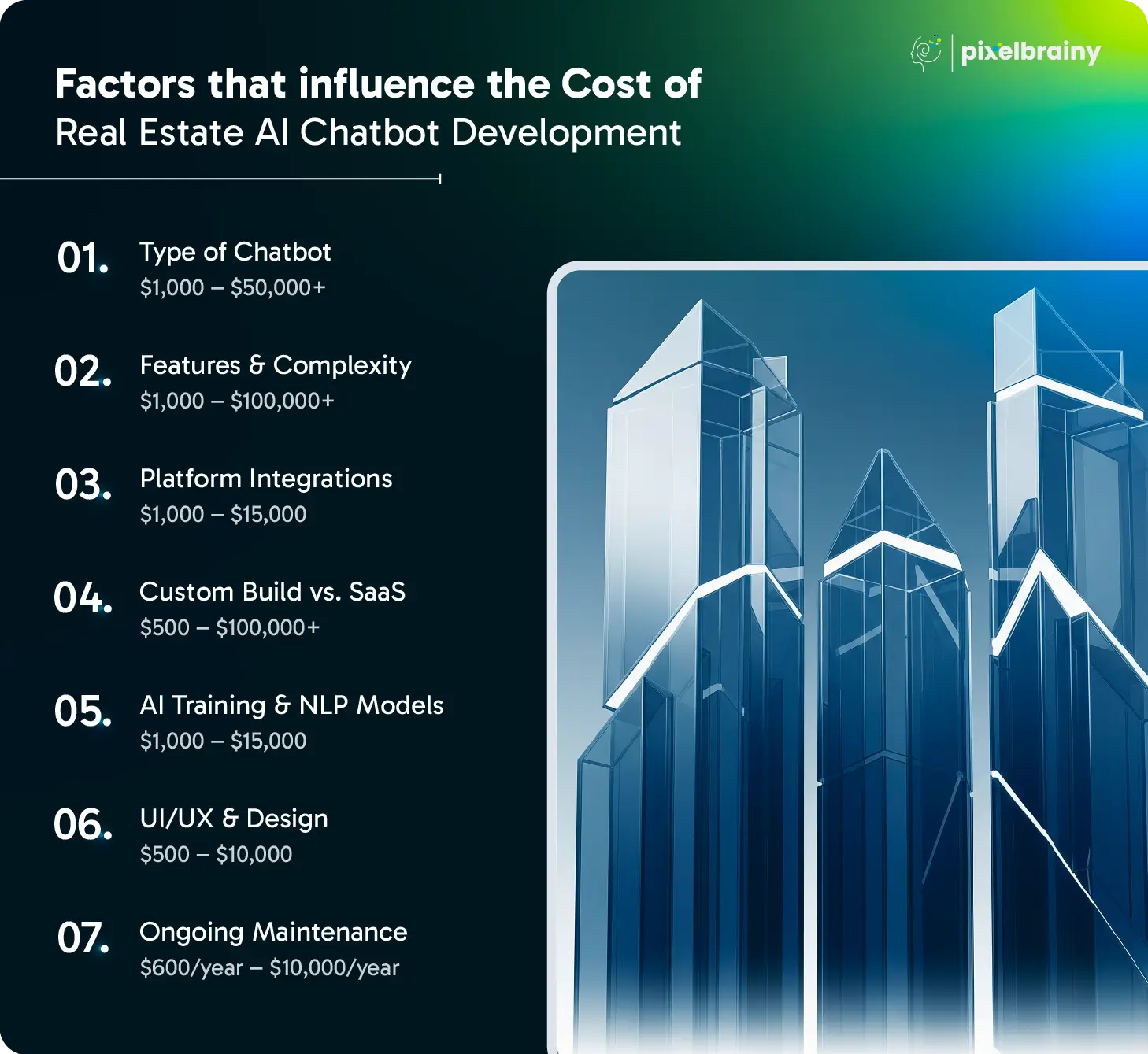
The first decision in chatbot planning is choosing the type of bot you need. This foundational choice has a major impact on both functionality and cost.
Estimated Cost:
The complexity of your chatbot directly impacts the overall creating cost of a real estate AI chatbot. As you add more features—like personalized property recommendations, calendar syncing, or lead scoring—the time and resources needed to build it increase.
Simple bots can be built quickly with standard flows. Mid-tier chatbots include smart features like user profiling or integrations. Advanced chatbots handle real-time data, NLP, voice, and complex APIs, offering the highest value but at a premium cost.
Cost Breakdown by Complexity:
| Complexity Level | Features Included | Estimated Cost |
| Basic Chatbot | FAQs, static lead capture, scripted flows | $1,000 – $5,000 |
| Mid-Tier AI Bot | AI-powered responses, property filters, CRM syncing, appointment booking | $5,000 – $20,000 |
| Advanced AI Bot | NLP, personalized MLS search, voice, analytics, full CRM/ERP/API integration | $20,000 – $100,000+ |
Integrating your chatbot with external systems like MLS listings, calendars, CRMs (e.g., HubSpot, Salesforce), or even WhatsApp/Facebook Messenger adds significant value—but also cost. These integrations make your chatbot smarter and more useful, but they require secure APIs, testing, and sometimes ongoing sync management.
For example, syncing a chatbot with your MLS system to fetch real-time property data can take weeks of development depending on the platform.
Estimated Cost:
One of the biggest budget-impact decisions is choosing between custom development and using SaaS chatbot platforms.
Estimated Cost:
For your chatbot to understand and respond to property-related questions intelligently, it needs to be trained on relevant data. This involves feeding it example conversations, property information, buyer behavior models, and FAQs.
Training a bot to deliver accurate, natural responses takes time and requires access to large, clean, real estate-specific datasets. The more data you need to train on, the higher the cost.
Estimated Cost:
A well-designed chatbot feels intuitive, on-brand, and easy to use—especially on mobile. Custom UI/UX design adds to your brand identity and can significantly improve engagement and conversion rates.
You may want to include branded avatars, conversational UI flows, animation, or visual property previews. These enhancements add to the chatbot’s usability and cost.
Estimated Cost:
Once your chatbot is live, it still requires care. Updates to APIs, fixing bugs, scaling for more users, adding new features, and retraining the AI as your listings or customer behavior changes are all part of post-launch costs.
Even SaaS solutions come with monthly platform fees and occasional update requirements.
Estimated Cost:
| Cost Factor | Cost Range |
| Type of Chatbot | $1,000 – $50,000+ |
| Features & Complexity | $1,000 – $100,000+ |
| Platform Integrations | $1,000 – $15,000 |
| Custom Build vs. SaaS | $500 – $100,000+ |
| AI Training & NLP Models | $1,000 – $15,000 |
| UI/UX & Design | $500 – $10,000 |
| Ongoing Maintenance | $600/year – $10,000/year |
Carefully evaluating each cost factor helps real estate businesses avoid overspending while ensuring their chatbot delivers real, measurable impact. The right investment in AI today can future-proof your customer experience for tomorrow’s market.
Also Read: AI Agent Development Cost Guide: Factors and Cost Optimization Tips
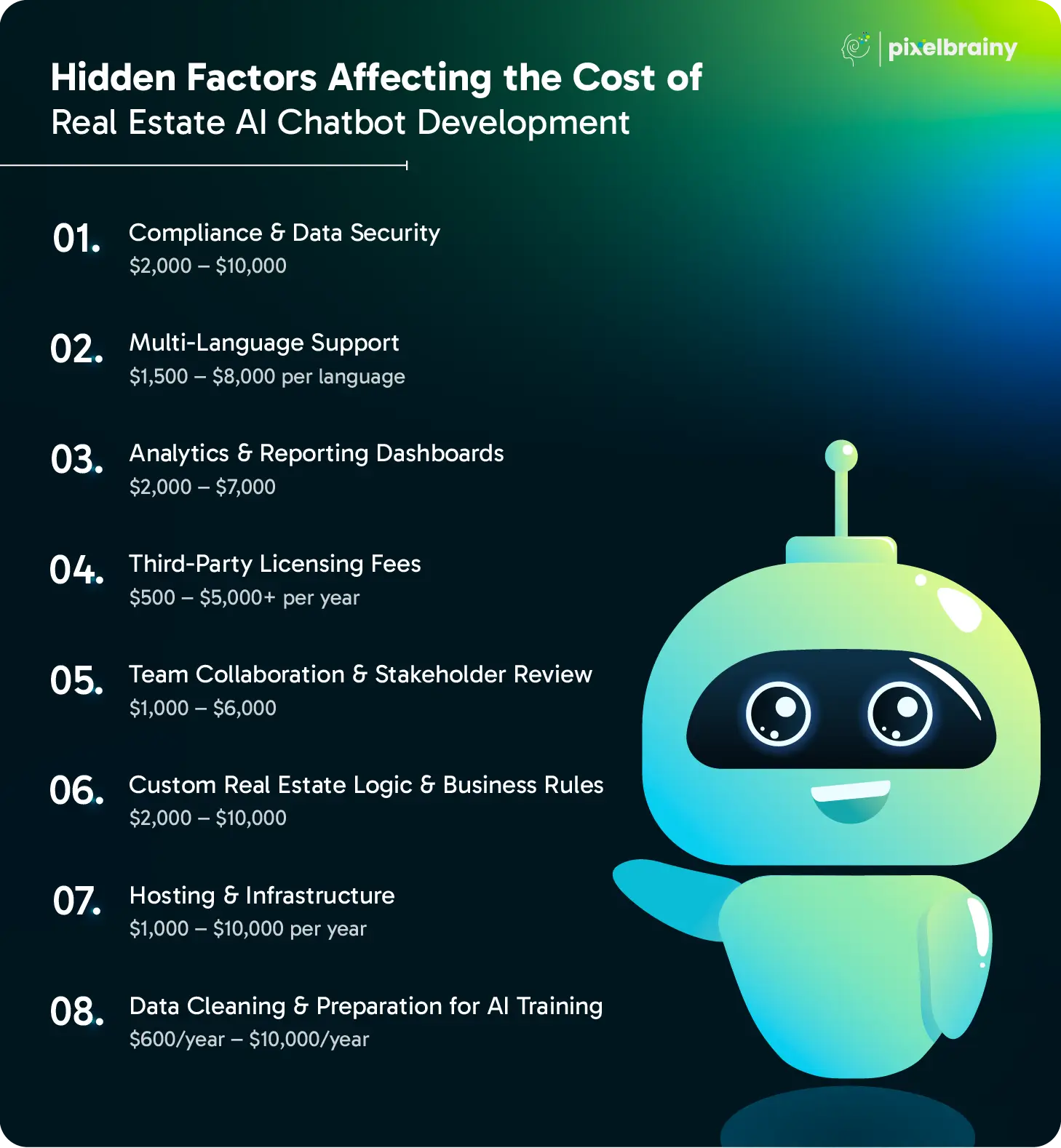
Beyond the obvious technical components, several hidden factors can significantly influence the real estate AI chatbot development cost—often pushing projects over budget if not accounted for early. Understanding these behind-the-scenes costs can help you avoid surprises and plan smarter.
Here are the most commonly overlooked contributors, with cost insights:
Real estate businesses handle sensitive data—buyer profiles, financial records, location history—which means your chatbot must comply with data protection laws like GDPR, CCPA, or local real estate regulations. Secure data encryption, privacy policy integrations, and compliance audits add development hours and legal consultations.
Estimated Cost: $2,000 – $10,000
If your agency operates in multilingual regions or works with international buyers, building language adaptability into your chatbot becomes necessary. AI translation and localized NLP training require additional models, datasets, and testing.
Estimated Cost: $1,500 – $8,000 per language
Many real estate businesses overlook the cost of integrating custom reporting tools. If you want performance dashboards, lead quality reports, or conversion tracking, these require backend development, database work, and analytics UI design.
Estimated Cost: $2,000 – $7,000
Many chatbot platforms use third-party APIs for NLP (like Dialogflow, OpenAI, or Azure), property data (MLS APIs), or voice (Twilio, Google Speech). These services often come with monthly or usage-based costs that add up over time.
Estimated Cost: $500 – $5,000+ per year
Real estate companies often involve multiple stakeholders—agents, marketing, legal, and IT—leading to extended feedback loops and revisions. The cost of multiple change requests, extra review meetings, and design iterations can add hidden labor costs.
Estimated Cost: $1,000 – $6,000 (depending on project timeline)
Your chatbot may need to apply region-specific logic (e.g., zoning laws, mortgage rules, local MLS criteria). Building these into conversation flows or backend systems often requires niche domain expertise and custom rule engines.
Estimated Cost: $2,000 – $10,000
If you're not using a SaaS platform, hosting your chatbot on a secure, scalable infrastructure (AWS, Azure, GCP) adds cloud architecture planning, server maintenance, and uptime management.
Estimated Cost: $1,000 – $10,000/year
Training a chatbot requires high-quality data. If property listings, customer FAQs, or CRM records are disorganized, your team may spend weeks cleaning, formatting, or structuring data for training. This data prep work adds hidden time and cost.
Estimated Cost: $1,000 – $5,000
By recognizing and planning for these hidden factors, real estate businesses can avoid unexpected budget spikes—and ensure their AI chatbot is built to scale securely, intelligently, and legally.
| Hidden Factor | Estimated Cost Range |
| Compliance & Data Security | $2,000 – $10,000 |
| Multi-Language Support | $1,500 – $8,000 per language |
| Analytics & Reporting Dashboards | $2,000 – $7,000 |
| Third-Party Licensing Fees (APIs, NLP, MLS, Voice) | $500 – $5,000+ per year |
| Team Collaboration & Stakeholder Review Time | $1,000 – $6,000 |
| Custom Real Estate Logic & Business Rules | $2,000 – $10,000 |
| Hosting & Infrastructure (Cloud, Uptime, Scaling) | $1,000 – $10,000 per year |
| Data Cleaning & Preparation for AI Training | $1,000 – $5,000 |
Real estate businesses don’t need to overspend to build an effective chatbot. With the right planning and smart decisions, you can reduce the overall Real Estate AI Chatbot Development Cost by up to 30–50%—without cutting corners on quality or performance.
Below are proven strategies to help lower the cost to develop a Real Estate AI Chatbot while maximizing ROI:
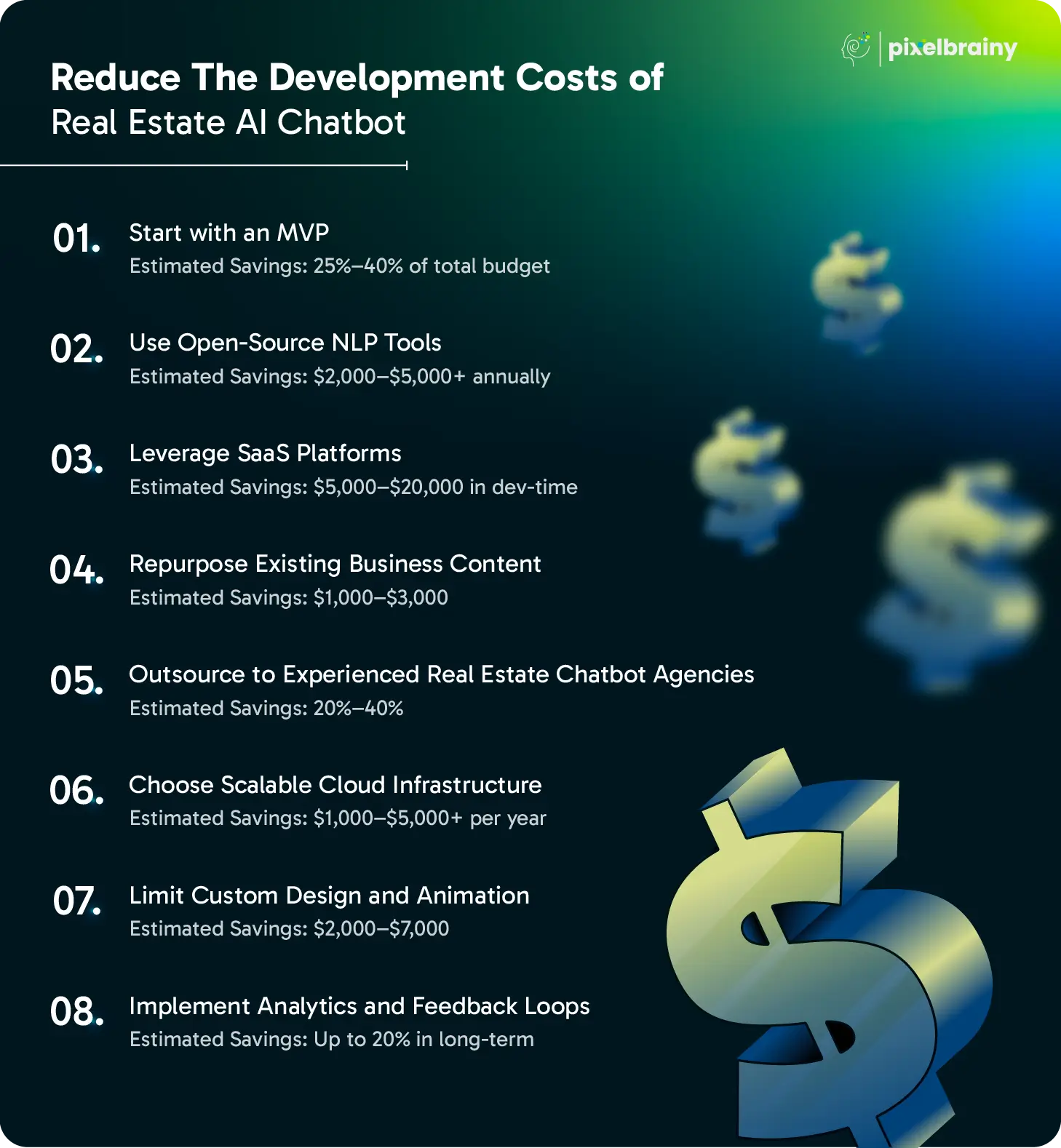
Instead of developing a feature-rich chatbot right away, launch with essential functionalities such as property search, basic FAQs, and lead capture. An MVP helps you validate market needs, collect real user feedback, and prioritize high-impact upgrades for future versions. This phased approach is ideal for keeping the initial AI chatbot development cost for real estate under control.
Estimated Savings: 25%–40% of total budget
Natural Language Processing engines like Rasa or Botpress are powerful, flexible, and open-source—meaning no recurring fees. By using them instead of premium services like Google Dialogflow or Microsoft Azure, you can retain full control over your AI logic while avoiding expensive subscription tiers.
Estimated Savings: $2,000–$5,000+ annually
Platforms such as Landbot, Tidio, or ManyChat offer drag-and-drop tools with pre-configured CRM, MLS, and calendar integrations. These platforms allow you to go live faster and reduce custom development time, helping to lower your overall Real Estate AI Chatbot Development Cost while maintaining core features.
Estimated Savings: $5,000–$20,000 in development time
Your current website FAQs, agent scripts, support tickets, and property descriptions can serve as valuable training data for your chatbot’s knowledge base. This reduces the need to create new training materials from scratch and ensures the bot aligns with your existing brand tone and language.
Estimated Savings: $1,000–$3,000 in data prep and training costs
Hiring a team that specializes in real estate chatbot development ensures faster delivery, better features, and fewer revisions. Compared to hiring generalist developers or building in-house, this approach minimizes trial-and-error costs and helps keep the cost to develop a Real Estate AI Chatbot in check.
Estimated Savings: 20%–40% depending on vendor location and experience
Instead of investing in heavy-duty cloud infrastructure upfront, opt for auto-scaling platforms like AWS, Google Cloud, or Azure, which charge based on usage. This pay-as-you-grow model avoids unnecessary hosting fees, especially in the early months when chatbot usage is low.
Estimated Savings: $1,000–$5,000+ per year
Highly stylized chatbots with animated avatars, micro-interactions, or gamified UX can look impressive but drive up development time and cost. Focus on clean, professional, and responsive design templates in the early phase. Once the bot proves its value, you can upgrade its visuals.
Estimated Savings: $2,000–$7,000 on UI/UX and frontend dev
Adding basic analytics (like chatbot usage metrics, drop-off points, and satisfaction ratings) in the first version helps you monitor performance and guide improvements. This reduces the risk of investing in features that users don’t need and minimizes future redevelopment costs.
Estimated Savings: Up to 20% in long-term redevelopment and iteration costs
By following these smart development and budgeting strategies, you can significantly lower your AI chatbot development cost for real estate—while still delivering a powerful, user-friendly solution that meets your business goals.
At PixelBrainy, we understand that building a high-quality AI chatbot shouldn’t break your budget—especially in the competitive real estate market. As a leading AI chatbot development company in USA, our mission is to deliver AI chatbot solutions that are scalable, affordable, and tailored to your unique business needs.
Whether you're a real estate startup or an established agency, we help you build a real estate AI chatbot for your business in budget without compromising on performance, design, or compliance.
We recently developed a real estate AI chatbot for a US-based brokerage firm (client name confidential under NDA). The chatbot was designed to:
Budget: Delivered under $18,000
Timeline: Completed in 6 weeks
The client saw a 32% increase in qualified lead capture and reduced manual inquiry handling by 60%—all within a budget-friendly deployment.
If you're looking for a trusted AI chatbot development company in the USA that delivers intelligent, cost-effective, and industry-ready solutions—PixelBrainy is your partner in innovation.
Let’s talk about how we can bring your real estate chatbot vision to life—on time, on budget, and at scale.

The rise of automation in real estate is unstoppable—and AI chatbots are leading that transformation. From handling buyer inquiries to qualifying leads, a well-built chatbot can significantly boost your efficiency and ROI. However, understanding the Real Estate AI Chatbot development cost is crucial before jumping in. Whether you're wondering about the cost to create a Real Estate AI chatbot, or how to reduce expenses without sacrificing quality, careful planning is key.
From MVPs to full-scale AI-powered assistants, the development cost can range from $10,000 to $100,000+, depending on features, integrations, and hidden variables. But with the right partner, you can build smart, scalable solutions—within budget.
Ready to explore affordable AI chatbot solutions for your real estate business?
Book a free consultation with PixelBrainy now.
The cost to develop a real estate AI chatbot ranges from $10,000 to over $100,000, depending on its complexity, features (like MLS integration, voice support), and whether you choose custom development or a SaaS-based solution.
SaaS platforms are budget-friendly and faster to launch, but custom AI chatbots offer more flexibility, better branding, and tailored functionality. The right choice depends on your business size, goals, and budget.
Yes. A well-developed chatbot can integrate seamlessly with CRMs like HubSpot or Salesforce, MLS databases, IDX feeds, and even your internal listing systems.
Development time varies from 3 to 12 weeks depending on scope. MVPs with basic features can be launched in under a month, while advanced bots with NLP, voice, and integrations may take longer.
Absolutely. AI chatbots can engage visitors 24/7, pre-qualify leads, and route them to the right agents—improving lead conversion rates by 20–40% in many real estate businesses.
Look for a team with real estate domain experience, strong AI/NLP capabilities, a portfolio of successful chatbot projects, and the ability to scale within your budget and timeline.

About The Author
Sagar Bhatnagar
Sagar Sahay Bhatnagar brings over a decade of IT industry experience to his role as Marketing Head at PixelBrainy. He's known for his knack in devising creative marketing strategies that boost brand visibility and market influence. Sagar's strategic thinking, coupled with his innovative vision and focus on results, sets him apart. His track record of successful campaigns proves his ability to utilize digital platforms effectively for impactful marketing efforts. With a genuine passion for both technology and marketing, Sagar continuously pushes PixelBrainy's marketing initiatives to greater success.

Working with the PixelBrainy team has been a highly positive experience. They understand the design requirements and create beautiful UX elements to meet the application needs. The dev team did an excellent job bringing my vision to life. We discussed usability and flow. Sagar worked with his team to design the database and begin coding. Working with Sagar was easy. He has the knowledge to create robust apps, including multi-language support, Google and Apple ID login options, Ad-enabled integrations, Stripe payment processing, and a Web Admin site for maintaining support data. I'm extremely satisfied with the services provided, the quality of the final product, and the professionalism of the entire process. I highly recommend them for Android and iOS Mobile Application Design and Development.

Great experience working with them. Had a lot of feedback and I found that unlike most contractors they were bugging me for updates instead of the other way around. They were extremely time conscience and great at communicating! All work was done extremely high quality and if not on time, early! They were always proactive when it comes to communication and the work is great/above par always. Very flexible and a great team to work with! Goes above and beyond to present us with multiple options and always provides quality. Amazing work per usual with Chitra. If you have UI/UX or branding design needs I recommend you go to them! Will likely work with them in the future as well, definitely recommended!

PixelBrainy is a joy to work with and is a great partner when thinking through branding, logo, and website layout. I appreciate that they spend time going into the "why" behind their decisions to help inform me and others about industry best practices and their expertise.

I hired them to design our software apps. Things I really like about them are excellent communication skills, they answer all project suggestions and collaborate right away, and their input on design and colors is amazing. This project was complex and needed patience and creativity. The team is amazing to do business with. I will be using them long-term. Glad to see there are some good people out there. I was afraid to try and outsource my project to someone but I am glad I met them! I really can't say enough. They went above and beyond on this project. I am very happy with everything they have done to make my business stand out from the competition.

It was great working with PixelBrainy and the team. They were very responsive and really owned the project. We'll definitely work with them again!

I recently worked with the PixelBrainy team on a project and I was blown away by their communication skills. They were prompt, clear, and articulate in all of our interactions. They listened and provided valuable feedback and suggestions to help make the project a success. They also kept me updated throughout the entire process, which made the experience stress-free and enjoyable.

PixelBrainy is very good at what it does. The team also presents themselves very professionally and takes care of their side of things very well. I could fully trust them taking up the design work in a timely and organised manner and their attention to detail saved us lots of effort and time. This particular project was quite intense and the team showed that they function very well under pressure. Very much looking forward to working with her again!

It's always an absolute pleasure working with them. They completed all of my requests quickly and followed every note I had for them to a T, which made our process go smoothly from start to finish. Everything was completed fast and following all of the guidelines. And I would recommend their services to anyone. If you need any design work done in the future, PixelBrainy should be your first call!

They took ownership of our requirements and designed and proposed multiple beautiful variants. The team is self-motivated, requires minimum supervision, committed to see-through designs with quality and delivering them on time. We would definitely love to work with PixelBrainy again when we have any requirements.

PixelBrainy was a big help with our SaaS application. We've been hard at work with a new UI/UX and they provided a lot of help with the designs. If you're looking for assistance with your website, software, or mobile application designs, PixelBrainy and the team is a great recommendation.

PixelBrainy designers are amazing. They are responsive, talented, and always willing to help craft the design until it matches your vision. I would recommend them and plan to continue them for my future projects and more!!!

They were awesome! Did a good job fast, and good communication. Will work with them again. Thank you

Creative, detail-oriented, and talented designers who take direction well and implement changes quickly and accurately. They consistently over-delivered for us.

PixelBrainy team is very talented and creative. Great designers and a pleasure to work with. PixelBrainy is an excellent communicator and I look forward to working with them again.

PixelBrainy has a very talented design team. Their work is excellent and they are very responsive. I enjoy working with them and hope to continue on all of our future projects.


Transform your ideas into reality with us.
Across these industries, each engagement brings unique challenges, from early-stage product development to scaling complex systems, helping us build a practical understanding of real-world product environments.