AI Summary Powered by PixelBrainy
What happens when a city has thousands of cameras, traffic signals, GPS trackers, and IoT sensors collecting data every second, yet traffic congestion continues to worsen because those systems cannot work together?
This is a growing challenge for municipalities, transportation authorities, urban planners, and smart city operators worldwide. Over the years, cities have invested heavily in traffic management infrastructure, including surveillance cameras, adaptive traffic signals, vehicle detection systems, connected public transit networks, and roadside IoT devices. However, many of these technologies still operate in isolation, creating disconnected data streams that limit visibility, coordination, and real-time decision making across transportation networks.
As cities pursue smarter mobility and more efficient urban operations, AI traffic system integration with existing smart city infrastructure has emerged as a practical solution for maximizing existing investments. Rather than replacing operational systems, organizations are increasingly adopting smart city infrastructure integration strategies that connect traffic data sources with AI-powered platforms capable of analyzing traffic patterns, predicting congestion, optimizing signal timing, and improving road safety. This approach allows cities to transform fragmented infrastructure into a connected and intelligent transportation ecosystem.
A question frequently raised by city stakeholders is: We're looking for a software development company that can integrate AI into our existing smart city infrastructure without forcing us to rebuild from scratch. Who has actual experience doing this kind of integration work, not just building from zero? The answer lies in technology partners with proven expertise in APIs, IoT ecosystems, sensor connectivity, traffic management platforms, cloud architecture, and AI deployment within complex legacy environments.
The market demand reflects this shift. According to MarketsandMarkets, the global Smart Cities market is projected to grow from USD 699.7 billion in 2025 to USD 1.44 trillion by 2030, driven by rapid advancements in artificial intelligence, IoT, and connected infrastructure technologies.
Understanding how to integrate AI traffic system with smart city infrastructure and how to integrate traffic sensors with AI software has become a critical focus for cities seeking intelligent, data-driven traffic management and sustainable urban mobility.
AI traffic system integration is the process of connecting artificial intelligence platforms with existing traffic infrastructure such as traffic signals, surveillance cameras, vehicle detection systems, IoT sensors, GPS tracking networks, and traffic management software. The objective is to enable these systems to exchange data, generate insights, and support automated traffic optimization through a unified framework.
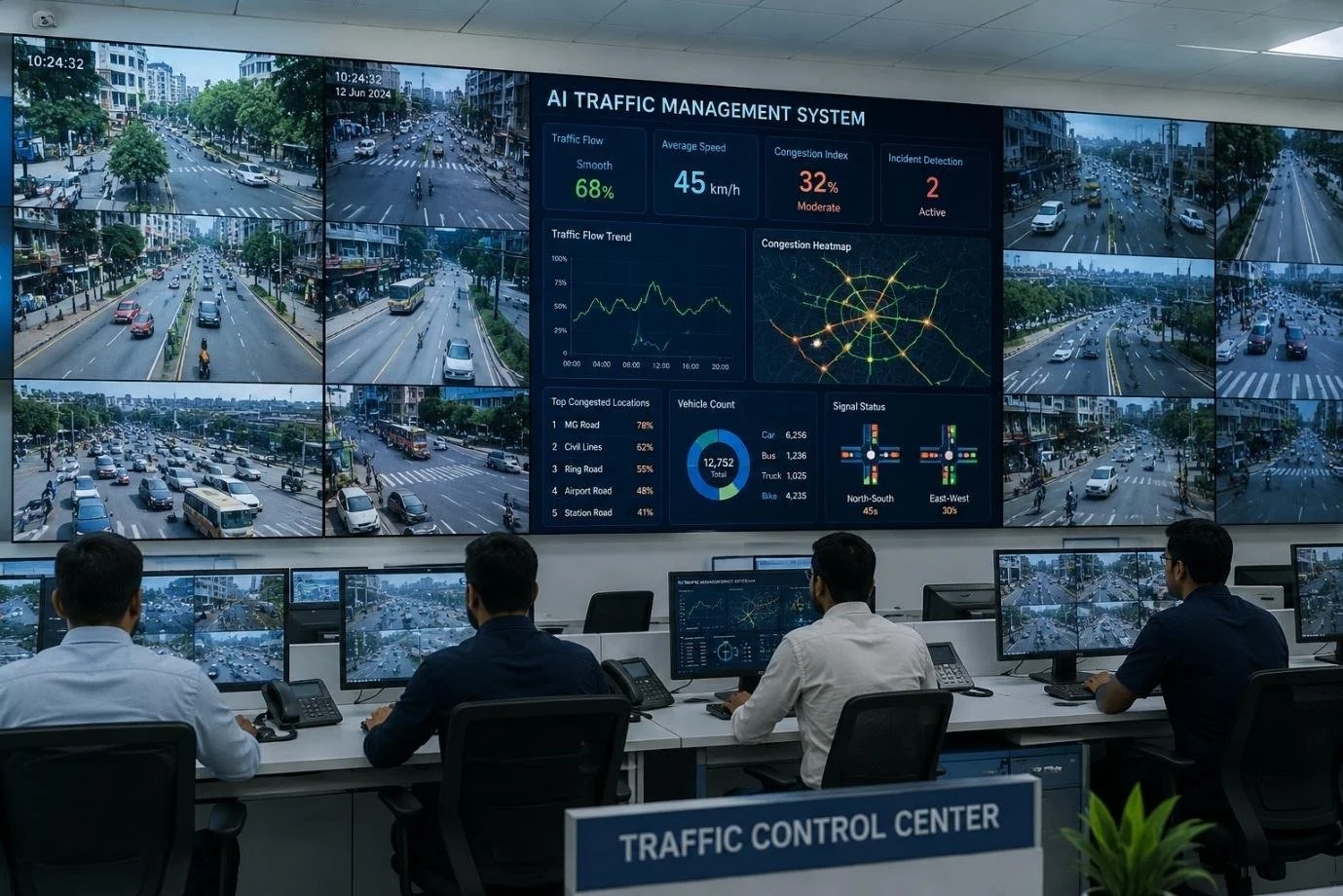
Unlike building a new traffic management ecosystem from the ground up, integration focuses on enhancing the infrastructure already deployed across a city. AI systems connect to existing assets through APIs, middleware, cloud platforms, and communication protocols, allowing real time data to flow between previously disconnected systems.
Once integrated, AI can analyze traffic volumes, predict congestion, optimize signal timing, identify incidents, and support traffic operators with data-driven recommendations. This approach helps municipalities maximize the value of existing infrastructure investments while improving operational efficiency, road safety, and overall transportation performance without requiring extensive hardware replacement.
Cities do not need to replace every camera, traffic signal, sensor, or control system to benefit from artificial intelligence. In most cases, the infrastructure already exists. The challenge is connecting these assets so they can exchange data, support automation, and enable intelligent decision making. This is why AI traffic system integration has become the preferred modernization strategy for transportation agencies and smart city operators.
A full infrastructure rebuild often involves significant capital expenditure, lengthy procurement cycles, service disruptions, and operational risks. By contrast, AI integration with smart cities focuses on connecting existing technologies through APIs, middleware, cloud platforms, and IoT communication frameworks. This approach allows cities to improve traffic performance faster while preserving current investments and minimizing implementation complexity.
Replacing citywide transportation infrastructure can require years of planning, deployment, and testing. AI integration significantly reduces these challenges by enabling existing systems to work together within a unified intelligent ecosystem.
Through AI integration with legacy traffic system environments, cities can introduce adaptive signal control, predictive traffic analytics, congestion forecasting, and incident detection without extensive hardware replacement. According to the U.S. Federal Highway Administration (FHWA), active traffic management technologies help improve traffic flow, increase throughput, reduce incident-related delays, and enhance travel reliability by using existing roadway infrastructure more intelligently.
This makes integration a faster and more cost-efficient path toward intelligent transportation operations.
Most municipalities already operate extensive networks of cameras, traffic signals, GPS systems, and roadside sensors that continuously generate valuable traffic data. Modern AI platforms are designed to leverage these assets rather than replace them.
By integrating IoT devices into traffic management software, AI can collect and analyze data from multiple sources in real time. This addresses a common question: how does AI traffic system communicate with smart city sensors? The connection typically occurs through APIs, IoT gateways, edge computing devices, and standardized communication protocols that enable seamless data exchange across systems.
Research from the Texas A&M Transportation Institute shows that intelligent traffic management technologies such as dynamic speed control can improve traffic flow, delay congestion formation, and reduce crash risks by using real-time sensor data and connected infrastructure.
That’s why cities that prioritize integration over replacement can accelerate AI adoption, reduce modernization costs, and unlock greater value from the infrastructure already deployed across their transportation networks.
Successful smart city infrastructure integration begins with understanding which infrastructure components generate traffic data and how they connect with AI platforms. Most cities already have a foundation of connected technologies deployed across roads, intersections, transit corridors, and control centers. The goal of integration is not to replace these systems but to enable seamless communication between them.
When organizations evaluate AI traffic system integration, three infrastructure categories play the most important role: traffic cameras, IoT sensors, and traffic signal controllers. Together, these systems form the backbone of connected traffic infrastructure, providing the real-time data that AI requires to analyze traffic conditions, predict congestion, detect incidents, and optimize signal timing.
A common question raised by transportation authorities is: Can AI work with our existing cameras, sensors, and traffic signal systems, or do we need to replace everything? In most cases, modern AI platforms are designed to integrate with existing infrastructure through APIs, IoT gateways, communication protocols, and edge computing technologies. This allows cities to build intelligent traffic management capabilities while maximizing current investments.
Traffic cameras and CCTV networks are among the most valuable data sources for AI-powered traffic management. These systems continuously capture visual information from intersections, highways, pedestrian crossings, and urban corridors.
When connected to AI software, camera feeds can be used for:
AI-powered video analytics transforms traditional surveillance systems into intelligent monitoring tools that support faster and more accurate traffic decisions.
IoT sensors provide real-time traffic and environmental data that AI systems use to improve operational awareness. These devices are installed throughout transportation networks and continuously collect information from roadways and intersections.
Common smart traffic devices include:
By connecting these devices to AI platforms, cities can improve congestion forecasting, traffic flow analysis, and predictive traffic management while creating a more responsive transportation ecosystem.
Traffic signal controllers manage the operation of intersections and are critical components of modern intelligent transportation systems. Most cities already operate signal control infrastructure that can be integrated with AI rather than replaced.
AI systems use signal controller data to:
Through API connectivity and traffic management software integration, AI can continuously evaluate traffic conditions and recommend signal adjustments based on real-time demand, helping cities improve mobility and intersection efficiency without major infrastructure upgrades.
Together, cameras, IoT sensors, and traffic signal controllers create the data foundation that enables scalable AI traffic system integration across connected urban transportation networks.
Traffic system APIs are the primary communication layer that enables AI platforms to connect with existing smart city infrastructure. They allow traffic cameras, signal controllers, IoT devices, transportation management platforms, and analytics systems to exchange data in a standardized way. Without APIs, most traffic systems would remain isolated, making real-time traffic intelligence and automation difficult to achieve.
In modern APIs for smart city traffic integration, AI platforms collect data from multiple sources, process it using machine learning models, and send recommendations or automated actions back to traffic management systems. This creates a continuous data flow that supports congestion prediction, adaptive signal control, incident detection, and traffic optimization.
Most integration projects rely on RESTful APIs because they are widely supported, scalable, and easier to connect with cloud and AI platforms. When systems use different protocols or data formats, middleware acts as a bridge that translates and routes information between legacy infrastructure and modern AI applications.
A typical smart city traffic integration architecture consists of several connected layers:
Through this architecture, AI can access traffic data from multiple sources in real time and generate insights that support operational decisions. Well-designed API architecture also improves scalability, making it easier to add new devices, sensors, or software platforms in the future.
One of the most common challenges in AI traffic system integration involves working with legacy systems that have incomplete documentation, outdated protocols, or custom-built APIs.
Many organizations ask: Our existing system has APIs but they're poorly documented, and most vendors we spoke to seem unsure how to work with them. We need a company confident enough to handle messy, undocumented legacy systems.
Experienced integration teams address this challenge through API discovery, traffic analysis, reverse engineering, log inspection, protocol mapping, and extensive testing. Instead of requiring infrastructure replacement, they identify how existing systems exchange data and build custom connectors that enable seamless AI integration. This expertise is often the difference between a successful modernization project and an expensive system rebuild.
Effective API integration allows AI platforms to work with both modern and legacy traffic systems, creating a connected transportation ecosystem without replacing existing infrastructure.

Also Read: AI Parking App Development: Features, Steps and Cost
IoT traffic sensors are the foundation of data-driven traffic management. Installed across intersections, highways, parking facilities, and urban corridors, these devices continuously collect information about vehicle movement, traffic density, speed, occupancy, and environmental conditions. However, many cities face a common challenge: vast amounts of sensor data are generated every day, but much of it remains isolated within separate systems and is rarely used to support real-time decision-making.
This is where traffic sensor integration plays a critical role. By connecting IoT sensors with AI traffic management platforms, cities can transform raw data into actionable intelligence. AI systems process continuous data streams, identify patterns, detect anomalies, predict congestion, and recommend operational adjustments that improve traffic flow and roadway efficiency.
For municipalities seeking smarter transportation operations, the value of IoT infrastructure is not simply collecting data but converting that data into insights that support faster and more informed decisions.
AI traffic management platforms rely on real-time connectivity between sensors and centralized dashboards. Data collected from field devices is continuously transmitted to AI systems, providing a live view of traffic conditions across the network.
Common real-time dashboard capabilities include:
This visibility enables traffic operators to monitor conditions proactively rather than reacting after congestion has already occurred.
Most transportation environments contain devices from multiple vendors that use different communication standards. Middleware serves as the integration layer that enables these systems to communicate effectively.
Key functions include:
Modern data pipelines then route information to cloud or edge-based AI platforms using technologies such as MQTT, REST APIs, WebSockets, and message brokers. This ensures a continuous flow of reliable traffic data for analysis and decision-making.
Different sensor technologies provide different types of traffic intelligence. AI platforms combine these data sources to create a comprehensive understanding of roadway conditions.
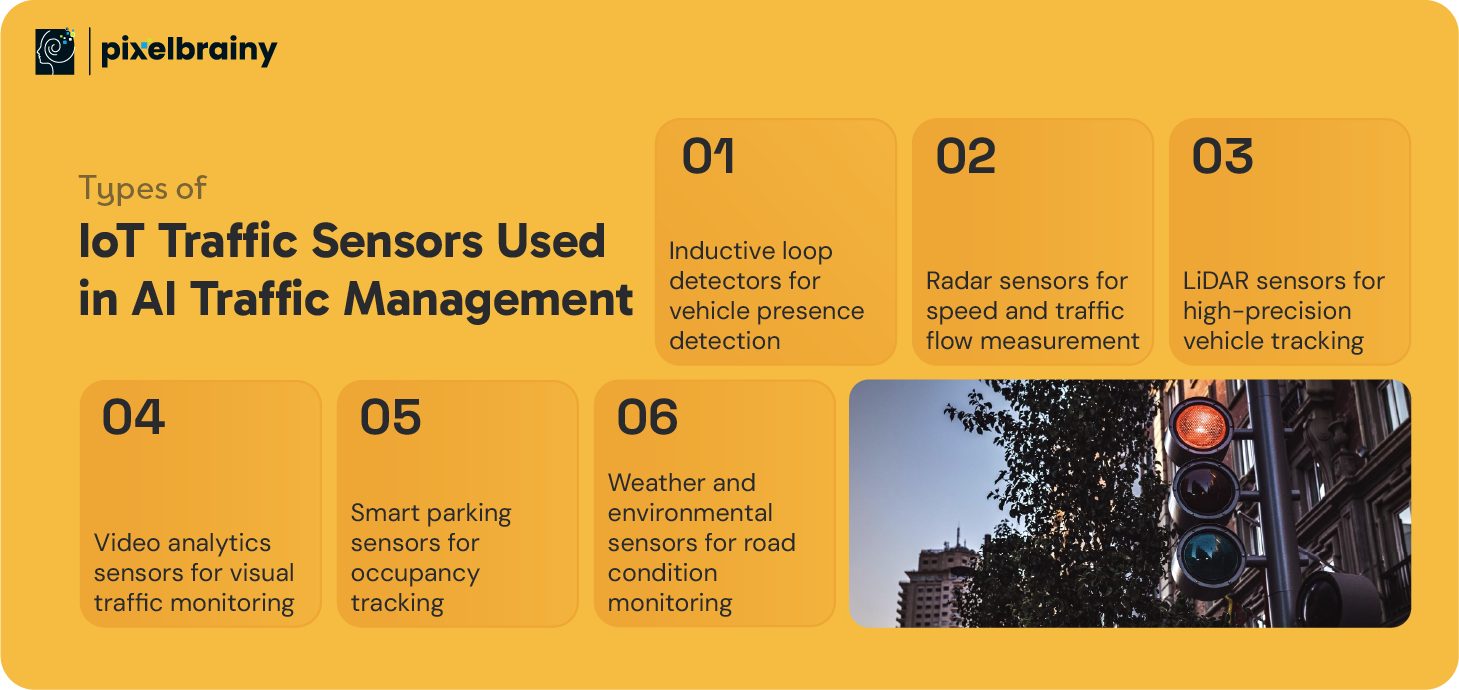
Common sensor types include:
Combining multiple sensor inputs improves the accuracy and effectiveness of AI-driven traffic management.
The true value of sensor integration emerges when AI begins processing incoming data in real time. Machine learning models analyze traffic patterns, historical trends, and current roadway conditions to generate operational recommendations.
AI-powered applications include:
Instead of relying solely on historical traffic plans, transportation agencies can make dynamic decisions based on continuously changing conditions.
When IoT traffic sensors are integrated with AI platforms through scalable data pipelines and intelligent analytics, cities can transform previously underutilized data into real-time traffic intelligence that improves mobility, safety, and transportation efficiency.
Successful integration of AI traffic system with smart city infrastructure requires a structured approach that connects existing assets, validates data flows, and minimizes operational risk. Whether a city operates cameras, signal controllers, IoT devices, or legacy traffic management software, following a phased integration roadmap helps ensure long-term success.
A common question from transportation agencies is: We have IoT sensors deployed across a few junctions but the data just sits unused in a separate dashboard. How do we connect this sensor data to an AI traffic management system so it actually helps in decision-making? The answer lies in a systematic integration process that transforms disconnected data sources into actionable traffic intelligence.
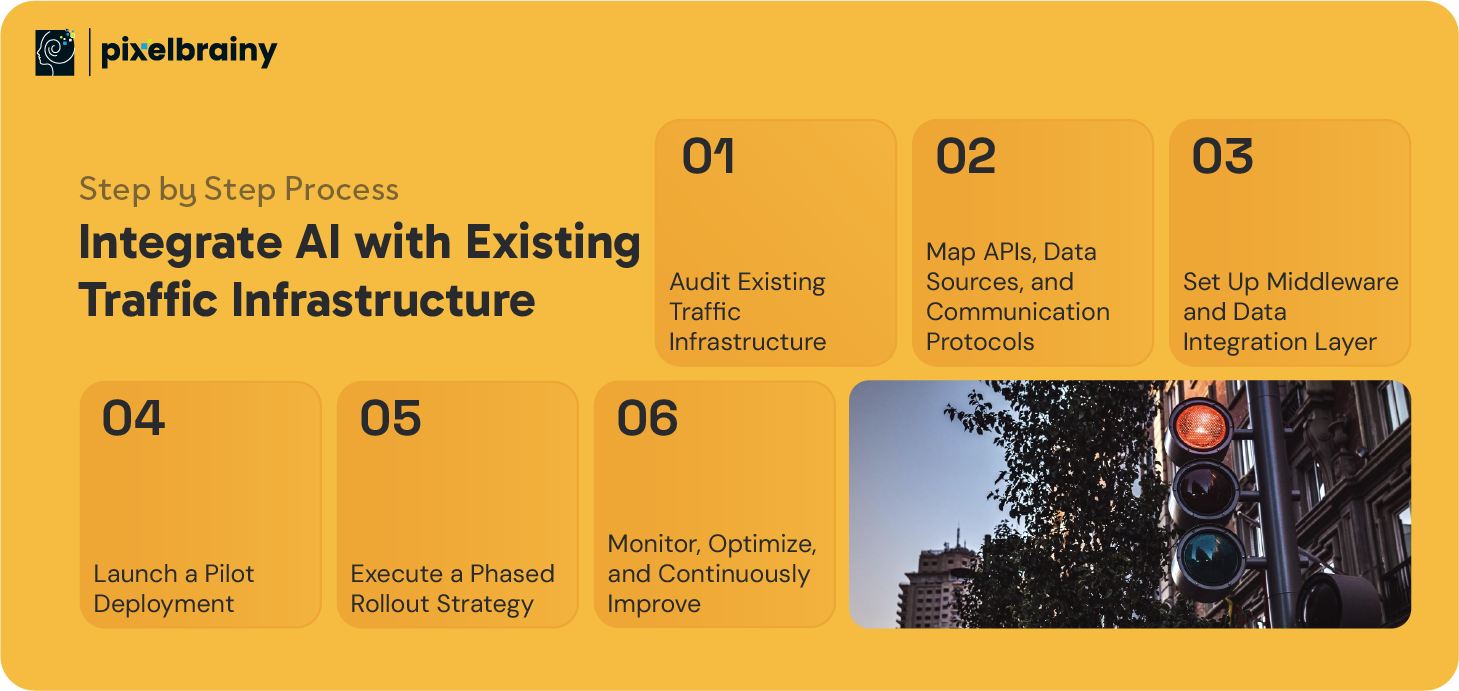
Begin by conducting a comprehensive assessment of the current traffic ecosystem. Identify all available assets, including cameras, traffic signals, IoT sensors, control systems, databases, and communication networks.
The objective is to understand what infrastructure already exists, what data is available, and which systems will participate in the future AI traffic management integration process.
The next step is identifying how data moves between systems. This includes reviewing APIs, data formats, network architecture, communication standards, and vendor platforms.
This stage helps answer an important technical question: how does AI traffic system communicate with smart city sensors? Understanding available integration points creates the foundation for reliable data exchange between infrastructure and AI platforms.
Most smart city environments contain systems from multiple vendors. Middleware acts as the central integration layer that connects devices, software applications, and AI engines.
During this stage, organizations focus on Integrating traffic sensors with AI software by standardizing data formats, routing information streams, and establishing secure communication between all connected systems.
Before expanding citywide, deploy AI capabilities in a limited area such as a corridor, district, or selected intersections.
Pilot testing helps validate:
This approach reduces risk while providing measurable performance benchmarks.
After successful pilot validation, expand implementation gradually across additional intersections and transportation corridors.
A phased rollout supports effective smart city infrastructure integration by allowing teams to optimize configurations, address operational challenges, and scale AI capabilities without disrupting existing traffic operations.
AI integration is an ongoing process rather than a one-time deployment. Continuous monitoring ensures that traffic models remain accurate and responsive to changing roadway conditions.
Key performance indicators typically include:
Following these steps to integrate AI traffic control with city infrastructure enables transportation agencies to build a scalable, intelligent traffic ecosystem that continuously improves mobility, operational efficiency, and decision-making across connected urban networks.
The success of an AI traffic system integration project depends on more than deploying artificial intelligence models. Cities need a technology ecosystem capable of connecting cameras, sensors, traffic signals, control centers, and analytics platforms into a unified operational environment.
Because most municipalities already operate a mix of legacy and modern infrastructure, the technologies used for smart city infrastructure integration must support interoperability, real-time communication, scalability, and security. From API gateways that connect disconnected systems to AI engines that generate traffic predictions, each technology layer plays a specific role in transforming traffic data into actionable intelligence.
The following technologies form the foundation of a successful integration of AI traffic system with existing smart city infrastructure.
| Technology Area | Role in Integration | Examples |
| Artificial Intelligence & Machine Learning | Analyzes traffic patterns, predicts congestion, and supports automated decision-making | TensorFlow, PyTorch, Azure AI |
| APIs & Integration Platforms | Connects cameras, sensors, traffic systems, and AI applications | Apigee, Kong, MuleSoft |
| IoT Platforms | Collects and manages data from connected traffic devices | AWS IoT Core, Azure IoT Hub |
| Middleware | Bridges communication between legacy systems and modern applications | Node-RED, Apache Camel |
| Data Streaming Platforms | Enables real-time movement of traffic data between systems | Apache Kafka, RabbitMQ |
| Edge Computing | Processes traffic data near the source for faster response times | NVIDIA Jetson, Intel Edge |
| Cloud Infrastructure | Provides scalable storage, computing power, and analytics capabilities | AWS, Azure, Google Cloud |
| Databases | Stores real-time and historical traffic information | PostgreSQL, MongoDB, InfluxDB |
| Computer Vision Tools | Extracts insights from CCTV and traffic camera feeds | OpenCV, YOLO |
| Monitoring Platforms | Tracks traffic operations and system performance | Grafana, Power BI |
Artificial intelligence serves as the decision-making layer of the traffic ecosystem. By analyzing data from cameras, sensors, and traffic controllers, AI can identify congestion patterns, forecast traffic conditions, detect incidents, and recommend signal timing adjustments in real time.
One of the biggest challenges in smart city infrastructure integration is connecting systems developed by different vendors. APIs and middleware act as the communication layer that allows traffic management software, IoT devices, and AI platforms to exchange data seamlessly without requiring infrastructure replacement.
Traffic decisions are only as effective as the data powering them. IoT platforms collect information from roadside devices, while edge computing enables rapid processing closer to the source. This combination reduces latency and allows AI systems to respond to changing traffic conditions faster.
AI traffic systems generate and process large volumes of information every day. Cloud platforms and database technologies provide the scalability needed to store, manage, and analyze traffic data while supporting future expansion across connected transportation networks.
Traffic cameras become significantly more valuable when combined with AI-powered computer vision technologies. These tools can automatically detect vehicles, monitor traffic density, identify incidents, and provide transportation teams with real-time operational visibility through centralized dashboards.
When these technologies work together, cities can create a connected traffic ecosystem where data flows seamlessly between infrastructure assets and AI systems, enabling faster decisions, better traffic flow, and more efficient transportation operations.
Connecting AI with cameras, traffic signals, IoT devices, and traffic management platforms is only one part of the modernization journey. Many transportation projects encounter challenges because of fragmented data sources, incompatible technologies, security concerns, and integration approaches that overlook existing infrastructure requirements.
For most municipalities and transportation authorities, the objective is not simply deploying artificial intelligence. The real goal is creating a connected ecosystem where traffic data moves seamlessly between infrastructure assets, software platforms, and decision-making systems. Achieving this requires a well-planned integration strategy that balances scalability, interoperability, security, and long-term operational efficiency.
Whether the focus is AI traffic system integration, smart city infrastructure integration, or modernizing legacy traffic networks, following proven best practices can significantly reduce implementation risks and improve project outcomes. The recommendations below help cities build intelligent transportation systems that deliver measurable improvements in mobility, traffic flow, and infrastructure performance.
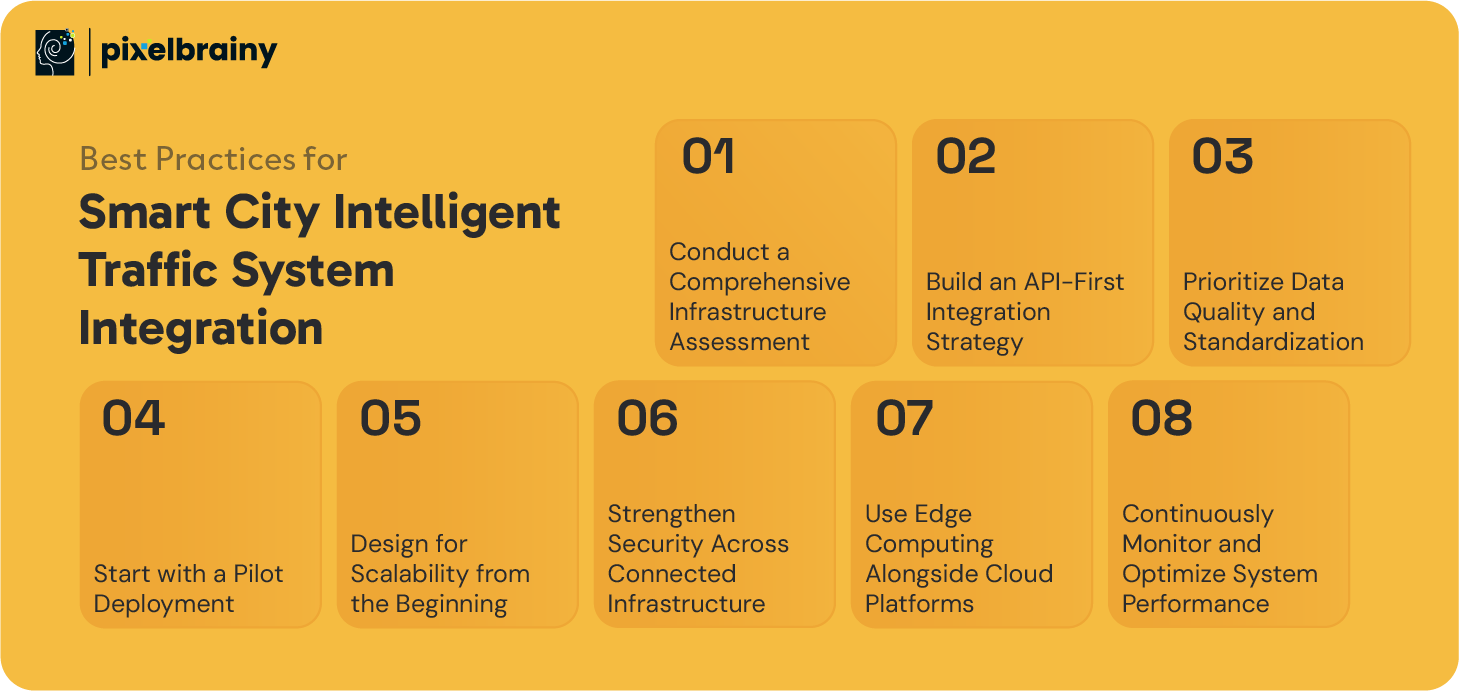
Before deploying AI, create a complete inventory of traffic cameras, signal controllers, IoT sensors, communication networks, databases, and traffic management platforms. Understanding what infrastructure already exists helps identify integration opportunities, technical limitations, and potential compatibility issues before development begins.
Modern traffic ecosystems depend on seamless data exchange. An API-first approach allows traffic signals, sensors, AI platforms, and third-party applications to communicate efficiently while supporting future technology upgrades and expansion initiatives.
Disconnected systems often generate inconsistent data formats and duplicate records. Establishing data validation, normalization, and governance processes improves the accuracy of traffic analytics, congestion forecasting, incident detection, and AI-driven decision-making.
Rather than implementing AI across an entire city at once, begin with a selected corridor, district, or group of intersections. Pilot deployments provide measurable insights into system performance, integration reliability, operational benefits, and return on investment before large-scale rollout.
Transportation networks continue to evolve as new sensors, connected vehicles, and mobility services are introduced. Scalable architecture ensures that additional devices, data sources, and AI capabilities can be integrated without requiring major infrastructure redesign.
Traffic systems exchange large volumes of operational data every day. Implementing encryption, secure APIs, authentication controls, network segmentation, and continuous monitoring helps protect connected infrastructure from cyber threats and unauthorized access.
Processing data at the edge enables faster response times for traffic control applications, while cloud infrastructure supports large-scale analytics, centralized management, and long-term data storage. Combining both technologies improves performance and operational flexibility.
Traffic conditions, transportation patterns, and infrastructure requirements change over time. Monitoring key performance indicators such as congestion levels, signal efficiency, traffic flow, sensor health, and AI model accuracy ensures that the system continues to deliver measurable operational improvements.
The most effective smart city traffic system integration projects are built on interoperability, reliable data, scalable architecture, and continuous optimization, enabling cities to transform existing infrastructure into an intelligent transportation network that delivers long-term operational value.
While the benefits of AI traffic management integration are significant, the implementation process is rarely straightforward. Most municipalities operate a combination of legacy traffic management systems, aging signal controllers, disconnected databases, CCTV networks, and IoT devices that were deployed years apart and often by different vendors.
As a result, the integration of AI traffic system with smart city infrastructure frequently involves challenges related to system compatibility, inconsistent data quality, communication barriers, and operational continuity. Organizations exploring AI integration with legacy traffic systems often ask whether their existing infrastructure can support modern AI capabilities without causing disruptions to daily traffic operations.
The good news is that most integration challenges can be addressed through proper planning, middleware architecture, API-driven connectivity, and phased deployment strategies. Understanding these obstacles before implementation helps cities reduce risks and accelerate their smart city infrastructure integration initiatives.
One of the biggest barriers to successful AI traffic system integration is the presence of infrastructure from multiple vendors. Traffic cameras, signal controllers, vehicle detection systems, and transportation management platforms often use different communication protocols, proprietary software, and incompatible data formats.
This fragmented environment can make it difficult for AI platforms to access and analyze data consistently across the transportation network.
How to resolve it:
These strategies enable AI applications and computer vision software to work across diverse infrastructure environments while reducing dependence on individual vendors.
Many cities possess years of traffic data, but much of it was collected for operational reporting rather than AI-driven analytics. Legacy datasets often contain missing records, inconsistent formatting, duplicate entries, and limited contextual information.
Poor data quality directly impacts the effectiveness of AI traffic management integration, leading to less accurate predictions, traffic forecasts, and optimization recommendations.
How to resolve it:
Reliable data provides the foundation for successful AI modeling and intelligent traffic decision-making.
A common concern during AI integration with smart cities is maintaining uninterrupted traffic operations while new technologies are being deployed. Traffic signals, emergency response systems, and transportation management platforms cannot simply be taken offline for extended upgrades.
Cities therefore require integration strategies that support gradual modernization without affecting day-to-day operations.
How to resolve it:
This approach allows transportation agencies to modernize infrastructure, validate AI performance, and scale deployments while minimizing operational risks and service disruptions.
Successfully overcoming multi-vendor conflicts, legacy data limitations, and deployment risks is essential for building a scalable AI-powered transportation ecosystem that supports long-term smart city infrastructure integration and intelligent traffic management.
For many municipalities, transportation agencies, and infrastructure operators, the biggest challenge is not deciding whether to adopt AI. The challenge is finding a technology partner that can work with existing systems, existing teams, and existing operational requirements.
At PixelBrainy, our approach focuses on AI traffic system integration with existing smart city infrastructure rather than recommending costly infrastructure replacement projects. We understand that most cities already have traffic cameras, signal controllers, IoT sensors, transportation management software, and data platforms in place. Our goal is to help these systems work together intelligently through AI-driven integration.
One of the most common questions we hear is: Our IT team is small and doesn't have in-house AI expertise to handle this integration internally. Are there AI development companies that can work alongside our existing staff instead of taking over the whole project?
Our answer is yes. As an experienced AI integration company, we work as an extension of your existing team. We collaborate with internal IT departments, transportation engineers, operations teams, and infrastructure vendors to build integration strategies that align with current workflows and operational objectives.
Our expertise includes:
We also understand that traffic operations cannot stop during implementation. That is why our deployment methodology prioritizes phased rollouts, pilot testing, parallel system validation, and low-risk migration strategies. Whether the objective is how to sync AI traffic system with existing traffic signals or connect AI with existing sensor networks, we focus on minimizing operational disruption throughout the process.
Beyond implementation, PixelBrainy provides ongoing optimization, monitoring, maintenance, and technical support to ensure long-term performance. Our AI solutions for traffic system integration are designed to evolve alongside changing transportation needs, helping cities build intelligent traffic ecosystems without disrupting the infrastructure they already depend on.
By combining integration expertise, collaborative delivery, and long-term support, PixelBrainy helps organizations unlock the full value of their existing transportation infrastructure through practical and scalable AI adoption.
Integrating AI into existing transportation infrastructure is often more practical and cost-effective than replacing entire systems. By connecting traffic cameras, signal controllers, IoT sensors, and traffic management platforms through APIs, middleware, and intelligent analytics, cities can unlock real-time insights, improve traffic flow, enhance road safety, and maximize the value of their existing investments.
The key to successful AI traffic system integration with existing smart city infrastructure lies in leveraging what already exists, ensuring seamless connectivity between systems, and adopting a phased implementation strategy that minimizes operational disruption.
If your organization is exploring AI-powered traffic management, schedule a consultation with the PixelBrainy AI experts. Our team can assess your current infrastructure, identify integration opportunities, and help create a practical roadmap for deploying AI without the cost and complexity of a full infrastructure rebuild.
In many cases, yes. Modern AI platforms can integrate with existing CCTV and traffic camera networks through APIs, video management systems, edge devices, or middleware. This allows cities to add vehicle detection, congestion monitoring, incident detection, and analytics capabilities without replacing operational camera infrastructure, reducing both implementation costs and deployment time.
AI can be connected to fixed-time traffic signal systems through signal controllers, APIs, or traffic management software. Rather than replacing existing signals, AI analyzes traffic conditions and recommends or automates timing adjustments based on real-time demand. This approach enables adaptive traffic control while preserving the underlying signal infrastructure.
Yes. Most IoT sensors can continue operating as data collection devices while AI platforms process their outputs. Through sensor integration, middleware, and communication protocols such as MQTT or REST APIs, existing traffic sensors can provide valuable data for congestion forecasting, traffic optimization, incident detection, and operational decision-making.
Yes. Multi-vendor integration is one of the most common requirements in smart city projects. Middleware, API gateways, and data standardization frameworks can connect cameras, traffic signals, sensors, and transportation management systems from different vendors into a centralized AI-enabled platform that supports unified monitoring and traffic management.
The recommended approach is a phased rollout strategy. Cities typically begin with a pilot deployment at selected intersections or corridors, validate performance, and then expand incrementally. This minimizes operational risk, allows existing systems to continue functioning normally, and provides opportunities to optimize configurations before large-scale deployment.
Yes. Historical traffic data often plays an important role in training AI models and improving traffic predictions. Before integration, legacy datasets are typically cleaned, standardized, and validated to address inconsistencies or missing records. Once prepared, historical and real-time data can be combined to support more accurate traffic analytics and forecasting.

About The Author
Sagar Bhatnagar
Sagar Sahay Bhatnagar brings over a decade of IT industry experience to his role as Marketing Head at PixelBrainy. He's known for his knack in devising creative marketing strategies that boost brand visibility and market influence. Sagar's strategic thinking, coupled with his innovative vision and focus on results, sets him apart. His track record of successful campaigns proves his ability to utilize digital platforms effectively for impactful marketing efforts. With a genuine passion for both technology and marketing, Sagar continuously pushes PixelBrainy's marketing initiatives to greater success.

Working with the PixelBrainy team has been a highly positive experience. They understand the design requirements and create beautiful UX elements to meet the application needs. The dev team did an excellent job bringing my vision to life. We discussed usability and flow. Sagar worked with his team to design the database and begin coding. Working with Sagar was easy. He has the knowledge to create robust apps, including multi-language support, Google and Apple ID login options, Ad-enabled integrations, Stripe payment processing, and a Web Admin site for maintaining support data. I'm extremely satisfied with the services provided, the quality of the final product, and the professionalism of the entire process. I highly recommend them for Android and iOS Mobile Application Design and Development.

Great experience working with them. Had a lot of feedback and I found that unlike most contractors they were bugging me for updates instead of the other way around. They were extremely time conscience and great at communicating! All work was done extremely high quality and if not on time, early! They were always proactive when it comes to communication and the work is great/above par always. Very flexible and a great team to work with! Goes above and beyond to present us with multiple options and always provides quality. Amazing work per usual with Chitra. If you have UI/UX or branding design needs I recommend you go to them! Will likely work with them in the future as well, definitely recommended!

PixelBrainy is a joy to work with and is a great partner when thinking through branding, logo, and website layout. I appreciate that they spend time going into the "why" behind their decisions to help inform me and others about industry best practices and their expertise.

I hired them to design our software apps. Things I really like about them are excellent communication skills, they answer all project suggestions and collaborate right away, and their input on design and colors is amazing. This project was complex and needed patience and creativity. The team is amazing to do business with. I will be using them long-term. Glad to see there are some good people out there. I was afraid to try and outsource my project to someone but I am glad I met them! I really can't say enough. They went above and beyond on this project. I am very happy with everything they have done to make my business stand out from the competition.

It was great working with PixelBrainy and the team. They were very responsive and really owned the project. We'll definitely work with them again!

I recently worked with the PixelBrainy team on a project and I was blown away by their communication skills. They were prompt, clear, and articulate in all of our interactions. They listened and provided valuable feedback and suggestions to help make the project a success. They also kept me updated throughout the entire process, which made the experience stress-free and enjoyable.

PixelBrainy is very good at what it does. The team also presents themselves very professionally and takes care of their side of things very well. I could fully trust them taking up the design work in a timely and organised manner and their attention to detail saved us lots of effort and time. This particular project was quite intense and the team showed that they function very well under pressure. Very much looking forward to working with her again!

It's always an absolute pleasure working with them. They completed all of my requests quickly and followed every note I had for them to a T, which made our process go smoothly from start to finish. Everything was completed fast and following all of the guidelines. And I would recommend their services to anyone. If you need any design work done in the future, PixelBrainy should be your first call!

They took ownership of our requirements and designed and proposed multiple beautiful variants. The team is self-motivated, requires minimum supervision, committed to see-through designs with quality and delivering them on time. We would definitely love to work with PixelBrainy again when we have any requirements.

PixelBrainy was a big help with our SaaS application. We've been hard at work with a new UI/UX and they provided a lot of help with the designs. If you're looking for assistance with your website, software, or mobile application designs, PixelBrainy and the team is a great recommendation.

PixelBrainy designers are amazing. They are responsive, talented, and always willing to help craft the design until it matches your vision. I would recommend them and plan to continue them for my future projects and more!!!

They were awesome! Did a good job fast, and good communication. Will work with them again. Thank you

Creative, detail-oriented, and talented designers who take direction well and implement changes quickly and accurately. They consistently over-delivered for us.

PixelBrainy team is very talented and creative. Great designers and a pleasure to work with. PixelBrainy is an excellent communicator and I look forward to working with them again.

PixelBrainy has a very talented design team. Their work is excellent and they are very responsive. I enjoy working with them and hope to continue on all of our future projects.


Transform your ideas into reality with us.
Across these industries, each engagement brings unique challenges, from early-stage product development to scaling complex systems, helping us build a practical understanding of real-world product environments.