
What if the traffic jam you sat in this morning could have been predicted and prevented before you even left home?
Urban mobility is reaching a breaking point. Cities worldwide are losing billions annually due to congestion, fuel wastage, delayed logistics, and environmental damage. For government authorities, urban planners, and smart city investors, the urgency to act has never been higher. This is where AI traffic management control system development becomes not just relevant but essential.
From policymakers and transport departments to infrastructure startups and enterprise tech leaders, stakeholders are actively exploring how to develop an AI traffic management control system that can intelligently adapt to real time traffic conditions. The demand for building AI traffic management software is accelerating as cities transition toward automation and predictive infrastructure.
According to a recent report by McKinsey & Company, smart mobility solutions powered by AI could reduce congestion by up to 30 percent while improving travel time reliability. At the same time, the global intelligent traffic management market is projected to surpass $60 billion by 2030, highlighting strong long term investment momentum.
A key concern often raised is the cost of developing AI traffic management system for cities, especially when balancing budgets with long term ROI. Yet, forward thinking administrations recognize that investing in developing smart traffic control systems for smart cities is far more cost effective than continuing to absorb congestion related losses.
One of the most common questions decision makers ask is: “We are looking to develop an AI traffic management system with a traffic video intelligence platform, which companies can help?” The answer lies in choosing experienced AI development partners with strong capabilities in computer vision, IoT integration, and scalable infrastructure.
For cities aiming to stay competitive, efficient, and sustainable, AI driven traffic systems are no longer optional. They are becoming a strategic necessity. In this blog you can explore how AI powered traffic systems work, why they matter, and how to successfully build and scale them.
An AI Traffic Management Control System is an advanced, data driven traffic solution that uses artificial intelligence, machine learning, computer vision, and connected infrastructure to monitor, analyze, and optimize traffic flow across urban environments.
Unlike traditional traffic systems that rely on fixed signal timings and manual adjustments, this system operates dynamically by responding to real time traffic conditions. It enables cities to reduce congestion, improve road safety, and enhance overall transportation efficiency through intelligent decision making.
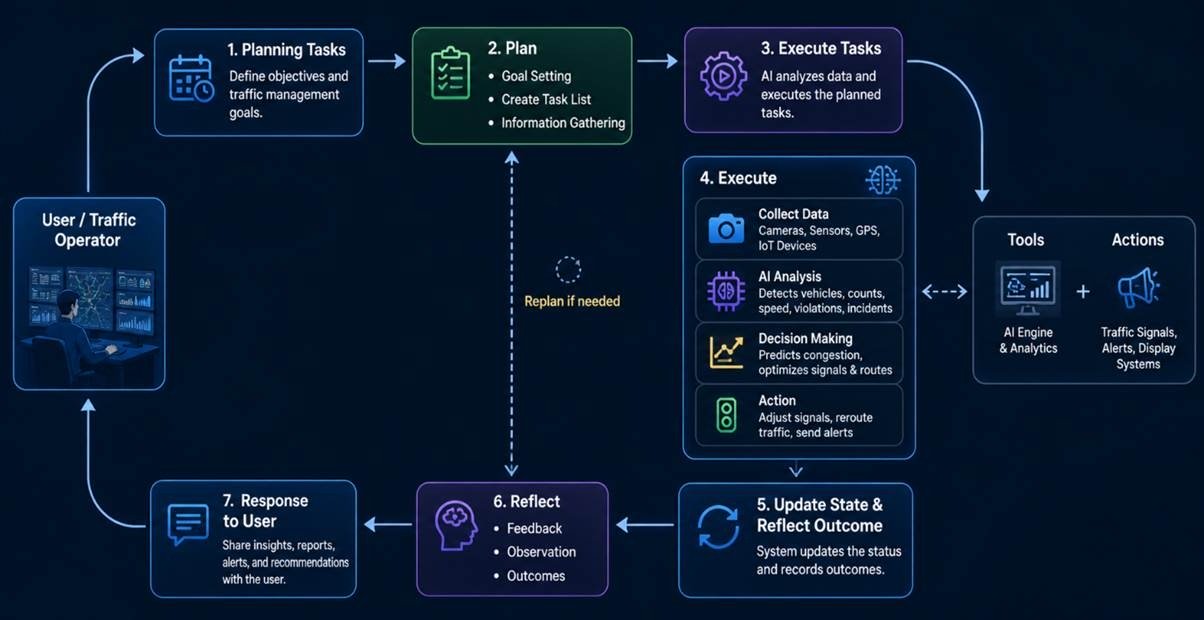
The system begins by gathering large volumes of data from a wide network of sources such as traffic cameras, IoT enabled road sensors, GPS devices, mobile applications, and connected vehicles. These data points provide continuous visibility into traffic movement across intersections, highways, and urban roads. The accuracy and diversity of this data form the foundation for effective traffic management.
Advanced computer vision models process live video feeds to detect and track vehicles in motion. The system can identify different vehicle types including cars, buses, trucks, and two wheelers. It also measures key parameters such as speed, vehicle count, lane occupancy, and traffic density. This analysis happens instantly, allowing authorities to understand current road conditions without delays.
Machine learning algorithms analyze both real time and historical data to identify recurring traffic patterns. These patterns include daily peak hours, frequently congested intersections, and seasonal traffic variations. By understanding these trends, the system generates actionable insights that help in planning and optimizing traffic flow more effectively.
Based on collected data and identified patterns, predictive models estimate future traffic conditions. The system can forecast congestion build ups, detect the likelihood of traffic jams, and anticipate delays caused by events such as roadblocks or weather changes. This predictive capability allows cities to take preventive actions rather than reacting after problems occur.
Traffic signals are controlled dynamically using AI based decision making. Instead of operating on fixed timers, signal durations are adjusted in real time according to traffic volume and flow. For example, roads with heavy traffic may receive extended green signals, while less busy routes are optimized to maintain balance. This helps reduce waiting time at intersections and improves traffic circulation.
The system integrates with navigation platforms and traffic management dashboards to suggest alternative routes during congestion. By redistributing traffic across multiple roads, it prevents overload on specific routes and ensures smoother movement throughout the city. This capability is especially useful during peak hours or unexpected disruptions.
The system continuously monitors for unusual events such as accidents, stalled vehicles, traffic violations, or sudden slowdowns. Once detected, alerts are instantly sent to traffic control centers and relevant authorities. Quick detection enables faster response times, reducing the impact of incidents on overall traffic flow.
The system improves its performance over time by learning from past data and outcomes. Each traffic cycle provides new insights, allowing algorithms to refine their predictions and decisions. This continuous improvement ensures that the system becomes more accurate, efficient, and reliable as it operates.
This comprehensive working approach allows cities to shift from reactive traffic control methods to a more predictive, efficient, and scalable traffic management ecosystem that can handle growing urban mobility demands.
Traditional traffic systems were designed for a time when vehicle volumes were lower and traffic patterns were more predictable. Today, with rapid urbanization and increasing vehicle ownership, these systems struggle to keep up with the complexity and scale of modern city traffic. Their static and rule-based nature makes them inefficient in handling dynamic, real-world conditions.
Most traditional systems operate on pre-set timers that do not change based on actual traffic conditions. This often leads to unnecessary waiting times at empty intersections while congested roads remain overloaded, creating imbalance across traffic flow.
These systems do not have the capability to collect and process live traffic data. Without real time insights, traffic authorities cannot make informed decisions quickly, resulting in delayed responses to congestion or disruptions.
Traditional systems are reactive rather than proactive. They respond only after congestion has already formed instead of anticipating and preventing it. This limitation makes it difficult to manage peak hour traffic effectively.
Traffic adjustments often require human involvement, such as manual signal changes or on ground traffic control. This not only increases operational costs but also slows down response times during critical situations.
Accidents, roadblocks, or unexpected events are not detected automatically. Authorities rely on external reports, which delays action and increases the overall impact on traffic flow.
As cities grow, traditional systems become harder to expand and integrate with new technologies. Upgrading infrastructure often requires significant time and cost without guaranteeing efficiency improvements.
These limitations lead to longer commute times, increased fuel consumption, higher carbon emissions, and reduced productivity. Businesses face delays in logistics, emergency services experience slower response times, and citizens deal with daily travel frustration.
Without intelligent and adaptive systems, cities continue to lose both time and economic value. This is why many urban regions are now shifting away from conventional traffic management toward smarter, data driven solutions.
Smart city investors are increasingly focusing on AI driven traffic solutions because they directly address some of the most expensive and complex urban challenges. A common strategic question shaping these investments is: how can cities build intelligent, future ready mobility systems that continuously adapt to traffic demands while maximizing efficiency and minimizing operational costs through AI driven innovation?
These investments are not just technology upgrades but strategic moves to improve economic efficiency, sustainability, and long-term city planning.
Traffic congestion is one of the biggest hidden costs for cities. Billions are lost every year due to delayed commutes, fuel wastage, and disrupted supply chains. Investors are prioritizing projects that focus on developing AI traffic system to reduce congestion costs in cities because even a small percentage improvement in traffic flow can lead to substantial economic savings across industries.
The intelligent traffic management market is experiencing rapid expansion due to increasing urbanization and demand for smarter infrastructure. According to Precedence Research, the global intelligent traffic management system market is expected to surpass USD 52 billion by 2035.
This growth indicates strong investor confidence and long term profitability in AI driven traffic solutions.
Urban populations are rising rapidly, and traditional infrastructure cannot scale at the same pace. Investors are focused on solutions that can create scalable AI traffic management system for growing cities, allowing authorities to manage increasing vehicle volumes without constantly expanding physical road networks. Scalability ensures long term viability and reduces infrastructure costs.
Modern cities are becoming interconnected ecosystems where data plays a central role in decision making. Investors are supporting initiatives related to building AI traffic management software that can integrate with other smart city components such as public transportation, emergency services, and urban planning systems. This integration improves overall city efficiency and enables better governance.
Reducing carbon emissions is a key priority for governments and global organizations. Traffic congestion significantly contributes to air pollution due to idle vehicles and inefficient routing. AI based traffic systems help optimize flow, reduce stop and go patterns, and lower fuel consumption. Investors see this as a critical step toward achieving sustainability targets while also improving urban living conditions.
AI powered traffic systems enhance road safety by detecting accidents, violations, and unusual traffic behavior in real time. They also enable faster coordination with emergency services by clearing routes and managing signal priorities. This leads to reduced accident impact and improved response times, making cities safer for residents and commuters.
From these factors, it is clear that AI traffic management is not just a technological upgrade but a strategic investment that delivers long term economic, environmental, and operational value for modern cities.
AI driven traffic solutions are transforming how cities manage mobility, safety, and infrastructure efficiency. As urban areas continue to grow, the demand for intelligent systems that can respond in real time is increasing rapidly. This is where AI traffic management control system development plays a critical role by enabling data driven decision making across transportation networks.
From improving daily commutes to enhancing emergency response, these systems are designed to solve real world traffic challenges at scale. Organizations investing in building AI traffic management software are focusing on practical use cases that deliver measurable impact, reduce congestion, and improve overall urban experience.
Below are the top use cases of AI traffic management control systems that are driving real world impact across modern cities:
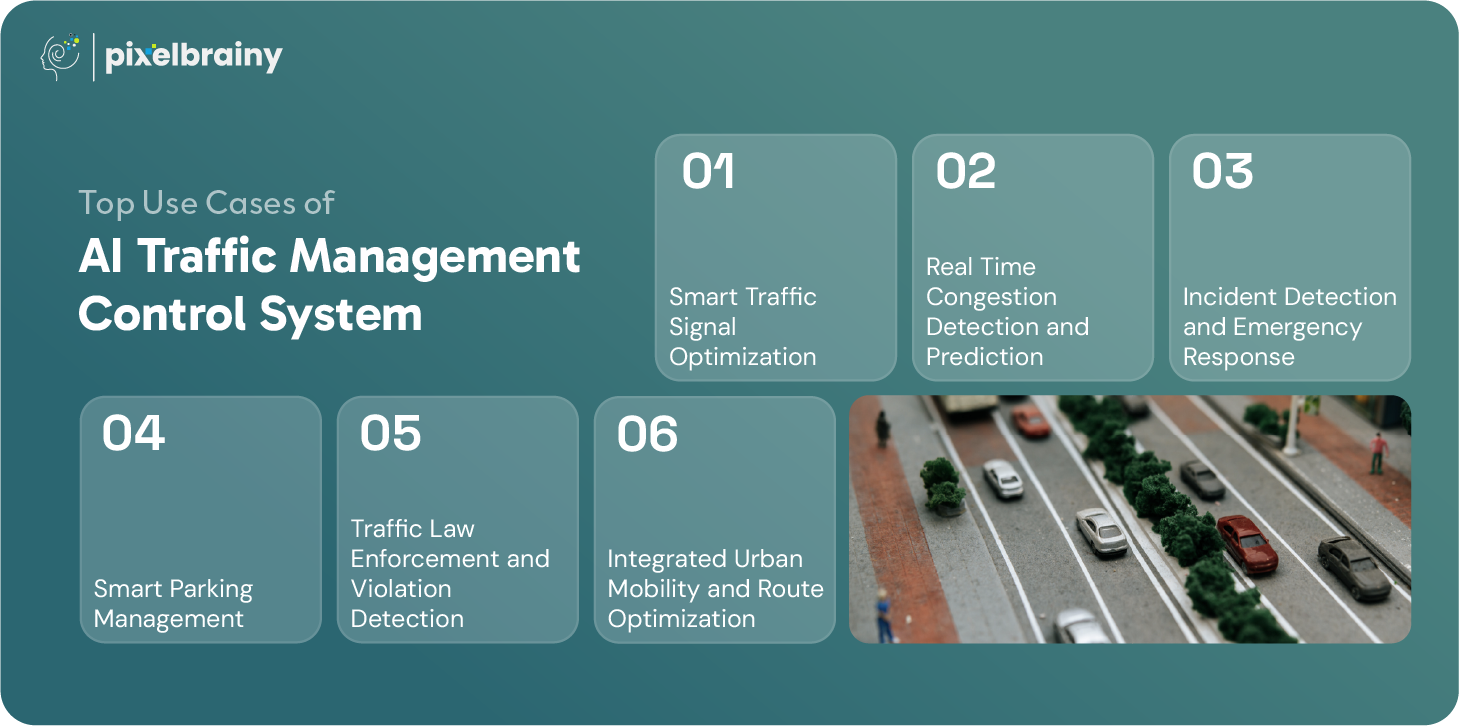
Smart traffic signal optimization is one of the most widely adopted use cases in modern cities. AI powered systems continuously monitor vehicle movement at intersections using cameras and sensors, allowing them to adjust signal timings dynamically based on real time traffic flow.
Instead of following fixed schedules, signals respond to actual demand, ensuring that congested lanes receive longer green lights while low traffic routes are cleared efficiently. This reduces waiting time, minimizes fuel consumption, and improves travel speed.
Over time, the system learns traffic patterns and further refines signal behavior, helping cities maintain smoother traffic flow even during peak hours and unexpected traffic surges.
AI traffic systems excel at identifying congestion in its early stages and predicting how it may evolve. By analyzing continuous data streams from multiple sources, the system detects slow moving traffic, bottlenecks, and unusual patterns that indicate potential delays.
It then uses predictive analytics to forecast congestion based on historical trends and current conditions. This allows authorities to take proactive measures such as rerouting vehicles or adjusting traffic signals before the situation worsens.
By supporting developing AI traffic system to reduce congestion costs in cities, this use case helps lower travel delays, improve productivity, and enhance the overall commuting experience.
Incident detection is a critical use case that improves both safety and traffic efficiency. AI powered systems use computer vision to analyze live video feeds and identify accidents, stalled vehicles, or unexpected road blockages within seconds.
Once an incident is detected, alerts are immediately sent to traffic control centers and emergency services. The system can also assist by adjusting traffic signals to create faster routes for emergency vehicles, ensuring quicker response times.
This reduces the severity and duration of traffic disruptions while improving public safety and preventing secondary accidents caused by delayed intervention.
Parking challenges contribute significantly to urban congestion, especially in busy commercial areas. AI traffic systems address this by identifying available parking spaces using sensors and camera-based detection.
Drivers can be guided to these spots through mobile applications, digital signage, or navigation systems, reducing the time spent searching for parking. This not only lowers fuel consumption but also decreases unnecessary traffic circulation in crowded zones.
Cities can also use collected data to optimize parking allocation, pricing, and infrastructure planning, making parking management more efficient and user friendly.
AI enables automated monitoring and enforcement of traffic regulations with high accuracy. Using advanced computer vision techniques, the system can detect violations such as overspeeding, red light jumping, illegal lane usage, and unauthorized turns.
These violations are recorded and processed in real time, allowing authorities to issue penalties without manual intervention. This ensures consistent enforcement and reduces the need for on ground personnel.
Over time, the data collected helps identify high risk areas and patterns of unsafe driving behavior, enabling authorities to take targeted actions to improve road safety.
AI traffic systems play a vital role in integrating different modes of transportation into a unified ecosystem. By analyzing real time traffic conditions, the system provides optimized route suggestions to drivers and supports coordination with public transport networks.
This helps distribute traffic more evenly across roads, reducing pressure on congested routes and improving overall travel efficiency. Integration with navigation platforms ensures that commuters receive accurate travel time estimates and alternative route options.
Cities can also use these insights to create scalable AI traffic management system for growing cities, ensuring long term adaptability as urban demand continues to increase.
From these use cases, it is clear that AI powered traffic systems are driving smarter, safer, and more efficient urban mobility across modern cities.

Building a reliable and future ready traffic solution requires a strong foundation of essential features. Cities aiming to create multi-intersection AI traffic coordination system must ensure seamless communication across signals, sensors, and control centers. At the same time, developing adaptive traffic signal control system using machine learning enables systems to respond intelligently to real time conditions.
Below are the must-have features that define an effective AI traffic management system:
| Feature | Description |
| Real Time Traffic Monitoring | Enables continuous tracking of vehicle movement using cameras and sensors, providing accurate and up to date traffic insights across intersections and highways for better operational visibility and faster decision making by traffic authorities. |
| Adaptive Signal Control | Adjusts traffic light timings dynamically based on real time traffic density, helping reduce waiting times, improve traffic flow, and manage congestion more efficiently without relying on fixed signal schedules. |
| Multi Intersection Coordination | Synchronizes traffic signals across multiple intersections to ensure smooth vehicle movement along major routes, minimizing stop and go conditions and improving overall traffic efficiency in high density urban areas. |
| Computer Vision Integration | Uses advanced image processing to detect vehicles, classify types, monitor lane usage, and identify violations, enabling accurate analysis of traffic patterns and improved enforcement capabilities. |
| Predictive Traffic Analytics | Leverages historical and real time data to forecast congestion patterns, peak hours, and potential delays, allowing proactive traffic management and better planning of traffic control strategies. |
| Incident Detection System | Automatically identifies accidents, stalled vehicles, or unusual traffic conditions, sending instant alerts to authorities for quick response and minimizing traffic disruption impact. |
| Centralized Control Dashboard | Provides a unified interface for monitoring, analyzing, and controlling traffic systems, allowing authorities to make informed decisions and manage city wide traffic operations efficiently. |
| IoT Device Integration | Connects with sensors, cameras, and connected infrastructure to gather real time data, ensuring seamless communication between physical traffic systems and digital control platforms. |
| Route Optimization Engine | Suggests alternative routes based on live traffic conditions, helping distribute traffic load evenly across road networks and reducing congestion in high traffic zones. |
| Data Visualization Tools | Converts complex traffic data into easy to understand charts and dashboards, enabling better insights for planners and decision makers to optimize traffic strategies effectively. |
| Scalability Architecture | Supports expansion across multiple locations and increasing traffic volumes, ensuring the system can grow with city infrastructure without major redesign or performance issues. |
| API Integration Capabilities | Allows integration with third party platforms such as navigation apps, public transport systems, and emergency services for a more connected and efficient traffic ecosystem. |
| Security and Data Protection | Ensures secure handling of sensitive traffic data through encryption, access control, and compliance with data privacy standards, protecting system integrity and user information. |
| Cloud Based Infrastructure | Enables flexible data storage and processing using cloud platforms, ensuring high availability, scalability, and cost efficiency for large scale traffic management systems. |
| Reporting and Analytics Module | Generates detailed reports on traffic performance, congestion trends, and system efficiency, helping authorities evaluate outcomes and continuously improve traffic management strategies. |
From these features, it is clear that a strong foundation is essential to build efficient, scalable, and intelligent traffic systems that can handle modern urban mobility challenges.
As cities evolve toward smarter ecosystems, basic features are no longer enough. Advanced capabilities play a critical role in enhancing performance, scalability, and long term adaptability. To create a smart traffic management system using AI, developers must integrate next generation technologies that support intelligent transportation system development and future mobility demands.
Below are the advanced capabilities that elevate AI traffic systems beyond standard implementations:
| Capability | Description |
| Edge AI Processing | Processes data locally at devices or intersections, reducing latency and enabling faster decision making without relying entirely on centralized cloud systems. |
| Digital Twin Simulation | Creates a virtual replica of the traffic network to simulate scenarios, test strategies, and optimize traffic flow before implementing changes in the real environment. |
| Vehicle to Infrastructure Communication | Enables direct communication between vehicles and traffic systems, allowing real time data exchange that improves traffic coordination and enhances road safety. |
| Autonomous Vehicle Integration | Supports interaction with self driving vehicles by providing real time traffic data, signal information, and route optimization for seamless autonomous mobility. |
| AI Driven Demand Forecasting | Predicts long term traffic demand based on population growth, urban development, and mobility trends, helping cities plan infrastructure and traffic strategies effectively. |
| Multi Modal Transport Integration | Connects road traffic systems with public transport, cycling, and pedestrian networks to create a unified and efficient urban mobility ecosystem. |
| Advanced Anomaly Detection | Identifies unusual traffic patterns, suspicious activities, or system irregularities, improving security and enabling faster response to unexpected events. |
| Real Time Weather Adaptation | Adjusts traffic strategies based on weather conditions such as rain, fog, or extreme heat, ensuring safer and more efficient traffic flow under varying conditions. |
| AI Powered Traffic Simulation | Uses machine learning models to simulate different traffic scenarios and evaluate potential improvements in signal timing and route optimization. |
| Energy Efficient Traffic Management | Optimizes traffic flow to reduce fuel consumption and emissions, supporting sustainability goals and improving environmental outcomes. |
| Smart Parking Integration | Connects traffic systems with parking infrastructure to manage availability, reduce search time, and improve overall urban traffic efficiency. |
| Dynamic Pricing Models | Implements variable tolling or congestion pricing based on traffic conditions, helping manage demand and reduce peak hour congestion effectively. |
| Cross City Data Integration | Enables sharing of traffic data across multiple cities or regions, improving coordination and enabling large scale traffic management strategies. |
| AI Based Policy Optimization | Helps governments evaluate and optimize traffic policies using data driven insights, ensuring better planning and decision making. |
| Continuous Learning Systems | Improves system performance over time by learning from new data, adapting to changing traffic patterns, and refining decision-making processes automatically. |
From these advanced capabilities, it is evident that next generation AI traffic systems are designed to be intelligent, adaptive, and future ready, supporting the long-term vision of smart and connected cities.
Developing an intelligent traffic solution requires a structured approach that combines strategy, data, design, and advanced technologies. Organizations planning such initiatives often evaluate multiple factors including scalability, integration, and vendor expertise while understanding what is the process of building an AI traffic management control software. The journey involves several critical stages that ensure successful implementation and long-term performance.
Below are the eight essential steps required to successfully build and deploy an AI driven traffic system.
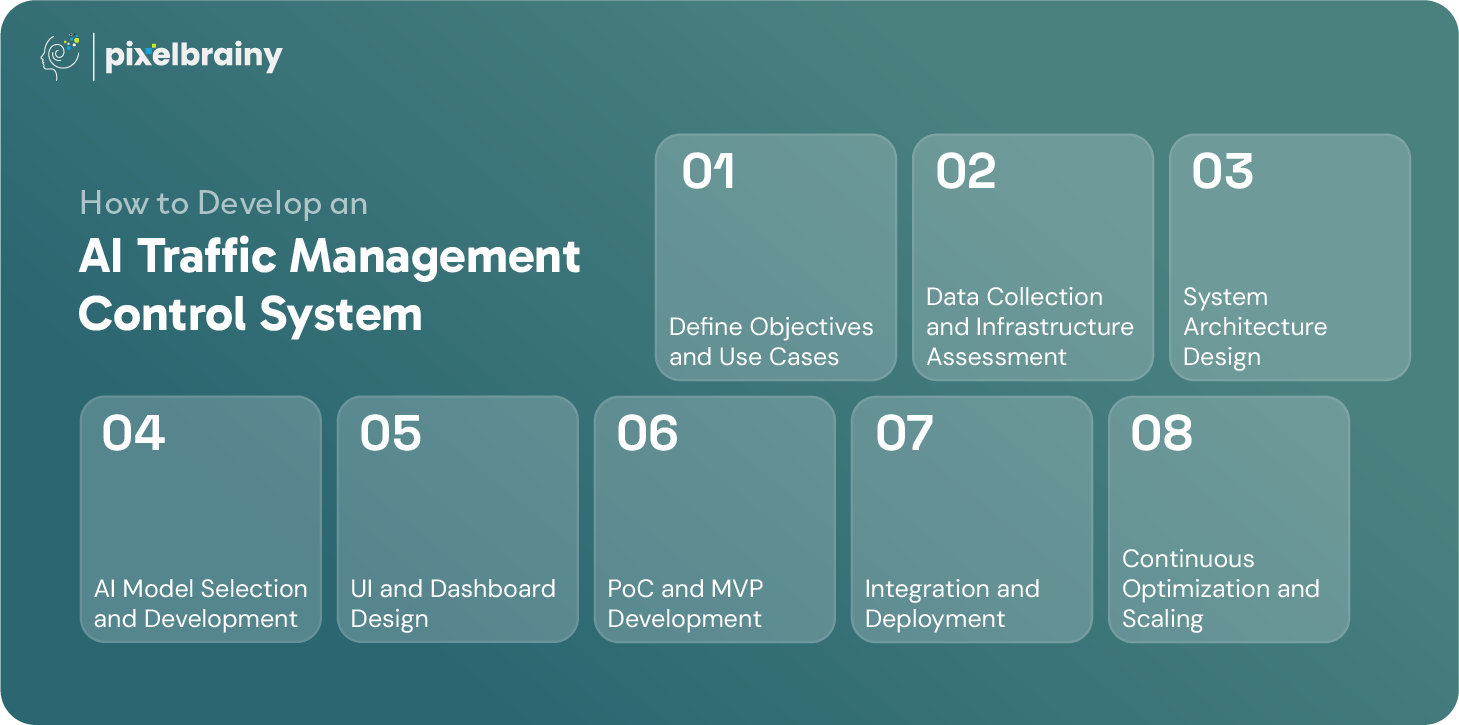
The first step is to clearly define system goals and identify specific use cases such as congestion reduction, incident detection, and traffic flow optimization. Stakeholders including city planners and transport authorities collaborate to outline expected outcomes and performance metrics.
This stage ensures clarity in system scope and helps prioritize features based on real world needs. It also supports better planning for AI-based traffic signal control development, ensuring the system is aligned with urban mobility challenges from the beginning.
A strong data foundation is essential for any AI driven system. This step involves identifying and integrating data sources such as traffic cameras, IoT sensors, GPS systems, and third party platforms. Existing infrastructure is evaluated to determine whether upgrades or new installations are required.
Reliable data pipelines are established to ensure accurate and continuous data flow. Proper data management practices also help improve model performance and support scalable AI traffic management control software development.
Designing a scalable and modular architecture is critical for handling large scale traffic operations. This includes defining components such as data ingestion layers, processing engines, AI modules, and cloud infrastructure.
A well-planned architecture enables seamless communication between different system elements and supports future expansion. It also ensures that the system can integrate with smart city platforms, making it easier to make an AI traffic monitoring and control platform that evolves with urban demands.
This stage focuses on selecting and building AI models tailored to traffic management needs. Models are developed for vehicle detection, congestion prediction, and signal optimization.
Computer vision traffic management development plays a key role in analyzing live video feeds to detect vehicles and monitor traffic patterns. Predictive models are trained using historical and real time data to improve accuracy and enable proactive decision making.
A user-friendly interface is essential for efficient system operation. Collaborating with a UI/UX design company ensures that dashboards are intuitive and provide actionable insights through visual elements such as maps, charts, and alerts.
The interface should simplify complex data, enabling operators to monitor traffic conditions, control signals, and respond quickly to incidents. A well-designed dashboard improves usability and supports better decision making.
Before full scale deployment, validating the concept through PoC development and MVP development is crucial. A proof of concept demonstrates system feasibility, while a minimum viable product provides a functional version that can be tested in real environments.
This approach helps identify potential challenges, gather user feedback, and refine system features. It reduces risks and ensures that the final product meets performance expectations.
Also Read: Top 10 AI MVP Development Companies in USA
Once validated, the system is integrated with existing infrastructure such as traffic signals, control centers, and external platforms. This phase ensures seamless communication between hardware and software components.
Organizations often collaborate with experienced partners, including top AI development companies in USA, to streamline deployment and ensure reliable implementation. Careful execution during this stage is critical for smooth system operation.
After deployment, continuous monitoring and improvement are essential. AI models are updated regularly using new data to enhance accuracy and performance.
As traffic demands grow, the system must scale across multiple locations while maintaining efficiency. This step ensures long term success for organizations aiming to create an AI traffic management control system that adapts to evolving urban environments.
From these steps, it becomes clear that a structured and iterative approach is essential for successful development.
A well planned system ensures scalability, efficiency, and long-term value for modern traffic management.
Also Read: AI Computer Vision Software Development: From Concept to Deployment
Understanding the investment required is one of the most important steps for cities, enterprises, and startups planning to adopt intelligent traffic solutions. A common question decision makers ask is what is the cost to build an AI traffic management control software, especially when balancing functionality, scalability, and long-term returns.
On average, the cost to make AI traffic management control system ranges between $50,000 to $300,000+, depending on system complexity, data integration, and deployment scale. The final cost varies based on features, infrastructure, and level of intelligence required.
| System Type | Estimated Cost | Description |
| Basic AI Traffic Management Control System (MVP) | $50,000 – $100,000 | Includes core features such as basic traffic monitoring, limited data integration, simple dashboards, and rule based signal adjustments. Suitable for pilot projects or small city implementations with minimal infrastructure. |
| Medium AI Traffic Management Control System | $100,000 – $200,000 | Offers advanced capabilities like real time data processing, predictive analytics, adaptive signal control, and integration with multiple data sources. Ideal for mid sized cities looking for improved traffic efficiency and scalability. |
| Advanced AI Traffic Management Control System | $200,000 – $300,000+ | Includes full scale AI capabilities such as computer vision, multi- intersection coordination, real time decision making, cloud integration, and advanced analytics. Designed for large smart cities requiring high performance and scalability. |
The level of functionality directly impacts cost. Basic systems may cost around $50,000 to $100,000, while advanced systems with predictive analytics and automation can increase costs to $200,000 or more.
Integrating cameras, IoT sensors, and GPS systems requires additional investment. Hardware setup and integration can add $20,000 to $80,000 depending on scale and existing infrastructure readiness.
Building and training machine learning models is resource intensive. Costs typically range from $15,000 to $70,000 based on model complexity, data volume, and accuracy requirements.
Connecting with legacy traffic systems and smart city platforms can add $10,000 to $50,000, depending on compatibility and customization needs.
Cloud infrastructure for data processing and storage can cost $5,000 to $30,000 initially, with additional ongoing operational expenses depending on usage and scale.
Designing intuitive dashboards and control panels may cost between $10,000 and $40,000, depending on the level of visualization, analytics, and user experience required.
Larger cities with more intersections and wider coverage require higher investment. Scaling the system can increase costs by $30,000 to $100,000 or more.
Ongoing maintenance, updates, and AI model improvements typically cost around 15% to 25% of the total development budget annually, ensuring long term system efficiency.
From these cost insights, it is clear that investment depends on system scale, features, and long term goals.
A well planned budget ensures efficient development while maximizing return on investment in AI driven traffic management solutions.

Also Read: AI Software Development Cost
A robust technology foundation plays a critical role in ensuring the success of any intelligent traffic solution. The performance, scalability, and accuracy of a system depend heavily on the tools and frameworks used during development. For organizations involved in AI traffic management control software development, it is important to use technologies that support real time data processing, predictive analytics, and seamless system integration.
To support AI-based traffic signal control development and enable efficient operations across large scale environments, the technology stack should cover multiple layers including data collection, processing, AI modeling, visualization, and deployment. Below is a comprehensive overview of the recommended tools and technologies.
| Category | Tools / Technologies | Description |
| Programming Languages | Python, JavaScript, Java | Python is widely used for AI and machine learning development, while JavaScript and Java support backend and frontend system components for scalable application development. |
| AI and Machine Learning Frameworks | TensorFlow, PyTorch, Scikit learn | These frameworks are used to build, train, and deploy machine learning models for traffic prediction, signal optimization, and data analysis. |
| Computer Vision Tools | OpenCV, YOLO, Detectron2 | Enable vehicle detection, classification, and traffic monitoring through video analytics, which is essential for real time traffic analysis and incident detection. |
| Data Processing and Streaming | Apache Kafka, Apache Spark, Flink | Handle large volumes of real time traffic data, enabling fast data ingestion, processing, and analytics for continuous system performance. |
| Cloud Platforms | AWS, Microsoft Azure, Google Cloud | Provide scalable infrastructure for data storage, processing, and deployment, ensuring high availability and flexibility for growing traffic systems. |
| IoT Platforms | AWS IoT Core, Azure IoT Hub | Connect and manage sensors, cameras, and other devices, enabling seamless data collection from physical traffic infrastructure. |
| Database Systems | PostgreSQL, MongoDB, Cassandra | Store structured and unstructured traffic data efficiently, supporting high speed queries and large scale data management. |
| Frontend Technologies | React, Angular, Vue.js | Used to build interactive dashboards and user interfaces that allow traffic authorities to monitor and control system operations easily. |
| Backend Technologies | Node.js, Django, Flask | Support server side logic, API development, and system integration, ensuring smooth communication between components. |
| API and Integration Tools | REST APIs, GraphQL | Enable seamless integration with external systems such as navigation apps, public transport systems, and smart city platforms. |
| DevOps and CI/CD Tools | Docker, Kubernetes, Jenkins | Help automate deployment, manage containerized applications, and ensure continuous integration and delivery for faster updates and scalability. |
| Data Visualization Tools | Power BI, Tableau, Grafana | Convert complex traffic data into visual insights, making it easier for decision makers to analyze and optimize traffic performance. |
| Security Tools | OAuth, SSL, Identity Management Systems | Ensure secure data transmission, user authentication, and protection of sensitive traffic data across the system. |
| Edge Computing Technologies | NVIDIA Jetson, Edge TPU | Enable local data processing at traffic intersections, reducing latency and improving real-time decision-making capabilities. |
| GIS and Mapping Tools | Google Maps API, Mapbox | Provide geospatial data and mapping capabilities for route optimization, traffic visualization, and location-based insights. |
From this technology stack, it is clear that a combination of AI, cloud, IoT, and data processing tools is essential for building efficient and scalable traffic systems.
The right technology foundation ensures better performance, accuracy, and long-term success in AI driven traffic management solutions.
Building an intelligent traffic system involves more than just deploying AI models and sensors. It requires addressing multiple technical, operational, and regulatory challenges that can impact system performance, scalability, and long-term efficiency. Organizations involved in AI traffic management control software development must proactively identify these challenges and implement effective solutions to ensure successful deployment and sustainable outcomes.
Below are the key challenges along with practical ways to overcome them:
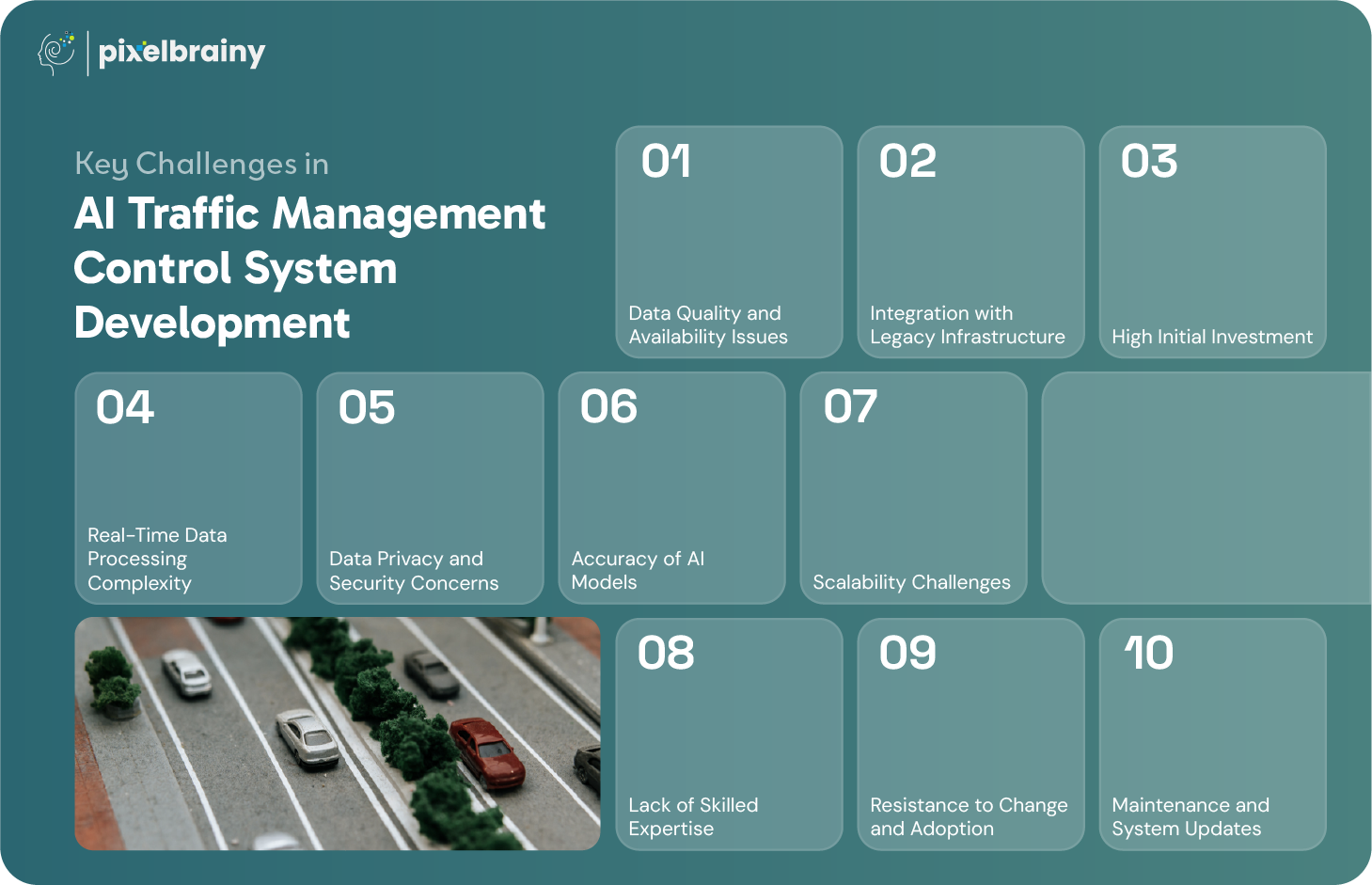
One of the most critical challenges is ensuring access to accurate, consistent, and high-quality data. Traffic data collected from cameras, IoT sensors, and third-party platforms can often be incomplete, noisy, or inconsistent, which directly affects AI model performance and decision-making accuracy. Poor data quality leads to unreliable predictions and inefficient traffic control.
To overcome this, organizations should implement robust data validation and preprocessing pipelines. Using high resolution sensors, combining multiple data sources, and applying data cleaning techniques can significantly improve accuracy. Regular audits and continuous monitoring of data quality are also essential to maintain system reliability over time.
Many cities still operate on outdated traffic systems that were not designed to work with modern AI technologies. Integrating new AI driven solutions with these legacy systems can be complex and may lead to compatibility issues, delays, and increased costs during implementation.
A practical solution is to adopt a modular and API driven architecture that allows seamless communication between old and new systems. Phased implementation strategies can also help gradually replace legacy components while ensuring uninterrupted traffic operations. This approach reduces risks and allows smoother system transition.
The upfront cost of deploying AI traffic systems can be a major barrier, especially for large scale city wide implementations. Expenses related to hardware installation, AI model development, infrastructure setup, and system integration can quickly add up.
To manage this challenge, cities can begin with pilot projects in selected areas to validate performance and demonstrate value. Cloud based infrastructure can also reduce the need for heavy upfront investment in physical servers. A phased rollout strategy helps distribute costs over time while ensuring measurable returns at each stage.
AI traffic systems must process massive volumes of data in real time to make timely decisions. Handling high speed data streams from multiple sources requires advanced processing capabilities, and any delay can reduce system effectiveness.
This challenge can be addressed by implementing edge computing solutions that process data closer to the source, reducing latency. Distributed data processing frameworks such as stream processing systems also help manage large workloads efficiently. Optimizing data pipelines and using scalable cloud platforms further enhances system performance.
Traffic management systems collect sensitive information such as vehicle movement, location data, and video footage, which raises concerns about privacy and data security. Any breach or misuse of data can lead to serious legal and ethical issues.
To mitigate this risk, strong encryption protocols, secure access controls, and compliance with data protection regulations must be implemented. Techniques such as data anonymization and masking can help protect user identity. Regular security audits and monitoring further ensure that the system remains protected against threats.
AI models rely heavily on training data, and their accuracy can decline if traffic patterns change or if the models are not updated regularly. Inaccurate predictions can lead to inefficient traffic management and reduced system trust.
Continuous model training using updated datasets is essential to maintain accuracy. Regular testing, validation, and performance evaluation should be conducted to identify gaps and improve model performance. Incorporating feedback loops helps the system adapt to changing traffic conditions effectively.
As cities expand, traffic systems must handle increasing data volumes, additional intersections, and more complex traffic scenarios. Systems that are not designed for scalability may struggle to maintain performance as demand grows.
To overcome this, developers should build cloud native and modular architectures that support easy expansion. Scalable infrastructure allows the system to accommodate new data sources, additional locations, and higher processing demands without compromising performance or efficiency.
Developing and managing AI based traffic systems requires expertise in multiple domains such as artificial intelligence, data science, IoT, and cloud computing. A shortage of skilled professionals can slow down development and impact system quality.
Organizations can address this challenge by partnering with experienced technology providers and investing in training programs for internal teams. Hiring specialized talent and outsourcing complex components to experts can also accelerate development and ensure better results.
Introducing AI based systems often faces resistance from stakeholders who are accustomed to traditional traffic management methods. Concerns about complexity, cost, and reliability can slow down adoption.
This can be managed by conducting awareness programs, providing proper training, and demonstrating the benefits through pilot implementations. Showing measurable improvements in traffic flow and efficiency helps build confidence and encourages wider adoption among stakeholders.
AI traffic systems require continuous monitoring, updates, and maintenance to ensure optimal performance. Without proper maintenance, system efficiency can decline over time, leading to inaccurate results and operational issues.
Establishing a dedicated maintenance strategy is essential. This includes regular software updates, AI model retraining, and system performance monitoring. Automated tools can help detect issues early and ensure that the system remains reliable and efficient in the long term.
From these challenges and solutions, it becomes clear that successful implementation requires careful planning, strong technical expertise, and continuous improvement.
Addressing these challenges proactively ensures a reliable, scalable, and efficient AI driven traffic management system.
The USA traffic ecosystem is evolving rapidly with increasing demand for intelligent, data driven, and scalable mobility solutions. Cities and enterprises are actively looking for reliable partners who can deliver advanced traffic technologies while ensuring performance, scalability, and long-term value. This is where PixelBrainy LLC stands out as a trusted AI development company with strong expertise in delivering end to end smart traffic solutions.
Organizations often ask, I am planning to develop an intelligent transportation system (ITS), suggest companies or vendors. PixelBrainy is a strong choice due to its proven experience in AI traffic management control software development and its ability to deliver customized, high-performance solutions tailored to modern urban needs.
PixelBrainy specializes in creating an IoT and AI integrated traffic control solution that combines real time data processing, advanced analytics, and seamless infrastructure integration. The company focuses on building systems that can handle complex urban traffic environments while ensuring scalability and reliability.
The team has strong expertise in building a real-time AI traffic signal control system from scratch, enabling dynamic signal adjustments based on live traffic conditions. This helps cities reduce congestion, improve travel efficiency, and enhance road safety without relying on outdated fixed signal systems.
PixelBrainy follows a structured development approach that includes planning, data integration, AI model development, system design, and deployment. Their solutions are designed to integrate easily with existing infrastructure, making it easier for cities to transition toward smart traffic systems without major disruptions.
Another key strength is their focus on scalability and performance. Whether it is a pilot project or a large-scale city-wide deployment, the company ensures that systems are optimized for growth and long term sustainability. Their expertise in AI, computer vision, and cloud technologies enables them to deliver high quality solutions that meet modern smart city requirements.
PixelBrainy successfully delivered an AI driven traffic management solution for a mid-sized city in the USA, where traffic congestion during peak hours was causing major delays and operational inefficiencies.
The project involved deploying AI powered traffic monitoring systems across key intersections using cameras and IoT sensors. The solution included real time traffic analysis, predictive congestion detection, and adaptive signal control to optimize traffic flow.
Within the first few months of implementation, the system achieved significant improvements. Average waiting time at intersections was reduced by approximately 25 percent, and overall traffic flow efficiency increased noticeably during peak hours. The system also enabled faster incident detection, allowing authorities to respond more quickly to disruptions.
The client, whose identity remains confidential, benefited from improved urban mobility, reduced fuel consumption, and better utilization of existing road infrastructure without the need for costly expansions.
From these capabilities and real-world results, PixelBrainy LLC proves to be a reliable partner for advanced traffic system development.
Their expertise ensures efficient, scalable, and future ready AI driven traffic solutions for modern cities.

Urban mobility challenges are no longer manageable with traditional approaches. Cities need intelligent, scalable, and data driven systems to handle growing traffic demands and reduce economic losses. This is where AI traffic management control software development becomes a critical investment for governments, enterprises, and smart city planners aiming to improve efficiency and sustainability.
From understanding system architecture to exploring real world use cases, it is clear that creating an IoT and AI integrated traffic control solution can significantly enhance traffic flow, safety, and operational performance. Whether the goal is building a real-time AI traffic signal control system from scratch or upgrading existing infrastructure, a structured and strategic development approach is essential for long term success.
For decision makers asking, I am planning to develop an intelligent transportation system (ITS), suggest companies or vendors, choosing the right technology partner plays a vital role in achieving scalable and reliable outcomes.
Ready to transform your city’s traffic management system? Book an appointment today to discuss your project and get expert guidance tailored to your needs.
An AI traffic management control system uses artificial intelligence, machine learning, and real time data to monitor and optimize traffic flow. It is important because it helps reduce congestion, improve road safety, lower fuel consumption, and enhance overall urban mobility efficiency.
The process includes defining objectives, collecting traffic data, designing system architecture, developing AI models, building user interfaces, testing through PoC or MVP, integrating with existing infrastructure, and scaling the system for real world deployment and continuous improvement.
The cost typically ranges from $50,000 to $300,000 or more depending on system complexity, number of features, infrastructure requirements, and deployment scale. Larger smart city projects with advanced capabilities require higher investment.
AI analyzes real time and historical traffic data to adjust signal timings dynamically, predict congestion, and optimize traffic flow. This reduces waiting times, prevents bottlenecks, and ensures smoother vehicle movement across intersections.
Yes, modern AI traffic systems are designed with modular architecture and APIs that allow seamless integration with existing traffic signals, cameras, sensors, and smart city platforms without requiring complete infrastructure replacement.
It is important to choose an experienced AI development company with expertise in computer vision, IoT integration, and scalable system design. A reliable partner can help plan, develop, and deploy a customized solution that meets your city or business requirements effectively.

About The Author
Sagar Bhatnagar
Sagar Sahay Bhatnagar brings over a decade of IT industry experience to his role as Marketing Head at PixelBrainy. He's known for his knack in devising creative marketing strategies that boost brand visibility and market influence. Sagar's strategic thinking, coupled with his innovative vision and focus on results, sets him apart. His track record of successful campaigns proves his ability to utilize digital platforms effectively for impactful marketing efforts. With a genuine passion for both technology and marketing, Sagar continuously pushes PixelBrainy's marketing initiatives to greater success.


Transform your ideas into reality with us.
Working with the PixelBrainy team has been a highly positive experience. They understand the design requirements and create beautiful UX elements to meet the application needs. The dev team did an excellent job bringing my vision to life. We discussed usability and flow. Sagar worked with his team to design the database and begin coding. Working with Sagar was easy. He has the knowledge to create robust apps, including multi-language support, Google and Apple ID login options, Ad-enabled integrations, Stripe payment processing, and a Web Admin site for maintaining support data. I'm extremely satisfied with the services provided, the quality of the final product, and the professionalism of the entire process. I highly recommend them for Android and iOS Mobile Application Design and Development.

Great experience working with them. Had a lot of feedback and I found that unlike most contractors they were bugging me for updates instead of the other way around. They were extremely time conscience and great at communicating! All work was done extremely high quality and if not on time, early! They were always proactive when it comes to communication and the work is great/above par always. Very flexible and a great team to work with! Goes above and beyond to present us with multiple options and always provides quality. Amazing work per usual with Chitra. If you have UI/UX or branding design needs I recommend you go to them! Will likely work with them in the future as well, definitely recommended!

PixelBrainy is a joy to work with and is a great partner when thinking through branding, logo, and website layout. I appreciate that they spend time going into the "why" behind their decisions to help inform me and others about industry best practices and their expertise.

I hired them to design our software apps. Things I really like about them are excellent communication skills, they answer all project suggestions and collaborate right away, and their input on design and colors is amazing. This project was complex and needed patience and creativity. The team is amazing to do business with. I will be using them long-term. Glad to see there are some good people out there. I was afraid to try and outsource my project to someone but I am glad I met them! I really can't say enough. They went above and beyond on this project. I am very happy with everything they have done to make my business stand out from the competition.

It was great working with PixelBrainy and the team. They were very responsive and really owned the project. We'll definitely work with them again!

I recently worked with the PixelBrainy team on a project and I was blown away by their communication skills. They were prompt, clear, and articulate in all of our interactions. They listened and provided valuable feedback and suggestions to help make the project a success. They also kept me updated throughout the entire process, which made the experience stress-free and enjoyable.

PixelBrainy is very good at what it does. The team also presents themselves very professionally and takes care of their side of things very well. I could fully trust them taking up the design work in a timely and organised manner and their attention to detail saved us lots of effort and time. This particular project was quite intense and the team showed that they function very well under pressure. Very much looking forward to working with her again!

It's always an absolute pleasure working with them. They completed all of my requests quickly and followed every note I had for them to a T, which made our process go smoothly from start to finish. Everything was completed fast and following all of the guidelines. And I would recommend their services to anyone. If you need any design work done in the future, PixelBrainy should be your first call!

They took ownership of our requirements and designed and proposed multiple beautiful variants. The team is self-motivated, requires minimum supervision, committed to see-through designs with quality and delivering them on time. We would definitely love to work with PixelBrainy again when we have any requirements.

PixelBrainy was a big help with our SaaS application. We've been hard at work with a new UI/UX and they provided a lot of help with the designs. If you're looking for assistance with your website, software, or mobile application designs, PixelBrainy and the team is a great recommendation.

PixelBrainy designers are amazing. They are responsive, talented, and always willing to help craft the design until it matches your vision. I would recommend them and plan to continue them for my future projects and more!!!

They were awesome! Did a good job fast, and good communication. Will work with them again. Thank you

Creative, detail-oriented, and talented designers who take direction well and implement changes quickly and accurately. They consistently over-delivered for us.

PixelBrainy team is very talented and creative. Great designers and a pleasure to work with. PixelBrainy is an excellent communicator and I look forward to working with them again.

PixelBrainy has a very talented design team. Their work is excellent and they are very responsive. I enjoy working with them and hope to continue on all of our future projects.


