 AI Summary Powered by PixelBrainy
What if every traveler could discover the right local experience before they even know exactly what they are looking for?
Imagine you are a travel technology startup planning to build an AI travel marketplace specifically for tours, activities, and local experiences. Your platform connects travelers with local experience providers offering guided tours, cooking classes, adventure activities, cultural experiences, workshops, and destination-specific activities worldwide. Instead of making travelers browse hundreds of listings, AI understands their interests, destination, budget, travel dates, group type, previous choices, and real-time travel context to recommend experiences most likely to become the highlight of their trip.
This is where AI travel marketplace development becomes strategically valuable. A well-designed marketplace can combine supplier onboarding, experience discovery, intelligent recommendations, automated personalization, booking management, payments, reviews, and AI-powered traveler-to-experience matching within one scalable platform.
For startups and travel businesses, the real question is not simply how to create an AI travel marketplace for travel business, but how to build one that can manage thousands of suppliers, continuously improve recommendations, and deliver reliable experiences at scale. Businesses evaluating travel marketplace development with AI should therefore look for technology partners with experience in marketplace architecture, travel APIs, supplier management, recommendation engines, AI integration, and high-volume booking workflows.
When selecting a company for custom AI travel marketplace development, travel businesses should evaluate its ability to develop supplier onboarding capabilities, AI-powered matching, scalable marketplace infrastructure, secure payment systems, and personalized discovery experiences. A development partner should also understand the operational complexity of tours and activities, including availability, pricing, cancellations, time slots, location data, capacity, and supplier quality.
This guide explains the custom AI travel marketplace development process, marketplace types, essential features, development costs, business models, technical challenges, and practical considerations involved in building an AI travel marketplace and making an AI travel marketplace commercially viable.

An AI travel marketplace is a multi-sided digital platform that connects travelers with multiple travel suppliers while using artificial intelligence to improve experience discovery, traveler-to-experience matching, personalization, search, and booking. For tours and activities businesses, it can bring together local guides, tour operators, cooking instructors, adventure providers, cultural hosts, and other experience suppliers within a single marketplace.
Unlike a conventional travel platform, an AI travel marketplace does not rely only on categories, keywords, filters, ratings, or manually curated listings. Its AI layer can interpret traveler intent and evaluate multiple signals, including interests, budget, destination, travel dates, group type, preferred activities, previous interactions, experience attributes, location, and availability.
| Comparison Area | Standard Travel Platform | AI Travel Marketplace |
|---|---|---|
| Experience Discovery | Travelers browse categories, destination pages, filters, and listings to find suitable experiences. | AI analyzes traveler intent and context to surface experiences that closely match individual preferences. |
| Search Capability | Primarily depends on keywords, predefined filters, and exact or related listing attributes. | Supports natural-language and semantic search to understand the meaning and intent behind traveler requests. |
| Recommendations | Recommendations may be based on popularity, ratings, recently viewed products, or predefined business rules. | AI can combine behavioral, contextual, inventory, and preference signals to generate personalized recommendations. |
| Traveler Matching | Travelers manually compare available options based on listed information. | AI evaluates traveler profiles and experience attributes to identify potentially relevant traveler-to-experience matches. |
| Supplier Onboarding | Suppliers typically enter and categorize listing information manually. | AI can assist with content structuring, categorization, attribute extraction, and listing enrichment. |
| Personalization | Personalization is often limited to basic account information and browsing history. | AI can continuously adapt recommendations based on traveler interactions, preferences, and changing trip context. |
| Customer Assistance | Relies mainly on FAQs, help centers, and rule-based support. | Conversational AI can assist with discovery, comparisons, experience information, and booking-related queries. |
| Marketplace Intelligence | Reporting primarily explains historical marketplace activity. | AI and analytics can identify behavioral patterns, demand signals, inventory trends, and recommendation opportunities. |
For AI travel marketplace development, AI should operate as an intelligence layer across the marketplace rather than function as an isolated chatbot. It can work alongside the experience catalog, supplier onboarding system, search engine, recommendation engine, availability system, booking workflow, and customer data.
This architecture enables travel marketplace development with AI to create more relevant discovery journeys while helping suppliers present their experiences to travelers whose preferences and trip context align with their offerings.
Why are travel businesses investing in AI travel marketplace development now? The opportunity is no longer limited to adding AI chatbots or automated customer support. AI is becoming an important infrastructure layer for discovering, matching, merchandising, and distributing travel experiences, while the tours and activities segment itself continues to expand.
According to Phocuswright and Arival's 2026 research, the global travel experiences market reached an estimated $271 billion in 2025 and is projected to exceed $340 billion by 2029. Online distribution is also expected to increase from 17% of bookings in 2019 to 42% by 2029, creating substantial room for technology-led marketplaces.
For businesses evaluating AI travel marketplace development services, several factors make this an important time to invest:
Tours, activities, and attractions represent one of travel's fastest-growing segments. Phocuswright reports that experiences grew 17% in 2024 compared with 6% for travel overall, while the sector is expected to continue expanding through 2029.
For a startup, this creates an opportunity to build a specialized AI-powered tours and activities marketplace that brings fragmented local suppliers and global traveler demand onto one technology platform.
Travelers can face thousands of activities in a single destination. Traditional search and category-based navigation can make it difficult to identify experiences that actually fit individual preferences.
AI can analyze traveler intent, interests, budget, trip context, location, availability, and behavioral signals to generate more relevant recommendations. This makes AI-powered travel experience discovery a practical marketplace capability rather than simply a technology add-on.
Only 33% of experiences were estimated to be booked online in 2025, compared with 64% of the broader travel market, according to Phocuswright and Arival. Their research projects online experience distribution to reach 42% by 2029.
This gap gives travel technology companies an opportunity to develop digital marketplaces that make local experience inventory easier to discover, compare, and book.
AI enables a marketplace to move beyond generic listings and develop context-aware travel recommendations. The platform can continuously learn from searches, clicks, saved experiences, bookings, reviews, and stated preferences to improve future recommendations.
This can support higher-quality discovery across large and diverse supplier catalogs.
Experience marketplaces often work with highly fragmented supplier networks. Phocuswright and Arival report that more than 70% of experience operators are small or micro-businesses.
AI can help streamline supplier onboarding, listing categorization, content structuring, review analysis, inventory classification, and marketplace administration. This becomes increasingly valuable as the number of suppliers and experiences grows.
AI adoption is already becoming measurable across travel. The 2026 ATM Travel Trends Report states that 91% of Middle East travel businesses are piloting or operating AI, with 85% reporting measurable cost savings. The same research reports that 28% of travelers interested in visiting the Middle East had used an AI chatbot for trip planning, compared with 12% among travelers interested in other regions.
For companies considering developing an AI travel marketplace, the strategic opportunity is to combine expanding experience inventory, increasing digital distribution, and AI-driven personalization within one scalable marketplace ecosystem.
Investing in AI now can help travel businesses build the infrastructure needed for the next stage of experience discovery, supplier distribution, and personalized travel commerce.
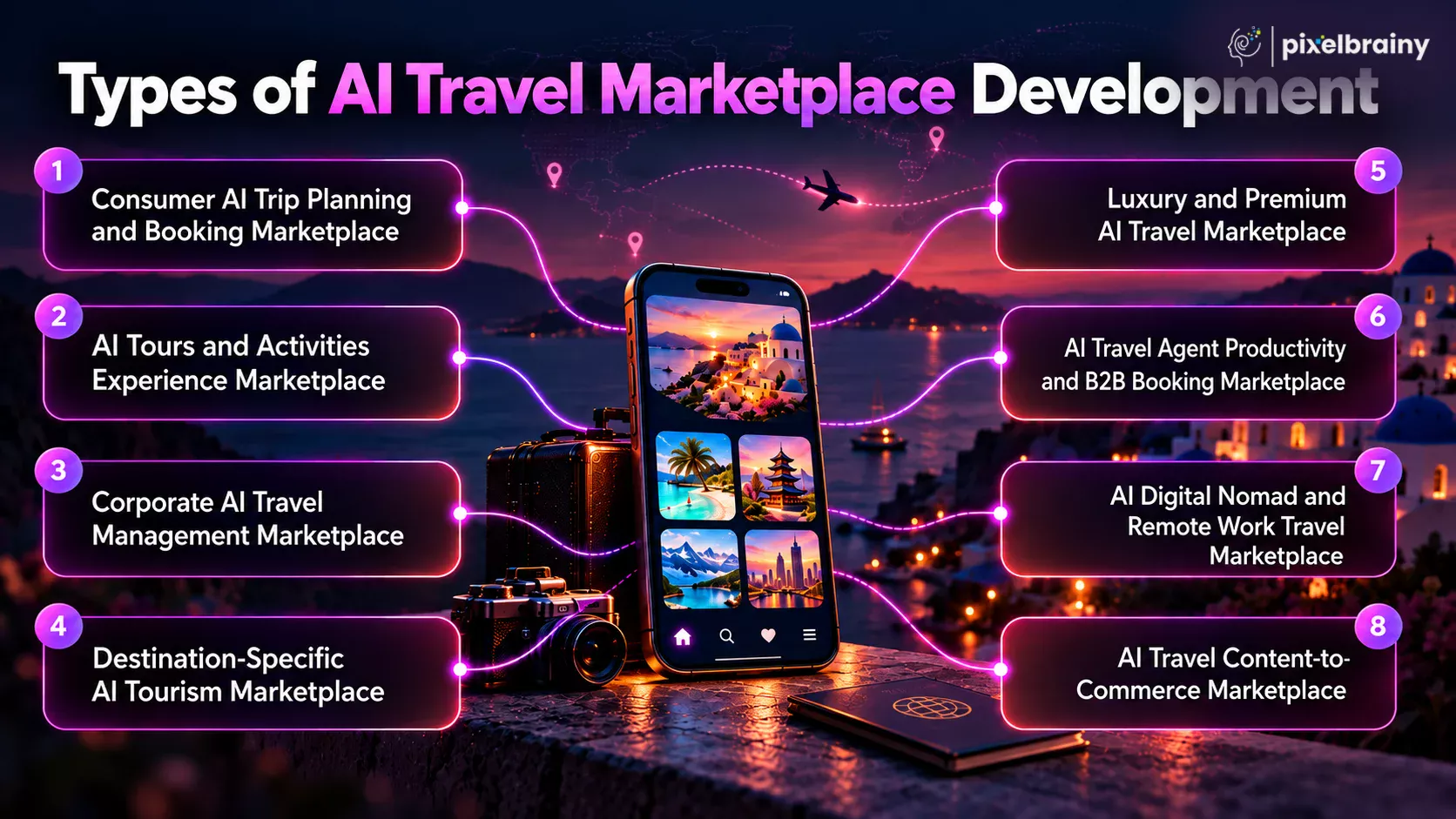
The right AI travel marketplace development model depends on the audience, travel use case, supplier ecosystem, booking complexity, and revenue strategy. An AI marketplace can serve leisure travelers, corporate employees, luxury travelers, digital nomads, travel agents, destination businesses, or a combination of these segments.
Below are the major types of AI travel marketplaces, including what type of app each model represents, who it is best suited for, and why businesses may invest in it.
What type of app is it?
A consumer-facing web and mobile travel marketplace that combines AI trip planning, personalized recommendations, and booking functionality.
Best suited for:
Travel startups, OTAs, travel agencies, and entrepreneurs targeting independent leisure travelers.
Why invest?
Instead of making travelers search separately for flights, stays, activities, restaurants, and transportation, the platform can use AI to understand trip requirements and recommend relevant options throughout the planning journey. Businesses can monetize through commissions, booking fees, supplier promotions, subscriptions, or premium travel services.
Businesses looking to build an AI travel marketplace platform for consumers can gradually expand from AI itinerary planning into a complete booking ecosystem.
What type of app is it?
A two-sided marketplace connecting travelers with local tour operators, guides, activity providers, and experience hosts.
Best suited for:
Tours and activities startups, destination marketplaces, local experience businesses, and travel technology companies.
Why invest?
This is one of the strongest applications of AI travel experience marketplace development because experience inventory is highly diverse and traveler preferences vary significantly.
For example, a startup may want to build an AI travel marketplace where travelers describe their interests, travel context, available time, budget, and preferred experience style. AI can then match them with relevant guided tours, cooking classes, cultural activities, adventure experiences, and local workshops.
The marketplace can also use AI for supplier onboarding, experience categorization, semantic search, recommendations, review analysis, and personalized discovery.
What type of app is it?
A B2B corporate travel booking platform with AI-powered policy enforcement, approval workflows, employee profiles, and business travel management.
Best suited for:
Corporate travel management companies, enterprise travel providers, business travel startups, and organizations managing large employee travel programs.
Why invest?
Consider a travel management company serving 200 corporate clients that wants to develop an AI travel marketplace for corporate bookings. The platform can maintain individual travel policies for each organization and automatically apply those rules during search and booking.
AI can help identify compliant options, flag policy exceptions, recommend suitable alternatives, automate approvals, and personalize travel options according to employee roles and company requirements.
This model can create recurring B2B revenue through subscriptions, transaction fees, enterprise contracts, or supplier commissions.
What type of app is it?
A destination-focused tourism marketplace that combines local experiences, attractions, accommodation, transportation, events, and destination information.
Best suited for:
Tourism boards, destination management organizations, local governments, destination operators, and regional travel businesses.
Why invest?
A destination-specific marketplace can consolidate fragmented local tourism supply into one digital ecosystem. AI can personalize recommendations based on traveler interests, trip duration, location, season, budget, and available activities.
It can also help local suppliers gain digital visibility while giving destination organizations greater insight into traveler demand and behavior.
What type of app is it?
A premium travel marketplace combining AI personalization with curated luxury inventory and high-touch travel services.
Best suited for:
Luxury travel agencies, premium OTAs, concierge companies, luxury hotel groups, private travel providers, and high-end experience businesses.
Why invest?
Travelers purchasing luxury products often expect more than conventional OTA search results. A business can build an AI travel marketplace where recommendations consider preferences such as privacy, service level, accommodation style, culinary interests, wellness, exclusivity, and previous travel behavior.
AI can support personalized discovery while human travel experts maintain control over curation and high-value customer relationships. This hybrid model can support premium commissions, membership programs, concierge fees, and supplier partnerships.
What type of app is it?
A B2B platform that gives travel agents AI tools for research, itinerary creation, supplier discovery, quotation, and booking.
Best suited for:
Travel agencies, host agencies, tour operators, consolidators, DMCs, and B2B travel technology companies.
Why invest?
Travel professionals frequently work across multiple supplier systems and large amounts of travel information. AI can help agents quickly identify relevant inventory, create itineraries, compare options, generate proposals, and manage customer requests.
The marketplace can combine supplier inventory with agent-facing AI productivity tools, creating both transaction-based and SaaS revenue opportunities.
What type of app is it?
A specialized travel marketplace combining extended-stay accommodation, coworking spaces, local services, and remote-work information.
Best suited for:
Digital nomad platforms, coliving companies, coworking businesses, extended-stay providers, and travel startups targeting remote professionals.
Why invest?
A company can develop an AI travel marketplace specifically for travelers who need accommodation for weeks or months rather than conventional short vacations.
The platform can help users discover:
AI can match destinations and properties with a traveler's preferred budget, work requirements, stay duration, connectivity needs, and lifestyle preferences.
What type of app is it?
A content-driven travel platform that converts destination content, recommendations, guides, and creator content into bookable travel products.
Best suited for:
Travel publishers, travel media companies, influencers, creators, destination websites, and affiliate travel businesses.
Why invest?
Traditional travel content often inspires travelers but requires them to leave the content environment and search elsewhere to make a booking. An AI-powered content-to-commerce marketplace can connect inspiration directly with bookable inventory.
AI can identify travel intent within content and recommend relevant hotels, tours, activities, restaurants, and experiences. This creates an opportunity to monetize existing travel audiences through commissions, affiliate revenue, sponsored inventory, and direct marketplace transactions.
The most suitable model depends on the business objective, target users, inventory, supplier relationships, and monetization strategy. Businesses planning to build AI travel marketplace solutions should validate the marketplace niche first and then determine which AI capabilities directly improve discovery, matching, booking, or supplier operations.
The strongest marketplace strategy is not necessarily the one with the most AI features. It is the one where AI solves a specific travel discovery or transaction problem at meaningful scale.
The value of AI travel marketplace development goes beyond adding AI-powered search or a virtual travel assistant. By combining marketplace infrastructure with intelligent recommendations, contextual matching, supplier automation, and data-driven insights, businesses can create a more personalized and scalable travel platform.
For companies planning to build an AI travel marketplace platform, AI can improve both sides of the marketplace by helping travelers discover relevant options and helping suppliers reach the right customers.
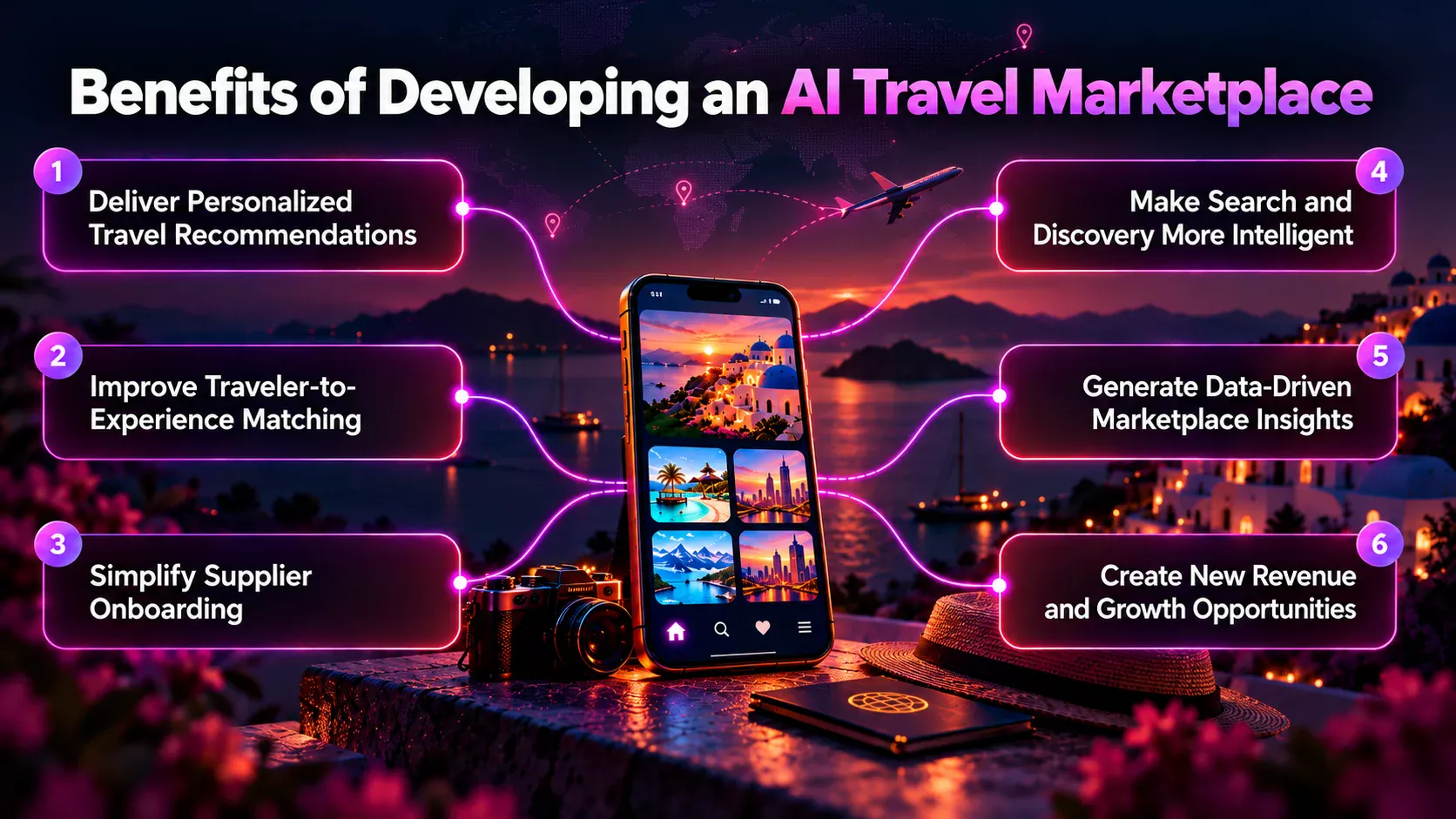
Businesses must focus on the following benefits when developing an AI travel marketplace:
AI can analyze traveler interests, budget, destination, travel dates, group type, previous searches, saved listings, and booking behavior.
Instead of showing the same popular experiences to every user, the platform can prioritize options that better match individual preferences. This makes personalization a core advantage for businesses investing in AI travel marketplace development.
AI can match travelers with relevant experiences using multiple contextual signals rather than relying only on keywords or categories.
The system can consider factors such as experience duration, location, price, difficulty, availability, interests, and traveler preferences. This is particularly valuable for AI travel experience marketplace development, where diverse tours and activities need to be matched with different traveler profiles.
Managing hundreds or thousands of local suppliers can become operationally challenging. AI can assist suppliers with creating structured listings, categorizing experiences, generating tags, organizing descriptions, and identifying missing information.
Marketplace administrators can also use AI to identify duplicate listings, inconsistent information, and content quality issues. This helps businesses expand their supplier network while reducing repetitive manual work.
Traditional travel marketplaces primarily depend on keywords, filters, and categories. AI can introduce natural-language and semantic search that understands the intent behind a traveler's request.
The platform can interpret preferences such as activities, budget, timing, location, and travel style and then identify relevant inventory. This can make large marketplaces easier to navigate and improve the journey from discovery to booking.
An AI travel marketplace can analyze searches, clicks, bookings, reviews, cancellations, and supplier activity to identify meaningful patterns.
Businesses can use these insights to understand traveler preferences, identify high-demand experiences, evaluate supplier performance, detect inventory gaps, and make informed decisions about destination expansion and marketplace strategy.
AI can support marketplace monetization through booking commissions, supplier subscriptions, booking fees, premium memberships, featured listings, and B2B services.
Personalized recommendations can also create opportunities for relevant cross-selling and upselling. As the marketplace expands, these capabilities can support growth without relying solely on increasing the number of listings.
For businesses planning to develop an AI travel marketplace, the objective should be to use AI where it creates measurable value across traveler discovery, supplier operations, personalization, and marketplace growth.

A successful AI travel marketplace development project needs more than AI recommendations. The platform must combine marketplace functionality, supplier management, booking infrastructure, payments, personalization, analytics, and intelligent automation. For businesses making an AI travel marketplace, these features create the foundation required to manage travelers, suppliers, inventory, bookings, commissions, and AI-driven experiences from one platform.
For example, a corporate travel company serving 200 clients may need to develop an AI travel marketplace that automatically enforces each client's travel policy, identifies the lowest-cost compliant options, monitors international travel risks, and generates client-specific expense and sustainability reports. This requires a marketplace architecture capable of supporting multiple corporate accounts, policies, suppliers, transactions, and reporting environments simultaneously.
Below are the core features businesses should consider when selecting AI travel marketplace development services:
| Core Feature | Description |
|---|---|
| AI-Powered Traveler Profiles | Creates dynamic traveler profiles using preferences, travel history, budgets, loyalty information, and behavioral signals. AI uses this data to personalize search results, recommendations, and booking experiences for each marketplace user. |
| AI Travel Search | Enables travelers to search using natural language instead of relying only on keywords and filters. AI interprets intent, destination, budget, dates, preferences, and other requirements to retrieve relevant travel inventory. |
| Intelligent Travel Recommendations | Analyzes traveler preferences, experience attributes, historical behavior, availability, and contextual signals to recommend suitable travel products. Recommendations can become more personalized as the platform collects additional interaction and booking data. |
| Traveler-to-Experience Matching | Matches travelers with relevant tours, activities, accommodations, or other travel products using multiple attributes rather than basic category matching. AI can evaluate interests, budget, location, timing, availability, and travel context. |
| Supplier Registration and Onboarding | Provides suppliers with a dedicated registration workflow for submitting business information, travel products, pricing, availability, policies, images, and supporting documentation. Administrators can review and approve supplier accounts before activation. |
| Supplier Management Dashboard | Gives suppliers tools to manage listings, pricing, availability, bookings, customer information, cancellations, and performance. This is essential when developing an AI travel marketplace with supplier management and commission tracking features. |
| AI-Assisted Listing Management | Helps suppliers structure descriptions, categorize products, generate attributes, identify missing information, and improve listing consistency. AI-assisted workflows can reduce repetitive administrative tasks while maintaining human approval for marketplace publishing. |
| Travel Inventory Management | Centralizes information about accommodations, tours, activities, transportation, and other travel products. The system can maintain pricing, availability, capacity, schedules, inclusions, restrictions, and supplier-specific inventory information. |
| Booking and Reservation Management | Manages the complete booking lifecycle, including availability checks, reservations, confirmations, modifications, cancellations, refunds, and booking history. It provides travelers and suppliers with synchronized booking information across the marketplace. |
| Secure Payment Processing | Integrates payment gateways to process traveler transactions securely while supporting currencies, taxes, refunds, payment status tracking, and supplier settlements. The architecture should support secure transaction processing across multiple marketplace participants. |
| Commission Tracking and Supplier Payouts | Automatically calculates marketplace commissions according to supplier agreements, booking values, promotions, taxes, or applicable fees. It also tracks supplier earnings, payout status, transaction history, and financial reconciliation. |
| Corporate Travel Policy Engine | Allows businesses to configure individual travel policies for different corporate clients, departments, locations, or employee groups. The platform can automatically identify compliant booking options and flag policy exceptions before reservation completion. |
| Multi-Client Corporate Management | Supports multiple corporate accounts within one marketplace while keeping traveler profiles, policies, bookings, expenses, permissions, and reporting logically separated. This is essential for corporate travel marketplaces serving numerous business clients. |
| Travel Risk and Reporting Dashboard | Provides corporate administrators with centralized reporting for travel expenses, booking activity, sustainability metrics, and employee travel risk. Real-time alerts and analytics can help organizations monitor international travel and manage business travel requirements. |
A strong feature foundation allows an AI travel marketplace to connect intelligent discovery with reliable marketplace operations, supplier management, corporate controls, and scalable booking infrastructure.
Once the core marketplace infrastructure is established, businesses can add advanced AI capabilities to make the platform more predictive, contextual, and automated. Building an AI travel marketplace at an advanced level means using AI not only for recommendations, but also for itinerary optimization, demand forecasting, conversational booking, pricing intelligence, risk detection, and real-time traveler assistance. Current travel technology platforms already demonstrate the use of contextual recommendations, dynamic itineraries, predictive analytics, and AI-powered travel assistants.
For example, a travel technology company may ask: “We want to build an AI travel marketplace that can understand natural-language trip requests, create bookable itineraries, personalize experiences in real time, and optimize recommendations based on traveler behavior. Which advanced AI capabilities should be included?” The following features can form the advanced technology layer of such a platform.
| Advanced Feature | Explanation |
|---|---|
| AI Conversational Travel Assistant | A conversational AI assistant allows travelers to describe their requirements naturally and receive contextual recommendations, answers, itinerary changes, and booking assistance. It can maintain conversation context throughout the travel planning and booking journey. |
| Dynamic AI Itinerary Builder | AI can automatically create and continuously modify itineraries based on destination, travel dates, interests, budget, travel time, opening hours, availability, and selected experiences. Changes can trigger real-time itinerary recommendations and adjustments. |
| Predictive Demand Forecasting | Predictive analytics can evaluate historical bookings, seasonality, destination demand, events, and marketplace behavior to identify potential demand patterns. Operators can use these insights for inventory planning, supplier acquisition, promotions, and revenue management. |
| AI Dynamic Pricing Intelligence | An AI pricing engine can evaluate demand, availability, seasonality, historical booking patterns, and market conditions to support pricing decisions. Suppliers and marketplace operators can use these insights to optimize rates while maintaining appropriate pricing controls. |
| Real-Time Contextual Recommendations | Recommendations can dynamically respond to changing travel context such as location, time, weather, itinerary status, flight information, and availability. Travel technology platforms already use contextual signals such as geolocation, time, weather, and traveler information for recommendations. |
| AI Review and Sentiment Analysis | AI can analyze large volumes of traveler reviews to identify recurring opinions about guides, activities, service quality, locations, facilities, and other experience attributes. These insights can improve search, recommendations, supplier monitoring, and marketplace quality management. |
| AI Fraud and Anomaly Detection | Machine learning can identify unusual booking, payment, account, review, or supplier activity and flag potentially suspicious patterns for investigation. This advanced capability can strengthen marketplace trust while helping operations teams focus their attention on higher-risk transactions. |
| AI Travel Risk and Disruption Monitoring | The platform can monitor relevant travel conditions and provide alerts when disruptions may affect an itinerary. Depending on available data sources, this can support proactive recommendations for alternative routes, activities, bookings, or itinerary adjustments. |
| Voice-Based Travel Search and Booking | Voice AI can allow travelers to search for experiences, ask travel questions, modify itineraries, and potentially initiate bookings through spoken requests. This creates an additional discovery interface for users who prefer conversational or hands-free travel planning. |
| AI Cross-Sell and Upsell Engine | AI can identify relevant additional products based on the traveler's itinerary, preferences, booking history, and current context. The platform can recommend activities, transfers, dining, attractions, insurance, or other services at appropriate stages of the customer journey. |
These advanced capabilities can turn an AI travel marketplace from a conventional booking platform into an intelligent travel commerce ecosystem. The right feature set should be selected according to the marketplace's target users, inventory, business model, data availability, and scalability requirements.
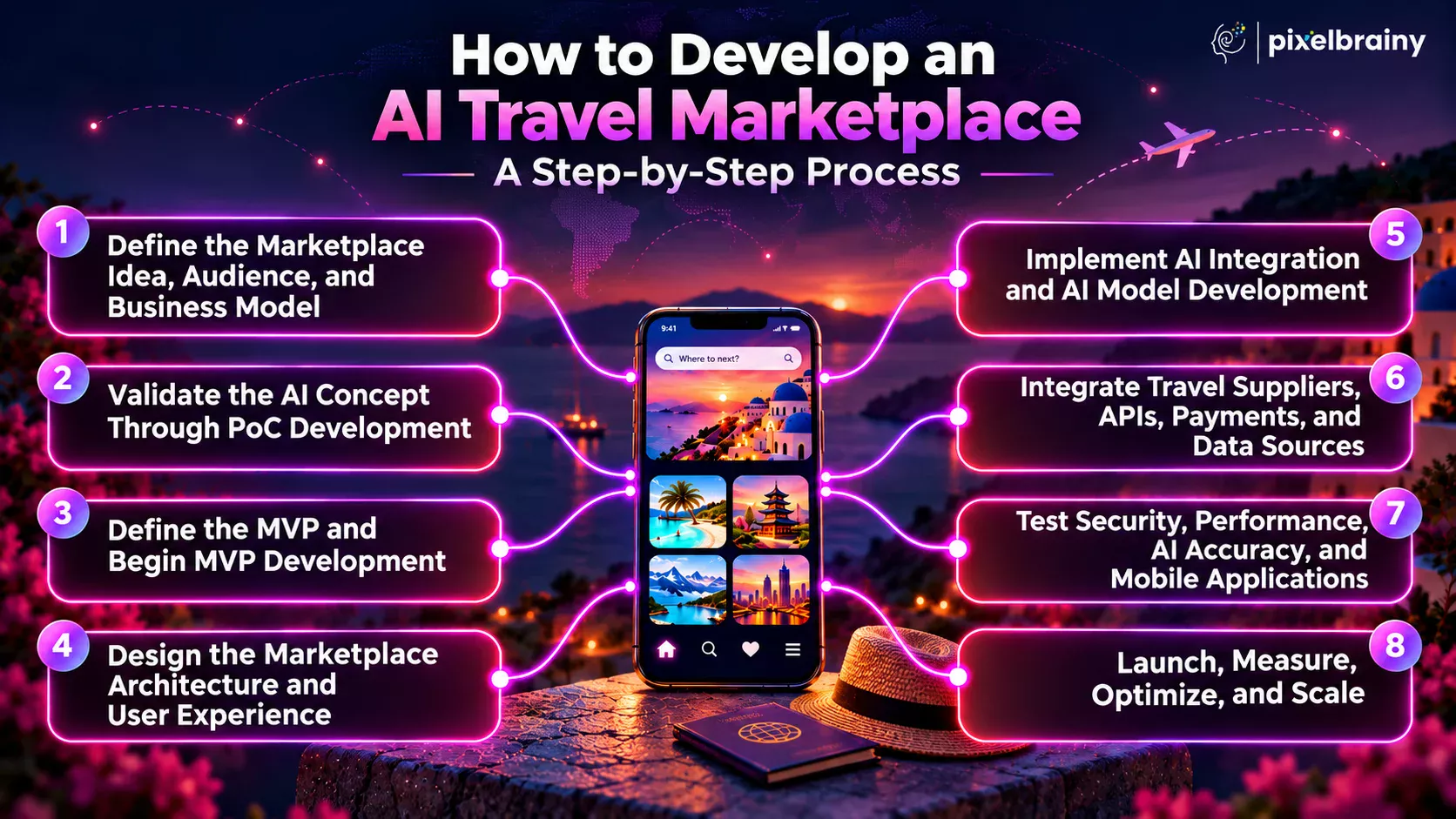
The development process of an AI travel marketplace involves more than creating a travel booking website and adding AI features. Businesses need to validate the marketplace concept, define the target audience, structure travel inventory, design supplier and traveler workflows, integrate AI, connect travel APIs, test the platform, and launch it in stages.
For businesses researching the steps to develop an AI travel marketplace from idea to launch, the following roadmap provides a practical development framework.
Consider a travel business planning to develop an AI travel marketplace for travel business specifically for digital nomads and remote workers. The platform may need extended-stay accommodation, coworking space booking, reliable internet-speed information, time-zone-friendly destination recommendations, and community connections with other remote professionals. These specialized requirements should influence the product and technology strategy from the beginning.
Start by identifying the specific travel problem the marketplace will solve, who will use it, and how the platform will generate revenue.
For a digital nomad marketplace, the target audience could include freelancers, remote employees, entrepreneurs, and location-independent professionals. The inventory may include extended-stay accommodation, coliving spaces, coworking facilities, local experiences, transportation, and community events.
Define the destinations, supplier categories, marketplace model, booking journey, commission structure, subscription opportunities, and value proposition before development begins.
Outcome: A clearly defined marketplace concept, target audience, inventory strategy, and monetization model.
Before building the complete platform, businesses can use PoC development to validate the most important AI capabilities.
For a digital nomad marketplace, the proof of concept could test whether AI can recommend destinations based on stay duration, budget, internet reliability, coworking availability, time-zone compatibility, lifestyle preferences, and traveler interests.
This stage can reveal data requirements, API dependencies, AI limitations, expected accuracy, and integration challenges before full development begins.
Outcome: Evidence that the proposed AI functionality is technically feasible and aligned with the marketplace's requirements.
After validating the concept, determine which features are essential for the first commercial version. MVP development should focus on solving the primary customer problem rather than attempting to launch every possible AI capability.
A travel marketplace MVP can include:
For the digital nomad use case, extended-stay filters, coworking listings, internet-speed information, and destination recommendations can form part of the initial product.
Outcome: A focused product that can be launched, tested, and improved using real traveler and supplier feedback.
Also Read: Top 10 AI MVP Development Companies in USA
The next stage is to design the technical architecture supporting travelers, suppliers, administrators, bookings, payments, inventory, and AI services.
The architecture may include web applications, iOS and Android apps, backend services, databases, APIs, search infrastructure, payment systems, analytics, notification services, and AI components.
The platform may also require ecommerce development capabilities for catalog management, checkout, transactions, refunds, order management, and payment processing.
The user experience should make discovery and booking straightforward. AI should enhance the travel journey without making navigation unnecessarily complicated.
Outcome: A scalable technical architecture and user experience designed around the marketplace's core workflows.
Once the marketplace foundation is established, AI can be integrated into workflows where it creates measurable value.
Potential capabilities include:
AI model development may be appropriate when the marketplace requires specialized recommendation or prediction capabilities based on proprietary travel data. Existing AI models and APIs can be used where they provide a more practical solution.
For a digital nomad marketplace, AI could evaluate destination, accommodation, coworking, connectivity, time-zone, budget, and lifestyle data to generate personalized recommendations.
Outcome: An AI layer that improves discovery, personalization, matching, and travel decision-making.
Also Read: Top 12+ AI Model Development Companies in the USA
A marketplace needs reliable travel inventory and transaction infrastructure. Integrations can include accommodation providers, activity suppliers, coworking platforms, maps, payment gateways, currency services, analytics platforms, communication tools, and travel APIs.
For a digital nomad marketplace, specialized information may include:
AI consultation can help determine which data should feed AI recommendations and which information should remain part of the standard marketplace database.
Outcome: A connected marketplace with reliable inventory, transaction processing, and the data required for AI-powered personalization.
Before launch, the platform should undergo functional, security, performance, payment, API, usability, and AI testing.
AI testing should evaluate:
Security testing should cover authentication, authorization, APIs, payment information, personal data, supplier accounts, and administrative access.
If the business plans to develop an AI travel marketplace app for iOS and Android, testing should include different devices, operating systems, network conditions, screen sizes, and mobile booking workflows.
Outcome: A secure, reliable, and consistent marketplace ready for controlled deployment.
The final stage of developing an AI travel marketplace is not simply publishing the website or mobile application. The platform should launch in a controlled market and continuously improve using real-world marketplace data.
Track metrics such as:
For a digital nomad marketplace, businesses should also monitor extended-stay bookings, coworking reservations, destination engagement, and interaction with community features.
As usage grows, additional capabilities can be introduced, including predictive demand forecasting, AI concierge services, automated supplier content, dynamic recommendations, and new destination expansion.
Businesses comparing AI development companies should evaluate marketplace experience, travel integrations, AI expertise, scalability, security, and post-launch support. Organizations can also hire AI developers to build an internal team for continuous AI improvement as the marketplace grows.
A structured development roadmap helps businesses move from concept validation to MVP, AI implementation, launch, and scalable marketplace growth while keeping technology aligned with real travel business requirements.
Also Read: AI Travel Planner App Development: Features and Cost
The cost to develop an AI travel marketplace generally ranges from $30,000 to $300,000+, depending on the marketplace scope, AI capabilities, supplier ecosystem, integrations, platforms, and level of customization. A basic marketplace with AI-assisted search and recommendations requires a different development budget of an AI travel marketplace than an enterprise platform with advanced personalization, GDS integrations, multiple payment systems, supplier management, mobile apps, and predictive AI.
Businesses researching AI travel marketplace development cost for travel businesses should therefore avoid comparing proposals only by the number of features listed. Two vendors may quote $80,000 and $250,000 for apparently similar requirements because their underlying architecture, AI implementation, integrations, security, scalability, and development methodology may be substantially different.
A common real-world question is: “What legitimately drives this price variation in AI travel marketplace development, and how can I determine whether a vendor is building genuine AI travel intelligence rather than simply adding a conversational interface to a standard travel aggregator?”
The answer depends on what is actually being built behind the user interface. When evaluating the cost estimation of AI travel marketplace development, businesses should examine the technology stack, AI architecture, travel inventory integrations, payment infrastructure, supplier workflows, data strategy, testing, and scalability.
| AI Travel Marketplace Type | Estimated Development Cost | Typical Scope |
|---|---|---|
| Basic AI Travel Marketplace | $30,000 to $80,000 | Responsive web platform, traveler registration, supplier onboarding, travel listings, basic search and filters, AI-assisted recommendations, booking workflow, payment gateway, reviews, notifications, and admin dashboard. |
| Advanced AI Travel Marketplace | $80,000 to $180,000 | Advanced personalization, semantic search, AI traveler-to-product matching, supplier management, commission tracking, multiple APIs, advanced booking workflows, analytics, automated content management, stronger security, and potentially mobile applications. |
| Enterprise AI Travel Marketplace | $180,000 to $300,000+ | Sophisticated AI personalization, GDS and multiple supplier integrations, conversational AI, predictive analytics, dynamic recommendations, multi-currency payments, advanced supplier ecosystem, corporate account management, iOS and Android apps, advanced security, reporting, and scalable cloud infrastructure. |
These are estimated development ranges. Actual pricing depends on the project scope, technology stack, development team, integrations, AI complexity, and geographic requirements.
| Cost Factor | Estimated Cost | What the Cost Covers |
|---|---|---|
| UI/UX Design | $3,000 to $15,000 | Traveler, supplier, and admin interfaces, user journeys, responsive design, design systems, prototypes, and marketplace usability. |
| Traveler & Supplier Modules | $8,000 to $30,000 | Registration, profiles, supplier onboarding, listing management, dashboards, availability, bookings, reviews, and account management. |
| AI Search & Recommendations | $8,000 to $40,000+ | Semantic search, recommendation logic, personalization, traveler-to-experience matching, embeddings, AI APIs, and recommendation workflows. |
| AI Model Development | $15,000 to $60,000+ | Custom recommendation models, behavioral learning, predictive models, model training, evaluation, optimization, and specialized AI capabilities. |
| GDS & Travel API Integration | $5,000 to $30,000+ | GDS connectivity, hotel and activity APIs, inventory synchronization, availability, pricing, API normalization, error handling, and supplier integrations. |
| Booking & Reservation Engine | $8,000 to $30,000 | Availability checks, reservations, confirmations, modifications, cancellations, refunds, booking history, and automated booking workflows. |
| Payment Integration | $3,000 to $15,000+ | Payment gateway integration, multi-currency transactions, refunds, payment status, transaction security, and marketplace payment workflows. |
| Commission & Supplier Payouts | $4,000 to $15,000 | Commission calculation, supplier earnings, payout rules, transaction reconciliation, invoices, financial reporting, and settlement management. |
| Mobile App Development | $15,000 to $60,000+ | iOS and Android applications, mobile booking, traveler profiles, notifications, AI features, location services, and mobile-specific workflows. |
| Admin & Analytics Dashboard | $5,000 to $20,000 | User management, supplier controls, booking monitoring, commissions, revenue analytics, AI performance, reports, and marketplace administration. |
| Security & Compliance | $5,000 to $25,000+ | Authentication, authorization, encryption, secure APIs, payment security, privacy controls, vulnerability testing, monitoring, and compliance requirements. |
| Cloud Infrastructure & DevOps | $5,000 to $25,000+ | Cloud deployment, databases, API infrastructure, CI/CD, monitoring, backups, scaling, logging, and production environments. |
| Testing & Quality Assurance | $5,000 to $20,000 | Functional testing, API testing, payment testing, performance testing, security testing, mobile testing, and AI recommendation validation. |
| Maintenance & AI Optimization | $1,500 to $10,000+ per month | Bug fixes, infrastructure monitoring, API updates, security patches, AI optimization, model evaluation, feature improvements, and technical support. |
The cost estimation of AI travel marketplace development ultimately depends on the combination of these factors. A startup building a focused marketplace for one destination may require a significantly smaller budget than a global platform supporting multiple suppliers, currencies, languages, GDS connections, mobile applications, and advanced AI personalization.
Businesses should also account for recurring costs such as AI API usage, cloud infrastructure, third-party travel API fees, payment processing charges, maintenance, and supplier integration expenses when calculating the long-term AI travel marketplace development cost for travel businesses.
The right development budget should reflect the intelligence, integrations, marketplace infrastructure, and scalability the platform actually needs, rather than simply comparing feature counts between vendors.

Before businesses should develop an AI travel marketplace, they must determine how the platform will generate revenue from travelers, suppliers, corporate customers, or other marketplace participants. The right business model influences pricing, supplier relationships, commission structures, AI feature access, customer acquisition, and long-term scalability.
For companies planning to build an AI travel marketplace platform, the monetization strategy should match the marketplace type. A tours and activities marketplace may depend primarily on booking commissions, while a corporate travel marketplace may combine transaction fees with recurring enterprise subscriptions. Similarly, a premium AI travel marketplace can monetize through memberships and concierge services.
Below are eight major business models businesses can consider when building an AI travel marketplace.
The marketplace charges suppliers a percentage of each successful booking. This model is particularly suitable for tours, activities, accommodation, transportation, and local experience marketplaces.
How it works:
This model allows businesses to generate revenue as marketplace transaction volume grows.
The platform charges travelers a service or booking fee in addition to the supplier's listed price.
Suitable for:
Revenue opportunities include:
The fee structure should remain transparent so travelers understand exactly what they are paying for.
Experience providers or travel suppliers pay a recurring subscription to access marketplace tools and customer demand.
Subscription benefits can include:
This model can create predictable recurring revenue while giving suppliers access to technology beyond basic marketplace listing functionality.
Businesses can introduce a paid membership for travelers who want additional benefits and advanced AI-powered travel services.
Possible membership benefits include:
This model is particularly relevant for AI-powered luxury travel marketplaces and platforms targeting frequent travelers.
Suppliers can pay for increased visibility within designated promotional areas of the marketplace.
Potential placements include:
For an AI travel marketplace, sponsored inventory should be clearly identified and kept separate from organic AI recommendations. This helps preserve transparency and traveler trust.
Businesses can offer the marketplace as a subscription platform for corporate travel companies, travel agencies, destination businesses, or enterprise customers.
The platform can provide:
This model is well suited to businesses asking, “How can we build an AI travel marketplace for corporate clients and generate recurring revenue?” Enterprise contracts can combine subscription fees with transaction-based charges.
The marketplace can charge for advanced AI-assisted or human-supported travel planning services.
Potential paid services include:
This model can work particularly well for luxury, corporate, and high-value leisure travel segments where travelers may be willing to pay for personalized assistance.
A business can combine marketplace transactions with software subscriptions for suppliers. Instead of simply providing access to customers, the platform becomes an operational technology solution.
Supplier tools can include:
This hybrid model creates two complementary revenue streams: marketplace transaction revenue and recurring SaaS revenue.
Businesses should select the monetization strategy according to their marketplace audience, supplier ecosystem, booking frequency, average transaction value, and AI functionality. Many successful platforms can combine multiple models rather than depending on a single revenue stream.
For example, an AI tours and activities marketplace could combine supplier commissions + booking fees + featured listings, while a corporate platform could combine enterprise subscriptions + transaction fees + premium AI services.
A well-designed AI travel marketplace business model should create value for travelers and suppliers while giving the platform multiple sustainable paths to generate recurring and transaction-based revenue.
What are the biggest challenges businesses face when developing an AI travel marketplace? The difficulty is not limited to integrating artificial intelligence. A successful marketplace must bring together travelers, suppliers, travel inventory, booking systems, payments, real-time availability, and AI capabilities within one reliable ecosystem.
Businesses planning to develop AI travel marketplace platforms must also ensure that AI recommendations are based on accurate marketplace data and lead travelers toward experiences that are actually available and bookable. For companies building a marketplace for tours, activities, corporate travel, luxury experiences, or digital nomads, addressing these challenges during the development process can prevent costly technical and operational problems after launch.
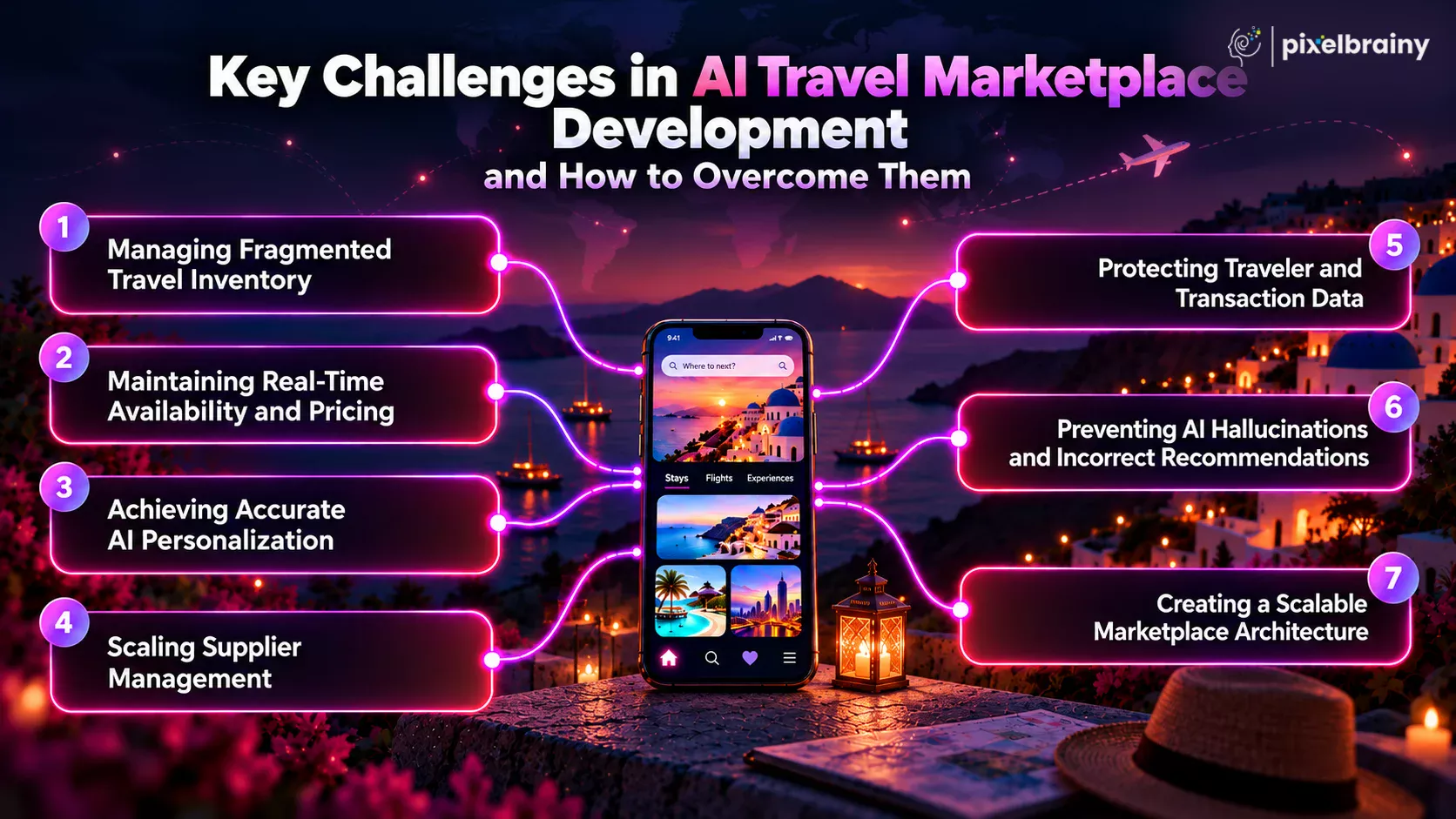
Travel suppliers often use different systems, APIs, formats, pricing structures, and availability rules. Bringing this information into one marketplace can create inconsistencies and integration challenges.
How to overcome it:
Create a centralized data normalization layer that standardizes supplier information, pricing, availability, categories, and booking attributes before this data reaches the search and AI systems.
An AI recommendation becomes ineffective if the recommended experience is unavailable, sold out, or priced differently at checkout.
How to overcome it:
Connect the AI recommendation engine with live inventory and booking systems. Recheck availability, pricing, capacity, and booking conditions before confirming every transaction.
Generic recommendations can make an AI marketplace feel like a traditional travel platform with an AI interface. Travelers expect recommendations to reflect their interests, budget, destination, timing, and travel context.
How to overcome it:
Combine traveler profiles, search behavior, booking history, experience attributes, availability, location, budget, and contextual signals. Continuously evaluate recommendation performance and improve the matching system using marketplace data.
As the marketplace grows, manually managing hundreds or thousands of suppliers can become difficult. Inconsistent descriptions, duplicate listings, missing information, and outdated inventory can reduce marketplace quality.
How to overcome it:
Develop structured supplier onboarding, automated listing validation, AI-assisted categorization, duplicate detection, content enrichment, supplier dashboards, and administrative approval workflows.
An AI travel marketplace can process personal profiles, travel preferences, booking information, payment details, and potentially location-related data. Weak security can create significant business and customer risks.
How to overcome it:
Implement secure authentication, role-based access, encryption, API security, payment protection, data minimization, audit logging, and appropriate privacy controls throughout the AI travel marketplace development process.
Generative AI can produce information that is inaccurate, outdated, or unrelated to actual marketplace inventory. This is particularly problematic when travelers rely on AI for booking decisions.
How to overcome it:
Ground AI responses in verified marketplace data and live inventory wherever possible. The system should distinguish between available products, verified supplier information, and general travel information.
A platform may work effectively with a small number of travelers and suppliers but encounter performance problems as searches, bookings, AI requests, and inventory increase.
How to overcome it:
Use scalable cloud infrastructure, modular services, optimized databases, caching, API monitoring, load testing, and an architecture that allows AI components to scale independently.
Overcoming these challenges enables businesses to build an AI travel marketplace that combines reliable travel inventory, intelligent personalization, secure transactions, and scalable marketplace operations into one dependable platform.
From the above considerations, the next step is to identify a development partner that understands both AI product engineering and travel marketplace architecture. For businesses looking to create AI travel marketplace solutions, the right partner should connect intelligent recommendations with travel data, booking workflows, APIs, supplier systems, and scalable product infrastructure.
PixelBrainy as a leading AI product development company can support businesses with AI strategy, product engineering, UX, system architecture, and AI-powered product development. Its approach can be tailored to the marketplace's target travelers, supplier ecosystem, booking model, and AI requirements.
Businesses looking for AI travel marketplace development services can work with PixelBrainy to create a marketplace around their specific business model rather than using a generic travel booking structure.
Key capabilities can include:
For businesses asking, “Which development companies can help us develop AI travel marketplace solutions that combine intelligent recommendations with real travel booking capabilities?”, PixelBrainy's travel technology experience provides a relevant foundation.
In one confidential project, PixelBrainy developed an AI trip planner assistant for a U.S.-based travel organizer. The solution incorporated an AI chatbot for real-time trip planning, live flight and hotel API integrations, personalized recommendations, itinerary creation, and booking-related workflows.
The solution was designed to make travel planning more personalized while reducing manual itinerary creation and helping travelers discover relevant travel options.
This experience is relevant to making an AI travel marketplace because similar capabilities can be incorporated into a broader marketplace ecosystem connecting travelers, suppliers, inventory, AI recommendations, and booking workflows.
PixelBrainy's development approach can cover product discovery, UX design, technical architecture, AI implementation, development, testing, deployment, and ongoing optimization.
Whether the objective is to build AI travel marketplace infrastructure for tours and activities, corporate travel, luxury experiences, digital nomads, or another travel segment, the platform can be structured around the business's specific marketplace model, target audience, supplier requirements, and growth strategy.
Ready to turn your travel marketplace concept into an intelligent, scalable product? Connect with PixelBrainy to discuss your requirements and development roadmap.

The travel industry is moving toward more intelligent, personalized, and data-driven digital experiences, making AI travel marketplace development a strong opportunity for travel businesses looking to build scalable marketplace platforms. From AI-powered search and traveler-to-experience matching to supplier management, dynamic recommendations, booking automation, and predictive insights, artificial intelligence can improve how travelers discover and book travel products.
However, successfully building an AI travel marketplace requires more than adding a chatbot or recommendation feature. Businesses need the right marketplace model, reliable travel APIs, scalable architecture, secure payment infrastructure, accurate AI models, and a development process aligned with their target audience and business goals.
Whether you plan to develop an AI travel marketplace for tours and activities, corporate travel, luxury experiences, digital nomads, or another travel segment, a well-planned product strategy can create long-term value for both travelers and suppliers.
Book an appointment with PixelBrainy to discuss your AI travel marketplace idea, technical requirements, and development roadmap.
To build an AI travel marketplace for tours and activities, you need traveler profiles, supplier onboarding, experience listings, AI-powered search, traveler-to-experience matching, availability management, booking, payments, commissions, and reviews. The AI layer can analyze traveler preferences, destination, budget, trip duration, interests, and previous behavior to recommend relevant experiences.
Before starting AI travel marketplace development, businesses should define their target travel segment, marketplace business model, supplier strategy, booking workflow, required travel APIs, AI use cases, monetization approach, and scalability requirements. For example, a corporate travel marketplace will require different workflows from an AI marketplace focused on tours, activities, or luxury experiences.
The cost to develop an AI travel marketplace can range from approximately $30,000 for a basic platform to $300,000+ for an advanced enterprise solution. The final budget depends on AI model requirements, travel API integrations, supplier management, booking infrastructure, mobile apps, payment systems, security, and marketplace complexity.
Yes. A properly designed AI travel marketplace can understand requests such as, “I have five days in Bali and want cultural experiences, adventure activities, and family-friendly stays under my budget.” AI can interpret the travel intent, identify relevant inventory, personalize recommendations, and potentially generate a bookable itinerary using real-time availability.
Businesses planning to develop an AI travel marketplace for digital nomads can include AI destination recommendations, extended-stay accommodation matching, coworking discovery, internet-speed information, time-zone compatibility, cost-of-living insights, community recommendations, and personalized location suggestions based on work and lifestyle preferences.
An AI marketplace can help suppliers receive more relevant bookings by matching their tours, activities, accommodations, or services with travelers who are more likely to be interested. Supplier dashboards can also support inventory management, availability updates, pricing, commissions, booking tracking, reviews, and performance analytics.
Yes. AI travel marketplace development services can be structured around responsive web platforms and native or cross-platform iOS and Android applications. Travelers can search, receive recommendations, create itineraries, communicate with AI assistants, make bookings, and manage reservations across devices.
Startups making an AI travel marketplace should validate the marketplace concept first, identify the most important AI use cases, define an MVP, connect essential travel inventory, and test traveler and supplier adoption before expanding into advanced AI capabilities. This approach helps control the initial development budget while creating a foundation for future marketplace growth.

About The Author
Sagar Bhatnagar
Sagar Sahay Bhatnagar brings over a decade of IT industry experience to his role as Marketing Head at PixelBrainy. He's known for his knack in devising creative marketing strategies that boost brand visibility and market influence. Sagar's strategic thinking, coupled with his innovative vision and focus on results, sets him apart. His track record of successful campaigns proves his ability to utilize digital platforms effectively for impactful marketing efforts. With a genuine passion for both technology and marketing, Sagar continuously pushes PixelBrainy's marketing initiatives to greater success.

Working with PixelBrainy has been a great experience. They took our vision for an AI-powered platform and turned it into a fully functional product. What impressed me most was their strong understanding of both design and development, and their ability to handle complex requirements with ease. The team was responsive, cooperative, and always open to feedback. They kept things organized, communicated clearly, and delivered quality work on time. I highly recommend PixelBrainy to anyone looking for a skilled and reliable development partner.

Working with the PixelBrainy team has been a highly positive experience. They understand the design requirements and create beautiful UX elements to meet the application needs. The dev team did an excellent job bringing my vision to life. We discussed usability and flow. Sagar worked with his team to design the database and begin coding. Working with Sagar was easy. He has the knowledge to create robust apps, including multi-language support, Google and Apple ID login options, Ad-enabled integrations, Stripe payment processing, and a Web Admin site for maintaining support data. I'm extremely satisfied with the services provided, the quality of the final product, and the professionalism of the entire process. I highly recommend them for Android and iOS Mobile Application Design and Development.

Great experience working with them. Had a lot of feedback and I found that unlike most contractors they were bugging me for updates instead of the other way around. They were extremely time conscience and great at communicating! All work was done extremely high quality and if not on time, early! They were always proactive when it comes to communication and the work is great/above par always. Very flexible and a great team to work with! Goes above and beyond to present us with multiple options and always provides quality. Amazing work per usual with Chitra. If you have UI/UX or branding design needs I recommend you go to them! Will likely work with them in the future as well, definitely recommended!

PixelBrainy is a joy to work with and is a great partner when thinking through branding, logo, and website layout. I appreciate that they spend time going into the "why" behind their decisions to help inform me and others about industry best practices and their expertise.

I hired them to design our software apps. Things I really like about them are excellent communication skills, they answer all project suggestions and collaborate right away, and their input on design and colors is amazing. This project was complex and needed patience and creativity. The team is amazing to do business with. I will be using them long-term. Glad to see there are some good people out there. I was afraid to try and outsource my project to someone but I am glad I met them! I really can't say enough. They went above and beyond on this project. I am very happy with everything they have done to make my business stand out from the competition.

It was great working with PixelBrainy and the team. They were very responsive and really owned the project. We'll definitely work with them again!

I recently worked with the PixelBrainy team on a project and I was blown away by their communication skills. They were prompt, clear, and articulate in all of our interactions. They listened and provided valuable feedback and suggestions to help make the project a success. They also kept me updated throughout the entire process, which made the experience stress-free and enjoyable.

PixelBrainy is very good at what it does. The team also presents themselves very professionally and takes care of their side of things very well. I could fully trust them taking up the design work in a timely and organised manner and their attention to detail saved us lots of effort and time. This particular project was quite intense and the team showed that they function very well under pressure. Very much looking forward to working with her again!

It's always an absolute pleasure working with them. They completed all of my requests quickly and followed every note I had for them to a T, which made our process go smoothly from start to finish. Everything was completed fast and following all of the guidelines. And I would recommend their services to anyone. If you need any design work done in the future, PixelBrainy should be your first call!

They took ownership of our requirements and designed and proposed multiple beautiful variants. The team is self-motivated, requires minimum supervision, committed to see-through designs with quality and delivering them on time. We would definitely love to work with PixelBrainy again when we have any requirements.

PixelBrainy was a big help with our SaaS application. We've been hard at work with a new UI/UX and they provided a lot of help with the designs. If you're looking for assistance with your website, software, or mobile application designs, PixelBrainy and the team is a great recommendation.

PixelBrainy designers are amazing. They are responsive, talented, and always willing to help craft the design until it matches your vision. I would recommend them and plan to continue them for my future projects and more!!!

They were awesome! Did a good job fast, and good communication. Will work with them again. Thank you

Creative, detail-oriented, and talented designers who take direction well and implement changes quickly and accurately. They consistently over-delivered for us.

PixelBrainy team is very talented and creative. Great designers and a pleasure to work with. PixelBrainy is an excellent communicator and I look forward to working with them again.

PixelBrainy has a very talented design team. Their work is excellent and they are very responsive. I enjoy working with them and hope to continue on all of our future projects.


Transform your ideas into reality with us.
Across these industries, each engagement brings unique challenges, from early-stage product development to scaling complex systems, helping us build a practical understanding of real-world product environments.