AI Summary Powered by PixelBrainy
What does it really cost to build an AI-powered website in 2026? For business owners planning their first website with artificial intelligence, the answer can vary widely. A company may receive one quote for $18,000 and another for $340,000 for what appears to be the same project. The difference usually comes down to what is being built behind the interface, including AI capabilities, data requirements, integrations, security, infrastructure, design complexity, and scalability.
Consider a business owner planning an ecommerce website with three core AI features: an AI chat assistant that answers customer questions, an AI product recommendation engine that suggests relevant products, and a personalized content experience that adapts for returning visitors. While the feature list may sound straightforward, each capability can involve very different levels of AI website development effort. A basic chatbot using a third-party API is fundamentally different from a custom AI assistant connected to company knowledge, customer data, product catalogs, and business workflows.
This is why understanding the AI website development cost is important before comparing development quotes. The cost to develop an AI website depends not only on the number of AI features but also on whether you use pre-built AI services, custom AI models, real-time personalization, advanced analytics, third-party integrations, or enterprise-grade infrastructure.
In this guide, we break down the cost of AI website development by project complexity, website type, features, technology stack, development requirements, and hidden expenses. You will also learn about AI website development timelines, factors that influence the overall budget, and practical ways to control development costs without limiting future scalability.
Whether you want to build an AI website from scratch or add AI capabilities to an existing platform, this guide will help you understand where your budget goes and what separates a basic AI-enabled website from a sophisticated intelligent digital platform.
The cost to develop an AI website can vary significantly even when two businesses describe similar requirements. For example, a business asking for an AI chat assistant, an ecommerce recommendation engine, and personalized content may receive quotes ranging from $18,000 to $340,000. The difference usually comes down to factors such as AI model complexity, data requirements, integrations, security, scalability, design, and ongoing infrastructure.
That is why budgeting should happen before development begins. A well-defined budget helps businesses understand what drives AI website development cost, which features deserve investment, and where a simpler technical approach can deliver the same business outcome.
Thus, budgeting is essential when you are planning to build an AI website:
AI website projects can become expensive when requirements change after development has started. Defining the required AI capabilities, integrations, data sources, user flows, and scalability expectations upfront gives development teams a clearer scope.
For a business building an ecommerce website with AI recommendations, for example, the budget may differ considerably depending on whether recommendations use basic rules, third-party AI APIs, or a custom machine learning model.
Not every AI feature contributes equally to revenue or customer experience. Budget planning helps businesses prioritize capabilities that solve measurable problems instead of adding AI simply for technical sophistication.
If the objective is to increase conversions, investment can focus on AI personalization, product recommendations, intelligent search, and behavioral analytics rather than expensive features that have little impact on the customer journey.
A defined budget makes it easier to decide whether the project should begin with an MVP, proof of concept, or complete enterprise platform. It also helps estimate the AI website development timeline based on the required features and technical complexity.
Businesses can then plan development in stages, validate AI functionality early, and expand capabilities as performance data and user feedback become available.
The AI website development cost does not end when the website goes live. Businesses may also need to budget for cloud hosting, AI API usage, model updates, data storage, monitoring, security, maintenance, and future integrations.
Planning these recurring expenses from the beginning creates a more accurate AI website development budget and helps ensure the platform remains reliable, scalable, and commercially sustainable after launch.
How much does it cost to build an AI website in 2026, and how can you estimate the investment before development starts? An AI website development cost calculator gives businesses a practical way to forecast their budget by considering the website scope, AI features, design complexity, integrations, infrastructure, and ongoing maintenance.
The cost to develop an AI website can vary significantly. A basic AI-enabled website with a conversational assistant may require a smaller investment, while an enterprise platform with personalized experiences, recommendation engines, custom AI models, and high-volume data processing can require a substantially larger budget. A structured AI website development cost estimation helps explain why two development quotes for seemingly similar projects can differ considerably.
A practical formula for estimating the AI website development cost is:
Total AI Website Cost = (Development Hours × Hourly Rate) + AI Feature Cost + Infrastructure Cost + Integration Cost + Maintenance Cost
This formula can be broken down into:
Using these variables in an AI website cost calculator makes it easier to create an initial budget instead of relying on a single generic price range.
Consider an ecommerce business planning to build an AI website with three core capabilities:
For a mid-level AI ecommerce website, assume:
Development Cost = 1,400 × $60
Development Cost = $84,000
Now apply the complete AI website development cost calculation:
Total AI Website Cost =
$84,000 + $25,000 + $12,000 + $15,000 + $18,000
Total Estimated Cost = $154,000
This example shows how the cost of AI website development depends on measurable project inputs rather than the website's page count alone. Businesses can adjust development hours, AI complexity, integrations, or infrastructure requirements to estimate a budget that better matches their goals, audience, and expected scale.
How much does it cost to build an AI website, and what explains the difference between a $20,000 project and an enterprise solution costing $300,000 or more? The answer depends on far more than the number of pages. AI website development cost is shaped by the website type, AI capabilities, technology stack, design requirements, development team, integrations, infrastructure, and long-term maintenance needs.
For example, a business adding an AI chat assistant to an existing marketing website has very different requirements from an ecommerce company building personalized product recommendations, predictive analytics, and real-time customer experiences. Understanding these cost drivers helps businesses evaluate development quotes more accurately and decide which AI capabilities are worth the investment.
The cost to build an AI website can typically range from $20,000 to $300,000+, while development may take around 3 to 6 months depending on scope, integrations, testing, and AI complexity. Projects involving custom AI models, large datasets, advanced personalization, or enterprise infrastructure may require additional development time.
Here’s a detailed look at the key factors that determine the AI website development cost and timeline:
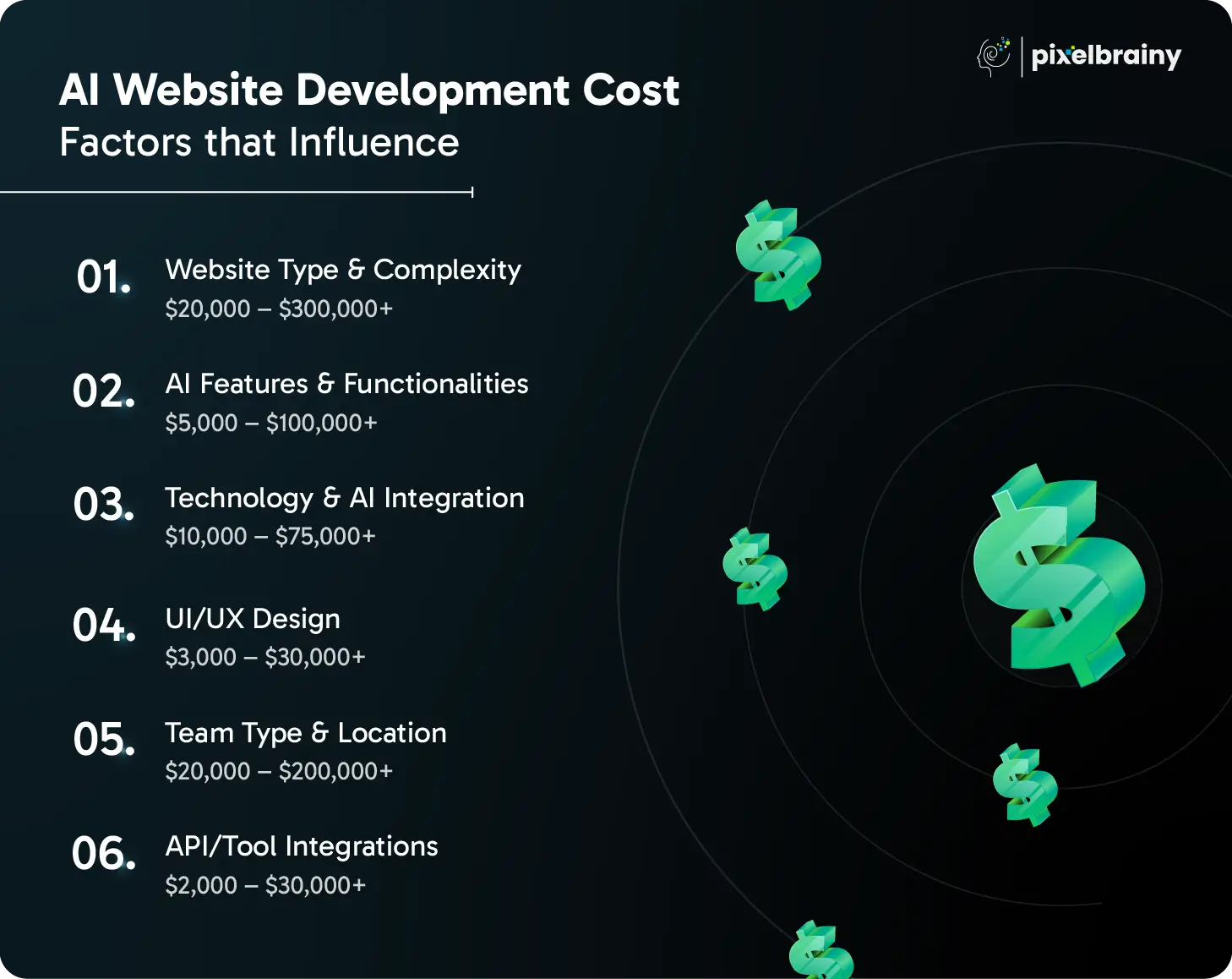
The foundation of your cost structure begins with the type of website you're aiming to build. Are you launching a simple marketing site with basic AI chatbots, or a fully-fledged AI-powered product platform?
Estimated Cost Range:
The smarter your website, the higher the cost. AI features range from simple automation to advanced decision-making engines.
Each additional layer of intelligence increases both the development timeline and budget due to testing, AI model accuracy requirements, and integration complexity.
Estimated Cost Range:
Your choice of development stack—front-end frameworks, backend architecture, and AI tools—plays a significant role in overall cost. Using ready-made APIs from OpenAI, Google, or AWS is cost-effective but offers limited customization, whereas building custom models demands more resources.
Estimated Cost Range:
AI websites are not only intelligent but also highly dynamic in how they interact with users. UI/UX design needs to reflect that intelligence—personalized dashboards, adaptive layouts, and intuitive interactions.
Great design enhances AI output, but it also requires more time from designers, front-end developers, and UX strategists.
Estimated Cost Range:
Where and how you build your AI website significantly affects the cost. Hiring a freelance team or outsourcing to regions like South Asia or Eastern Europe is generally more affordable than working with agencies in the U.S., Canada, or Western Europe.
Estimated Cost Range:
AI websites often connect with CRMs, analytics platforms, payment gateways, or external data providers. These integrations come with licensing, setup, and maintenance costs.
Some APIs charge usage-based fees, which should be considered in both development and post-launch phases.
Estimated Cost Range:
| Cost Factor | Scope | Estimated Cost Range |
| Website Type & Complexity | Basic to Enterprise | $20,000 – $300,000+ |
| AI Features & Functionalities | Basic bots to advanced ML models | $5,000 – $100,000+ |
| Technology & AI Integration | API setup to custom AI model training | $10,000 – $75,000+ |
| UI/UX Design | Template to dynamic AI-driven interfaces | $3,000 – $30,000+ |
| Team Type & Location | Offshore to local in-house experts | $20,000 – $200,000+ |
| API/Tool Integrations | Basic (chatbot, payment) to advanced AI platforms | $2,000 – $30,000+ |
Understanding these factors makes it easier to estimate the cost of developing an AI website, compare proposals, prioritize high-value AI features, and create a realistic development roadmap that balances budget, functionality, scalability, and business outcomes.
There is no single answer to how much it costs to develop an AI website because the website type directly affects the scope, features, and technical requirements. An AI-powered landing page may need only a few intelligent features, while an AI ecommerce platform may require recommendation engines, smart search, predictive analytics, and multiple integrations. Custom AI web apps can involve advanced technologies such as machine learning, NLP, or computer vision.
For businesses planning AI website development, breaking down costs by website type makes budgeting much easier. It also helps founders and decision-makers compare development quotes based on actual features instead of focusing only on the final price.
For example, a business may need an AI chat assistant for customer support, while another may want a website that personalizes content based on visitor behavior. Both are AI websites, but their development scope, infrastructure, and timelines can differ significantly.
The following breakdown covers major AI website types, their core AI features, estimated development costs, and timelines to help you plan your project more effectively.
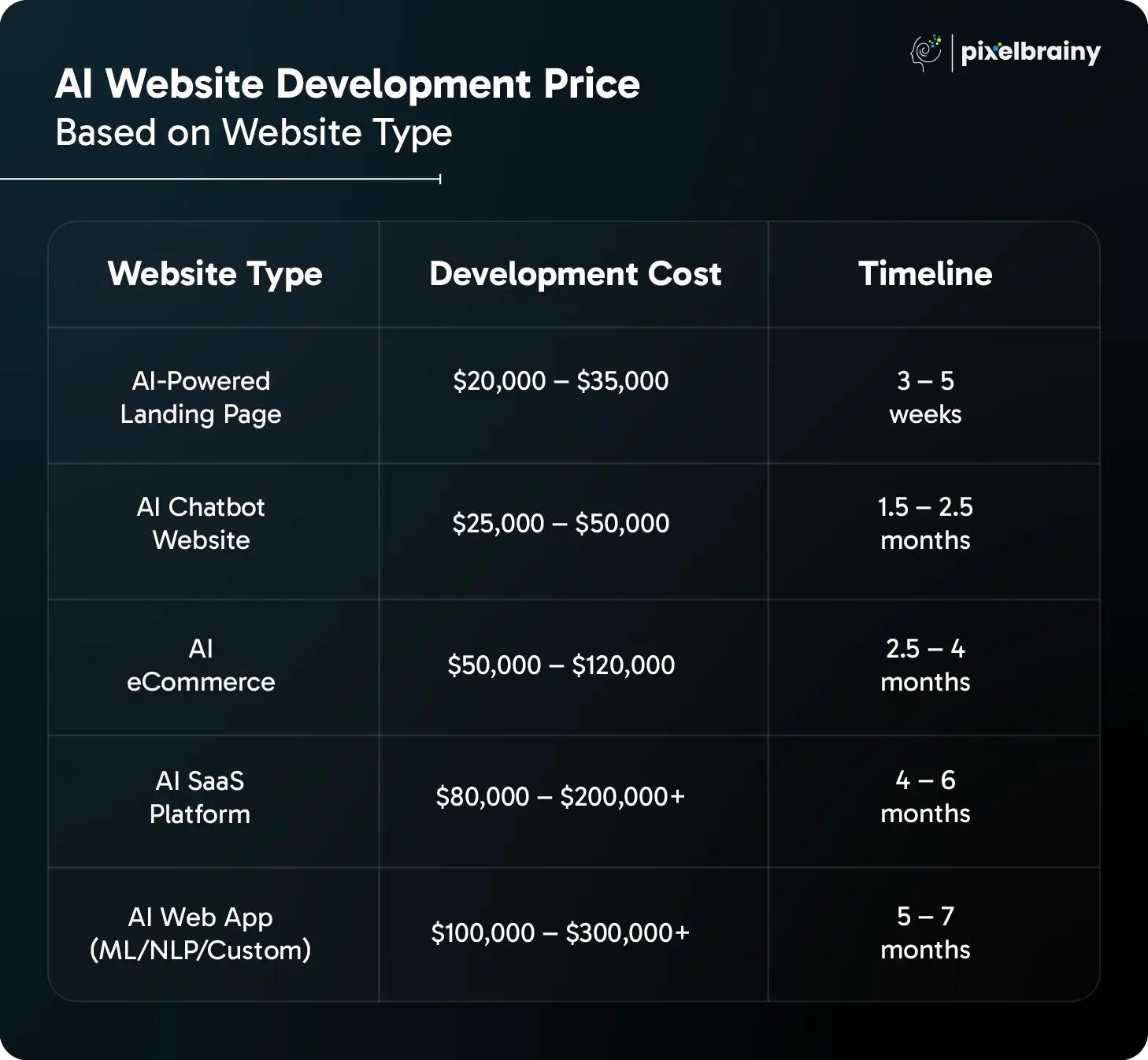
An AI-enhanced landing page is perfect for businesses looking to boost conversions with automation and personalization. These are typically single-page websites or campaign-specific microsites equipped with intelligent features.
This type of website focuses on replacing or enhancing human support through AI-driven conversation flows. It can either serve as a virtual assistant or become the primary customer interaction layer.
AI is transforming online shopping experiences. From understanding preferences to predicting needs, AI plays a vital role in increasing sales, reducing cart abandonment, and driving personalization.
Also Read: AI In eCommerce: 15 Use Cases Artificial Intelligence is Transforming The eCommerce Industry
An AI-based SaaS website offers services powered by artificial intelligence such as data analytics, HR automation, productivity monitoring, or marketing intelligence. These platforms are complex, scalable, and often multi-tenant.
This is the most advanced and resource-intensive category. These applications often rely on large data sets and machine learning models to deliver services such as real-time predictions, language modeling, or visual recognition.
| Website Type | Core AI Features | Development Cost | Timeline |
| AI-Powered Landing Page | Dynamic content, AI chatbot, behavior tracking, auto-optimization | $20,000 – $35,000 | 3 – 5 weeks |
| AI Chatbot Website | NLP chatbot, sentiment detection, multilingual support, CRM integration | $25,000 – $50,000 | 1.5 – 2.5 months |
| AI eCommerce Website | Recommendation engine, smart search, AI inventory, dynamic pricing, guided shopping | $50,000 – $120,000 | 2.5 – 4 months |
| AI SaaS Platform | Predictive analytics, smart workflows, adaptive dashboards, usage-based learning | $80,000 – $200,000+ | 4 – 6 months |
| AI Web App (ML/NLP/Custom) | Custom models, vision/NLP tools, intelligent data pipelines, real-time AI adaptation | $100,000 – $300,000+ | 5 – 7 months |
Understanding these cost and timeline ranges helps you define the right AI website development scope and invest your budget in the features that offer the most business value.

The initial quote for an AI website may cover design, development, and core AI features, but several additional expenses can appear as the project moves toward launch and scale. These costs are often related to AI model development, data preparation, cloud infrastructure, API usage, security, compliance, maintenance, and AI-specific UX requirements.
This matters when businesses are trying to understand how much it costs to build an AI website. Two projects with similar feature lists can have very different budgets because one may use pre-built AI services, while the other requires custom models, proprietary data, higher infrastructure capacity, or stricter security controls.
If you are planning to develop an AI website from scratch, reviewing these hidden cost drivers early can help you assess development proposals more accurately, avoid unexpected expenses, and create a more realistic budget for both launch and long-term operation.
Below are the key hidden factors that can influence the AI Website Development Cost beyond the initial development estimate.
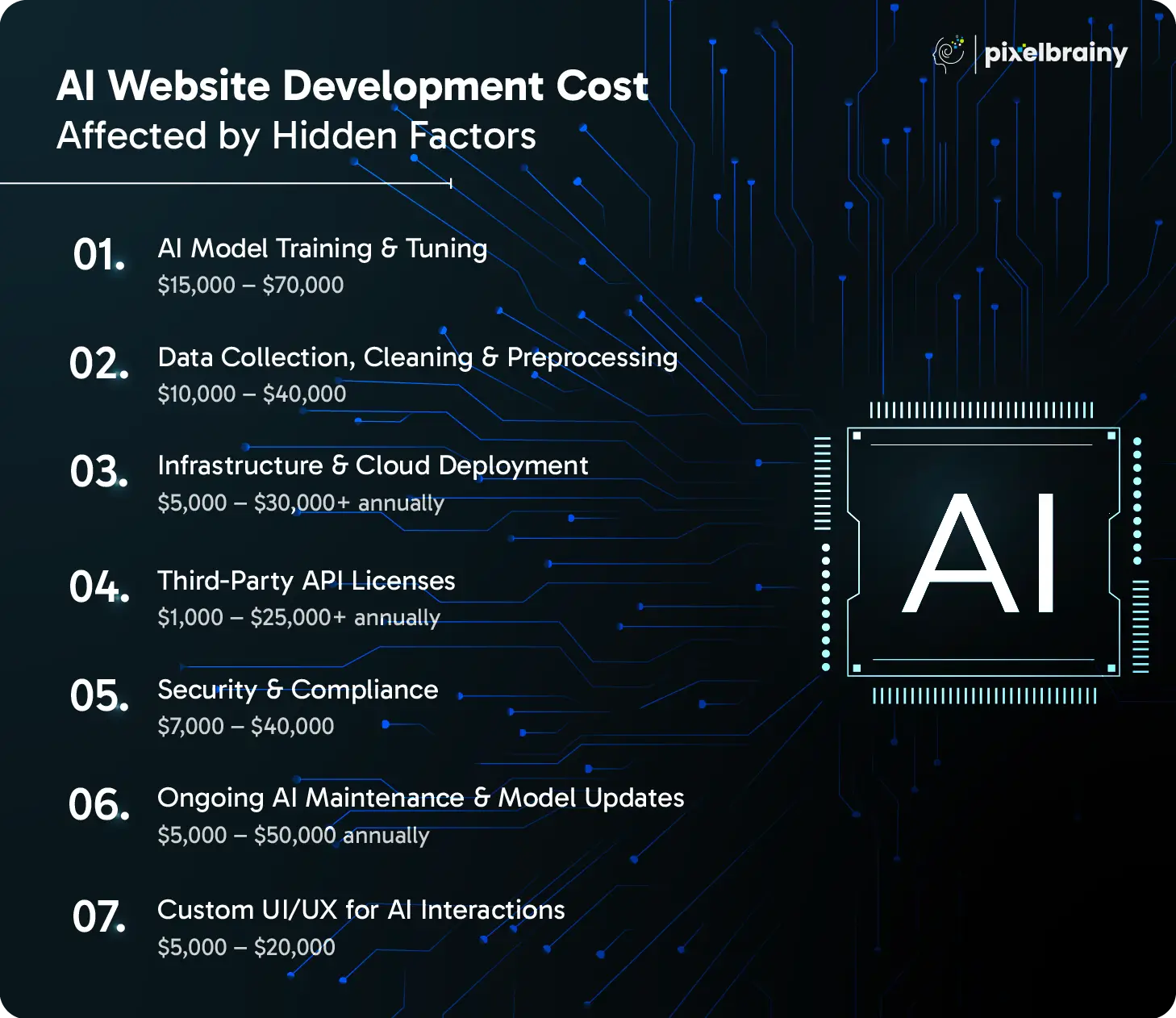
Pre-built AI APIs are useful, but if your website relies on custom models (e.g., for voice, text, image, or predictive tasks), the cost of data labeling, training, and performance tuning can skyrocket. You may need ML engineers and expensive GPU resources to refine models for accuracy and real-world conditions.
AI systems are only as good as the data they learn from. Gathering usable data—especially if you're starting from scratch—requires investment in collection methods (surveys, integrations, sensors), data cleaning tools, and human oversight.
The hosting environment for AI is often more demanding than a traditional website. You'll likely need cloud services like AWS, Azure, or GCP with GPU support, autoscaling, model-serving APIs, and secure storage for training datasets.
Relying on paid AI APIs like OpenAI’s GPT models, Google Cloud Vision, or AWS Rekognition can add monthly or per-call usage costs. These are usually variable, based on user volume and interaction frequency.
If your AI website deals with personal, financial, or health-related data, strict compliance measures are required. Security audits, data encryption, legal consulting, and specialized architecture are often overlooked.
Once deployed, AI models require constant monitoring, updates, and retraining to stay relevant and accurate. Without proper MLOps (Machine Learning Operations), performance can degrade over time.
Traditional web design doesn’t always apply to AI-powered websites. Chat interfaces, predictive forms, voice input, or decision-making dashboards require advanced UX strategies and specialized development.
| Hidden Factor | Cost Estimate | Impact on AI Website Development Cost |
| AI Model Training & Tuning | $15,000 – $70,000 | Essential for custom AI behavior and accuracy |
| Data Collection & Preprocessing | $10,000 – $40,000 | Drives learning quality and output reliability |
| Infrastructure & Cloud Deployment | $5,000 – $30,000+ | Enables scalable and fast model delivery |
| Third-Party AI API Usage | $1,000 – $25,000+ | Recurring fees for services like GPT or Vision AI |
| Security & Compliance | $7,000 – $40,000 | Required for privacy-centric or regulated industries |
| Ongoing AI Maintenance | $5,000 – $50,000 | Keeps AI functional, relevant, and secure post-launch |
| Custom AI UI/UX | $5,000 – $20,000 | Enhances usability, trust, and adoption of AI features |
Accounting for these hidden expenses gives you a clearer view of the total cost to develop an AI website, helping you plan for launch, scaling, security, and ongoing AI performance without unexpected budget pressure.
A high-quality AI website does not require every advanced capability from day one. The most effective way to control the AI website development cost is to match the technology investment with the features that directly support your business goals. This is especially important for startups and businesses comparing different quotes for how much it costs to build an AI website.
For example, if your immediate goal is to improve customer support, starting with an AI chat assistant may be more practical than investing in a custom machine learning model. An ecommerce business may get greater value from an AI recommendation engine before adding predictive pricing or advanced computer vision.
The following strategies can help you reduce the cost to build an AI website while maintaining quality, scalability, security, and a clear path for future upgrades.
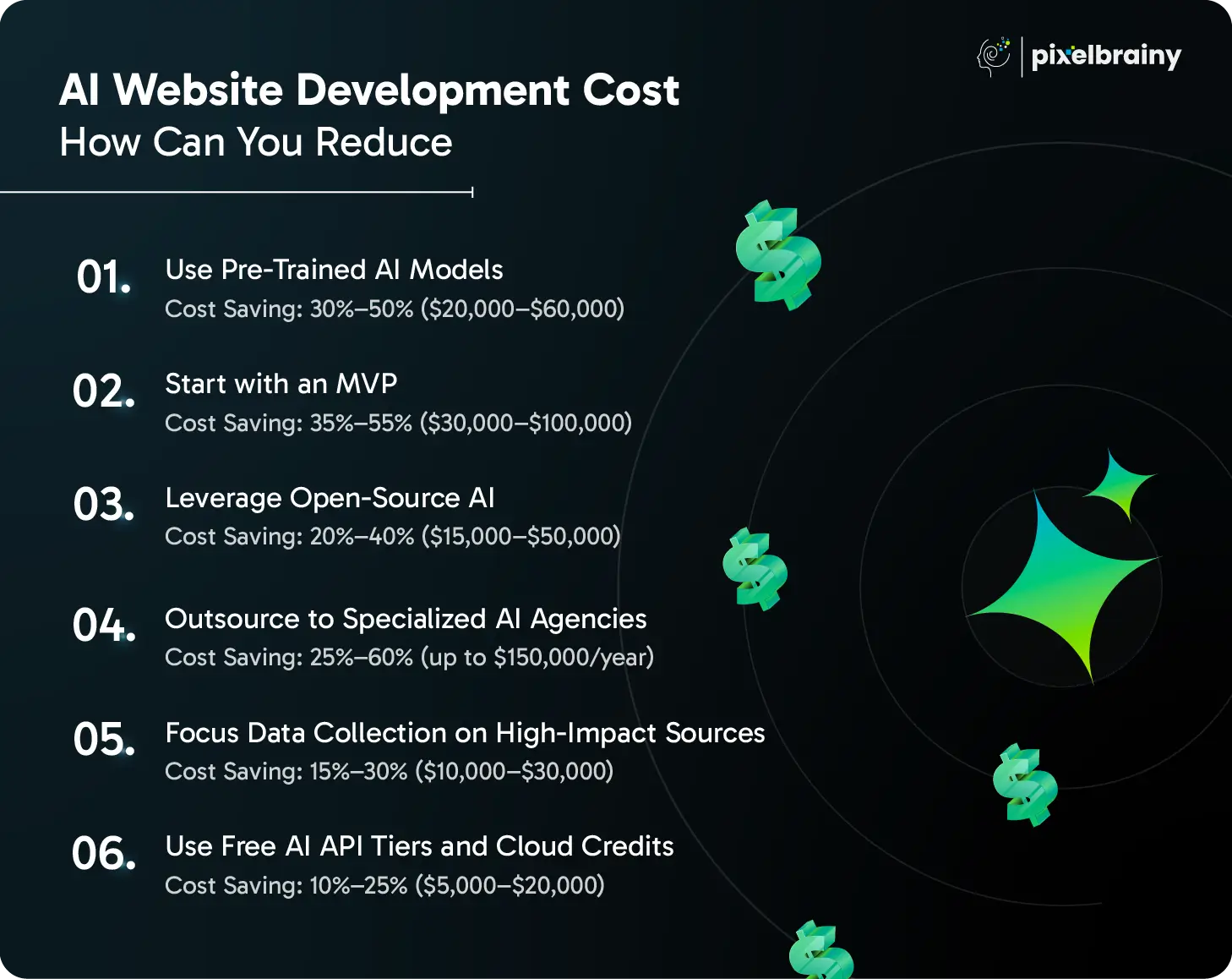
Building an AI model from the ground up can require significant investment in data collection, labeling, training, infrastructure, and testing. For many website use cases, pre-trained models and AI APIs can provide the required capabilities without this level of development.
Businesses can use established AI models for conversational search, content generation, image analysis, recommendations, and other functions, then customize the experience around their specific business requirements.
A focused MVP development for an AI website can make it more affordable by concentrating the initial release on features that have a clear business purpose. Instead of launching with every possible AI capability, identify the functionality most likely to improve conversions, engagement, support, or operational efficiency.
User feedback and performance data can then guide the next development phase.
Also Read: Top 10 AI MVP Development Companies in USA
Open-source technologies such as TensorFlow, PyTorch, Hugging Face, and LangChain can provide reliable building blocks for AI website projects. Instead of creating every component from scratch, development teams can use established frameworks for model integration, natural language processing, data workflows, and AI application logic.
This approach can also make future customization easier.
Maintaining an in-house team with expertise across web development, AI engineering, cloud infrastructure, and data science can significantly increase project costs. Working with a specialized AI development team provides access to these skills without the full expense of permanent hiring.
Experienced teams may also bring reusable components, established development processes, and domain expertise that can shorten delivery timelines.
More data does not automatically mean better AI performance. Businesses can reduce AI website development cost by identifying the data sources that have the greatest impact on the intended AI functionality.
For example, an ecommerce recommendation system may benefit more from accurate product, browsing, and purchase data than from collecting large volumes of unrelated information. A focused data strategy can reduce storage, cleaning, labeling, and processing requirements.
Early-stage AI website projects can take advantage of available cloud credits, developer programs, and limited API tiers when appropriate. These resources can help teams prototype AI features and test infrastructure before moving to higher-volume paid plans.
As usage increases, businesses should monitor API consumption, compute requirements, storage, and model usage to keep recurring infrastructure expenses predictable.
| Strategy | Estimated Saving | Reason It Works |
| Pre-trained AI models | 30%–50% ($20K–$60K) | Cuts out custom training and model building |
| MVP-first development | 35%–55% ($30K–$100K) | Launch lean; iterate based on real user data |
| Open-source frameworks | 20%–40% ($15K–$50K) | No licensing fees, faster setup, huge community support |
| Specialized AI agencies / remote teams | 25%–60% (up to $150K/yr) | Scalable, expert-led delivery without hiring overhead |
| Targeted data strategy | 15%–30% ($10K–$30K) | Focuses efforts on valuable training data |
| Free cloud credits & AI API tiers | 10%–25% ($5K–$20K) | Saves cloud, API, and infrastructure setup costs |
A focused scope, reusable AI technologies, targeted data strategy, and phased development approach can help businesses reduce AI website development cost while keeping the platform scalable, reliable, and ready for future AI capabilities.

You don’t always need a complete rebuild to turn an existing website into an AI-powered platform. In many cases, businesses can add AI capabilities to their current website and introduce intelligent functionality in phases. The cost to integrate AI into an existing website depends on the feature being added, the condition of the current technology stack, available data, third-party integrations, and the level of customization required.
For businesses asking how much does it cost to add AI to a website, the investment can range from $5,000 to $150,000+. A straightforward AI chatbot may sit at the lower end, while recommendation engines, predictive analytics, smart search, and voice-based functionality require more extensive development and integration.
The right approach is to assess the existing website first, identify the AI features with the clearest business value, and then estimate the AI integration cost based on technical effort rather than treating AI as a single fixed-price feature.
Typical AI Integration Cost Range: $5,000 – $150,000+
Let’s break it down by AI feature type and effort required:
Adding an AI-powered chatbot using platforms like Dialogflow, GPT-based APIs, or Microsoft Bot Framework is often one of the easiest and most cost-effective enhancements.
AI recommendation systems can dramatically improve user engagement and conversions but require historical user data, tagging, and integration with backend systems.
If your business needs insights from user behavior or wants to forecast trends, AI-driven analytics dashboards can be integrated using Python-based AI engines and cloud services.
Integrating intelligent search (semantic, contextual, or vector-based search) can drastically improve content discovery and user retention.
Useful for smart interfaces, accessibility, or hands-free control, but requires deeper AI stack integration and sometimes hardware compatibility.
| AI Feature | Estimated Cost | Timeline | Complexity Level |
| AI Chatbot/Assistant | $5,000 – $20,000 | 2–4 weeks | Low |
| Personalized Recommendations | $15,000 – $50,000 | 4–8 weeks | Medium |
| Predictive Analytics | $25,000 – $60,000 | 6–10 weeks | Medium–High |
| Smart Search Functionality | $20,000 – $45,000 | 5–8 weeks | Medium |
| Voice Recognition Integration | $30,000 – $80,000+ | 8–12 weeks | High |
The cost to integrate AI in a website ultimately depends on what you want the AI to achieve and how prepared your existing platform is for it. Starting with one high-impact feature can help you validate results, control investment, and expand AI capabilities as your business needs grow.
An AI website can generate revenue in several ways, depending on what it offers, who it serves, and where AI creates measurable value. A SaaS platform may charge users for ongoing access, while an eCommerce website can increase revenue through personalized recommendations and intelligent upselling. Content platforms can combine AI-driven personalization with advertising or affiliate revenue, while B2B platforms can monetize proprietary AI capabilities through licensing or API access.
For businesses asking how AI websites make money, the important consideration is matching the monetization model with the website’s audience and AI capabilities. The right model can turn AI website development from a technology investment into a scalable revenue channel.
The following models show how to monetize an AI website, from recurring subscriptions and usage-based pricing to personalized commerce, lead generation, advertising, and AI licensing.
One of the most common and stable revenue models for AI websites is a monthly or annual subscription plan. This is especially effective for AI tools that offer continuous value, like chatbots, content generators, AI analytics, or personalization engines.
Many AI services adopt a freemium model, offering basic features for free while charging for advanced capabilities or usage-based tiers. This model is popular with AI APIs and tools that require computing resources.
For AI websites that run online stores, product recommendation engines and dynamic pricing models significantly boost revenue. AI analyzes user preferences, shopping behavior, and demand signals to increase cart values and conversions.
AI websites can boost affiliate income by showing users highly relevant affiliate products or content. Recommendation engines, chatbots, and smart banners increase conversion rates by matching user intent with affiliate offerings.
AI websites can integrate programmatic ads while using AI to optimize placement, relevance, and timing. Advanced AI platforms can even segment audiences or predict high-CTR placements in real-time.
AI websites often capture and analyze user behavior to generate qualified leads. These leads can then be sold to third parties or used internally for sales pipelines. In some cases, anonymized data insights are monetized directly.
If your AI website is built around a proprietary model, algorithm, or dataset, you can monetize by licensing it to other businesses or offering API access. This is common in B2B AI platforms.
| Monetization Method | Best For | AI Role |
| Subscription Plans | AI tools, SaaS, services | Personalized experiences and feature gating |
| Freemium + Usage Fees | APIs, generation tools | Adaptive pricing, behavioral tracking |
| Personalized E-Commerce | Online stores | Higher AOV through intelligent recommendations |
| Affiliate Marketing | Blogs, reviews, niche sites | Contextual targeting to increase affiliate sales |
| AI-Driven Ads | Media, content websites | Higher CTR through smart targeting |
| Lead Generation & Data Sales | B2B, surveys, service platforms | Segmentation, qualification, and conversion |
| Licensing / API Access | B2B platforms, niche AI models | Scalable model sharing with enterprise clients |
The revenue potential of an AI website depends on how effectively its AI capabilities solve user problems and support a sustainable business model. From subscriptions and personalized eCommerce to affiliate sales, qualified leads, and API licensing, AI website monetization can create multiple paths to recurring and scalable revenue.
PixelBrainy as an AI development company helps businesses turn AI website ideas into practical digital platforms without adding unnecessary development complexity or cost. Our approach focuses on identifying the AI capabilities that create measurable business value, selecting the right technology approach, and building the website in stages so the initial investment remains controlled.
Whether you need an AI-powered eCommerce website, SaaS platform, business website, or an intelligent customer-support experience, our team aligns the scope, architecture, integrations, and development roadmap with your budget.
Our goal is to help you build an AI website that delivers meaningful functionality today while remaining flexible enough to support future AI capabilities.
Client Overview:
An emerging eCommerce business wanted to upgrade its existing website with AI capabilities that could:
The Challenge:
The business had received development estimates ranging from $18,000 to $340,000 for what appeared to be the same requirements. They needed a clearer scope and a cost-conscious approach without compromising the quality of the AI experience.
How We Solved It
Results Delivered
With the right strategy, AI website development cost can be controlled without sacrificing the intelligence, usability, or scalability your business needs.

Understanding AI website development cost requires looking beyond the initial development quote. The final investment depends on your website type, AI features, technology stack, integrations, data requirements, security, design complexity, and long-term maintenance. A simple AI chatbot website may require a very different budget from an enterprise platform with custom AI models, predictive analytics, personalization, and real-time data processing.
For businesses planning to develop an AI website, the most practical approach is to define the highest-value use cases first, validate them through an MVP or PoC, and expand the platform as business needs and user data evolve. This makes AI website development more predictable while reducing unnecessary upfront spending.
Whether you want to build an AI website from scratch or add intelligent capabilities to an existing platform, a clear scope and scalable development roadmap can help you control costs while creating a website that delivers measurable business value.
Ready to plan your AI website within the right budget? Book an appointment with PixelBrainy to discuss your project.
The difference usually comes from AI complexity, customization, data requirements, integrations, security, design, and scalability. A website using a ready-made AI API and basic chatbot can cost far less than one requiring custom AI models, predictive analytics, personalized experiences, or enterprise-grade infrastructure.
The cost to build an AI website can range from around $20,000 to $300,000+ based on the project's scope. A basic AI-enabled website sits toward the lower end, while advanced AI web applications with custom models and complex integrations require a substantially larger investment.
Usually, yes. If your existing website has a stable architecture and usable data, you can integrate individual AI capabilities without rebuilding the entire platform. The cost to integrate AI into an existing website may start around $5,000 for simpler features and increase significantly for advanced functionality.
A focused MVP approach can help control the AI website development cost. Businesses can begin with one or two high-value features, use pre-trained AI models or APIs, rely on existing infrastructure where appropriate, and expand functionality after validating user demand.
Beyond development, budget for AI API usage, cloud infrastructure, data preparation, model tuning, security, compliance, monitoring, maintenance, and future updates. These recurring and technical expenses can substantially affect the total cost of developing an AI website.
Not necessarily. Many business websites can use pre-trained models through APIs for functions such as conversational support, content generation, semantic search, and recommendations. Custom AI model development becomes more relevant when your website requires specialized behavior, proprietary data, or greater control over model performance.
A typical AI website project can take 4–6 weeks, although timelines vary according to scope and complexity. A basic AI-enabled website may launch sooner, while enterprise platforms involving custom models, multiple integrations, extensive testing, or regulatory requirements can take considerably longer.
Start with clearly defined business goals, AI use cases, target users, integrations, data requirements, and scalability expectations. A professional AI website development team can then break the project into features, development stages, infrastructure, and ongoing costs to provide a more realistic estimate instead of relying on a generic price range.

About The Author
Sagar Bhatnagar
Sagar Sahay Bhatnagar brings over a decade of IT industry experience to his role as Marketing Head at PixelBrainy. He's known for his knack in devising creative marketing strategies that boost brand visibility and market influence. Sagar's strategic thinking, coupled with his innovative vision and focus on results, sets him apart. His track record of successful campaigns proves his ability to utilize digital platforms effectively for impactful marketing efforts. With a genuine passion for both technology and marketing, Sagar continuously pushes PixelBrainy's marketing initiatives to greater success.

Working with the PixelBrainy team has been a highly positive experience. They understand the design requirements and create beautiful UX elements to meet the application needs. The dev team did an excellent job bringing my vision to life. We discussed usability and flow. Sagar worked with his team to design the database and begin coding. Working with Sagar was easy. He has the knowledge to create robust apps, including multi-language support, Google and Apple ID login options, Ad-enabled integrations, Stripe payment processing, and a Web Admin site for maintaining support data. I'm extremely satisfied with the services provided, the quality of the final product, and the professionalism of the entire process. I highly recommend them for Android and iOS Mobile Application Design and Development.

Great experience working with them. Had a lot of feedback and I found that unlike most contractors they were bugging me for updates instead of the other way around. They were extremely time conscience and great at communicating! All work was done extremely high quality and if not on time, early! They were always proactive when it comes to communication and the work is great/above par always. Very flexible and a great team to work with! Goes above and beyond to present us with multiple options and always provides quality. Amazing work per usual with Chitra. If you have UI/UX or branding design needs I recommend you go to them! Will likely work with them in the future as well, definitely recommended!

PixelBrainy is a joy to work with and is a great partner when thinking through branding, logo, and website layout. I appreciate that they spend time going into the "why" behind their decisions to help inform me and others about industry best practices and their expertise.

I hired them to design our software apps. Things I really like about them are excellent communication skills, they answer all project suggestions and collaborate right away, and their input on design and colors is amazing. This project was complex and needed patience and creativity. The team is amazing to do business with. I will be using them long-term. Glad to see there are some good people out there. I was afraid to try and outsource my project to someone but I am glad I met them! I really can't say enough. They went above and beyond on this project. I am very happy with everything they have done to make my business stand out from the competition.

It was great working with PixelBrainy and the team. They were very responsive and really owned the project. We'll definitely work with them again!

I recently worked with the PixelBrainy team on a project and I was blown away by their communication skills. They were prompt, clear, and articulate in all of our interactions. They listened and provided valuable feedback and suggestions to help make the project a success. They also kept me updated throughout the entire process, which made the experience stress-free and enjoyable.

PixelBrainy is very good at what it does. The team also presents themselves very professionally and takes care of their side of things very well. I could fully trust them taking up the design work in a timely and organised manner and their attention to detail saved us lots of effort and time. This particular project was quite intense and the team showed that they function very well under pressure. Very much looking forward to working with her again!

It's always an absolute pleasure working with them. They completed all of my requests quickly and followed every note I had for them to a T, which made our process go smoothly from start to finish. Everything was completed fast and following all of the guidelines. And I would recommend their services to anyone. If you need any design work done in the future, PixelBrainy should be your first call!

They took ownership of our requirements and designed and proposed multiple beautiful variants. The team is self-motivated, requires minimum supervision, committed to see-through designs with quality and delivering them on time. We would definitely love to work with PixelBrainy again when we have any requirements.

PixelBrainy was a big help with our SaaS application. We've been hard at work with a new UI/UX and they provided a lot of help with the designs. If you're looking for assistance with your website, software, or mobile application designs, PixelBrainy and the team is a great recommendation.

PixelBrainy designers are amazing. They are responsive, talented, and always willing to help craft the design until it matches your vision. I would recommend them and plan to continue them for my future projects and more!!!

They were awesome! Did a good job fast, and good communication. Will work with them again. Thank you

Creative, detail-oriented, and talented designers who take direction well and implement changes quickly and accurately. They consistently over-delivered for us.

PixelBrainy team is very talented and creative. Great designers and a pleasure to work with. PixelBrainy is an excellent communicator and I look forward to working with them again.

PixelBrainy has a very talented design team. Their work is excellent and they are very responsive. I enjoy working with them and hope to continue on all of our future projects.


Transform your ideas into reality with us.
Across these industries, each engagement brings unique challenges, from early-stage product development to scaling complex systems, helping us build a practical understanding of real-world product environments.