
 AI Summary Powered by PixelBrainy
If you are an entrepreneur, startup founder, or business leader wondering how to stand out online in 2026 and beyond, the answer lies in the rise of AI Websites. In today’s fast-changing digital world, traditional websites are no longer enough to capture attention or deliver the personalized experiences users expect. This is where AI Website Development comes into play, combining speed, intelligence, and automation to reshape how businesses build and manage their online presence.
The creation of AI Website solutions is not just about design but about building smarter platforms that learn, adapt, and improve over time. Instead of relying solely on manual coding, businesses can now leverage artificial intelligence to automate layouts, personalize content, optimize performance, and even predict user behavior. For startups aiming to scale quickly or enterprises looking to enhance efficiency, knowing how to build AI Website solutions can be a true competitive edge.
This blog has been designed as a Step-by-Step Guide to AI Website Development, offering insights tailored to decision-makers, innovators, and anyone looking to future-proof their digital strategy. We will begin by defining what AI websites are, then compare them to traditional web design approaches. From there, we will explore the role of AI in web creation, highlight key trends, and outline practical steps for developing AI Website projects effectively.
By the end of this guide, you will walk away with both the fundamentals and advanced knowledge to embrace AI Website Development, ensuring your business is equipped for growth and innovation for future.
AI Websites are websites that use artificial intelligence to design, manage, and optimize digital experiences. Unlike traditional sites that depend only on static coding, AI websites can adapt in real time, personalize content, and automate tasks like design, SEO, and customer support.
Through technologies such as machine learning and natural language processing, AI Website Development allows businesses to create smarter platforms that learn from user behavior. For example, an AI website can recommend products, adjust layouts automatically, or answer customer queries through chatbots.
In short, the creation of AI Website solutions means moving beyond static pages to intelligent platforms that grow, evolve, and deliver better results over time.
When businesses think about building a website, they often face two choices: traditional web design or AI-powered website development. Both approaches serve the same purpose of creating an online presence, but the methods and outcomes differ significantly.
Traditional web design relies on manual coding, static templates, and human creativity. While it offers complete control and customization, the process is usually time-consuming, requires skilled developers, and demands ongoing maintenance. Small updates like adding new features or optimizing for SEO often need expert involvement, which can increase costs and delay results.
On the other hand, AI Website Development leverages automation, machine learning, and intelligent design assistants. This approach reduces development time, cuts costs, and delivers personalized user experiences. AI-driven websites can optimize themselves through real-time data analysis, adapt layouts automatically, and provide insights to improve performance. For businesses looking to scale quickly and keep up with digital trends, AI often provides a faster, smarter, and more flexible solution.
Still, traditional web design may be a better choice for highly complex projects that require unique branding or custom functionality not yet supported by AI tools. In most cases, however, AI websites strike the perfect balance between efficiency, affordability, and innovation.
| Feature | Traditional Web Design | AI Website Development |
| Development Speed | Weeks to months | Minutes to days |
| Cost | High (depends on developer rates) | Lower (automation reduces expenses) |
| Customization | Fully manual, highly flexible | Semi-automated, improving with AI tools |
| User Experience | Static and requires manual updates | Personalized, adaptive, and data-driven |
| Maintenance | Ongoing developer support required | Self-optimizing through AI analytics |
| SEO Optimization | Manual implementation | AI-powered, automated suggestions |
| Best Suited For | Complex, unique, and highly customized projects | Businesses seeking speed, efficiency, and scale |
If your business requires a highly customized website with unique design elements or specialized functionality, traditional web design may still be the right choice.
However, if your priority is speed, scalability, affordability, and delivering personalized digital experiences, AI Website Development is the smarter option. For most small to medium businesses, AI-powered websites offer the best balance of performance and cost efficiency.
AI is not just a fancy upgrade to a website. It is the engine that helps a site think, respond, and adapt in ways traditional development cannot. Instead of being a static digital brochure, an AI-powered website becomes an active partner in how a business communicates and grows.
Imagine a visitor browsing your site late at night. Instead of leaving with unanswered questions, they are welcomed by a chatbot that learns from every interaction and guides them directly to the right solution. Or picture an ecommerce homepage that rearranges itself instantly to highlight products based on that shopper’s behavior. These experiences make a website feel alive and relevant to every user.
This is the strength of AI Web Development. Every click and every interaction becomes a learning moment, allowing the site to deliver faster responses and more personalized content. With Artificial Intelligence Website Development, businesses can go beyond design and truly create intelligent platforms.
Overall, automated website creation with AI gives businesses a powerful advantage by combining intelligence, adaptability, and efficiency. It does not replace human creativity but amplifies it, enabling companies to deliver experiences that are faster, smarter, and more relevant to customer needs.
When your website does more than just exist online and instead acts as a smart, adaptive digital asset, investing in AI Website Development moves from optional to essential. Here are the real drivers behind that shift:
The global AI-powered website builder market is currently worth around USD 2.5 billion in 2025 and is expected to grow at a compound annual growth rate of roughly 25 % through 2033.
At the same time, the broader artificial intelligence software market was valued at USD 279 billion in 2024 and is forecast to reach USD 1.8 trillion by 2030, growing at a CAGR of nearly 36 %.
These numbers show that more companies are embracing how AI is changing website development and moving quickly to leverage its potential.
With automated website creation with AI tools, businesses can spin up new sites, landing pages, or campaign microsites in hours or days, rather than weeks or months. This speed allows rapid response to market trends, A/B testing of offers, and fast iteration on digital campaigns. Being first or fast often confers a big competitive edge.
AI-powered sites reduce dependence on ongoing manual updates, routine debugging, and costly redesigns. Intelligent automation handles layout adaptation, content optimization, SEO tweaks, and performance tuning, thus lowering the total cost of ownership. Over time, Artificial Intelligence Website Development can deliver far better returns per dollar spent.
An AI-built site is built to continuously learn. It doesn’t just report metrics—it predicts user behavior, possible drop-off points, or engagement opportunities. Businesses gain real-time insights into what’s working and what’s not, and can pivot faster based on predictive signals rather than just historical reports.
As traffic grows, an AI-enabled website can scale personalization without linear increases in cost. It can dynamically rearrange content, adjust navigation pathways, refresh product recommendations, or personalize offers, all without requiring a full redesign or manual intervention. In effect, the website evolves along with user needs.
Investing in AI Web Development today helps a business stay prepared for upcoming capabilities — voice and conversational interfaces, predictive UX personalization, generative content, and continuous self-optimization. Companies that delay risk falling behind competitors that see their website not just as a brochure, but as an intelligent, learning platform.
So, by adopting AI Website Development now, you are not just building a website, you are laying the foundation for long-term growth and market leadership.
As businesses explore different Types of AI Websites, it becomes clear that AI is not a one-size-fits-all solution. Each industry has unique needs, and the way you develop AI Website solutions should reflect that. From eCommerce and finance to healthcare and nonprofits, every sector can benefit from the intelligence and automation of AI Website Development.
Below are detailed categories with use cases and real-world examples to show how companies can build AI Website projects that deliver impact.
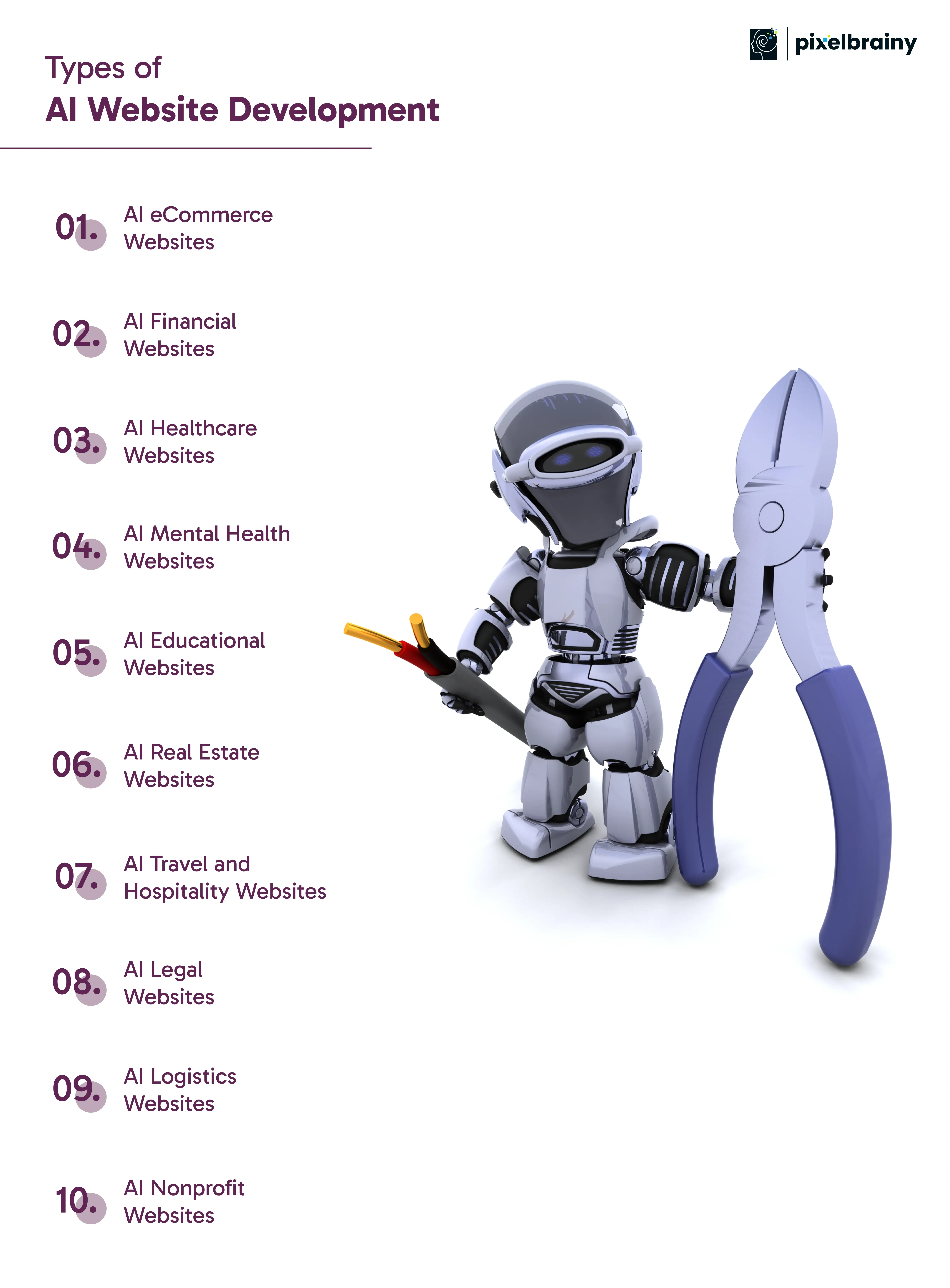
Online shopping has become highly competitive, and customers now expect speed and personalization. With AI website development for eCommerce, businesses can turn their sites into intelligent sales assistants that predict what buyers want and help them complete purchases faster. These websites also optimize pricing and inventory to improve margins while reducing cart abandonment.
Use cases:
Example: Amazon uses AI-driven recommendations to influence a large percentage of its sales.
Consumers want financial services that are both safe and easy to use. AI financial website development helps banks and fintech companies deliver smarter digital experiences by combining fraud detection, personalized advice, and automated reporting. These websites make finance less intimidating and more secure for users.
Use cases:
Example: Revolut integrates AI into its platform to provide personalized spending insights and fraud protection.
Patients look for fast, reliable, and accurate digital healthcare support. Through AI healthcare website development, medical providers can create websites that guide users through symptom checks, booking appointments, and managing health records. These platforms reduce workload for doctors while giving patients immediate assistance.
Use cases:
Example: WebMD offers AI-powered symptom checkers that guide patients toward next steps.
Access to mental health support is becoming essential, and digital platforms fill that gap. AI mental health website development allows people to access conversational tools, guided exercises, and personalized wellness resources from anywhere, making support more accessible and private.
Use cases:
Example: Woebot uses conversational AI to deliver cognitive behavioral therapy techniques.
Learning platforms are shifting from one-size-fits-all to adaptive models. With AI website development for education, institutions and edtech companies can provide tailored learning experiences that improve engagement and retention. These platforms help teachers save time and help students learn at their own pace.
Use cases:
Example: Duolingo applies AI to adapt lessons and track individual progress.
Property search can be overwhelming, but AI real estate website development simplifies the process. These websites can match users with homes that fit their needs, provide value predictions, and even offer immersive AI-powered tours. They speed up decision-making for both buyers and sellers.
Use cases:
Example: Zillow uses AI for its “Zestimate” tool, giving property value predictions.
Travelers demand seamless booking experiences and personalized itineraries. With AI travel website development, businesses can suggest destinations, optimize pricing, and manage reservations automatically. These websites keep customers engaged while reducing manual booking tasks.
Use cases:
Example: Booking.com uses AI to deliver tailored travel recommendations.
Legal services are often complex and time-consuming, but AI legal website development makes them more accessible. These websites automate routine tasks, provide instant legal answers, and streamline client communications, saving firms both time and resources.
Use cases:
Example: DoNotPay is known as the “robot lawyer” and helps users contest fines automatically.
In logistics, transparency and speed are critical. With AI logistics website development, companies can create portals that provide real-time updates, optimize routes, and forecast delivery times. This improves efficiency and customer trust.
Use cases:
Example: DHL applies AI to optimize delivery routes and minimize delays.
Nonprofits depend on engagement and trust, and AI nonprofit website development helps them connect more meaningfully with supporters. These websites use AI to personalize campaigns, guide donations, and improve volunteer recruitment.
Use cases:
Example: Charity:Water uses AI-driven donor engagement strategies to increase campaign effectiveness.
So, investing in the right type of AI Website Development allows businesses across industries to create smarter, adaptive, and future-ready digital platforms.
The world of web development is evolving faster than ever, and in 2026 the influence of AI is moving from "nice to have" to essential. Businesses that want to stay ahead must track emerging patterns in AI Website Development. It is not only about how sites are built but also how they learn, adapt and scale.
Here are the key trends reshaping the landscape:
Websites are no longer static. AI enables dynamic layouts and content placement that change based on visitor behavior, device type, location, and even time of day. This means a homepage can rearrange itself instantly or highlight different calls to action depending on whether someone visits from a mobile phone in the morning or a desktop at night.
Generative AI tools now let you build a website from a simple prompt or description. Shopify’s AI Store Builder can generate complete store layouts including images and text based on keywords, dramatically shortening development time.
From layout generation to code suggestions, AI is increasingly embedded in the development workflow. Tools like GitHub Copilot or Google’s UI generation systems help developers and designers by automating repetitive tasks and offering intelligent refinements.
AI chatbots and agentic tools are becoming the first line of digital interaction. Whether helping users find products, answering questions, or even transacting autonomously, these conversational agents act as both guide and assistant.
AI is also playing a big role in making websites more accessible. Automated captioning, alt text generation, color contrast adjustments, and language translation are being integrated into tools so sites comply with accessibility standards more easily.
Websites are shifting from reactive to proactive. AI analytics anticipate what users are likely to click next, suggest content or products before users explicitly ask, and continuously refine experiences without the need for manual updates.
Building AI websites is becoming more accessible, even to non-technical users. Platforms like Div-idy and other “conversational no code” tools let people generate web apps or landing pages through natural language or modular AI prompts.
We are also seeing the rise of web browsers and frontends designed for AI agents and language model interactions. This trend, known as the AI native web, reshapes how content is structured and makes conversational access a first-class experience.
So, understanding these AI Website Development trends is the first step toward building websites that adapt, perform, and grow along with your business.
The shift toward Website Development with AI is transforming how businesses operate online. Beyond aesthetics, websites now function as intelligent platforms that learn, adapt, and deliver value in real time.
Companies that create AI website solutions are finding that the results go beyond cost savings — they are reshaping customer engagement, decision-making, and growth strategies. Below are the most impactful advantages of AI Website Development today.

Modern customers expect websites to recognize their needs without asking. With AI web development, platforms can analyze data such as browsing history, purchase behavior, and location to customize experiences instantly. This makes every visitor feel valued and understood, which increases trust and conversions.
Building a website traditionally requires weeks of design, coding, and revisions. One of the greatest advantages of AI Website Development is the ability to cut that timeline significantly. AI-driven tools handle repetitive coding, generate design prototypes, and even automate testing, enabling teams to move from idea to launch at record speed.
Data is only valuable if it drives action. With Website Development with AI, companies gain intelligent insights that go beyond traditional analytics dashboards. AI identifies patterns, predicts user behavior, and highlights opportunities to improve performance, giving businesses a clear advantage over competitors still relying on manual analysis.
Customer service is one of the most visible areas of a website. When you create AI website platforms with embedded chatbots and smart assistants, support shifts from reactive to proactive. AI ensures visitors get instant help, reducing frustration and freeing human teams to handle complex issues.
Websites can be expensive to build and maintain, especially when updates are frequent. With automation at its core, AI web development reduces reliance on large development teams and ongoing manual work. Companies save money on labor, while their sites continuously optimize themselves for better results.
A traditional website often needs manual updates to stay relevant, but an AI-powered site is built to evolve. Website Development with AI ensures that your platform adapts automatically to changing traffic, user needs, and business goals. It grows as you grow, scaling intelligently without compromising performance.
So, the true advantages of AI Website Development lie in its ability to make websites faster, smarter, and more scalable, ensuring businesses stay ahead in a digital-first world.
For any business investing in AI website development, certain features form the foundation of success. Without them, even the most advanced tools cannot deliver consistent results.
To effectively develop AI website solutions, these must-have features ensure that every site is functional, intelligent, and user-friendly from the start.
| Must-Have Feature | Explanation |
| AI-Powered Chatbots | Intelligent chatbots provide round-the-clock customer support by answering questions, resolving issues, and guiding users through their journey. They free up human agents to focus on complex tasks |
| Personalized Recommendations | By analyzing user preferences, purchase history, and browsing patterns, AI delivers targeted suggestions. This increases conversions while making users feel valued and understood |
| Predictive Analytics | Predictive tools process historical and real-time data to forecast behavior. Businesses can act before trends shift, optimizing campaigns and improving decision-making |
| Smart Search Functionality | AI-driven search engines interpret intent and natural language queries. This ensures users quickly find what they are looking for, even with vague or misspelled inputs |
| Automated Content Generation | AI helps teams scale content creation by producing blogs, product descriptions, and landing page copy. This saves time while ensuring messaging remains consistent |
| Voice Search Integration | With voice interactions growing, AI enables websites to support voice-based queries. This makes navigation more convenient and improves accessibility for all users |
| Real-Time Data Tracking | AI systems track user actions instantly, highlighting engagement trends. Businesses can make live adjustments to boost conversions and reduce bounce rates |
| Adaptive User Interfaces | Interfaces powered b+B10y AI adjust layouts, colors, and calls to action based on visitor behavior. This keeps the experience intuitive and engaging for every user |
| Multi-Language Support | AI-driven translations allow websites to serve international audiences. Context-aware systems ensure accuracy and cultural relevance across multiple languages |
| Security and Fraud Detection | AI continuously monitors traffic and transactions to spot unusual patterns. Real-time alerts protect both customers and businesses from fraud or breaches |
So, including these essential features in AI web development ensures that every website is smart, secure, and built to deliver long-term value.
Also Read: AI Chatbot Development Cost: Factors and Examples
Once the must-have features are in place, businesses that want to stand out should aim higher. Advanced capabilities take AI website development to the next level, helping brands deliver cutting-edge experiences and future-proof their digital presence.
When you create AI website solutions with these advanced elements, you unlock innovation, scalability, and long-term competitive advantage.
| Advanced Feature | Explanation |
| Generative Design Tools | These tools allow websites to generate layouts, themes, and visuals automatically from prompts. Designers save time while still offering users highly creative and unique experiences |
| Emotion Recognition | AI can analyze sentiment through text, tone, or even facial expressions. This lets websites adapt responses, content, or support in real time based on the emotional state of users |
| Hyper-Personalized Dashboards | Instead of a single view for everyone, websites deliver personalized dashboards. Each user sees analytics, offers, or content tailored to their role, preferences, and needs |
| Conversational AI Agents | Unlike basic chatbots, these advanced assistants can hold natural, human-like conversations. They also execute tasks such as scheduling, ordering, or problem-solving directly on the site |
| AI-Powered Accessibility Tools | These features improve inclusivity with real-time captioning, automatic alt-text, and color adjustments. They make websites compliant with accessibility standards and welcoming to all users |
| Automated SEO Optimization | AI continuously monitors keywords, page structure, and backlinks. It then suggests or implements updates that improve search rankings without constant manual intervention |
| Image and Video Recognition | AI can identify objects, people, and themes within images or videos. This enables advanced search, auto-tagging, and content recommendations that improve user discovery |
| Blockchain-Integrated Security | Combining AI with blockchain adds an extra layer of trust. Data is verified and monitored in real time, ensuring higher transparency and stronger protection against breaches |
| Predictive Customer Journey Mapping | AI maps user behavior and predicts next steps, from browsing to checkout. Businesses can fine-tune navigation flows to reduce drop-offs and improve conversions |
| Self-Learning Content Management | A CMS powered by AI continuously improves by learning from user interactions. It recommends new formats, topics, and layouts to keep websites fresh and engaging |
So, adopting these advanced features while you develop AI website platforms ensures your digital presence is not only smart but also prepared for the future of online experiences.
Businesses across industries are eager to embrace AI, but many still wonder what is the process of building AI Website solutions that deliver value. A clear roadmap helps companies minimize risks, validate ideas, and launch platforms that actually solve problems.
This AI website development step-by-step process walks through the journey from idea to full-scale launch, ensuring your project succeeds in both functionality and business impact.
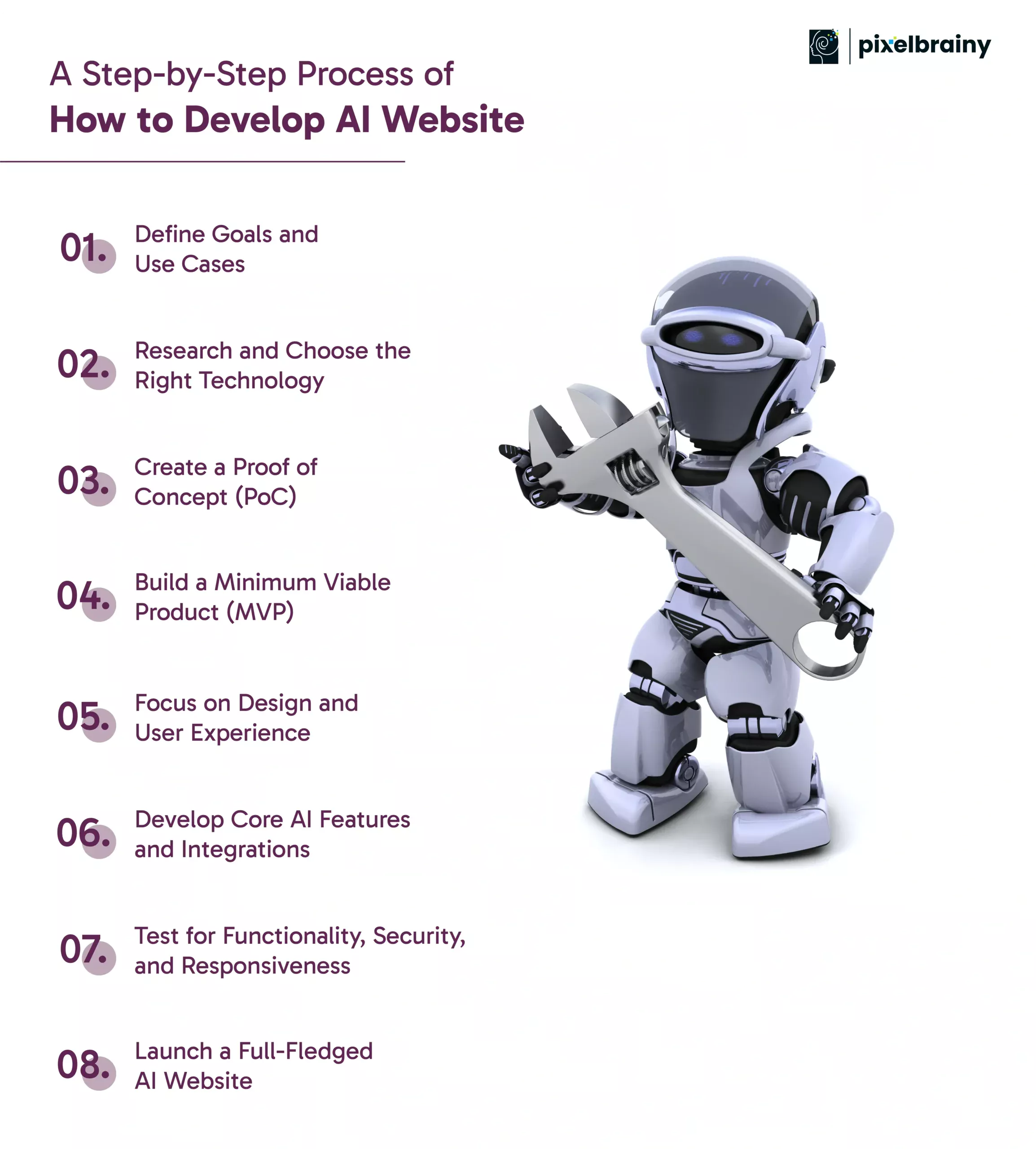
Every Artificial Intelligence Website Development project begins with clarity of purpose. Businesses must decide whether the site will drive ecommerce sales, streamline patient care, or personalize financial services. Defining goals helps teams prioritize AI features such as recommendation engines, chatbots, or fraud detection.
Why this matters: Without clear goals, businesses risk wasting resources on features users do not need. A goal-driven approach ensures the website serves its industry purpose.
Example: A retail startup might focus on personalization to boost conversions, while a hospital portal may prioritize AI-powered symptom checkers for patients.
AI projects rely on the right stack. This includes programming languages, frameworks, APIs, and cloud infrastructure. Collaborating with top AI development companies in USA ensures you select scalable and secure tools that will grow with your business.
Why this matters: Choosing the wrong technology can lead to costly rebuilds later. Scalable solutions keep the project sustainable.
Example: A fintech company might adopt secure blockchain integrations with AI fraud detection, while an e-learning platform could prioritize cloud scalability to handle thousands of concurrent learners.
Before committing large budgets, a PoC tests whether AI models and features work as intended. It is a small-scale version of your website, designed to validate concepts like predictive search, personalization, or AI chat support.
Why this matters: PoCs reduce risk by ensuring the technology meets expectations before a full rollout.
Example: An eCommerce brand could test AI-driven recommendations with a small group of users before expanding across its entire catalog.
After validating ideas, businesses should Build MVP versions of their websites. An MVP includes only the core AI features necessary to launch and gather real-world feedback. This lean approach reduces time-to-market while confirming that users find value in the AI functions.
Why this matters: MVPs prevent overspending and help refine features based on actual user data.
Example: A travel agency might release an MVP with AI trip recommendations, then add advanced chatbots and predictive pricing once feedback proves demand.
Even the best AI will fail if the interface is confusing. Partnering with a UI/UX design company ensures the platform is intuitive, visually appealing, and user-friendly. Great design supports adoption of AI features like chatbots or recommendation systems.
Why this matters: Poor design creates friction and damages trust, especially in sensitive industries like healthcare and finance.
Example: A healthcare website with AI symptom checkers must guide patients smoothly without overwhelming them with technical details.
At this stage, the project moves into AI Web Development, where AI modules like chatbots, voice search, and recommendation engines are integrated. Connections with CRM, ERP, or eCommerce tools ensure the website fits into the company’s broader ecosystem.
Why this matters: Seamless integrations make the website a central hub for operations rather than a standalone tool.
Example: A real estate firm could integrate AI property matching with its CRM to personalize offers for each buyer.
Rigorous testing ensures the website performs under real-world conditions. This involves validating AI accuracy, stress testing for high traffic, and reviewing security protocols. Applying AI and responsive web design ensures the site adapts to all devices and user environments.
Why this matters: A poorly tested AI website can cause reputational and financial damage, especially when handling sensitive user data.
Example: A banking website must test fraud detection AI across multiple devices to ensure consistent results for mobile and desktop users.
After iterations of PoC, MVP, design, and testing, the website is ready for full deployment. A complete launch incorporates advanced AI capabilities, scalability, and automation. Leveraging AI-driven web design ensures the site evolves dynamically with user behavior and industry demands.
Why this matters: Full-scale launches transform pilot projects into sustainable business assets that drive long-term growth.
Example: An eCommerce retailer could move from a simple chatbot in the MVP stage to a full-fledged AI ecosystem offering predictive inventory, personalized shopping, and automated customer support.
So, by following this structured AI website development step-by-step process, businesses across industries can move from vision to execution with confidence, ensuring their platforms evolve into powerful assets for growth.
When planning a project, one of the most common questions businesses ask is about the cost to build AI website solutions. On average, the AI Website Development Cost ranges between $15,000 to $20,000+, depending on complexity, features, and industry-specific requirements.
The cost of developing AI Website platforms is influenced by several factors, including the type of AI integrations needed, the design approach, scalability requirements, and whether you are creating a simple MVP or a full-scale enterprise solution.
So, understanding the basics of AI Website Development Cost helps businesses plan budgets wisely, and for a detailed-breakdown you can refer to our dedicated blog on AI website cost analysis.
To successfully make AI Website projects, businesses need the right combination of technologies that cover every stage of development. From design to deployment, the AI Tools and tech stack required for the development of AI Website determine how efficient, scalable, and intelligent the final platform will be.
Below is a breakdown of the most important layers and tools used in AI Web Development.
| Parameter | Tools & Platforms | Explanation |
| Frontend Frameworks | React, Angular, Vue.js | These frameworks help build responsive, interactive user interfaces. React is often preferred for scalability, Angular for enterprise-grade apps, and Vue for lightweight projects |
| Backend Frameworks | Django, Flask, Node.js | Backend frameworks handle logic, APIs, and AI integrations. Django and Flask (Python-based) are strong choices for AI-heavy workloads, while Node.js excels at real-time applications |
| AI and Machine Learning Platforms | TensorFlow, PyTorch, Scikit-learn | These platforms enable model training, deployment, and customization. TensorFlow is widely used for deep learning, PyTorch is flexible for experimentation, and Scikit-learn is great for classical ML algorithms |
| Databases | MongoDB, PostgreSQL, Firebase | AI websites need databases that handle large volumes of structured and unstructured data. MongoDB works well with unstructured inputs, PostgreSQL ensures reliability, and Firebase integrates easily with modern apps |
| Cloud Platforms | AWS, Google Cloud, Microsoft Azure | Cloud services provide the infrastructure to deploy AI models at scale. They offer managed AI services, scalability, and strong security, making them vital for enterprise-level solutions |
| Design and Prototyping Tools | Figma, Adobe XD, Sketch | Tools like Figma and XD simplify prototyping and design collaboration. They also help integrate intelligent layouts, supporting automated website creation with AI for faster iterations |
| Content Management Systems (CMS) | WordPress with AI plugins, Headless CMS | A CMS simplifies content updates. Headless CMS platforms integrate directly with AI models, allowing for dynamic, personalized content delivery across devices |
| Testing and QA Tools | Selenium, Cypress, Testim | AI-powered testing tools automate repetitive test cases, identify bugs faster, and ensure seamless performance across browsers and devices |
| Analytics and Monitoring Tools | Google Analytics, Mixpanel, Hotjar | These tools track user journeys and behavior. When integrated with AI, they deliver predictive insights that drive smarter content, design, and engagement strategies |
| Security Tools | IBM Security, Snyk, Cloudflare | Security layers protect sensitive data and detect unusual activities. Tools like IBM Security provide real-time AI-driven monitoring, ensuring websites are safe and compliant |
So, selecting the right tools across every layer of development ensures your AI website is not only functional but also future-ready.
The best way to understand the power of AI website development is by looking at real-world use cases. Across industries, leading brands have adopted AI to personalize experiences, automate processes, and drive measurable business growth. These examples prove how AI Web Development has moved from theory to practical, revenue-generating applications.
Amazon uses AI extensively to tailor product recommendations based on browsing and purchase behavior. Their website adjusts in real time, showing dynamic suggestions that increase conversion rates and average order values. This has made Amazon a benchmark in automated website creation with AI for eCommerce.
Netflix integrates AI into its website and platform to predict what viewers want to watch. By analyzing watch history, time spent, and ratings, Netflix personalizes recommendations and even adjusts thumbnails for different audiences. This keeps users engaged longer and reduces churn.
Beauty retailer Sephora leverages AI through its website to allow customers to virtually try on products. Using augmented reality and AI analysis, the website provides personalized product matches, boosting confidence in online purchases.
Through its Erica chatbot, Bank of America offers AI-powered customer assistance on its digital platforms. Users can get account updates, budgeting advice, and payment reminders directly on the website. This illustrates how Artificial Intelligence Website Development enhances financial services with smarter support.
Healthcare organizations like Mayo Clinic use AI to guide patients online. Their website includes a symptom checker powered by AI that asks structured questions and suggests possible next steps, improving access to preliminary care.
Duolingo’s platform adapts dynamically to each learner. The AI engine adjusts lessons, difficulty, and practice schedules to suit individual learning styles. This ensures higher retention and progress while keeping the user experience engaging.
Real estate giant Zillow incorporates AI to suggest properties based on user preferences and browsing behavior. Its website predicts which listings are most relevant, helping buyers find homes faster and keeping sellers connected to motivated prospects.
These examples show that AI website development is not limited to one sector. From eCommerce and entertainment to healthcare and finance, businesses are transforming their websites into intelligent platforms that engage, assist, and convert.
While the opportunities of AI in web design are exciting, businesses must also be aware of the challenges that come with it. Successful developing of AI website requires careful planning, skilled execution, and the right solutions to avoid common pitfalls.
Let’s explore the biggest obstacles and how to address them.
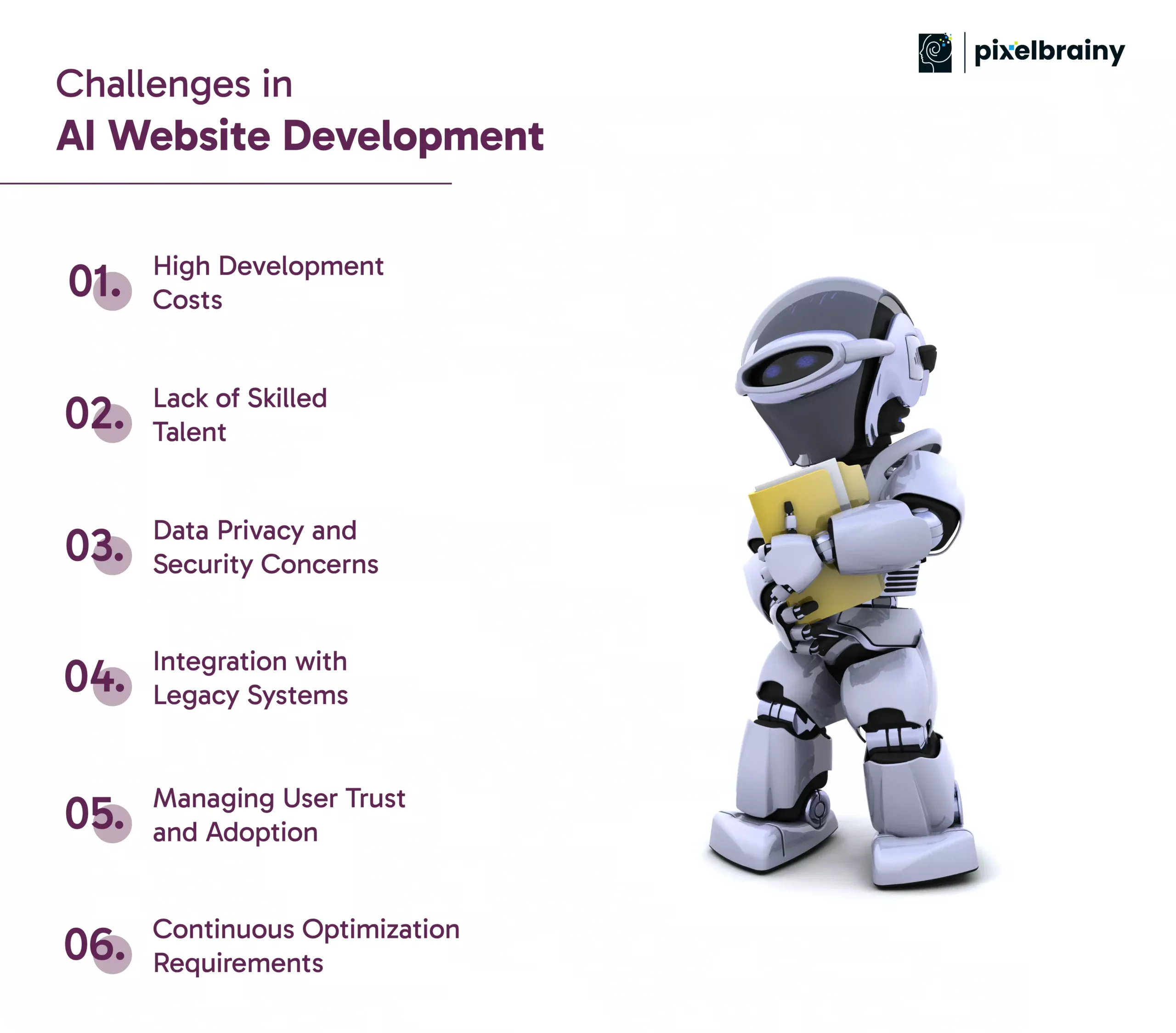
One of the most common challenges is the significant AI Website Development Cost. Advanced features like predictive analytics, AI chatbots, and natural language processing often require large investments in both tools and talent.
How to overcome it: Businesses can start small with a PoC or MVP and expand gradually. Using open-source AI frameworks such as TensorFlow or PyTorch reduces licensing costs. Partnering with experienced agencies ensures resources are used efficiently.
AI Web Development requires professionals who understand both artificial intelligence and web technologies. Many companies struggle to find developers who can integrate AI models with frontend and backend systems.
How to overcome it: Organizations can upskill existing teams through AI certifications or collaborate with specialized AI service providers. Outsourcing specific tasks to niche experts is also a cost-effective option.
AI websites rely heavily on user data for personalization and automation. Collecting and processing this data introduces risks related to privacy regulations and cybersecurity.
How to overcome it: Compliance with standards like GDPR and HIPAA is crucial. Businesses should implement AI-driven security systems that detect anomalies in real time and adopt transparent data policies to build trust.
Many organizations operate on outdated infrastructure that was not designed for Artificial Intelligence Website Development. Integrating new AI features into these systems can cause compatibility and performance issues.
How to overcome it: A phased integration strategy works best. APIs and middleware solutions help bridge the gap between legacy platforms and modern AI-driven web systems. Cloud-based AI services can also simplify the transition.
Users may be skeptical of interacting with AI-driven platforms, especially when it comes to sensitive industries like finance or healthcare. Over-automation can also reduce the human touch.
How to overcome it: Businesses should maintain transparency by clearly explaining how AI is used. A hybrid model that combines AI assistance with human support builds confidence while still improving efficiency.
AI models require regular training and updates to remain accurate and effective. Without ongoing optimization, websites risk becoming outdated or irrelevant.
How to overcome it: Companies should plan for long-term maintenance as part of their AI strategy. Using cloud platforms with automated updates and real-time monitoring ensures systems remain reliable and scalable.
By understanding these challenges and preparing effective solutions, businesses can ensure their AI website development projects deliver strong, sustainable results without being derailed by avoidable obstacles.
The future of AI Website Development promises a digital world where websites are no longer static platforms but intelligent ecosystems that anticipate, adapt, and evolve with every interaction.
As businesses compete for user attention, the future of website development with AI will determine how brands connect, engage, and grow in a digital-first economy.
We are moving toward a future where businesses can request a website with a simple prompt and have it generated instantly by AI. This evolution in automated website development with AI will cover everything from design to copywriting, SEO, and personalization without heavy human input. The result is faster launches and lower entry barriers for startups and small businesses.
Websites of tomorrow will deliver unique journeys for every visitor. AI engines will analyze browsing history, location, real-time behavior, and even mood to build interfaces tailored to each individual. This kind of personalization, powered by Artificial Intelligence Website Development, will deepen customer loyalty and significantly increase conversion rates.
Future websites will rely on AI that understands not only text but also voice, gestures, and visuals. By merging voice assistants, computer vision, and natural language processing, websites will create seamless interactions. This development within AI Web Development will make digital platforms more inclusive and user-friendly for global audiences.
AI will no longer just support websites; it will actively advise businesses. By embedding predictive analytics and machine learning, websites will recommend pricing models, forecast demand, and suggest marketing strategies. This shift will redefine AI website development as a way of building intelligent business partners rather than simple digital storefronts.
As IoT devices and wearables become mainstream, websites will connect with them to deliver live data-driven experiences. A fitness site could adjust workouts using data from smartwatches, while a healthcare portal might provide personalized treatment updates. This deeper integration ensures Artificial Intelligence Website Development aligns with the connected lifestyle of future users.
The rise of AI in websites also brings ethical concerns around privacy, bias, and transparency. Users will demand clarity on how their data is used and how AI makes decisions. By embedding explainable AI models into platforms, businesses can build trust. This will become a core expectation in the future of website development with AI.
Future websites will be dynamic, constantly evolving based on real-world interactions. With self-learning algorithms, websites will redesign layouts, update content, and test new flows automatically. This approach to automated website development with AI ensures that digital platforms stay optimized without manual intervention.
Thus, the future of AI Web Development is about intelligent, transparent, and ever-evolving platforms. Businesses that embrace these possibilities now will lead the next era of digital transformation.
For entrepreneurs aiming to launch innovative platforms, startups looking to scale quickly, and enterprises ready to modernize their digital presence, the challenge is not just building a website but building one that truly thinks and adapts. That is where PixelBrainy comes in.
We specialize in AI Website Development that transforms websites into intelligent business assets, designed to personalize experiences, optimize performance, and deliver measurable growth. With us, you gain more than developers — you gain a partner that understands your business goals and aligns AI technology to achieve them.
Recently, we partnered with a fast-growing eCommerce startup to transform their online platform with AI capabilities. The project involved integrating an AI-powered recommendation engine, predictive analytics for customer behavior, and automated chat support.
Within three months of launch, the client saw a 35% increase in sales conversions and a noticeable reduction in customer service response times. For confidentiality, we cannot disclose the client’s name, but the results reflect our ability to deliver real-world business impact through AI-driven solutions.
Choosing PixelBrainy means choosing a partner committed to innovation, transparency, and measurable success in your AI website development journey.

The rise of AI Website Development marks a turning point in how businesses build and manage their digital presence. From personalization and predictive analytics to automation and continuous optimization, Artificial Intelligence Website Development is no longer an option but a necessity. Companies that embrace this shift gain smarter platforms, stronger customer connections, and a competitive edge in their industries.
By following a clear AI website development step-by-step process, choosing the right tech stack, and integrating must-have and advanced features, businesses can transform ordinary websites into intelligent assets. The future of AI Web Development is about adaptability, scalability, and creating user experiences that truly resonate.
Ready to unlock the power of AI for your business? Book an appointment with PixelBrainy today and start your journey toward smarter, AI-driven websites.
AI Website Development can be applied across industries including eCommerce, healthcare, finance, education, real estate, and travel. Each sector uses AI differently, from personalized shopping to predictive patient care.
Timelines vary depending on features and complexity. A simple AI website may take 6–8 weeks, while full-scale projects with advanced integrations may require several months.
Not necessarily. Many platforms are built with user-friendly dashboards, so even non-technical users can manage content, analytics, and AI-driven insights easily.
Yes. Businesses can integrate AI tools such as chatbots, recommendation engines, and predictive analytics into their existing websites without a full rebuild.
Startups often find AI valuable because automation reduces overhead and helps scale faster. Starting with an MVP allows them to test ideas affordably.
AI websites can be highly secure when developed with robust encryption and fraud detection systems. Regular updates and monitoring ensure ongoing protection.

About The Author
Sagar Bhatnagar
Sagar Sahay Bhatnagar brings over a decade of IT industry experience to his role as Marketing Head at PixelBrainy. He's known for his knack in devising creative marketing strategies that boost brand visibility and market influence. Sagar's strategic thinking, coupled with his innovative vision and focus on results, sets him apart. His track record of successful campaigns proves his ability to utilize digital platforms effectively for impactful marketing efforts. With a genuine passion for both technology and marketing, Sagar continuously pushes PixelBrainy's marketing initiatives to greater success.


Transform your ideas into reality with us.
Working with the PixelBrainy team has been a highly positive experience. They understand the design requirements and create beautiful UX elements to meet the application needs. The dev team did an excellent job bringing my vision to life. We discussed usability and flow. Sagar worked with his team to design the database and begin coding. Working with Sagar was easy. He has the knowledge to create robust apps, including multi-language support, Google and Apple ID login options, Ad-enabled integrations, Stripe payment processing, and a Web Admin site for maintaining support data. I'm extremely satisfied with the services provided, the quality of the final product, and the professionalism of the entire process. I highly recommend them for Android and iOS Mobile Application Design and Development.

Great experience working with them. Had a lot of feedback and I found that unlike most contractors they were bugging me for updates instead of the other way around. They were extremely time conscience and great at communicating! All work was done extremely high quality and if not on time, early! They were always proactive when it comes to communication and the work is great/above par always. Very flexible and a great team to work with! Goes above and beyond to present us with multiple options and always provides quality. Amazing work per usual with Chitra. If you have UI/UX or branding design needs I recommend you go to them! Will likely work with them in the future as well, definitely recommended!

PixelBrainy is a joy to work with and is a great partner when thinking through branding, logo, and website layout. I appreciate that they spend time going into the "why" behind their decisions to help inform me and others about industry best practices and their expertise.

I hired them to design our software apps. Things I really like about them are excellent communication skills, they answer all project suggestions and collaborate right away, and their input on design and colors is amazing. This project was complex and needed patience and creativity. The team is amazing to do business with. I will be using them long-term. Glad to see there are some good people out there. I was afraid to try and outsource my project to someone but I am glad I met them! I really can't say enough. They went above and beyond on this project. I am very happy with everything they have done to make my business stand out from the competition.

It was great working with PixelBrainy and the team. They were very responsive and really owned the project. We'll definitely work with them again!

I recently worked with the PixelBrainy team on a project and I was blown away by their communication skills. They were prompt, clear, and articulate in all of our interactions. They listened and provided valuable feedback and suggestions to help make the project a success. They also kept me updated throughout the entire process, which made the experience stress-free and enjoyable.

PixelBrainy is very good at what it does. The team also presents themselves very professionally and takes care of their side of things very well. I could fully trust them taking up the design work in a timely and organised manner and their attention to detail saved us lots of effort and time. This particular project was quite intense and the team showed that they function very well under pressure. Very much looking forward to working with her again!

It's always an absolute pleasure working with them. They completed all of my requests quickly and followed every note I had for them to a T, which made our process go smoothly from start to finish. Everything was completed fast and following all of the guidelines. And I would recommend their services to anyone. If you need any design work done in the future, PixelBrainy should be your first call!

They took ownership of our requirements and designed and proposed multiple beautiful variants. The team is self-motivated, requires minimum supervision, committed to see-through designs with quality and delivering them on time. We would definitely love to work with PixelBrainy again when we have any requirements.

PixelBrainy was a big help with our SaaS application. We've been hard at work with a new UI/UX and they provided a lot of help with the designs. If you're looking for assistance with your website, software, or mobile application designs, PixelBrainy and the team is a great recommendation.

PixelBrainy designers are amazing. They are responsive, talented, and always willing to help craft the design until it matches your vision. I would recommend them and plan to continue them for my future projects and more!!!

They were awesome! Did a good job fast, and good communication. Will work with them again. Thank you

Creative, detail-oriented, and talented designers who take direction well and implement changes quickly and accurately. They consistently over-delivered for us.

PixelBrainy team is very talented and creative. Great designers and a pleasure to work with. PixelBrainy is an excellent communicator and I look forward to working with them again.

PixelBrainy has a very talented design team. Their work is excellent and they are very responsive. I enjoy working with them and hope to continue on all of our future projects.


