 AI Summary Powered by PixelBrainy
What if your banking app could understand not only where a customer’s money went, but also why it went there, what financial pressure they face, and what action could improve their financial position next?
For a fintech entrepreneur, that is the real opportunity behind AI financial assistant development. A modern financial assistant can go far beyond a traditional budgeting dashboard by connecting income patterns, spending behavior, recurring bills, debt obligations, savings progress, account balances, and financial goals into one continuously updated financial profile.
The goal of financial assistant development with AI is not simply to add a chatbot to a banking application. It is to develop an AI financial assistant that can analyze financial data, explain what is happening, identify risks or opportunities, recommend practical next steps, and, where authorized, help users execute those actions.
This creates a fundamental shift from passive money management to proactive financial guidance. Visa's 2026 AI Financial Assistant offering, for example, is designed to combine cardholder activity with financial-institution data to provide personalized insights and support actions inside banking apps.
For businesses researching how to create an AI financial assistant, the central question is therefore not just technology. It is also economics, compliance, data infrastructure, UX, AI reliability, and measurable customer outcomes.
So, how much does it cost to build a production-grade AI financial assistant, and which companies have demonstrated measurable improvements beyond basic budgeting experiences?
There is no single development price. The average cost to build an AI financial assistant ranges from approximately $30,000 to $250,000+, depending on the level of AI complexity, financial data integrations, customization, security, compliance requirements, automation, platform infrastructure, and scalability.
Documented examples show that personalized financial guidance can produce measurable engagement and savings outcomes. Personetics, FIS, and financial institutions have reported cases involving increased savings, engagement, and financial guidance adoption.
This guide explains building an AI financial assistant, including architecture, features, development steps, technologies, costs, business models, challenges, and how fintech companies can turn AI-powered financial guidance into a scalable product.

An AI financial assistant is an AI-powered financial technology solution designed to understand a user's financial situation, analyze financial data, answer financial questions, provide personalized insights, recommend relevant actions, and support better financial decision-making. Instead of focusing on one isolated financial activity, it can bring together information from bank accounts, credit cards, loans, investments, income, expenses, savings, recurring payments, and financial goals to create a more complete picture of a customer's financial position.
The primary purpose of an AI financial assistant is to turn complex financial information into personalized and actionable financial guidance. For example, instead of simply telling a customer that their spending increased this month, the assistant can identify which categories contributed to the increase, compare current spending with historical patterns, consider upcoming financial obligations, and explain what the customer can do to stay on track with their goals.
A traditional banking chatbot is generally designed to answer predefined customer-service questions and handle simple banking requests, such as:
An AI financial assistant can support more complex financial conversations by combining natural language processing with financial data, analytics, predictive models, and personalization.
For example, a chatbot may explain what a savings account is, while an AI financial assistant can analyze a customer's income, expenses, existing savings, recurring bills, and financial goals to suggest a realistic savings strategy.
A robo-advisor primarily focuses on automated investment management. It can assess an investor's risk profile, recommend an investment portfolio, allocate assets, and potentially rebalance investments automatically.
An AI financial assistant has a broader financial scope. Depending on its design and regulatory permissions, it can help users understand spending, savings, debt, cash flow, investments, financial goals, and other aspects of personal finance.
| Capability | Traditional Chatbot | Robo-Advisor | AI Financial Assistant |
|---|---|---|---|
| Primary Purpose | Handles common customer-service questions and basic banking requests. | Automates investment management and portfolio recommendations based on an investor's profile. | Provides personalized financial guidance across spending, saving, debt, cash flow, investments, and financial goals. |
| Financial Data Analysis | Usually works with limited account or service information. | Primarily analyzes investment and portfolio-related information. | Can analyze transactions, income, expenses, balances, debts, savings, investments, and other connected financial information. |
| Budgeting | May provide basic budgeting information or direct users to budgeting tools. | Generally does not manage personal budgets. | Can create, monitor, and personalize budgets based on actual spending patterns and financial goals. |
| Spending Analysis | Usually provides transaction-related information when specifically requested. | Not a primary function. | Identifies spending patterns, unusual expenses, category changes, recurring costs, and potential areas for improvement. |
| Savings Management | May answer questions about savings products. | Focuses mainly on investment portfolios rather than everyday savings. | Can track savings progress, recommend realistic savings targets, and identify opportunities to improve savings behavior. |
| Debt Management | Can provide general information about loans or credit products. | Usually outside its core functionality. | Can analyze debt obligations, interest rates, repayment patterns, and potential repayment strategies. |
| Cash-Flow Forecasting | Rarely provides personalized forecasts. | Usually limited to investment-related projections. | Can estimate future cash flow using income, recurring expenses, upcoming bills, spending patterns, and account balances. |
| Investment Guidance | Usually provides general product or service information. | Core capability, including portfolio construction and automated investment management. | Can provide investment-related insights as part of a broader financial picture, depending on the product's regulatory scope. |
| Personalization | Mostly based on the user's immediate question or available account information. | Primarily personalized around investment goals and risk preferences. | Can personalize recommendations using financial behavior, goals, income, expenses, debt, savings, preferences, and historical activity. |
| Proactive Insights | Usually responds after the customer initiates a conversation. | May provide portfolio alerts or automated investment notifications. | Can proactively identify financial events, risks, opportunities, upcoming obligations, and changes in financial behavior. |
| Financial Goal Tracking | Usually limited or unavailable. | Primarily focused on investment or wealth goals. | Can track goals such as emergency savings, debt repayment, home purchases, education, vacations, and retirement. |
| Action Support | May guide users through basic banking tasks. | Can execute permitted investment actions automatically. | Can potentially support transfers, payments, savings plans, budget updates, and other authorized financial workflows. |
| Overall Scope | Customer service and basic banking assistance. | Automated investment and portfolio management. | Comprehensive, personalized financial intelligence and guidance. |
The key difference can be summarized simply: a chatbot primarily answers questions, a robo-advisor primarily manages investments, while an AI financial assistant can understand and support a much broader range of a user's financial needs.
This broader capability makes AI financial assistant development particularly valuable for banks, neobanks, fintech startups, wealth-management platforms, and other financial service providers. By combining financial data, AI models, predictive analytics, personalization, and secure financial workflows, businesses can create digital financial experiences that move beyond basic information delivery toward contextual and actionable financial guidance.
An AI financial assistant works by combining financial data, artificial intelligence, machine learning, predictive analytics, natural language processing, and secure financial workflows to understand a user's financial situation and provide personalized guidance. Instead of relying only on a conversational AI model, a production-grade assistant connects multiple technology layers that work together to collect verified financial information, analyze it, understand user intent, generate relevant recommendations, and support authorized actions.
The typical workflow can be summarized as:
Financial Data Collection → Data Processing → Financial Analysis → AI Understanding → Personalization → Recommendation → User Action → Continuous Learning
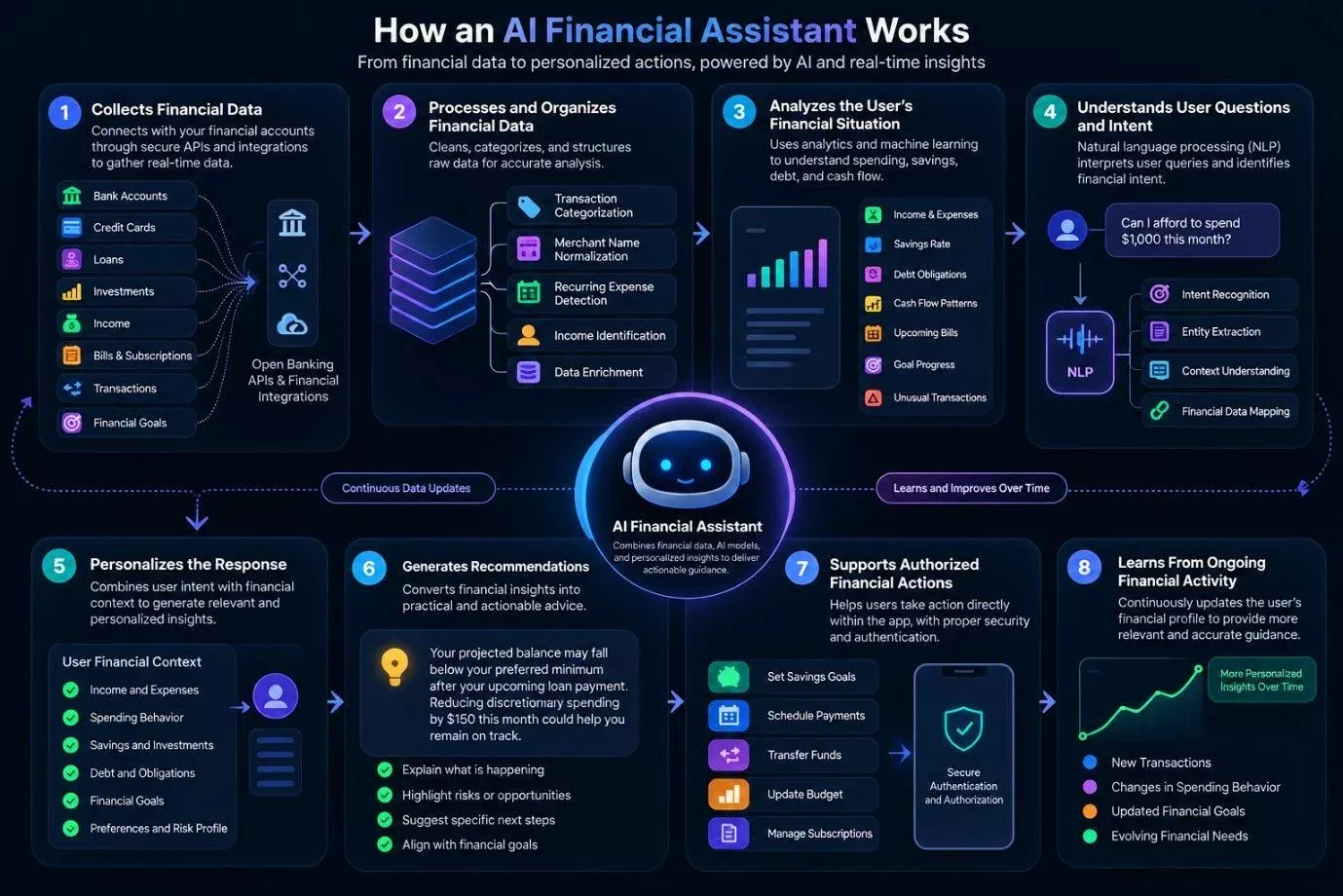
The first step in an AI financial assistant is collecting relevant financial information from authorized sources. Depending on the product, this may include:
Open banking APIs, financial data aggregators, banking APIs, and other authorized integrations can help bring this information into a centralized financial environment.
Raw financial data is often inconsistent. Different banks may use different merchant names, transaction descriptions, categories, and formats.
The system therefore normalizes and organizes the data by identifying:
This creates a structured financial profile that AI models and financial services can work with more reliably.
The financial intelligence layer analyzes the user's current and historical information.
It can calculate or identify:
For example, the system may identify that a customer's discretionary spending has increased by 20% over the previous three months.
The natural language processing layer allows users to communicate with the assistant conversationally.
A customer could ask:
"Can I afford to spend $1,000 this month?"
The AI interprets the question and determines which financial information is required to provide a relevant answer.
The assistant combines the user's question with their financial context.
Instead of providing generic budgeting advice, it may consider income, upcoming bills, existing savings, debt, spending patterns, and financial goals before generating a response.
The recommendation engine converts financial insights into practical actions.
For example:
"Your projected balance may fall below your preferred minimum after your upcoming loan payment. Reducing discretionary spending by $150 this month could help you remain on track."
Important financial calculations should generally be performed by deterministic financial services rather than relying solely on an LLM.
Advanced AI financial assistants can move beyond recommendations and support permitted actions such as setting savings goals, scheduling payments, transferring funds, or updating budgets.
For sensitive financial actions, the system should use appropriate authentication, authorization, confirmation, and audit controls.
The assistant can continuously update the user's financial profile as new transactions, income, expenses, goals, and preferences become available.
This allows recommendations to become more context-aware over time.
Ultimately, how an AI financial assistant works comes down to connecting trusted financial data with AI-powered interpretation and personalization. The AI provides the conversational intelligence, while financial APIs, databases, analytics engines, rules, predictive models, and security systems provide the reliable foundation required for a production-grade financial experience.
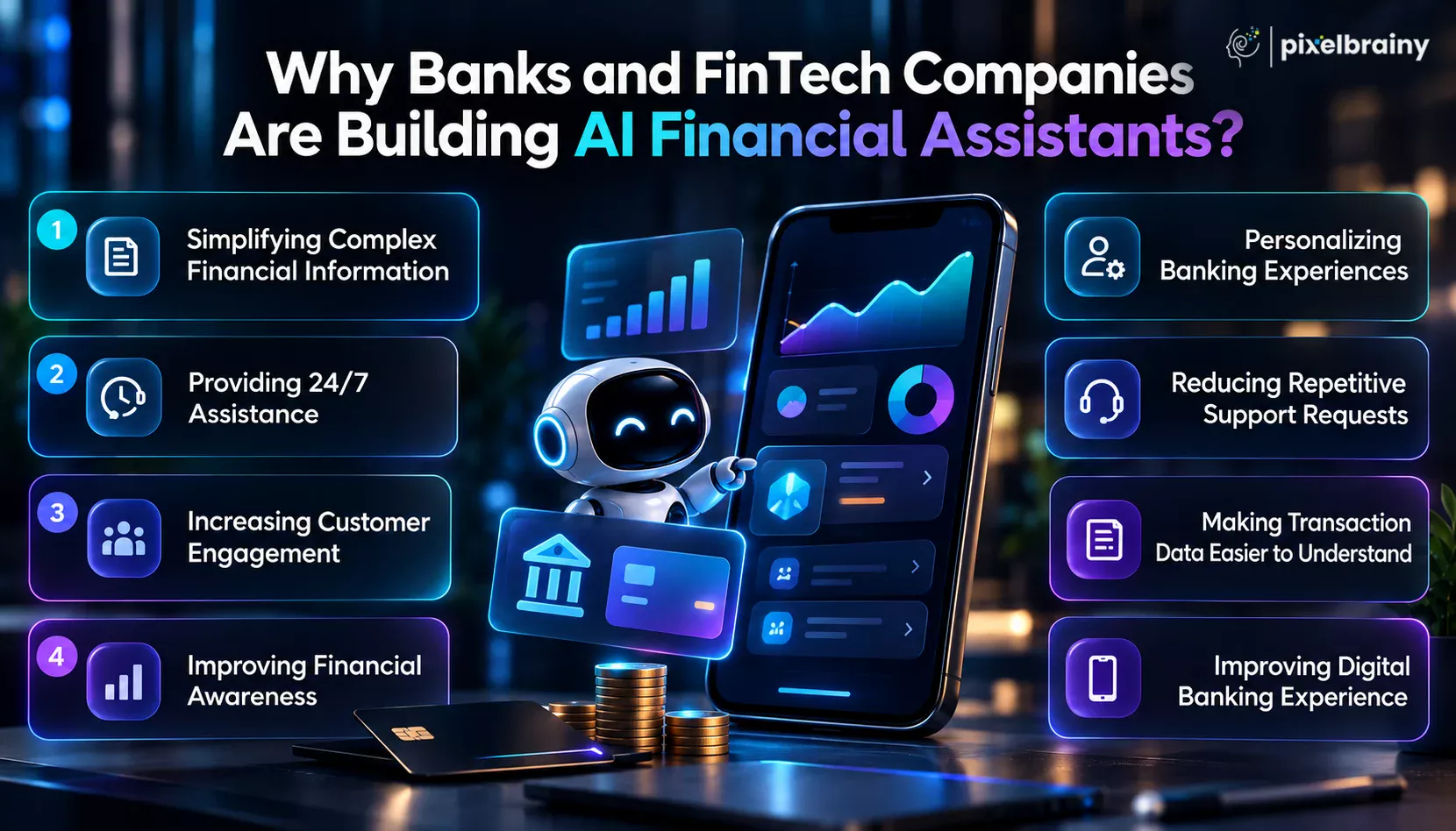
Why are banks and FinTech companies investing in AI financial assistants when traditional banking apps and customer-support chatbots already exist? The answer is changing customer expectations. Users increasingly want banking experiences that are personalized, conversational, proactive, and available whenever they need financial support.
The latest market research shows that this shift is already underway. Accenture's 2026 banking research found that 71% of consumers would welcome an AI assistant in their primary bank's mobile app, while 65% are open to using a GPT-like financial assistant through a generative AI platform or digital wallet. Accenture also found that 86% of consumers would trust their main bank to deliver smart AI assistants.
The 2026 Global AI in Financial Services Report from the Cambridge Centre for Alternative Finance provides another strong market signal. 81% of surveyed financial-services firms are adopting AI at some level, while 52% are actively adopting agentic AI. AI-powered customer support is the leading front-office AI use case, with 74% of surveyed institutions reporting adoption.
These developments explain why AI financial assistant development for banks and FinTech companies is becoming a strategic priority.
Financial information can be difficult to interpret. Bank statements, transaction histories, credit-card bills, loan schedules, investment reports, and savings data often provide numbers without explaining what they mean.
An AI financial assistant for banking can turn complex financial data into simple, conversational explanations. Instead of merely showing that spending increased by 18%, the assistant can identify the categories responsible, compare the change with previous spending, and explain how it may affect the customer's financial goals.
For example, a customer could ask, "Why did I spend more this month?" The assistant can analyze recent transactions and explain whether the increase came from dining, shopping, subscriptions, travel, bills, or another category.
Customers may need financial assistance at any time, whether they are checking a transaction, reviewing a payment, understanding a bill, or looking for information about a banking service.
An AI assistant can provide 24/7 banking assistance through mobile applications and digital channels, handling suitable routine questions while directing complex or sensitive matters to human employees.
Deloitte's 2026 Global Contact Center Survey found that 37% of surveyed US banking executives were already using generative AI in contact centers, while another 37% planned to use it in 2026. The executives identified improved customer satisfaction and net promoter scores as the leading expected benefit, cited by 70% of respondents, followed by lower cost per contact and higher agent productivity at 60%.
Traditional banking apps are often opened when customers need to complete a specific task. AI financial assistants can create more meaningful interactions by proactively surfacing relevant financial insights.
Bank of America reported in 2026 that 20.6 million users interacted with its AI-powered Erica assistant nearly 700 million times during 2025, while cumulative Erica interactions exceeded 3.2 billion since its 2018 launch. Bank of America also reported approximately 30 billion digital client interactions during 2025, a 14% year-over-year increase.
This demonstrates how an AI banking assistant can become a recurring digital touchpoint rather than simply a customer-support feature.
Customers may have access to their financial information without fully understanding the patterns behind it.
AI can identify and explain:
This transforms raw financial data into understandable financial insights and helps customers make better sense of their everyday financial activity.
For example, instead of expecting customers to manually review hundreds of transactions, an AI assistant can summarize the most important financial changes and explain what they could mean for the customer's budget or goals.
Every customer has different income, spending habits, financial goals, debt obligations, and priorities. AI can use this context to deliver more relevant banking experiences instead of presenting identical recommendations to everyone.
For example, a customer building an emergency fund may receive savings-focused insights, while a customer carrying high-interest debt may receive information about repayment strategies.
Accenture's 2026 research found that 86% of consumers would trust their main bank to deliver smart AI assistants, providing banks with an important trust advantage when introducing personalized AI-powered financial experiences.
This makes personalized banking with AI one of the major opportunities for banks and FinTech companies developing next-generation digital financial products.
Banks handle large volumes of repetitive questions about transactions, cards, payments, account information, and routine procedures.
An AI customer service assistant for banks can handle appropriate low-risk requests while allowing human agents to focus on complex, sensitive, or high-value customer situations.
Deloitte's 2026 research shows that banks are already moving toward this model, with 74% of surveyed banking executives either currently using or planning to use generative AI in their contact centers. The research also highlights fragmented data, legacy systems, security, compliance, and integration as important barriers to scaling these solutions.
Transaction histories can contain hundreds of individual records, making meaningful patterns difficult to identify manually.
An AI financial assistant can transform transaction data into natural-language insights such as:
"Your restaurant spending increased by 22% this month compared with your recent average."
Customers can also ask:
"How much did I spend on subscriptions this year?"
"Why was my spending higher this month?"
"Which recurring expenses increased recently?"
This makes AI transaction analysis one of the most practical applications of conversational banking technology. Instead of forcing customers to search through transaction lists and filters, the assistant can interpret their questions and surface the relevant information.
Accenture's 2026 research points to this emerging conversational banking model, noting that banks are increasingly developing experiences where customers can use plain-language questions to retrieve and understand their financial information.
Digital banking is increasingly moving from navigation-based experiences toward intent-based banking, where customers can simply describe what they want to understand or accomplish.
The Cambridge 2026 report found that 81% of surveyed financial-services firms are adopting AI, with fintechs showing more advanced AI adoption than traditional financial institutions. The report also found that 57% of fintech respondents were actively adopting agentic AI compared with 45% of traditional financial institutions. Looking toward 2030, 81% of industry respondents expect agentic AI to become meaningfully established.
This creates a future where customers may interact with their bank by expressing an intent rather than navigating through multiple screens.
For example:
"Help me understand why my balance is lower this month."
"Show me where I can reduce my monthly expenses."
"How much do I need to save each month to reach my goal?"
The AI assistant can combine conversational AI with verified financial information to provide a contextual response.
Banks and FinTech companies are therefore building AI financial assistants to make financial services simpler, more accessible, personalized, proactive, and easier to understand. The market data from 2026 suggests that adoption is moving from experimentation toward broader deployment, particularly in customer support, conversational banking, and emerging agentic financial experiences.
AI financial assistants can be developed for different financial products, customer segments, and business models. From consumer budgeting apps and neobanks to wealth management and enterprise platforms, each type uses AI differently based on the financial problems it aims to solve.
A Consumer Personal Finance AI Assistant is a mobile or web-based personal finance application that helps individuals understand, manage, and improve their everyday finances.
What type of app is it?
A consumer-facing personal finance and financial wellness app that can connect bank accounts, credit cards, investments, loans, and other financial accounts.
Best suited for:
Key capabilities:
Why invest in it?
Traditional budgeting apps primarily show users where their money went. An AI assistant can explain why spending changed, what it means, and what the user can do next. This makes it a practical starting point for businesses looking to build an AI financial assistant focused on personalized financial guidance.
A Retail Bank Customer Engagement AI Assistant is integrated directly into a bank's existing mobile or digital banking platform.
What type of app is it?
An AI-powered banking assistant that combines customer support with personalized financial insights and banking assistance.
Best suited for:
Key capabilities:
Why invest in it?
Banks already have extensive customer financial data. AI can turn that data into contextual insights instead of leaving it inside static dashboards. Bank of America reported that 20.6 million users interacted with its AI-powered Erica assistant nearly 700 million times during 2025, demonstrating the potential scale of AI-driven banking engagement.
This makes AI banking assistant development particularly relevant for institutions looking to increase digital engagement and provide more personalized customer experiences.
A Neobank Intelligent Banking Core goes beyond adding a chatbot to a banking application. In this model, AI becomes a central intelligence layer across the digital banking experience.
What type of app is it?
An AI-native neobanking platform where financial intelligence is embedded into everyday banking activities.
Best suited for:
Key capabilities:
Why invest in it?
This model allows neobanks to differentiate through proactive financial intelligence rather than relying only on pricing, banking features, or interface design.
For example, the assistant could identify recurring expenses, detect changes in spending behavior, recognize an upcoming cash-flow gap, and suggest an appropriate savings strategy before the customer asks for help.
For a neobank asking, "Which development companies can build an AI financial assistant that acts as a proactive financial coach rather than simply providing reactive chatbot support?", the evaluation should focus on proven fintech experience, financial-data integrations, proactive recommendation capabilities, AI governance, and the ability to work reliably with real customer financial data.
A Wealth Management Advisor Intelligence Tool uses AI to support wealth managers, financial advisors, and their clients.
What type of app is it?
It can be a client-facing wealth management application, an advisor dashboard, or a combined advisor-assistant platform.
Best suited for:
Key capabilities:
Why invest in it?
Wealth managers work with large volumes of financial information across multiple clients. AI can organize that information, identify relevant changes, prepare insights, and help advisors spend more time on relationship-focused activities.
It can also translate complex investment information into plain-language explanations for customers.
An Insurance Company Financial Wellness Assistant combines insurance information with broader financial wellness support.
What type of app is it?
It can be integrated into an insurer's customer portal, mobile application, or financial wellness platform.
Best suited for:
Key capabilities:
Why invest in it?
Insurance products can be difficult for customers to understand because of terminology around coverage, deductibles, premiums, exclusions, and benefits. An AI assistant can explain these concepts in simpler language while providing a more continuous digital relationship between the insurer and customer.
A Small Business Financial Management Assistant helps business owners understand and manage their company's financial activity.
What type of app is it?
A B2B fintech application that can connect banking, accounting, payroll, invoicing, and expense-management data.
Best suited for:
Key capabilities:
Why invest in it?
Small businesses frequently have financial information distributed across several systems. AI can bring that information together and provide understandable insights into cash flow, expenses, revenue, and upcoming obligations.
For example, instead of reviewing multiple accounting reports, a business owner could ask:
"Will I have enough cash to cover next month's expenses?"
The assistant can analyze available financial data and present the relevant information in a simple format.
A Financial Inclusion AI Assistant is designed for customers who may have limited access to traditional financial services, financial education, or sophisticated digital financial tools.
What type of app is it?
A mobile-first financial wellness, banking, savings, or lending application designed around accessibility and simple financial communication.
Best suited for:
Key capabilities:
Why invest in it?
Complex financial terminology can create barriers to financial participation. AI can explain financial concepts in simpler language and provide accessible experiences across different languages and user groups.
Responsible development is especially important for this category. AI recommendations should account for uncertainty, avoid unsupported assumptions, and provide clear explanations so that accessibility does not come at the expense of financial safety.
An Enterprise White-Label Financial Assistant Platform allows banks, fintechs, insurers, wealth managers, and other financial companies to deploy an AI assistant under their own brand.
What type of app is it?
A B2B SaaS or API-based financial AI platform that can be customized and integrated into multiple financial products.
Best suited for:
Key capabilities:
Why invest in it?
Instead of developing an AI assistant separately for every financial institution, technology companies can build an AI financial assistant platform that can be configured for multiple enterprise customers.
This model can support recurring SaaS revenue, licensing, API usage, and white-label deployments while allowing the underlying AI infrastructure to be continuously improved.
Together, these models show how developing an AI financial assistant can support very different financial products, from everyday personal finance to enterprise banking infrastructure. The right development model depends on the target users, financial data available, business objectives, and level of AI-driven personalization required.

When businesses build an AI financial assistant, the objective is to create more than a conversational banking interface. The assistant should understand a customer's financial context, analyze authorized financial data, identify meaningful patterns, provide personalized guidance, and support users at the right moment. A common real-world requirement is: “How can we develop an AI financial assistant that monitors a customer's financial health, identifies personalized savings opportunities, explains spending patterns in simple language, and provides proactive guidance instead of waiting for customers to ask?”
To address these requirements, businesses need a combination of conversational AI, financial analytics, personalization, predictive intelligence, secure integrations, and controlled action support. Below are the top 15 features to consider when developing an AI financial assistant for banking, FinTech, wealth management, personal finance, and other financial applications.
| Feature | Detailed Explanation | Business Value |
|---|---|---|
| Conversational AI | Conversational AI allows users to ask financial questions using everyday language. The assistant can understand intent, maintain conversational context, retrieve relevant financial information, and provide clear responses about accounts, transactions, spending, savings, budgets, and financial goals. | Creates a natural banking experience and reduces dependence on complex menus, dashboards, and traditional customer-support workflows. |
| Personalized Financial Insights | Personalized financial insights analyze a customer's authorized financial information, including transactions, income patterns, recurring expenses, savings behavior, and goals. The assistant uses this context to explain what is happening financially and identify information relevant to that individual customer. | Makes financial guidance more relevant than generic financial content and helps customers understand their own financial position. |
| Intelligent Expense Tracking | Intelligent expense tracking categorizes transactions and interprets spending behavior rather than simply displaying transaction records. The assistant can identify recurring expenses, unusual transactions, spending changes, subscription costs, and category-level patterns that may require customer attention. | Helps customers understand where their money goes and provides a foundation for budgeting, savings recommendations, and financial coaching. |
| AI Budgeting | AI budgeting creates spending plans using income, expenses, historical behavior, financial goals, and customer preferences. Instead of relying entirely on static budgets, the assistant can adjust guidance as spending patterns or financial circumstances change and explain the reason behind suggested changes. | Makes budgeting easier to maintain while providing more contextual and personalized money-management support. |
| Cash Flow Forecasting | Cash flow forecasting uses available financial information to estimate upcoming income, expenses, recurring payments, and potential changes in available funds. The assistant can explain expected cash-flow conditions and highlight situations that may require additional planning or attention. | Helps customers prepare for upcoming financial obligations and make more informed decisions about spending and saving. |
| Proactive Financial Alerts | Proactive financial alerts allow the assistant to identify meaningful events without requiring customers to initiate a conversation. Alerts can cover unusual spending, upcoming bills, low balances, recurring payments, changes in spending behavior, or progress toward financial goals. | Changes the experience from reactive banking support to proactive financial assistance that can reach customers at relevant moments. |
| Personalized Savings Recommendations | Personalized savings recommendations examine cash flow, spending patterns, recurring expenses, available funds, and financial objectives to identify potential opportunities to save. Recommendations should explain the underlying context and allow customers to understand how suggested actions relate to their goals. | Encourages more informed saving behavior while making savings guidance specific to the customer's financial circumstances. |
| Financial Goal Management | Financial goal management lets users create objectives such as building emergency savings, purchasing an asset, reducing debt, or preparing for education. The assistant tracks progress and connects spending, budgeting, forecasting, and savings insights with those objectives. | Gives customers a continuous view of progress and connects everyday financial decisions with longer-term goals. |
| Debt Management | Debt management organizes available information about loans, credit balances, repayment schedules, interest, and payment behavior. The assistant can explain repayment obligations, identify relevant patterns, and provide educational planning support while clearly communicating the limits of automated financial guidance. | Helps customers better understand debt obligations and how repayment decisions may interact with their broader financial situation. |
| Financial Health Assessment | A financial health assessment combines relevant indicators such as spending behavior, savings, debt obligations, cash-flow stability, emergency funds, and financial goals to provide a broader view of financial wellness. The methodology should be understandable and appropriately governed. | Converts fragmented financial information into an easier-to-understand picture of overall financial wellbeing. |
| Personalized Recommendations | Personalized recommendations use customer context to determine which insights, educational resources, financial opportunities, or supported actions may be relevant. The recommendation engine can consider financial behavior, goals, preferences, account information, and the customer's current financial situation. | Improves relevance and helps financial institutions deliver more contextual customer experiences instead of identical recommendations to everyone. |
| Secure Banking Integration | Secure banking integration connects the AI financial assistant with authorized banking, card, transaction, accounting, investment, or other financial data sources. Authentication, consent management, encryption, permissions, monitoring, and access controls should be incorporated into the underlying architecture. | Gives the assistant the financial context required for useful personalization while supporting privacy, security, compliance, and controlled data access. |
| AI-Powered Financial Education | AI-powered financial education explains concepts such as interest, fees, credit, savings, cash flow, investments, and financial terminology according to the customer's question and level of understanding. The assistant can simplify complex information without removing important limitations or conditions. | Makes financial information easier to understand and can improve customer confidence when navigating financial products and decisions. |
| Explainable AI | Explainable AI shows customers why an insight, alert, assessment, or recommendation was generated. Instead of presenting an unexplained result, the assistant can identify relevant factors, data patterns, assumptions, and limitations in language that customers can understand. | Builds transparency and makes AI-generated financial guidance easier to review, question, and understand. |
| Human Handoff and Action Support | Human handoff and action support connect AI assistance with appropriate human expertise and controlled banking workflows. Depending on permissions and risk controls, the assistant can escalate complex cases or guide customers through authorized actions while maintaining authentication and auditability. | Combines AI convenience with human oversight and controlled execution for financial tasks that require additional review or authorization. |
These features provide the foundation for AI financial assistant development, helping financial products move from basic question answering toward personalized, proactive, and context-aware financial support.
Basic features such as budgeting, expense tracking, financial insights, and savings recommendations create the foundation of an AI financial assistant. However, businesses looking to develop an AI financial assistant that can deliver deeper personalization, proactive support, and intelligent financial actions need more advanced capabilities.
A real-world query businesses may ask is: “How can we build an AI financial assistant that not only understands a customer's financial goals, but can proactively monitor those goals, coordinate multiple banking tasks, make context-aware recommendations, and safely take authorized actions?”
This requires moving beyond conventional chatbot functionality toward agentic AI, real-time intelligence, multi-system orchestration, stronger personalization, and built-in governance. Current banking developments are increasingly exploring assistants that can understand intent, plan multi-step workflows, access financial data, and perform controlled actions within defined permissions.
Below are 10 advanced features to consider while developing an AI financial assistant for modern banking and FinTech products.
| Advanced Feature | Detailed Explanation | Business Value |
|---|---|---|
| Agentic AI and Autonomous Task Execution | Agentic AI enables the financial assistant to understand a user's objective, break it into multiple steps, select appropriate tools, and execute permitted tasks within predefined rules. Instead of only answering questions, it can coordinate workflows while maintaining authorization and control. | Moves the product from reactive assistance toward goal-oriented financial support and controlled task automation. |
| Real-Time Financial Intelligence | Real-time financial intelligence continuously processes relevant account activity, transactions, cash-flow changes, and other authorized signals to identify events that may require attention. The assistant can update its understanding of the customer's financial situation as new information becomes available. | Enables timely recommendations and more context-aware financial assistance instead of relying only on historical or periodically refreshed information. |
| Multi-Agent Financial Orchestration | Multi-agent orchestration allows specialized AI agents to work together for different financial functions, such as budgeting, savings, fraud monitoring, customer support, and financial education. An orchestration layer coordinates these agents and determines which capability should handle each request. | Supports complex financial workflows while allowing businesses to separate specialized capabilities and scale the AI architecture more efficiently. |
| Goal-Based Financial Planning | Goal-based planning allows the assistant to understand a customer's desired outcome and develop a sequence of appropriate financial actions around it. The system can connect income, expenses, savings, debt, cash flow, and timelines to provide context-specific planning support. | Creates a more personalized experience by organizing financial intelligence around what the customer is trying to accomplish. |
| Predictive Financial Risk Detection | Predictive risk detection identifies patterns that could indicate emerging financial pressure, unusual account behavior, cash-flow problems, or other situations requiring attention. Models can evaluate multiple signals while applying appropriate thresholds, validation, and escalation rules. | Helps financial institutions provide earlier guidance and allows customers to address potential issues before they become more difficult to manage. |
| Next-Best-Action Intelligence | Next-best-action intelligence evaluates the customer's current context, financial goals, available products, previous interactions, and relevant financial signals to determine which action or information may be most appropriate next. Recommendations should remain explainable and subject to business and regulatory rules. | Creates more contextual customer journeys and can connect insights with useful, authorized financial actions. |
| Contextual Financial Memory | Contextual financial memory allows the assistant to retain relevant information from previous interactions, such as stated financial goals, preferences, recurring concerns, or previously discussed plans, subject to privacy and retention policies. This creates continuity across conversations and channels. | Reduces repetitive conversations and helps the assistant provide more consistent, personalized financial experiences. |
| Cross-Platform Financial Intelligence | Cross-platform intelligence connects information and workflows across banking systems, cards, accounting platforms, investment services, payment systems, and other authorized financial applications. The assistant can use this broader context to provide a more complete understanding of the customer's financial position. | Creates a unified financial experience instead of forcing customers to manage disconnected information across multiple applications. |
| Advanced AI Governance and Guardrails | Advanced governance establishes rules controlling what the AI can access, recommend, or execute. It can include policy enforcement, permission controls, audit trails, human oversight, model monitoring, escalation mechanisms, and safeguards for high-risk financial activities. | Helps businesses develop AI financial assistants that remain controlled, auditable, secure, and aligned with organizational and regulatory requirements. |
| Multimodal Financial Interaction | Multimodal interaction allows users to communicate through combinations of text, voice, documents, charts, images, and other supported formats. The assistant can interpret financial information presented through different channels and respond using the format most suitable for the customer's request. | Makes financial assistance more accessible and creates richer experiences across mobile banking, web applications, voice interfaces, and other digital channels. |
These advanced capabilities can help AI financial assistant development evolve from simple conversational banking into a more proactive, intelligent, goal-oriented, and securely controlled financial experience.
Building an AI financial assistant requires more than connecting a large language model to a banking application. The steps to develop AI financial assistant from idea to launch involve defining the business objective, understanding users, designing the financial data architecture, selecting AI capabilities, developing the product, integrating financial systems, testing the solution, and preparing it for production.
For example, a wealth management firm may ask: “We want to build an AI financial assistant for our advisors that monitors each client's financial picture across investment portfolios, banking accounts, insurance coverage, and estate planning, then surfaces the client conversations advisors should have based on life events, financial changes, and planning gaps. Which development companies have built AI financial assistants for wealth management firms with multi-account aggregation and advisor workflow integration?”
A requirement like this shows why the development process of AI financial assistant needs to address both AI intelligence and financial-product workflows. Below are the 8 key steps to develop an AI financial assistant from idea to launch.
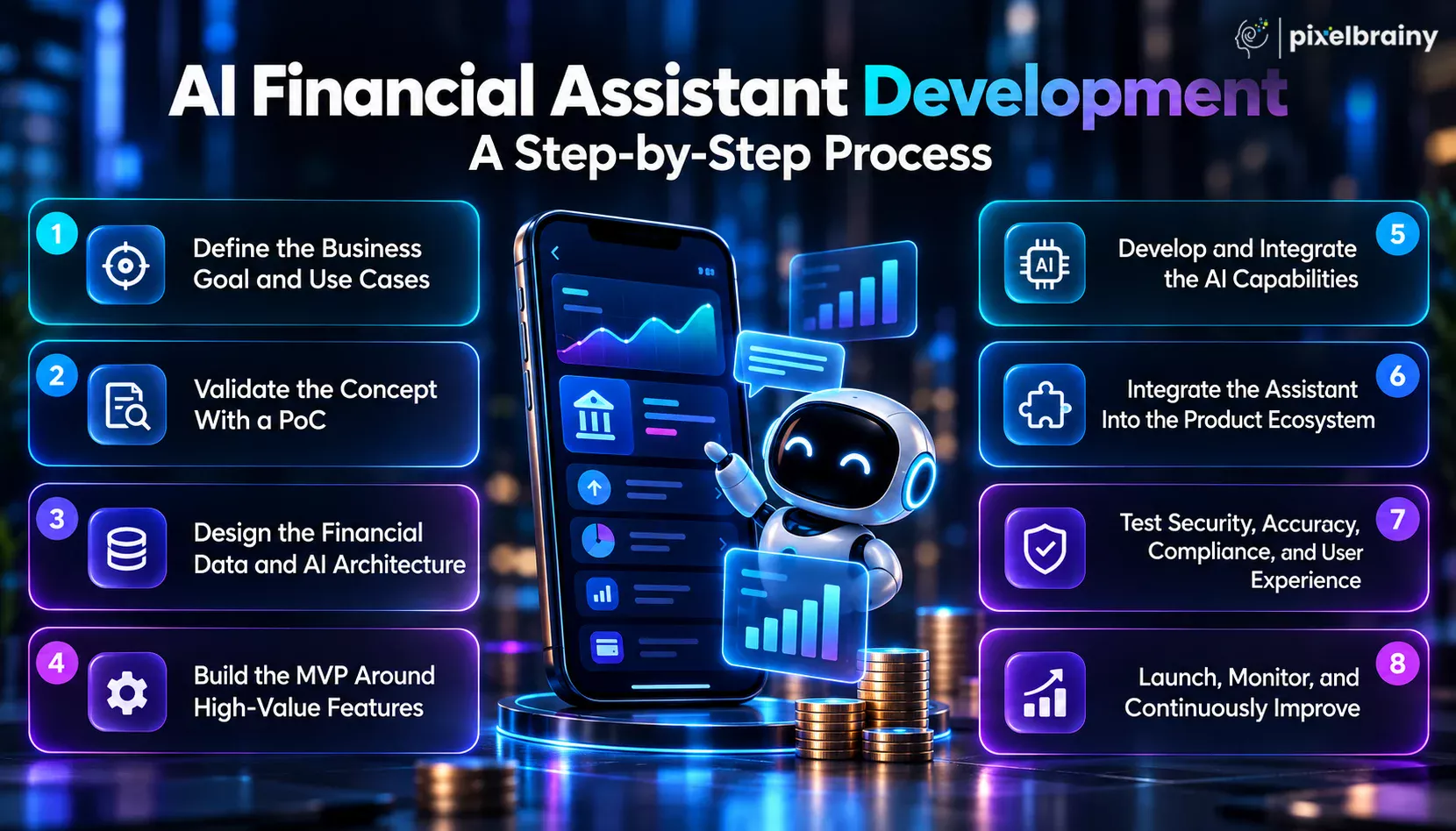
The first step in AI financial assistant development is defining what the product needs to accomplish. Businesses should identify the target users, financial problems, supported channels, expected outcomes, and specific workflows the assistant will handle. A wealth management assistant, for example, may focus on portfolio monitoring and advisor alerts, while a consumer application may prioritize budgeting and savings.
At this stage, teams should document core use cases, customer journeys, data requirements, permissions, and success metrics. An AI consultation can help turn an initial concept into a practical product strategy before technical development begins.
Also Read: Top 10 AI Consulting Companies in USA
Once the use cases are defined, the next step is validating whether the proposed AI experience can work with real financial workflows and data. PoC development can test a limited set of capabilities such as transaction analysis, financial question answering, portfolio summaries, personalized recommendations, or advisor notifications.
The objective is to validate technical feasibility, data availability, model performance, response quality, security requirements, and user experience before committing to a larger build. This stage can also reveal which functions require deterministic financial logic, traditional machine learning, retrieval systems, or generative AI.
A strong architecture is essential when building an AI financial assistant because the system may need to process sensitive information from multiple financial sources. Teams should define how banking, investment, insurance, accounting, payment, and other authorized data will enter the platform.
The architecture should establish APIs, data pipelines, identity management, consent controls, databases, AI orchestration, retrieval systems, model layers, analytics, and audit mechanisms. For complex products, AI model development should be designed around the actual financial use cases rather than selecting a model first and attempting to build the product around it.
Also Read: Top 12+ AI Model Development Companies in the USA
After validating the architecture, businesses can move toward MVP development with a focused set of capabilities. The initial product should solve the most important user problems instead of attempting to include every possible AI feature from the beginning.
For a financial assistant, an MVP could include conversational financial queries, transaction analysis, personalized insights, budgeting, goal tracking, alerts, or advisor-facing recommendations. The development team should establish clear boundaries around what the AI can answer, what data it can access, and which actions require explicit authorization or human review.
Also Read: Top 10 AI MVP Development Companies in USA
This stage focuses on develop AI financial assistant capabilities that transform financial data into useful responses and recommendations. Developers can combine large language models, retrieval-augmented generation, predictive models, recommendation engines, deterministic financial calculations, and business rules according to the specific requirements.
AI integration connects these capabilities with banking systems, CRM platforms, portfolio management software, financial-data providers, authentication systems, and other required services. For example, a wealth management assistant may need to combine portfolio data with CRM information before generating an advisor conversation prompt.
Also Read: Top 10+ AI Integration Companies in USA
The assistant should not operate as an isolated AI interface. During developing an AI financial assistant, teams need to integrate it into the channels and workflows where customers or financial professionals already work.
For a wealth management firm, this could mean integrating AI-generated client insights into an advisor dashboard, CRM, portfolio management system, or relationship-management workflow. For other businesses, the integration could involve mobile banking, web applications, payment platforms, accounting systems, or customer-support systems. This ensures the assistant becomes a practical part of the existing financial ecosystem rather than a standalone AI feature.
Financial AI requires extensive testing before launch because incorrect information, inappropriate recommendations, unauthorized actions, or data exposure can create serious consequences. Teams should test model accuracy, hallucination risks, financial calculations, data permissions, authentication, API security, response consistency, bias, latency, and failure handling.
Human review should be included for workflows where automated decisions or actions require additional oversight. Teams should also test how the assistant responds when information is incomplete, conflicting, outdated, or unavailable. Working with experienced top AI development companies can help businesses establish structured testing and governance processes for complex financial AI products.
The final stage is launching the AI financial assistant in a controlled production environment and continuously evaluating its performance. Development should not end when the application reaches the app store or production server. Teams need monitoring for model quality, user satisfaction, failed requests, system performance, security events, and changes in financial data.
Organizations may hire AI developers or maintain an internal AI team to manage ongoing improvements, model updates, integrations, and new capabilities. Experienced AI development companies and AI product development companies can also support post-launch optimization when businesses need additional expertise as the product scales.
Following these steps makes the development process of AI financial assistant more structured, helping businesses move from an initial concept to a secure, scalable, and production-ready financial AI product.
The cost to develop an AI financial assistant generally starts around $30,000 and can exceed $250,000, depending on the product's complexity, AI capabilities, integrations, security requirements, compliance scope, and development model. A basic assistant that answers financial questions and provides limited insights requires a very different development budget of AI financial assistant than an enterprise platform connected to banking, insurance, investment, CRM, and customer-data systems.
For an insurance company, the cost estimation of AI financial assistant development becomes more complex when the product needs to understand policyholder information, identify potential coverage gaps, provide personalized financial guidance, integrate with insurance systems, and operate within applicable regulatory and compliance requirements. A real query in this context is: “What does an insurer-deployed AI financial assistant cost to build with SEC and state insurance regulation compliance, and which development companies have built financial assistant products for insurance company customer engagement?”
Therefore, the AI financial assistant development cost should be estimated according to the actual scope rather than a single fixed development price. The following ranges provide a practical starting point for understanding what is the development pricing of AI financial assistant solutions.
| Type of AI Financial Assistant | Estimated Development Cost | Typical Scope |
|---|---|---|
| Basic AI Financial Assistant | $30,000 to $70,000 | Conversational AI, financial FAQs, basic financial education, simple personalization, limited data integration, basic dashboard, authentication, and essential analytics. |
| Advanced AI Financial Assistant | $70,000 to $150,000 | Personalized financial insights, expense analysis, budgeting, financial goals, predictive analytics, multiple API integrations, proactive alerts, advanced conversational AI, recommendation engine, and stronger security controls. |
| Enterprise AI Financial Assistant | $150,000 to $250,000+ | Multi-source financial-data aggregation, advanced AI orchestration, agentic workflows, enterprise integrations, advisor or employee dashboards, complex personalization, extensive security, compliance controls, auditability, scalable infrastructure, and ongoing AI optimization. |
| Cost Factor | Estimated Cost | What the Cost Covers |
|---|---|---|
| AI Model and Conversational Intelligence | $5,000 to $35,000+ | LLM integration, prompt engineering, conversational workflows, retrieval systems, model configuration, response optimization, and AI guardrails. |
| Financial Data Integration | $5,000 to $30,000+ | Integration with banking APIs, insurance systems, investment platforms, accounting software, payment systems, financial-data providers, and other authorized data sources. |
| Personalization Engine | $5,000 to $25,000+ | Customer profiling, behavioral analysis, financial preferences, personalized recommendations, financial goals, and context-aware responses. |
| Predictive Analytics | $8,000 to $30,000+ | Cash-flow forecasting, spending predictions, financial trend analysis, risk indicators, anomaly detection, and other predictive capabilities. |
| AI Recommendation Engine | $5,000 to $25,000+ | Personalized savings recommendations, financial insights, next-best-action logic, goal recommendations, and contextual financial guidance. |
| Security and Authentication | $5,000 to $25,000+ | Encryption, authentication, authorization, role-based access, secure API communication, consent management, monitoring, and access controls. |
| Compliance and Governance | $10,000 to $40,000+ | Audit trails, AI governance, privacy controls, regulatory workflows, explainability, policy enforcement, data retention, and compliance-related technical requirements. |
| Web and Mobile Development | $10,000 to $50,000+ | Customer-facing mobile applications, web interfaces, dashboards, conversational interfaces, account views, notifications, and responsive user experiences. |
| Admin and Analytics Dashboard | $5,000 to $20,000+ | Customer analytics, AI performance monitoring, conversation management, user management, recommendation tracking, system monitoring, and administrative controls. |
| Testing and Quality Assurance | $5,000 to $25,000+ | Functional testing, AI response evaluation, security testing, API testing, performance testing, hallucination testing, permission testing, and user acceptance testing. |
| Cloud Infrastructure and Deployment | $3,000 to $20,000+ | Cloud hosting, databases, AI infrastructure, storage, monitoring, deployment pipelines, scalability, backups, and production environments. |
| Post-Launch Maintenance | $2,000 to $15,000+ per month | Model optimization, bug fixes, security updates, API maintenance, monitoring, new integrations, performance improvements, and feature enhancements. |
Important: These individual ranges are indicative development components, so they should not simply be added together to determine the final project price. Some capabilities overlap, while others are included within broader development packages.
For the insurance use case described above, SEC and state insurance regulation requirements can materially affect the budget, particularly when the assistant moves beyond education and customer engagement into personalized investment or insurance recommendations, automated decisions, or financial actions. The exact compliance scope should therefore be determined during the requirements and architecture stages.
The final AI financial assistant development cost depends on the combination of AI capabilities, financial integrations, personalization, security, compliance, platforms, and ongoing maintenance required for the product.

Also Read: AI Fintech App Development Cost: Factors and Examples
The technology stack behind an AI financial assistant determines how effectively the product can understand financial questions, process sensitive financial data, generate personalized insights, integrate with financial systems, and support secure user interactions. The tools and technologies required for the development of AI financial assistant can include AI models, machine learning frameworks, financial APIs, databases, cloud infrastructure, security technologies, analytics tools, and application development frameworks.
A practical query businesses often have is: “What technology stack do we need to develop an AI financial assistant that can aggregate banking and investment data, understand each customer's financial situation, provide personalized recommendations, and securely integrate with our existing financial systems?”
The answer depends on the product's scope, but a modern AI financial assistant development stack generally combines several technology layers rather than relying on a single AI model. Below are the core tools and technologies commonly required when developing an AI financial assistant.
| Technology / Tool | Recommended Options | How It Is Used in an AI Financial Assistant |
|---|---|---|
| Large Language Models | OpenAI GPT models, Anthropic Claude, Google Gemini, open-source LLMs | Powers natural-language conversations, financial explanations, intent understanding, summarization, and conversational assistance. |
| AI Orchestration Frameworks | LangChain, LangGraph, LlamaIndex | Connects language models with financial data, APIs, retrieval systems, business logic, tools, and multi-step AI workflows. |
| Machine Learning Frameworks | PyTorch, TensorFlow, scikit-learn | Supports predictive analytics, financial classification, anomaly detection, forecasting, recommendation models, and other machine learning workloads. |
| Retrieval-Augmented Generation | Vector databases, embedding models, LlamaIndex, LangChain | Allows the assistant to retrieve relevant information from approved financial documents, policies, product information, and knowledge bases before generating responses. |
| Financial Data APIs | Plaid, Finicity, MX, Flinks, Open Banking APIs | Connects the assistant with authorized financial accounts, transactions, balances, and other financial information depending on market and provider availability. |
| Investment and Market Data APIs | Financial market data providers and brokerage APIs | Provides approved market, portfolio, asset, and investment information for assistants designed for wealth management or investment applications. |
| Backend Development | Python, FastAPI, Node.js, Java, .NET | Handles business logic, authentication, financial data processing, API communication, AI orchestration, user management, and application services. |
| Databases | PostgreSQL, MySQL, MongoDB | Stores customer profiles, application data, financial metadata, preferences, goals, configuration, and other structured or semi-structured information. |
| Vector Databases | Pinecone, Weaviate, Milvus, pgvector | Stores and retrieves embeddings for semantic search, financial knowledge retrieval, personalized information access, and RAG-based AI experiences. |
| Cloud Infrastructure | AWS, Microsoft Azure, Google Cloud | Provides scalable computing, storage, databases, AI infrastructure, networking, monitoring, backups, and production deployment environments. |
| Frontend Development | React, Next.js, Flutter, React Native | Builds customer-facing web applications, mobile applications, dashboards, financial insight screens, and conversational interfaces. |
| Authentication and Authorization | OAuth 2.0, OpenID Connect, JWT, MFA | Protects customer accounts and controls which users, applications, or AI workflows can access specific financial information and functionality. |
| Security Technologies | Encryption, tokenization, secrets management, WAF, IAM | Protects sensitive financial information during storage and transmission while controlling access to financial systems and AI services. |
| Data Processing and ETL | Apache Spark, Apache Airflow, AWS Glue, cloud-native data pipelines | Collects, cleans, transforms, normalizes, and prepares financial data for analytics, AI models, forecasting, and personalized recommendations. |
| Analytics and Monitoring | Datadog, Grafana, Prometheus, cloud monitoring services | Tracks application performance, API health, AI latency, errors, infrastructure activity, and operational issues across the financial assistant platform. |
| AI Observability and Evaluation | LangSmith, MLflow, custom evaluation frameworks | Evaluates AI responses, monitors model behavior, tracks prompt performance, identifies quality issues, and supports continuous AI improvement. |
| DevOps and CI/CD | Docker, Kubernetes, GitHub Actions, GitLab CI/CD | Automates application testing, deployment, infrastructure management, scaling, and release processes across development and production environments. |
| Notification and Communication Services | Twilio, Firebase, SendGrid, push notification services | Delivers financial alerts, reminders, goal updates, security notifications, and other approved communications through relevant customer channels. |
The right combination of these technologies enables businesses to develop an AI financial assistant that can connect financial data, understand customer context, generate personalized insights, and deliver secure AI-powered financial experiences at scale.
Before businesses should develop an AI financial assistant, they need to define how the product will generate revenue and how that revenue model fits the target users, financial services, and AI capabilities. The business model for an AI financial assistant can range from consumer subscriptions and enterprise licensing to transaction-based revenue and white-label solutions.
A practical query businesses may have is: “How can we build an AI financial assistant that attracts users with personalized financial guidance while creating a scalable revenue model for our FinTech or banking business?”
The right monetization structure depends on whether the product is designed for consumers, financial institutions, advisors, insurers, businesses, or other FinTech platforms. Below are 8 major business models for an AI financial assistant.
A freemium model provides basic financial-assistant capabilities at no cost while reserving advanced AI features for paying users. This approach can reduce the barrier to adoption and allow customers to experience the product before upgrading.
How it works:
Best suited for: Consumer FinTech apps, budgeting platforms, savings applications, and financial wellness products.
For businesses building an AI financial assistant, freemium can create a large user base while using premium capabilities to generate recurring revenue.
A subscription model charges users a recurring monthly or annual fee for access to advanced AI financial capabilities. Different subscription tiers can provide different levels of personalization, financial analysis, automation, and support.
How it works:
Best suited for: Personal finance applications, wealth management tools, financial wellness platforms, and premium FinTech products.
This model creates predictable recurring revenue and works particularly well when the AI assistant delivers continuous value rather than a one-time service.
Under an enterprise SaaS model, financial institutions or businesses pay to use the AI financial assistant as a software platform. Pricing can depend on users, institutions, usage volume, features, or deployment requirements.
How it works:
Best suited for: Banks, credit unions, insurers, wealth management firms, and large FinTech companies.
For AI financial assistant development, enterprise SaaS can support long-term B2B relationships while allowing the provider to continuously improve the underlying AI platform.
A white-label model allows businesses to offer an AI financial assistant under their own brand without developing the entire technology infrastructure internally. The technology provider manages the underlying platform while the financial institution controls the customer-facing experience.
How it works:
Best suited for: Banks, insurers, FinTech platforms, payment companies, and embedded-finance providers.
This approach can reduce the time required to bring an AI financial assistant to market while allowing financial institutions to maintain their own customer relationship.
With usage-based monetization, businesses pay according to how much they use the AI financial assistant platform. Pricing can be linked to API calls, AI interactions, processed financial records, active users, or other measurable usage units.
How it works:
Best suited for: FinTech APIs, financial infrastructure providers, embedded-finance platforms, and businesses integrating AI financial capabilities into existing applications.
This model can be particularly useful when customers have significantly different usage levels.
A transaction-based model generates revenue when customers complete eligible financial activities through the AI financial assistant. The assistant can guide users toward authorized financial actions while the business earns revenue from qualifying transactions or services.
How it works:
Best suited for: Banking platforms, payment companies, financial marketplaces, and FinTech applications.
When businesses develop an AI financial assistant around transaction workflows, appropriate disclosures, permissions, and regulatory requirements should be incorporated into the product design.
An AI financial assistant can generate revenue by connecting users with relevant financial products or services through approved referral arrangements. Recommendations should be based on appropriate eligibility and relevance criteria rather than simply maximizing product sales.
How it works:
Best suited for: Financial marketplaces, FinTech platforms, comparison services, and financial wellness applications.
For this model, businesses need strong recommendation governance and transparent communication so users understand when recommendations involve commercial relationships.
An AI financial assistant can also be monetized as a professional productivity platform for financial advisors, insurance professionals, wealth managers, or other financial teams.
How it works:
Best suited for: Wealth management firms, financial advisory businesses, insurance companies, private banks, and professional financial-service organizations.
This model focuses on helping professionals analyze client information, identify relevant conversations, prepare meetings, and deliver more personalized service.
When developing an AI financial assistant, businesses should align monetization with the product's target audience and the value it provides.
The most suitable business model for an AI financial assistant ultimately depends on the target market, customer acquisition strategy, AI operating costs, financial workflows, and the specific value the product delivers to its users.
Developing an AI financial assistant involves more than connecting an LLM with financial data. Businesses must address data privacy, AI accuracy, security, compliance, model risk, personalization, and integration challenges before deploying the assistant in a real financial environment. The Financial Stability Board's 2026 guidance highlights AI governance, lifecycle risk management, cyber risk, information and communication technology risk, and third-party dependencies as important areas for financial institutions adopting AI.
A real query businesses face is: “How can we develop an AI financial assistant that provides personalized financial guidance from sensitive customer data while preventing inaccurate recommendations, protecting financial information, and maintaining regulatory and human oversight?”
Below are the major challenges businesses should address during AI financial assistant development.
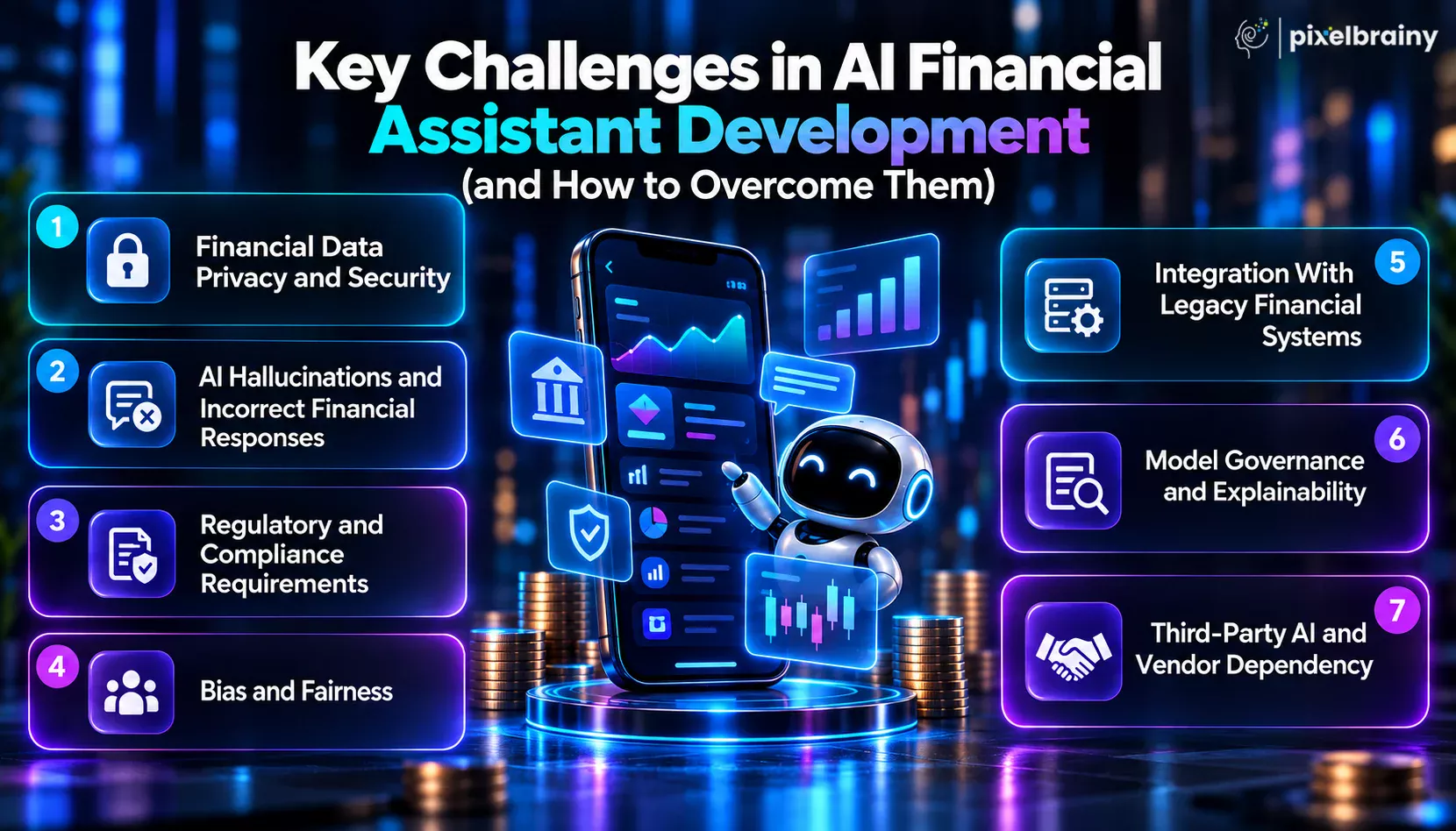
AI financial assistants require access to sensitive information such as transactions, balances, financial goals, and account details. Weak data controls can expose customers and create significant operational and regulatory risks.
How to overcome it:
BIS identifies data privacy, quality, security, and third-party dependencies as important challenges for AI adoption in financial services.
Generative AI can produce responses that sound convincing but are inaccurate. In financial applications, incorrect information can mislead customers or create inappropriate recommendations.
How to overcome it:
BIS specifically identifies hallucination and model limitations as important risks when AI is used in finance.
Financial assistants may operate across banking, insurance, investments, lending, or payments, with requirements varying according to the product, jurisdiction, and actions performed by the system.
How to overcome it:
AI systems can reproduce patterns or biases present in their training and operational data. This becomes particularly important when an assistant influences financial access, recommendations, eligibility, or customer treatment.
How to overcome it:
BIS highlights bias, unfair outcomes, and model opacity as significant concerns for AI in finance.
Banks, insurers, and financial institutions often operate complex technology environments. Connecting an AI financial assistant with core banking, CRM, portfolio, payment, or insurance systems can create technical and operational challenges.
How to overcome it:
Financial institutions need to understand how AI systems behave and establish accountability for their outputs. A black-box assistant can make it difficult to investigate incorrect recommendations or customer complaints.
How to overcome it:
The FSB's 2026 framework recommends organization-wide AI governance and risk management throughout the AI development and deployment lifecycle.
AI financial assistants may depend on external LLM providers, cloud platforms, financial-data providers, and specialized APIs. A disruption, pricing change, security issue, or model change at a critical provider can affect the assistant.
How to overcome it:
BIS and the FSB both identify third-party dependencies as an important AI risk area for financial institutions.
Addressing these challenges during the development process of an AI financial assistant helps create a system that is more secure, reliable, explainable, and suitable for real-world financial services.
From the above development process, features, technology stack, costs, and challenges, it is now time to identify the right development partner for your financial AI product. PixelBrainy is a leading AI financial software development company helping businesses turn complex financial workflows into intelligent, scalable, and user-focused digital products.
For businesses looking for AI financial assistant development services, PixelBrainy brings together AI engineering, FinTech product development, UX strategy, secure integrations, and scalable architecture. The team can help businesses build AI financial assistant solutions around specific customer journeys, financial data requirements, and business objectives rather than relying on a generic chatbot approach. PixelBrainy states that its work spans AI product development, AI agent development, AI integration, and FinTech and trading systems.
In one confidential fintech project, PixelBrainy developed an AI-powered trading assistant for a financial technology client. The solution included real-time financial data interpretation, trade summaries, personalized financial insights, and intelligent conversational interaction. Because the project was delivered under confidentiality, the client's identity is not disclosed.
PixelBrainy has also documented work involving financial AI platforms, including AI-powered financial automation, risk assessment, compliance workflows, and trading intelligence.
For organizations planning to create AI financial assistant products, this experience can be applied to different financial use cases, including personal finance, banking, wealth management, insurance, financial advisory, and FinTech platforms.
If your objective is making AI financial assistant technology part of an existing financial product or launching a completely new AI-first platform, PixelBrainy can help translate the concept into a practical product roadmap and production-ready system. Its stated approach combines product thinking, UX, AI systems, and engineering for real-world applications.
Ready to turn your financial AI idea into a production-ready product? Connect with PixelBrainy to discuss your requirements.

An AI financial assistant is becoming a practical way for banks, FinTech companies, insurers, wealth management firms, and financial platforms to deliver more personalized and proactive digital experiences. From conversational AI and expense tracking to financial forecasting, goal management, proactive alerts, secure integrations, and intelligent recommendations, the right capabilities can turn a traditional financial application into a context-aware financial companion.
However, successful AI financial assistant development requires more than integrating an AI model. Businesses need a clear use-case strategy, reliable financial data, secure architecture, appropriate AI technologies, strong governance, comprehensive testing, and a scalable development roadmap. The overall cost to develop an AI financial assistant can range from $30,000 to $250,000+, depending on functionality, integrations, AI complexity, security, and compliance requirements.
Whether your goal is to build AI financial assistant technology for consumers, advisors, policyholders, or enterprise customers, the right development approach can turn the concept into a reliable financial product that delivers measurable user value.
Ready to turn your AI financial assistant idea into reality? Book an appointment with PixelBrainy today and discuss your project with our AI development team.
Yes. Modern AI financial assistant development can combine transaction monitoring, cash-flow analysis, financial goals, predictive models, and event triggers to surface relevant insights proactively. Depending on permissions, assistants can identify spending changes, upcoming obligations, or savings opportunities and guide users toward supported actions.
To build an AI financial assistant with a broader financial view, businesses typically need secure integrations with authorized banking, investment, insurance, credit, and other relevant data sources. The data should be normalized into a unified financial profile that the AI can use for contextual analysis, personalization, and recommendations.
It can support certain authorized actions when appropriate authentication, permissions, business rules, and safeguards are implemented. Agentic AI can plan and execute multi-step tasks using APIs and connected systems, but higher-risk financial activities may require additional verification or human approval.
Businesses should ground responses in verified financial data, use retrieval-augmented generation where appropriate, separate deterministic calculations from generative responses, establish AI guardrails, test outputs continuously, and introduce human review for higher-risk scenarios. Strong governance becomes particularly important as assistants move toward agentic workflows.
Yes. Businesses can develop an AI financial assistant specifically for wealth managers, insurance professionals, bankers, or financial advisors. It can aggregate client information, summarize portfolio changes, identify planning gaps, prepare meeting insights, prioritize follow-ups, and surface relevant client conversations while keeping professionals involved in final decisions.
The architecture does not have to depend on one model. Developing an AI financial assistant may involve LLMs for conversations, predictive models for forecasting, recommendation engines for personalization, deterministic services for financial calculations, and specialized agents for individual workflows. Model orchestration can route each task to the appropriate capability.
Yes. Businesses do not necessarily need to replace their existing digital product to create AI financial assistant functionality. The assistant can be integrated with mobile apps, web platforms, core banking services, CRMs, portfolio systems, customer-support tools, and approved financial APIs. Existing banking assistants already demonstrate integration with digital banking environments and operational services.
Before launch, teams should evaluate response accuracy, financial calculations, security, permissions, data privacy, integrations, latency, escalation workflows, AI guardrails, and behavior across edge cases. Making an AI financial assistant production-ready also requires ongoing monitoring because financial data, customer behavior, AI models, and operational requirements can change after deployment.

About The Author
Sagar Bhatnagar
Sagar Sahay Bhatnagar brings over a decade of IT industry experience to his role as Marketing Head at PixelBrainy. He's known for his knack in devising creative marketing strategies that boost brand visibility and market influence. Sagar's strategic thinking, coupled with his innovative vision and focus on results, sets him apart. His track record of successful campaigns proves his ability to utilize digital platforms effectively for impactful marketing efforts. With a genuine passion for both technology and marketing, Sagar continuously pushes PixelBrainy's marketing initiatives to greater success.

Working with PixelBrainy has been a great experience. They took our vision for an AI-powered platform and turned it into a fully functional product. What impressed me most was their strong understanding of both design and development, and their ability to handle complex requirements with ease. The team was responsive, cooperative, and always open to feedback. They kept things organized, communicated clearly, and delivered quality work on time. I highly recommend PixelBrainy to anyone looking for a skilled and reliable development partner.

Working with the PixelBrainy team has been a highly positive experience. They understand the design requirements and create beautiful UX elements to meet the application needs. The dev team did an excellent job bringing my vision to life. We discussed usability and flow. Sagar worked with his team to design the database and begin coding. Working with Sagar was easy. He has the knowledge to create robust apps, including multi-language support, Google and Apple ID login options, Ad-enabled integrations, Stripe payment processing, and a Web Admin site for maintaining support data. I'm extremely satisfied with the services provided, the quality of the final product, and the professionalism of the entire process. I highly recommend them for Android and iOS Mobile Application Design and Development.

Great experience working with them. Had a lot of feedback and I found that unlike most contractors they were bugging me for updates instead of the other way around. They were extremely time conscience and great at communicating! All work was done extremely high quality and if not on time, early! They were always proactive when it comes to communication and the work is great/above par always. Very flexible and a great team to work with! Goes above and beyond to present us with multiple options and always provides quality. Amazing work per usual with Chitra. If you have UI/UX or branding design needs I recommend you go to them! Will likely work with them in the future as well, definitely recommended!

PixelBrainy is a joy to work with and is a great partner when thinking through branding, logo, and website layout. I appreciate that they spend time going into the "why" behind their decisions to help inform me and others about industry best practices and their expertise.

I hired them to design our software apps. Things I really like about them are excellent communication skills, they answer all project suggestions and collaborate right away, and their input on design and colors is amazing. This project was complex and needed patience and creativity. The team is amazing to do business with. I will be using them long-term. Glad to see there are some good people out there. I was afraid to try and outsource my project to someone but I am glad I met them! I really can't say enough. They went above and beyond on this project. I am very happy with everything they have done to make my business stand out from the competition.

It was great working with PixelBrainy and the team. They were very responsive and really owned the project. We'll definitely work with them again!

I recently worked with the PixelBrainy team on a project and I was blown away by their communication skills. They were prompt, clear, and articulate in all of our interactions. They listened and provided valuable feedback and suggestions to help make the project a success. They also kept me updated throughout the entire process, which made the experience stress-free and enjoyable.

PixelBrainy is very good at what it does. The team also presents themselves very professionally and takes care of their side of things very well. I could fully trust them taking up the design work in a timely and organised manner and their attention to detail saved us lots of effort and time. This particular project was quite intense and the team showed that they function very well under pressure. Very much looking forward to working with her again!

It's always an absolute pleasure working with them. They completed all of my requests quickly and followed every note I had for them to a T, which made our process go smoothly from start to finish. Everything was completed fast and following all of the guidelines. And I would recommend their services to anyone. If you need any design work done in the future, PixelBrainy should be your first call!

They took ownership of our requirements and designed and proposed multiple beautiful variants. The team is self-motivated, requires minimum supervision, committed to see-through designs with quality and delivering them on time. We would definitely love to work with PixelBrainy again when we have any requirements.

PixelBrainy was a big help with our SaaS application. We've been hard at work with a new UI/UX and they provided a lot of help with the designs. If you're looking for assistance with your website, software, or mobile application designs, PixelBrainy and the team is a great recommendation.

PixelBrainy designers are amazing. They are responsive, talented, and always willing to help craft the design until it matches your vision. I would recommend them and plan to continue them for my future projects and more!!!

They were awesome! Did a good job fast, and good communication. Will work with them again. Thank you

Creative, detail-oriented, and talented designers who take direction well and implement changes quickly and accurately. They consistently over-delivered for us.

PixelBrainy team is very talented and creative. Great designers and a pleasure to work with. PixelBrainy is an excellent communicator and I look forward to working with them again.

PixelBrainy has a very talented design team. Their work is excellent and they are very responsive. I enjoy working with them and hope to continue on all of our future projects.


Transform your ideas into reality with us.
Across these industries, each engagement brings unique challenges, from early-stage product development to scaling complex systems, helping us build a practical understanding of real-world product environments.