AI Summary Powered by PixelBrainy
Can an AI sports betting bot automate your proven betting strategy before bookmakers adjust the odds?
Suppose you are a professional sports bettor with seven years of experience. You have developed a value betting methodology for football and basketball that has delivered consistent positive returns over the last four seasons. Your strategy is profitable, but your daily process is not.
Every day, you spend hours scanning bookmaker websites, comparing odds, calculating probabilities, identifying value bets, and placing wagers manually. By the time you confirm a betting opportunity, the odds have often changed because the market reacts within seconds. You know automation is the next logical step, but you have never hired a software development company before. As a result, you begin searching for answers to questions like: How to create an AI sports betting bot? What does the custom AI sports betting bot development process involve? What features should the bot include? And how much does it cost to transform a manual betting strategy into an intelligent AI powered system?
If this sounds like your situation, you are not alone. Many professional bettors, betting syndicates, sportsbooks, and gaming startups face the same challenge. They already have profitable betting strategies, but manually identifying and placing value bets limits their ability to scale. Missing even a few opportunities each day can significantly reduce long term profitability.
This is exactly where AI sports betting bot development becomes a competitive advantage. Instead of relying on manual research and constant market monitoring, an AI powered bot can continuously analyze live odds, historical match data, team statistics, player performance, and betting market movements. It can instantly identify profitable opportunities, estimate winning probabilities, detect value bets, and execute wagers based on your predefined rules. Rather than replacing your betting expertise, AI enhances it by eliminating repetitive tasks and responding to market changes much faster than any human can.
In this comprehensive guide, you will learn everything about sports betting bot development with AI, including how to develop AI sports betting automation bot solutions, the complete custom AI sports betting bot development process, the essential features every bot should have, the technologies required, estimated development costs, compliance requirements, and the best practices for building an AI sports betting bot with value bet detection that delivers long term value.
An AI sports betting bot is an intelligent software solution that uses artificial intelligence, machine learning, predictive analytics, and automation to analyze sports data, identify profitable betting opportunities, and execute bets with minimal human intervention. Unlike conventional betting bots that only follow predefined rules, an AI powered bot can learn from historical and real time data, adapt to changing market conditions, and continuously improve its betting decisions.
In simple terms, a standard sports betting bot automates repetitive betting tasks, while an AI sports betting bot automates both decision making and execution. This makes it a powerful tool for professional bettors, betting syndicates, sportsbooks, and gaming platforms looking to improve betting accuracy and operational efficiency.
A custom AI sports betting bot can perform multiple tasks throughout the betting lifecycle, including:
Instead of relying solely on fixed conditions, the AI continuously evaluates new information before making a betting decision.
A standard sports betting bot is an automation tool designed to perform predefined actions without using artificial intelligence. It follows a fixed set of instructions created by the user.
For example, a traditional betting bot can:
While this reduces manual effort, the bot cannot analyze complex data, predict outcomes, or adapt when betting markets change.
A custom AI sports betting bot can perform multiple tasks throughout the betting lifecycle, including:
Instead of relying solely on fixed conditions, the AI continuously evaluates new information before making a betting decision.
A standard sports betting bot is an automation tool designed to perform predefined actions without using artificial intelligence. It follows a fixed set of instructions created by the user.
For example, a traditional betting bot can:
While this reduces manual effort, the bot cannot analyze complex data, predict outcomes, or adapt when betting markets change.
| Feature | AI Sports Betting Bot | Standard Sports Betting Bot |
|---|---|---|
| Decision Making | Uses AI and machine learning to make data driven decisions | Follows predefined rules only |
| Learning Capability | Continuously improves using historical and live data | Does not learn or adapt |
| Value Bet Detection | Automatically identifies profitable betting opportunities | Limited to user defined conditions |
| Odds Analysis | Compares odds across multiple bookmakers in real time | Basic odds monitoring |
| Prediction Accuracy | Uses predictive analytics and probability models | No predictive capability |
| Market Adaptability | Adjusts strategies based on changing market conditions | Cannot respond intelligently to market changes |
| Automation Level | Automates analysis, prediction, and bet placement | Mainly automates bet execution |
| Scalability | Supports multiple sports, bookmakers, and betting strategies | Limited scalability |
Sports betting markets change rapidly, and odds can shift within seconds. Manual betting or traditional automation often fails to keep up, causing bettors to miss profitable opportunities.
With AI sports betting bot development, the bot can monitor multiple betting markets in real time, analyze probabilities, detect value bets, and execute wagers almost instantly. As it processes more data, the AI continuously improves its predictions, making sports betting bot development with AI a smart long-term investment for professional bettors and sports betting businesses.
Therefore, if your objective is to simply automate repetitive betting tasks, a standard sports betting bot may be enough. However, if you want to automate market analysis, detect value betting opportunities, improve prediction accuracy, and scale a profitable betting strategy, building an AI sports betting bot with value bet detection is the more effective and future ready solution.
Also Read: Top 15 Sports Betting App Development Companies in USA
An AI sports betting bot follows a structured workflow to identify profitable betting opportunities, make intelligent predictions, and automate bet execution. Instead of relying on fixed rules, it combines artificial intelligence, machine learning, predictive analytics, and real time automation to make faster and more accurate betting decisions.
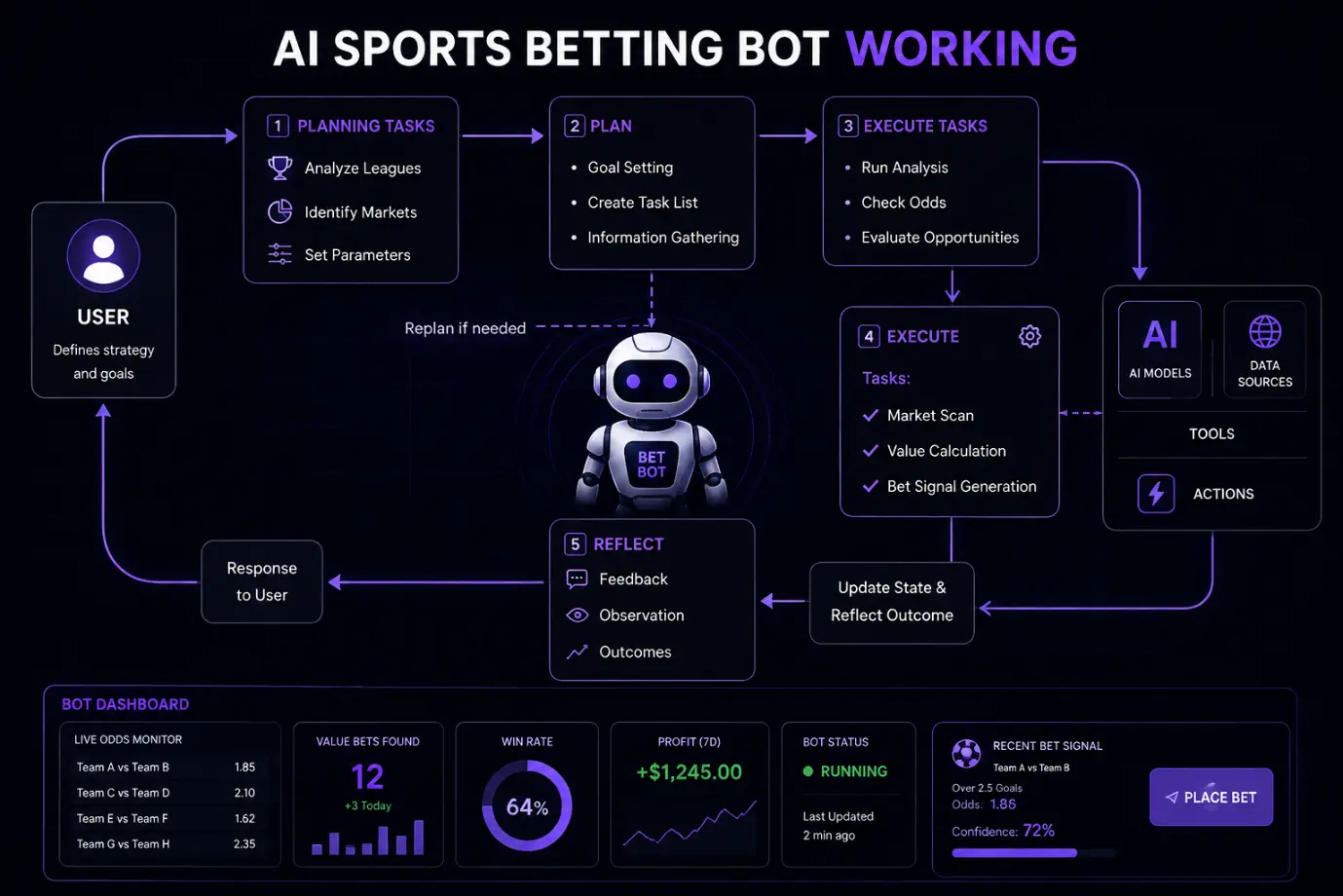
Here is a step-by-step breakdown of how an AI sports betting bot works:
The process begins with collecting data from multiple sources. The bot gathers both historical and real time information to build a complete picture of upcoming events and betting markets.
Common data sources include:
The more relevant and accurate the data, the better the predictions.
Once the data is collected, the AI system cleans, organizes, and analyzes it to remove inconsistencies and prepare it for prediction models.
During this stage, the bot identifies meaningful patterns, trends, and statistical relationships that influence match outcomes.
Using machine learning algorithms, the bot estimates the probability of different betting outcomes based on historical performance and current conditions.
Depending on the sport, predictions may include:
Unlike traditional bots, these predictions continuously improve as the AI learns from new data.
This is one of the most valuable functions of an AI sports betting bot.
The AI compares its predicted probability with the implied probability from bookmaker odds. When it identifies a meaningful difference, it flags the opportunity as a value bet.
For example:
Since the AI believes the true probability is higher than the bookmaker's estimate, the bet may offer positive expected value.
Before placing a wager, the bot evaluates several risk factors to ensure responsible betting.
These include:
This helps protect the bankroll while maintaining a consistent betting strategy.
If the betting opportunity meets all predefined criteria, the bot automatically places the wager through integrated bookmaker APIs or supported betting platforms.
This allows bettors to react instantly before odds change.
After every completed event, the AI compares its predictions with the actual results. It uses this feedback to refine its machine learning models, improve prediction accuracy, and optimize future betting decisions.
As more data becomes available, the bot becomes smarter and more effective, making it increasingly valuable for long term betting success.
Therefore, an AI sports betting bot works by combining real time data collection, intelligent analysis, predictive modeling, value bet detection, automated bet execution, and continuous learning into a single automated workflow. This enables professional bettors and sports betting companies to make faster, more informed, and data driven betting decisions while reducing manual effort and maximizing profitable opportunities.
Also Read: A Guide to AI Sports Betting Agent Development for Betting Platforms and Sports Analytics Companies
The question is not whether AI can improve sports betting. Professional betting syndicates, quantitative trading firms, and exchange market participants have relied on automation for years to identify and execute profitable opportunities before betting lines move.
The real question is whether your betting operation can automate fast enough to keep pace with an increasingly data driven and competitive market. As the global sports betting market is projected to grow from USD 123.4 billion in 2026 to USD 236.0 billion by 2033, businesses investing in intelligent automation today are better positioned to capitalize on this growth.
Suppose you have been placing sports bets professionally for six years using a proprietary statistical model across the NFL, NBA, and Premier League. Your model generates a value betting signal, but before you compare odds across eight bookmakers and place the wager, the betting line has already shifted.
That is the reality of today's betting market. Bookmakers and automated syndicates react within minutes or even seconds. For bettors with a proven edge, AI sports betting bot development is not about replacing strategy. It is about ensuring profitable opportunities are executed before they disappear.
Manual betting eventually reaches a limit. Even experienced bettors struggle to monitor multiple sports, bookmakers, and hundreds of live markets simultaneously.
When you build AI sports betting bot solutions, the system can analyze dozens of competitions, compare odds across multiple bookmakers, and execute qualifying bets around the clock without losing speed or consistency.
For sports analytics companies looking to commercialize prediction models or launch subscriber-based betting products, AI sports betting automation bot development transforms a manual service into a scalable software platform.
A profitable betting strategy often fails because of inconsistent execution rather than poor predictions.
Human bettors skip valid bets after losing streaks, increase stakes after wins, or hesitate on high confidence opportunities. An AI bot follows predefined rules every time, executing each qualified signal with the correct bankroll and stake sizing strategy.
That discipline helps preserve the long term expected value of a profitable model.
Quantitative betting firms, exchange traders, and professional betting syndicates have been operating systematic betting models for years.
Whether you are a quantitative investment firm expanding into sports betting or a sports media company converting statistical analysis into automated betting signals, AI sports betting bot software development provides the infrastructure needed to compete with organizations that already rely on automation for faster execution and smarter decision making.
An AI sports betting bot records every prediction, bookmaker odds, expected value, stake, and betting outcome.
Over thousands of wagers, this data becomes a strategic asset that improves prediction models, validates historical performance, and strengthens investor confidence.
For startups seeking funding or companies offering betting products, documented AI generated performance provides a far stronger commercial advantage than manually tracked betting records.
The cost of develop AI sports betting bot solutions is measurable through development, infrastructure, and maintenance expenses. The cost of remaining manual is much harder to see but often far greater.
Every missed value bet, every delayed execution, and every operational bottleneck reduce the return from an otherwise profitable strategy. As AI adoption across the sports industry is forecast to grow at a 21.6% CAGR between 2026 and 2033, organizations that invest earlier can continuously improve their models while competitors are still relying on manual execution.
Therefore, organizations that establish AI powered betting infrastructure today will be better prepared for a market where intelligent automation becomes the benchmark for competitive performance.
Not every AI sports betting bot is built for the same purpose. The right solution depends on the betting strategy you want to automate, the markets you want to target, and your long-term business goals.
For example, you may be asking, "I want to build an AI sports betting bot that monitors odds across 15+ bookmakers in real time, identifies arbitrage opportunities instantly, calculates the optimal stake distribution, and places all bets before the opportunity closes."
In that case, an arbitrage bot would be a better fit than a value betting or signal distribution bot. Understanding these both types is the first step in successful AI sports betting bot development.
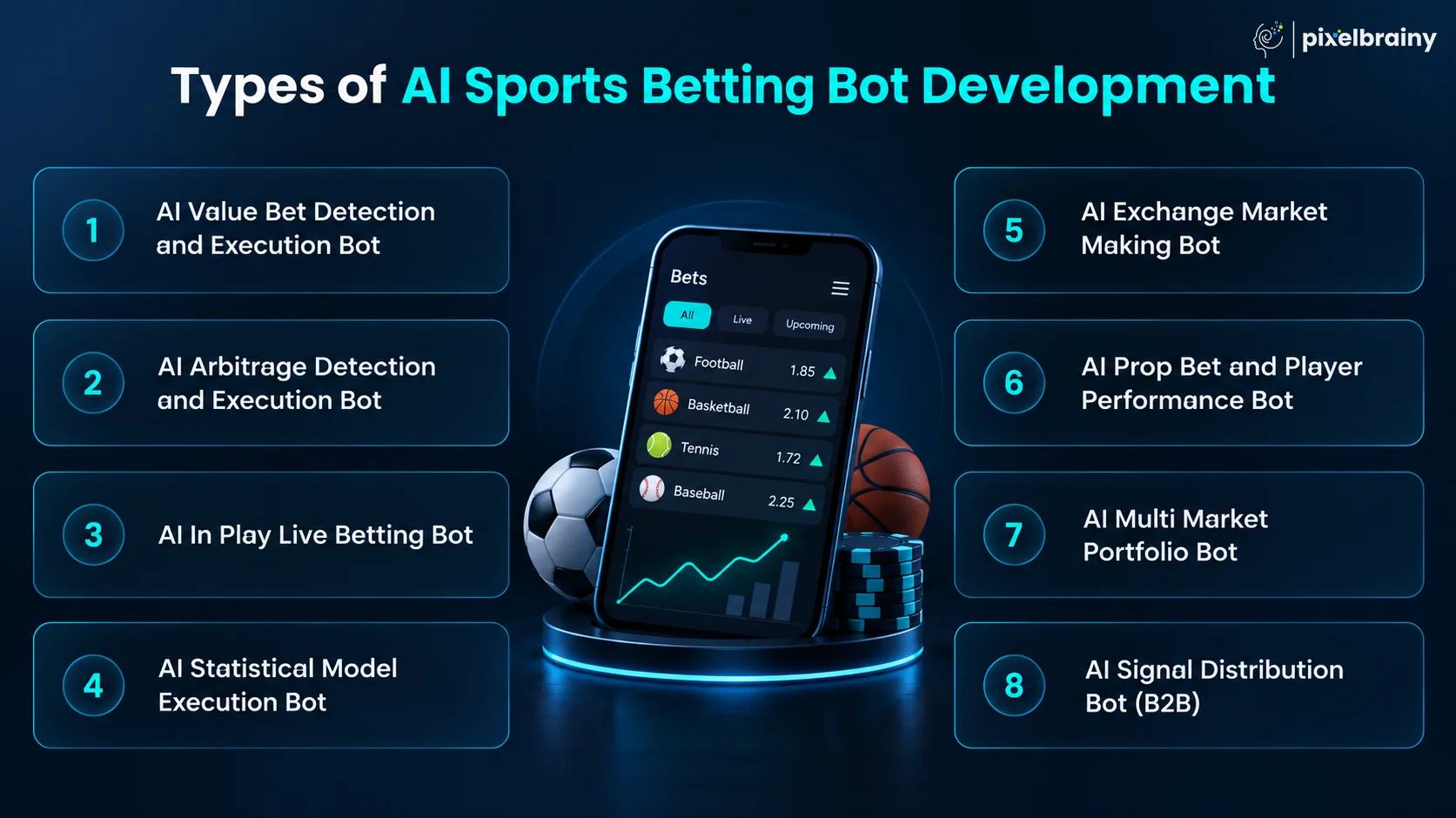
This is the most widely used type of AI sports betting bot among professional bettors. It compares its predicted probability with bookmaker implied probability to identify positive expected value opportunities and automatically places bets using bankroll management strategies such as the Kelly Criterion.
Best suited for: Professional bettors and betting syndicates that already have a profitable value betting methodology and want to automate identification and execution before the odds move.
Technical implication: Requires predictive AI models, probability engines, bookmaker API integration, automated stake sizing, and real time odds monitoring.
An AI arbitrage bot continuously scans odds across multiple bookmakers to identify pricing differences where the combined implied probability falls below 100 percent, creating guaranteed profit opportunities regardless of the match outcome.
Best suited for: Bettors who want to monitor 15 or more bookmakers simultaneously, detect arbitrage opportunities instantly, calculate optimal stake allocation, and execute every betting leg within seconds.
Technical implication: Requires ultra-low latency infrastructure, multi bookmaker integrations, synchronized execution logic, and automated stake distribution.
This bot focuses exclusively on live betting markets where bookmaker odds change continuously during sporting events. It analyzes live match events, momentum shifts, player statistics, and real time game data to identify pricing inefficiencies before bookmakers adjust their odds.
Best suited for: Bettors who believe the biggest edge exists in live betting markets and want to automate in play betting decisions.
Technical implication: Requires live event streaming, real time sports data feeds, event driven architecture, predictive AI models, and extremely fast execution infrastructure.
Unlike prediction focused bots, this solution automates the execution of an existing statistical model. The prediction logic already exists, while the bot handles odds monitoring, value comparison, stake calculation, bankroll management, and automated bet placement.
Best suited for: Professional bettors, quantitative analysts, and data scientists who already have a proven prediction model and simply want to automate its deployment.
Technical implication: Requires external model integration, bookmaker APIs, execution workflows, bankroll management, and odds comparison modules.
Instead of betting against bookmakers, this bot operates on peer-to-peer betting exchanges such as Betfair Exchange. It continuously places both back and lay orders, manages exposure, and earns profits from bid ask spreads and market liquidity.
Best suited for: Quantitative trading firms looking to apply market making and statistical arbitrage strategies from financial markets to sports betting exchanges.
Technical implication: Requires exchange APIs, order book analytics, automated pricing engines, exposure management, and high frequency trading infrastructure.
This bot specializes in player proposition markets such as passing yards, rebounds, assists, touchdowns, goals, and other individual performance metrics. It uses player level AI models, matchup analysis, and historical performance data to identify mispriced betting opportunities.
Best suited for: Bettors who want to focus exclusively on NFL, NBA, and other player prop betting markets where pricing inefficiencies are often greater than traditional game outcome markets.
Technical implication: Requires player performance models, advanced sports analytics databases, injury analysis, and matchup intelligence.
Rather than maximizing returns from a single betting market, this bot manages an entire betting portfolio across multiple sports, leagues, bookmakers, and wager types. It applies diversification, correlation analysis, bankroll optimization, and drawdown control to improve long term risk adjusted returns.
Best suited for: Institutional bettors, betting syndicates, hedge funds, and quantitative firms managing multiple betting strategies simultaneously.
Technical implication: Requires portfolio optimization algorithms, centralized bankroll management, cross market analytics, and enterprise level risk management.
Instead of automatically placing wagers, this bot generates AI powered betting signals and distributes them to subscribers through dashboards, APIs, mobile applications, Telegram, Discord, or email. Subscribers execute the bets using their own bookmaker accounts, making this model commercially attractive and generally easier to structure from a regulatory perspective.
Best suited for: Sports analytics companies, betting startups, and SaaS businesses that want to commercialize prediction models by offering subscription-based betting signals without requiring users to write code.
Technical implication: Requires signal generation engines, subscriber management, notification systems, secure APIs, authentication, cloud infrastructure, and scalable SaaS architecture.
The AI sports betting bot you build will define your data requirements, execution speed, infrastructure, compliance strategy, and commercial model from the very beginning of the development process.
Also Read: AI Sports Betting App MVP Development: Go from Idea to a Live AI Sports Betting MVP in 30 Days
As a sports bettor, when you plan to build an AI sports betting bot, your primary goal should not be limited to predicting match outcomes. The real objective is to create a solution that can automatically analyze betting markets, identify profitable opportunities, execute wagers within seconds, and continuously improve its performance. Without the right feature set, even the most accurate betting strategy can lose its competitive advantage.
Suppose you have spent years developing a profitable value betting methodology and now want to automate the entire workflow instead of manually comparing odds across multiple bookmakers every day. Your first question will likely be, "What features should an AI sports betting bot include to automate my betting strategy successfully?" The answer extends far beyond artificial intelligence alone. Successful AI sports betting bot development combines predictive analytics, intelligent automation, risk management, real time data processing, and enterprise grade security into a single platform.
Whether you want to develop AI sports betting bot software for your personal betting operation or offer professional AI sports betting bot development services, the following features should be considered essential during the planning and development phase.
| Must Have Feature | Purpose | Business Benefit |
|---|---|---|
| AI Prediction Engine | Predicts match outcomes using machine learning models trained on historical and live sports data. | Improves prediction accuracy and identifies higher value betting opportunities. |
| Real Time Odds Monitoring | Continuously tracks odds across multiple bookmakers and betting exchanges. | Captures profitable opportunities before bookmakers adjust their prices. |
| Value Bet Detection | Compares AI generated probabilities with bookmaker implied probabilities. | Automatically identifies positive expected value betting opportunities. |
| Automated Bet Placement | Places wagers automatically when predefined betting conditions are satisfied. | Eliminates manual delays and improves execution speed. |
| Multi Bookmaker Integration | Connects several bookmakers through secure APIs for odds comparison. | Ensures access to the best available odds while supporting arbitrage strategies. |
| Bankroll Management | Calculates optimal stake sizes using configurable staking models. | Protects betting capital and improves long term profitability. |
| Risk Management Controls | Applies betting limits, confidence thresholds, and exposure rules. | Minimizes unnecessary financial risk and supports disciplined betting. |
| Live Sports Data Integration | Collects live match events, player statistics, injuries, and game updates. | Enhances prediction quality during both pre match and live betting. |
| Machine Learning Model Training | Continuously retrains AI models using new betting outcomes and historical performance. | Keeps prediction models accurate as betting markets evolve. |
| Arbitrage Opportunity Scanner | Detects pricing discrepancies across bookmakers in real time. | Enables guaranteed profit opportunities whenever arbitrage conditions appear. |
| Performance Analytics Dashboard | Displays ROI, win rate, betting history, bankroll growth, and prediction accuracy. | Helps users optimize betting strategies through measurable insights. |
| Alerts and Notification System | Sends instant betting signals and execution updates through multiple communication channels. | Keeps users informed without constant platform monitoring. |
| Admin and Strategy Management Panel | Allows users to configure betting rules, AI settings, and bookmaker integrations. | Simplifies strategy management without requiring programming knowledge. |
| Cloud Infrastructure and Security | Provides scalable cloud deployment with encrypted data storage and secure authentication. | Ensures reliable performance while protecting sensitive betting information. |
| Reporting and Audit Logs | Maintains detailed records of every prediction, bet, execution, and system activity. | Supports performance analysis, transparency, compliance, and future model improvements. |
The features you prioritize during AI sports betting bot development will ultimately determine how intelligent, scalable, secure, and profitable your betting platform becomes after deployment.
When you think about building an AI sports betting bot, it may seem like the development process starts with artificial intelligence or machine learning. In reality, a successful bot is built through a structured roadmap that combines business strategy, data engineering, AI model development, software architecture, automation, testing, and continuous optimization. Every stage contributes to creating a solution that is accurate, scalable, secure, and capable of executing profitable betting strategies in real time.
Consider this scenario. You have been a professional sports bettor for several years with a proven value betting methodology, but manually identifying opportunities, comparing bookmaker odds, and placing bets has become increasingly time consuming. You now want to automate your entire workflow but are unsure how to develop an AI sports betting bot from scratch or what the development process of AI sports betting bot actually involves. Understanding each development stage helps transform your manual betting strategy into an intelligent automated platform.
Whether your goal is to create an AI sports betting bot for personal betting, build a sports betting bot with AI for commercial use, or launch a scalable SaaS platform, the following step by step process explains how experienced development teams successfully deliver modern AI sports betting bot development projects.
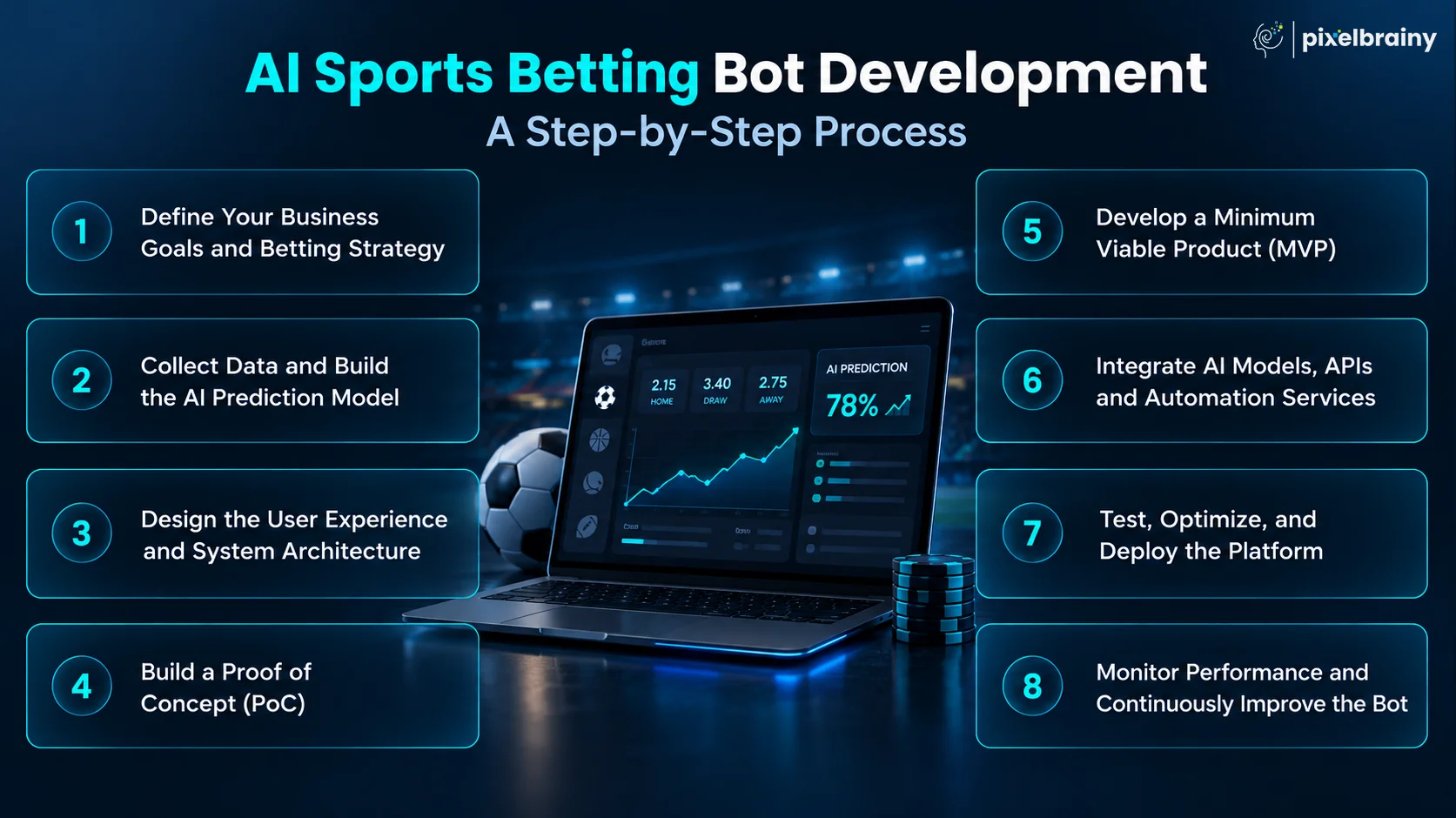
Every successful development of AI sports betting bot begins with clearly defining what you want the bot to accomplish. Before selecting technologies or training AI models, identify the sports, leagues, betting markets, bookmakers, and betting strategies your solution will support. You should also determine whether the bot will automate value betting, arbitrage betting, live betting, player prop betting, or simply generate betting signals for subscribers.
At this stage, you should document your betting rules, bankroll strategy, stake sizing methodology, and risk management framework. Having a well-defined strategy allows developers to convert your manual workflow into automated business logic without assumptions.
Working with experienced AI consultation solutions during this phase helps validate technical feasibility, identify potential challenges, estimate project costs, and establish a realistic roadmap before development begins.
Artificial intelligence cannot make reliable betting decisions without quality data. The next step involves collecting historical sports data, live match statistics, bookmaker odds, player performance, injury reports, weather information, and other variables that influence betting outcomes.
After collecting the data, it must be cleaned, standardized, and prepared for machine learning. Data scientists then train predictive models capable of estimating winning probabilities across different betting markets while continuously evaluating prediction accuracy using historical results.
This stage forms the intelligence behind the platform and plays a critical role in building an AI sports betting bot that produces consistent and reliable betting recommendations.
A powerful AI engine alone does not guarantee a successful betting platform. Users also need an intuitive interface that makes it easy to monitor betting opportunities, configure strategies, review analytics, manage bookmaker accounts, and control automated betting rules.
At the same time, software architects design the overall technical infrastructure, including cloud deployment, APIs, databases, AI services, authentication, and security frameworks. Every component must work together to ensure fast execution and future scalability.
Partnering with an experienced UI/UX design company helps create a platform that is both user friendly and capable of supporting professional bettors, sports betting businesses, and enterprise customers.
Before investing in full scale development, it is important to validate the core concept through a Proof of Concept. Instead of building every feature immediately, the development team focuses on testing the prediction model, bookmaker integrations, odds monitoring, and automated betting logic using a simplified version of the product.
A well planned PoC development reduces technical uncertainty by confirming that the proposed architecture, AI model, and automation workflow perform as expected. It also helps stakeholders evaluate the commercial viability of the solution before committing to larger development budgets.
Completing this stage significantly reduces project risks and provides a strong foundation for the next phase of development.
Once the Proof of Concept validates the core functionality, the next step is to build a Minimum Viable Product that includes the essential features required for real world testing. Instead of developing every advanced capability, the focus remains on delivering a working product with AI predictions, odds monitoring, value bet detection, automated bet placement, bankroll management, and a user dashboard.
An MVP development approach enables you to test the platform with actual users, collect valuable feedback, measure system performance, and identify improvements before investing in a full-scale commercial release. This iterative process reduces development costs while ensuring the final product aligns with user expectations and business objectives.
Also Read: Top 10 AI MVP Development Companies in USA
After the MVP is ready, developers integrate all external systems required to make the platform fully operational. This includes bookmaker APIs, live sports data providers, payment systems, notification services, authentication mechanisms, and cloud infrastructure. At the same time, the trained AI models are connected to the betting workflow so they can generate predictions and trigger automated actions in real time.
Reliable AI integrating services ensure that every component communicates efficiently without affecting execution speed or prediction accuracy. Proper integration also makes the platform easier to maintain, expand, and upgrade as new sports, bookmakers, and betting strategies are introduced.
Before launching the solution, every component should undergo extensive testing to ensure it performs reliably under real betting conditions. Developers test AI prediction accuracy, API connectivity, automated bet execution, security controls, performance under high traffic, and compatibility across different devices.
User Acceptance Testing and simulated betting environments are also essential for validating that the platform behaves exactly as intended before real money is involved. Once all issues are resolved, the bot is deployed on a secure cloud environment with monitoring systems that track uptime, system health, and operational performance.
Many businesses prefer working with top AI bot development companies during this phase because they follow proven deployment methodologies, security best practices, and post launch support processes.
Launching the platform is only the beginning of the development journey. Sports betting markets evolve continuously as teams, players, betting patterns, and bookmaker pricing strategies change over time. An AI sports betting bot must therefore be monitored and improved regularly to maintain its competitive advantage.
After deployment, developers analyze betting performance, prediction accuracy, ROI, bankroll growth, execution speed, and user behavior. Based on these insights, AI models are retrained, betting strategies are refined, and new features are introduced to improve overall system performance.
Continuous optimization ensures that the platform remains accurate, scalable, and competitive while supporting future enhancements without disrupting existing operations.
Following a structured development process transforms a profitable betting strategy into a scalable, intelligent, and high performing AI sports betting platform that is built for long term success.
Also Read: AI Sports Betting App Development: Benefits, Steps and Cost
The AI sports betting bot development cost in 2026 depends on several factors, including the complexity of AI models, number of supported bookmakers, automation level, integrations, security requirements, and deployment infrastructure. There is no fixed price because every project is built around unique betting strategies and business objectives.
If you're wondering what is the cost to make AI sports betting bot software, the average investment typically ranges between $15,000 and $150,000+. A basic solution designed for individual bettor’s costs significantly less than an enterprise platform that supports multiple bookmakers, live betting, AI recommendations, and large-scale commercial operations. Understanding the AI sports betting bot cost breakdown helps you estimate a realistic budget before starting development.
| Bot Type | Estimated Development Cost | What You Will Get |
|---|---|---|
| Basic AI Sports Betting Bot | $15,000 to $35,000 | AI prediction engine, bookmaker integration, basic value bet detection, simple dashboard, bankroll management, reporting, and automated bet placement for limited bookmakers. |
| Advanced AI Sports Betting Bot | $35,000 to $80,000 | Everything in the basic version plus live odds monitoring, multiple bookmaker integrations, machine learning optimization, arbitrage detection, advanced analytics dashboard, notifications, and enhanced security. |
| Enterprise AI Sports Betting Bot | $80,000 to $150,000+ | Fully customized AI platform with multi-sport support, enterprise architecture, cloud scalability, real time data processing, advanced AI recommendations, SaaS capabilities, API integrations, compliance modules, and high availability infrastructure. |
Developing intelligent prediction models is one of the largest contributors to the cost of building an AI sports betting bot in 2026. This phase includes collecting training data, preparing datasets, selecting machine learning algorithms, training prediction models, and optimizing their performance.
Estimated Cost: $5,000 to $30,000
The more sophisticated the AI recommendations and prediction accuracy, the higher the development investment.
A professional betting dashboard improves usability by allowing users to monitor betting opportunities, configure automation rules, manage bookmaker accounts, and analyze betting performance.
Estimated Cost: $3,000 to $12,000
Enterprise dashboards with analytics, reporting, and multi user management generally require a larger investment.
Your bot must integrate with sports data providers, live score services, bookmaker APIs, and odds comparison platforms to receive accurate real time information.
Estimated Cost: $4,000 to $20,000
Projects requiring multiple sportsbook integrations or premium sports data providers typically increase the overall AI sports betting bot development cost.
This module handles value bet detection, stake calculation, bankroll management, and automatic wager execution according to predefined betting rules.
Estimated Cost: $5,000 to $18,000
More complex execution logic involving arbitrage betting, live betting, or portfolio management requires additional development effort.
Enterprise grade cloud deployment ensures high availability, secure authentication, encrypted communication, automated backups, and scalable infrastructure capable of handling increasing betting activity.
Estimated Cost: $3,000 to $15,000
Cloud hosting and maintenance costs continue after deployment depending on traffic volume and system usage.
Before launch, every AI sports betting bot should undergo functional testing, API validation, AI model verification, security testing, performance testing, and user acceptance testing.
Estimated Cost: $3,000 to $10,000
Comprehensive testing significantly reduces production issues and improves long term system reliability.
Launching the platform is only the beginning. Continuous monitoring, AI model retraining, feature updates, API maintenance, cloud optimization, and security patches ensure the platform remains accurate and competitive.
Estimated Cost: $2,000 to $15,000 per year
Annual maintenance costs vary depending on the platform's complexity and the frequency of feature enhancements.
The final AI sports betting bot development cost in 2026 is influenced by several important factors, including:
The final cost of building an AI sports betting bot depends on your automation goals, AI capabilities, integrations, and scalability requirements, making a well-defined project scope essential for accurate budgeting.
As a professional sports bettor, betting startup, or sportsbook operator, your AI model is only one part of the overall solution. The technologies you use to process live sports data, monitor bookmaker odds, execute wagers, and scale your platform ultimately determine how reliable and profitable your betting bot becomes. Building a successful solution requires a technology stack that supports real time processing, intelligent automation, enterprise security, and future scalability.
Suppose you have already developed a profitable betting strategy and now want to create an AI sports betting bot that automatically analyzes betting markets, recommends value bets, and executes wagers across multiple bookmakers. A common question at this stage is, "Which programming languages, AI frameworks, databases, APIs, and cloud technologies should I use to build an AI sports betting bot?" The answer depends on your technical requirements, automation goals, and expected business growth.
Whether your objective is building an AI sports betting bot for personal betting, launching a SaaS betting platform, or delivering enterprise AI sports betting bot development solutions, the following technology stack is widely recommended for developing secure, scalable, and high-performance AI betting platforms in 2026.
| Technology Layer | Recommended Tools & Technologies | Why It Is Recommended |
|---|---|---|
| Frontend Development | React.js, Next.js, Vue.js | Builds responsive dashboards with real time betting analytics and seamless user experience across desktop and mobile devices. |
| Backend Development | Python, Node.js, FastAPI, Django | Handles business logic, AI model execution, bookmaker integrations, and high speed API processing efficiently. |
| AI & Machine Learning | TensorFlow, PyTorch, Scikit learn, XGBoost | Develops predictive models for value betting, probability estimation, player analysis, and continuous model improvement. |
| Programming Languages | Python, JavaScript, TypeScript | Python powers AI development, while JavaScript and TypeScript support scalable web applications and APIs. |
| Sports Data APIs | Sportradar, Sportmonks, API Football, The Odds API | Delivers live scores, historical statistics, player performance, bookmaker odds, and betting market data. |
| Bookmaker APIs | Betfair API, Pinnacle API, Bet365 supported integrations, Betdaq API | Enables automated odds monitoring, value bet detection, and bet execution across multiple betting platforms. |
| Database | PostgreSQL, MongoDB, Redis | Stores betting history, AI predictions, user data, market information, and high speed caching for real time processing. |
| Cloud Infrastructure | AWS, Microsoft Azure, Google Cloud Platform | Provides scalable infrastructure, high availability, secure hosting, and automatic resource scaling. |
| Authentication & Security | OAuth 2.0, JWT, Multi Factor Authentication, SSL Encryption | Protects user accounts, bookmaker credentials, API communication, and sensitive betting information. |
| Real Time Data Processing | Apache Kafka, RabbitMQ, WebSockets | Processes live betting events, bookmaker odds, and AI predictions with minimal latency. |
| DevOps & Deployment | Docker, Kubernetes, GitHub Actions, Jenkins | Automates deployment, scaling, monitoring, and software updates while improving system reliability. |
| Monitoring & Analytics | Grafana, Prometheus, ELK Stack | Tracks application performance, server health, API response times, AI accuracy, and operational metrics. |
The technology stack you choose lays the foundation for building an AI sports betting bot that is intelligent, scalable, secure, and capable of delivering consistent performance as your betting operation grows.
Deploying an AI sports betting bot involves more than completing software development. Before the platform goes live, professional bettors, betting startups, sportsbooks, and SaaS providers must ensure the solution complies with applicable gambling regulations, data protection laws, bookmaker policies, and cybersecurity standards. Overlooking these requirements can lead to account restrictions, regulatory penalties, legal disputes, or reputational damage.
Consider this scenario. You have successfully completed the development of an AI sports betting bot and plan to launch it as a subscription platform where users can connect their bookmaker accounts for automated betting. Before deployment, an important question arises: "What legal and compliance requirements should I satisfy before launching my AI sports betting bot?" Addressing these obligations early helps reduce legal risks while building trust with users and business partners.
| Compliance Requirement | Why It Matters |
|---|---|
| Gambling Regulations | Every country has different laws governing online betting, betting software, and automated wagering. Verify that your platform complies with the gambling regulations of every jurisdiction where it will operate. |
| Bookmaker Terms of Service | Many bookmakers restrict or prohibit automated betting tools. Review API policies and platform terms carefully before integrating bookmaker accounts or automated execution features. |
| Data Privacy Compliance | If your platform collects user information, it should comply with applicable privacy regulations such as GDPR, CCPA, or other regional data protection laws governing personal data. |
| Know Your Customer (KYC) | If your platform manages customer accounts or financial transactions, identity verification procedures may be required to prevent fraud and satisfy regulatory obligations. |
| Anti Money Laundering (AML) | Sports betting businesses that process financial transactions should implement AML monitoring, suspicious activity reporting, and transaction verification procedures where required by law. |
| API Licensing Agreements | Sports data providers and bookmaker APIs often require commercial licensing. Ensure all third-party data sources are legally licensed before deployment. |
| Intellectual Property Rights | AI models, datasets, software code, and proprietary betting algorithms should be legally protected while respecting third party copyrights and licensing agreements. |
| Cybersecurity Standards | Secure authentication, encrypted communications, vulnerability testing, and regular security updates help protect user accounts, API credentials, and sensitive betting information. |
| Responsible Gambling Measures | Features such as betting limits, self-exclusion options, spending controls, and responsible gambling notices demonstrate commitment to safer betting practices. |
| Audit Logging and Record Keeping | Maintaining complete records of betting signals, automated wagers, user activity, and system events improves transparency while supporting regulatory reviews and operational analysis. |
Building compliance into your AI sports betting bot before deployment helps protect your business, strengthen user trust, and support sustainable growth across regulated betting markets.
An AI sports betting bot can automate betting strategies, improve execution speed, and identify profitable opportunities more efficiently than manual betting. However, creating a reliable and scalable solution comes with several technical, operational, and regulatory challenges. Understanding these challenges before starting AI sports betting bot development helps professional bettors and sports betting companies reduce risks, improve development efficiency, and maximize long term performance.
Consider this scenario. You have spent years refining a profitable betting strategy and now want to automate it. Your biggest concern is not whether AI can identify value bets, but whether the system can consistently deliver accurate predictions, execute bets before odds change, and remain reliable as betting markets evolve. Addressing the following challenges early makes the development of AI sports betting bot significantly more successful.
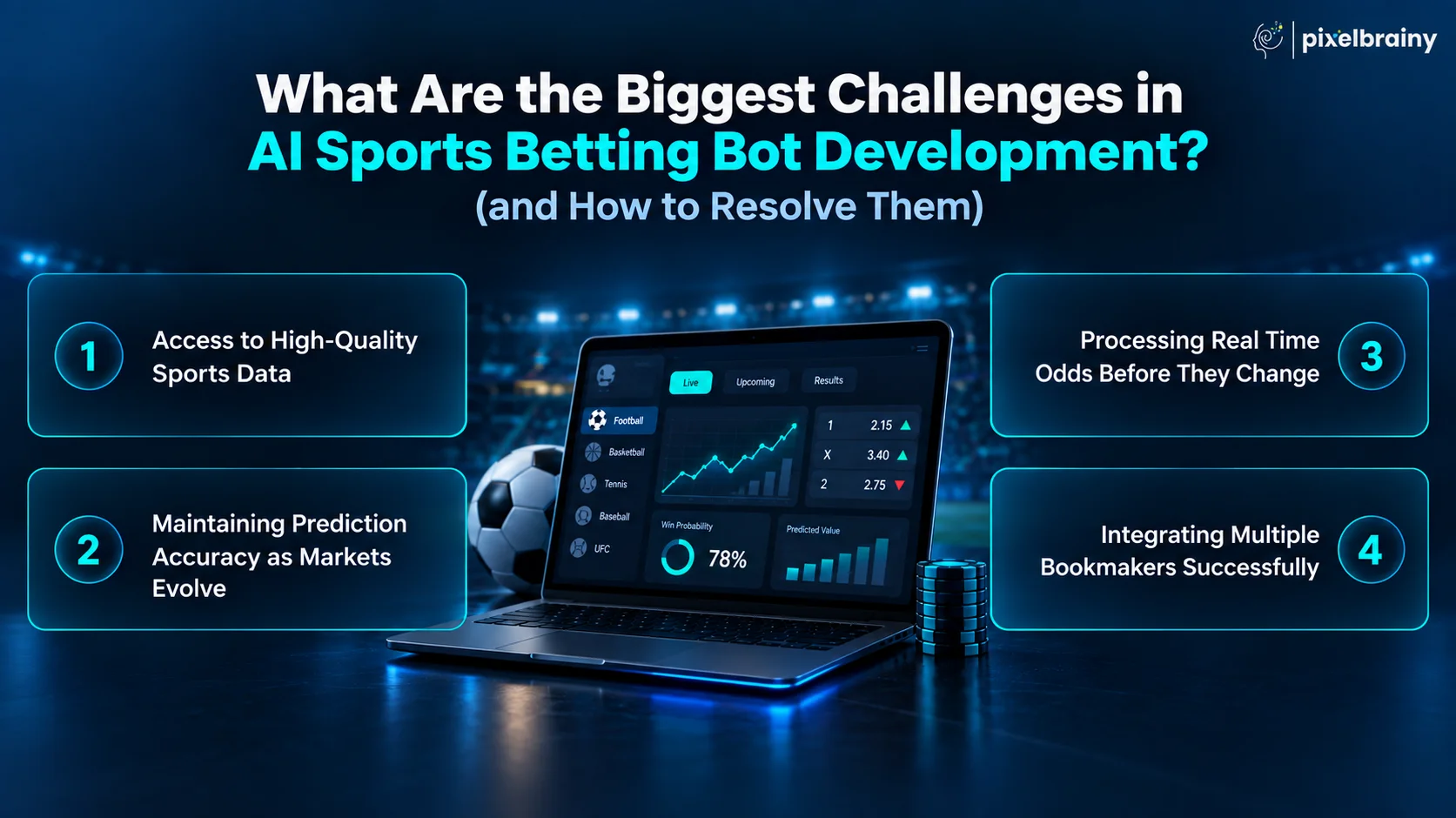
Every successful AI sports betting bot development project begins with reliable data. Artificial intelligence cannot generate accurate betting recommendations if it is trained on incomplete historical records, delayed live feeds, inconsistent bookmaker odds, or inaccurate player statistics. Since betting markets change rapidly, even minor data inconsistencies can significantly affect prediction accuracy and reduce the profitability of your automated betting strategy.
Suppose your objective is to automate a proven value betting methodology. If the AI receives outdated odds or missing match information, it may identify opportunities that no longer exist or completely overlook profitable bets. This is one of the most common reasons why many AI betting projects fail despite having sophisticated prediction models.
How to Resolve It
Integrate multiple licensed sports data providers, bookmaker APIs, and live statistics platforms instead of relying on a single source. Implement automated data validation, duplicate detection, and quality monitoring processes to ensure your AI model always receives accurate, complete, and real time information throughout the development of AI sports betting bot.
One of the biggest misconceptions about AI sports betting bot development is that training a machine learning model once is enough. In reality, sports betting markets continuously evolve because of player transfers, injuries, coaching changes, tactical adjustments, bookmaker pricing strategies, and public betting behavior. A prediction model that performs exceptionally well today may gradually lose its competitive advantage over time.
For example, a football prediction model trained using data from previous seasons may produce less accurate predictions if team formations, player performance, or league competitiveness change significantly. Without continuous optimization, the overall betting strategy becomes less profitable.
How to Resolve It
Continuously retrain AI models using recent historical data, live betting outcomes, and updated team statistics. Monitor prediction accuracy through performance dashboards and regularly fine tune machine learning algorithms to ensure your AI recommendations remain competitive under changing market conditions.
Speed is one of the most important factors in building an AI sports betting bot. Bookmaker odds can change within seconds after professional bettors place large wagers or breaking news affects a sporting event. If your platform processes betting opportunities too slowly, profitable value bets may disappear before the automated system executes them.
This challenge becomes even more significant for live betting and arbitrage strategies where execution windows often remain open for less than a minute. Even a few seconds of delay can dramatically reduce profitability.
How to Resolve It
Design the platform using low latency cloud architecture, WebSocket connections, event driven processing, and efficient caching technologies. Direct API integration with bookmakers and sports data providers also helps minimize delays while improving execution speed across the entire betting workflow.
Professional bettors rarely rely on one sportsbook. They compare odds across multiple bookmakers to maximize value betting opportunities and improve long term returns. However, every bookmaker provides different APIs, authentication methods, betting markets, data structures, and rate limits, making integration one of the most technically demanding stages of AI sports betting bot development.
Managing these differences while maintaining consistent performance requires careful software architecture and ongoing API maintenance. Without a standardized integration framework, expanding to additional bookmakers becomes increasingly difficult.
How to Resolve It
Develop a centralized integration layer that normalizes bookmaker data into a common format. This simplifies future API integrations, improves maintainability, and allows your platform to support additional bookmakers without major architectural changes.
Even the most accurate prediction model cannot guarantee long term profitability without disciplined bankroll management. Many betting strategies fail because stake sizes are inconsistent, exposure limits are ignored, or emotional decision-making overrides mathematical probability. These risks remain equally important when you build an sports betting bot with AI.
An intelligent AI sports betting bot should not only identify profitable opportunities but also determine how much capital should be allocated to every wager according to predefined risk management rules.
How to Resolve It
Integrate configurable bankroll management strategies such as Kelly Criterion, percentage-based staking, confidence weighted stake sizing, maximum daily loss limits, and portfolio exposure controls. These features help protect betting capital while allowing the AI system to execute profitable opportunities with greater consistency over the long term.
Successfully overcoming these challenges enables AI sports betting bot development to deliver a secure, scalable, and intelligent platform that continues generating value as betting markets evolve.
After deciding to automate your betting strategy, the next important question is whether you should buy an existing AI sports betting bot or invest in custom AI sports betting bot development. While both options can automate betting activities, they differ significantly in terms of flexibility, scalability, ownership, long term costs, and competitive advantage.
Suppose you have spent years developing a profitable value betting methodology for football and basketball and now want to automate every step of the process. You need a solution that can monitor multiple bookmakers, identify value bets, calculate stake sizes, and execute wagers before the odds change. Naturally, you begin asking, "Should I purchase an existing AI betting bot or build an AI sports betting bot that is customized around my own strategy?" The answer depends on whether your goal is short term convenience or long-term business growth.
Whether you are an independent bettor, a betting syndicate, a sports analytics company, or a sportsbook operator, understanding the differences between buying and building a custom AI sports betting bot will help you make a smarter investment and choose a solution that aligns with your betting strategy and future expansion plans.
A ready-made AI sports betting bot is a pre developed software solution that can be purchased or subscribed to immediately. These bots usually include common features such as odds monitoring, basic betting automation, reporting dashboards, and predefined betting strategies.
Buying an existing solution is suitable for users who want to begin automated betting quickly without investing in software development. Since the platform is already built, implementation is faster and the initial investment is generally lower than custom development.
However, pre built bots also have limitations. You cannot fully customize AI prediction models, modify the betting logic according to your proprietary strategy, or integrate unique data sources and bookmaker workflows. As your betting operation grows, these limitations may reduce your ability to scale and maintain a competitive advantage.
Best For
A custom AI sports betting bot is developed specifically around your betting methodology, business objectives, and operational requirements. Every feature, workflow, AI model, and automation rule is designed according to your unique strategy instead of forcing your business to adapt to existing software.
For example, if your goal is "to automate a proprietary value betting model, compare odds across multiple bookmakers, calculate optimal stake sizes, and execute wagers before bookmaker prices change," a custom platform provides the flexibility needed to automate every stage of that workflow.
Although custom AI sports betting bot development requires a larger initial investment, it provides complete ownership of the software, greater scalability, stronger security, and unlimited opportunities for future enhancements. It also allows you to integrate advanced AI recommendations, live betting automation, portfolio management, and commercial SaaS features as your business expands.
Best For
| Comparison Factor | Buy Ready Made AI Bot | Build Custom AI Sports Betting Bot |
|---|---|---|
| Development Time | Ready to use immediately | Developed according to project requirements |
| Initial Cost | Lower upfront investment | Higher initial investment with long term value |
| Customization | Limited configuration options | Fully customized according to your betting strategy |
| AI Prediction Models | Predefined and difficult to modify | Designed specifically for your betting methodology |
| Scalability | Limited by vendor capabilities | Easily scalable as your business grows |
| Bookmaker Integrations | Supports limited platforms | Integrates any supported bookmaker APIs |
| Security & Data Ownership | Controlled partially by the vendor | Complete ownership and greater data security |
| Competitive Advantage | Shared with other users | Built exclusively around your unique strategy |
| Future Enhancements | Depends on vendor updates | New features can be added whenever required |
| Best Suited For | Casual bettors and small operations | Professional bettors and commercial betting businesses |
If your goal is to automate a unique betting strategy, scale your business, and maintain a long-term competitive advantage, investing in a custom AI sports betting bot delivers significantly greater value than relying on a generic pre built solution.
Turning a profitable betting strategy into a fully automated AI platform requires much more than software development. It demands expertise in artificial intelligence, machine learning, sports data integration, cloud infrastructure, bookmaker APIs, automation, and scalable product engineering. This is where PixelBrainy stands out as the right AI sports betting development company in USA, helping businesses transform manual betting workflows into intelligent, automated betting platforms.
Suppose your situation is similar to this: "I have been a professional sports bettor for several years with a profitable value betting methodology, but I have no technical background. I want to understand how to develop an AI sports betting bot that can automate my entire betting process without compromising my existing strategy." Instead of forcing you to adapt your strategy to pre-built software, PixelBrainy develops a fully customized solution around your unique betting methodology, automation goals, and long-term business vision.
Unlike many companies that develop AI sports betting bot solutions using generic templates, PixelBrainy follows a strategy first approach. Every project begins by understanding your betting model, target markets, operational workflow, and commercial objectives before designing the right AI architecture.
Our development team helps you:
Whether your objective is to create an AI sports betting bot for personal betting, launch a commercial betting platform, or make an AI sports betting bot for enterprise operations, PixelBrainy delivers solutions that are built specifically around your business requirements.
One of our recent projects involved a professional sports analytics business that had developed its own proprietary value betting methodology for football and basketball. The client's biggest challenge was manually monitoring bookmaker odds across several betting platforms, causing valuable opportunities to disappear before bets could be placed.
Our team designed and developed a custom AI sports betting platform that integrated live sports data, bookmaker APIs, automated value bet detection, bankroll management, and real time bet execution. We also implemented an AI powered analytics dashboard that continuously measured prediction accuracy and betting performance.
Following deployment, the client significantly reduced manual betting effort, accelerated bet execution, expanded monitoring across multiple bookmakers, and established a scalable technology platform capable of supporting future commercial growth. Client identity remains confidential under a non-disclosure agreement.
PixelBrainy provides complete end to end services, including:
Our goal is not simply to develop software but to help you build a reliable, scalable, and future ready AI betting platform that delivers measurable business value.
If you're ready to create an AI sports betting bot that automates your proven betting strategy, PixelBrainy is the AI sports betting development company in USA that can turn your vision into a production ready solution.

Successfully automating a profitable betting strategy requires much more than simply using artificial intelligence. It demands a clear development roadmap, reliable sports data, intelligent prediction models, secure infrastructure, real time bookmaker integrations, and continuous optimization. Whether your goal is to create an AI sports betting bot for personal betting or launch a commercial platform, understanding every stage of AI sports betting bot development helps you make informed technical and business decisions.
Throughout this guide, we've explored how to develop an AI sports betting bot, the essential features, technology stack, compliance requirements, development process, common challenges, and the AI sports betting bot development cost in 2026. More importantly, we've highlighted why a custom solution delivers greater flexibility, scalability, and long-term value compared to generic software. If you already have a proven betting methodology, investing in building an AI sports betting bot allows you to automate execution, capture more value betting opportunities, and scale your strategy with confidence.
Ready to turn your betting strategy into a fully automated AI platform? Schedule a call with our experts today and discover how PixelBrainy can help you build a custom AI sports betting bot tailored to your unique goals.
Yes. One of the biggest advantages of AI sports betting bot development is that it can automate your existing betting methodology rather than replacing it. Developers convert your betting rules, value betting logic, bankroll strategy, and execution process into an AI powered system that continuously identifies and places qualifying bets automatically.
The timeline depends on the complexity of your project. A basic AI betting solution may take 8 to 12 weeks, while an enterprise platform with multiple bookmaker integrations, live betting capabilities, and advanced AI recommendations can require 4 to 8 months. A clear project scope helps accelerate development and reduce delays.
AI can automate almost any data driven betting strategy, including value betting, arbitrage betting, live betting, player prop betting, exchange trading, and portfolio-based betting. The best results come from strategies that already demonstrate consistent profitability and have clearly defined betting rules before AI automation begins.
Yes. A custom AI sports betting bot can integrate with multiple bookmaker APIs and continuously monitor odds across several betting platforms simultaneously. This allows the bot to compare prices, identify the best available odds, detect value betting opportunities, and even support arbitrage strategies in real time.
If your goal is to automate a unique betting strategy, building a custom AI sports betting bot is usually the better long-term investment. Unlike pre built software, a custom solution provides complete ownership, personalized AI models, flexible integrations, better scalability, and the ability to continuously improve your betting strategy over time.
The AI sports betting bot development cost primarily depends on AI model complexity, number of bookmaker integrations, live betting functionality, sports data licensing, cloud infrastructure, security features, automation level, and ongoing maintenance. Enterprise platforms naturally require a larger investment than basic betting automation tools.
Absolutely. If you prefer to maintain manual control, developers can create an AI sports betting bot that only analyzes betting markets and generates AI powered recommendations without executing wagers. This approach is particularly popular among sports analytics companies and subscription-based betting signal platforms.
Look for a development partner with proven experience in AI sports betting bot development, machine learning, sportsbook API integration, cloud architecture, and custom software engineering. The right company should understand both artificial intelligence and the technical requirements of modern sports betting platforms while delivering solutions tailored to your specific business objectives.

About The Author
Sagar Bhatnagar
Sagar Sahay Bhatnagar brings over a decade of IT industry experience to his role as Marketing Head at PixelBrainy. He's known for his knack in devising creative marketing strategies that boost brand visibility and market influence. Sagar's strategic thinking, coupled with his innovative vision and focus on results, sets him apart. His track record of successful campaigns proves his ability to utilize digital platforms effectively for impactful marketing efforts. With a genuine passion for both technology and marketing, Sagar continuously pushes PixelBrainy's marketing initiatives to greater success.

Working with the PixelBrainy team has been a highly positive experience. They understand the design requirements and create beautiful UX elements to meet the application needs. The dev team did an excellent job bringing my vision to life. We discussed usability and flow. Sagar worked with his team to design the database and begin coding. Working with Sagar was easy. He has the knowledge to create robust apps, including multi-language support, Google and Apple ID login options, Ad-enabled integrations, Stripe payment processing, and a Web Admin site for maintaining support data. I'm extremely satisfied with the services provided, the quality of the final product, and the professionalism of the entire process. I highly recommend them for Android and iOS Mobile Application Design and Development.

Great experience working with them. Had a lot of feedback and I found that unlike most contractors they were bugging me for updates instead of the other way around. They were extremely time conscience and great at communicating! All work was done extremely high quality and if not on time, early! They were always proactive when it comes to communication and the work is great/above par always. Very flexible and a great team to work with! Goes above and beyond to present us with multiple options and always provides quality. Amazing work per usual with Chitra. If you have UI/UX or branding design needs I recommend you go to them! Will likely work with them in the future as well, definitely recommended!

PixelBrainy is a joy to work with and is a great partner when thinking through branding, logo, and website layout. I appreciate that they spend time going into the "why" behind their decisions to help inform me and others about industry best practices and their expertise.

I hired them to design our software apps. Things I really like about them are excellent communication skills, they answer all project suggestions and collaborate right away, and their input on design and colors is amazing. This project was complex and needed patience and creativity. The team is amazing to do business with. I will be using them long-term. Glad to see there are some good people out there. I was afraid to try and outsource my project to someone but I am glad I met them! I really can't say enough. They went above and beyond on this project. I am very happy with everything they have done to make my business stand out from the competition.

It was great working with PixelBrainy and the team. They were very responsive and really owned the project. We'll definitely work with them again!

I recently worked with the PixelBrainy team on a project and I was blown away by their communication skills. They were prompt, clear, and articulate in all of our interactions. They listened and provided valuable feedback and suggestions to help make the project a success. They also kept me updated throughout the entire process, which made the experience stress-free and enjoyable.

PixelBrainy is very good at what it does. The team also presents themselves very professionally and takes care of their side of things very well. I could fully trust them taking up the design work in a timely and organised manner and their attention to detail saved us lots of effort and time. This particular project was quite intense and the team showed that they function very well under pressure. Very much looking forward to working with her again!

It's always an absolute pleasure working with them. They completed all of my requests quickly and followed every note I had for them to a T, which made our process go smoothly from start to finish. Everything was completed fast and following all of the guidelines. And I would recommend their services to anyone. If you need any design work done in the future, PixelBrainy should be your first call!

They took ownership of our requirements and designed and proposed multiple beautiful variants. The team is self-motivated, requires minimum supervision, committed to see-through designs with quality and delivering them on time. We would definitely love to work with PixelBrainy again when we have any requirements.

PixelBrainy was a big help with our SaaS application. We've been hard at work with a new UI/UX and they provided a lot of help with the designs. If you're looking for assistance with your website, software, or mobile application designs, PixelBrainy and the team is a great recommendation.

PixelBrainy designers are amazing. They are responsive, talented, and always willing to help craft the design until it matches your vision. I would recommend them and plan to continue them for my future projects and more!!!

They were awesome! Did a good job fast, and good communication. Will work with them again. Thank you

Creative, detail-oriented, and talented designers who take direction well and implement changes quickly and accurately. They consistently over-delivered for us.

PixelBrainy team is very talented and creative. Great designers and a pleasure to work with. PixelBrainy is an excellent communicator and I look forward to working with them again.

PixelBrainy has a very talented design team. Their work is excellent and they are very responsive. I enjoy working with them and hope to continue on all of our future projects.


Transform your ideas into reality with us.
Across these industries, each engagement brings unique challenges, from early-stage product development to scaling complex systems, helping us build a practical understanding of real-world product environments.