AI Summary Powered by PixelBrainy
Can a regional health system deliver a faster, more personalized patient experience across every stage of care without continuously increasing call-center and administrative staffing?
For a Chief Digital Officer evaluating digital transformation, this is no longer just an innovation question. It is a strategic question about patient access, operational efficiency, workforce capacity, and long-term competitiveness.
An AI virtual assistant for healthcare can become a digital front door for an entire health system, supporting patients from initial symptom assessment and care navigation through appointment scheduling, pre-visit preparation, post-visit follow-up, and chronic disease engagement between appointments.
The market opportunity is expanding rapidly. According to a February 2026 MarketsandMarkets forecast, the global AI in virtual medical assistants market is projected to increase from USD 1.86 billion in 2025 to USD 8.85 billion by 2030, representing a 36.6% CAGR. The report identifies applications including workflow automation, triage, remote patient monitoring, scheduling, billing, and patient access as important areas of the market.
But market growth alone does not make a business case for a health system.
The more important questions are: What does it actually cost to build an AI virtual assistant for healthcare? What documented patient engagement and satisfaction improvements have healthcare organizations achieved? How much administrative work can AI safely automate? What integrations are required? And which companies can deliver enterprise-grade healthcare AI virtual assistant development in the United States?
These questions become particularly important when the proposed solution must work across an entire care network rather than a single website or department.
Modern AI powered virtual assistant for healthcare development combines conversational AI, large language models, healthcare knowledge, workflow automation, patient authentication, EHR integration, scheduling, analytics, voice technology, and human escalation.
The objective should not be to replace clinicians. Instead, healthcare AI should handle appropriate repetitive interactions, make healthcare navigation easier, improve access, collect information before encounters, support follow-up, and keep patients engaged between appointments.
For organizations evaluating how to create an AI virtual assistant for healthcare, the development strategy should therefore begin with patient journeys and measurable business outcomes rather than technology alone.
This guide explains healthcare AI virtual assistant development in detail, including its difference from traditional chatbots, architecture, features, development process, technology stack, development costs, documented healthcare examples, challenges, ROI considerations, and potential development partners.
What if a healthcare digital assistant could do more than answer a patient's question and actually help complete the next step in their care journey?
An AI virtual assistant for healthcare is an intelligent, conversational software solution that uses artificial intelligence, natural language processing, large language models, healthcare knowledge bases, and system integrations to interact with patients and perform approved healthcare-related tasks.
Unlike a traditional chatbot that primarily provides information, an AI virtual assistant can understand the patient's intent, maintain conversational context, access relevant information, execute predefined workflows, personalize interactions, and escalate complex situations to human staff.
For healthcare organizations investing in AI virtual assistant development, this distinction is particularly important. A health system does not simply need an AI system that can "talk." It needs an intelligent digital layer that can help patients navigate healthcare services and complete appropriate tasks across the patient journey.
Depending on its integrations and governance framework, an AI virtual assistant can support:
For example, a patient might say:
"I need to see a cardiologist next week."
A basic chatbot may respond with a link to the cardiology department.
A more advanced AI virtual assistant could understand the patient's request, identify the appropriate specialty, check available providers and appointments through an authorized scheduling integration, present suitable options, complete the booking, and provide pre-visit instructions.
This is the fundamental difference between providing information and orchestrating a healthcare workflow.
Although these terms are sometimes used interchangeably, they describe different levels of functionality.
| Capability | AI Healthcare Chatbot | AI Patient Concierge Platform | AI Virtual Assistant for Healthcare |
|---|---|---|---|
| Primary purpose | Answer questions and provide information | Help patients navigate healthcare services | Understand, assist, act, and coordinate patient workflows |
| Patient interaction | Mostly reactive | Reactive with some proactive engagement | Reactive and proactive |
| Natural-language conversation | Yes | Yes | Yes, with deeper contextual understanding |
| FAQ support | Strong | Strong | Strong |
| Healthcare information | General or organization-specific | Organization-specific | Contextual and connected to approved knowledge sources |
| Provider search | May provide links or information | Common capability | Can search and guide patients to appropriate providers |
| Facility navigation | Basic | Strong | Strong and potentially personalized |
| Appointment information | Provides information | Helps patients navigate scheduling | Can potentially schedule, reschedule, and cancel appointments through integrations |
| EHR integration | Often limited | May be available | Important capability for enterprise implementations |
| Scheduling integration | Limited or none | Possible | Core capability for many implementations |
| Patient authentication | Basic or optional | May support authentication | Can support secure identity verification for authorized workflows |
| Patient intake | Limited | May support forms or guided intake | Can conduct conversational intake and transfer approved information into connected systems |
| Pre-visit preparation | Provides instructions | Sends reminders and information | Can combine reminders, preparation, intake, and workflow actions |
| Post-visit follow-up | Usually limited | Can support reminders and navigation | Can conduct structured follow-up and trigger approved workflows |
| Chronic disease engagement | Basic educational support | Engagement and reminders | Can support structured, personalized engagement between appointments |
| Personalization | Limited | Moderate to high | High when appropriate patient context is available |
| Workflow automation | Low | Moderate | High |
| AI agent capabilities | Usually limited | May be available | Can use AI agents and tools to execute approved workflows |
| Multichannel support | Usually web or mobile | Web, mobile, messaging | Web, mobile, SMS, voice, portal, and contact-center channels |
| Voice AI | Optional | Optional | Can be a major capability |
| Human escalation | Basic handoff | Concierge or staff handoff | Context-aware escalation with conversation history |
| Proactive outreach | Limited | Common | Advanced capability |
| Patient journey coverage | Individual questions | Navigation and service support | Potentially the complete patient journey |
| Analytics | Conversation metrics | Engagement and service metrics | Engagement, automation, operational, clinical workflow, and financial metrics |
| Enterprise integrations | Usually limited | Moderate | Deep integration with EHR, CRM, scheduling, contact center, and other systems |
| Best suited for | FAQs and basic digital support | Patient navigation and concierge services | Enterprise patient access, engagement, workflow automation, and digital front door strategies |
Consider a patient who says:
"I have been referred to an orthopedic specialist. Can you help me arrange an appointment?"
A healthcare chatbot might respond:
"You can schedule an orthopedic appointment through our patient portal."
An AI patient concierge might guide the patient:
"Our orthopedic department is located at three facilities. Here are the locations and scheduling options."
An AI virtual assistant for healthcare could potentially take the workflow further:
Understand the referral request → verify the patient's identity → retrieve authorized referral information → identify the appropriate specialty → check appointment availability → present suitable appointments → schedule the appointment → confirm the booking → provide preparation instructions → send reminders.
This illustrates why AI powered virtual assistant for healthcare development is increasingly viewed as an enterprise technology initiative rather than simply a chatbot project.
For a regional or enterprise health system, choosing between a chatbot, patient concierge, and AI virtual assistant should depend on the organization's objectives.
If the goal is simply to answer common questions, a chatbot may be sufficient.
If the objective is to improve navigation and make healthcare services easier to discover, an AI patient concierge may be appropriate.
If the health system wants to automate patient-access workflows, integrate with the EHR and scheduling systems, support multiple channels, provide personalized engagement, and maintain continuity from pre-visit through post-visit care, an AI virtual assistant for healthcare is the more comprehensive approach.
Ultimately, how to create an AI virtual assistant for healthcare should not begin with selecting an AI model. It should begin by mapping the patient journey, identifying high-volume friction points, determining which tasks can be safely automated, and designing the integrations and safeguards required to make those workflows reliable.
The result should be more than an AI that talks to patients. It should be an intelligent, secure, and measurable digital healthcare assistant that helps patients get information, access services, complete tasks, and connect with human professionals when human judgment is required.
How can an AI virtual assistant for healthcare understand what a patient needs, provide a relevant response, complete an authorized task, and know when a healthcare professional should take over?
A healthcare AI virtual assistant works by combining conversational AI, large language models, healthcare-specific knowledge, workflow automation, secure system integrations, and human escalation into a single digital experience. Instead of functioning as a standalone chatbot, it acts as an intelligent layer between patients and the healthcare organization's digital systems.
The process typically follows these key stages:
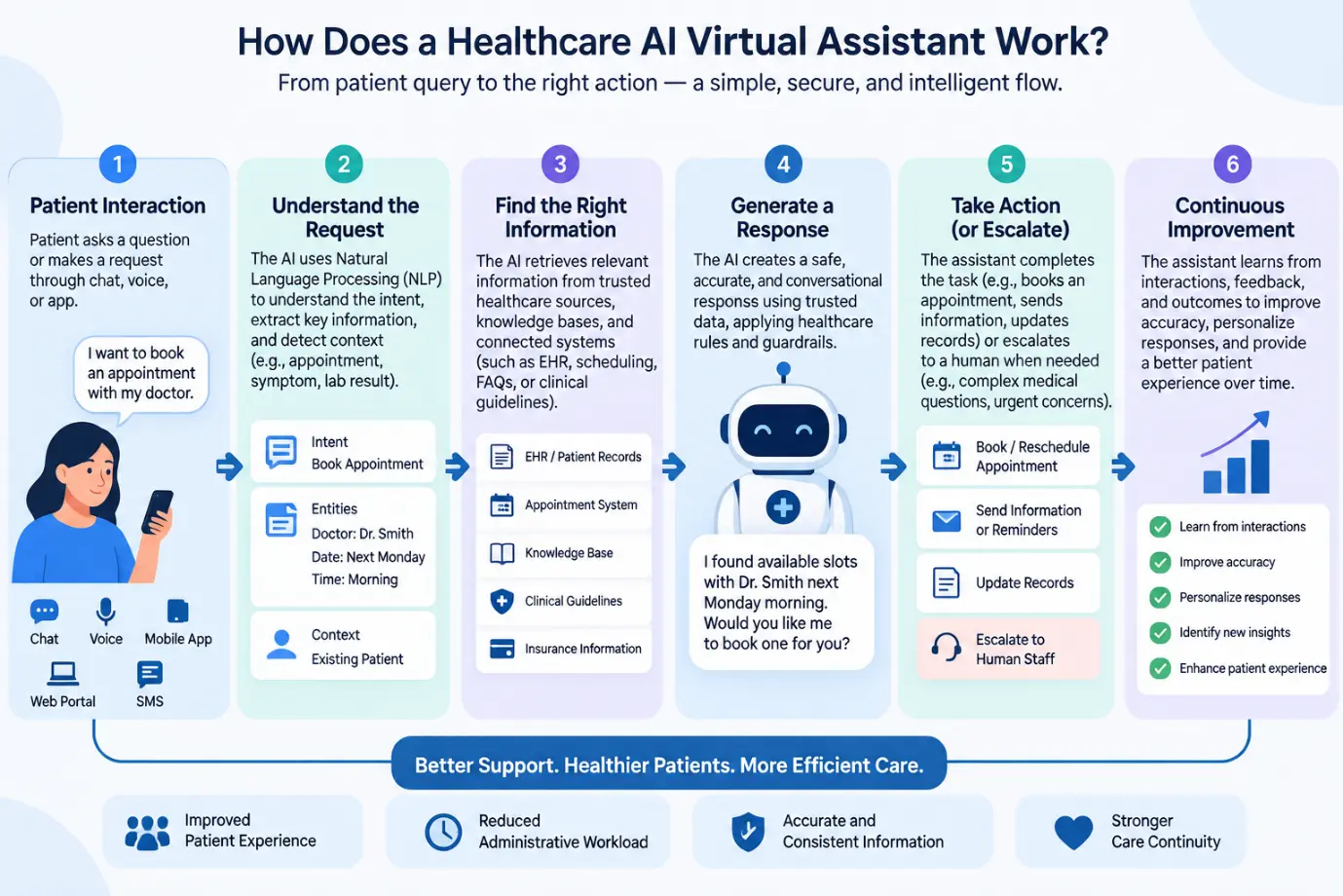
The journey starts when a patient interacts with the assistant through a website, mobile app, patient portal, SMS, or voice channel.
For example:
"I need to reschedule my appointment with Dr. Johnson."
The assistant receives the message and analyzes the patient's request.
Natural language processing and large language models identify the patient's intent, context, and relevant entities.
In this example, the system identifies:
This allows the assistant to determine what should happen next.
The assistant accesses approved healthcare knowledge sources rather than relying entirely on the language model's general knowledge.
These sources may include:
Retrieval-augmented generation can help the assistant generate responses based on verified organizational information.
This is where healthcare AI virtual assistant development becomes more powerful than basic chatbot development.
Through APIs and interoperability technologies such as FHIR and HL7, the assistant can connect with systems including:
For example, the assistant can retrieve available appointment slots and present them to the patient.
Once the patient selects an available appointment, the system can perform the authorized action.
The workflow may look like:
Understand request → Authenticate patient → Check availability → Present options → Confirm selection → Update appointment → Send confirmation
The AI does not need unrestricted access to healthcare systems. Instead, it should use controlled tools and permissions that define exactly what actions it can perform.
After completing the workflow, the assistant confirms the outcome in simple language.
For example:
"Your appointment has been rescheduled to Tuesday at 10:30 AM. You will receive a confirmation shortly."
If the request is clinically sensitive, ambiguous, unsupported, or requires professional judgment, the assistant should transfer the conversation to an appropriate staff member.
This creates a human-in-the-loop healthcare AI model, where AI handles suitable tasks while clinicians and staff retain control over complex decisions.
Finally, analytics measure how the assistant performs.
Key metrics include:
This continuous feedback loop helps healthcare organizations improve the assistant over time.
In simple terms, a healthcare AI virtual assistant works through a connected cycle:
Patient request → AI understanding → Trusted information → Secure integration → Workflow execution → Personalized response → Human escalation when needed → Performance monitoring
This architecture allows organizations to move from a basic healthcare chatbot toward an intelligent digital front door capable of supporting patients throughout the healthcare journey.
Why are healthcare organizations investing in AI virtual assistants when they already have patient portals, automated reminders, chatbots, and call centers?
For many health systems, the answer is not simply a desire to adopt new AI technology. The investment is being driven by specific operational challenges that traditional digital tools struggle to address, including appointment no-shows, short-notice cancellations, limited scheduling capacity, patient access barriers, fragmented communication, and increasing pressure on healthcare staff.
For a hospital system experiencing a 40% no-show rate for outpatient specialty appointments, the problem becomes even more significant. A missed appointment does not only represent a lost appointment slot. It can also prevent another patient from receiving care, reduce provider utilization, create additional administrative work, and contribute to longer waiting times.
This is creating a stronger business case for healthcare AI virtual assistant development, particularly when the assistant is designed to proactively engage patients rather than simply answer questions.
A conventional reminder might send:
"Your appointment is scheduled for tomorrow at 10:00 AM. Reply YES to confirm."
But a patient may not attend because they:
This creates a major opportunity for an AI virtual assistant for healthcare because AI can support two-way conversations.
Instead of simply asking whether the patient received a reminder, the assistant can ask whether the patient still intends to attend and, when appropriate, identify the barrier preventing attendance.
A 2026 quality improvement study published in The Journal of Nursing Administration found that extending appointment phone reminders from one day before the appointment to three days before reduced a clinic's no-show rate from 29% to 21%, while generating $5,200 in savings over 12 days. The study also found that notification timing was a significant predictor of no-shows.
The implication for healthcare leaders is important: when, how, and what the health system communicates with patients can influence appointment adherence.
An AI virtual assistant can take this concept further by creating an interactive conversation instead of relying exclusively on a fixed reminder.
A patient who cancels an appointment five days in advance gives the health system an opportunity to use that appointment slot again.
A patient who simply does not appear creates a much more difficult operational problem.
This is why organizations are increasingly interested in systems that can determine:
Will the patient attend?
If not, why?
Can the appointment be rescheduled?
Can another patient use the available slot?
This makes appointment adherence a strong use case for AI powered virtual assistant for healthcare development.
The assistant can potentially create an event-driven workflow:
Appointment booked → Patient contacted → Attendance intention confirmed → Barrier identified → Appropriate action initiated → Cancellation or rescheduling completed → Waitlisted patient contacted
This approach changes the role of AI from a reminder mechanism into an appointment-management layer.
Healthcare organizations are increasingly recognizing that missed appointments are not always caused by forgetfulness.
A large 2026 Mayo Clinic study examined 859,346 primary care appointments and found that patients with documented transportation needs were 5.2 percentage points less likely to attend an in-person appointment than patients without transportation needs.
This is particularly relevant for health systems serving geographically dispersed or socially vulnerable populations.
If a patient responds:
"I want to come, but I don't have a way to get there."
a simple reminder cannot solve the problem.
A properly designed AI assistant can identify the issue and route the patient toward an approved transportation-support workflow, alternative appointment option, telehealth option where clinically appropriate, or human assistance.
The AI should not make unsupported clinical or social-service decisions. Instead, it should identify the barrier and activate predefined workflows.
Specialty appointments are often difficult to obtain.
A patient may wait weeks or months for an appointment, while another appointment slot becomes unused because of a late cancellation or no-show.
This creates an unusual operational problem:
Demand for care exists, but available capacity is not always utilized efficiently.
A healthcare AI virtual assistant can be designed to help close this gap by connecting appointment adherence with cancellation and waitlist workflows.
For example:
Patient A cannot attend → AI identifies cancellation early → appointment becomes available → eligible Patient B on the waitlist is contacted → Patient B accepts → appointment is filled.
This requires deeper integration with scheduling and patient-management systems. It is therefore fundamentally different from deploying an informational chatbot.
Healthcare organizations could theoretically have staff call every patient before every appointment, ask about attendance, identify barriers, process cancellations, reschedule appointments, and contact patients on waitlists.
At large health-system scale, that approach is difficult to sustain.
The 2026 AI Agent Benchmark Report from Hyro, based on insights from nearly 400 health systems, reports that 41% of health systems cite staffing shortages as a major driver for AI adoption and that AI agents are offloading an average of 263 administrative hours per month. The report also says 94% of surveyed health systems use AI agents for appointment rescheduling, cancellations, and verification. These are vendor-reported benchmark figures and should be validated against an individual health system's baseline.
This explains why AI virtual assistant for healthcare development is increasingly being evaluated as an operational capacity strategy rather than simply a digital engagement initiative.
Traditional healthcare technology often waits for the patient to initiate an interaction.
The patient must:
AI virtual assistants can introduce a more proactive model.
For example:
"Your specialty appointment is three days away. Are you still planning to attend?"
If the patient responds:
"No, I need to reschedule because I cannot get transportation."
the assistant can continue the approved workflow.
This makes proactive patient engagement an important reason organizations are exploring healthcare AI virtual assistant development.
Not every patient has the same likelihood of missing an appointment.
Factors that may influence attendance can include:
A more advanced AI strategy can combine predictive analytics with conversational outreach.
The 2026 Penn Medicine randomized study is an important example. Researchers evaluated an automated interactive voice-response intervention for patients identified as being at higher risk of missing appointments. Across 59,994 high-risk patients, the intervention reduced the no-show rate from 11.3% to 9.6%, a 1.7 percentage-point reduction. The researchers estimated that, at scale, the intervention could produce approximately 19,000 additional completed appointments per million new appointment slots.
The significance is not that every health system should expect the same result. The important point is that targeted, automated patient outreach can be evaluated as a measurable operational intervention.
Patients increasingly expect healthcare organizations to provide digital experiences that are as convenient and responsive as other services they use.
However, digital transformation does not automatically mean patients want to abandon phone communication.
Hyro's 2026 State of Patient Communications research reports that 33% of patients still prefer calling for help, while 33% of healthcare leaders surveyed said legacy workflows were too outdated to integrate effectively with agentic AI. The report also found that 91% of providers reported using AI agents. These are survey findings from Hyro and should be considered in the context of its methodology and respondent population.
This creates an important design principle for how to create an AI virtual assistant for healthcare:
AI should not force patients into one channel.
A modern assistant can potentially support web, mobile, SMS, patient portals, and voice while maintaining a consistent workflow across channels.
The investment trend is also visible at the broader healthcare IT level.
A July 2026 report from KLAS Research, covering 182 healthcare organizations across 43 countries and territories outside the United States, found that 57% identified AI as their top healthcare IT investment priority, compared with 44% for EHR and digitalization, 26% for IT and infrastructure, and 25% for cybersecurity.
For US health systems, this broader market direction reinforces why AI investment is moving from experimentation toward specific operational use cases.
The key question is no longer simply whether a health system should experiment with AI. It is which patient and operational problems should be prioritized, what workflows can safely be automated, and how success will be measured.
Therefore, the strongest reason to invest in healthcare AI virtual assistant development is not AI adoption itself. It is the opportunity to turn fragmented appointment communication into a proactive, measurable workflow that helps patients overcome barriers before valuable care capacity is lost.
What can a healthcare organization actually gain by building an AI virtual assistant that can communicate with patients, understand their needs, and support them throughout the care journey?
For healthcare leaders asking, "How can we improve patient engagement without putting additional pressure on our clinical and administrative teams?", an AI virtual assistant for healthcare offers a way to connect patient communication with everyday healthcare workflows.
Consider a health system where patients frequently call to find providers, ask about preparation instructions, request appointment changes, check referral status, or seek help understanding what to do next. When these interactions are handled manually, staff must repeatedly answer similar questions across different departments and channels.
A well-designed AI virtual assistant for healthcare development can bring these interactions into a single conversational experience. It can provide information, guide patients, support approved tasks, and escalate situations that require human assistance.
The benefits are not limited to automation. The real value comes from creating a more connected patient experience while helping healthcare organizations manage growing demand for digital access.
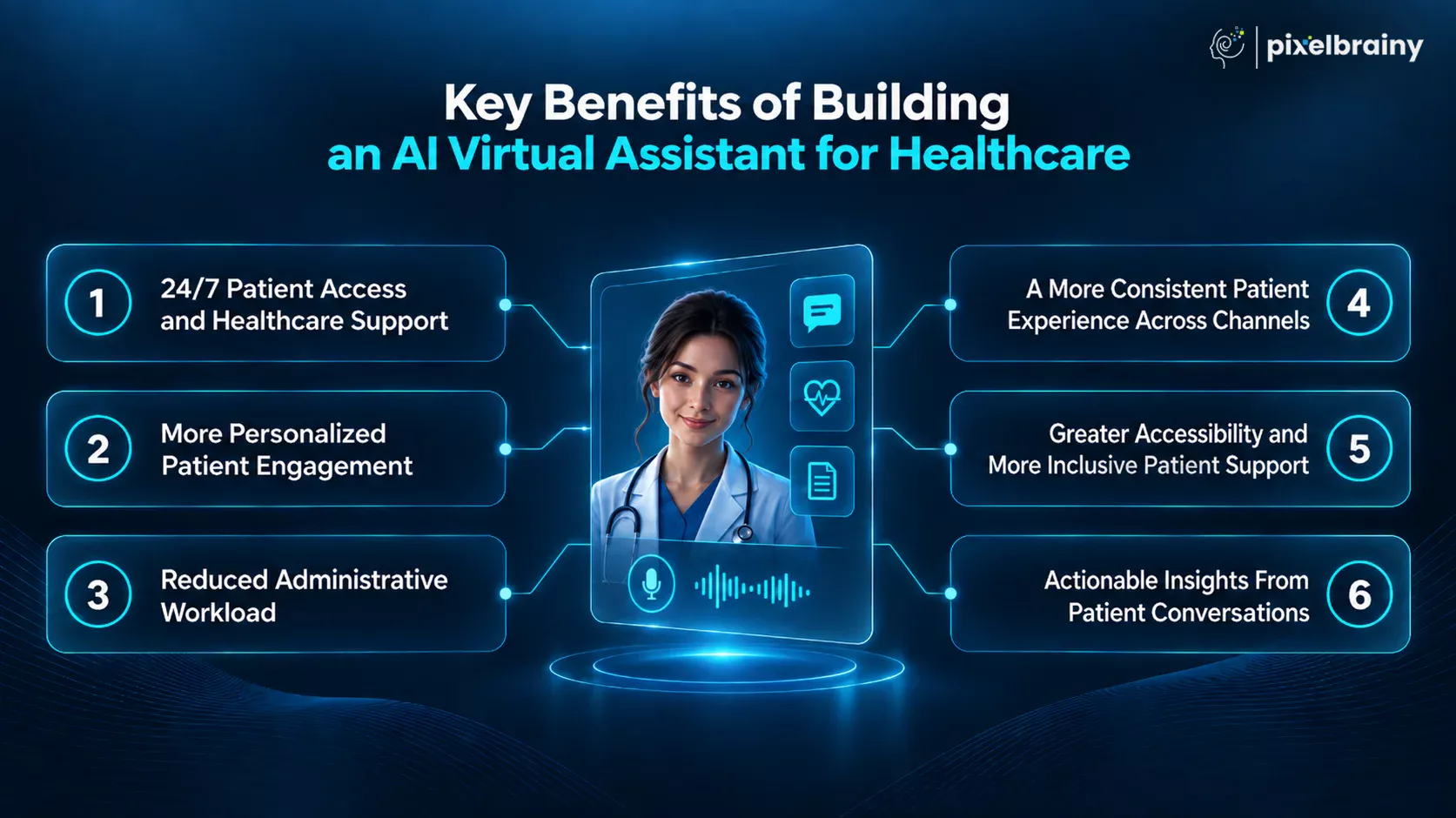
Patients do not need healthcare assistance only during traditional office hours. They may need information about appointments, providers, locations, preparation requirements, or healthcare services at night or on weekends.
An AI virtual assistant for healthcare can provide conversational support around the clock through websites, mobile applications, patient portals, SMS, and voice channels.
Instead of searching through multiple pages or waiting for a call center, patients can simply explain what they need. The assistant can understand the request and guide them to the appropriate information or workflow.
This makes building an AI virtual assistant for healthcare particularly valuable for health systems developing a stronger digital front door.
A major advantage of AI powered virtual assistant for healthcare development is the ability to make patient interactions more relevant to the individual.
With appropriate authorization, the assistant can use information such as appointment details, care stage, communication preferences, and previous interactions to provide more contextual conversations.
For example, a patient preparing for surgery could receive information specifically related to that procedure rather than generic healthcare content.
The assistant can also continue engagement after the initial interaction, helping patients receive reminders, instructions, follow-up information, and appropriate next steps throughout their care journey.
A 2026 global Future Health Index study from Philips found that 62% of healthcare leaders said the benefits of their AI investments were meeting or exceeding costs, based on surveys of more than 2,000 healthcare professionals and more than 20,000 patients across 10 countries.
Healthcare employees spend substantial time responding to repetitive patient requests.
Common examples include:
A healthcare AI virtual assistant can automate appropriate interactions and allow staff to concentrate on tasks requiring human judgment, empathy, or specialized expertise.
The goal of healthcare AI virtual assistant development should not be to replace healthcare professionals. Instead, AI can take responsibility for suitable repetitive interactions while employees focus on more complex patient needs.
A 2026 study of an AI voice assistant used for pre-procedural preparation achieved an 87.9% completed-call rate during its real-world implementation, demonstrating the potential for AI to support repetitive preparation workflows.
Patients may communicate with the same health system through a website, mobile application, patient portal, SMS, or telephone.
Without an integrated approach, these channels can feel disconnected. Patients may have to repeat information or restart the same process when switching between channels.
An AI virtual assistant for healthcare can create a more consistent conversational experience across supported channels.
For example, patients can ask about an appointment, receive relevant information, and continue toward an appropriate scheduling or support workflow without having to navigate multiple disconnected systems.
This is especially valuable for large healthcare organizations operating multiple hospitals, clinics, specialties, and locations.
Healthcare organizations serve patients with different languages, communication preferences, accessibility requirements, and levels of health literacy.
A healthcare AI virtual assistant can support multilingual conversations, voice interaction, simplified explanations, and conversational navigation.
This can make digital healthcare services easier to access for patients who may struggle with complex portals or traditional digital interfaces.
For organizations planning how to create an AI virtual assistant for healthcare, accessibility should be considered from the beginning rather than treated as an additional feature after development.
The US Department of Health and Human Services has identified potential AI applications for communicating with patients in preferred languages and literacy levels and improving accessibility.
An advanced AI virtual assistant development for healthcare strategy can generate valuable insights from patient interactions.
With appropriate privacy, security, and governance controls, organizations can analyze conversation patterns to identify recurring questions, access barriers, communication problems, and service gaps.
For example, if patients repeatedly ask how to prepare for the same procedure, the health system may need to improve its existing preparation content.
Similarly, frequent questions about referrals, provider availability, insurance, or locations can reveal broader patient-experience issues.
The assistant therefore becomes more than a communication tool. It can become a source of operational intelligence that helps healthcare leaders understand where patients experience friction and where digital processes need improvement.The real value of making an AI virtual assistant for healthcare is its ability to connect patient conversations with meaningful healthcare workflows.
When built around patient needs, secure integrations, accessibility, and responsible AI governance, it can become an important component of a health system's digital front door and long-term patient engagement strategy.
Also Read: AI Medication Assistant App Development: A Complete Guide
What should a healthcare organization include when it decides to build an AI virtual assistant for healthcare?
The answer depends on the patient journeys the health system wants to support, but a strong foundation should cover the most common patient access, communication, and administrative workflows. The assistant should be able to understand natural-language requests, provide reliable information, support routine tasks, connect with healthcare systems, and transfer patients to staff when a request falls outside its approved scope.
For healthcare leaders asking, "What features should an AI virtual assistant have to support patients from finding the right provider through scheduling, preparation, and follow-up?", the core functionality should focus on practical, high-volume patient needs first. Advanced capabilities such as predictive AI, autonomous agents, remote patient monitoring, and sophisticated clinical intelligence can be considered later as separate capabilities.
The following 15 features represent the core foundation of healthcare AI virtual assistant development.
| Core Feature | What It Does and Why It Matters |
|---|---|
| Natural Language Understanding | Natural language understanding allows the assistant to interpret how patients naturally describe their needs instead of requiring exact keywords. It can identify intent, relevant details, dates, services, and context to provide an appropriate response or initiate a supported workflow. |
| 24/7 Patient Support | The assistant provides round-the-clock support for routine patient questions and administrative requests. Patients can access information outside regular call-center hours, reducing dependence on business-hour availability for basic healthcare navigation and service-related interactions. |
| Healthcare FAQ Management | A centralized healthcare knowledge base allows the assistant to answer frequently asked questions about services, departments, locations, providers, preparation instructions, visiting policies, and administrative processes using approved organizational information instead of unsupported generated answers. |
| Provider and Facility Search | Patients can describe the type of care they need and receive relevant provider or facility information. The feature can organize results by specialty, location, service, availability, and other approved criteria to simplify healthcare discovery. |
| Appointment Scheduling | Integrated scheduling allows patients to find available appointment slots and complete supported bookings through conversation. Production implementations should use the health system's scheduling system or appropriate FHIR resources rather than allowing the AI model to invent availability. |
| Appointment Rescheduling and Cancellation | Patients can request changes to existing appointments through natural conversation. The assistant can verify the patient's identity, retrieve the relevant appointment, present permitted options, and update the scheduling system after the patient confirms the requested change. |
| Appointment Reminders and Confirmations | The assistant can send conversational reminders and ask patients to confirm, cancel, or reschedule appointments. Unlike one-way notifications, two-way communication gives patients an opportunity to communicate problems before an appointment is missed. |
| Patient Registration and Intake | Conversational registration can collect approved demographic, contact, insurance, and visit-related information before an encounter. The assistant can guide patients through required questions and transfer structured information to connected systems, reducing repetitive manual data entry. |
| Pre-Visit Preparation | The assistant can explain appointment-specific preparation requirements, provide check-in information, answer routine preparation questions, and remind patients about documents or instructions they need before arriving at the healthcare facility. |
| Care Navigation | Patients can describe what they need in everyday language and receive guidance about the appropriate service, department, provider, or care location. This helps simplify complex healthcare networks where patients may not know which department to contact. |
| Patient Education | A healthcare virtual assistant can provide approved educational content related to services, procedures, conditions, medications, and care instructions. Responses should be grounded in reviewed healthcare content and clearly remain within the assistant's approved scope. |
| Post-Visit Communication | After an encounter, the assistant can provide approved follow-up information, reminders, instructions, and administrative guidance. It can also direct patients toward appropriate human support when questions require clinical judgment or information outside its configured capabilities. |
| Multichannel Communication | Patients can interact through supported channels such as websites, mobile applications, patient portals, SMS, and voice. A multichannel architecture helps health systems provide a consistent digital experience rather than creating separate disconnected conversational experiences. |
| Human Handoff and Escalation | When the assistant cannot safely or confidently complete a request, it can transfer the conversation to an appropriate staff member. The handoff should preserve relevant conversation context so patients do not need to repeat their entire request. |
| Analytics and Conversation Reporting | Analytics provide visibility into patient interactions, common intents, completed tasks, failed workflows, escalations, response patterns, and engagement. Healthcare organizations can use these insights to identify patient-access problems and continuously improve the assistant and its underlying workflows. |
These features form the foundation of a practical AI virtual assistant for healthcare development strategy. They focus on the interactions patients and healthcare staff encounter frequently, including finding services, obtaining information, managing appointments, completing intake, preparing for visits, and receiving follow-up support.
For example, a patient could start with:
"I need to see a dermatologist."
The assistant could identify the request, find appropriate providers, help the patient select a location, check available appointments, complete the booking, provide preparation information, and send a confirmation.
That type of connected workflow is what separates an enterprise AI powered virtual assistant for healthcare from a simple question-and-answer chatbot.
It is also important to build these capabilities with controlled integrations. Current healthcare AI implementations commonly use FHIR-based integration and scheduling resources to connect conversational interfaces with EHR and appointment systems.
The assistant should therefore be designed around a simple principle:
Understand the patient, provide trusted information, complete approved actions, and escalate when human expertise is required.
Therefore A strong AI virtual assistant for healthcare starts with these core capabilities before expanding into more advanced AI functionality, creating a reliable foundation for patient access, engagement, and healthcare workflow automation.
Once the core capabilities of an AI virtual assistant for healthcare are established, healthcare organizations can introduce advanced features that make the platform more intelligent, proactive, personalized, and capable of supporting complex patient journeys.
For organizations planning healthcare AI virtual assistant development, these capabilities should generally be introduced after the foundational workflows, integrations, security controls, and human escalation processes are working reliably. Advanced functionality can then help the assistant move beyond routine patient support toward more proactive and context-aware healthcare engagement.
The following 10 advanced features can be considered while developing a sophisticated AI powered virtual assistant for healthcare.
| Advanced Feature | Explanation |
|---|---|
| Agentic AI and Autonomous Workflow Execution | Agentic AI enables the healthcare virtual assistant to plan and execute multiple connected steps within predefined boundaries. For example, it can interpret a patient request, retrieve relevant information, call approved APIs, complete a workflow, verify the result, and communicate the outcome without requiring staff intervention at every step. |
| Predictive Patient Engagement | Predictive AI can identify patients who may require additional outreach based on approved historical, behavioral, or operational data. The assistant can then trigger appropriate conversations for appointments, follow-ups, preventive care, or other predefined engagement workflows. |
| Personalized Care Journey Orchestration | This feature allows the assistant to adapt interactions according to a patient's current stage of care. Instead of treating every patient identically, it can coordinate relevant information and tasks before appointments, after procedures, during recovery, or between ongoing care encounters. |
| Voice AI and Conversational Calling | Advanced voice capabilities allow patients to interact with the healthcare AI virtual assistant through natural telephone conversations. Speech recognition, conversational AI, and text-to-speech can support appointment management, reminders, follow-up calls, and other approved workflows for patients who prefer voice communication. |
| Remote Patient Monitoring Integration | Integration with approved remote monitoring platforms can allow the assistant to participate in workflows involving patient-generated health information. Depending on clinical governance, it can communicate reminders, collect reported information, identify predefined escalation conditions, and route relevant information to healthcare teams. |
| Real-Time Clinical Context Integration | With appropriate authorization and safeguards, the assistant can retrieve relevant information from connected healthcare systems to make conversations more contextual. This may include appointment details, care plans, referral status, or other approved information, while maintaining strict access controls around protected health information. |
| Multilingual and Adaptive Conversations | Advanced language capabilities can enable the assistant to communicate with patients in multiple languages while adapting explanations to different literacy and communication needs. Healthcare organizations should validate translations and terminology carefully, particularly when conversations involve clinically sensitive information. |
| Intelligent Human-in-the-Loop Escalation | Instead of simply transferring every difficult conversation to staff, an advanced assistant can determine when human intervention is appropriate based on predefined rules, confidence thresholds, workflow conditions, or patient requests. It can also provide the receiving employee with conversation history and relevant context. |
| AI-Powered Sentiment and Conversation Analysis | Conversation analysis can identify signals such as frustration, confusion, repeated failed attempts, or dissatisfaction. The system can use these signals to offer human assistance and help healthcare organizations identify recurring patient-experience problems across large volumes of conversations. |
| Continuous AI Evaluation and Optimization | Advanced monitoring continuously evaluates response quality, workflow completion, hallucination rates, escalation patterns, latency, patient feedback, and other performance indicators. These insights allow healthcare organizations to identify problems, update knowledge sources, improve workflows, and maintain AI quality after deployment. |
Advanced AI virtual assistant for healthcare development should focus on solving real patient, clinical, and operational needs, not simply adding more AI features.
Agentic AI can automate connected workflows, predictive engagement can enable proactive outreach, and voice AI can improve telephone access. These capabilities can work together to create a more personalized and efficient patient experience.
However, advanced AI also requires strong privacy, cybersecurity, interoperability, clinical safety, governance, and human oversight. Healthcare organizations should introduce these features gradually and validate each workflow before scaling.
For organizations exploring how to create an AI virtual assistant for healthcare, advanced capabilities provide a path toward a smarter, more proactive digital healthcare experience.
Building an AI virtual assistant for healthcare requires more than selecting an AI model and connecting a chatbot interface. Healthcare workflows involve sensitive patient information, clinical context, regulatory requirements, and multiple systems, so every stage needs careful planning and validation.
For a primary care physician managing a 2,400-patient panel, the development process may focus on practical needs such as drafting clinical notes, preparing routine patient communications, and organizing low-risk inbox messages. The following steps to develop a healthcare AI virtual assistant from idea to launch provide a structured roadmap for turning that workflow into a secure, scalable solution.
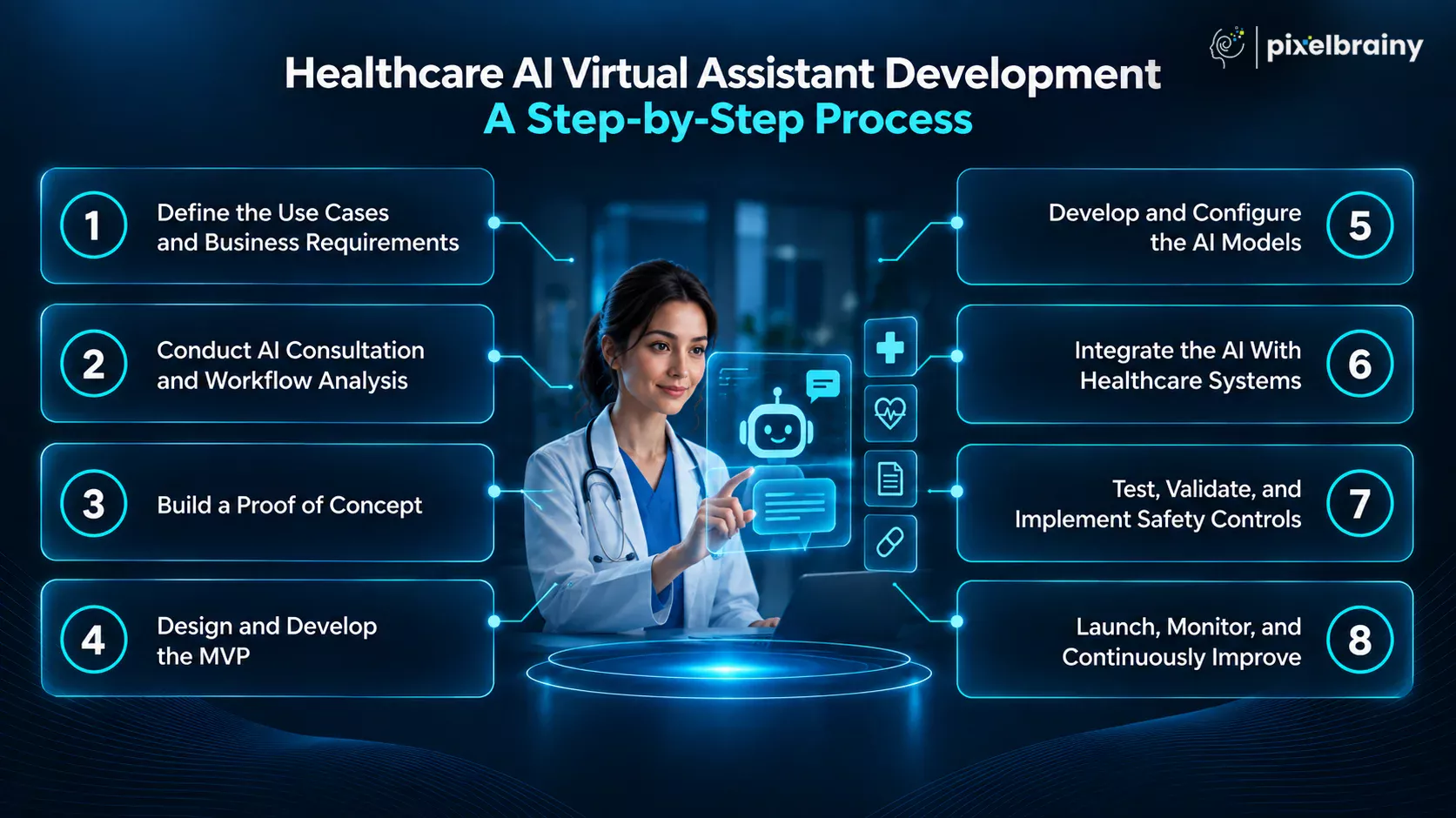
The first step is to clearly define what the healthcare AI virtual assistant should accomplish. Start by documenting the specific problems, users, workflows, and expected outcomes instead of beginning with technology selection.
For a primary care practice, this could include clinical note drafting, routine result communication, follow-up instructions, inbox categorization, appointment-related support, and administrative task routing. Each use case should identify what the AI can handle independently and what requires physician or staff approval.
This stage also establishes measurable goals such as reducing after-hours administrative work, improving response times, and increasing staff productivity. Clear requirements create the foundation for the entire healthcare AI virtual assistant development process.
Once the requirements are documented, analyze how the assistant will fit into existing clinical and administrative workflows. This involves mapping how information currently moves between physicians, patients, staff, EHR systems, scheduling platforms, and communication channels.
An AI consultation can help identify suitable automation opportunities while separating low-risk administrative tasks from workflows that require clinical oversight. For example, the assistant might draft a routine response but require physician approval before sending it.
Workflow analysis also helps identify bottlenecks, integration requirements, security considerations, and opportunities for future expansion. This ensures the proposed solution supports real-world healthcare operations rather than functioning as a standalone AI tool.
Also Read: Top 10 AI Consulting Companies in USA
Before investing heavily in full-scale development, organizations can validate the most important workflow through PoC development. The goal is to test whether the proposed AI experience can solve a specific problem effectively and safely.
For example, a primary care practice could begin by testing AI-generated clinical note drafts from approved patient conversations. The evaluation can measure accuracy, documentation quality, physician editing time, and overall usability.
A focused proof of concept can reveal technical or workflow issues early. It also provides stakeholders with evidence about whether the solution deserves further investment and which capabilities should be prioritized during the next development stage.
After validating the core concept, the next stage is MVP development, where the most valuable features are converted into a usable product. The MVP should remain focused rather than attempting to automate every healthcare workflow immediately.
A physician-focused MVP might include conversation-to-note drafting, routine message drafting, inbox classification, patient communication templates, role-based access, approval workflows, and basic analytics.
During this phase, the development team establishes the user interface, backend architecture, AI workflows, security controls, and data-handling processes. A focused MVP makes it easier to gather feedback from physicians and staff before expanding the assistant into more complex workflows.
Also Read: Top 10 AI MVP Development Companies in USA
The intelligence layer must then be designed around the specific healthcare use cases. AI model development may involve selecting foundation models, configuring prompts, developing retrieval workflows, creating evaluation datasets, and implementing specialized AI agents.
The model should understand healthcare terminology and the organization's approved workflows without being given unnecessary access to sensitive information. Different tasks may also require different AI approaches.
For example, note drafting, message classification, information retrieval, and workflow automation may use separate components with different validation criteria. Human review should remain central for workflows where incorrect AI output could affect patient care.
An assistant becomes significantly more useful when it can securely interact with the systems physicians already use. AI integration may connect the assistant with EHR platforms, patient portals, scheduling systems, messaging tools, laboratory information, and other approved healthcare applications.
Integration should follow appropriate security and interoperability standards and use controlled permissions. The assistant should only access information required for the specific task.
For a primary care workflow, integration could allow the assistant to retrieve relevant appointment or patient-message context, prepare a response, and return the draft to the physician for review. Strong integration reduces duplicate data entry and helps embed AI directly into existing workflows.
Healthcare AI requires extensive testing before deployment. Teams should evaluate accuracy, hallucinations, privacy, security, response consistency, bias, workflow reliability, and failure scenarios.
Testing should include realistic healthcare conversations and edge cases. The system should also have clear escalation rules for situations that require human intervention.
For physician productivity tools, validation might measure whether clinical notes accurately reflect conversations, whether routine messages contain appropriate information, and whether sensitive or clinically complex messages are correctly routed to a physician.
This stage is critical for AI healthcare software development companies because technical performance alone is not enough. The assistant must behave predictably within the intended healthcare environment.
The final stage is launching the assistant in a controlled environment and continuously measuring its performance. Start with a limited group of users or workflows before expanding across the organization.
After launch, collect feedback from physicians, staff, and patients where appropriate. Monitor metrics such as task completion, response accuracy, physician editing time, escalation rates, user satisfaction, and system reliability.
Organizations may hire AI developers to support ongoing improvements, model evaluation, integrations, security updates, and new workflow automation. Over time, the assistant can evolve from a focused MVP into a broader healthcare AI platform.
From defining the right use case to continuous optimization, a structured development process helps organizations build a secure, useful, and scalable AI virtual assistant for healthcare.
The cost to develop a healthcare AI virtual assistant typically ranges from $25,000 to $200,000+, depending on the assistant's capabilities, integrations, security requirements, AI complexity, and deployment scale. A basic hospital front-desk assistant can cost considerably less than an enterprise solution connected to EHRs, scheduling systems, patient portals, voice channels, and multiple hospital departments.
For organizations planning the development budget of a healthcare AI virtual assistant, the most important step is to define the required workflows before estimating the technology investment. The cost estimation of healthcare AI virtual assistant development should account for both initial development and ongoing expenses such as infrastructure, AI usage, maintenance, security, and model optimization.
So, what is the development pricing of a healthcare AI virtual assistant for a hospital front desk? A realistic estimate starts around $25,000 for a basic assistant and can exceed $200,000 for an enterprise-grade platform with advanced automation and healthcare system integrations.
| Basic Healthcare AI Virtual Assistant | $25,000 to $60,000 | Website or patient portal assistant, healthcare FAQs, hospital and provider information, basic appointment requests, simple navigation, conversational AI, basic analytics, authentication, and essential security controls. |
| Advanced Healthcare AI Virtual Assistant | $60,000 to $120,000 | Everything in the basic version plus appointment scheduling, rescheduling, patient intake, personalized responses, EHR or scheduling integration, multilingual support, escalation to staff, patient reminders, workflow automation, and advanced analytics. |
| Enterprise Healthcare AI Virtual Assistant for Hospitals | $120,000 to $200,000+ | Multi-department deployment, complex EHR integrations, voice AI, agentic workflows, real-time data access, advanced security, role-based access, enterprise analytics, multiple communication channels, high availability, extensive testing, governance, and ongoing optimization. |
Note: These are planning ranges, not fixed quotes. Actual AI virtual assistant development cost for healthcare depends heavily on scope, integration complexity, compliance requirements, and the number of workflows being automated.
| Cost Factor | Estimated Cost Impact | Why It Affects Cost |
|---|---|---|
| AI Model and Conversational Intelligence | $5,000 to $30,000+ | Basic FAQ responses require less work than sophisticated conversational AI capable of understanding healthcare terminology, context, intent, and complex patient requests. |
| UI/UX Design | $3,000 to $15,000+ | A simple chat interface costs less, while a customized patient-facing experience with dashboards, accessibility features, multilingual interfaces, and personalized workflows requires additional design and development. |
| EHR Integration | $10,000 to $40,000+ | Connecting with systems such as Epic, Oracle Health, or other EHR platforms requires secure APIs, interoperability workflows, authentication, permissions, data mapping, and extensive testing. |
| Appointment and Scheduling Integration | $5,000 to $20,000+ | Real-time appointment search, booking, cancellation, rescheduling, provider selection, and availability synchronization increase backend and integration complexity. |
| Voice AI Development | $10,000 to $35,000+ | Voice assistants require speech recognition, text-to-speech, telephony integration, conversational handling, call routing, recording controls, and additional testing. |
| Patient Intake and Forms | $5,000 to $15,000+ | Digital registration, intake questions, document collection, validation, and secure transfer of patient information add development and security requirements. |
| Multilingual Support | $5,000 to $20,000+ | Supporting multiple languages requires additional language processing, testing, translation workflows, and localized conversational experiences. |
| Security and Compliance | $8,000 to $30,000+ | Healthcare assistants handling protected health information require stronger authentication, encryption, access controls, audit logging, privacy safeguards, and security testing. |
| Agentic Workflow Automation | $15,000 to $50,000+ | AI agents that can perform multi-step actions, such as checking information, updating workflows, scheduling appointments, and escalating cases, require additional orchestration and validation. |
| Analytics and Monitoring | $3,000 to $15,000+ | Reporting dashboards, conversation analytics, AI performance monitoring, escalation tracking, and operational metrics add development and infrastructure costs. |
| Cloud Infrastructure and Deployment | $3,000 to $15,000+ initially | Cloud architecture, databases, APIs, deployment environments, monitoring, backups, and scalability requirements influence the initial and ongoing investment. |
| Testing and Quality Assurance | $5,000 to $25,000+ | Healthcare AI needs functional, security, integration, usability, performance, and AI-response testing across different workflows and edge cases. |
| Maintenance and AI Optimization | $2,000 to $15,000+ per month | Ongoing costs can include infrastructure, AI API usage, monitoring, bug fixes, model evaluation, security updates, new integrations, and workflow improvements. |
For a hospital front-desk assistant, the $25,000 to $60,000 range is generally appropriate when the solution focuses on basic patient questions and simple navigation. Once real-time scheduling, patient intake, EHR connectivity, voice communication, and workflow automation are introduced, the budget can move toward $60,000 to $120,000+.
An enterprise hospital deployment can exceed $200,000 when it requires multiple EHR and third-party integrations, advanced AI agents, voice capabilities, high availability, extensive security controls, multiple departments, and continuous optimization.
For a primary care physician asking about the cost of an assistant that drafts clinical notes, prepares routine patient communications, and manages routine inbox messages, the budget will depend particularly on EHR integration, clinical documentation workflows, AI accuracy requirements, physician approval mechanisms, and security architecture. A focused MVP can keep the initial investment significantly lower than a full enterprise deployment.
In short, the right healthcare AI virtual assistant development budget depends on the workflows you need to automate, the systems you need to connect, and the level of intelligence, security, and scalability your organization requires.
A reliable technology stack is the foundation of AI virtual assistant development for healthcare. The right combination of AI models, backend technologies, healthcare APIs, databases, security tools, and cloud infrastructure determines how effectively an assistant can understand patient requests, access approved information, automate workflows, and communicate with healthcare systems.
For organizations exploring how to build an AI virtual assistant for healthcare from scratch, the technology architecture should support both today's requirements and future expansion. For example, a primary care physician managing a 2,400-patient panel may initially need AI for clinical note drafting, routine patient communication, and inbox management. The stack should therefore support secure EHR connectivity, natural language processing, workflow automation, and physician review without creating unnecessary technical complexity.
Modern healthcare AI architectures increasingly emphasize interoperability and secure data exchange. ONC describes HL7 FHIR as an API-focused standard for exchanging health information, while HHS highlights interoperability, privacy, security, and AI-ready infrastructure as important components of healthcare technology modernization.
| Technology Layer | Recommended Technologies | Role in Healthcare AI Virtual Assistant Development |
|---|---|---|
| AI and LLM Layer | OpenAI, Anthropic, Google Gemini, Azure OpenAI, open-source LLMs | Powers natural language understanding, patient conversations, summarization, clinical note drafting, response generation, intent detection, and other AI capabilities. Model selection should depend on accuracy, privacy, latency, cost, and healthcare workflow requirements. |
| Natural Language Processing | NLP frameworks, embeddings, transformers, speech processing APIs | Helps the assistant understand patient questions, clinical terminology, conversation context, intent, and unstructured healthcare information. |
| AI Agent and Workflow Layer | LangChain, LangGraph, Semantic Kernel, custom orchestration | Coordinates multi-step workflows such as retrieving approved information, preparing a response, checking appointment data, initiating an action, and escalating to staff. |
| Backend Development | Python, FastAPI, Node.js, Java, .NET | Handles business logic, authentication, APIs, workflow orchestration, data processing, AI requests, and communication between the assistant and healthcare systems. |
| Healthcare Interoperability | HL7 FHIR, HL7 v2, REST APIs, SMART on FHIR | Enables secure exchange of clinical and administrative information with EHRs and other healthcare applications. FHIR is widely used for API-based health data exchange. |
| EHR Integration | Epic, Oracle Health, athenahealth and other supported EHR APIs | Connects the assistant with approved patient, appointment, messaging, clinical, and administrative information. Integration scope depends on the healthcare organization's systems and permissions. |
| Database | PostgreSQL, MySQL, MongoDB, Redis | Stores application data, workflow information, configurations, conversation metadata, and other approved information. Sensitive healthcare data requires appropriate security controls and architecture. |
| Vector Database | Pinecone, Weaviate, pgvector, Milvus | Supports retrieval-augmented generation by allowing the assistant to retrieve relevant information from approved knowledge sources instead of relying only on the model's internal knowledge. |
| Cloud Infrastructure | AWS, Microsoft Azure, Google Cloud | Provides computing, storage, networking, databases, monitoring, scalability, and deployment infrastructure. Healthcare deployments require appropriate security and compliance configurations. |
| Security and Authentication | OAuth 2.0, OpenID Connect, MFA, RBAC, encryption | Protects patient and organizational data through authentication, authorization, encryption, role-based permissions, and controlled system access. Healthcare organizations must consider security across systems containing electronic protected health information. |
| Voice AI | Speech-to-text, text-to-speech, telephony APIs | Enables telephone-based conversations, voice scheduling, patient reminders, intake, and other voice-enabled workflows. |
| Frontend | React, Next.js, Angular, Flutter | Builds patient-facing chat interfaces, physician dashboards, staff consoles, admin panels, and mobile experiences. |
| API and Integration Layer | REST APIs, GraphQL, API gateways, webhooks | Connects AI services with EHRs, scheduling platforms, patient portals, CRM systems, communication platforms, and internal healthcare applications. |
| Monitoring and Analytics | Cloud monitoring, application logs, AI evaluation tools, custom dashboards | Tracks system performance, response quality, errors, escalations, usage, latency, and workflow outcomes. Continuous monitoring is especially important when AI is integrated into healthcare operations. |
| DevOps and Deployment | Docker, Kubernetes, CI/CD, Terraform | Supports consistent development, testing, deployment, scaling, and infrastructure management across healthcare environments. |
| Testing and AI Evaluation | Automated testing, LLM evaluation frameworks, security testing | Validates AI responses, workflow accuracy, integration reliability, security, hallucination rates, and performance before and after deployment. |
| Compliance and Governance Layer | Audit logs, access controls, data retention policies, AI governance processes | Supports responsible AI deployment through traceability, permission management, monitoring, risk controls, and documented oversight. HHS emphasizes governance, risk management, infrastructure, and trustworthy AI adoption. |
A well-designed technology stack allows a healthcare AI virtual assistant to combine intelligent conversations, secure healthcare data access, workflow automation, and human oversight into one scalable platform.
Before presenting an investment case to the board, healthcare leaders need more than an AI demo. A practical question is: “Before I present this investment to our board I need an honest cost breakdown and what documented patient engagement and satisfaction improvement outcomes look like for health systems that have deployed AI virtual assistants.” The platforms below provide useful market validation because they demonstrate measurable approaches to patient engagement, care automation, clinical productivity, and digital access.
For founders asking how to develop AI virtual assistant for healthcare with chronic disease management features, or CIOs looking to build AI virtual assistant for healthcare, these companies also show how focused use cases can evolve into broader healthcare platforms.
What it does: Memora supports automated care journeys, patient engagement, symptom monitoring, chronic disease management, post-discharge follow-up, and care-team task management through conversational AI and digital workflows.
AI advantage: Its retrieval-based AI, clinician-curated content, intelligent triage, and EHR-connected workflows focus on controlled healthcare interactions rather than unrestricted generative responses.
Primary healthcare clients: Health systems and healthcare organizations, including Penn Medicine, Boston Medical Center, and Virtua Health. Memora reports a 95% engagement rate among enrolled patients and 85% of patient inquiries resolved by its AI assistant.
Key lesson: Founders can develop AI virtual assistant for healthcare around structured care pathways first, then expand into broader patient engagement.
What it does: Notable automates patient intake, registration, scheduling, outreach, referrals, and other administrative workflows through AI agents.
AI advantage: Its combination of AI agents, voice AI, two-way messaging, workflow automation, and healthcare-system integrations turns conversations into completed tasks.
Primary healthcare clients: Health systems and provider organizations including MUSC Health and Intermountain Health. MUSC reports 98% patient satisfaction, while Intermountain reported a 25% reduction in check-in time and 96% patient satisfaction.
Key lesson: Administrative automation can provide a clear ROI story when AI is connected directly to operational workflows.
What it does: Hyro provides conversational AI agents for scheduling, physician search, prescription support, registration, FAQs, routing, and patient communications.
AI advantage: Its NLP and agentic communication approach allows health systems to automate conversations across chat, voice, and other channels while generating insights from patient interactions.
Primary healthcare clients: Large health systems, including Intermountain Health and other provider organizations.
Key lesson: AI virtual assistant for healthcare development should treat patient conversations as both an engagement channel and a source of operational intelligence. Hyro reported more than 100 million patient conversations by July 2026.
What it does: Buoy provides an AI-powered symptom assessment and triage experience that asks patients questions, evaluates symptoms, and guides them toward appropriate next steps.
AI advantage: Its clinically designed triage engine focuses on appropriate care guidance rather than simply generating conversational answers. Its API allows healthcare organizations to integrate symptom assessment into their own digital experiences.
Primary healthcare clients: Health systems and digital healthcare organizations, with its technology designed for integration into patient portals and digital front doors.
Key lesson: Developing an healthcare AI virtual assistant for clinical use requires carefully bounded workflows, clinical validation, and appropriate safety controls.
What it does: Suki is an emerging AI-native healthcare assistant focused on physician productivity, including ambient documentation, pre-visit preparation, patient summaries, and chart-based questions.
AI advantage: Its conversational and ambient AI helps reduce documentation burden while integrating directly into clinical workflows.
Primary healthcare clients: Health systems, hospitals, and physician organizations, including Privia Health.
Key lesson: For a practice-level assistant, the opportunity is not always patient-facing. AI virtual assistant development for healthcare can also target physician productivity and administrative workload.
For teams asking how to build AI virtual assistant for healthcare, these platforms show that the strongest opportunities come from solving specific healthcare workflows, proving measurable value, and expanding only after the initial use case is validated.
Developing a healthcare AI virtual assistant involves challenges that go beyond standard chatbot development. Patient data, clinical safety, EHR integration, accuracy, and user trust must all be addressed before the solution can scale.
A common question healthcare organizations ask is: “How can we make an AI virtual assistant useful for patients without allowing it to make unsafe clinical decisions or create additional work for our staff?” The answer is to establish clear AI boundaries, strong security controls, human oversight, and continuous testing.
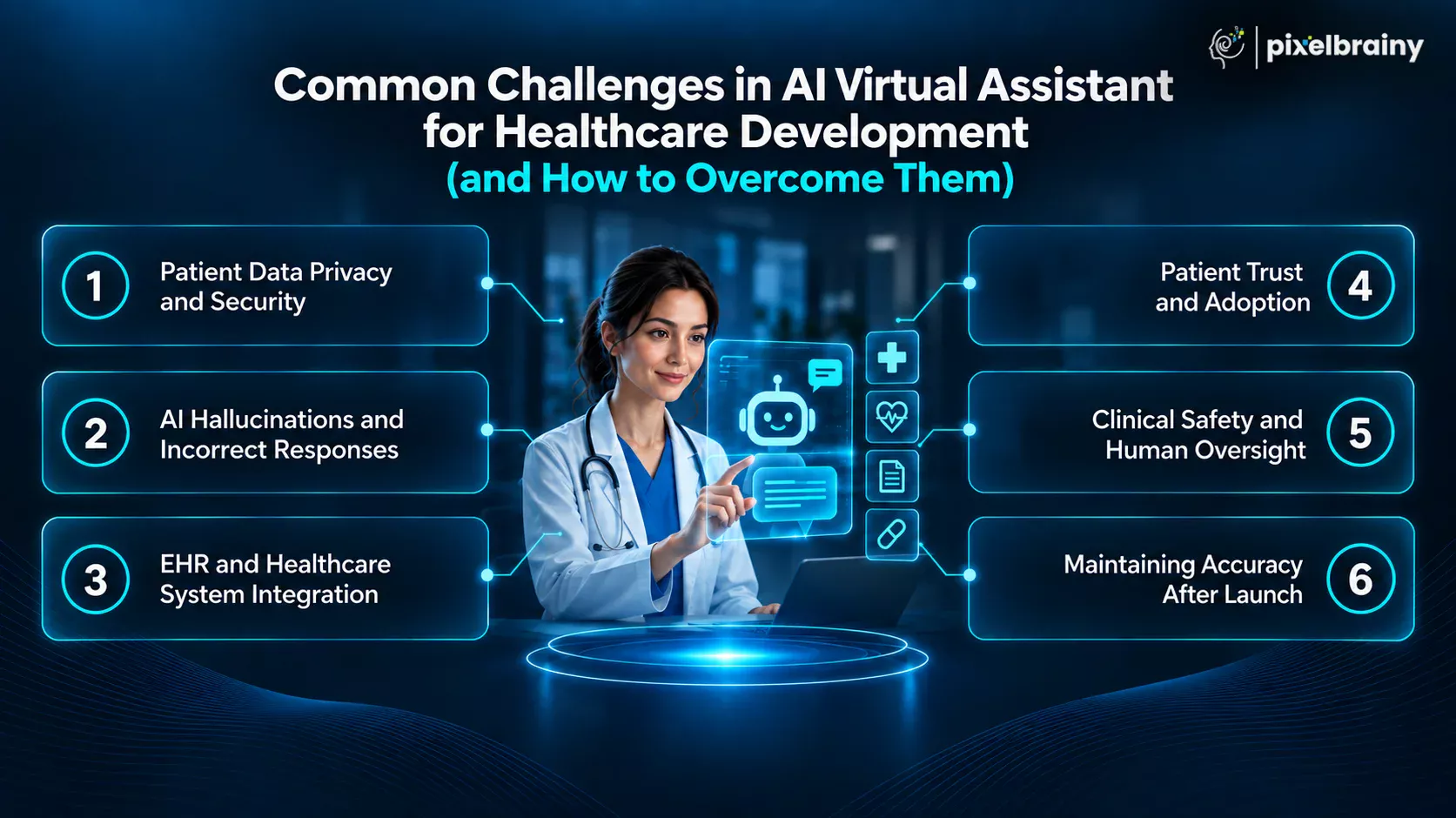
Healthcare assistants may handle sensitive patient information, making privacy and security a critical concern. Weak access controls or poor data handling can create serious compliance and reputational risks.
Solution: Use encryption, secure authentication, role-based access, audit logs, data minimization, and appropriate HIPAA safeguards. The assistant should only access the patient information required for a specific workflow.
Generative AI can sometimes provide inaccurate or unsupported information. In healthcare, even a seemingly minor error can negatively affect patient decisions or staff workflows.
Solution: Use trusted healthcare knowledge sources, retrieval-augmented generation, response validation, confidence thresholds, and predefined escalation rules. Sensitive clinical interactions should include appropriate human review.
Connecting the assistant with EHRs, scheduling platforms, patient portals, and other healthcare applications can be technically complex. Poor integration can create duplicate work instead of reducing it.
Solution: Use secure APIs and healthcare interoperability standards such as HL7 FHIR where supported. Start with high-value integrations and gradually expand the assistant's access as workflows are validated.
Patients may be uncomfortable sharing health information with an AI assistant, especially when they do not understand its capabilities or limitations.
Solution: Clearly identify the system as AI, explain what it can and cannot do, protect patient information, and provide an easy path to human assistance. A transparent experience can improve confidence and adoption.
An AI assistant should not independently handle situations that require clinical judgment unless the workflow has been specifically designed, validated, and governed for that purpose.
Solution: Establish clear boundaries between administrative and clinical tasks. Use predefined escalation criteria and require clinician approval for sensitive actions, recommendations, or communications.
AI performance can change as models, healthcare information, patient questions, and organizational workflows evolve. Launching the assistant is therefore not the end of development.
Solution: Continuously evaluate conversations, monitor errors and escalations, collect staff feedback, update knowledge sources, and test new model versions before deployment.
Addressing these challenges from the beginning helps create a secure, reliable, and scalable healthcare AI virtual assistant that supports both patients and healthcare teams.
From this above discussion, it is now time to identify the right development partner who can turn healthcare AI opportunities into a secure, practical, and scalable product. PixelBrainy, a leading AI healthcare software development company, helps healthcare organizations transform specific operational and patient engagement challenges into intelligent digital solutions.
For organizations looking for healthcare AI virtual assistant development services, the priority should not simply be access to an AI model. The development partner should understand healthcare workflows, integrations, security requirements, user experience, and the importance of keeping AI within clearly defined boundaries.
PixelBrainy brings experience across AI product engineering, conversational AI, AI agents, automation, healthcare software, and system integrations. This allows organizations to build healthcare AI virtual assistant solutions around their actual workflows rather than adopting a generic chatbot approach.
The team can help organizations define use cases, design conversational experiences, integrate required healthcare systems, implement AI workflows, establish human escalation, and prepare the product for continuous improvement.
For behavioral health organizations, these capabilities can be particularly important. Consider this real-world requirement:
“Our behavioral health organization provides outpatient therapy to 8,000 active patients and we want an AI virtual assistant for healthcare that supports patients between weekly therapy sessions through mood tracking, coping exercises, homework completion tracking, and crisis detection with immediate escalation to our on-call clinical team. The assistant must maintain therapeutic boundaries and never attempt to provide therapy itself.”
This type of requirement demonstrates why healthcare AI needs carefully defined scope. PixelBrainy can approach such a solution around structured patient support, approved coping resources, monitoring workflows, escalation rules, clinician oversight, and secure communication rather than positioning AI as a replacement for therapists.
In one confidential healthcare project, the team worked on an AI-powered patient support solution designed to simplify interactions, automate routine communication, and connect users with appropriate next steps. The solution incorporated conversational AI, workflow automation, secure backend architecture, and human escalation mechanisms.
Because the client operates in a sensitive healthcare environment, identifying details and proprietary implementation information cannot be disclosed. The project nevertheless demonstrates PixelBrainy's approach to combining AI capabilities with practical healthcare workflows and responsible user experiences.
Organizations seeking to develop healthcare AI virtual assistant solutions can also start with a focused use case and expand functionality as adoption, safety, and performance are validated. This approach helps control complexity while creating a foundation for broader healthcare automation.
PixelBrainy can support the healthcare virtual assistant development integrating AI across patient engagement, administrative automation, care coordination, and other approved workflows.
Ready to turn your healthcare AI idea into a secure, scalable solution? Connect with PixelBrainy today.

Healthcare is moving toward more connected, responsive, and personalized digital experiences, and AI virtual assistants are becoming an important part of that transformation. From patient scheduling and intake to clinical documentation, care navigation, follow-up communication, and chronic disease support, the possibilities for healthcare AI virtual assistant development continue to expand.
However, successful AI virtual assistant development for healthcare is not simply about adding advanced AI features. It requires a clear understanding of healthcare workflows, secure data handling, reliable integrations, appropriate clinical boundaries, human oversight, and continuous performance evaluation.
Whether your goal is to build AI virtual assistant for healthcare for a hospital, health system, primary care practice, or behavioral health organization, starting with a focused use case can help control cost, validate value, and create a foundation for future expansion.
With the right strategy and development partner, an AI virtual assistant can reduce administrative workload while creating a more accessible and engaging patient experience.
Book an appointment with PixelBrainy to discuss your healthcare AI virtual assistant idea and development requirements.
The key steps include defining healthcare use cases, analyzing workflows, creating a proof of concept, developing an MVP, selecting AI models, integrating healthcare systems, testing for safety and accuracy, and continuously optimizing the solution after launch. Following these steps to develop healthcare AI virtual assistant from idea to launch helps organizations control complexity and validate business value.
The cost to develop an AI virtual assistant for healthcare generally starts around $25,000 and can exceed $200,000 for enterprise solutions. Factors such as EHR integration, AI complexity, voice capabilities, security, number of workflows, and ongoing maintenance can significantly affect the overall AI virtual assistant development cost for healthcare.
To build an AI virtual assistant for healthcare, begin with the workflows creating the greatest administrative burden. For a primary care practice, these could include clinical note drafting, routine patient communication, inbox categorization, appointment management, and follow-up support. The assistant can then be integrated with the practice's existing systems and expanded as its performance is validated.
Organizations can develop AI virtual assistant for healthcare with structured chronic care workflows such as medication reminders, symptom tracking, educational support, follow-up questionnaires, and escalation alerts. The assistant should operate within approved clinical protocols and involve healthcare professionals when a situation requires clinical judgment.
Behavioral health solutions require particularly clear boundaries. During healthcare AI virtual assistant development, organizations should define what the assistant can support, establish crisis detection and escalation rules, protect sensitive patient information, and ensure the system does not represent itself as a replacement for a licensed therapist.
The timeline depends on the product's scope. A focused MVP may take several months, while an enterprise AI virtual assistant development for healthcare project involving EHR integrations, voice AI, multiple workflows, advanced security, and extensive testing can require considerably longer. Defining a focused first release can help accelerate validation.
To create healthcare AI virtual assistant solutions, teams commonly use large language models, natural language processing, backend frameworks, healthcare APIs, HL7 FHIR integrations, databases, cloud infrastructure, authentication systems, analytics, and AI evaluation tools. The exact technology stack should be determined by the intended workflows and healthcare system integrations.
Look for a partner with experience in AI virtual assistant development for healthcare, healthcare integrations, secure data architecture, conversational AI, workflow automation, and responsible AI implementation. Ask potential development partners for relevant case studies, development methodology, estimated costs, security approach, and details about how they handle human oversight and clinical boundaries.

About The Author
Sagar Bhatnagar
Sagar Sahay Bhatnagar brings over a decade of IT industry experience to his role as Marketing Head at PixelBrainy. He's known for his knack in devising creative marketing strategies that boost brand visibility and market influence. Sagar's strategic thinking, coupled with his innovative vision and focus on results, sets him apart. His track record of successful campaigns proves his ability to utilize digital platforms effectively for impactful marketing efforts. With a genuine passion for both technology and marketing, Sagar continuously pushes PixelBrainy's marketing initiatives to greater success.

Working with the PixelBrainy team has been a highly positive experience. They understand the design requirements and create beautiful UX elements to meet the application needs. The dev team did an excellent job bringing my vision to life. We discussed usability and flow. Sagar worked with his team to design the database and begin coding. Working with Sagar was easy. He has the knowledge to create robust apps, including multi-language support, Google and Apple ID login options, Ad-enabled integrations, Stripe payment processing, and a Web Admin site for maintaining support data. I'm extremely satisfied with the services provided, the quality of the final product, and the professionalism of the entire process. I highly recommend them for Android and iOS Mobile Application Design and Development.

Great experience working with them. Had a lot of feedback and I found that unlike most contractors they were bugging me for updates instead of the other way around. They were extremely time conscience and great at communicating! All work was done extremely high quality and if not on time, early! They were always proactive when it comes to communication and the work is great/above par always. Very flexible and a great team to work with! Goes above and beyond to present us with multiple options and always provides quality. Amazing work per usual with Chitra. If you have UI/UX or branding design needs I recommend you go to them! Will likely work with them in the future as well, definitely recommended!

PixelBrainy is a joy to work with and is a great partner when thinking through branding, logo, and website layout. I appreciate that they spend time going into the "why" behind their decisions to help inform me and others about industry best practices and their expertise.

I hired them to design our software apps. Things I really like about them are excellent communication skills, they answer all project suggestions and collaborate right away, and their input on design and colors is amazing. This project was complex and needed patience and creativity. The team is amazing to do business with. I will be using them long-term. Glad to see there are some good people out there. I was afraid to try and outsource my project to someone but I am glad I met them! I really can't say enough. They went above and beyond on this project. I am very happy with everything they have done to make my business stand out from the competition.

It was great working with PixelBrainy and the team. They were very responsive and really owned the project. We'll definitely work with them again!

I recently worked with the PixelBrainy team on a project and I was blown away by their communication skills. They were prompt, clear, and articulate in all of our interactions. They listened and provided valuable feedback and suggestions to help make the project a success. They also kept me updated throughout the entire process, which made the experience stress-free and enjoyable.

PixelBrainy is very good at what it does. The team also presents themselves very professionally and takes care of their side of things very well. I could fully trust them taking up the design work in a timely and organised manner and their attention to detail saved us lots of effort and time. This particular project was quite intense and the team showed that they function very well under pressure. Very much looking forward to working with her again!

It's always an absolute pleasure working with them. They completed all of my requests quickly and followed every note I had for them to a T, which made our process go smoothly from start to finish. Everything was completed fast and following all of the guidelines. And I would recommend their services to anyone. If you need any design work done in the future, PixelBrainy should be your first call!

They took ownership of our requirements and designed and proposed multiple beautiful variants. The team is self-motivated, requires minimum supervision, committed to see-through designs with quality and delivering them on time. We would definitely love to work with PixelBrainy again when we have any requirements.

PixelBrainy was a big help with our SaaS application. We've been hard at work with a new UI/UX and they provided a lot of help with the designs. If you're looking for assistance with your website, software, or mobile application designs, PixelBrainy and the team is a great recommendation.

PixelBrainy designers are amazing. They are responsive, talented, and always willing to help craft the design until it matches your vision. I would recommend them and plan to continue them for my future projects and more!!!

They were awesome! Did a good job fast, and good communication. Will work with them again. Thank you

Creative, detail-oriented, and talented designers who take direction well and implement changes quickly and accurately. They consistently over-delivered for us.

PixelBrainy team is very talented and creative. Great designers and a pleasure to work with. PixelBrainy is an excellent communicator and I look forward to working with them again.

PixelBrainy has a very talented design team. Their work is excellent and they are very responsive. I enjoy working with them and hope to continue on all of our future projects.


Transform your ideas into reality with us.
Across these industries, each engagement brings unique challenges, from early-stage product development to scaling complex systems, helping us build a practical understanding of real-world product environments.