AI Summary Powered by PixelBrainy
What if your gym's front desk could answer hundreds of repetitive member questions without adding another employee to the team?
For a gym with 450 members, questions about class schedules, membership options, gym hours, workout guidance, and routine support can consume a significant amount of front desk time. An AI chatbot for gyms and fitness trainers can automate many of these interactions, provide instant responses, assist with bookings, guide members through fitness-related queries, and help trainers manage recurring communication more efficiently.
But before investing in an AI chatbot, gym owners need a practical answer to a bigger question: “How much does it cost to build a gym-specific AI chatbot, what features can I realistically get at different budget levels, and which development companies have built AI chatbots for gym operators with documented improvements in member engagement and staff time savings?”
The AI chatbot development cost for gyms and fitness trainers can range from $10,000 to $100,000+, depending on the chatbot's intelligence, feature complexity, integrations, personalization, and deployment requirements. A basic solution may handle FAQs, gym hours, membership information, and class schedules, while an advanced chatbot can support personalized workout recommendations, CRM integration, booking automation, wearable connectivity, analytics, and more sophisticated conversational AI.
Understanding the gym and fitness trainers AI chatbot development cost helps businesses set a realistic budget and prioritize features according to their operational goals. This guide explores the complete AI chatbot development cost breakdown, timeline, major and hidden cost factors, sourcing models, revenue opportunities, and practical ways to control expenses while creating a scalable chatbot for gyms and fitness trainers.
What if your gym could answer member questions and provide fitness support 24/7 without increasing front desk workload? An AI chatbot for gyms and fitness trainers is a digital assistant that uses AI and natural language processing to automate conversations and routine fitness-related tasks.
For trainers, it can provide workout suggestions, nutrition guidance, progress tracking, and routine reminders, helping manage multiple clients more efficiently. For gyms, it can handle membership questions, gym hours, class schedules, bookings, promotions, and other repetitive requests.
An AI fitness chatbot can also personalize interactions using member goals, preferences, fitness levels, and previous activities. Basic solutions may focus on FAQs and support, while advanced chatbots can include personalized workout recommendations, CRM integration, booking automation, wearable connectivity, and analytics.
By automating repetitive communication and providing personalized assistance, AI chatbots help gyms and trainers improve member engagement, reduce manual workload, and scale fitness services more efficiently.
The opportunity for AI chatbot development for gyms and fitness trainers is growing alongside the wider digital fitness market. According to The Business Research Company, the global fitness app market is expected to grow from $17.71 billion in 2025 to $22.36 billion in 2026, reaching $56.9 billion by 2030 at a 26.3% CAGR. The report identifies AI-powered personalized workout plans, wearable integration, virtual coaching, and holistic health monitoring among the major trends shaping the market.
For startups and fitness businesses, the investment case for an AI chatbot for gyms and fitness trainers is not simply about following an AI trend. It is about solving specific operational and customer experience problems.
A gym chatbot can answer recurring questions about membership plans, class schedules, opening hours, pricing, bookings, and basic workout guidance. This can reduce the volume of routine conversations handled manually by front desk teams.
AI can help deliver more personalized interactions based on member goals, fitness levels, preferences, previous activities, and training history. This creates opportunities for AI-powered workout recommendations, progress guidance, reminders, and virtual coaching without requiring a trainer to handle every interaction manually.
A chatbot can maintain ongoing communication through workout reminders, check-ins, class notifications, progress updates, and personalized messages. For startups building digital fitness products, this creates more touchpoints between the platform and its users.
The market is moving toward deeper integration between AI, fitness applications, wearables, and health data. Technavio forecasts the global fitness app market to grow by $155.69 billion between 2025 and 2030, with a 28.6% CAGR, and identifies AI and predictive health analytics as important growth drivers.
Beyond customer support, startups can use AI chatbots to support premium coaching, personalized workout plans, nutrition services, class bookings, subscriptions, and white-label solutions. This gives an AI chatbot a potential role in both operations and revenue generation.
For independent trainers and growing gyms, adding staff for every increase in member volume can become expensive. An AI chatbot can handle a portion of routine interactions simultaneously, allowing human staff and trainers to focus on conversations that require personal attention.
The latest market forecasts show continued growth in fitness applications through 2030, while AI personalization, wearable integration, and virtual coaching are becoming increasingly prominent. The Business Research Company For startups, this creates a practical opportunity to build AI capabilities around specific fitness workflows rather than treating the chatbot as a standalone FAQ tool.
The key investment question is therefore not simply whether to add AI, but where an AI chatbot can deliver measurable value through lower repetitive workload, stronger member engagement, personalized support, and scalable fitness services.
Also Read: How To Develop Custom AI Chatbot: Benefits, Types, And Cost
How should a gym owner divide the chatbot budget between essential features, testing, integrations, and future upgrades without overspending on the first release? This is an important consideration because the AI chatbot development cost for gyms and fitness trainers is influenced not only by the final feature list but also by how the product is planned, validated, and expanded. A phased approach can help businesses connect spending with actual user feedback and operational needs.
For example, a fitness startup may ask: “Should I spend my entire budget on an advanced AI fitness chatbot now, or launch a smaller MVP, test it with members, and add personalization and integrations after validating demand?” The answer depends on the chatbot's intended role, target users, available data, and business objectives.
A structured AI chatbot development cost plan can divide the project into practical stages:
This staged gym AI chatbot development approach gives businesses greater control over spending while creating opportunities to validate each investment before expanding the product. It also helps align the development budget with measurable business requirements rather than paying upfront for features that may not be needed.
When fitness businesses or startups begin planning an AI chatbot, one of the first questions they ask is: How much will it cost to build an AI Chatbot for Gyms and Fitness Trainers? On average, AI chatbot development costs range between $10,000 and $100,000+, depending on factors such as feature complexity, personalization level, integrations and data requirements.
To make early planning easier, an AI chatbot development cost estimator can help users get an instant rough quote based on the options they select. This gives them a quick understanding of the potential investment before moving into detailed discussions.
Estimated Cost = Base Chatbot Cost + (AI Feature Cost × Complexity Factor) + Integration Cost + UI/UX Design + Data Training and Management Cost
Where:
For example, imagine a gym wants a chatbot with class scheduling, personalized workout recommendations and CRM integration.
Estimated Cost = ($18,000 + $12,000) × 1.5 + $8,000 + $7,000 + $5,000 = $63,000
A cost estimation tool can:
Your estimator can include dropdowns or sliders for selecting:
With the growing interest in automation across the fitness industry, offering an instant estimate tool gives your business a strong competitive edge and helps clients begin their AI chatbot journey with confidence.
Also Read: How to Integrate AI Chatbot into Website: A Step-by-Step Process
What makes an AI chatbot for a gym cost $15,000 while another fitness chatbot can exceed $100,000? The difference usually comes down to the chatbot's AI capabilities, personalization, integrations, data requirements, security, interface complexity, and deployment scope. The development timeline for an AI chatbot for gyms and fitness trainers can typically range from 4 to 12 weeks, although projects with advanced AI features and multiple integrations may require additional time.
For example, a fitness startup may ask: “I want an AI chatbot that can understand natural fitness conversations, generate personalized workout plans, connect with my gym CRM and booking system, and work across WhatsApp and my mobile app. Which factors will have the biggest impact on development cost and timeline?” These requirements involve considerably more development work than a basic FAQ or membership-support chatbot.
Understanding the AI chatbot development cost for gyms and fitness trainers requires evaluating each component separately. The following factors explain where the development budget is typically allocated and how additional functionality can affect the overall gym AI chatbot development cost.
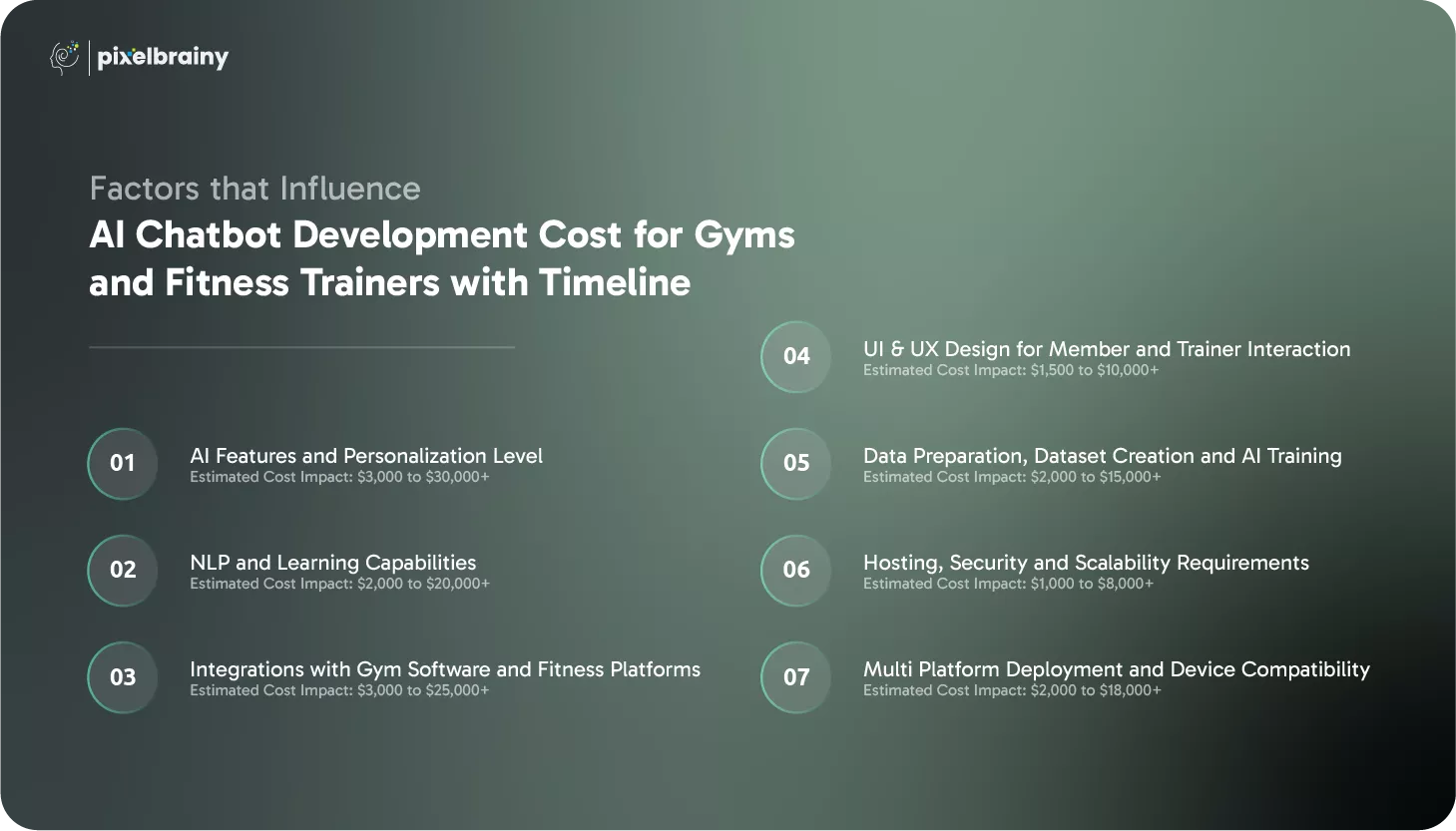
The feature set plays a major role in determining the Gym and Fitness Trainer AI Chatbot Development Cost. A chatbot that only handles basic FAQs or membership queries requires simple logic and limited configuration.
However, gyms and fitness trainers often want more advanced features such as personalized workout plans, calorie tracking, diet recommendations, program progressions, hybrid training support and adaptive workout suggestions. These capabilities demand deeper algorithms, fitness datasets and continuous refinement, which increases development complexity.
Estimated Cost Impact: $3,000 to $30,000+
The complexity of NLP and machine learning directly influences the cost of making an AI Chatbot for Gyms and Fitness Trainers. A basic NLP model that understands simple questions is relatively easy to build.
A fitness chatbot that recognizes detailed exercise queries, fitness terminology, slang, user intent, follow-up messages and contextual conversations requires advanced training and higher data validation. Improving accuracy across multiple languages or offering voice-based interactions also increases development time.
Estimated Cost Impact: $2,000 to $20,000+
Gyms and trainers rely on multiple software systems including CRMs, class scheduling tools, wearable devices, payment gateways, workout tracking apps and membership management platforms.
Integrating the AI chatbot with these systems ensures a seamless user experience but requires additional API development, customization, error handling and security validation. The more integrations required, the higher the development and testing workload.
Estimated Cost Impact: $3,000 to $25,000+
A user-friendly interface greatly improves member satisfaction and adoption rates. A simple web-based chat interface costs less, but a fully branded multi-platform experience with animations, personalized flows, fitness dashboards and trainer specific control panels requires dedicated UI and UX design.
Designing clear flows for booking classes, receiving workout recommendations or chatting with a virtual trainer increases design and development hours.
Estimated Cost Impact: $1,500 to $10,000+
Gyms and fitness trainers who want a chatbot that gives personalized workout or nutrition recommendations must provide data such as exercise libraries, member history, fitness levels, calorie requirements, schedules and behavioral patterns.
Preparing this data for AI model training is one of the most time intensive tasks. Data cleaning, labeling, validation and model retraining require expertise, and the quality of this data determines how accurate and helpful the chatbot becomes.
Estimated Cost Impact: $2,000 to $15,000+
Fitness businesses often deal with personal information, medical notes, fitness goals and payment details, which means the chatbot must meet high security standards. Features such as encrypted communication, GDPR compliance, secured API connections and scalable cloud hosting add to the development budget.
Larger gyms with thousands of active members require stronger server capacity and monitoring systems to ensure uninterrupted performance.
Estimated Cost Impact: $1,000 to $8,000+
If the chatbot is intended for a single platform such as a website, costs remain low. When gyms want to deploy their chatbot across WhatsApp, mobile apps, Facebook Messenger, SMS platforms, smartwatch apps or interactive kiosks, it requires additional coding, interface adjustments, testing and setup.
Supporting multiple devices ensures wider reach but increases development and maintenance time.
Estimated Cost Impact: $2,000 to $18,000+
| Cost Factor | Description | Estimated Cost Impact |
| AI Features and Personalization | Advanced workout plans, nutrition support, adaptive fitness logic | $3,000 to $30,000+ |
| NLP and Learning Complexity | Understanding detailed queries and contextual conversations | $2,000 to $20,000+ |
| Integrations | Booking systems, CRMs, wearables, payment gateways | $3,000 to $25,000+ |
| UI and UX Design | Custom chat flows and fitness branded interfaces | $1,500 to $10,000+ |
| Data Preparation and Training | Fitness datasets, labeling, model tuning | $2,000 to $15,000+ |
| Hosting and Security | Encryption, compliance and scalable architecture | $1,000 to $8,000+ |
| Multi-Platform Deployment | Website, mobile apps, WhatsApp, Messenger and more | $2,000 to $18,000+ |
The final AI chatbot development cost for gyms and fitness trainers depends on how these factors come together. AI complexity, integrations, data preparation, security, UI/UX, and deployment requirements should be evaluated against the business goals and expected user volume. A clear feature roadmap helps gyms and fitness businesses allocate their budget effectively while leaving room for future upgrades and scalability.
Why can two gym chatbots with similar core features have very different development budgets? Beyond the visible development work, recurring AI service fees, security requirements, scalability, multilingual support, model optimization, analytics, and voice capabilities can add significantly to the overall AI chatbot development cost for gyms and fitness trainers.
For example, a fitness business may ask: “We already have a basic chatbot planned, but what additional costs should we expect if we want it to support 5,000 members, multiple languages, voice interactions, advanced analytics, and continuous AI improvements?” These requirements can introduce expenses that are easy to overlook when preparing the initial gym AI chatbot development cost estimate.
The following hidden factors highlight potential expenses that should be considered when planning, launching, and maintaining an AI chatbot for gyms and fitness trainers.
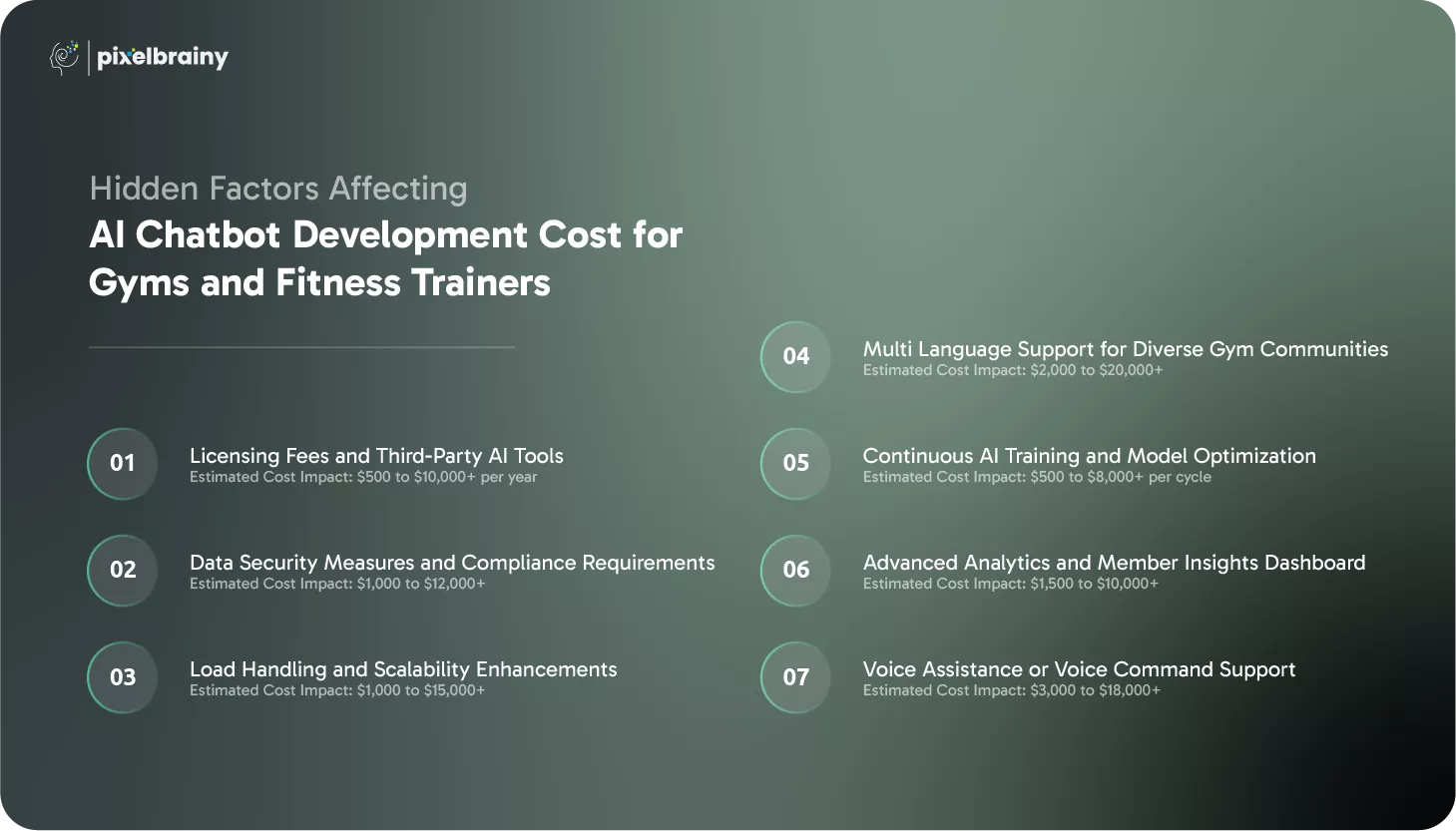
Many AI chatbots rely on licensed NLP engines, analytics tools or premium AI services. If a gym or trainer requires higher message volumes, advanced AI reasoning or specialized fitness AI engines, licensing fees increase. This can add recurring monthly or yearly expenses that must be included in the total cost.
Estimated Cost Impact: $500 to $10,000+ per year
Handling personal fitness data requires strict privacy protection. If the chatbot deals with sensitive information such as fitness history, health conditions or payment details, additional security layers are needed. Compliance standards like GDPR or HIPAA increase development hours, security testing and infrastructure requirements.
Estimated Cost Impact: $1,000 to $12,000+
A chatbot used by hundreds of gym members daily might run smoothly on basic hosting. However, gyms with larger member bases or fitness trainers with high online traffic need enhanced server capacity, faster response engines and performance monitoring systems. These scalability needs elevate both hosting and development costs.
Estimated Cost Impact: $1,000 to $15,000+
Many fitness businesses serve clients who speak different languages. Training a chatbot to understand and respond accurately in multiple languages requires additional NLP models, testing and localized fitness content. This impacts both development time and dataset creation.
Estimated Cost Impact: $2,000 to $20,000+
AI chatbots improve over time based on feedback, new training data and user behavior patterns. Ongoing model tuning ensures accurate workout suggestions, smarter responses and better personalization. Continuous AI optimization becomes a hidden but essential cost for gyms wanting long term performance.
Estimated Cost Impact: $500 to $8,000+ per cycle
If a fitness business wants deeper insights such as member engagement trends, workout preferences, peak usage hours or retention data, an analytics dashboard is needed. Creating custom dashboards requires additional back-end logic, tracking scripts and visualization tools.
Estimated Cost Impact: $1,500 to $10,000+
Some gyms and trainers want hands free interaction through voice commands, especially for workout sessions where users might not be able to type. Integrating voice recognition engines requires extra programming, speech training and NLP alignment.
Estimated Cost Impact: $3,000 to $18,000+
The total AI chatbot development cost does not end with the initial build. Licensing, security, infrastructure, AI optimization, analytics, language support, and voice capabilities can influence both upfront and recurring expenses. Factoring these elements into the budget early gives fitness businesses a more realistic view of the investment required to operate and scale their chatbot over time.
Also Read: AI Chatbot Development Cost: Factors and Examples
What does it cost to build an AI chatbot similar to the fitness apps and coaching platforms that gyms and personal trainers already use? The answer depends on how much intelligence, personalization, automation, and integration the chatbot needs. A basic gym support bot may handle FAQs, bookings, and member inquiries at a relatively lower cost, while an AI fitness coach with adaptive workout plans, nutrition guidance, progress tracking, and personalized recommendations requires a much larger development investment.
For example, a gym operator may ask: “How much would it cost to build an AI chatbot like Freeletics or Fitbod that can create personalized workouts, track member progress, connect with our gym systems, and also handle everyday member support?” The development budget can vary significantly based on the features and technology required.
Below are examples of popular AI fitness chatbot types and comparable solutions, along with estimated development costs. These ranges can help gym owners, fitness businesses, and personal trainers understand how different AI chatbot features, personalization levels, integrations, and automation requirements affect the overall AI chatbot development cost.
Freeletics offers personalized workout plans based on user fitness levels, goals and progress. The AI continuously adapts routines to match performance. Developing a similar AI chatbot with advanced personalization, training logic and habit tracking would require strong machine learning infrastructure and a large exercise dataset.
Average Development Cost: $60,000 to $120,000+
Fitbod uses machine learning to recommend strength training plans tailored to available equipment, fitness experience and muscle recovery. Recreating this type of chatbot requires exercise recognition, workout rotation logic and a detailed fitness library.
Average Development Cost: $50,000 to $100,000+
Many gyms use chatbots to answer membership questions, manage class bookings, remind users about upcoming sessions and promote offers. These chatbots are simpler than full AI coaches but require scheduling integrations and automated workflows.
Average Development Cost: $10,000 to $25,000+
Nutrition chatbots provide calorie tracking, meal suggestions and customized diet plans. Building a similar chatbot requires food databases, nutritional logic and personalization rules, which increases development time.
Average Development Cost: $25,000 to $60,000+
Gyms often prefer WhatsApp chatbots because members can access them instantly without downloading an app. These bots automate FAQs, bookings and support tasks. Costs depend on WhatsApp API integration, conversation flows and branding.
Average Development Cost: $8,000 to $20,000+
Independent coaches increasingly use AI powered chatbots to scale their 1 on 1 coaching. These bots provide daily check ins, form reminders, workout adjustments and progress insights. The personalization and trainer integration features influence the overall budget.
Average Development Cost: $20,000 to $50,000+
| AI Chatbot Type | Key Features | Average Development Cost |
| Freeletics Style AI Coach | Adaptive workout engine, progress tracking | $60,000 to $100,000+ |
| Fitbod Style Training Bot | Equipment based workout generation | $50,000 to $100,000+ |
| Gym Support and Scheduling Bot | FAQs, bookings, membership support | $10,000 to $25,000+ |
| AI Nutrition Assistant | Meal plans, calorie tracking, diet logic | $25,000 to $60,000+ |
| WhatsApp Gym Automation Bot | Easy access, automated responses | $8,000 to $20,000+ |
| Personal Trainer AI Coach | Daily coaching, habit tracking | $20,000 to $50,000+ |
These examples show that AI chatbot development costs for gyms and fitness trainers vary based on features, personalization, integrations, and AI complexity. Defining the required capabilities early helps create a more realistic development budget.
Who should build your AI chatbot for gyms and fitness trainers: an in-house team, freelancer, AI development agency, no-code platform, or a hybrid team? The answer depends on the chatbot’s complexity, development budget, required integrations, and the level of ongoing support your fitness business needs.
For example, a gym owner may ask: “Should I hire an AI development company to build a personalized fitness chatbot, or would a freelancer or no-code platform be enough for member support, bookings, and basic workout recommendations?” The right sourcing model can affect development cost, launch time, scalability, customization, and long-term maintenance.
Whether you want to create an AI chatbot for a gym, develop a personal trainer AI chatbot, or build a more advanced fitness coaching platform, the sourcing approach should match your technical requirements and growth plans. The following models cover different project sizes, budgets, and levels of AI functionality.
Before choosing a sourcing model, fitness businesses should be clear about their goals.
Ask yourself:
These answers help define which sourcing model will work best for your project.
An in-house team gives you complete ownership of how your chatbot is created and maintained. It is ideal for gyms or fitness startups planning long term development with frequent updates. This model requires skilled AI developers, designers and machine learning experts, so it fits businesses with larger budgets and long-term product goals.
If your goal is to make or develop a basic chatbot without highly complex AI features, freelancers can be a practical option. They offer flexibility and lower upfront costs. This model is best for trainers or small gyms that want a functional chatbot but do not need deep personalization or multiple integrations.
For fitness brands that want to build a powerful AI chatbot quickly and professionally, an experienced development agency is often the best fit. Agencies bring technical expertise, fitness industry knowledge and ready-made tools that speed up development. This model is ideal for businesses wanting advanced features such as workout recommendations, progress tracking or wearable integrations.
If you only need to create a chatbot that answers basic questions or sends reminders, no code chatbot builders may be enough. These platforms allow gyms to make simple bots without writing code. However, they have limited AI capabilities and cannot deliver the level of personalization many fitness trainers require.
Some gym owners prefer to manage the strategy and fitness content internally while outsourcing the technical work. A hybrid model allows you to stay creative while relying on experts to handle the difficult parts of AI development. This approach balances cost, control and quality.
Therefore, the right sourcing model depends on your budget, technical requirements, and long-term support needs. The right approach can help control costs while ensuring your AI chatbot for gyms can scale with your business.
How can a gym or personal trainer turn an AI chatbot into a revenue-generating tool instead of using it only for member support? The answer depends on how the chatbot is connected to subscriptions, digital fitness services, bookings, promotions, and other paid offerings. A well-planned AI chatbot for gyms and fitness trainers can support both direct revenue generation and stronger member retention.
For example, a gym owner may ask: “How can I monetize my AI fitness chatbot through personalized workout plans, premium memberships, class bookings, and add-on services without making the chatbot feel like a sales tool?” Different monetization models can be combined based on the gym's audience, services, and business model.
The following approaches cover practical ways to generate revenue from an AI fitness chatbot, from premium coaching and digital plans to white-label solutions and targeted gym promotions.
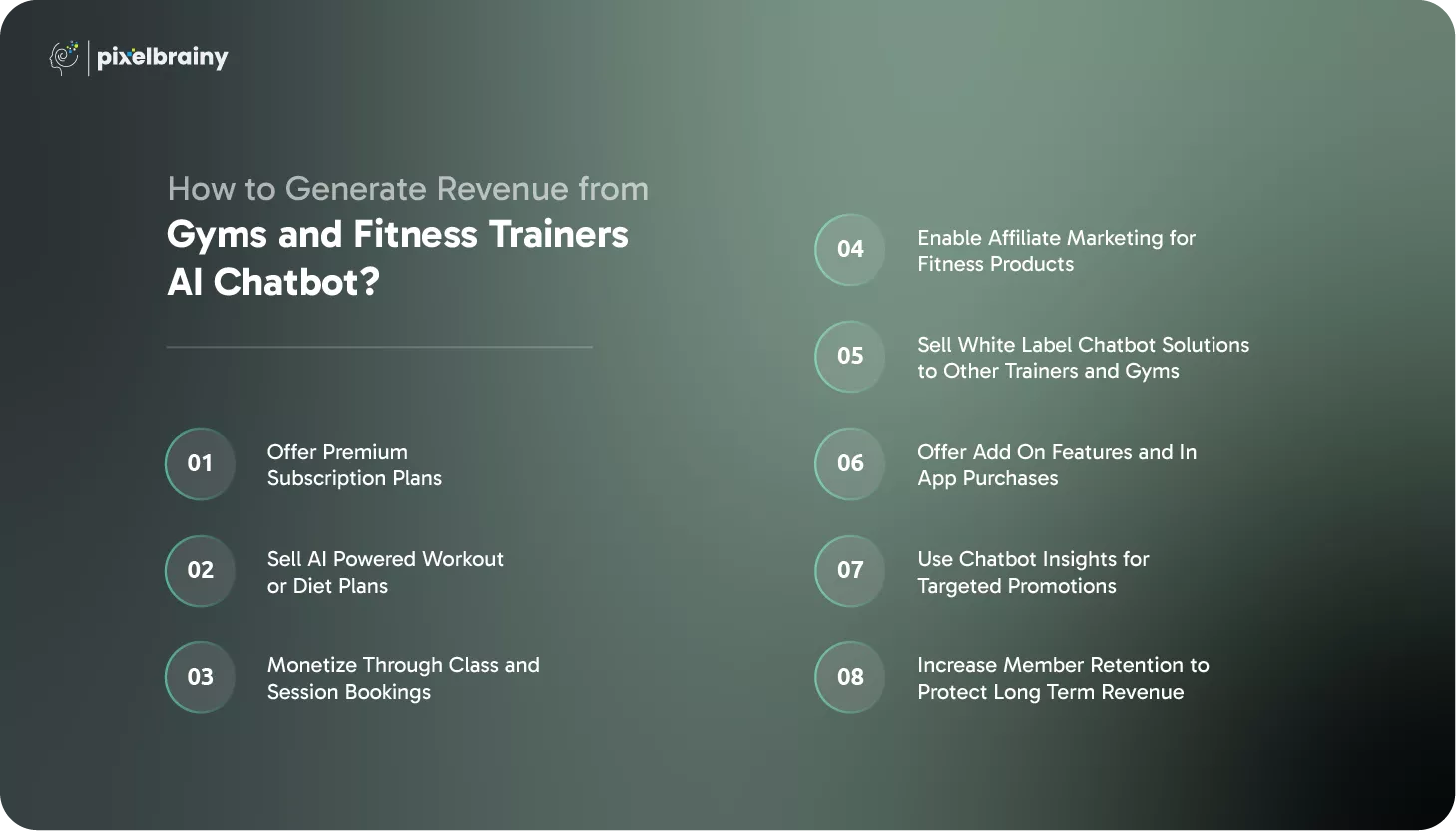
Give members the option to upgrade for advanced features.
You can charge for:
Turn your chatbot into a digital coaching platform.
Revenue opportunities include:
Use the chatbot to boost bookings automatically.
Your chatbot can help sell:
Leverage your user base to promote fitness brands.
Possible affiliate categories:
Turn your chatbot into a business product.
Ways to monetize:
Create micro revenue opportunities inside your chatbot.
Examples of add ons:
Use AI driven insights to increase internal gym sales.
Your chatbot can promote:
Engaged members stay longer and contribute more to recurring revenue.
Retention boosting features include:
A well-monetized AI fitness chatbot can create additional revenue through subscriptions, digital coaching, bookings, add-on services, and personalized promotions while supporting member retention.
How can a gym or personal trainer build an effective AI chatbot without stretching the development budget? AI chatbot development cost can be controlled by prioritizing essential features, using existing AI technologies, limiting integrations during the first phase, and expanding the chatbot only after validating real user demand.
For example, a gym owner may ask: “How can I reduce the cost of developing an AI fitness chatbot while still supporting member questions, workout recommendations, bookings, and personalized assistance?” The answer often lies in building a focused first version rather than investing in every advanced capability from day one.
The following strategies can help gyms and fitness trainers reduce AI chatbot development costs while maintaining the functionality needed for a useful and scalable solution.
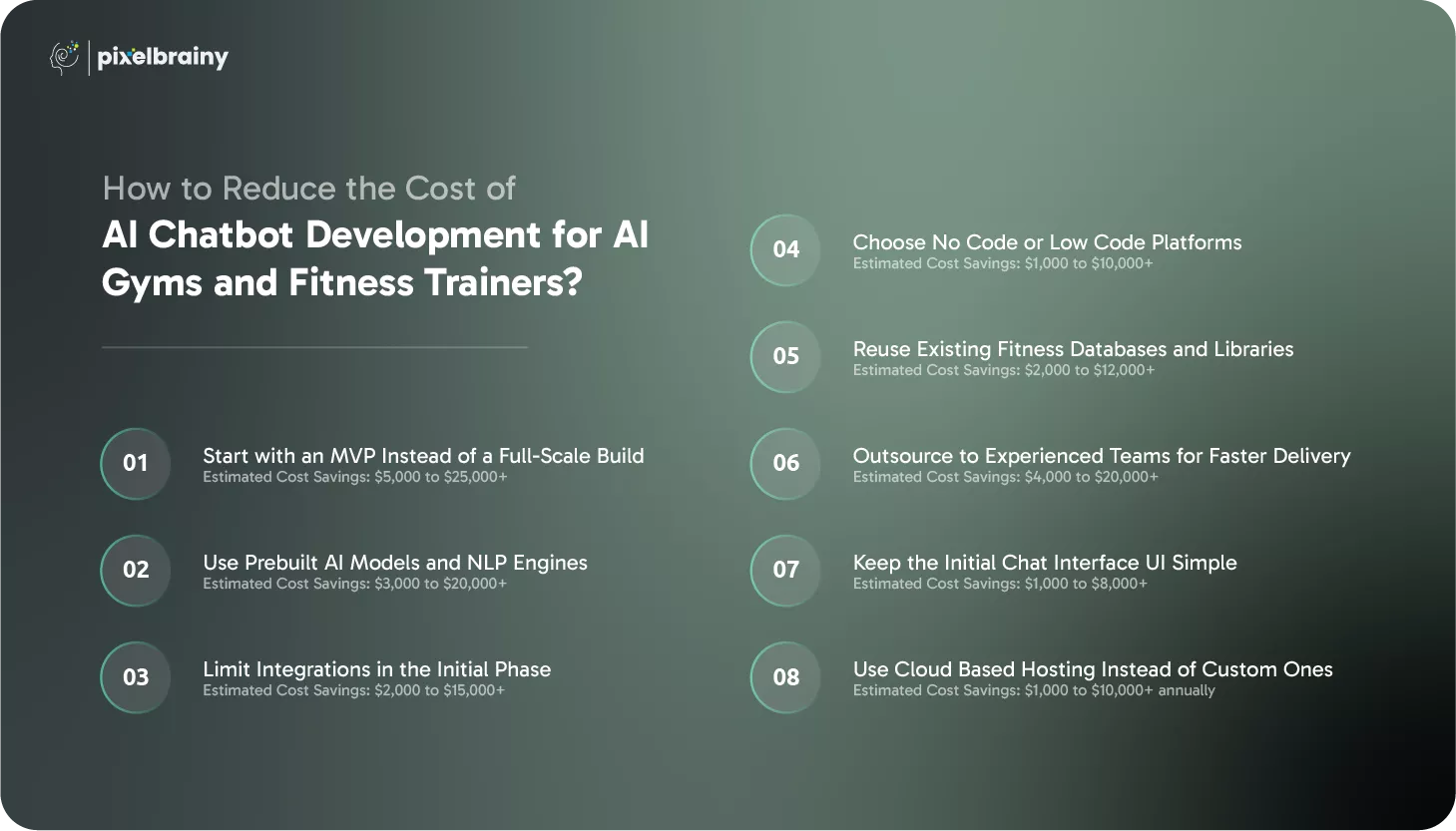
Developing an MVP is one of the most effective ways to keep costs under control. Instead of trying to build every advanced feature at once, you focus only on the core functionalities your gym members or clients need in the beginning. This reduces development hours and allows you to gather real user feedback before investing in more complex capabilities like personalized workout generation or AI powered nutrition tracking.
You can save cost by:
Estimated Cost Savings: $5,000 to $25,000+
Many chatbots become expensive because businesses try to develop custom AI models from scratch. Fitness chatbots can operate smoothly using existing NLP services and AI engines that already understand human language and fitness related queries. Using these tools eliminates the need for large datasets, heavy training cycles and specialized machine learning teams, which significantly reduces costs and speeds up development.
You save by:
Estimated Cost Savings: $3,000 to $20,000+
Integrations with gym management platforms, wearable devices, CRM tools and scheduling systems are useful but also add significant cost due to API configuration, testing and troubleshooting. For early development, gyms and trainers should keep integrations minimal and focus on delivering value through automated communication and basic assistance. Additional integrations can be added gradually as your member base grows or as the chatbot proves its ROI.
You can save cost by:
Estimated Cost Savings: $2,000 to $15,000+
If your fitness business needs a chatbot mainly for answering questions, sending reminders or handling basic member support, a no code or low code chatbot builder can keep development extremely cost efficient. These platforms offer drag and drop features, ready made templates and simple workflows that eliminate the need for extensive coding. While not ideal for advanced AI fitness coaching features, they work well for gyms wanting quick deployment.
You save by:
Estimated Cost Savings: $1,000 to $10,000+
Developing a fitness chatbot often requires exercise descriptions, workout libraries, nutrition data and instructional content. Creating this information from scratch takes a lot of time and money. By using existing libraries or repurposing your gym’s current content, you reduce the workload needed to train your chatbot and keep development smooth.
You save cost by:
Estimated Cost Savings: $2,000 to $12,000+
While outsourcing may seem like an added cost, working with a skilled development team often saves money long term. Experienced AI teams already have frameworks, tools and best practices in place, which helps avoid costly mistakes, delays and unnecessary redevelopment. They can guide your roadmap, suggest the most affordable tech stack and deliver a high quality chatbot faster than an inexperienced team could.
You save cost by:
Estimated Cost Savings: $4,000 to $20,000+
Many businesses spend a large portion of their budget on UI elements that do not directly affect the chatbot’s performance. A clean and functional design is enough for launch. Advanced animations, custom graphics or multi platform UI screens can be added once the chatbot starts generating revenue and proving user engagement.
You save cost by:
Estimated Cost Savings: $1,000 to $8,000+
Setting up custom servers for hosting an AI chatbot is expensive and requires ongoing technical management. Cloud hosting platforms offer scalable and secure environments at reasonable prices. Since gyms and fitness trainers may not need enterprise level infrastructure right away, choosing cloud hosting reduces initial costs and lets you upgrade only when necessary.
You save cost by:
Estimated Cost Savings: $1,000 to $10,000+ annually
Smart planning, phased development, existing AI tools, and focused features can help reduce AI chatbot development costs without compromising the core functionality needed by gyms and fitness trainers.
Building an AI chatbot for a gym or fitness business does not require investing in every advanced feature from day one. By prioritizing essential functionality, using proven AI technologies, and developing features in phases, fitness businesses can control their AI chatbot development cost while creating a solution that can scale with their needs.
As an AI chatbot development company, PixelBrainy helps gyms, fitness centers, studios, and personal trainers define the right feature set based on their business goals, budget, and member requirements. The approach focuses on delivering the most valuable capabilities first and adding advanced functionality as the business grows.
PixelBrainy can help optimize development costs by:
Client: Fitness center in California, USA
Aim:
The fitness center wanted an AI assistant to support member onboarding, bookings, and workout suggestions while keeping development within a defined budget.
Client Budget:
$80,000
How PixelBrainy Optimized the Budget:
Rather than allocating the entire budget toward unnecessary advanced features, PixelBrainy focused development on the gym's most important requirements. The initial solution prioritized booking assistance, workout suggestions, and member onboarding.
The team used a phased development approach to keep the scope focused and avoid adding features that were not essential to the gym's immediate needs. This allowed the $80,000 budget to be directed toward the functionality that could provide practical value to members and staff while leaving a foundation for future enhancements.
Result:
The project was completed within the controlled $80,000 budget and, according to the project information, delivered measurable results within the first month:
The project demonstrates how careful feature prioritization and phased development can help gyms make effective use of their AI chatbot budget without overbuilding the first version.
For gyms and fitness trainers planning a similar solution, PixelBrainy can help develop an AI chatbot around your business goals, required features, and available budget. So let’s connect!
The cost of developing an AI chatbot for gyms and fitness trainers can vary significantly based on the chatbot's features, AI capabilities, integrations, personalization, platform requirements, and long-term scalability. As this guide shows, a basic member support chatbot can require a much smaller investment than an advanced AI fitness assistant with personalized workout recommendations, nutrition support, progress tracking, voice capabilities, and multiple integrations.
The key is not to build everything at once. Defining the right MVP, prioritizing high-value features, choosing an appropriate sourcing model, using existing AI technologies, and adding advanced capabilities in phases can help fitness businesses manage AI chatbot development costs more effectively. The right approach can also create opportunities to automate repetitive tasks, improve member engagement, support bookings, deliver personalized fitness assistance, and generate additional revenue.
Whether you operate a gym, fitness studio, or personal training business, the right AI chatbot should be built around your specific workflows, members, budget, and growth plans. A well-planned solution can start with essential functionality today and evolve into a more capable AI fitness platform as your business and user needs grow.
Ready to build an AI chatbot for your gym or fitness business? Book an appointment with PixelBrainy to discuss your requirements, budget, and development roadmap.
The AI chatbot development cost for gyms and fitness trainers can range from around $8,000 to $120,000+, depending on features, personalization, integrations, AI complexity, and platform requirements. A basic support chatbot costs less than an AI fitness coach with adaptive workouts and advanced analytics.
A chatbot with personalized workout generation typically requires a higher development budget because it needs fitness logic, user data, exercise libraries, personalization, and AI processing. Based on the solution scope, development can fall within the $20,000 to $100,000+ range.
Yes, a $20,000 AI chatbot development budget can support a focused solution covering features such as FAQs, member assistance, basic booking workflows, reminders, and automated communication. Advanced personalization, multiple integrations, and AI coaching may require additional investment.
Features such as personalized workout plans, nutrition recommendations, progress tracking, voice interaction, multilingual support, wearable integrations, CRM connectivity, and advanced analytics can increase the overall AI chatbot development cost.
A WhatsApp AI chatbot for gym automation can cost approximately $8,000 to $20,000+ for a focused solution. The final cost depends on WhatsApp integration, conversation workflows, booking functionality, AI capabilities, branding, and other required integrations.
Developing an AI chatbot MVP for a gym can reduce the initial investment by focusing on essential features instead of building the complete solution at once. Gyms can validate member demand first and add advanced capabilities such as personalization and integrations in later phases.
Gyms can control AI chatbot development costs by prioritizing essential features, using prebuilt AI models, limiting initial integrations, reusing existing fitness content, keeping the first UI simple, and adding advanced functionality after the initial chatbot proves its value.
Before hiring an AI chatbot development company, gyms should evaluate the team's AI expertise, experience with integrations, development methodology, scalability approach, maintenance support, estimated timeline, and ability to work within the available development budget.

About The Author
Sagar Bhatnagar
Sagar Sahay Bhatnagar brings over a decade of IT industry experience to his role as Marketing Head at PixelBrainy. He's known for his knack in devising creative marketing strategies that boost brand visibility and market influence. Sagar's strategic thinking, coupled with his innovative vision and focus on results, sets him apart. His track record of successful campaigns proves his ability to utilize digital platforms effectively for impactful marketing efforts. With a genuine passion for both technology and marketing, Sagar continuously pushes PixelBrainy's marketing initiatives to greater success.

Working with the PixelBrainy team has been a highly positive experience. They understand the design requirements and create beautiful UX elements to meet the application needs. The dev team did an excellent job bringing my vision to life. We discussed usability and flow. Sagar worked with his team to design the database and begin coding. Working with Sagar was easy. He has the knowledge to create robust apps, including multi-language support, Google and Apple ID login options, Ad-enabled integrations, Stripe payment processing, and a Web Admin site for maintaining support data. I'm extremely satisfied with the services provided, the quality of the final product, and the professionalism of the entire process. I highly recommend them for Android and iOS Mobile Application Design and Development.

Great experience working with them. Had a lot of feedback and I found that unlike most contractors they were bugging me for updates instead of the other way around. They were extremely time conscience and great at communicating! All work was done extremely high quality and if not on time, early! They were always proactive when it comes to communication and the work is great/above par always. Very flexible and a great team to work with! Goes above and beyond to present us with multiple options and always provides quality. Amazing work per usual with Chitra. If you have UI/UX or branding design needs I recommend you go to them! Will likely work with them in the future as well, definitely recommended!

PixelBrainy is a joy to work with and is a great partner when thinking through branding, logo, and website layout. I appreciate that they spend time going into the "why" behind their decisions to help inform me and others about industry best practices and their expertise.

I hired them to design our software apps. Things I really like about them are excellent communication skills, they answer all project suggestions and collaborate right away, and their input on design and colors is amazing. This project was complex and needed patience and creativity. The team is amazing to do business with. I will be using them long-term. Glad to see there are some good people out there. I was afraid to try and outsource my project to someone but I am glad I met them! I really can't say enough. They went above and beyond on this project. I am very happy with everything they have done to make my business stand out from the competition.

It was great working with PixelBrainy and the team. They were very responsive and really owned the project. We'll definitely work with them again!

I recently worked with the PixelBrainy team on a project and I was blown away by their communication skills. They were prompt, clear, and articulate in all of our interactions. They listened and provided valuable feedback and suggestions to help make the project a success. They also kept me updated throughout the entire process, which made the experience stress-free and enjoyable.

PixelBrainy is very good at what it does. The team also presents themselves very professionally and takes care of their side of things very well. I could fully trust them taking up the design work in a timely and organised manner and their attention to detail saved us lots of effort and time. This particular project was quite intense and the team showed that they function very well under pressure. Very much looking forward to working with her again!

It's always an absolute pleasure working with them. They completed all of my requests quickly and followed every note I had for them to a T, which made our process go smoothly from start to finish. Everything was completed fast and following all of the guidelines. And I would recommend their services to anyone. If you need any design work done in the future, PixelBrainy should be your first call!

They took ownership of our requirements and designed and proposed multiple beautiful variants. The team is self-motivated, requires minimum supervision, committed to see-through designs with quality and delivering them on time. We would definitely love to work with PixelBrainy again when we have any requirements.

PixelBrainy was a big help with our SaaS application. We've been hard at work with a new UI/UX and they provided a lot of help with the designs. If you're looking for assistance with your website, software, or mobile application designs, PixelBrainy and the team is a great recommendation.

PixelBrainy designers are amazing. They are responsive, talented, and always willing to help craft the design until it matches your vision. I would recommend them and plan to continue them for my future projects and more!!!

They were awesome! Did a good job fast, and good communication. Will work with them again. Thank you

Creative, detail-oriented, and talented designers who take direction well and implement changes quickly and accurately. They consistently over-delivered for us.

PixelBrainy team is very talented and creative. Great designers and a pleasure to work with. PixelBrainy is an excellent communicator and I look forward to working with them again.

PixelBrainy has a very talented design team. Their work is excellent and they are very responsive. I enjoy working with them and hope to continue on all of our future projects.

Transform your ideas into reality with us.
Across these industries, each engagement brings unique challenges, from early-stage product development to scaling complex systems, helping us build a practical understanding of real-world product environments.