
 AI Summary Powered by PixelBrainy
Are you planning to build an AI real estate website and wondering how much investment you should expect before taking the idea to market? For a real estate technology startup, the budget is not limited to website design and development. AI capabilities, property data, MLS integration, cloud infrastructure, and ongoing data licensing can significantly influence the overall AI real estate website development cost.
Imagine you are the founder of a real estate technology startup preparing for seed funding. You want to compete with platforms such as Zillow and Realtor.com by offering more accurate AI property recommendations, smarter property search, personalized listings, and better home valuation estimates. Your platform should learn from each user's browsing behavior and continuously improve the properties it recommends. Before approaching investors, you need an honest estimate of the cost to develop an AI real estate website, including MLS data integration, AI recommendation engine development, and recurring data licensing expenses that may come under investor due diligence.
This is where understanding the cost of AI real estate website development becomes essential. Depending on the platform's complexity, AI capabilities, integrations, data requirements, and development approach, a production-grade solution can range from $20,000 to $200,000+. Enterprise platforms with advanced AI models, extensive property databases, multiple integrations, and scalable infrastructure can require a substantially larger investment.
In this guide, you will discover:
Understanding these costs early can help founders build a realistic budget, prepare stronger investor projections, and plan an AI real estate website designed for long-term growth.
Before investing in an AI real estate website, having a clear development budget helps you connect technology spending with business goals. The cost of developing an AI real estate website can change significantly when you add AI recommendation engines, property valuation models, MLS data integration, personalized search, and ongoing data or infrastructure expenses. A realistic budget helps founders understand where the investment is going and which capabilities should be prioritized first.
For example, a real estate technology startup planning to compete with established property platforms may need to budget not only for the initial website build, but also for AI model development, property data licensing, MLS integration, cloud infrastructure, maintenance, and future model improvements. Addressing these expenses early makes it easier to prepare investor projections and avoid major financial surprises.
A defined budget helps prevent unexpected expenses from disrupting the AI real estate website development process. Advanced capabilities such as personalized property recommendations, predictive home valuations, natural language search, and real-time property data processing can require specialized development resources.
Breaking the project into clear cost categories allows you to estimate development hours, third-party services, AI infrastructure, integrations, and testing requirements before development begins. This makes the cost to develop an AI real estate website easier to control while reducing the risk of scope expansion, delayed launches, and unplanned technical rework.
Budgeting allows you to identify which features should deliver the highest business value. Instead of investing heavily in every AI capability from day one, you can prioritize core functions such as intelligent property search, recommendation systems, lead capture, and AI-powered valuation.
A phased approach can help you launch an MVP, collect user behavior data, and validate demand before investing in more advanced capabilities. This approach makes the AI real estate website development cost more manageable while creating a foundation for future functionality and revenue growth.
A realistic budget also helps you evaluate potential development partners based on technical expertise, project scope, and expected deliverables rather than price alone. An AI real estate platform may require expertise across AI, web development, data engineering, API integration, cloud infrastructure, and security.
Clearly defining your budget and technical requirements makes it easier to compare agencies, dedicated teams, and other development models. It also helps ensure that the partner you choose can support both the initial product and its future scaling requirements.
The initial development estimate is only part of the total investment. An AI real estate platform may generate recurring expenses for MLS and property data licensing, cloud hosting, AI API usage, database storage, cybersecurity, maintenance, monitoring, and model retraining.
Including these expenses in the initial financial plan gives you a more realistic picture of the total cost of AI real estate website development. It also helps avoid situations where a platform becomes expensive to operate after launch because recurring costs were not considered during planning.
A detailed budget gives product teams a financial framework for making decisions throughout development. If priorities change, you can determine which features can be delayed, redesigned, or added without losing control of the overall investment.
For founders preparing for funding, this is particularly important. A clear breakdown of AI real estate website development costs, data expenses, infrastructure requirements, and future scaling needs can support more realistic financial projections and investor discussions.
Effective budgeting is therefore not simply about reducing expenses. It helps allocate investment toward the AI capabilities, data infrastructure, and product features that can create measurable value while supporting sustainable growth.

How much does it cost to develop an AI real estate website in 2026, and what should you budget before development begins? A structured AI real estate website cost calculator can help businesses estimate their investment by considering development scope, AI capabilities, property data requirements, integrations, infrastructure, and ongoing maintenance.
For a startup planning an intelligent property platform, the AI real estate website development cost can vary from around $20,000 to $200,000+. A basic website with AI-powered search and recommendations may require a smaller investment, while a production-grade platform with MLS integration, property valuation, behavioral personalization, predictive analytics, and scalable infrastructure can require a significantly larger budget.
A practical AI real estate website development cost calculator can use the following formula:
Total AI Real Estate Website Cost = (Development Hours × Hourly Rate) + AI Model Cost + Data & Infrastructure Cost + Integration Cost + Maintenance Cost
This formula breaks the cost to develop an AI real estate website into measurable components:
Consider a founder preparing to raise seed funding for an AI real estate marketplace. The founder wants to understand:
"I want to build an AI real estate website with MLS integration, personalized property recommendations, AI-based home valuation, and a smart search system that learns from user behavior. What should I budget for a production-ready platform, including development, AI, data licensing, integrations, and first-year maintenance?"
This type of requirement needs a broader estimate than a standard real estate website because AI development, property data, and ongoing infrastructure become significant cost components.
Assume a startup wants to build a mid-level AI real estate website with:
For this example, assume:
Development Cost = 1,000 × $55
Development Cost = $55,000
Now apply the complete formula:
Total AI Real Estate Website Cost = $55,000 + $20,000 + $12,000 + $10,000 + $12,000
Total Estimated Cost = $109,000
Based on this example, a production-ready AI property platform could require an estimated $109,000 for development, AI capabilities, infrastructure, integrations, and first-year maintenance.
A simpler MVP with property listings, basic search, and limited AI recommendations may fall closer to $20,000 to $60,000. Advanced platforms with sophisticated valuation models, extensive MLS integrations, behavioral personalization, predictive analytics, AI automation, and enterprise-grade infrastructure can reach $150,000 to $200,000+.
Using an AI real estate website cost calculator gives startups and real estate businesses a clearer view of where their investment will go. Instead of estimating website development from design and coding alone, this approach accounts for the AI, data, integrations, infrastructure, and ongoing costs that influence the actual cost of AI real estate website development.
Now that you understand why AI is becoming increasingly important for real estate platforms, the next question is how much you should actually budget for development. The AI real estate website development cost depends on far more than website design and coding. AI capabilities, property data, MLS integration, third-party APIs, development expertise, infrastructure, and ongoing maintenance can all influence the final investment.
Consider a real-world scenario. You are building an AI real estate website for a startup and want to include MLS integration, personalized property recommendations, and AI-powered home valuation. Before approaching investors, you need to know what factors will determine the development budget and how much each part of the platform could add to the overall cost. This is where breaking down the major cost drivers becomes important.
For a startup, the cost to build an AI real estate website can be very different from that of an established enterprise platform. A basic MVP may focus on property listings, intelligent search, and limited AI functionality, while a larger platform may require advanced recommendation engines, predictive valuation, real-time property data, CRM integrations, analytics, and scalable cloud infrastructure.
Understanding these variables before development begins can help you prioritize features, compare development approaches, estimate recurring expenses, and create a more realistic AI real estate website development budget.
Below are the 7 major factors affecting AI real estate website development cost in 2026, along with estimated cost ranges to help you plan the investment required for your platform.
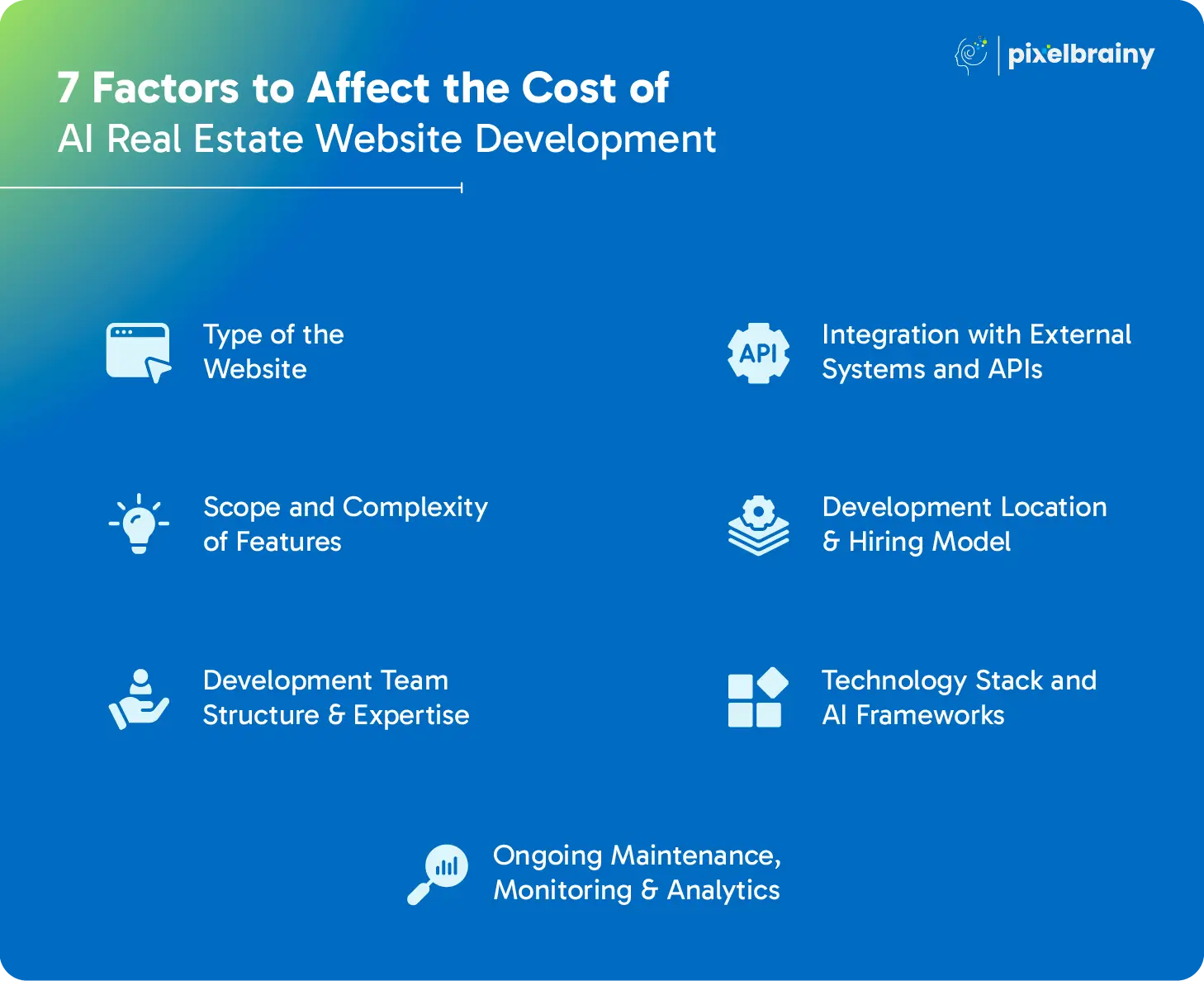
One of the most important factors affecting the AI real estate website development cost is the type of platform you want to build. Your choice largely depends on your business goals, timeline, and available resources.
There are generally three tiers:
Each of these tiers comes with different development timelines, resource requirements, and of course, costs.
Expected Cost Projection:
| Website Type | Development Scope | Estimated Cost Range |
| MVP AI Real Estate Website | Basic listing, AI search, simple chatbot, mobile-responsive UI | $20,000 – $40,000 |
| Advanced AI Real Estate Website | AI property suggestions, interactive tours, user dashboards, CRM integration | $40,000 – $100,000 |
| Enterprise-Level AI Real Estate Platform | End-to-end AI engine, custom analytics, API ecosystem, enterprise CRM, scalability | $100,000 – $200,000+ |
The range and depth of features you include in your AI real estate website can dramatically impact both development time and overall cost. More advanced features not only require greater technical expertise but also increase testing, integration, and maintenance efforts.
For example, a simple website might include only basic listings and search, while a more sophisticated platform could incorporate AI-based recommendations, 3D virtual property tours, voice-enabled search, or dynamic investment insights. Each added layer of functionality demands more robust backend systems, UI/UX refinement, and often, custom-built AI algorithms.
The cost to build an AI real estate website scales proportionally with the complexity of the features you choose to implement.
Expected Cost Projection:
| Feature Complexity Level | Feature Scope | Estimated Cost Range |
| Basic Features | Property listings, search/filtering, user login/signup | $5,000 – $15,000 |
| Intermediate Features | AI suggestions, saved searches, chatbots, photo galleries | $15,000 – $35,000 |
| Advanced Features | Virtual tours, AI-driven valuations, voice search, dynamic dashboards | $35,000 – $60,000+ |
The composition, size, and experience level of your development team play a vital role in both the quality and the cost of AI real estate website projects. Whether you’re hiring freelancers, assembling an in-house team, or partnering with a specialized agency—each option comes with trade-offs in cost, control, and capability.
Freelancers might be budget-friendly, but they often lack the coordination required for complex AI integrations.
In-house teams offer better alignment and quicker feedback cycles but can drive up expenses due to full-time salaries and operational overhead.
On the other hand, dedicated AI development agencies bring deep expertise, structured project management, and faster delivery—though at a premium price.
Ultimately, your team’s structure will shape your AI real estate website building cost and determine how efficiently your project scales.
Expected Cost Projection:
| Team Type | Structure & Capabilities | Estimated Cost Range |
| Freelancers | Ideal for small MVPs; limited AI/UX experience | $5,000 – $15,000 |
| In-House Development Team | Full-time developers; higher control and quality | $15,000 – $40,000 |
| Specialized AI Development Agency | End-to-end service with AI, UI/UX, and project management expertise | $30,000 – $60,000+ |
A modern AI-powered real estate website rarely functions in isolation. To deliver a seamless, intelligent user experience, it often needs to connect with various third-party platforms such as MLS databases, CRMs, payment gateways, property valuation APIs, virtual tour software, and geolocation services.
These integrations not only expand your website's capabilities but also add to the overall AI real estate website development cost. The complexity of integrating APIs depends on the number of systems involved, their documentation quality, and whether they require custom connectors or real-time data syncing. For example, integrating with a national MLS system can be significantly more complex than embedding a simple map widget.
Choosing the right integrations—and ensuring they’re implemented securely and efficiently—will directly influence your AI real estate website building cost.
Expected Cost Projection:
| Integration Level | Systems/Tools Integrated | Estimated Cost Range |
| Basic Integrations | Google Maps, contact forms, live chat tools | $2,000 – $7,000 |
| Moderate Integrations | Payment gateways, CRM systems, email automation | $7,000 – $15,000 |
| Advanced/API-Heavy Integrations | MLS/IDX listings, valuation engines, virtual tour APIs, AI data pipelines | $15,000 – $30,000+ |
For real estate businesses aiming to launch an AI-driven platform, where and how you hire your development team can significantly influence your overall success—and your budget. The cost of hiring developers to build an AI real estate website varies widely based on geographical location and the hiring model you choose.
Offshore development teams (e.g., in India or Eastern Europe) offer competitive pricing and solid technical skills—ideal for startups or real estate agencies building MVPs. Nearshore options balance cost and communication efficiency, while onshore or in-house teams deliver premium service, often suited for enterprise-level real estate firms that need close collaboration and tighter control.
Making the right hiring decision ensures not only timely delivery but also determines your long-term AI real estate website developing cost.
Expected Cost Projection:
| Location & Hiring Model | Ideal For | Estimated Cost Range |
| Offshore (India, Ukraine, etc.) + Freelancers | Budget-conscious real estate startups building MVPs | $5,000 – $15,000 |
| Nearshore (Eastern Europe, LATAM) + Agency | Mid-size agencies needing reliable delivery at moderate cost | $15,000 – $30,000 |
| Onshore (US, UK, Canada) + In-House Team | Large real estate enterprises demanding full control and top-tier output | $30,000 – $60,000+ |
The technology and AI frameworks behind your platform are critical to its performance, intelligence, and scalability—especially for real estate businesses aiming to lead in 2025. Your stack impacts everything from property search speed to chatbot accuracy, investment prediction models, and overall AI real estate website development cost.
Python stands out as a key language in this space, powering most machine learning models using frameworks like TensorFlow, PyTorch, and Scikit-learn. Combined with frontend tools like React or Next.js, backend frameworks such as Django (Python-based), Node.js, and databases like PostgreSQL or MongoDB, this stack enables a future-ready platform for real estate enterprises.
The deeper the AI capabilities—like image recognition for property photos or predictive pricing—the higher the AI real estate website building cost. But with the right stack, it’s a long-term investment in performance and innovation.
Expected Cost Projection:
| Technology Stack Type | Tech Stack & Tools | Estimated Cost Range |
| Basic Stack + Light AI | HTML/CSS, basic JS, Python (Flask), OpenAI API, Google Maps | $5,000 – $15,000 |
| Mid-Level AI Stack | React, Node.js/Django (Python), TensorFlow, PyTorch, PostgreSQL, Map APIs | $15,000 – $35,000 |
| Advanced AI Stack | Python (Django + custom ML), PyTorch/TensorFlow, AI chatbots, investment analytics, real-time ML, cloud AI services (AWS/GCP) | $35,000 – $60,000+ |
For real estate businesses, launching an AI-powered platform is just the beginning. To ensure it runs smoothly, remains secure, and evolves with user behavior, ongoing maintenance, performance monitoring, and analytics are non-negotiable. These behind-the-scenes tasks directly impact long-term success—and influence the making cost of an AI real estate web platform.
Post-launch, your team must consistently monitor uptime, fix bugs, update third-party integrations (like MLS feeds or valuation APIs), and improve AI models based on user interaction. Additionally, real-time analytics provide insights into property trends, user preferences, and campaign ROI, which can shape future feature updates and marketing strategies.
While often overlooked, these ongoing needs are a recurring part of the cost of creating an AI real estate website and should be included in every budget plan.
Expected Cost Projection:
| Maintenance Level | Services Included | Estimated Cost Range (Annually) |
| Basic Maintenance | Bug fixes, hosting updates, light monitoring | $3,000 – $7,000 |
| Standard Support + Analytics | Regular updates, user analytics dashboard, performance tuning | $7,000 – $15,000 |
| Advanced AI Optimization & Scaling | AI model re-training, traffic/load balancing, predictive analytics upgrades | $15,000 – $30,000+ |
Understanding these seven factors gives you a clearer foundation for estimating your AI real estate website budget and deciding where to invest for scalability, intelligence, and long-term business value.
Also Read: AI Real Estate App Development Cost: Factors and Examples
The AI real estate website development cost varies significantly based on the type of platform you plan to launch, its target users, and the level of AI intelligence required. A property listing website may need AI search and recommendations, while an investment or valuation platform may require predictive models, market analytics, and extensive real estate data integrations.
For example, a startup aiming to compete with platforms such as Zillow or Realtor.com may need a more advanced architecture, particularly if the website includes personalized property recommendations, AI-powered valuation, MLS data integration, and behavior-based search. Understanding these differences helps answer a common business question: how much does it cost to build an AI real estate website for a specific business model and feature set?
In general, the cost to develop an AI real estate website can range from $20,000 to $200,000+, depending on platform complexity, AI capabilities, integrations, data requirements, and scalability needs.
Below, we compare eight common AI real estate website types and their estimated development costs.
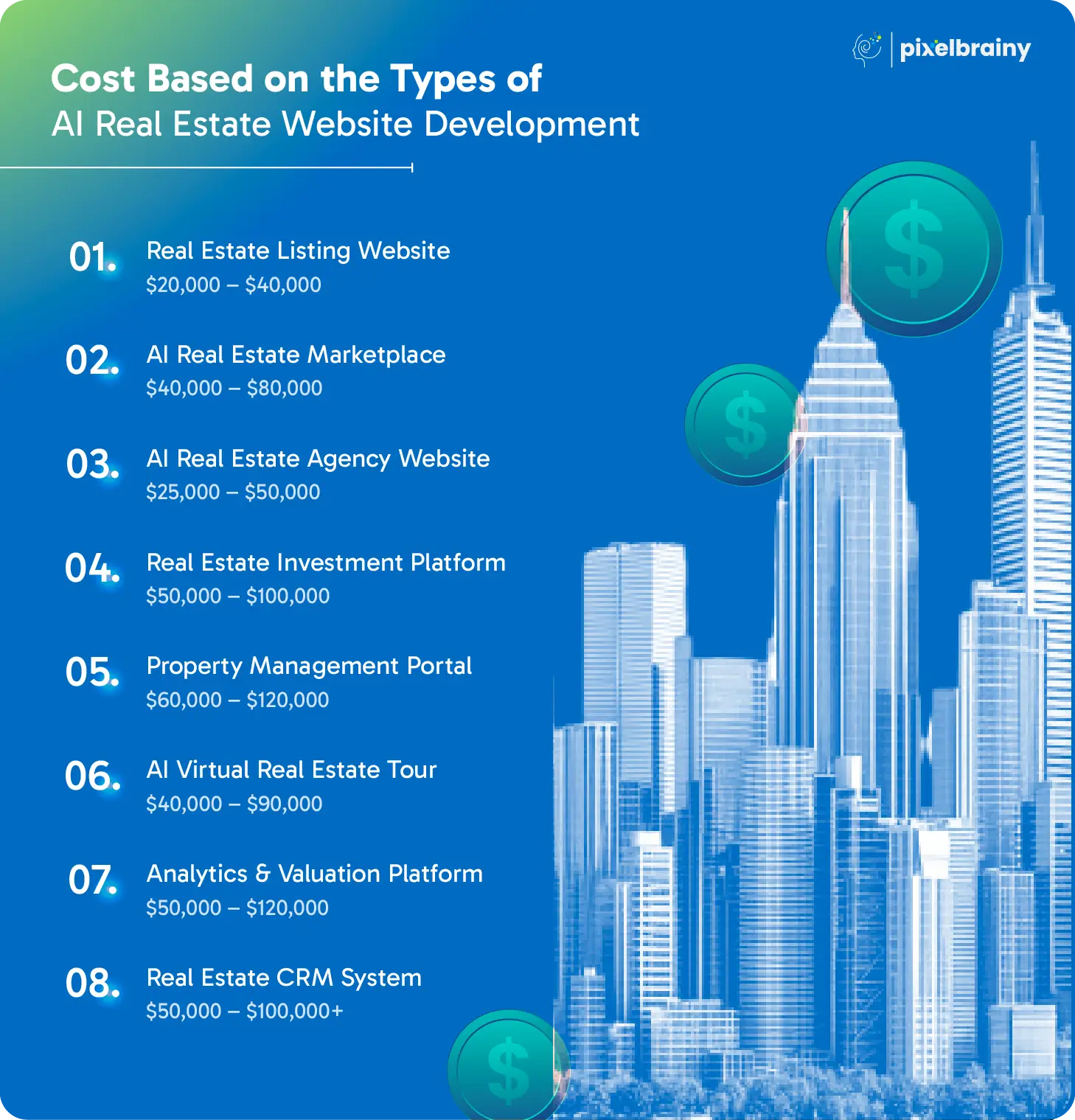
This is the most foundational type of AI real estate platform. It allows users to browse and search property listings with the help of AI-driven search engines, personalized recommendations, and filters based on user behavior. Chatbots can assist in property queries, while backend systems can automate new listing approvals.
The development cost of an AI-powered real estate listing website is relatively moderate but scales with additional features like predictive filters or integrated CMS.
Estimated Cost to Create: $20,000 – $40,000
This model connects multiple parties—buyers, sellers, agents, and agencies—under one intelligent platform. These platforms use AI for intelligent property matching, fraud detection, dynamic pricing, and automated lead routing. It's ideal for businesses building the next Zillow or Redfin-style ecosystem.
The cost to build an AI real estate marketplace platform is higher due to multi-user roles, database complexity, and advanced AI integrations.
Estimated Cost to Develop: $40,000 – $80,000
Tailored for individual or multi-agent real estate firms, these websites feature AI chatbots, smart appointment booking, lead qualification tools, and CRM integration. They enhance client interaction and streamline internal operations.
The cost to make an AI real estate agency website depends on the depth of automation and brand-level customization but is generally manageable for small to mid-sized agencies.
Estimated Cost to Build: $25,000 – $50,000
Designed for investors and property analysts, these platforms offer AI-driven investment advice, market forecasting, ROI projections, risk analysis, and deal suggestions. They often integrate external financial data and use deep-learning models to guide investors.
The cost to develop an AI real estate investment platform is higher due to the complexity of algorithms and data dependencies.
Estimated Development Cost: $50,000 – $100,000
This platform serves landlords and property managers by automating rent tracking, maintenance requests, tenant screening, predictive vacancy analytics, and smart lease management. Some even feature AI tools that flag potential late payments or legal issues.
The cost to create an AI real estate property management portal rises with multi-property functionality and third-party integrations.
Estimated Cost to Build: $60,000 – $120,000
With remote buying on the rise, virtual tour platforms are transforming how properties are showcased. These websites feature 360° virtual tours, AI voice guides, interactive floor plans, and real-time Q&A assistants to simulate an in-person experience.
The cost to make an AI virtual real estate tour website depends on the level of immersive tech and AI interaction built in.
Estimated Cost to Develop: $40,000 – $90,000
Built for data-centric decision-making, these platforms provide real-time pricing trends, area comparisons, appreciation forecasts, and property valuation engines. Advanced models use historical and current market data to train AI predictions.
Because of the machine learning model training and API needs, the development cost of an AI real estate analytics and valuation platform is higher than most.
Estimated Cost to Create: $50,000 – $120,000
A CRM built for real estate companies can use AI to score leads, automate follow-ups, personalize communication, track client behavior, and predict closing probabilities. Integrated with websites or apps, it ensures a seamless flow of data and insights.
The cost to build an AI-integrated real estate CRM system varies based on integration depth with existing tools (like MLS, Zapier, or HubSpot) and the level of AI intelligence added.
Estimated Development Cost: $50,000 – $100,000+
Here’s a clear, easy-to-read summary comparison table for the 8 AI real estate website types with their estimated development cost ranges:
| AI Real Estate Website Type | Purpose / Key Features | Estimated Development Cost |
| AI-Powered Real Estate Listing Website | Property listings, AI search, recommendations, chatbot | $20,000 – $40,000 |
| AI Real Estate Marketplace Platform | Multi-user marketplace, dynamic pricing, fraud detection | $40,000 – $80,000 |
| AI Real Estate Agency Website | AI chatbots, lead qualification, CRM integration | $25,000 – $50,000 |
| AI-Based Real Estate Investment Platform | Investment advice, ROI projections, risk analysis | $50,000 – $100,000 |
| AI-Driven Real Estate Property Management Portal | Rent tracking, tenant screening, maintenance automation | $60,000 – $120,000 |
| AI Virtual Real Estate Tour Website | 360° tours, AI voice guidance, interactive floor plans | $40,000 – $90,000 |
| AI Real Estate Analytics & Valuation Platform | Market trends, pricing forecasts, valuation engines | $50,000 – $120,000 |
| AI-Integrated Real Estate CRM System | Lead scoring, automation, client behavior tracking | $50,000 – $100,000+ |
The right platform type and AI feature set can help you control the cost of creating an AI real estate website while building a solution that is scalable and aligned with your real estate business goals.
The AI real estate website development cost does not end when the core platform is built. Real estate businesses often discover additional expenses related to data, compliance, cloud infrastructure, security, AI model updates, and user support only after development begins. These costs can materially increase the total cost to develop an AI real estate website, particularly for platforms that depend on MLS data, personalized recommendations, property valuation, or large-scale AI processing.
For startups asking, “What are the hidden costs of building an AI real estate website with MLS integration, AI recommendations, and ongoing data licensing?”, these expenses should be included in the initial financial plan rather than treated as post-launch surprises.
Understanding these hidden expenses gives businesses a more realistic view of AI real estate website development pricing, helps establish an accurate budget, and makes it easier to plan for long-term platform operations and growth.
Below are the key hidden costs that should be considered alongside the initial cost to build an AI real estate website.
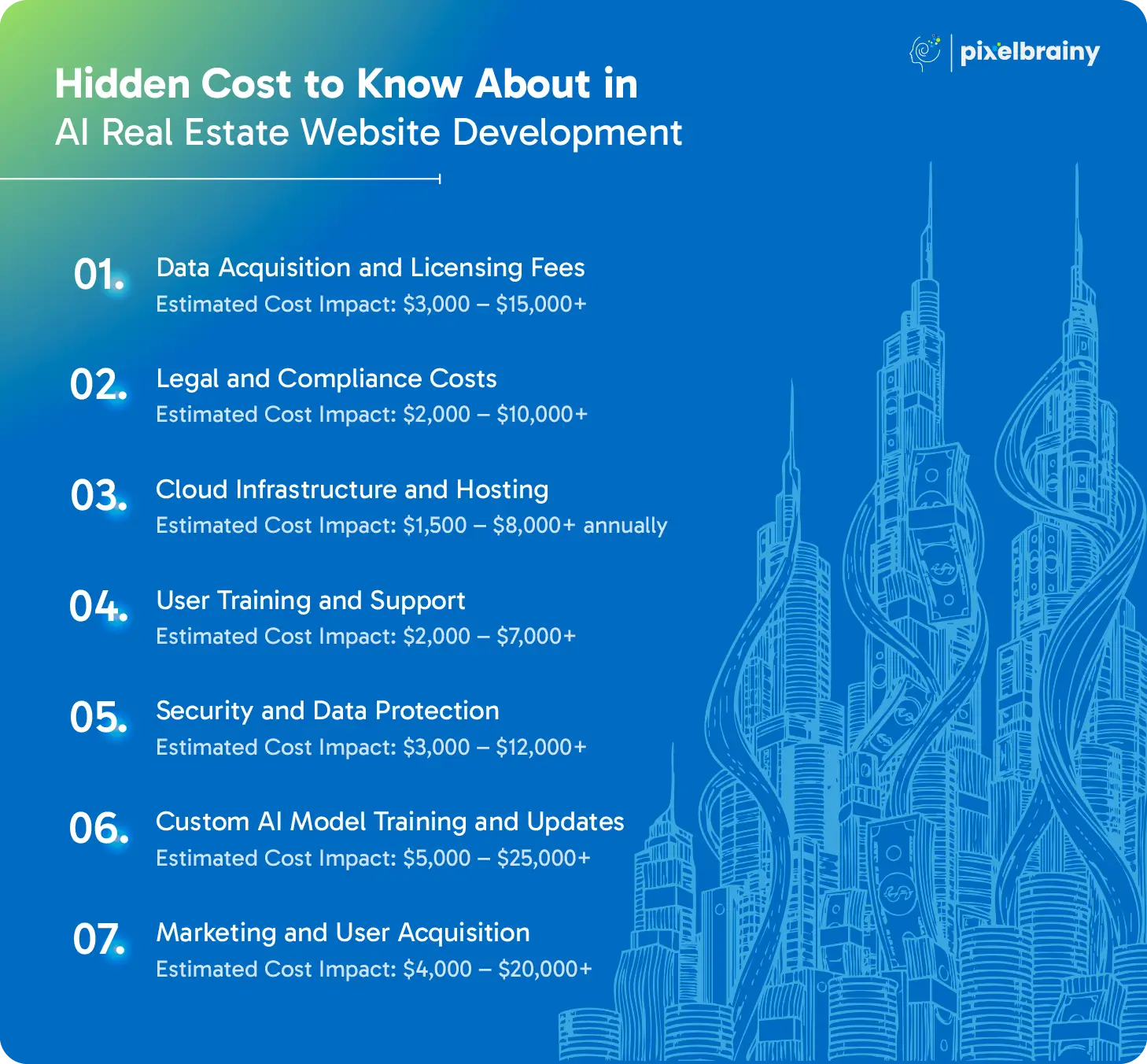
AI systems rely heavily on high-quality data to deliver accurate insights and recommendations. Real estate data, such as property listings, historical market trends, or demographic info, often requires purchasing or licensing from third-party providers. These fees can vary widely depending on the dataset’s size and source but are essential to fuel AI accuracy.
Estimated Cost Impact: $3,000 – $15,000+
Real estate websites must comply with strict regulations related to user data privacy (e.g., GDPR, CCPA), fair housing laws, and industry-specific requirements. Ensuring legal compliance involves consulting with legal experts, conducting compliance audits, and updating policies regularly to keep pace with changing laws—important steps that can add to the total development budget.
Estimated Cost Impact: $2,000 – $10,000+
Running AI features, storing large volumes of data, and supporting high website traffic demand reliable cloud infrastructure. Costs for cloud hosting, data storage, and bandwidth, especially with GPU-enabled servers for AI processing, accumulate over time. These ongoing infrastructure costs are vital for maintaining performance and scalability.
Estimated Cost Impact: $1,500 – $8,000+ annually
Introducing AI tools requires more than deployment. Your real estate team and end-users need training to effectively use AI-powered search, chatbots, analytics, or virtual tours. Providing training materials, onboarding sessions, and ongoing technical support ensures smooth adoption but adds to operational expenses.
Estimated Cost Impact: $2,000 – $7,000+
Real estate websites handle sensitive personal and financial data, making robust security essential. Investments in encryption protocols, regular vulnerability assessments, penetration testing, and incident response planning protect your platform and users but come with additional costs.
Estimated Cost Impact: $3,000 – $12,000+
While some AI components come pre-built, tailoring models to your specific market and updating them continuously for accuracy is a specialized task. Custom model development, training on proprietary data, and periodic AI enhancements require expert data scientists and engineers.
Estimated Cost Impact: $5,000 – $25,000+
Building the website is just the start. Real estate businesses must invest in marketing to attract visitors and convert leads. SEO strategies, paid advertising campaigns, social media promotions, and influencer partnerships are vital for visibility but need dedicated budget allocation.
Estimated Cost Impact: $4,000 – $20,000+
By factoring in these often overlooked but essential hidden costs, real estate businesses can budget wisely and ensure their AI real estate website development project delivers real value without unexpected financial burdens.
Factoring these hidden expenses into your AI real estate website development budget helps prevent cost overruns and supports sustainable, scalable platform growth.
Also Read: AI Chatbot Development Cost: Factors and Examples

Real-world AI real estate platforms show how different business models can require very different levels of investment. From AI-powered property search and valuation to automated offers, predictive analytics, and immersive virtual tours, the AI real estate website development cost depends heavily on the platform’s functionality, data requirements, AI complexity, and integration needs.
For businesses asking, “How much would it cost to build an AI real estate website similar to Zillow or Redfin with AI property recommendations, accurate valuation, and intelligent search?”, these platforms provide useful benchmarks for understanding the potential scope and investment. However, the costs below should be treated as estimated development benchmarks for comparable functionality, not the actual historical cost of building these companies' platforms.
The following examples highlight common AI real estate website models, their core capabilities, and the estimated investment required to develop a platform with a similar level of functionality.
Zillow uses AI to power its Zestimate home valuation tool, personalized property recommendations, and virtual tours. Its platform processes massive datasets to deliver reliable price estimates and insights for buyers and sellers. The advanced AI algorithms and extensive real-time data feeds make Zillow a complex project.
Estimated development cost: $150,000+
Redfin combines AI-driven property search with predictive analytics to forecast market trends and automate customer interactions using chatbots. Their platform also incorporates an AI-powered CRM system for agents, making property management seamless. Building a similar platform involves significant investment in both AI and user experience design.
Estimated development cost: $100,000 – $180,000
Opendoor revolutionizes property buying by offering instant home-buying offers backed by AI valuation and risk analytics. This platform’s AI models analyze multiple market variables to streamline and speed up transactions, appealing especially to investors and sellers looking for convenience.
Estimated development cost: $120,000 – $200,000+
Compass focuses on empowering agents with AI-driven lead scoring, personalized marketing, and predictive sales analytics. Their platform helps agencies target prospects more effectively and close deals faster. Developing such an AI-enhanced agency website requires a blend of AI expertise and CRM integration.
Estimated development cost: $80,000 – $140,000
Matterport specializes in creating realistic 3D virtual tours powered by AI, allowing buyers to explore properties remotely and interactively. This technology enhances engagement and accelerates decision-making. Building an AI virtual tour platform demands specialized AI imaging and 3D modeling capabilities.
Estimated development cost: $70,000 – $130,000
| Platform Type | Key Features | Estimated Development Cost |
| Zillow (AI Real Estate Marketplace) | Zestimate valuation, virtual tours, AI search | $150,000+ |
| Redfin (Search & Brokerage) | AI search, predictive analytics, CRM | $100,000 – $180,000 |
| Opendoor (Investment Platform) | Instant offers, valuation, risk analysis | $120,000 – $200,000+ |
| Compass (Agency Website) | Lead scoring, marketing automation, analytics | $80,000 – $140,000 |
| Matterport (Virtual Tour Website) | AI-powered 3D tours, immersive property views | $70,000 – $130,000 |
These examples demonstrate that the cost to develop an AI real estate website is primarily driven by AI sophistication, data infrastructure, integrations, scalability, and the complexity of the user experience.
Keeping the AI real estate website development cost under control does not mean cutting essential features or compromising platform quality. The better approach is to allocate your budget strategically, validate high-value features early, and avoid unnecessary technical complexity. For businesses asking, “How can I reduce the cost to build an AI real estate website while still offering AI property search, recommendations, and a reliable user experience?”, a phased development strategy can make a significant difference.
The key is to distinguish between features required for launch and capabilities that can be introduced after the platform gains users and market feedback. Using an MVP, reusable AI technologies, scalable infrastructure, and efficient development practices can help reduce the cost of creating an AI real estate website while keeping the architecture ready for future expansion.
Below are practical strategies that can help real estate startups, agencies, and enterprises optimize their AI real estate website development budget without sacrificing scalability, performance, or user value.
Launching a Minimum Viable Product with just the essential AI features lets you validate your concept quickly and cost-effectively. Instead of developing every possible feature upfront, you can focus on core functionalities like property listings, AI search, and basic chatbots. Once you gain traction and user feedback, you can gradually enhance the platform. This staged approach not only lowers initial costs but also minimizes the risk of overspending on features users don’t need.
Estimated Savings: Up to 40% ($8,000 – $80,000+)
Also Read: Top 10 AI MVP Development Companies in USA
Building AI from scratch can be expensive and time-consuming. Instead, use established open-source AI frameworks such as Python’s TensorFlow or PyTorch, along with pre-built APIs for natural language processing, image recognition, and predictive analytics. This approach speeds up development and reduces costs by avoiding reinventing the wheel. It also gives you access to a wide community and continuous improvements at no extra charge.
Estimated Savings: 15-25% ($3,000 – $30,000+)
Hiring experienced developers from countries with lower labor costs is a highly effective way to reduce your AI real estate website developing cost. Offshore or nearshore teams can deliver high-quality work at a fraction of the price compared to onshore developers. However, choose your team carefully to ensure strong communication and expertise in AI and real estate domains.
Estimated Savings: 20-50% ($5,000 – $100,000+)
Avoid the temptation to include all possible AI features and bells-and-whistles at launch. Prioritize those that directly impact user experience and business objectives—like AI-driven search, property recommendations, and basic analytics. Advanced features such as investment analytics or multi-agent management can be added later as your platform grows. This helps control your AI real estate website development cost and keeps the project manageable.
Estimated Savings: Up to 30% ($6,000 – $60,000+)
Instead of investing heavily in physical servers and infrastructure upfront, opt for cloud services like AWS, Google Cloud, or Azure. These platforms offer flexible, pay-as-you-go pricing models, allowing you to scale your resources based on traffic and usage. This ensures you only pay for what you need and can adjust your costs as your real estate platform grows.
Estimated Savings: 15-25% annually ($1,500 – $8,000+)
Implement automated testing and monitoring tools from the beginning to identify bugs, security vulnerabilities, or performance issues early in the development cycle. This proactive approach minimizes expensive manual fixes, downtime, and maintenance costs later on. It also ensures a smoother user experience, which is crucial for retaining clients.
Estimated Savings: 10-15% on maintenance costs ($2,000 – $6,000+)
By incorporating these tips, real estate businesses can make informed decisions that lower the cost to build AI real estate websites without sacrificing innovation or quality. Smart budgeting paired with strategic development choices will maximize your ROI in the fast-evolving AI real estate market.
Smart prioritization and phased investment can significantly reduce the AI real estate website development cost while creating a platform that is ready to scale with real estate market demand.
Also Read: AI App Development Cost: From MVPs to Full-Scale AI App
The right development partner can make a significant difference in the AI real estate website development cost, especially when your platform requires AI-powered property recommendations, intelligent search, valuation models, MLS integrations, and scalable infrastructure. At PixelBrainy, we focus on building real estate AI solutions that deliver the required functionality without adding unnecessary technical complexity or development expenses.
If your question sounds like this:
“I’m a real estate technology startup looking to build an AI-powered website with smart property recommendations, AI search, home valuation, MLS integration, and personalized user experiences. My initial budget is $50,000 to $100,000. Which USA-based real estate AI software development company can help me build a production-ready platform while keeping development costs under control?”
This is the type of cost and development challenge we help businesses address before development begins.
At PixelBrainy, we start by understanding your business model, target users, required AI capabilities, data sources, integrations, and growth plans. This allows us to create a realistic AI real estate website development cost estimate and prioritize features according to business value.
As a real estate AI software development company, PixelBrainy helps startups, agencies, and enterprises develop intelligent real estate platforms with AI search, recommendation engines, property valuation, conversational AI, analytics, automation, and third-party integrations.
Business Challenge
A real estate business wanted to create an intelligent property platform that could improve property discovery while reducing manual lead qualification. The company needed AI recommendations, smart search, automated conversations, and an architecture capable of supporting future growth without exceeding its planned development budget.
Our Solution
Business Results
At PixelBrainy, the goal is not simply to deliver more features. It is to help you invest in the right features at the right stage. From MVP planning and AI implementation to data integrations, cloud infrastructure, and post-launch optimization, our approach focuses on controlling the cost to develop an AI real estate website while maintaining scalability, performance, and business value.
Have a real estate AI platform idea? Connect with PixelBrainy to discuss your requirements and development budget.

The AI real estate website development cost depends on far more than the initial coding effort. Platform type, AI capabilities, property data, MLS integrations, technology stack, development team, security, infrastructure, and ongoing maintenance can all influence the final investment. As discussed throughout this guide, a basic AI real estate website may start around $20,000, while advanced platforms with intelligent recommendations, AI-powered valuation, predictive analytics, and enterprise integrations can exceed $200,000.
The most effective approach is to define your core business objectives, prioritize high-value features, and launch with a scalable architecture that allows AI capabilities to expand over time. A realistic AI real estate website development budget should also account for hidden costs such as data licensing, cloud infrastructure, compliance, security, and AI model optimization.
Ultimately, successful AI real estate website development is about balancing innovation, usability, scalability, and investment to create measurable business value.
Ready to plan your AI real estate website? Schedule a Call with PixelBrainy today.
The AI real estate website development cost typically ranges from $20,000 to $200,000+, depending on the platform type, AI capabilities, integrations, data requirements, and scalability. A basic MVP may cost $20,000 to $40,000, while an enterprise platform with AI valuation, personalized recommendations, MLS integration, analytics, and automation can exceed $100,000.
The major factors include website complexity, AI features, development team, technology stack, MLS and third-party integrations, data licensing, security, cloud infrastructure, and ongoing maintenance. Advanced capabilities such as AI property recommendations, predictive valuation, conversational AI, and behavioral personalization generally increase the overall cost to develop an AI real estate website.
A website with functionality comparable to Zillow can require $100,000 to $200,000+, depending on the scope. Features such as AI-powered property search, personalized recommendations, property valuation, large-scale listings, maps, user accounts, analytics, and extensive data integrations can significantly increase the AI real estate website development cost.
Starting with an MVP is one of the most practical approaches. Instead of building every feature upfront, businesses can launch with essential capabilities such as property listings, smart search, basic AI recommendations, and conversational support. Pre-trained AI models, reusable components, and scalable cloud infrastructure can further help control the cost of creating an AI real estate website.
MLS integration and data licensing costs vary according to the MLS provider, geographic coverage, access requirements, usage volume, and licensing agreement. Development expenses for API or MLS integration may be several thousand dollars, while ongoing data licensing fees can become a recurring operational cost. These expenses should be included when calculating the total AI real estate website development budget.
Beyond development, businesses should budget for data acquisition, licensing, cloud hosting, security testing, legal and compliance requirements, AI model retraining, maintenance, monitoring, and user support. These recurring and one-time expenses can materially affect the total cost to develop an AI real estate website and should be considered before development begins.
The development timeline depends on the platform's complexity and AI requirements. A focused MVP may take several weeks, while an advanced AI real estate marketplace with valuation models, MLS integrations, personalized recommendations, analytics, and enterprise infrastructure can require several months. Defining the scope early helps control both development time and AI real estate website development cost.
Yes. PixelBrainy can help businesses control development expenses through MVP planning, feature prioritization, reusable AI technologies, scalable architecture, and milestone-based development. The objective is to build the required AI capabilities without unnecessary complexity while maintaining a clear AI real estate website development cost and roadmap for future growth.

About The Author
Sagar Bhatnagar
Sagar Sahay Bhatnagar brings over a decade of IT industry experience to his role as Marketing Head at PixelBrainy. He's known for his knack in devising creative marketing strategies that boost brand visibility and market influence. Sagar's strategic thinking, coupled with his innovative vision and focus on results, sets him apart. His track record of successful campaigns proves his ability to utilize digital platforms effectively for impactful marketing efforts. With a genuine passion for both technology and marketing, Sagar continuously pushes PixelBrainy's marketing initiatives to greater success.

Working with the PixelBrainy team has been a highly positive experience. They understand the design requirements and create beautiful UX elements to meet the application needs. The dev team did an excellent job bringing my vision to life. We discussed usability and flow. Sagar worked with his team to design the database and begin coding. Working with Sagar was easy. He has the knowledge to create robust apps, including multi-language support, Google and Apple ID login options, Ad-enabled integrations, Stripe payment processing, and a Web Admin site for maintaining support data. I'm extremely satisfied with the services provided, the quality of the final product, and the professionalism of the entire process. I highly recommend them for Android and iOS Mobile Application Design and Development.

Great experience working with them. Had a lot of feedback and I found that unlike most contractors they were bugging me for updates instead of the other way around. They were extremely time conscience and great at communicating! All work was done extremely high quality and if not on time, early! They were always proactive when it comes to communication and the work is great/above par always. Very flexible and a great team to work with! Goes above and beyond to present us with multiple options and always provides quality. Amazing work per usual with Chitra. If you have UI/UX or branding design needs I recommend you go to them! Will likely work with them in the future as well, definitely recommended!

PixelBrainy is a joy to work with and is a great partner when thinking through branding, logo, and website layout. I appreciate that they spend time going into the "why" behind their decisions to help inform me and others about industry best practices and their expertise.

I hired them to design our software apps. Things I really like about them are excellent communication skills, they answer all project suggestions and collaborate right away, and their input on design and colors is amazing. This project was complex and needed patience and creativity. The team is amazing to do business with. I will be using them long-term. Glad to see there are some good people out there. I was afraid to try and outsource my project to someone but I am glad I met them! I really can't say enough. They went above and beyond on this project. I am very happy with everything they have done to make my business stand out from the competition.

It was great working with PixelBrainy and the team. They were very responsive and really owned the project. We'll definitely work with them again!

I recently worked with the PixelBrainy team on a project and I was blown away by their communication skills. They were prompt, clear, and articulate in all of our interactions. They listened and provided valuable feedback and suggestions to help make the project a success. They also kept me updated throughout the entire process, which made the experience stress-free and enjoyable.

PixelBrainy is very good at what it does. The team also presents themselves very professionally and takes care of their side of things very well. I could fully trust them taking up the design work in a timely and organised manner and their attention to detail saved us lots of effort and time. This particular project was quite intense and the team showed that they function very well under pressure. Very much looking forward to working with her again!

It's always an absolute pleasure working with them. They completed all of my requests quickly and followed every note I had for them to a T, which made our process go smoothly from start to finish. Everything was completed fast and following all of the guidelines. And I would recommend their services to anyone. If you need any design work done in the future, PixelBrainy should be your first call!

They took ownership of our requirements and designed and proposed multiple beautiful variants. The team is self-motivated, requires minimum supervision, committed to see-through designs with quality and delivering them on time. We would definitely love to work with PixelBrainy again when we have any requirements.

PixelBrainy was a big help with our SaaS application. We've been hard at work with a new UI/UX and they provided a lot of help with the designs. If you're looking for assistance with your website, software, or mobile application designs, PixelBrainy and the team is a great recommendation.

PixelBrainy designers are amazing. They are responsive, talented, and always willing to help craft the design until it matches your vision. I would recommend them and plan to continue them for my future projects and more!!!

They were awesome! Did a good job fast, and good communication. Will work with them again. Thank you

Creative, detail-oriented, and talented designers who take direction well and implement changes quickly and accurately. They consistently over-delivered for us.

PixelBrainy team is very talented and creative. Great designers and a pleasure to work with. PixelBrainy is an excellent communicator and I look forward to working with them again.

PixelBrainy has a very talented design team. Their work is excellent and they are very responsive. I enjoy working with them and hope to continue on all of our future projects.


Transform your ideas into reality with us.
Across these industries, each engagement brings unique challenges, from early-stage product development to scaling complex systems, helping us build a practical understanding of real-world product environments.