AI Summary Powered by PixelBrainy
Have you ever considered what an AI health companion should actually do for someone managing several chronic conditions at the same time? Imagine you are the founder of a digital health startup and want to create a health companion that supports adults living with conditions such as diabetes, hypertension, or asthma. Instead of offering generic wellness tips, your goal is to provide continuous, personalized health intelligence based on each user's health conditions, medications, symptoms, routines, and lifestyle patterns.
This is where AI Health Companion App development becomes significantly more complex than building a conventional health-tracking application. A production-grade AI Health Companion App may need to combine health data, medication information, wearable signals, user-reported symptoms, predictive models, conversational AI, personalized alerts, and adaptive lifestyle coaching into one connected experience. The challenge is not simply adding an AI chatbot. It is creating a reliable system that can interpret changing health information and deliver context-aware support while maintaining strong privacy, security, and compliance practices.
The market opportunity is expanding alongside this demand. According to Grand View Research, the global digital health market is estimated to reach $420.2 billion in 2026 and is projected to grow to $1,830.4 billion by 2033, at a 23.4% CAGR from 2026 to 2033.
For startups preparing to approach seed investors, understanding the cost to develop an AI Health Companion App is therefore essential. The budget can vary considerably depending on AI complexity, health data integrations, personalized coaching, proactive alerts, security, compliance, and the level of intelligence required.
In this guide, we explore how to create an AI Health Companion App, including its benefits, essential and advanced features, development process, technology stack, development cost, challenges, and future opportunities.
An AI Health Companion App is an intelligent digital health application that uses artificial intelligence to help users monitor, understand, and manage their health through personalized, continuous support. Unlike basic health or fitness apps that primarily record information such as steps, calories, or heart rate, an AI health companion can analyze multiple types of health data and generate personalized insights, reminders, alerts, and recommendations.
These apps can combine information from wearable devices, medical records, user inputs, medication details, symptoms, and lifestyle patterns to create a more complete view of an individual's health. Machine learning and predictive analytics can identify patterns in the available data, while natural language processing enables conversational interaction through AI assistants or chatbots.
For someone managing multiple chronic conditions, an AI health companion app can provide condition-specific support, medication reminders, proactive alerts, and adaptive lifestyle guidance instead of delivering the same wellness advice to every user. However, its role and capabilities should be clearly defined, particularly where health decisions or clinical care are involved.
In simple terms, an AI health companion acts as a personalized digital health partner, combining health data, AI-driven insights, and continuous user interaction in one platform.
An AI health companion app works through a continuous cycle of health data collection, AI analysis, personalized insights, user interaction, proactive alerts, and feedback. Instead of simply recording health metrics, the application brings information from multiple sources together and uses AI to understand patterns that can support more personalized health management.
For adults managing multiple chronic conditions, this workflow can connect information about health conditions, medications, symptoms, lifestyle habits, wearable data, and user activity to create a more complete health profile. The system can then use that information to provide relevant guidance and adapt the experience as new data becomes available.
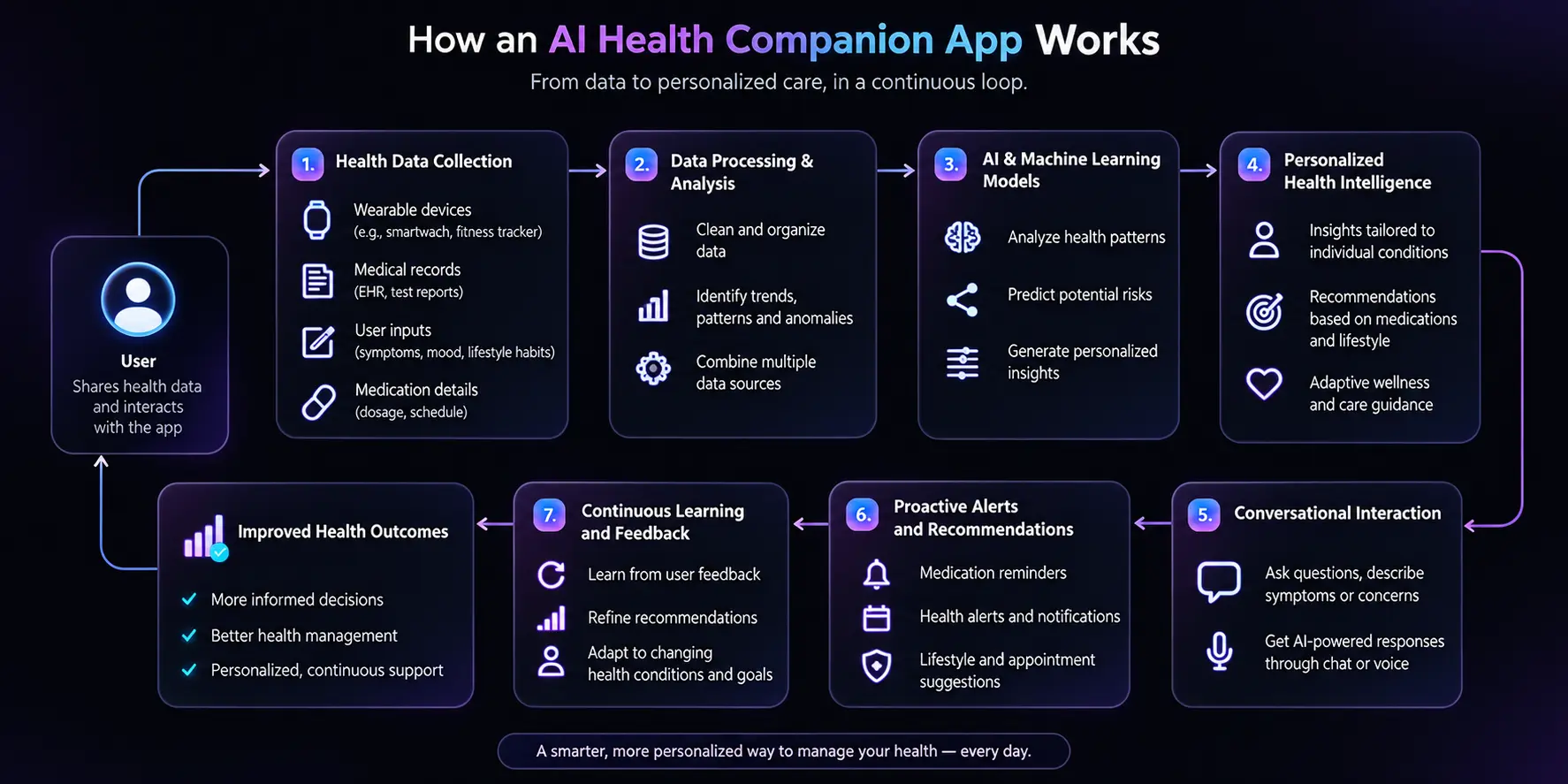
The first stage is gathering relevant information from different sources. An AI health companion may receive user-entered symptoms, medication details, lifestyle habits, wearable data, health records, and information from connected devices.
For someone managing multiple conditions, combining these data points can provide greater context than tracking one metric in isolation.
The collected information must be cleaned, structured, and processed before AI models can use it effectively. The system organizes data from different sources and identifies changes, patterns, relationships, or unusual activity.
This stage creates a consistent information layer that allows the application to work with health data over time rather than treating every interaction as a separate event.
Machine learning and other AI models analyze the processed information to identify meaningful patterns and generate relevant insights. Depending on the application's purpose, these models can examine trends related to symptoms, activity, sleep, medication routines, or lifestyle behavior.
For example, changes across several tracked health indicators may be identified as a pattern that deserves attention or further review.
The next stage turns analysis into user-specific insights. Instead of presenting the same wellness information to everyone, the application considers the individual's health profile, conditions, medications, preferences, and lifestyle patterns.
This is a key part of AI health companion app development, because the value comes from adapting information and guidance to the individual rather than providing generic health content.
Users can interact with the application through conversational interfaces powered by natural language processing. They can ask questions, describe symptoms or concerns, provide information, or request explanations in a more natural way.
The AI can use the available context to respond more appropriately and make the application easier to use than a traditional dashboard that requires users to interpret multiple health metrics themselves.
An AI health companion can proactively deliver reminders, notifications, recommendations, or alerts based on configured rules and available health information. These may relate to medication schedules, appointments, lifestyle goals, or changes identified within tracked data.
For chronic-condition management, proactive support can help users stay informed about important tasks and patterns instead of requiring them to open the application and check their data manually.
The workflow continues as the user interacts with the application and provides new information or feedback. Updated data can help refine personalization, improve recommendations, and adapt the experience to changing health conditions, routines, goals, and preferences.
This creates a continuous loop:
Health Data → Processing → AI Analysis → Personalized Intelligence → Interaction → Alerts and Guidance → Feedback → Updated Insights
The core idea behind an AI Health Companion App is this continuous loop, where health information is transformed into personalized, context-aware support that evolves as the user's needs and health profile change.
Why should a digital health startup invest in an AI health companion app instead of creating another basic health tracking tool? The stronger opportunity is to build a platform that can understand individual health needs and provide continuous, context-aware support. For adults managing multiple chronic conditions, this can mean connecting information about health conditions, medications, symptoms, lifestyle habits, and daily behavior to deliver more relevant guidance.
The market opportunity also supports this direction. Grand View Research estimates that the global digital health market is expected to reach $420.2 billion in 2026 and grow to $1,830.4 billion by 2033, at a 23.4% CAGR from 2026 to 2033.
For businesses, this growing ecosystem creates opportunities to develop differentiated products that improve user engagement, create recurring revenue, and expand into broader healthcare and wellness services.
Traditional health applications often focus on displaying information, while an AI-powered companion can interpret available data in the context of an individual's needs.
For users managing multiple conditions, the platform can personalize support around medications, symptoms, lifestyle routines, health goals, and other relevant information. This gives businesses an opportunity to create a more focused product instead of another generic wellness tracker.
Users increasingly expect digital health products to provide meaningful assistance rather than simply display dashboards and metrics. An AI health companion app can support conversational interactions, personalized insights, relevant reminders, proactive notifications, and adaptive guidance.
This creates a more interactive experience and can make the application useful throughout the user's daily health-management routine.
An AI-powered health platform can support different monetization models based on its audience and use case. Premium subscriptions can provide access to advanced insights, personalized coaching, specialized programs, or additional intelligent features.
Businesses can also explore employer wellness programs, healthcare partnerships, white-label products, device ecosystems, and B2B offerings. This gives startups more flexibility when developing a long-term revenue strategy.
A basic symptom or activity tracker may provide limited differentiation. Businesses can establish a stronger position by designing the application around a clearly defined user problem.
For example, a platform focused on people managing multiple chronic conditions could provide medication-aware support, personalized coaching, health alerts, and longitudinal insights. A focused value proposition can help the product stand apart from general-purpose wellness applications.
With proper consent, privacy controls, and responsible data practices, interaction data can help businesses understand how users engage with the application. Teams can identify which features users value, where engagement declines, and which workflows need improvement.
These insights can support feature prioritization, personalization, product refinement, and model improvement while keeping transparency and responsible data management at the center.
Managing health is an ongoing process, so sustained engagement is important for the success of an AI health companion. AI can make recurring interactions more relevant through personalized reminders, adaptive goals, contextual recommendations, and lifestyle coaching.
Rather than providing identical guidance to every user, the experience can evolve as individual routines, preferences, goals, and available health information change.
The opportunity extends beyond consumer health startups. Healthcare providers, insurers, employers, pharmaceutical companies, wellness platforms, and healthtech businesses can explore companion technology for different purposes.
Depending on the product scope, applications can support wellness coaching, medication adherence, chronic-condition management, remote monitoring, patient engagement, or healthcare navigation. Businesses can begin with one focused use case and expand as the platform matures.
A well-planned AI health companion app development strategy can create a differentiated digital health product while supporting personalization, engagement, recurring revenue, and future expansion across healthcare use cases.
The rise of AI Health Companion Apps is not just a technological trend but a major shift in how healthcare is delivered and experienced. As organizations race to digitize their services, understanding the Advantages of AI Health Companion App Development becomes crucial for any business that wants to lead the future of patient care.
From improving engagement to unlocking predictive insights, these solutions offer transformative potential for both users and providers.
Here are the six most impactful benefits you should consider:
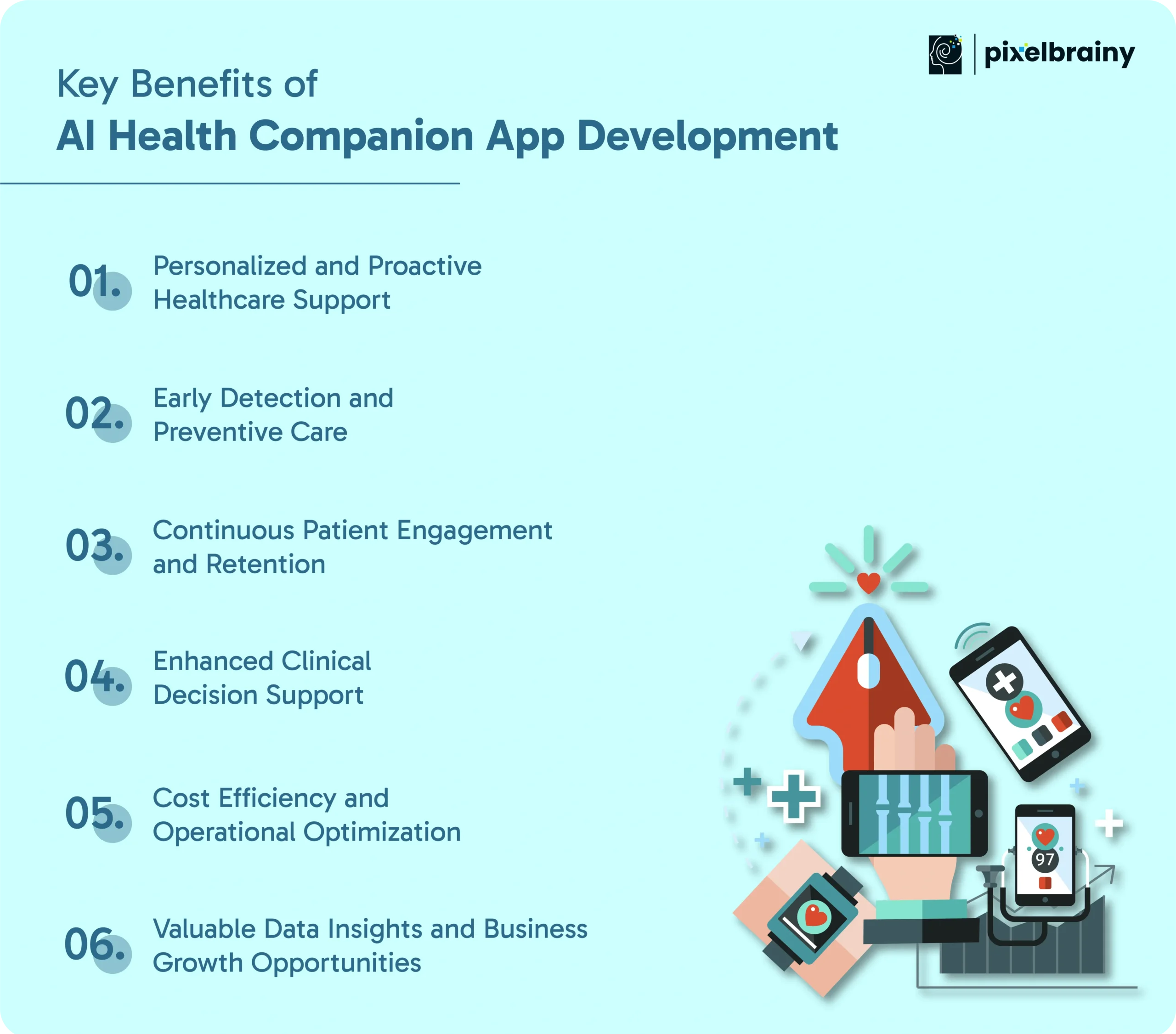
One of the most impactful outcomes of building of Benefits of AI Health Companion App is the ability to provide deeply personalized and proactive care. Unlike conventional apps that simply collect data, AI-driven companions analyze patterns in real time to deliver actionable insights tailored to each user.
For example, if a user’s sleep quality drops over several nights, the app might correlate it with changes in stress levels or physical activity and suggest relaxation exercises or adjusted workout plans. Similarly, if diet logs indicate poor nutrition, the app can recommend balanced meal plans aligned with individual health goals.
This proactive personalization not only improves user satisfaction but also enhances health outcomes. It empowers users to make informed decisions, address potential issues early, and adopt healthier lifestyle habits with continuous, intelligent support.
One of the strongest reasons to develop Benefits of AI Health Companion App is its potential for early detection and preventive healthcare. AI algorithms continuously analyze user data — such as vital signs, behavioral trends, and self-reported symptoms — to identify subtle changes that might indicate a health risk.
For instance, an irregular heart rhythm detected over time can prompt users to consult a cardiologist before the condition worsens. Similarly, tracking subtle weight fluctuations combined with dietary patterns can flag potential metabolic issues before they evolve into chronic diseases.
This shift from reactive to preventive healthcare has enormous value. It reduces hospitalization rates, lowers healthcare costs, and most importantly, empowers users to take control of their well-being before conditions become critical.
AI companions excel at keeping users consistently engaged — a critical factor for improving health outcomes and app retention. Through intelligent notifications, personalized nudges, and conversational interfaces, these apps seamlessly integrate into users’ daily lives.
They can remind users to take medications on time, suggest hydration or stretching breaks during work hours, and offer motivational feedback when users achieve health milestones. This continuous engagement builds trust and fosters a long-term relationship between the user and the platform.
For healthcare providers and insurers, this high engagement translates into improved treatment adherence, lower dropout rates, and better overall health outcomes. Engaged users are also more likely to explore premium features, participate in wellness programs, and recommend the app to others — boosting revenue and brand loyalty.
The power of AI Health Companion Apps extends beyond end-users — they also provide valuable decision-making support for healthcare professionals. By consolidating and analyzing vast amounts of user data, AI can deliver evidence-based recommendations and predictive insights that enhance clinical judgment.
For example, an app might compile months of blood pressure, heart rate, and lifestyle data into a comprehensive report for a physician. This detailed insight enables more precise diagnoses, optimized treatment plans, and faster intervention strategies.
Moreover, AI can flag concerning patterns, prioritize patient follow-ups, and even recommend diagnostic tests based on predictive models. This reduces the cognitive load on clinicians, saves time, and leads to more accurate and personalized care.
AI-driven health companions significantly reduce costs for both businesses and users. Automated symptom checkers, virtual consultations, and smart triage tools can handle large volumes of routine queries without human intervention, cutting operational expenses for healthcare providers.
From the patient’s perspective, access to AI-powered health guidance means fewer unnecessary clinic visits and more affordable preventive care. Early detection and proactive monitoring also reduce the likelihood of costly emergency interventions or hospitalizations.
For businesses, operational efficiency improves as support teams, care coordinators, and clinical staff can focus on more complex cases. This combination of automation, scalability, and early intervention leads to a substantial reduction in costs across the healthcare ecosystem.
AI health companions generate vast amounts of high-quality, anonymized data that can unlock new growth opportunities. Businesses can analyze user trends to develop new features, refine existing products, and explore partnerships with pharmaceutical companies, wellness providers, and insurers.
For example, aggregated data on patient lifestyle patterns can support clinical research or power predictive analytics solutions for healthcare organizations. These insights also enable better segmentation, personalized marketing strategies, and targeted product offerings.
Beyond product improvement, this data becomes a strategic asset — positioning your company at the forefront of innovation and driving new revenue streams from research collaborations, B2B services, and data-driven product expansion.
Incorporating these six benefits ensures your platform is not just another health companion app but a transformative, intelligent ecosystem that creates real value for users, healthcare providers, and your business.
To make an AI-powered health platform truly impactful, it’s essential to integrate the right set of features that deliver personalization, automation, and intelligence. When it comes to AI Health Companion App development, these features lay the foundation for scalability, user engagement, and reliable healthcare delivery.
Companies focusing on the benefits of AI-powered healthcare solutions must ensure their app is feature-rich, secure, and capable of handling dynamic user needs. By doing so, they can unlock the full potential of AI Health Companion Apps and create long-term value for both users and healthcare providers.
Here are the most important features every AI-powered health solution should include:
| Feature | Description |
| User Profile & Health History | Collects personal details, medical history, and lifestyle information to help the AI deliver highly tailored recommendations, ensuring a personalized health experience from day one |
| AI-Powered Chatbot Assistant | Acts as a virtual healthcare guide by answering queries, assisting with symptom checks, and providing round-the-clock health advice, enhancing engagement and building user trust |
| Health Data Dashboard | Displays key metrics like heart rate, activity levels, calories, and sleep cycles in a visually interactive format, empowering users to track and understand their wellness journey |
| Symptom Checker | Utilizes advanced algorithms to analyze user-reported symptoms and suggest possible causes or next steps, bridging the gap between self-care and professional consultation |
| Wearable Device Integration | Syncs with wearables like smartwatches and fitness bands to continuously collect real-time health data, improving the accuracy and intelligence of predictive insights |
| Medication Reminder System | Sends automated notifications for prescriptions, refills, and dosage times, increasing medication adherence and improving patient outcomes |
| Appointment Scheduling | Lets users easily schedule teleconsultations or in-person visits with healthcare professionals directly within the app, streamlining access to care |
| Personalized Health Insights | Analyzes user data to deliver customized recommendations such as diet tips, exercise plans, or stress management techniques, enhancing the effectiveness of AI Health Companion App features |
| Nutrition and Meal Tracking | Monitors food intake, calculates calorie balance, and recommends nutritional plans aligned with user health goals, supporting preventive care strategies |
| Goal Setting & Progress Tracking | Encourages users to set health or fitness targets and monitors their progress over time, helping maintain motivation and improve adherence to lifestyle changes |
| Push Notifications & Smart Alerts | Sends intelligent reminders about health goals, appointments, or potential risks, keeping users engaged and informed without overwhelming them |
| Data Analytics & Reports | Generates detailed analytics and trend reports, giving users and healthcare providers deeper insights into health improvements and potential risk factors |
| Multi-Language Support | Expands accessibility by offering multiple language options, increasing user adoption and retention across global audiences |
| Data Security & Compliance | Incorporates robust encryption and ensures compliance with regulations like HIPAA and GDPR, making privacy and security a top priority |
| Feedback & Support System | Provides users with an easy way to report issues, ask questions, or give feedback, allowing continuous improvement and higher satisfaction levels |
The inclusion of these must-have features builds a solid foundation for scalability, reliability, and user trust, ensuring your AI-powered solution stands out in the competitive healthcare landscape.
While basic functionalities deliver immediate value, advanced capabilities are what transform a healthcare app into a truly intelligent platform. In the evolving landscape of AI Health Companion App development, forward-thinking businesses must integrate innovative tools that leverage machine learning, data science, and predictive analytics to enhance personalization and user outcomes. These advanced features also elevate brand authority and ensure long-term adoption, making your product stand out among competitors.
Here are some of the most impactful advanced capabilities to include in your solution:
AI algorithms analyze continuous health data to forecast potential conditions before symptoms even appear. This proactive capability enables early intervention, helping users avoid severe complications and allowing healthcare providers to deliver preventive care with precision.
Adding voice functionality improves accessibility and convenience, especially for elderly users or those with mobility limitations. By enabling voice-based commands, users can interact with the AI Health Companion App naturally, increasing engagement and adoption rates.
Advanced sentiment analysis uses voice tone, language patterns, and usage behavior to assess mental well-being. The app can then offer tailored mindfulness exercises, therapy recommendations, or stress management techniques, expanding its utility beyond physical health.
This cutting-edge feature creates a virtual replica of a user’s health profile to simulate outcomes of treatments, diet changes, or lifestyle decisions. It gives users a unique way to visualize the potential effects of their choices before implementing them.
By integrating real-time video consultations and remote monitoring, the app becomes a full healthcare ecosystem. Users can receive professional advice without leaving their homes, increasing convenience and improving patient-provider communication.
Also Read: Doctor Appointment Booking Mobile App Development
For users with chronic illnesses such as diabetes, asthma, or hypertension, AI continuously adapts care plans based on real-time data and predictive modeling. This level of support ensures more effective long-term disease management.
Advanced security features like blockchain ensure that health records remain tamper-proof and fully traceable. This enhances user confidence and helps the app comply with strict regulatory standards, making it an industry-ready solution.
Combining genetic data with real-time health metrics allows the app to deliver hyper-personalized care plans. This feature pushes the boundaries of personalized medicine, giving users unique insights into hereditary risks and tailored interventions.
Incorporating these advanced features elevates your solution from a standard digital health app to a next-generation healthcare platform that offers intelligence, precision, and innovation.
What is the process to develop an AI health companion app that can support real users rather than functioning as another basic health tracker? For a digital health startup preparing to approach investors, the development journey needs to validate the idea, prove AI feasibility, build a secure product, and prepare it for real-world use.
This becomes especially important when the app is intended for adults managing multiple chronic conditions. The platform may need to combine health conditions, medication information, symptoms, lifestyle patterns, wearable data, personalized health intelligence, proactive alerts, and AI-guided lifestyle coaching. Each requirement introduces technical, usability, security, and compliance considerations that should be addressed progressively.
A structured AI health companion app development process helps businesses move from concept validation to a production-ready solution without committing the entire budget before the most important assumptions are tested. The roadmap below covers the major stages involved in developing an AI health companion app, from market research and technical validation to development, testing, deployment, and continuous improvement.
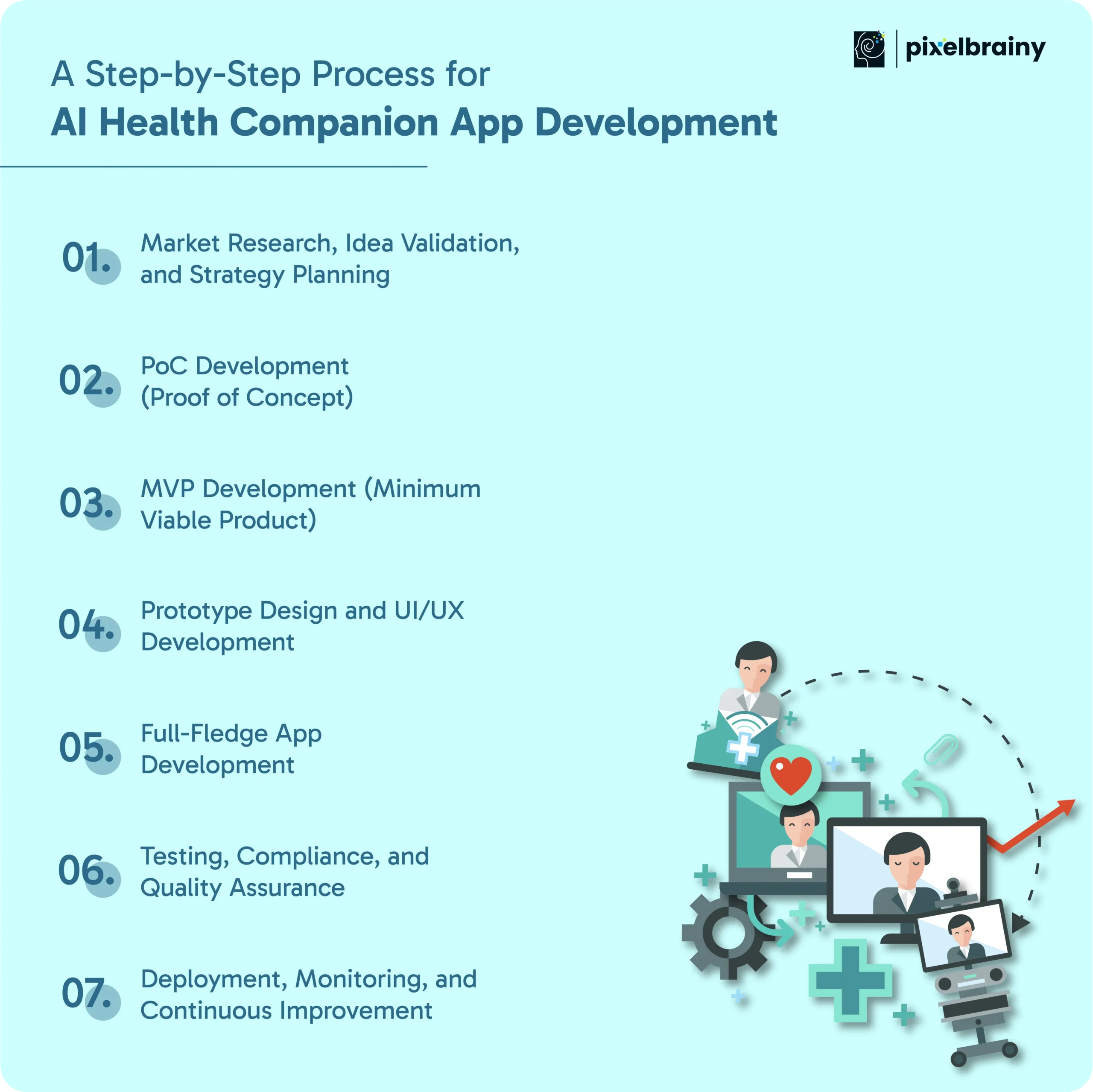
Every impactful AI health companion app begins with a deep understanding of the market. This stage involves analyzing user pain points, studying competitors, identifying gaps, and mapping regulatory requirements. Businesses also define their unique value proposition and outline monetization strategies based on market demand and healthcare trends.
Why it matters: This step ensures your solution addresses a real-world healthcare problem, reducing the risk of failure later in the journey. A strong strategic foundation gives your product a clear purpose and competitive edge in the evolving healthcare ecosystem.
The next phase is PoC Development, where the technical feasibility of your concept is tested. Developers build a lightweight prototype to validate the AI’s capabilities, ensuring it can process healthcare data accurately, deliver relevant insights, and integrate with external systems. This experimental version focuses on proving that your AI health companion app can solve the core problem it aims to address.
Why it matters: A successful proof of concept builds confidence among investors and stakeholders. It identifies technical challenges early, reduces financial risk, and helps refine the product’s direction before heavy development investment.
Once the proof of concept validates the idea, MVP Development begins. This stage involves creating a simplified, functional version of the AI health companion app that includes only the most essential features such as basic symptom checking, AI chatbot functionality, and wearable integration. The goal is to test the product with real users in a live environment.
Why it matters: MVPs allow you to launch faster, gather real-world feedback, and adapt quickly based on user behavior. This data-driven approach reduces development waste and helps prioritize the most valuable features for future releases.
Also Read: Top 10 AI MVP Development Companies in USA
Design plays a pivotal role in healthcare technology adoption. Collaborating with a professional UI/UX design company ensures your AI health companion app is intuitive, user-friendly, and accessible to a wide range of users — including elderly patients and those with limited digital literacy. Wireframes and prototypes simulate the user journey, allowing for usability testing and design refinements before full development.
Why it matters: A well-designed interface builds trust, improves engagement, and drives higher retention rates. It ensures that even complex AI-generated insights are delivered in a clear, actionable, and visually appealing manner.
At this stage, the focus shifts to Full-Fledge App Development — building the complete, feature-rich version of the AI health companion app. This includes advanced analytics, predictive algorithms, remote patient monitoring, telemedicine integration, and secure data management systems. The backend infrastructure is scaled to support large volumes of real-time health data and third-party API integrations.
Why it matters: This step transforms your product from a basic solution into a comprehensive healthcare platform. It positions your business to serve enterprise clients, integrate with clinical systems, and expand globally.
Thorough testing is critical in healthcare software. During this phase, developers conduct functionality tests, security audits, and AI accuracy validations. Compliance checks are also performed to ensure the app meets legal standards like HIPAA and GDPR. By prioritizing quality and security, you ensure that your AI health companion app is both reliable and trustworthy.
Why it matters: A single security flaw or inaccurate prediction can erode user trust. Rigorous testing safeguards patient data, ensures platform stability, and builds credibility with healthcare providers, insurers, and users.
The final stage involves launching the AI health companion app across platforms and continuously monitoring its performance. Real-time analytics, user feedback, and AI model retraining help optimize the product post-launch. Many Top AI development companies in USA also provide ongoing support, ensuring the app remains scalable, secure, and compliant as technology and regulations evolve.
Why it matters: Launching the app is just the beginning. Continuous improvement ensures your platform adapts to new healthcare demands, integrates emerging technologies, and stays ahead of competitors in a rapidly changing digital health market.
Following these AI health companion app development steps can help transform a healthcare concept into a secure, scalable, and personalized solution that is better prepared to support users managing complex health needs.
Also Read: A Comprehensive Guide To AI Mobile App Development
AI health companion app development cost typically ranges from $20,000 to $200,000+, depending on the level of intelligence, number of features, healthcare integrations, security requirements, and overall product complexity. A basic application with user profiles, health tracking, and a simple AI assistant requires considerably less investment than a production-grade platform designed to support personalized health intelligence, proactive alerts, wearable data, medication management, and advanced AI capabilities.
For a digital health startup preparing for seed funding, cost to develop an AI Health Companion App should be estimated around the product's actual scope rather than a single fixed figure. The AI health companion app development budget should account for product design, mobile and backend development, AI model integration, health data connectivity, security, testing, compliance requirements, cloud infrastructure, and post-launch optimization.
A practical AI health companion app development pricing model can be divided into three levels:
| AI Health Companion App Type | Typical Scope | Estimated Cost |
| Basic AI Health Companion App | User profiles, health history, basic health tracking, AI chatbot, basic reminders, simple dashboard, and essential backend functionality. Suitable for validating an initial product concept. | $20,000 to $50,000 |
| Medium AI Health Companion App | Everything in the basic version plus wearable integration, medication reminders, personalized insights, health analytics, enhanced security, third-party APIs, and a more sophisticated AI experience. | $50,000 to $120,000 |
| Advanced AI Health Companion App | Production-grade platform with personalized health intelligence, proactive alerts, adaptive AI coaching, multiple health-data integrations, advanced analytics, telehealth capabilities, enterprise security, and custom AI workflows. | $120,000 to $200,000+ |
App complexity: A simple wellness companion costs less than a platform supporting multiple chronic conditions, real-time data, personalized intelligence, and complex user workflows.
AI capabilities: Basic chatbot integration is relatively straightforward, while custom recommendation engines, predictive models, adaptive coaching, or multimodal AI can significantly increase development effort.
Healthcare integrations: Connecting Apple Health, Health Connect, wearables, medical devices, EHR systems, or other healthcare APIs can add integration and testing costs.
Personalization: The more deeply the app adapts to a user's conditions, medications, behavior, and lifestyle, the more sophisticated the data architecture and AI workflows need to become.
Security and compliance: Healthcare applications require stronger controls around authentication, encryption, consent, auditability, data handling, and applicable regulatory requirements, increasing both development and testing effort.
UI/UX design: A simple tracking interface costs less than a highly personalized experience with health dashboards, conversational AI, alerts, coaching workflows, and accessibility considerations.
Backend and cloud infrastructure: Real-time health data processing, AI inference, storage, analytics, monitoring, and scalable infrastructure can add significantly to both initial and recurring costs.
Testing and maintenance: AI health applications require functional testing, security testing, integration testing, model evaluation, bug fixes, infrastructure management, and continuous improvement after launch.
For a startup validating the concept, a $20,000 to $50,000 budget can support a focused first version. A more capable product with wearable integrations, personalization, and richer AI functionality may require $50,000 to $120,000. A production-grade platform designed for complex health use cases, extensive integrations, and advanced AI can move into the $120,000 to $200,000+ range.
The final cost estimation of an AI Health Companion App should therefore be based on the features, AI depth, healthcare integrations, security requirements, and scale you plan to support from launch.
Also Read: AI App Development Cost: From MVPs to Full-Scale AI App
When planning the development journey, businesses often ask what technologies are essential to create a scalable, secure, and intelligent platform. The choice of tools defines how efficient, accurate, and user-friendly the final AI health companion app will be.
From frontend design to backend infrastructure and AI frameworks, each layer must work seamlessly to deliver high performance. Selecting the right stack also ensures faster deployment, better compliance, and long-term scalability for healthcare applications.
Here’s a breakdown of the most important tools and frameworks required for AI Health Companion App development:
| Development Layer | Tools & Frameworks | Explanation |
| Frontend Development | React Native, Flutter, Angular | These frameworks allow developers to build responsive and cross-platform mobile apps. React Native and Flutter speed up development with reusable codebases, while Angular provides strong scalability for web-based interfaces. |
| Backend Development | Node.js, Django, Ruby on Rails | These backend frameworks manage data, APIs, and server logic. Node.js offers real-time communication, Django ensures fast development with high security, and Ruby on Rails provides quick prototyping capabilities for healthcare apps. |
| AI & Machine Learning Frameworks | TensorFlow, PyTorch, Scikit-learn | These are the foundation of intelligent functionality in an app. TensorFlow and PyTorch power predictive analytics and deep learning models, while Scikit-learn supports machine learning algorithms for symptom analysis and health predictions. |
| Natural Language Processing (NLP) | spaCy, Rasa, OpenAI GPT | NLP enables the chatbot and conversational features of the app. SpaCy processes user text inputs, Rasa manages AI-driven conversations, and OpenAI GPT powers contextual and human-like responses. |
| Cloud & Hosting | AWS, Microsoft Azure, Google Cloud Platform | These platforms provide reliable infrastructure to host the app, manage large datasets, and run AI models at scale. They also offer built-in healthcare compliance options for data security. |
| Database Management | PostgreSQL, MongoDB, Firebase | Databases are essential for storing sensitive health records and real-time data. PostgreSQL supports structured data, MongoDB handles unstructured information, and Firebase allows real-time sync across devices. |
| Wearable & Device Integration APIs | Apple HealthKit, Google Fit, Fitbit API | These APIs enable integration with health trackers and IoT devices, allowing the app to collect real-time vitals and activity data, which enhances the AI-driven insights. |
| UI/UX Design Tools | Figma, Adobe XD, Sketch | These tools ensure a seamless and user-friendly design experience. They help designers create wireframes, prototypes, and polished interfaces that increase adoption and usability in healthcare applications. |
| Data Security Tools | OAuth 2.0, SSL/TLS, Blockchain | Security frameworks protect sensitive health data. OAuth 2.0 manages user authentication, SSL/TLS secures communication, and blockchain provides tamper-proof storage of critical medical information. |
Choosing the right mix of tools and frameworks ensures that your AI health companion app is intelligent, scalable, secure, and ready to deliver high-quality healthcare experiences.
What will the next generation of AI health companion apps look like as healthcare technology becomes more connected and personalized? Future solutions are expected to move beyond basic tracking and provide more context-aware health intelligence, adaptive support, multimodal interaction, and deeper integration with the broader healthcare ecosystem.
For businesses planning AI health companion app development, understanding these trends can help shape a product roadmap that remains relevant as user expectations, AI capabilities, and healthcare technologies evolve. The focus is increasingly shifting toward experiences that can interpret multiple sources of information, personalize recommendations, support different interaction methods, and connect with other digital health systems.
One of the most impactful trends is the rise of hyper-personalized healthcare. Future AI health companion apps will not only analyze real-time data but also use predictive modeling to anticipate user needs before they arise. For instance, based on historical activity patterns, sleep data, and genetic information, the app could predict potential risks like diabetes or cardiovascular disease and recommend lifestyle changes proactively.
This trend is being driven by the rapid advancement of machine learning algorithms and larger, more diverse health datasets. As predictive accuracy improves, users will receive highly customized care plans that evolve continuously with their lifestyle and medical history.
The future of digital health will see a strong convergence between AI, genetics, and precision medicine. Next-generation AI health companion apps will integrate genomic data to provide deeper insights into individual health risks, treatment responses, and preventive care strategies.
For example, a user with a genetic predisposition to high cholesterol could receive dietary recommendations, targeted exercise plans, and early warning alerts long before symptoms appear. This level of personalization empowers users to make proactive health decisions based on their unique biological makeup.
Voice assistants are becoming increasingly popular, and healthcare apps are no exception. Future AI health companion apps will integrate voice-based and multimodal interaction, allowing users to communicate naturally through speech, text, gestures, and even biometric signals.
This will improve accessibility for elderly users, people with disabilities, or those who prefer hands-free interactions. Additionally, multimodal interfaces will enable deeper data collection, such as tone-of-voice analysis for emotional well-being, further enriching the AI’s understanding of user health.
The next wave of innovation will focus heavily on mental and emotional well-being. Future AI health companion apps will leverage emotional intelligence — using sentiment analysis, facial recognition, and behavioral data to understand a user’s mood and mental state.
Such apps could detect early signs of stress, anxiety, or depression and offer tailored interventions like mindfulness exercises, therapy recommendations, or virtual counseling. The integration of mental health support will transform these apps into holistic healthcare platforms, addressing both physical and psychological well-being.
Also Read: How To Build An AI Mental Health and Wellness App Like Wysa?
The future of digital health is moving toward ecosystem-driven platforms. Instead of operating as standalone tools, AI health companion apps will become interconnected with electronic health records (EHRs), hospital systems, insurance databases, and wearable IoT devices.
This interoperability will enable seamless data sharing and more coordinated care. A user’s data from their app could directly inform a doctor’s treatment plan or help insurers create personalized wellness programs. This shift will create a more connected, efficient, and data-driven healthcare environment.
Keeping these trends in view can help businesses create future-ready AI health companion apps that evolve with emerging technologies while delivering more personalized, connected, and intelligent health experiences.
What makes AI health companion app development challenging when the product needs to provide personalized support for adults managing multiple chronic conditions? Beyond building the interface and integrating AI, businesses must address sensitive health data, model reliability, regulatory requirements, healthcare system connectivity, user trust, and development costs.
These challenges become more important when the goal is to create a production-grade application that goes beyond basic symptom tracking and delivers personalized health intelligence, proactive alerts, and adaptive lifestyle guidance. Identifying these risks early helps startups make better technology decisions, plan realistic budgets, and create an AI health companion app that users and healthcare stakeholders can trust.
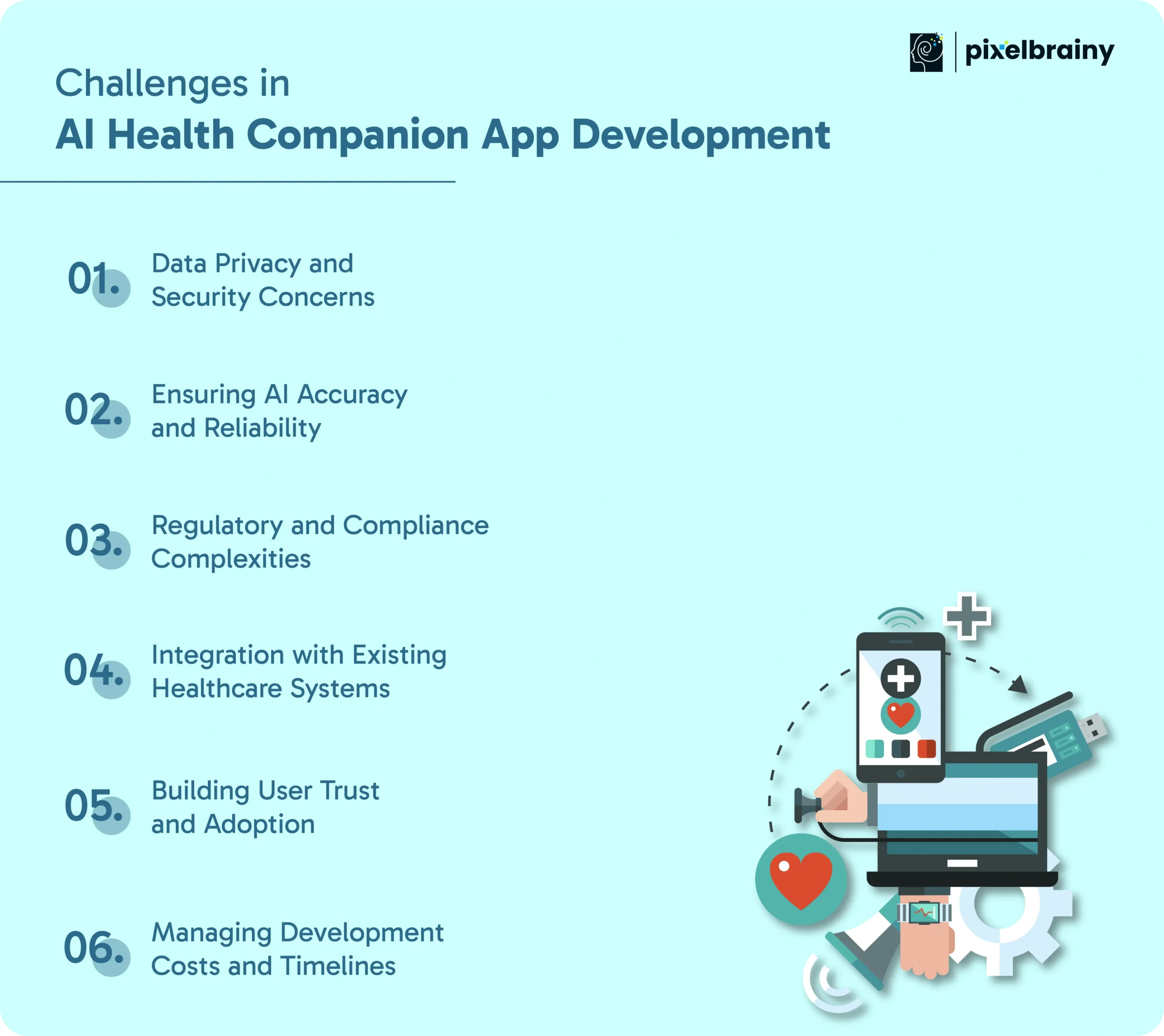
The Challenge: One of the most critical issues in developing an AI health companion app is protecting sensitive user health data. Breaches, unauthorized access, or non-compliance with regulations like HIPAA and GDPR can lead to severe legal and financial consequences, not to mention loss of trust.
How to Resolve: Implement advanced encryption protocols, secure cloud infrastructure, and regular security audits. Ensure compliance with global healthcare data protection standards and include transparent data policies so users understand how their information is used and stored.
The Challenge: AI-driven recommendations are only as accurate as the data and models behind them. Inconsistent or biased data, limited datasets, or poorly trained models can lead to inaccurate predictions, which can harm users or reduce trust in the platform.
How to Resolve: Use diverse, high-quality datasets and regularly retrain machine learning models to improve their accuracy. Incorporate explainable AI techniques so users and healthcare professionals can understand how decisions are made, increasing confidence in the app’s recommendations.
The Challenge: Healthcare is one of the most regulated industries, and AI Health Companion App development must adhere to numerous legal standards. Meeting requirements like HIPAA (USA), GDPR (Europe), and FDA guidelines can be complex and time-consuming.
How to Resolve: Engage with legal and compliance experts from the start of the project. Design your app’s architecture with compliance in mind, including features like consent management, data anonymization, and audit trails. Keeping documentation and processes transparent will also simplify certification and approvals.
The Challenge: Many healthcare providers already use EHR (Electronic Health Record) systems and medical software. Ensuring your AI health companion app integrates seamlessly with these platforms can be challenging due to data format differences, outdated APIs, or lack of interoperability.
How to Resolve: Adopt industry standards like FHIR (Fast Healthcare Interoperability Resources) for data exchange and build flexible APIs that allow smooth integration with multiple platforms. Collaborating with healthcare IT teams early in the process also improves compatibility and adoption.
The Challenge: Users are often skeptical about sharing sensitive health data with AI-powered platforms. Without transparency and reliable results, they may be hesitant to engage with your app regularly.
How to Resolve: Focus on creating a transparent user experience by clearly explaining how data is used, how AI makes decisions, and how privacy is protected. Adding human-in-the-loop features — like offering users the option to consult healthcare professionals — can further increase trust and credibility.
The Challenge: Creating a fully functional AI health companion app with advanced features, regulatory compliance, and security layers can be expensive and time-consuming. Many projects face delays or exceed budgets due to underestimation of complexity.
How to Resolve: Adopt an agile development approach, starting with an MVP and scaling gradually. Prioritize features based on user needs and ROI. Partnering with experienced AI development teams can also reduce risks, improve efficiency, and ensure cost-effective delivery.
Addressing these challenges early can help businesses build an AI health companion app that is more secure, reliable, compliant, and prepared to support personalized health experiences at scale.
From the above, it is clear that an AI health companion app requires much more than mobile app development. When the product is expected to support adults managing multiple chronic conditions, provide personalized health intelligence, deliver proactive alerts, and adapt lifestyle guidance to individual health patterns, the technology partner needs expertise across AI, healthcare data, security, integrations, and scalable product engineering.
This is where PixelBrainy as an AI healthcare software development company can support businesses from product strategy through deployment. Our AI health companion app development services cover AI engineering, mobile and backend development, health data integrations, personalized experiences, predictive capabilities, security, testing, and post-launch improvements.
For a startup preparing for seed investment, our approach can also help translate a product vision into a practical roadmap. Whether you want to build an AI health companion app as an MVP for validation or plan a production-grade healthcare platform, we focus on the use cases, data architecture, technology requirements, and scalability needed for the intended audience.
In one confidential engagement, PixelBrainy worked with the U.S.-based digital health company to create an AI-driven virtual health companion. The application reached 50,000+ active users within six months of launch, while the client reported a 65% improvement in patient engagement and 40% reduction in operational costs. The solution combined AI capabilities with secure health data infrastructure and a user-focused experience.
Our team also brings experience across predictive analytics, NLP, personalized care algorithms, third-party healthcare integrations, scalable architecture, and compliance-focused development, supporting both startups and enterprise healthcare initiatives.
For businesses looking to develop AI health companion app solutions, we can help define and implement the right architecture and AI capabilities without losing sight of usability, security, and business objectives. Our experience also supports health companion app development integrating AI for personalized and intelligent digital health experiences.
Ready to turn your AI health companion concept into a production-ready product? Connect with PixelBrainy today.
An AI health companion app can help businesses move beyond basic health tracking by bringing together personalized insights, continuous monitoring, conversational support, proactive alerts, and adaptive lifestyle guidance. As discussed throughout this guide, creating a reliable solution requires more than adding AI to a mobile application. It involves careful planning around health data, AI models, integrations, security, compliance, user experience, and long-term scalability.
For a digital health startup targeting adults managing multiple chronic conditions, the right AI health companion app development strategy can create a product tailored to individual health conditions, medications, behaviors, and lifestyle patterns rather than delivering generic wellness recommendations. The cost to develop an AI health companion app will depend on this level of personalization, AI complexity, integrations, and regulatory requirements.
With the right technology partner, businesses can move from concept validation to a production-ready and future-focused healthcare platform designed around real user needs.
Book an appointment with PixelBrainy to discuss your AI health companion app idea.
To develop an AI health companion app for chronic care, businesses need more than health tracking. The platform may require personalized health profiles, medication information, wearable integrations, AI-driven insights, proactive alerts, lifestyle coaching, secure data management, and healthcare-related integrations based on the intended use case.
The cost to develop an AI health companion app typically ranges from $20,000 to $200,000+. The final AI health companion app development cost depends on AI complexity, personalized coaching, predictive capabilities, health data integrations, security, compliance requirements, platform scope, and post-launch support.
Yes. An AI health companion app can be designed to organize information about multiple conditions, medications, symptoms, lifestyle patterns, and user activity. AI can use this context to provide more relevant insights, reminders, and guidance, subject to the product's intended purpose and appropriate healthcare safeguards.
The core AI health companion app development feature set can include user health profiles, health tracking, medication reminders, AI conversational assistance, personalized insights, notifications, wearable connectivity, dashboards, appointment support, and secure data management. The final feature set should reflect the target users and healthcare use case.
To build AI health companion app solutions with adaptive coaching, the platform needs relevant user data, defined health goals, personalization logic, AI models, feedback mechanisms, and appropriate safeguards. The system can use changing activity, preferences, routines, and other available information to adjust recommendations over time rather than delivering static advice.
The AI health companion app development timeline depends on the number of features, AI capabilities, integrations, data architecture, security requirements, testing scope, and regulatory considerations. An MVP with focused functionality can be delivered sooner than a production-grade platform with advanced personalization, predictive intelligence, wearable connectivity, and multiple healthcare integrations.
An AI health companion can analyze available information and trigger relevant alerts based on configured rules, detected patterns, or defined thresholds. During health companion app development integrating AI, businesses should clearly establish how alerts work, how they are validated, and when users should be directed to qualified healthcare professionals.
When evaluating an AI health companion app development company, look for expertise in AI engineering, healthcare software, secure data architecture, integrations, personalization, predictive analytics, compliance-sensitive development, and scalable mobile platforms. Relevant healthcare case studies and experience taking products from MVP through production can also help assess technical fit.

About The Author
Sagar Bhatnagar
Sagar Sahay Bhatnagar brings over a decade of IT industry experience to his role as Marketing Head at PixelBrainy. He's known for his knack in devising creative marketing strategies that boost brand visibility and market influence. Sagar's strategic thinking, coupled with his innovative vision and focus on results, sets him apart. His track record of successful campaigns proves his ability to utilize digital platforms effectively for impactful marketing efforts. With a genuine passion for both technology and marketing, Sagar continuously pushes PixelBrainy's marketing initiatives to greater success.

Working with the PixelBrainy team has been a highly positive experience. They understand the design requirements and create beautiful UX elements to meet the application needs. The dev team did an excellent job bringing my vision to life. We discussed usability and flow. Sagar worked with his team to design the database and begin coding. Working with Sagar was easy. He has the knowledge to create robust apps, including multi-language support, Google and Apple ID login options, Ad-enabled integrations, Stripe payment processing, and a Web Admin site for maintaining support data. I'm extremely satisfied with the services provided, the quality of the final product, and the professionalism of the entire process. I highly recommend them for Android and iOS Mobile Application Design and Development.

Great experience working with them. Had a lot of feedback and I found that unlike most contractors they were bugging me for updates instead of the other way around. They were extremely time conscience and great at communicating! All work was done extremely high quality and if not on time, early! They were always proactive when it comes to communication and the work is great/above par always. Very flexible and a great team to work with! Goes above and beyond to present us with multiple options and always provides quality. Amazing work per usual with Chitra. If you have UI/UX or branding design needs I recommend you go to them! Will likely work with them in the future as well, definitely recommended!

PixelBrainy is a joy to work with and is a great partner when thinking through branding, logo, and website layout. I appreciate that they spend time going into the "why" behind their decisions to help inform me and others about industry best practices and their expertise.

I hired them to design our software apps. Things I really like about them are excellent communication skills, they answer all project suggestions and collaborate right away, and their input on design and colors is amazing. This project was complex and needed patience and creativity. The team is amazing to do business with. I will be using them long-term. Glad to see there are some good people out there. I was afraid to try and outsource my project to someone but I am glad I met them! I really can't say enough. They went above and beyond on this project. I am very happy with everything they have done to make my business stand out from the competition.

It was great working with PixelBrainy and the team. They were very responsive and really owned the project. We'll definitely work with them again!

I recently worked with the PixelBrainy team on a project and I was blown away by their communication skills. They were prompt, clear, and articulate in all of our interactions. They listened and provided valuable feedback and suggestions to help make the project a success. They also kept me updated throughout the entire process, which made the experience stress-free and enjoyable.

PixelBrainy is very good at what it does. The team also presents themselves very professionally and takes care of their side of things very well. I could fully trust them taking up the design work in a timely and organised manner and their attention to detail saved us lots of effort and time. This particular project was quite intense and the team showed that they function very well under pressure. Very much looking forward to working with her again!

It's always an absolute pleasure working with them. They completed all of my requests quickly and followed every note I had for them to a T, which made our process go smoothly from start to finish. Everything was completed fast and following all of the guidelines. And I would recommend their services to anyone. If you need any design work done in the future, PixelBrainy should be your first call!

They took ownership of our requirements and designed and proposed multiple beautiful variants. The team is self-motivated, requires minimum supervision, committed to see-through designs with quality and delivering them on time. We would definitely love to work with PixelBrainy again when we have any requirements.

PixelBrainy was a big help with our SaaS application. We've been hard at work with a new UI/UX and they provided a lot of help with the designs. If you're looking for assistance with your website, software, or mobile application designs, PixelBrainy and the team is a great recommendation.

PixelBrainy designers are amazing. They are responsive, talented, and always willing to help craft the design until it matches your vision. I would recommend them and plan to continue them for my future projects and more!!!

They were awesome! Did a good job fast, and good communication. Will work with them again. Thank you

Creative, detail-oriented, and talented designers who take direction well and implement changes quickly and accurately. They consistently over-delivered for us.

PixelBrainy team is very talented and creative. Great designers and a pleasure to work with. PixelBrainy is an excellent communicator and I look forward to working with them again.

PixelBrainy has a very talented design team. Their work is excellent and they are very responsive. I enjoy working with them and hope to continue on all of our future projects.


Transform your ideas into reality with us.
Across these industries, each engagement brings unique challenges, from early-stage product development to scaling complex systems, helping us build a practical understanding of real-world product environments.