AI Summary Powered by PixelBrainy
What if an investment app could not only manage a user's portfolio, but also teach that user why every investment decision is being made?
For a fintech startup targeting first-generation wealth builders, this question creates an important opportunity. Instead of simply building an AI investment app like Wealthfront that automates portfolio management, a startup can develop a platform that combines automated investing with personalized financial education, coaching, and transparent AI explanations.
This is where AI investment app development like Wealthfront becomes more than a conventional robo-advisory project. The objective is to create a wealth-building platform for people who may be investing for the first time, starting with small amounts, and looking for guidance rather than a completely hands-off experience.
Imagine a fintech startup wants to serve an underserved segment of first-generation investors. Its users may have limited investment knowledge and may not understand concepts such as diversification, risk tolerance, asset allocation, index funds, or portfolio rebalancing. The startup wants to offer automated portfolio management while adding a financial literacy layer that explains every AI recommendation in accessible language, teaches fundamental investment principles, and helps users build financial confidence over time.
This scenario changes the scope of Wealthfront like AI app development considerably. The product needs a recommendation engine, portfolio management infrastructure, financial data integrations, risk profiling, security controls, compliance workflows, and an educational intelligence layer that can explain recommendations without creating misleading financial advice.
The market opportunity also supports this direction. Grand View Research estimates that the global robo advisory market will reach $14.1 billion in 2026 and projects it to reach $41.8 billion by 2030, representing a 30.5% CAGR from 2024 to 2030.
For startups considering making an AI investment app like Wealthfront, the opportunity is therefore not simply to replicate an existing platform. The stronger strategy is to identify an underserved audience and build differentiated experiences around its needs. This guide to create an AI investment app like Wealthfront explains the business model, essential features, advanced capabilities, development process, technology stack, estimated cost, and major challenges.
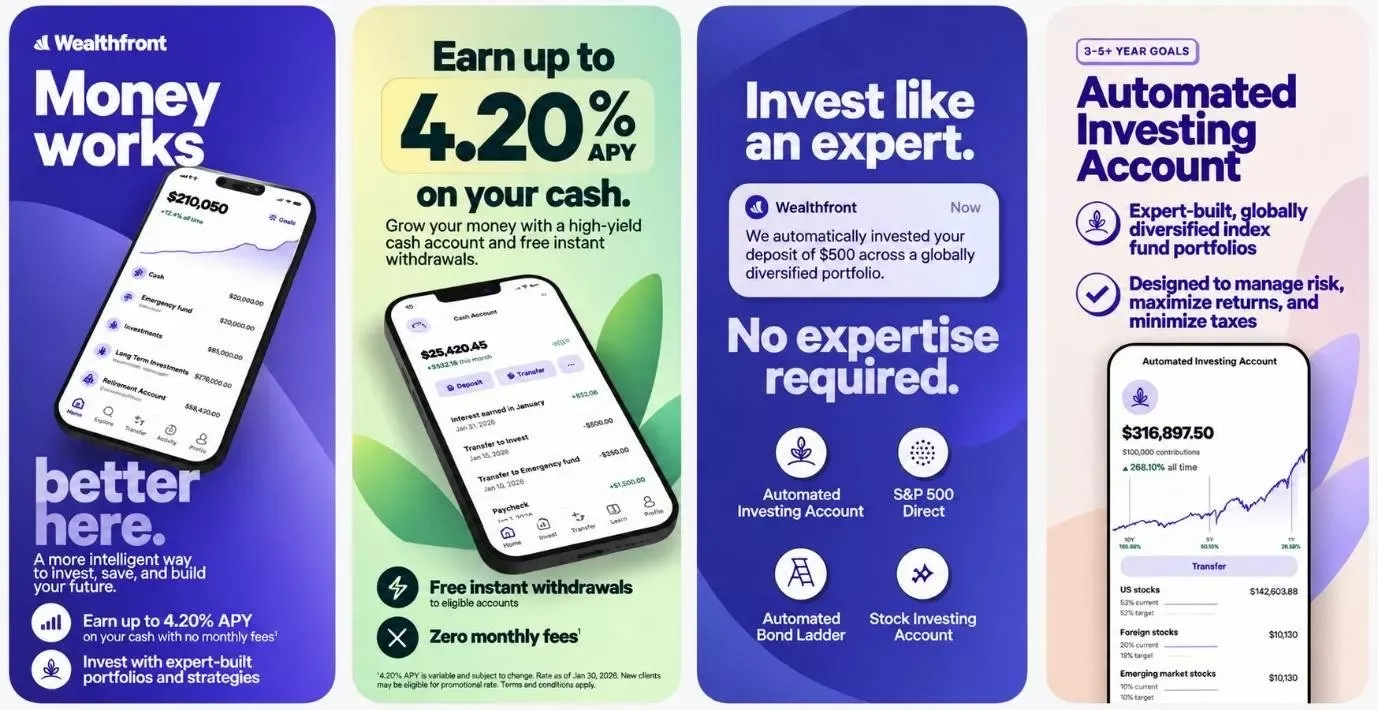
An AI investment app like Wealthfront is a digital wealth management platform that uses automation, financial data, algorithms, and AI technologies to help users manage investments and make informed financial decisions.
Wealthfront is an example of a digital wealth management platform built around automated investing, portfolio management, cash management, and related financial services.
A startup does not necessarily need to reproduce every Wealthfront capability. Instead, it can use the underlying product model as a reference and create a differentiated platform for a specific audience.
A typical platform can connect the following components:
User profile → financial goals → risk assessment → portfolio recommendation → investment execution → portfolio monitoring → rebalancing → education and insights
For an AI-first product, another layer can sit across this entire workflow.
For example, instead of simply telling a user:
"Your portfolio has been rebalanced."
The application could explain:
"Your portfolio was rebalanced because stocks increased to a larger percentage of your target allocation. Reducing that exposure helps bring the portfolio closer to the risk level you selected."
This educational layer can become the core differentiator.
A conventional robo advisor primarily focuses on automation. An AI investment platform can add personalization, conversational interfaces, intelligent explanations, financial education, behavioral insights, and adaptive recommendations.
For first-generation wealth builders, this can create a hybrid experience:
Automated portfolio management + financial education + AI coaching + human-centered UX
That positioning can help a startup compete without trying to become a direct copy of Wealthfront.
Before starting AI investment app development like Wealthfront, fintech startups need to establish a clear and sustainable monetization strategy. The revenue model affects pricing, product architecture, financial integrations, compliance requirements, and long-term customer acquisition costs.
A startup planning to serve first-generation wealth builders may have an important question before development begins:
"How can we monetize an AI investment app like Wealthfront while keeping investing and financial education affordable for users who are starting with small investment amounts?"
The answer is usually not to depend on a single revenue stream. An AI investment app like Wealthfront can combine several monetization models based on its target audience, investment products, market, and regulatory structure.
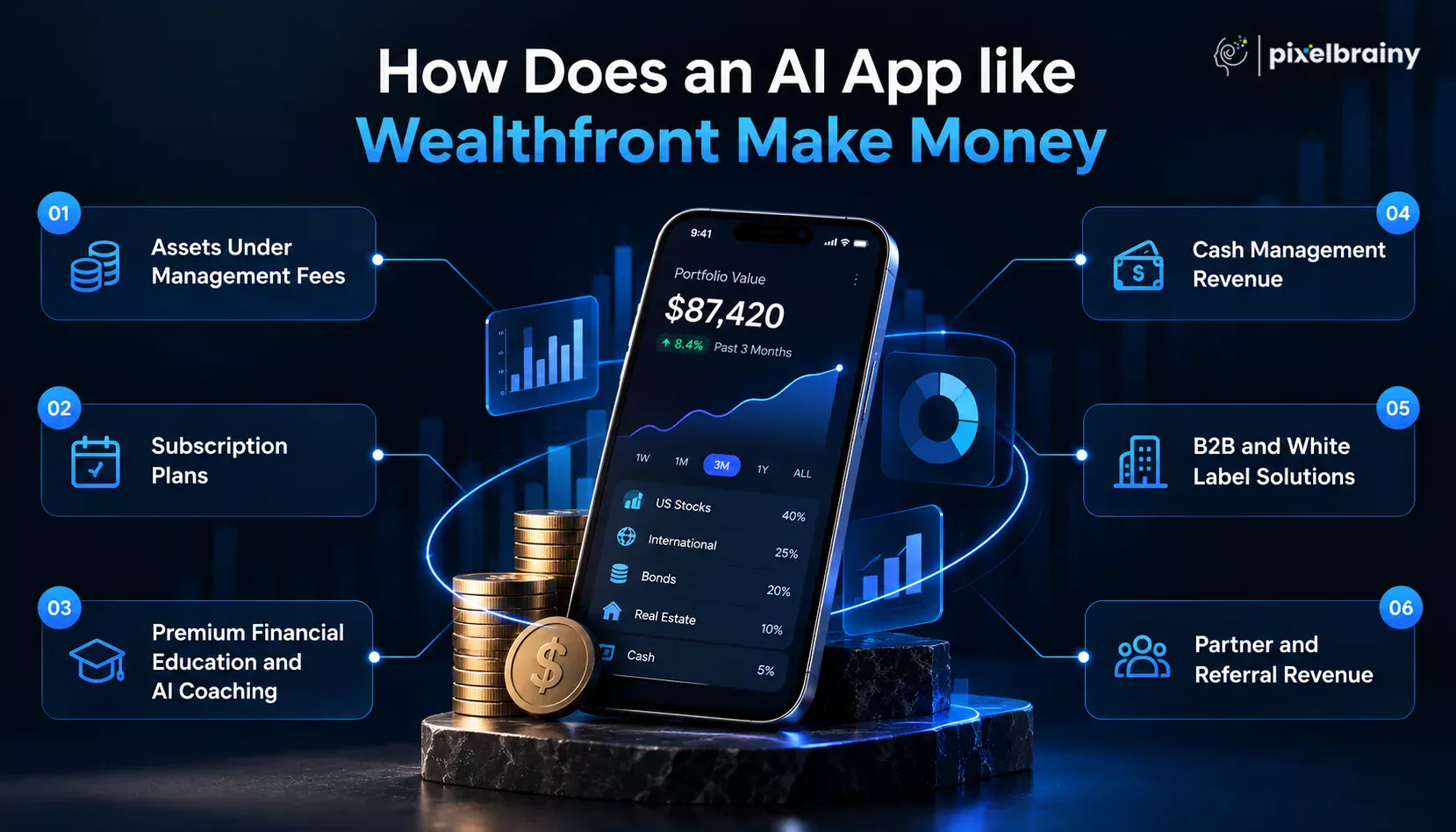
Assets under management, commonly called AUM fees, are a widely used model for digital wealth management platforms. The application charges a percentage based on the assets managed through the platform.
For example, a startup can charge an annual management fee based on a user's portfolio value. As users increase their investments and the total assets managed by the platform grow, the business can generate recurring revenue.
For building an AI investment app like Wealthfront, this model can create a long-term relationship between platform growth and customer asset growth. However, fee structures, disclosures, licensing, and applicable regulations must be carefully evaluated before implementation.
Subscription plans can create predictable recurring revenue while allowing businesses to offer different levels of functionality.
A possible subscription structure could include:
For a startup targeting first-generation wealth builders, a freemium strategy can provide access to basic financial education while reserving advanced coaching and planning capabilities for paid users.
For Wealthfront like AI app development, financial education can become more than an additional feature. It can become a core monetization opportunity and product differentiator.
Premium services could include personalized learning paths, AI coaching, financial literacy assessments, interactive investment lessons, and goal specific educational programs.
For example, a beginner investor could receive personalized lessons about diversification, risk tolerance, compound growth, asset allocation, and long-term investing based on their knowledge level and financial objectives.
This approach allows the platform to generate revenue while directly supporting its goal of helping users become more financially confident.
An investment platform can expand its revenue opportunities by offering cash management services through an appropriate regulated structure and financial partners.
Potential offerings may include:
Adding cash management can also increase customer retention by allowing users to manage more aspects of their financial lives within one platform.
Another monetization opportunity for an AI investment app like Wealthfront is selling the underlying technology to businesses.
A platform can provide investment management, portfolio technology, AI education, and financial coaching capabilities to:
This B2B approach can diversify revenue and allow the technology to serve a larger audience through established financial organizations.
Depending on the jurisdiction, business model, disclosures, and applicable regulations, partnerships with financial service providers can create additional revenue opportunities.
For example, a platform may collaborate with eligible providers for financial products or complementary services. Any such arrangement should be transparent to users and structured in accordance with applicable financial regulations.
There is no single monetization model that works for every AI investment app development like Wealthfront project. A startup serving small-balance investors may benefit from combining free educational content with affordable subscriptions, premium AI coaching, and scalable B2B partnerships.
The most important principle is to align monetization with customer value. The platform should make money by helping users build better financial habits and manage their wealth, rather than encouraging unnecessary transactions or excessive investing activity.
A diversified revenue strategy can make an AI investment app like Wealthfront more sustainable while keeping financial education and automated wealth management accessible to the users who need them most.
Is building an AI investment app like Wealthfront a worthwhile opportunity for fintech businesses in 2026 and beyond? For startups and financial companies, the answer increasingly depends on whether they can combine automated investing with a differentiated customer experience rather than simply replicate an existing robo advisor.
A useful real-world query for businesses exploring this space is: "Why should I build an AI investment app like Wealthfront for first-time and underserved investors?" The answer lies in growing demand for accessible investing, personalization, financial education, and scalable wealth management.
The robo advisory market is entering a strong growth phase. According to The Business Research Company, the global robo advisory market is projected to grow from $14.25 billion in 2025 to $18.7 billion in 2026, with a further forecast of $54.74 billion by 2030, representing a 30.8% CAGR from 2026 to 2030. The report identifies AI driven advisory tools, personalized financial planning, younger investors, and automated risk profiling among the factors supporting future growth.
This creates a significant opportunity for businesses considering AI investment app development like Wealthfront, particularly those that can offer a more specialized user experience.
Many potential investors are interested in building wealth but may find traditional financial services complicated, expensive, or difficult to access. This creates an opportunity to develop investment platforms specifically for:
An AI investment app like Wealthfront can make the experience more accessible by combining automated investing with simple explanations, personalized education, and guided financial experiences.
AI allows businesses to move beyond standardized investment experiences. An AI powered platform can personalize financial education, portfolio explanations, goal tracking, notifications, and user interactions according to individual needs.
For example, a beginner could receive basic explanations of diversification, while a more experienced investor could receive deeper portfolio analytics. This creates opportunities for Wealthfront like AI app development with a stronger focus on personalization.
Financial education can become one of the strongest differentiators for a new investment platform. Instead of following a purely set-it-and-forget-it approach, businesses can build an AI financial education layer that explains investment concepts and helps users understand the reasoning behind portfolio decisions.
This is particularly valuable for first-generation wealth builders who want to develop financial confidence alongside their investment portfolios.
Automation enables businesses to serve a growing customer base without requiring every routine portfolio activity to be handled manually. AI can further support personalization, customer education, financial insights, and digital assistance at scale.
For companies planning to build an AI investment app like Wealthfront, this combination can create a scalable foundation for serving thousands or potentially millions of users while maintaining a personalized digital experience.
The strongest opportunity is not simply to copy Wealthfront, but to build a differentiated AI investment platform that makes wealth management more accessible, personalized, and educational. This can help businesses create long-term customer value while participating in a rapidly expanding digital wealth management market.
For fintech businesses, building an AI investment app like Wealthfront is not only about adding automated investing features. The real business value comes from creating a platform that can personalize financial experiences, reduce operational effort, improve customer retention, and serve investors who may need more guidance than traditional investment platforms provide.
A common question from business owners is: “What are the actual benefits of developing an AI investment app like Wealthfront for my fintech business?” The answer depends on how effectively AI, automation, investment technology, and financial education are combined into one user-focused platform.
Wealthfront demonstrates the commercial value of combining automated portfolio management with personalized investing, tax-aware features, and customizable portfolios. Its current platform also includes socially responsible investment options.
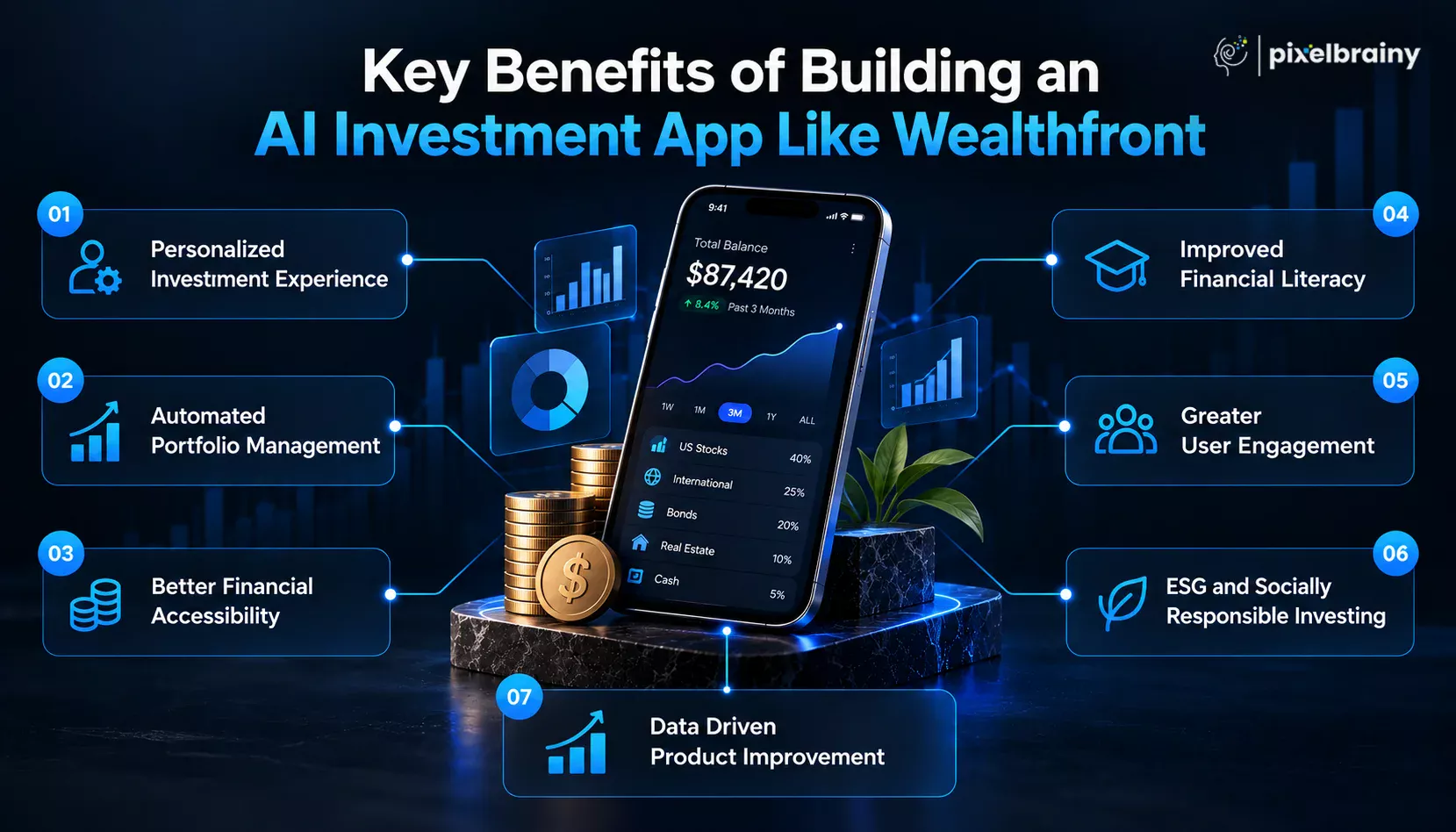
One of the biggest benefits of AI investment app development like Wealthfront is the ability to create highly personalized investment experiences. Instead of presenting every customer with the same portfolio recommendations, AI can analyze factors such as investment goals, risk tolerance, financial objectives, investment behavior, and preferences.
For example, a first-time investor may receive simpler explanations and educational recommendations, while an experienced investor can receive more advanced portfolio insights. AI can continuously personalize content, alerts, financial goals, and investment recommendations based on changing user needs.
For businesses, this personalization can create a stronger product experience and help differentiate an AI investment app like Wealthfront from generic investment platforms.
Automation can significantly reduce the amount of manual effort required to manage investment portfolios. An AI app like Wealthfront can automate activities such as portfolio allocation, rebalancing, dividend reinvestment, investment contributions, and other predefined portfolio management processes.
Wealthfront, for example, uses software to automatically manage portfolios, maintain investment targets, and support features such as automatic rebalancing and tax-loss harvesting.
For business owners, automation can improve operational efficiency while allowing the platform to support a growing number of customers. This makes automated portfolio management an important benefit when planning Wealthfront like AI app development.
An AI investment app like Wealthfront can make investing easier to access for people who may feel excluded by traditional financial services. This is particularly valuable for first-time investors, younger professionals, underserved wealth builders, and customers starting with relatively small amounts.
AI can simplify financial terminology, provide guided onboarding, explain investment options, and help users understand their financial goals. A platform can also provide digital access to investment services without requiring customers to schedule meetings with financial professionals for every basic question.
For businesses, greater accessibility means a larger potential customer base and an opportunity to build an inclusive wealth management app like Wealthfront.
Financial education can become one of the strongest differentiators for an AI investment app like Wealthfront. Many users understand that investing is important but struggle with concepts such as diversification, asset allocation, risk, compound growth, and market volatility.
An AI-powered financial education layer can explain these concepts in simple language and provide contextual explanations based on what the user is viewing. For example, when a portfolio changes, AI could explain why the change occurred and what it means for the user's long-term strategy.
This approach helps businesses move beyond a simple robo advisor app like Wealthfront and create a platform that actively builds customer knowledge, confidence, and trust.
Investment platforms can struggle with keeping users engaged after account creation. AI can help businesses create more meaningful interactions through personalized insights, portfolio updates, goal reminders, educational content, conversational assistance, and relevant notifications.
Instead of sending generic messages to every customer, an AI investment app development strategy can use user behavior and financial goals to determine what information is most relevant. A new investor might receive a lesson about diversification, while another user might receive a portfolio progress update.
For business owners, higher-quality engagement can support stronger retention, more frequent app usage, and greater opportunities for cross-selling premium financial services.
Adding ESG and socially responsible investing options can help an AI investment app like Wealthfront appeal to users who want their investment choices to reflect personal values. AI can help users explore investment themes, understand ESG factors, compare portfolio options, and customize selected investment preferences.
Wealthfront currently offers socially responsible portfolios that consider environmental, social, and governance factors, along with options for users to customize their investments.
For businesses, ESG capabilities can create another product differentiation opportunity. A fintech startup can develop its own responsible investing methodology and use AI to make those choices easier for customers to understand.
An AI investment app like Wealthfront can generate valuable product insights from user interactions, engagement patterns, portfolio preferences, feature usage, and educational content consumption. When handled with appropriate privacy, security, consent, and regulatory controls, these insights can help businesses understand how customers use the platform.
For example, product teams can identify where users abandon onboarding, which educational topics generate the most interest, or which features are most frequently used. These insights can guide future product updates, personalization strategies, and customer experience improvements.
This makes data-driven product improvement a long-term advantage of AI investment app development, helping businesses continuously refine their platform instead of treating development as a one-time project.
The strongest benefit of building an AI investment app like Wealthfront is the combination of automation, personalization, education, accessibility, and scalable digital wealth management. For businesses, these capabilities can create a more differentiated product while improving operational efficiency and long-term customer value.

When businesses plan to build an AI investment app like Wealthfront, the feature set should match the target investor rather than simply replicate an existing robo advisor. For a millennial and Gen Z audience, the core platform can combine automated ETF investing with stronger ESG customization, accessible financial education, and a simple digital investing experience.
A real business query worth addressing is:
“We are building an AI investment app for millennial and Gen Z investors. What core features should we include to support traditional ETF portfolios, deeper ESG customization, crypto and alternative assets, and privacy-preserving social investing?”
For a Wealthfront-comparable product, the foundation should first cover essential investing functionality. Wealthfront's current platform includes personalized portfolios, automatic investing, rebalancing, dividend reinvestment, portfolio customization, and performance tracking.
The following features focus on the core functionality of an AI investment app like Wealthfront. Advanced AI capabilities are intentionally excluded and can be covered separately.
| Feature | Explanation |
|---|---|
| Digital Account Registration | Users can create investment accounts digitally by entering personal details, contact information, and required account information, giving businesses a convenient foundation for a fully online investment experience. |
| KYC and Identity Verification | Built-in KYC and identity verification can collect required customer information and validate identities during onboarding, helping businesses establish compliant account-opening workflows for their investment platform. |
| Risk Assessment | A risk assessment questionnaire can evaluate financial goals, investment experience, time horizon, income, and risk tolerance to support suitable portfolio recommendations for different investor profiles. |
| Investment Goal Setting | Users can create goals such as retirement, home ownership, education, or wealth building, then establish target amounts and timelines that help organize their investment strategy. |
| Personalized Portfolio Creation | The platform can generate diversified portfolios based on investor profiles, goals, risk preferences, and selected investment categories, creating a more personalized experience than standardized investment products. |
| ETF Portfolio Management | Users can manage diversified ETF portfolios through a centralized interface showing holdings, allocations, contributions, performance, and portfolio changes while maintaining the simplicity expected from a robo advisor. |
| Automated Investing | Users can schedule recurring contributions and automate eligible investment transactions, helping them maintain consistent investing habits while reducing the manual effort associated with placing individual portfolio trades. |
| Portfolio Rebalancing | The platform can monitor portfolio allocation changes and trigger eligible rebalancing actions when holdings move away from defined targets, helping maintain the intended investment allocation over time. |
| Dividend Reinvestment | Eligible dividends can be automatically reinvested into selected investments, helping users keep their capital invested while reducing the need to manually place recurring reinvestment transactions. |
| Portfolio Customization | Investors can personalize eligible portfolios by adjusting allocations or selecting supported investments, giving users greater control while retaining automated management capabilities for their long-term investment strategy. |
| ESG Investment Preferences | Users can select ESG and values-based investment preferences to build portfolios aligned with environmental, social, and governance priorities, creating stronger differentiation for younger values-conscious investors. |
| Crypto and Alternative Asset Support | A multi-asset architecture can allow eligible cryptocurrency and alternative investment products alongside traditional ETFs, giving younger investors broader portfolio choices while requiring separate risk and compliance controls. |
| Portfolio Performance Tracking | Users can monitor portfolio returns, gains, losses, contributions, allocation changes, and historical performance from one dashboard, making investment progress easier to understand and evaluate over time. |
| Privacy-Preserving Social Features | Users can optionally compare selected portfolio performance metrics, investment strategies, or milestones with friends without exposing sensitive account balances, holdings, or personally identifiable financial information. |
These core features provide a strong foundation for AI investment app development like Wealthfront, while creating room for differentiation through ESG investing, alternative assets, and privacy-focused social investing.
For businesses targeting millennial and Gen Z investors, combining automated ETF management with multi-asset support and personalized experiences can create a more competitive investment app like Wealthfront.
The key is to build scalability, privacy, security, and compliance into the platform from the beginning, especially when adding crypto, alternative investments, and social features.
After implementing the core functionality, businesses can introduce advanced AI capabilities to make an AI investment app like Wealthfront more intelligent, personalized, and competitive. These features can improve investment decision support, financial education, portfolio analysis, and user engagement.
A real business question is: “What advanced AI features should we add to an investment app like Wealthfront to provide smarter portfolio guidance and a more personalized investing experience?”
The following advanced features can help businesses develop a differentiated AI wealth management app like Wealthfront, while creating additional value for investors with different financial goals, experience levels, risk profiles, and investment preferences.
| Advanced Feature | Explanation |
|---|---|
| AI Financial Coach | An AI financial coach can provide personalized guidance, explain investment concepts, answer financial questions, and help users understand financial decisions according to their goals and investment experience. |
| AI Portfolio Insights | AI can analyze portfolio data and generate personalized insights about diversification, allocation, performance, risk exposure, and areas users may need to review or better understand. |
| Conversational Investment Assistant | A conversational AI assistant can allow users to ask natural-language questions about investments, portfolios, financial goals, market concepts, and account activity without navigating multiple screens. |
| Predictive Goal Planning | AI can evaluate contribution patterns, investment timelines, portfolio performance, and financial objectives to estimate potential outcomes and show whether current strategies remain aligned with user goals. |
| Personalized Financial Education | AI can recommend educational content based on a user's knowledge level, portfolio, investment behavior, and questions, making financial learning more relevant than generic educational resources. |
| Behavioral Investment Insights | AI can identify patterns such as frequent portfolio changes, reactions to market volatility, or inconsistent contributions and provide educational prompts that encourage more disciplined long-term investment behavior. |
| AI Powered Risk Monitoring | AI can continuously evaluate portfolio characteristics, allocation changes, concentration, and relevant risk indicators to identify potential concerns and provide appropriate information for users to review. |
| Intelligent ESG Recommendations | AI can analyze user-selected ESG preferences and investment information to help identify portfolio options that better align with environmental, social, and governance priorities. |
| Personalized Market Summaries | AI can summarize relevant market developments and explain general portfolio implications in accessible language, helping users understand financial events without requiring extensive investment knowledge. |
| AI Portfolio Optimization | AI can evaluate investment objectives, diversification, risk factors, preferences, and portfolio constraints to identify potential allocation improvements within the platform's defined investment methodology and regulatory framework. |
These advanced capabilities can take Wealthfront like AI app development beyond basic automated investing by adding intelligent guidance, personalized education, portfolio intelligence, and conversational experiences.
For businesses investing in AI investment app development like Wealthfront, the strongest approach is to use AI to improve personalization and financial understanding while maintaining transparency, security, human oversight, and regulatory compliance.
After you finalized the features, now it’s time to turn the product concept into a structured AI investment app development like Wealthfront process. Building a regulated investment platform requires more than designing screens and integrating an AI model. Businesses need to define the investment model, compliance architecture, data infrastructure, security controls, AI capabilities, and launch strategy before development begins.
A real-world question from a fintech compliance team could be: “How can we build a Wealthfront-comparable AI investment platform while addressing SEC registration, fiduciary responsibilities, broker-dealer custody, AI recommendations, disclosures, and compliance from the beginning?”
This is an important consideration because internet-based investment advisers can fall within specific SEC registration requirements, while broker-dealers handling customer assets have separate customer protection obligations. The SEC's internet adviser reforms and FINRA's customer protection framework should therefore be considered during product planning, not after development.
Here are the key steps to build AI investment app like Wealthfront from idea to launch.
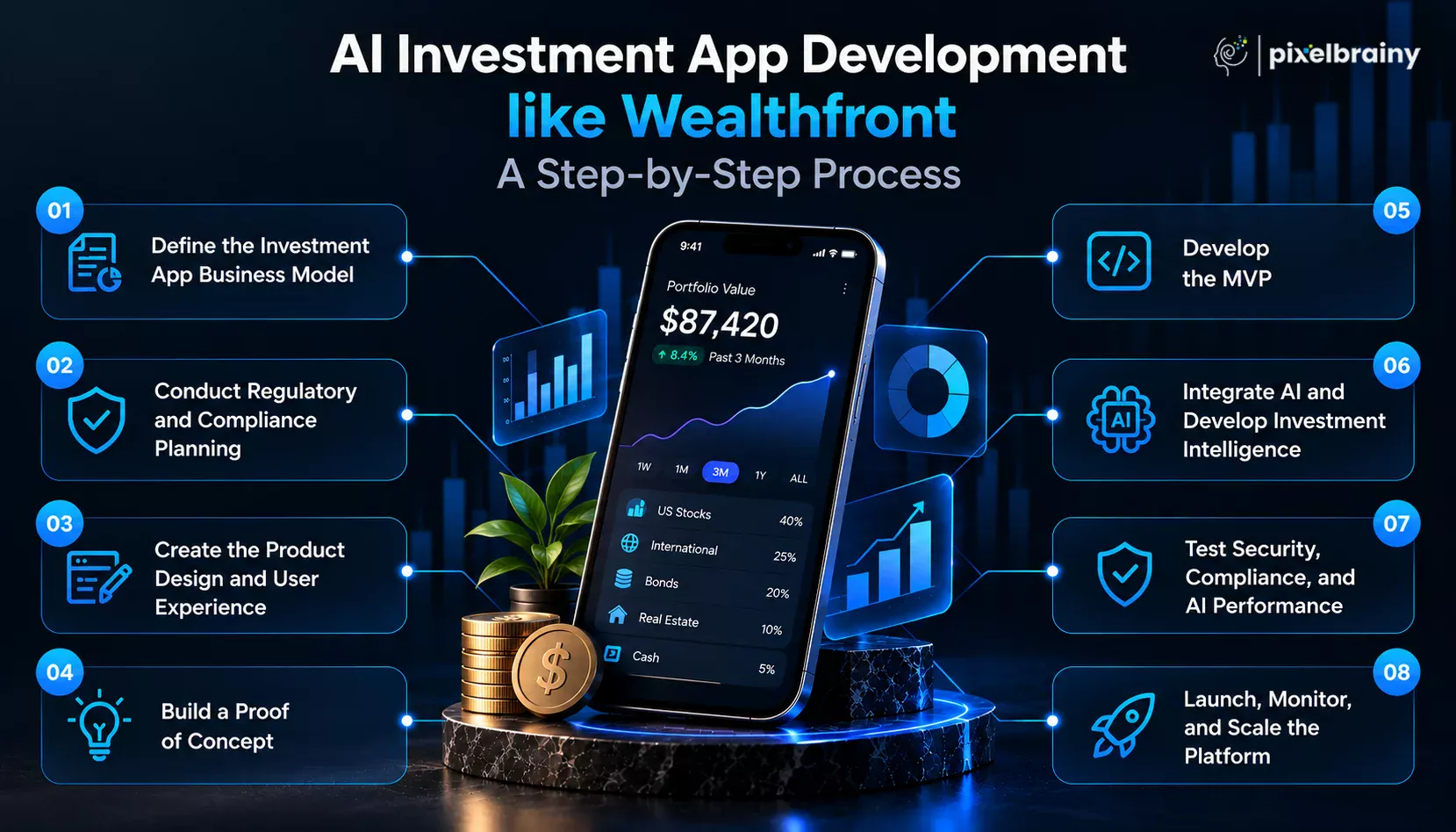
Start by defining exactly what the platform will offer, who it will serve, and how it will generate revenue. Decide whether the product will provide automated investment advice, brokerage services, portfolio management, financial education, or a combination of these services.
For building an AI investment app like Wealthfront, define the target users, investment products, account types, pricing model, geographic market, custody arrangement, and level of portfolio automation. This stage should also establish whether the business will operate as an adviser, partner with an existing regulated entity, or use another appropriate structure.
A clearly defined business model prevents unnecessary development and gives technical and compliance teams a concrete product scope.
Compliance should be designed into the development process of AI investment app like Wealthfront, particularly when the platform provides personalized investment advice or manages customer portfolios. The regulatory structure can influence onboarding, disclosures, recommendation logic, recordkeeping, custody arrangements, supervision, and user communications.
The SEC states that certain internet investment advisers can register under the Internet Adviser Exemption, subject to specific conditions, including maintaining an operational interactive website and providing advice to clients exclusively through that website.
Broker-dealer relationships introduce additional considerations. FINRA explains that broker-dealers are subject to customer protection requirements concerning customer funds and securities.
Because requirements depend on the actual business structure, involve qualified securities counsel and compliance professionals before implementation.
Once the business and compliance requirements are defined, design the complete user journey from account registration to portfolio management. Map onboarding, KYC, risk assessment, goal creation, portfolio recommendations, funding, investment monitoring, withdrawals, disclosures, and customer support.
Working with a specialized UI/UX design company can help translate complex financial workflows into clear and understandable experiences. This is particularly important for an investment app because users need to understand what they are approving before money is invested.
Design should also consider accessibility, transparent disclosures, consent flows, privacy controls, error handling, and educational explanations. Prototypes can then be tested with representative users before engineering begins, reducing expensive design changes during development.
Before committing to full-scale AI product development, businesses can validate the most important technical and investment assumptions through PoC development. The proof of concept can test whether selected AI models can analyze relevant financial information, generate appropriate explanations, classify user inputs, or support portfolio-related workflows.
The PoC should not be treated as a production investment adviser. Instead, it can demonstrate technical feasibility while allowing compliance, investment, product, and engineering teams to identify limitations early.
Testing should include model accuracy, explainability, response consistency, data handling, latency, security, and failure scenarios. A successful proof of concept gives stakeholders greater confidence about the architecture and helps determine which AI capabilities should move into the MVP.
The next stage is MVP development, where the validated product concept becomes a usable investment platform with essential functionality. The MVP can include account registration, identity verification, risk profiling, investment goals, portfolio creation, account funding, portfolio dashboards, automated investing, notifications, and required disclosures.
For how to build AI investment app like Wealthfront from scratch, the MVP should focus on the smallest compliant product capable of delivering the intended investment experience. Avoid adding every possible asset class or AI capability immediately.
The MVP should also include audit logging, permission management, security controls, data encryption, and appropriate administrative tools. This approach allows businesses to test the product with controlled users, collect feedback, and validate the operating model before expanding functionality.
Also Read: Top 10 AI MVP Development Companies in USA
After establishing the core platform, businesses can move toward AI integration for capabilities such as financial education, portfolio explanations, personalized insights, conversational assistance, behavioral analysis, and decision-support workflows.
The AI layer should operate within clearly defined rules and permissions. Investment recommendations should have appropriate controls, explainability mechanisms, testing procedures, monitoring, and human oversight where required by the operating model.
For investment app development like Wealthfront using AI, the objective should not simply be to add a chatbot. AI should solve meaningful user and business problems while producing consistent, understandable, and appropriately controlled outputs.
The development team should also establish procedures for monitoring model performance, handling inaccurate responses, updating models, managing data quality, and documenting changes.
Before launch, conduct comprehensive testing across application security, financial workflows, AI behavior, data protection, integrations, and compliance requirements. AI consultation can be valuable at this stage when businesses need to assess model selection, AI governance, risk controls, and production-readiness.
Testing should cover authentication, authorization, encryption, API security, transaction workflows, account permissions, data retention, audit trails, and failure recovery. AI systems should also be tested for inaccurate recommendations, inconsistent explanations, biased outputs, prompt manipulation, and inappropriate financial guidance.
The compliance team should review disclosures, consent mechanisms, communication workflows, records, and supervisory controls. This stage is essential for to create an AI investment app like Wealthfront that is technically reliable and operationally ready.
After successful testing and required regulatory preparation, launch the platform through a controlled rollout rather than immediately targeting the entire market. Start with a limited user group, monitor technical performance, analyze user behavior, review AI outputs, and resolve operational issues before scaling.
Businesses can hire AI developers with experience in fintech systems, machine learning, secure APIs, cloud infrastructure, and production AI monitoring to support continuous improvements. When evaluating top AI app development companies, look for teams that understand regulated financial products rather than focusing only on generic AI development.
As AI adoption grows, the platform can expand into additional investment products, personalization, financial education, alternative assets, and other capabilities. Continuous monitoring should remain part of the operating model because AI systems, regulations, financial products, and user expectations can change over time.
A successful Wealthfront like app development strategy combines product planning, compliance, secure engineering, AI capabilities, testing, and continuous optimization from the beginning, rather than treating regulatory requirements as a final development task.
The cost to develop an AI investment app like Wealthfront typically ranges from $50,000 to $350,000+, depending on the product scope, investment features, AI capabilities, regulatory requirements, integrations, security architecture, and development team location.
For businesses preparing the development budget of an AI investment app like Wealthfront, it is important to distinguish between a basic MVP and a production-ready investment platform. Current 2026 industry estimates place investment and robo-advisor platforms in a broad range, with one recent estimate putting MVP development around $85,000 to $125,000 and more complex platforms at $260,000 to $650,000.
So, what is the development pricing of an AI investment app like Wealthfront? A realistic answer is that the AI investment app like Wealthfront development cost depends heavily on the level of automation, AI intelligence, compliance architecture, asset classes, integrations, and scalability required.
| App Type | Estimated Development Cost | Suitable For |
|---|---|---|
| Basic AI Investment App | $50,000 to $100,000 | Startups validating an investment concept with essential onboarding, risk assessment, portfolio management, basic automation, dashboards, and limited AI capabilities. |
| Advanced AI Investment App | $100,000 to $200,000 | Businesses requiring automated portfolio management, deeper AI personalization, financial education, multiple integrations, advanced analytics, stronger security, and expanded investment functionality. |
| Enterprise AI Investment App | $200,000 to $350,000+ | Large fintech businesses requiring scalable architecture, sophisticated AI, multi-asset investing, extensive compliance infrastructure, enterprise security, high-volume transactions, and multiple financial integrations. |
These figures are development estimates, not fixed quotes. A regulated, production-ready platform can exceed $350,000 when businesses require complex compliance architecture, multiple jurisdictions, proprietary AI models, extensive integrations, or additional financial products.
The overall complexity has a direct impact on the cost estimation of an AI investment app like Wealthfront. A simple MVP with basic portfolio management costs considerably less than a platform supporting multiple account types, asset classes, automated investing, advanced analytics, and complex financial workflows.
Investment platforms require clear dashboards, onboarding flows, portfolio visualizations, risk questionnaires, transaction screens, and educational interfaces. A highly customized financial experience can increase design and prototyping costs.
The AI budget depends on whether the product uses third-party AI APIs, customized machine learning models, or proprietary investment intelligence. AI financial coaching, portfolio insights, personalization, and recommendation systems can significantly increase the AI investment app development cost.
KYC, AML, audit trails, disclosures, permissions, regulatory reporting, data retention, and adviser or broker-dealer workflows can add substantial development costs. For US investment products, the appropriate SEC and FINRA considerations should be assessed during product planning rather than added after development.
Integrations with brokerage APIs, custodians, market data providers, KYC services, payment systems, banking platforms, tax services, analytics tools, and notification providers can increase development and testing costs.
Financial applications require strong authentication, encryption, access controls, secure APIs, monitoring, audit logging, vulnerability testing, and data protection. Security becomes increasingly important as the platform handles sensitive financial and personal information.
Supporting traditional ETFs is different from supporting stocks, cryptocurrency, bonds, alternative assets, or other investment products. Each additional asset class can require new APIs, portfolio logic, transaction workflows, risk controls, data sources, and compliance considerations.
Businesses choosing proprietary AI model development may need additional spending for data preparation, model training, evaluation, infrastructure, monitoring, explainability, and continuous improvement. Using existing AI services can reduce the initial development budget.
Testing costs cover functional testing, API testing, security testing, performance testing, financial transaction workflows, mobile compatibility, AI output evaluation, and compliance-related validation. The more complex the platform, the greater the testing effort.
The initial development budget does not cover all ongoing expenses. Businesses should plan for cloud infrastructure, security updates, third-party API charges, AI usage, model monitoring, bug fixes, regulatory changes, performance optimization, and new feature development.
For a startup, $50,000 to $100,000 can be a reasonable starting range for a focused MVP. A more complete AI investment app like Wealthfront with sophisticated automation and AI capabilities may require $100,000 to $200,000, while enterprise-grade platforms can reach $350,000+.
For context, Wealthfront currently charges a 0.25% annual advisory fee for its Automated Investing Account and provides automated trades, portfolio customization, automatic rebalancing, and tax-loss harvesting. This illustrates why businesses should evaluate the underlying technology and operational scope rather than comparing development costs based only on visible app features.
The final cost to develop an AI investment app like Wealthfront depends on the combination of AI sophistication, investment functionality, compliance, security, integrations, and scalability required for the target market.
The technology stack is a critical part of AI investment app development like Wealthfront because the platform must handle financial transactions, portfolio data, AI workloads, real-time market information, third-party integrations, and sensitive customer information. A modern architecture should be scalable, API-first, cloud-ready, and designed with security and compliance requirements from the beginning. Current 2026 fintech guidance increasingly emphasizes cloud-native infrastructure, API-led connectivity, governed data, real-time processing, and AI-ready architecture.
A real business query is: “What technology stack should we use to build an AI investment app like Wealthfront that can support automated portfolios, AI recommendations, real-time market data, secure transactions, and future scalability?”
For businesses planning Wealthfront like app development, the following stack provides a practical foundation. The exact technologies can vary based on the target market, regulatory environment, investment products, and development requirements.
| Technology Layer | Recommended Tools and Technologies | Purpose in an AI Investment App |
|---|---|---|
| Mobile App | React Native, Flutter, Swift, Kotlin | Builds secure iOS and Android investment experiences, including onboarding, portfolios, transactions, notifications, and financial dashboards. React Native and Flutter can support cross-platform development, while Swift and Kotlin provide native development options. |
| Web Application | React.js, Next.js, TypeScript | Supports investor dashboards, administration panels, compliance interfaces, portfolio management, analytics, and other web-based experiences with scalable frontend architecture. |
| Backend Development | Python, FastAPI, Node.js, Java Spring Boot, Go | Handles authentication, portfolio logic, account management, investment workflows, API services, transaction processing, and communication between application components. |
| Database | PostgreSQL, MongoDB | PostgreSQL can manage structured financial and transactional data with strong consistency, while MongoDB can support flexible data requirements where appropriate. |
| Caching | Redis | Provides fast access to frequently requested information such as sessions, temporary calculations, portfolio data, and application-level cache, helping improve response times. |
| AI and Machine Learning | Python, PyTorch, TensorFlow, scikit-learn | Supports portfolio intelligence, personalization, recommendation models, behavioral analysis, financial education, predictive analytics, and other AI capabilities. |
| Generative AI | OpenAI API, Anthropic API, Google Gemini API, RAG frameworks | Enables conversational financial assistants, investment explanations, educational experiences, document processing, and natural-language interactions while allowing businesses to maintain appropriate AI governance. |
| AI Model Management | MLflow, managed cloud ML services | Helps teams track model versions, evaluate performance, manage experiments, monitor models, and maintain controlled AI deployment workflows. |
| Market Data APIs | Polygon, Bloomberg, Refinitiv, exchange or broker APIs | Provides market prices, historical data, securities information, corporate actions, and other financial datasets required for investment applications. |
| Brokerage and Custody APIs | Alpaca, DriveWealth, Apex Clearing and similar providers | Connects the application with brokerage infrastructure for eligible account opening, trading, custody, portfolio operations, and investment workflows depending on the business model. |
| KYC and AML | Persona, Alloy, Sumsub, Jumio | Supports identity verification, customer onboarding, sanctions screening, and other compliance-related workflows based on the applicable regulatory requirements. |
| Cloud Infrastructure | AWS, Microsoft Azure, Google Cloud | Provides scalable computing, storage, databases, networking, security services, AI infrastructure, monitoring, and disaster recovery capabilities. |
| API Management | AWS API Gateway, Kong, Apigee | Controls API access, authentication, rate limiting, traffic management, monitoring, and communication between application services and external financial providers. |
| Authentication and Security | OAuth 2.0, OpenID Connect, MFA, biometric authentication, AWS KMS or equivalent | Protects user accounts and sensitive financial information through strong authentication, authorization, encryption, key management, and secure access controls. |
| Event Streaming | Apache Kafka, AWS EventBridge | Processes real-time events such as portfolio updates, transactions, market data, notifications, and audit events across distributed application services. |
| DevOps and Deployment | Docker, Kubernetes, Terraform, GitHub Actions | Supports containerized deployment, infrastructure automation, continuous integration, continuous delivery, environment management, and scalable production operations. |
| Monitoring and Analytics | Datadog, Grafana, Prometheus, Mixpanel | Helps monitor application health, infrastructure performance, AI services, errors, user behavior, engagement, and operational metrics. |
| Security Testing | SAST, DAST, vulnerability scanners, penetration testing tools | Identifies application vulnerabilities, insecure dependencies, API weaknesses, authentication problems, and other security risks before and after production deployment. |
The right technology stack gives an AI investment app like Wealthfront the security, scalability, AI capabilities, and financial infrastructure needed to support reliable growth from MVP to enterprise scale.
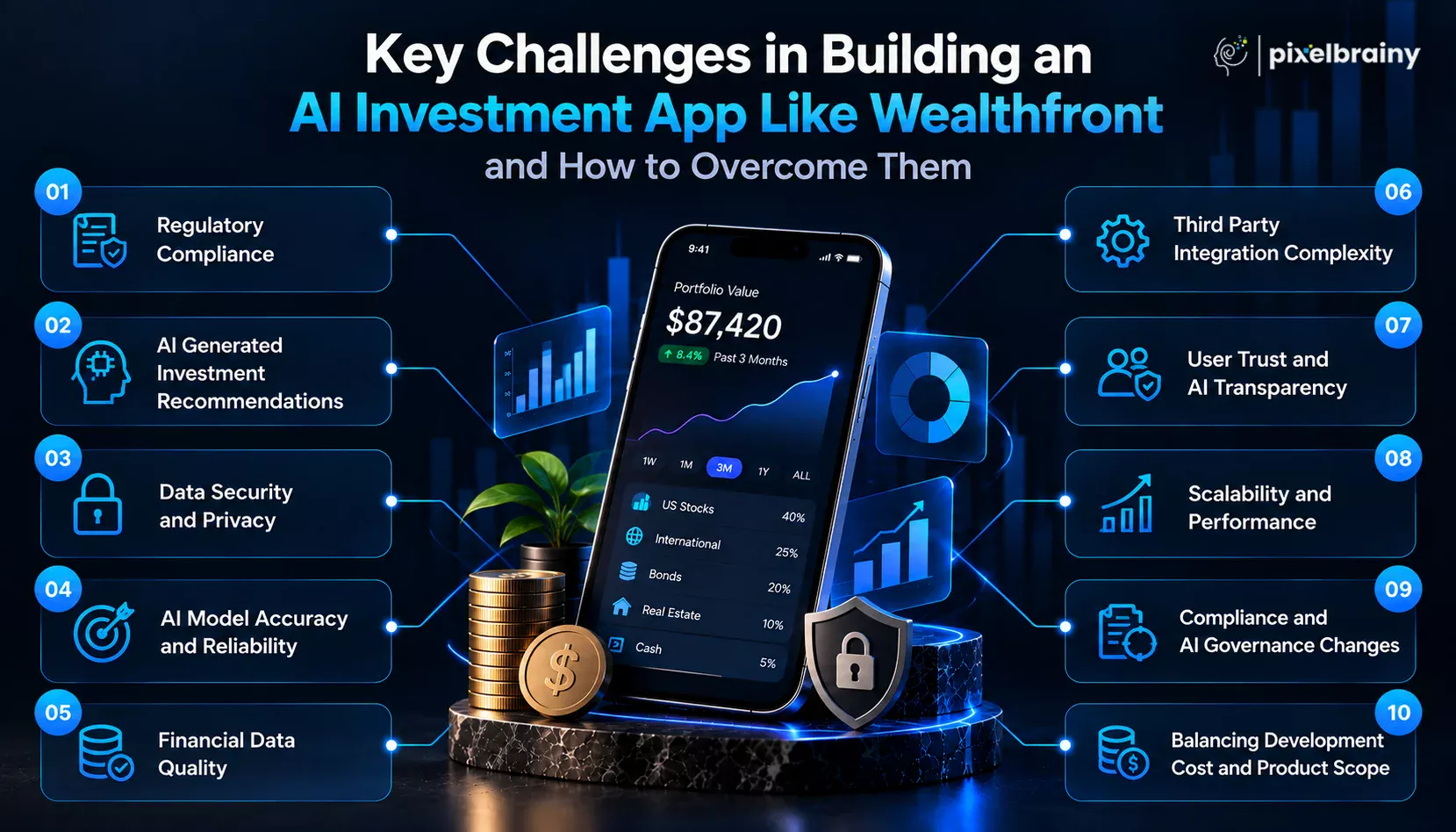
Building an AI investment app like Wealthfront involves more than developing automated portfolios and adding AI features. Businesses must address regulatory compliance, financial data security, AI reliability, investment suitability, third party integrations, scalability, and user trust throughout the development lifecycle.
A real business question is: “What are the biggest challenges we may face when developing an AI investment app like Wealthfront, and how can we solve them without increasing compliance and technology risks?”
The SEC has emphasized that robo advisers remain subject to applicable investment adviser obligations, while FINRA notes that using AI does not remove a firm's existing regulatory responsibilities.
Challenge:
Regulatory compliance is one of the biggest challenges when developing a Wealthfront like AI investment app. Depending on the business model and jurisdiction, the platform may need to address investment adviser registration, fiduciary obligations, disclosures, KYC, AML, custody, recordkeeping, and applicable broker-dealer requirements.
How to overcome it:
Build compliance requirements into the product architecture from the beginning. Map each investment workflow to applicable regulatory obligations and involve securities counsel and compliance professionals before development. The SEC's internet adviser framework has specific requirements for advisers relying on that exemption.
Challenge:
AI can produce inaccurate, inconsistent, or unsuitable outputs. This becomes particularly important when an AI system influences investment decisions or communicates personalized recommendations to customers.
How to overcome it:
Use controlled recommendation logic, predefined investment policies, model validation, monitoring, explainability mechanisms, and human oversight where appropriate. FINRA specifically notes that firms using AI must conduct due diligence and assess the technology's impact on regulatory obligations.
Challenge:
An AI investment app like Wealthfront handles highly sensitive information, including identity details, financial information, portfolio data, transaction records, and potentially connected banking information. A security incident could create financial, legal, and reputational consequences.
How to overcome it:
Implement encryption, MFA, role-based access controls, secure APIs, tokenization where appropriate, audit logs, vulnerability testing, continuous monitoring, and strict data-access policies. Security should be incorporated into every development layer rather than added before launch.
Challenge:
AI models can generate incorrect explanations, identify misleading patterns, or behave differently when input data changes. Generative AI can also produce confident but inaccurate responses.
How to overcome it:
Establish model evaluation criteria, test datasets, validation procedures, response controls, monitoring systems, fallback mechanisms, and documented model governance. Avoid allowing a general-purpose AI model to independently execute investment decisions without appropriate controls.
Challenge:
Investment applications depend on accurate market prices, portfolio information, transaction data, account balances, and other financial datasets. Delayed, incomplete, or inconsistent data can affect portfolio calculations and user-facing information.
How to overcome it:
Use reliable market data providers, validation processes, data reconciliation, error detection, monitoring, and fallback data sources where appropriate. Financial calculations should also be independently validated instead of relying entirely on AI-generated outputs.
Challenge:
A Wealthfront like app development project may require integrations with brokerages, custodians, KYC providers, payment systems, market data providers, banking platforms, tax services, and notification systems. Changes or outages in external APIs can affect the application.
How to overcome it:
Use modular API architecture, integration abstraction layers, automated testing, monitoring, retry mechanisms, and clearly defined provider contracts. Keeping external integrations separate from core investment logic makes future provider changes easier.
Challenge:
Users may hesitate to trust an AI system with their money, particularly when they do not understand why a portfolio recommendation or investment action was generated.
How to overcome it:
Provide understandable explanations, transparent disclosures, clear portfolio information, risk communication, and user controls. The AI should explain financial concepts in accessible language without presenting uncertain predictions as guaranteed outcomes.
The SEC has also taken enforcement action against investment advisers for misleading claims about their use of AI, demonstrating why businesses need accurate and supportable AI representations.
Challenge:
As the customer base grows, the platform must process more transactions, portfolio calculations, market data, AI requests, notifications, and account activity without compromising performance or reliability.
How to overcome it:
Use cloud infrastructure, scalable databases, API-based services, caching, event-driven architecture, load testing, monitoring, and automated deployment. AI workloads should also be separated from transaction-critical services so heavy AI usage does not affect essential financial operations.
Challenge:
AI technology, digital assets, financial regulations, and industry expectations continue to evolve. A platform built around today's assumptions may require significant changes later.
The SEC's 2026 discussion of AI and investment management highlights the challenge of developing regulatory approaches while technology continues to evolve.
How to overcome it:
Use a modular architecture, maintain detailed documentation, monitor regulatory developments, conduct periodic compliance reviews, and design AI governance processes that can adapt to new requirements.
Challenge:
Businesses can quickly increase the AI investment app development cost by adding cryptocurrency, alternative assets, sophisticated AI models, advanced analytics, social investing, multiple account types, and extensive financial integrations before validating the core product.
How to overcome it:
Start with a focused MVP, validate the business model, measure user demand, and introduce advanced functionality in phases. This approach helps control development costs while creating a clear roadmap for future AI investment app development like Wealthfront.
A compliance-first architecture, controlled AI implementation, strong security, and phased development strategy can significantly reduce the technical and regulatory risks involved in building an AI investment app like Wealthfront.
From the above discussion, now it’s time to identify the right development partner for your fintech product. An AI investment app like Wealthfront requires a combination of fintech expertise, AI engineering, secure financial integrations, scalable architecture, and a clear understanding of investment workflows.
PixelBrainy positions itself as an AI financial software development company, with published expertise across AI, fintech, trading systems, robo-advisors, financial APIs, and intelligent financial products. Its capabilities cover consultation, product development, AI integration, testing, deployment, and post-launch support.
PixelBrainy's fintech-focused development capabilities can support businesses that want to build AI investment app like Wealthfront with a customized product strategy. Its published services include robo-advisor development, AI trading platforms, broker and financial API integrations, real-time data processing, portfolio rebalancing, and multi-asset environments.
This experience can be valuable when a business wants to develop AI investment app like Wealthfront while adding its own investment model, target audience, financial products, AI capabilities, and user experience.
PixelBrainy has experience working on financial products involving AI, trading intelligence, portfolio analytics, real-time data, and personalized financial experiences.
For one confidential financial technology project, PixelBrainy worked on an trading intelligence platform that consolidated multiple financial data sources into centralized analytics, monitoring, research workflows, and AI-supported insights. The solution included structured financial data, intelligent analysis, customized dashboards, role-based access, and scalable backend infrastructure. Specific client and proprietary details remain confidential.
PixelBrainy also reports delivering an AI trading assistant involving predictive algorithms, real-time alerts, and personalized coaching capabilities. The project demonstrates experience combining AI with financial decision-support and user engagement workflows.
Another published project involved an AI-powered paper trading platform for the US market with real-time equity and crypto data, customizable trading bots, gamified engagement, and risk analytics. According to PixelBrainy, the platform was designed for learners and early-stage traders.
For businesses planning investment app like Wealthfront development integrating AI, PixelBrainy's combination of fintech, AI, trading, data integration, and product engineering experience can support a roadmap from initial concept through production.
The focus can remain on creating a differentiated platform rather than copying Wealthfront, with architecture tailored to your investment strategy, users, asset classes, AI requirements, compliance needs, and long-term growth plans.
Ready to turn your AI investment platform idea into a market-ready product? Connect with PixelBrainy to discuss your requirements and development roadmap.
Creating an AI investment app like Wealthfront is an opportunity to build a smarter, more accessible, and highly personalized wealth management experience. However, success depends on much more than adding AI to an investment platform. Businesses need to bring together automated portfolio management, personalized investing, financial education, secure financial integrations, regulatory compliance, and a scalable technology foundation.
The right approach to AI investment app development like Wealthfront starts with understanding the target users and defining a clear product strategy. From core investment features and advanced AI capabilities to security, compliance, technology stack, development cost, and ongoing optimization, every element should support the overall business objective.
Rather than creating a simple Wealthfront clone app, businesses can use the model as inspiration and build a differentiated platform around their own investment strategy, audience, asset classes, and value proposition. This can create a stronger foundation for long-term growth and customer trust.
Book an appointment with our experts today and turn your AI investment app idea into a clear, actionable development roadmap.
Businesses should begin with a defined investor segment, investment goals, risk profiles, asset classes, and revenue model. The MVP can include onboarding, KYC, risk assessment, portfolio creation, automated investing, and performance tracking before adding advanced AI capabilities.
An AI app like Wealthfront can include AI financial coaching, portfolio analysis, predictive goal planning, behavioral insights, personalized financial education, risk monitoring, conversational assistance, and AI-powered portfolio optimization. These capabilities can make the investment experience more personalized and informative.
The AI investment app like Wealthfront development cost can range from approximately $50,000 for a basic MVP to $350,000+ for an enterprise-grade platform. AI complexity, compliance requirements, financial integrations, security, supported assets, and development scope significantly influence the final investment app development cost.
Before you develop an AI investment app like Wealthfront, assess investment adviser registration, fiduciary obligations, KYC and AML requirements, disclosures, custody arrangements, data protection, recordkeeping, and AI governance. Compliance requirements should be incorporated into the architecture rather than addressed after development.
To create an app like Wealthfront, businesses can combine investor profiles, financial goals, risk tolerance, portfolio data, and market information with recommendation models. AI-generated recommendations should be explainable, appropriately tested, and designed around applicable regulatory and fiduciary requirements.
Wealthfront like AI app development typically requires a secure mobile or web frontend, scalable backend, financial databases, AI and ML services, market data APIs, brokerage integrations, KYC and AML tools, cloud infrastructure, authentication, monitoring, and security testing.
To build a wealth management app like Wealthfront, focus on a distinct value proposition instead of copying an existing platform. Differentiation can come from specialized investment strategies, financial education, ESG preferences, alternative assets, tax-aware investing, AI coaching, or advanced portfolio intelligence.
For investment app development like Wealthfront, PixelBrainy can support businesses with AI-powered fintech product development, robo-advisor solutions, financial API integrations, portfolio management, real-time data processing, and secure scalable architectures. Its published capabilities cover AI consultation, AI integration, AI product development, and fintech application engineering, making it suitable for businesses looking to build a differentiated investment platform rather than a simple clone.

About The Author
Sagar Bhatnagar
Sagar Sahay Bhatnagar brings over a decade of IT industry experience to his role as Marketing Head at PixelBrainy. He's known for his knack in devising creative marketing strategies that boost brand visibility and market influence. Sagar's strategic thinking, coupled with his innovative vision and focus on results, sets him apart. His track record of successful campaigns proves his ability to utilize digital platforms effectively for impactful marketing efforts. With a genuine passion for both technology and marketing, Sagar continuously pushes PixelBrainy's marketing initiatives to greater success.

Working with the PixelBrainy team has been a highly positive experience. They understand the design requirements and create beautiful UX elements to meet the application needs. The dev team did an excellent job bringing my vision to life. We discussed usability and flow. Sagar worked with his team to design the database and begin coding. Working with Sagar was easy. He has the knowledge to create robust apps, including multi-language support, Google and Apple ID login options, Ad-enabled integrations, Stripe payment processing, and a Web Admin site for maintaining support data. I'm extremely satisfied with the services provided, the quality of the final product, and the professionalism of the entire process. I highly recommend them for Android and iOS Mobile Application Design and Development.

Great experience working with them. Had a lot of feedback and I found that unlike most contractors they were bugging me for updates instead of the other way around. They were extremely time conscience and great at communicating! All work was done extremely high quality and if not on time, early! They were always proactive when it comes to communication and the work is great/above par always. Very flexible and a great team to work with! Goes above and beyond to present us with multiple options and always provides quality. Amazing work per usual with Chitra. If you have UI/UX or branding design needs I recommend you go to them! Will likely work with them in the future as well, definitely recommended!

PixelBrainy is a joy to work with and is a great partner when thinking through branding, logo, and website layout. I appreciate that they spend time going into the "why" behind their decisions to help inform me and others about industry best practices and their expertise.

I hired them to design our software apps. Things I really like about them are excellent communication skills, they answer all project suggestions and collaborate right away, and their input on design and colors is amazing. This project was complex and needed patience and creativity. The team is amazing to do business with. I will be using them long-term. Glad to see there are some good people out there. I was afraid to try and outsource my project to someone but I am glad I met them! I really can't say enough. They went above and beyond on this project. I am very happy with everything they have done to make my business stand out from the competition.

It was great working with PixelBrainy and the team. They were very responsive and really owned the project. We'll definitely work with them again!

I recently worked with the PixelBrainy team on a project and I was blown away by their communication skills. They were prompt, clear, and articulate in all of our interactions. They listened and provided valuable feedback and suggestions to help make the project a success. They also kept me updated throughout the entire process, which made the experience stress-free and enjoyable.

PixelBrainy is very good at what it does. The team also presents themselves very professionally and takes care of their side of things very well. I could fully trust them taking up the design work in a timely and organised manner and their attention to detail saved us lots of effort and time. This particular project was quite intense and the team showed that they function very well under pressure. Very much looking forward to working with her again!

It's always an absolute pleasure working with them. They completed all of my requests quickly and followed every note I had for them to a T, which made our process go smoothly from start to finish. Everything was completed fast and following all of the guidelines. And I would recommend their services to anyone. If you need any design work done in the future, PixelBrainy should be your first call!

They took ownership of our requirements and designed and proposed multiple beautiful variants. The team is self-motivated, requires minimum supervision, committed to see-through designs with quality and delivering them on time. We would definitely love to work with PixelBrainy again when we have any requirements.

PixelBrainy was a big help with our SaaS application. We've been hard at work with a new UI/UX and they provided a lot of help with the designs. If you're looking for assistance with your website, software, or mobile application designs, PixelBrainy and the team is a great recommendation.

PixelBrainy designers are amazing. They are responsive, talented, and always willing to help craft the design until it matches your vision. I would recommend them and plan to continue them for my future projects and more!!!

They were awesome! Did a good job fast, and good communication. Will work with them again. Thank you

Creative, detail-oriented, and talented designers who take direction well and implement changes quickly and accurately. They consistently over-delivered for us.

PixelBrainy team is very talented and creative. Great designers and a pleasure to work with. PixelBrainy is an excellent communicator and I look forward to working with them again.

PixelBrainy has a very talented design team. Their work is excellent and they are very responsive. I enjoy working with them and hope to continue on all of our future projects.


Transform your ideas into reality with us.
Across these industries, each engagement brings unique challenges, from early-stage product development to scaling complex systems, helping us build a practical understanding of real-world product environments.