AI Summary Powered by PixelBrainy
What would it take to build an AI trading assistant that can analyze live market data, understand earnings calls, generate technical signals, and answer portfolio questions with evidence from current financial data?
Imagine a fintech founder wants to launch a conversational trading assistant with exactly these capabilities. A trader could ask, “Why did my technology holdings move today?” and receive an answer grounded in current prices, recent earnings commentary, market news, portfolio exposure, and technical indicators rather than generic financial commentary. The system could combine real-time market data analysis, earnings call sentiment processing, technical signal generation, portfolio analytics, and natural language interaction within one interface.
This type of product requires considerably more than connecting a chatbot to an LLM. A production-grade AI trading assistant needs reliable financial data pipelines, brokerage or market APIs, portfolio context, retrieval and grounding mechanisms, machine learning models, sentiment analysis, technical indicators, secure infrastructure, and controls for accuracy, explainability, and compliance. Current financial AI products and filings also show a growing emphasis on conversational interfaces that connect AI with real-time or user-specific financial data.
The development cost depends on the scope. A basic market-information assistant is fundamentally different from an enterprise platform that processes live feeds, analyzes earnings calls, generates trading signals, connects portfolios, and provides conversational financial intelligence. The complexity of data licensing, integrations, AI models, security, and regulatory requirements can significantly affect the final budget.
This guide explains AI trading assistant development from concept to market launch. It covers how these systems work, the difference between assistants, trading bots, and autonomous agents, core and advanced features, practical development steps, technology requirements, monetization models, development challenges, and estimated costs.
Whether your goal is to develop an AI trading assistant, build a fintech product, or create an institutional trading intelligence platform, the following sections provide a practical roadmap for moving from an initial concept to a production-ready solution.
An AI Trading Assistant is a software system designed to support or automate trading by combining financial intelligence with advanced artificial intelligence technologies. Unlike basic trading bots that operate only on predefined rules, AI-powered assistants adapt to changing conditions, learn from new information, and refine their performance over time.
These assistants integrate techniques such as machine learning, predictive analytics, and natural language processing to process vast amounts of financial data. By analyzing patterns and market signals, they provide traders with actionable insights and even execute trades automatically, depending on user preferences.
Here is how an AI Trading Assistant typically operates:
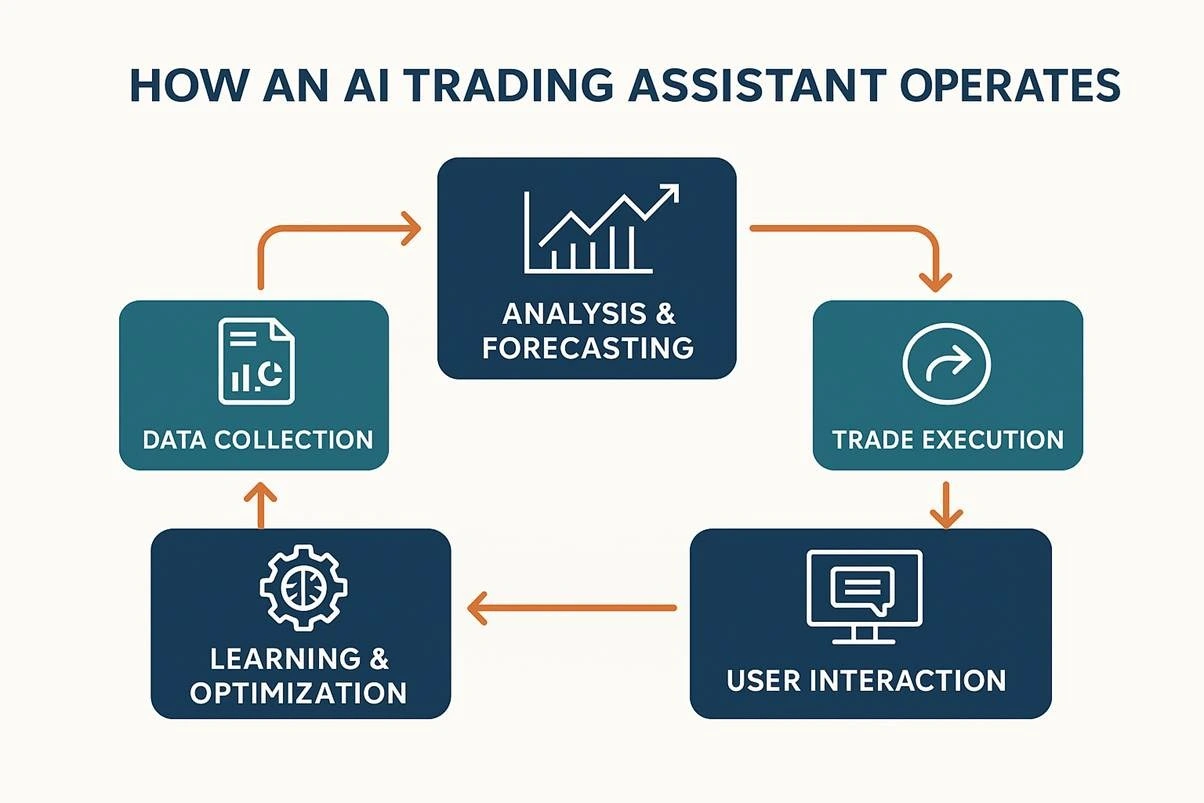
Consider a trader preparing for a major tech company’s earnings announcement. Market volatility is expected to spike, and the risk of emotional decision-making is high. An AI Trading Assistant monitors analyst reports, news headlines, and options market activity in real time. As soon as the earnings report is released, it processes the numbers within seconds, compares them to forecasts, and detects an opportunity. It executes a well-timed trade aligned with the trader’s risk profile—while also setting stop-loss orders to protect against sudden reversals. Instead of reacting under pressure, the trader benefits from data-driven decisions delivered instantly.
An AI Trading Assistant functions as an evolving partner. It enhances decision-making, removes emotional bias, and frees traders to focus on broader strategy while it manages the complexity of execution.
When exploring automated trading, you’ll often come across terms like AI Trading Assistants, Trading Bots, and Agents. While they may seem similar, the underlying technologies and capabilities differ significantly. Understanding these differences is critical for anyone considering AI trading assistant development or looking to build solutions that stand out in a competitive market.
Here’s the comparison of AI Trading Assistants vs. Trading Bots vs. Agents
| Feature | Trading Bots | AI Trading Assistants | Agents (Autonomous Systems) |
| Complexity | Simple, rule-based | Moderate to advanced, AI-driven | Highly advanced, fully autonomous |
| Adaptability | Low – fixed strategies | Medium – learns and adapts from data | High – self-directed and continuously evolving |
| Decision-Making | Pre-programmed rules | AI-driven insights and recommendations | Independent goal-setting and strategy changes |
| Data Handling | Limited to specific inputs | Wide range (price, news, sentiment, fundamentals) | Multi-modal, integrates multiple environments |
| User Interaction | Minimal, settings-based | Dashboards, alerts, conversational interfaces | Autonomous, may act without direct oversight |
| Use Case | Simple repetitive trades | Personalized trading support and strategy execution | Advanced, multi-agent trading ecosystems |
Takeaway
From these comparisons, it’s clear that AI Trading Assistants bridge the gap between basic bots and fully autonomous agents, delivering adaptable, intelligent, and user-focused solutions for modern trading.
Financial firms are moving beyond basic automation toward AI systems that can analyze market information, support research, monitor portfolios, and deliver insights through conversational interfaces. For brokers and investment companies, the opportunity is not simply to automate trading activity. It is to connect real-time financial data, AI analytics, portfolio intelligence, risk controls, and human decision-making within a single workflow.
Consider a brokerage evaluating a practical use case: “Can we build an AI trading assistant that monitors live market data and earnings calls, identifies relevant technical signals, and lets traders ask natural-language questions about portfolios with answers grounded in current data?” Delivering that experience requires reliable data pipelines, financial-domain AI, retrieval and grounding, secure APIs, and clear human oversight.
These figures describe broader financial services, investment management, and fintech AI adoption, rather than the AI trading assistant market specifically. They provide context for why financial firms are evaluating AI-enabled products and workflows.
Traders and investment professionals may need to process prices, company filings, earnings calls, news, economic indicators, technical data, and portfolio information simultaneously. An AI trading assistant can bring these sources together and surface relevant information through dashboards, alerts, or natural-language queries.
AI can automate parts of financial research by processing large volumes of structured and unstructured information. For example, an assistant can summarize an earnings call, identify sentiment changes, compare management commentary with previous quarters, and connect those findings with relevant market data.
A generic chatbot cannot reliably answer questions about a specific portfolio without access to current holdings and relevant financial data. A production-grade AI trading assistant can combine portfolio positions, market feeds, historical information, and user-defined parameters to provide context-specific analysis.
AI can continuously monitor portfolio exposure, volatility, trading activity, and predefined risk thresholds. Investment firms can use these capabilities to generate alerts and support human review rather than relying entirely on manual monitoring.
For brokers and investment companies, AI can support several workflows:
Deloitte's research also highlights examples of investment managers using AI for portfolio analysis, security research, compliance monitoring, and AI-enabled analyst workflows.
The important distinction is that AI should support better-informed financial workflows, not be presented as a guarantee of profitable trades or accurate market predictions. For firms planning AI trading assistant development, production readiness depends on data quality, model validation, explainability, security, regulatory requirements, and appropriate human oversight. Deloitte similarly identifies AI governance and regulatory obligations as significant challenges as financial firms move from experimentation toward production.
For brokers and investment companies, the strongest opportunity is therefore to build an AI system that combines financial intelligence with reliable data, conversational access, risk controls, and human decision-making, rather than simply adding a chatbot to an existing trading platform.
AI trading assistants can support brokers, traders, and investment companies by bringing real-time market analysis, portfolio intelligence, risk monitoring, automation, and conversational financial insights into a single workflow. Their value is not limited to trade execution. A well-designed assistant can reduce repetitive research, organize complex financial information, and help users access relevant insights faster.
For example, a brokerage may ask, “How can we build an AI trading assistant that monitors live market data, analyzes earnings sentiment, tracks portfolio exposure, and alerts traders when predefined technical or risk conditions change?” The answer involves combining AI with reliable financial data, portfolio context, analytics, and workflow automation rather than relying on a standalone chatbot.
For businesses planning AI trading assistant development, the key benefits include:

One of the biggest advantages of AI assistants is their ability to process and analyze data much faster than human traders. This speed translates into smarter, real-time insights that improve profitability and reduce missed opportunities.
Managing risk effectively is crucial in trading. AI assistants provide advanced monitoring and predictive tools to protect portfolios from unnecessary exposure.
Automation reduces overhead costs and makes it easier to expand trading activities across different assets and markets without additional staff. This makes it practical to develop AI Trading Assistant solutions that scale with business growth.
Modern AI assistants don’t just automate trades; they personalize the experience for each trader or client. With customization, traders gain tools that align with their goals and risk appetite.
In an environment where speed and innovation dictate success, firms adopting AI assistants stay ahead of the curve. The benefits of building AI Trading Assistant solutions become clear when compared with outdated manual processes.
AI systems improve over time by learning from both successful and unsuccessful trades. This ensures strategies stay relevant and aligned with evolving market conditions.
Together, these benefits show how AI trading assistant development can support faster financial analysis, continuous monitoring, personalized user experiences, scalable workflows, and stronger risk oversight while keeping human decision-making at the center of the trading process.
Also Read: AI Trading Agent Development: Benefits and Features
AI trading assistants can support a wide range of financial workflows, from monitoring market movements and analyzing financial news to managing portfolios, supporting risk controls, and interacting with clients. Their applications become particularly useful when real-time financial data, AI analytics, and natural language interfaces are connected within the same system.
For example, an investment firm may ask, “Can we build an AI trading assistant that analyzes live market movements, processes earnings calls and financial news, monitors portfolio exposure, and lets analysts ask questions about current holdings in natural language?” This type of solution can combine market data, sentiment analysis, portfolio analytics, technical indicators, and automated alerts to support different users and workflows.
The following use cases demonstrate how AI trading assistant development can be applied across retail trading, brokerage operations, investment management, risk monitoring, and client-facing financial services.
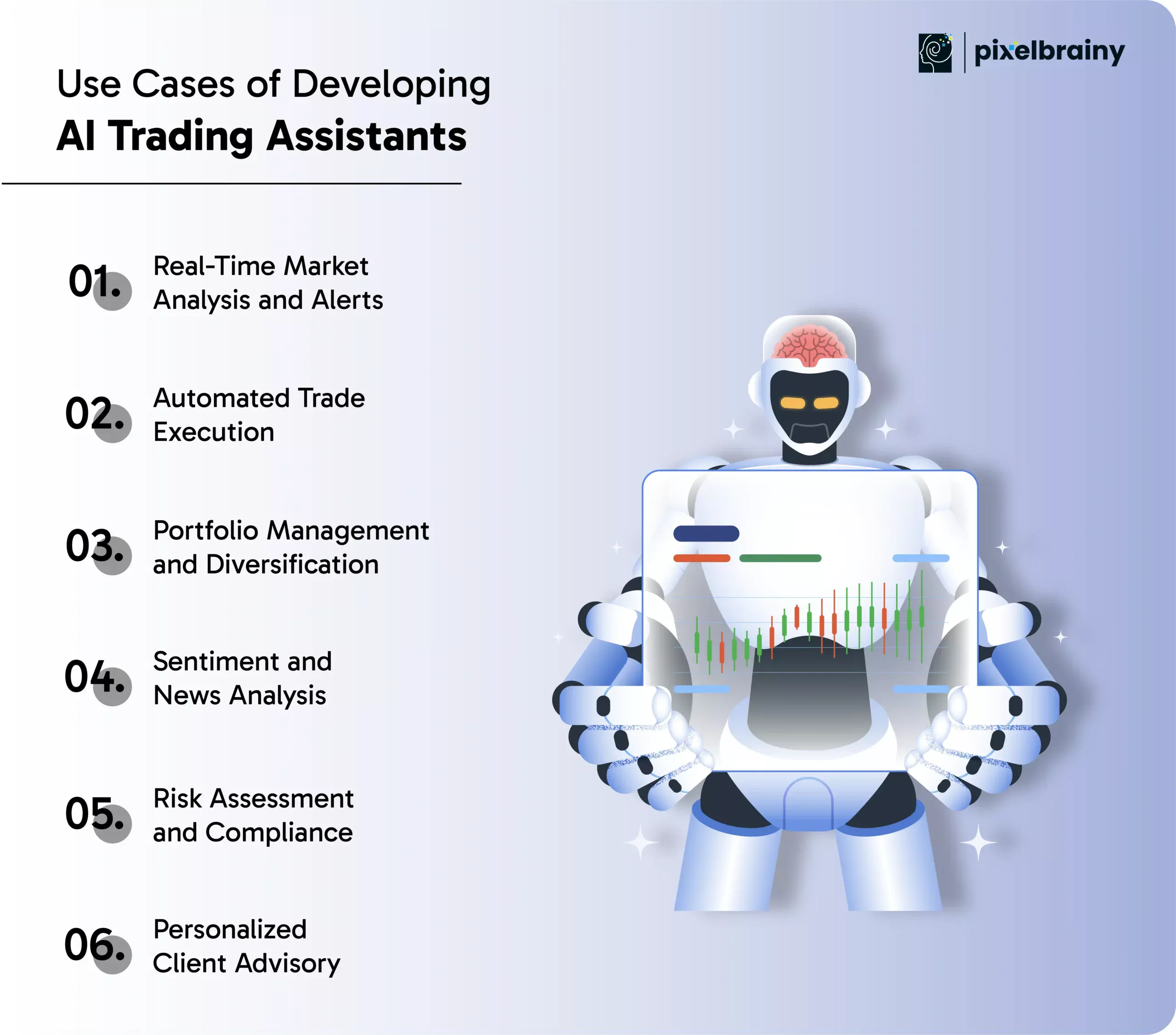
AI trading assistants can track global financial markets continuously, scanning thousands of instruments at once. Instead of relying on delayed reports, traders receive instant alerts when significant price movements or unusual patterns occur.
Example: A retail investor using an AI assistant gets notified within seconds of a sudden spike in oil prices triggered by geopolitical news. The assistant suggests a hedging trade in related energy stocks, helping the investor act before the broader market responds.
Beyond analysis, AI assistants can execute trades instantly based on predefined rules or adaptive strategies. This eliminates delays that cost money in volatile markets.
Example: A day trader sets an AI assistant to automatically enter and exit positions on tech stocks when momentum indicators align. The assistant executes trades in milliseconds, capturing gains that would otherwise be lost to manual lag.
AI assistants help balance portfolios by assessing exposure, suggesting reallocation, and diversifying across assets. They use predictive analytics to spot imbalances and opportunities.
Example: An investment company integrates an AI assistant to monitor client portfolios. When one client becomes overly concentrated in a single sector, the system recommends reallocating into bonds and global equities to reduce risk.
Markets are often influenced by headlines and social sentiment. AI assistants can process vast streams of text and sentiment data, giving traders an edge.
Example: A hedge fund deploys an AI assistant that monitors Twitter, news outlets, and earnings calls. When sentiment suddenly turns negative for a tech firm before official reports, the assistant signals to reduce exposure, preventing major losses.
For brokers and institutions, risk and regulatory compliance are top priorities. AI assistants can detect unusual trading patterns, enforce risk rules, and ensure compliance automatically.
Example: A brokerage uses an AI assistant to flag trades that violate internal risk thresholds. If a client’s position exceeds leverage limits, the assistant issues a real-time alert and prevents execution until reviewed.
AI assistants are also being used as digital advisors, offering tailored recommendations based on individual goals, timelines, and risk preferences.
Example: A wealth management firm integrates an AI assistant into its client app. When a user asks, “What’s the outlook for my retirement portfolio this month?”, the assistant analyzes current holdings, market conditions, and risk tolerance before generating a personalized response.
These use cases demonstrate that AI trading assistants can extend beyond automated execution to support market intelligence, portfolio analysis, sentiment processing, risk management, compliance workflows, and personalized financial interactions. The appropriate use cases depend on the firm's data environment, regulatory requirements, user needs, and level of automation.

A production-grade AI trading assistant needs more than a chatbot interface. It should connect live market feeds, portfolio data, financial news, technical indicators, AI models, and trading infrastructure so users can access relevant financial intelligence in one place.
For example, a fintech company may ask, “Can I build an AI trading assistant that lets traders ask natural-language questions about their portfolio while the system analyzes current market prices, earnings calls, sentiment, and technical signals?” Supporting this workflow requires a combination of real-time data integration, AI analytics, risk controls, conversational capabilities, and secure trading infrastructure.
The following features form the core technology foundation for an intelligent trading assistant:
| Real-Time Market Data Integration | Connects exchanges, broker APIs, and market data providers to deliver current prices, volumes, order data, and other relevant financial information. |
| Advanced Analytics and Forecasting | Uses machine learning and predictive analytics to identify patterns across historical and live data and generate analytical insights. |
| Automated Trade Execution | Executes predefined trading actions through connected brokerage or exchange APIs when configured conditions are met. |
| Risk Management Tools | Supports stop-loss, take-profit, position sizing, exposure monitoring, hedging rules, and other predefined risk controls. |
| Sentiment and News Analysis | Processes financial news, earnings reports, earnings calls, and other text sources to identify relevant sentiment and market information. |
| Customizable Dashboards | Provides configurable views for portfolio performance, market signals, risk metrics, alerts, and other trading information. |
| Natural Language Interaction | Allows users to ask questions about markets, portfolios, positions, and financial data through conversational interfaces. |
| Backtesting and Simulation | Tests trading strategies against historical data and simulated environments before they are considered for live deployment. |
| Multi-Asset and Multi-Platform Support | Supports multiple asset classes and connected trading platforms, allowing users to manage different market data and accounts through one interface. |
| Continuous Learning and Optimization | Monitors model and strategy performance and supports retraining, evaluation, and optimization as new data becomes available. |
Together, these capabilities provide the foundation for an AI trading assistant that connects real-time financial data, conversational intelligence, analytics, execution, and risk management within a unified platform.
As trading platforms become more data-driven, advanced capabilities can help an AI trading assistant move beyond basic market monitoring and predefined automation. Features such as reinforcement learning, multi-agent collaboration, predictive risk modeling, explainable AI, sentiment analysis, and AI-powered portfolio rebalancing can support more sophisticated trading workflows.
For example, a financial technology company may ask, “How can we build an AI trading assistant that analyzes market sentiment, predicts portfolio risks, coordinates specialized AI agents, and explains why a trading action or portfolio adjustment was recommended?” Addressing this type of use case requires advanced AI models, reliable financial data, scalable infrastructure, and appropriate controls for testing, explainability, and risk management.
These capabilities can strengthen AI trading assistant development by supporting more adaptive analysis, personalized portfolio intelligence, cross-platform access, and transparent decision support.
| Advanced Feature | Explanation |
| Reinforcement Learning Models | These models enable the system to learn by trial and error, adjusting trading strategies based on outcomes. Over time, the assistant becomes smarter and more effective in unpredictable markets |
| Multi-Agent Collaboration | Instead of relying on one assistant, multiple specialized agents can collaborate on equities, forex, and crypto. This creates a distributed intelligence network that maximizes efficiency across asset classes |
| Predictive Risk Modeling | Beyond traditional stop-loss rules, predictive models simulate market conditions to estimate potential risks. This foresight allows firms to prepare for volatility before it happens |
| Blockchain Integration | Linking with blockchain adds secure, tamper-proof transaction records. This feature is especially useful for digital assets, ensuring transparency and building trust with clients |
| Natural Language Querying | Users can ask questions in plain English, such as “What’s my portfolio exposure to tech stocks?” The assistant processes the query and responds with actionable insights instantly |
| AI-Powered Portfolio Rebalancing | Portfolios are automatically adjusted to maintain a healthy balance between risk and reward. This ensures traders stay aligned with their long-term objectives even in turbulent markets |
| Cloud-Native Scalability | A cloud-first design makes it possible to develop AI Trading Assistant solutions that scale globally. Traders benefit from low-latency performance and access anytime, anywhere |
| Sentiment-Driven Trading Engines | Advanced NLP analyzes news, earnings calls, and social media for mood shifts that may influence prices. By acting on sentiment, traders gain an edge before market reactions fully unfold |
| Explainable AI (XAI) | Transparency is critical in finance, and XAI provides reasoning behind every decision. This builds trust with users, auditors, and regulators by showing why trades were recommended or executed |
| Cross-Platform Omni-Access | A modern AI assistant in trading should work seamlessly across devices. Whether on desktop, mobile, or web, users get consistent, synchronized access to tools and insights |
These advanced capabilities can extend an AI trading assistant from basic automation into a more adaptive platform for market analysis, portfolio intelligence, predictive risk assessment, and transparent decision support.
Also Read: Top 16+ Trading Software Development Companies in USA
For businesses asking how to build an AI trading assistant from scratch, the development process starts well before model training or interface design. A production-ready solution needs a clear use case, reliable financial data, suitable AI architecture, quantitative validation, secure integrations, and continuous performance monitoring.
Consider a quant-focused use case: “I want to build an AI trading assistant with a natural language interface that lets me query backtesting results, compare strategy performance across market regimes, identify where strategies underperform, and generate new strategy hypotheses from historical trade patterns. What would it cost to build, and which companies have experience with quantitative trading research workflows?”
This requires more than a conversational chatbot. The system needs access to historical trade data, backtesting infrastructure, quantitative analytics, retrieval mechanisms, AI models, and safeguards against unsupported or misleading research conclusions.
The following steps to develop an AI trading assistant from idea to launch provide a structured roadmap for AI trading assistant development, from initial discovery and architecture through validation, deployment, and continuous improvement.
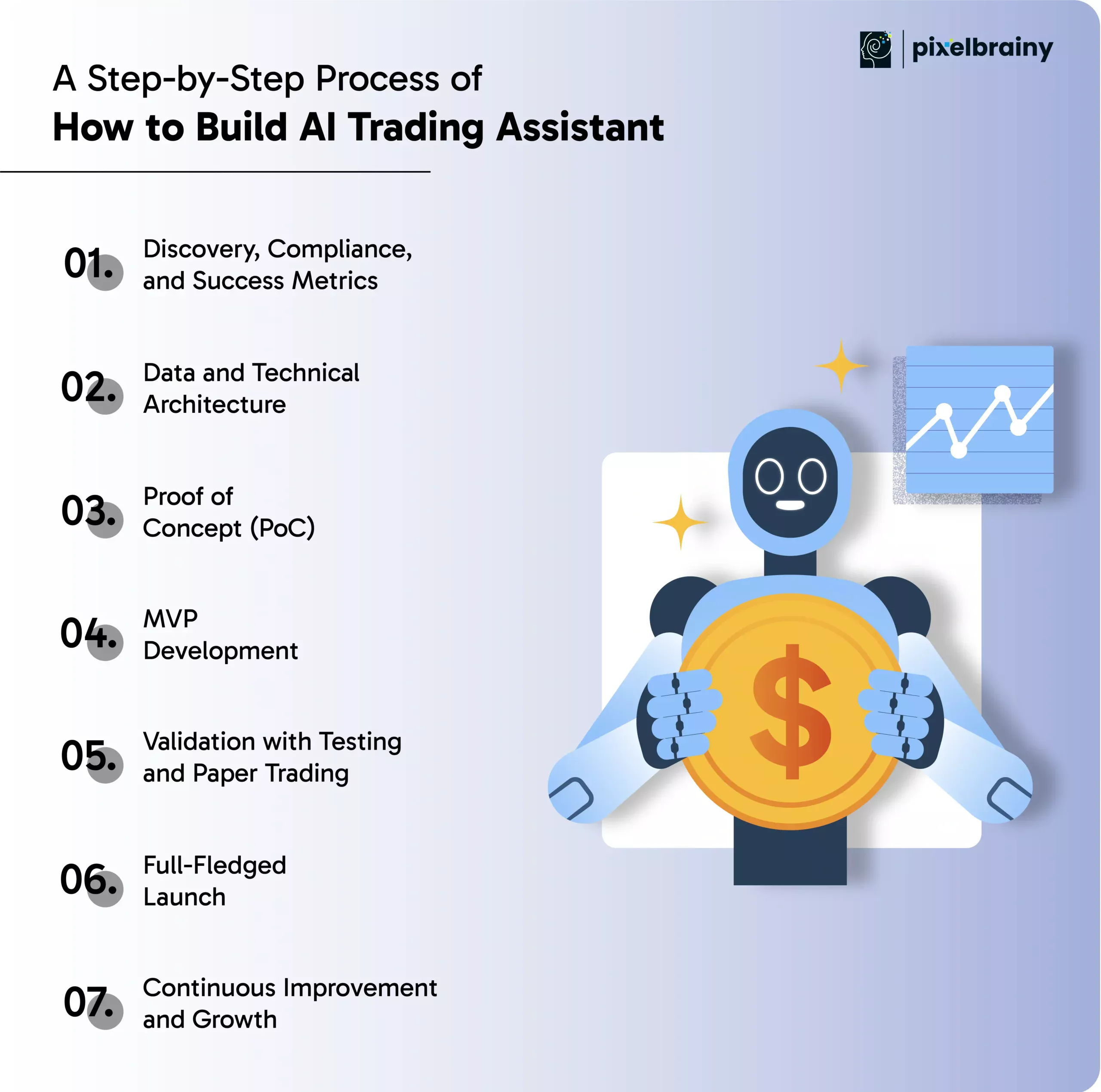
The first stage of building an AI trading assistant is defining exactly what the product should accomplish and who will use it. Teams identify target users, trading workflows, supported asset classes, data requirements, integrations, and business objectives.
For a quantitative research assistant, this could include querying historical trades, comparing strategy performance, analyzing drawdowns, and exploring market-regime behavior.
Compliance requirements should also be considered early, particularly when the assistant provides recommendations or connects to brokerage systems. Success metrics should be measurable and tied to the intended workflow, such as research time saved, query accuracy, backtest retrieval accuracy, response latency, and reliability of generated analysis.
A reliable assistant depends on the quality and structure of the financial data behind it. This stage defines how the system will ingest, clean, store, retrieve, and process market prices, historical trades, portfolio information, news, earnings data, and other relevant sources.
Teams also establish the architecture for broker connectivity, databases, APIs, model services, and real-time processing.
AI integration should be planned around the actual trading workflow rather than added as a standalone chatbot layer. For quantitative research, the architecture may need connections to backtesting engines, strategy repositories, performance databases, and analytical tools.
A PoC helps determine whether the proposed assistant can solve a narrowly defined problem before significant resources are committed.
Instead of developing the entire platform, teams can test one workflow, such as allowing a quant to ask natural-language questions about historical strategy performance and receive results from an existing backtesting database.
The team can evaluate data retrieval, analytical accuracy, response quality, model behavior, and integration feasibility against predefined benchmarks. This stage can expose limitations in data quality or model reasoning before full-scale development begins.
Once feasibility has been established, MVP development turns the validated concept into a functional product. The MVP should focus on the workflows that provide the greatest practical value rather than implementing every advanced capability immediately.
For example, a quant-focused assistant might initially support natural-language queries, historical performance analysis, strategy comparison, market-regime filtering, and backtest result retrieval.
Teams can then collect feedback from actual users and identify which capabilities need refinement. Businesses may work with top AI trading software development companies when the product requires financial APIs, quantitative infrastructure, secure data handling, and AI systems within the same application.
Also Read: Top 10 AI MVP Development Companies in USA
Before moving into live environments, the assistant should undergo structured technical, analytical, and workflow validation.
Historical backtesting can evaluate strategy-related outputs, while walk-forward analysis can test how systems behave across different periods and market conditions. Paper trading can provide additional evidence without immediately exposing capital to live execution.
For a conversational quantitative assistant, testing should also examine whether responses accurately retrieve the underlying data, distinguish observed results from generated hypotheses, and avoid presenting speculative outputs as established findings.
Human review remains important for research workflows, particularly when the assistant is used to interpret complex strategy behavior or support decisions involving real financial positions.
After validation, the product can move toward controlled production deployment. The launch stage covers infrastructure scaling, security hardening, monitoring, audit logging, access controls, API reliability, and operational support.
A phased rollout can help teams observe real-world usage before expanding access across users or markets.
The interface also becomes important at this stage because complex quantitative information needs to remain understandable and efficient to navigate. Working with a UI/UX design company can help refine conversational workflows, dashboards, research visualizations, alerts, and portfolio views.
Businesses may also hire AI developers with experience in financial systems when ongoing model, data, and integration work is required.
Launching the product is not the final stage of developing an AI trading assistant. Models, data sources, user workflows, and market conditions can change over time, requiring continuous evaluation and refinement.
Teams can introduce new data sources, improve retrieval quality, retrain models, evaluate strategy-analysis outputs, and test new conversational workflows.
Governance should include model versioning, performance tracking, auditability, access controls, and explainability. As adoption grows, the platform can expand into multi-asset analysis, advanced portfolio research, automated reporting, and additional brokerage integrations.
Specialized AI product development companies can support this ongoing evolution when organizations need expertise across AI, financial technology, data engineering, and product development.
Following these steps creates a structured path for AI trading assistant development, from an initial trading research concept to a validated, scalable, and continuously improving product.

The cost to develop an AI trading assistant typically starts around $15,000 and can exceed $150,000, depending on the product scope, AI complexity, financial data requirements, integrations, security, and deployment environment. Published industry estimates also show that advanced or enterprise-grade AI trading platforms can move beyond this range when they require sophisticated AI models, real-time analytics, multiple integrations, and production-scale infrastructure.
For businesses planning the development budget of an AI trading assistant, cost estimation should be based on the actual trading workflow rather than simply the number of features. A conversational assistant that provides market information requires considerably less infrastructure than a derivatives platform that continuously calculates portfolio Greeks, monitors risk thresholds, generates hedge recommendations, and connects to live brokerage systems.
For example, a trading desk may ask: “What does an options-specific AI trading assistant cost if it needs to monitor our entire options portfolio in real time, calculate delta, gamma, and vega exposure, alert us when risk limits are breached, recommend adjustment trades, and explain those recommendations in plain language?” This type of solution requires real-time options data, portfolio-level risk calculations, AI reasoning, alert infrastructure, broker or trading-system integrations, and strong testing and security controls.
Therefore, the AI trading assistant development cost for trading businesses can vary substantially based on whether the product is a basic assistant, an advanced trading intelligence platform, or an enterprise-grade derivatives solution.
| AI Trading Assistant Type | Estimated Development Cost | Typical Scope |
| Basic AI Trading Assistant | $15,000 - $40,000 | Natural-language interface, market data integration, basic technical analysis, portfolio queries, alerts, simple dashboards, and limited AI functionality. |
| Advanced AI Trading Assistant | $40,000 - $100,000 | Real-time market analysis, sentiment analysis, portfolio analytics, advanced alerts, backtesting, multiple financial APIs, AI-driven insights, and brokerage integrations. |
| Enterprise AI Trading Assistant | $100,000 - $150,000+ | Real-time multi-asset monitoring, advanced AI models, derivatives analytics, portfolio risk management, automated workflows, multiple integrations, scalable cloud infrastructure, security, auditability, and enterprise controls. |
These ranges are indicative rather than fixed quotes. Published estimates for AI trading platforms similarly show substantial variation based on model sophistication, real-time processing, integrations, security, and platform scale.
For an options-focused trading desk, requirements such as portfolio-level Greeks, stress testing, real-time risk alerts, and hedge recommendations can place the project toward the advanced or enterprise end of the range. Existing derivatives platforms demonstrate that real-time Greeks, portfolio risk analytics, and hedge calculations require specialized infrastructure rather than a basic conversational AI layer.
The choice between a pre-trained LLM, domain-adapted model, predictive ML models, or multiple specialized models directly affects the development budget.
A quantitative assistant that interprets portfolio data and generates research summaries may require less AI engineering than one combining forecasting, strategy analysis, sentiment processing, and automated recommendation workflows.
Real-time and historical market data are essential for an AI trading assistant. Options-focused systems may require option chains, implied volatility, Greeks, historical prices, market depth, news, and other specialized datasets.
Data licensing, API usage, normalization, validation, and storage can all increase the cost depending on the provider and required data volume.
Connecting the assistant with brokers or trading platforms adds integration and testing requirements. The cost increases when the system needs multiple brokers, order types, real-time position synchronization, or automated execution.
For derivatives platforms, the integration may also need to synchronize positions and risk information continuously.
An options trading assistant that calculates delta, gamma, theta, and vega across an entire portfolio requires specialized quantitative logic.
If the system also performs scenario analysis, stress testing, exposure aggregation, margin analysis, or hedge calculations, the engineering complexity increases further. Existing risk APIs illustrate how portfolio-level Greeks, scenario analysis, stress tests, and hedge recommendations can form separate technical capabilities.
A conversational interface allows traders to ask questions such as “Why is my portfolio's vega exposure increasing?” or “Which positions are driving today's gamma risk?”
The system must connect natural-language queries with verified portfolio and market data rather than relying solely on an LLM's general knowledge. This requires retrieval, tool calling, data grounding, response validation, and conversational workflow design.
Generating potential adjustment trades is considerably more complex than displaying portfolio information.
The assistant may need to evaluate current exposures, available instruments, liquidity, transaction costs, predefined risk limits, and scenario outcomes before presenting potential adjustments. Recommendation workflows should also distinguish analytical suggestions from automatically executed trades.
Continuous monitoring adds infrastructure requirements because the platform must evaluate positions and risk conditions as market data changes.
For an options desk, this could include alerts when portfolio delta, gamma, or vega crosses predefined thresholds, followed by contextual explanations of the exposure and relevant market conditions.
The interface needs to present complex financial information without creating unnecessary friction for traders.
Costs increase when the product requires interactive options chains, Greeks dashboards, payoff visualizations, portfolio risk views, conversational interfaces, real-time alerts, and multi-device support.
Financial applications require stronger controls around authentication, authorization, sensitive data, audit trails, API security, and system monitoring.
Enterprise deployments may also require penetration testing, compliance reviews, model governance, and detailed records of AI-generated recommendations.
Cloud expenses depend on data volume, real-time processing requirements, model usage, storage, user volume, and system availability requirements.
Production systems may also require monitoring, backups, disaster recovery, logging, model evaluation, and infrastructure scaling. Ongoing maintenance and security updates should therefore be included in the long-term development budget.
Therefore, the AI trading assistant development cost ultimately depends on the required AI capabilities, financial data infrastructure, integrations, security, quantitative analytics, and overall platform complexity. A clearly defined scope helps businesses establish a realistic development budget and prioritize features.
A reliable AI trading assistant technology stack needs to support real-time financial data, AI model processing, portfolio analytics, secure trading integrations, and scalable infrastructure. The right combination of frontend, backend, databases, AI frameworks, streaming tools, APIs, and cloud services directly affects the assistant's performance and reliability.
For example, a trading business may ask, “What technology stack do we need to build an AI trading assistant that processes live market data, connects with brokerage APIs, analyzes portfolio risk, and delivers real-time insights through a conversational interface?” The answer depends on the product's asset classes, data volume, AI requirements, execution workflows, security needs, and expected scale.
The following technology stack provides a practical foundation for AI trading assistant development, covering the key layers required to build, deploy, and operate a production-ready trading intelligence platform.
| Parameter | Recommended Tools | Explanation |
| Frontend (UI/UX) | React.js, Angular, Vue.js | A responsive and intuitive interface is key for traders who need real-time insights. These frameworks deliver smooth dashboards, interactive charts, and customizable alerts that enhance the trading experience |
| Backend (Application Layer) | Node.js, Django, Flask | The backend handles user requests, API connections, and trade logic execution. Scalable frameworks like Node.js and Django ensure low latency and high availability for the trading assistant |
| Databases | PostgreSQL, MongoDB, Redis | Efficient data storage is essential for both structured market data and unstructured sentiment feeds. SQL databases handle transactional integrity, while NoSQL stores like MongoDB ensure flexible storage for AI-driven insights |
| AI & ML Frameworks | TensorFlow, PyTorch, Scikit-learn | These frameworks power the intelligence behind the trading assistant. They support model training, predictive analytics, and reinforcement learning, helping the system adapt to changing markets |
| Data Streaming & Processing | Apache Kafka, Spark, RabbitMQ | Real-time trading depends on seamless data streaming. Tools like Kafka and Spark process millions of events quickly, ensuring accurate and timely decision-making for the assistant |
| Brokerage & Market APIs | FIX Protocol, Alpaca, Interactive Brokers API | Secure APIs connect the assistant to financial markets. They enable trade execution, market data retrieval, and compliance checks in a reliable and standardized way |
| Cloud Infrastructure | AWS, Google Cloud, Microsoft Azure | Cloud platforms provide scalability, global reach, and advanced security features. They support model deployment, monitoring, and scaling as trading volumes grow |
| Security Tools | OAuth 2.0, JWT, TLS/SSL | Security is paramount in trading systems. Authentication and encryption tools safeguard sensitive trading data, prevent breaches, and ensure trust with users |
| DevOps & CI/CD | Docker, Kubernetes, Jenkins | Continuous integration and deployment streamline updates and scaling. Containerization and orchestration guarantee stability and resilience in production environments |
| Monitoring & Logging | Prometheus, Grafana, ELK Stack | Ongoing monitoring ensures that the trading assistant operates reliably. These tools track performance, detect anomalies, and provide detailed analytics for better decision-making |
A well-structured technology stack enables AI trading assistant development teams to combine real-time data processing, AI/ML capabilities, financial APIs, security, and scalable infrastructure into a reliable trading platform.
Also Read: How Much Does AI Trading Agent Development Cost?
When you plan to develop an AI trading assistant, you also need to analyze how the product will generate sustainable revenue after launch. The monetization model should reflect the assistant's capabilities, target users, pricing structure, and the value it provides to traders, brokers, and financial institutions.
For example, a fintech founder may ask, “How can I monetize an AI trading assistant that provides real-time market analysis, portfolio insights, trading signals, and advanced analytics for both individual and institutional users?” The answer may involve combining recurring subscriptions with premium features, enterprise licensing, API access, or other revenue channels based on the product's target market.
The following monetization strategies can help turn AI trading assistant development into a scalable business while creating different revenue opportunities for retail traders, professional users, brokers, and institutional clients.
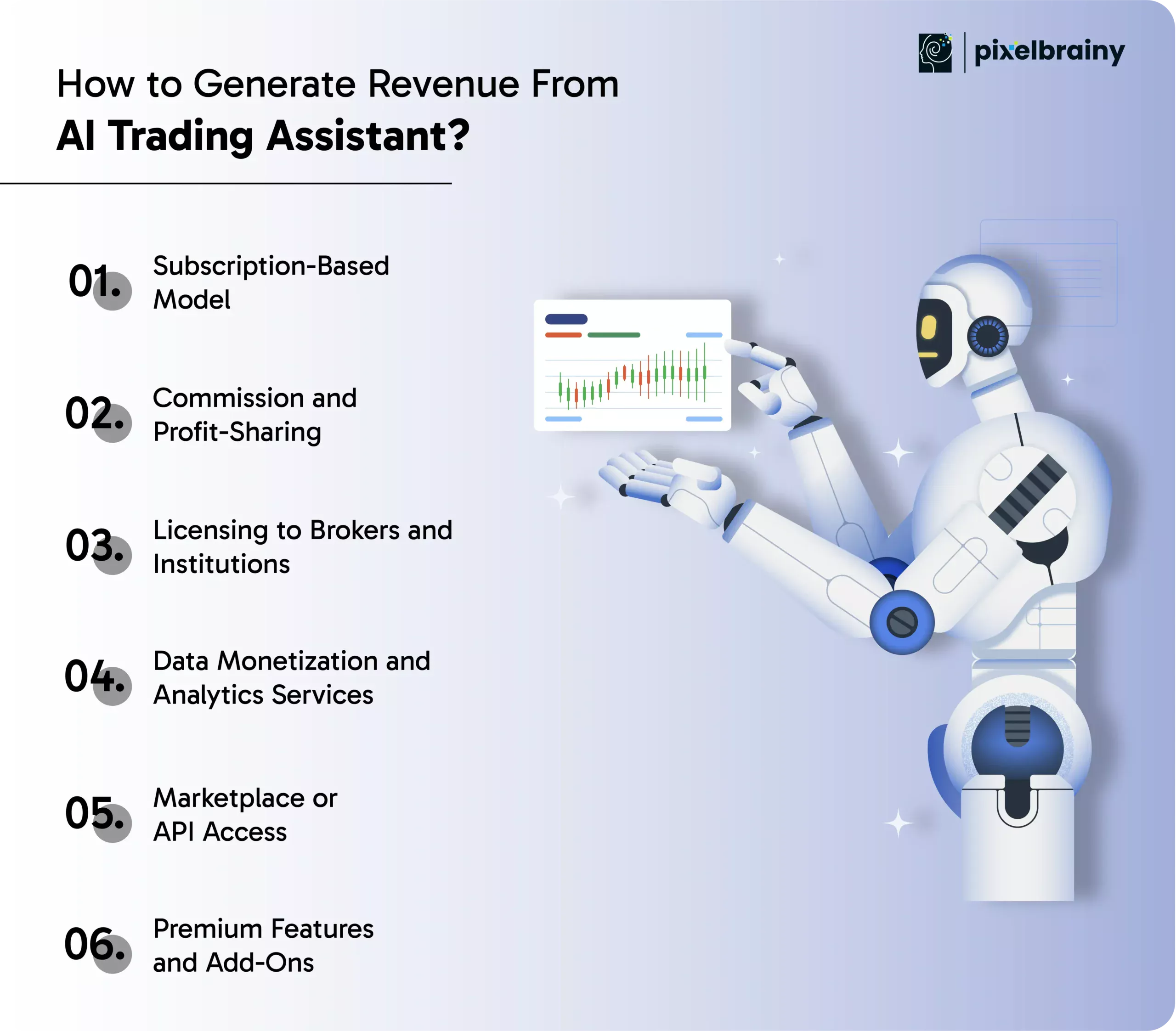
A widely adopted model where users pay monthly or annual fees to access the trading assistant. This ensures predictable, recurring income.
Instead of charging upfront, firms take a share of profits or commissions from trades executed by the assistant. This aligns incentives with client success.
Brokers and investment companies can license the trading assistant as part of their service offering. This creates enterprise-level deals with higher margins.
AI assistants generate valuable trading data, which can be anonymized and sold as insights or premium analytics.
Developers can open their assistant as a platform, allowing third-party integrations or strategy add-ons. Revenue is generated through API fees or marketplace sales.
The freemium model gives basic access for free but charges for advanced features such as predictive analytics, sentiment tracking, or multi-asset support.
Combining suitable monetization models allows an AI trading assistant to generate recurring and diversified revenue while supporting continuous product development, feature expansion, and long-term business growth.
Real-world AI trading assistant development involves more than building AI models and connecting market APIs. Data inconsistencies, regulatory requirements, security risks, changing market conditions, development costs, and user trust can all affect the reliability and adoption of the final product.
A trading business may ask, “What challenges could we face when developing an AI trading assistant that analyzes live market data, provides trading insights, monitors portfolio risks, and supports automated workflows?” Each requirement introduces specific technical and operational considerations that need to be addressed during development rather than after launch.
The following challenges highlight the key areas businesses should evaluate when building an AI trading assistant, along with practical solutions for managing them.
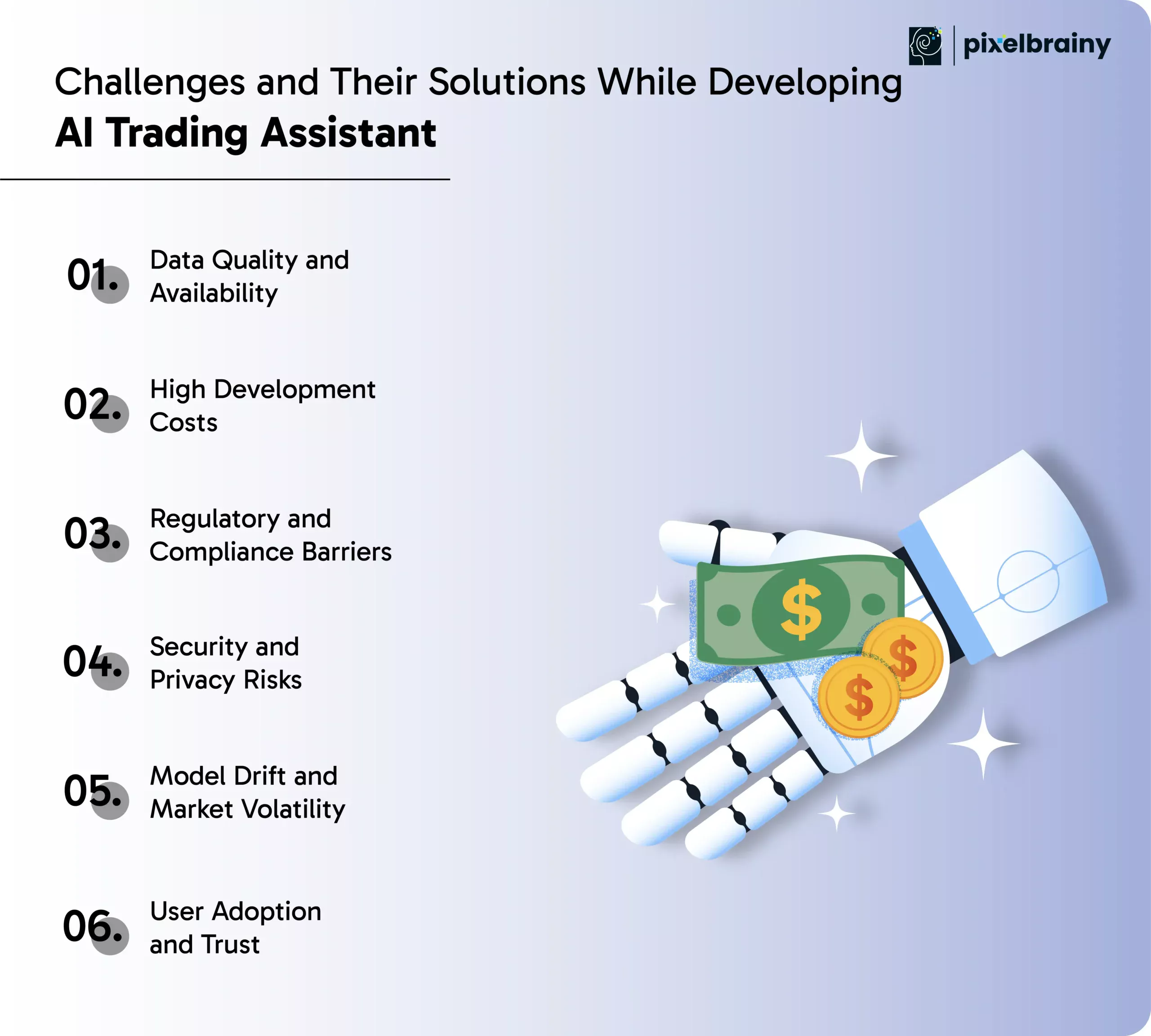
Challenge: AI systems are only as strong as the data they are trained on. Inconsistent, incomplete, or biased market and sentiment data can lead to poor predictions and unreliable outcomes in trading assistant development using AI.
Solution: Partner with trusted financial data providers and implement rigorous data-cleaning pipelines. Using diverse sources such as historical prices, news, and social sentiment ensures models stay balanced and accurate.
Challenge: Many firms hesitate when they realize what is the cost to create AI Trading Assistant, as building advanced models, integrating APIs, and ensuring compliance can quickly escalate budgets.
Solution: Begin with an MVP approach to reduce upfront expenses. Firms can also collaborate with top AI development companies to optimize resources and leverage existing frameworks, lowering the total AI Trading Assistant development cost.
Challenge: Financial markets are heavily regulated, and failing to meet compliance standards exposes firms to penalties. This is a major concern in the cost of building AI Trading Assistant since compliance demands add complexity.
Solution: Integrate compliance checks into the system design from the very beginning. Work with legal experts to understand requirements across jurisdictions (SEC, FCA, ESMA) and use explainable AI for transparent decision-making.
Challenge: Trading assistants handle sensitive user and market data. Breaches, unauthorized access, or weak encryption undermine trust and pose legal risks.
Solution: Use robust security measures such as multi-factor authentication, end-to-end encryption, and role-based access controls. Regular penetration testing ensures the trading assistant remains secure in real-world conditions.
Challenge: Financial markets evolve quickly, and models that work today may underperform tomorrow. Without continuous learning, even the best AI assistant in trading can lose relevance.
Solution: Set up ongoing retraining pipelines that adapt to new market conditions. Monitor performance with drift detection tools and update models proactively to keep accuracy high.
Challenge: Traders and firms may be reluctant to rely on automated systems, fearing loss of control or transparency.
Solution: Provide explainable insights, clear reporting dashboards, and options for human oversight. Building transparency and user education into the develop AI Trading Assistant process fosters trust and wider adoption.
Addressing these challenges as part of the development strategy can help businesses build a more secure, reliable, scalable, and trustworthy AI trading assistant while controlling unnecessary risks and development expenses.
From the above development roadmap, technology stack, costs, and challenges, the next step is to identify a development partner that understands both AI engineering and trading workflows. For financial businesses, the right partner needs to go beyond building a conversational interface and understand portfolio data, financial APIs, quantitative analysis, security, explainability, and the operational requirements of production trading systems.
PixelBrainy is a leading AI trading software development company helping businesses turn complex financial workflows into practical AI-powered products. Its experience across AI, financial technology, data engineering, and product design enables teams to approach AI trading assistant development services with a focus on the complete product lifecycle, from discovery and architecture through deployment and ongoing optimization.
A wealth management firm may ask, “We need an AI trading assistant for our advisors that monitors client portfolios for tax-loss harvesting opportunities, identifies allocation drift, recommends rebalancing trades, evaluates potential after-tax outcomes, and drafts explanations that advisors can review before sending to clients. Which development partner can support this type of registered investment adviser workflow?”
This type of product requires careful separation between AI-generated analysis and advisor approval. The architecture can incorporate portfolio data, tax-related rules, tolerance bands, recommendation logic, audit trails, advisor review, and explainable outputs. SEC materials emphasize that investment advisers have fiduciary obligations, including duties of care and loyalty, and that firms should not make false or misleading claims about their use of AI.
PixelBrainy delivered a confidential AI-powered wealth management solution designed to support advisors with portfolio analysis and investment decision workflows.
The solution brought together:
The architecture was designed around a key requirement for financial applications: AI should support the advisor's workflow without removing human oversight from investment decisions.
Due to client confidentiality, the firm's identity and specific implementation details cannot be disclosed. However, the project demonstrates PixelBrainy's ability to design AI solutions for portfolio intelligence, advisor workflows, recommendation systems, and explainable financial AI.
PixelBrainy can support businesses looking to build AI trading assistant products through capabilities including:
Whether the objective is to develop AI trading assistant software for advisors, traders, brokers, or institutional users, the product can be structured around the organization's specific workflows, data environment, integrations, and governance requirements.
For firms planning to create AI trading assistant solutions for the US market, compliance should be considered an architectural requirement rather than something added after development. Regulatory expectations and the applicable obligations depend on the firm's activities and the way the system is used. The SEC has also taken enforcement action against investment advisers for misleading claims about their use of AI, making accurate representation and appropriate governance particularly important.
Ready to discuss your AI trading assistant idea? Connect with PixelBrainy to explore the right architecture, development scope, and roadmap for your financial workflow.
An AI trading assistant becomes valuable when it solves a specific financial workflow, not simply when it adds AI to an existing trading platform. The real opportunity lies in connecting market data, portfolio intelligence, quantitative analysis, risk monitoring, conversational AI, and human decision-making within one reliable system.
From defining the use case and architecture to estimating development costs, integrating financial APIs, validating AI models, and preparing the product for production, every stage influences the quality and scalability of the final solution. The right approach also depends on whether the product is intended for individual traders, brokerage teams, wealth managers, or institutional trading desks.
For businesses planning AI Trading Assistant Development, PixelBrainy can help translate a specific trading or investment workflow into a practical AI product, with the technology, integrations, interface, and infrastructure aligned with the intended use case.
Have a trading workflow you want to turn into an AI product? Talk to PixelBrainy and discuss your requirements with our team.
The AI trading assistant development cost generally ranges from $15,000 to $150,000+, depending on AI complexity, financial data integrations, brokerage APIs, portfolio analytics, security, and infrastructure requirements.
To build an AI trading assistant for quantitative trading, you typically need historical market data, backtesting infrastructure, strategy analytics, AI models, natural-language querying, and integrations with research or trading systems. The development scope depends on whether the assistant is intended for research, monitoring, recommendations, or execution.
The development process of an AI trading assistant generally covers requirement discovery, data and technical architecture, proof of concept, MVP development, testing and validation, production deployment, and continuous optimization. Quantitative or institutional systems may require additional risk, security, and compliance workflows.
Yes. Businesses can develop an AI trading assistant specifically for options by integrating options-chain data, portfolio Greeks, risk thresholds, market analytics, alerts, and recommendation workflows. The system can also provide natural-language explanations of portfolio exposure and potential adjustments.
An AI trading assistant technology stack may include React.js, Node.js or Python frameworks, PostgreSQL or MongoDB, Redis, TensorFlow or PyTorch, Kafka or Spark, brokerage APIs, cloud infrastructure, authentication tools, and monitoring systems. The final stack should match the required latency, data volume, AI functionality, and trading integrations.
Core AI trading assistant development can include real-time market data, portfolio analysis, technical indicators, sentiment analysis, natural-language interaction, risk monitoring, backtesting, alerts, brokerage integration, and customizable dashboards. Advanced solutions may also include predictive risk modeling, multi-agent systems, explainable AI, and automated portfolio analysis.
AI trading assistant development services can help wealth management firms create advisor-focused systems for portfolio monitoring, allocation analysis, tax-loss harvesting workflows, rebalancing suggestions, client portfolio queries, and AI-generated explanations that advisors can review before communicating with clients.
When evaluating an AI trading software development company, consider its experience with financial data, brokerage integrations, quantitative analytics, AI model development, security, conversational interfaces, and production-scale financial applications. The development partner should also be able to map the technology architecture to your specific trading or investment workflow.

About The Author
Sagar Bhatnagar
Sagar Sahay Bhatnagar brings over a decade of IT industry experience to his role as Marketing Head at PixelBrainy. He's known for his knack in devising creative marketing strategies that boost brand visibility and market influence. Sagar's strategic thinking, coupled with his innovative vision and focus on results, sets him apart. His track record of successful campaigns proves his ability to utilize digital platforms effectively for impactful marketing efforts. With a genuine passion for both technology and marketing, Sagar continuously pushes PixelBrainy's marketing initiatives to greater success.

Working with the PixelBrainy team has been a highly positive experience. They understand the design requirements and create beautiful UX elements to meet the application needs. The dev team did an excellent job bringing my vision to life. We discussed usability and flow. Sagar worked with his team to design the database and begin coding. Working with Sagar was easy. He has the knowledge to create robust apps, including multi-language support, Google and Apple ID login options, Ad-enabled integrations, Stripe payment processing, and a Web Admin site for maintaining support data. I'm extremely satisfied with the services provided, the quality of the final product, and the professionalism of the entire process. I highly recommend them for Android and iOS Mobile Application Design and Development.

Great experience working with them. Had a lot of feedback and I found that unlike most contractors they were bugging me for updates instead of the other way around. They were extremely time conscience and great at communicating! All work was done extremely high quality and if not on time, early! They were always proactive when it comes to communication and the work is great/above par always. Very flexible and a great team to work with! Goes above and beyond to present us with multiple options and always provides quality. Amazing work per usual with Chitra. If you have UI/UX or branding design needs I recommend you go to them! Will likely work with them in the future as well, definitely recommended!

PixelBrainy is a joy to work with and is a great partner when thinking through branding, logo, and website layout. I appreciate that they spend time going into the "why" behind their decisions to help inform me and others about industry best practices and their expertise.

I hired them to design our software apps. Things I really like about them are excellent communication skills, they answer all project suggestions and collaborate right away, and their input on design and colors is amazing. This project was complex and needed patience and creativity. The team is amazing to do business with. I will be using them long-term. Glad to see there are some good people out there. I was afraid to try and outsource my project to someone but I am glad I met them! I really can't say enough. They went above and beyond on this project. I am very happy with everything they have done to make my business stand out from the competition.

It was great working with PixelBrainy and the team. They were very responsive and really owned the project. We'll definitely work with them again!

I recently worked with the PixelBrainy team on a project and I was blown away by their communication skills. They were prompt, clear, and articulate in all of our interactions. They listened and provided valuable feedback and suggestions to help make the project a success. They also kept me updated throughout the entire process, which made the experience stress-free and enjoyable.

PixelBrainy is very good at what it does. The team also presents themselves very professionally and takes care of their side of things very well. I could fully trust them taking up the design work in a timely and organised manner and their attention to detail saved us lots of effort and time. This particular project was quite intense and the team showed that they function very well under pressure. Very much looking forward to working with her again!

It's always an absolute pleasure working with them. They completed all of my requests quickly and followed every note I had for them to a T, which made our process go smoothly from start to finish. Everything was completed fast and following all of the guidelines. And I would recommend their services to anyone. If you need any design work done in the future, PixelBrainy should be your first call!

They took ownership of our requirements and designed and proposed multiple beautiful variants. The team is self-motivated, requires minimum supervision, committed to see-through designs with quality and delivering them on time. We would definitely love to work with PixelBrainy again when we have any requirements.

PixelBrainy was a big help with our SaaS application. We've been hard at work with a new UI/UX and they provided a lot of help with the designs. If you're looking for assistance with your website, software, or mobile application designs, PixelBrainy and the team is a great recommendation.

PixelBrainy designers are amazing. They are responsive, talented, and always willing to help craft the design until it matches your vision. I would recommend them and plan to continue them for my future projects and more!!!

They were awesome! Did a good job fast, and good communication. Will work with them again. Thank you

Creative, detail-oriented, and talented designers who take direction well and implement changes quickly and accurately. They consistently over-delivered for us.

PixelBrainy team is very talented and creative. Great designers and a pleasure to work with. PixelBrainy is an excellent communicator and I look forward to working with them again.

PixelBrainy has a very talented design team. Their work is excellent and they are very responsive. I enjoy working with them and hope to continue on all of our future projects.


Transform your ideas into reality with us.
Across these industries, each engagement brings unique challenges, from early-stage product development to scaling complex systems, helping us build a practical understanding of real-world product environments.