AI Summary Powered by PixelBrainy
What would it take to build an AI property investment app that can evaluate dozens of real estate opportunities across multiple markets while you focus on the deals that actually fit your investment strategy? For an investor managing a portfolio of 12 rental properties, manually comparing listings, rental income potential, financing assumptions, market trends, and expected returns for every acquisition can become a time-consuming process.
This is where AI property investment app development can create a more intelligent investment workflow. Instead of reviewing each opportunity individually, an AI-powered platform can bring property, market, rental, and financial data into one system and analyze opportunities against predefined investment criteria.
Imagine an investor who wants to evaluate acquisitions across several markets using specific portfolio objectives. The app could analyze market conditions, estimate rental income, calculate cash-on-cash returns, compare properties against investment thresholds, and generate acquisition recommendations based on the investor's documented strategy. Such a platform can turn large amounts of fragmented real estate data into a structured decision-support experience.
Before approaching a development company, however, there are practical questions to answer. How much does it cost to build an AI property investment app? What does a production-grade system require beyond a property search interface? How much development effort goes into market analysis, rental income prediction, financial modeling, data integrations, AI recommendations, security, and scalable infrastructure?
This guide explores how to build AI property investment app solutions from concept to launch. It covers the core real estate investment app features, AI capabilities, technology stack, development process, business models, cost considerations, and challenges that can influence the final product.
Whether you are looking to create AI property investment app solutions for individual investors, real estate firms, brokers, or PropTech businesses, the goal is to build a platform that combines real estate intelligence with clear financial analysis and actionable recommendations.
An AI property investment app is a real estate investment platform that uses artificial intelligence to help investors research, evaluate, compare, and monitor property opportunities. Instead of functioning primarily as a property listing or search tool, an AI real estate investment platform can combine property data, rental information, market trends, and financial metrics to generate structured investment insights.
For an investor managing multiple rental properties, the value becomes clearer when the app can analyze opportunities across several markets simultaneously. It can evaluate properties against predefined criteria such as purchase price, projected rental income, cash-on-cash return, appreciation potential, location factors, and investment risk. The platform can then rank opportunities and explain why certain properties may align better with the investor’s portfolio objectives.
AI capabilities can enable the platform to:
The objective is not to replace an investor’s judgment. Instead, the app organizes large volumes of real estate information and converts it into data-driven decision support that makes property research more systematic and easier to evaluate.
A typical property investment app can work through the following stages:
The platform collects property listings, historical sales information, rental data, market indicators, mortgage details, and other relevant datasets through APIs and approved data sources.
AI and machine learning systems process the collected information to identify pricing patterns, rental trends, market signals, and other variables relevant to the investor’s strategy.
Each opportunity can be evaluated against factors such as expected rental income, cash-on-cash return, appreciation potential, investment risk, and the investor’s predefined acquisition criteria.
Investors enter preferences such as target markets, budget, property type, return expectations, and risk tolerance. The platform uses these inputs to rank and recommend properties that best match the strategy.
A centralized dashboard can display property comparisons, portfolio performance, financial projections, alerts, and market insights. A conversational AI assistant can provide explanations, summarize opportunities, and help users explore investment data through natural-language queries.
A well-designed AI property investment app connects real estate data with financial modeling, personalized criteria, and AI-driven analysis, giving investors a structured way to evaluate opportunities without manually researching every property one at a time.
Why should a real estate investor invest in an AI property investment app instead of continuing with spreadsheets, listing portals, and manual market research? The answer becomes clearer when the investment process involves evaluating large numbers of properties across different markets, forecasting rental performance, comparing financial returns, and filtering opportunities against specific acquisition criteria.
The real estate technology market is expanding, while AI adoption across the sector is moving from experimentation toward practical use. Grand View Research estimates the global PropTech market will reach $50.1 billion in 2026 and projects it to reach $115.0 billion by 2033, growing at a 12.6% CAGR. The report also identifies AI, machine learning, IoT, and cloud technologies as important drivers of market growth.
Real estate organizations are also moving AI into investment-related workflows. PwC's 2026 real estate outlook reports that 53% of real estate CEOs have a clearly defined roadmap for AI initiatives. It also notes that AI adoption is already appearing in areas such as data analytics, leasing, investment decision-making, and pricing
AI is increasingly being applied to the activities investors already perform, including opportunity screening, underwriting, pricing analysis, and portfolio strategy. PwC reports that leading investors are using AI across deal sourcing, underwriting, asset management, and portfolio strategy.
For a property investment platform, this creates opportunities to automate repetitive analysis and surface relevant acquisition candidates faster.
The current AI opportunity in real estate extends beyond conversational assistants. Deloitte's 2026 commercial real estate outlook highlights interest in multimodal AI, multi-agent systems, small language models, digital twins, large action models, and agentic AI.
This creates room for AI property investment app development focused on valuation, financial modeling, risk analysis, property discovery, and portfolio intelligence rather than basic customer support alone.
Investors may need to evaluate property prices, rental income, market trends, neighborhood characteristics, financing assumptions, and portfolio exposure simultaneously. AI can help organize these datasets and produce consistent analysis according to predefined investment criteria.
For an investor managing multiple rental properties, this means the platform can screen opportunities across several markets rather than requiring every property to be researched manually.
The market opportunity is not based on the assumption that every real estate company has already implemented sophisticated AI. Deloitte reports that 19% of surveyed CRE organizations were still in the early stages of their AI journey, while 27% reported implementation challenges, including technical issues and lack of expertise.
This gap creates an opportunity for PropTech businesses to build focused AI products around clearly defined investment workflows instead of attempting broad AI transformation from day one.
The growth of the broader PropTech market provides a stronger technology environment for AI property applications. Grand View Research reports that North America accounted for 55.5% of PropTech revenue in 2025, with the US holding the largest country share in its analysis.
For businesses targeting the US market, this creates an established ecosystem for property data providers, investment platforms, cloud services, analytics, and other technology integrations.
Data Volume: Property and market information is spread across multiple systems, making manual comparison increasingly difficult.
Faster Analysis: Investors can use AI to screen opportunities and prioritize properties that meet defined financial and portfolio criteria.
Investment Personalization: AI can evaluate properties according to individual objectives such as target markets, budget, rental yield, cash-on-cash return, and risk tolerance.
Operational Scale: A structured AI platform can evaluate a larger pipeline of properties without increasing manual research effort at the same rate.
For real estate agencies, PropTech founders, investment firms, and financial technology businesses, AI property investment app development creates an opportunity to build products around the parts of the investment workflow where data complexity and repetitive analysis are highest.
The strongest investment case is not simply that AI is growing. It is that AI can be embedded into specific real estate investment workflows where faster opportunity screening, structured financial analysis, personalized recommendations, and scalable decision support can create tangible product value.
What can an AI property investment app actually improve for investors and real estate businesses? Beyond making property data easier to access, AI can help users evaluate more opportunities, analyze complex market signals, personalize investment recommendations, and automate repetitive research. For an investor managing multiple rental properties, this can mean reviewing acquisition opportunities across several markets without manually analyzing every property, while still applying predefined criteria such as rental income, cash-on-cash return, risk, and portfolio objectives.
The value of AI property investment app development comes from connecting large volumes of real estate and financial data with practical decision-support tools. Instead of presenting raw listings or isolated market statistics, the platform can turn these inputs into valuations, forecasts, risk indicators, recommendations, alerts, and portfolio insights.
Here are the top benefits you should consider when planning to create AI property investment app solutions:
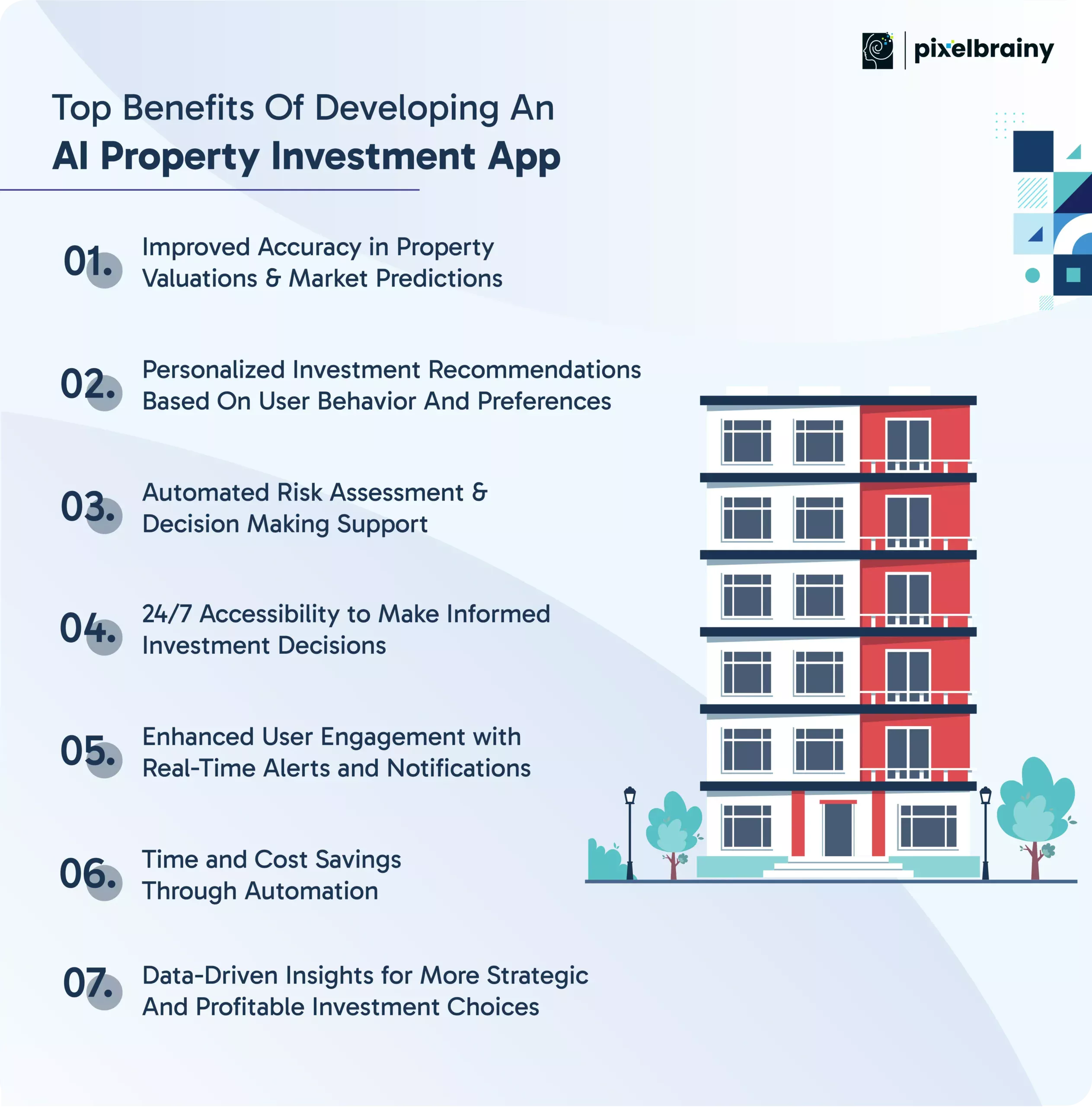
AI algorithms utilize historical trends, real-time market data, and behavioral patterns to provide precise property valuations. Predictive analytics in real estate reduces human error and offers investors a clearer view of current and future opportunities. Instead of counting on static comparisons, users catch up with dynamic, data-backed forecasts powered by AI and big data modeling.
AI property investment platforms have the strength to track user behavior, past preferences, and risk appetite to curate tailored investment prospects. This surges with a smart real estate investment assistant that unwinds with each user, boosting satisfaction and ROI.
Making use of machine learning-powered risk assessment, AI can evaluate economic indicators, neighborhood trends, and asset health to block risky investments before the money is committed. It assists in diminishing losses and improving portfolio resilience. Businesses proposing these tools create a trusted environment for novice and seasoned investors.
Whether your user surveys a property at 2 AM or compares returns on a Sunday, an AI property valuation platform ensures uninterrupted access to insights. Cloud integration and mobile-first UI make investment decisions easier than ever before.
From sudden market shifts to emerging possibilities, real-time notifications help users act fast. The real estate investment app features boost user engagement and ensure convenient decision-making.
AI eradicates the need for manual research, data entry, and document analysis. Investors save hours per transaction while developers downsize support and overhead costs, making the AI property investment app a win-win for all stakeholders.
AI-powered dashboards integrate key metrics like rental yield, ROI, and vacancy risk into actionable insights. This leads to better financial planning and data-driven real estate investment decisions.
A well-designed AI real estate investment platform can therefore help investors move from manual property research toward a more structured, personalized, and data-driven investment workflow, while giving businesses a stronger foundation for scalable real estate technology.
Also Read: A Guide to Real Estate AI Software Development
What would make an AI property investment app genuinely useful for an investor who evaluates multiple properties across different markets? A property search interface alone is not enough. Investors need a way to bring property data, market conditions, financing numbers, rental performance, risk factors, and portfolio goals into a single decision-making workflow.
For example, an investor managing several rental properties may want to compare new acquisition opportunities based on purchase price, projected rental income, cash-on-cash return, appreciation potential, and risk tolerance. The right AI real estate investment platform can support this process by combining intelligent valuation, predictive analysis, financial modeling, property comparisons, personalized recommendations, and portfolio tracking.
The features below cover the core capabilities needed across the property investment journey, from discovering suitable properties and analyzing their financial potential to monitoring existing holdings and receiving timely investment insights. Each feature should serve a clear purpose and fit the target investor's strategy rather than simply increasing the app's feature count.
| Feature | What It Is | Why It Matters | How It Helps the User |
| AI-powered Property Valuation | Uses machine learning to estimate accurate property values | Reduces human error and bias | Investors get realistic and data-backed valuations |
| Predictive Market Analysis | AI analyzes trends to forecast market shifts | Enables proactive investment strategies | Users anticipate demand, price changes, and risks |
| Personalized Investment Advice | Recommends assets based on user profile and behavior | Customizes experience and improves outcomes | Users receive relevant, ROI-focused suggestions |
| Machine Learning-Powered Risk Assessment | Evaluates potential risks using multiple data points | Helps prevent losses before they occur | Users make safer, more informed decisions |
| Data Visualization Tools | Interactive charts and graphs for real estate data | Simplifies complex data sets | Users better understand trends and performance |
| Investment Portfolio Tracking / Automation of Investment Portfolios | Monitors portfolio value, ROI, and performance | It centralizes asset management | Users see real-time performance across all holdings |
| Interactive Property Listings | Engaging UI with maps, media, and details | Increases exploration and engagement | Users can evaluate listings faster and smarter |
| Advanced Search Filters | Filter by location, price, property type, etc. | Enhances precision in search | Users quickly find properties that meet criteria |
| Property Comparison Tool | Side-by-side evaluation of multiple listings | Aids in better decision-making | Users identify the best investment opportunity |
| Automation of Investment Alerts and Notifications | Push notifications for market changes | Enables timely action | Users never miss out on time-sensitive deals |
| Property Price Trend Analysis | Tracks historical pricing data by region | Informs future value projections | Users assess appreciation potential accurately |
| AI-Driven Mortgage Calculator | Estimates financing, interest, and payment terms | Simplifies budgeting for buyers | Users plan investments with full cost awareness |
| Third-Party Real Estate Data API Integration | Connects to MLS, Zillow, Redfin, etc | Keeps listings and insights updated | Users access credible, real-time market data |
| User Profile Customization | It tailors the platform experience to individual users | Boosts engagement and satisfaction | Users feel in control of their investment journey |
| Historical Data Analysis | Analyzes years of performance and pricing data | Identifies long-term patterns | Users build strategies backed by proven trends |
| Investment Performance Analytics | Tracks returns, occupancy, rental income, etc. | Empowers smarter asset allocation | Users optimize their portfolios over time |
| Personalized Property Recommendations | AI suggests listings aligned with user goals | Increases conversion rate | Users discover better-matching properties faster |
| AI-Powered Strategy Builder | Lets users create investment models based on goals | Supports planning and scalability | Users test different paths to financial success |
| Investment Cost Breakdown | Breaks down taxes, maintenance, agent fees, etc. | Promotes transparency | Users get the full picture of ownership cost |
| Collaborative Features | Share listings, notes, and strategies with peers | Encourages group decision-making | Users can co-invest or seek peer validation |
| Virtual Tours / 3D Property Views | Allows walkthroughs of properties online | Saves time, improves engagement | Users assess properties without in-person visits |
| Geo-Mapping & AR Integration | Shows listings on interactive maps, with AR overlays | Enables location-first decision-making | Users visualize properties in a real-world context |
| AI Chatbot for Investor Queries | Smart assistant answers questions 24/7 | Enhances support and trust | Users get instant help with navigation or data |
| Multi-Platform Access | Seamless sync between mobile, web, and tablet | Boosts accessibility | Users invest and track from any device |
| User Reviews & Ratings | Real investor feedback on listings | Builds community trust | Users rely on peer insights before purchase |
A well-planned feature set gives AI property investment app development a stronger foundation for delivering personalized, data-driven investment analysis while keeping the user experience focused on decisions that matter.
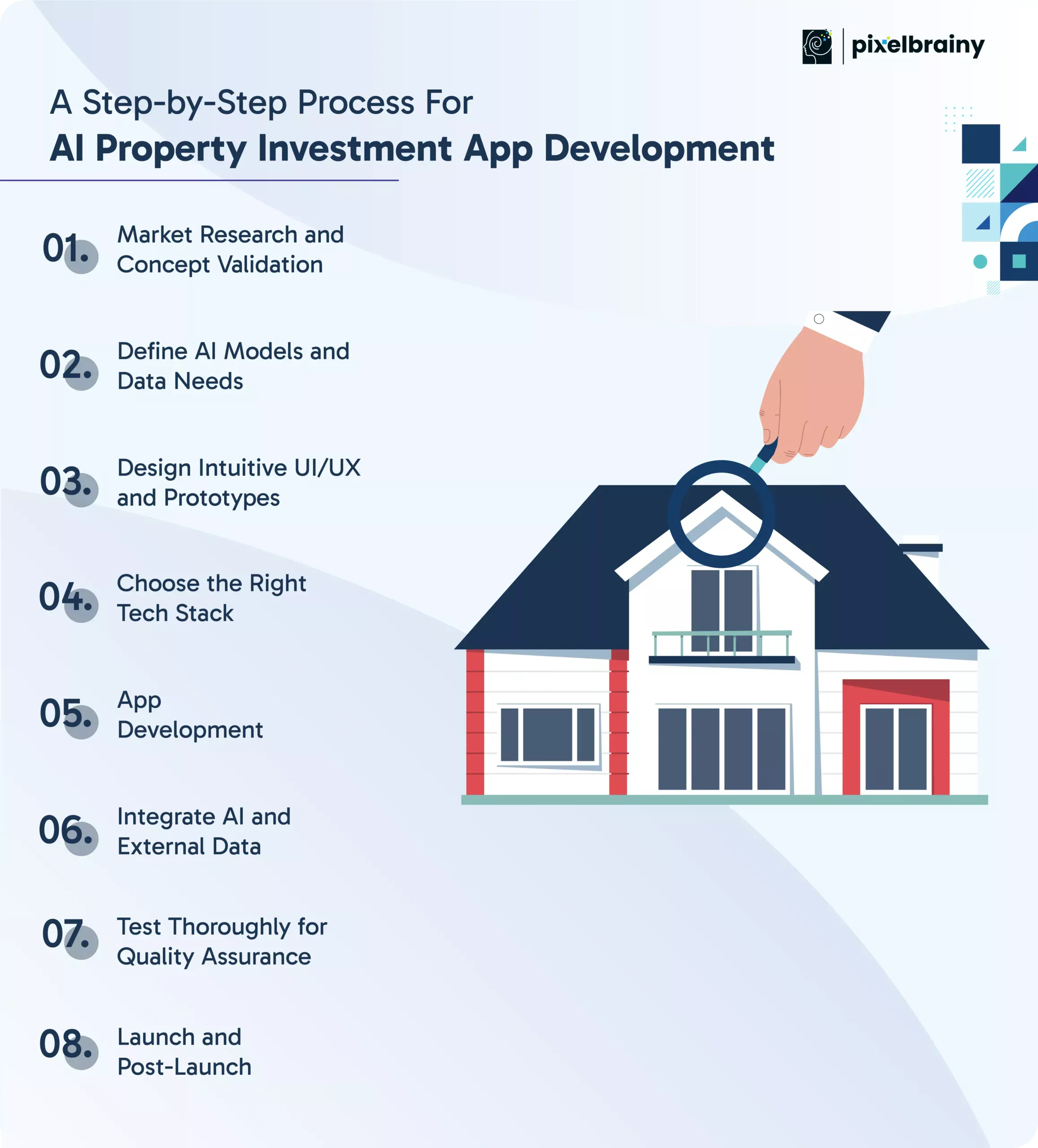
How to build AI property investment app?
AI mobile app development for property investment demands a well-planned approach, fusing real estate domain knowledge, smart tech, and seamless user experience.
Here's how to do it right:
Also Read: Top 10 AI MVP Development Companies in USA
Also Read: Top 12+ AI Model Development Companies in the USA
Also Read: Top 15 AI App Development Companies in USA
AI property investment app development in 2026 includes not only coding but also the creation of a platform that combines real estate expertise, AI modeling, and user-friendly mobile UX. Thus, the cost to develop AI property app can be anywhere from $40,000 to $400,000+.
To help you plan proficiently, here’s an analysis comparing the MVP, standard, and advanced versions of an AI real estate investment app in 2026.
| App Type | Ideal For | Key Features Included | Estimated Cost (USD) |
| MVP Level App | Startups testing product-market fit | Basic AI valuation, property listings, alerts, and user login | $40,000 – $75,000 |
| Advanced | Growing businesses & investment firms | Predictive analysis, investment tracking, personalized dashboards | $75,000 – $180,000 |
| Enterprise-Level | Enterprises & platforms with full AI | Full AI engine, custom ML models, chatbot, AR/VR tours, deep analytics | $180,000 – $400,000+ |
| Development Phase | MVP ($) | Standard ($) | Advanced ($) |
| Discovery & Research | 3,000 | 5,000 | 10,000 |
| UI/UX Design | 6,000 | 12,000 | 25,000 |
| Frontend + Backend Development | 20,000 | 45,000 | 100,000 |
| AI & ML Integration | 5,000 | 25,000 | 80,000 |
| API Integrations | 2,000 | 10,000 | 20,000 |
| Testing & QA | 3,000 | 8,000 | 15,000 |
| Deployment + Launch | 1,000 | 2,000 | 5,000 |
| Maintenance (Yearly avg.) | 5,000 | 10,000 | 20,000+ |
| Total Estimated Cost | $45,000 | $117,000 | $275,000+ |
Note: These estimates serve as a general reference and may vary based on factors like project complexity, feature set, design standards, development team rates, and integration needs.
| Factor | How It Impacts Cost |
| Feature Complexity | More AI-powered features (for example, risk assessment, smart suggestions) lead to higher cost |
| AI/ML Model Integration | Custom models cost more than pre-trained APIs |
| Third-party Integrations | APIs for property data, mortgage rates, tax, and legal compliance add development effort |
| Team Type | In-house U.S. team > Agency > Offshore (India, Eastern Europe) in terms of cost |
| UI/UX Design Depth | High-fidelity designs and personalized dashboards increase design hours |
| Security & Compliance | HIPAA (if needed), GDPR, or SEC-level security raises development time and testing costs |
| Post-Launch Support | Ongoing AI model training and maintenance affect the total cost over time |
Pro Tip: Start with an MVP focused on core AI features. Expand after validation using real investor feedback.
| Pro Tip*: Cost-Saving Strategies (Without Compromising Quality) 1. Focus on an MVP First 2. Use Pre-trained Models (OpenAI, Zillow / Redfin data, Open-source LLMs (like Mistral or LLaMA) 3. Choose Hybrid Dev Teams 4. Reuse UI Components & Open Source Tools (Tailwind UI, Chart.js, Radix UI for dashboards) |
Looking to build your AI property app for investors? At PixelBrainy, we offer transparent estimates and tailored strategies to help you minimize the cost to develop an AI property app without compromising on quality or performance.
Also Read: AI App Development Cost: From MVPs to Full-Scale AI App

The technology stack behind an AI property investment app has to support several functions at once, including property data processing, predictive analysis, financial modeling, personalized recommendations, real-time updates, and secure portfolio management. For businesses planning to create an AI property investment app, the right combination of AI frameworks, real estate data APIs, backend services, cloud infrastructure, and mobile technologies can directly influence performance, scalability, and development effort.
For an investor managing properties across multiple markets, the architecture should also support large datasets and fast analysis of acquisition opportunities. The stack needs to handle inputs such as property history, rental trends, market indicators, financing data, and user-defined investment criteria while keeping recommendations and portfolio insights responsive.
Below is the recommended technology stack for AI property investment app development, covering AI and machine learning, real estate data sources, backend infrastructure, and frontend or mobile development.
| Tool / Framework | Purpose |
| TensorFlow / PyTorch | Core ML model training & inference |
| OpenAI GPT APIs | NLP-driven chatbot, report summarization |
| scikit-learn | Predictive analytics, regression modeling |
| LangChain / LlamaIndex | AI-driven query engines on structured data |
| API / Source | Use Case |
| Zillow API | Property listing data, valuations |
| Realtor.com API | Market trends, local listings |
| ATTOM / Estated | Property history, tax, and mortgage data |
| Tech | Role |
| Node.js / Python (FastAPI) | API and ML orchestration backend |
| PostgreSQL + TimescaleDB | Real-time property and user data |
| AWS / GCP / Azure | Cloud hosting, AI model deployment |
| Docker + Kubernetes | Scalability and containerized deployments |
| Tech | Use Case |
| React / Next.js | Web dashboard & admin interface |
| React Native / Flutter | Cross-platform mobile app |
| Chart.js / D3.js | Investment graphs & data visualizations |
A well-matched technology stack gives AI real estate investment platform development a reliable foundation for accurate analysis, scalable data processing, secure operations, and personalized investment experiences.
How can an AI property investment app generate sustainable revenue while continuing to provide useful investment analysis and real estate data? The answer depends on the target audience, the app’s core functionality, and how much value users receive from features such as AI property valuation, predictive market analysis, portfolio tracking, and personalized investment recommendations.
For a PropTech startup, the monetization strategy may need to keep entry barriers low while encouraging users to upgrade for advanced AI capabilities. A platform targeting professional investors or real estate firms may instead focus on recurring subscriptions, transaction-based fees, licensing, or strategic partnerships. The model should also account for ongoing expenses such as data APIs, cloud infrastructure, AI processing, maintenance, and compliance.
For businesses planning AI property investment app development, the following monetization models provide practical options for turning an AI-powered real estate investment platform into a scalable revenue-generating product.
Here are the key AI property investment app monetization models:
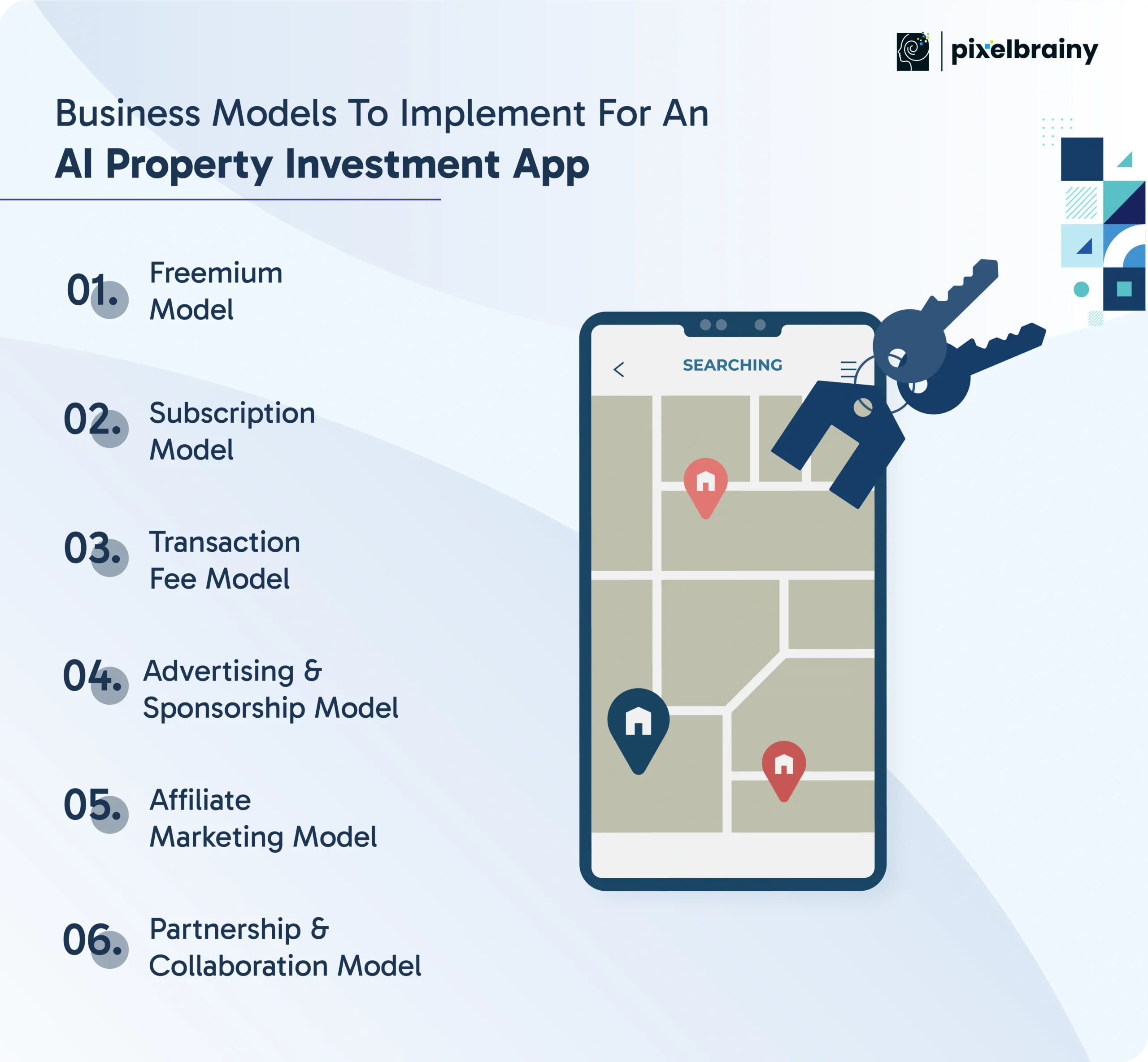
What It Is: Users get basic features free, like property search and alerts, but must pay to reap the benefits of AI-powered valuation tools or portfolio automation.
Why It Works: Low obstacles to entry cause user acquisition, while premium upgrades power revenue.
Best For: Startups creating a user base or testing AI features in the market.
What It Is: Users pay a monthly or annual fee to access premium AI features, like predictive insights, automated alerts, or detailed investment analytics.
Why It Works: It provides predictable recurring revenue and robust user retention.
Best For: Platforms offering advanced tools to individual investors or brokers.
What It Is: Charge users a percentage or flat fee for each successful property deal, portfolio execution, or AI-assisted investment transaction.
Why It Works: It scales with usage and aligns platform revenue with user outcomes.
Best For: Apps integrated with buying/selling, property tokenization, or fractional investing platforms.
What It Is: Sell ad space to mortgage lenders, real estate developers, or fintech brands targeting investors.
Why It Works: It monetizes free users without affecting UX if done per the standards.
Best For: High-traffic apps with strong free-tier engagement.
What It Is: Promote related services, such as home inspection, mortgage tools, and legal advice, and earn commissions for conversions.
Why It Works: It boosts user value and builds passive revenue streams.
Best For: Content-rich platforms or apps delivering educational investment resources.
What It Is: Collaborate with real estate agencies, data providers, or financial platforms to co-offer services or white-label the app.
Why It Works: It drives B2B monetization and opens new distribution channels.
Best For: Enterprise-focused apps or platforms built for scale.
Pro Tip: Many top-performing apps utilize a hybrid monetization approach, such as combining subscription and transaction fees to maximize revenue flexibility.
A hybrid model can give an AI property investment app multiple revenue streams while allowing the business to balance user acquisition, recurring revenue, transaction volume, and long-term platform growth.
What can go wrong when you develop AI property investment apps that depend on property data, financial modeling, predictive analytics, and AI-generated recommendations? For investors and PropTech businesses, the challenge is not simply getting AI to produce an output. The platform also needs reliable property data, explainable recommendations, appropriate privacy controls, scalable infrastructure, and a user experience that investors can trust.
These considerations become more important when an AI property investment app is expected to analyze acquisition opportunities across multiple markets and evaluate metrics such as rental income, cash-on-cash return, market trends, and investment risk. Addressing these issues early can reduce technical rework, improve decision quality, and create a more dependable product.
Below are the key challenges developers and founders should address, along with practical ways to overcome them:
Solution:
Solution:
Solution:
Solution:
Solution:
Solution:
Addressing these challenges during AI property investment app development helps businesses create platforms that are more reliable, transparent, scalable, and aligned with how investors actually evaluate opportunities. For users asking how to build an AI property investment app they can trust, strong data governance, explainable AI, and human oversight are as important as the underlying technology.
When your product needs to evaluate properties, analyze market signals, model investment returns, and generate personalized acquisition recommendations, the development partner needs to understand both AI and real estate investment workflows. This is where PixelBrainy positions itself as a real estate AI software development company, helping PropTech startups, investors, real estate firms, and investment-focused businesses turn complex ideas into scalable digital products.
With experience across AI-powered property valuation, predictive analytics, investment dashboards, real estate data integrations, and intelligent recommendations, PixelBrainy focuses on building solutions around specific investment objectives rather than adding AI features without a clear purpose.
Whether you are planning an MVP or a full-scale investment platform, our team can structure the product around your target markets, financial models, user profiles, data sources, and growth roadmap.
Client: A solo investor from Texas wanted to launch a mobile app that uses AI to identify potentially undervalued properties.
Approach:
Result:
The client reported that the AI property valuation app helped identify opportunities that were missed through the previous spreadsheet-based process. The first three selected properties reportedly outperformed the investor's previous method by 18%. This case detail is retained from the existing published content, with the client identified only as a solo investor from Texas.
For businesses looking for a real estate AI software development company that can translate investment workflows into practical AI products, PixelBrainy offers a strategy-led approach focused on scalability, usability, and measurable product value.
Want a tailored AI property investment app estimate? Contact PixelBrainy to discuss your idea, scope, and development roadmap.

An AI property investment app can turn fragmented real estate and market data into a more structured investment workflow. From AI-powered property valuation and rental income analysis to risk assessment, portfolio tracking, market predictions, and personalized acquisition recommendations, the right capabilities can help investors evaluate opportunities with greater consistency and speed.
However, successful AI property investment app development depends on more than integrating AI models. Data quality, reliable real estate APIs, financial modeling, security, scalability, user experience, and regulatory considerations all influence the final product. Defining the right use cases and starting with a focused MVP can also help control the property investment app development cost while creating room for future expansion.
Whether you are an individual investor, real estate firm, PropTech startup, or investment platform, a well-planned AI solution can become a valuable digital asset aligned with your investment strategy and business goals.
Ready to turn your AI property investment app idea into a scalable product? Schedule a call with PixelBrainy today.
The cost to build an AI-powered property investment app in the U.S. ranges from $40,000 to $400,000, depending on the complexity, AI integrations, and development team location.
Developing an AI-powered property investment app typically takes 3 to 9 months, depending on the feature set and AI complexity. MVPs can be ready in about 8 to 12 weeks, while fully-featured, AI-integrated platforms with advanced automation and analytics may take longer.
AI enhances property investment apps by offering predictive analytics, automated valuations, smart portfolio management, and personalized investment advice. It helps users make informed decisions faster while streamlining backend operations and data analysis.
Generative AI can be used to generate dynamic reports, simulate investment outcomes, and offer intelligent, conversational support. It improves user experience by delivering real-time insights and customized property recommendations at scale.
Yes. An AI property investment app can aggregate property, rental, market, and financial data from multiple locations and evaluate opportunities against predefined investment criteria. This is useful for investors who want to compare acquisitions across several markets without manually researching each property.
AI can be integrated with rental, property, and historical market data to estimate potential rental income and support financial calculations such as cash-on-cash return, rental yield, and ROI. The results should be presented as estimates based on available data and assumptions rather than guaranteed investment outcomes.
The AI property investment app development cost depends on factors such as AI model complexity, property data integrations, financial modeling, portfolio management features, platform support, UI/UX requirements, security, cloud infrastructure, and the development team's location.
Yes. An AI platform can be configured to evaluate properties against criteria such as budget, location, property type, expected rental income, target returns, risk tolerance, and portfolio objectives. It can then rank suitable opportunities and explain the factors behind each AI-generated property recommendation.

About The Author
Sagar Bhatnagar
Sagar Sahay Bhatnagar brings over a decade of IT industry experience to his role as Marketing Head at PixelBrainy. He's known for his knack in devising creative marketing strategies that boost brand visibility and market influence. Sagar's strategic thinking, coupled with his innovative vision and focus on results, sets him apart. His track record of successful campaigns proves his ability to utilize digital platforms effectively for impactful marketing efforts. With a genuine passion for both technology and marketing, Sagar continuously pushes PixelBrainy's marketing initiatives to greater success.

Working with the PixelBrainy team has been a highly positive experience. They understand the design requirements and create beautiful UX elements to meet the application needs. The dev team did an excellent job bringing my vision to life. We discussed usability and flow. Sagar worked with his team to design the database and begin coding. Working with Sagar was easy. He has the knowledge to create robust apps, including multi-language support, Google and Apple ID login options, Ad-enabled integrations, Stripe payment processing, and a Web Admin site for maintaining support data. I'm extremely satisfied with the services provided, the quality of the final product, and the professionalism of the entire process. I highly recommend them for Android and iOS Mobile Application Design and Development.

Great experience working with them. Had a lot of feedback and I found that unlike most contractors they were bugging me for updates instead of the other way around. They were extremely time conscience and great at communicating! All work was done extremely high quality and if not on time, early! They were always proactive when it comes to communication and the work is great/above par always. Very flexible and a great team to work with! Goes above and beyond to present us with multiple options and always provides quality. Amazing work per usual with Chitra. If you have UI/UX or branding design needs I recommend you go to them! Will likely work with them in the future as well, definitely recommended!

PixelBrainy is a joy to work with and is a great partner when thinking through branding, logo, and website layout. I appreciate that they spend time going into the "why" behind their decisions to help inform me and others about industry best practices and their expertise.

I hired them to design our software apps. Things I really like about them are excellent communication skills, they answer all project suggestions and collaborate right away, and their input on design and colors is amazing. This project was complex and needed patience and creativity. The team is amazing to do business with. I will be using them long-term. Glad to see there are some good people out there. I was afraid to try and outsource my project to someone but I am glad I met them! I really can't say enough. They went above and beyond on this project. I am very happy with everything they have done to make my business stand out from the competition.

It was great working with PixelBrainy and the team. They were very responsive and really owned the project. We'll definitely work with them again!

I recently worked with the PixelBrainy team on a project and I was blown away by their communication skills. They were prompt, clear, and articulate in all of our interactions. They listened and provided valuable feedback and suggestions to help make the project a success. They also kept me updated throughout the entire process, which made the experience stress-free and enjoyable.

PixelBrainy is very good at what it does. The team also presents themselves very professionally and takes care of their side of things very well. I could fully trust them taking up the design work in a timely and organised manner and their attention to detail saved us lots of effort and time. This particular project was quite intense and the team showed that they function very well under pressure. Very much looking forward to working with her again!

It's always an absolute pleasure working with them. They completed all of my requests quickly and followed every note I had for them to a T, which made our process go smoothly from start to finish. Everything was completed fast and following all of the guidelines. And I would recommend their services to anyone. If you need any design work done in the future, PixelBrainy should be your first call!

They took ownership of our requirements and designed and proposed multiple beautiful variants. The team is self-motivated, requires minimum supervision, committed to see-through designs with quality and delivering them on time. We would definitely love to work with PixelBrainy again when we have any requirements.

PixelBrainy was a big help with our SaaS application. We've been hard at work with a new UI/UX and they provided a lot of help with the designs. If you're looking for assistance with your website, software, or mobile application designs, PixelBrainy and the team is a great recommendation.

PixelBrainy designers are amazing. They are responsive, talented, and always willing to help craft the design until it matches your vision. I would recommend them and plan to continue them for my future projects and more!!!

They were awesome! Did a good job fast, and good communication. Will work with them again. Thank you

Creative, detail-oriented, and talented designers who take direction well and implement changes quickly and accurately. They consistently over-delivered for us.

PixelBrainy team is very talented and creative. Great designers and a pleasure to work with. PixelBrainy is an excellent communicator and I look forward to working with them again.

PixelBrainy has a very talented design team. Their work is excellent and they are very responsive. I enjoy working with them and hope to continue on all of our future projects.


Transform your ideas into reality with us.
Across these industries, each engagement brings unique challenges, from early-stage product development to scaling complex systems, helping us build a practical understanding of real-world product environments.