
 AI Summary Powered by PixelBrainy
Most founders know they are overspending. They just do not know where until it is too late.
At first, everything feels under control. The product is progressing, customers are showing interest, and the team is working hard. Then the expenses start stacking up. Software subscriptions multiply. Freelancers are hired to handle repetitive tasks. Marketing campaigns consume more budget than expected. Administrative work expands faster than revenue. Before long, the startup is spending money in dozens of places without a clear understanding of what is truly driving growth.
This story is far more common than most founders realize.
Industry data consistently shows that nearly 90% of startups fail, and one of the biggest contributing factors is poor financial management and unnecessary spending. While founders often focus on funding rounds, product development, and customer acquisition, many overlook the hidden operational costs that quietly drain cash every month. Small inefficiencies become major expenses over time. Tasks that once seemed manageable suddenly require additional hires, more software, and larger budgets.
This is where how AI reduces startup costs becomes one of the most important conversations for modern entrepreneurs.
Many business articles still present artificial intelligence as an emerging trend that companies should prepare for someday. The reality is very different. AI is already helping businesses automate repetitive work, streamline operations, improve productivity, reduce labor costs, and eliminate inefficiencies that previously required entire teams to manage.
Yet countless founders continue spending valuable resources solving problems that AI has already solved.
Consider this common scenario:
"I am looking for an AI integration agency that does not just hand me a list of tools but actually builds the entire automated system inside my existing business so I do not have to figure it out myself."
This reflects a growing realization among founders. The goal is not to collect more software. The goal is to create systems that reduce workload, improve efficiency, and generate measurable financial savings.
By the end of this blog, you'll know the exact areas where AI cuts costs, the tools to use, and how to measure savings in real dollars.
Most startup founders believe they have a revenue problem. In reality, many have a spending problem they cannot see.
When a startup begins to grow, expenses rarely explode overnight. Instead, they accumulate quietly through dozens of small decisions that seem reasonable in isolation. A new hire here. Another software subscription there. A manual process that requires extra hours every week. Over time, these costs compound and create a burn rate that becomes difficult to sustain.
The challenge is that most founders are never taught where startup money actually goes. They focus on raising capital, building products, and attracting customers while overlooking the operational inefficiencies slowly draining their runway.
Three silent cost killers are responsible for most unnecessary startup spending:
Many founders hire before they truly need to. Instead of automating repetitive tasks, they add employees or contractors to handle work that could be streamlined through technology. Salaries, benefits, onboarding, and management costs quickly add up.
Modern startups often subscribe to dozens of platforms. Marketing tools, project management software, analytics platforms, customer support systems, and productivity apps can create a bloated technology stack that delivers limited value relative to its cost.
Manual workflows are one of the biggest hidden expenses in any startup. Tasks such as data entry, reporting, scheduling, customer support responses, lead qualification, and content creation consume hours that could be spent on growth-focused activities.
Industry estimates suggest that the average early-stage startup burns between $50,000 and $150,000 per year on tasks that modern AI systems can either automate or significantly streamline.
Many founders spend their days managing operations rather than growing the business.
All of these activities feel productive, but they rarely create meaningful business growth.
This is what many experts call the "fake busy" trap. Founders stay occupied while the activities that actually drive revenue receive less attention.
| Traditional Approach | AI-Powered Approach |
|---|---|
| Hire a content writer for routine blog drafts | Generate first drafts using AI and have humans edit |
| Manual customer support responses | AI-powered support assistants handle common inquiries |
| Sales team manually entering CRM data | Automated AI workflows update records instantly |
| Virtual assistants scheduling meetings | AI scheduling systems coordinate appointments automatically |
| Manual market research | AI research tools gather and summarize insights |
A common example looks like this:
"Our sales team is wasting too much time on manual lead follow ups and data entry into the CRM and I want to find an agency that can automate this entire process using AI so my team can focus only on closing deals."
This is no longer a future use case. It is happening today across startups that understand How can AI help startups save money while improving productivity at the same time.
The companies gaining an advantage are not necessarily spending less. They are spending smarter. They understand how AI reduces startup costs, how startups use AI to extend their runway, and how to reduce burn rate using AI automation before unnecessary expenses become a serious threat.
Here's where AI steps in, not as a gimmick, but as a real financial decision.
Most startup founders think their budget problems will begin after launch.
The truth is that many startups start burning through cash long before they acquire customers, generate revenue, or release a finished product. By the time the product is ready for the market, a large portion of the available budget has already been consumed by operational activities that contribute little to long-term growth.
This is one of the biggest reasons startup budgets fail.
Founders typically plan for obvious expenses such as product development, marketing campaigns, and hiring. What they often underestimate are the hidden costs that emerge during the building phase. Administrative work, market research, customer discovery, content creation, reporting, scheduling, data management, and internal communication all require resources. Individually, these expenses appear small. Together, they create a significant financial burden.
Before launch, startups frequently spend money on tasks such as:
None of these activities directly improve the product, yet they consume a substantial share of the budget.
This is why many founders struggle to understand How startups use AI to extend their runway. They focus on product costs while overlooking operational inefficiencies that steadily drain capital behind the scenes.
A common mistake among early-stage startups is treating every new workload as a hiring problem.
While these decisions may seem logical, they often increase fixed costs before the business has achieved predictable revenue.
As salaries, contractor fees, and management responsibilities grow, the company's financial flexibility decreases. The startup becomes more expensive to operate even though the product itself may still be in development.
Imagine a startup where sales representatives spend hours every week updating customer records, organizing lead information, sending routine follow-up messages, and managing CRM data.
The founder realizes that talented salespeople are spending more time on administration than on actual selling. Instead of adding more staff, the smarter question becomes whether those repetitive workflows can be automated and integrated into existing business systems.
This shift in thinking represents one of the most practical examples of How can AI help startups save money.
The old startup model assumed that growth required more people, more manual effort, and more operational overhead.
Today's most efficient companies operate differently.
They identify repetitive work early, automate it, and reserve human talent for activities that generate revenue, improve products, and strengthen customer relationships.
This approach helps founders reduce burn rate using AI automation while maintaining productivity and scalability.
Ultimately, startup budgets rarely collapse because founders spend too much building their products. They collapse because businesses spend too much supporting processes that could have been streamlined from the beginning.
Understanding this distinction is the first step toward effective startup cost reduction using AI. Once founders recognize where money is actually leaking, they can begin building a business that grows efficiently rather than expensively.
At its core, AI is not a cost-cutting magic trick. It is a system for removing inefficiencies that quietly consume money every day.
When founders ask how artificial intelligence creates measurable savings, the answer usually comes down to four mechanisms. These are the areas where startups see the fastest and most consistent financial impact.
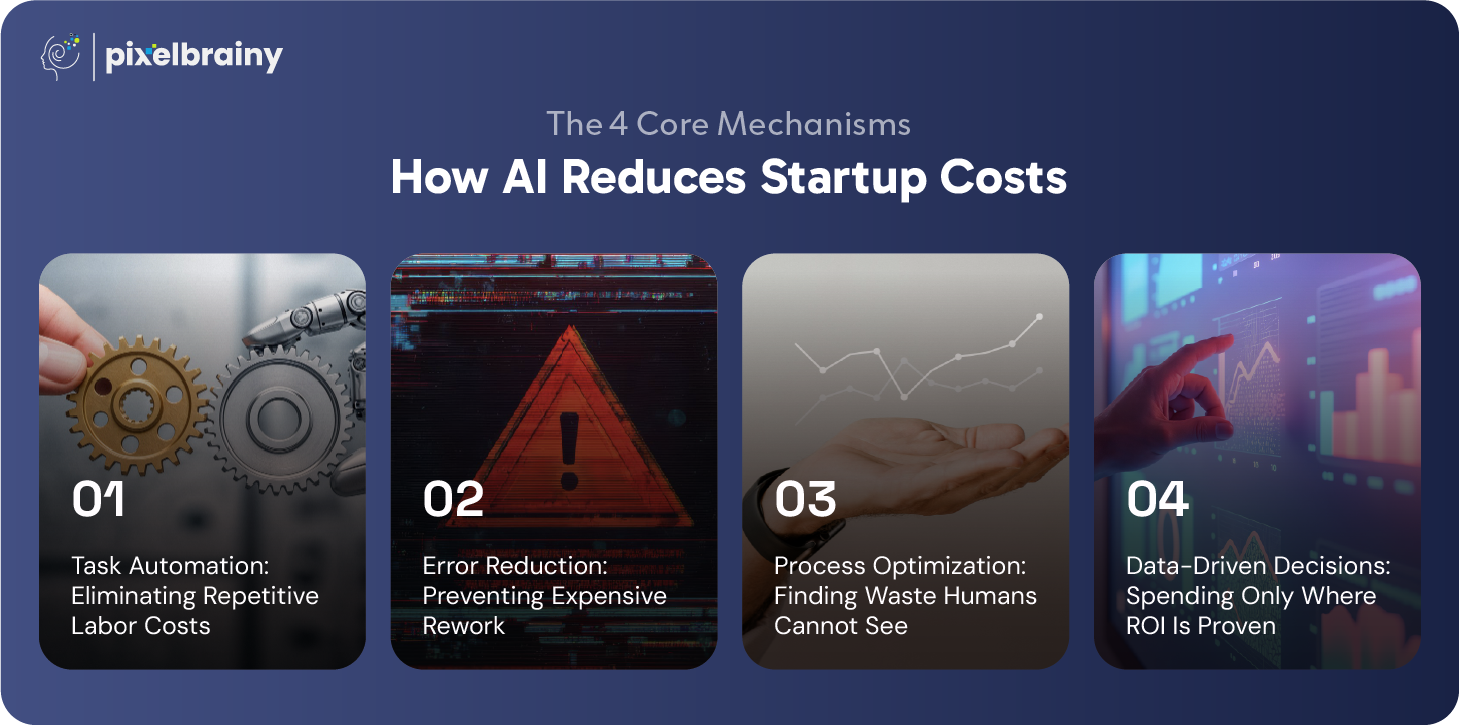
Every startup has repetitive tasks that consume valuable employee time. Data entry, scheduling, customer follow-ups, reporting, lead qualification, document processing, and content creation are just a few examples.
AI automates these activities, allowing employees to focus on work that directly generates revenue.
Micro Example: Klarna reported that its AI assistant was able to handle customer service work equivalent to hundreds of support agents, helping the company increase efficiency while reducing operational costs.
For startups, this means fewer hours spent on routine work and more time spent acquiring customers, improving products, and growing revenue.
Mistakes are expensive.
Incorrect data entry, missed follow-ups, inaccurate reports, and process failures often create hidden costs that founders rarely track. Every error leads to additional labor, delayed projects, and lost opportunities.
AI systems follow predefined workflows consistently, reducing the likelihood of costly mistakes.
Micro Example: An automated invoice-processing system can identify missing information instantly, preventing payment delays and reducing the need for manual corrections.
Less rework means lower labor costs and smoother operations.
Many businesses operate with inefficient workflows simply because nobody has the time to analyze them.
AI can monitor operational data, identify bottlenecks, and recommend improvements that increase productivity without increasing headcount.
Micro Example: An AI-powered workflow system may discover that customer onboarding takes seven days due to unnecessary approval steps. By automating approvals, onboarding time can drop significantly while reducing administrative workload.
This is one of the most overlooked Ways AI helps early-stage startups survive longer because it improves efficiency without requiring additional investment.
Founders often make decisions based on assumptions, incomplete information, or gut instinct.
AI helps businesses analyze large amounts of data quickly, revealing which marketing channels, sales activities, products, or customer segments actually generate returns.
Micro Example: Instead of spending equally across five marketing campaigns, AI analytics may reveal that one campaign generates 80% of qualified leads. The startup can then redirect budget toward proven opportunities.
Smarter spending naturally leads to better financial outcomes.
AI doesn't replace your team. It replaces the busywork that's draining them.
This distinction is critical. The goal is not to remove people from the business. The goal is to remove inefficiencies that prevent talented employees from doing their highest-value work.
A growing number of founders are reaching a point where they think: Our team understands the business, but we do not have the technical expertise to automate workflows, connect systems, deploy AI solutions, and train employees on how to use them effectively. We need a partner that can manage the entire process from planning and implementation to team adoption.
That mindset reflects the next stage of startup efficiency.
The founders seeing the biggest gains are not simply experimenting with AI tools. They are building integrated systems that deliver measurable savings. Understanding How founders use AI to cut business expenses starts with identifying the right workflows to automate and selecting the Best AI tools to reduce startup operating costs for each business function. The next section breaks down eight specific areas where those savings are already happening today.

The biggest misconception about artificial intelligence is that it only benefits large enterprises with massive budgets.
In reality, startups often see the greatest impact because every dollar saved directly extends runway, improves cash flow, and creates more opportunities for growth. The key is knowing where AI delivers immediate financial value.
Below are eight areas where startups are already reducing operational costs, increasing productivity, and scaling without adding unnecessary headcount.
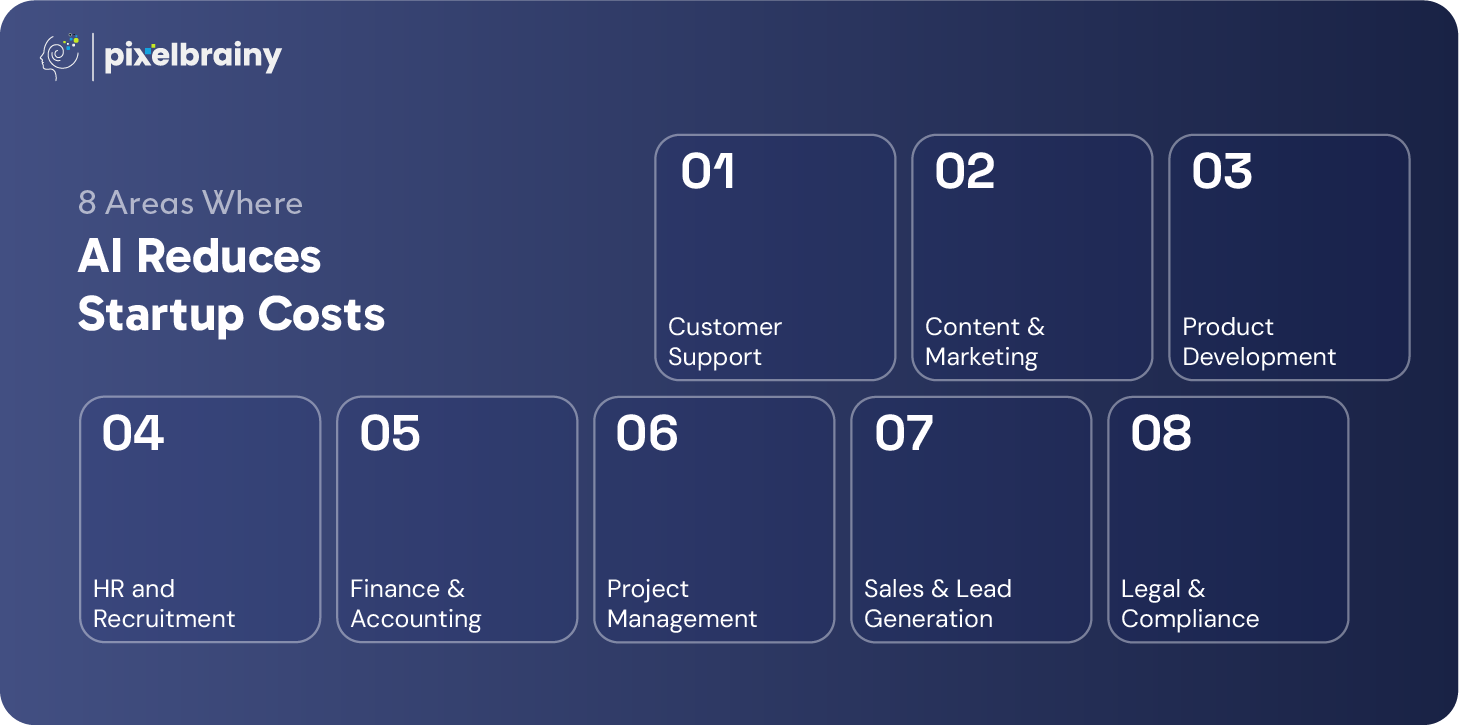
What It Costs Without AI: Customer support is one of the first departments that becomes expensive as a startup grows. More customers typically mean more tickets, emails, live chat requests, and support staff.
Many startups hire additional agents simply to keep up with repetitive questions.
What AI Does: AI-powered chatbots and ticketing systems can answer common questions, categorize tickets, route inquiries, and provide instant support 24/7.
Human agents can then focus on complex customer issues rather than repetitive requests.
Recommended Tools: Intercom AI, Tidio AI, Zendesk AI
Estimated Savings: 40% to 60% reduction in support staffing costs
For startups handling hundreds of support requests weekly, this can translate into thousands of dollars saved every month.
What It Costs Without AI: Creating blog posts, ad copy, email campaigns, landing pages, social media content, and SEO content often requires agencies, freelancers, or full-time marketers.
Many startups spend heavily before seeing measurable marketing results.
What AI Does: AI can generate content drafts, optimize campaigns, analyze performance, create ad variations, and accelerate content production.
Instead of replacing marketers, it dramatically increases their output.
Recommended Tools: ChatGPT, Jasper, Surfer SEO
Estimated Savings: $2,000 to $5,000 per month compared to agency costs
This is one of the most effective examples of AI-powered business automation for startups because content production is often a recurring expense.
What It Costs Without AI: Software development is typically one of the largest startup expenses.
Building products often requires larger engineering teams, longer development cycles, and higher testing costs.
What AI Does: AI coding assistants generate code suggestions, identify bugs, automate testing, and accelerate development workflows.
Developers spend less time on repetitive coding tasks and more time solving complex problems.
Recommended Tools: GitHub Copilot, Cursor
Estimated Savings: Ship products 30% to 40% faster with smaller teams
For startups, faster product releases can mean reaching revenue milestones months earlier.
What It Costs Without AI: Hiring is time-consuming and expensive.
Recruiters often spend hours reviewing resumes, coordinating interviews, communicating with candidates, and scheduling meetings.
What AI Does: AI can screen applicants, rank candidates, automate communication, and schedule interviews automatically. This reduces administrative workload, improves candidate experience, and speeds up hiring decisions. Many businesses partner with an AI HR software development company to build customized recruitment automation solutions tailored to their hiring workflows and talent acquisition goals.
Recommended Tools: Kula, Workable AI
Estimated Savings: Reduce time-to-hire by up to 50%
Faster hiring means lower recruitment costs and less productivity lost from open positions.
Also Read: AI HR Software Development: Top Benefits and Features
What It Costs Without AI: Bookkeeping, expense tracking, invoicing, financial reporting, and forecasting often require outside accountants or dedicated finance staff.
These expenses increase as transactions grow.
What AI Does: AI automates bookkeeping, categorizes expenses, detects anomalies, generates reports, and forecasts cash flow. Founders gain financial visibility without spending hours reviewing spreadsheets. Many startups invest in AI financial software development to create customized solutions that automate routine financial processes, improve reporting accuracy, and support better decision-making.
Recommended Tools: Digits, Dext, Fathom
Estimated Savings: $500 to $2,000 per month on accounting and financial management
This is one of the most practical ways startups improve financial efficiency while maintaining accurate records.
What It Costs Without AI: Founders spend countless hours managing tasks, assigning responsibilities, following up on progress, and resolving workflow bottlenecks.
As teams grow, coordination becomes increasingly expensive.
What AI Does: AI prioritizes tasks, predicts delays, identifies bottlenecks, and recommends workflow improvements.
Teams stay aligned without requiring constant manual oversight.
Recommended Tools: Motion, Asana AI
Estimated Savings: 5 to 10 hours per week saved per founder
Those hours can be redirected toward fundraising, sales, partnerships, and strategic growth initiatives.
What It Costs Without AI: Sales teams frequently waste time researching prospects, updating CRM records, qualifying leads, and managing follow-ups manually.
These activities increase customer acquisition costs and reduce sales productivity.
What AI Does: AI scores leads, enriches contact data, automates follow-ups, updates CRM systems, and identifies high-intent prospects.
Sales teams can focus on conversations that actually generate revenue.
Recommended Tools: HubSpot AI, Clay
Estimated Savings: Reduce customer acquisition costs by 20% to 35%
This is one of the strongest examples of how AI improves startup profitability because every efficiency gain directly impacts revenue generation.
What It Costs Without AI: Many startups spend significant amounts on contract reviews, compliance checks, policy updates, legal research, and document preparation.
Even routine legal work can become surprisingly expensive.
What AI Does: AI reviews contracts, identifies risky clauses, summarizes legal documents, assists with compliance requirements, and speeds up document analysis. Legal professionals can then focus on higher-value advisory work. Many organizations are also investing in AI legal software development to build tailored solutions that automate contract management, compliance monitoring, and legal document workflows.
Recommended Tools: Harvey, Ironclad
Estimated Savings: $300 to $1,500 per document
For startups handling vendor agreements, partnership contracts, employment documents, and compliance requirements, the savings can be substantial.
This area is often ignored in discussions about startup automation, yet it represents one of the fastest-growing opportunities for operational cost reduction.
The most successful startups are no longer asking whether AI works.
They are asking how quickly they can integrate it across multiple departments.
A common scenario looks something like this:
A growing startup realizes its customer support team is overwhelmed, marketing costs keep rising, developers are spending too much time on repetitive coding tasks, sales representatives are buried in CRM administration, and founders are still manually reviewing reports every week. Instead of purchasing disconnected software tools, the leadership team starts searching for a partner that can design, implement, connect, and manage a complete AI automation ecosystem across customer support, marketing, operations, sales, finance, and internal workflows so every department works together efficiently inside the existing business.
That shift in thinking is where the biggest savings occur.
The real opportunity is not using one AI tool. It is building a connected system that eliminates inefficiencies across the entire organization.
When implemented strategically, these eight areas represent some of the most effective Best AI tools to reduce startup operating costs, demonstrate How founders use AI to cut business expenses, and highlight the most practical Ways AI helps early-stage startups survive longer in an increasingly competitive market.
Most founders are not interested in theoretical benefits.
They want to know one thing:
How much money can AI actually save a startup?
The answer depends on the size of the business, the number of manual processes being performed, and how effectively automation is implemented. However, one pattern appears consistently across industries. Startups that strategically adopt AI often achieve meaningful reductions in operational expenses while increasing productivity.
Industry research from McKinsey has found that AI-powered workflows can save employees approximately 13 hours per week on average. For a small startup team, that productivity gain can translate into roughly $4,700 or more per month in recovered value, depending on salaries and workload distribution.
Many experts now agree on a realistic benchmark:
"Startups can realistically reduce operational costs by 10% to 40% through targeted AI adoption."
| Function | Without AI (Monthly) | With AI (Monthly) | Monthly Savings |
|---|---|---|---|
| Customer Support | $4,000 | $800 | $3,200 |
| Content & Marketing | $5,000 | $1,200 | $3,800 |
| Accounting | $1,500 | $300 | $1,200 |
| Development (Extra Hires) | $12,000 | $7,000 | $5,000 |
| Total | $22,500 | $9,300 | $13,200/month |
For many startups, saving over $13,000 per month can dramatically extend runway, delay fundraising pressure, and create more flexibility for growth initiatives.
At the pre-revenue stage, every dollar matters. Founders can often automate content creation, market research, customer support, and administrative work instead of hiring early.
Potential savings: $2,000 to $8,000 per month
Seed-funded companies typically experience rapid growth in operations. AI helps automate marketing, sales workflows, reporting, customer service, and recruiting.
Potential savings: $8,000 to $25,000 per month
As teams scale, operational complexity increases significantly. AI can reduce costs across departments while improving efficiency and decision-making.
Potential savings: $25,000 to $100,000+ per month depending on team size
Many founders eventually reach a point where they realize the opportunity is much bigger than using a few isolated tools. They start looking for a solution that can automate customer support, sales operations, reporting, marketing workflows, recruiting processes, and internal business systems while connecting everything into one streamlined operation that employees can actually use without adding more complexity.
This is where AI cost savings for startups become measurable rather than theoretical.
The businesses achieving the strongest results are not simply experimenting with automation. They are implementing systems designed around startup operational efficiency, AI business process automation, reducing startup overhead costs, and extending startup runway with artificial intelligence. The result is lower expenses, higher productivity, and a stronger foundation for long-term growth.
One of the biggest mistakes founders make is assuming that buying more AI tools automatically leads to lower costs.
It does not.
In fact, many startups end up creating a new problem by paying for dozens of subscriptions that never get fully implemented. The result is a growing software bill, disconnected workflows, and little measurable return.
The startups that achieve meaningful savings take a different approach. They focus on solving specific business problems first and choosing technology second.
If your goal is how AI reduces startup costs in a measurable way, follow these five steps.
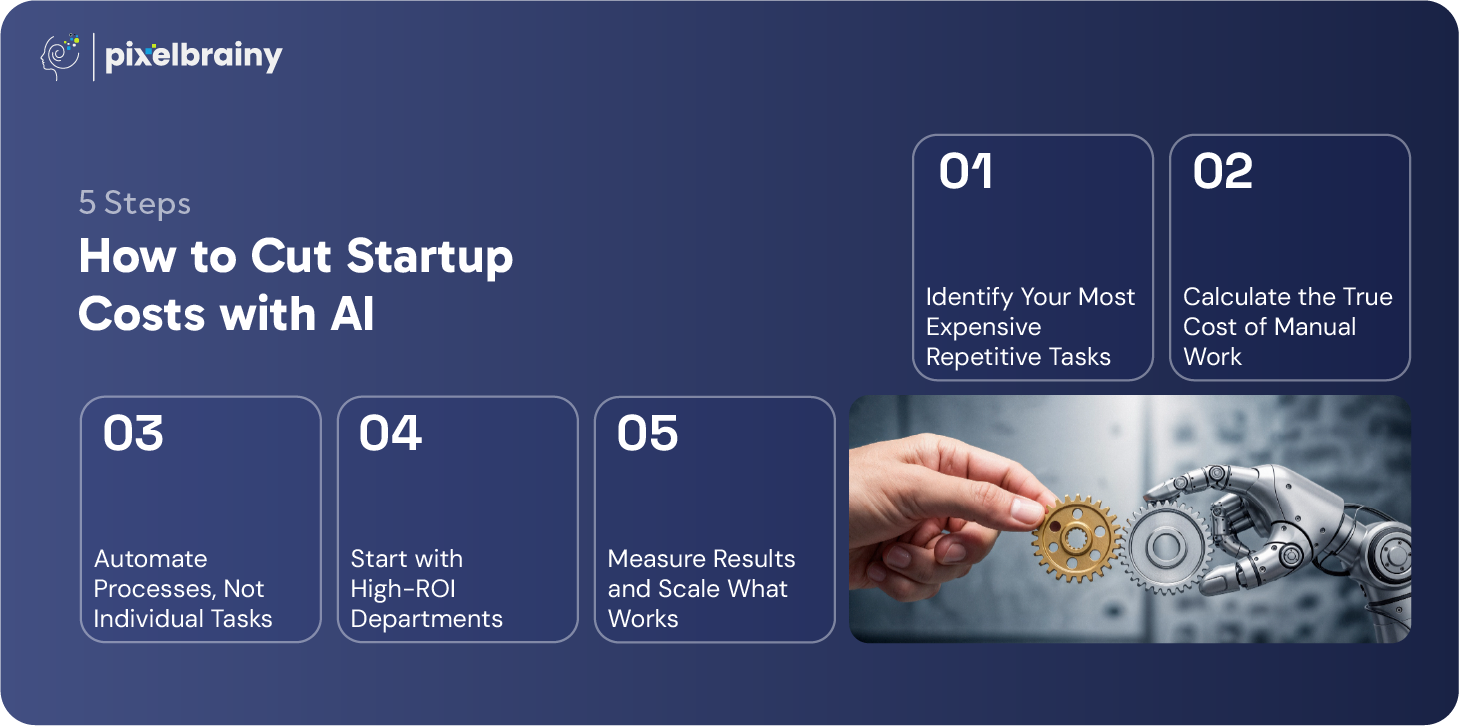
Before evaluating any AI platform, map out where your team spends time every week.
Look for activities such as:
The best opportunities for startup cost reduction using AI are usually repetitive, time-consuming tasks that follow predictable workflows.
Ask a simple question:
"If this task disappeared tomorrow, how much time and money would we save?"
The higher the answer, the better the automation opportunity.
Many founders underestimate how expensive manual processes actually are.
For example, if an employee earning $4,000 per month spends 30% of their time updating spreadsheets, sending follow-up emails, or moving data between systems, the business is effectively spending $1,200 every month on work that may be automated.
This exercise helps founders understand how founders use AI to cut business expenses by attaching real dollar values to operational inefficiencies.
When viewed this way, automation becomes a financial decision rather than a technology decision.
A common mistake is automating one task while leaving the rest of the workflow untouched.
For example:
The workflow remains fragmented.
Instead, focus on complete process automation.
A lead enters the system, gets qualified automatically, receives personalized communication, updates the CRM, and alerts the sales team when action is required.
This approach delivers far greater savings and is one of the most effective ways AI helps early-stage startups survive longer.
Not every department should be automated first.
The fastest results typically come from:
These areas often contain repetitive work that directly impacts operating costs.
Prioritizing them allows startups to see measurable improvements before expanding automation across the organization.
This is why many experts recommend focusing on the best AI tools for startups that address immediate business bottlenecks rather than experimenting with dozens of unrelated platforms.
Automation should always be tied to measurable outcomes.
Track metrics such as:
If an AI implementation saves ten hours per week but costs more than the value it creates, it is not delivering ROI.
Successful founders continuously optimize their systems based on performance data.
This is how companies learn to reduce business expenses with AI while maintaining growth and operational efficiency.
Consider a startup founder who realizes their team is spending hours every day manually responding to customer inquiries, updating CRM records, generating reports, qualifying leads, creating marketing content, and coordinating internal workflows. Instead of purchasing separate tools for every problem, they begin searching for an AI implementation partner that can evaluate the entire business, identify the highest-cost inefficiencies, connect existing software, automate workflows across departments, train employees, and create a fully integrated system that delivers measurable savings from day one.
That approach is often far more effective than chasing the latest AI trend.
The goal is not to use the most AI tools.
The goal is to eliminate the most expensive inefficiencies.
Founders who succeed with AI for startups focus on outcomes rather than software. They understand that how to cut startup costs with AI begins with identifying waste, automating high-value processes, measuring results, and scaling only what delivers proven ROI.
When executed correctly, this approach can significantly lower operating expenses, improve productivity, extend runway, and create a stronger foundation for long-term growth.
One of the biggest questions founders ask before investing in automation is simple:
Is AI actually worth the money?
The good news is that measuring AI performance is much easier than most people think. You do not need a finance team, expensive analytics software, or a dedicated CFO to determine whether your investment is generating value.
In fact, one spreadsheet is often enough.
Use this formula:
(Total Savings + Added Revenue – Total AI Costs) ÷ Total AI Costs × 100
This gives you a percentage that shows whether your AI investment is producing a positive return.
For example:
ROI = ($3,000 + $2,000 - $1,000) ÷ $1,000 × 100
ROI = 400%
That means every dollar invested in AI generated four dollars in return.
This is one of the simplest ways founders can evaluate AI ROI for startups and determine whether an automation initiative deserves further investment.
When measuring startup cost reduction using AI, focus on these four key metrics:
Track how many hours employees save each week through automation.
Examples include:
Time savings often translate directly into lower operating costs.
Measure expenses you no longer need to incur.
Examples include:
This metric is essential for understanding how AI reduces startup costs in practical financial terms.
Mistakes create hidden expenses.
Track reductions in:
Fewer errors mean less rework and higher efficiency.
Monitor improvements such as:
These indicators help measure the broader business impact of AI business automation for startups.
Imagine an AI customer support system handles 500 support tickets per month.
Monthly human cost: $2,500
Monthly AI cost: $250
Monthly savings: $2,250
Over a year, that equals $27,000 in savings from a single workflow.
This is why many founders exploring AI for startups, reduce business expenses with AI, and AI cost savings strategies quickly realize that even small automations can produce significant returns.
Most importantly, remember this:
You do not need a CFO to track AI ROI. A basic spreadsheet works.
The founders who see the biggest gains are not necessarily financial experts. They simply measure time saved, costs avoided, errors reduced, and business outcomes improved. When those numbers move in the right direction, the value of AI becomes impossible to ignore.
AI can significantly lower operating expenses, improve productivity, and extend a startup's runway. However, not every implementation delivers results. In many cases, founders invest in automation expecting immediate savings, only to discover that costs remain unchanged or even increase.
The problem is usually not the technology. It is the way the technology is implemented.
Here are the five most common mistakes startups make when pursuing AI cost reduction for startups.
One of the biggest misconceptions about automation is that it automatically fixes inefficiency.
It does not.
If a workflow is poorly designed, AI will simply help that inefficient process run faster.
Before implementing automation, founders should simplify and optimize workflows first. This approach is essential for successful startup process automation with AI.
Many startups purchase AI software because it is popular, not because it solves a specific business challenge.
The result is unused subscriptions, disconnected systems, and wasted budget.
The smartest founders start with the problem and then select the technology that addresses it. This is one of the most effective principles behind how AI reduces startup costs in a measurable way.
AI systems depend on data.
If customer records are incomplete, sales information is inaccurate, or operational data is outdated, automation results will be unreliable.
This is often called the "garbage in, garbage out" problem.
Strong data quality is the foundation of successful AI business automation for startups.
Another common mistake is deploying AI across the entire company before proving it works.
A better approach is to start with one department, one workflow, or one business process.
Measure results, optimize performance, and then expand gradually.
This reduces risk while improving the likelihood of long-term success.
Surprisingly, many founders implement AI but never measure the outcome.
They do not track:
Without measurement, it becomes impossible to understand the true value of AI for startups or identify the areas generating the highest return.
Founders looking to reduce business expenses with AI, improve operational efficiency, and achieve meaningful startup cost reduction using AI should remember a simple principle:
AI won't save you money by accident. It saves you money because you decided to use it with intention.
Reducing startup expenses is no longer just about hiring fewer people or negotiating lower vendor contracts. The most efficient companies are using artificial intelligence to automate repetitive work, improve productivity, and increase output without significantly increasing headcount.
For founders exploring the best AI tools for startups to reduce costs, the following categories offer some of the highest ROI opportunities in 2026.
Content production, SEO, campaign management, and copywriting can quickly become expensive for growing startups. AI tools help teams create more content in less time while reducing dependence on agencies and freelancers.
| Tool | Primary Use Case | Pricing Tier | Savings Potential |
|---|---|---|---|
| ChatGPT | Content creation, brainstorming, marketing copy | Free / Paid | Reduce content production costs |
| Jasper | AI copywriting and campaign generation | Mid-Range | Lower agency spending |
| Surfer SEO | Content optimization and SEO planning | Mid-Range | Improve organic traffic efficiently |
These platforms are frequently used by startups pursuing AI-powered marketing automation and lower customer acquisition costs.
Support costs often increase as customer volume grows. AI-powered support platforms help businesses maintain service quality without continuously expanding support teams.
| Tool | Primary Use Case | Pricing Tier | Savings Potential |
|---|---|---|---|
| Tidio | AI chatbot automation | Affordable | Reduce support staffing costs |
| Intercom AI | Conversational customer support | Premium | Scale support operations efficiently |
| Freshdesk AI | Ticket automation and routing | Mid-Range | Improve response times |
Development remains one of the largest startup expenses. AI coding assistants help developers work faster, reduce repetitive tasks, and accelerate product releases.
| Tool | Primary Use Case | Pricing Tier | Savings Potential |
|---|---|---|---|
| GitHub Copilot | AI-assisted coding | Affordable | Increase developer productivity |
| Cursor | Intelligent coding workflows | Affordable | Speed up product development |
| Tabnine | Code completion and generation | Mid-Range | Reduce development workload |
Financial management requires accuracy, visibility, and consistent reporting. AI tools simplify bookkeeping and forecasting while reducing manual effort.
| Tool | Primary Use Case | Pricing Tier | Savings Potential |
|---|---|---|---|
| Dext | Expense management | Mid-Range | Reduce bookkeeping time |
| Digits | Financial insights and forecasting | Premium | Improve cash flow visibility |
| Fathom | Financial reporting and analysis | Mid-Range | Lower accounting overhead |
Hiring processes often consume valuable founder time. AI streamlines candidate screening, scheduling, and recruitment workflows.
| Tool | Primary Use Case | Pricing Tier | Savings Potential |
|---|---|---|---|
| Kula | Recruiting automation | Premium | Faster hiring decisions |
| Workable | Candidate screening | Mid-Range | Lower recruitment costs |
| Paradox | Interview scheduling | Premium | Reduce administrative workload |
Legal operations represent a hidden cost for many startups. AI-powered legal tools help review contracts, identify risks, and improve compliance efficiency.
| Tool | Primary Use Case | Pricing Tier | Savings Potential |
|---|---|---|---|
| Harvey | Legal research and document review | Premium | Lower legal review expenses |
| Ironclad | Contract lifecycle management | Premium | Improve contract efficiency |
| Spellbook | AI contract drafting | Mid-Range | Reduce document preparation costs |
This category is often overlooked despite being one of the strongest opportunities for startup operational cost reduction.
As startups grow, managing workflows becomes increasingly complex. AI-driven project management tools help teams stay organized and focused on high-value work.
| Tool | Primary Use Case | Pricing Tier | Savings Potential |
|---|---|---|---|
| Motion | Automated scheduling and prioritization | Mid-Range | Save leadership time |
| Asana AI | Workflow optimization | Mid-Range | Improve team productivity |
| Notion AI | Documentation and knowledge management | Affordable | Reduce administrative effort |
Many founders eventually find themselves in a situation where multiple tools are running across sales, marketing, support, operations, finance, and recruiting, but none of them communicate effectively with one another. The real challenge becomes finding a partner that can evaluate existing workflows, recommend the right AI stack, integrate every platform, automate cross-functional processes, and ensure the entire business operates as one connected system instead of a collection of disconnected software subscriptions.
The most successful examples of AI for startups are not built around a single tool. They come from combining the right technologies to improve efficiency, automate operations, reduce business expenses, and create scalable systems that support long-term growth.
Most founders do not wake up thinking they need another AI tool.
They wake up thinking about missed opportunities, rising operating costs, overloaded teams, slow processes, and the constant pressure to do more with limited resources.
Many companies provide lists of tools.
Others offer strategy decks filled with recommendations.
The problem is that recommendations alone do not reduce costs, automate operations, or improve productivity.
PixelBrainy helps businesses move beyond experimentation by designing, building, and implementing complete AI solutions that work inside existing business operations.
As an AI development company, our focus is simple:
Help businesses eliminate inefficiencies, automate repetitive work, and create systems that scale without constantly increasing costs.
Every company operates differently.
A SaaS startup has different challenges than an eCommerce brand. A service business has different workflows than a healthcare provider. A growing sales team faces different operational bottlenecks than a marketing agency.
That is why we do not believe in one-size-fits-all solutions.
Our team analyzes your existing workflows, identifies inefficiencies, and develops custom AI strategies tailored to your business goals, processes, and growth plans.
Many businesses get stuck between knowing they need AI and knowing how to implement it.
PixelBrainy bridges that gap by handling the complete journey:
Instead of managing multiple vendors, consultants, and software providers, businesses gain a single partner focused on delivering measurable outcomes.
The greatest value of AI is not replacing people.
It is helping talented people focus on higher-value work.
By automating repetitive tasks, streamlining workflows, and connecting disconnected systems, businesses can:
These outcomes are why more founders are investing in AI business automation services, custom AI solutions, and business process automation initiatives.
Companies work with PixelBrainy because they want more than software.
And they want a trusted technology partner that can transform AI from a buzzword into a measurable business asset.
The companies that thrive over the next decade will not necessarily be the ones with the biggest teams or the largest budgets.
They will be the companies that use technology intelligently to operate faster, leaner, and more efficiently.
At PixelBrainy, we help make that transformation possible.
Through strategic consulting, custom software development, AI integration, workflow automation, and end-to-end implementation, we help businesses unlock the full potential of artificial intelligence and create systems that drive sustainable growth.
Because the goal is not simply the adoption of AI.
The goal is to build a business that performs better because of it.
Remember the challenge we discussed at the beginning of this guide.
Most founders know they are overspending. They just do not know where.
The reality is that many startups are still spending valuable time, money, and talent on tasks that can already be automated. From customer support and marketing to sales operations, finance, recruiting, and workflow management, the opportunities for startup cost reduction using AI are no longer theoretical. They are available right now.
The companies gaining an advantage are not necessarily raising more capital. They are operating more efficiently. They understand how AI for startups can improve productivity, reduce operational expenses, extend runway, and help teams focus on growth instead of repetitive work.
Most importantly, every month you wait is runway you're burning unnecessarily.
The good news is that you do not need to automate everything at once. Start with one process, measure the results, and build from there. Small improvements often create significant long-term savings.
The future belongs to founders who spend less time solving routine problems and more time building exceptional businesses.
Ready to Explore What AI Could Save Your Business?
Schedule a discovery call with PixelBrainy to uncover automation opportunities, identify cost-saving workflows, and create a practical roadmap for implementing AI solutions that drive measurable business growth.
AI reduces startup costs by automating repetitive tasks, improving operational efficiency, minimizing human errors, and helping teams accomplish more without increasing headcount. Businesses can automate customer support, content creation, lead management, reporting, accounting, and other time-consuming processes. This allows founders to lower operating expenses while improving productivity.
The amount varies depending on the size of the company and the processes being automated. Many startups report savings ranging from 10% to 40% of operational costs through targeted AI adoption. Businesses that automate customer support, marketing, finance, and sales workflows often save thousands of dollars per month while extending their runway.
Some of the most popular AI tools for early-stage startups include ChatGPT for content creation, GitHub Copilot for development, Tidio for customer support, Dext for bookkeeping, Motion for project management, and HubSpot AI for sales automation. The best solution depends on the startup's specific goals and operational challenges.
Not necessarily. Many AI platforms offer affordable monthly subscriptions, and some provide free tiers for smaller teams. Compared to hiring additional employees or outsourcing repetitive tasks, AI implementation is often significantly more cost-effective. The key is selecting tools that solve real business problems and deliver measurable ROI.
The highest-impact areas typically include customer support, marketing, sales, product development, finance, recruitment, legal operations, and project management. These departments often contain repetitive workflows that can be automated to reduce costs and improve efficiency.
Many startups begin seeing measurable benefits within 30 to 90 days of implementation. Simple automations such as AI chatbots, CRM workflows, content generation, and reporting systems can produce immediate time savings. More advanced AI business automation projects may take several months but often generate significantly larger long-term returns.

About The Author
Sagar Bhatnagar
Sagar Sahay Bhatnagar brings over a decade of IT industry experience to his role as Marketing Head at PixelBrainy. He's known for his knack in devising creative marketing strategies that boost brand visibility and market influence. Sagar's strategic thinking, coupled with his innovative vision and focus on results, sets him apart. His track record of successful campaigns proves his ability to utilize digital platforms effectively for impactful marketing efforts. With a genuine passion for both technology and marketing, Sagar continuously pushes PixelBrainy's marketing initiatives to greater success.


Transform your ideas into reality with us.
Working with the PixelBrainy team has been a highly positive experience. They understand the design requirements and create beautiful UX elements to meet the application needs. The dev team did an excellent job bringing my vision to life. We discussed usability and flow. Sagar worked with his team to design the database and begin coding. Working with Sagar was easy. He has the knowledge to create robust apps, including multi-language support, Google and Apple ID login options, Ad-enabled integrations, Stripe payment processing, and a Web Admin site for maintaining support data. I'm extremely satisfied with the services provided, the quality of the final product, and the professionalism of the entire process. I highly recommend them for Android and iOS Mobile Application Design and Development.

Great experience working with them. Had a lot of feedback and I found that unlike most contractors they were bugging me for updates instead of the other way around. They were extremely time conscience and great at communicating! All work was done extremely high quality and if not on time, early! They were always proactive when it comes to communication and the work is great/above par always. Very flexible and a great team to work with! Goes above and beyond to present us with multiple options and always provides quality. Amazing work per usual with Chitra. If you have UI/UX or branding design needs I recommend you go to them! Will likely work with them in the future as well, definitely recommended!

PixelBrainy is a joy to work with and is a great partner when thinking through branding, logo, and website layout. I appreciate that they spend time going into the "why" behind their decisions to help inform me and others about industry best practices and their expertise.

I hired them to design our software apps. Things I really like about them are excellent communication skills, they answer all project suggestions and collaborate right away, and their input on design and colors is amazing. This project was complex and needed patience and creativity. The team is amazing to do business with. I will be using them long-term. Glad to see there are some good people out there. I was afraid to try and outsource my project to someone but I am glad I met them! I really can't say enough. They went above and beyond on this project. I am very happy with everything they have done to make my business stand out from the competition.

It was great working with PixelBrainy and the team. They were very responsive and really owned the project. We'll definitely work with them again!

I recently worked with the PixelBrainy team on a project and I was blown away by their communication skills. They were prompt, clear, and articulate in all of our interactions. They listened and provided valuable feedback and suggestions to help make the project a success. They also kept me updated throughout the entire process, which made the experience stress-free and enjoyable.

PixelBrainy is very good at what it does. The team also presents themselves very professionally and takes care of their side of things very well. I could fully trust them taking up the design work in a timely and organised manner and their attention to detail saved us lots of effort and time. This particular project was quite intense and the team showed that they function very well under pressure. Very much looking forward to working with her again!

It's always an absolute pleasure working with them. They completed all of my requests quickly and followed every note I had for them to a T, which made our process go smoothly from start to finish. Everything was completed fast and following all of the guidelines. And I would recommend their services to anyone. If you need any design work done in the future, PixelBrainy should be your first call!

They took ownership of our requirements and designed and proposed multiple beautiful variants. The team is self-motivated, requires minimum supervision, committed to see-through designs with quality and delivering them on time. We would definitely love to work with PixelBrainy again when we have any requirements.

PixelBrainy was a big help with our SaaS application. We've been hard at work with a new UI/UX and they provided a lot of help with the designs. If you're looking for assistance with your website, software, or mobile application designs, PixelBrainy and the team is a great recommendation.

PixelBrainy designers are amazing. They are responsive, talented, and always willing to help craft the design until it matches your vision. I would recommend them and plan to continue them for my future projects and more!!!

They were awesome! Did a good job fast, and good communication. Will work with them again. Thank you

Creative, detail-oriented, and talented designers who take direction well and implement changes quickly and accurately. They consistently over-delivered for us.

PixelBrainy team is very talented and creative. Great designers and a pleasure to work with. PixelBrainy is an excellent communicator and I look forward to working with them again.

PixelBrainy has a very talented design team. Their work is excellent and they are very responsive. I enjoy working with them and hope to continue on all of our future projects.


