AI Summary Powered by PixelBrainy
How much should it actually cost to build an AI product, and how do you know whether the first quote you receive is fair or wildly overpriced?
That question is becoming increasingly common among US business owners, startup founders, CTOs, and technology leaders. Imagine this scenario. My business partner and I have spent the last eight months developing an idea for an AI personal trainer app. We have polished wireframes, identified our target audience, validated a monetization strategy, and outlined the core features. Yet we have not contacted a single developer because we have no idea what realistic development costs look like. One article claims an AI fitness app costs $10,000, while another suggests a similar product could exceed $500,000. Without reliable benchmarks, every proposal feels like a guess rather than an informed investment.
This uncertainty comes at a time when the demand for AI engineering talent in the United States continues to outpace supply. Experienced AI engineers command premium salaries, making full-scale in-house development difficult for many startups and mid-market businesses. At the same time, competitive pressure to launch AI powered products is increasing across every industry. As a result, offshore AI software development has become a practical strategy for companies seeking specialized expertise, faster delivery, and sustainable costs. However, questions about code quality, intellectual property protection, communication, compliance, and long-term reliability remain valid concerns for businesses considering an offshore AI development team.
This guide presents a balanced perspective. It does not portray offshore outsourcing as a shortcut, nor does it assume every offshore engagement ends in failure. Instead, you will learn how offshore AI development for startups and established businesses works, how to hire offshore AI developers, what to expect from offshore AI development services USA, which are the best countries for offshore AI software development, how pricing is structured, how to protect your intellectual property, and how to evaluate vendors with confidence.
Whether you are launching your first AI product, recovering from a disappointing outsourcing experience, or building a business case for global AI development, this guide will equip you with the knowledge to make informed decisions, reduce risk, and choose the right offshore AI development partner for long term success.
Offshore AI software development is the practice of outsourcing the design, development, deployment, and maintenance of AI powered applications to a specialized software development team located in another country. Unlike traditional offshore software development, it involves building intelligent systems that rely on machine learning models, large language models (LLMs), retrieval augmented generation (RAG), AI agents, computer vision, or predictive analytics instead of only writing business logic and application code.
Many businesses assume that if they have successfully outsourced web or mobile app development in the past, they can apply the same procurement, management, and quality assurance process to AI projects. In reality, that assumption creates one of the biggest risks in offshore AI software development. AI projects introduce technical, operational, and intellectual property challenges that simply do not exist in conventional software engineering. The evaluation methods that work for traditional development often fail to identify weaknesses in AI systems until they reach production.
In traditional software projects, quality is relatively straightforward to assess. Development teams can review source code, execute automated tests, measure performance, and verify whether application features behave as expected.
AI systems require a completely different evaluation process.
An experienced offshore AI development company makes critical decisions that extend far beyond writing code, including:
For many US companies beginning to outsource AI software development, the challenge is obvious. Internal engineering teams may have strong software development expertise but limited experience evaluating AI architecture. As a result, an offshore team may appear technically competent during demos while making architectural decisions that eventually create scalability, accuracy, or cost problems after deployment.
The rapid growth of generative AI has created enormous market demand.
Unfortunately, it has also encouraged many traditional software vendors to market themselves as AI specialists without demonstrating genuine expertise.
This directly addresses a common concern from technology leaders:
"How do we know the team actually understands LLM applications, RAG systems, and AI agents instead of simply adding AI services to their website?"
Unlike standard software procurement, evaluating an AI partner requires verifying practical experience with technologies such as:
Rather than relying on marketing claims, businesses should request architecture walkthroughs, production case studies, GitHub contributions where appropriate, technical interviews with AI engineers, and detailed explanations of previous AI implementations.
This is one of the most overlooked offshore AI software development best practices for US technology companies.
Traditional offshore software contracts typically define ownership of application code through standard work for hire clauses.
AI development creates additional intellectual property assets that require explicit contractual language.
These assets may include:
Many legal teams discover this issue only after contract review.
A work for hire clause may clearly assign ownership of software code while remaining completely silent on ownership of trained model weights or proprietary datasets created during development.
Without specific contractual protection, ownership of these AI assets may become disputed or remain unclear.
Before signing with an offshore AI development company, businesses should ensure contracts explicitly define ownership, licensing rights, data retention policies, and restrictions on model reuse.
Traditional software failures are usually visible.
A login button stops working.
An API returns an error.
A payment process crashes.
These issues are generally discovered quickly during testing or immediately after release.
AI failures behave differently.
An AI assistant may appear accurate during demonstrations while quietly producing hallucinations in production.
A recommendation engine may introduce subtle bias after processing thousands of users.
A predictive model may gradually lose accuracy because of data drift.
An AI agent may complete tasks successfully in testing but fail unpredictably when exposed to real customer behavior.
These failures are significantly harder to detect because they often emerge gradually rather than immediately.
For companies pursuing AI software development outsourcing, this means quality assurance cannot rely solely on traditional testing. AI projects require continuous model evaluation, benchmark testing, human validation, bias assessment, monitoring, and performance tracking long after deployment.
| Evaluation Area | Standard Offshore Software Development | Offshore AI Software Development |
|---|---|---|
| Skill Evaluation Difficulty | Moderate. Code quality and technical ability are easier to assess through reviews and testing. | High. Requires evaluating AI architecture, model selection, RAG design, and ML expertise that many buyers cannot independently verify. |
| IP Complexity | Primarily application source code and documentation. | Includes source code, model weights, embeddings, datasets, prompt libraries, evaluation frameworks, and AI pipelines. |
| Quality Assurance Approach | Functional testing, regression testing, security testing, and automated QA. | Functional testing plus model evaluation, hallucination testing, bias analysis, benchmark validation, and continuous monitoring. |
| Failure Detection Speed | Problems are usually visible during development or shortly after release. | Failures may remain hidden until production data exposes accuracy, bias, or scalability issues. |
| Vendor Differentiation Clarity | Certifications, portfolios, and development history often provide reliable indicators. | Marketing claims alone are insufficient. Deep technical validation is essential to separate genuine AI expertise from inflated credentials. |
| Management Overhead | Primarily focused on project delivery and communication. | Requires ongoing collaboration on data quality, AI governance, model evaluation, compliance, and operational monitoring. |
Understanding these differences is the foundation of successful offshore AI software development. Businesses that recognize AI as a distinct engineering discipline rather than an extension of traditional software development are better positioned to select capable partners, protect valuable intellectual property, and reduce the risk of costly production failures.
Why are more US businesses building offshore AI teams instead of expanding their in house engineering teams?
Consider this real business scenario:
"Our Series B startup has 18 months of runway, and we need to triple our AI engineering capacity within 60 days to hit our next product milestone. We cannot hire fast enough in the US market at the salary levels we can afford. Should we build an offshore AI development team instead?"
This is one of the most common questions technology leaders are asking in 2026. AI has become a business priority across industries, but hiring experienced AI engineers in the United States has become increasingly difficult. Companies are under pressure to launch AI powered products faster, meet investor expectations, and stay competitive without waiting months to build an internal engineering team.
Although many businesses initially explore offshore AI software development services to reduce costs, the biggest drivers are access to specialized talent, faster scaling, and greater hiring flexibility. Organizations that understand this market forces are making smarter decisions about when and how to build global AI teams.
Key Takeaway: US businesses are choosing offshore AI development because of four major factors: a structural AI talent shortage, widening salary differences, faster team deployment, and the rapid maturity of offshore AI engineering ecosystems.
According to the PwC 2026 AI Jobs Barometer, jobs requiring AI skills are growing nearly eight times faster than the overall job market, while AI related roles now earn an average 62% wage premium. These findings demonstrate why recruiting experienced AI engineers has become one of the biggest operational challenges for businesses.
The shortage of experienced AI engineers is driven by long term market dynamics rather than temporary hiring cycles.
Businesses across every sector are competing for professionals with expertise in Large Language Models, Retrieval Augmented Generation, AI agents, machine learning, and enterprise AI platforms. Although universities continue producing AI graduates, the supply of experienced engineers remains significantly lower than business demand.
For startups and established enterprises, waiting for the domestic talent pipeline to catch up is rarely practical. Instead, many organizations hire offshore AI developers to gain immediate access to experienced AI specialists located in global technology hubs.
| Business Challenge | How Offshore AI Development Helps |
|---|---|
| Limited AI engineering talent in the US | Access experienced AI engineers worldwide |
| Lengthy recruitment cycles | Build engineering teams within weeks |
| Difficulty hiring niche AI specialists | Gain expertise in LLMs, RAG, AI agents, and ML |
| Growing AI project backlog | Scale engineering capacity without permanent hiring |
AI hiring has become one of the largest technology investments for many businesses.
Senior AI engineers in major US technology markets commonly receive total annual compensation ranging from $250,000 to more than $400,000, according to compensation platforms and industry hiring reports.
Meanwhile, engineers with comparable technical expertise in established offshore markets generally earn between $40,000 and $120,000 annually, depending on experience and region.
This difference reflects local salary benchmarks and living costs rather than engineering quality.
For startups extending investor runway and enterprises working within fixed headcount budgets, building an experienced offshore AI development team often provides the financial flexibility needed to accelerate AI initiatives without compromising technical capability.
Artificial intelligence markets reward companies that execute quickly.
Building an internal AI engineering department usually requires six to eighteen months of recruiting, interviewing, hiring, and onboarding experienced professionals.
Experienced providers offering AI software offshoring services can often assemble a dedicated team of AI engineers, machine learning specialists, data engineers, and solution architects within two to six weeks.
This faster deployment allows businesses to:
For organizations competing in rapidly evolving AI markets, reducing hiring time can be just as valuable as reducing development costs.
The offshore AI ecosystem has evolved dramatically in recent years.
Technology hubs across India, Eastern Europe, and Latin America now employ thousands of engineers with hands on experience building production ready LLM applications, Retrieval Augmented Generation systems, AI agents, recommendation engines, predictive analytics platforms, and enterprise AI solutions. Many have previously contributed to AI initiatives for global technology companies before joining specialized AI development firms.
Businesses have also become more effective at evaluating vendors. Technical architecture reviews, proof of concept engagements, engineering interviews, AI capability assessments, and production case studies make it much easier to identify genuine expertise while avoiding vendors with limited real world AI experience.
According to the ManpowerGroup 2026 Global Talent Shortage Survey, 72% of employers report difficulty filling open positions, with AI skills ranking as the hardest capability to hire globally.
Expert Insight: Companies that achieve the strongest results with offshore AI development services USA typically retain ownership of AI strategy, product vision, and architecture while partnering with offshore engineering teams for implementation, scaling, and long-term innovation.
That’s why selecting the right offshore engagement model is the next critical step toward building a successful AI product, which we'll explore in the following section.
Which offshore AI software development model delivers the best balance of cost, flexibility, and control for your business?
The answer depends on far more than budget. The right engagement model should align with your project's complexity, your internal AI leadership capabilities, how quickly requirements are likely to evolve, and how much day-to-day management your team can realistically provide.
Consider this real business scenario:
"We want to use an offshore AI software development company to provide surge capacity with engineers who can integrate into our existing Jira, GitHub, and Slack workflows seamlessly, and who our in-house team will actually respect technically. Which engagement model gives us that level of collaboration?"
There is no universal "best" model for offshore AI software development. A startup building its first AI MVP has very different needs than an enterprise expanding an existing AI platform. Understanding each engagement structure helps you choose the right balance of ownership, scalability, delivery speed, and operational risk.
Key Takeaway: The success of an offshore AI project depends as much on selecting the right engagement model as selecting the right development partner.
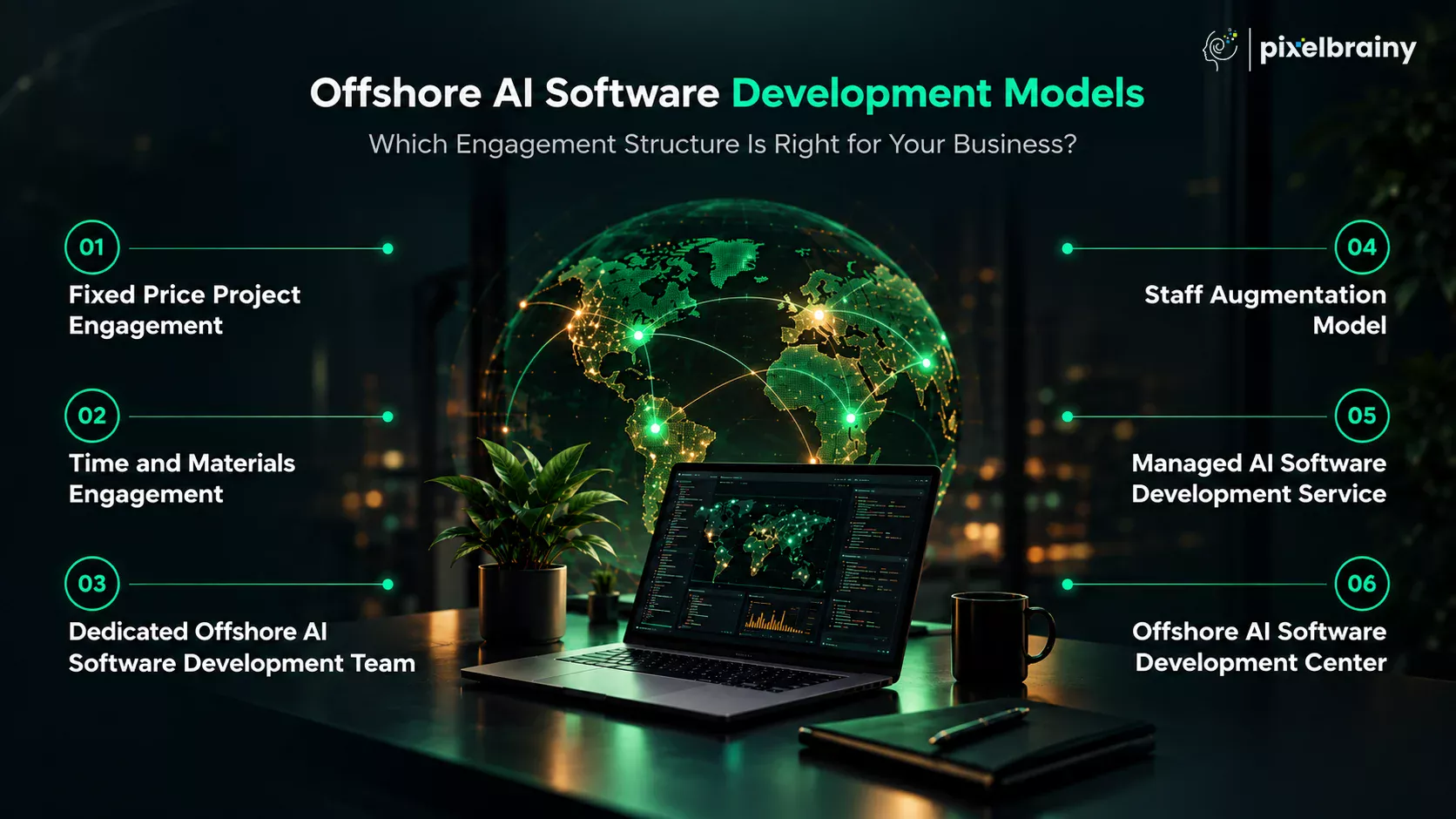
A Fixed Price engagement defines the project scope, timeline, deliverables, and budget before development begins. The offshore vendor accepts responsibility for delivering the agreed scope within the contracted price.
This model works well for AI projects with clearly documented requirements, limited uncertainty, and minimal expected changes. Examples include AI chatbot integrations, document automation tools, or proof of concept projects with predefined functionality.
Best suited for:
Key consideration for US businesses:
AI projects naturally evolve as data quality, model performance, and user feedback become clearer during development. If requirements are expected to change frequently, a Fixed Price model may create delays, change requests, and contract renegotiations.
Under a Time and Materials model, businesses pay for the actual engineering hours spent on the project instead of committing to a fixed project cost.
This approach provides maximum flexibility because priorities, features, and technical approaches can evolve throughout development. It is particularly effective for generative AI applications, AI agents, Retrieval Augmented Generation systems, and machine learning products where experimentation is part of the development process.
Best suited for:
Key consideration for US businesses:
This model requires strong project management, disciplined sprint planning, and regular budget reviews to prevent unnecessary scope expansion and unexpected costs.
A dedicated offshore AI software development team functions as a long term extension of your internal engineering department.
Instead of assigning engineers across multiple clients, the offshore partner builds a team that works exclusively on your products, follows your engineering standards, participates in daily standups, and collaborates through your existing Jira, GitHub, Slack, and CI/CD workflows.
This model is increasingly popular among growing SaaS companies and enterprises expanding AI capabilities across multiple products.
Best suited for:
Key consideration for US businesses:
A dedicated team typically delivers the greatest value when maintained for at least six to twelve months. This allows engineers to develop deep product knowledge while improving collaboration and development velocity.
Staff augmentation allows businesses to hire offshore AI developers as individual contributors who become part of the existing engineering organization.
Rather than managing an independent offshore team, these engineers report directly to your internal engineering managers while following your established development processes.
This model provides maximum technical control while increasing engineering capacity quickly.
Best suited for:
Key consideration for US businesses:
Success depends on your internal team's ability to provide technical direction, conduct architecture reviews, manage sprint planning, and mentor offshore engineers effectively.
A Managed AI Development Service offers the highest level of end-to-end project ownership.
The offshore partner manages discovery workshops, solution architecture, UI and UX design, AI model development, testing, deployment, infrastructure, monitoring, and ongoing support while providing regular progress updates.
Businesses with limited internal technical resources often choose this model because it reduces management overhead without sacrificing delivery quality.
Best suited for:
Key consideration for US businesses:
Choose a provider with demonstrated experience managing complete AI delivery lifecycles, transparent communication practices, and clearly defined governance processes.
An Offshore AI Software Development Center, often called a Captive Center, involves establishing your own engineering operation in another country.
Instead of working through a vendor, your business recruits, hires, manages, and retains every engineer directly while building local HR, legal, finance, and operational infrastructure.
This model provides the highest level of ownership and long-term cost efficiency.
Best suited for:
Key consideration for US businesses:
Although this model provides maximum control, it also requires significant investment in legal setup, local compliance, recruitment, payroll, management, and operational infrastructure before engineering productivity begins.
| Business Factor | Fixed Price | Time & Materials | Dedicated Team | Staff Augmentation | Managed Service | Offshore Development Center |
|---|---|---|---|---|---|---|
| Internal AI Management Capability | Low | High | Medium | High | Very Low | Very High |
| Project Requirements Clearly Defined | Excellent Fit | Moderate Fit | Good Fit | Good Fit | Moderate Fit | Flexible |
| Budget Predictability Required | High | Medium | Medium | Medium | High | Low Initially |
| Timeline Flexibility | Low | High | High | High | Medium | High |
| Long Term Offshore Commitment | Low | Medium | High | Medium | Medium | Very High |
| Ideal Business Type | Startups with defined MVPs | AI product companies | Growing SaaS & Enterprises | Mature engineering teams | Non technical businesses | Large enterprises |
Expert Insight: Businesses asking how to build and manage a dedicated offshore AI development team from scratch typically achieve the strongest long-term results with either a Dedicated Team model or a Managed AI Development Service, depending on whether they have experienced internal AI leadership.
That’s why choosing the right engagement model lays the foundation for selecting the right offshore AI development partner, which is exactly what we'll cover in the next section.
Section 5: Key Benefits of Offshore AI Software Development for US Businesses
How do you separate a genuinely capable offshore AI development company from a vendor that simply added "AI" to its services page?
For many US businesses, this is the most important decision in the entire outsourcing journey.
Consider this real business concern:
"We are willing to try offshore AI software development again, but only with vendors who can demonstrate strong quality controls, escrow arrangements, and reference clients we can actually speak with. How do we evaluate offshore AI development companies rigorously enough to avoid repeating our previous experience?"
The answer is simple. Do not evaluate an AI vendor the same way you would evaluate a traditional software development company. AI projects involve model architecture, training data, evaluation frameworks, security, and intellectual property that require much deeper technical validation.
Key Takeaway: The best offshore AI partner is not the one with the biggest portfolio. It is the one that can prove technical capability, stable engineering teams, mature delivery processes, and strong governance before a contract is signed.
According to the 2026 Stanford AI Index Report, organizations are investing significantly more in production AI systems, making vendor selection and governance increasingly critical as AI projects become larger and more business critical.
Below is a practical framework that reflects offshore AI software development best practices for US technology companies.
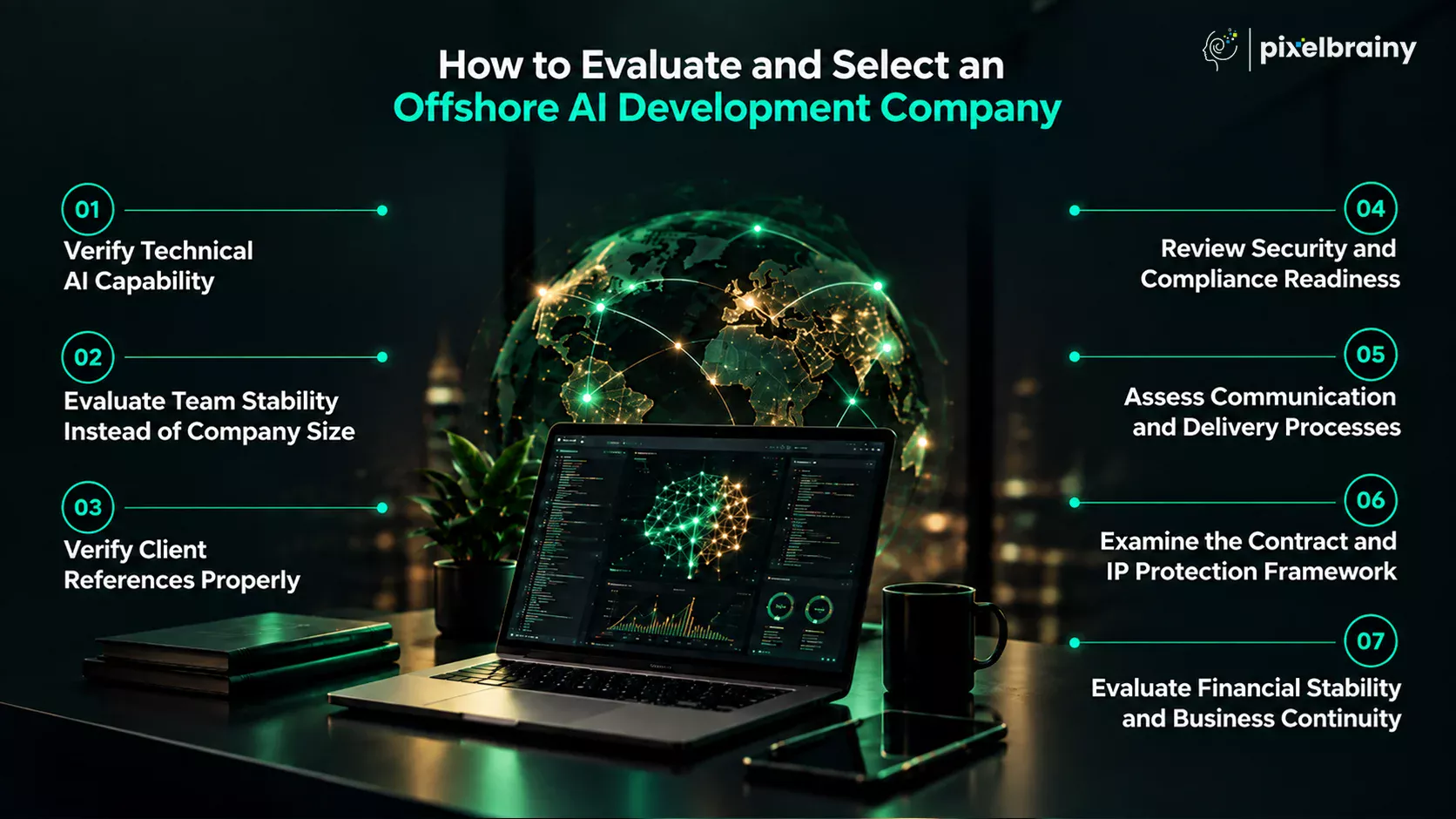
Marketing presentations and polished case studies rarely reveal a company's actual AI expertise.
Instead, request a paid technical discovery workshop where the engineers who would work on your project discuss your AI architecture, data pipeline, model selection, Retrieval Augmented Generation strategy, AI agent design, and deployment approach.
Pay close attention to the questions they ask.
Experienced AI engineers usually spend more time exploring your business objectives, data quality, scalability requirements, and model evaluation strategy than talking about technologies.
Before signing a long-term agreement, request a paid proof of concept or technical pilot. It is one of the safest ways to validate real engineering capability.
The value of an offshore AI software development company comes from its engineers, not its marketing team.
Ask for details about the actual people who will join your project, including:
Also ask about the company's engineering turnover during the past 24 months.
A vendor losing 40 percent of its AI engineers every year creates unnecessary delivery risk, regardless of its client portfolio.
Website testimonials should never be your primary source of validation.
Request three to five references from US clients with projects similar to yours in terms of complexity, technology, and business objectives.
Conduct these conversations without the vendor participating.
Ask questions such as:
One honest reference call often provides more valuable insight than dozens of online reviews.
AI systems frequently process sensitive business information, customer data, and proprietary intellectual property.
Request documentation covering:
If your organization operates in healthcare, finance, or another regulated industry, verify evidence of HIPAA, financial compliance requirements, GDPR, or other relevant regulatory capabilities before beginning development.
Even highly skilled engineers can struggle within poorly managed delivery environments.
Evaluate how the vendor manages projects by asking:
A mature AI software development outsourcing company should integrate smoothly into your existing Jira, GitHub, Slack, and CI/CD workflows rather than forcing your organization to adopt entirely new processes.
Your legal review should begin before development discussions move too far.
Traditional software contracts often protect application code but overlook AI specific assets.
Ensure the agreement clearly defines ownership of:
Also review governing law, dispute resolution, confidentiality obligations, termination rights, code handoff procedures, and non-solicitation clauses protecting your engineering investment.
Technical excellence means little if the vendor cannot sustain long term operations.
Ask questions such as:
Heavy dependence on one or two major clients increases operational risk.
A financially stable offshore AI software development company should demonstrate diversified revenue, established delivery processes, and contingency planning that protects client projects.
| Evaluation Area | What You Should Verify |
|---|---|
| Technical AI Capability | Paid discovery session, proof of concept, architecture discussions, AI engineering depth |
| Engineering Team Stability | Named engineers, tenure, AI experience, turnover rate |
| Client References | US references, production success, communication quality, repeat business |
| Security & Compliance | SOC 2, HIPAA where applicable, secure repositories, NDA, access controls |
| Project Management | Jira, GitHub, Slack integration, sprint management, escalation process |
| Contracts & IP Protection | AI asset ownership, model weights, training data, code handoff, legal protections |
| Business Stability | Years in business, client diversification, continuity planning, financial health |
Expert Insight: If an offshore AI vendor is unwilling to provide access to its technical engineers before signing a contract, avoids proof of concept work, or cannot clearly explain its AI architecture decisions, consider it a significant warning sign regardless of its portfolio or pricing.
A structured evaluation process dramatically reduces outsourcing risk and increases the likelihood of building a long-term AI partnership instead of managing another failed project.

Which offshore region offers US businesses the strongest combination of AI engineering talent, development cost, time zone compatibility, and intellectual property protection in 2026?
The answer depends on what your business values most. India offers exceptional talent depth and scalability, Eastern Europe combines advanced engineering capabilities with stronger US working-hour overlap, Latin America provides excellent real-time collaboration, and Southeast Asia remains attractive for cost-sensitive projects with clearly defined requirements.
Consider this real business scenario:
"Our US based AI product company is considering building a dedicated offshore AI development center in either India or Eastern Europe. We need to compare talent quality, cost, time zone compatibility with our US East Coast team, IP protection frameworks, and cultural fit before deciding where to invest."
Another important consideration is total cost of ownership. Saving 50% on hourly rates means little if those savings are absorbed by additional management, communication delays, quality remediation, engineer replacement, or slower delivery.
Key Takeaway: When selecting an offshore AI development region in 2026, compare engineering depth, total cost of ownership, time zone overlap, communication quality, IP protection, and scalability together rather than choosing a location based on hourly rates alone.
India remains one of the deepest technology talent markets available to US companies seeking an offshore AI development team.
The country's engineering ecosystem includes specialists across LLM application development, machine learning, RAG, AI agents, data engineering, cloud infrastructure, MLOps, and enterprise AI implementation.
The scale of the underlying technology workforce is significant. NASSCOM's Technology Sector in India: Strategic Review 2026 projects India's direct technology-sector employment at approximately 6 million people in FY2026, with about 135,000 net additions, while the sector is expected to cross $315 billion.
For budgeting purposes, businesses commonly encounter vendor rate cards around $25 to $75 per hour for AI engineering roles, although senior architects and highly specialized AI engineers can exceed this range.
The biggest operational tradeoff is time zone separation. US East Coast organizations should plan asynchronous development workflows, documented handoffs, and scheduled overlap hours rather than expecting continuous real-time collaboration.
Best suited for: Large AI programs, data-intensive platforms, LLM applications, enterprise AI transformation, and businesses requiring substantial engineering capacity.
Poland, Romania, Ukraine, and the Czech Republic offer strong computer science foundations and experienced engineering talent across machine learning, data science, cloud architecture, AI infrastructure, and increasingly generative AI development.
Businesses should distinguish between EU jurisdictions and non-EU jurisdictions when assessing legal protections. Poland, Romania, and the Czech Republic operate within EU frameworks, including increasingly developed AI governance requirements. The European Commission continues expanding AI talent and skills initiatives alongside obligations introduced through the EU AI Act.
Typical planning benchmarks for offshore AI engineers in this region are approximately $45 to $95 per hour, with specialist architects potentially costing more.
Eastern Europe also provides better working-hour alignment with US East Coast organizations than most Asian locations, which can simplify sprint reviews, architecture discussions, and technical decision-making.
Best suited for: Complex AI architecture, enterprise platforms, regulated applications, European deployments, and businesses prioritizing engineering depth alongside stronger legal frameworks.
Mexico, Colombia, Brazil, and Argentina offer something particularly valuable to US technology organizations: working-day overlap.
Engineering teams can participate in standups, sprint planning, pair programming, production troubleshooting, and customer discussions during regular US business hours.
The region's broader AI ecosystem is also developing quickly. A May 2026 Inter-American Development Bank publication examines expanding AI development and adoption across Latin America and the Caribbean, including the importance of infrastructure, cybersecurity, connectivity, investment, and technology capability in supporting regional AI growth.
Planning benchmarks typically fall around $35 to $75 per hour, although English proficiency, senior AI talent availability, and pricing vary substantially between countries and individual vendors.
Best suited for: AI SaaS products, agile product teams, customer-facing AI systems, Spanish-language applications, and projects requiring continuous collaboration.
Vietnam, the Philippines, and Indonesia provide another growing option for businesses researching how to outsource AI software development to an offshore team in 2026.
The region combines competitive engineering costs with expanding investment in AI skills and infrastructure.
Vietnam, for example, identified talent as a core pillar of its national AI strategy in July 2026, alongside policy and AI infrastructure development, signaling continued investment in building its domestic AI ecosystem.
Typical planning benchmarks range from approximately $20 to $55 per hour, with substantial differences by country and specialization.
US companies should account for significant time zone differences. English communication tends to be particularly strong in the Philippines, while individual capability should still be evaluated at the engineer level across every location.
Best suited for: AI MVPs, automation projects, structured AI applications, and cost-sensitive development programs supported by experienced US technical leadership.
| Evaluation Dimension | India | Eastern Europe | Latin America | Southeast Asia |
|---|---|---|---|---|
| AI Engineering Talent Depth | Very High | Very High | High and Growing | Growing |
| Planning Rate Benchmark | $25 to $75/hour | $45 to $95/hour | $35 to $75/hour | $20 to $55/hour |
| US Time Zone Overlap | Limited | Moderate | Excellent | Limited |
| English Proficiency | Strong | Strong | Varies by country and seniority | Strongest in Philippines, varies elsewhere |
| IP Protection Framework | Established, contracts remain critical | Strongest within EU jurisdictions | Country dependent and improving | Country dependent |
| Best Suited Projects | Large-scale AI, LLM, ML, data engineering | Complex architecture, enterprise and regulated AI | Collaborative SaaS and customer-facing AI | MVPs and structured cost-sensitive projects |
| Key Risk | Time zone friction | Higher engineering rates | Senior talent depth varies by location | Smaller senior AI talent pool in some markets |
Cost Note: These hourly ranges should be treated as 2026 planning benchmarks, not fixed market prices. Actual quotations from the best offshore AI software development companies for US businesses in 2026 will depend on engineer seniority, AI specialization, engagement model, security requirements, contract length, team size, and whether vendor management costs are included.
For US startups and mid-market businesses seeking a balance between AI capability, cost, and scalability, India and Eastern Europe are particularly strong candidates in 2026. India generally becomes more attractive when engineering scale and budget efficiency carry greater weight, while Eastern Europe becomes more attractive when working-hour overlap, complex architecture, and EU legal frameworks are priorities.
Latin America deserves serious consideration when synchronous collaboration is essential, while Southeast Asia can provide compelling economics when specifications are mature and the US organization has strong technical management.
The right offshore AI location is ultimately the region where engineering capability, collaboration efficiency, legal protection, and total cost of ownership best match your project's risk profile.
How do you protect your AI intellectual property when an offshore team is building part of your product?
This is one of the first questions investors, legal teams, and technology leaders ask before approving an offshore AI engagement.
Consider this real business concern:
"Our legal team has identified a potential issue with the AI model weights and training outputs produced by an offshore AI development vendor. The vendor's contract states that all code is work for hire but does not specifically address ownership of trained model weights, fine-tuned model outputs, and proprietary training datasets. How should we protect these AI assets?"
The concern is valid because AI projects generate intellectual property that extends far beyond application source code. Model weights, embeddings, prompt libraries, synthetic datasets, evaluation frameworks, training pipelines, and proprietary AI workflows often become some of a company's most valuable business assets. Protecting them requires a combination of legal safeguards, technical controls, and disciplined operational processes throughout the engagement.
Key Takeaway: The most effective approach to how to protect intellectual property when outsourcing AI development offshore is to combine AI specific contracts, controlled access to sensitive assets, secure development infrastructure, and continuous governance rather than relying on a single NDA.
According to the 2026 IBM Cost of a Data Breach Report, organizations continue to strengthen data governance and access controls because intellectual property and sensitive business information remain among the most expensive assets to compromise during software development projects.
Traditional software contracts usually define ownership of application source code through standard work for hire clauses.
AI development creates additional intellectual property that requires explicit legal ownership.
Your agreement should specifically assign ownership of:
Before signing any agreement with an offshore AI software development company, ask an intellectual property attorney experienced in AI technology to review these clauses separately from the rest of the contract.
Many businesses focus heavily on pricing while overlooking dispute resolution.
Whenever possible, offshore AI contracts should specify US governing law together with US courts or American Arbitration Association arbitration procedures.
Although enforcing legal judgments internationally can still involve practical challenges, governing law determines how contractual obligations are interpreted and what legal remedies remain available if disputes arise.
Avoid agreements that rely exclusively on the offshore country's legal jurisdiction without offering any US legal framework.
Not every engineer working on your project requires access to every component of your AI platform.
Protect sensitive intellectual property by separating responsibilities across the development team.
For example:
This compartmentalized approach significantly reduces unnecessary exposure of valuable business assets while still allowing efficient collaboration.
Your organization should always own the primary development environment.
Require all engineering work to be performed inside your company's GitHub or GitLab repositories instead of infrastructure owned by the vendor.
This provides continuous visibility into development progress while ensuring immediate access to source code if the engagement ends unexpectedly.
Additional security controls should include:
Training data frequently contains a company's most valuable information.
If your offshore AI software development partner will access customer records, financial information, healthcare data, proprietary documents, or confidential business datasets, establish detailed contractual requirements before development begins.
These requirements should define:
For organizations operating in regulated industries, these controls become even more important as part of broader offshore AI software development security requirements for US financial services companies and healthcare organizations.
Intellectual property extends beyond software and data.
Experienced AI engineers often accumulate valuable knowledge about your product strategy, model architecture, customer workflows, and competitive advantages.
Your agreement should include reasonable non solicitation provisions preventing either party from recruiting employees during and after the engagement for an agreed period.
Where legally appropriate, businesses may also consider carefully drafted competitive protection provisions that restrict vendors from using confidential knowledge gained during the project to build directly competing AI products.
Long term AI partnerships should include contingency planning.
Instead of relying solely on source code backups, consider periodic escrow arrangements covering:
Escrow ensures your organization retains access to critical AI assets if the vendor relationship ends unexpectedly because of operational, legal, or financial circumstances.
| Protection Area | Recommended Best Practice |
|---|---|
| AI IP Ownership | Explicitly assign ownership of model weights, embeddings, datasets, prompts, and AI artifacts. |
| Governing Law | Prefer US governing law with US courts or AAA arbitration where possible. |
| Access Management | Limit engineer access using role based and need to know principles. |
| Source Code Control | Maintain all development within your GitHub or GitLab repositories. |
| Training Data Security | Define storage, processing, deletion, encryption, and audit requirements in the contract. |
| Team Protection | Include reasonable non solicitation and confidentiality obligations. |
| AI Artifact Escrow | Periodically escrow model weights, pipelines, and documentation for business continuity. |
Expert Insight: The most successful AI startups rarely expose their complete AI ecosystem to external teams. They typically retain ownership of product strategy, proprietary algorithms, and core research internally while using offshore partners to accelerate implementation, platform engineering, integrations, testing, and infrastructure development under carefully controlled access policies.
Strong intellectual property protection begins long before development starts and continues throughout every stage of the offshore AI partnership.
Can you legally and securely outsource AI development offshore if your business operates in a regulated industry?
The answer is yes in many cases, but only when the engagement is structured around the applicable legal, security, and industry compliance requirements. Compliance is not determined by where your offshore team is located. It depends on how data is accessed, processed, secured, monitored, and governed throughout the AI development lifecycle.
Consider this real business concern:
"Our legal team requires any offshore AI development vendor to sign a HIPAA Business Associate Agreement, process sensitive data only within approved geographic locations, and complete annual security audits. Which compliance controls should we verify before signing a contract?"
Businesses planning to outsource AI software development should treat compliance as a vendor selection requirement rather than a post deployment activity. The strongest offshore AI partnerships establish regulatory controls before development begins, reducing legal exposure and avoiding costly remediation later.
Key Takeaway: Successful offshore AI software development depends on selecting vendors that can demonstrate documented compliance processes, secure engineering environments, and industry specific regulatory experience instead of relying solely on contractual promises.
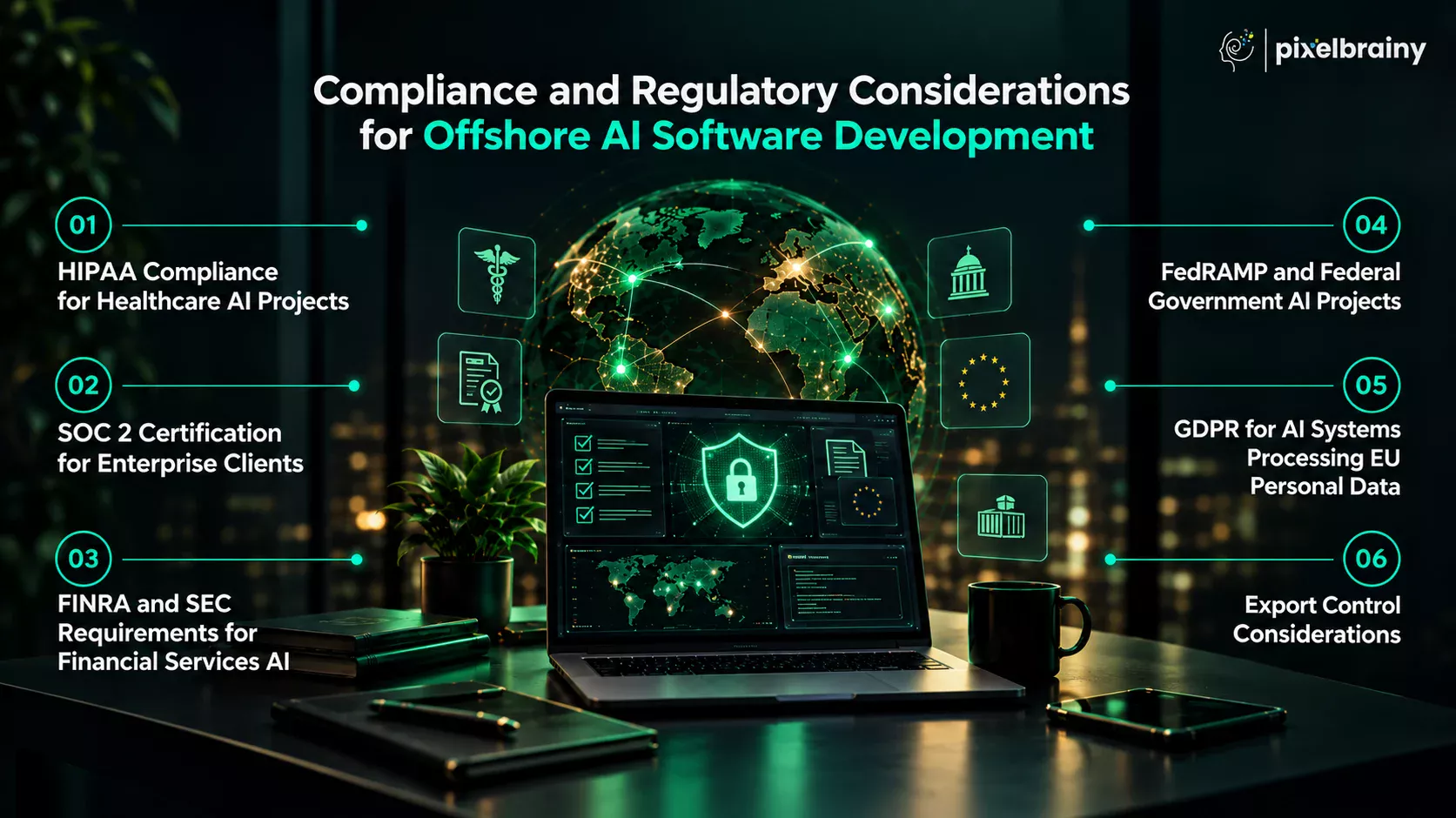
Healthcare organizations handling Protected Health Information (PHI) must verify that an offshore AI development partner can operate within HIPAA requirements.
A qualified vendor should be willing to sign a Business Associate Agreement (BAA) and demonstrate documented controls covering data access, encryption, audit logging, incident response, and breach notification procedures.
Healthcare organizations should also define:
Several established AI development firms in India, Eastern Europe, and Latin America have experience supporting US healthcare organizations through HIPAA compliant engineering environments, but compliance should always be verified at the vendor level rather than assumed based on location.
This is an essential consideration for offshore AI software development for healthcare and HIPAA compliant projects.
Many enterprise organizations require technology vendors to maintain SOC 2 Type II certification before granting access to sensitive systems or business data.
SOC 2 evaluates whether a company's security controls effectively protect customer information across areas such as:
When evaluating an offshore AI vendor, request the latest SOC 2 Type II report and verify:
Independent audits provide stronger assurance than vendor self-assessments.
Financial institutions face additional regulatory responsibilities when developing AI systems used for investment research, trading support, fraud detection, or customer recommendations.
Development teams working on these projects should implement controls that protect:
Organizations should also establish information barriers between engineering teams, maintain detailed audit trails, and ensure all AI generated outputs receive appropriate supervisory review before production deployment.
These practices are increasingly important for offshore AI software development security requirements for US financial services companies.
Federal agencies and government contractors operate under additional security obligations.
Projects involving government cloud environments may require compliance with FedRAMP, while contracts governed by FAR or DFARS can impose restrictions on foreign access to government systems, technical information, or sensitive project data.
Before engaging an offshore AI development team, organizations should confirm:
Government AI projects should always include legal and compliance review before offshore development begins.
US businesses serving European customers must also consider GDPR when offshore teams process personal information.
If data is transferred outside the European Union, organizations may need:
Whenever possible, offshore teams should receive only the minimum amount of personal data necessary to complete development tasks.
Using anonymized, masked, or synthetic datasets during AI model development can significantly reduce compliance risk.
Certain AI technologies cannot be shared freely across international borders.
US export regulations, including the Export Administration Regulations (EAR) and the International Traffic in Arms Regulations (ITAR), may restrict access to specific algorithms, technical documentation, encryption technologies, or defense related AI systems.
Organizations developing AI solutions involving:
should conduct an export control review before providing offshore teams with technical documentation, source code, datasets, or system architecture.
Legal guidance is strongly recommended whenever export controlled technologies are involved.
| Compliance Area | What You Should Verify |
|---|---|
| HIPAA | Signed BAA, secure PHI handling, audit logs, breach notification procedures, annual security assessments |
| SOC 2 Type II | Current certification, audited security controls, software development scope included |
| FINRA & SEC | Protection of MNPI, supervisory review, audit trails, information barriers |
| FedRAMP / FAR / DFARS | Cloud authorization, foreign access restrictions, contract specific security obligations |
| GDPR | SCCs, DPAs, data minimization, lawful international data transfers |
| EAR & ITAR | Export control review for restricted AI technologies, encryption, and defense related systems |
Expert Insight: The most mature offshore AI development partners build compliance into their engineering process from day one through secure development environments, documented governance policies, continuous auditing, and role-based access controls instead of treating compliance as a final project checklist.
Strong compliance planning protects your AI project, your customers, and your business long before the first line of code is written.
Can an offshore AI project succeed when your engineering team and development partner work nearly twelve hours apart?
This is a concern shared by many US technology leaders before they begin an offshore engagement.
"Our CTO has never managed an offshore team before and is worried about code quality, communication overhead, and intellectual property protection. How do we ensure an offshore AI development team integrates smoothly into our existing Jira, GitHub, and Slack workflows without slowing delivery?"
The success of offshore AI software development is not determined only by the technical capability of your development partner. Communication structure, sprint discipline, documentation standards, and decision-making processes across different time zones play an equally important role. Organizations that redesign their collaboration model for distributed AI engineering consistently achieve better delivery outcomes than those attempting to replicate an in-house working style.
The biggest mistake many US companies make is expecting an offshore AI team to operate exactly like an internal engineering department.
A 9-to-12-hour time difference requires teams to redesign how work is assigned, how technical decisions are documented, and how progress is reviewed. Instead of depending on continuous real time communication, successful organizations build processes around asynchronous collaboration, detailed documentation, and clearly defined ownership. Teams that embrace this operating model develop productive long-term partnerships, while those that resist it often experience communication friction and delivery delays.
Every offshore engagement includes a limited period when both teams are working simultaneously.
Treat this one-to-three-hour overlap window as a protected resource dedicated only to activities requiring live collaboration.
Reserve this time for:
Routine status updates, progress reports, and non-urgent questions should be handled asynchronously through Jira, GitHub, Slack, or project documentation. Protecting this overlap window significantly improves productivity and reduces unnecessary meetings.
One of the most effective practices for how to manage offshore AI development teams across different time zones is implementing a structured daily handoff.
At the end of every workday, the offshore team should provide a written update covering:
The US engineering team reviews this document at the start of its workday, provides clarifications, and updates priorities before development continues. This simple process prevents minor misunderstandings from accumulating into costly project deviations across multiple sprints.
Traditional software acceptance criteria are insufficient for offshore AI software development.
Every completed AI task should satisfy additional technical validation before being accepted.
This should include:
Documenting these AI specific acceptance standards before development begins reduces the risk of
AI development involves frequent architectural decisions that should not delay engineering progress while waiting for the next shared working hour.
Maintain a shared decision log where the offshore team records pending technical decisions, proposed solutions, supporting rationale, and implementation recommendations. Unless the US engineering team requests an alternative approach during the overlap window, development proceeds using the documented recommendation.
This workflow supports how to run agile sprints with offshore AI development teams in different time zones, keeping projects moving while ensuring US engineering leadership maintains visibility and control over significant technical decisions.
Expert Insight: High performing offshore AI teams succeed because they optimize communication quality, documentation, and engineering discipline rather than increasing the number of meetings.
With effective time zone management in place, the next section examines the complete cost structure of offshore AI development.
How much does offshore AI development actually cost once you include project management, onboarding, compliance, communication, and hidden operational expenses?
This is one of the most important questions businesses ask before deciding to outsource AI software development.
Consider this real business scenario:
"I need to understand the realistic total cost of ownership difference when you factor in not just hourly rates, but also management overhead, communication costs, quality remediation, time zone friction, and the transition cost of moving an active AI development project to a new offshore team."
The reality is that hourly rates tell only part of the story. A vendor offering the lowest engineering rate may ultimately cost more if poor documentation, weak project management, or frequent rework slows delivery. The most successful organizations evaluate offshore AI development using total cost of ownership (TCO) rather than comparing hourly pricing alone.
Key Takeaway: The true cost of offshore AI software development includes engineering rates, management effort, legal review, onboarding, security compliance, communication, and long-term delivery efficiency.
According to Deloitte's 2024 Global Outsourcing Survey, organizations increasingly prioritize access to specialized talent and service quality alongside cost optimization, reinforcing that outsourcing decisions are driven by overall business value rather than hourly pricing alone.
Several factors influence the total investment required for an AI project.
Engineering rates vary significantly between India, Eastern Europe, Latin America, Southeast Asia, and the United States because of local salary benchmarks, talent availability, and operating costs.
A junior AI engineer may support data preparation or model integration, while senior engineers, AI architects, and principal engineers handle solution architecture, model optimization, and production deployment. Higher expertise naturally increases hourly costs but often reduces delivery risk and expensive rework.
Fixed Price projects emphasize predictable budgets, while Time and Materials engagements provide flexibility. Dedicated teams typically offer better long term value for ongoing AI product development.
A simple AI chatbot costs significantly less than building an enterprise AI platform involving Retrieval Augmented Generation, AI agents, custom model fine tuning, or computer vision.
Projects requiring HIPAA, SOC 2, GDPR, FedRAMP, or financial industry compliance involve additional engineering controls, documentation, audits, and governance that increase development costs.
Every offshore engagement requires US side technical leadership. Engineering reviews, sprint planning, architectural decisions, and vendor management represent real business costs that should be included in budgeting.
| Seniority | India | Eastern Europe | Latin America | Southeast Asia | US In House Equivalent |
|---|---|---|---|---|---|
| Junior AI Engineer | $25 to $40 | $45 to $60 | $35 to $50 | $20 to $35 | $70 to $110 |
| Mid-Level AI Engineer | $40 to $60 | $60 to $80 | $50 to $70 | $35 to $50 | $110 to $160 |
| Senior AI Engineer | $60 to $90 | $80 to $110 | $70 to $95 | $50 to $75 | $160 to $230 |
| Principal or Lead AI Engineer | $90 to $130 | $110 to $150 | $90 to $130 | $75 to $100 | $230 to $320 |
| AI Architect | $110 to $160 | $130 to $180 | $120 to $170 | $90 to $140 | $280 to $400+ |
*US figures represent estimated fully burdened market equivalent hourly costs based on salary, benefits, taxes, and overhead rather than contractor billing rates.
Vendor proposals typically focus on engineering rates, but they rarely include several important costs that affect the overall success of an AI project.
Your engineering managers, product owners, architects, and CTO still spend time reviewing code, planning sprints, making technical decisions, and coordinating delivery. Although these costs never appear on a vendor invoice, they are part of the project's true investment.
Licensing and administration costs for Jira, GitHub Enterprise, Slack, Microsoft Teams, Miro, Confluence, and secure development environments should be included in project budgeting.
If engineering quality falls below expectations, businesses absorb the cost of additional testing, debugging, refactoring, and production support. Selecting an experienced offshore partner significantly reduces this hidden expense.
Every new engineering team requires time to understand business requirements, architecture, coding standards, infrastructure, and deployment workflows. Productivity typically increases gradually during the first several weeks.
US organizations often require attorney review covering intellectual property ownership, confidentiality, AI specific contract language, governing law, and vendor negotiations before development begins.
Healthcare, financial services, and government projects frequently require additional audits, penetration testing, compliance assessments, and documentation that increase overall project investment.
Poor communication processes can delay architectural decisions, slow sprint completion, and increase management overhead. Well-structured asynchronous workflows help minimize these hidden productivity costs.
| Cost Category | US In House Team | US Boutique AI Agency | Offshore AI (Eastern Europe) | Offshore AI (India) |
|---|---|---|---|---|
| Average Hourly Cost | Highest | High | Moderate | Lowest |
| Fully Loaded Annual Cost per Engineer | Very High | High | Moderate | Low |
| Management Overhead | Low | Low | Moderate | Moderate to High |
| Quality Remediation Risk | Low | Low | Low to Moderate | Moderate (depends on vendor maturity) |
| Transition and Onboarding | Low | Low | Moderate | Moderate |
| Hidden Operational Costs | Moderate | Moderate | Moderate | Moderate |
| Estimated Total Cost of Ownership | Highest | High | Moderate | Lowest to Moderate |
Reducing AI development costs should never come at the expense of engineering quality.
The most successful organizations reduce costs by:
Expert Insight: Businesses comparing an offshore AI development team vs in house AI team cost comparison in 2026 often discover that engineering quality, project governance, and communication maturity have a far greater impact on total project cost than hourly rates alone.
The most cost-effective offshore AI strategy is the one that minimizes rework, accelerates delivery, and creates sustainable long term engineering value rather than simply reducing hourly costs.
Can every industry follow the same offshore AI development strategy?
The answer is no. Every industry has its own regulatory obligations, security expectations, operational workflows, and data governance requirements. A strategy that works well for an AI powered retail chatbot may create significant compliance risks when applied to healthcare, financial services, or government projects.
Consider this real business scenario:
"Our healthcare technology company is building an AI diagnostic platform that will process protected health information. We want to use an offshore AI development team to accelerate development, but we need to understand what additional compliance, documentation, and security requirements apply before moving forward."
Businesses planning to outsource AI software development should always evaluate industry specific obligations before selecting an offshore development partner. Understanding these requirements early helps prevent compliance failures, unexpected project delays, and costly redevelopment.
Key Takeaway: The success of offshore AI development depends not only on engineering capability but also on the vendor's ability to satisfy your industry's regulatory, security, and operational requirements.
According to Gartner, by 2027, more than 70% of organizations will use industry specific AI solutions to improve business outcomes, increasing the importance of selecting AI development partners with domain expertise alongside technical capability.
Healthcare organizations operate under some of the strictest compliance requirements.
For offshore AI software development for healthcare and HIPAA compliant projects, vendors should be capable of:
AI diagnostic platforms may also require documentation supporting FDA Software as a Medical Device (SaMD) submission, clinical validation studies, Institutional Review Board (IRB) processes, and model performance evidence.
Banks, investment firms, fintech companies, and wealth management organizations face additional regulatory oversight.
For offshore AI software development security requirements for US financial services companies, vendors should understand:
Organizations serving European financial institutions should also consider DORA (Digital Operational Resilience Act) requirements governing ICT risk management and third-party technology providers.
Government AI projects require significantly higher levels of security and governance.
Before engaging an offshore AI team, organizations should evaluate:
Many federal contracts permit offshore development only under carefully controlled circumstances, making legal and contractual review essential before project initiation.
Retail AI applications often process large volumes of customer behavior and transaction data.
Development teams should understand:
Computer vision projects introduce another practical challenge.
Offshore teams developing inventory recognition, shelf monitoring, or checkout automation frequently require testing environments that closely replicate physical retail stores because remote simulation alone may not accurately reproduce lighting conditions, camera positioning, or customer movement.
Legal AI platforms require exceptional confidentiality.
Organizations developing legal AI solutions should carefully evaluate:
Many legal clients require dedicated development environments with significantly tighter confidentiality obligations than standard software projects.
Insurance companies increasingly use AI for underwriting, fraud detection, claims automation, and customer service.
Offshore development partners should understand:
Because AI recommendations may directly influence coverage decisions, maintaining transparent model governance becomes particularly important.
AI adoption is expanding rapidly across sportsbook operations and online gaming platforms.
Development teams working in this sector should address:
Since regulations vary significantly across US states and international markets, compliance requirements often differ between deployments.
AI powered trading systems operate within highly regulated environments where performance and governance are equally important.
Offshore teams should understand:
Organizations developing AI driven trading platforms should also establish strict approval processes before production deployment because model behavior may directly influence investment decisions.
| Industry | Primary Compliance Focus | Additional Offshore AI Considerations |
|---|---|---|
| Healthcare | HIPAA, FDA, IRB | PHI protection, clinical validation, SaMD documentation |
| Financial Services | SEC, FINRA, SOC 2, DORA | MNPI controls, audit trails, information barriers |
| Government | FedRAMP, FAR, DFARS, ITAR | Export controls, ATO, foreign access restrictions |
| Retail | PCI DSS, CCPA | Physical environment testing, consumer data governance |
| Legal | Attorney Client Privilege | Confidential document handling, ethical obligations |
| Insurance | PII, State Insurance Regulations | Explainable AI, underwriting governance, fraud detection |
| Sports Betting | AML, KYC, Gaming Regulations | Real time AI, fraud prevention, responsible gaming |
| Trading | SEC, FINRA, Market Regulations | Model validation, latency, algorithm governance |
Expert Insight: The strongest offshore AI software development best practices for US technology companies begin with selecting a partner that understands your industry's regulatory environment as deeply as its AI technology stack.
Industry expertise often determines whether an offshore AI project achieves compliance by design or requires expensive remediation after deployment.
Why do some offshore AI projects deliver impressive demos but struggle after deployment, while others become long term success stories?
The difference usually has very little to do with geography. Most failed engagements follow a predictable pattern of weak governance, poor communication, inadequate quality controls, or unrealistic expectations. Understanding these risks before development begins helps businesses avoid costly mistakes and build more resilient AI delivery partnerships.
Consider this real business concern:
"Our company has been through three failed offshore software development engagements in the past four years. Every project followed the same pattern. The initial demos looked impressive, production quality was poor, and the documentation was never sufficient for our internal engineers to maintain the system. How do we prevent this from happening again?"
Businesses planning to outsource AI project development should focus just as much on preventing delivery failures as selecting the right vendor.
Key Takeaway: Most offshore AI failures are not caused by engineering capability alone. They result from weak governance, unclear expectations, poor documentation, and inadequate production readiness planning.
According to the Standish Group CHAOS research, projects with well-defined governance, executive involvement, and disciplined project management consistently achieve significantly higher success rates than projects with weak planning and uncontrolled scope changes.
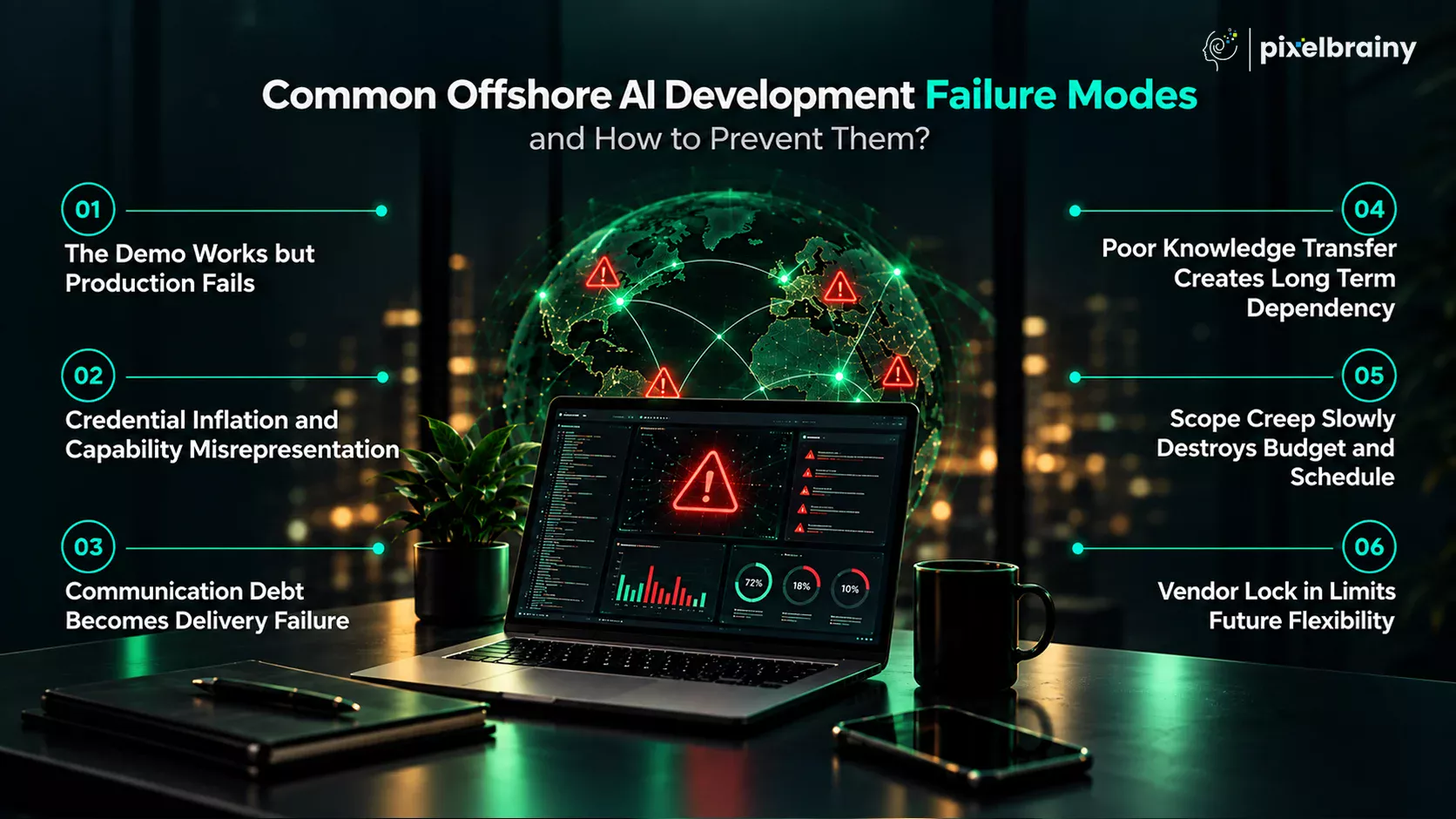
This is one of the most common failure patterns in offshore AI software development.
The offshore team delivers a working prototype that satisfies every agreed acceptance criterion. Once deployed into production, however, the AI system struggles with real user behavior, larger datasets, unexpected inputs, and production latency requirements.
This happens because demonstration environments rarely reflect production conditions.
How to prevent it:
Production readiness should be treated as part of project acceptance rather than a post deployment activity.
Many vendors showcase highly experienced AI architects during the sales process while assigning less experienced engineers after the contract is signed.
The result is slower development, weaker technical decisions, and increased supervision requirements from the client.
How to prevent it:
This is one of the most effective ways to outsource AI software development without sacrificing code quality.
Small misunderstandings often appear harmless during early sprints.
Over time, delayed clarifications, undocumented assumptions, and limited visibility create growing divergence between what the US team expects and what the offshore team builds.
By the time major milestone reviews occur, weeks of engineering effort may require rework.
How to prevent it:
Consistent written communication is often more valuable than additional meetings.
Some offshore engagements appear successful until the project concludes.
Only during transition does the client discover that critical AI pipelines, deployment scripts, architecture decisions, or model training workflows remain undocumented.
This creates unnecessary dependency on the original vendor.
How to prevent it:
Good documentation protects business continuity just as much as good engineering.
AI projects naturally evolve.
Without disciplined change management, additional features, revised priorities, and evolving business requirements gradually expand beyond the original project plan.
Eventually both the vendor and client become frustrated because timelines, budgets, and expectations no longer align.
How to prevent it:
Strong governance protects both the client and the development partner.
Some vendors unintentionally create long term dependency by using proprietary deployment tools, undocumented infrastructure, or internal frameworks that cannot easily be transferred.
Migrating to another development partner later becomes expensive and time consuming.
How to prevent it:
A well-designed AI platform should remain transferable regardless of who maintains it in the future.
| Common Failure | Recommended Prevention Strategy |
|---|---|
| Production failures after successful demos | Test against production representative data, define performance benchmarks, validate scalability before acceptance |
| AI capability misrepresentation | Interview assigned engineers, require named resources, approve substitutions contractually |
| Communication breakdown | Daily handoff documentation, written assumptions, rapid clarification process |
| Poor documentation and difficult handoff | Continuous documentation, client owned repositories, ongoing knowledge transfer |
| Scope creep | Formal change control, sprint scope freeze, documented approvals |
| Vendor lock in | Open technology stack, documented architecture, portability reviews, client ownership of repositories |
Expert Insight: The strongest offshore AI software development quality assurance best practices for production AI systems focus less on finding a "perfect" vendor and more on establishing governance processes that detect problems early, before they become expensive production failures.
Preventing offshore AI delivery failures begins with disciplined project governance, not after production issues appear.
By now, you've seen that successful AI software development outsourcing is not just about finding developers. It is about choosing a partner that can deliver production ready AI solutions, protect your intellectual property, communicate transparently, and scale alongside your business.
Consider this real business concern:
"How do I identify an offshore AI development company that has genuine expertise in modern AI engineering instead of simply adding AI services to its website? We want a partner that can demonstrate technical depth, structured delivery, and production quality before we commit."
This is exactly where PixelBrainy is different.
Rather than positioning ourselves as another software outsourcing company, we focus on delivering AI development solutions that help startups, enterprises, and growing businesses confidently build, launch, and scale AI products.
✔ Access to experienced AI engineers, not just sales consultants. Our team works with technologies including GPT-4, Claude, LangChain, LangGraph, RAG architecture, AI agents, LLM fine tuning, machine learning, and production AI deployment.
✔ A transparent engagement process where you interact directly with the engineers who will build your solution through a Paid Discovery Session before making a long term commitment.
✔ Complete ownership of your AI assets, including source code, model weights, training pipelines, prompts, datasets, embeddings, and technical documentation through AI specific IP protection clauses.
✔ US business focused communication, including dedicated overlap hours, daily engineering updates, sprint reviews, and seamless collaboration through Jira, GitHub, Slack, Azure DevOps, and Microsoft Teams.
✔ Compliance conscious AI development solutions for healthcare, financial services, SaaS, insurance, retail, legal technology, and other industries requiring secure engineering practices and structured documentation.
✔ Flexible engagement models, whether you need a Fixed Price engagement, Staff Augmentation, a Dedicated Offshore AI Team, or a fully Managed AI Development Service.
Project: Client Confidential
A US based SaaS company approached PixelBrainy after an unsuccessful offshore engagement had delayed its AI product launch by nearly four months. The client needed an experienced offshore AI partner to rebuild the architecture, improve model performance, and integrate seamlessly with its internal engineering team.
Within the first phase of the engagement, our team redesigned the RAG architecture, optimized the AI pipeline, implemented structured sprint governance, and established production readiness checkpoints. The client successfully launched its AI platform with improved response accuracy, faster inference performance, and a development workflow that continues to scale with its growing product roadmap.
Every successful partnership begins with clarity, not assumptions.
Our Paid AI Discovery Session allows your business to validate both your product idea and our engineering capability before moving into development.
During the session, you'll work directly with our AI engineers to:
You leave the session with practical recommendations, architectural direction, and a clear execution strategy that your business can confidently move forward with.
Build Your Next AI Product with Confidence
Whether you're a startup preparing for launch, an enterprise expanding AI capabilities, or an established business looking for a trusted offshore AI development company, PixelBrainy delivers AI development solutions built around engineering excellence, transparent collaboration, and long-term business success.
Book a Paid AI Discovery Session with PixelBrainy today and discover what it's like to work with an offshore AI partner that proves its expertise before asking for your trust.

From this guide, one thing becomes clear: successful offshore AI software development is not determined by location alone. It is determined by the quality of your AI engineering partner, the engagement model you choose, the governance framework you establish, and the processes you put in place to protect quality, security, and intellectual property.
Businesses that take a strategic approach to outsource AI software development gain access to global AI talent, accelerate product development, optimize costs, and build scalable AI solutions without compromising on innovation or compliance. Whether you're evaluating your first offshore AI development company or expanding an existing AI team, the right partner should bring proven technical expertise, transparent communication, strong IP protection, and a production first mindset that supports your long-term business goals. By applying the best practices covered throughout this guide, you can confidently build AI products that deliver measurable value and sustainable growth.
Ready to build your AI product with confidence? Book a discovery appointment with the PixelBrainy team and explore how our offshore AI development services can transform your vision into a production ready AI solution.
Offshore AI software development involves hiring an offshore AI development company to design, build, deploy, and maintain AI powered applications using technologies such as Large Language Models (LLMs), Retrieval Augmented Generation (RAG), AI agents, and machine learning. Unlike traditional software outsourcing, AI projects require specialized expertise in model development, prompt engineering, data pipelines, evaluation frameworks, and production AI deployment.
The best offshore AI development company should demonstrate proven AI engineering expertise, transparent communication, strong IP protection policies, production AI experience, and verified client references. Before signing a contract, schedule a technical discovery session with the engineers who will actually work on your project and review their experience with modern AI technologies such as GPT-4, Claude, LangChain, LangGraph, and RAG.
The offshore AI software development cost depends on the project scope, AI complexity, engagement model, engineering seniority, compliance requirements, and development region. While offshore AI engineer rates typically range from $20 to $180 per hour, businesses should evaluate the total cost of ownership, including onboarding, project management, legal review, security compliance, and long-term maintenance instead of comparing hourly rates alone.
The best countries for offshore AI software development include India, Eastern Europe, Latin America, and Southeast Asia. India offers the largest AI engineering talent pool and competitive pricing, Eastern Europe provides strong engineering quality and legal frameworks, Latin America supports real time collaboration with US businesses, while Southeast Asia is well suited for structured and cost-effective AI projects.
Yes. Offshore AI development for startups enables founders to access experienced AI engineers without building a large in house team. Many startups use offshore AI software development services to build MVPs, validate AI products faster, reduce hiring costs, and extend their funding runway while maintaining engineering quality.
When you outsource AI software development, your agreement should clearly define ownership of source code, model weights, fine-tuned models, embeddings, training pipelines, prompts, datasets, and other AI assets. Businesses should also use client owned GitHub repositories, implement role-based access controls, require strong NDA provisions, and conduct regular security reviews throughout the engagement.
The right engagement model depends on your business goals. A Dedicated Offshore AI Development Team is ideal for long term product development, Staff Augmentation works well for expanding an existing engineering team, Fixed Price projects suit clearly defined AI initiatives, and Managed AI Development Services are best for organizations looking to outsource complete AI product delivery.
Businesses are increasingly adopting offshore AI development services USA to overcome AI talent shortages, reduce hiring costs, accelerate product development, and access specialized expertise in machine learning, AI agents, generative AI, and enterprise AI platforms. With the right offshore AI development partner, organizations can scale AI initiatives faster while maintaining security, compliance, and production quality.

About The Author
Sagar Bhatnagar
Sagar Sahay Bhatnagar brings over a decade of IT industry experience to his role as Marketing Head at PixelBrainy. He's known for his knack in devising creative marketing strategies that boost brand visibility and market influence. Sagar's strategic thinking, coupled with his innovative vision and focus on results, sets him apart. His track record of successful campaigns proves his ability to utilize digital platforms effectively for impactful marketing efforts. With a genuine passion for both technology and marketing, Sagar continuously pushes PixelBrainy's marketing initiatives to greater success.

Working with the PixelBrainy team has been a highly positive experience. They understand the design requirements and create beautiful UX elements to meet the application needs. The dev team did an excellent job bringing my vision to life. We discussed usability and flow. Sagar worked with his team to design the database and begin coding. Working with Sagar was easy. He has the knowledge to create robust apps, including multi-language support, Google and Apple ID login options, Ad-enabled integrations, Stripe payment processing, and a Web Admin site for maintaining support data. I'm extremely satisfied with the services provided, the quality of the final product, and the professionalism of the entire process. I highly recommend them for Android and iOS Mobile Application Design and Development.

Great experience working with them. Had a lot of feedback and I found that unlike most contractors they were bugging me for updates instead of the other way around. They were extremely time conscience and great at communicating! All work was done extremely high quality and if not on time, early! They were always proactive when it comes to communication and the work is great/above par always. Very flexible and a great team to work with! Goes above and beyond to present us with multiple options and always provides quality. Amazing work per usual with Chitra. If you have UI/UX or branding design needs I recommend you go to them! Will likely work with them in the future as well, definitely recommended!

PixelBrainy is a joy to work with and is a great partner when thinking through branding, logo, and website layout. I appreciate that they spend time going into the "why" behind their decisions to help inform me and others about industry best practices and their expertise.

I hired them to design our software apps. Things I really like about them are excellent communication skills, they answer all project suggestions and collaborate right away, and their input on design and colors is amazing. This project was complex and needed patience and creativity. The team is amazing to do business with. I will be using them long-term. Glad to see there are some good people out there. I was afraid to try and outsource my project to someone but I am glad I met them! I really can't say enough. They went above and beyond on this project. I am very happy with everything they have done to make my business stand out from the competition.

It was great working with PixelBrainy and the team. They were very responsive and really owned the project. We'll definitely work with them again!

I recently worked with the PixelBrainy team on a project and I was blown away by their communication skills. They were prompt, clear, and articulate in all of our interactions. They listened and provided valuable feedback and suggestions to help make the project a success. They also kept me updated throughout the entire process, which made the experience stress-free and enjoyable.

PixelBrainy is very good at what it does. The team also presents themselves very professionally and takes care of their side of things very well. I could fully trust them taking up the design work in a timely and organised manner and their attention to detail saved us lots of effort and time. This particular project was quite intense and the team showed that they function very well under pressure. Very much looking forward to working with her again!

It's always an absolute pleasure working with them. They completed all of my requests quickly and followed every note I had for them to a T, which made our process go smoothly from start to finish. Everything was completed fast and following all of the guidelines. And I would recommend their services to anyone. If you need any design work done in the future, PixelBrainy should be your first call!

They took ownership of our requirements and designed and proposed multiple beautiful variants. The team is self-motivated, requires minimum supervision, committed to see-through designs with quality and delivering them on time. We would definitely love to work with PixelBrainy again when we have any requirements.

PixelBrainy was a big help with our SaaS application. We've been hard at work with a new UI/UX and they provided a lot of help with the designs. If you're looking for assistance with your website, software, or mobile application designs, PixelBrainy and the team is a great recommendation.

PixelBrainy designers are amazing. They are responsive, talented, and always willing to help craft the design until it matches your vision. I would recommend them and plan to continue them for my future projects and more!!!

They were awesome! Did a good job fast, and good communication. Will work with them again. Thank you

Creative, detail-oriented, and talented designers who take direction well and implement changes quickly and accurately. They consistently over-delivered for us.

PixelBrainy team is very talented and creative. Great designers and a pleasure to work with. PixelBrainy is an excellent communicator and I look forward to working with them again.

PixelBrainy has a very talented design team. Their work is excellent and they are very responsive. I enjoy working with them and hope to continue on all of our future projects.


Transform your ideas into reality with us.
Across these industries, each engagement brings unique challenges, from early-stage product development to scaling complex systems, helping us build a practical understanding of real-world product environments.