AI Summary Powered by PixelBrainy
Imagine your real estate business has an idea for an AI agent that automatically qualifies leads, answers property inquiries, recommends properties, schedules site visits, updates your CRM, and hands over only high-intent prospects to your sales team. The opportunity is clear, but turning that vision into a production-ready AI solution is a completely different challenge. Which AI models should you choose? How do you integrate the agent with MLS databases, CRM platforms, and property management systems? Which features are essential, and how do you ensure the solution is secure, scalable, and accurate? These are the questions thousands of real estate businesses are asking as AI agents become the next evolution of PropTech.
Unlike traditional chatbots that rely on predefined responses, a real estate AI agent is an intelligent software system that can understand user intent, reason through complex requests, retrieve information from multiple business systems, and execute tasks with minimal human intervention. Powered by Large Language Models (LLMs), Natural Language Processing (NLP), Machine Learning (ML), Retrieval-Augmented Generation (RAG), Computer Vision, and workflow automation, AI agents can automate lead qualification, deliver personalized property recommendations, estimate property values, analyze market trends, schedule appointments, generate documents, and streamline customer interactions across the entire real estate lifecycle.
The adoption of AI in real estate is accelerating as organizations move beyond basic automation toward intelligent, autonomous business operations. According to PwC's Global Artificial Intelligence Study, AI is expected to contribute up to $15.7 trillion to the global economy by 2030, making it one of the largest commercial technology opportunities across industries, including real estate.
At the same time, the National Association of Realtors (NAR) reports that AI adoption among real estate professionals continues to grow rapidly as firms increasingly use AI for lead generation, marketing, client communication, market analysis, and operational efficiency. These trends clearly indicate that AI agents are becoming a strategic investment rather than an experimental technology.
In this guide, you will learn how to build a real estate AI agent from concept to deployment. We will explore AI agent architecture, core technologies, LLMs, RAG, AI workflows, essential features, CRM and MLS integration, technology stack, development process, implementation costs, security, compliance, common challenges, and future trends.
Whether you are a real estate agency planning to automate lead qualification, a proptech startup building an AI-powered platform, or an enterprise investing in intelligent real estate solutions, this guide provides a practical roadmap for developing a scalable, secure, and production-ready real estate AI agent that delivers measurable business value.
A real estate AI agent is more than just software. It’s a digital partner designed to support real estate professionals, buyers, and sellers by automating tasks that typically require hours of manual effort. Instead of replacing human expertise, it enhances it—allowing agents to focus on building relationships and closing deals while the AI handles the repetitive, time-consuming work.
At its core, an AI real estate agent is built to think and act like an assistant. It can:
How does it work? Imagine feeding your AI system all the essential data sources: MLS listings, property photos, market reports, and client preferences. Using advanced machine learning models, the AI analyzes this information to understand patterns. With natural language processing (NLP), it can interpret client questions in plain English and respond conversationally. Pair that with computer vision, and it can even analyze images of homes to assess conditions or highlight features.
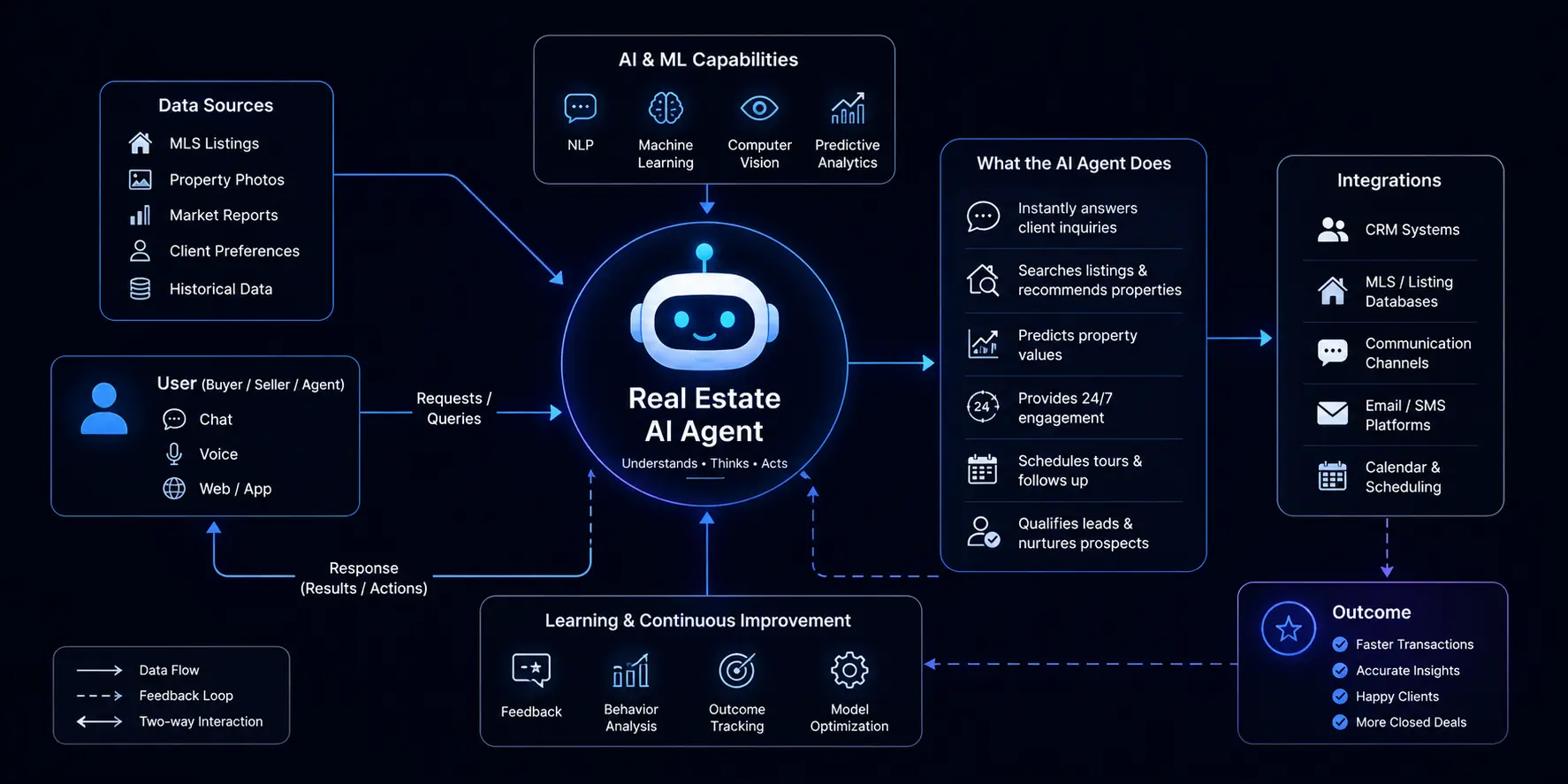
The magic happens when all these technologies are integrated. Your AI real estate agent connects with CRMs, listing databases, and communication channels, creating a seamless experience for both clients and professionals. The result is faster transactions, more accurate insights, and a real estate process that feels effortless for everyone involved.
To successfully create a real estate AI agent, it’s important to understand the building blocks that make it work. Each component plays a unique role in shaping an intelligent, reliable, and user-friendly system. Let’s break them down:
A real estate AI agent is only as smart as the data it has access to. By pulling information from MLS listings, property records, CRM systems, and market trends, the agent can analyze everything from home features to pricing patterns. High-quality, accurate data ensures better predictions and more personalized client recommendations.
This is the engine that powers intelligence. Different models serve different functions:
Even the smartest AI needs connections to work effectively. APIs integrate the AI agent with real estate platforms, CRMs, and property databases, ensuring seamless communication across systems. This allows agents to pull listings instantly or update client data without manual work.
The interface is how clients and professionals interact with the AI. This could be through chatbots on websites, mobile apps, voice assistants, or integrated tools inside CRM platforms. A well-designed UI ensures the AI feels approachable and easy to use.
Finally, no real estate AI agent is complete without strong attention to compliance and ethics. Adhering to data privacy rules, fair housing laws, and bias prevention ensures the system is both trustworthy and legally sound. This not only protects your business but also builds confidence with clients.
Together, these components form the foundation of a powerful real estate AI agent development strategy, making the technology both practical and scalable for real-world use.
The practical impact of real estate AI agents is best understood by looking at how they’re applied in real-world scenarios. These intelligent systems are reshaping everything from customer interactions to investment strategies. Let’s explore the top use cases of real estate AI agents in detail.
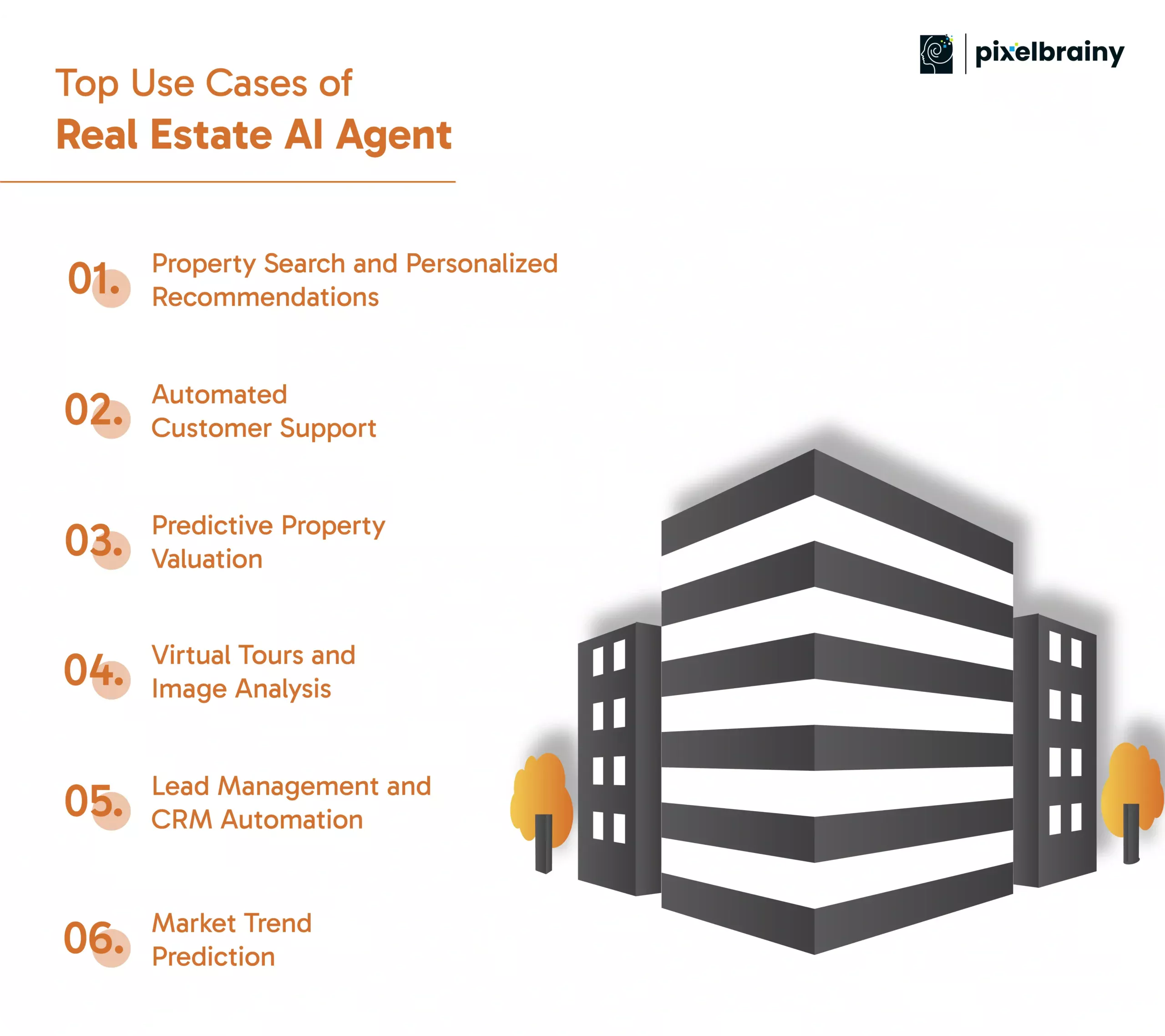
For most buyers, finding the right property can feel overwhelming. An AI real estate agent simplifies this by learning client preferences—budget, location, family size, commute distance, and even lifestyle habits. It then scans thousands of listings in seconds, presenting only the most relevant options. The more the client interacts, the smarter the recommendations become.
Example: Zillow and Trulia use AI-driven recommendation engines to personalize search results, making property discovery faster and more tailored to each buyer. For busy professionals or families, this saves hours of browsing and leads to higher satisfaction.
Answering repetitive questions like “Is this property still available?” or “What are the HOA fees?” consumes valuable time for agents. An AI real estate agent can handle these inquiries instantly, providing accurate and consistent answers 24/7. Beyond FAQs, AI can schedule appointments, send reminders, and follow up with leads automatically.
Example: Real estate firms using AI chatbots on their websites report shorter response times and higher conversion rates. Clients feel supported at any hour, while human agents can focus on high-value negotiations and closing deals.
Valuation is one of the most high-stakes areas in real estate. AI real estate agents use historical sales data, neighborhood growth trends, and market comparisons to deliver accurate, data-driven property valuations. This reduces guesswork, builds client trust, and helps both buyers and sellers make confident decisions.
Example: Redfin’s “Redfin Estimate” leverages AI to provide property values in real time. For agents, this means they can walk into meetings with reliable figures, strengthening their credibility with clients.
In today’s digital-first world, many clients expect to preview homes online before scheduling in-person visits. AI real estate agents equipped with computer vision can analyze listing photos to identify features, detect needed repairs, and even enhance images for better presentation. Combined with VR/AR, AI can offer immersive 3D virtual tours that allow buyers to walk through properties from their phone or laptop.
Example: Matterport uses AI to power 3D home tours, giving remote buyers a realistic feel for a property without ever stepping foot inside. This has become especially valuable for international buyers and relocation clients.
Real estate is a relationship-driven business, but managing leads manually can be exhausting. AI real estate agents integrate with CRMs to automatically score leads, prioritize high-value prospects, and nurture them with personalized messages. They ensure no potential client slips through the cracks and help agents focus on warm leads.
Example: Platforms like HubSpot and Salesforce, when paired with AI, can auto-categorize leads based on engagement, flagging which prospects are ready to buy or sell. This significantly improves conversion rates while reducing wasted effort.
The ability to forecast where the market is heading is invaluable. Real estate AI agents analyze massive datasets—economic conditions, buyer behavior, rental trends, and even social factors—to predict future shifts. This helps agents and investors make smarter, data-backed decisions about when and where to buy or sell.
Example: Proptech startups use predictive AI to highlight emerging neighborhoods that are likely to appreciate in value. For investors, this insight can mean entering markets before they boom, resulting in higher ROI.
These use cases of real estate AI agents highlight how the technology is more than a trend—it’s a practical tool that drives efficiency, accuracy, and customer satisfaction. From personalizing property searches to forecasting market movements, AI is redefining the way real estate professionals serve their clients and grow their businesses.
When you set out to develop a real estate AI agent, success depends on the features you build into it. Each feature should not only enhance functionality but also create a smooth, client-focused experience.
Whether you’re building a real estate AI agent for lead management, valuation, or customer engagement, these capabilities form the foundation of effective real estate AI agent development.
| Feature | Explanation |
| Property Search & Filtering | Allows clients to find homes based on budget, location, amenities, and lifestyle preferences, saving time and improving relevance |
| Personalized Recommendations | Learns client behavior and suggests properties that match unique needs, making the buying journey more engaging |
| Predictive Valuation | Uses AI models to deliver accurate property valuations by analyzing market trends, sales history, and neighborhood data |
| Automated Customer Support | Provides 24/7 answers to client queries, reducing workload for agents while ensuring consistent communication |
| Virtual Tours | Integrates with AR/VR to offer immersive home walkthroughs, helping remote buyers explore properties |
| Image Recognition | Uses computer vision to analyze photos, highlight property features, and detect potential issues in listings |
| Lead Scoring | Evaluates and prioritizes leads based on engagement and intent, allowing agents to focus on high-value prospects |
| CRM Integration | Seamlessly connects with existing customer management systems to centralize data and automate workflows |
| AI Chatbot & Voice Assistant | Engages clients across websites, mobile apps, and voice platforms with natural, conversational interactions |
| Market Trend Analysis | Predicts future pricing, rental shifts, and demand hotspots to support smarter investment decisions |
| Scheduling & Calendar Sync | Automates property tour bookings and syncs with agent calendars, reducing back-and-forth communication |
| Multi-Channel Engagement | Connects with clients across email, SMS, social media, and apps for consistent outreach |
| Document Automation | Generates contracts, agreements, and forms automatically, minimizing paperwork delays |
| Mortgage & Affordability Tools | Provides instant loan estimates and affordability checks, helping clients make financial decisions faster |
| Fraud Detection | Flags suspicious listings or transactions to protect buyers and sellers from scams |
| Multilingual Support | Offers communication in multiple languages, expanding reach for global and diverse client bases |
| Data Privacy & Security | Ensures compliance with regulations while safeguarding client information through encryption and secure access |
| Bias-Free Recommendations | Prevents discrimination in property suggestions, ensuring fair housing practices |
| Performance Analytics | Tracks agent and AI performance metrics, offering insights into conversion rates and client satisfaction |
| Scalability & Customization | Allows the AI agent to grow with the business, adapting features to different markets and client needs |
This table outlines the 20 core features of real estate AI agent development, each described in practical, two-line explanations. These features together ensure that when you create and deploy a real estate AI agent, it is powerful, client-friendly, and future-ready.

If you’re wondering what is the process to build a real estate AI agent, the answer is simple: it starts with a clear roadmap. To succeed, businesses need more than just technology; they need strategy, data, and seamless execution. With the right approach, it becomes easier to develop a real estate AI agent that automates tasks, improves client engagement, and delivers measurable business value.
This section breaks down a practical framework for building a real estate AI agent, covering everything from defining goals to scaling for growth. By following these steps, you can turn an idea into a real-world solution through effective AI agent development for real estate.
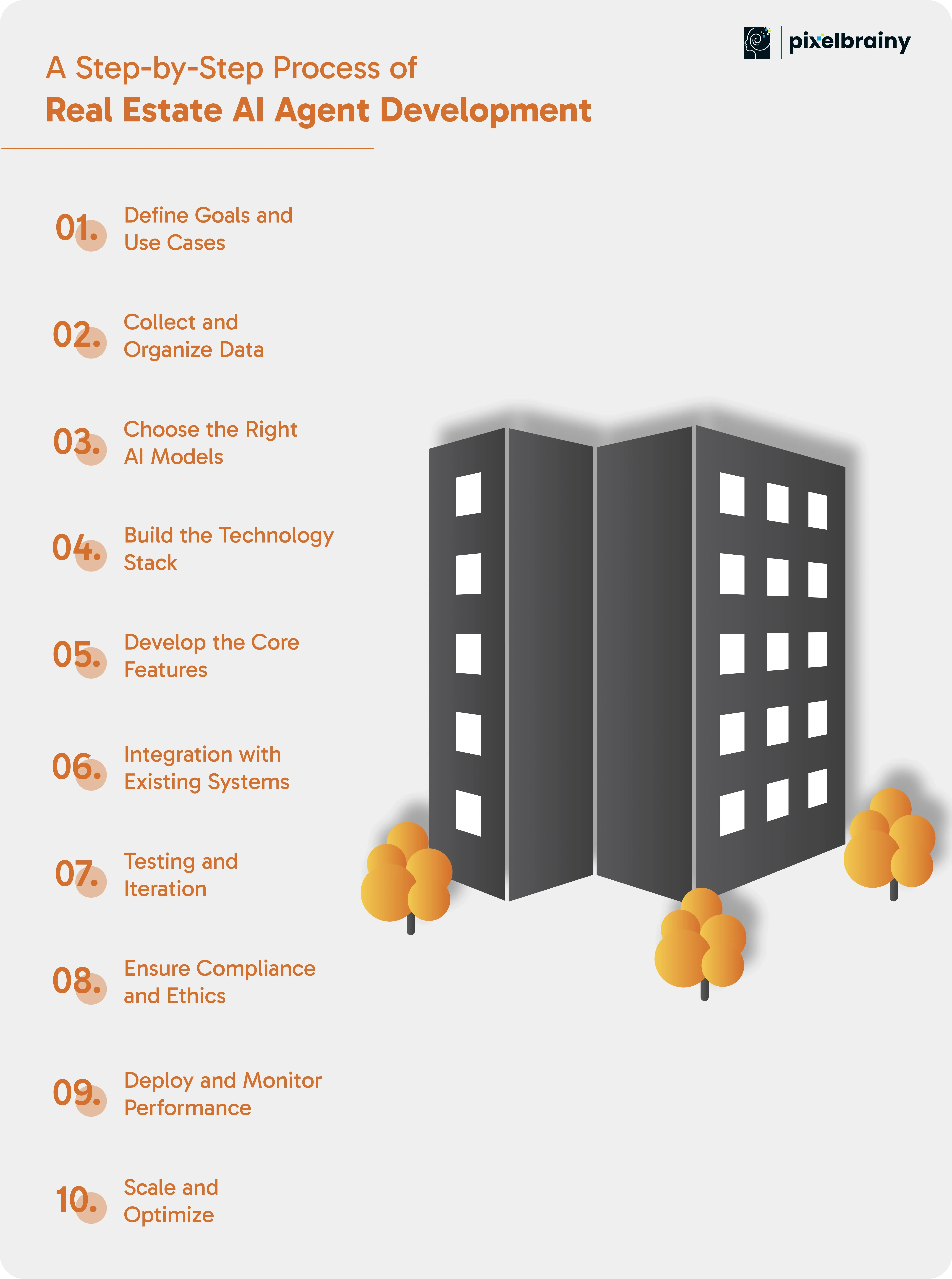
Every project starts with a clear purpose. Decide the use cases of your AI real estate agent before diving into development. Do you want it to handle customer service, improve property valuations, or strengthen lead management? Defining these priorities helps you focus resources wisely. Many top AI agent development companies in USA recommend beginning with one or two core features before expanding.
Key points:
Data is the backbone of intelligence. Gather MLS records, CRM inputs, pricing history, and market insights to feed into your system. Ensure the information is structured, standardized, and accurate—because quality data leads to trustworthy outputs.
Key points:
Your AI agent’s intelligence depends on the models you select. NLP enables natural conversations, computer vision powers image and video recognition, and machine learning predicts pricing trends. Tailoring these models is central to real estate AI agent development.
Key points:
Frameworks like PyTorch, TensorFlow, and spaCy form the foundation of AI development. Pair them with MLS APIs and CRM connectors. At this stage, working with a UI/UX design company is crucial—because even powerful AI is wasted if the interface isn’t user-friendly.
Key points:
Now the AI agent begins to take shape. Prioritize features such as property search, predictive valuation, and automated client support. Think about client journeys and eliminate common frustrations to create features that deliver immediate value.
Key points:
No AI agent stands alone. Effective AI integration ensures your agent connects with CRMs, property databases, and websites seamlessly. This helps realtors use the system without disrupting their workflows.
Key points:
Testing ensures your system works in practice, not just in theory. Run pilots with real users to identify weaknesses. Use their feedback to refine both features and accuracy. Iteration transforms your AI from basic automation into a reliable digital assistant.
Key points:
Real estate is tightly regulated. A successful AI agent must adhere to fair housing laws, privacy rules, and bias-prevention standards. Ethical design not only protects your business legally but also builds trust with clients.
Key points:
Deployment marks the beginning of real-world use. Launch the AI across websites, apps, or CRM systems, and then carefully monitor its performance. Metrics like conversion rates, response speed, and customer satisfaction show whether the AI is achieving business goals.
Key points:
Once your AI agent is established, scale it for growth. Expand features to include multilingual support, AR-powered tours, or predictive investment tools. Many businesses partner with experts in the development of real estate AI agent solutions to handle this stage effectively.
Key points:
By following this 10-step framework, building an MVP for real estate AI agent or Fully-fledge becomes less overwhelming and more achievable. Each step brings you closer to an AI solution that is practical, ethical, and scalable. Whether you’re exploring AI Agent Use Cases for customer support, valuation, or market forecasting, this roadmap provides a clear path to long-term success.
Also Read: A Guide to Real Estate AI Software Development
One of the first questions businesses ask is: “How much does it cost to build a real estate AI agent?” The truth is, there’s no one-size-fits-all answer. The cost to develop a real estate AI agent depends on multiple factors such as project scope, technology stack, data sources, and the complexity of features. On average, the investment ranges from $15,000 to $100,000+.
Let’s break down the key cost drivers in real estate AI agent development:
The actual cost of building a real estate AI agent depends entirely on your vision. If your goal is to start small, you can launch a minimum viable product (MVP) affordably and expand later. If you’re aiming for a full-scale enterprise solution, budget for the higher end of the range to ensure quality and long-term success.
Also Read: AI Real Estate App Development Cost: Factors and Examples
Choosing the right tools is critical in the development of real estate AI agent. The technology stack not only determines performance but also impacts scalability, cost, and user experience.
Below is a breakdown of the recommended stack covering frontend, backend, and AI/ML layers along with supporting infrastructure.
| Parameter | Recommended Tools | Explanation |
| Frontend (UI/UX) | React.js, Angular, Vue.js, Flutter (for mobile) | These frameworks ensure smooth, responsive, and user-friendly interfaces. A great frontend makes the AI agent accessible through web apps, mobile apps, or chat interfaces |
| Backend (Server-Side) | Node.js, Django, Flask, Ruby on Rails | Backend frameworks manage APIs, databases, and system logic. They handle property data, client requests, and communication between the AI and other platforms |
| Databases | PostgreSQL, MongoDB, Firebase, MySQL | Reliable databases are needed to store property listings, user data, and transaction history. Choosing between relational or NoSQL depends on scalability needs |
| AI/ML Frameworks | TensorFlow, PyTorch, Scikit-learn, spaCy | These are core tools for AI real estate agent development. They enable natural language processing, computer vision for images, and predictive analytics for valuations |
| NLP & Chatbot Platforms | Dialogflow, Rasa, OpenAI GPT, Amazon Lex | Essential for building conversational agents that understand and respond in natural language, powering customer support and property inquiries |
| Computer Vision Tools | OpenCV, AWS Rekognition, Google Vision AI | Used for analyzing images and videos of properties, detecting features, and enhancing virtual tours |
| Cloud Hosting | AWS, Google Cloud, Microsoft Azure | Scalable cloud platforms ensure reliable hosting, real-time data processing, and cost-effective deployment |
| API Integrations | Zillow API, MLS APIs, Redfin API | APIs connect the AI agent to property databases and listing services, ensuring up-to-date and accurate real estate data |
| CRM Integration | Salesforce, HubSpot, Zoho CRM | These tools integrate with the AI to automate lead nurturing, scoring, and client communications |
| Security & Compliance | OAuth 2.0, SSL/TLS, GDPR/CCPA compliance frameworks | Security ensures sensitive client data is protected, while compliance prevents violations of privacy and fair housing regulations |
By combining these technologies, businesses can build a real estate AI agent that is intelligent, secure, and scalable. The right stack ensures seamless AI integration across client interfaces, property databases, and CRM systems—making the solution practical for real-world adoption.

While the potential of AI in real estate is enormous, the development of real estate AI agents comes with real-world challenges. Ignoring these issues can result in underperforming systems, compliance risks, or poor adoption by users.
Below are the major obstacles faced during building real estate AI agents—and the strategies to overcome them.
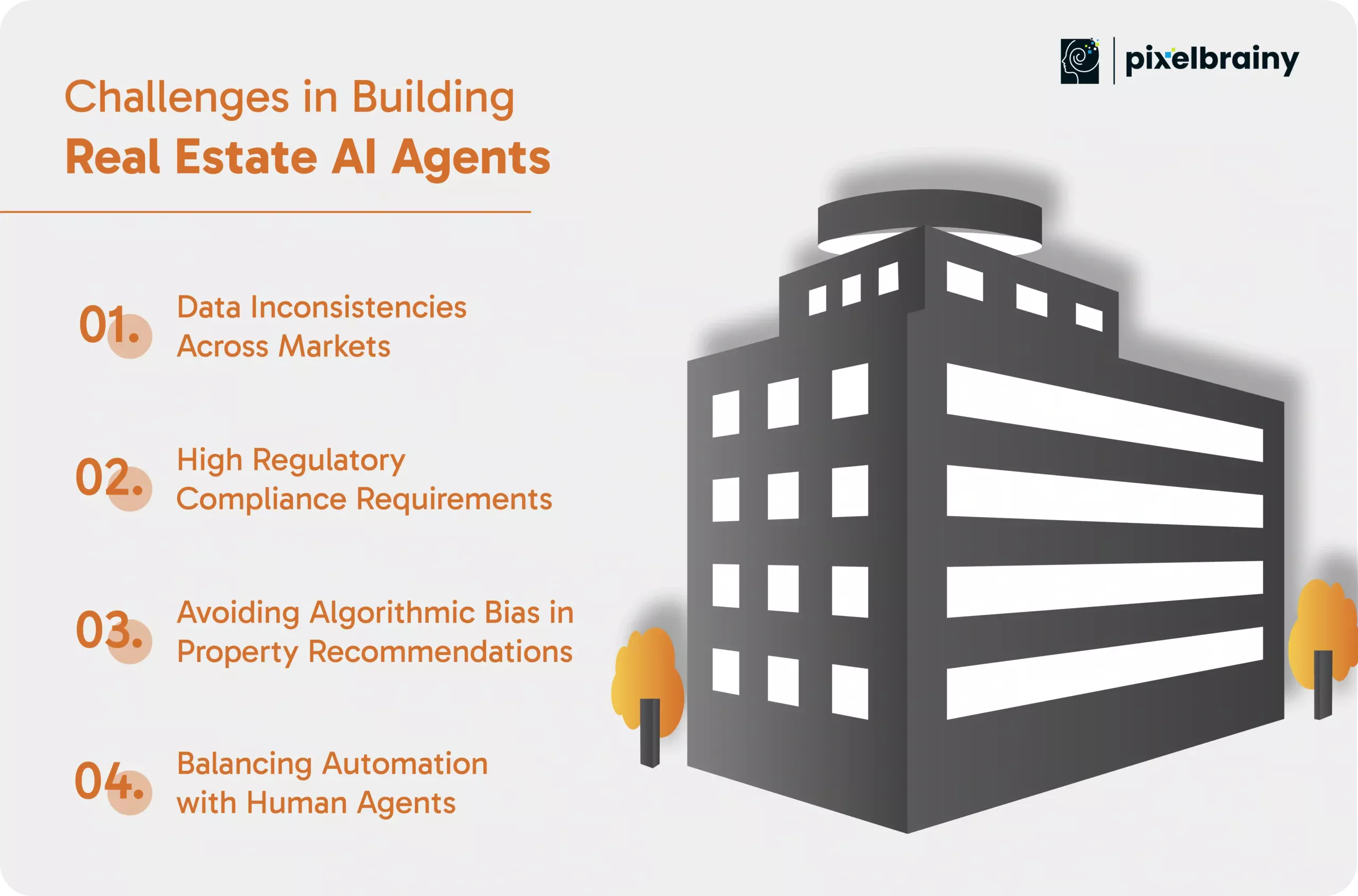
Real estate data is notoriously fragmented. Different markets have their own listing formats, varying data quality, and even missing records. These inconsistencies make it difficult for AI models to provide accurate valuations or recommendations.
How to Resolve:
Real estate is a heavily regulated industry, and AI systems must comply with housing laws, data privacy standards, and ethical guidelines. Non-compliance can lead to penalties or reputational damage.
How to Resolve:
AI models trained on biased data may inadvertently reinforce discrimination—for example, by recommending homes only in certain neighborhoods or excluding minority groups. This can violate fair housing laws and damage trust.
How to Resolve:
While AI can automate tasks like valuations, lead nurturing, and customer queries, it should not completely replace human agents. Over-automation risks making the experience feel impersonal and may alienate clients who value human expertise.
How to Resolve:
These challenges highlight why thoughtful planning is essential in building a real estate AI agent. From data inconsistencies to ethical concerns, each obstacle can be overcome with the right mix of technology, compliance, and human oversight. By addressing these issues early, businesses can create AI agents that are not only powerful but also trustworthy, compliant, and widely adopted.
The field of real estate AI agent development is evolving rapidly, opening up exciting new possibilities for buyers, sellers, and professionals alike. Beyond automating repetitive tasks, future AI agents will reshape how deals are negotiated, properties are discovered, and transactions are executed.
Let’s explore the most promising trends and opportunities that will define the next generation of AI in real estate.
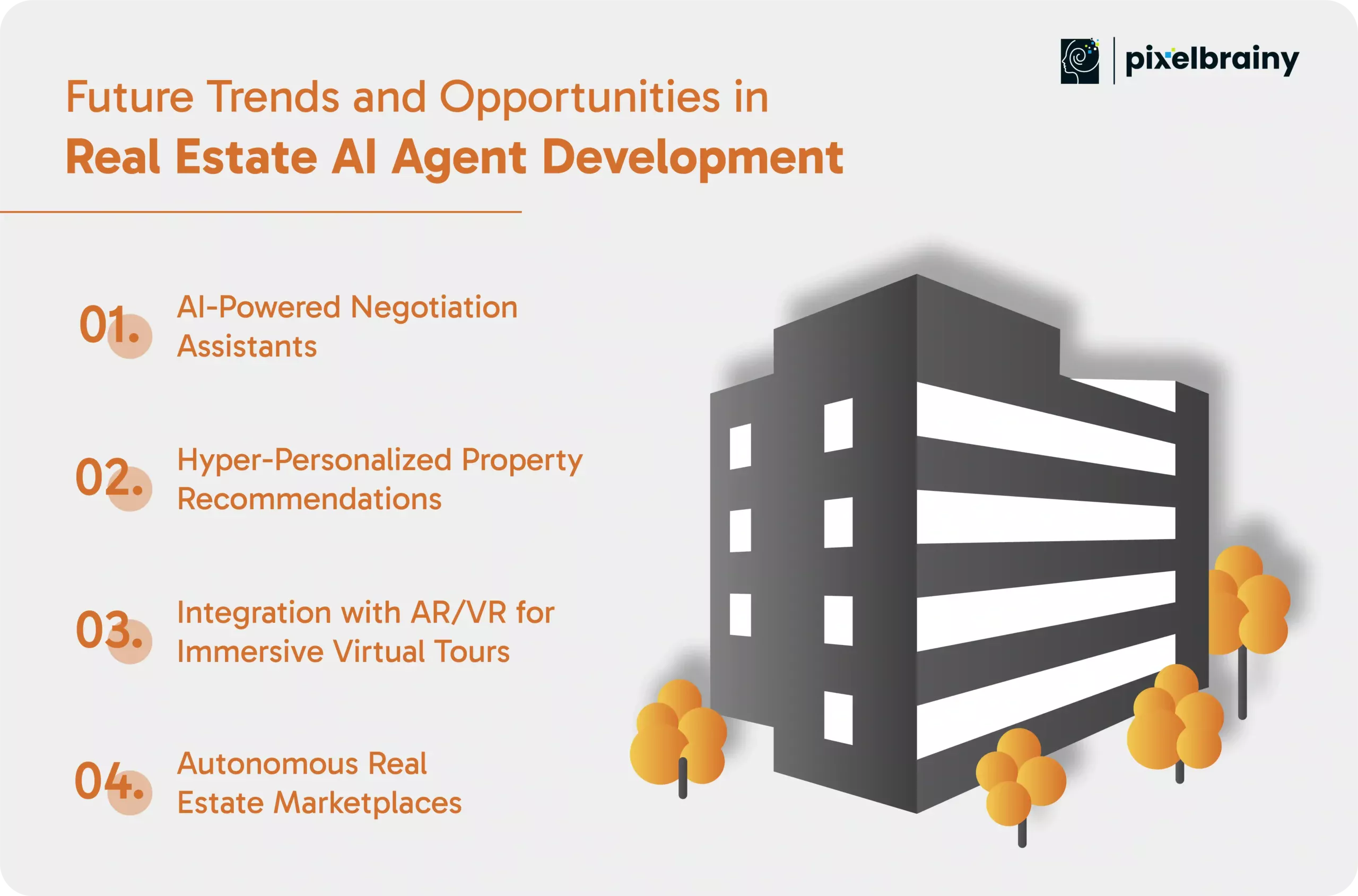
Negotiation is one of the most time-consuming parts of real estate transactions. Future AI agents will be capable of analyzing market data, buyer intent, and property history to suggest optimal negotiation strategies. These assistants won’t replace agents but will provide realtors with actionable insights, strengthening their bargaining position.
Opportunity: Imagine an AI system advising both agents and clients with data-backed recommendations on pricing, counteroffers, and closing strategies—saving time while boosting confidence in decision-making.
While property search has already been improved by AI, the future lies in hyper-personalization. AI agents will consider not just basic filters like budget and location but also lifestyle data such as commute preferences, school ratings, and even long-term investment goals.
Opportunity: This level of personalization will create client experiences that feel tailor-made, increasing engagement, trust, and conversion rates for real estate businesses.
Virtual tours are becoming mainstream, but integrating AI with AR/VR will elevate them further. AI real estate agents will curate immersive property walkthroughs, highlighting features relevant to individual buyers. For example, one buyer might see a tour focused on kitchen design, while another is shown home office setups.
Opportunity: This fusion of AI and AR/VR will make remote property buying more practical, especially for international clients, and reduce the time spent on physical visits.
In the near future, we may see autonomous real estate marketplaces powered entirely by AI agents. These platforms will connect buyers and sellers directly, handling property listings, valuations, negotiations, and even initial contracts—without the need for constant human intervention.
Opportunity: Such marketplaces could drastically reduce transaction costs, improve transparency, and streamline the buying process while still allowing human agents to step in for high-value or complex deals.
The next wave of real estate AI agent development is set to move beyond automation into intelligence and autonomy. From negotiation to immersive property tours, these innovations present tremendous opportunities for businesses ready to embrace the future.
By staying ahead of these trends, real estate professionals can unlock new revenue streams, deliver exceptional client experiences, and redefine the property market.
If you’re searching for an AI Agent Development Company in USA, the partner you choose will determine how successful your project becomes. At PixelBrainy, we specialize in Real Estate AI Agent Development in USA, helping real estate businesses transform ideas into intelligent solutions that simplify operations and create new growth opportunities.
Our reputation as one of the best companies for developing real estate AI agents comes from proven results, not promises.
We don’t just build AI systems—we design solutions that solve real business problems for real estate professionals. Here’s what sets us apart:
Recently, we partnered with a leading real estate company in USA to design and launch a custom AI agent. The solution included:
The outcome was significant - faster property matching, reduced manual workload for agents, and higher client satisfaction scores.
When you choose PixelBrainy, a leading real estate AI solutions provider, you’re choosing a partner that understands both real estate and AI. Whether you need an MVP to test AI Agent Use Cases or a full-scale enterprise solution, we deliver systems that grow with your business. For real estate companies ready to scale, PixelBrainy is the trusted choice for real estate AI agent development that delivers measurable results.

"The future of real estate belongs to businesses that embrace intelligent AI agents and data-driven innovation."
Developing a real estate AI agent is one of the most impactful investments for businesses looking to automate lead qualification, deliver personalized property recommendations, streamline customer engagement, analyze market trends, and improve operational efficiency. Throughout this guide, we've explored every stage of real estate AI agent development, including AI agent architecture, core technologies, essential features, implementation steps, technology stack, development costs, security considerations, common challenges, and future opportunities. With the right strategy and technology, AI agents can help real estate businesses improve customer experiences, increase team productivity, and accelerate business growth.
Selecting the right AI development partner plays a critical role in the success of your project. The top companies that build AI agents specifically for real estate understand industry workflows, MLS and CRM integrations, property data management, compliance requirements, predictive analytics, and intelligent automation. Their expertise extends far beyond building conversational interfaces to delivering enterprise-grade AI solutions designed for real business outcomes.
At PixelBrainy, we specialize in developing custom AI agents tailored for real estate agencies, brokers, property developers, and proptech startups. From strategy and design to deployment, integration, and continuous optimization, we build secure, scalable, and high-performance AI solutions that create measurable business value.
Connect with PixelBrainy today to build a real estate AI agent that helps your business innovate, scale, and stay ahead in an AI-driven market.
The timeline varies depending on the complexity of features. A basic AI agent may take 2–3 months, while an advanced enterprise-level solution can require 6–9 months, including integration and testing.
No, the goal is not replacement but support. AI agents handle repetitive tasks like answering queries or valuations, while human agents focus on negotiations, relationship-building, and closing deals.
Absolutely. Even small agencies can use AI agents to automate customer support, manage leads, and improve client engagement without needing a large team.
High-quality MLS listings, property records, CRM data, pricing history, and market trends are key inputs. Clean and standardized data leads to more accurate predictions and recommendations.
Yes, if built properly. By implementing encryption, secure APIs, and compliance with GDPR/CCPA, AI agents can safely manage sensitive data like client profiles and property details.
Yes, most AI agents are designed for seamless integration with CRMs like Salesforce or HubSpot and property websites, ensuring smooth workflows without disrupting current systems.

About The Author
Sagar Bhatnagar
Sagar Sahay Bhatnagar brings over a decade of IT industry experience to his role as Marketing Head at PixelBrainy. He's known for his knack in devising creative marketing strategies that boost brand visibility and market influence. Sagar's strategic thinking, coupled with his innovative vision and focus on results, sets him apart. His track record of successful campaigns proves his ability to utilize digital platforms effectively for impactful marketing efforts. With a genuine passion for both technology and marketing, Sagar continuously pushes PixelBrainy's marketing initiatives to greater success.

Working with the PixelBrainy team has been a highly positive experience. They understand the design requirements and create beautiful UX elements to meet the application needs. The dev team did an excellent job bringing my vision to life. We discussed usability and flow. Sagar worked with his team to design the database and begin coding. Working with Sagar was easy. He has the knowledge to create robust apps, including multi-language support, Google and Apple ID login options, Ad-enabled integrations, Stripe payment processing, and a Web Admin site for maintaining support data. I'm extremely satisfied with the services provided, the quality of the final product, and the professionalism of the entire process. I highly recommend them for Android and iOS Mobile Application Design and Development.

Great experience working with them. Had a lot of feedback and I found that unlike most contractors they were bugging me for updates instead of the other way around. They were extremely time conscience and great at communicating! All work was done extremely high quality and if not on time, early! They were always proactive when it comes to communication and the work is great/above par always. Very flexible and a great team to work with! Goes above and beyond to present us with multiple options and always provides quality. Amazing work per usual with Chitra. If you have UI/UX or branding design needs I recommend you go to them! Will likely work with them in the future as well, definitely recommended!

PixelBrainy is a joy to work with and is a great partner when thinking through branding, logo, and website layout. I appreciate that they spend time going into the "why" behind their decisions to help inform me and others about industry best practices and their expertise.

I hired them to design our software apps. Things I really like about them are excellent communication skills, they answer all project suggestions and collaborate right away, and their input on design and colors is amazing. This project was complex and needed patience and creativity. The team is amazing to do business with. I will be using them long-term. Glad to see there are some good people out there. I was afraid to try and outsource my project to someone but I am glad I met them! I really can't say enough. They went above and beyond on this project. I am very happy with everything they have done to make my business stand out from the competition.

It was great working with PixelBrainy and the team. They were very responsive and really owned the project. We'll definitely work with them again!

I recently worked with the PixelBrainy team on a project and I was blown away by their communication skills. They were prompt, clear, and articulate in all of our interactions. They listened and provided valuable feedback and suggestions to help make the project a success. They also kept me updated throughout the entire process, which made the experience stress-free and enjoyable.

PixelBrainy is very good at what it does. The team also presents themselves very professionally and takes care of their side of things very well. I could fully trust them taking up the design work in a timely and organised manner and their attention to detail saved us lots of effort and time. This particular project was quite intense and the team showed that they function very well under pressure. Very much looking forward to working with her again!

It's always an absolute pleasure working with them. They completed all of my requests quickly and followed every note I had for them to a T, which made our process go smoothly from start to finish. Everything was completed fast and following all of the guidelines. And I would recommend their services to anyone. If you need any design work done in the future, PixelBrainy should be your first call!

They took ownership of our requirements and designed and proposed multiple beautiful variants. The team is self-motivated, requires minimum supervision, committed to see-through designs with quality and delivering them on time. We would definitely love to work with PixelBrainy again when we have any requirements.

PixelBrainy was a big help with our SaaS application. We've been hard at work with a new UI/UX and they provided a lot of help with the designs. If you're looking for assistance with your website, software, or mobile application designs, PixelBrainy and the team is a great recommendation.

PixelBrainy designers are amazing. They are responsive, talented, and always willing to help craft the design until it matches your vision. I would recommend them and plan to continue them for my future projects and more!!!

They were awesome! Did a good job fast, and good communication. Will work with them again. Thank you

Creative, detail-oriented, and talented designers who take direction well and implement changes quickly and accurately. They consistently over-delivered for us.

PixelBrainy team is very talented and creative. Great designers and a pleasure to work with. PixelBrainy is an excellent communicator and I look forward to working with them again.

PixelBrainy has a very talented design team. Their work is excellent and they are very responsive. I enjoy working with them and hope to continue on all of our future projects.


Transform your ideas into reality with us.
Across these industries, each engagement brings unique challenges, from early-stage product development to scaling complex systems, helping us build a practical understanding of real-world product environments.