AI Summary Powered by PixelBrainy
Finding the right therapy for every individual is a challenge for healthcare providers, wellness platforms, and therapy-focused businesses. With the rise of AI in healthcare, more companies are exploring how to create Therapy Recommendation AI Apps that personalize care and improve patient outcomes. Whether the goal is to develop Therapy Recommendation AI App solutions for mental health, physical therapy, speech therapy, or holistic wellness, one thing is clear. AI powered personalization is reshaping the way people access therapy support.
Today, millions of users in the United States are turning to digital health tools for convenience, affordability, and quick guidance. This shift has pushed businesses to rethink their approach to care delivery. Building an AI App for Therapy Recommendation allows organizations to offer tailored treatment suggestions, intelligent assessments, and continuous progress tracking without overloading healthcare professionals. For startups and enterprises looking to scale, Therapy Recommendation AI App Development creates a powerful opportunity to enter the fast growing digital therapy market.
This blog explains everything you need to know before you start building your own therapy recommendation system. From understanding how these apps work to learning the must have features, advanced AI capabilities, development process, and overall cost, we have covered all essential details.
If you want to stay ahead in the competitive healthtech landscape, this guide will help you understand exactly how Therapy Recommendation AI Apps can benefit your customers and fuel business growth. Let us explore how you can build a successful and scalable AI driven therapy recommendation solution.
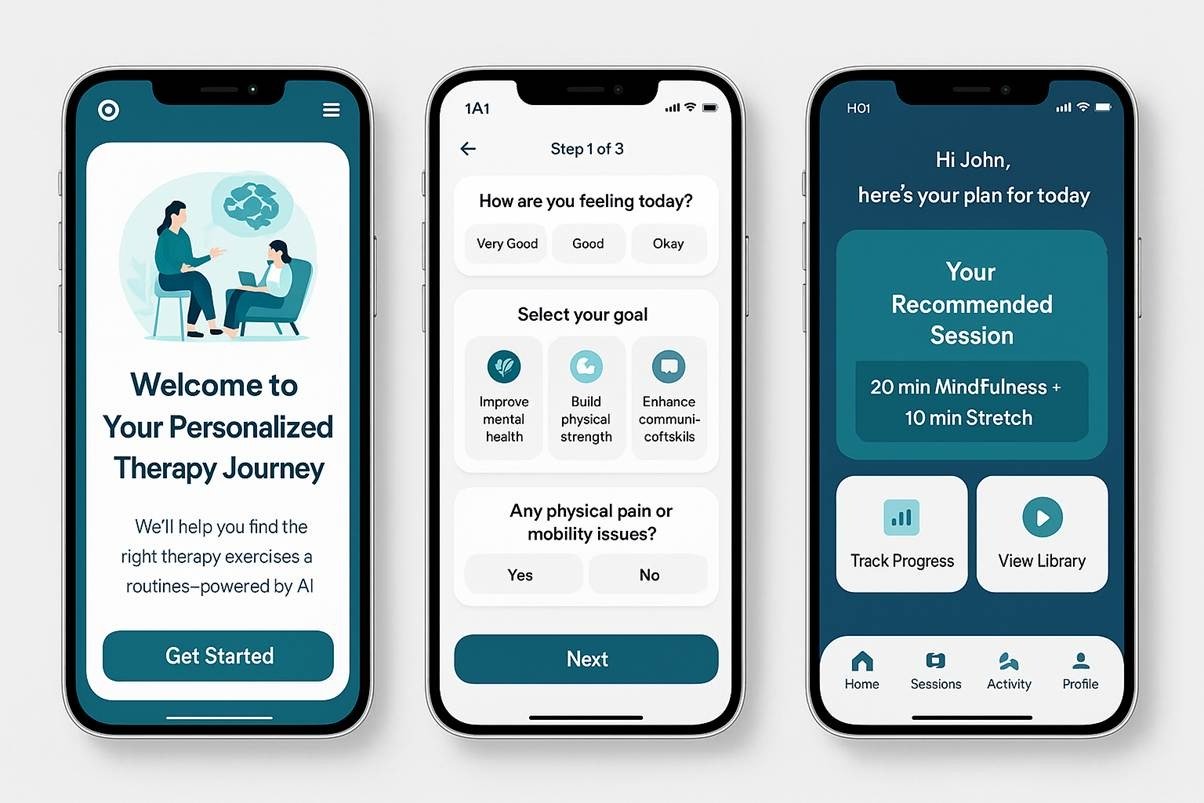
A Therapy Recommendation AI App is a digital platform that uses artificial intelligence, data analytics, and behavioral insights to recommend personalized therapy paths to users. Instead of offering generic advice, the app evaluates user inputs such as symptoms, habits, activity levels, medical history, emotional states, or lifestyle patterns to provide tailored therapy suggestions.
Depending on the use case, the app can support various domains such as mental health therapy, physiotherapy, occupational therapy, speech therapy, or overall wellness. Users receive therapy plans, exercises, coping strategies, or treatment sessions that match their needs.
These apps rely on AI models trained with clinical guidelines, user behavior data, and evidence based therapy frameworks. The result is an intelligent system that adjusts recommendations over time, improving accuracy as the user continues to interact with the app.
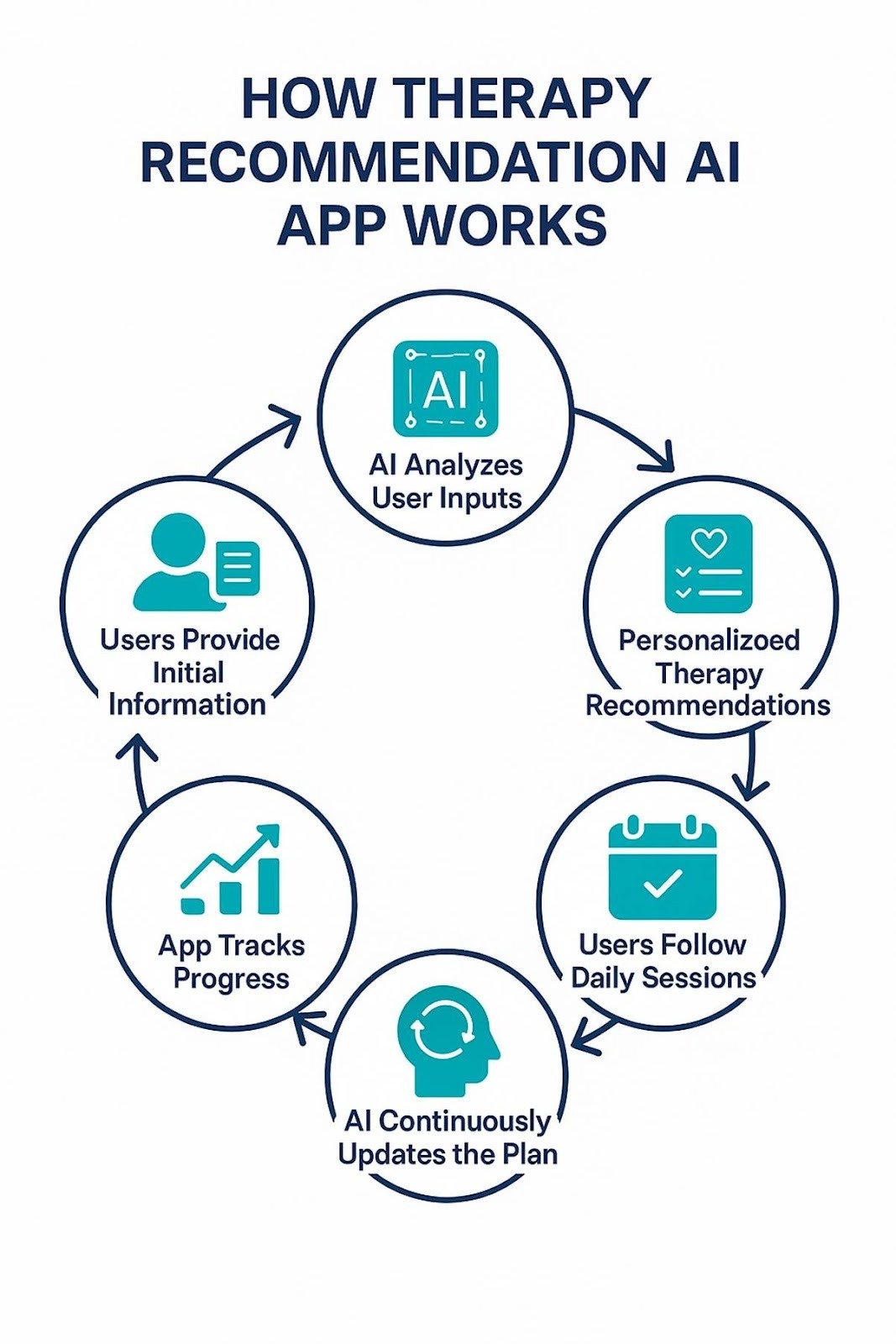
A Therapy Recommendation AI App is designed to feel simple and natural for users, even though powerful AI runs behind the scenes. When someone opens the app, the system begins understanding their needs, symptoms, goals, and daily behavior. From there, the app intelligently recommends the most suitable therapy sessions, exercises, or routines that can help them improve mentally, physically, or emotionally.
Here is how the process works from the user’s point of view:
The first step is a quick onboarding assessment.
Users answer a few simple questions such as:
This information forms the foundation of the recommendation system.
Once the user shares their data, the AI processes the information instantly.
It looks for:
The AI compares this with large therapy datasets and scientifically backed therapy methods to understand what the user needs.
Based on the analysis, the app displays a personalized plan for the user.
For example:
Every recommendation is tailored specifically for that individual.
The app guides users through each session with:
Users feel as if a personal coach or therapist is guiding them throughout the journey.
As users complete sessions or log their progress, the system learns more about their condition.
The app tracks:
This helps users see how they are improving over time.
Unlike manual therapy plans, AI recommendations evolve dynamically.
If the user’s condition changes or new symptoms appear, the app automatically updates the therapy plan so it remains accurate and relevant.
Businesses today are under increasing pressure to deliver personalized, accessible, and efficient therapy experiences. Investing in Therapy Recommendation AI App Development allows companies to tap into a rapidly growing digital health market while meeting rising user expectations.
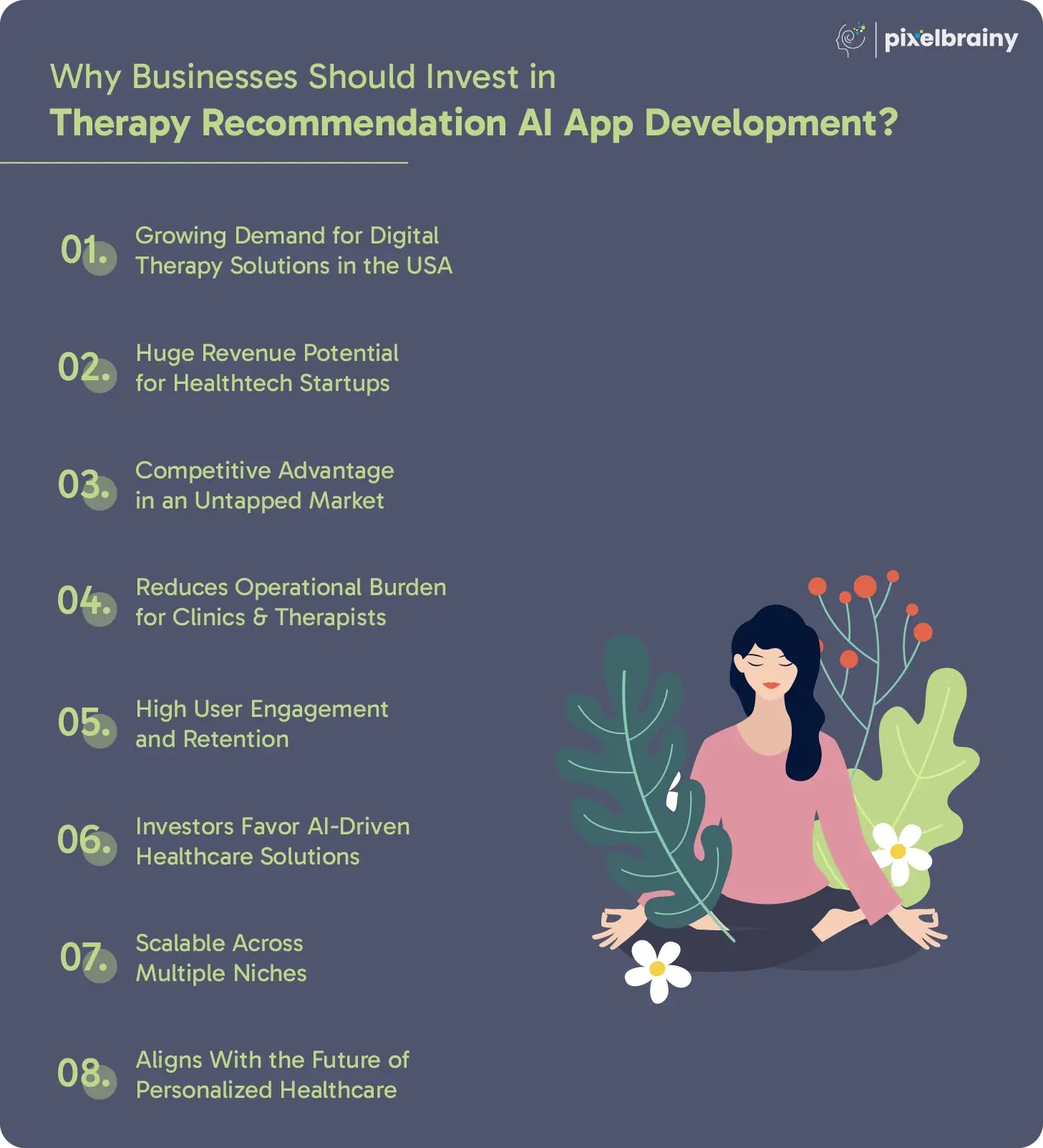
The demand for AI-powered therapy solutions is rapidly rising across the United States. The U.S. digital health market is projected to surpass 550 billion dollars by 2030, driven by a surge in telehealth adoption, increased investment in AI technologies, and growing acceptance of virtual care. More than 70 percent of Americans now prefer digital therapy tools because they offer accessibility, privacy, and affordability compared to traditional in-person sessions.
Additional market forces strengthen this demand. Mental health cases continue to rise, chronic pain conditions are becoming more common, and the U.S. population is aging faster than ever. These factors make digital therapy solutions not just convenient, but essential. Therapy Recommendation AI Apps fill this gap by offering scalable, personalized, and evidence-based guidance that adapts to individual user needs. As AI becomes more trusted in healthcare, businesses investing now can capitalize on an expanding and highly receptive market.
Therapy Recommendation AI Apps offer multiple monetization opportunities, making them ideal for startups and enterprises looking for strong financial returns. Revenue can be generated through:
These diversified revenue streams help create recurring, predictable income, which is highly attractive for investors and founders seeking long-term profitability.
Despite rapid growth, the therapy personalization market is still relatively untapped. Very few companies offer AI-driven therapy recommendation systems, leaving huge space for early innovators to establish themselves as leaders. With applications across mental health, physiotherapy, speech therapy, and occupational therapy, businesses can differentiate themselves with intelligent and personalized therapy solutions.
Early adopters of AI benefit from stronger brand positioning, higher customer loyalty, and reduced competition. This creates a strategic advantage as demand accelerates and the market matures.
Therapists and clinics often face overwhelming workloads, limited appointment availability, and growing administrative tasks. Therapy Recommendation AI Apps help reduce this operational burden by:
This results in lower operational costs, improved workflow efficiency, and increased capacity for clinics to serve more patients without compromising care quality.
AI delivers personalization that keeps users engaged longer. When users receive custom therapy plans, real-time insights, reminders, and weekly progress summaries, they are far more likely to continue using the app consistently. These engagement features naturally reduce churn and make subscription models more stable and profitable.
High engagement also boosts customer satisfaction, encouraging positive reviews, referrals, and long-term loyalty.
The healthtech investment landscape is shifting strongly toward AI. Venture capital firms and private investors are actively funding:
By investing in Therapy Recommendation AI App Development today, businesses align themselves with one of the fastest-growing innovation trends in healthcare. This significantly increases the chances of attracting funding for scaling and expansion.
One of the biggest advantages of AI therapy recommendation engines is their scalability. The same AI core can be repurposed across multiple niches, including:
This makes it easy for businesses to expand into new markets without rebuilding the entire system, reducing time to market and development costs.
The U.S. healthcare system is rapidly shifting toward personalization, remote monitoring, and AI-assisted clinical decisions. Therapy Recommendation AI Apps are perfectly aligned with this future. They offer individualized treatment, continuous guidance, and adaptive care — all essential components of modern digital healthcare.
As personalized healthcare becomes the norm, businesses investing in AI therapy solutions today will be positioned as leaders of tomorrow’s healthtech ecosystem.
With strong demand, high scalability, and long-term revenue potential, Therapy Recommendation AI Apps offer one of the most promising investment opportunities in the modern healthtech landscape.
Therapy Recommendation AI Apps are being widely adopted across healthcare, wellness, and rehabilitation because they deliver personalized therapy guidance at scale. As more users look for smart, accessible tools, AI powered therapy solutions are becoming essential in both clinical and consumer environments.
Below are the top use cases where Therapy Recommendation AI Apps create meaningful impact through intelligent personalization and data driven insights.
AI Therapy Recommendation Apps for mental health help users manage emotions, stress, and challenging thoughts. These apps analyze mood patterns, daily journals, and emotional triggers to recommend personalized CBT exercises, mindfulness practices, and coping strategies.
Examples:
These Therapy Recommendation AI Apps enhance emotional well-being and make mental health support more accessible.
Also Read: How To Build An AI Mental Health and Wellness App Like Wysa?
Physiotherapy is one of the most impactful use cases for Therapy Recommendation AI App Development. These apps evaluate mobility issues, pain levels, and user performance to recommend personalized recovery exercises.
Examples:
AI powered physiotherapy recommendations help users recover faster and with greater confidence.
Therapy Recommendation AI Apps are transforming speech therapy by analyzing voice clarity, tone, articulation, and pronunciation. The AI identifies repeating errors and recommends exercises that match the user’s speech challenges.
Examples:
These AI driven speech therapy solutions allow users to practice consistently and improve communication skills at home.
AI powered occupational therapy applications help users build daily living skills, motor coordination, and functional independence. Therapy Recommendation AI Apps evaluate developmental needs and create structured practice routines.
Examples:
These AI supported therapy solutions empower users to rebuild essential life skills at their own pace.
Wellness and behavior-focused Therapy Recommendation AI Apps support users in building healthier habits, improving lifestyle choices, and staying consistent with their goals. The AI evaluates sleep patterns, activity levels, emotional trends, and daily routines to create personalized coaching plans.
Examples:
These AI therapy and coaching solutions increase motivation and help users transform long-term behavioral patterns.
These use cases highlight how Therapy Recommendation AI Apps can transform mental, physical, and behavioral wellness through data driven, personalized care.

Therapy Recommendation AI Apps need a strong foundation of essential features to deliver accurate guidance, seamless user experiences, and adaptable therapy plans. When focusing on AI Therapy Recommendation App Development, these features ensure your app stays functional, accessible, and trustworthy. Whether you are creating a Therapy Recommendation AI App for mental health, physiotherapy, or general wellness, these core features are the building blocks required to build Therapy Recommendation AI App platforms that users rely on every day.
Below is a comprehensive list of must-have features for creating Therapy Recommendation AI App solutions.
| Feature | Explanation |
| User Profile & Personalization Settings | Allows users to enter demographics, therapy goals, and personal health details. This information helps the AI create personalized therapy recommendations tailored to individual needs. |
| Onboarding Assessment & Screening Tools | Includes mental health questionnaires, pain scales, or mobility assessments. These tools gather essential information needed when creating Therapy Recommendation AI App flows. |
| AI-Powered Recommendation Engine | The core intelligence behind AI Therapy Recommendation App Development. It analyzes user data and generates personalized therapy plans that adapt over time. |
| Progress Tracking Dashboard | Shows user improvement trends, therapy completion rates, and personal milestones. This boosts motivation and helps users understand their progress. |
| Interactive Exercise & Therapy Library | A categorized content library with videos, audio guides, and exercises. Users access personalized therapy materials based on AI recommendations. |
| Multi-Format Session Guidance (Video, Audio, Text) | Supports multiple content types to improve accessibility. Helps users follow therapy routines comfortably, regardless of learning style. |
| Real-Time Notifications & Reminders | Encourages routine consistency with timely reminders. Smart reminders adapt based on user engagement patterns. |
| Chat Support or AI Therapy Assistant | Provides conversational guidance, session explanations, and helpful responses. Enhances user engagement and makes the app feel more interactive. |
| Secure Login & HIPAA-Compliant Data Protection | Essential for apps handling sensitive medical data. Includes encryption, secure authentication, and strict privacy measures. |
| Goal Setting & Routine Planner | Helps users define therapy goals and organize daily or weekly therapy routines. AI adjusts suggestions based on performance. |
| Mood, Pain, or Activity Logging Tools | Allows users to record symptoms, emotional states, or physical activity. These logs help the AI deliver more accurate recommendations. |
| Therapist or Coach Dashboard (Optional) | Gives professionals oversight of user progress and therapy performance. Useful for hybrid clinical models. |
| In-App Messaging or Feedback System | Enables users to share feedback, report issues, or ask questions. Improves app support and therapy personalization. |
| Analytics & Insights Center | Displays progress insights, emotional trends, or physical improvements. Empowers users to understand therapy impact. |
| Cloud Sync & Multi-Device Access | Ensures data is synchronized across devices for seamless access. Users can continue therapy anytime without losing progress. |
These essential features form the backbone of effective AI Therapy Recommendation App Development and ensure a reliable, personalized experience for every user.
Beyond the core features, advanced capabilities take your AI therapy app to the next level by enhancing personalization, intelligence, and real-time responsiveness. When focusing on AI Therapy Recommendation mobile App Development, these advanced features help create a truly differentiated product that stands out in a competitive market. Whether you are building Therapy Recommendation AI App solutions for healthcare providers or consumers, these features deliver unmatched value.
Below is a detailed list of advanced features to consider when you plan to develop Therapy Recommendation AI App systems.
| Advanced Feature | Explanation |
| Computer Vision for Posture & Movement Analysis | Ideal for physiotherapy apps, this tool analyzes movements in real time and provides corrective feedback. It enhances recovery accuracy and prevents improper exercise form. |
| Emotion Recognition Through Voice Analysis | Uses AI to detect emotional tones, stress levels, or articulation challenges through voice inputs. Helps personalize mental wellness and speech therapy recommendations. |
| Predictive Analytics for Therapy Forecasting | Forecasts future health patterns, relapse risks, or therapy needs. Helps users and clinicians stay proactive in adjusting therapy plans. |
| Wearable & IoT Device Integration | Connects with smartwatches, fitness trackers, and biomedical sensors. Provides real-time data so the AI can refine therapy suggestions for better accuracy. |
| Context-Aware Recommendations Using Behavioral AI | Adapts therapy suggestions based on lifestyle, patterns, time of day, mood, and environmental triggers. Delivers hyper-personalized therapy experiences. |
| AI Chatbot with Natural Language Understanding | Offers intelligent conversation, therapy explanations, reminders, and emotional check-ins. Enhances engagement and accessibility. |
| Custom AI Model Training Based on User Data | Allows the model to improve continuously as more user data is collected. Helps the system deliver more accurate and personalized recommendations over time. |
| Gamification System with Rewards & Achievements | Adds points, badges, streaks, and challenges to keep users motivated. Gamification significantly boosts therapy completion rates. |
| Multi-Language AI Recommendation Support | Enables global accessibility by providing therapy recommendations in various languages. Adjusts tone and cultural context for better user relevance. |
| Integration with EHR or Clinic Management Systems | Allows seamless data exchange with clinical systems so therapists can track patient progress. Ideal for clinical-grade Therapy Recommendation AI Apps. |
These advanced features elevate the potential of building Therapy Recommendation AI Apps and help create smarter, more adaptive therapy experiences for users.
Creating an AI driven therapy solution requires a clear, strategic development flow that ensures accuracy, safety, personalization, and long-term scalability. If you are wondering what is the process to build AI Therapy Recommendation App, the following step-by-step breakdown explains everything in detail. These steps cover the full journey of AI Therapy Recommendation App Development, from ideation and planning to deployment and scaling.
This workflow is used by leading product teams, healthcare startups, and the top AI development companies in USA when working on the development of AI Therapy Recommendation App platforms.
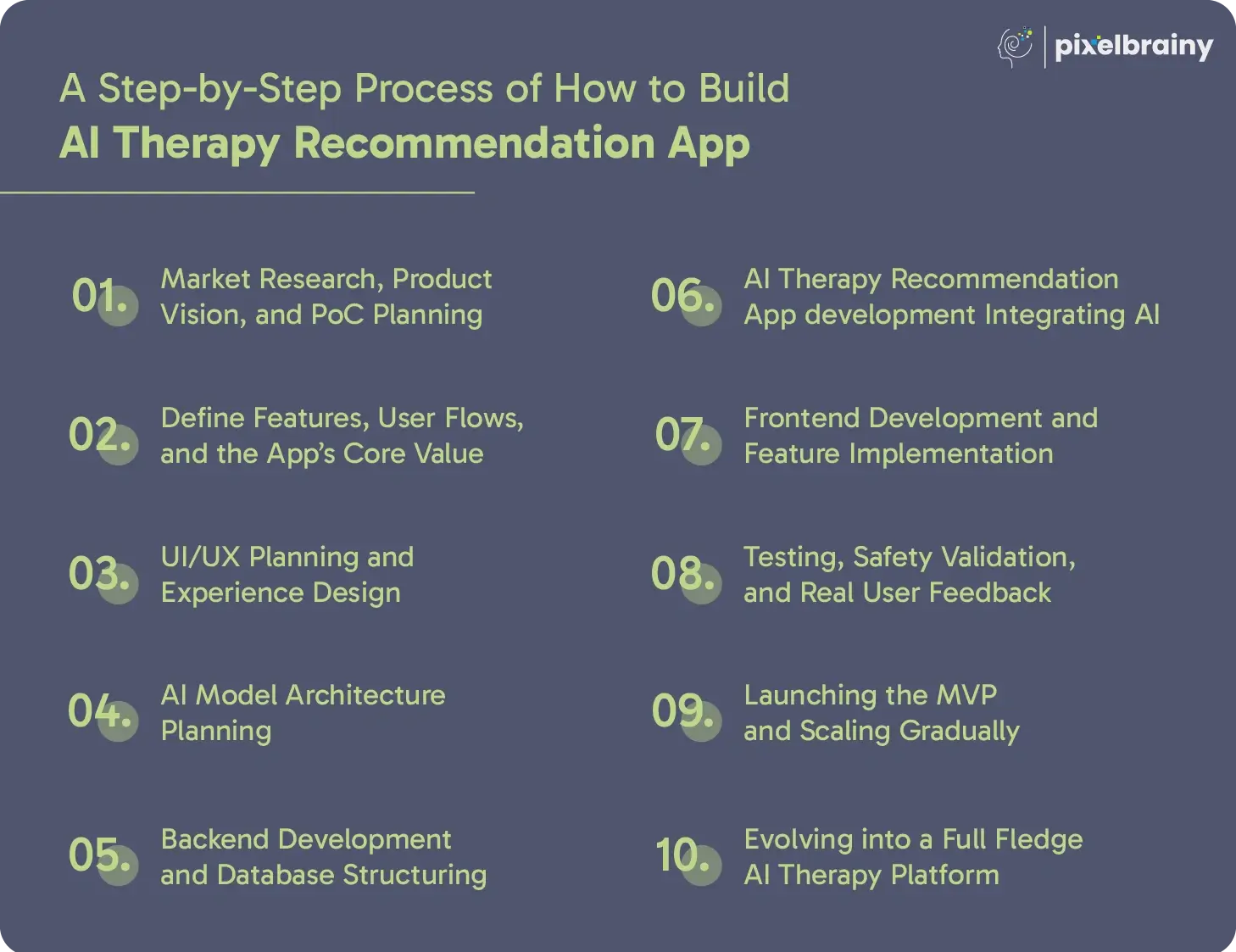
This stage focuses on understanding user needs, therapy categories, competitors, and market gaps. Teams create a PoC to validate the core AI concept and feasibility. Key research includes understanding mental health trends, physiotherapy needs, and how individuals engage with therapy routines.
Aim of this step: To validate the problem and identify where the app can deliver the strongest impact.
Why this matters: Without strong research, it becomes difficult when developing AI Therapy Recommendation App solutions that truly address user pain points or stand out in the marketplace.
Here, teams identify the essential features, advanced functionality, therapy modules, and AI capability requirements. User journeys and therapy workflows are mapped out to ensure a smooth and intuitive experience.
Aim of this step: To plan features that align with the real needs of therapists, clinics, and end users.
Why this matters: Clear feature planning ensures the app evolves logically from an MVP to a Full fledge platform without unnecessary rework or complexity.
A professional UI/UX Design company crafts user interfaces, therapy screens, assessments, dashboards, and recommendation layouts. Major focus is placed on accessibility, emotional comfort, and therapy clarity. The design should make users feel supported, not overwhelmed.
Aim of this step: To present therapy content in a simple, soothing design that encourages daily engagement.
Why this matters: Thoughtful design significantly improves app usability, especially for users dealing with pain, stress, anxiety, or cognitive challenges.
This step includes defining datasets, recommendation logic, machine learning models, natural language understanding modules, and the algorithms required for therapy personalization. An AI model development company collaborates with product and clinical teams to determine how behavioral data will be processed and how recommendations will adapt automatically over time.
Aim of this step: To build a strong intelligence layer that understands the user’s condition deeply and continuously improves.
Why this matters: The AI engine is the core element in developing AI Therapy Recommendation App solutions. A weak AI system leads to irrelevant or unsafe recommendations.
The backend handles authentication, user profiles, therapy content, progress logs, chat systems, data analysis, security rules, and HIPAA compliant operations. Scalable cloud architecture is created for long-term growth and reliable performance.
Aim of this step: To ensure the app runs smoothly, securely, and efficiently under any user load.
Why this matters: A solid backend allows you to make AI Therapy Recommendation App stable and secure for real-world healthcare use.
ML, NLP, motion analysis systems, or voice analysis components are integrated into the backend and user flows. The AI engine is trained with relevant datasets and tested for accuracy in therapy personalization. Continuous model refinement ensures the AI learns from user behavior safely.
Aim of this step: To connect the intelligence layer with the app interface so users receive meaningful and personalized therapy suggestions.
Why this matters: Without proper AI integration, the system cannot deliver the personalized therapy experience promised to users.
Developers build all visible screens such as assessments, therapy libraries, tracking dashboards, chat assistants, notifications, and exercise modules. Features are implemented with careful attention to speed, performance, and accessibility.
Aim of this step: To deliver a seamless and visually appealing user experience that supports daily therapy routines.
Why this matters: A high quality frontend ensures users stay engaged and trust the therapy guidance provided by the app.
The app undergoes functional testing, usability testing, AI accuracy validation, data protection checks, and performance evaluation. Early users or therapists participate in beta testing to validate therapy recommendations and improve system reliability.
Aim of this step: To ensure the app is safe, accurate, and compliant with healthcare expectations.
Why this matters: High reliability builds user trust and ensures the AI recommendations are clinically aligned and beneficial.
A carefully planned MVP is released to a controlled user group. User behavior is analyzed to refine features and AI models. Based on performance, new therapy modules, personalization layers, and wellness tools are gradually added.
Aim of this step: To launch quickly while still collecting meaningful real-world data.
Why this matters: Launching an MVP reduces risk and ensures the final product is based on real user needs.
Once the MVP is validated, advanced features such as posture correction, voice analysis, wearable integration, therapist dashboards, and predictive analytics are added. The platform evolves into a comprehensive therapy ecosystem used by clinics and users.
Aim of this step: To scale the app into a powerful long-term solution that supports diverse therapy needs.
Why this matters: A well scaled platform creates a sustainable business model and long-term competitive advantage.
This step-by-step process ensures your AI Therapy Recommendation App is built with accuracy, user trust, and long-term scalability at its core.
The cost to build a Therapy Recommendation AI App can vary significantly depending on features, complexity, AI capabilities, integrations, compliance needs, and how advanced the recommendation engine must be. On average, AI therapy recommendation app development cost ranges from $20,000 to $150,000+, depending on whether you are building a basic MVP or a fully scalable AI powered therapy platform.
When calculating the AI Therapy Recommendation App Development cost estimate, it is important to understand how different development factors influence the final budget. Below is a detailed breakdown to help you understand how much it costs to develop AI therapy apps for real-world use.
Estimated Cost: $20,000 – $40,000
A basic MVP includes onboarding, simple assessments, a small therapy library, basic AI suggestion logic, user profiles, progress tracking, and clean UI.
Suitable for startups that want to validate the concept before investing in full development.
Estimated Cost: $40,000 – $90,000
This version includes smarter recommendation logic, multi-format sessions, analytics, dashboards, secure login, reminders, and a broader therapy library.
Ideal for businesses that want a strong market presence with solid AI functionality.
Estimated Cost: $90,000 – $150,000+
A full-scale therapy platform includes advanced AI engines, predictive analytics, wearable integration, computer vision posture analysis, voice emotion detection, gamification, multilingual support, and clinician dashboards.
Recommended for companies targeting nationwide or global adoption.
The more advanced the AI features, the higher the development cost.
Functions like behavior forecasting, computer vision, and voice emotion detection require complex AI training and testing.
Mental health, physiotherapy, occupational therapy, and speech therapy each require specialized content models, affecting cost.
Highly personalized recommendation engines increase the cost due to more complex data processing and ML modeling.
Telehealth APIs, wearable devices, payment gateways, and EHR integrations can increase the total budget.
Healthcare apps require higher security investments.
Encryption, secure authentication, and compliance testing add to the development cost.
Premium UI and UX created by skilled designers impact cost but significantly improve user adoption rates.
Hiring teams in the USA costs more compared to offshore teams, but the quality and compliance expectations are generally higher.
For most businesses aiming to launch a competitive, well-built therapy AI solution, a practical budget falls between $45,000 and $120,000 depending on scale and long-term vision.
Understanding the full cost structure helps you plan a realistic budget and invest in the right features to build a powerful AI therapy recommendation platform.
Choosing the right tech stack is essential for building a secure, scalable, and high-performance AI Therapy Recommendation App. Below is a recommended technology stack used by leading AI and healthtech teams when developing intelligent therapy platforms.
| Category | Recommended Technologies | Purpose / Why It’s Used |
| Frontend (Mobile App) | React Native, Flutter, Swift (iOS), Kotlin (Android) | Enables smooth, responsive mobile interfaces with cross-platform or native development support. Ideal for therapy exercises, tracking screens, and user dashboards. |
| Backend Development | Node.js, Python (Django or Flask), Ruby on Rails | Powers the server-side logic, user management, therapy workflows, and communication between the app and AI systems. |
| AI & Machine Learning | Python (TensorFlow, PyTorch, Scikit-learn), OpenAI APIs, Hugging Face Models | Used to build, train, and deploy AI models for therapy recommendations, behavior analysis, personalization, and predictive insights. |
| NLP & Chatbot Frameworks | spaCy, NLTK, Rasa, Dialogflow | Helps implement smart conversational assistants, emotional analysis, and therapy-guided dialogues. |
| Computer Vision Tools (Optional) | OpenCV, MediaPipe, TensorFlow Lite | Used for posture detection, movement analysis, and real-time motion tracking for physiotherapy use cases. |
| Voice Analysis & Speech Tools | Google Speech-to-Text, Azure Cognitive Services, DeepSpeech | Enables speech therapy features like pronunciation scoring, voice tone analysis, and articulation guidance. |
| Database | PostgreSQL, MongoDB, Firebase | Stores users, therapy modules, progress logs, AI-generated outputs, and assessment data securely. |
| Cloud & Deployment | AWS, Google Cloud, Microsoft Azure | Ensures scalable, secure hosting for AI models, databases, and backend services used by therapy recommendation apps. |
| Authentication & Security | OAuth 2.0, JWT, AWS Cognito, Firebase Auth | Used to protect user accounts, secure sessions, and comply with healthcare-grade authentication practices. |
| HIPAA-Compliant Tools | AWS HIPAA Services, Google Cloud Healthcare API, Aptible | Ensures encrypted data storage, privacy protection, and compliance with healthcare regulations. |
| APIs & Integrations | Twilio, Stripe, WebRTC, Apple HealthKit, Google Fit | Enables teletherapy sessions, payments, wearable integrations, real-time communication, and fitness data syncing. |
| DevOps & CI/CD | Docker, Kubernetes, Jenkins, GitHub Actions | Helps manage deployments, updates, and scalable environments for AI microservices. |
| Analytics & Monitoring | Mixpanel, Google Analytics, Firebase Analytics | Tracks user behavior, therapy engagement, retention metrics, and app performance. |
The right technology stack enables faster development, stronger security, and smarter AI capabilities for your therapy recommendation app.
Building an AI powered therapy recommendation app requires careful planning, technical precision, and deep understanding of healthcare standards. Unlike traditional mobile apps, therapy recommendation systems involve sensitive user data, specialized AI modeling, and continuous validation to maintain accuracy and trust.
Below are the major challenges and considerations businesses must keep in mind during development.
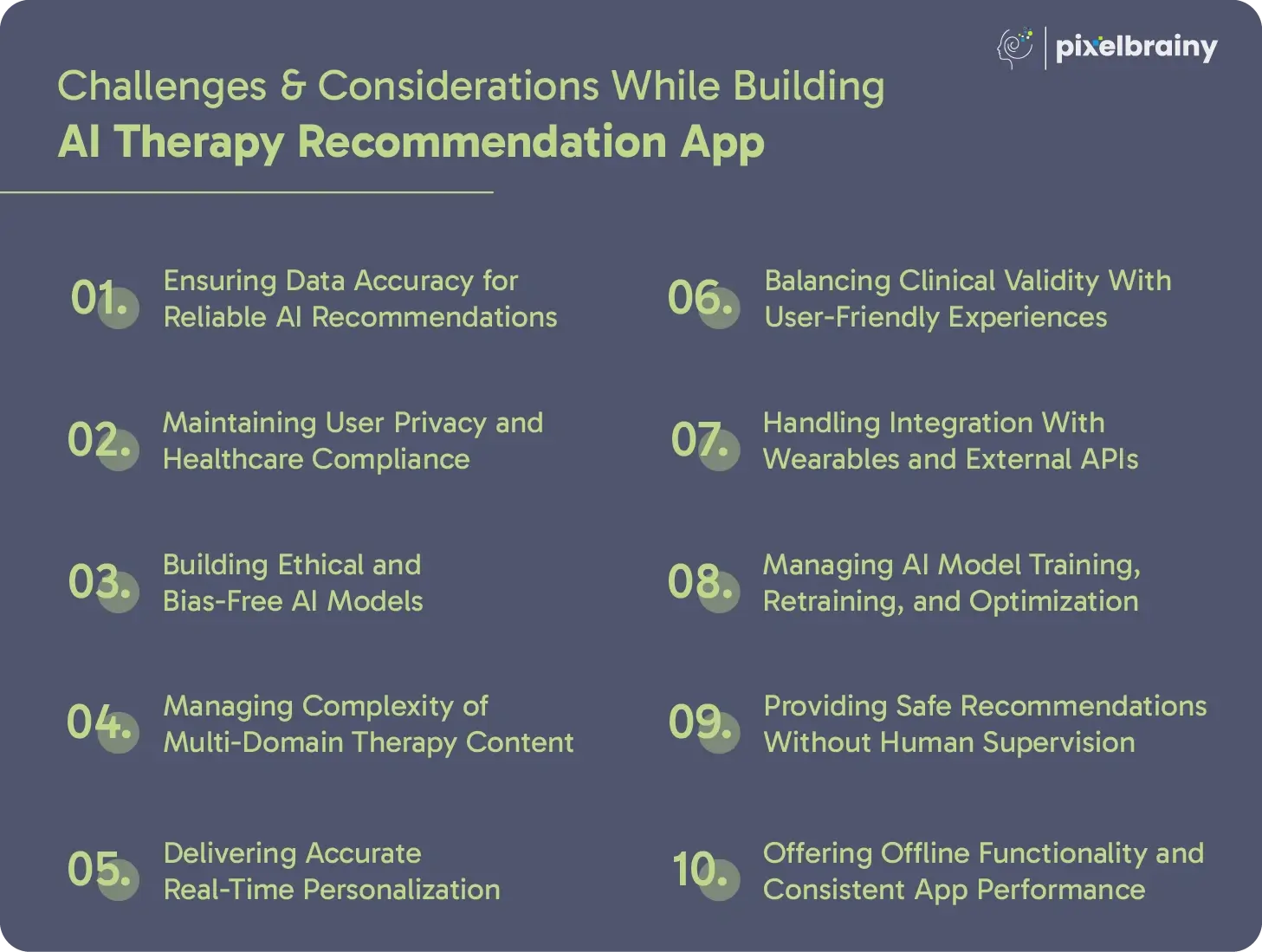
AI therapy systems depend on accurate and diverse data sources to produce personalized recommendations. Incomplete or low-quality data can lead to inaccurate therapy suggestions, reducing user trust and potentially causing harm.
Developers must carefully curate datasets, validate data sources, and continuously retrain models to maintain accuracy.
Therapy apps handle sensitive health information, which means compliance with HIPAA, GDPR, and regional healthcare privacy laws is mandatory.
This includes encryption, secure authentication, controlled access, and safe storage. Ensuring compliance can be complex but is essential for building user confidence and avoiding legal risks.
AI systems can unintentionally produce biased recommendations if trained on narrow or unbalanced datasets.
Developers must ensure that the AI is ethically trained, regularly audited, and capable of providing fair and inclusive recommendations across different demographics and therapy needs.
Therapy recommendation apps often support multiple domains such as mental health, physiotherapy, occupational therapy, speech therapy, and behavioral coaching.
Each category requires its own content models, professional validation, and customization. Managing multiple therapy modules adds complexity to both design and development.
Users expect therapy recommendations that adapt to their behavior, symptoms, and progress.
Achieving real-time personalization requires a powerful AI engine, continuous data processing, and intelligent tracking systems. This adds significant backend complexity and increases infrastructure requirements.
Therapy content must be clinically accurate while still being easy for users to understand and follow.
Finding this balance requires collaboration between therapists, clinicians, data scientists, and UI designers to ensure guidance remains accurate and digestible.
Advanced AI therapy apps integrate with devices like smartwatches, heart rate monitors, and fitness trackers.
These integrations require additional development effort, custom mapping of health data, and rigorous performance testing to ensure reliable syncing.
AI models powering therapy apps must be retrained regularly with new data to improve accuracy.
This ongoing maintenance requires dedicated machine learning pipelines, model monitoring tools, and infrastructure that supports continuous improvement.
Since many users rely on the app without consulting a therapist, recommendations must be safe, clearly explained, and aligned with medically accepted practices.
Developers must include safety rules, red flag detection, and intelligent boundaries to avoid incorrect or harmful suggestions.
Users may require access to therapy routines even without stable internet.
Ensuring offline access, fast load times, and smooth performance on all devices is essential to maintain trust and long-term engagement.
Addressing these challenges carefully ensures the AI therapy recommendation app is safe, accurate, compliant, and trusted by users seeking long-term support.
When choosing a partner for Therapy Recommendation AI App Development, businesses need a team that understands both advanced artificial intelligence and the sensitive nature of healthcare technology. PixelBrainy stands as a leading AI App development company in USA, known for delivering intelligent, secure, and user focused digital health solutions that meet the expectations of modern patients, therapists, and wellness providers. The team brings a unique blend of AI expertise, mobile innovation, compliance knowledge, and human centered design, making PixelBrainy the ideal choice to develop Therapy Recommendation AI App platforms that achieve real market impact.
PixelBrainy’s approach focuses on building meaningful user outcomes rather than just building software. Every project starts with a deep understanding of therapy workflows, patient challenges, behavioral patterns, and clinical expectations. This allows PixelBrainy to craft personalized recommendation engines, structured therapy journeys, and adaptive learning models that feel accurate, safe, and emotionally supportive. The team’s experience in creating AI Therapy Recommendation App systems comes from working with wellness brands, health startups, and therapy organizations across the US who trust PixelBrainy to turn complex ideas into practical, scalable digital solutions.
PixelBrainy has also successfully delivered multiple confidential projects in the therapy and wellness space, involving advanced personalization, assessment automation, patient tracking dashboards, and AI generated therapy paths. While client identities remain undisclosed, these projects helped organizations reduce manual workload, improve user adherence, and deliver therapy guidance more efficiently. This proven industry experience gives PixelBrainy the insight and confidence required to build powerful therapy recommendation platforms that meet clinical expectations and user needs alike.

Therapy Recommendation AI Apps are transforming how individuals access personalized care, mental wellness support, physical rehabilitation, and behavioral improvement. With the rising demand for digital health solutions, businesses have a significant opportunity to innovate and scale using intelligent, user centric platforms. Understanding the development flow, features, challenges, and technology stack helps companies explore the full potential of AI Therapy Recommendation App Development and confidently move forward in building modern healthcare solutions.
Whether you want to create a simple MVP or a complete therapy ecosystem, partnering with the right experts is essential for quality, security, and long term scalability. By investing in the right strategy and technology, your business can successfully lead in this growing digital therapy market and offer meaningful value to patients, therapists, and wellness providers.
Ready to discuss your project? Book an appointment with PixelBrainy and start your journey today.
An AI therapy app can support multiple domains including mental health, physiotherapy, speech therapy, occupational therapy, behavioral coaching, and general wellness. The AI engine can be trained with domain specific datasets to provide accurate, personalized recommendations for different therapy needs.
AI systems use clinically validated rules, user input analysis, and data driven personalization. They are tested extensively with real user scenarios and verified by domain experts to ensure recommendations are safe, accurate, and aligned with accepted therapy practices.
Yes, users can follow AI guided sessions independently, but the app can also include optional therapist dashboards or telehealth modules. This hybrid model helps users receive support even when a therapist is not available.
Traditional apps provide static content, while AI apps personalize every session based on user behavior, progress, mood, movement patterns, and preferences. This dynamic approach increases long term engagement and leads to better therapy outcomes.
Yes. Startups can begin with an MVP, launch core features, and add advanced AI over time. This reduces risk, lowers initial investment, and allows businesses to scale based on real user feedback and adoption.
Development timelines vary based on features and AI complexity. A basic MVP may take 8 to 12 weeks, while a full scale AI platform with advanced personalization, analytics, and multi-therapy modules may require 4 to 8 months.

About The Author
Sagar Bhatnagar
Sagar Sahay Bhatnagar brings over a decade of IT industry experience to his role as Marketing Head at PixelBrainy. He's known for his knack in devising creative marketing strategies that boost brand visibility and market influence. Sagar's strategic thinking, coupled with his innovative vision and focus on results, sets him apart. His track record of successful campaigns proves his ability to utilize digital platforms effectively for impactful marketing efforts. With a genuine passion for both technology and marketing, Sagar continuously pushes PixelBrainy's marketing initiatives to greater success.

Working with the PixelBrainy team has been a highly positive experience. They understand the design requirements and create beautiful UX elements to meet the application needs. The dev team did an excellent job bringing my vision to life. We discussed usability and flow. Sagar worked with his team to design the database and begin coding. Working with Sagar was easy. He has the knowledge to create robust apps, including multi-language support, Google and Apple ID login options, Ad-enabled integrations, Stripe payment processing, and a Web Admin site for maintaining support data. I'm extremely satisfied with the services provided, the quality of the final product, and the professionalism of the entire process. I highly recommend them for Android and iOS Mobile Application Design and Development.

Great experience working with them. Had a lot of feedback and I found that unlike most contractors they were bugging me for updates instead of the other way around. They were extremely time conscience and great at communicating! All work was done extremely high quality and if not on time, early! They were always proactive when it comes to communication and the work is great/above par always. Very flexible and a great team to work with! Goes above and beyond to present us with multiple options and always provides quality. Amazing work per usual with Chitra. If you have UI/UX or branding design needs I recommend you go to them! Will likely work with them in the future as well, definitely recommended!

PixelBrainy is a joy to work with and is a great partner when thinking through branding, logo, and website layout. I appreciate that they spend time going into the "why" behind their decisions to help inform me and others about industry best practices and their expertise.

I hired them to design our software apps. Things I really like about them are excellent communication skills, they answer all project suggestions and collaborate right away, and their input on design and colors is amazing. This project was complex and needed patience and creativity. The team is amazing to do business with. I will be using them long-term. Glad to see there are some good people out there. I was afraid to try and outsource my project to someone but I am glad I met them! I really can't say enough. They went above and beyond on this project. I am very happy with everything they have done to make my business stand out from the competition.

It was great working with PixelBrainy and the team. They were very responsive and really owned the project. We'll definitely work with them again!

I recently worked with the PixelBrainy team on a project and I was blown away by their communication skills. They were prompt, clear, and articulate in all of our interactions. They listened and provided valuable feedback and suggestions to help make the project a success. They also kept me updated throughout the entire process, which made the experience stress-free and enjoyable.

PixelBrainy is very good at what it does. The team also presents themselves very professionally and takes care of their side of things very well. I could fully trust them taking up the design work in a timely and organised manner and their attention to detail saved us lots of effort and time. This particular project was quite intense and the team showed that they function very well under pressure. Very much looking forward to working with her again!

It's always an absolute pleasure working with them. They completed all of my requests quickly and followed every note I had for them to a T, which made our process go smoothly from start to finish. Everything was completed fast and following all of the guidelines. And I would recommend their services to anyone. If you need any design work done in the future, PixelBrainy should be your first call!

They took ownership of our requirements and designed and proposed multiple beautiful variants. The team is self-motivated, requires minimum supervision, committed to see-through designs with quality and delivering them on time. We would definitely love to work with PixelBrainy again when we have any requirements.

PixelBrainy was a big help with our SaaS application. We've been hard at work with a new UI/UX and they provided a lot of help with the designs. If you're looking for assistance with your website, software, or mobile application designs, PixelBrainy and the team is a great recommendation.

PixelBrainy designers are amazing. They are responsive, talented, and always willing to help craft the design until it matches your vision. I would recommend them and plan to continue them for my future projects and more!!!

They were awesome! Did a good job fast, and good communication. Will work with them again. Thank you

Creative, detail-oriented, and talented designers who take direction well and implement changes quickly and accurately. They consistently over-delivered for us.

PixelBrainy team is very talented and creative. Great designers and a pleasure to work with. PixelBrainy is an excellent communicator and I look forward to working with them again.

PixelBrainy has a very talented design team. Their work is excellent and they are very responsive. I enjoy working with them and hope to continue on all of our future projects.


Transform your ideas into reality with us.
Across these industries, each engagement brings unique challenges, from early-stage product development to scaling complex systems, helping us build a practical understanding of real-world product environments.