AI Summary Powered by PixelBrainy
What if the biggest patient engagement problem facing your health system is not a lack of digital tools, but a lack of proactive digital engagement?
For a 22-facility health system in the Southeast, having a patient portal does not automatically mean having an engaged patient population. If only 12% of registered patients actively use the portal, the remaining 88% represent a significant opportunity to improve communication, care continuity, appointment adherence, preventive care, and patient experience. Instead of waiting for patients to remember to log in, healthcare organizations are now exploring AI-powered applications that can identify the right patient, the right moment, the right message, and the right channel for proactive outreach.
This is where AI healthcare app development companies in USA are becoming increasingly important. Modern AI healthcare applications can connect EHR information, appointment data, care gaps, patient preferences, predictive analytics, conversational AI, SMS, voice, push notifications, and mobile experiences to create personalized patient journeys. The goal is no longer simply to provide another patient portal. It is to create an intelligent engagement layer that encourages patients to take appropriate actions between visits.
The opportunity is expanding rapidly. Fortune Business Insights projects that the global AI in healthcare market will reach $56.01 billion in 2026 and $1,033.27 billion by 2034, with a projected CAGR of 43.96%.
In this blog, we examine the top AI healthcare app development services providers USA that healthcare organizations can evaluate for building proactive patient engagement solutions. We review their healthcare expertise, AI capabilities, EHR and interoperability experience, custom application development capabilities, enterprise scalability, patient engagement solutions, and publicly documented results. The custom AI healthcare app development companies in USA covered here range from specialized healthcare technology providers to global digital transformation firms with large-scale health system experience.
Most importantly, this review addresses a practical question for healthcare buyers: which USA-based AI healthcare app development companies have demonstrated experience with proactive patient engagement, multi-facility healthcare environments, conversational AI, personalized outreach, and measurable digital engagement outcomes? We also explain what buyers should verify before selecting a development partner, because publicly documented improvements in patient portal activation remain much harder to find than general claims about patient engagement.
What does an AI healthcare application actually include beyond a chatbot, patient portal, or appointment booking feature?
Today, AI healthcare app development companies in USA are building much broader healthcare technology ecosystems that connect patients, providers, clinical data, healthcare operations, and intelligent automation. Instead of developing isolated applications, leading providers are combining artificial intelligence with EHR integration, predictive analytics, conversational interfaces, mobile technology, workflow automation, remote monitoring, and digital health platforms.
For healthcare organizations, this evolution matters because patients interact with a health system through multiple touchpoints. A patient may discover a physician through a website, schedule an appointment through an app, receive an SMS reminder, complete digital intake, attend a virtual consultation, receive post-visit instructions, and later need another follow-up interaction. AI can connect these separate experiences into a more continuous digital healthcare journey.
The top AI healthcare app development services providers USA therefore work across both patient-facing and clinical environments.
One of the fastest-growing areas of healthcare application development is AI-powered patient engagement.
Unlike a conventional application that simply provides information, an AI-enabled engagement platform can use authorized patient, appointment, and care information to deliver context-aware interactions.
Depending on the healthcare organization's approved workflows, these applications can support:
The intelligence comes from connecting these capabilities to the patient's healthcare journey.
For example, instead of displaying a generic message saying "Schedule your annual checkup," an AI-enabled system can determine whether a patient is eligible for a particular workflow, identify the appropriate service or provider, select an approved communication channel, and guide the patient toward scheduling.
This makes patient engagement more contextual and actionable.
The digital front door has become an important part of modern healthcare technology strategy.
A healthcare digital front door brings multiple patient services into connected digital experiences across mobile, web, messaging, and other channels.
Depending on the organization's requirements, an AI-powered digital front door may include:
CitiusTech describes digital front-door capabilities that include scheduling, telemedicine, remote patient monitoring, payments, insurance tracking, consent management, AI-powered personal health assistants, and conversational AI.
For health systems, the value is not simply having more digital features. The objective is to make it easier for patients to move from finding care to receiving care and completing follow-up actions without navigating disconnected systems.
This is an important capability to examine when comparing USA-based AI healthcare app development companies.
Conversational AI is another major component of modern healthcare applications.
Healthcare organizations can deploy AI assistants across:
These assistants can answer routine questions, navigate patients to services, support appointment workflows, and handle appropriate self-service interactions.
Hyro's published work with Intermountain Health provides an example of this approach. Its AI assistants were deployed across websites, mobile applications, and call centers, with Epic integration. Intermountain reported an 85% reduction in call abandonment and a 79% improvement in speed to answer in the published case study.
For healthcare buyers, the important question is not simply whether a vendor offers a chatbot.
Instead, ask:
Can the AI assistant understand the healthcare context, access approved information, complete authorized tasks, and escalate an interaction when automation is not appropriate?
That distinction separates a basic conversational interface from an enterprise healthcare AI solution.
Predictive analytics allows healthcare organizations to move from broad communication campaigns toward more targeted interventions.
AI models can analyze permitted data to identify patterns associated with specific healthcare workflows.
Potential applications include:
Accenture's published CCS case study describes a predictive AI model designed to identify patient behavior and support targeted interventions. Accenture reports 50% improved adherence among targeted high-risk cohorts and 85% accuracy in predicting patient behavior almost three months ahead.
For custom AI healthcare app development companies in USA, predictive engagement is particularly valuable because it can turn an application from a communication channel into an intelligent workflow layer.
However, healthcare organizations should ask vendors how their models are validated, monitored, governed, and integrated into clinical workflows before putting predictive recommendations into production.
Appointment management is another area where AI can create measurable operational value.
AI healthcare applications can support:
ScienceSoft describes AI scheduling solutions capable of supporting booking, rescheduling, and cancellation while connecting with healthcare scheduling systems and EHR infrastructure.
An advanced workflow can connect the complete journey:
Patient request → AI conversation → identity verification → availability search → appointment selection → scheduling → confirmation → reminder → follow-up
This approach can reduce the number of disconnected steps patients encounter when attempting to access care.
Chronic conditions require continuous engagement rather than interaction only during scheduled appointments.
AI healthcare applications can support ongoing programs for areas such as:
Depending on the clinical program, an application may combine authorized information from:
AI can then support approved workflows by identifying relevant patterns, generating appropriate notifications, or routing information to care teams.
The important consideration is that AI should operate within defined clinical governance and escalation frameworks rather than functioning as an unrestricted autonomous clinical decision-maker.
Remote patient monitoring has created another major opportunity for AI healthcare app development companies in USA.
A connected healthcare application can collect information from approved devices and patient inputs and present relevant information to patients and care teams.
Typical capabilities include:
AI can add another layer by helping identify patterns within large volumes of monitoring information and prioritizing signals for appropriate review.
For healthcare organizations, the objective is not simply collecting more patient data. The application should help transform that data into an actionable workflow.
Patient engagement does not stop when a patient leaves a hospital.
The post-discharge period can involve multiple tasks, including:
AI applications can help organize these interactions into structured digital journeys.
CitiusTech has described AI-enabled virtual-agent solutions for post-discharge care that support patient assessments and early identification of potential risks.
A well-designed application can therefore create a continuous connection between the hospital encounter and the patient's next stage of care.
The scope of healthcare AI development extends beyond patient-facing applications.
Leading AI healthcare app development services providers USA may also build solutions for healthcare professionals and administrative teams.
Examples include:
This is important because patient-facing AI and clinical AI increasingly depend on the same underlying data and workflow infrastructure.
For example:
Patient interaction → AI-generated information → approved workflow → care-team review → action → patient notification
This creates a connected ecosystem instead of separate patient and provider applications.
Healthcare navigation can be complicated, particularly within large health systems that operate multiple hospitals, specialties, locations, and service lines.
AI-powered navigation applications can help patients find:
Instead of requiring patients to understand the health system's organizational structure, AI can provide a more natural interface for navigating available services.
For large provider organizations, this can become an important component of the digital front door.
Medication-related engagement is another area where healthcare applications can provide ongoing support.
Depending on the program, applications can provide:
AI can personalize the timing and type of communication according to approved patient preferences and workflow rules.
The objective should be to make medication management easier without creating excessive notifications or replacing appropriate clinical guidance.
Another important capability is turning healthcare data into personalized digital experiences.
An AI healthcare platform may combine information from:
EHR + scheduling + CRM + patient interactions + approved clinical data + engagement history
to support:
This is particularly important for healthcare organizations that want to understand not only whether patients received a message, but whether the interaction resulted in a meaningful action.
Patients do not all prefer the same communication channel.
Some may prefer:
Modern healthcare applications can therefore coordinate engagement across multiple channels while maintaining a consistent patient journey.
For example:
Healthcare event → AI workflow → patient preference → selected channel → patient response → action → system update
This can help healthcare organizations move away from disconnected communication campaigns toward coordinated patient journeys.
The most advanced custom AI healthcare app development companies in USA are increasingly working toward connected architectures rather than standalone applications.
A simplified model looks like this:
Healthcare Data Layer
EHR + Scheduling + CRM + Patient Data + Care Management Systems
↓
AI and Intelligence Layer
Predictive Analytics + Generative AI + NLP + Recommendation Models + Rules Engine
↓
Engagement Layer
Patient Segmentation + Personalization + Trigger Management + Workflow Automation
↓
Experience Layer
Mobile App + Web + SMS + Voice + Chat + Patient Portal
↓
Action Layer
Scheduling + Registration + Care Navigation + Follow-Up + Human Escalation
↓
Measurement Layer
Engagement + Conversion + Care-Gap Closure + Operational Metrics
This architecture explains why simply hiring a conventional mobile application developer may not be enough for an enterprise healthcare AI project.
The development partner needs to understand AI engineering, healthcare interoperability, patient experience, security, clinical workflows, data architecture, and enterprise integration at the same time.
Therefore, AI healthcare app development companies in USA now build more than mobile apps. Leading providers combine AI, EHR integration, predictive analytics, conversational AI, digital front doors, remote monitoring, scheduling, and patient engagement into connected healthcare ecosystems.
When choosing a provider, healthcare organizations should evaluate its ability to integrate data, automate approved workflows, support patients and care teams, maintain AI governance, and measure real healthcare outcomes.
Also Read: Top 12 AI Healthcare Software Development Companies in USA
To build this revi
ewed and ranked list of AI healthcare app development companies in USA, we applied a seven-criteria framework designed for regulated clinical environments.
Our evaluation focused on HIPAA-native architecture, HL7 FHIR and EHR integration, clinical AI accuracy, explainability, FDA regulatory knowledge, accessibility, and verified healthcare experience.
We also considered a real-world clinical AI use case: a health system losing an estimated $18 million annually to undercoded encounters and looking for an ambient AI application that can listen to physician-patient encounters, identify potentially missing diagnoses, pre-populate EHR documentation, and show the clinical evidence behind every AI suggestion for audit purposes.
This use case helped us distinguish companies that simply offer AI development from those with relevant experience in clinical documentation, EHR-connected AI, auditable AI workflows, and healthcare-grade application development.
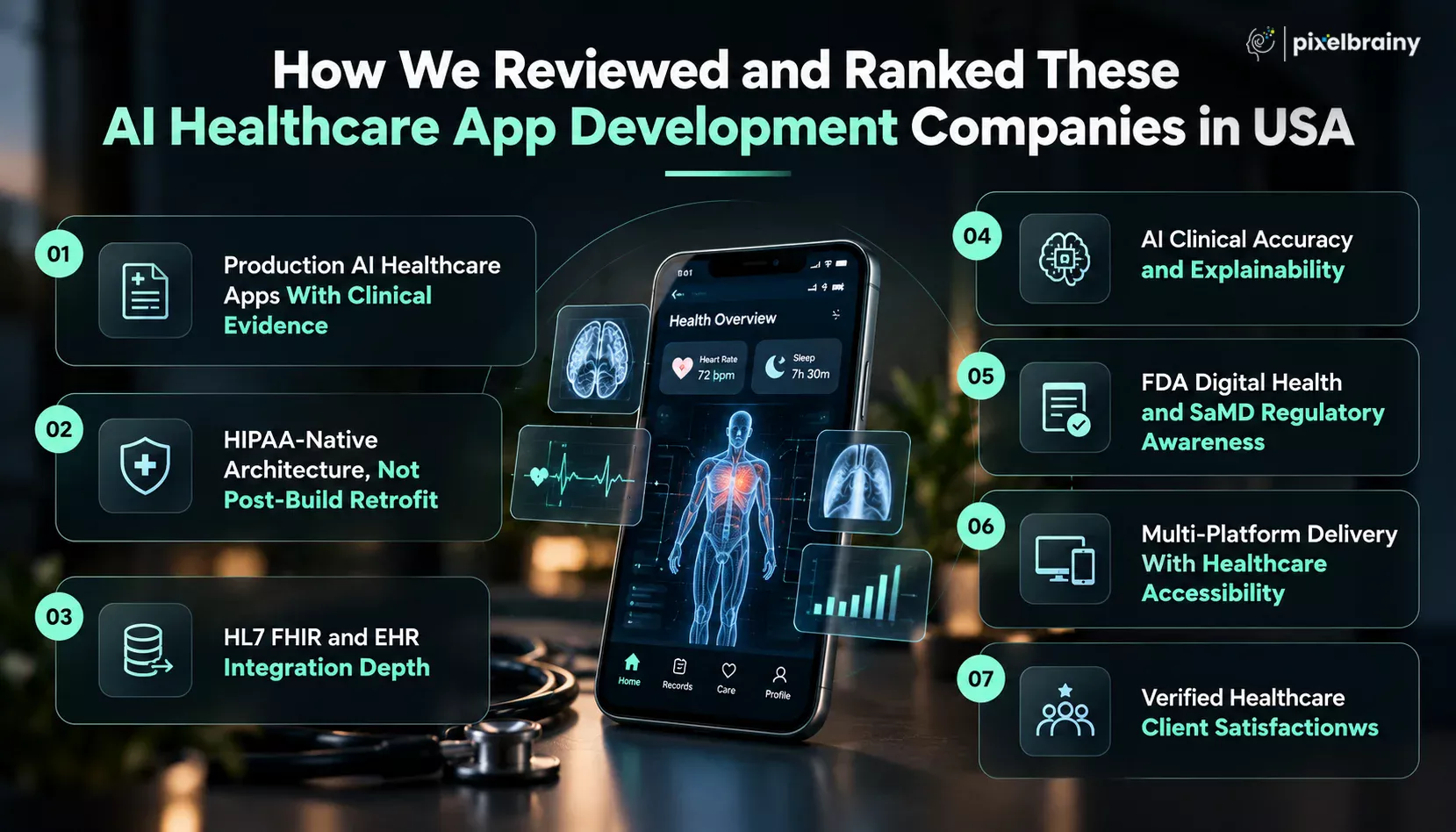
We looked for companies with AI healthcare applications deployed for real US healthcare clients, including hospitals, health systems, physician groups, telehealth providers, and digital health companies.
We prioritized documented clinical outcomes, accuracy measurements, validation results, adoption metrics, and evidence of clinical-domain involvement. Generic AI capabilities and technical demonstrations were not considered equivalent to production healthcare experience.
For ambient documentation, we also looked for capabilities beyond basic transcription, such as clinical information extraction, summarization, documentation generation, and clinician review.
HIPAA compliance needed to be demonstrated as part of the application's architecture from the beginning of development.
We evaluated PHI protection, encryption, access controls, identity management, audit logging, secure development environments, data isolation, and BAA-ready infrastructure.
Companies that treated HIPAA primarily as a legal agreement or final compliance checklist received less consideration.
We evaluated demonstrated experience integrating healthcare applications with major EHR environments, including Epic, Oracle Health, Cerner, and athenahealth.
We prioritized production interoperability over basic sandbox demonstrations, including experience with FHIR, APIs, clinical data exchange, authentication, patient matching, and secure data flows.
For AI documentation applications, we also considered whether vendors understand how AI-generated information can be reviewed and incorporated into existing EHR workflows.
Clinical AI needs to be evaluated beyond whether its output appears accurate.
We looked for clinical validation, accuracy measurement, confidence handling, human-in-the-loop workflows, error management, explainability, and auditability.
For applications that suggest diagnoses or generate clinical documentation, we considered whether clinicians can identify the source evidence behind AI-generated suggestions and review or correct the output.
FDA guidance also emphasizes the importance of enabling healthcare professionals to independently review the basis for certain clinical decision-support recommendations.
We evaluated whether companies understand FDA requirements related to digital health, Software as a Medical Device, clinical decision support, intended use, and regulatory classification.
This distinction is important because different healthcare AI functions can have different regulatory implications. FDA's January 2026 guidance provides additional clarification around clinical decision-support software and the device definition. (FDA)
We therefore favored companies that address regulatory considerations during product planning rather than after development.
We assessed experience delivering secure healthcare applications across iOS, Android, and web, including accessibility considerations.
Relevant capabilities included ADA accessibility, Section 508 considerations, secure authentication, responsive interfaces, and accessible user experiences.
This is important for healthcare applications serving diverse patients, clinicians, and administrative teams across multiple facilities.
We reviewed third-party client feedback and healthcare-specific references where available.
Reviews were considered more relevant when they specifically mentioned healthcare software, HIPAA, EHR integration, AI, clinical applications, or healthcare interoperability.
General software development ratings alone were not treated as evidence of healthcare specialization.
Our methodology prioritizes AI healthcare app development companies in USA with proven healthcare expertise, secure architecture, deep interoperability, clinically responsible AI, regulatory awareness, accessibility, and verifiable client experience.
Also Read: AI Healthcare Triage Software Development: A Complete Guide
Patient engagement becomes challenging when most patients register for a portal but rarely return after the first interaction. For multi-facility health systems, modern healthcare apps need to go beyond passive portals and support proactive engagement through personalized reminders, care-gap alerts, follow-ups, and intelligent patient communication.
This real-world need shapes our review of the AI healthcare app development companies in USA. We focused on providers that can build AI-powered healthcare applications, connect with EHR systems, support personalized engagement, and scale across multiple facilities.
The companies below cover capabilities including AI patient engagement, digital front doors, conversational AI, telehealth, mental health, remote patient monitoring, clinical documentation, appointment automation, and healthcare workflow intelligence.
Our top 10+ AI healthcare app development companies in USA list also considers healthcare experience, interoperability, compliance readiness, AI capabilities, development approach, and pricing.
Whether a health system needs proactive patient outreach, an EHR-connected AI application, or a broader digital healthcare platform, these companies offer different approaches to building healthcare technology for the US market.
Custom AI Healthcare App Development for Enterprise Health Innovation
Location: Sheridan, WY, USA
Founded: 2021
Clutch Rating: 4.9/5
Website: https://www.pixelbrainy.com/
Core AI healthcare app capabilities: AI patient engagement, AI healthcare agents, AI medical voice assistants, clinical documentation, remote patient monitoring, predictive analytics, telehealth, mental health applications, care coordination, medical billing automation, and custom healthcare platforms.
EHR and FHIR integration depth: FHIR and HL7 integration capabilities, with stated experience involving Epic and Oracle Cerner. PixelBrainy also describes patient identity validation, encounter mapping, secure APIs, and EHR synchronization for AI medical voice assistants.
HIPAA compliance tier: HIPAA-focused architecture; public materials describe encryption, role-based access, audit logging, secure APIs, and compliance-first development. Independent HITRUST, SOC 2, or ISO 13485 certification should be verified directly.
Notable clients: EY, MSC Cruises, VetPlus, Tykr, EventPlaybook, and Makula, according to the supplied company profile.
Healthcare verticals: Hospitals, physician groups, telehealth, digital health startups, payers, mental health, remote monitoring, clinical documentation, and healthcare operations.
Pricing range: Custom quote. PixelBrainy's published guidance places HIPAA-compliant AI healthcare software projects broadly around $40,000 to $300,000+, depending on scope and complexity.
Best fit for: US health systems, physician organizations, telehealth businesses, digital health startups, and healthcare companies seeking bespoke AI applications.
Why they're on this list: PixelBrainy is positioned around custom AI healthcare development rather than a single healthcare SaaS product. Its publicly described work spans AI agents, medical voice assistants, EHR integration, remote monitoring, patient engagement, and clinical workflow automation. Its medical voice assistant material specifically describes secure transcription, structured clinical documentation, FHIR and HL7 integration, and clinical accuracy testing, making it relevant to buyers evaluating AI-powered clinical and patient-facing applications.
Healthcare-Specialist AI Development and EHR Integration
Location: Chicago, Illinois, USA
Founded: 2013 materials
Core AI healthcare app capabilities: Healthcare AI applications, clinical software, patient management, remote patient monitoring, revenue-cycle platforms, diagnostic workflows, healthcare automation, and custom EHR-connected applications.
EHR and FHIR integration depth: Strong publicly stated focus on Epic, Oracle Health, HL7 v2, FHIR R4, and Mirth Connect. Taction reports more than 200 EHR integrations and 785+ healthcare implementations.
HIPAA compliance tier: HIPAA-focused development, with the company stating that BAAs are executed before development begins. Public materials also state zero HIPAA breaches or findings across engagements. These claims should be validated through vendor due diligence.
Notable US healthcare clients: The company publicly lists healthcare organizations and healthcare technology businesses including Procentive, Cobalt Health, Linear Health, and others.
Healthcare verticals: Hospitals, behavioral health, RPM, diagnostics, revenue cycle, clinical software, and healthcare administration.
Pricing range: Custom quote.
Best fit for: Health systems and established healthcare organizations that need deep healthcare domain expertise and complex EHR integration.
Why they're on this list: Taction is differentiated by its healthcare specialization. Its current positioning emphasizes taking healthcare AI from prototype to production, with EHR integration and HIPAA architecture treated as core engineering requirements rather than add-ons. The company's stated experience across 785+ healthcare implementations and 200+ EHR integrations makes it particularly relevant for buyers dealing with complicated clinical-system environments.
Healthtech Product Development for Specialty Care
Location: Irvine, California
Founded: 2016
Core AI healthcare app capabilities: Healthcare mobile applications, telemedicine, remote patient monitoring, digital therapeutics, AI healthcare applications, medical coding, clinical trial technology, and patient-facing platforms.
EHR and FHIR integration depth: Healthcare development includes EHR connectivity and interoperability work. Buyers should confirm specific production Epic, Cerner, FHIR R4, or SMART on FHIR deployments during procurement.
HIPAA compliance tier: HIPAA-focused healthcare development. Specific HITRUST, SOC 2, or ISO 13485 status should be confirmed for the proposed project.
Notable clients: Medable and other healthcare and healthtech organizations. Topflight's Clutch profile also highlights GaleAI, a medical coding application developed with Topflight.
Healthcare verticals: Telehealth, medical coding, clinical trials, specialty care, digital health, remote monitoring, and healthcare startups.
Pricing range: Clutch lists a $50,000+ minimum project size and $100 to $149 per hour; Topflight also publishes different engagement structures, including enterprise arrangements.
Best fit for: Digital health startups, specialty-care companies, and scaleups preparing for enterprise healthcare procurement.
Why they're on this list: Topflight combines healthcare product development with modern mobile and AI engineering. Its published GaleAI case study reports that a one-month audit identified 7.9% more codes and projected $1.14 million in annual recovered revenue. Its current Clutch profile reports a 4.9 rating based on 41 verified reviews.
Full-Service Healthcare Application Engineering
Location: Los Angeles, California, USA
Founded: 2009
Core AI healthcare app capabilities: Healthcare mobile and web applications, patient engagement, telemedicine, remote patient monitoring, IoMT, healthcare analytics, cloud applications, and AI-enabled workflows.
EHR and FHIR integration depth: TechAhead states experience with Epic, Cerner, Allscripts, Athena, NextGen, and eClinicalWorks, along with proprietary healthcare systems.
HIPAA compliance tier: HIPAA-focused architecture with encryption, MFA, role-based access control, audit logging, vendor BAAs, security assessments, and penetration testing.
Notable clients: Healthcare client details vary by project and should be verified through the company's current portfolio and references.
Healthcare verticals: Hospitals, clinics, telehealth, remote monitoring, connected devices, patient engagement, and digital health.
Pricing range: Custom quote.
Best fit for: Health systems and mid-market healthcare organizations seeking end-to-end application development plus post-launch support.
Why they're on this list: TechAhead offers a broad healthcare engineering model rather than concentrating on a single AI use case. Its stated ability to integrate major EHR platforms and its security-first approach make it relevant for healthcare buyers that need an application to operate within an existing clinical technology ecosystem. The company also emphasizes ongoing maintenance rather than treating launch as the end of the engagement
Mature Healthcare Software and Medical Technology Engineering
Location: McKinney, Texas
Founded: 1989
Core AI healthcare app capabilities: Healthcare software, telemedicine, patient portals, healthcare analytics, AI applications, remote monitoring, medical device software, and enterprise healthcare platforms.
EHR and FHIR integration depth: Healthcare interoperability, EHR integration, patient portals, and connected healthcare systems. Specific EHR and FHIR implementation details should be confirmed for each proposed engagement.
HIPAA compliance tier: HIPAA-focused healthcare software development. ScienceSoft also has ISO 13485 certification relevant to medical device software quality management.
Notable clients: ScienceSoft's healthcare portfolio includes provider, medical technology, and healthcare software engagements. Specific references should be requested during vendor evaluation.
Healthcare verticals: Hospitals, telehealth, medical devices, patient engagement, healthcare analytics, diagnostics, and clinical software.
Pricing range: Custom quote.
Best fit for: Large enterprises and healthcare organizations seeking an established technology partner with medical software experience.
Why they're on this list: ScienceSoft brings a long operating history to healthcare software development and combines healthcare applications with medical technology capabilities. Its ISO 13485 positioning is particularly relevant for organizations where the application may intersect with regulated medical-device software processes. Buyers should still distinguish ISO 13485 certification from FDA clearance or approval.
Azure-Centered Healthcare AI and Product Engineering
Location: Lviv, Ukraine, with international delivery
Founded: 2009
Core AI healthcare app capabilities: AI and machine learning, healthcare applications, cloud modernization, telehealth, remote monitoring, medical imaging, laboratory systems, and enterprise software.
EHR and FHIR integration depth: Strong Microsoft and Azure ecosystem expertise. The company describes capabilities across Azure, .NET, API integration, AI, and healthcare technology.
HIPAA compliance tier: Healthcare security and compliance capabilities should be assessed project by project. Buyers should request current HIPAA, SOC 2, HITRUST, and other relevant evidence rather than assuming certification from Microsoft partnership status.
Notable clients: Specific US healthcare client references should be requested during procurement.
Healthcare verticals: Health and wellness, biotech, telehealth, medical imaging, laboratory software, and healthcare operations.
Pricing range: Custom quote.
Best fit for: Healthcare organizations already invested in Microsoft Azure and seeking an Azure-native engineering partner.
Why they're on this list: Blackthorn Vision is particularly relevant where healthcare AI must operate inside a Microsoft-centered technology environment. Its Microsoft Solutions Partner background and experience with Azure, AI, .NET, and healthcare applications can reduce architectural friction for organizations already standardized on Microsoft's ecosystem.
AI-Enabled Cross-Platform Healthcare Application Development
Location: San Francisco, California, with global delivery
Founded: 2006
Core AI healthcare app capabilities: Telemedicine, patient portals, clinic management, medication applications, remote monitoring, AI-enabled healthcare applications, mHealth, and cross-platform mobile development.
EHR and FHIR integration depth: The company publicly lists HL7 and FHIR among its healthcare compliance and interoperability capabilities.
HIPAA compliance tier: HIPAA-focused healthcare development, with public materials also referencing FHIR, HL7, ISO, and related healthcare requirements. Specific certification status should be validated for the project.
Notable clients: Healthcare client references should be requested based on the exact use case.
Healthcare verticals: Telemedicine, patient engagement, clinic management, pharma, mHealth, remote monitoring, and digital therapeutics.
Pricing range: Custom quote.
Best fit for: Digital health startups and mid-market healthcare companies requiring modern cross-platform engineering.
Why they're on this list: GeekyAnts combines healthcare application development with contemporary mobile and AI engineering. Its US healthcare practice specifically describes patient portals, telemedicine, clinic management, medication workflows, and healthcare compliance capabilities. The company's healthcare material also covers AI-enabled wearables, patient engagement, and remote monitoring, making it relevant to organizations building connected digital health products.
Healthcare-Weighted Product and AI Development
Location: Los Angeles, California
Founded: 2012
Core AI healthcare app capabilities: Healthcare mobile applications, AI development, custom software, data platforms, patient engagement, health coaching, and enterprise healthcare products.
EHR and FHIR integration depth: Sidebench publicly states production integrations with Epic and FHIR, alongside SSO and payment integrations for regulated clients.
HIPAA compliance tier: Company-wide HIPAA compliance training and certification is publicly listed; buyers should request current security documentation for project-specific controls.
Notable clients: Healthcare work includes Kenshō Health and other health and wellness organizations.
Healthcare verticals: Health systems, health plans, behavioral health, health coaching, digital health, and patient-facing platforms.
Pricing range: Clutch lists $50,000+ minimum projects and $50 to $99 per hour.
Best fit for: Health systems and digital health companies needing complex product, data, and AI engineering.
Why they're on this list: Sidebench has a particularly strong healthcare weighting within its product-development portfolio. Clutch currently reports a 4.9 rating across 48 verified reviews and documents production Epic and FHIR integration experience. Its work also extends into large, complex healthcare platforms rather than focusing only on basic patient applications.
EHR, FHIR, Legacy-System and Healthcare Integration Specialist
Location: US presence in Corona, California, with global delivery
Founded: 2003
Core AI healthcare app capabilities: EHR and EMR systems, telehealth, remote patient monitoring, healthcare analytics, AI applications, patient portals, hospital systems, pharmacy software, and healthcare interoperability.
EHR and FHIR integration depth: Strong stated focus on Epic, Cerner/Oracle Health, athenahealth, eClinicalWorks, NextGen, Allscripts, HL7 v2.x, FHIR R4, and SMART on FHIR.
HIPAA compliance tier: HIPAA and HITECH-focused architecture, including secure authentication and healthcare data handling.
Notable clients: Specific client references should be validated for the intended US healthcare use case.
Healthcare verticals: Hospitals, clinics, telehealth, RPM, laboratories, pharmacies, EHR, RCM, and healthcare operations.
Pricing range: Published timelines indicate approximately $3,000+ for basic modules, $5,000 to $20,000+ for more substantial builds, and significantly higher budgets for enterprise systems. Healthcare AI projects require custom estimates.
Best fit for: Healthcare IT teams managing multiple legacy systems and complex interoperability requirements.
Why they're on this list: DreamSoft4u's strongest differentiator is interoperability. Its current healthcare materials describe FHIR R4, HL7 v2.x, SMART on FHIR, Epic, Oracle Health, athenahealth, and other integrations. It also covers RPM, telehealth, AI healthcare applications, laboratory systems, and hospital platforms, making it relevant where integration is as important as the user-facing application.
Experienced Healthcare Mobile and Digital Product Development
Location: Philadelphia, Pennsylvania, with additional US locations
Founded: 2009
Core AI healthcare app capabilities: Mobile applications, healthcare platforms, telemedicine, patient portals, medication management, healthcare education, and digital products.
EHR and FHIR integration depth: Healthcare application integration capabilities are available, but buyers should request project-specific evidence for Epic, Oracle Health, FHIR, or HL7 integration.
HIPAA compliance tier: HIPAA requirements can be incorporated into healthcare projects. Certification and security controls should be verified for a specific engagement.
Notable clients: Jefferson Health, University of Pennsylvania, University of Washington, and other organizations are listed in the company's portfolio materials.
Healthcare verticals: Telemedicine, health and wellness, patient education, medication management, and healthcare applications.
Pricing range: Clutch lists $50 to $99 per hour, with healthcare-related projects commonly falling within broader $10,000 to $350,000+ ranges. Chop Dawg's own pricing information places MVP development at approximately $25,000 to $50,000+ and larger products at $75,000 to $150,000.
Best fit for: Healthcare startups and mid-market organizations needing experienced mobile product development.
Why they're on this list: Chop Dawg brings substantial experience in shipping mobile and digital products. The company reports more than 500 products since 2009, while its portfolio includes healthcare organizations such as Jefferson Health and major universities. Its transparent pricing model can also be useful for healthcare startups planning phased development.
Location: USA
Founded: Verify current corporate details during procurement
Core AI healthcare app capabilities: Telemedicine, specialty-care platforms, patient engagement, remote monitoring, clinical workflows, EHR integration, and healthcare mobile applications.
EHR and FHIR integration depth: Public positioning emphasizes HL7, FHIR, SMART on FHIR, and healthcare interoperability. Buyers should validate production integrations and specific EHR references.
HIPAA compliance tier: HIPAA and HITECH-focused healthcare application development, with FHIR and clinical interoperability considerations.
Notable clients: The supplied company profile identifies Stanford Medicine, Cleveland Clinic, and Medable. These relationships should be validated directly before publication or procurement.
Healthcare verticals: Telemedicine, specialty care, digital health, remote monitoring, and clinical applications.
Pricing range: Custom quote.
Best fit for: Healthcare product teams building specialty-care and telemedicine platforms requiring clinical and enterprise integration.
Why they're on this list: RemoteState is positioned around healthcare and telemedicine rather than generic consumer mobile development. Its relevance is strongest for product teams that need clinical workflows, healthcare interoperability, and patient-facing technology to work together. For enterprise buyers, the most important due-diligence step is verifying the scope of its named health-system integrations and whether those implementations are currently in production.
Location: US presence with global delivery
Founded: 2015
Core AI healthcare app capabilities: AI healthcare platforms, telemedicine, patient engagement, remote patient monitoring, healthcare analytics, clinical AI, hospital systems, and mobile applications.
EHR and FHIR integration depth: Public materials describe EHR/EMR integration and healthcare development aligned with HL7 and FHIR. Its healthcare application capabilities include patient EHR access, clinical decision support, appointment scheduling, telemedicine, RPM, and healthcare analytics.
HIPAA compliance tier: HIPAA-focused development; public materials also reference ISO 27001, ISO 9001, FHIR, HL7, and FDA SaMD guidance.
Notable clients: Atlantic Health System and other healthcare and healthtech organizations are displayed in its healthcare portfolio.
Healthcare verticals: Hospitals, health systems, clinics, telehealth, RPM, mental health, digital health, pharma, and biotech.
Pricing range: Custom quote.
Best fit for: US health systems and digital health companies wanting mobile-first AI development with broad healthcare functionality.
Why they're on this list: Appinventiv covers a wide healthcare technology spectrum, from hospital systems and EHR integration to AI, telemedicine, remote monitoring, and patient engagement. Its current healthcare AI materials explicitly address regulated healthcare AI, FDA SaMD considerations, HIPAA, and clinical safety.
Location: USA
Founded: Verify current corporate information before procurement
Core AI healthcare app capabilities: Custom healthcare software, AI-enabled clinical applications, patient engagement, healthcare automation, mobile applications, and healthcare data integration.
EHR and FHIR integration depth: The company is positioned around healthcare integration and FHIR-enabled development. Buyers should verify specific production Epic, Cerner, Oracle Health, or SMART on FHIR implementations.
HIPAA compliance tier: HIPAA-focused healthcare development; buyers should request current security policies, BAA terms, penetration-test documentation, and any applicable certifications.
Notable clients: Client references should be requested and matched to the buyer's healthcare use case.
Healthcare verticals: Physician practices, healthcare organizations, patient engagement, clinical workflows, and digital health.
Pricing range: Custom quote.
Best fit for: Physician groups and mid-market healthcare organizations requiring bespoke application development.
Why they're on this list: Analogue IT Solutions is relevant for buyers seeking customized healthcare software rather than a standardized patient engagement product. Its positioning around healthcare applications, interoperability, and AI-enabled workflows makes it a potential fit for organizations that need application functionality tailored to their clinical operating model. For enterprise procurement, buyers should validate the depth of production EHR integrations, AI deployments, and healthcare references before final selection.
Location: USA
Founded: Verify current corporate details for procurement
Core AI healthcare app capabilities: AI documentation, patient intake, document extraction, clinical workflow automation, AI agents, healthcare forms, and workflow orchestration.
EHR and FHIR integration depth: Public positioning includes integrations with Epic, Oracle Health, athenahealth, eClinicalWorks, and other systems through FHIR and HL7.
HIPAA compliance tier: Public materials describe HIPAA-enabling capabilities and cite HITRUST e1 and SOC 2 Type II. Buyers should request current certificates and scope statements because certification coverage can vary by service and environment.
Notable clients: Specific healthcare customer references should be requested for the relevant workflow.
Healthcare verticals: Provider organizations, clinical documentation, intake, administrative automation, and healthcare operations.
Pricing range: Custom quote.
Best fit for: Healthcare organizations looking to deploy AI workflow automation quickly without building every workflow component from scratch.
Why they're on this list: Blaze is differentiated by its emphasis on rapid AI workflow deployment. Its healthcare positioning covers documentation, intake, extraction, and clinical workflow automation, while its stated EHR connectivity includes major healthcare platforms and HL7/FHIR interfaces. The platform is particularly relevant when the buyer wants to automate a defined healthcare workflow quickly and then expand the AI footprint across additional processes.
These above AI healthcare app development companies in USA span custom engineering firms, healthcare specialists, AI platforms, and enterprise technology partners. The right choice depends on your required combination of AI capability, EHR integration, compliance, clinical workflow expertise, scalability, and budget.
Also Read: How to Develop an AI Health Companion App: Benefits, Features and Cost
A strong healthcare AI portfolio does not automatically mean a provider has deep EHR integration experience. For healthcare buyers, the more important question is whether an AI healthcare app development company in USA can demonstrate secure, production-level connections with systems such as Epic, Oracle Health, and other clinical platforms.
The comparison below puts HIPAA compliance tier and EHR integration depth at the center, while also showing AI capabilities, buyer fit, and pricing. These filters help healthcare organizations move beyond portfolio claims and identify AI healthcare app development firms USA that can support real clinical environments.
Before moving from a shortlist to a contract, buyers should ask whether the provider has deployed an EHR-connected application in a live healthcare environment, which interoperability standards were used, what data actually flowed through the integration, and how access, auditability, and security were handled. These questions are particularly useful when evaluating AI healthcare app developers USA for applications involving real patient data.
| Company | HQ | HIPAA Compliance Tier | EHR Integration | AI Healthcare Capabilities | Buyer Type | Pricing Range |
| PixelBrainy LLC | Sheridan, WY, USA | HIPAA-focused; verify certifications | Epic, Oracle Health, FHIR/HL7 | Patient engagement, AI agents, clinical documentation, RPM | Health systems, digital health | $40K–$300K+ |
| Taction Software | Chicago, IL | HIPAA; SOC 2/HITRUST verify | Epic, Oracle Health, HL7 v2, FHIR R4 | RCM, RPM, behavioral health, AI workflows | Hospitals, healthcare enterprises | Custom quote |
| Topflight Apps | USA | HIPAA-focused | Healthcare integrations; verify live Epic scope | AI health apps, digital health, clinical workflows | Healthtech, enterprises | $50K+ |
| TechAhead Corp | USA | HIPAA-focused | Epic, Cerner, Allscripts, Athena, NextGen | AI apps, patient engagement, telehealth | Healthcare organizations | Custom quote |
| ScienceSoft | USA | HIPAA-focused; ISO 13485 available in healthcare services | HL7/FHIR, EHR/EMR | AI analytics, patient portals, RPM | Enterprises, hospitals | Custom quote |
| Blackthorn Vision | Lviv, Ukraine | Healthcare compliance support; verify certifications | FHIR/HL7 capabilities | AI/ML, cloud healthcare applications | US healthcare, enterprises | Custom quote |
| GeekyAnts | San Francisco, CA | HIPAA-focused | FHIR, HL7 | Telehealth, RPM, patient portals, AI | Startups, providers | Custom quote |
| Sidebench | Los Angeles, CA | HIPAA trained/certified | Epic, FHIR | Digital health, AI, patient platforms | Health systems, healthtech | $50K+ |
| DreamSoft4U | Corona, CA | HIPAA/HITECH | FHIR R4, HL7, Epic, Oracle Health | EHR, RPM, telehealth, AI | Providers, mid-market | Custom quote |
| Chop Dawg | USA | HIPAA projects; verify scope | Healthcare integrations | Telehealth, healthcare apps, AI | Startups, SMBs | $10K–$350K+ |
| RemoteState | USA | HIPAA/HITECH; verify certifications | HL7, FHIR, SMART on FHIR | Telemedicine, AI healthcare apps | Providers, healthtech | Custom quote |
| Appinventiv | USA/Global | HIPAA, ISO-focused | HL7, FHIR, EHR integrations | AI triage, RPM, analytics, telehealth | Hospitals, enterprises | Custom quote |
| Analogue IT Solutions | USA/Global | Verify directly | Strong FHIR focus | AI clinical features, custom healthcare apps | Physician groups, mid-market | Custom quote |
| Blaze | USA | HIPAA-enabled; HITRUST/SOC 2 claims verify | Epic, Oracle Health, athenahealth, eClinicalWorks | AI documentation, intake, extraction, workflows | Healthcare teams, enterprises | Custom quote |
For AI health app development companies USA, the table should be treated as a starting point. Buyers should validate live EHR references, production data flows, security controls, and compliance documentation during technical due diligence.
In 2026, AI healthcare app development is expanding across healthcare segments with very different clinical and technology requirements. This is especially relevant for organizations serving older adults, where a high app abandonment rate can make traditional smartphone interfaces ineffective.
For senior-care providers serving thousands of independent-living seniors, voice-first AI companions with large tap targets, proactive outreach, and conversational cognitive monitoring are becoming a distinct application category. The same principle applies across healthcare: the technology must match the users, workflows, and clinical environment.
Hospital systems are using AI for ambient clinical documentation, patient engagement, prior authorization, coding, and revenue cycle management.
AI-powered patient engagement can support proactive reminders, care-gap notifications, and follow-up communication instead of relying entirely on patients to access a portal.
For enterprise deployments, Epic, Oracle Health, FHIR, and HL7 integration are important technical considerations.
Telehealth platforms are adding AI triage, intelligent intake, asynchronous care support, and behavioral health capabilities.
AI can collect preliminary information, identify potential urgency, and route patients into appropriate care pathways.
Secure video infrastructure, patient identity management, and clinically defensible AI workflows are important requirements for AI healthcare app development companies in USA for patient engagement.
RPM applications collect continuous information from CGMs, blood-pressure monitors, pulse oximeters, and cardiac devices.
AI can analyze these data streams and prioritize clinically relevant changes instead of sending every signal to a clinician.
Effective alert filtering is therefore important for reducing unnecessary notifications and supporting AI healthcare app development companies in USA for clinical decision support.
Mental health applications use AI for patient check-ins, personalized content, therapist matching, sentiment analysis, and safety monitoring.
AI can also help identify changes in behavioral patterns between therapy sessions.
However, automated safety features require clear escalation workflows, clinical oversight, and appropriate privacy controls. This makes AI healthcare app development companies in USA for behavioral health different from general consumer AI developers.
Pharmaceutical companies and digital therapeutics providers use AI for medication reminders, treatment education, adherence support, and side-effect monitoring.
Some applications may also interact directly with prescribed treatment pathways.
When software could influence clinical decisions or deliver therapeutic interventions, regulatory requirements need to be assessed before development begins. This is particularly relevant to AI healthcare app development companies in USA for medication adherence.
Health insurers are deploying conversational AI for benefits questions, network navigation, prior authorization information, and cost-related inquiries.
These applications can connect AI assistants with claims, benefits, and member-service systems.
Call deflection, resolution rates, and member satisfaction can provide measurable indicators of operational performance.
Home health applications connect caregivers, family members, nurses, and physicians through shared care information.
AI can analyze caregiver observations, identify potential changes, and help distribute updated care-plan information.
FHIR and EHR interoperability become particularly important when home health teams need to coordinate with primary-care providers. This supports the growing role of AI healthcare app development companies in USA for care coordination.
Senior care presents a unique interface challenge because some older adults may struggle with conventional smartphone navigation.
Voice-first AI companions can provide conversational interaction, medication reminders, appointment prompts, wellness check-ins, and proactive outreach.
Large tap targets, simplified navigation, clear language, and caregiver connectivity can further improve accessibility.
For organizations exploring AI healthcare app development companies in USA for senior care, cognitive decline monitoring through conversational patterns should also be approached with clinical validation, privacy safeguards, and appropriate human oversight.
Pediatric healthcare applications must account for children, parents, caregivers, and adolescent privacy requirements.
AI can support developmental screening, medication reminders, multilingual communication, appointment preparation, and patient education.
Privacy architecture should address applicable requirements such as COPPA and relevant state privacy laws, while federally funded organizations may also need to consider applicable language-access requirements.
Employee health platforms use AI for personalized wellness coaching, mental health support, benefits navigation, and chronic disease management.
The compliance requirements depend on the type of health information collected and how the platform is structured.
When protected health information is involved, organizations need appropriate privacy and security safeguards rather than assuming that a wellness application is automatically outside healthcare compliance.
Across these segments, the strongest AI healthcare applications are built around the user's actual environment, whether that means a hospital EHR, a home monitoring device, a telehealth workflow, or a voice-first interface for seniors.
The right AI healthcare app development companies in USA should be evaluated beyond portfolios, AI demos, or hourly rates. Healthcare buyers need to know whether a provider can handle real patient data, integrate with EHR systems, build secure AI workflows, and support clinical requirements.
For example, if your shortlist includes three vendors claiming Epic experience, the key question is not simply whether they have worked with Epic. You should ask which app was connected, whether it operated in a live hospital environment, what patient data flowed through it, which APIs or interoperability standards were used, and how the integration was secured and monitored.
These six criteria can help buyers compare top AI healthcare app development companies USA on capabilities that matter after deployment, not just during development.
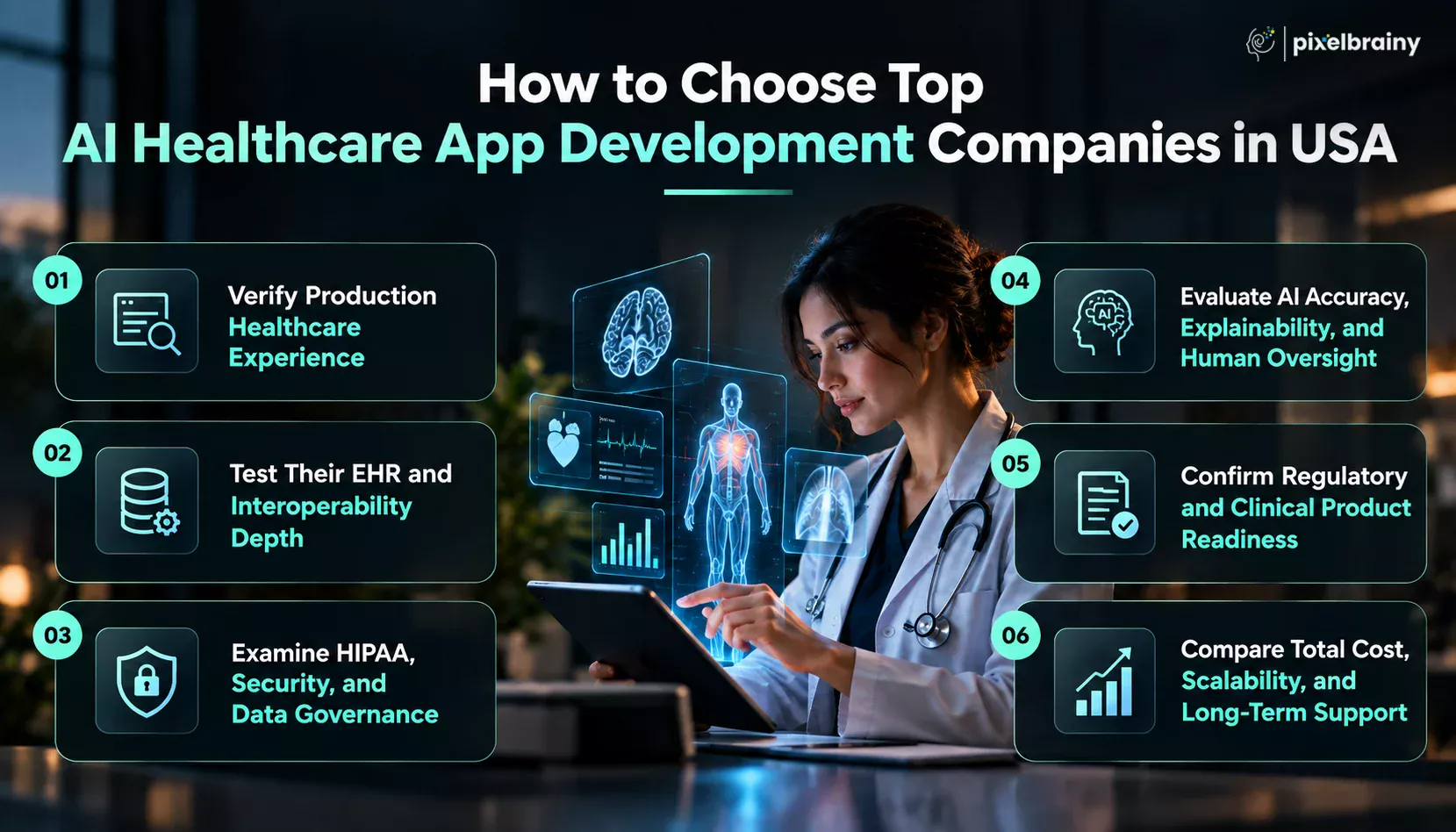
Look beyond a vendor's healthcare portfolio and ask for evidence of applications that reached production.
A provider may have built healthcare prototypes without ever supporting real clinical workflows or patient data. Ask whether the team has deployed applications for hospitals, health systems, physician groups, health plans, or other regulated healthcare organizations.
Request relevant case studies and clarify the application's purpose, user population, deployment environment, and production status.
For AI healthcare app developers USA, practical healthcare experience should include more than UI development. Look for experience with clinical workflows, healthcare data, security requirements, and ongoing application support.
EHR integration should be one of the first technical areas discussed with shortlisted vendors.
Ask specifically whether the company has completed production integrations with Epic, Oracle Health, athenahealth, or other systems relevant to your organization. Then ask what data was exchanged and through which mechanisms.
FHIR, HL7, SMART on FHIR, APIs, and healthcare data standards should be discussed in technical terms rather than simply listed on a website. ONC also provides developer resources covering interoperability, APIs, privacy, and security considerations.
This helps distinguish experienced AI healthcare app development firms USA from general software agencies.
HIPAA should be evaluated as an architecture and operational requirement, not merely as a marketing checkbox.
Ask how PHI is encrypted, where healthcare data is stored, how access is controlled, how audit logs are maintained, and how data is protected across development, testing, and production environments.
Also clarify the vendor's role as a business associate when applicable and request relevant agreements and security documentation. HHS specifically notes that different federal privacy and security requirements can apply to mobile health applications depending on their function, data, and operating model.
For AI health app development companies USA, also ask how prompts, model inputs, outputs, logs, and third-party AI services are handled.
AI capability should be assessed according to the application's clinical risk.
Ask how the model was evaluated, what data was used for validation, how errors are detected, and when a human clinician must review an AI-generated recommendation.
This becomes particularly important for clinical decision support. The FDA's January 2026 guidance distinguishes certain non-device CDS functions from software functions that remain subject to medical-device oversight.
For higher-risk applications, ask vendors to explain model limitations, validation methods, monitoring processes, and escalation workflows. Avoid accepting generic claims about AI accuracy without application-specific evidence.
Regulatory requirements should be discussed before development begins, especially when the application performs diagnosis, treatment-related functions, clinical decision support, or other medical functions.
Ask the vendor to document the intended use, target users, patient population, clinical claims, and regulatory assumptions.
The FDA's Digital Health Policy Navigator is designed to help developers assess whether particular software functions may fall under FDA oversight.
A capable provider should therefore be able to explain where its development responsibilities end and where specialized regulatory, clinical, or quality expertise is required.
The lowest initial development quote may not represent the lowest total cost of ownership.
Ask each vendor to separate development, AI infrastructure, EHR integration, cloud costs, security work, testing, maintenance, model monitoring, and post-launch support.
Also evaluate whether the architecture can scale as patient volume, facilities, integrations, and AI workloads increase.
For buyers comparing AI healthcare app development companies in USA, the final proposal should clearly define milestones, ownership, support responsibilities, security obligations, integration scope, and expected ongoing costs.
A strong buyer evaluation focuses on production evidence, EHR integration, security, AI governance, regulatory readiness, and long-term scalability. These factors provide a more reliable basis for comparing AI healthcare app development companies than portfolios or pricing alone.
A healthcare AI project can become expensive and difficult to scale when vendor evaluation focuses only on development speed, portfolio size, or pricing. The AI healthcare app development companies in USA you consider should be assessed against clinical, technical, regulatory, and operational requirements from the beginning.
For healthcare buyers comparing best AI healthcare app development companies USA, the biggest risks often appear after development starts. Weak EHR integration, unclear AI governance, inadequate security planning, and unrealistic ROI expectations can create problems that are expensive to fix later.
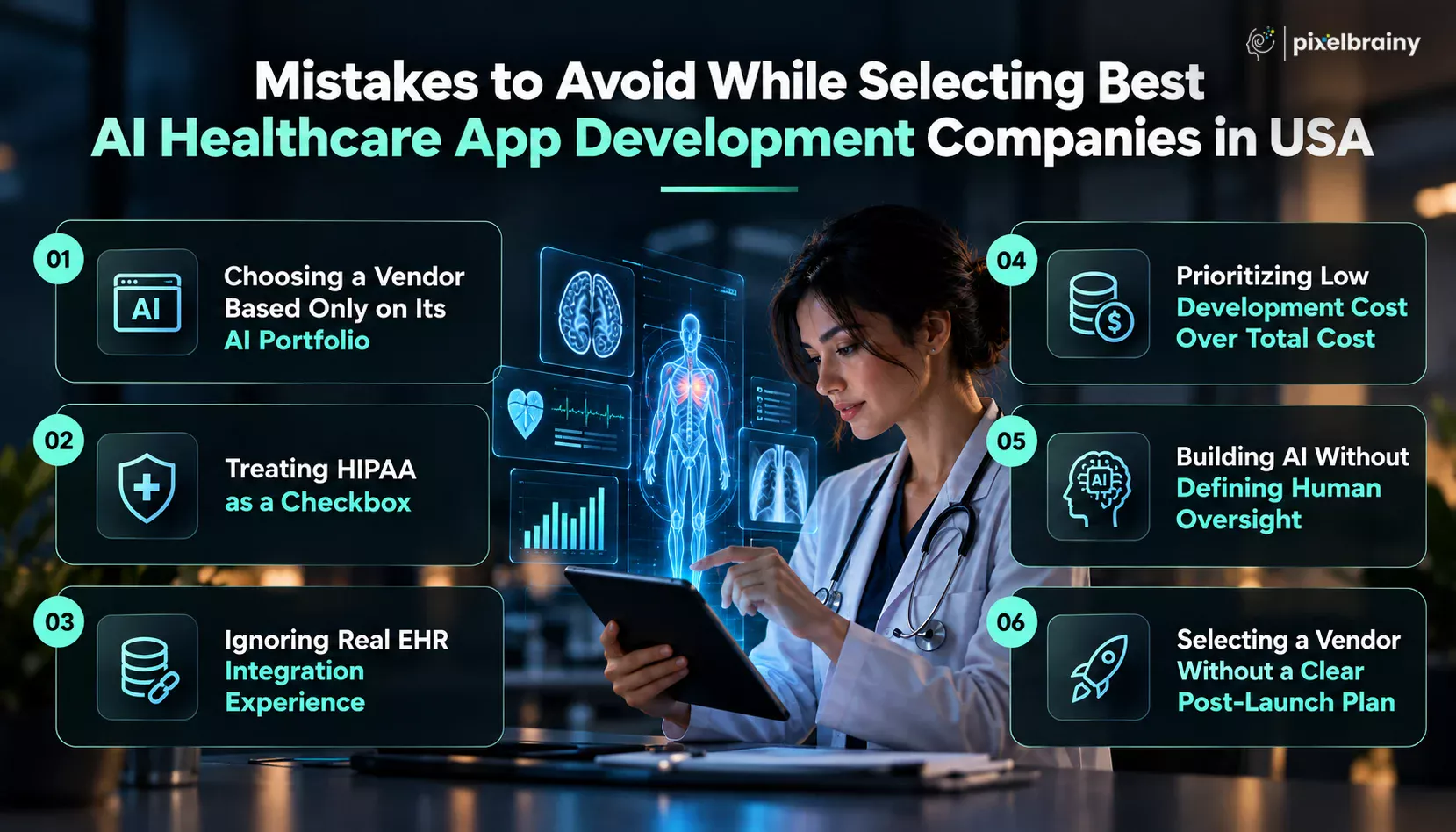
A large collection of AI projects does not necessarily demonstrate healthcare expertise.
Buyers should check whether the company has built applications for healthcare organizations and understands clinical workflows, PHI, healthcare interoperability, and patient-facing requirements.
Ask for relevant healthcare case studies rather than relying on generic AI demos. A vendor that has built recommendation engines for retail, for example, may not have the experience required for a clinical application.
HIPAA should not be evaluated simply by asking whether a company is "HIPAA compliant."
Ask how PHI is encrypted, accessed, stored, logged, transmitted, and deleted. Review access controls, audit mechanisms, business associate responsibilities, cloud infrastructure, and third-party services.
Healthcare buyers should also understand what security responsibilities remain with their own organization. For AI healthcare app development companies in USA, compliance needs to be reflected throughout the application architecture and operating model.
A vendor mentioning Epic or FHIR on its website does not automatically prove production integration experience.
Ask whether the company has connected an application to Epic, Oracle Health, or another relevant EHR in a live environment.
Then ask which APIs or standards were used, what data moved between systems, and how authentication and authorization were handled.
This distinction is particularly important when comparing AI healthcare app development firms USA for applications that will process real patient information.
A low initial estimate can become expensive when integrations, security, AI infrastructure, testing, maintenance, and post-launch support are added later.
Before signing a contract, ask for a complete cost structure covering development, integrations, cloud infrastructure, AI model usage, security testing, maintenance, and future enhancements.
The objective is to understand the total ownership cost rather than comparing hourly rates alone.
AI should not automatically make clinical decisions simply because the technology allows it.
Define which actions AI can perform independently and which require review by clinicians, care teams, or administrators.
Ask how the vendor handles incorrect outputs, escalation, model monitoring, auditability, and changes to AI models after deployment.
For higher-risk healthcare applications, this becomes an essential part of responsible AI implementation.
Healthcare applications require ongoing maintenance because EHR APIs, security requirements, AI models, operating systems, and clinical workflows can change.
Before selecting among AI healthcare app developers USA, clarify who will handle monitoring, security updates, integration maintenance, performance issues, AI evaluation, and technical support after launch.
A strong vendor relationship should cover the full application lifecycle, from discovery and development through deployment, monitoring, optimization, and future scaling.
Avoiding these mistakes helps healthcare organizations evaluate vendors on evidence and long-term capability rather than marketing claims alone. The strongest partnerships begin with clear clinical, technical, compliance, and operational requirements.
The healthcare AI market is moving from experimental applications toward practical solutions that can improve patient engagement, clinical workflows, care coordination, and operational efficiency. From proactive patient communication and AI-powered telehealth to remote monitoring, clinical documentation, medication adherence, and senior care, the right application can address a specific healthcare challenge while fitting into existing workflows.
Our review of the AI healthcare app development companies in USA shows that providers differ significantly in healthcare expertise, EHR integration, AI capabilities, compliance readiness, pricing, and post-launch support.
For healthcare organizations, the key is to match the development partner with the actual use case, patient population, integration requirements, and expected outcomes. Production healthcare experience and proven interoperability should carry as much importance as AI capabilities or development cost.
If you have a healthcare AI idea and want to understand the right technology, integrations, development approach, and investment required, our team can help you evaluate the next steps.
Schedule a call with our healthcare AI experts today to discuss your app idea and development requirements.
There is no single best provider for every healthcare project. Among the AI healthcare app development companies in USA, PixelBrainy, Taction Software, Topflight Apps, TechAhead, ScienceSoft, and Appinventiv offer different healthcare, AI, EHR integration, and product development capabilities. The right fit depends on clinical use case, compliance requirements, integrations, budget, scalability, and deployment needs.
The cost of working with AI health app development companies USA can range from approximately $40,000 to $350,000 or more. Basic healthcare MVPs may cost less, while applications requiring AI models, Epic or Oracle Health integration, advanced security, wearable connectivity, and enterprise scalability can require larger budgets. Development scope, compliance, integrations, and ongoing AI infrastructure significantly affect the final cost.
FDA Software as a Medical Device, or SaMD, refers to software intended for medical purposes that may be regulated as a medical device. For AI healthcare app development firms USA, the intended use, clinical function, risk level, and claims can affect regulatory requirements. This may influence software architecture, validation, documentation, testing, quality processes, and commercialization planning.
Several AI healthcare app developers USA report experience with major EHR platforms. Taction Software lists Epic and Oracle Health integrations, while TechAhead describes integrations with Epic and Cerner. DreamSoft4U also lists Epic and Oracle Health connectivity. Buyers should verify whether the vendor has completed a comparable production integration and what patient data actually moved through the connected application.
HIPAA-native architecture means privacy and security requirements are incorporated into the application from the beginning rather than added after development. For AI healthcare app development companies in USA, this can include encryption, role-based access, secure APIs, audit logging, identity management, and appropriate PHI handling. This approach is important because AI applications may process sensitive patient information across multiple systems and services.
Several AI healthcare app development companies in USA for patient engagement can support multilingual healthcare applications, including providers such as GeekyAnts, Appinventiv, ScienceSoft, and TechAhead. Buyers should verify supported languages, translation workflows, accessibility capabilities, and experience with comparable patient populations. Multilingual healthcare applications should also maintain consistent clinical terminology and privacy protections across languages.
An AI healthcare application with EHR integration can typically require several months to more than a year, depending on complexity. For AI healthcare app development firms USA, timelines increase when projects involve Epic or Oracle Health integration, clinical AI, multiple workflows, security testing, and regulatory requirements. A focused MVP may take around 3 to 6 months, while complex enterprise platforms can take 6 to 12+ months.
Top AI healthcare app development companies USA serving digital health startups include providers such as Topflight Apps, PixelBrainy, Appinventiv, GeekyAnts, and Sidebench. Series A companies should evaluate product strategy, healthcare experience, AI capabilities, EHR integration, security, scalability, and post-launch support. The most suitable provider will depend on the startup's product roadmap, regulatory requirements, funding objectives, and technical complexity.
Yes. AI healthcare app development companies in USA for care coordination can build RPM platforms that connect with devices such as glucose monitors, blood-pressure monitors, pulse oximeters, and cardiac monitoring equipment. Providers such as Taction Software, DreamSoft4U, Appinventiv, GeekyAnts, and PixelBrainy describe RPM or connected healthcare capabilities. Buyers should evaluate device compatibility, data processing, alert logic, EHR integration, and clinician workflows.
Several AI healthcare app development companies in USA for behavioral health have capabilities relevant to mental health applications, including Taction Software, Sidebench, Appinventiv, GeekyAnts, and ScienceSoft. Potential capabilities include telehealth, behavioral health workflows, patient engagement, and remote care. For AI-powered behavioral health platforms, buyers should also evaluate crisis escalation, clinical oversight, privacy controls, AI safety, and applicable regulatory requirements.
AI healthcare app development companies in USA for senior care should understand accessibility, simplified interfaces, voice interaction, caregiver connectivity, and remote monitoring. Providers with broader healthcare and AI capabilities can develop senior-focused applications, but buyers should verify specific experience with older adult populations. For voice-first AI companions or cognitive monitoring, clinical validation, accessibility testing, privacy, and human oversight should be evaluated before deployment.

About The Author
Sagar Bhatnagar
Sagar Sahay Bhatnagar brings over a decade of IT industry experience to his role as Marketing Head at PixelBrainy. He's known for his knack in devising creative marketing strategies that boost brand visibility and market influence. Sagar's strategic thinking, coupled with his innovative vision and focus on results, sets him apart. His track record of successful campaigns proves his ability to utilize digital platforms effectively for impactful marketing efforts. With a genuine passion for both technology and marketing, Sagar continuously pushes PixelBrainy's marketing initiatives to greater success.

Working with the PixelBrainy team has been a highly positive experience. They understand the design requirements and create beautiful UX elements to meet the application needs. The dev team did an excellent job bringing my vision to life. We discussed usability and flow. Sagar worked with his team to design the database and begin coding. Working with Sagar was easy. He has the knowledge to create robust apps, including multi-language support, Google and Apple ID login options, Ad-enabled integrations, Stripe payment processing, and a Web Admin site for maintaining support data. I'm extremely satisfied with the services provided, the quality of the final product, and the professionalism of the entire process. I highly recommend them for Android and iOS Mobile Application Design and Development.

Great experience working with them. Had a lot of feedback and I found that unlike most contractors they were bugging me for updates instead of the other way around. They were extremely time conscience and great at communicating! All work was done extremely high quality and if not on time, early! They were always proactive when it comes to communication and the work is great/above par always. Very flexible and a great team to work with! Goes above and beyond to present us with multiple options and always provides quality. Amazing work per usual with Chitra. If you have UI/UX or branding design needs I recommend you go to them! Will likely work with them in the future as well, definitely recommended!

PixelBrainy is a joy to work with and is a great partner when thinking through branding, logo, and website layout. I appreciate that they spend time going into the "why" behind their decisions to help inform me and others about industry best practices and their expertise.

I hired them to design our software apps. Things I really like about them are excellent communication skills, they answer all project suggestions and collaborate right away, and their input on design and colors is amazing. This project was complex and needed patience and creativity. The team is amazing to do business with. I will be using them long-term. Glad to see there are some good people out there. I was afraid to try and outsource my project to someone but I am glad I met them! I really can't say enough. They went above and beyond on this project. I am very happy with everything they have done to make my business stand out from the competition.

It was great working with PixelBrainy and the team. They were very responsive and really owned the project. We'll definitely work with them again!

I recently worked with the PixelBrainy team on a project and I was blown away by their communication skills. They were prompt, clear, and articulate in all of our interactions. They listened and provided valuable feedback and suggestions to help make the project a success. They also kept me updated throughout the entire process, which made the experience stress-free and enjoyable.

PixelBrainy is very good at what it does. The team also presents themselves very professionally and takes care of their side of things very well. I could fully trust them taking up the design work in a timely and organised manner and their attention to detail saved us lots of effort and time. This particular project was quite intense and the team showed that they function very well under pressure. Very much looking forward to working with her again!

It's always an absolute pleasure working with them. They completed all of my requests quickly and followed every note I had for them to a T, which made our process go smoothly from start to finish. Everything was completed fast and following all of the guidelines. And I would recommend their services to anyone. If you need any design work done in the future, PixelBrainy should be your first call!

They took ownership of our requirements and designed and proposed multiple beautiful variants. The team is self-motivated, requires minimum supervision, committed to see-through designs with quality and delivering them on time. We would definitely love to work with PixelBrainy again when we have any requirements.

PixelBrainy was a big help with our SaaS application. We've been hard at work with a new UI/UX and they provided a lot of help with the designs. If you're looking for assistance with your website, software, or mobile application designs, PixelBrainy and the team is a great recommendation.

PixelBrainy designers are amazing. They are responsive, talented, and always willing to help craft the design until it matches your vision. I would recommend them and plan to continue them for my future projects and more!!!

They were awesome! Did a good job fast, and good communication. Will work with them again. Thank you

Creative, detail-oriented, and talented designers who take direction well and implement changes quickly and accurately. They consistently over-delivered for us.

PixelBrainy team is very talented and creative. Great designers and a pleasure to work with. PixelBrainy is an excellent communicator and I look forward to working with them again.

PixelBrainy has a very talented design team. Their work is excellent and they are very responsive. I enjoy working with them and hope to continue on all of our future projects.


Transform your ideas into reality with us.
Across these industries, each engagement brings unique challenges, from early-stage product development to scaling complex systems, helping us build a practical understanding of real-world product environments.