AI Summary Powered by PixelBrainy
What separates an app that disappears after launch from one that becomes part of millions of people's daily routines across the United States?
That is the question every startup founder, entrepreneur, and product team should answer before investing months of development time and thousands of dollars into a new product. Studying the trending apps in USA 2026 is not about chasing viral moments or copying successful products. It is about understanding the evolving needs of users, the problems they are willing to pay to solve, and the product decisions that consistently drive adoption and long-term engagement.
Consider a common founder scenario. You are in the early stages of deciding what to build next and want to identify which apps are genuinely gaining momentum in the US market instead of relying on social media hype or technology headlines. Your goal is to discover the products that are seeing measurable download growth, strong daily usage, and increasing customer retention. More importantly, you want to uncover the user behaviour, product strategy, and market demand behind that growth so your next app idea is backed by evidence rather than assumptions.
The opportunity has never been bigger. According to Statista, the global app market is projected to generate US$739.61 billion in revenue in 2026, with the United States alone expected to account for US$317.39 billion, making it the largest app market worldwide.
This article goes beyond another list of the most popular apps in USA. Instead, it analyses the top trending apps USA that are shaping consumer behaviour in 2026, explains what are the top 10 trending apps in USA in 2026, and uncovers the product, growth, and monetisation strategies behind their success.
Whether you are validating a startup idea, researching competitors, or planning your next digital product, these insights will help you understand what it takes to build one of the best apps in USA in today's highly competitive mobile ecosystem.
Every year, thousands of mobile apps are launched in the United States, but only a small percentage achieve sustained growth. Becoming one of the fastest growing apps USA is no longer determined by download numbers alone. In 2026, successful apps earn their position by solving real user problems, delivering immediate value, and creating experiences that encourage people to return every day.
This shift reflects broader mobile app market trends 2026, where long term engagement has become more valuable than short lived popularity. Industry reports also show that Generative AI, stronger monetization models, and user retention strategies are shaping the next phase of app growth.
For founders evaluating app trends USA 2026, the goal should not be to identify the app with the highest download count. The real opportunity lies in understanding why users continue choosing certain apps over countless alternatives. Those insights help founders validate product ideas based on measurable user demand instead of temporary market excitement.
Modern users expect apps to fit naturally into their daily routines. The user behavior trends mobile apps are revealing in 2026 show that convenience, relevance, and personalization have become the biggest drivers of adoption.
Artificial intelligence has moved beyond being a premium feature and is becoming part of the core product experience. Users now expect apps to assist with decision making, automate repetitive tasks, generate content, and deliver smarter recommendations. Research also shows that nearly half of U.S. adults now use AI chatbots, highlighting how quickly AI powered experiences are becoming mainstream.
Users decide within the first few minutes whether an app deserves a place on their phone. The most successful products eliminate lengthy onboarding and help users experience their first meaningful outcome almost immediately.
Generic experiences no longer create lasting engagement. Leading apps continuously learn from user preferences, browsing history, behaviour patterns, and goals to deliver highly relevant recommendations that improve with every interaction.
Instead of trying to attract everyone, many successful apps focus on building highly engaged niche communities. Whether centred around fitness, investing, learning, or content creation, these communities encourage stronger participation and increase long term retention through shared interests.
Consumers are increasingly willing to pay for applications that consistently provide measurable value. Rather than offering one-time purchases, many leading apps combine free access with premium subscriptions that unlock advanced features, exclusive content, or AI powered capabilities.
Many founders still judge success by installation numbers. While downloads generate initial visibility, they reveal very little about an app's long-term potential. Investors, product teams, and experienced founders evaluate performance using a broader set of growth indicators.
A growing daily active user base indicates that people are integrating the app into their regular habits rather than abandoning it after installation.
Retention is often a stronger indicator of product market fit than acquisition. If users continue returning after their first week or first month, the app is consistently delivering value. This is especially important because many users uninstall newly downloaded apps within the first month if they fail to meet expectations.
Healthy revenue growth demonstrates that users are willing to pay for the value an app provides. Sustainable monetisation through subscriptions, in app purchases, or premium services often reflects stronger customer satisfaction than download volume alone.
Session frequency, time spent, feature adoption, and repeat interactions provide valuable insight into whether users genuinely depend on an app or simply installed it out of curiosity.
The strongest products reduce customer acquisition costs by encouraging users to invite friends, share content, or collaborate with others. Organic referrals often signal genuine customer satisfaction and support faster, more sustainable growth.
Many founders make the mistake of replicating the features of today's market leaders. That approach rarely produces lasting success because users already associate those experiences with established brands.
A better strategy is to study the underlying patterns behind the fastest growing apps USA. Ask why users adopted the product, what pain point it solved more effectively, how it shortened the path to value, and what encouraged people to keep coming back. These insights reveal opportunities that competitors may have overlooked.
The most valuable app trends USA 2026 are not individual features or design styles. They represent shifts in customer expectations, purchasing behaviour, and digital habits. Founders who understand these changes can build products that address emerging needs before markets become crowded. Instead of copying successful apps, they create solutions inspired by the same user problems that made those products successful in the first place. This approach leads to stronger product market fit, better retention, and more sustainable long-term growth.
The top trending apps USA are not necessarily the apps with the highest lifetime downloads. They are the products that continue attracting new users, increasing engagement, improving retention, and shaping consumer behaviour across multiple industries. For startup founders, studying these products provides far more value than simply tracking App Store rankings. Every successful app reflects a specific market demand, solves a meaningful user problem, and executes its product strategy exceptionally well.
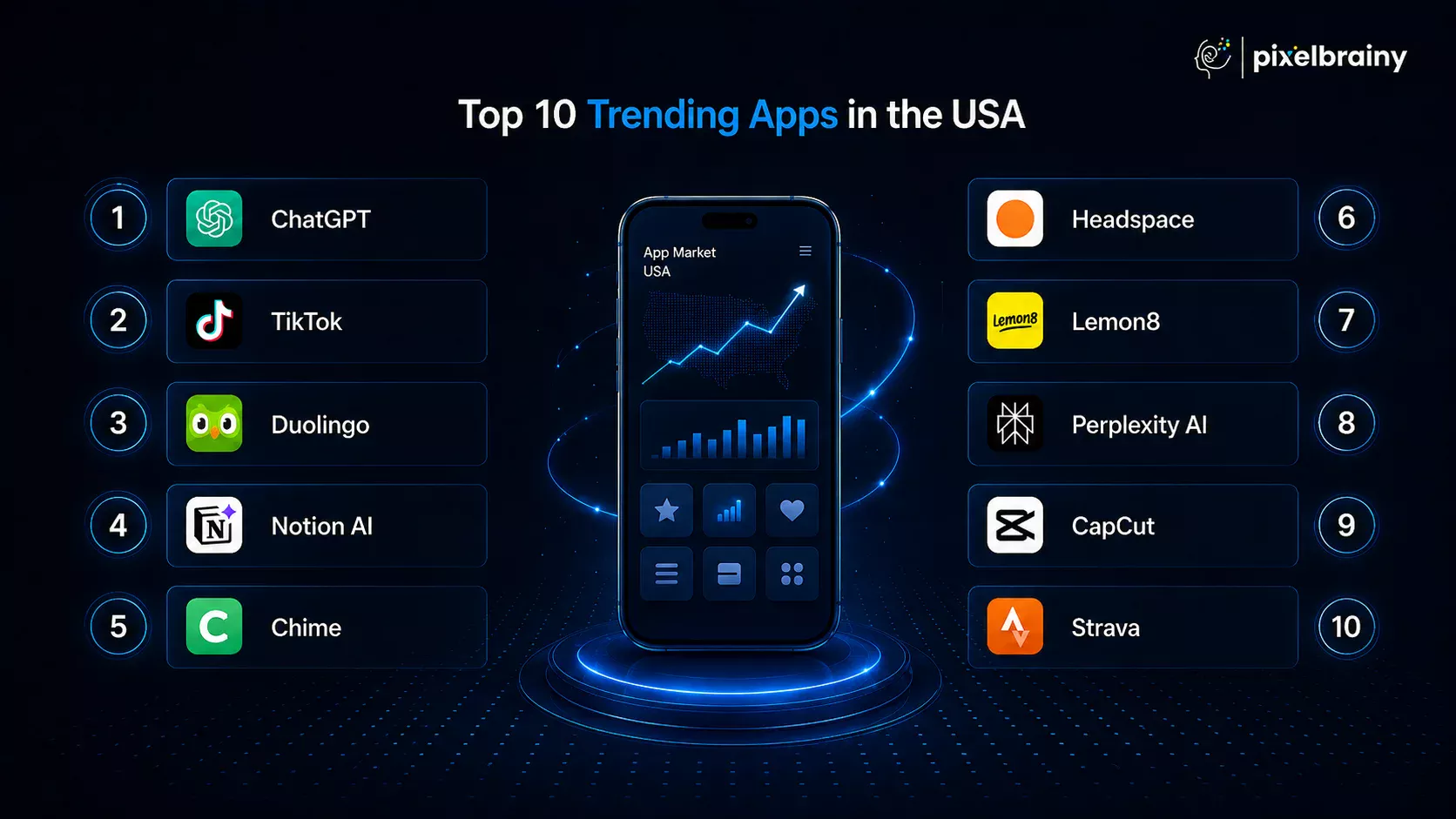
If you have been wondering what are the top 10 trending apps in USA in 2026, the list below highlights some of the most popular apps in USA based on user adoption, product innovation, engagement, and market influence. More importantly, each app offers practical lessons that founders can apply when building products designed for today's competitive mobile ecosystem.
ChatGPT has become one of the top trending apps USA because it has transformed the way people work, learn, create, and solve problems. What began as an AI chatbot has evolved into a complete productivity platform used by entrepreneurs, developers, marketers, students, and enterprises every day. Instead of opening multiple applications to research information, write content, analyse documents, generate code, or brainstorm ideas, users can complete these tasks from a single interface.
This ability to simplify complex workflows has positioned ChatGPT among the most popular apps in USA and set a new benchmark for AI powered mobile experiences. According to Andreessen Horowitz, ChatGPT continues to lead the consumer AI market with exceptional growth across both mobile and web platforms.
ChatGPT continues expanding its user base because every major update improves real world usability rather than simply adding new technology.
Some of the biggest growth drivers include:
Another important factor is the growing acceptance of AI among consumers. According to Pew Research Center, nearly 49% of U.S. adults now use AI chatbots, demonstrating how AI has become part of everyday digital behaviour.
Many founders assume ChatGPT became successful because it uses advanced AI. In reality, its biggest advantage is reducing the amount of effort required to complete everyday tasks.
Instead of asking, "How can we add AI?", founders should ask:
These questions often lead to stronger product decisions than simply adding AI features for marketing purposes.
The biggest opportunity is not building another general-purpose AI assistant. Competition in that category is already intense. Instead, founders should identify industries where specialised AI can solve high value problems.
Promising opportunities include:
These focused products solve specific business challenges while serving clearly defined audiences, making them easier to position and scale.
The success of ChatGPT proves that users reward products that simplify work rather than showcase technology. AI should remain invisible in the experience, allowing users to focus on achieving results instead of learning new systems.
Founder Lesson: Build AI that removes effort from the user's workflow, because the best technology is the technology users barely notice.
TikTok continues to rank among the top trending apps USA because it has fundamentally changed how people discover content, brands, and creators. Unlike traditional social media platforms that prioritise existing connections, TikTok focuses on matching users with content they are most likely to enjoy.
This content first approach has helped the platform attract millions of active users across different age groups while creating significant opportunities for creators and businesses. Its influence extends far beyond entertainment, shaping shopping behaviour, product discovery, digital marketing, and even search habits.
TikTok's growth comes from continuously delivering highly relevant content that keeps users engaged for longer sessions.
Key growth drivers include:
Rather than encouraging users to follow more accounts, TikTok focuses on helping users discover content that matches their interests from the very first session.
TikTok demonstrates that people spend more time on platforms that consistently deliver relevant experiences instead of simply showing content from existing connections.
Startup founders should ask:
The best products anticipate user needs instead of waiting for users to search.
There is still significant room for innovation around community driven experiences.
Emerging opportunities include:
Building niche communities often creates stronger engagement than competing with large social networks.
TikTok proves that personalised experiences outperform chronological feeds. When users consistently discover valuable content, they spend more time, interact more frequently, and naturally become loyal customers.
Founder Lesson: Engagement beats follower count.
Duolingo remains one of the most popular apps in USA because it transformed language learning into a habit rather than a classroom activity. Instead of asking users to complete long lessons, the platform encourages short, enjoyable learning sessions that fit naturally into busy schedules. By combining education with behavioural psychology, Duolingo has achieved exceptional retention while making learning feel rewarding instead of overwhelming.
Duolingo succeeds because it motivates users to return every day through carefully designed engagement systems.
Its biggest growth drivers include:
Every interaction encourages users to continue learning without making the experience feel like work.
Duolingo teaches an important lesson about customer retention. Users rarely remain loyal because of features alone. They stay because products become part of their daily routine.
Startup founders should consider:
Products that create habits naturally improve retention while lowering acquisition costs.
Habit based product design extends far beyond education.
Potential opportunities include:
Helping users improve consistently creates long term engagement.
Duolingo demonstrates that lasting growth comes from changing user behaviour instead of increasing feature count. Small daily achievements build stronger loyalty than occasional major successes.
Founder Lesson: Habit formation drives retention.
Notion AI has become one of the best apps in USA for professionals because it combines note taking, project management, documentation, collaboration, and artificial intelligence within a single workspace. Instead of asking users to switch between multiple applications throughout the day, Notion centralises work into one organised environment. This integrated approach has made it a preferred productivity platform for startups, enterprises, students, and remote teams.
Its popularity continues growing because AI enhances existing workflows instead of replacing them.
Key growth drivers include:
Rather than introducing unnecessary complexity, AI helps users complete familiar tasks more efficiently.
Many companies build AI as a separate feature. Notion AI succeeds because intelligence is integrated directly into everyday work.
Startup founders should evaluate:
Products become more valuable when AI complements existing behaviour instead of changing it completely.
There is growing demand for industry specific AI workspaces.
Examples include:
Vertical productivity platforms often solve specialised problems more effectively than generic software.
Notion AI proves that users value seamless experiences more than impressive technology. AI should strengthen existing workflows instead of forcing customers to learn entirely new ways of working.
Founder Lesson: AI works best when embedded into existing workflows.
Chime has emerged as one of the fastest growing fintech apps in the United States by making everyday banking simpler, faster, and more transparent. Unlike traditional banks that often overwhelm customers with lengthy processes and hidden fees, Chime delivers a mobile first experience focused on accessibility and convenience. Its user-friendly interface, instant account setup, and personalised financial tools have made it especially popular among younger consumers and digital first users. As financial technology continues to evolve, Chime demonstrates how removing friction can become a stronger competitive advantage than simply offering more features.
Chime continues attracting new users because it simplifies financial management while building trust through transparency.
Its key growth drivers include:
Every feature is designed to help users manage their money with less effort and greater confidence.
Financial products succeed when they eliminate confusion rather than adding complexity. Chime proves that users value convenience, speed, and clarity more than extensive feature lists.
Startup founders should ask:
The easiest products to understand are often the easiest to adopt.
Digital finance continues creating opportunities for specialised products.
High potential areas include:
Products focused on specific financial challenges often outperform broad banking solutions.
Chime demonstrates that trust is built through simplicity. Users remain loyal to products that make important decisions easier instead of overwhelming them with unnecessary complexity.
Founder Lesson: Simplicity builds trust.
Headspace continues to rank among the most popular apps in USA because it addresses one of today's fastest growing consumer priorities, mental wellbeing. As work pressures, digital fatigue, and stress levels continue increasing, more people are investing in meditation, better sleep, and emotional wellness. Headspace has successfully positioned itself as a daily wellness companion by making mindfulness accessible, practical, and easy to integrate into everyday routines. Rather than offering occasional relaxation content, it encourages users to build sustainable habits that improve long term wellbeing.
Its continued success comes from helping users achieve measurable improvements in their daily lives.
Major growth drivers include:
The platform focuses on creating lasting behavioural change rather than one time engagement.
Headspace proves that products delivering emotional value often create stronger customer loyalty than those offering only functional benefits.
Startup founders should consider:
People continue paying for products that consistently make them feel better.
Demand for digital wellness continues expanding across multiple industries.
Promising opportunities include:
Wellness products that deliver measurable outcomes continue attracting loyal customers.
Headspace shows that long term customer relationships are built through consistent positive experiences. Emotional impact often becomes a stronger competitive advantage than technical innovation.
Founder Lesson: Emotional outcomes increase customer loyalty.
Lemon8 has quickly established itself as one of the top trending apps USA by combining social media, lifestyle discovery, and visual storytelling into a highly engaging platform. Instead of encouraging endless scrolling through random content, Lemon8 helps users discover ideas around fashion, travel, beauty, food, wellness, and personal growth based on their interests. Its clean design and community driven content have particularly resonated with Gen Z users looking for authentic recommendations rather than heavily commercialised influencer posts.
The platform continues expanding because it focuses on quality discovery rather than content volume.
Its strongest growth drivers include:
Users return because they consistently discover useful, inspiring, and relevant content.
Lemon8 highlights the growing importance of community driven experiences over traditional social networking.
Startup founders should ask:
People trust communities more than advertisements.
Niche social platforms continue presenting attractive opportunities.
Examples include:
Focused communities often generate deeper engagement than broad social networks.
Lemon8 demonstrates that users increasingly seek trusted communities where they can discover ideas, learn from peers, and share authentic experiences.
Founder Lesson: Communities outperform audiences.
Perplexity AI has become one of the top trending apps USA by redefining how people search for information. Instead of presenting a long list of links like traditional search engines, it delivers direct, conversational answers backed by credible sources. This approach saves users time while increasing confidence in the information they receive.
Professionals, researchers, students, and business leaders increasingly rely on Perplexity AI to find accurate insights without spending valuable time comparing multiple websites. As AI powered search continues evolving, Perplexity AI has positioned itself as a strong alternative for users who value speed, accuracy, and transparency.
The platform continues gaining users because it focuses on solving one problem exceptionally well by making information discovery faster and more reliable.
Its biggest growth drivers include:
Rather than forcing users to browse multiple pages, Perplexity AI delivers structured answers supported by trusted references.
Perplexity AI proves that solving one important problem exceptionally well often creates more value than offering dozens of loosely connected features.
Startup founders should ask:
Products that solve a single problem exceptionally well often achieve stronger market positioning than products trying to solve everything.
The demand for AI powered search extends far beyond general knowledge.
Promising opportunities include:
Specialised AI search products often deliver higher value because they understand industry specific terminology and workflows.
Perplexity AI demonstrates that customers reward clarity and reliability. Instead of competing by adding more features, founders should focus on delivering the fastest and most trustworthy solution to a clearly defined problem.
Founder Lesson: Solving one problem exceptionally well beats solving many poorly.
CapCut has become one of the most popular apps in USA by making professional quality video editing accessible to everyone. As short form video continues dominating social media, businesses, creators, educators, and entrepreneurs need tools that simplify content production without requiring advanced editing skills.
CapCut removes technical barriers through AI powered editing features, allowing users to create polished videos within minutes. Its seamless integration with modern content creation workflows has made it an essential tool for creators looking to publish consistently across multiple platforms.
CapCut continues growing because it dramatically reduces the time required to produce engaging video content.
Its strongest growth drivers include:
The platform enables anyone to produce professional looking content without specialised software or technical expertise.
CapCut highlights one of the biggest opportunities in product development by removing unnecessary complexity from tasks users perform regularly.
Startup founders should ask:
The easier it becomes to achieve results, the more likely users are to return.
AI powered content creation continues expanding across multiple industries.
Emerging opportunities include:
Products that simplify creative work continue attracting both professionals and casual users.
CapCut proves that customers value speed as much as quality. Removing friction from complex workflows often creates stronger competitive advantages than adding advanced features that only experts understand.
Founder Lesson: Remove friction from content creation.
Strava remains one of the best apps in USA because it successfully combines fitness tracking with social motivation. Rather than functioning as a simple activity tracker, Strava creates a community where runners, cyclists, walkers, and fitness enthusiasts encourage one another through shared achievements, challenges, and progress updates.
This combination of personal goals and social accountability has helped Strava maintain exceptional user engagement while building one of the strongest fitness communities in the mobile app market.
The platform continues expanding because it turns individual exercise into a shared experience that keeps users motivated.
Its major growth drivers include:
Every completed workout becomes an opportunity for users to celebrate progress while connecting with others pursuing similar goals.
Strava demonstrates that products become more engaging when they connect people around shared goals rather than individual activities.
Startup founders should ask:
People are more likely to stay committed when they feel connected to others with similar interests.
Community driven products continue creating opportunities across many industries.
Examples include:
Products that combine measurable progress with community interaction often achieve higher retention than products designed for individual use only.
Strava proves that long term engagement is created through shared experiences, not just individual achievements. Communities motivate users to stay active long after the excitement of downloading a new app has faded.
Founder Lesson: Shared experiences increase retention.
Each of these trending apps reflects a larger shift in user expectations, proving that founders who study the underlying product strategies, user behaviour, and market gaps behind successful apps are far more likely to build scalable products than those who simply copy popular features.

Also Read: 115 Innovative Mobile App Ideas for New Business to Launch
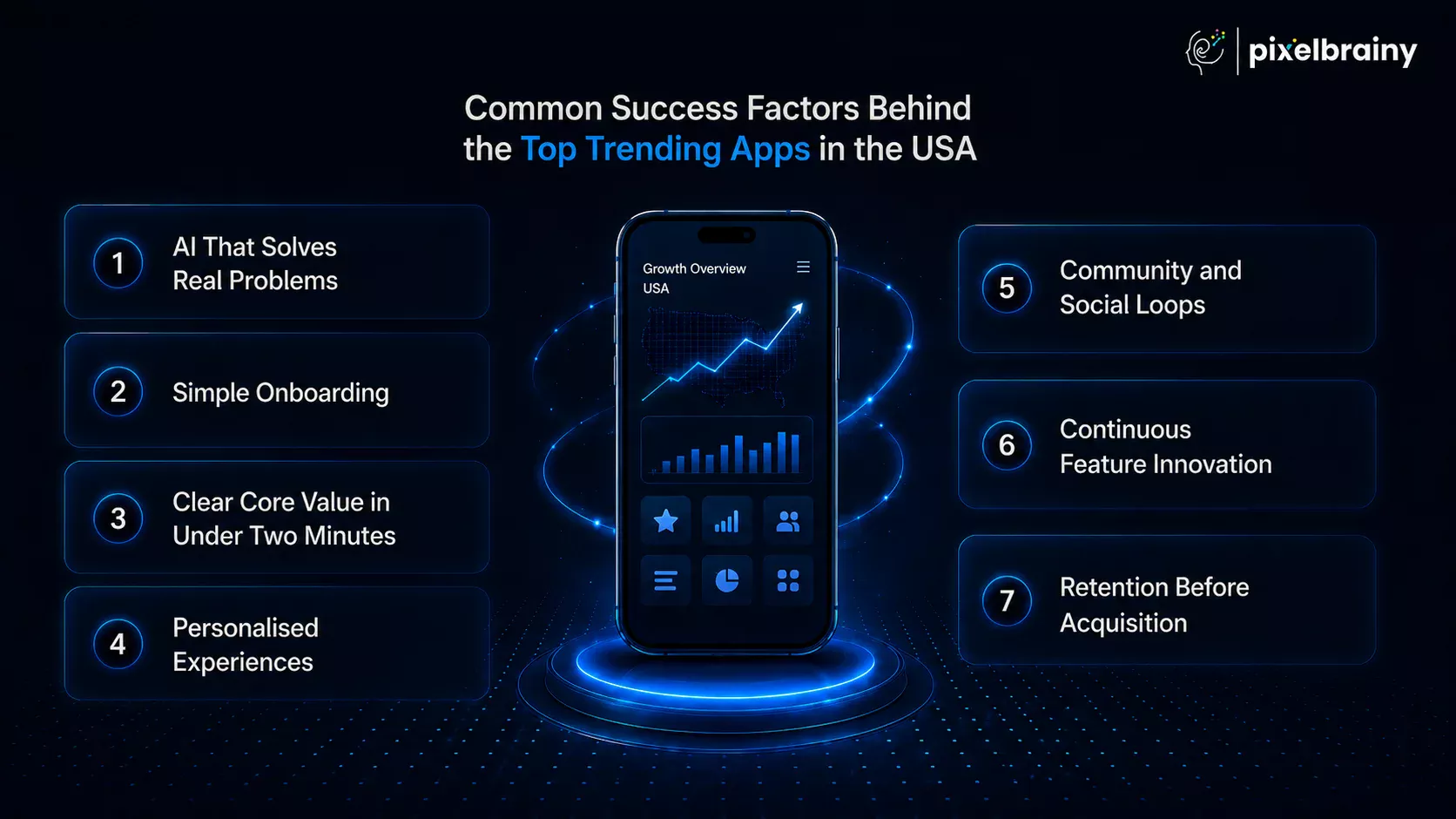
The apps featured in this list belong to different industries, including artificial intelligence, fintech, social media, productivity, wellness, and fitness. Yet despite serving different audiences, they share several characteristics that consistently drive adoption, engagement, and long-term growth. Understanding what the top trending apps have in common is far more valuable than copying their individual features because these underlying patterns reveal what modern users genuinely expect from digital products.
If you are evaluating a new app idea, these principles can serve as a practical framework before investing in development. They also reflect the latest app growth hacking strategies, viral app features 2026, and app retention strategies that continue shaping successful mobile products.
Artificial intelligence is no longer a competitive advantage on its own. Users expect AI to solve specific problems that save time, reduce effort, or improve decision making. The fastest growing apps use AI to simplify everyday tasks rather than adding unnecessary complexity.
Successful apps focus on practical outcomes such as:
Whether it is ChatGPT helping users write faster, Perplexity AI delivering reliable answers, or CapCut simplifying video editing, AI always supports the core user experience instead of becoming the product itself.
Before adding AI to your application, ask one important question.
Does AI genuinely solve a user problem, or is it simply another feature on the product roadmap?
Users make surprisingly quick decisions about whether an app deserves space on their phone. Long registration forms, complicated setup processes, and unnecessary permissions often lead to early abandonment.
The top trending apps USA consistently reduce friction during onboarding by helping users experience value almost immediately.
Common onboarding best practices include:
Apps like Chime, TikTok, and ChatGPT allow users to begin using core features without navigating lengthy tutorials.
Every additional step during onboarding increases the chance of losing a potential customer. Simplicity improves activation.
One pattern appears across almost every successful application. Users understand its value almost immediately.
They do not need lengthy demonstrations or extensive documentation because the product communicates its purpose through the experience itself.
Examples include:
Users stay when they experience success quickly.
Ask Yourself
Can a new user answer these questions within two minutes?
If the answer is no, improving the first user experience should become a priority.
Modern users expect products to understand their preferences instead of presenting identical experiences to everyone.
Personalisation has become one of the strongest drivers of engagement because it increases relevance with every interaction.
Leading apps personalise experiences through:
TikTok recommends videos based on viewing behaviour, Headspace personalises wellness journeys, and Chime provides customised financial insights that help users make smarter decisions.
People remain loyal to products that continuously become more useful over time.
Many of today's fastest growing apps succeed because users create value for one another.
Instead of depending entirely on paid advertising, they encourage interaction, collaboration, competition, and sharing that naturally increases engagement.
Common community driven growth mechanisms include:
TikTok thrives through creators, Strava motivates users through fitness communities, while Lemon8 encourages authentic lifestyle discussions around shared interests.
These social loops transform individual experiences into network effects that support sustainable growth.
Products become significantly more valuable when users encourage other users to participate.
Successful applications never remain static. They consistently introduce meaningful improvements based on changing customer expectations and real user feedback.
However, continuous innovation does not mean releasing as many features as possible.
The strongest products focus on:
This explains why applications like ChatGPT, Notion AI, and CapCut continue attracting new users while retaining existing ones through regular product improvements.
Every feature should strengthen your core value proposition instead of distracting users from it.
Many founders focus heavily on acquiring new users while overlooking the customers they already have.
The fastest growing apps understand that sustainable growth depends on keeping existing users engaged.
Strong app retention strategies often include:
Acquiring thousands of downloads means very little if users stop opening the app after a few days. Products like Duolingo, Headspace, and Strava demonstrate that consistent engagement creates stronger business growth than aggressive acquisition campaigns.
Retention also improves customer lifetime value, referral rates, and monetisation while reducing long term acquisition costs.
The best app growth hacking strategies begin after the first download, not before it. Products that consistently deliver value earn repeat usage, stronger customer loyalty, and sustainable growth without relying entirely on paid acquisition.
The fastest growing mobile apps do not succeed because they belong to trending categories. They succeed because they solve meaningful problems, deliver value immediately, personalise every interaction, build engaged communities, continuously improve the product, and prioritise long term user retention over short term download numbers. These patterns provide a proven blueprint for founders who want to build products that can compete in the evolving mobile app market.
The biggest mistake many entrepreneurs make is trying to build the next ChatGPT, TikTok, or Duolingo. Successful founders do not copy winning products. They understand the principles behind their success and apply those lessons to solve different customer problems. Every app featured in this guide became successful because it achieved strong app product market fit, addressed a clear user need, and continuously evolved based on customer behaviour.
If you are looking for app ideas inspired by trending apps, the goal should not be replication. The goal should be identifying unmet opportunities that follow the same product thinking. These startup app development lessons also align with the latest app development trends USA 2026, where user experience, AI integration, and long-term retention matter far more than simply launching new features.
Every successful app begins by solving a problem that people already experience.
ChatGPT reduces the time required to complete knowledge-based tasks. Duolingo makes language learning enjoyable. Chime simplifies personal banking. Strava motivates people to stay active through community. None of these products became successful because they introduced new technology alone. They became successful because they solved problems users genuinely cared about.
Before writing a single line of code, founders should validate whether the problem is important enough to solve.
Ask yourself:
Customer interviews, surveys, competitor analysis, and landing page validation often provide more valuable insights than months of product development based on assumptions.
Build around validated customer problems, not around exciting technologies.
The fastest growing apps become part of everyday routines rather than occasional tools.
Users open TikTok multiple times each day because fresh content is always available. ChatGPT helps professional’s complete daily tasks. Duolingo encourages language practice through daily streaks. Headspace supports consistent mindfulness habits.
When products naturally fit into daily life, customer retention increases without requiring constant marketing investment.
Founders should design experiences that encourage repeat engagement.
Consider questions like:
The more frequently users benefit from your product, the more valuable it becomes.
Products that become daily habits rarely struggle to retain customers.
Many early-stage startups fail because they try to solve too many problems at once.
The top trending apps USA became market leaders by excelling at one primary value before expanding into additional capabilities.
Examples include:
Instead of launching dozens of average features, focus on building one capability that users immediately recognise and recommend.
Ask yourself:
Great products are remembered for one exceptional capability before becoming complete ecosystems.
Depth creates stronger differentiation than breadth.
Artificial intelligence has become one of the biggest app development trends USA 2026, but many startups still approach it incorrectly.
Adding AI simply because competitors are doing so rarely improves customer satisfaction.
The most successful apps use AI to make existing experiences faster, simpler, and more intelligent.
Effective AI applications include:
Before introducing AI into your product, ask whether it improves the customer's experience or simply increases product complexity.
Customers rarely choose products because they contain AI.
They choose products because AI helps them achieve better outcomes with less effort.
AI should improve the product experience, not become the product itself.
One common startup mistake is focusing on monetisation before customers fully understand the product's value.
Successful applications first build trust and engagement before asking users to pay.
This approach can be seen across many leading apps:
Founders should concentrate on creating value before optimising revenue.
Strong monetisation models include:
People willingly pay for products that consistently solve meaningful problems.
Value creates trust, and trust creates sustainable revenue.
Downloads generate attention.
Retention builds businesses.
Many founders celebrate installation numbers while overlooking the metric that matters most. If users stop opening the app after a few days, acquisition costs continue increasing while long term growth becomes difficult.
Instead of tracking downloads alone, measure metrics such as:
These metrics reveal whether customers genuinely depend on your product.
The strongest app product market fit appears when users consistently return because the product has become part of their routine.
The most valuable customer is not the one who installs your app. It is the one who continues using it months after the first download.
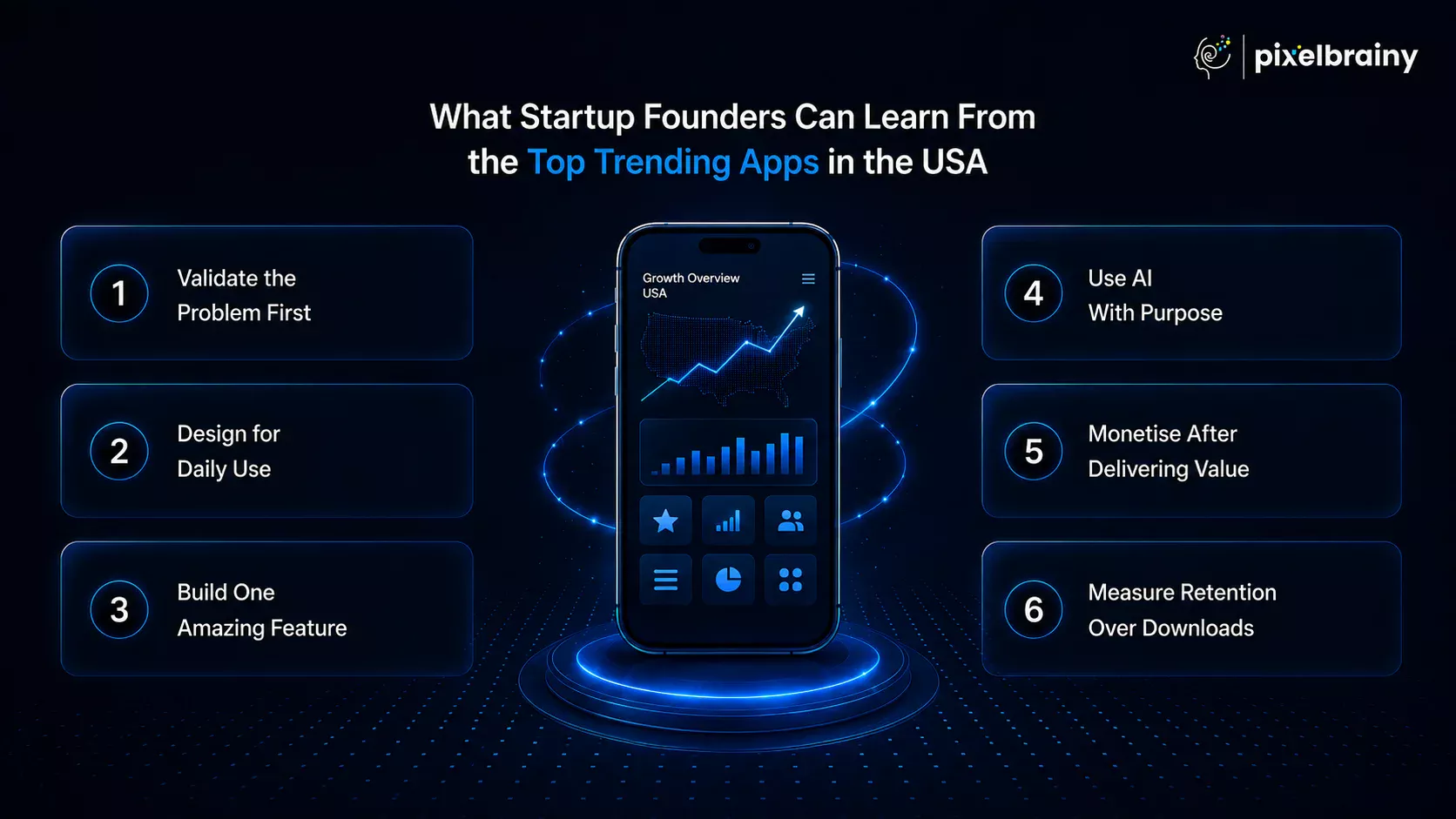
The best startup app development lessons are not about copying successful products but about following the principles that made them successful.
Founders who validate real customer problems, design products people use daily, build one exceptional feature, apply AI with purpose, monetise after delivering value, and prioritise retention over downloads are far more likely to achieve lasting app product market fit than those who simply follow short term market trends.
Every successful app begins with choosing the right market. While studying today's trending apps reveals what users currently love, founders also need to identify markets where demand is increasing faster than competition. The strongest opportunities are rarely found in overcrowded categories.
Instead, they emerge where consumer behaviour is changing, technology is creating new possibilities, and existing products still leave important customer problems unsolved. If you are researching the top apps to build in USA 2026 or looking for successful app ideas USA 2026, the categories below offer the strongest long-term potential for innovation and scalable growth.
Artificial intelligence has become a core part of modern business operations. Professionals are looking for smarter ways to automate repetitive work, improve productivity, and make faster decisions without changing the way they already work.
Instead of replacing employees, AI is becoming an intelligent assistant that improves efficiency across almost every industry. This shift continues driving demand for trending AI apps USA that solve practical business problems rather than simply showcasing new technology.
Instead of creating another general AI assistant, focus on specialised solutions that address industry specific workflows.
High potential opportunities include:
Most productivity platforms remain general purpose software. Businesses increasingly need industry specific AI solutions that understand their terminology, compliance requirements, and workflows. Startups that solve one business challenge exceptionally well often compete more effectively than products trying to serve every industry.
Build AI that removes repetitive work from one profession instead of trying to become another all-in-one productivity platform.
Healthcare is rapidly moving beyond hospitals and clinics into everyday digital experiences. Consumers now expect personalised healthcare, mental wellness support, fitness guidance, and preventive care directly from their smartphones.
The continued rise of remote consultations, wearable devices, and personalised wellness programmes is creating significant demand for innovative health apps USA that improve accessibility while helping users take greater control of their health.
Healthcare remains one of the largest untapped opportunities for startup innovation.
Potential products include:
Although digital healthcare has expanded rapidly, many existing platforms remain fragmented and difficult to navigate. There is growing demand for simpler, more personalised experiences that combine medical guidance, preventive care, and wellness into one seamless platform.
Focus on helping users improve everyday health outcomes instead of building another appointment booking application.
Consumers increasingly expect financial services to be instant, transparent, and mobile first. From budgeting and investing to digital banking and credit management, users want personalised financial experiences that simplify money management. This demand continues driving the growth of trending fintech apps, particularly those using AI to improve financial decision making and automate everyday financial tasks.
Financial technology continues offering multiple opportunities for innovation.
Promising areas include:
Many financial applications still overwhelm users with complicated dashboards and financial terminology. Products that make money management simple, educational, and personalised continue finding strong product market opportunities across different customer segments.
The future belongs to fintech products that reduce financial anxiety while helping users make smarter everyday decisions.
Learning has become a lifelong activity rather than something limited to schools and universities. Professionals continuously upgrade their skills, businesses invest in employee development, and students increasingly prefer personalised digital learning experiences. AI powered education is making learning faster, more interactive, and tailored to individual progress, creating excellent opportunities for founders.
Modern education extends far beyond traditional online courses.
Potential opportunities include:
Most education platforms still deliver identical content to every learner. Future success will belong to products that personalise lessons, measure learning progress, and adapt content according to each user's strengths and weaknesses.
Build educational products that help users achieve measurable outcomes rather than simply consuming more content.
Millions of creators now operate businesses through YouTube, TikTok, Instagram, podcasts, newsletters, and online communities. As competition increases, creators need smarter tools that reduce production time, improve audience growth, and simplify monetisation. This makes creator software one of the strongest categories among the top apps to build in USA 2026.
Creators need tools that automate repetitive work while improving content quality.
Opportunities include:
Most creator tools solve only one part of the workflow. Founders can build products that integrate planning, production, publishing, analytics, and monetisation into more connected creator experiences.
Help creators spend less time managing content and more time creating valuable experiences for their audiences.
Personal finance is evolving beyond simple budgeting. Consumers increasingly seek personalised guidance that helps them save, invest, reduce debt, and achieve long term financial goals. Younger generations especially prefer mobile first financial coaching over traditional banking advice, creating strong opportunities for innovative consumer finance applications.
Consumers want financial guidance that feels simple and actionable.
Potential opportunities include:
Many finance applications focus heavily on tracking numbers but provide limited decision support. Products combining education, automation, and personalised recommendations can create stronger long-term engagement.
Focus on improving financial confidence instead of simply displaying financial information.
Consumers increasingly rely on mobile apps to discover nearby businesses, book local services, and support neighbourhood communities. Small businesses are also looking for affordable digital platforms that help them compete without relying entirely on large marketplaces.
Location based services continue expanding across multiple industries.
Examples include:
Many communities still lack specialised local platforms tailored to regional businesses and customer needs. Founders can create strong network effects by solving problems within specific cities or industries before expanding nationally.
Build trusted digital ecosystems that connect local businesses with nearby customers more efficiently.
Travellers increasingly expect personalised planning instead of generic booking platforms. AI recommendations, itinerary automation, and local discovery are reshaping the travel experience before, during, and after every trip.
Modern travel extends beyond flights and hotels.
Potential opportunities include:
Traditional travel platforms primarily focus on bookings. There is growing demand for intelligent travel assistants that simplify planning, improve personalisation, and support travellers throughout their complete journey.
Help travellers make better decisions instead of simply helping them make reservations.
Businesses continue increasing investment in software that improves productivity, reduces operational costs, and automates manual processes. Unlike many consumer applications, B2B SaaS products often generate recurring subscription revenue, higher customer lifetime value, and more predictable business growth.
Business software remains one of the strongest startup opportunities.
Potential products include:
Many companies still rely on disconnected software solutions that create inefficiencies. Founders who simplify complex business workflows through automation and AI can build highly scalable subscription businesses.
Solve one expensive business problem exceptionally well before expanding into adjacent markets.
The next generation of successful app ideas USA 2026 will come from founders who identify growing markets before they become saturated. Whether you focus on trending
AI apps USA, health apps USA, trending fintech apps, B2B SaaS, creator tools, or digital wellness, the greatest opportunity lies in solving specific customer problems with simple, scalable, and user focused products rather than competing directly with today's biggest apps.

Many founders researching the top trending apps USA ask the same question: "If these apps are growing so quickly, should I build something similar?" The answer is usually no. The founders behind today's market leaders did not become successful by copying existing products.
They identified changing customer behaviour, validated real market demand, and built solutions that addressed specific problems better than anyone else. If you are analysing what are the top 10 trending apps in USA in 2026 to decide what to build next, your objective should be understanding the strategies behind their success rather than replicating their features.
The following mistakes repeatedly prevent startups from achieving app product market fit, even when they enter fast growing markets. Learning how to avoid these pitfalls will help you turn market research into a product that customers genuinely want to use and pay for.
Many founders see a feature becoming popular and immediately try to recreate it. Whether it is AI chat, short form videos, social feeds, or gamification, they assume copying the experience will produce similar results.
Unfortunately, users do not adopt products because they have trendy features. They adopt products because those features solve a meaningful problem.
Instead of asking:
"How can we build something like TikTok or ChatGPT?"
Ask:
"What customer problem made these products valuable in the first place?"
A feature should always support the problem you are solving, not become the product itself.
Successful startups copy customer problems, not competitor features.
One of the fastest ways to waste time and money is building an app before confirming that customers actually want it.
Many founders become emotionally attached to an idea without speaking to potential users. By the time they launch, they discover that the problem is either too small or already solved better by existing products.
Before building your MVP, validate your assumptions.
Practical validation methods include:
Real customer conversations often reveal opportunities that market reports never will.
Validate demand before investing heavily in development.
The market should approve your idea before your development team builds it.
Artificial intelligence has become one of the biggest app development trends USA 2026, but not every product becomes better by adding AI.
Many startups include AI simply because investors, competitors, or the media expect it.
The best AI experiences solve practical problems such as:
If AI does not improve the customer experience, it probably does not belong in the product.
Use AI only where it creates measurable value for users.
Customers remember the outcome AI delivers, not the technology behind it.
Every additional step during onboarding increases the chance of losing a new user.
Long registration forms, mandatory profile setup, unnecessary permissions, and complicated tutorials create friction before customers experience any real value.
The fastest growing apps focus on helping users achieve their first success as quickly as possible.
Strong onboarding usually includes:
Users should understand why the app matters within the first few minutes.
Reduce friction until users experience value before asking for commitment.
The best onboarding feels invisible because users stay focused on their goals, not your interface.
Many founders introduce subscriptions, advertisements, or premium upgrades before users have experienced enough value to justify paying.
This approach often reduces trust and increases churn.
Most successful apps follow a different sequence.
They:
Customers are far more willing to pay once they understand how the product improves their daily lives.
Let customer satisfaction drive monetisation instead of forcing early revenue.
Revenue is a result of value creation, not the starting point of it.
Many startup founders believe a larger target audience means greater success.
In reality, broad positioning usually creates products that fail to resonate with anyone.
Instead of serving everyone, identify one customer segment with an urgent problem.
Ask yourself:
Winning a niche market often creates a stronger foundation for long term expansion.
Become indispensable for one audience before expanding into others.
The strongest products are built for a specific customer before they become products for everyone.
Many founders celebrate download milestones while ignoring the metrics that actually determine business success.
An app with one million downloads but poor retention creates little long term value.
A smaller user base that returns every day often generates higher revenue, stronger referrals, and better customer feedback.
Track metrics that reflect genuine product value, including:
Retention is one of the clearest indicators that your product has achieved real market demand.
Optimise for repeat usage before increasing acquisition budgets.
Downloads create awareness, but retained users create sustainable businesses.
The founders behind today's top trending apps USA did not succeed by chasing trends. They succeeded by solving validated customer problems, building products that users wanted to return to every day, and improving those products through continuous customer feedback.
If you want to build the next successful mobile app, let market research guide your decisions, but let customer problems shape your product. That approach will always outperform copying the latest trend.
Not every trending app represents a good startup opportunity. Some products succeed because they entered the market early, benefited from strong network effects, or invested heavily in customer acquisition over many years.
As a founder, your objective is not to copy what is already successful. It is to determine whether there is still room to build a better solution or solve an adjacent problem. Before investing time and money into development, evaluate your idea using a structured framework.
The following six criteria can help you identify whether an app idea has the potential to achieve long term product market fit, sustainable growth, and commercial success.
Every successful startup begins with a real customer problem.
The first question is not whether your app idea sounds exciting. It is whether enough people actively need a solution.
Start by understanding your target audience.
Ask questions such as:
Use multiple validation sources before making development decisions.
Useful research methods include:
✔ The problem is frequent.
✔ Existing solutions have obvious limitations.
✔ Customers are actively searching for alternatives.
Competition should not discourage you.
In fact, competition often validates market demand.
The important question is whether you can offer a better experience, target a different audience, or solve the problem more effectively.
Evaluate competitors by analysing:
Look beyond the biggest companies.
Smaller competitors often reveal opportunities that larger platforms overlook.
✔ You have identified clear market gaps.
✔ Your value proposition is different.
✔ Customers have unmet needs competitors are not addressing.
Many founders build products that users enjoy but struggle to generate sustainable revenue.
Before development begins, understand how the business will eventually make money.
Common monetisation models include:
More importantly, ask:
The strongest businesses combine customer value with predictable revenue.
✔ Customers clearly understand the value.
✔ Revenue grows alongside customer usage.
✔ Pricing supports long term business growth.
A brilliant idea can still fail if the first version becomes too expensive or takes years to build.
Many successful startups launched with a focused Minimum Viable Product before expanding into larger platforms.
Evaluate technical complexity by considering:
Ask yourself:
"What is the smallest version that still solves the customer's core problem?"
Building faster often creates more learning than building bigger.
✔ An MVP can launch quickly.
✔ Core functionality is clearly defined.
✔ Future features can be added gradually.
Downloads create awareness.
Retention creates businesses.
The best products become part of users' daily or weekly routines.
Before building your app, consider why customers would continue returning after installation.
Questions worth asking include:
Products with strong retention generally require lower acquisition costs and achieve higher customer lifetime value.
✔ Users have reasons to return regularly.
✔ The product becomes more valuable over time.
✔ Long term engagement is built into the experience.
Some ideas solve problems for a small audience but struggle to expand.
Scalable businesses grow without increasing costs at the same rate.
Consider questions such as:
Scalability should be considered from the beginning, even if the first version targets a niche audience.
✔ Growth does not require proportional cost increases.
✔ Expansion opportunities already exist.
✔ The technology supports future scale.
| Evaluation Factor | Key Question | Strong Signal |
|---|---|---|
| Market Demand | Are people actively looking for this solution? | High search demand and validated customer pain points |
| Competitive Landscape | Can you offer something meaningfully different? | Clear differentiation and identifiable market gaps |
| Monetisation Potential | Will customers pay for the value you provide? | Recurring revenue opportunities and sustainable pricing |
| Technical Complexity | Can an MVP be built efficiently? | Fast development with a focused feature set |
| User Retention Potential | Will users continue returning after installation? | Habit forming experiences and recurring engagement |
| Scalability | Can the business grow efficiently over time? | Expandable product, automation, and larger market opportunities |
Note*: Before committing to development, score your idea from 1 to 5 for each evaluation factor. If your app performs well across most categories, it has a stronger chance of achieving sustainable growth. If several areas score poorly, refine the concept before investing significant time and resources.
The top trending apps USA were not built on assumptions or short-term market hype. They succeeded because their founders validated customer demand, identified clear market opportunities, developed sustainable business models, prioritised retention, and built products that could scale over time.
Following this evaluation framework will help you make smarter product decisions and increase the likelihood of building an app that customers genuinely need, use, and recommend.
Identifying a promising app idea is only the beginning. The real challenge is transforming that idea into a product that users adopt, investors recognise, and businesses can scale. Many startups fail not because the idea lacks potential, but because they skip market validation, build unnecessary features, overlook user experience, or struggle to launch effectively. This is where choosing the right technology partner becomes a strategic advantage. If you are inspired by the top trending apps USA and wondering how to build the next successful product, working with an experienced development team can significantly reduce risk while accelerating your path from idea to market.
At PixelBrainy, we help startups, entrepreneurs, and enterprises transform validated ideas into scalable digital products. As a leading mobile app development company, our focus extends beyond writing code. We combine product strategy, user research, AI innovation, and scalable engineering to help founders build applications that solve real customer problems and support long term business growth.
Many founders approach development with a solution already in mind. At PixelBrainy, we begin by understanding the problem.
Before development starts, our team works closely with founders to answer critical questions such as:
This validation first approach reduces unnecessary development costs while improving the chances of achieving strong product market fit.
Successful startups rarely launch with fully featured products.
Instead, they launch focused MVPs that validate assumptions, collect customer feedback, and evolve based on real usage.
Our MVP development approach helps founders:
Rather than building everything at once, we help founders build the right product first.
Artificial intelligence should improve user experiences, not complicate them.
Whether you are building a productivity platform, healthcare application, fintech solution, or creator tool, our team integrates AI where it delivers measurable value.
Our AI capabilities include:
Every AI feature is designed around solving business problems rather than following technology trends
Downloads create visibility.
User experience creates retention.
Our UX and UI design process focuses on reducing friction, improving usability, and helping users experience value from their very first interaction.
Every design decision is guided by:
The goal is not simply creating attractive interfaces. It is creating experiences that users enjoy returning to.
Many applications perform well during launch but struggle as user numbers increase.
PixelBrainy develops products with future growth in mind by creating scalable architectures that support expanding user bases, feature enhancements, and business growth without requiring complete redevelopment.
Our development approach includes:
This ensures your application is prepared for growth long after launch.
Launching an application is not the finish line.
It is the beginning of product growth.
Our team continues supporting founders through every stage of their journey.
Growth support includes:
As your business evolves, your product evolves with it.
One of our recent startup clients approached us with an early-stage idea for an AI powered workforce management platform. The concept had strong potential but lacked market validation, a clear feature roadmap, and a scalable technical architecture.
Our team worked closely with the founders to:
Within the first few months after launch, the platform achieved strong user adoption, improved operational efficiency for its target customers, and provided the founders with valuable product insights that shaped the next phase of development. While specific details remain confidential under our client agreement, the project demonstrates how combining strategy, technology, and continuous iteration can significantly improve startup outcomes.
Working with PixelBrainy means partnering with a team that understands both technology and business growth.
We help founders:
Whether you are building an AI platform, fintech application, healthcare solution, marketplace, SaaS product, or the next category defining mobile app, our team helps transform ambitious ideas into successful digital products.
Ready to turn your app idea into a scalable product? Connect with PixelBrainy and let's build an application that solves real problems, delights users, and grows with your business.

The top trending apps USA offer much more than inspiration. They provide valuable insights into changing user behaviour, emerging market demands, and the product strategies that drive long term success. Instead of copying popular features or replicating existing platforms, founders should focus on understanding the real problems these apps solve and why users continue returning to them every day. The strongest products are built on validated customer needs, intuitive onboarding, meaningful user experiences, and retention strategies that create lasting engagement.
Whether you are exploring successful app ideas USA 2026 or planning to build one of the top apps to build in USA 2026, your success will depend on solving unmet customer needs better than anyone else. The next breakthrough app will not be another copy of today's market leaders. It will be a product that learns from their success while creating a unique solution for tomorrow's users.
Ready to turn your app idea into reality? Schedule a call with the experts at PixelBrainy to validate your concept, build a scalable MVP, and launch a future ready mobile application that is designed for long term growth.
The top 10 trending apps in the USA in 2026 include ChatGPT, TikTok, Duolingo, Notion AI, Chime, Headspace, Lemon8, Perplexity AI, CapCut, and Strava. These apps are leading the US market because they solve real user problems, deliver personalized experiences, encourage daily engagement, and continuously evolve based on changing customer needs rather than short term trends.
The top trending apps USA continue growing because they focus on user retention instead of downloads alone. They provide clear value within minutes, simplify everyday tasks, use AI with purpose, personalize user experiences, and continuously improve based on customer feedback. These strategies help them attract new users while keeping existing users highly engaged.
The most popular apps in USA teach founders that long term success comes from solving validated customer problems instead of copying competitors. Before building an app, founders should validate market demand, launch a focused MVP, prioritize user experience, and improve retention. These startup app development lessons increase the chances of achieving strong product market fit.
Some of the top apps to build in USA 2026 belong to high growth categories such as AI productivity, healthcare, fintech, education, creator economy, personal finance, travel technology, local commerce, and B2B SaaS. These industries continue expanding because customer expectations are changing, creating demand for innovative digital solutions with long term business potential.
Yes. Trending AI apps USA continue shaping the mobile app market by helping users automate repetitive tasks, improve productivity, generate content, and make better decisions. However, successful AI apps focus on solving specific customer problems instead of adding AI for marketing purposes. Practical AI experiences consistently outperform feature heavy products.
Strong app product market fit is achieved when your application solves a meaningful problem, attracts consistent user engagement, and retains customers over time. Founders should validate customer demand through interviews, competitor analysis, MVP testing, and retention metrics before investing in full scale app development or product expansion.
A professional mobile app development company helps founders validate ideas, define MVP features, build scalable applications, integrate AI, improve user experience, and support post launch growth. Working with an experienced development partner like PixelBrainy reduces development risks while increasing the likelihood of building one of the best apps in USA that delivers long term business success.

About The Author
Sagar Bhatnagar
Sagar Sahay Bhatnagar brings over a decade of IT industry experience to his role as Marketing Head at PixelBrainy. He's known for his knack in devising creative marketing strategies that boost brand visibility and market influence. Sagar's strategic thinking, coupled with his innovative vision and focus on results, sets him apart. His track record of successful campaigns proves his ability to utilize digital platforms effectively for impactful marketing efforts. With a genuine passion for both technology and marketing, Sagar continuously pushes PixelBrainy's marketing initiatives to greater success.

Working with the PixelBrainy team has been a highly positive experience. They understand the design requirements and create beautiful UX elements to meet the application needs. The dev team did an excellent job bringing my vision to life. We discussed usability and flow. Sagar worked with his team to design the database and begin coding. Working with Sagar was easy. He has the knowledge to create robust apps, including multi-language support, Google and Apple ID login options, Ad-enabled integrations, Stripe payment processing, and a Web Admin site for maintaining support data. I'm extremely satisfied with the services provided, the quality of the final product, and the professionalism of the entire process. I highly recommend them for Android and iOS Mobile Application Design and Development.

Great experience working with them. Had a lot of feedback and I found that unlike most contractors they were bugging me for updates instead of the other way around. They were extremely time conscience and great at communicating! All work was done extremely high quality and if not on time, early! They were always proactive when it comes to communication and the work is great/above par always. Very flexible and a great team to work with! Goes above and beyond to present us with multiple options and always provides quality. Amazing work per usual with Chitra. If you have UI/UX or branding design needs I recommend you go to them! Will likely work with them in the future as well, definitely recommended!

PixelBrainy is a joy to work with and is a great partner when thinking through branding, logo, and website layout. I appreciate that they spend time going into the "why" behind their decisions to help inform me and others about industry best practices and their expertise.

I hired them to design our software apps. Things I really like about them are excellent communication skills, they answer all project suggestions and collaborate right away, and their input on design and colors is amazing. This project was complex and needed patience and creativity. The team is amazing to do business with. I will be using them long-term. Glad to see there are some good people out there. I was afraid to try and outsource my project to someone but I am glad I met them! I really can't say enough. They went above and beyond on this project. I am very happy with everything they have done to make my business stand out from the competition.

It was great working with PixelBrainy and the team. They were very responsive and really owned the project. We'll definitely work with them again!

I recently worked with the PixelBrainy team on a project and I was blown away by their communication skills. They were prompt, clear, and articulate in all of our interactions. They listened and provided valuable feedback and suggestions to help make the project a success. They also kept me updated throughout the entire process, which made the experience stress-free and enjoyable.

PixelBrainy is very good at what it does. The team also presents themselves very professionally and takes care of their side of things very well. I could fully trust them taking up the design work in a timely and organised manner and their attention to detail saved us lots of effort and time. This particular project was quite intense and the team showed that they function very well under pressure. Very much looking forward to working with her again!

It's always an absolute pleasure working with them. They completed all of my requests quickly and followed every note I had for them to a T, which made our process go smoothly from start to finish. Everything was completed fast and following all of the guidelines. And I would recommend their services to anyone. If you need any design work done in the future, PixelBrainy should be your first call!

They took ownership of our requirements and designed and proposed multiple beautiful variants. The team is self-motivated, requires minimum supervision, committed to see-through designs with quality and delivering them on time. We would definitely love to work with PixelBrainy again when we have any requirements.

PixelBrainy was a big help with our SaaS application. We've been hard at work with a new UI/UX and they provided a lot of help with the designs. If you're looking for assistance with your website, software, or mobile application designs, PixelBrainy and the team is a great recommendation.

PixelBrainy designers are amazing. They are responsive, talented, and always willing to help craft the design until it matches your vision. I would recommend them and plan to continue them for my future projects and more!!!

They were awesome! Did a good job fast, and good communication. Will work with them again. Thank you

Creative, detail-oriented, and talented designers who take direction well and implement changes quickly and accurately. They consistently over-delivered for us.

PixelBrainy team is very talented and creative. Great designers and a pleasure to work with. PixelBrainy is an excellent communicator and I look forward to working with them again.

PixelBrainy has a very talented design team. Their work is excellent and they are very responsive. I enjoy working with them and hope to continue on all of our future projects.


Transform your ideas into reality with us.
Across these industries, each engagement brings unique challenges, from early-stage product development to scaling complex systems, helping us build a practical understanding of real-world product environments.