
 AI Summary Powered by PixelBrainy
Insurance fraud remains one of the most significant challenges facing the insurance industry today. According to industry research, insurance fraud losses are expected to exceed $308 billion in the United States alone in 2025, creating substantial financial and operational pressure on insurance providers. Simultaneously, the industry processes more than 500 million insurance benefit verification and claim-related phone calls every year, yet nearly 90% of these interactions are still handled manually. This reliance on traditional verification methods is becoming increasingly unsustainable in a highly competitive and customer-driven market.
The problem is straightforward but costly. Manual claim validation processes are often slow, labor-intensive, inconsistent, and vulnerable to fraudulent activities. Claims teams must spend significant time conducting phone interviews, verifying policy information, reviewing supporting documents, and cross-checking claim details. As claim volumes continue to increase, these manual workflows not only delay claim approvals but also drive-up operational costs and increase the likelihood of human error.
To address these challenges, many insurers are turning to voice AI agent development for insurance claim validation as a modern and scalable solution. By combining conversational AI, speech recognition, natural language processing (NLP), machine learning, and automated decision-making capabilities, voice AI agents can validate claims over phone calls, identify suspicious patterns, gather critical information, and accelerate approval workflows with minimal human intervention. Organizations focused on building voice AI agents to reduce insurance fraud are already experiencing improvements in efficiency, fraud detection accuracy, customer experience, and operational scalability.
If you are wondering, "We are planning to build a voice AI system for our insurance startup that can automatically validate claims over a phone call, where do we start and who can help us develop this?", this guide is designed for you. Throughout this blog, we will explore what these systems are, how they work, the development process of voice AI agent for insurance claim validation, implementation costs, compliance requirements, technology stacks, and expected business returns.
By the end of this blog, you will have a clear roadmap for voice AI agent development for insurance claim validation that helps reduce fraud, streamline operations, and accelerate claim approvals.
A Voice AI Agent for Insurance Claim Validation is an intelligent software system that can independently conduct phone conversations with claimants, verify claim information, assess potential fraud risks, and determine the next step in the claims process without requiring constant human involvement. Unlike traditional call center workflows, the AI agent can understand natural speech, ask follow-up questions, access insurance databases in real time, and make informed decisions based on predefined business rules and machine learning models.
In simple terms, it functions as a virtual claims representative that is available 24/7 to validate claims quickly, consistently, and at scale.
It is important to distinguish a voice AI agent from older technologies such as Interactive Voice Response (IVR) systems and basic chatbots. Traditional IVR systems rely on rigid menu options like "Press 1 for claims" or "Press 2 for policy support." They cannot understand complex conversations or adapt to different claimant responses. Similarly, basic chatbots are limited to text-based interactions and predefined scripts. A modern voice AI agent can engage in dynamic, human-like conversations, understand context, ask clarifying questions, and respond intelligently based on the information provided by the claimant.
The core capabilities of a voice AI agent for insurance claim validation typically include:
For insurers focused on Building Voice AI Agents for Insurance Claims, these capabilities enable faster claim processing while improving fraud detection accuracy and reducing operational costs.
This combination of conversational intelligence, automation, and fraud detection makes voice AI agents one of the most effective technologies for modern insurance claim validation.
Successful voice AI agent development for insurance claim validation requires much more than speech recognition and automated phone calls. Modern insurance voice AI systems operate through multiple interconnected technology layers that work together to validate claims, identify fraud risks, access policy data, and make intelligent routing decisions in real time. Understanding this architecture is essential for organizations interested in Building Voice AI Pipelines for End-to-End Insurance Claims Processing.
The telephony layer serves as the communication gateway between claimants and the AI system. It manages inbound and outbound calls, call routing, session management, and secure voice transmission.
Modern implementations use SIP trunking infrastructure combined with SRTP (Secure Real-time Transport Protocol) encryption to protect sensitive claimant conversations. This layer also handles call queuing, failover routing, call recording, and omnichannel communication workflows.
Popular platforms include:
The telephony layer ensures reliable and secure call connectivity while supporting thousands of simultaneous claim validation interactions.
Once a call is connected, the ASR engine converts the claimant's spoken responses into text in real time.
For example, if a claimant says, "My vehicle was damaged in a rear-end collision last Friday," the ASR system instantly transcribes the statement into structured text that downstream AI systems can analyze.
Leading ASR technologies include:
High-quality ASR is critical because claim validation accuracy depends on precise speech interpretation.
After speech is converted to text, the NLU layer interprets the claimant's meaning.
Rather than simply recognizing words, the system identifies:
This process uses intent mapping, slot filling, and entity extraction techniques to transform conversational data into structured claim information that can be validated against policy records.
The dialogue management layer acts as the brain of the conversation.
It determines:
For example, if a claimant provides partial information, the AI can intelligently request clarification rather than restarting the verification process.
Common technologies include:
This layer enables human-like, multi-turn conversations that adapt dynamically to claimant responses.
A voice AI agent cannot validate claims without access to enterprise systems.
The backend integration layer connects the conversation engine with:
During a live call, APIs retrieve policy information, verify coverage eligibility, confirm claimant identity, and validate claim details in real time.
This allows the AI agent to make informed decisions while the conversation is still taking place.
Fraud detection is often the most valuable component of voice AI agent development for insurance claim validation.
This layer combines behavioral analytics, machine learning models, and voice intelligence technologies to identify suspicious patterns.
Key capabilities include:
For example, if a claimant's statements conflict with historical records or exhibit unusual behavioral indicators, the system can automatically assign a higher fraud risk score and route the case for manual investigation.
After processing claimant responses and retrieving relevant information, the AI must communicate naturally.
The Text-to-Speech layer converts system-generated responses into realistic spoken language.
Examples include:
Leading TTS providers include:
Modern neural voice technologies create highly natural and professional customer experiences that closely resemble human agents.
Insurance organizations operate in heavily regulated environments, making compliance a critical architectural requirement.
Every interaction must be documented and traceable.
The audit and compliance layer records:
This creates a complete audit trail from initial claimant contact through final claim resolution, supporting regulatory compliance, internal investigations, quality assurance, and legal review requirements.
This multi-layer architecture enables insurers to automate claim validation at scale while improving accuracy, accelerating approvals, strengthening compliance, and significantly reducing fraud exposure.
Also Read: How to Build an AI Chatbot for Insurance Agencies?
Insurance carriers are under increasing pressure to process claims faster, reduce operating costs, and strengthen fraud prevention capabilities. As a result, voice AI is becoming a strategic technology investment across the industry. From First Notice of Loss (FNOL) intake to claim verification and fraud detection, insurers are deploying AI-powered voice agents to automate critical workflows while delivering faster and more consistent customer experiences.
The market momentum behind this shift is substantial. According to recent industry research, the global conversational AI market is projected to grow from $17.97 billion in 2026 to more than $82 billion by 2034, driven by enterprise adoption across customer service, healthcare, financial services, and insurance.
At the leadership level, AI investment continues to accelerate. Recent insurance industry surveys reveal that 73% of insurance CEOs identify AI as one of their top investment priorities, with most expecting measurable business returns within the next one to three years.
Insurance companies are investing in voice AI because it directly addresses some of the industry's most persistent operational challenges:
| Challenge | How Voice AI Helps? |
|---|---|
| Slow claim validation processes | Automates information gathering and verification workflows |
| High FNOL call volumes | Handles thousands of inbound and outbound claim calls simultaneously |
| Rising fraud activity | Detects suspicious behavior patterns during live conversations |
| Increasing operational costs | Reduces dependency on large claims support teams |
| Customer service delays | Provides instant 24/7 claim assistance and status verification |
| Scaling during catastrophe events | Maintains service levels without additional staffing requirements |
Organizations implementing voice AI for claims operations are reporting measurable improvements across multiple business functions:
A regional auto insurer may receive thousands of First Notice of Loss reports following a severe weather event. Instead of expanding call center capacity, voice AI agents can immediately answer incoming calls, collect accident details, verify policy information, and initiate claim workflows automatically. This reduces customer wait times while ensuring claims move through the system faster.
Health insurance providers often process large volumes of benefit verification and claim-related inquiries every day. Voice AI agents can verify member eligibility, confirm coverage details, authenticate claimant information, and resolve routine inquiries around the clock, helping eliminate operational bottlenecks.
For property and casualty insurers, fraud remains a major financial risk. Voice AI systems equipped with behavioral analytics can identify response inconsistencies, unusual speech patterns, excessive hesitation, and other fraud indicators during live conversations. High-risk claims can then be automatically escalated for manual review before payments are approved.
The business value of voice AI extends beyond automation. Insurance organizations are using these systems to improve operational efficiency, strengthen compliance, enhance customer satisfaction, and reduce claim leakage caused by fraud. Recent industry studies indicate that insurers expect AI-driven initiatives to deliver operational cost reductions exceeding 20% over the coming years.
For this reason, developing AI Voice Bots for Claim Validation has become a strategic priority for insurers seeking to build scalable, efficient, and fraud-resistant claims operations. Companies that invest in voice AI today are positioning themselves to deliver faster claim approvals, lower operating costs, and superior customer experiences while preparing for the next generation of insurance automation.
As insurers continue developing a voice AI system to accelerate claim approvals, the focus is shifting from simple call automation to intelligent claim validation workflows. Modern voice AI agents can participate in multiple stages of the claims lifecycle, helping carriers reduce manual effort, improve customer experiences, and strengthen fraud prevention measures. Below are the most impactful use cases driving adoption across the insurance industry.
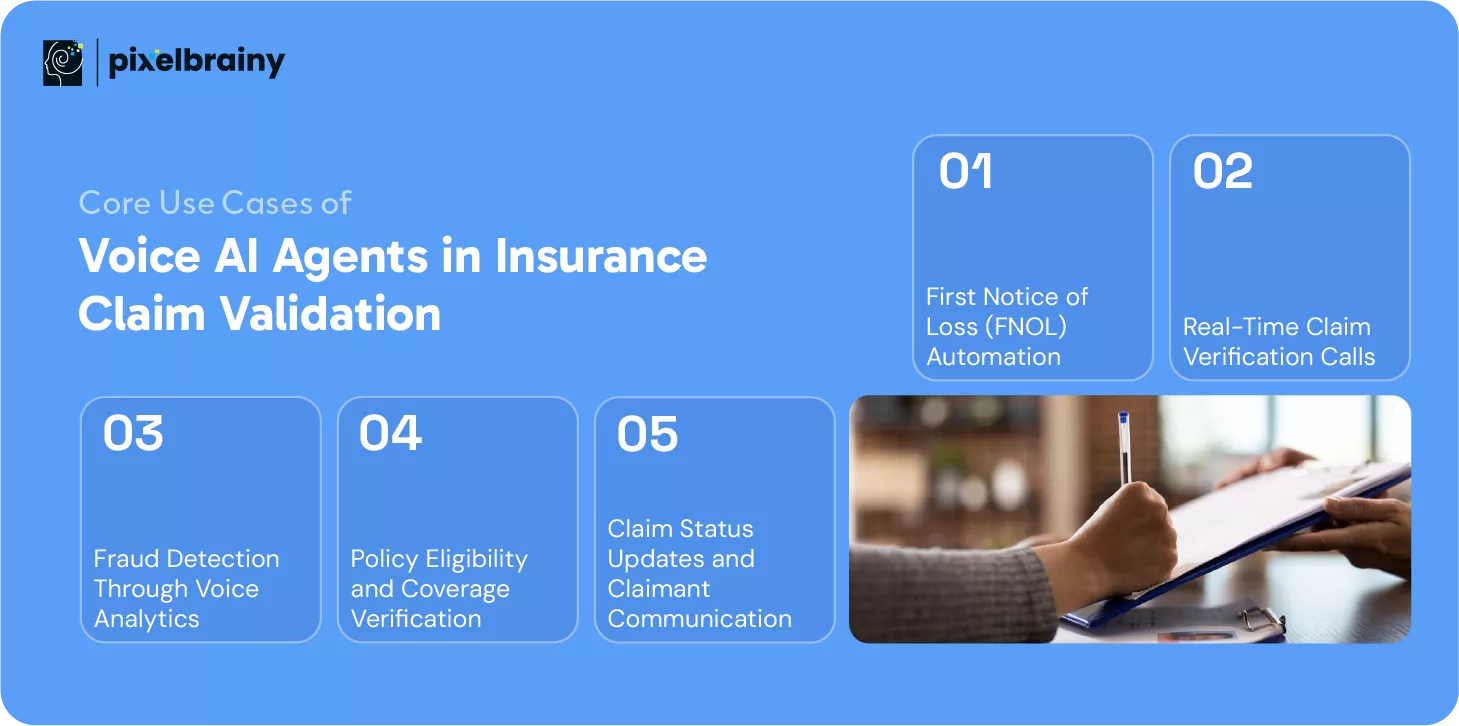
First Notice of Loss is often the first interaction between a policyholder and an insurer after an incident occurs. Traditionally, this process requires lengthy conversations with customer service representatives to collect claim information and initiate the claims process.
Voice AI agents can automate the entire FNOL workflow by guiding policyholders through a structured conversation over the phone. The AI collects critical information such as incident date, location, type of loss, involved parties, and supporting details while simultaneously verifying policy information. The collected data is then automatically documented within CRM and claims management systems, eliminating manual data entry and reducing processing delays.
This allows insurers to initiate claims faster while ensuring consistency and accuracy across every claim intake interaction.
One of the most valuable applications of voice AI is conducting outbound claim verification calls.
After a claim is submitted through a website, mobile app, or agent, the voice AI system can proactively contact the claimant to validate the information provided. During the conversation, the AI cross-checks spoken responses against submitted forms, policy records, and existing claim documentation.
Any discrepancies between verbal statements and documented information can be flagged instantly for further investigation. This automated verification process significantly reduces the workload on claims teams while accelerating claim assessments.
Insurance fraud remains a major financial challenge, making voice AI development for insurance fraud prevention a high-priority investment for carriers.
Advanced voice AI systems analyze more than just claimant responses. They evaluate behavioral and acoustic indicators that may suggest fraudulent activity.
Including:
These signals are combined with historical claim data and fraud detection models to generate risk scores. Cases identified as potentially suspicious are automatically routed for secondary human review, helping insurers make voice AI agents that detect fraudulent insurance claims before payouts occur.
Claim validation requires accurate verification of policy coverage and eligibility. Voice AI agents can connect directly to policy administration systems and perform real-time coverage checks while speaking with claimants.
During the conversation, the AI can instantly verify:
This real-time verification capability reduces processing delays and enables faster decision-making throughout the claims workflow.
A significant percentage of inbound calls received by insurers involve claim status inquiries and document follow-ups. Voice AI agents can proactively handle these communications through automated outbound calls.
The system can notify claimants about:
By automating routine claimant communication, insurers can reduce inbound call volumes by 40% to 60% while improving customer satisfaction through timely and consistent updates.
As insurers continue creating voice AI solutions for faster insurance claims processing, these use cases demonstrate how voice AI can transform claim validation from a manual, reactive process into an intelligent, scalable, and fraud-resistant operation.
When organizations begin voice AI agent development for insurance claim validation, one of the most common questions is: "We are planning to build a voice AI system for our insurance startup that can automatically validate claims over a phone call, where do we start and who can help us develop this?" The answer starts with understanding the essential features that separate a basic voice bot from an enterprise-grade insurance claim validation platform.
Insurance claim validation is a high-risk, highly regulated process that requires accuracy, security, scalability, and intelligent decision-making. A successful solution must do much more than answer calls. It should verify claim details, detect fraud indicators, integrate with policy systems, support compliance requirements, and provide a seamless experience for policyholders. Whether your goal is to build scalable voice AI for high-volume insurance claims or focus on developing multilingual voice AI for global insurance claim validation, the right feature set will determine the effectiveness and long-term success of your implementation.
The following features should be considered mandatory when planning a modern voice AI solution for insurance claim validation.
| Feature | Why It Matters? |
|---|---|
| Natural Language Understanding (NLU) | The system must understand claimant intent, context, and meaning rather than simply recognizing spoken words. Advanced NLU enables accurate claim validation conversations, improves response quality, and reduces misunderstandings during critical claim-related interactions. |
| Real-Time Speech Recognition | High-quality speech-to-text conversion is essential for capturing claimant responses accurately. Real-time transcription allows the AI to process information instantly, maintain natural conversations, and support faster decision-making during live claim verification calls. |
| Intelligent Dialogue Management | Insurance conversations rarely follow a fixed script. Dialogue management enables the AI to handle multi-step discussions, ask follow-up questions, maintain context, and adapt dynamically based on claimant responses throughout the validation process. |
| Policy Database Integration | Direct integration with policy administration systems allows the AI to verify coverage details, policy status, deductibles, exclusions, and eligibility in real time. This eliminates delays and improves claim validation accuracy significantly. |
| Claims Management System Connectivity | The voice AI should connect seamlessly with existing claims platforms to retrieve claim records, update case information, document interactions, and automate workflow actions without requiring manual intervention from staff members. |
| Fraud Detection Intelligence | One of the most valuable capabilities is identifying suspicious behavior patterns. The system should analyze claimant responses, compare information against historical data, detect inconsistencies, and support voice AI development for insurance fraud prevention initiatives. |
| Voice Analytics and Behavioral Monitoring | Beyond spoken words, advanced systems analyze tone changes, hesitation patterns, speech consistency, confidence levels, and unusual behavioral indicators that may suggest fraud or require additional investigation before claim approval. |
| Automated Identity Verification | Before discussing claim information, the AI should verify claimant identity using multiple factors such as policy details, personal information, voice biometrics, or authentication workflows to prevent unauthorized access and fraudulent activity. |
| Multilingual Conversation Support | Organizations developing multilingual voice AI for global insurance claim validation need support for multiple languages, regional accents, and localized claim workflows. This enables insurers to serve diverse customer populations while maintaining consistent service quality. |
| Human Agent Escalation | Not every claim can be resolved automatically. The system should intelligently transfer complex, disputed, or high-risk cases to human adjusters while preserving conversation history and collected information for seamless handoffs. |
| Omnichannel Communication Capabilities | Modern claim validation often spans voice calls, SMS, email, mobile apps, and customer portals. A connected omnichannel experience ensures claimants receive consistent communication regardless of their preferred interaction channel. |
| Compliance and Audit Logging | Every interaction should be recorded, transcribed, timestamped, and stored securely. Comprehensive audit trails support regulatory requirements, internal investigations, quality assurance reviews, and legal documentation needs. |
| High-Volume Scalability | Insurance providers handling thousands of daily claims must build scalable voice AI for high-volume insurance claims. The platform should support concurrent conversations, automatic scaling, peak demand management, and disaster recovery capabilities. |
| Analytics and Performance Dashboards | Decision-makers need visibility into claim outcomes, fraud rates, call volumes, escalation frequency, customer satisfaction metrics, and operational efficiency. Real-time reporting enables continuous optimization and measurable business improvements. |
| AI-Powered Decision Support Engine | Advanced voice AI solutions should provide automated recommendations based on claim data, policy rules, risk scores, and fraud indicators. This helps accelerate approvals while ensuring decisions remain consistent and compliant with business policies. |
That's why selecting these right combination of these features is the foundation of successful voice AI agent development for insurance claim validation, enabling insurers to reduce fraud, improve customer experiences, and process claims with greater speed, accuracy, and scalability.
Building a production-ready voice AI solution for insurance claim validation requires much more than integrating speech recognition and voice responses. Insurance organizations must create a secure, compliant, and intelligent platform capable of handling sensitive customer conversations, verifying policy information, detecting fraud indicators, and integrating seamlessly with existing enterprise systems.
Many insurers begin this journey after realizing the limitations of traditional automation systems. A common scenario is: "We already have a basic IVR system for claims but we are looking to upgrade it to a fully intelligent voice AI agent that can validate claims and detect fraud, who can help us develop this upgrade?" The answer lies in following a structured development roadmap that combines insurance expertise, AI engineering, compliance planning, and user experience design.
The following process outlines a proven approach for voice AI agent development for insurance claim validation.
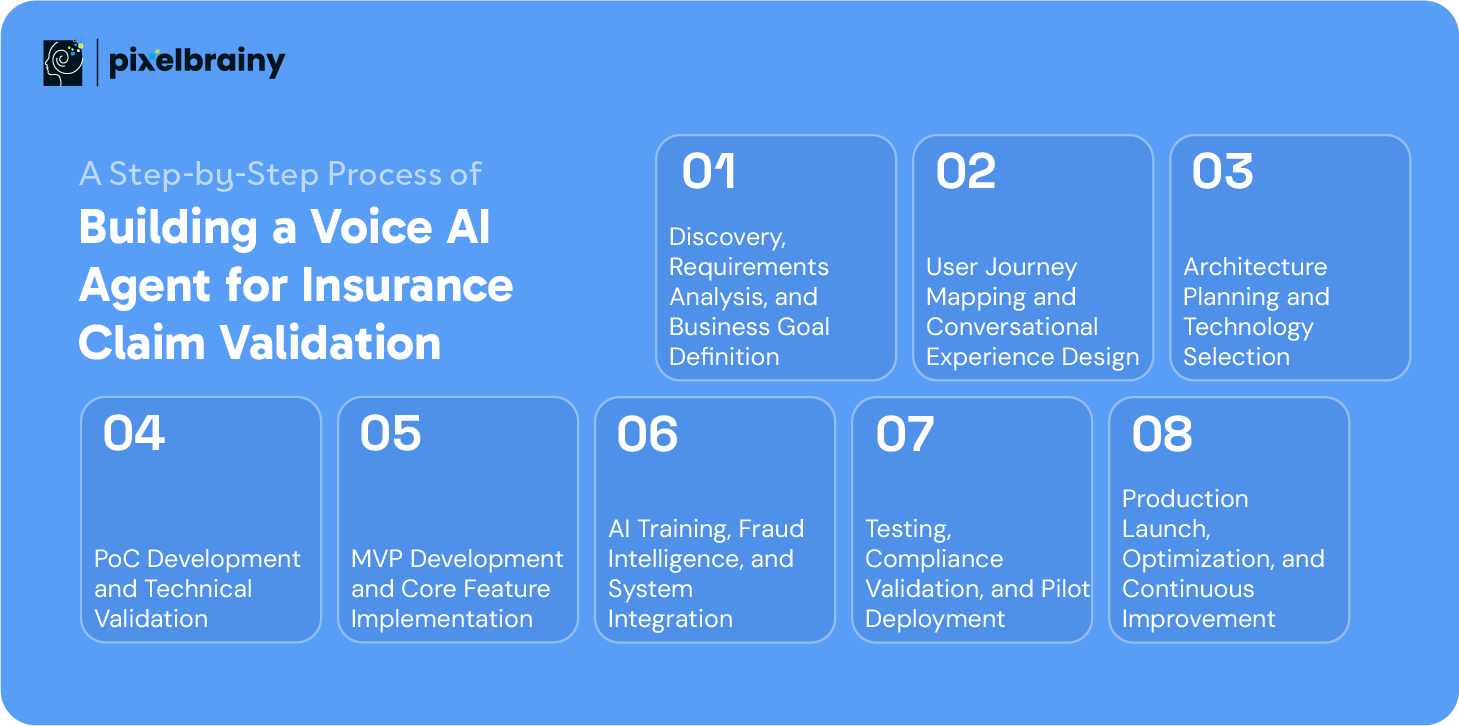
Every successful project begins with a comprehensive discovery phase. During this stage, stakeholders identify the business objectives, operational challenges, compliance requirements, and success metrics for the voice AI solution.
Teams analyze existing claims workflows, call center operations, fraud detection processes, and customer service bottlenecks. This helps determine where automation can deliver the greatest value. Key questions include claim volumes, average handling times, fraud rates, escalation requirements, and integration needs.
The discovery phase also defines project scope, user journeys, technology constraints, and expected business outcomes. Establishing clear objectives early helps prevent costly development changes later while ensuring the final solution aligns with organizational goals.
Once requirements are defined, the next phase focuses on designing the claimant experience.
A specialized UI/UX design company typically collaborates with business analysts, claims experts, and AI architects to map conversational journeys for various claim scenarios. These may include auto insurance claims, health insurance verification, property damage reports, and fraud investigation workflows.
Design teams create detailed conversation flows, escalation paths, authentication processes, and fallback responses for unexpected claimant inputs. The objective is to ensure conversations feel natural while still collecting structured data required for claim validation.
Carefully designed conversation experiences significantly improve user satisfaction, completion rates, and claim processing efficiency.
After defining user journeys, development teams establish the technical foundation of the platform.
This includes selecting speech recognition providers, natural language processing frameworks, telephony infrastructure, cloud environments, fraud analytics engines, and integration technologies. Architects must also determine data storage strategies, API requirements, security controls, and scalability requirements.
Organizations planning creating HIPAA-compliant voice AI agents for health insurance claims must pay particular attention to data encryption, access controls, audit logging, and regulatory compliance requirements during this stage.
A well-designed architecture ensures the system can support future growth while maintaining reliability and security.
Before investing in full-scale implementation, organizations typically begin with PoC development to validate technical feasibility and business assumptions.
The proof of concept focuses on a limited use case, such as FNOL intake or claim verification calls. Development teams test speech recognition accuracy, conversation handling, policy system integrations, and fraud detection capabilities using real-world insurance scenarios.
This phase helps identify technical challenges early while providing measurable data on automation rates, user experience quality, and operational improvements. A successful proof of concept creates confidence among stakeholders and provides a strong foundation for broader implementation.
Following successful validation, teams move into MVP development, where the primary capabilities required for production use are built.
The minimum viable product generally includes speech recognition, conversational AI, policy verification, claims system integration, authentication workflows, fraud detection mechanisms, reporting dashboards, and escalation capabilities.
The objective is not to build every possible feature immediately. Instead, the MVP focuses on delivering measurable business value while minimizing complexity and development risk.
At this stage, insurers can effectively make a voice AI bot that validates insurance claims instantly while gathering valuable operational feedback for future enhancements.
Also Read: Top 10 AI MVP Development Companies in USA
With core functionality established, attention shifts toward improving intelligence and operational effectiveness.
Machine learning models are trained using historical claim records, customer interaction data, fraud cases, and policy information. The system learns to recognize claim patterns, identify suspicious behavior, and improve conversational accuracy over time.
Development teams integrate the platform with policy administration systems, CRM platforms, document repositories, fraud databases, and claims management solutions. These integrations enable real-time data access and decision-making during live claimant interactions.
This phase is especially important for organizations focused on building voice AI agents to reduce insurance fraud through proactive risk detection and automated investigation workflows.
Before production launch, extensive testing is required to ensure reliability, accuracy, and compliance.
Teams conduct functional testing, security testing, performance testing, conversation testing, and regulatory compliance reviews. Real insurance scenarios are simulated to validate system behavior under different claim conditions.
Pilot deployments are often introduced to a limited group of policyholders or specific claim categories. This controlled rollout provides valuable insights into customer interactions, automation performance, and operational impact before full deployment.
The pilot phase also helps refine fraud detection models and conversation flows based on real-world usage patterns.
Once pilot objectives are achieved, the system is deployed across broader insurance operations.
However, deployment is not the final stage. Continuous monitoring, performance optimization, AI retraining, and conversation analysis are essential for long-term success. Organizations regularly evaluate metrics such as claim processing times, fraud detection rates, automation percentages, escalation volumes, and customer satisfaction scores.
Many insurers also partner with specialized AI development firms or top AI product development companies in USA to support ongoing enhancements, compliance updates, and advanced feature development.
This continuous improvement approach ensures the voice AI platform evolves alongside changing customer expectations, regulatory requirements, and fraud trends.
By following this structured development roadmap, insurers can successfully implement intelligent voice AI systems that accelerate claim validation, strengthen fraud prevention, and deliver scalable long-term business value.
One of the most common questions insurance executives, startup founders, and innovation teams ask is: "How much does it cost to build a voice AI agent for insurance claim validation?" The answer depends on several factors, including the complexity of claim workflows, fraud detection capabilities, integration requirements, compliance obligations, language support, and scalability goals.
Organizations exploring How to Develop Low-Cost Voice AI Agents for Small Insurance Companies can start with a focused MVP and gradually expand functionality as adoption and business requirements grow. In contrast, large insurers often invest in enterprise-grade platforms capable of handling millions of conversations annually while meeting strict regulatory and security requirements.
| Solution Type | Typical Features | Estimated Cost |
|---|---|---|
| Basic MVP | Single claim type, one language, basic conversational flows, limited integrations, no advanced fraud detection | $15,000 to $40,000 |
| Mid-Tier Solution | Multiple claim types, CRM integration, policy database connectivity, fraud detection workflows, analytics dashboard | $40,000 to $100,000 |
| Enterprise-Grade Platform | Multi-language support, custom AI models, advanced fraud analytics, regulatory compliance controls, enterprise integrations, high-volume scalability | $100,000 to $250,000+ |
The final investment depends on factors such as conversation complexity, number of integrations, custom AI requirements, deployment environment, and security architecture.
Development costs represent only part of the overall investment. Insurance organizations should also budget for recurring operational expenses.
| Cost Category | Description |
|---|---|
| Platform Licensing Fees | Subscription costs for platforms such as Voiceflow, Retell AI, or enterprise conversational AI solutions. |
| ASR, NLU, and TTS API Usage | Charges associated with speech recognition, language understanding, and text-to-speech services based on call volume and usage. |
| Cloud Infrastructure | Hosting, storage, networking, monitoring, and disaster recovery resources. |
| Maintenance and Support | Bug fixes, performance optimization, system updates, and technical support. |
| AI Model Retraining | Continuous improvement of fraud detection models and conversational accuracy using new claim data. |
| Compliance Monitoring | Security audits, regulatory reviews, data governance, and compliance reporting activities. |
While the upfront investment may seem significant, the business case is often compelling for insurers processing large claim volumes.
Key ROI indicators commonly reported across the industry include:
| Factor | Build Custom Solution | Buy Existing Platform |
|---|---|---|
| Initial Investment | Higher | Lower |
| Deployment Speed | Longer development timeline | Faster implementation |
| Customization | Full flexibility and control | Limited by platform capabilities |
| Ownership | Complete ownership of code and intellectual property | Vendor-dependent |
| Scalability | Designed around specific business needs | Platform-dependent |
| Vendor Lock-In | None | Potential long-term dependency |
| Long-Term Cost | Lower over time for large deployments | Ongoing subscription and usage fees |
For insurance startups and smaller carriers, platform-based solutions can provide a faster route to market. However, organizations with complex workflows, strict compliance requirements, or long-term scalability goals often benefit from investing in a custom-built solution that provides full control, flexibility, and ownership.
Ultimately, the right investment strategy depends on your claim volume, compliance requirements, growth plans, and long-term vision for insurance automation.
The success of voice AI agent development for insurance claim validation depends heavily on the underlying technology stack powering the solution. Insurance claim validation requires much more than speech recognition and automated phone calls. The platform must be capable of understanding claimant intent, verifying policy information in real time, detecting fraud indicators, maintaining regulatory compliance, and integrating with multiple enterprise systems simultaneously.
Organizations planning to build scalable voice AI for high-volume insurance claims must invest in technologies that can handle thousands of concurrent conversations while maintaining high accuracy and low latency. Similarly, insurers focused on developing multilingual voice AI for global insurance claim validation need platforms that support multiple languages, regional accents, and localized compliance requirements. The ideal technology stack combines conversational AI, telephony infrastructure, fraud detection systems, cloud services, and enterprise integrations to create an end-to-end claims validation ecosystem.
| Technology Layer | Recommended Tools | Purpose |
|---|---|---|
| Telephony & Voice Infrastructure | Twilio Voice, Telnyx, Amazon Connect, Vonage | Handles inbound and outbound calls, SIP connectivity, call routing, recording, and secure voice communication between claimants and the AI system. |
| Speech Recognition (ASR) | Deepgram, Google Speech-to-Text, AWS Transcribe, OpenAI Whisper | Converts claimant speech into structured text in real time, enabling accurate claim validation conversations and information extraction. |
| Natural Language Understanding (NLU) | OpenAI GPT-4o, Claude, Google Dialogflow CX, Microsoft LUIS | Interprets claimant intent, identifies insurance-related entities, extracts claim information, and understands conversational context. |
| Conversation Management Engine | Voiceflow, Rasa, LangGraph, LangChain | Manages multi-turn conversations, workflow orchestration, context retention, and intelligent dialogue handling throughout the claim validation process. |
| Text-to-Speech (TTS) | ElevenLabs, Amazon Polly, Azure Speech, Google TTS | Converts AI-generated responses into natural-sounding voice interactions for policyholders and claimants. |
| Fraud Detection Engine | SAS Fraud Management, DataRobot, IBM SPSS, Custom AI Models | Analyzes behavioral patterns, claim inconsistencies, and fraud indicators to identify potentially suspicious claims. |
| Voice Analytics Platform | Observe.AI, CallMiner, Verint, NICE Enlighten | Evaluates speech characteristics, sentiment, hesitation patterns, and voice behavior to strengthen insurance fraud detection capabilities. |
| Claims Management Integration | Guidewire, Duck Creek, Sapiens, Majesco | Provides direct access to claim records, workflows, policy information, and claim processing systems. |
| CRM Integration Layer | Salesforce, Microsoft Dynamics 365, HubSpot | Maintains customer records, interaction history, communication tracking, and claimant profiles. |
| API & Middleware Layer | REST APIs, GraphQL, MuleSoft, Boomi | Connects voice AI systems with insurance platforms, databases, external services, and enterprise applications. |
| Identity Verification Tools | Auth0, Okta, Azure Active Directory, Voice Biometrics Solutions | Authenticates claimants and protects sensitive insurance information during conversations. |
| Database & Storage Layer | PostgreSQL, MongoDB, Amazon RDS, Elasticsearch | Stores transcripts, call recordings, claim information, audit logs, and operational data securely. |
| Business Intelligence & Reporting | Power BI, Tableau, Looker, Grafana | Provides visibility into fraud metrics, claim outcomes, call volumes, automation rates, and operational performance. |
| Cloud Infrastructure | AWS, Microsoft Azure, Google Cloud Platform | Delivers scalable hosting, AI processing capabilities, security controls, and disaster recovery support. |
| Security & Compliance Solutions | AWS Security Hub, Azure Security Center, Splunk, CrowdStrike | Supports regulatory compliance requirements, security monitoring, threat detection, and audit readiness. |
| DevOps & Deployment Tools | Docker, Kubernetes, GitHub Actions, Terraform | Enables automated deployments, infrastructure management, scalability, and continuous system updates. |
For insurers investing in voice AI agent development for insurance claim validation, the most effective technology stacks are those that balance conversational intelligence, fraud prevention, enterprise integrations, regulatory compliance, and long-term scalability.
A well-architected platform not only accelerates claim validation but also provides the foundation needed to build scalable voice AI for high-volume insurance claims and support developing multilingual voice AI for global insurance claim validation as business requirements evolve.

Compliance and security are not optional considerations in insurance AI projects. They are foundational requirements that influence system architecture, data handling practices, deployment models, and operational workflows. Insurance voice AI platforms process highly sensitive information, including personal identifiers, medical records, financial details, policy information, and claim histories. As a result, insurers must ensure that every component of the solution aligns with applicable regulations and industry security standards.
Organizations investing in Creating HIPAA-Compliant Voice AI Agents for Health Insurance Claims or deploying voice AI across multiple jurisdictions must address privacy, consent, data protection, and cybersecurity requirements from the earliest stages of development. Failure to do so can result in regulatory penalties, legal disputes, reputational damage, and loss of customer trust.
For health insurance providers, HIPAA compliance is one of the most critical regulatory requirements. Voice AI systems handling Protected Health Information (PHI) must implement strict safeguards to protect patient data throughout the claims validation process.
HIPAA violations can result in penalties ranging from $100 per violation to $1.5 million annually, depending on the severity and nature of the breach.
To maintain compliance, insurers should implement:
Voice conversations containing PHI must be protected during collection, transmission, storage, and processing.
Insurance providers operating within the European Union or serving EU residents must comply with the General Data Protection Regulation (GDPR).
Voice recordings and transcripts are considered personal data under GDPR, meaning organizations must establish lawful grounds for processing and clearly communicate how data will be used.
Key requirements include:
For high-risk voice AI deployments, organizations are often required to complete a Data Protection Impact Assessment (DPIA) before implementation.
GDPR penalties can reach €20 million or 4% of global annual revenue, whichever amount is higher.
Voice AI systems that place outbound calls must comply with the Telephone Consumer Protection Act (TCPA).
Insurance companies cannot simply automate claim-related calls without obtaining the appropriate permissions from policyholders. Prior express written consent is often required for autodialed communications, particularly when calls involve automated technologies.
Best practices include:
Organizations should also provide clear disclosure statements at the beginning of interactions, such as:
"This call may be recorded and you are speaking with an AI assistant."
Transparent communication helps reduce legal risk while improving customer trust.
Beyond regulatory compliance, insurers must implement enterprise-grade security controls to protect voice data and system infrastructure.
A secure voice AI platform should include:
Many insurance organizations also require annual third-party penetration testing and independent security audits to validate system resilience.
Additionally, incident response plans should include breach notification procedures capable of supporting regulatory reporting obligations, including potential 72-hour notification requirements under applicable privacy regulations.
Many advanced voice AI systems use voice biometrics for identity verification and fraud prevention. However, biometric information is subject to additional legal requirements in several jurisdictions.
For example, the Biometric Information Privacy Act (BIPA) in Illinois regulates the collection, storage, and use of biometric identifiers, including voiceprints.
Organizations leveraging voice biometrics should implement:
These safeguards should be incorporated during the design phase rather than added after deployment, as retrofitting biometric compliance can be both expensive and operationally complex.
Strong compliance and security practices are essential for building trustworthy insurance voice AI systems that protect sensitive data, reduce regulatory risk, and support long-term adoption at scale.
The success of any voice AI agent development for insurance claim validation project depends not only on the technology but also on the development partner behind it. Insurance claim validation involves complex workflows, sensitive customer data, regulatory requirements, fraud detection mechanisms, and deep enterprise integrations. Choosing the wrong vendor can result in compliance risks, poor adoption rates, limited scalability, and costly redevelopment efforts.
For insurers looking at How to Build Scalable Voice AI for High-Volume Insurance Claims, the evaluation process should go beyond pricing and focus on long-term technical capability, insurance expertise, and implementation experience. The ideal partner should understand both AI technologies and the unique operational challenges of the insurance industry.
Insurance is not a generic customer service use case. The development company should have experience building solutions for property and casualty, health, life, auto, or specialty insurance providers.
Teams with prior insurance experience can better understand claim workflows, policy structures, fraud detection requirements, and regulatory obligations, resulting in faster development and fewer implementation risks.
Voice AI systems handle highly sensitive customer information. The development partner should demonstrate proven experience with compliance frameworks such as HIPAA, GDPR, SOC 2 Type II, and industry security standards.
Ask about their security architecture, audit processes, encryption practices, and compliance management approach before committing to a project.
Some vendors primarily assemble third-party tools, while others build proprietary AI frameworks and orchestration layers.
Understanding whether the company owns key components of the solution helps assess customization flexibility, future scalability, intellectual property ownership, and long-term dependency risks.
A voice AI system is only as effective as its ability to access insurance data.
The development team should have experience integrating with:
Strong integration expertise ensures seamless claim validation workflows and real-time decision-making.
Insurance companies operating across multiple regions should evaluate whether the vendor can support multilingual conversations, regional accents, localization requirements, and country-specific compliance regulations.
This capability becomes especially important for insurers serving diverse customer bases or expanding into international markets.
A reputable provider should be willing to develop a proof of concept before a full-scale implementation.
A PoC allows insurers to validate speech recognition accuracy, fraud detection capabilities, integration feasibility, and overall business value before making a larger investment.
Pricing models should be clear, predictable, and easy to understand.
Look for partners that provide transparent cost structures, ownership clarity, and deployment options that prevent unnecessary vendor lock-in. This flexibility becomes increasingly valuable as your AI ecosystem grows over time.
Voice AI systems require ongoing maintenance, model retraining, performance monitoring, and compliance updates.
The right development company should offer long-term support services that help improve conversational accuracy, fraud detection performance, and operational efficiency after deployment.
Always ask for client references and real-world insurance case studies.
Past projects provide valuable insight into the vendor's ability to deliver measurable results, handle complex insurance requirements, and successfully implement voice AI agent development for insurance claim validation solutions at scale.
The best development partners combine insurance expertise, AI engineering excellence, compliance knowledge, and long-term support capabilities to help insurers deploy scalable, secure, and high-performing voice AI solutions.
While the benefits of automation are substantial, voice AI agent development for insurance claim validation comes with a unique set of technical, operational, compliance, and business challenges. Insurance claim validation involves sensitive customer information, complex workflows, fraud detection requirements, and strict regulatory obligations.
Organizations pursuing initiatives such as developing a voice AI system to accelerate claim approvals, building voice AI agents to reduce insurance fraud, or creating voice AI solutions for faster insurance claims processing must address these challenges early to ensure successful implementation and long-term scalability.
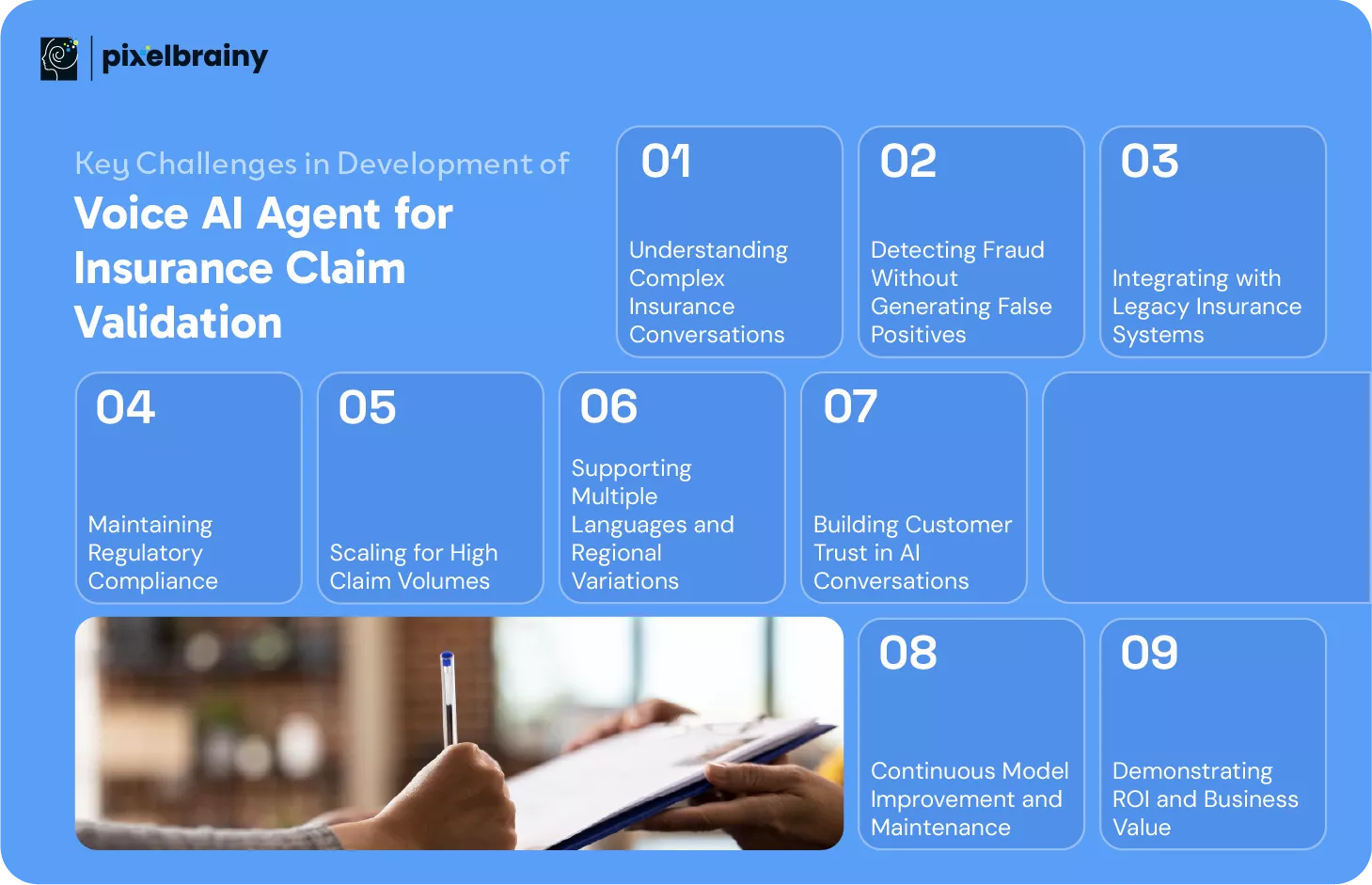
Insurance claim discussions are often unpredictable. Claimants may provide incomplete information, describe incidents differently, use industry-specific terminology, or change topics during a conversation. Unlike scripted customer service interactions, claim validation requires contextual understanding and dynamic questioning.
How to Overcome It: Train conversational AI models using insurance-specific datasets rather than generic customer service conversations. Implement advanced Natural Language Understanding (NLU) models capable of recognizing policy terminology, claim types, accident details, and industry-specific language patterns. Continuous retraining using real-world claim interactions helps improve accuracy over time.
One of the primary objectives of voice AI development for insurance fraud prevention is identifying suspicious claims before payouts occur. However, systems that aggressively flag potential fraud can create unnecessary investigations and negatively impact legitimate customers.
How to Overcome It: Combine voice analytics, behavioral analysis, policy verification, historical claim comparisons, and machine learning risk models to generate balanced fraud scores. Instead of automatically rejecting claims, route high-risk cases to human investigators for further review.
Many insurers continue to operate on legacy policy administration platforms, claims management systems, and CRM environments that were not originally designed to support modern AI technologies. Integration challenges can slow deployments and limit automation capabilities.
How to Overcome It: Adopt an API-first integration strategy and leverage middleware platforms to connect AI services with existing systems. Prioritize integration with policy databases, claims platforms, and customer records to maximize business impact during the initial deployment phase.
Insurance organizations must comply with HIPAA, GDPR, TCPA, SOC 2, and various state-level privacy regulations. Voice AI systems introduce additional compliance responsibilities because conversations are recorded, processed, analyzed, and stored digitally.
How to Overcome It: Build compliance requirements directly into the system architecture from the beginning. Implement encryption, consent management workflows, audit trails, role-based access controls, secure storage practices, and automated retention policies to reduce regulatory risks.
One of the biggest reasons insurers invest in AI is to build scalable voice AI for high-volume insurance claims. However, claim volumes can spike dramatically during natural disasters, severe weather events, or large-scale incidents, placing significant pressure on infrastructure.
How to Overcome It: Deploy cloud-native architectures with auto-scaling capabilities, containerized workloads, load balancing, and distributed processing. These technologies allow the platform to maintain performance even during periods of exceptionally high claim activity.
Global insurance providers often serve customers across multiple countries and languages. As a result, developing multilingual voice AI for global insurance claim validation can become a complex undertaking. Accents, dialects, local insurance terminology, and cultural communication styles all influence conversational performance.
How to Overcome It: Use multilingual speech recognition models, localized conversation flows, region-specific training data, and language-specific testing frameworks. Continuous monitoring helps ensure consistent performance across different customer groups and geographic markets.
Many policyholders remain cautious when sharing personal, financial, or medical information with automated systems. A lack of trust can reduce engagement rates and negatively affect claim validation outcomes.
How to Overcome It: Be transparent about AI usage, clearly communicate privacy protections, and provide easy access to human agents whenever necessary. Natural conversational design, empathy-driven responses, and accurate information handling can significantly improve customer confidence.
Insurance regulations, claim patterns, customer expectations, and fraud tactics constantly evolve. Organizations focused on creating voice AI solutions for faster insurance claims processing cannot treat deployment as a one-time project.
How to Overcome It: Establish a continuous optimization framework that includes conversation analysis, AI model retraining, fraud rule updates, compliance audits, and performance monitoring. Ongoing improvement ensures the system remains accurate, compliant, and aligned with changing business requirements.
Insurance leaders often require measurable evidence before expanding AI initiatives across the organization. Projects that fail to demonstrate operational improvements or cost savings may struggle to secure long-term support.
How to Overcome It: Start with a focused proof of concept targeting high-impact use cases such as FNOL automation, claim verification calls, or fraud detection workflows. Measuring reductions in processing time, operational costs, and fraud exposure helps establish a clear business case for broader adoption.
Organizations that proactively address these challenges can maximize the success of voice AI agent development for insurance claim validation while building secure, scalable, and fraud-resistant claims operations that deliver faster approvals and better customer experiences.
Once you get into execution, the biggest challenge is not identifying the opportunity. It is selecting a technology partner that understands insurance operations, AI architecture, compliance requirements, fraud prevention workflows, and enterprise integrations. We have been helping businesses build intelligent software products, AI-powered automation systems, and industry-specific digital solutions that solve complex operational challenges. Our team combines expertise in conversational AI, machine learning, cloud infrastructure, enterprise software engineering, and insurance technology to deliver scalable and measurable results.
As a trusted AI agent development company in USA, PixelBrainy LLC works closely with insurance providers, startups, insurtech companies, and enterprises looking to modernize claims operations through intelligent automation. From claim intake and policy verification to fraud detection and customer communication, we develop customized solutions that align with business objectives while maintaining compliance and security standards.
A common inquiry we receive from insurance organizations is:
"We currently handle thousands of claim verification calls every month through a combination of agents and traditional IVR systems. We want to automate claim validation, verify policy details in real time, detect potential fraud during conversations, reduce claim processing delays, and improve customer experience. We also want the solution to integrate with our claims management platform and CRM. Also suggest the company who can develop, deploy, and support this solution long term. Where should we start?"
This is exactly the type of challenge our team helps solve.
A regional insurance provider approached our team with challenges related to rising claim volumes, lengthy verification cycles, and increasing operational costs. The company needed a scalable solution capable of automating claimant interactions while maintaining accuracy and fraud prevention standards.
Our team designed and implemented a platform focused on building and deploying voice AI for insurance claims automation. The solution included an AI-powered voice verification agent, real-time policy lookup capabilities, automated claim intake workflows, fraud risk scoring, CRM integration, and intelligent escalation paths for complex claims.
Project Results:
Beyond implementation, we continued supporting the client with performance monitoring, model optimization, and ongoing enhancements to improve automation accuracy.
Many vendors focus solely on technology. Our approach focuses on business outcomes. Whether the goal is reducing operational costs, improving fraud detection, accelerating approvals, or enhancing customer experience, every solution is designed around measurable results.
Organizations looking at creating voice AI solutions for faster insurance claims processing often need more than a conversational interface. They require a complete ecosystem that connects AI, claims systems, policy databases, fraud analytics, reporting tools, and compliance controls into a unified platform.
Similarly, insurers exploring AI voice agent development for insurance claims processing need a solution that can evolve alongside changing regulations, customer expectations, and claim volumes. Our development methodology prioritizes scalability, maintainability, and long-term business value from day one.
Ready to transform your insurance claims operations with AI? Connect with PixelBrainy LLC to discuss your requirements and explore the right solution for your business.
Insurance companies face a difficult balancing act: approving legitimate claims quickly while identifying fraudulent activity before payouts occur. Traditional claim validation processes often struggle to meet these expectations due to manual reviews, growing claim volumes, rising operational costs, and increasingly sophisticated fraud schemes. This is why voice AI is becoming a strategic investment for insurers seeking to automate verification workflows, strengthen fraud detection capabilities, and deliver faster claimant experiences.
From FNOL automation and real-time claim verification to voice analytics, policy validation, and compliance-driven workflows, voice AI agents can transform how modern insurers process claims at scale. Organizations that invest early in voice AI agent development for insurance claim validation are better positioned to improve operational efficiency, accelerate approvals, reduce claim leakage, enhance customer satisfaction, and build more resilient claims operations for the future.
If you are evaluating the voice AI landscape, exploring investment opportunities, or planning to build a voice AI-powered insurance claims product, having the right technical and strategic roadmap is critical. Our team can help you understand the architecture, technology stack, development costs, compliance requirements, implementation approach, and deployment timelines needed to bring a successful solution to market.
Ready to explore how Voice AI can transform your insurance claims process? Schedule a call with our experts today to discuss your use case, evaluate feasibility, and build a tailored solution for your business.
Development timelines depend on project complexity, integrations, and compliance requirements. A basic MVP can typically be developed within 4 to 6 weeks, while an enterprise-grade solution with advanced fraud detection, multilingual support, and full system integrations generally takes 7 to 12 weeks.
Yes. Modern voice AI systems can identify fraud indicators in real time through acoustic analysis, response inconsistency detection, behavioral monitoring, and cross-referencing claimant responses with policy and claim records. Suspicious cases can be automatically flagged for human review.
An IVR system relies on pre-recorded menus and keypad selections. A voice AI agent understands natural speech, asks follow-up questions, maintains conversational context, and makes intelligent decisions during the conversation. This creates a more personalized and efficient claims experience.
Yes, when designed correctly. HIPAA-compliant voice AI solutions use encrypted storage, secure data transmission, Business Associate Agreements (BAAs), access controls, audit logs, and consent management workflows to protect sensitive health information.
Costs vary based on functionality and complexity. A basic MVP typically ranges from $15,000 to $40,000, a mid-tier solution from $40,000 to $100,000, and an enterprise-grade platform from $100,000 to $250,000+.
Yes. Modern voice AI platforms can support multiple languages, regional accents, and localized claim workflows. Solutions built on platforms such as Yellow.ai, Kore.ai, or custom AI architectures can support over 100 languages with insurance-specific language training.
A voice AI agent typically integrates with policy administration systems, claims management platforms, CRM software, fraud detection tools, telephony infrastructure, identity verification services, and compliance logging systems to enable real-time claim validation and decision-making.

About The Author
Sagar Bhatnagar
Sagar Sahay Bhatnagar brings over a decade of IT industry experience to his role as Marketing Head at PixelBrainy. He's known for his knack in devising creative marketing strategies that boost brand visibility and market influence. Sagar's strategic thinking, coupled with his innovative vision and focus on results, sets him apart. His track record of successful campaigns proves his ability to utilize digital platforms effectively for impactful marketing efforts. With a genuine passion for both technology and marketing, Sagar continuously pushes PixelBrainy's marketing initiatives to greater success.


Transform your ideas into reality with us.
Working with the PixelBrainy team has been a highly positive experience. They understand the design requirements and create beautiful UX elements to meet the application needs. The dev team did an excellent job bringing my vision to life. We discussed usability and flow. Sagar worked with his team to design the database and begin coding. Working with Sagar was easy. He has the knowledge to create robust apps, including multi-language support, Google and Apple ID login options, Ad-enabled integrations, Stripe payment processing, and a Web Admin site for maintaining support data. I'm extremely satisfied with the services provided, the quality of the final product, and the professionalism of the entire process. I highly recommend them for Android and iOS Mobile Application Design and Development.

Great experience working with them. Had a lot of feedback and I found that unlike most contractors they were bugging me for updates instead of the other way around. They were extremely time conscience and great at communicating! All work was done extremely high quality and if not on time, early! They were always proactive when it comes to communication and the work is great/above par always. Very flexible and a great team to work with! Goes above and beyond to present us with multiple options and always provides quality. Amazing work per usual with Chitra. If you have UI/UX or branding design needs I recommend you go to them! Will likely work with them in the future as well, definitely recommended!

PixelBrainy is a joy to work with and is a great partner when thinking through branding, logo, and website layout. I appreciate that they spend time going into the "why" behind their decisions to help inform me and others about industry best practices and their expertise.

I hired them to design our software apps. Things I really like about them are excellent communication skills, they answer all project suggestions and collaborate right away, and their input on design and colors is amazing. This project was complex and needed patience and creativity. The team is amazing to do business with. I will be using them long-term. Glad to see there are some good people out there. I was afraid to try and outsource my project to someone but I am glad I met them! I really can't say enough. They went above and beyond on this project. I am very happy with everything they have done to make my business stand out from the competition.

It was great working with PixelBrainy and the team. They were very responsive and really owned the project. We'll definitely work with them again!

I recently worked with the PixelBrainy team on a project and I was blown away by their communication skills. They were prompt, clear, and articulate in all of our interactions. They listened and provided valuable feedback and suggestions to help make the project a success. They also kept me updated throughout the entire process, which made the experience stress-free and enjoyable.

PixelBrainy is very good at what it does. The team also presents themselves very professionally and takes care of their side of things very well. I could fully trust them taking up the design work in a timely and organised manner and their attention to detail saved us lots of effort and time. This particular project was quite intense and the team showed that they function very well under pressure. Very much looking forward to working with her again!

It's always an absolute pleasure working with them. They completed all of my requests quickly and followed every note I had for them to a T, which made our process go smoothly from start to finish. Everything was completed fast and following all of the guidelines. And I would recommend their services to anyone. If you need any design work done in the future, PixelBrainy should be your first call!

They took ownership of our requirements and designed and proposed multiple beautiful variants. The team is self-motivated, requires minimum supervision, committed to see-through designs with quality and delivering them on time. We would definitely love to work with PixelBrainy again when we have any requirements.

PixelBrainy was a big help with our SaaS application. We've been hard at work with a new UI/UX and they provided a lot of help with the designs. If you're looking for assistance with your website, software, or mobile application designs, PixelBrainy and the team is a great recommendation.

PixelBrainy designers are amazing. They are responsive, talented, and always willing to help craft the design until it matches your vision. I would recommend them and plan to continue them for my future projects and more!!!

They were awesome! Did a good job fast, and good communication. Will work with them again. Thank you

Creative, detail-oriented, and talented designers who take direction well and implement changes quickly and accurately. They consistently over-delivered for us.

PixelBrainy team is very talented and creative. Great designers and a pleasure to work with. PixelBrainy is an excellent communicator and I look forward to working with them again.

PixelBrainy has a very talented design team. Their work is excellent and they are very responsive. I enjoy working with them and hope to continue on all of our future projects.


