
 AI Summary Powered by PixelBrainy
Have you ever wondered how businesses are transforming customer experiences with intelligent chat systems that not only respond but think, plan, and act? That’s where Agentic AI Chatbots come into play. As industries increasingly embrace automation and AI-driven interactions, the demand for autonomous, goal-oriented chatbots is rising rapidly. According to a recent MarketsandMarkets report (2025), the global chatbot market is expected to surpass $24.5 billion by 2030, growing at a compound annual growth rate (CAGR) of over 23%, highlighting a massive opportunity for businesses ready to innovate.
Agentic AI Chatbot Development is not just about creating conversational bots; it’s about building intelligent digital agents capable of reasoning, decision-making, and completing tasks autonomously. Whether you’re a product owner, CTO, startup founder, or enterprise innovator, understanding how to build Agentic AI Chatbot solutions is becoming an essential skill to stay competitive in the evolving digital ecosystem.
From automated sales support and dynamic workflow execution to personalized virtual assistants, building Agentic AI Chatbot systems is revolutionizing how companies engage users. With the right strategy, architecture, and technology stack, it’s now easier than ever to create Agentic AI Chatbot solutions tailored to your business goals.
This guide explores every crucial aspect of the development of Agentic AI Chatbot, from core concepts and use cases to advanced features, tools, costs, and best practices, equipping you with the knowledge to design, build, and scale intelligent AI agents.
An Agentic AI Chatbot is an advanced form of conversational AI that goes beyond predefined responses and static scripts. Unlike traditional chatbots that simply reply to user queries, an agentic chatbot acts as an autonomous digital agent capable of reasoning, planning, taking actions, and learning from context — much like a human assistant.
It not only understands language but also interprets intent, makes decisions, executes tasks through external tools or APIs, and adapts its behavior based on continuous feedback. This makes Agentic AI Chatbot Development a powerful way to deliver intelligent, goal-driven interactions that can automate complex workflows, handle multi-step tasks, and solve real-world business challenges without human intervention.
In simple terms, an agentic chatbot doesn’t just respond — it acts.
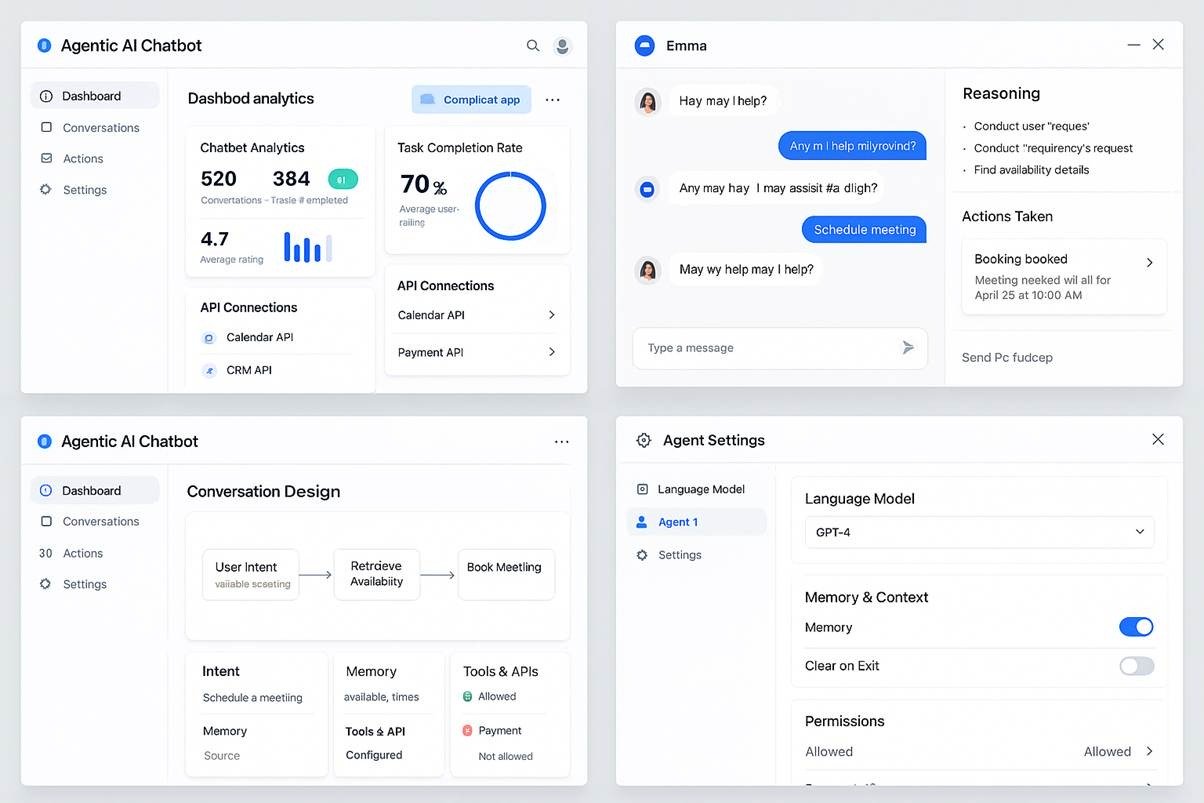
Building Agentic AI Chatbot systems involves combining large language models (LLMs) with decision-making, memory, and action modules to mimic intelligent behavior. Here’s how it works step-by-step:
The chatbot starts by analyzing the input using Natural Language Processing (NLP) to extract meaning, context, and intent. It doesn’t just look for keywords — it understands what the user wants to achieve.
Once intent is understood, the chatbot applies reasoning techniques, often powered by LLMs like GPT-4 or Claude, to plan the next steps. This includes breaking down goals into sub-tasks, retrieving relevant knowledge, or selecting the best course of action.
Unlike static bots, agentic chatbots can connect to external systems, APIs, or databases. For example, they might schedule a meeting, process a payment, generate a report, or pull CRM data autonomously.
The chatbot continuously uses memory and contextual awareness to handle multi-turn conversations and complex requests. It can switch topics, recall past interactions, and personalize responses in real time.
A key part of building Agentic AI Chatbots is enabling them to learn from user feedback, outcomes, and interactions. Over time, they refine their decision-making, improve task accuracy, and deliver more relevant results.
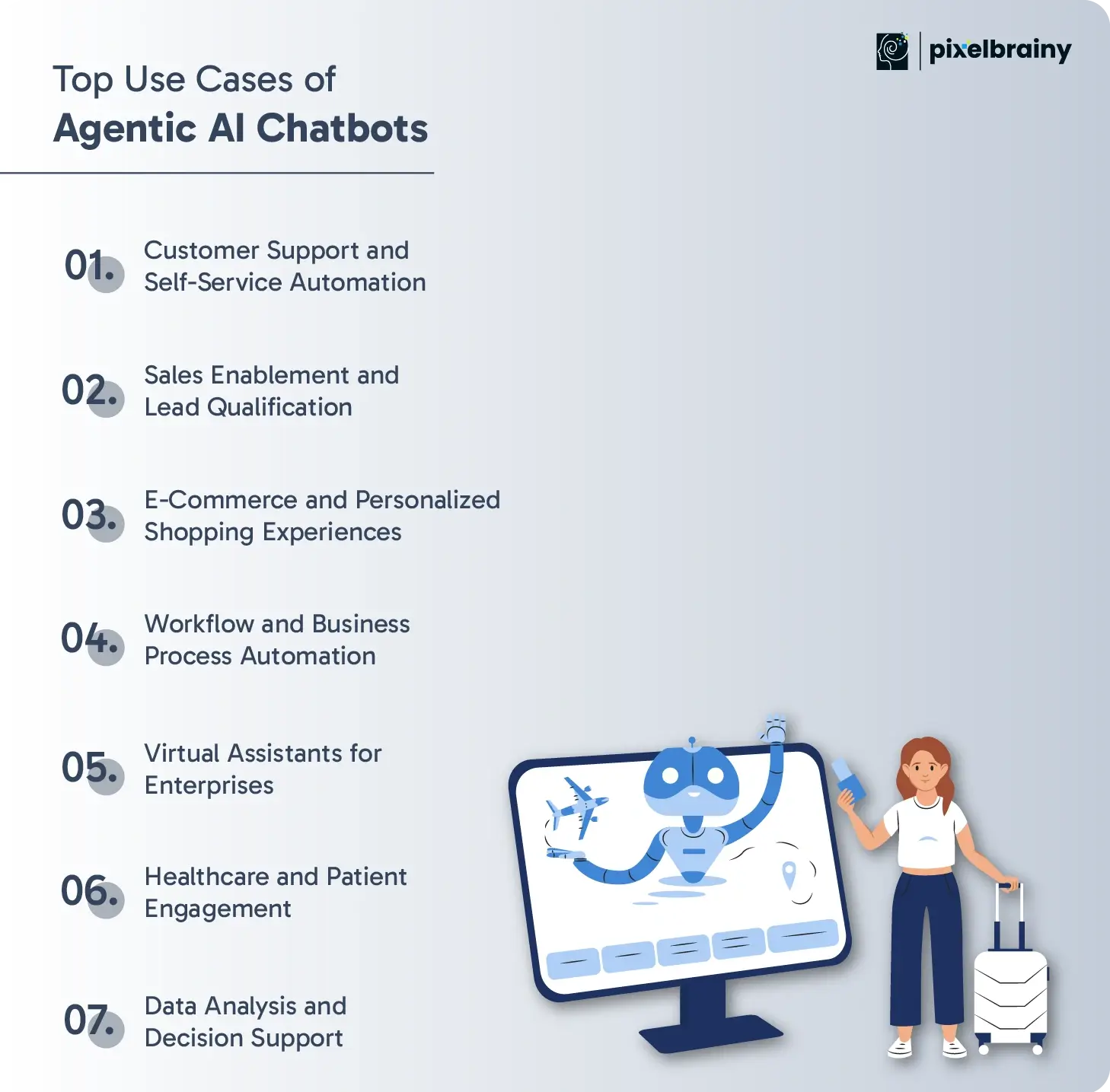
The power of Agentic AI Chatbots lies in their ability to go beyond simple question-answering and transform into autonomous digital agents that can plan, reason, and execute tasks. These capabilities open up a wide range of real-world applications across industries, making Agentic AI Chatbot Development a strategic investment for organizations looking to automate complex workflows and deliver intelligent, personalized user experiences.
Below are the most impactful use cases of building Agentic AI Chatbot systems in today’s business landscape:
Use Case: Intelligent help desks, 24/7 support agents, and proactive problem resolution.
Agentic AI Chatbots can autonomously understand customer issues, troubleshoot problems, integrate with CRM tools, create or close support tickets, and even escalate cases to human agents when needed. They go beyond static responses by taking context-aware actions like resetting accounts, scheduling callbacks, or providing personalized solutions.
Example: A telecom company deploys an agentic chatbot that not only answers billing questions but also processes payments and updates account details without human involvement.
Use Case: Intelligent sales assistants that nurture leads and close deals autonomously.
Instead of just capturing leads, an agentic chatbot can qualify prospects, schedule meetings, generate proposals, and follow up — all while integrating with CRMs like Salesforce or HubSpot. They continuously learn from interactions, adapting messaging based on lead behavior and engagement.
Example: A B2B SaaS platform uses a chatbot that identifies high-intent leads, books demos directly into sales calendars, and sends tailored product recommendations.
Use Case: AI-powered shopping concierges that browse, recommend, and transact.
Agentic AI chatbots in e-commerce can understand preferences, compare products, apply discounts, and complete purchases autonomously. They enhance conversions by delivering hyper-personalized product suggestions and managing order tracking or returns on behalf of users.
Example: A retail store deploys an agentic assistant that curates entire outfit suggestions, compares product prices, and finalizes checkout within a single conversation.
Use Case: Intelligent task orchestration across multiple systems.
One of the most transformative applications of Agentic AI Chatbot Development is workflow automation. These bots can chain multiple actions — like generating reports, sending emails, updating databases, and triggering workflows — without human oversight.
Example: A financial services firm uses an agentic chatbot to gather client data, generate compliance documents, and notify relevant departments — all triggered by a single user query.
Use Case: Digital employees that handle internal operations and productivity tasks.
Agentic AI Chatbots act as AI co-workers — managing meetings, drafting emails, summarizing documents, handling HR queries, and even integrating with enterprise apps like Slack, Google Workspace, or Jira. They reduce administrative overhead and free up teams to focus on high-value work.
Example: A tech startup deploys an agentic assistant to onboard new hires, set up accounts, send welcome kits, and introduce them to team workflows.
Use Case: Intelligent patient support and care management.
In healthcare, agentic chatbots can triage symptoms, schedule appointments, send medication reminders, and track recovery progress — all while integrating with electronic health record (EHR) systems. They help providers scale care delivery without compromising quality.
Example: A telehealth platform uses an AI chatbot that evaluates patient symptoms, books a virtual consultation, and follows up with post-care instructions.
Use Case: AI copilots that transform data into insights.
Agentic chatbots can autonomously pull data from multiple sources, run analyses, and present actionable insights — often before users even ask. They serve as real-time business intelligence agents that proactively support strategic decision-making.
Example: A marketing team uses an agentic chatbot to analyze campaign performance, generate dashboards, and suggest budget reallocations based on real-time data.
The versatility of Agentic AI Chatbots is rapidly expanding as they evolve from conversation tools into autonomous digital agents. Whether you’re looking to boost revenue, reduce operational costs, or deliver more personalized user experiences, building Agentic AI Chatbot solutions can revolutionize how your organization operates across departments.
Building a powerful and intelligent chatbot goes far beyond text-based conversations. The strength of an Agentic AI Chatbot lies in its feature set, which enables it to reason, plan, act, and adapt like a human digital agent.
Below is a comprehensive table of 15 essential core features every modern Agentic AI Chatbot should include:
| Feature | Explanation |
| Natural Language Understanding (NLU) | Allows the chatbot to accurately interpret user input, detect intent, and extract key entities for more meaningful conversations |
| Context Awareness | Enables the chatbot to understand previous interactions and use contextual data to provide relevant, personalized responses |
| Memory Retention | Stores conversation history, user preferences, and previous actions to enhance decision-making and improve future interactions |
| Autonomous Task Execution | Empowers the chatbot to complete tasks like booking, data retrieval, or order processing without human input |
| Multi-turn Conversation Handling | Manages complex dialogues across multiple interactions while maintaining a clear understanding of user objectives |
| Decision-Making Engine | Uses reasoning and logic to determine the best course of action based on user intent, goals, and available data |
| Dynamic Workflow Orchestration | Automates multi-step workflows by linking tasks and integrating with external systems and APIs for seamless execution |
| Multi-Channel Deployment | Works effortlessly across websites, apps, messaging platforms, and enterprise tools, ensuring consistent experiences |
| Real-Time Data Access | Connects to databases, CRMs, and APIs to provide users with the most accurate and up-to-date information instantly |
| Tool and API Integration | Extends chatbot capabilities by integrating with third-party services for payments, scheduling, analytics, and more |
| Multi-Language Support | Engages users in their preferred language, improving accessibility and expanding global usability |
| Human-in-the-Loop Option | Routes complex or sensitive interactions to human agents when necessary, ensuring accuracy and user satisfaction |
| Security and Compliance Layer | Protects user data with encryption, authentication, and adherence to industry regulations like GDPR and HIPAA |
| Learning and Adaptation | Continuously refines responses and strategies through machine learning and user feedback over time |
| Analytics and Performance Monitoring | Tracks key metrics like engagement, success rate, and sentiment to improve performance and optimize workflows |
With these core features in place, your Agentic AI Chatbot becomes a powerful, intelligent, and scalable solution that can transform how businesses interact with users.
Once the foundational capabilities are in place, the next step in Agentic AI Chatbot Development is integrating advanced features that push intelligence, autonomy, and performance to the next level.
These features help transform your chatbot from a smart assistant into a fully autonomous digital agent capable of strategic decision-making and complex task execution.
| Advanced Feature | Explanation |
| Autonomous Planning and Goal Chaining | Allows the chatbot to break down complex objectives into smaller tasks and execute them in the right sequence to achieve a final goal |
| Self-Learning and Continuous Improvement | Uses real-time feedback, user interactions, and performance data to adapt its behavior and enhance accuracy over time |
| Multi-Agent Collaboration | Enables multiple AI agents to communicate and collaborate with each other to solve complex workflows or achieve shared goals |
| Knowledge Graph Integration | Connects structured and unstructured data to enhance the chatbot’s reasoning, contextual awareness, and decision-making capabilities |
| Advanced Memory Architecture | Goes beyond short-term context to include long-term memory, user preferences, and historical data for deeper personalization |
| Actionable Insights and Predictive Analytics | Analyzes user behavior, predicts future needs, and proactively recommends solutions before the user asks |
| Custom Tool Invocation | Dynamically integrates and calls custom-built tools or APIs based on task requirements, without manual configuration |
| Multi-Modal Interaction | Supports text, voice, image, and document inputs, enabling richer, more intuitive interactions with users |
| Proactive Task Execution | Anticipates user needs and initiates tasks autonomously, such as sending reminders or performing follow-up actions |
| Chain-of-Thought Reasoning Visualization | Makes the reasoning process transparent by displaying decision paths, improving trust and explainability |
| Adaptive Persona and Tone Control | Dynamically adjusts communication style, tone, and personality based on user profile, context, or intent |
| Emotion and Sentiment Detection | Analyzes user sentiment to tailor responses, improve empathy, and enhance user satisfaction |
| Real-Time API Chaining | Orchestrates multiple API calls in a single session to complete complex, multi-step tasks seamlessly |
| Autonomous Workflow Generation | Creates new workflows automatically based on user objectives without the need for manual programming |
| Edge Deployment and On-Device Processing | Allows chatbot deployment on local devices or private infrastructure for low latency, enhanced security, and offline capabilities |
Incorporating these advanced features takes building Agentic AI Chatbot solutions beyond traditional boundaries, delivering unmatched automation, intelligence, and adaptability.
The process of building Agentic AI Chatbot solutions is not a one-size-fits-all journey. It’s a structured, strategic approach that moves from validating the concept to creating a scalable, enterprise-ready product. Whether your goal is to automate support, improve workflows, or deliver intelligent virtual assistants, understanding what is the process of developing Agentic AI Chatbot is key to success. From POC Development to MVP Development and finally to a full-fledged deployment, every stage plays a vital role in ensuring your chatbot is intelligent, autonomous, and future-ready.
Here’s a comprehensive breakdown of each stage in the development of Agentic AI Chatbot:
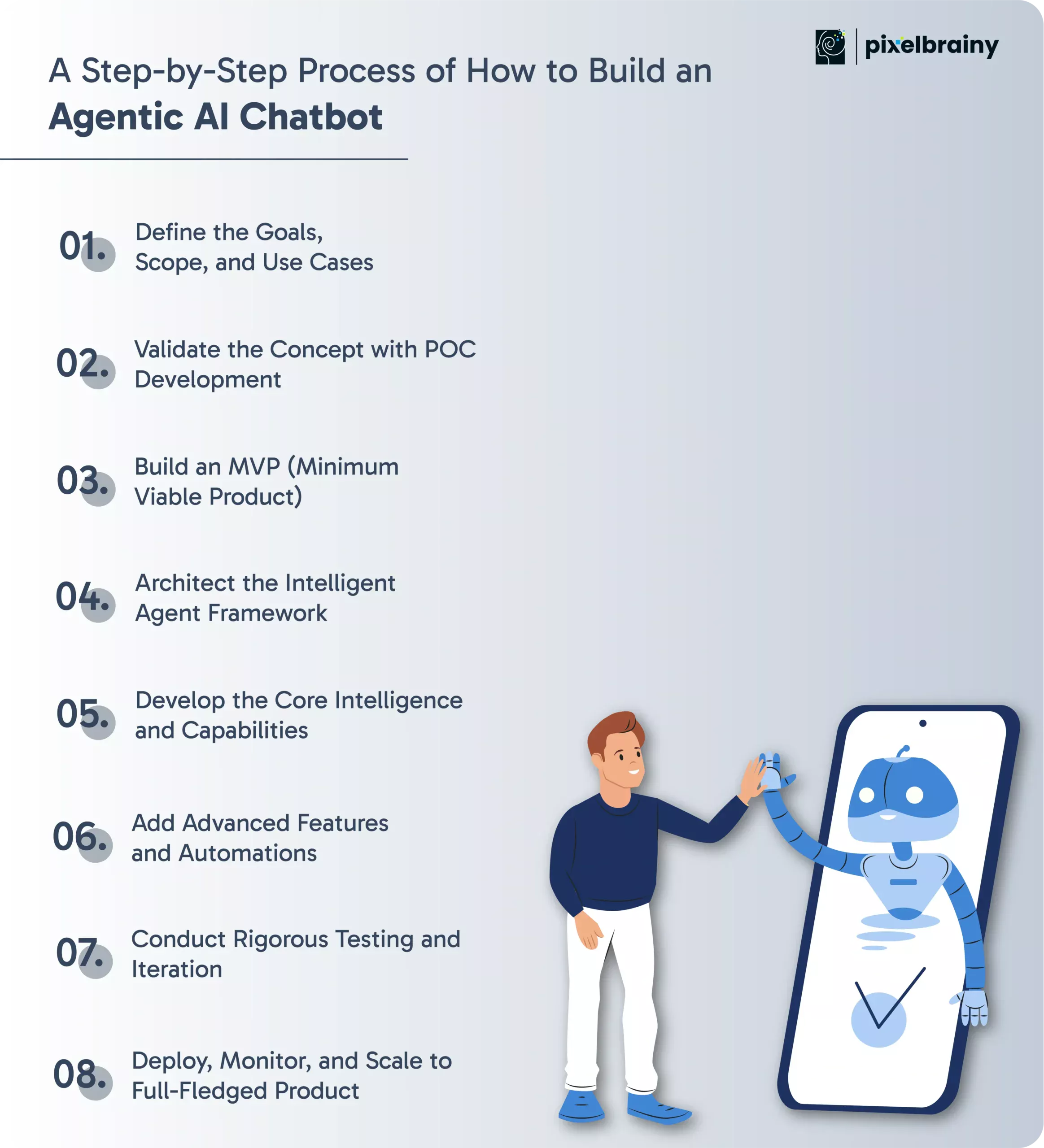
Before you begin creating an Agentic AI Chatbot, it’s crucial to establish a clear foundation. Identify the primary objectives your chatbot should achieve — whether it’s improving customer service, automating internal workflows, enhancing user engagement, or streamlining sales processes.
Outline the target audience, define the types of interactions you expect, and specify measurable KPIs such as response accuracy, automation rate, or conversion improvements.
At this stage, studying top AI chatbot development companies in the USA can help you benchmark best practices and understand market-leading capabilities. This foundational clarity ensures that every subsequent step aligns with your business vision and delivers maximum impact.
Once your objectives are clear, the next step is to test the feasibility of your idea through AI Chatbot POC Development. The Proof of Concept is a lightweight prototype built to validate key functionalities such as natural language understanding, intent detection, or basic task execution.
This stage helps answer critical questions:
The POC minimizes risk, secures stakeholder buy-in, and provides valuable insights before heavy investment. If successful, it sets the foundation for the next stage: MVP development.
The MVP Development phase transforms the proven concept into a usable, real-world version of your chatbot. Unlike the POC, the MVP includes essential features such as NLP, basic dialogue management, memory, and simple decision-making capabilities. It also introduces initial AI integration with internal systems or third-party platforms.
The primary goal here is to launch quickly, gather real user feedback, and validate performance in real environments. MVP testing helps identify gaps, usability issues, and opportunities for improvement before you invest in scaling the product.
A successful MVP is a crucial step in the development of Agentic AI Chatbot because it builds user trust and guides the evolution of the final product.
Designing the core architecture is the backbone of AI development. In this phase, you define how the chatbot will process information, make decisions, and execute tasks autonomously. This includes choosing the right large language model (LLM), implementing context management, and designing the decision-making logic.
Workflow design is equally important — it determines how inputs are processed, goals are broken down, and tasks are performed. Consider integrations with CRMs, payment systems, knowledge bases, or enterprise tools to maximize efficiency.
This stage ensures that your chatbot is not only intelligent but also scalable, modular, and capable of evolving as new business needs emerge.
This step is where your chatbot’s “brain” comes to life. Begin with AI solutions like Natural Language Understanding (NLU), contextual memory, and decision-making modules. Then, implement reasoning capabilities that allow the chatbot to plan actions and solve problems autonomously.
Integration is key here. By connecting your chatbot to internal databases, APIs, and third-party tools, it can perform advanced actions such as data retrieval, scheduling, order processing, and reporting. The result is a powerful, goal-oriented system that does more than respond — it acts intelligently and independently.
To truly make an Agentic AI Chatbot stand out, you must go beyond the basics. This step involves integrating advanced features like proactive task execution, predictive analytics, sentiment detection, and multi-agent collaboration. These capabilities enable the chatbot to anticipate needs, offer recommendations, and even initiate actions without user prompts.
Multi-modal capabilities (like voice, image, or document support) and custom workflow automation can further elevate user experiences. Continuous AI integration at this stage ensures that your chatbot adapts to changing requirements and keeps delivering increasing value over time.
Before deployment, your chatbot must undergo comprehensive testing to ensure performance, accuracy, and reliability. Testing should include conversation flow validation, load testing for scalability, and security testing to ensure data privacy and compliance.
Equally important is user feedback. Real-world testing will reveal potential improvements in decision-making, response quality, or user experience. Regular iteration ensures that the chatbot becomes smarter, more accurate, and more aligned with user expectations — a critical step in creating enterprise-grade AI solutions.
The final step in building an Agentic AI Chatbot is deployment. Launch your chatbot on the chosen platforms — website, mobile app, messaging platforms, or internal dashboards — and closely monitor its performance. Track KPIs, analyze user interactions, and optimize its behavior continuously.
Scaling comes next. Expand capabilities, integrate new tools, support additional languages, and introduce more complex workflows. Many organizations partner with top AI chatbot development companies in the USA at this stage to ensure robust deployment, compliance, and future scalability. Over time, your chatbot evolves from an experimental tool into a business-critical AI platform.
By following this structured roadmap, businesses can confidently develop Agentic AI Chatbot solutions that evolve from proof-of-concept to enterprise-grade products — delivering automation, intelligence, and lasting business value.
Also Read: How To Develop Custom AI Chatbot: Benefits, Types, And Cost
Before investing in intelligent automation, most businesses want to know: What is the cost to develop Agentic AI Chatbot? The answer depends on several factors — including feature complexity, AI capabilities, integrations, scalability, and long-term support. On average, the Agentic AI Chatbot Development cost ranges from $10,000 to $150,000+, depending on whether you are building a simple chatbot prototype or a fully autonomous enterprise-grade solution.
To help you estimate the cost of creating Agentic AI Chatbot more accurately, here’s a breakdown of pricing across three key development tiers. This will help you plan the right budget of Agentic AI Chatbot Development based on your business goals, use cases, and technical requirements.
| Type | Best For | Key Features | Estimated Cost |
| Basic Agentic AI Chatbot | Startups, small businesses, or early-stage projects validating their idea through POC Development or launching a lightweight MVP | - Core NLP and intent recognition | $10,000 – $30,000 |
| - Basic conversation flow | |||
| - Limited integrations (e.g., website or CRM) | |||
| - Basic analytics and reporting | |||
| - Rule-based or partially agentic behavior | |||
| Medium Agentic AI Chatbot | Growing companies or SaaS platforms aiming to offer more advanced automation and intelligence while maintaining a balanced budget of Agentic AI Chatbot Development | - Context awareness and memory | $30,000 – $80,000 |
| - Decision-making and reasoning engine | |||
| - Multi-turn conversation handling | |||
| - API and tool integrations | |||
| - Multi-channel deployment (web, mobile, Slack, etc.) | |||
| - Real-time analytics dashboard | |||
| Advanced Agentic AI Chatbot | Large enterprises and organizations seeking highly intelligent, autonomous solutions as part of their broader AI integration and digital transformation strategy | - Full agentic capabilities with planning and autonomous execution | $80,000 – $150,000+ |
| - Knowledge graph and multi-agent collaboration | |||
| - Proactive task automation and predictive insights | |||
| - Multi-modal support (text, voice, documents) | |||
| - Enterprise-grade security and compliance | |||
| - Custom ML model training and continuous learning | |||
| - Scalability for millions of users |
While the table gives a general range for the pricing of Agentic AI chatbot development, several variables can impact the final budget:
Understanding the cost of creating Agentic AI Chatbot early in the project lifecycle helps you prioritize features and align expectations. Whether you start small with an MVP or invest in a fully autonomous solution, careful planning ensures your Agentic AI Chatbot Development cost delivers maximum ROI and long-term business value.
Also Read: Agentic AI Development Cost: Factors & Examples
Building a high-performing Agentic AI Chatbot is not just about coding intelligence into a system — it’s about choosing the right technology stack that can support scalability, adaptability, and real-world functionality. Each layer of the architecture, from the frontend user interface to backend processing and AI orchestration, contributes to the chatbot’s overall performance and capabilities.
The selection of tools also plays a crucial role in how effectively you can develop Agentic AI Chatbot solutions, how seamlessly the system integrates with existing platforms, and how efficiently it can evolve over time. The right technology stack ensures your chatbot is future-ready, cost-efficient, and capable of handling complex tasks autonomously.
Below is a detailed breakdown of the essential components, tools, and frameworks needed to create Agentic AI Chatbot solutions that deliver enterprise-grade intelligence and performance:
| Layer / Component | Popular Tools & Platforms | Explanation |
| Frontend (User Interface) | React, Vue.js, Angular | The frontend determines how users interact with the chatbot. Modern frameworks help build intuitive interfaces with real-time message rendering and responsive chat windows. They also allow for seamless integration into websites, dashboards, and mobile apps for a smooth user experience. |
| Backend (Server and Logic Layer) | Node.js, Django, Express.js, Flask | The backend manages conversation flow, routes user queries, handles requests, and connects to AI models. It ensures scalability, security, and high performance. A robust backend enables the chatbot to handle thousands of requests simultaneously and integrate with databases and third-party systems. |
| Database & Storage | MongoDB, PostgreSQL, Firebase, MySQL | Databases store conversation history, user preferences, intents, and memory data. They also enable personalization by retrieving relevant information quickly. Choosing a scalable database ensures low latency, data security, and efficient handling of large volumes of chatbot interaction data. |
| Large Language Models (LLMs) | OpenAI GPT-4, Anthropic Claude, LLaMA, Cohere | LLMs are the heart of Agentic AI Chatbot Development. They understand user intent, generate natural language responses, and support reasoning and planning. Their integration allows the chatbot to act autonomously, adapt to context, and deliver human-like conversations. |
| NLP and Machine Learning Frameworks | spaCy, Hugging Face Transformers, TensorFlow, PyTorch | NLP and ML tools improve chatbot intelligence by enabling tasks like sentiment analysis, entity recognition, and language understanding. They support custom model training and domain-specific tuning, enhancing chatbot performance and contextual accuracy. |
| Agent Orchestration Frameworks | LangChain, Semantic Kernel, Haystack | These frameworks give the chatbot “agentic” abilities such as multi-step reasoning, tool usage, and decision-making. They allow the bot to chain tasks, call APIs dynamically, and plan actions autonomously — essential for building intelligent workflows and automation pipelines. |
| Integration & API Layer | REST, GraphQL, Zapier, Make (Integromat) | APIs connect the chatbot to CRMs, databases, payment gateways, and other business systems. Automation tools like Zapier and Make further extend capabilities by enabling no-code workflow automation, streamlining operations, and enhancing the chatbot’s value in business ecosystems. |
| Cloud Infrastructure & Deployment | AWS, Google Cloud, Microsoft Azure, DigitalOcean | Cloud platforms ensure reliable hosting, autoscaling, load balancing, and deployment of AI models. They also provide essential DevOps capabilities, continuous integration/continuous deployment (CI/CD), and secure environments to support enterprise-grade chatbot solutions. |
| Authentication & Security | OAuth 2.0, JWT, AWS Cognito, Auth0 | Security layers protect sensitive data, manage user authentication, and ensure compliance with standards like GDPR and HIPAA. Implementing secure authentication protocols prevents unauthorized access and builds user trust in the chatbot system. |
| Analytics and Monitoring Tools | Mixpanel, Datadog, Grafana, Google Analytics | Analytics platforms help track chatbot performance, user engagement, conversation success rates, and system errors. Continuous monitoring and reporting are vital for optimizing workflows, improving decision-making, and enhancing ROI from your chatbot investment. |
| Multi-Channel Deployment Tools | Twilio, Telegram Bot API, Slack SDK, WhatsApp Business API | These tools enable your chatbot to function across platforms — including websites, messaging apps, mobile apps, and enterprise software. Multi-channel deployment ensures maximum reach and consistent user experiences across all communication touchpoints. |
The right technology stack is the backbone of Agentic AI Chatbot Development, ensuring your solution is powerful, scalable, secure, and capable of delivering real-world business value.
The difference between a standard chatbot and a truly impactful Agentic AI Chatbot often depends on how it is designed, deployed, and managed. Best practices are not just technical guidelines; they are strategic principles that ensure the chatbot is intelligent, reliable, ethical, and scalable. Applying these proven strategies will help your solution deliver real business value, build trust with users, and evolve effectively over time.
Here are the most important best practices to follow when planning and executing your Agentic AI Chatbot Development strategy:
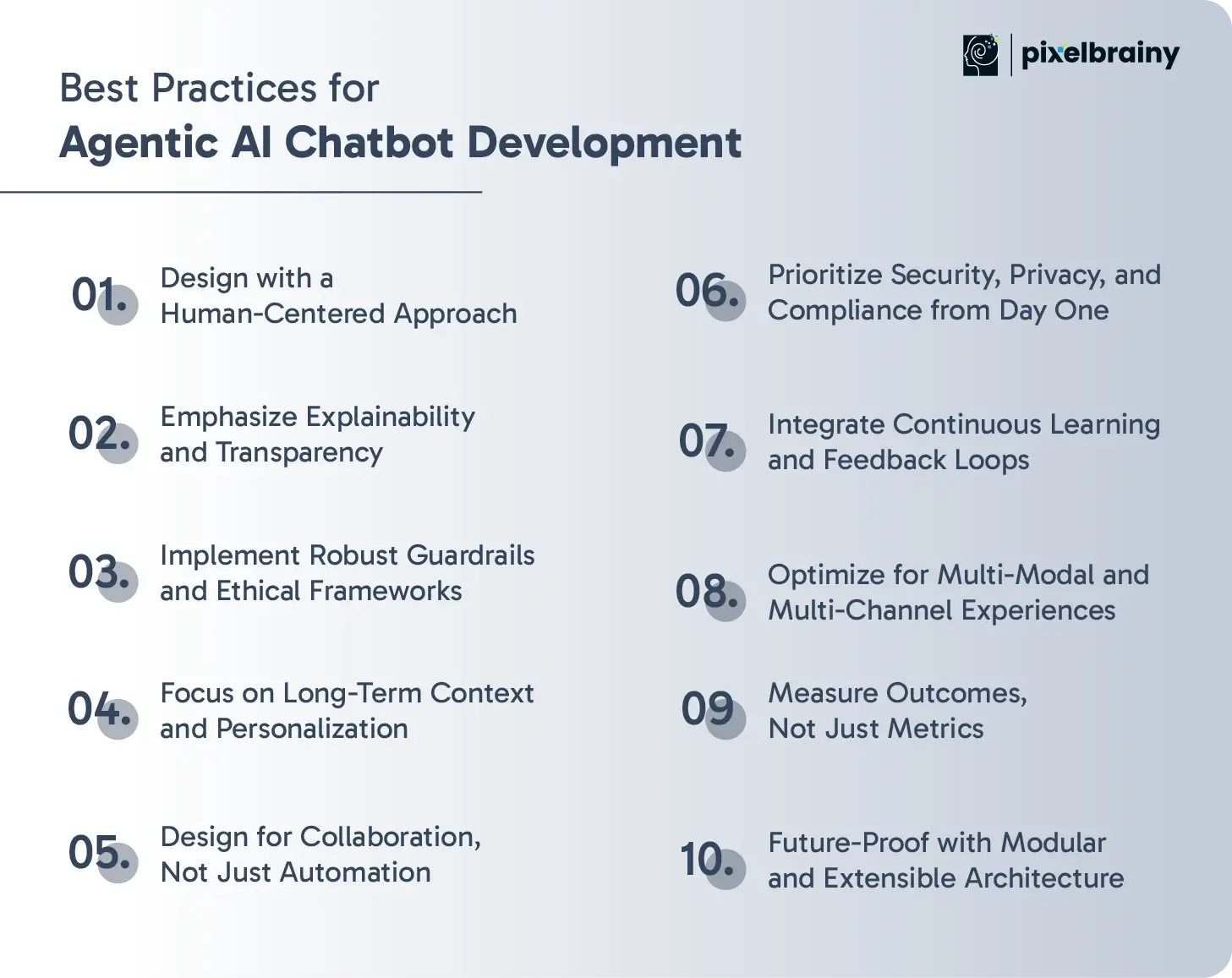
Agentic AI should feel natural, helpful, and intuitive. Designing your chatbot around real user needs ensures higher adoption, satisfaction, and engagement.
Users are more likely to trust and adopt AI systems when they understand how decisions are made. Explainability should be a key design principle in chatbot development.
Agentic chatbots are capable of autonomous actions, which makes safety and ethics essential. Without boundaries, AI systems can produce biased, harmful, or unintended outcomes.
An Agentic AI Chatbot becomes far more powerful when it understands context beyond a single conversation. Personalization leads to more relevant, efficient, and engaging user interactions.
The most effective chatbots do not replace humans; they work with them. Collaborative workflows improve trust, reliability, and decision quality.
Since chatbots often handle sensitive data, security is a non-negotiable priority. A secure foundation builds user trust and ensures regulatory compliance.
Agentic chatbots should evolve and improve over time. Building systems for feedback and continuous learning ensures they become smarter with every interaction.
Modern users engage with businesses across various platforms and devices. A truly agentic chatbot must deliver consistent performance everywhere.
Focusing only on technical KPIs like response time is not enough. True success lies in measuring how well the chatbot contributes to real business goals.
Technology evolves rapidly, and your chatbot should be able to evolve with it. A modular and extensible design ensures future scalability without major rework.
By following these best practices, businesses can ensure their Agentic AI Chatbot Development initiatives result in intelligent, secure, ethical, and scalable solutions that deliver long-term business value and world-class user experiences.
While Agentic AI Chatbots offer revolutionary capabilities, their development is not without complexity. From technical limitations and data challenges to ethical concerns and integration issues, building an intelligent, autonomous chatbot involves solving multiple layers of problems. Organizations that anticipate these challenges and plan proactively can significantly accelerate their time-to-market, reduce risks, and ensure a more successful deployment.
Below are the most common challenges faced during Agentic AI Chatbot Development — and practical ways to overcome them.
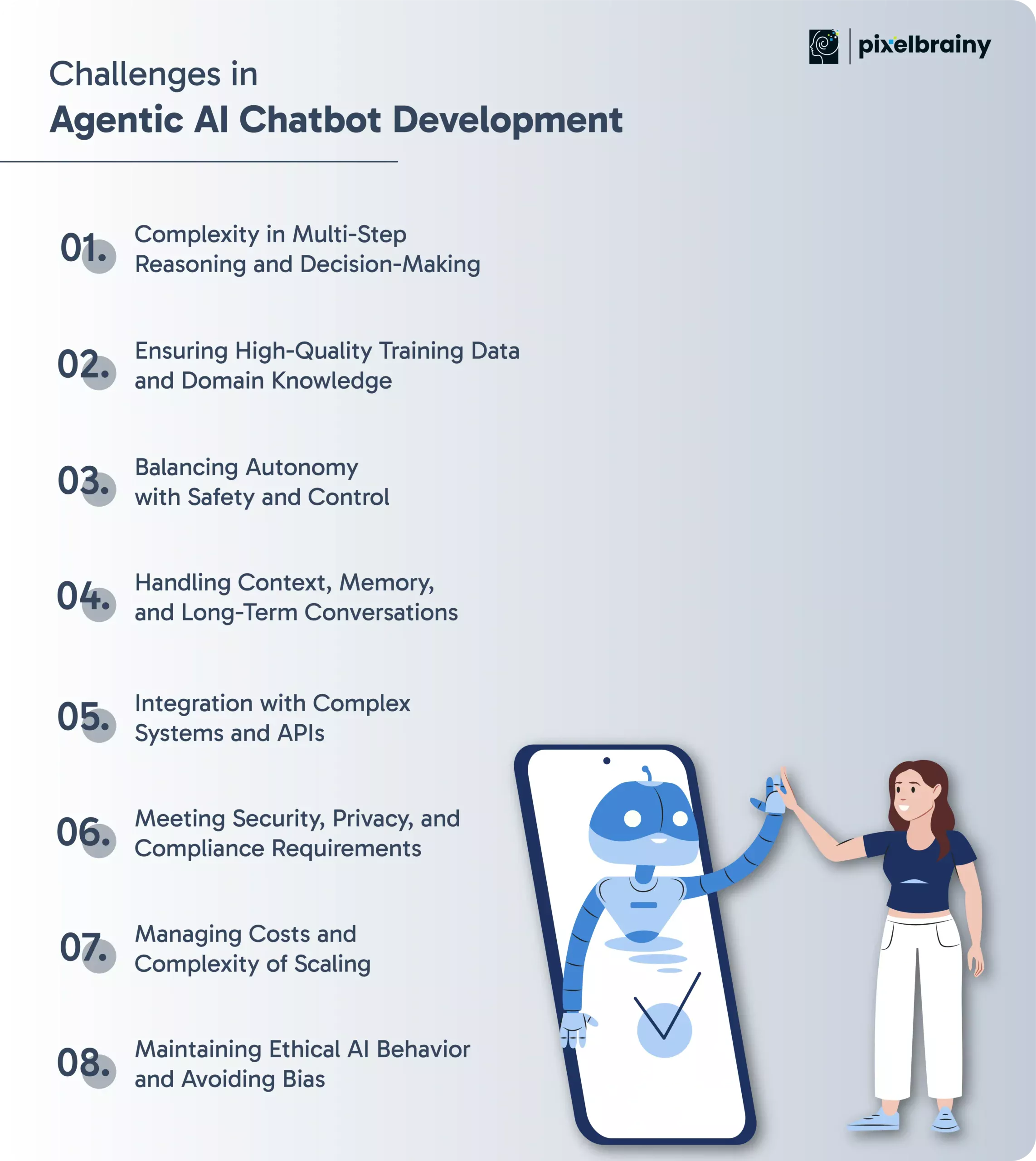
Challenge: Unlike traditional bots, agentic chatbots must reason, plan, and execute multi-step tasks autonomously. Designing accurate decision-making workflows and chaining multiple actions is one of the hardest parts of development.
How to Solve It:
Challenge: AI systems are only as good as the data they are trained on. Poor, biased, or incomplete data can result in inaccurate responses, poor reasoning, and limited adaptability.
How to Solve It:
Challenge: Agentic chatbots that act autonomously pose potential risks if they execute incorrect actions or exceed intended permissions. Striking the right balance between autonomy and control is critical.
How to Solve It:
Challenge: Maintaining memory across sessions and understanding context over time is essential but technically challenging. Many chatbots lose context, leading to repetitive or irrelevant responses.
How to Solve It:
Challenge: Real-world enterprise environments involve multiple platforms, CRMs, data pipelines, and APIs. Ensuring seamless integration without performance issues is a major hurdle.
How to Solve It:
Challenge: As chatbots process sensitive data and sometimes make decisions, compliance with regulations and ensuring user trust are top priorities. Security breaches or non-compliance can result in severe consequences.
How to Solve It:
Challenge: As chatbots evolve from prototypes to enterprise-grade solutions, costs can escalate significantly. Infrastructure, model training, and ongoing maintenance often require substantial investment.
How to Solve It:
Challenge: Unintended biases in AI systems can damage brand reputation, lead to compliance issues, and negatively affect user trust. Agentic systems require extra care due to their autonomous nature.
How to Solve It:
By understanding these challenges early and applying the right strategies, businesses can navigate the complexities of Agentic AI Chatbot Development more effectively and build solutions that are intelligent, secure, scalable, and trusted by users.
Choosing the right technology partner is one of the most important decisions when it comes to developing Agentic AI Chatbot solutions that deliver measurable business outcomes. As a leading AI chatbot development company in USA, PixelBrainy specializes in designing, building, and deploying intelligent, autonomous chatbots that transform the way businesses interact with their customers, automate workflows, and scale operations.
Our approach goes beyond just coding. We focus on creating AI systems that think, reason, and act — empowering enterprises to solve complex challenges, improve customer experiences, and unlock new revenue streams.
Our team consists of AI engineers, NLP specialists, and software architects who have deep expertise in Agentic AI Chatbot Development. We have successfully delivered projects across industries such as finance, healthcare, e-commerce, and enterprise SaaS, helping businesses integrate intelligent automation into their operations.
From concept to deployment, we handle the complete lifecycle of development of Agentic AI Chatbot solutions. Our services include research and discovery, proof of concept (POC), MVP development, architecture design, LLM integration, and multi-channel deployment — ensuring a seamless and efficient build process.
Every business has unique requirements, and our solutions reflect that. Whether you want to build Agentic AI Chatbot for customer service, workflow automation, knowledge retrieval, or predictive insights, we customize the architecture and intelligence layers to align with your specific objectives.
Our chatbots are built on scalable cloud infrastructure and designed to evolve with your business. As your user base grows and requirements change, we ensure the chatbot continues to deliver peak performance with robust security, compliance, and integration capabilities.
PixelBrainy does not stop at deployment. We offer ongoing optimization, performance tuning, model fine-tuning, and continuous learning updates to ensure your chatbot becomes smarter and more efficient over time.
One of our most impactful projects involved creating an enterprise-grade Agentic AI Chatbot for a global technology firm (client confidential). The solution was designed to automate complex internal workflows, handle multi-turn employee support queries, and make autonomous decisions based on context and data. Within six months of deployment, the chatbot successfully automated over 40 percent of internal service requests, improved resolution times by 60 percent, and significantly reduced operational costs.
Whether you are starting from scratch or looking to enhance an existing solution, PixelBrainy has the expertise, tools, and vision to guide you through the entire development of Agentic AI Chatbot journey. Our mission is to help organizations innovate faster, scale smarter, and unlock the full potential of autonomous AI.
As a trusted AI chatbot development company in USA, PixelBrainy is your ideal partner to design, build, and scale intelligent chatbot solutions that redefine customer engagement and business automation.
From the above, it is clear that Agentic AI Chatbot Development is no longer just a trend but a strategic investment for businesses aiming to automate, personalize, and scale their operations. By leveraging intelligent, goal-oriented chatbots, organizations can deliver superior customer experiences, streamline workflows, and unlock new revenue opportunities. With the right approach, technology stack, and expert support, it becomes easier than ever to build Agentic AI Chatbot solutions that evolve with your business needs.
Partnering with an experienced AI chatbot development company in USA like PixelBrainy ensures you stay ahead of the curve and turn AI potential into real-world impact.
Ready to transform your business with intelligent automation? Book an appointment with PixelBrainy today and start your journey toward smarter, autonomous chatbot solutions.
Agentic AI Chatbots are highly versatile and can be tailored for almost any industry. Sectors like healthcare, finance, e-commerce, customer support, education, and logistics are seeing significant benefits. These chatbots automate repetitive tasks, handle complex decision-making, personalize user experiences, and provide real-time support — improving efficiency and ROI across operations.
Traditional chatbots follow predefined scripts and can only respond to specific commands. Agentic AI Chatbots, on the other hand, are autonomous and goal-driven. They reason, plan, and take action independently, allowing them to perform multi-step tasks, integrate with business systems, and proactively solve problems — much like a digital team member.
Yes, one of the biggest advantages of developing Agentic AI Chatbot solutions is their ability to integrate seamlessly with CRMs, ERPs, knowledge bases, and other enterprise platforms. Through APIs and orchestration layers, these chatbots can access, process, and act on data from different systems, creating a unified and automated workflow.
The timeline depends on project complexity, features, and integration requirements. A basic prototype or MVP can be built in 4–8 weeks, while a fully autonomous, enterprise-grade chatbot may take 3–6 months. Working with an experienced AI chatbot development company in USA ensures faster delivery without compromising quality or scalability.
Absolutely. When developed with proper security protocols, Agentic AI Chatbots are highly secure. They can be designed with data encryption, secure authentication, role-based access, and compliance with standards like GDPR or HIPAA. Partnering with a trusted development team ensures enterprise-grade protection and peace of mind.
The future of Agentic AI Chatbot Development will include multi-agent collaboration, advanced personalization through memory, multi-modal capabilities (voice, image, and text), and deeper integration with enterprise systems. As large language models evolve, these chatbots will become even more autonomous, context-aware, and capable of driving end-to-end business processes.

About The Author
Sagar Bhatnagar
Sagar Sahay Bhatnagar brings over a decade of IT industry experience to his role as Marketing Head at PixelBrainy. He's known for his knack in devising creative marketing strategies that boost brand visibility and market influence. Sagar's strategic thinking, coupled with his innovative vision and focus on results, sets him apart. His track record of successful campaigns proves his ability to utilize digital platforms effectively for impactful marketing efforts. With a genuine passion for both technology and marketing, Sagar continuously pushes PixelBrainy's marketing initiatives to greater success.


Transform your ideas into reality with us.
Working with the PixelBrainy team has been a highly positive experience. They understand the design requirements and create beautiful UX elements to meet the application needs. The dev team did an excellent job bringing my vision to life. We discussed usability and flow. Sagar worked with his team to design the database and begin coding. Working with Sagar was easy. He has the knowledge to create robust apps, including multi-language support, Google and Apple ID login options, Ad-enabled integrations, Stripe payment processing, and a Web Admin site for maintaining support data. I'm extremely satisfied with the services provided, the quality of the final product, and the professionalism of the entire process. I highly recommend them for Android and iOS Mobile Application Design and Development.

Great experience working with them. Had a lot of feedback and I found that unlike most contractors they were bugging me for updates instead of the other way around. They were extremely time conscience and great at communicating! All work was done extremely high quality and if not on time, early! They were always proactive when it comes to communication and the work is great/above par always. Very flexible and a great team to work with! Goes above and beyond to present us with multiple options and always provides quality. Amazing work per usual with Chitra. If you have UI/UX or branding design needs I recommend you go to them! Will likely work with them in the future as well, definitely recommended!

PixelBrainy is a joy to work with and is a great partner when thinking through branding, logo, and website layout. I appreciate that they spend time going into the "why" behind their decisions to help inform me and others about industry best practices and their expertise.

I hired them to design our software apps. Things I really like about them are excellent communication skills, they answer all project suggestions and collaborate right away, and their input on design and colors is amazing. This project was complex and needed patience and creativity. The team is amazing to do business with. I will be using them long-term. Glad to see there are some good people out there. I was afraid to try and outsource my project to someone but I am glad I met them! I really can't say enough. They went above and beyond on this project. I am very happy with everything they have done to make my business stand out from the competition.

It was great working with PixelBrainy and the team. They were very responsive and really owned the project. We'll definitely work with them again!

I recently worked with the PixelBrainy team on a project and I was blown away by their communication skills. They were prompt, clear, and articulate in all of our interactions. They listened and provided valuable feedback and suggestions to help make the project a success. They also kept me updated throughout the entire process, which made the experience stress-free and enjoyable.

PixelBrainy is very good at what it does. The team also presents themselves very professionally and takes care of their side of things very well. I could fully trust them taking up the design work in a timely and organised manner and their attention to detail saved us lots of effort and time. This particular project was quite intense and the team showed that they function very well under pressure. Very much looking forward to working with her again!

It's always an absolute pleasure working with them. They completed all of my requests quickly and followed every note I had for them to a T, which made our process go smoothly from start to finish. Everything was completed fast and following all of the guidelines. And I would recommend their services to anyone. If you need any design work done in the future, PixelBrainy should be your first call!

They took ownership of our requirements and designed and proposed multiple beautiful variants. The team is self-motivated, requires minimum supervision, committed to see-through designs with quality and delivering them on time. We would definitely love to work with PixelBrainy again when we have any requirements.

PixelBrainy was a big help with our SaaS application. We've been hard at work with a new UI/UX and they provided a lot of help with the designs. If you're looking for assistance with your website, software, or mobile application designs, PixelBrainy and the team is a great recommendation.

PixelBrainy designers are amazing. They are responsive, talented, and always willing to help craft the design until it matches your vision. I would recommend them and plan to continue them for my future projects and more!!!

They were awesome! Did a good job fast, and good communication. Will work with them again. Thank you

Creative, detail-oriented, and talented designers who take direction well and implement changes quickly and accurately. They consistently over-delivered for us.

PixelBrainy team is very talented and creative. Great designers and a pleasure to work with. PixelBrainy is an excellent communicator and I look forward to working with them again.

PixelBrainy has a very talented design team. Their work is excellent and they are very responsive. I enjoy working with them and hope to continue on all of our future projects.


