AI Summary Powered by PixelBrainy
What does it take to build an AI avatar for a mental health app that feels genuinely compassionate, clinically informed, and trustworthy rather than like another robotic chatbot?
For mental health platforms, an AI avatar for mental health apps can create a more personal way for users to interact with digital wellness and therapeutic support. Instead of relying only on text-based conversations, an avatar can combine conversational AI, voice, facial expressions, animation, emotional analysis, and therapeutic frameworks to create a more engaging experience.
Consider a real-world scenario: a licensed therapist wants to build an AI avatar for a mental health app that can provide patients with a compassionate therapeutic presence between weekly sessions. The avatar needs to use a photorealistic appearance, deliver evidence-based CBT exercises, conduct mood check-ins, and provide emotional support while maintaining a warm and empathetic communication style. The therapist also needs to understand the production-grade AI avatar development cost and identify a development company with both clinical psychology knowledge and advanced avatar technology expertise.
This raises important questions for anyone developing an AI avatar for a mental health app: How should the avatar be designed? What technologies are required? How much does it cost to develop? How can safety, privacy, emotional responsiveness, and therapeutic boundaries be incorporated into the product?
This guide explores mental health app AI avatar development from concept to deployment, covering its benefits, use cases, essential features, development process, technology stack, costs, monetization opportunities, challenges, and future possibilities.It also explores the practical steps involved in how to create an AI avatar for a mental health app, from defining its role and personality to choosing the right AI, voice, animation, and safety technologies. The guide also covers the key considerations involved in AI avatar development for mental health applications, including cost, privacy, personalization, and long-term scalability.
Whether you are planning to build a mental health app AI avatar from scratch or add one to an existing platform, this guide provides a practical foundation for planning the product, technology, budget, and development roadmap.

An AI avatar for a mental health app is an artificial intelligence-powered digital character that interacts with users through text, voice, facial expressions, and animation. Unlike a conventional chatbot, it is designed to create a more personal and emotionally responsive experience by combining conversational AI with visual and voice-based communication.
Depending on the app's purpose, the avatar can function as a mental wellness companion, emotional support assistant, coaching guide, or therapy support tool. It may facilitate mood check-ins, journaling, mindfulness activities, or structured exercises based on frameworks such as CBT and DBT.
AI avatars can be designed as 2D characters, stylized digital personalities, or realistic 3D human-like figures. Their appearance, voice, personality, and communication style can be customized for a specific audience. Behind the experience, technologies such as large language models, natural language processing, speech systems, animation, context memory, and safety mechanisms work together to generate relevant interactions.
For mental health platforms, the goal of an AI avatar is to make digital support feel more accessible, engaging, and consistent while maintaining appropriate safety boundaries.
An AI avatar for a mental health app combines conversational AI, natural language processing, emotional analysis, voice technology, animation, personalization, and safety mechanisms to create a more interactive support experience. Instead of simply displaying text responses, the avatar can listen or read a user's message, interpret the conversation, generate an appropriate response, and deliver it through a digital character using voice, facial expressions, and animation.
For example, imagine a user opens a mental health app after a stressful workday and says, “I have been feeling anxious all evening and I cannot focus.” The AI avatar can process the statement, identify relevant emotional and conversational cues, and respond with a supportive interaction such as a brief mood check-in, a guided breathing exercise, or another activity appropriate to the app's defined purpose.
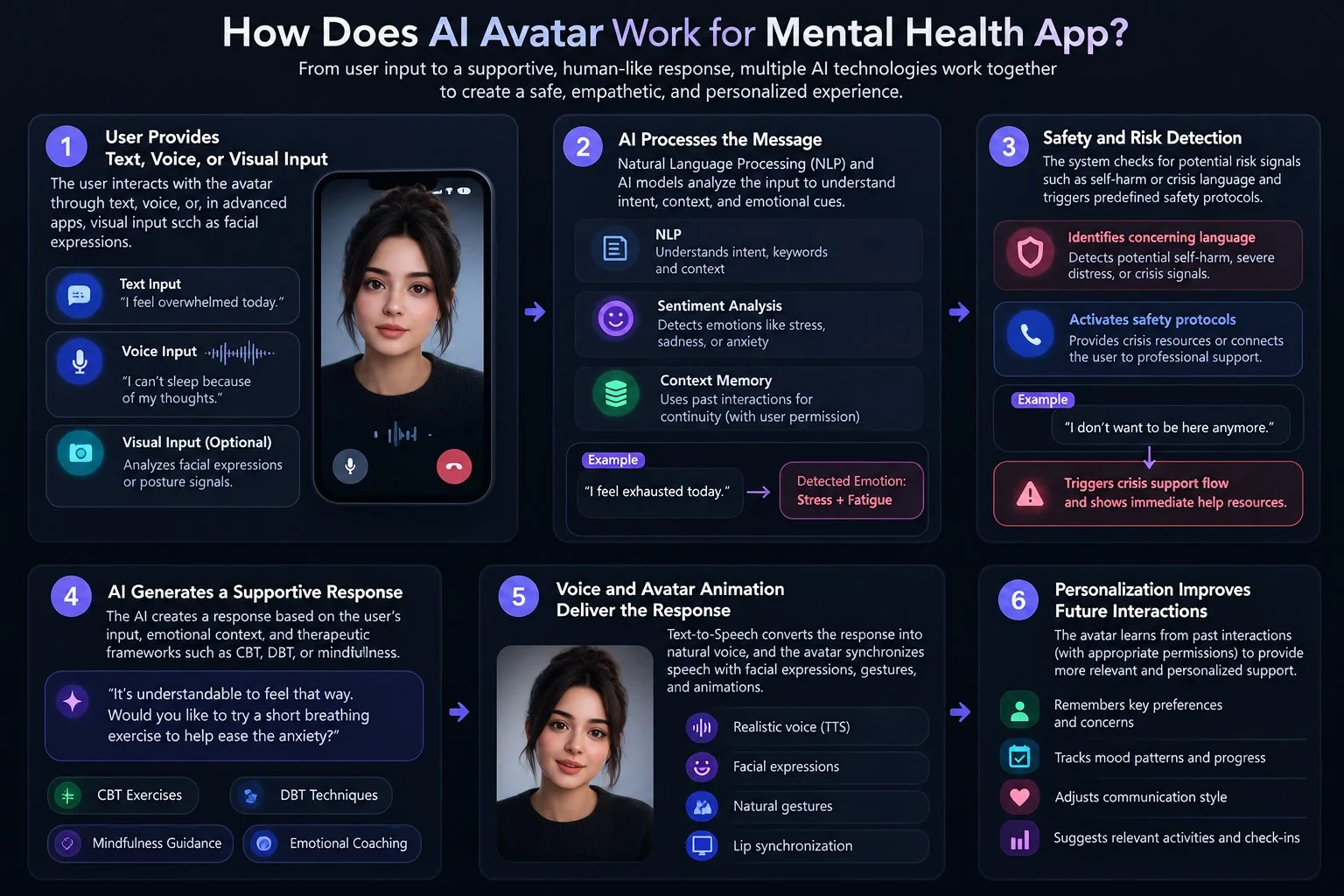
The interaction begins when the user communicates with the avatar through text or voice. Some advanced implementations may also use visual input to support additional interaction signals.
Example: A user says, “I feel overwhelmed today,” instead of typing the message.
Natural Language Processing (NLP) and AI models analyze the user's input to understand its meaning, intent, context, and relevant emotional signals. The system can also use conversation history where permitted to maintain continuity.
Example: If a user previously mentioned difficulty sleeping and now says they feel exhausted, the system can recognize the connection within the permitted conversation context.
The application can use sentiment or emotional analysis to identify signals associated with feelings such as stress, sadness, frustration, or anxiety. Mental health applications also require safety mechanisms that can detect potentially concerning language and activate predefined escalation or crisis-support flows.
Example: If a conversation contains language indicating possible self-harm, the application can move away from a routine wellness conversation and present appropriate crisis resources or professional support options.
The conversational AI generates a response based on the user's input, conversation context, and the therapeutic or wellness framework defined for the application. Depending on the product, this may include CBT exercises, DBT-informed activities, mindfulness guidance, mood check-ins, or general emotional coaching.
Example: After a user reports feeling overwhelmed, the avatar might guide them through a short breathing exercise and then ask whether they would like to record their current mood.
When voice interaction is enabled, Text-to-Speech (TTS) converts the generated response into spoken language. The avatar can synchronize the speech with lip movements, facial expressions, gestures, and other animations.
Example: Instead of displaying only “Let's try a breathing exercise,” a virtual therapist-style avatar can speak the instruction while using calm facial expressions and natural movements.
With appropriate user permission and data controls, the AI avatar can use relevant preferences, mood patterns, and previous interactions to personalize future conversations.
Example: If a user regularly completes evening mood check-ins, the avatar may provide a consistent check-in experience and suggest activities aligned with the app's wellness program.
Together, these components form the core of AI avatar development for mental health applications. The goal is to make digital support more conversational and engaging while maintaining clear safety boundaries and recognizing that an AI avatar is not a replacement for qualified mental health professionals.
What does an AI avatar add to a mental health app beyond a conventional chatbot, and why are therapists and digital health companies considering this technology for more personalized support?
As mental health apps move toward more conversational, personalized, and interactive experiences, AI avatar development for mental health applications is becoming an important product consideration. An avatar can combine conversational AI, voice, facial expressions, animation, emotional analysis, and personalization to create a stronger sense of interaction than text-only interfaces.
Consider a practical scenario: a licensed therapist wants to build an AI avatar for a mental health app that supports patients between weekly sessions with mood check-ins, CBT exercises, and emotional support. The objective is not to replace therapy, but to create a consistent digital touchpoint that can guide users through approved activities while maintaining appropriate clinical and safety boundaries.
The market is also expanding. Fortune Business Insights estimates the global mental health apps market will grow from USD 8.68 billion in 2026 to USD 25.45 billion by 2034, representing a 14.39% CAGR. Its September 2026 report also identifies AI integration, personalized support, and broader digital behavioral healthcare as part of the market landscape.
Grand View Research separately estimates the chatbot-based mental health apps market at USD 2.6 billion in 2026, with a projected 16.5% CAGR through 2033. This provides additional context for why conversational interfaces are becoming relevant to mental health product development.
For businesses planning to build a mental health app AI avatar, the value therefore extends beyond visual presentation. The technology can influence accessibility, engagement, personalization, clinical workflows, and the overall way users interact with digital mental health services.
Access to mental health support can be affected by cost, location, availability of professionals, scheduling constraints, and stigma. An AI avatar for mental health apps can provide an additional digital interaction layer that is available whenever the application is accessible.
For example, a user who cannot immediately reach their therapist could open the app for a scheduled mood check-in, guided breathing activity, journaling prompt, or other preconfigured wellness exercise.
The important distinction is that the avatar should provide support within its defined scope, rather than presenting itself as a substitute for a licensed professional. Safety escalation and appropriate referral pathways should remain part of the product architecture.
Mental health applications often depend on repeated user participation. An AI avatar can make recurring activities more conversational by giving users a consistent interface for check-ins, exercises, reminders, and educational content.
For example, instead of a notification saying “Complete today's mood check-in,” the avatar could ask the user how they are feeling, collect the response, and guide them through the next appropriate activity.
This type of interaction can make mental health app AI avatar experiences feel more structured and personal. However, actual retention and adherence should be measured through product analytics rather than assumed simply because an avatar is present.
One of the strongest applications of developing an AI avatar for mental health apps is personalized interaction. With appropriate consent and data controls, an avatar can use relevant information such as previous conversations, user preferences, mood patterns, completed activities, and communication preferences.
For example, if a user regularly reports work-related stress, the application could prioritize relevant journaling prompts, stress-management exercises, or previously selected coping activities.
This allows developers to create different interaction experiences without manually designing a separate support flow for every individual user. Personalization should still operate within predefined clinical, privacy, and safety boundaries.
The growing mental health app market creates more demand for differentiated user experiences. Fortune Business Insights estimates the global market will reach USD 25.45 billion by 2034, while Grand View Research projects the chatbot-based segment to reach USD 7.6 billion by 2033.
For product teams, these figures indicate a growing market for digital mental health and conversational support technologies. An AI avatar can provide one potential way to differentiate an application through voice interaction, visual presence, personalized conversations, guided exercises, and human-like communication.
The business value should come from how effectively these capabilities solve a defined user problem, rather than from adding an avatar simply as a visual feature.
An AI avatar should not be positioned as a replacement for licensed therapists. Instead, AI avatar development for mental health applications can support specific parts of a broader care or wellness experience.
For example, an avatar could guide users through therapist-approved CBT exercises, collect structured mood information, provide homework reminders, support journaling, or prepare information that can be reviewed during a professional session, depending on the application's clinical design.
For a therapist building such a platform, this creates a potential bridge between scheduled sessions and structured digital activities. The exact role depends on clinical oversight, intended use, evidence requirements, and applicable regulatory considerations.
Users increasingly interact with conversational AI through voice assistants, customer-service systems, productivity tools, and other digital products. Mental health applications can apply similar interaction patterns while requiring additional attention to privacy, emotional sensitivity, safety, and clinical boundaries.
For example, instead of navigating multiple menus to find a mindfulness exercise, a user could tell the avatar, “I am feeling anxious right now,” and receive an appropriate response based on the application's approved support framework.
This is where how to create an AI avatar for a mental health app becomes a broader product question. Developers need to consider not only the avatar's appearance, but also its conversational behavior, voice, emotional responses, memory, therapeutic framework, safety mechanisms, privacy controls, and escalation pathways.
As mental health applications continue to develop, AI avatars can provide a more interactive layer between users and digital mental health services. For businesses planning mental health app AI avatar development, the focus should be on combining engaging interaction with personalization, clinical oversight, safety, and measurable user value.
Also Read: Mental Health AI Chatbot Development: Tools, Techniques, and Challenges
Should I use a realistic human-like avatar or a friendly stylized character for my mental health app if I want users to feel comfortable, supported, and willing to engage? This is a practical question for product teams developing AI avatars for mental health apps, because avatar design can influence how users perceive trust, warmth, privacy, and emotional safety from their first interaction.
A human-like avatar for a mental health app can create a more familiar, conversational presence through realistic facial expressions, voice, eye contact, and natural gestures. This can be relevant for therapy-support, emotional coaching, and guided conversations. However, achieving convincing realism requires careful character design, facial animation, voice synchronization, and interaction quality.
A stylized avatar takes a different approach, using simplified visuals, softer expressions, and a more approachable personality. This can work well for mood tracking, mindfulness, journaling, wellness activities, and audiences that may prefer less human-like digital companions.
For businesses planning AI avatar development for mental health applications, the decision should therefore be based on the app's purpose, target users, interaction model, and desired emotional tone rather than visual realism alone. The following comparison highlights how both approaches differ in terms of trust, cost, animation requirements, audience, and potential use cases.
| Feature | Human-Like Avatars | Stylized Avatars |
| Visual Style | Realistic and lifelike | Cartoon or simplified art |
| Emotional Tone | Serious, warm, relatable | Gentle, safe, friendly |
| Ideal Audience | Adults and therapy-focused users | Teens, young adults, wellness-first users |
| Trust Building | Strong if realism is polished | Strong even with simple animations |
| Cost to Produce | Higher due to detailed animation | Lower because style is simple |
| Risk Factor | Possible discomfort if too realistic | No uncanny valley risk |
| Best Fit For | Therapy coaching, emotional guidance | Mood tracking, mindfulness, gamified wellness |
| Animation Needs | High precision | Flexible and expressive |
There is no single avatar style that fits every mental health application. A realistic avatar may align with an app centered on structured emotional guidance, while a stylized character may create a softer environment for wellness and self-guided activities.
The right direction depends on what users need from the avatar and how they are expected to interact with it. During AI avatar development for mental health apps, teams should evaluate the avatar's personality, visual style, voice, emotional expressions, accessibility, development cost, and safety requirements together so the final experience feels appropriate rather than simply more technologically advanced.
How can an AI avatar for a mental health app support users beyond basic chatbot conversations? For a therapist, healthcare startup, or digital wellness company planning mental health app AI avatar development, the answer depends on how the avatar is integrated into the user journey. It can support daily emotional check-ins, guided therapeutic exercises, youth wellness, workplace mental health programs, and pre-therapy assessment workflows.
The value of AI avatar development for mental health applications comes from combining conversational AI with voice, facial expressions, personalization, and structured support flows. Instead of simply displaying information, the avatar can guide users through specific activities and respond to their inputs in a more interactive format.
For example, a therapist planning to build a mental health app AI avatar may want the avatar to check in with patients between weekly sessions, guide approved CBT exercises, identify concerning responses, and direct users toward professional support when necessary. In another application, the avatar may serve primarily as a wellness companion for mood tracking, mindfulness, or stress management.
Below are the key use cases that demonstrate how to create an AI avatar for a mental health app around specific user needs rather than treating the avatar as a standalone visual feature.
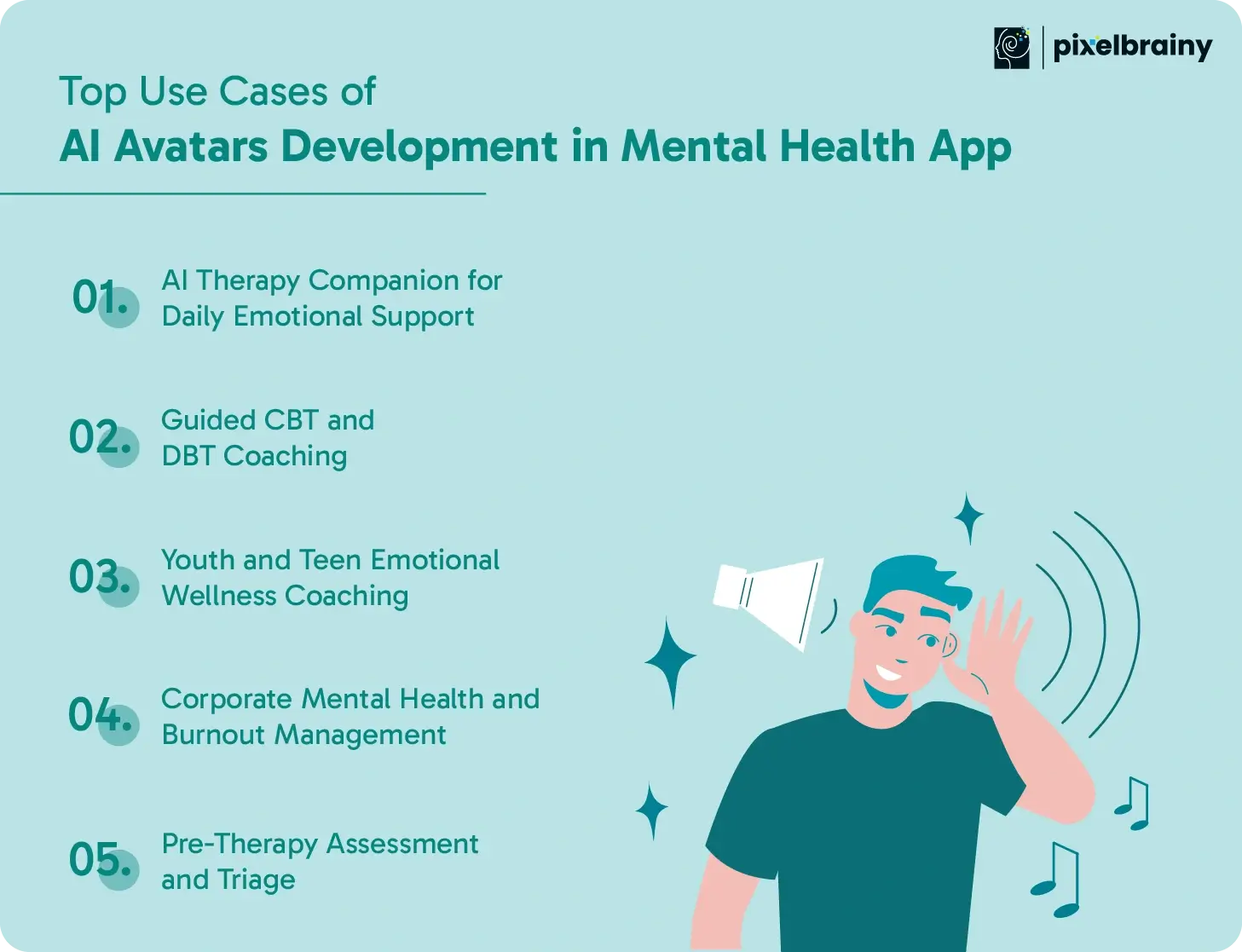
One of the most powerful roles of an AI avatar in mental health apps is acting as a therapy companion. This avatar checks in with users, asks how they are feeling, and guides them through emotional reflection.
Example: A user opens the app after a stressful day. The AI therapy avatar notices a pattern of negative mood entries and gently encourages the user to talk about what happened. It listens, validates the emotions, and suggests a calming exercise or grounding technique.
This creates a consistent, non-judgmental space where the user feels understood.
Cognitive Behavioral Therapy and Dialectical Behavior Therapy often require structured steps. With AI avatar development for mental health apps, these methods can be delivered in a more human and engaging way.
Example: Instead of reading a long text about managing intrusive thoughts, the avatar walks the user through a CBT thought reframing exercise. It explains each step with visual expressions, calm voice cues, and simple prompts.
Learning becomes personal rather than instructional.
Younger users often prefer stylized or animated avatars because they feel safe and approachable. AI avatar development helps mental health apps create a companion that teens trust.
Example: A teen feels overwhelmed with school stress. The stylized avatar encourages them to share their feelings, offers small achievable steps, and helps them create a simple daily plan. The playful design keeps the experience friendly rather than clinical.
This builds emotional resilience in a non-threatening environment.
Businesses increasingly use mental wellness apps to support their employees. An AI avatar can deliver personalized burnout prevention and stress management.
Example: An employee logs into a corporate wellness platform. The AI avatar detects high stress in recent entries and suggests short breaks, breathing sessions, and work-life balance tips. It can even provide tailored analytics for long-term improvement.
This helps organizations support mental health at scale.
Before users meet a real therapist, AI avatars can help gather information, identify emotional states, and guide them toward appropriate resources.
Example: The avatar asks structured questions about mood, sleep, stress, and daily functioning. Based on the responses, it guides the user to an in-app therapist or provides immediate self-help tools.
This improves the efficiency of mental health services.
For teams developing AI avatars for mental health apps, these use cases show how avatars can support emotional check-ins, guided exercises, wellness programs, and pre-therapy workflows while maintaining clear safety and professional boundaries.
What features does a health system need in an AI avatar for a mental health app if the goal is to extend therapist support while keeping clinicians involved in patient care? This is especially important when the avatar is expected to provide guided therapy exercises, monitor mood, support patients between sessions, and operate within a clear therapist oversight architecture.
For example, a behavioral health department may want to build an AI avatar for a mental health app that guides patients through therapist-approved exercises and daily check-ins while allowing the clinical team to review AI interactions. If an interaction log indicates a potential need for immediate human attention, the system should support an appropriate escalation workflow rather than allowing the avatar to operate independently.
For organizations planning AI avatar development for mental health applications, this means looking beyond the avatar's appearance or conversational abilities. The underlying platform may need natural language understanding, emotion recognition, conversational memory, voice interaction, safety and crisis detection, therapist dashboards, secure data handling, mood monitoring, real-time responses, and healthcare system integrations. Where integration with an EHR such as Epic is required, interoperability and clinical workflow requirements should also be addressed during the architecture stage.
The following features outline the core capabilities to consider when developing an AI avatar for a mental health app, particularly for healthcare organizations that need both patient-facing support and clinician visibility.
| Feature | Explanation |
| Natural Language Understanding | The avatar should understand user messages with context and clarity. This helps create conversations that feel genuine. Users feel heard in a natural and supportive way. |
| Emotion Recognition System | Detecting emotional cues helps the avatar respond with empathy. It identifies stress, sadness, or frustration. This emotional awareness builds trust. |
| Text to Speech and Speech to Text | Users can speak or listen to the avatar depending on comfort. High quality voice makes guidance feel warm and relatable. This also supports accessibility. |
| Personalized Conversation Memory | The avatar remembers patterns, past interactions, and preferences. This gives each user a sense of continuity. It makes the journey feel personal. |
| Realistic Facial Expressions | Calm gestures and gentle expressions make the avatar feel supportive. Visual cues help users feel understood. This enhances emotional connection. |
| Safety and Crisis Detection | The system identifies warning signs related to emotional crisis. It provides immediate guidance and resources. This ensures ethical AI Avatar Development for Mental Health Apps. |
| Guided CBT and DBT Tools | The avatar can lead users through structured therapeutic exercises. This makes learning emotional skills easier and more engaging. Users receive practical, step-by-step help. |
| Mood Tracking Interaction | Instead of simple check-ins, the avatar talks with users to understand mood shifts. It helps identify patterns and triggers. This encourages consistent self-awareness. |
| Customizable Avatar Appearance | Users should be able to adjust the avatar’s look or voice. This personalization increases comfort. It also supports long-term engagement. |
| Multilingual Support | Mental health support becomes accessible across cultures and languages. Multiple language options expand your audience. This promotes global inclusivity. |
| Privacy and HIPAA Compliant Data Handling | Emotional information must be protected with strong security. Safe handling of data builds user trust. It ensures responsible development of AI avatars for mental health integrating AI. |
| Real Time Response Engine | The avatar should reply quickly for smooth conversations. Slow responses break emotional flow. Fast interactions feel more human. |
| Daily Wellness Check-ins | The avatar encourages small daily habits like journaling or breathing exercises. These gentle nudges support routine building. Users stay consistent with self care. |
| Adaptive Personality Behavior | The avatar adjusts tone based on the user’s emotional needs. It can be soft, informative, or motivating when needed. This adaptability feels human. |
| Integration With Wearables and Sensors | Wearable data gives the avatar insights into stress levels, sleep, or activity. These insights allow proactive guidance. It creates a holistic mental wellness experience. |
The right feature set should connect the AI avatar, patient experience, clinical oversight, safety workflows, and healthcare infrastructure into one controlled system. For health systems, therapist visibility and escalation capabilities are just as important as conversational and visual features.
Also Read: How To Build An AI Mental Health and Wellness App Like Wysa?
What are the steps to develop an AI avatar for mental health from idea to launch when the product needs to provide employees with private, judgment-free emotional support outside working hours? This is a practical concern for corporate wellness companies that want to build a mental health AI avatar from scratch while protecting sensitive employee conversations from employer access.
For example, a corporate wellness provider may want an avatar that offers mood check-ins, guided mindfulness or CBT-based exercises, and between-session emotional support. At the same time, the platform needs clear privacy controls, secure data architecture, appropriate crisis escalation, and a defined boundary between employee conversations and employer-facing analytics.
The mental health AI avatar development process therefore involves much more than creating a realistic digital character. It combines user research, avatar design, conversational intelligence, voice technology, personalization, safety protocols, privacy architecture, testing, and deployment. The following development process of AI avatar for mental health explains how these components can be planned and implemented from the initial concept through launch.
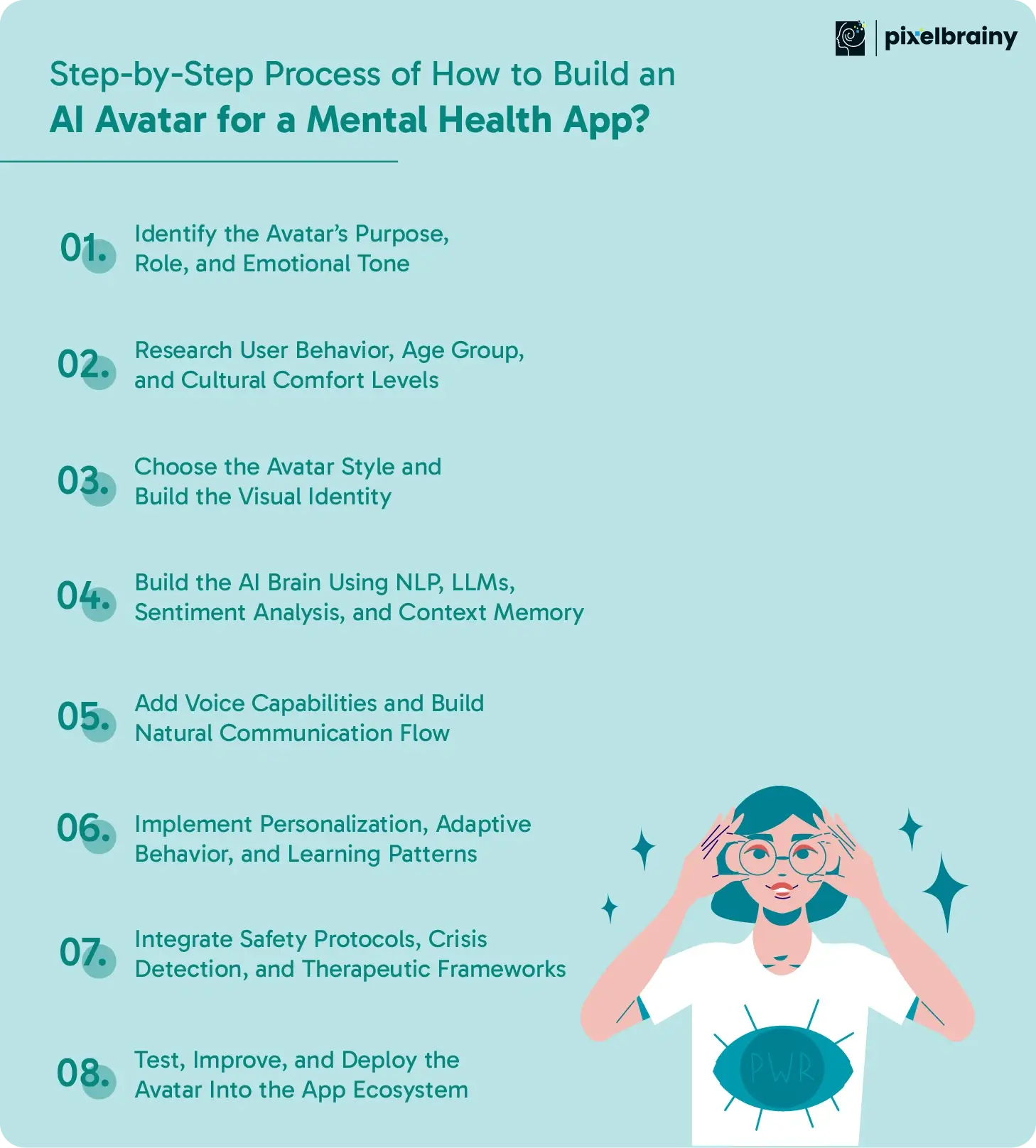
The first step in building an mental health AI avatar is defining exactly what the avatar should do. It could serve as a wellness companion, emotional support assistant, meditation guide, or therapy exercise facilitator. Its role determines the conversations, features, safety boundaries, and technology required later.
For a corporate wellness application, the avatar might provide employees with private mood check-ins, guided breathing exercises, journaling prompts, and approved emotional wellness activities outside work hours. The personality should also be defined at this stage, including communication style, tone, language, and level of emotional expressiveness.
An AI consultation can help translate these product objectives into a practical scope, user journey, technical architecture, and development roadmap.
Also Read: Top 10 AI Consulting Companies in USA
Developing mental health AI avatar experiences requires understanding who will interact with the avatar and what makes those users comfortable. Research should examine age groups, communication preferences, accessibility requirements, cultural expectations, privacy concerns, and common emotional triggers.
For a corporate wellness product, employees may have very different expectations from a mental health avatar. Some may prefer a realistic professional appearance, while others may feel more comfortable with a stylized character. Voice, language, expressions, and communication patterns should also be tested with representative users.
This stage can include interviews, surveys, usability research, and prototype testing. The goal is to establish an interaction model that feels supportive without becoming intrusive, overly clinical, or judgmental.
The third stage of developing a mental health AI avatar focuses on its visual and behavioral identity. The product team can develop a 2D character, stylized avatar, semi-realistic figure, or highly realistic 3D human-like avatar based on the intended experience.
Design work includes facial features, expressions, gestures, body movements, lip synchronization, voice personality, and interaction states. A healthcare or wellness-focused UI/IUX design company can help ensure that the avatar is integrated naturally into the application's interface rather than functioning as a disconnected visual element.
The selected visual direction also affects development cost and scalability. Highly realistic avatars generally require more sophisticated modeling, animation, rendering, and testing than simpler character designs.
This is where AI integration gives the avatar its conversational capabilities. Developers connect Natural Language Processing, Large Language Models, sentiment or emotion analysis, contextual memory, and response-generation systems so the avatar can understand and respond to users.
For example, when an employee says, “I have been anxious about work all week,” the system can identify the conversational intent and emotional context before generating an appropriate response based on the application's approved support framework.
AI model development should also include response guardrails, prompt controls, context management, and testing for inappropriate or unsafe outputs. The objective is not simply to make the avatar conversational, but to make its behavior consistent with the defined wellness purpose and safety boundaries.
Voice can make an avatar interaction more accessible and engaging. Speech-to-Text allows users to speak naturally, while Text-to-Speech converts the avatar's responses into spoken language. Developers also need to consider voice quality, pacing, pronunciation, pauses, emotional tone, and synchronization with facial animation.
For example, an employee using the app after work could verbally describe how they are feeling instead of typing a long message. The avatar can process the input and respond through a calm, appropriately paced voice.
During AI product development companies engagement, teams should test voice interactions across devices and environments to ensure conversations remain clear and responsive. Voice should enhance the experience without creating pressure for users who prefer text-based communication.
Personalization allows the avatar to provide continuity across interactions. Depending on the application's privacy architecture and user permissions, it can remember relevant preferences, previous activities, communication choices, and mood patterns.
For a corporate wellness platform, the avatar might remember that an employee prefers short mindfulness sessions or tends to complete wellness check-ins in the evening. It can then tailor future interactions without exposing private conversational details to the employer.
An MVP development approach can initially include limited personalization and expand capabilities after real user feedback is collected. Clear controls should define what information is stored, how long it is retained, and who can access it.
Also Read: Top 10 AI MVP Development Companies in USA
Safety is a core part of creating an AI avatar for mental health because users may discuss sensitive emotional experiences or potential crises. The system should identify predefined risk signals, follow appropriate escalation protocols, and provide relevant professional or emergency resources when necessary.
The avatar can also incorporate approved CBT exercises, grounding techniques, mindfulness activities, or other structured wellness content within its intended scope. It should not present itself as a replacement for a licensed therapist.
For corporate wellness products, privacy and escalation architecture are particularly important. Employers should not automatically receive access to individual employee conversations. Where clinical escalation is required, the workflow should clearly define who receives alerts, under what circumstances, and how the user's privacy is protected.
The final stage of developing a mental health AI avatar involves validating the complete experience before and after launch. Testing should cover conversational accuracy, emotional responses, voice quality, avatar animation, accessibility, privacy controls, crisis scenarios, response speed, and application performance.
For a corporate wellness product, testing should also verify that employee conversations remain separated from employer-facing reporting and that only permitted aggregate information is exposed to organizational administrators.
A PoC development phase can validate the most important technical assumptions before full implementation. After testing, teams can deploy the avatar into the mobile or web application and continuously refine its models, conversations, animations, and safety workflows. Organizations that hire AI developers for this work should prioritize experience with conversational AI, avatar technology, privacy-sensitive applications, and mental health workflows. Top AI avatar development companies may also support the transition from prototype to production through structured engineering, testing, and maintenance.
A well-planned process helps turn a mental health avatar from a visual concept into a secure, conversational, and scalable digital wellness experience.
Understanding the cost of developing an AI avatar for a mental health app is one of the most important steps in planning your product roadmap. The budget helps determine the level of realism, complexity, emotional intelligence, and overall experience your avatar will deliver. Many founders ask what is the cost of building an AI avatar or how much does AI Avatar Development cost for a Mental Health App. The truth is that pricing depends on visual style, AI capabilities, safety systems, and long term maintenance.
Overall, the cost of AI avatar development for a mental health app typically ranges from $10,000 dto over $100,000+ depending on how advanced the avatar needs to be. Basic designs with simple chat interactions stay on the lower end, while realistic, emotionally intelligent multimodal avatars require more engineering and animation work. Most top AI development companies consider mental health apps a sensitive category, so they invest more effort in emotional accuracy and safety protocols, which also affects cost.
Development timelines also vary. A simple avatar may take a few weeks, while a full multimodal avatar may require several months. Below is a detailed breakdown to help you understand what to expect before starting the development journey.
| AI Avatar Type | What It Includes | Cost Range | Estimated Timeline |
| Basic 2D Avatar (chat + simple animations) | Simple animations, text based conversation, limited emotional response, 2D art style, essential expressions like blinking or smiling | $10,000 to $35,000 | 4 to 8 weeks |
| 3D Avatar with Voice + Advanced Animations | Realistic 3D model, voice interactions, lip syncing, smoother gestures, improved emotional expressions, better companion feel | $40,000 to $85,000 | 2 to 4 months |
| Full AI Multimodal Avatar | High realism, emotional intelligence, gesture tracking, voice, text, real time reactions, sentiment analysis, therapeutic behavior, advanced safety systems | $90,000 to $150,000+ | 4 to 7 months |
A major part of the AI Avatar Development cost for a Mental Health App comes from design quality.
A highly expressive avatar requires detailed modeling, facial rigs, body movements, and micro expressions. The more lifelike the design, the higher the cost.
The biggest investment is in AI engineering. This includes natural language processing, large language model integration, contextual memory, sentiment analysis, and safe response generation.
Mental health apps need emotionally aware avatars that understand user tone, stress levels, and emotional triggers. Building this intelligence affects the overall cost of creating an AI avatar.
If the avatar speaks, you need Text to Speech and Speech to Text systems.
Natural voices, emotional tone shifts, and smooth pacing increase the quality but also impact pricing.
Voice leads to a more immersive experience but requires an additional budget.
Mental health apps must include crisis detection features. This means the avatar should identify red flag terms, emotional distress, or harmful intent and redirect the user toward professional help or emergency resources.
These safeguards take time and expertise, contributing to the cost of development.
If the avatar needs to guide CBT, DBT, grounding techniques, or mindfulness exercises, the development process becomes more specialized.
This type of therapeutic integration increases the budget since clinical accuracy is essential.
Connecting the avatar to the app interface, backend servers, databases, and analytics tools also affects the total budget.
Fast response times, smooth animations, and seamless communication require strong technical architecture.
AI models require regular updates to improve emotional accuracy.
New features, improved animations, or expanded languages may get added over time.
Maintenance is part of the ongoing cost, especially for apps handling sensitive emotional data.
If you want to build a simple prototype or MVP, a budget of $10,000 to $30,000 is enough. This gives you a basic avatar with simple animations and reliable chat interactions.
For a high quality avatar with voice, animations, and emotional responses, expect $40,000 to $80,000+.
If your goal is to create a flagship product with a fully realistic, emotionally intelligent, multimodal AI avatar that feels like a virtual therapist, the cost will fall between $90,000 and $150,000+.
A well planned budget ensures your AI avatar delivers the emotional depth, safety, and intelligence required to support users on their mental health journey.
What technology stack is required to build an AI avatar for a mental health app that can provide empathetic conversations while protecting sensitive employee mental health data? This is a key consideration for organizations developing a mental wellness platform where the avatar needs to understand conversations, respond naturally, recognize emotional signals, support voice interaction, and operate within strong privacy and security controls.
For example, a corporate wellness company may want to develop a mental health AI avatar that employees can access outside work hours for mood check-ins, guided wellness exercises, and emotional support. The technology stack must support the avatar experience while ensuring that private employee conversations remain protected and are not exposed to employers.
The mental health AI avatar development stack typically combines language models, NLP and sentiment analysis, speech technologies, avatar design and rendering tools, cloud infrastructure, security systems, analytics, and structured therapeutic content. Each layer has a specific role in making the avatar conversational, responsive, personalized, and safe.
Below is a detailed table of the core tools and technologies involved in developing a mental health AI avatar, along with why each technology matters.
| Category | Tools / Technologies | Explanation |
| AI Language Models | GPT based models, LLaMA, Claude, custom fine tuned LLMs | These models allow the avatar to understand conversations, generate empathetic responses, and maintain context. They serve as the brain behind emotional intelligence and therapeutic dialogue. |
| NLP and Sentiment Analysis | SpaCy, HuggingFace Transformers, IBM Watson NLP | Used to detect emotional cues such as sadness, stress, or anxiety within user input. Sentiment detection helps the avatar adjust tone, provide comfort, and identify emotional risk patterns. |
| Speech Systems | Google Speech to Text, Azure Cognitive Speech, Amazon Polly TTS, ElevenLabs | These tools enable voice based conversations. They convert text to natural sounding speech and translate user voice input into written form. This creates a more human communication experience. |
| 2D and 3D Design Software | Blender, Maya, Unity, Adobe Animate | These tools are used to design the avatar’s appearance, animations, facial expressions, and gestures. Good animation makes the avatar look alive, calming, and emotionally responsive. |
| Real Time Rendering Engines | Unity, Unreal Engine | Required for smooth visual movements, lip syncing, and interactive expressions. Real time rendering helps the avatar react instantly during conversations. |
| Emotion Recognition AI | Affectiva, Microsoft Emotion API, OpenFace | Helps the avatar detect emotional states from text, voice, or facial signals. This is important for adapting responses during sensitive conversations. |
| Backend and Cloud Services | AWS, Google Cloud, Azure | Cloud infrastructure supports LLM processing, analytics, data storage, and user sessions. This ensures the avatar works smoothly even when thousands of people are online. |
| Security and Compliance Tools | HIPAA compliant cloud storage, end to end encryption APIs | Mental health data is sensitive. These tools protect user information, ensure safe storage, and maintain confidentiality across the entire platform. |
| Analytics and Monitoring | Firebase Analytics, Mixpanel, Amplitude | Used to understand user behavior, emotional patterns, feature usage, and session engagement. Insights help refine the avatar and improve emotional accuracy. |
| Therapy Framework Libraries | CBT modules, DBT scripts, mindfulness content libraries | Provides the psychological backbone for guided exercises and wellness routines. These frameworks help the avatar deliver safe and structured guidance. |
A well-planned technology stack brings together AI, voice, avatar animation, cloud infrastructure, security, analytics, and therapeutic frameworks so the final product can deliver a responsive experience without compromising privacy or safety.
How can an AI avatar for a mental health app generate sustainable revenue without making emotional support feel commercial or compromising user trust? This is an important consideration for businesses investing in AI avatar development for mental health applications, particularly when the avatar provides personalized conversations, wellness guidance, mood check-ins, and ongoing emotional support.
A well-designed monetization strategy can turn mental health app AI avatar development into a sustainable business model by connecting revenue to meaningful user value. Depending on the app's audience and positioning, businesses can combine subscriptions, pay-per-use access, corporate partnerships, premium features, licensing, and carefully selected wellness partnerships.
For teams planning how to create an AI avatar for a mental health app, monetization should be considered alongside privacy, safety, personalization, and user experience. The goal is to create revenue opportunities that support continued product development while keeping the avatar's primary purpose focused on accessible and responsible mental wellness support.
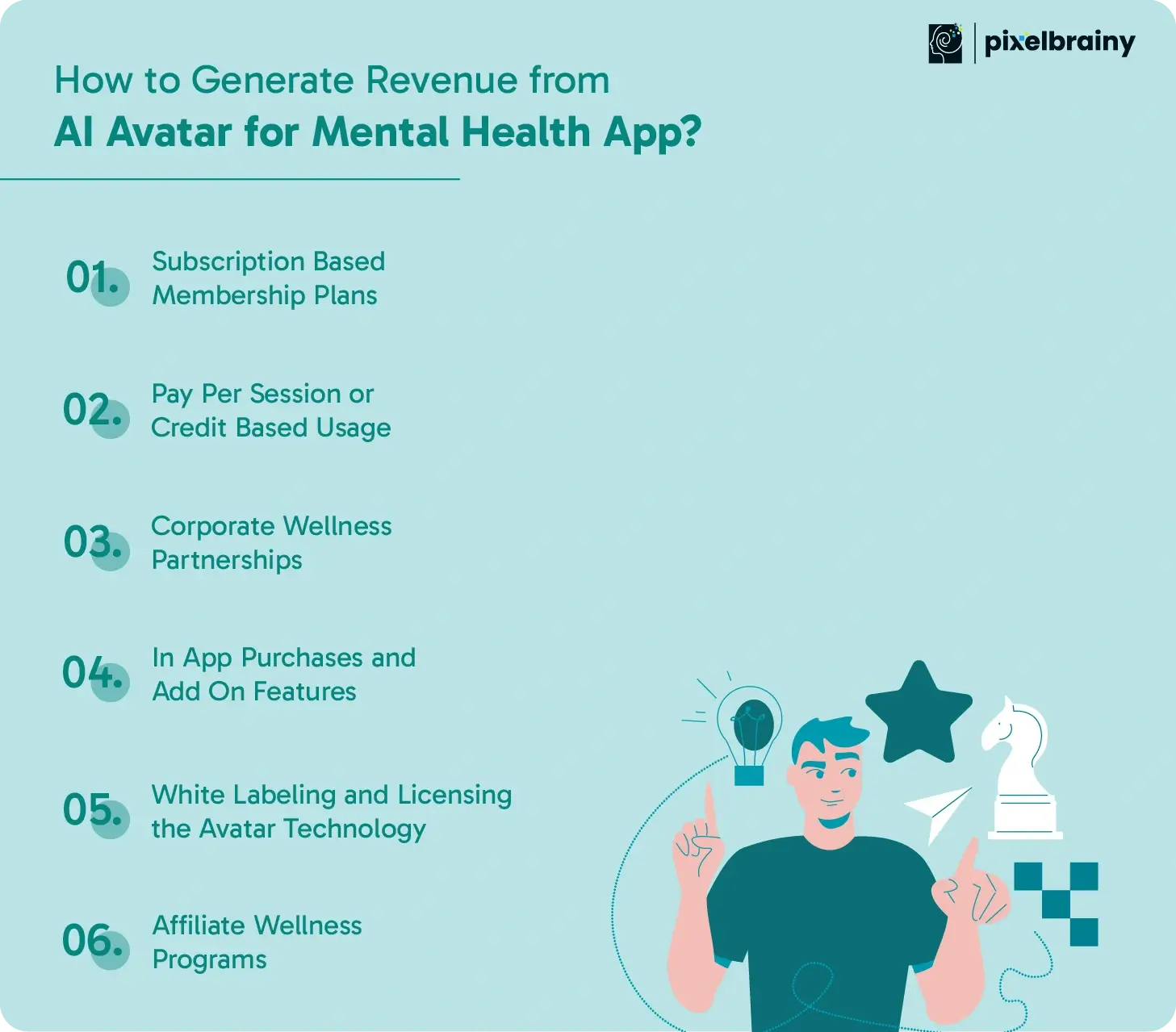
A subscription model works well because users often want continuous access to their AI avatar and personalized mental health journeys.
Subscriptions offer predictable monthly or yearly revenue. This model is suitable for apps that provide ongoing emotional support, coaching, or daily check ins. Users pay for unlimited access to advanced features, deeper conversations, and wellness routines guided by the avatar.
Possible offerings:
Some users prefer paying only when they need the avatar, especially for task based or therapy inspired interactions.
This model charges users for each emotional support session, guided activity, or avatar consultation. It works well for audiences who want flexibility rather than monthly commitments. It also helps new users gradually adopt the platform.
Possible offerings:
Companies are increasingly investing in employee mental wellness programs where an AI avatar can act as a preventive support resource.
Partnering with organizations allows you to sell bulk licenses or wellness packages. Employees receive access to the avatar for stress management, burnout prevention, and emotional check ins. This creates a reliable B2B revenue stream.
Possible offerings:
Users may want optional upgrades or enhancements that enrich their relationship with the avatar.
In app purchases allow users to buy specific features without committing to a full subscription. This model encourages exploration and lets people personalize their experience. It works especially well in wellness and self improvement apps.
Possible offerings:
If your avatar becomes highly advanced, other apps or wellness platforms may want to adopt it.
White labeling allows you to license the AI avatar to third party companies. They integrate the avatar into their own mental health ecosystems while you earn licensing fees. This model turns your technology into a scalable product.
Possible offerings:
Your avatar can recommend books, courses, or wellness products that align with emotional health.
Affiliate partnerships work well when recommendations feel genuine and helpful. The avatar suggests resources only when they match the user’s needs. This creates additional revenue without disrupting the user experience.
Possible offerings:
A sustainable AI avatar for mental health apps monetization strategy should balance recurring revenue with user trust, privacy, accessibility, and meaningful features that genuinely enhance the mental wellness experience.
What are the biggest challenges when developing an AI avatar for a mental health app that needs to respond empathetically, protect sensitive conversations, and remain safe during emotionally difficult interactions? This is a critical consideration for businesses investing in AI avatar development for mental health applications, because an avatar must do more than generate natural conversations. It needs reliable emotional understanding, appropriate safety responses, privacy controls, consistent communication, and clear boundaries.
A key question for product teams is: How can we build a mental health AI avatar that provides personalized emotional support while protecting user data and avoiding inappropriate responses during crisis situations? Addressing this requires collaboration between AI developers, mental health professionals, UX teams, and security specialists throughout the mental health AI avatar development process.
The challenges below cover the major technical, clinical, privacy, personalization, and user experience considerations involved in developing an AI avatar for a mental health app, along with practical approaches to address each one.
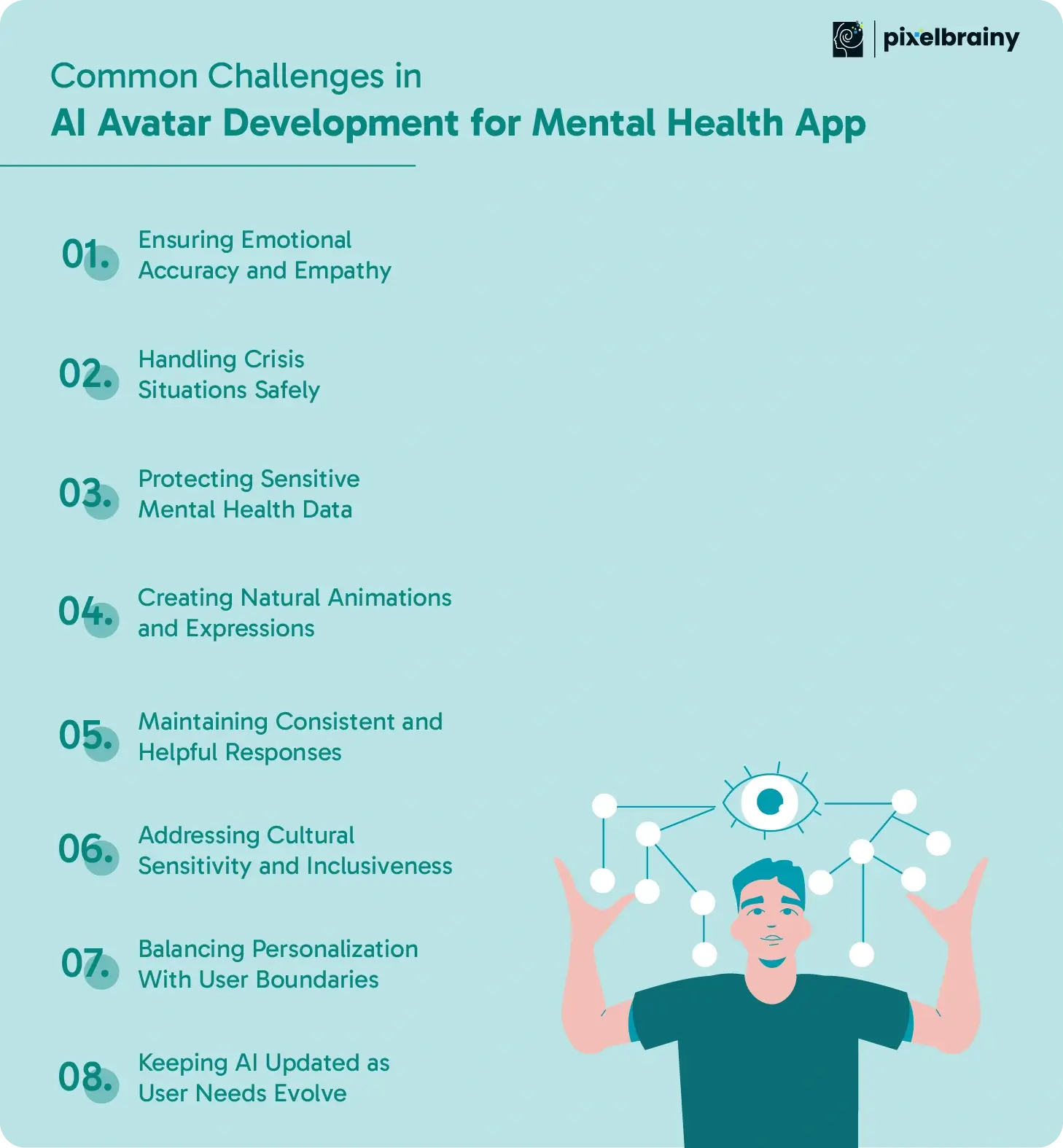
The Challenge: Mental health conversations require sensitivity. If the avatar misunderstands a user’s emotional tone, it can break trust or create frustration. AI sometimes struggles with subtle emotional cues, sarcasm, or indirect expressions of distress.
How to Overcome It:
The Challenge: Users may express self harm thoughts, panic episodes, or severe emotional distress. An avatar cannot replace a licensed therapist, so it must handle these moments responsibly.
How to Overcome It:
The Challenge: Mental health conversations contain private information that must be handled securely. Any data breach can damage user trust and violate compliance requirements.
How to Overcome It:
The Challenge: If facial expressions or gestures feel stiff or unnatural, users might disconnect from the avatar emotionally. Expressive realism is especially important in mental health settings.
How to Overcome It:
The Challenge: AI may generate inconsistent or repetitive answers, which can reduce user engagement. Users expect the avatar to feel reliable and emotionally stable.
How to Overcome It:
The Challenge: Mental health perceptions vary across cultures. An avatar that feels appropriate in one region may sound dismissive or harsh in another.
How to Overcome It:
The Challenge: AI personalization can feel intrusive if not handled properly. Users want support, not surveillance.
How to Overcome It:
The Challenge: Mental health trends, user expectations, and best practices evolve with time. Outdated avatars can feel disconnected or less effective.
How to Overcome It:
Successful AI avatar development for mental health apps requires continuous testing and refinement rather than a one-time deployment. By addressing emotional accuracy, crisis safety, data protection, natural interaction, consistency, inclusiveness, personalization, and ongoing updates, teams can create an AI avatar that is more reliable, responsible, and appropriate for mental health support.
What will the next generation of AI avatars for mental health apps need to deliver more personalized, immersive, and emotionally responsive support? As AI avatar development for mental health applications advances, product teams are exploring technologies that can move beyond text-based conversations toward multimodal interaction, adaptive personalization, wearable data, virtual environments, and stronger safety frameworks.
A key question for businesses planning mental health AI avatar development is: How can we build a mental health AI avatar that uses voice, facial expressions, personalization, wearable data, and immersive technologies while maintaining appropriate privacy, safety, and clinical boundaries? The answer will increasingly depend on how conversational AI, avatar technology, biometric inputs, VR, and regulatory requirements are combined within a responsible product architecture.
These developments will influence developing AI avatars for mental health apps, from the way users communicate with avatars to how systems personalize support and respond to changing emotional signals. The following trends highlight the technologies and industry developments likely to shape the future of AI avatars in mental health.
The next generation of avatars will not rely on text alone. Multimodal agents will combine voice tone, facial expressions, and full body gestures to create a more lifelike presence. These avatars will react the way humans do, using subtle emotional signals like eye movements, posture changes, and breathing rhythms.
Such multimodal capabilities will make mental health conversations feel more natural, helping users feel understood, comforted, and supported during vulnerable moments.
Future AI avatars will deliver deeply personalized mental health guidance based on each user’s mood patterns, life events, coping style, and emotional history. These systems will use long term emotional tracking and adaptive learning to shape tailored therapeutic pathways.
Instead of generic responses, the avatar will offer specific exercises, reflections, or reminders based on the user’s unique mental health journey. This creates a sense of continuity and personal care that traditional apps cannot match.
Wearable devices will play a major role in improving emotional support. AI avatars will connect with biosensors that monitor heart rate, sleep, stress levels, and breathing patterns.
By interpreting biometric data, the avatar can intervene at the right moment. For example, if the system detects elevated stress, the avatar may encourage grounding exercises or calming breathing sessions. This turns mental health support into a proactive experience instead of a reactive one.
Virtual reality will unlock new possibilities for immersive emotional healing. AI avatars will guide users through calming VR environments such as peaceful forests, safe rooms, or grounding meditation spaces.
This combination allows users to work through anxiety, trauma, or stress in controlled virtual settings. It also offers exposure therapy opportunities where users can overcome fears with the avatar’s support inside VR experiences.
As AI avatars become more capable, global regulations will evolve to protect users. Governments and mental health organizations will introduce standards for safety, transparency, and ethical use of AI in therapy related applications.
This includes rules about data privacy, crisis handling, emotional recommendations, and ensuring AI does not replace licensed therapists. These frameworks will help developers build safer and more responsible mental health avatars.
The future of AI avatar development for mental health apps will depend on combining richer interaction with responsible personalization, privacy, safety, and clinical oversight. As multimodal AI, wearable integration, VR, and regulatory frameworks mature, developers will need to ensure that greater technological capability also supports a trustworthy and appropriate mental health experience.
Also Read: Building an AI Avatar Therapy App for Counselors and Coaches
Developing an AI avatar for a mental health app requires more than conversational AI or visual avatar technology. It requires a careful combination of AI engineering, emotional interaction design, user experience, privacy, safety, and clinical sensitivity. PixelBrainy positions itself as an AI avatar development company focused on building interactive digital avatars that can communicate naturally, respond to emotional cues, and deliver personalized experiences.
Our expertise covers the complete AI avatar development lifecycle, from avatar concept and conversational architecture to voice interaction, personalization, animation, AI integration, testing, and deployment. For mental health applications, we focus on creating avatars that provide a supportive and consistent experience while maintaining clear boundaries around what the AI should and should not do.
Whether you are planning AI avatar creation for a mental health app, a conversational wellness companion, a voice-guided support experience, or a multimodal emotional agent, PixelBrainy can help translate the concept into a production-ready solution. Our approach also emphasizes secure development, privacy-conscious architecture, and continuous refinement so the avatar can evolve with user and product requirements.
PixelBrainy supports businesses across different stages of AI avatar development for mental health applications, including:
If you are planning to build an AI avatar for a mental health app, PixelBrainy can support the journey from concept and prototype to production deployment. Our AI avatar development team combines conversational AI, avatar technology, voice interaction, personalization, and safety-focused engineering to create digital experiences designed around real user needs.
Partner with PixelBrainy to develop an AI avatar that brings conversational intelligence, personalization, and human-centered interaction to your mental health application.
AI avatars are becoming a meaningful component of modern mental health applications, bringing together conversational AI, voice, emotional understanding, personalization, and visual interaction in a single user experience. Throughout this guide, we explored how an AI avatar for a mental health app works, where it can be used, the features and technologies it requires, the development process, monetization opportunities, key challenges, and the trends shaping its future.
For businesses planning AI avatar development for mental health applications, the priority should not be to make the avatar simply look or sound human. The real value comes from creating an experience that is supportive, personalized, secure, emotionally appropriate, and responsibly designed. Strong privacy controls, safety mechanisms, clinical boundaries, and thoughtful user experience are essential alongside the underlying AI and avatar technology.
Whether you want to build a mental health app AI avatar from scratch, add an avatar to an existing wellness platform, or develop a more advanced voice and multimodal experience, the right development strategy can help turn the concept into a practical product.
If you are ready to explore how to create an AI avatar for a mental health app, book an appointment with PixelBrainy to discuss your requirements and development roadmap.
The cost of AI avatar development for a mental health app depends on the avatar type, conversational AI, voice capabilities, personalization, animation, safety mechanisms, integrations, and development complexity. A basic avatar may require a smaller investment, while a production-grade platform with advanced AI, real-time voice, emotional analysis, and healthcare integrations will require a larger budget.
The development timeline depends on the product scope and technology requirements. A basic MVP with conversational capabilities can be developed faster than a sophisticated avatar with voice interaction, emotional analysis, personalization, safety workflows, and third-party integrations. Defining the avatar's role and core features early can help establish a realistic development timeline.
Mental health AI avatar development can involve large language models, NLP, sentiment and emotion analysis, speech-to-text, text-to-speech, conversational memory, avatar animation, recommendation systems, cloud infrastructure, and safety guardrails. The required stack depends on the avatar's intended role and interaction model.
Yes, an AI avatar for a mental health app can be designed to deliver structured CBT-based exercises, mindfulness activities, journaling prompts, mood check-ins, and other approved wellness content. However, the avatar's capabilities and boundaries should be clearly defined so it does not present itself as a replacement for licensed mental health professionals.
Privacy should be incorporated into the architecture from the beginning. Developing an AI avatar for mental health applications can include encryption, access controls, secure data storage, configurable data retention, consent management, and appropriate healthcare privacy measures. The exact requirements depend on the application's users, location, integrations, and regulatory obligations.
A mental health AI avatar can use predefined risk indicators, conversational analysis, safety classifiers, and escalation rules to identify interactions that require additional attention. Depending on the product design, the system can provide crisis resources, recommend professional support, or trigger a defined human escalation workflow.
The appropriate avatar style depends on the application's purpose, target audience, interaction model, and desired user experience. Realistic avatars can provide a more human-like presence, while stylized avatars may offer a softer or less clinical interaction. During AI avatar development for mental health apps, visual design should be evaluated alongside voice, personality, accessibility, privacy, and user comfort.
Yes. AI avatar development for mental health applications can include integrations with mobile and web applications, APIs, patient engagement systems, analytics platforms, scheduling tools, and healthcare infrastructure where technically and legally appropriate. The integration requirements should be defined during architecture planning to ensure that the avatar fits the existing product and operational workflows.

About The Author
Sagar Bhatnagar
Sagar Sahay Bhatnagar brings over a decade of IT industry experience to his role as Marketing Head at PixelBrainy. He's known for his knack in devising creative marketing strategies that boost brand visibility and market influence. Sagar's strategic thinking, coupled with his innovative vision and focus on results, sets him apart. His track record of successful campaigns proves his ability to utilize digital platforms effectively for impactful marketing efforts. With a genuine passion for both technology and marketing, Sagar continuously pushes PixelBrainy's marketing initiatives to greater success.
Working with PixelBrainy has been a great experience. They took our vision for an AI-powered platform and turned it into a fully functional product. What impressed me most was their strong understanding of both design and development, and their ability to handle complex requirements with ease. The team was responsive, cooperative, and always open to feedback. They kept things organized, communicated clearly, and delivered quality work on time. I highly recommend PixelBrainy to anyone looking for a skilled and reliable development partner.

Working with the PixelBrainy team has been a highly positive experience. They understand the design requirements and create beautiful UX elements to meet the application needs. The dev team did an excellent job bringing my vision to life. We discussed usability and flow. Sagar worked with his team to design the database and begin coding. Working with Sagar was easy. He has the knowledge to create robust apps, including multi-language support, Google and Apple ID login options, Ad-enabled integrations, Stripe payment processing, and a Web Admin site for maintaining support data. I'm extremely satisfied with the services provided, the quality of the final product, and the professionalism of the entire process. I highly recommend them for Android and iOS Mobile Application Design and Development.

Great experience working with them. Had a lot of feedback and I found that unlike most contractors they were bugging me for updates instead of the other way around. They were extremely time conscience and great at communicating! All work was done extremely high quality and if not on time, early! They were always proactive when it comes to communication and the work is great/above par always. Very flexible and a great team to work with! Goes above and beyond to present us with multiple options and always provides quality. Amazing work per usual with Chitra. If you have UI/UX or branding design needs I recommend you go to them! Will likely work with them in the future as well, definitely recommended!

PixelBrainy is a joy to work with and is a great partner when thinking through branding, logo, and website layout. I appreciate that they spend time going into the "why" behind their decisions to help inform me and others about industry best practices and their expertise.

I hired them to design our software apps. Things I really like about them are excellent communication skills, they answer all project suggestions and collaborate right away, and their input on design and colors is amazing. This project was complex and needed patience and creativity. The team is amazing to do business with. I will be using them long-term. Glad to see there are some good people out there. I was afraid to try and outsource my project to someone but I am glad I met them! I really can't say enough. They went above and beyond on this project. I am very happy with everything they have done to make my business stand out from the competition.

It was great working with PixelBrainy and the team. They were very responsive and really owned the project. We'll definitely work with them again!

I recently worked with the PixelBrainy team on a project and I was blown away by their communication skills. They were prompt, clear, and articulate in all of our interactions. They listened and provided valuable feedback and suggestions to help make the project a success. They also kept me updated throughout the entire process, which made the experience stress-free and enjoyable.

PixelBrainy is very good at what it does. The team also presents themselves very professionally and takes care of their side of things very well. I could fully trust them taking up the design work in a timely and organised manner and their attention to detail saved us lots of effort and time. This particular project was quite intense and the team showed that they function very well under pressure. Very much looking forward to working with her again!

It's always an absolute pleasure working with them. They completed all of my requests quickly and followed every note I had for them to a T, which made our process go smoothly from start to finish. Everything was completed fast and following all of the guidelines. And I would recommend their services to anyone. If you need any design work done in the future, PixelBrainy should be your first call!

They took ownership of our requirements and designed and proposed multiple beautiful variants. The team is self-motivated, requires minimum supervision, committed to see-through designs with quality and delivering them on time. We would definitely love to work with PixelBrainy again when we have any requirements.

PixelBrainy was a big help with our SaaS application. We've been hard at work with a new UI/UX and they provided a lot of help with the designs. If you're looking for assistance with your website, software, or mobile application designs, PixelBrainy and the team is a great recommendation.

PixelBrainy designers are amazing. They are responsive, talented, and always willing to help craft the design until it matches your vision. I would recommend them and plan to continue them for my future projects and more!!!

They were awesome! Did a good job fast, and good communication. Will work with them again. Thank you

Creative, detail-oriented, and talented designers who take direction well and implement changes quickly and accurately. They consistently over-delivered for us.

PixelBrainy team is very talented and creative. Great designers and a pleasure to work with. PixelBrainy is an excellent communicator and I look forward to working with them again.

PixelBrainy has a very talented design team. Their work is excellent and they are very responsive. I enjoy working with them and hope to continue on all of our future projects.


Transform your ideas into reality with us.
Across these industries, each engagement brings unique challenges, from early-stage product development to scaling complex systems, helping us build a practical understanding of real-world product environments.