AI Summary Powered by PixelBrainy
What if your customers expected instant replies at any hour of the day? What if your support team could not scale fast enough to meet growing demand? And what if your competitors were already using AI to deliver faster, smarter conversations while you were still relying on manual workflows?
These are the questions driving AI chatbot adoption across industries in 2026. Businesses are no longer experimenting with chatbots simply to appear innovative. They are adopting them out of necessity. Customer expectations have shifted toward speed and convenience, operational costs continue to rise, and digital experiences now play a major role in brand loyalty and customer retention. As a result, AI chatbot adoption has moved from a nice-to-have feature to a core business strategy.
The global AI chatbot market is experiencing rapid growth. In 2024, the chatbot market was valued at approximately USD 11.58 billion and is projected to grow significantly by 2030 as demand for automated customer engagement increases . Research also shows that 68% of IT professionals are now implementing or have already implemented chatbots in their organizations, and 78% of companies use AI in at least one business function . These figures illustrate why AI chatbot adoption statistics are trending upward and why leaders are investing more heavily in conversational AI capabilities.
As businesses scale their digital operations, AI chatbot usage statistics in 2026 continue to show that chatbots are being deployed across customer support, sales, HR, and internal operations. AI chatbot adoption trends indicate that companies embracing automation gain measurable advantages in efficiency, customer experience, and operational cost savings.
This article answers the most common questions business leaders are actively searching for today:
AI chatbots have become a critical business tool in 2026 due to shifting customer expectations, rising operational costs, and the growing importance of data-driven decision-making. Their value extends far beyond simple automation.
Modern customers expect immediate responses regardless of time zone or business hours. With interactions spread across websites, mobile apps, and messaging platforms, traditional support teams struggle to keep pace. AI chatbots ensure continuous availability and consistent responses, helping businesses meet customer expectations without delays.
As support volumes grow, hiring additional staff becomes expensive and difficult to sustain. AI chatbots allow businesses to manage thousands of conversations simultaneously without expanding headcount. By automating repetitive and high-frequency inquiries, organizations can scale efficiently while controlling operational costs.
AI chatbots handle routine questions, freeing human agents to focus on complex, high-value interactions. This improves productivity, reduces employee burnout, and enhances overall service quality. The result is a more balanced and effective support operation.
Every chatbot interaction generates valuable data. In 2026, businesses use these insights to understand customer behavior, identify common issues, and personalize experiences. Companies that leverage chatbot-driven data gain an advantage in customer retention, conversion rates, and long-term growth.
AI chatbots matter in 2026 because they help businesses meet customer expectations, control costs, and grow smarter at scale.
Global AI chatbot adoption continues to accelerate in 2026 as businesses increasingly embrace conversational AI to transform customer experience and operational efficiency. Here’s a data-rich snapshot of where adoption stands today, backed by real, clickable sources:
Adoption of AI chatbots in 2026 is no longer experimental. A significant portion of businesses are integrating these systems into core operations. Market growth, enterprise usage, and rapid investment all indicate that conversational AI is firmly embedded in business strategy worldwide.
In 2026, AI chatbot adoption is no longer uniform across industries. Each sector is deploying conversational AI differently, based on customer interaction intensity, compliance needs, and operational complexity. Industries with high volumes of repetitive inquiries and real-time engagement requirements are leading adoption, while others are rapidly catching up as chatbot capabilities mature.
Below is a sector-specific view of AI chatbot adoption and usage in 2026, grounded in enterprise consulting research and market analysis.
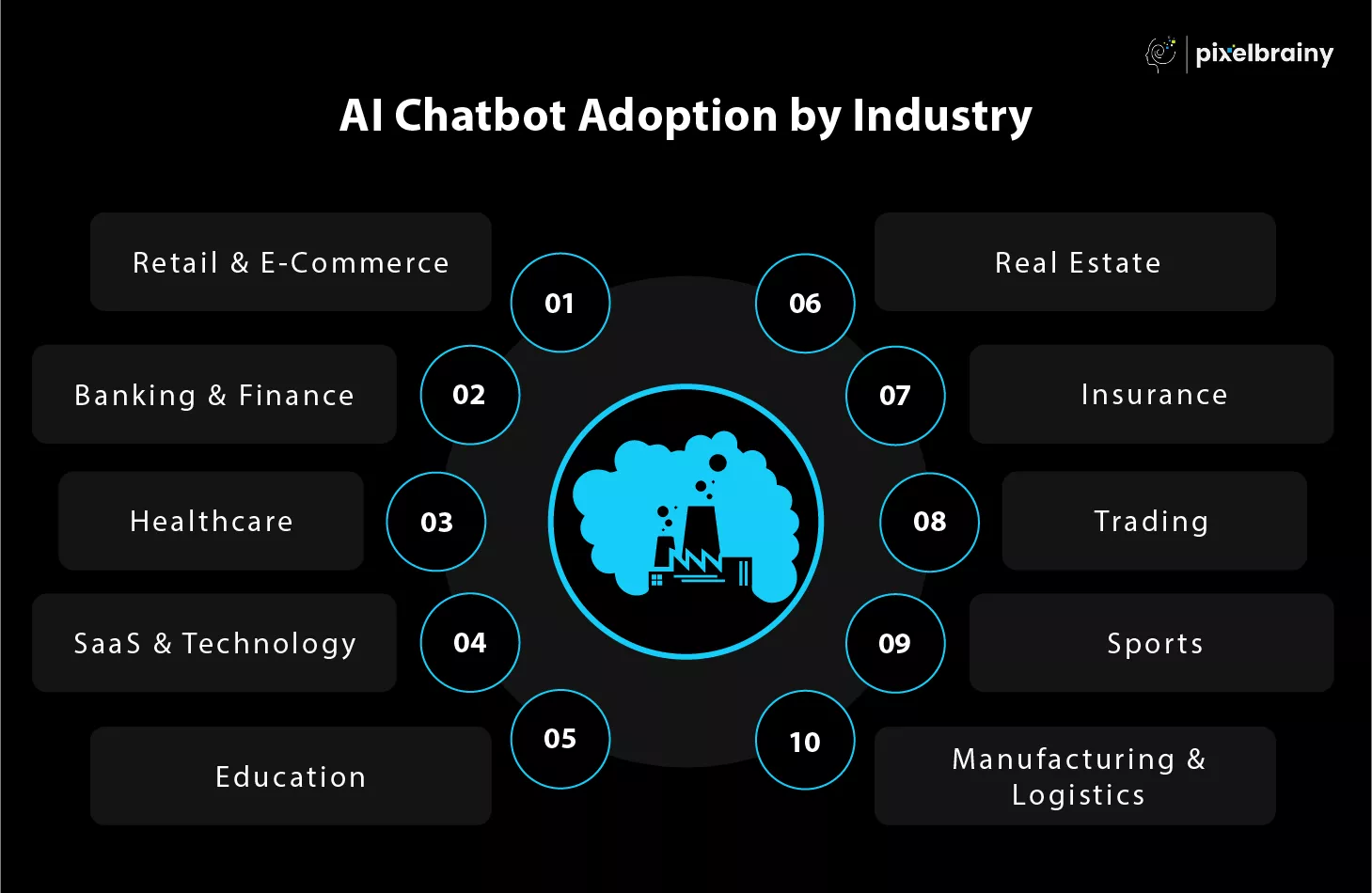
Retail and e-commerce remain the most chatbot-intensive industries in 2026, largely due to nonstop customer interactions across browsing, purchasing, and post-purchase support. As digital commerce becomes increasingly omnichannel, retailers must manage customer conversations across websites, mobile apps, and messaging platforms simultaneously. AI chatbots have become a foundational layer in this ecosystem, enabling brands to deliver real-time assistance at scale while maintaining consistency across touchpoints.
Modern retail chatbots go far beyond answering basic FAQs. They support product discovery, personalized recommendations, order tracking, returns management, and promotional guidance. This evolution has positioned conversational AI as a core capability within retail digital transformation strategies.
Retailers face persistent pressure to respond instantly to customer inquiries, especially during peak shopping seasons and promotional campaigns. AI chatbots enable businesses to handle large volumes of repetitive questions without proportionally increasing support staff. Personalization is another major driver. Customers now expect tailored product suggestions and contextual assistance, which chatbots can deliver by analyzing browsing behavior and purchase intent in real time. The growth of conversational commerce has further accelerated adoption, making chatbots essential for maintaining seamless engagement across channels.
An online fashion retailer deploys an AI chatbot across its website and mobile app to answer product questions, recommend complementary items, and provide real-time shipping and return updates. Following implementation, the retailer reduces live support ticket volume, improves response times, and increases average order value as more customers engage with personalized recommendations.
AI chatbot adoption in banking and financial services has rapidly accelerated as institutions modernize customer service and reduce operational burden. In 2026, banks, fintech firms, and credit unions deploy conversational AI to answer routine customer inquiries, support digital interactions, and improve user experience across web portals, mobile apps, and social channels. With rising customer expectations for instant service and automation, chatbots are now a core part of digital banking engagement strategies.
Unlike early rule-based bots, modern banking chatbots use natural language processing to understand context and intent, making them far more effective at handling common inquiries while escalating complex issues to human agents when needed.
Banks face high volumes of repetitive inquiries related to account balances, transaction histories, and password resets. AI chatbots handle these efficiently without expanding support teams. Customers expect 24/7 access to financial information, and chatbots deliver always-on service. Cost containment is another driver, as digital support reduces pressure on expensive call centers. Improved customer satisfaction and brand loyalty also result from rapid response and personalization across digital channels. Finally, the competitive landscape, where fintech challengers rely heavily on chatbots, pushes traditional banks to adopt conversational AI to stay relevant.
A large retail bank integrates an AI chatbot into its mobile banking app to answer questions about account balances, recent transactions, card support, and product features. After adoption, the bank reduces call volume, improves customer response times, and allows human advisors to concentrate on high-value financial consultations.
AI chatbot adoption in healthcare in 2026 is primarily centered on improving administrative efficiency and patient access to services rather than diagnosing medical conditions. As healthcare organizations face rising patient volumes and limited administrative resources, chatbots are becoming valuable tools for streamlining repetitive tasks such as appointment scheduling, patient reminders, medication guidance, and basic support. Unlike clinical AI systems designed for diagnosis, healthcare chatbots focus on improving communication, reducing wait times, and supporting operational workflows across hospitals, clinics, and digital health platforms.
The increasing availability of consumer-grade health-related chatbots also reflects broader adoption trends, with patients frequently turning to AI tools for basic health navigation, insurance help, and general information outside of traditional clinical settings.
Healthcare providers are adopting AI chatbots to address several persistent challenges. Staff shortages and high administrative costs make it difficult to handle routine inquiries and scheduling tasks efficiently, leading to longer wait times and increased workload for clinical and administrative teams. Chatbots help reduce these burdens by automating patient outreach for appointment confirmations, prescription reminders, and FAQs. They also support patient engagement outside clinic hours, offering convenience and timeliness that align with modern expectations for healthcare accessibility. The combination of financial pressure to reduce overhead and the need to enhance patient experience drives adoption across facilities of varied sizes.
A large hospital network implements an AI chatbot on its patient portal and mobile app to manage appointment bookings, send automated reminders, and answer common questions about insurance coverage and clinic locations. After deployment, the hospital sees decreased front-desk call volumes, fewer missed appointments, and higher patient satisfaction scores as individuals receive timely, 24/7 assistance without tying up clinical staff.
AI chatbot adoption in SaaS and technology companies has surged in 2026 as software vendors embed conversational AI directly into products and support experiences. In an industry where users expect instant, contextual assistance across complex applications, chatbots serve as frontline support, onboarding guides, and in-product helpers. This trend reflects a broader shift toward automation and real-time digital experiences in software services, where reducing friction and improving user success are top priorities.
Modern SaaS chatbots leverage advanced natural language understanding and integration with platform data to offer relevant, contextual help. They are used not only for customer support but also for product discoverability, feature tutorials, and proactive guidance.
SaaS and technology companies adopt AI chatbots for several strategic reasons. First, global, always-on user bases demand support and guidance at all hours, which chatbots provide without scaling human teams. Second, software products with complex interfaces and frequent updates benefit from chatbots that can deliver in-app, context-aware assistance. Third, reducing support ticket volume while improving customer satisfaction and retention is a major business priority. Finally, AI chatbots help SaaS companies differentiate their products by embedding proactive, intelligent help directly where users need it.
A mid-tier SaaS company integrates an AI chatbot into its product interface to guide users through setup workflows, answer feature questions, and escalate only the most complex issues to human support. After deployment, the company sees a significant drop in support tickets, faster feature adoption, and higher user satisfaction scores as customers get the help they need, right where they work.
AI chatbot adoption in education has grown steadily in 2026 as schools, colleges, and universities adopt conversational AI to support students and administrative staff at scale. Chatbots in education are used to answer repetitive questions about admissions, courses, campus services, and registration, reducing the burden on faculty and improving accessibility for students. Unlike clinical AI, these chatbots focus on logistical and support functions that help learners navigate academic life more easily.
In higher education especially, conversational AI is being integrated into digital platforms to accelerate response times and engage students across multiple touchpoints. This shift reflects an increasing expectation for digital self-service tools that can operate 24/7.
Educational institutions are adopting AI chatbots to address high volumes of repetitive student questions and limited administrative staffing. Peak periods such as admissions deadlines, course registration, or exam scheduling often overwhelm traditional support channels. Chatbots provide instant answers, improve turnaround times for student queries, and free up faculty and support staff to focus on complex or high-value tasks. Students also increasingly expect digital self-service options, and implementing chatbots helps institutions meet these evolving expectations while reducing operational costs.
A university integrates an AI chatbot into its website and student portal to handle inquiries about admissions deadlines, course registration, scholarship information, and campus resources. After deployment, the institution experiences reduced email and call volumes, faster response times, and higher student satisfaction as learners receive 24/7 access to accurate information without overburdening administrative staff.
In 2026, AI chatbot adoption in real estate is rapidly advancing as property firms, brokerages, and agent teams harness conversational AI to transform customer interactions and lead workflows. Real estate chatbots are used to engage prospects instantly, answer property inquiries, qualify leads, assist with scheduling tours, and handle basic customer support tasks 24/7. This shift is part of a broader digital transformation in real estate, where AI tools help agents stay responsive in a highly competitive market.
Instead of relying solely on human staff to capture and respond to inquiries, more real estate organizations use chatbots to ensure prospects never go unanswered — an important differentiator when buyers expect fast, personalized engagement.
Several factors drive AI chatbot adoption in real estate. The first is immediacy: potential buyers often expect instant answers about listings, pricing, and availability, especially outside business hours. Chatbots provide 24/7 engagement without increasing staffing costs. Another driver is lead qualification. By automating early interactions, chatbots help filter serious prospects from casual browsers, enabling agents to focus on high-value conversations. Finally, chatbots help improve conversion efficiency, ensuring inquiries lead to actionable follow-ups rather than being lost in email inboxes or voicemail queues.
A mid-sized real estate agency integrates an AI chatbot on its website and listing pages to answer inquiry questions, share property details, schedule showing appointments, and collect contact information. After adoption, the agency experiences higher lead capture rates, faster follow-up cycles, and noticeable increases in client engagement, all without adding additional staff hours.
AI chatbot adoption in insurance has become a defining trend in 2026 as insurers pivot toward digital engagement and automated customer support. Insurance companies are deploying conversational AI to automate routine policyholder interactions, assist with claims processing, and provide instant 24/7 support across websites, mobile apps, and messaging platforms. Unlike traditional customer service channels that rely heavily on human agents, chatbots help insurers scale support without proportional increases in headcount, making them ideal for high-volume queries about policies, billing, claims, and coverage.
Modern insurance chatbots use natural language processing to interpret context and guide users through tasks such as filing claims, checking claim status, and retrieving policy information, significantly improving responsiveness while lowering operational costs.
Several factors are accelerating AI chatbot adoption in insurance. First, policyholders increasingly expect instant, digital support, particularly for routine questions about coverage, billing, and claims status. Chatbots provide immediate, consistent answers that improve customer satisfaction. Second, insurers face cost pressures in traditional call centers; AI chatbots reduce support volumes by automating repetitive tasks. Third, chatbots help streamline claims workflows by collecting initial details and providing updates, speeding up resolution times. Finally, as digital transformation becomes a strategic priority, insurers use chatbots to remain competitive against fintech and digital native firms.
A major property and casualty insurer integrates an AI chatbot across its website and mobile app to answer policy questions, assist with claims filing, and provide status updates. Within months of deployment, the company sees a significant drop in call center volume, faster claim initiation, and improved customer satisfaction as policyholders receive instant, accurate assistance without waiting in queues.
AI chatbot adoption in trading has evolved significantly by 2026 as online brokerages, trading platforms, and fintech investing apps integrate conversational AI to support client interactions and operational workflows. In the fast-paced world of trading, users often need immediate access to market information, account data, trade execution support, risk alerts, and platform navigation. AI chatbots help trading firms deliver on these demands by providing real-time responses, reducing friction, and improving user engagement without burdening human staff.
Unlike algorithmic trading bots that execute trades automatically, trading chatbots focus on customer support, information retrieval, and interaction automation — acting as first-line assistants that help traders get answers, alerts, and basic actions across web and mobile platforms.
While formal industry reports on chatbot penetration rates in trading are still emerging, available data shows clear momentum for conversational AI in financial markets:
These statistics may not yet be captured in large industry trackers like Gartner or IDC by specific percentages, but multiple brokerages and fintech platforms now report significant operational benefits from deploying AI chatbots for support and engagement, and adoption is closely tied to enhanced digital client experience.
Traders and trading platforms are adopting AI chatbots for several reasons:
A digital brokerage integrates an AI chatbot within its trading app that answers questions about account balances, trade order status, fee schedules, and market summaries. The chatbot also pushes alerts on price movements and news relevant to a user’s portfolio. After deployment, the brokerage observes faster response times, reduced support load, and higher engagement rates as users rely on the chatbot for quick information and basic trade guidance.
In 2026, AI chatbot adoption in the sports industry is emerging as an important driver of digital fan engagement and support services. Sports organizations — including professional teams, leagues, broadcasters, and event platforms — are deploying conversational AI to provide fans with real-time information on schedules, scores, tickets, and interactive content. AI chatbots support high-volume fan interactions during peak engagement periods, such as live matches, ticket sales, and event promotions, helping organizations deliver instant, personalized responses without overwhelming human support teams.
Rather than replacing in-stadium or broadcast experiences, sports chatbots extend engagement across digital channels, making it easier for fans to access information on demand.
While precise chatbot-only adoption rates in sports platforms are not yet widely published by major analysts like Gartner or Deloitte, the combination of market growth, fan expectation for instant digital interaction, and rising deployment of AI conversational tools clearly indicates upward momentum for AI chatbot usage in sports.
A professional football club integrates an AI chatbot into its mobile app and website to provide fans with live score updates, match schedules, ticketing assistance, and player information. During match days and high-traffic events, the chatbot handles thousands of queries simultaneously, reducing load on support teams and improving fan satisfaction by delivering immediate, relevant responses.
In 2026, AI chatbot adoption in manufacturing and logistics is gaining momentum as companies seek ways to streamline operations, enhance communication, and support both internal teams and external customers. While these industries have traditionally been slower to adopt customer-facing bots than sectors like retail or banking, logistics and supply chain firms are increasingly implementing AI chatbots to automate routine tasks, provide real-time updates, and improve coordination among stakeholders — including carriers, customers, and suppliers.
Chatbots in logistics are used for shipment updates, order tracking, inventory alerts, and basic customer service interactions. In manufacturing, conversational agents can support internal help desks, coordinate supplier communications, and automate common inquiries about production schedules or materials availability.
Several factors drive AI chatbot adoption in manufacturing and logistics. First, the complexity of logistics operations — involving multiple stakeholders and touchpoints — creates high volumes of routine queries about order status, delivery times, or inventory levels. Chatbots handle these consistently and without human intervention. Second, modern supply chains require real-time visibility and communication; chatbots help provide instant updates and notifications. Third, chatbots help reduce customer support costs and improve customer satisfaction by delivering 24/7 assistance. Finally, internal help desks in manufacturing plants use chatbots to support staff with equipment status, production schedules, and documentation access.
A logistics provider integrates an AI chatbot into its customer portal and internal systems to automatically provide shipment status updates, estimated delivery times, and order tracking links. The chatbot also supports internal staff by answering queries about inventory levels and warehouse locations. After deployment, the company sees reduced customer support workload, faster response times, and improved operational transparency, allowing human teams to focus on higher-value exceptions and strategic planning.
In 2026, businesses are adopting AI chatbots because the results are measurable and repeatable. According to AI chatbot adoption statistics for businesses, organizations across industries are using chatbots to improve speed, reduce costs, and scale customer engagement. The benefits below are supported by reliable AI chatbot market stats and long-lived research sources.
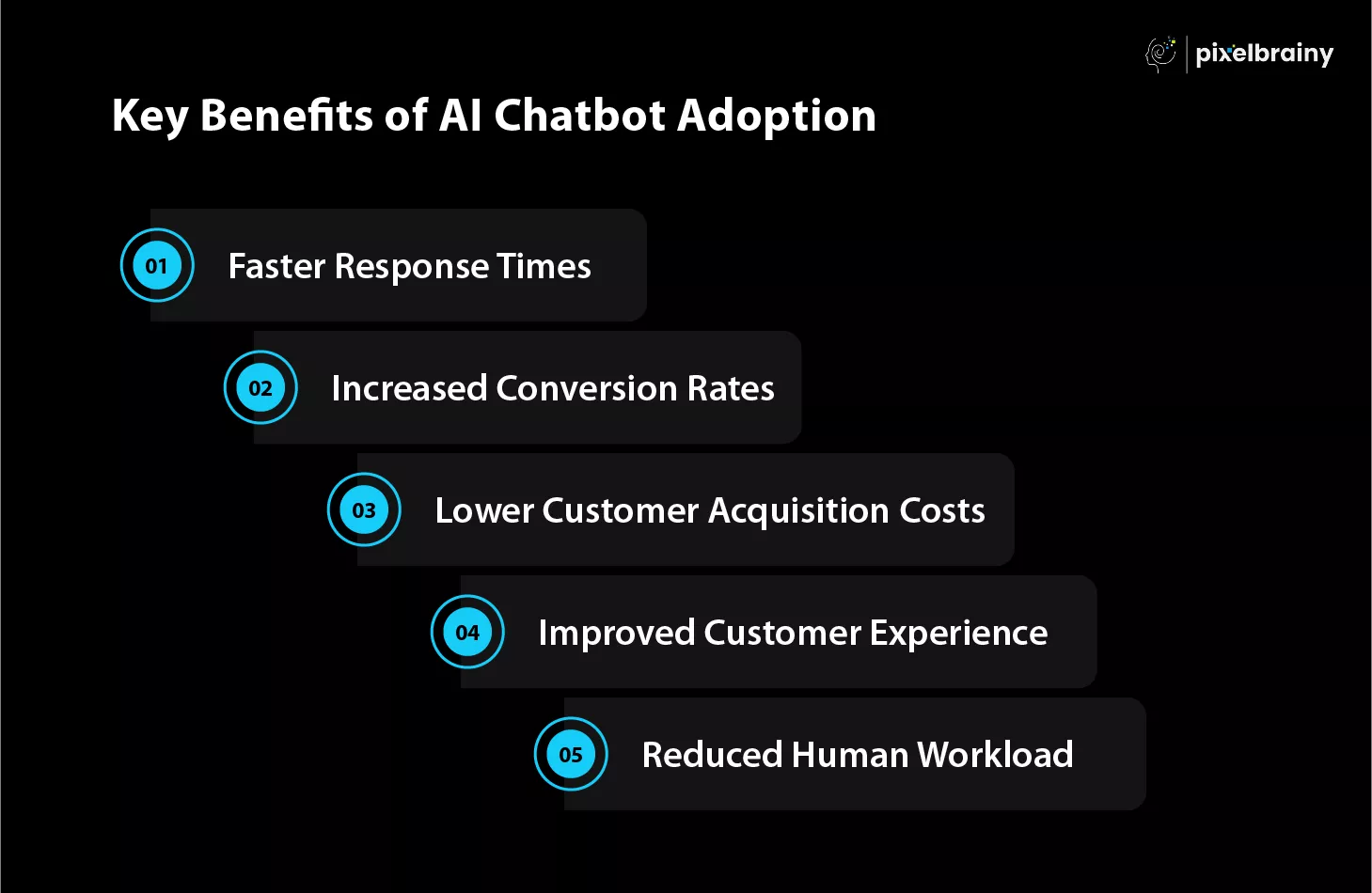
Supporting statistics:
AI chatbots provide instant responses to customer inquiries, regardless of time zone or volume. This eliminates wait times, reduces frustration, and improves first-contact resolution. Faster responses are one of the most cited reasons behind rising AI chatbot adoption rates by industry.
AI chatbots engage users at moments of high intent. By answering questions in real time and guiding customers through decisions, chatbots reduce drop-offs and increase conversion rates across sales funnels.
Supporting statistics:
By automating lead qualification, onboarding, and early-stage support, AI chatbots reduce dependency on paid advertising and manual sales outreach. This directly lowers customer acquisition costs while improving efficiency.
Supporting statistics:
AI chatbots improve customer experience by delivering consistent, accurate, and always-available support. Customers receive help when they need it, without delays, which strengthens trust and brand loyalty.
Supporting statistics:
AI chatbots take over repetitive questions such as FAQs, booking requests, and status updates. This reduces support ticket volume, improves productivity, and helps prevent employee burnout.
Market Growth Context
To put these benefits in perspective, AI chatbot market stats show strong growth. Mordor Intelligence estimates the global chatbot market will reach approximately 11 billion USD in 2026, driven by increasing enterprise adoption across industries.
Faster responses, higher conversions, lower acquisition costs, improved customer experience, and reduced human workload explain why AI chatbot adoption statistics for businesses continue to rise in 2026. As AI chatbot adoption rates increase by industry, conversational AI is becoming a core business capability rather than an optional add-on.
Despite strong growth in AI chatbot adoption, many businesses still face practical and strategic challenges when implementing conversational AI at scale. Understanding these barriers is critical for organizations planning long-term chatbot strategies in 2026 and beyond.
One of the most common AI chatbot adoption challenges is the cost associated with implementation. While basic chatbots are affordable, enterprise-grade AI chatbots require integration with CRM systems, customer databases, analytics platforms, and internal tools. These integrations often demand technical expertise, ongoing maintenance, and infrastructure investment, which can slow adoption for small and mid-sized businesses.
AI chatbots rely heavily on high-quality data to deliver accurate responses. Poorly structured data, outdated knowledge bases, or incomplete training datasets can result in incorrect or irrelevant answers. This is a major barrier to AI chatbot adoption, especially in industries with complex products, regulatory requirements, or frequently changing information.
Although conversational AI has improved significantly, chatbots can still struggle with nuanced language, slang, sarcasm, or complex multi-intent queries. These AI chatbot limitations may lead to user frustration if conversations feel robotic or if the chatbot fails to understand intent correctly. This challenge becomes more visible in customer-facing roles where expectations for natural conversations are high.
Not all users are comfortable interacting with AI. Some customers still prefer human support, especially for sensitive issues such as billing disputes, healthcare questions, or financial concerns. Building trust in AI-driven interactions remains a key AI chatbot adoption barrier, requiring transparency, clear escalation paths, and consistent performance.
Handling customer data introduces security and privacy risks. Businesses operating in regulated industries must ensure AI chatbots comply with data protection laws and industry standards. Concerns around data leakage, unauthorized access, and compliance failures can delay or limit AI chatbot deployment.
AI chatbots are not “set and forget” solutions. They require continuous monitoring, retraining, and optimization to remain effective. Without regular updates, chatbot performance can degrade over time, reducing ROI and customer satisfaction. This operational overhead is often underestimated during early adoption stages.
While AI chatbot adoption offers clear benefits, businesses must address technical, operational, and trust-related challenges to succeed. Organizations that invest in proper planning, data readiness, user education, and ongoing optimization are far more likely to overcome these barriers and unlock long-term value from conversational AI.
Understanding how AI chatbots compare with human support is essential for businesses evaluating AI chatbot adoption statistics for businesses, AI chatbot adoption rate by industry, and AI chatbot market stats in 2026. The data shows that AI chatbots and human agents each have strengths, and the most effective customer support models combine both.
Stat: Around 37 % of businesses use chatbots for support, and chatbots respond up to three times faster than human agents on routine questions.
Insight: AI chatbots provide instant responses to repetitive inquiries 24 hours a day, 7 days a week, whereas human teams are limited by working hours and capacity. Faster responses improve customer satisfaction and reduce abandonment.
Stat: Studies indicate that AI chatbots can reduce customer service costs by about 30%, since they handle large volumes of routine queries more cheaply than human teams.
Insight: Chatbots excel at handling high-volume, low-complexity inquiries (such as FAQs), allowing businesses to cut operational expenses. This efficiency is reflected in AI chatbot adoption rates across industries where cost control and scalability are priorities.
Stat: In one survey, 49 % of respondents preferred human support for customer service, especially when dealing with emotional, nuanced, or complex problems.
Insight: Despite chatbot efficiency, many customers trust humans more when issues are complicated or emotionally charged. This preference highlights why human support remains essential for complex cases, even as chatbots handle simpler tasks.
Stat: Research suggests that AI assistance helps human agents respond about 20 % faster and supports less experienced staff in delivering better overall performance.
Insight: AI chatbots can augment human teams rather than replace them. When bots handle routine work, human agents are freed up to focus on higher-value interactions, which improves overall team productivity and service quality.
Stat: Surveys show that 62 % of customers prefer chatbots over waiting for human agents when the inquiry is simple and quick answers are available.
Insight: For straightforward questions, customers often prefer the immediacy of chatbots. This is why businesses implementing AI chatbot adoption strategies see higher engagement on basic support workflows.
Stat: Industry forecasts suggest that by 2027 about 50 % of customer service cases could be resolved by AI, up from 30 % in 2025, indicating accelerated adoption.
Insight: As AI chatbot adoption rate by industry increases, more support tasks will shift toward automation, with complex issues still routed to humans. This blended approach maximizes efficiency without sacrificing empathy.
AI chatbots outperform humans when it comes to speed, availability, consistency, and cost efficiency. They are most effective at routine and repetitive tasks, enabling faster responses and freeing human staff for complex support. Human agents, on the other hand, remain critical for empathy, problem resolution, and emotionally sensitive interactions that AI alone cannot handle.
Overall, the data supports a hybrid support model where AI chatbots and humans collaborate to deliver faster, more efficient, and more satisfying customer experiences. This blend is becoming the norm as businesses expand their AI chatbot adoption strategies in 2026.
Return on investment (ROI) is one of the most important measures that business leaders look at before committing to major technology projects. For AI chatbot adoption in 2026, ROI can be evaluated across cost savings, productivity gains, revenue impact, and customer experience improvements. Here are the key data-backed insights showing how chatbots deliver value:
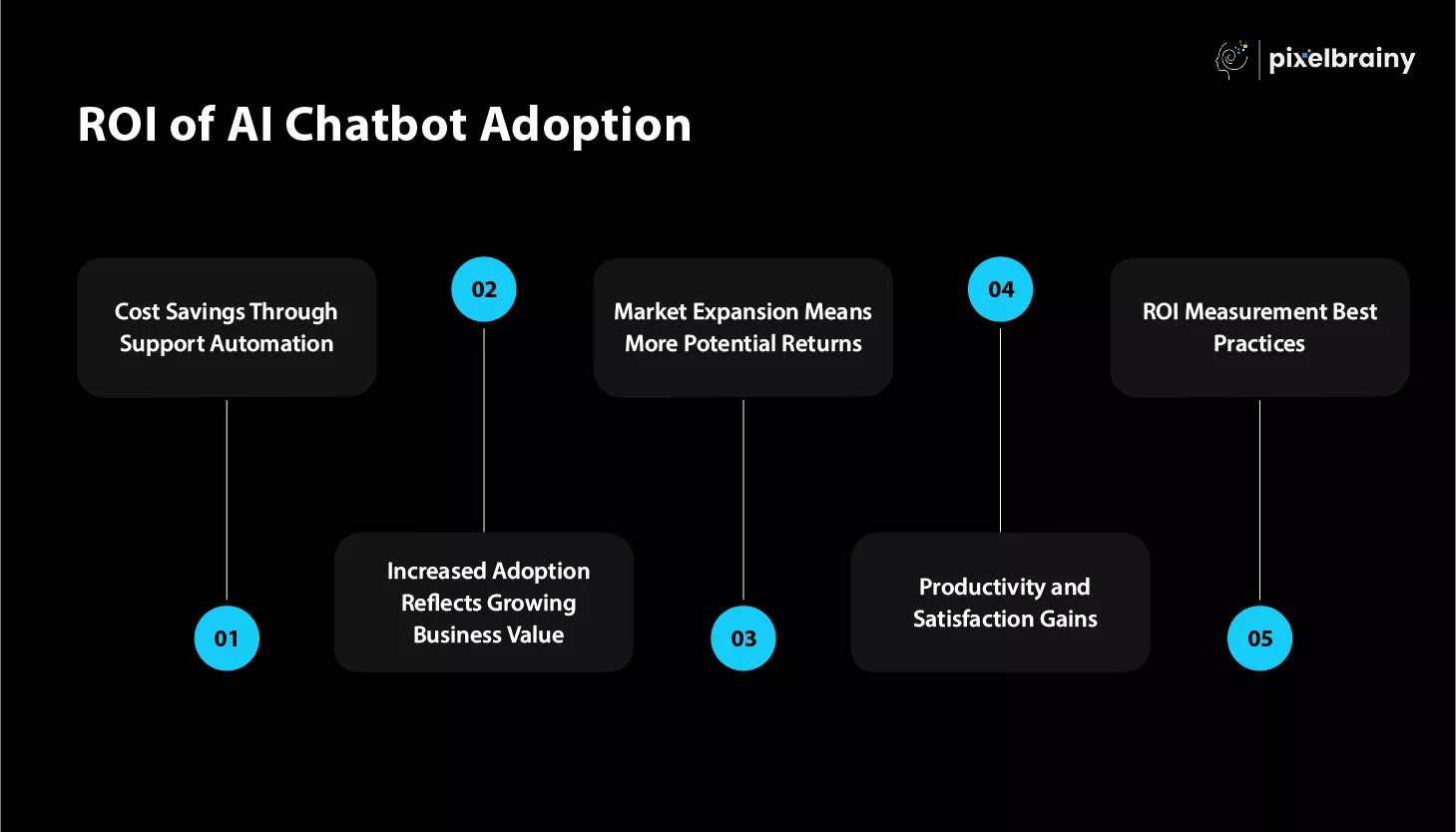
AI chatbots are expected to reduce contact center operational costs by USD 80 billion by 2026, as more routine customer interactions are automated.
Automating frequent inquiries such as order status, FAQs, account updates, and basic troubleshooting can significantly cut support expenses. For many businesses, savings come not only from staffing efficiencies but also from faster handling of routine queries that do not require human involvement.
About 57 percent of businesses are either using self-service chatbots now or plan to adopt them by 2025 and later, indicating that chatbot ROI is becoming a core consideration in enterprise digital strategy.
Broad adoption signals that leaders see measurable value in deploying chatbots. When a majority of companies include chatbot deployment in their technology roadmap, it reflects confidence that the ROI — in terms of cost, productivity, or customer satisfaction — justifies the investment.
The global chatbot market is projected to grow to about USD 11.45 billion in 2026 and continue expanding through 2031.
A large and growing market signifies strong demand from enterprises and suggests that vendors are improving ROI-related features such as analytics, integration, and automation capabilities. This growth supports investment confidence among adopters.
Approximately 75 percent of businesses using chatbots report increased customer satisfaction, and high satisfaction usually correlates with higher customer retention and lifetime value.
Improved satisfaction not only influences customer loyalty but also enhances ROI through repeat business and positive brand sentiment. Combining customer retention with operational savings strengthens the financial case for chatbots.
ROI from AI chatbots isn’t just about cost reduction. It’s calculated using the total value generated (including revenue, savings, productivity, and satisfaction) minus the total cost of implementation and ongoing operations, divided by total cost.
A proper ROI framework helps businesses justify the investment to stakeholders and align chatbot goals with broader financial and operational objectives.
Although exact ROI will vary by industry and use case, AI chatbot adoption is delivering measurable returns in 2026. Savings from automated support, increased customer satisfaction, productivity gains, and expanding market adoption combine to make conversational AI a high-impact investment for many organizations. As AI chatbot adoption statistics for businesses continue to show increases in usage and satisfaction, the financial value — in both cost and revenue terms — becomes clearer and more quantifiable.
As AI chatbot adoption statistics for businesses continue to rise in 2026, the technology is evolving rapidly and shaping the next phase of digital interaction. Beyond 2026, trends point toward deeper integration, richer capabilities, and broader economic and social impacts. Here are the most important trends to watch, backed by current market forecasts and technology research.
The global chatbot market was valued at around USD 7.76 billion in 2024 and is projected to reach about USD 27.29 billion by 2030, growing at a compound annual growth rate (CAGR) of 23.3 percent from 2025 to 2030.
Beyond 2026, expanding business investment in conversational AI will accelerate as more organizations integrate chatbots into core processes, including sales, customer service, marketing, and internal operations. This growth reflects broader confidence in ROI and the increasing importance of automated digital engagement.
Future conversational AI is expected to provide more natural and human-like interactions, understanding tone, context, and even emotional cues. Enhanced natural language understanding will allow chatbots to conduct longer, more fluent conversations that feel closer to human dialogue, reducing friction and increasing user trust.
As chatbots become more conversational, businesses will rely on them for complex interactions previously handled only by humans, such as consultative support, nuanced negotiation of customer needs, and high-value service workflows.
Future AI chatbots will have improved context awareness, meaning they will remember past interactions, follow multi-step conversations without losing context, and tailor responses based on user history.
This will allow chatbots to deliver more personalized and seamless experiences. Rather than restarting a conversation each session, next-gen models will understand user intent over longer periods and provide continuity in dialogue.
AI chatbots will increasingly support voice and multimodal interactions (text, voice, images, video, and visual inputs). This makes them accessible across devices and use cases, from mobile support to interactive kiosks and hands-free environments.
Conversational experiences will become more intuitive and frictionless, particularly as voice assistants become capable of handling complex queries and generating dynamic responses.
Beyond reactive chatbots that wait for user prompts, the next wave of conversational AI will include autonomous agents that proactively handle tasks — such as scheduling, follow-ups, and transaction workflows — with minimal human input.
This shift will make chatbots an active part of business operations rather than a passive support layer, enabling tasks that are fully or partially automated end-to-end.
Chatbots tailored for specific verticals — such as healthcare, finance, retail, or education — will become more prevalent. These bots will be trained on industry-specific data, compliance requirements, and workflows to provide specialized support.
Industry-specific chatbots will deliver higher accuracy, better compliance, and deeper functional value than generic bots, driving wider adoption across sectors.
Beyond 2026, AI chatbots are poised to evolve from tools for simple interactions into powerful, context-aware, multimodal conversational agents that enhance customer experience, streamline complex workflows, and drive new business value. With the market growing strongly and capability breakthroughs on the horizon, businesses that plan their AI chatbot adoption strategies now will be better positioned to leverage these future advances.
Successful AI chatbot adoption in 2026 is less about choosing the most advanced technology and more about aligning conversational AI with real business goals, data readiness, and customer expectations. Organizations that follow a structured adoption approach are far more likely to achieve strong ROI and long-term impact.
Before implementation, businesses should define what success looks like. Common objectives include reducing support volume, improving response times, increasing conversions, or enhancing customer experience. Clear goals help determine where chatbots add the most value and prevent overengineering solutions that do not address real needs.
Not every process should be automated immediately. The most successful AI chatbot adoption strategies begin with high-volume, repetitive tasks such as FAQs, appointment scheduling, order tracking, onboarding, or lead qualification. These use cases deliver quick wins and build confidence across teams.
AI chatbots are only as effective as the data they are trained on. Businesses must ensure their knowledge bases, product information, policies, and customer data are accurate, up to date, and well structured. Poor data quality is one of the leading causes of chatbot failure and customer frustration.
Selecting the right chatbot platform is critical. Businesses should evaluate solutions based on natural language understanding quality, integration capabilities, scalability, analytics, and security. The chosen platform should integrate seamlessly with existing CRM systems, help desks, and digital channels.
AI chatbots should complement human teams, not replace them entirely. Successful deployments include clear escalation paths to human agents for complex or sensitive issues. Smooth handoffs preserve customer trust and ensure chatbots enhance rather than limit support quality.
AI chatbot adoption is an ongoing process. Businesses should regularly monitor chatbot performance using metrics such as resolution rate, response accuracy, customer satisfaction, and conversation drop-offs. Continuous testing and retraining help improve accuracy and relevance over time.
Customers and employees need to understand what the chatbot can and cannot do. Clear communication, transparent design, and consistent performance help build trust and encourage adoption. Providing simple prompts and guidance also improves user engagement.
Businesses that succeed with AI chatbot adoption focus on strategy, data readiness, and continuous improvement rather than quick deployment. By starting with clear goals, prioritizing high-impact use cases, and combining automation with human support, organizations can unlock long-term value from conversational AI in 2026 and beyond.
As AI chatbot adoption accelerates across industries, businesses need more than just tools. They need a strategic partner who understands AI chatbot adoption rate by industry, real-world AI chatbot ROI statistics, and evolving AI chatbot trends for enterprises. This is where PixelBrainy LLC, a trusted AI Chatbot Development Company, helps organizations move from experimentation to measurable success.
PixelBrainy LLC focuses on aligning chatbot initiatives with business outcomes. Instead of deploying generic bots, the team designs solutions based on industry-specific use cases, customer behavior, and operational goals. This approach helps businesses improve adoption rates, reduce implementation risks, and achieve faster ROI from AI chatbot development for business environments.
By analyzing workflows, customer journeys, and data readiness, PixelBrainy ensures that each chatbot deployment supports tangible outcomes such as cost reduction, higher conversions, improved customer experience, and scalable support operations.
PixelBrainy works closely with stakeholders to define chatbot objectives, identify high-impact use cases, and build a clear roadmap aligned with enterprise goals and industry benchmarks.
The team develops fully customized AI chatbots tailored to business needs, industry requirements, and user expectations. These solutions are designed for performance, scalability, and long-term adaptability.
PixelBrainy integrates chatbots seamlessly with CRMs, ERPs, help desks, analytics platforms, and internal databases to ensure smooth data flow and operational efficiency.
Post-deployment, PixelBrainy provides ongoing monitoring, optimization, retraining, and performance tuning to ensure chatbots remain accurate, relevant, and effective as business needs evolve.
For businesses using legacy or rule-based bots, PixelBrainy modernizes existing systems by upgrading them with advanced conversational AI, NLP capabilities, and improved user experience.
PixelBrainy specializes in natural language processing solutions that enable chatbots to understand intent, context, and multi-turn conversations, delivering more human-like and meaningful interactions.
Client: Mid-sized B2C services company based in the United States
Challenge: The client faced high customer support volumes, long response times, and rising operational costs across digital channels.
Solution: PixelBrainy LLC designed and implemented a custom AI chatbot integrated with the client’s CRM and ticketing system. The chatbot handled FAQs, service requests, account queries, and automated ticket routing with seamless human handoff for complex cases.
Results:
This project demonstrated how a well-planned chatbot strategy can directly impact business performance in the competitive US market.
PixelBrainy LLC combines deep technical expertise with business-driven strategy, helping enterprises stay ahead of AI chatbot trends for enterprises while delivering real value. By focusing on scalable design, industry alignment, and continuous optimization, PixelBrainy enables organizations to achieve sustainable growth through AI chatbot adoption.
With the right strategy, technology, and execution partner, AI chatbots become a growth engine rather than a cost center. PixelBrainy LLC helps businesses unlock that potential through end-to-end AI chatbot development for business success.
AI chatbot adoption in 2026 is no longer driven by experimentation but by clear business outcomes. Across industries, organizations are using AI chatbots to improve response times, reduce operational costs, enhance customer experience, and scale support without increasing headcount. The data shows that businesses investing in conversational AI are gaining a competitive edge by meeting rising customer expectations for speed, personalization, and availability.
As AI chatbot adoption rates continue to grow by industry, success depends on more than technology alone. Strategy, data readiness, seamless integration, and continuous optimization play a critical role in delivering long-term ROI. Companies that approach chatbot adoption with a clear roadmap and the right development partner are far better positioned to achieve measurable results.
If you are planning to adopt or scale AI chatbot solutions for your business, now is the right time to act. Book an appointment with PixelBrainy LLC to explore how AI chatbot development can drive real value for your organization.
AI chatbot adoption has grown significantly in 2026, with businesses across industries deploying chatbots for customer support, sales, and internal operations. Adoption rates are highest in retail, banking, SaaS, healthcare, and logistics, where high interaction volumes and the need for automation drive usage.
Industries with high customer engagement and repetitive workflows lead adoption. Retail and e-commerce, banking and financial services, SaaS and technology, insurance, and healthcare show the highest AI chatbot adoption rates due to clear ROI in cost reduction and response efficiency.
AI chatbots are not fully replacing human agents. Instead, they handle routine and repetitive inquiries while complex, sensitive, or high-value interactions are escalated to humans. Most businesses adopt a hybrid model combining AI chatbots with human support.
AI chatbots help businesses achieve faster response times, lower customer acquisition costs, higher conversion rates, improved customer experience, and reduced workload for support teams. These benefits contribute to strong AI chatbot ROI across industries.
Implementation timelines vary based on complexity. A basic chatbot can be deployed in a few weeks, while enterprise-grade AI chatbots with system integrations, NLP customization, and analytics may take several months to fully implement and optimize.
Common challenges include data quality issues, system integration complexity, user trust, compliance concerns, and ongoing maintenance. Businesses that plan for these challenges early and invest in optimization are more likely to succeed.
Strong ROI comes from clear goal-setting, selecting high-impact use cases, integrating chatbots with existing systems, and continuously monitoring performance. Working with an experienced AI chatbot development partner also helps reduce risks and improve outcomes.

About The Author
Sagar Bhatnagar
Sagar Sahay Bhatnagar brings over a decade of IT industry experience to his role as Marketing Head at PixelBrainy. He's known for his knack in devising creative marketing strategies that boost brand visibility and market influence. Sagar's strategic thinking, coupled with his innovative vision and focus on results, sets him apart. His track record of successful campaigns proves his ability to utilize digital platforms effectively for impactful marketing efforts. With a genuine passion for both technology and marketing, Sagar continuously pushes PixelBrainy's marketing initiatives to greater success.

Working with the PixelBrainy team has been a highly positive experience. They understand the design requirements and create beautiful UX elements to meet the application needs. The dev team did an excellent job bringing my vision to life. We discussed usability and flow. Sagar worked with his team to design the database and begin coding. Working with Sagar was easy. He has the knowledge to create robust apps, including multi-language support, Google and Apple ID login options, Ad-enabled integrations, Stripe payment processing, and a Web Admin site for maintaining support data. I'm extremely satisfied with the services provided, the quality of the final product, and the professionalism of the entire process. I highly recommend them for Android and iOS Mobile Application Design and Development.

Great experience working with them. Had a lot of feedback and I found that unlike most contractors they were bugging me for updates instead of the other way around. They were extremely time conscience and great at communicating! All work was done extremely high quality and if not on time, early! They were always proactive when it comes to communication and the work is great/above par always. Very flexible and a great team to work with! Goes above and beyond to present us with multiple options and always provides quality. Amazing work per usual with Chitra. If you have UI/UX or branding design needs I recommend you go to them! Will likely work with them in the future as well, definitely recommended!

PixelBrainy is a joy to work with and is a great partner when thinking through branding, logo, and website layout. I appreciate that they spend time going into the "why" behind their decisions to help inform me and others about industry best practices and their expertise.

I hired them to design our software apps. Things I really like about them are excellent communication skills, they answer all project suggestions and collaborate right away, and their input on design and colors is amazing. This project was complex and needed patience and creativity. The team is amazing to do business with. I will be using them long-term. Glad to see there are some good people out there. I was afraid to try and outsource my project to someone but I am glad I met them! I really can't say enough. They went above and beyond on this project. I am very happy with everything they have done to make my business stand out from the competition.

It was great working with PixelBrainy and the team. They were very responsive and really owned the project. We'll definitely work with them again!

I recently worked with the PixelBrainy team on a project and I was blown away by their communication skills. They were prompt, clear, and articulate in all of our interactions. They listened and provided valuable feedback and suggestions to help make the project a success. They also kept me updated throughout the entire process, which made the experience stress-free and enjoyable.

PixelBrainy is very good at what it does. The team also presents themselves very professionally and takes care of their side of things very well. I could fully trust them taking up the design work in a timely and organised manner and their attention to detail saved us lots of effort and time. This particular project was quite intense and the team showed that they function very well under pressure. Very much looking forward to working with her again!

It's always an absolute pleasure working with them. They completed all of my requests quickly and followed every note I had for them to a T, which made our process go smoothly from start to finish. Everything was completed fast and following all of the guidelines. And I would recommend their services to anyone. If you need any design work done in the future, PixelBrainy should be your first call!

They took ownership of our requirements and designed and proposed multiple beautiful variants. The team is self-motivated, requires minimum supervision, committed to see-through designs with quality and delivering them on time. We would definitely love to work with PixelBrainy again when we have any requirements.

PixelBrainy was a big help with our SaaS application. We've been hard at work with a new UI/UX and they provided a lot of help with the designs. If you're looking for assistance with your website, software, or mobile application designs, PixelBrainy and the team is a great recommendation.

PixelBrainy designers are amazing. They are responsive, talented, and always willing to help craft the design until it matches your vision. I would recommend them and plan to continue them for my future projects and more!!!

They were awesome! Did a good job fast, and good communication. Will work with them again. Thank you

Creative, detail-oriented, and talented designers who take direction well and implement changes quickly and accurately. They consistently over-delivered for us.

PixelBrainy team is very talented and creative. Great designers and a pleasure to work with. PixelBrainy is an excellent communicator and I look forward to working with them again.

PixelBrainy has a very talented design team. Their work is excellent and they are very responsive. I enjoy working with them and hope to continue on all of our future projects.


Transform your ideas into reality with us.
Across these industries, each engagement brings unique challenges, from early-stage product development to scaling complex systems, helping us build a practical understanding of real-world product environments.