AI Summary Powered by PixelBrainy
In 2026, AI agents have moved far beyond experimental pilots and proof-of-concept tools. They are now being actively deployed across enterprises to automate workflows, support decision-making, and operate alongside human teams at scale. Organizations are under intense pressure to improve efficiency, reduce operational costs, and deliver faster, more personalized experiences, and AI agents are becoming a core part of modern business infrastructure.
The global market for AI agents is rapidly expanding. Estimates show that the global AI agents market is projected to exceed USD 10.9 billion in 2026, up from USD 7.6–7.8 billion in 2025, reflecting strong year-over-year growth as organizations integrate autonomous technologies into business processes.
Analyst forecasts also paint a picture of dramatic expansion beyond 2026, with projections suggesting the AI agents market could reach USD 251.38 billion and beyond by 2034, driven by widespread enterprise adoption and deeper integration into business workflows.
Enterprise use of AI technologies broadly has already reached critical mass. According to surveys, 79 percent of enterprises now use AI in at least one function, and AI is viewed as a top strategic priority for a large share of global companies.
These trends reflect a broader shift in how businesses view artificial intelligence. Technology research firms have predicted that by 2026, 40 percent of enterprise applications will feature task-specific AI agents, up from less than 5 percent in 2025.
This article provides a comprehensive, data-driven view of AI agent adoption in 2026, combining global statistics, industry benchmarks, and real-world business impact. It is designed specifically for CTOs, founders, product managers, and enterprise decision-makers who are evaluating how AI agents can create measurable value within their organizations.
By examining adoption trends, implementation challenges, and ROI metrics, this guide aims to answer a critical question many leaders are asking today:
How are businesses actually using AI agents in 2026 and what do the numbers mean for strategic decision-making?
AI agents are intelligent software systems designed to autonomously perform tasks, make decisions, and interact with users or other systems in order to achieve specific goals. In a business context, AI agents go beyond traditional automation by combining reasoning, contextual understanding, and action execution within real-world workflows.
By 2026, the definition of an AI agent has become more precise and more practical. Unlike earlier AI tools that focused on isolated tasks, modern AI agents are built to operate continuously, adapt to changing inputs, and coordinate across multiple systems such as databases, APIs, enterprise software, and user interfaces.
AI agents typically share the following characteristics:
These capabilities distinguish AI agents from earlier generations of automation and conversational tools.
To understand adoption statistics accurately, it is important to clarify what does and does not qualify as an AI agent in 2026.
Most enterprise adoption statistics in 2026 focus on AI agents that combine conversational intelligence with autonomous execution.
Organizations deploy different categories of AI agents depending on their maturity and objectives:
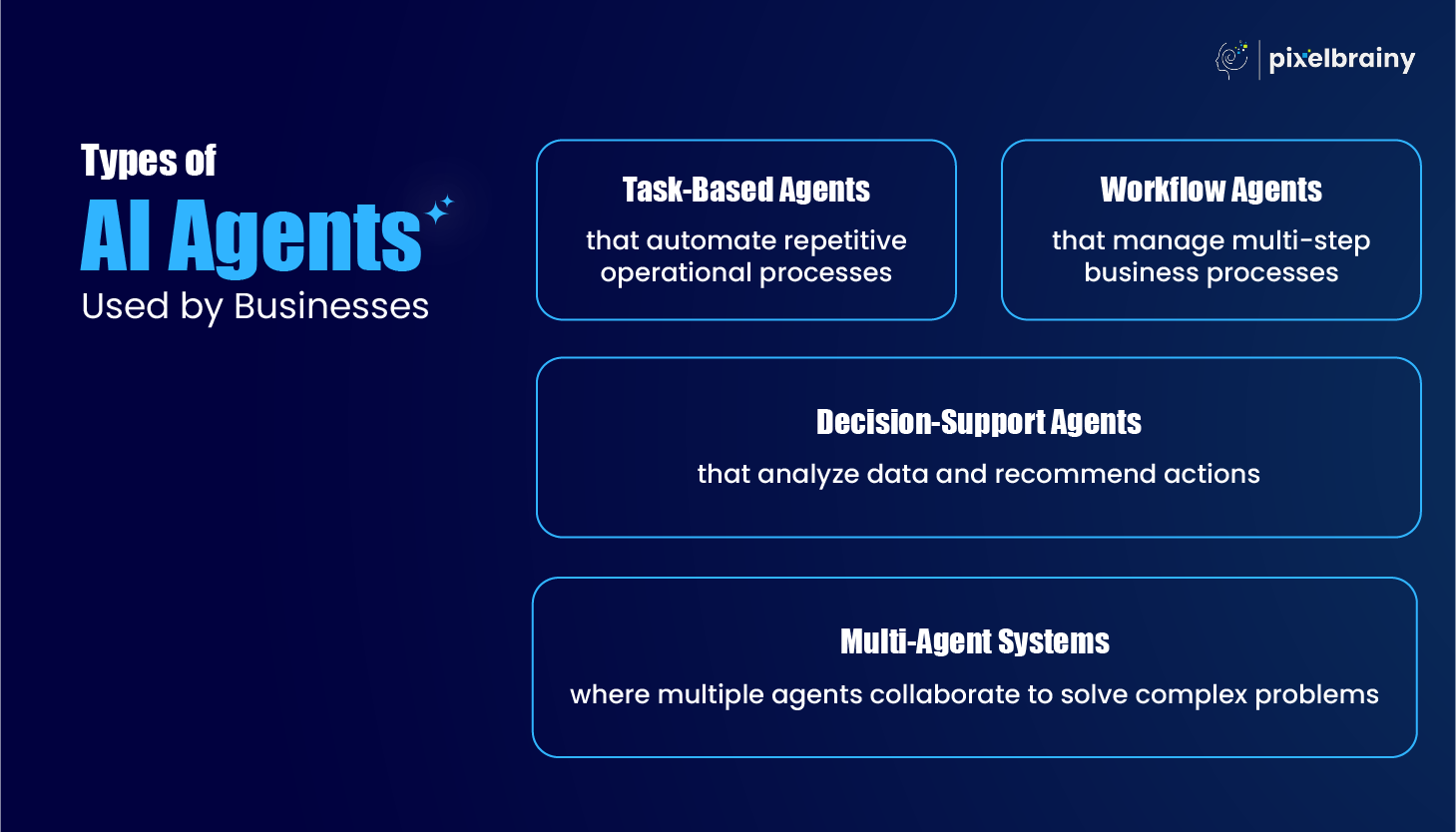
This distinction is important when analyzing AI agent adoption statistics, as more advanced agent types are typically adopted by enterprises with higher AI maturity.
By clearly defining AI agents in this way, businesses can better evaluate adoption benchmarks, implementation challenges, and expected business impact throughout 2026.
As enterprises move beyond basic automation, AI agents are emerging as a distinct and measurable category within the broader AI landscape. In 2026, adoption statistics increasingly focus on agentic systems that can autonomously plan actions, interact with enterprise software, and execute tasks across workflows. Data from leading research organizations shows that AI agent adoption is no longer experimental and is rapidly becoming embedded in enterprise operations.
The following statistics provide a global snapshot of AI agent adoption in 2026, drawing selectively from authoritative sources including McKinsey, Gartner, Statista, and the World Economic Forum.
Market research indicates that the global AI agents market is projected to reach approximately USD 11 to 12 billion in 2026, up from roughly USD 8 billion in 2025. Long-term forecasts suggest exponential growth, with the market expected to exceed USD 250 billion by the early 2030s as enterprises adopt autonomous agents across operations, customer engagement, and decision support.
What this means for decision-makers: AI agents represent one of the fastest-growing segments within enterprise AI. The pace of market expansion signals that agent-based automation is moving into core business budgets rather than remaining an innovation experiment.
Enterprise surveys show that approximately 65 to 75 percent of large organizations are already using, piloting, or actively evaluating AI agents in at least one business function by 2026. These deployments are most common in customer support, internal operations, IT service management, and sales enablement.
What this means for decision-makers: AI agents have crossed the early-adopter threshold. Enterprises that delay adoption risk falling behind peers who are already embedding agentic systems into daily operations and internal workflows.
Research shows that while many companies experiment with agentic AI, only a subset have moved further:
What this means for decision-makers: This maturity pattern highlights that scaling remains a challenge for many organizations. Leaders should invest in governance, data integration, and workflow redesign to elevate pilots into strategic deployments.
Research indicates that agentic AI could unlock significant value for enterprise workflows, with some industry analysts estimating potential value creation in the hundreds of billions of dollars over the next few years as organizations automate complex processes.
What this means for decision-makers: Beyond cost savings, the strategic value of AI agents lies in accelerating decisions, improving process consistency, and enabling new operating models that were previously too labor intensive.
This snapshot of global AI agent adoption in 2026 shows that agentic technologies are moving from early experimentation toward meaningful business usage, setting the stage for industry-specific benchmarks and deeper impact analysis in the next section.
Also Read: AI Adoption Statistics: Trends, Industry Data, and Business Impact
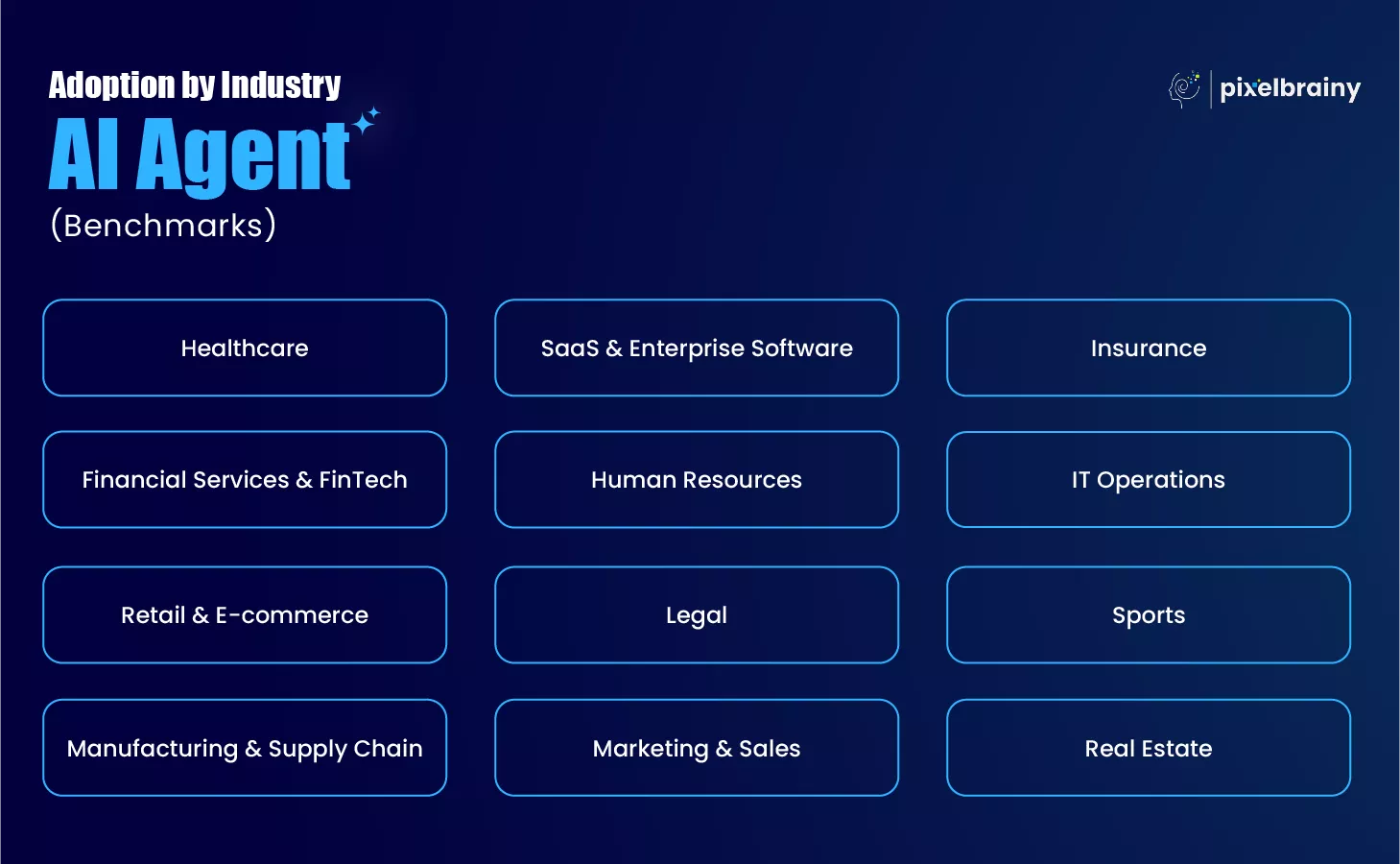
In 2026, AI agents are becoming core technology across multiple industries. Adoption rates vary by vertical depending on workflow complexity, data maturity, and business priorities.
The statistics and benchmarks below use the most recent available data that reflects agentic AI usage, autonomous workflows, and enterprise automation (often directly linked to AI agents or agent-like systems).
Each subsection includes an estimated adoption benchmark, common AI agent use cases, and a maturity assessment.
Healthcare organizations are increasingly adopting AI agents and agentic systems to automate administrative workflows, support clinical processes, and improve patient engagement. Although precise adoption rates for agentic AI tools alone are still emerging, market size and growth forecasts provide a clear signal that healthcare is a major growth area within the global AI agent landscape.
The global agentic AI in healthcare market was valued at approximately USD 0.80 billion in 2025 and is projected to reach around USD 1.17 billion in 2026, with continued rapid expansion over the next decade at a projected compound annual growth rate (CAGR) of about 44.9 percent from 2026 to 2035.
This forecast specifically measures agentic AI systems that can perform coordinated, multi-step tasks autonomously or semi-autonomously in healthcare settings.
Healthcare leaders are deploying AI agents in areas where autonomous action improves efficiency and reduces manual burden, including:
These uses reflect agentic behavior because the systems both interpret inputs and take action proactively within health systems.
Healthcare adoption of AI agents in 2026 remains early to scaling rather than universally mature. Many health systems are piloting agentic workflows or integrating them into administrative functions, while autonomous clinical decision-making remains cautious due to patient safety, regulatory oversight, and data governance concerns. However, the strong market growth forecasts and increasing investment signal a fast-growing trajectory.
For healthcare executives and CIOs evaluating AI agent deployment:
The growth in the agentic AI healthcare market suggests that organizations that act now will be better positioned to harness autonomous capabilities and deliver measurable outcomes ahead of competitors.
While exact industry reports on AI agents alone are still emerging, market research shows that the AI agents segment within financial services is rapidly accelerating.
According to a specialized industry analysis, the global AI agents in financial services market was valued at around USD 490.2 million in 2024 and is projected to grow significantly, nearing USD 691.3 million in 2025 and expected to expand at a compound annual growth rate (CAGR) of 45.4 percent through 2030*. This rapid growth reflects increasing adoption of autonomous and semi-autonomous agentic systems for core banking and FinTech operations.
AI agents in financial services are increasingly deployed across a range of autonomous and decision-assisting tasks that go beyond simple rule-based automation:
These use cases represent agentic behavior because they combine perception, logic, and action execution rather than just responding to predefined prompts.
Financial services and FinTech firms are among the fastest adopters of AI agents because they operate in highly data-rich environments with clear business cases for automation, decision support, and risk reduction.
The strong market growth for AI agents in finance suggests that autonomous capabilities are becoming foundational, not experimental. Leaders should consider:
The financial services sector is not only scaling agentic systems but also seeing direct business value as these systems expand beyond pilots into mission-critical functions.
AI agents are rapidly transforming the retail and e-commerce landscape, shifting from simple rule-based automation toward autonomous systems that assist with decisions, customer interactions, fulfillment tasks, and merchandising optimization. In 2026, retailers are increasingly exploring and deploying agentic AI capabilities to improve efficiency, personalize experiences, and streamline operations.
Recent industry research indicates that retail leadership views agentic and autonomous AI as critical for future competitiveness, with a majority expecting AI systems that can drive decisions and actions without constant human direction. According to retail tech insights, 75 percent of retailers say AI agents will be essential to compete by 2026, and roughly 67 percent believe autonomous AI will bring net opportunities to their business.
Additionally, a recent report found that 43 percent of retailers are currently piloting autonomous AI solutions, with many focused on operational efficiency gains in areas such as demand forecasting and fulfillment.
These trends point to meaningful growth in agentic AI deployment, even though fully scaled implementations remain less common.
Retailers are beginning to deploy AI agents in areas where autonomy and contextual decision-making can deliver measurable business value:
These use cases extend beyond passive recommendations or analytics to systems that make decisions and act autonomously within business workflows.
Retail adoption of AI agents in 2026 is best described as scaling across pilots, emerging production use cases, and early strategic integration. While many retailers are still in pilot or limited-use phases, the strong emphasis on agentic AI’s competitive impact suggests a rapid evolution toward broader adoption.
For example, research shows that a large majority of retail executives believe autonomous AI capabilities will be a key differentiator for future retail competitiveness, and many retailers are actively investing in these technologies.
For retail and e-commerce executives, the available data suggests the following priorities:
Retailers that treat AI agents as strategic infrastructure, not tactical automation tools, will be better positioned to drive both operational efficiency and customer experience differentiation in 2026 and beyond.
Manufacturing and supply chain organizations are increasingly adopting AI agents and agentic systems to improve operational resilience, reduce downtime, and optimize complex production and logistics workflows. While precise AI agent adoption percentages by manufacturer are not yet published, market size and growth data for autonomous and industrial AI systems clearly indicate accelerating deployment across the sector.
According to MarketsandMarkets, the global AI in manufacturing market was valued at approximately USD 3.2 billion in 2023 and is projected to reach USD 20.8 billion by 2028, growing at a compound annual growth rate (CAGR) of about 45.6 percent. This rapid growth is driven largely by agentic and autonomous AI systems used in predictive maintenance, production planning, quality inspection, and supply chain optimization.
These systems increasingly function as AI agents, as they monitor conditions, make decisions, and trigger actions across industrial environments with minimal human intervention.
Manufacturers are deploying AI agents in high-impact, data-intensive operational areas where autonomy delivers clear efficiency gains:
These use cases demonstrate agentic behavior through continuous monitoring, decision-making, and execution across interconnected systems.
AI agent adoption in manufacturing in 2026 is best described as early to scaling. Many organizations have moved beyond experimentation and are deploying agentic systems in specific production lines or logistics networks. However, full end-to-end autonomy across factories and global supply chains is still evolving due to integration complexity and change management challenges.
Despite this, manufacturing is one of the fastest-growing verticals for agentic AI, supported by strong investment and measurable ROI.
For manufacturing and supply chain leaders, the data highlights several strategic priorities:
Manufacturers that invest early in agentic AI capabilities are better positioned to improve efficiency, resilience, and competitiveness as industrial automation continues to accelerate.
In 2026, SaaS and enterprise software vendors are shifting from simply embedding generative AI features to integrating agentic AI capabilities that can execute multi-step tasks and automate workflows autonomously.
According to market projections, a significant share of enterprise applications is expected to include task-specific AI agents by the end of 2026 — marking a major shift in how software delivers value.
Industry forecasts indicate that 40 percent of enterprise applications will include task-specific AI agents by the end of 2026, a steep increase from under 5 percent in previous years. These task-specific AI agents are designed to perform operational tasks automatically within enterprise systems, such as CRM, ERP, service platforms, and productivity suites.
This forecast reflects a broader software industry shift toward agentic AI as a core product capability rather than a standalone experiment.
In SaaS and enterprise platforms, AI agents are increasingly embedded to automate complex workflows and reduce manual effort across many functions:
These uses illustrate agentic behavior because systems combine context awareness, action execution, and decision logic rather than just responding to individual queries or displaying static recommendations.
The SaaS and enterprise software sector represents one of the most advanced markets for AI agent adoption. Many vendors, including major CRM, ERP, and service platforms, are already integrating agentic features into their core products. This reflects a strong shift from traditional AI assistants toward autonomous task completion, especially for internal business operations and user productivity enhancements.
Embedding AI agents directly into platforms allows software companies to differentiate product offerings, improve user productivity, and reduce support load — turning AI from a feature into an execution layer that drives business outcomes.
For product leaders, CTOs, and enterprise decision-makers evaluating SaaS and enterprise software strategies in 2026:
Software vendors and enterprise IT teams that embrace agentic AI as a fundamental product layer rather than an optional enhancement are better positioned to lead in user productivity and operational automation in 2026 and beyond.
Artificial intelligence is reshaping Human Resources (HR) by automating repetitive processes and augmenting decision-making across talent acquisition, onboarding, workforce analytics, and employee engagement. While granular “AI agent adoption rates” specific to HR agents remain early in public research, market data and industry forecasts clearly show the growing role of autonomous and agent-like AI systems in HR functions worldwide.
The AI in Human Resources market is expanding rapidly, serving as a proxy for agentic AI adoption across HR workflows. According to market forecasts, the global AI in HR market was estimated at approximately USD 3.25 billion in 2023 and is projected to reach USD 15.24 billion by 2030, growing at a compound annual growth rate (CAGR) of around 24.8 percent from 2024 to 2030.
This growth reflects the adoption of AI systems — including automated resume screening, interview scheduling tools, talent analytics, and employee self-service agents — that increasingly behave like agentic AI workflows within HR platforms.
Additionally, another authoritative source Market.us estimates the agentic AI in HR & recruitment market at around USD 842.3 million in 2024, with a projected surge to approximately USD 23.17 billion by 2034, growing at a CAGR of 39.3 percent during 2025–2034.
These figures indicate fast-accelerating interest in agentic AI solutions for HR and recruitment, although full deployment maturity differs by function and organization size.
HR teams are adopting AI agents across key processes where autonomous action and workflow orchestration deliver measurable efficiency gains:
These agentic workflows enable HR to handle volume-intensive tasks with reduced manual effort and improved consistency, helping HR teams focus on strategic human-centric work.
AI agent adoption in HR in 2026 remains early to scaling. While many functions have automated tasks such as resume parsing and interview scheduling, end-to-end autonomous HR agents that manage full hiring pipelines or employee lifecycle without oversight are still emerging. Adoption tends to be strongest in large enterprises and technology-forward organizations where HR systems are integrated and data-ready.
Supporting this, surveys show that 43 percent of organizations worldwide used AI for HR and recruiting tasks in 2025, up from 26 percent in 2024 — and usage is expected to continue increasing as agentic capabilities mature.
HR leaders are also positioning AI as strategic infrastructure: one study found that AI agent adoption in HR was expected to surge more than 380 percent over two years, with productivity improvements of over 40 percent reported among adopters.
For HR executives, CHROs, and people leaders planning AI agent deployments in 2026:
Organizations that treat AI agents as operational HR infrastructure rather than standalone experiments are better positioned to improve efficiency, quality of hire, and overall workforce experience.
Legal organizations are increasingly experimenting with AI agents and agentic workflows to automate document-intensive and regulatory tasks that traditionally require significant human time. While broad industry surveys on agent-specific adoption rates are not yet published, market forecasts and segment-specific research show that autonomous AI systems tailored to legal and regulatory work are now a measurable and growing market category.
According to a dedicated market analysis, the Agentic AI in Legal and Regulatory Tech market reached an estimated USD 103.60 million in 2025 and is projected to grow to approximately USD 395.14 million by 2030, representing a compound annual growth rate (CAGR) of about 30.7 percent. This market segment reflects the adoption of autonomous or semi-autonomous AI tools capable of executing multi-step legal tasks such as document review, eDiscovery, and compliance monitoring.
This segment covers AI agents that go beyond generic AI tools by performing autonomous analysis, multi-stage review, and proactive task execution within legal workflows.
Legal teams adopt AI agents in areas where autonomy materially boosts productivity, reduces repetitive effort, and enhances risk identification:
These examples illustrate agentic behavior — systems that interpret context, make decisions, and trigger actions without requiring step-by-step human input.
AI agent adoption in legal departments and law firms is currently early but accelerating. Although many organizations have experimented with generative AI for drafting and research, the integration of true agentic AI — autonomous, multi-step execution systems — remains limited but rapidly growing. Adoption is strongest in large law firms, corporate legal operations, alternative legal service providers (ALSPs), and compliance units where document volume and complexity justify advanced automation.
For general counsels, legal operations leaders, and law firm partners evaluating AI agents in 2026:
Legal departments that approach AI agents as productivity accelerators with responsible oversight are better positioned to reduce costs and improve legal service delivery.
Also Read: How To Build An AI Agent: A Step-by-Step Guide
Marketing and sales functions are among the earliest business areas to deploy AI agents due to their data-rich environments, repetitive workflows, and direct linkage to revenue outcomes. In 2026, AI agents in marketing and sales are primarily used to autonomously qualify leads, personalize outreach, manage CRM data, and support pipeline forecasting with minimal human intervention.
According to Market.us, the global AI agents market for sales and marketing applications is emerging as a distinct growth segment within the broader AI agents ecosystem. The market for AI agents used in sales and customer engagement workflows was valued at approximately USD 1.4 billion in 2024 and is projected to reach USD 10.2 billion by 2033, growing at a compound annual growth rate (CAGR) of about 25 percent.
Market.us identifies marketing, sales, and customer engagement as key functional areas driving AI agent demand, particularly for autonomous task execution such as lead routing, follow-ups, and customer interaction management.
Marketing and sales teams deploy AI agents in workflows where autonomous execution delivers measurable efficiency and revenue impact:
These AI agents operate across marketing automation platforms, CRM systems, and analytics tools, performing continuous actions rather than responding to isolated prompts.
AI agent adoption in marketing and sales in 2026 is best described as scaling to advanced. Many organizations have moved beyond experimentation and are deploying AI agents in production for lead management, campaign execution, and revenue operations. However, full autonomy across end-to-end sales cycles is still evolving as organizations refine governance and trust models.
The strong market growth projections indicate that marketing and sales will remain one of the fastest-maturing domains for AI agent deployment.
For CMOs, CROs, and revenue operations leaders, the data suggests several priorities:
Organizations that treat AI agents as execution engines within marketing and sales operations, rather than simple AI features, are more likely to achieve sustained productivity and revenue gains in 2026.
Insurance companies are increasingly adopting AI agents that can autonomously execute insurance workflows such as claims intake, underwriting support, fraud detection, and customer servicing. Unlike traditional AI tools that provide insights or recommendations, AI agents in insurance actively perform tasks and trigger actions across core systems with limited human involvement.
Industry reporting focused specifically on AI agents shows that AI agent adoption in insurance operations increased significantly between 2024 and 2025. One industry analysis reports that full AI agent adoption in insurance workflows rose from approximately 8 percent to 34 percent year over year, reflecting rapid uptake of autonomous systems used in claims processing, underwriting assistance, and customer service automation.
This data reflects the growing use of AI agents that independently handle insurance processes, rather than general AI analytics or decision support tools.
Insurers deploy AI agents in areas where autonomous task execution improves efficiency and accuracy while reducing manual workload:
These AI agents operate continuously and interact directly with claims systems, policy administration platforms, and customer communication channels.
AI agent adoption in insurance in 2026 is best described as scaling. A growing number of carriers have moved beyond pilots into production deployments, particularly for claims and customer service workflows. However, full enterprise wide adoption remains limited due to regulatory oversight, data quality challenges, and the need for strong governance controls.
For insurance executives and technology leaders, the data highlights several priorities:
Insurance organizations that treat AI agents as operational infrastructure rather than experimental tools are more likely to achieve sustainable efficiency improvements and competitive advantage in 2026 and beyond.
IT operations is one of the most advanced domains for AI agent adoption, as IT environments are highly structured, event driven, and rich in machine readable signals. In 2026, AI agents are increasingly used to autonomously monitor systems, triage incidents, and execute remediation workflows without requiring constant human intervention.
According to the State of AI Agents report published by LangChain, 51% of organizations report that they are already using AI agents in production, while an additional 78 percent state that they plan to deploy AI agents in the near term. IT operations is identified as one of the primary functional areas where AI agents are actively deployed due to clear automation triggers and measurable outcomes.
This data reflects real usage of AI agents that autonomously perform tasks, not experimental chatbots or analytics tools.
IT teams deploy AI agents in operational workflows where autonomous execution significantly improves speed and reliability:
These AI agents interact directly with monitoring platforms, ticketing systems, and infrastructure tooling to perform continuous operational tasks.
AI agent adoption in IT operations in 2026 is best described as advanced. Many organizations have moved beyond pilots and now rely on AI agents for day to day operational support. IT is one of the few domains where AI agents are trusted to take autonomous action at scale, provided guardrails and escalation policies are in place.
For CIOs, CTOs, and IT operations leaders, the data points to clear strategic actions:
Organizations that deploy AI agents as core IT operations infrastructure gain faster incident response, lower operational costs, and improved system reliability.
In 2026, the sports industry is transitioning from basic analytics and assisted workflows to AI agents that autonomously perform operational and performance tasks for teams, leagues, and fan engagement. Unlike traditional sports AI tools that simply generate insights, AI agents can interpret data, execute multi-step tasks, and trigger actions independently, making them uniquely valuable across sports operations.
Below are the best real examples and market insights available from purpose-built sports AI agent use cases and reports. These reflect actual agent deployment trends and measurable impact rather than general AI speculation.
There are not yet large-scale, industry-wide published adoption percentages for AI agents in sports, but real case examples and use-case reporting provide a clear adoption direction:
These usages indicate emerging but measurable adoption where AI agents are no longer hypothetical but operational tools in several professional sports contexts.
AI agents in sports are most commonly deployed where autonomous analysis and action speed provide significant competitive or operational advantage:
These functions reflect AI agents acting on data continuously and autonomously in the background, which is the defining characteristic of true AI agent deployment.
AI agent adoption in sports in 2026 is best described as early to scaling rather than fully mature:
This trend mirrors other industries where agent adoption begins in high-value niches and grows outward as governance, data quality, and integration improve.
For sports executives, team general managers, analytics directors, and technology leaders:
Sports organizations that treat AI agents as operational partners, not experiments are positioned to deliver both competitive advantage on the field and business impact off it.
Real estate professionals are increasingly using AI agents and agent-like systems to automate tasks, accelerate lead engagement, analyze market data, and support client workflows. Although formal industry reports have not yet published exact “AI agent adoption” percentages by real estate firms worldwide, multiple credible surveys and industry signals confirm widespread use of autonomous AI-powered tools — which function as AI agents in practice.
Industry research from the National Association of Realtors shows that 75 percent of top real estate brokerages are already using AI technologies, and nearly 80 percent of individual agents report using AI tools to enhance productivity and client service. These AI tools increasingly include autonomous or semi-autonomous functions such as automated lead interaction, predictive property recommendations, and activity tracking that resemble AI agent behavior.
Popular reports indicate that a majority of real estate professionals regularly use AI systems to augment workflows, including client communication and data summaries, and adoption is expected to continue climbing in 2026 as agentic features become more integrated.
While not pure adoption statistics for AI agents alone, these numbers show that AI-powered autonomous tools resembling agents are rapidly becoming part of real estate operations.
Real estate firms and agents are deploying AI agents (or agent-like systems) in practical, revenue-supporting workflows, including:
These functions go beyond simple recommendation or lookup tools and represent autonomous task execution characteristic of AI agents.
Adoption of AI agents in real estate is best described as early to scaling in 2026. Most brokerages and agents use autonomous features embedded in CRM, listing, and marketing platforms rather than standalone AI agent products. As adoption spreads from workflow augmentation into transaction-related automation and predictive planning, the industry is accelerating toward more strategic use of autonomous agents.
For real estate executives, brokers, and PropTech leaders:
Real estate organizations that treat these autonomous systems as workflow partners rather than niche features will be better positioned to compete in a technology-enabled market.
Also Read: Real Estate AI Agent Development: From Concept to Development
In 2026, AI agent adoption is accelerating as enterprises shift from experimental AI tools to autonomous systems that execute tasks, coordinate workflows, and operate within enterprise environments. The following trends reflect how large organizations are actually deploying AI agents today, supported by data from leading global research institutions and consulting firms.
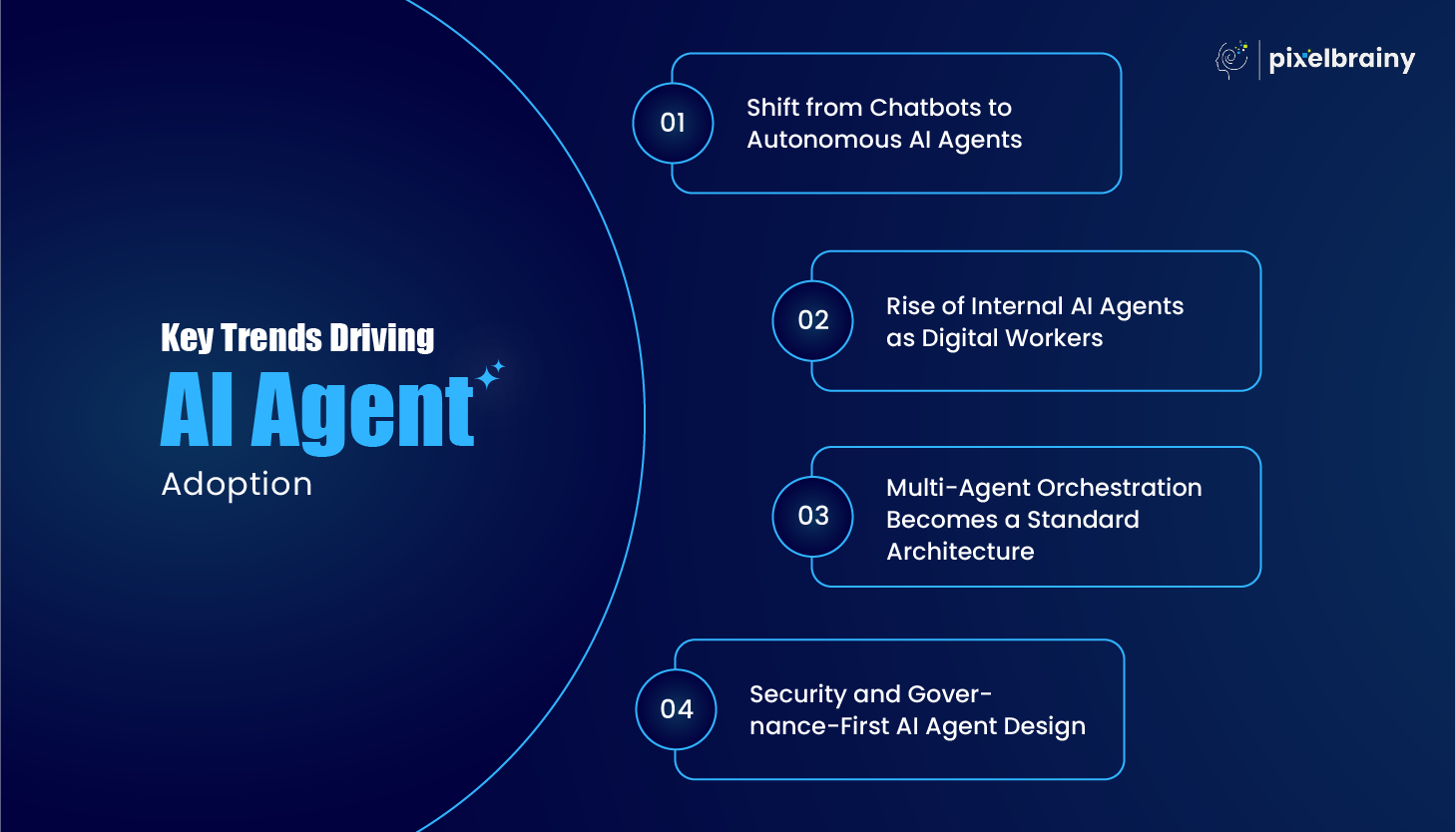
What is changing: Organizations are moving beyond basic chatbots toward AI agents that can independently plan and execute multi-step workflows across systems. These agents are designed to act, not just respond.
Market data: According to PwC, 73 percent of business leaders believe AI agents will deliver a competitive advantage in the near term, reflecting a clear shift toward autonomous, execution-focused AI rather than conversational tools.
What this means in practice: Teams see higher ROI when AI agents are allowed to complete tasks end to end instead of stopping at recommendations.
What is changing: Enterprises are increasingly deploying internal AI agents that operate inside departments such as IT, finance, HR, and operations. These agents function as digital workers that automate routine tasks, handle process steps, and free employees to focus on higher-value work.
Market data: According to PwC’s AI business predictions, companies that embed autonomous and workflow-executing AI systems across operations are beginning to see clear, measurable impact on business processes as they move from experimentation to scaling. This reflects a shift from tools that assist to systems that execute operational tasks across teams.
Real-world implementation insight: Organizations that have integrated internal AI agents into existing business systems report faster adoption and less resistance than those that treated AI as separate or siloed technology. Integrating agents within workflow platforms ensures they become part of everyday operations rather than isolated experiments.
What is changing: By 2026, organizations are moving from single standalone AI agents to multi-agent orchestration, where groups of AI agents collaborate to complete complex workflows. Rather than having one agent perform a single task, enterprises are designing systems in which multiple specialized agents communicate, coordinate, and share context to solve composite business processes.
Market data: Industry trend reports identify multi-agent orchestration as one of the core AI agent adoption vectors in 2026, with enterprises increasingly building agent ecosystems capable of coordinated task execution across functions such as IT, supply chain, customer service, and finance. These structured, interconnected systems reflect a deeper level of autonomy than standalone agents.
What this means in practice: Multi-agent orchestration enables enterprises to automate entire business processes instead of isolated steps. For example, one agent may handle data retrieval, another evaluates compliance, and a third executes the final action. Businesses that adopt this architecture see stronger scalability and improved operational continuity because tasks are shared and coordinated rather than siloed.
What is changing: As AI agents gain autonomous capabilities and access to enterprise data and systems, organizations are prioritizing security, compliance, and governance. AI agents need clear policies, access controls, monitoring, and human oversight to ensure they act within boundaries and do not introduce unacceptable risk.
Market data: According to the State of AI in the Enterprise – 2026 report, while AI agent usage is growing sharply, only about 20 percent of companies have mature frameworks for governing autonomous AI agents, meaning most governments and compliance systems have yet to catch up with adoption. This shows that governance remains a top priority if AI agents are to operate safely at scale.
What this means in practice: Leaders need to design governance up front, including role-based access, audit logging, escalation policies, and monitoring controls. Proper governance ensures that AI agents can automate workflows securely and consistently without causing data leaks, unauthorized actions, or compliance violations.
From this above key trends driving AI agent adoption show that organizations are shifting from chatbots to autonomous AI agents, embedding them as internal digital workers, orchestrating multiple agents, integrating them with enterprise systems, and prioritizing security and governance to scale AI agents responsibly.
Also Read: AI Agent Development Cost Guide: Factors and Cost Optimization Tips
AI agents are increasingly recognized as drivers of business value in 2026, helping organizations improve efficiency, productivity, customer outcomes, and competitive positioning. Although many enterprises are still refining how they measure impact, real-world data shows meaningful returns when AI agents are deployed strategically.
AI agents help automate repetitive, rule-based tasks, allowing human teams to focus on higher-value work and reducing cycle times in functions such as support, operations, and analytics.
Market stats: Enterprise research shows that 87 percent of large enterprises have implemented AI solutions, and 76 percent report process automation as a key use case, which directly overlaps with AI agent workflows used for execution and monitoring. Organizations adopting AI report operational efficiency improvements, including reduced cycle times and fewer manual touchpoints.
What this means: AI agents often represent the execution layer of AI; efficiency gains observed at the enterprise level are frequently driven by autonomous task execution rather than simple decision support.
Where companies measure impact formally, many report that AI systems, including autonomous agents, boost return on investment and competitive advantage.
Market stats: In PwC’s survey on AI agent strategy, 73 percent of business leaders agree that AI agents will provide a significant competitive advantage, and 75 percent say they are confident in their company’s AI agent strategy. This reflects rising executive confidence that AI agents will deliver measurable business value.
What this means: While ROI frameworks are still emerging in many firms, the fact that three-quarters of executives expect strategic benefit from AI agents shows that leaders are linking investment to outcomes.
Broader enterprise AI adoption surveys show that companies systematically measuring AI impact see measurable performance improvements, which provides context for how firms using AI agents measure ROI.
Market stat: According to the 2025 AI Adoption Report, 72 percent of organizations formally measure AI ROI, focusing on productivity and incremental profit.
This trend of measuring outcomes is critical because AI agents — by virtue of acting autonomously — require outcome-oriented metrics such as time saved or cycle time reductions.
What this means: Organizations that quantify impact across productivity, cost, and revenue are better positioned to demonstrate real value from AI agents.
Growth in the AI agent segment also signals future business impact, as large-scale adoption often follows observable ROI.
Market stat: The global AI agents market reached about USD 7.9 billion in 2025 with projections extending into the hundreds of billions by 2034, reflecting strong demand driven by ROI expectations tied to automation and autonomous execution.
What this means: Large projected growth indicates that enterprises are allocating budget toward AI agents because they anticipate measurable returns, including cost savings, productivity gains, and strategic leverage.
Enterprises that successfully track AI agent impact focus on a set of measurable KPIs that capture actual business outcomes. These include:
The stronger firms tie AI agent deployment directly to these business outcomes, the easier it becomes to justify ongoing investment and scale.
While AI agents are rapidly advancing from pilots to production use, many organizations still face significant obstacles that slow or prevent full adoption. These challenges are both technical and organizational, and they reflect how real-world AI agent deployments interact with existing systems, people, and governance requirements.
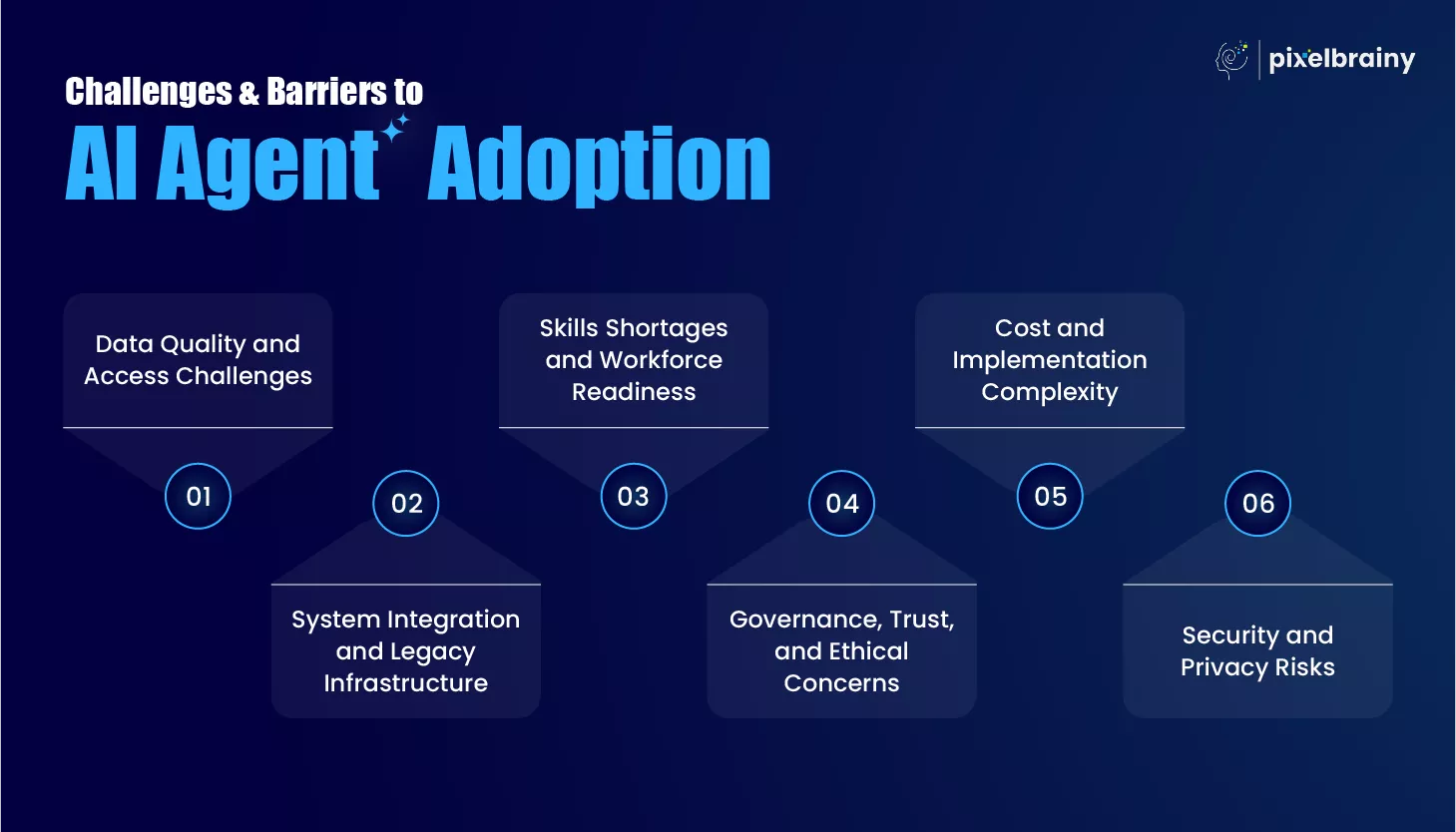
AI agents require high-quality, well-structured data to function effectively. In many enterprises, data remains fragmented across silos, inconsistent in format, and difficult to access in real time.
Market stats: A recent industry report found that 42 percent of organizations identify data access and quality issues as a primary barrier to scaling AI agents. When data is incomplete or poorly integrated, agent performance degrades and reliability suffers.
What this means: Before scaling AI agents, enterprises must invest in unified data architectures, governance, and pipelines so agents can act on reliable, consistent information.
Many enterprise systems were not designed with autonomous agents in mind, making integration complex and costly.
Market stat: Surveys of IT leaders show that 95 percent cite system integration as a top AI agent adoption challenge, yet only 28 percent of enterprise applications are effectively connected for AI-driven workflows.
What this means: Without strong integration across CRM, ERP, and workflow systems, AI agents remain isolated tools instead of impactful execution layers. Integration barriers directly limit what agents can automate.
Deploying and managing AI agents requires specialized technical skills that many organizations lack.
Market stats: In a recent enterprise AI agent roadmap survey, 38 percent of respondents cited skill gaps as a top barrier to scaling AI agents, above other challenges like tooling or funding.
What this means: Companies must invest in upskilling, reskilling, and multidisciplinary teams (including data engineers, AI specialists, and business analysts) to build and maintain agent frameworks.
AI agents can make autonomous decisions that affect people, processes, and sensitive data. Without careful design, they can introduce bias, privacy risks, or compliance failures.
Market stats: In broader enterprise AI agent adoption research, governance and compliance feature among the most common barriers, especially where agents interact with sensitive workflows that must adhere to regulations or ethical standards.
What this means: Enterprises need clear governance frameworks that define acceptable agent behavior, oversight mechanisms, and auditing protocols. Trust and explainability are essential for both regulators and internal stakeholders.
AI agent projects often begin with promising pilots but struggle to scale into production due to high implementation costs, unclear value propositions, or misaligned expectations.
Market context: Executive surveys indicate that more than half of companies report limited tangible benefit from early AI investments due to gaps in execution, governance, and integration.
What this means: Organizations should align AI agent initiatives with strategic business priorities, define clear ROI metrics, and adopt disciplined implementation approaches to avoid costly, unfocused deployments.
AI agents typically have access to systems, data, and user contexts. Without robust security, agents can become vectors for risk.
Market signal: Industry commentary highlights growing concern that AI agents may introduce security risks if not monitored or governed properly, especially when they interact with identity systems or sensitive data stores.
What this means: Security planning must account for AI agents as non-human system actors with defined privileges, monitoring, and controls similar to human users.
AI agent adoption in 2026 is constrained not by lack of interest but by real implementation barriers:
Addressing these barriers systematically — with strong data foundations, integration architecture, talent strategies, governance frameworks, and security models — is key to moving from pilots to sustained, enterprise-wide AI agent deployment.
The AI agent adoption statistics in 2026 point to a clear shift in how organizations should think about automation, productivity, and digital transformation. AI agents are no longer experimental tools. They are becoming operational assets that directly influence efficiency, cost structures, and competitive advantage.
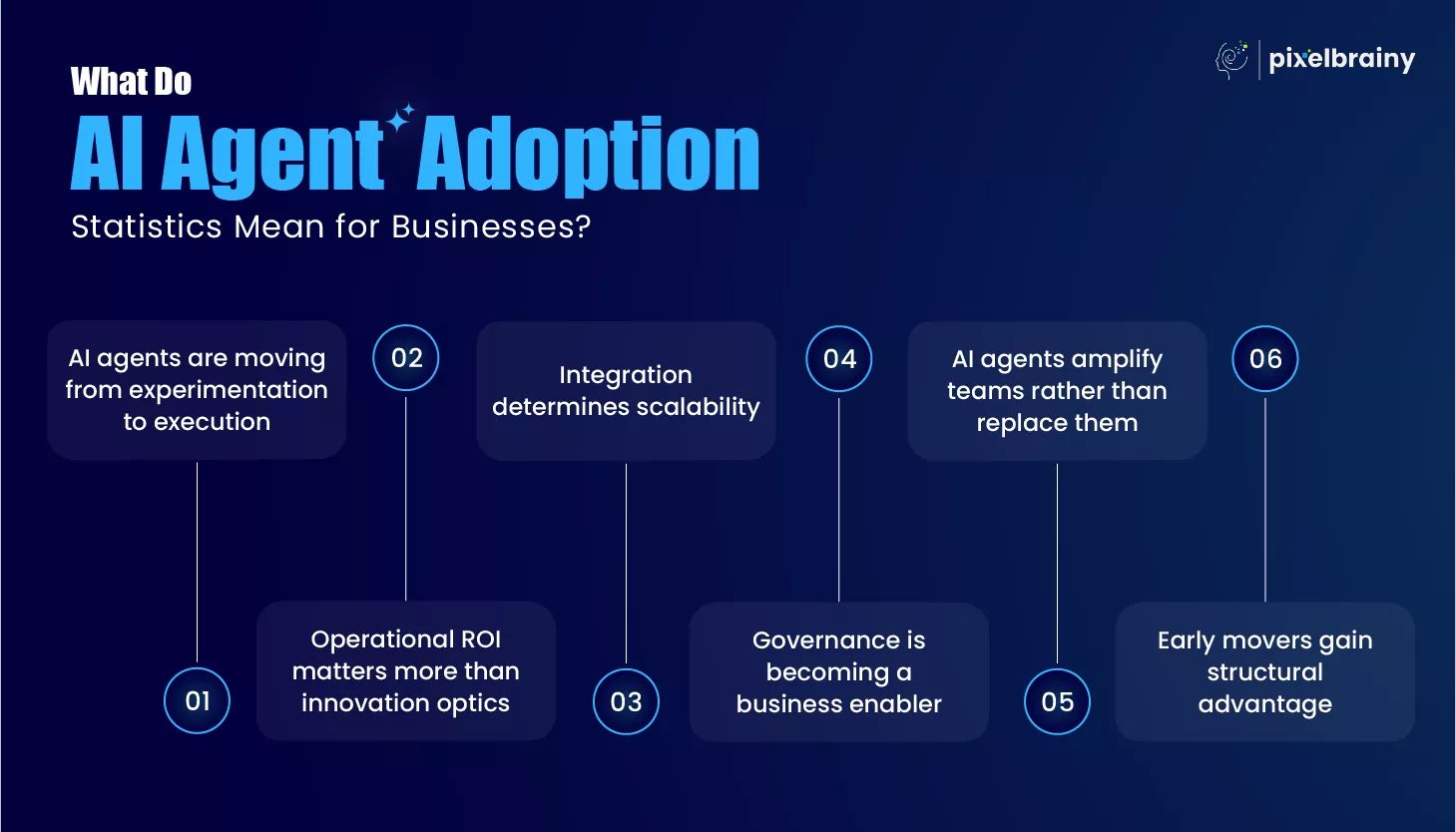
The data shows that businesses gaining the most value are those that move beyond pilots and deploy AI agents in real production workflows. Organizations that limit AI agents to proof-of-concepts struggle to see ROI, while those embedding agents into daily operations achieve measurable improvements in speed, accuracy, and output.
Adoption statistics consistently indicate that AI agents deliver the strongest returns when applied to high-volume, repeatable processes such as IT operations, customer support, finance workflows, and internal services. For business leaders, this means success is driven by practical use cases, not by adopting AI for visibility or experimentation alone.
Businesses that integrate AI agents with existing enterprise systems such as CRM, ERP, and ITSM platforms scale faster and experience fewer failures. The statistics highlight that integration challenges are one of the main reasons AI agent initiatives stall, making system readiness a strategic prerequisite rather than a technical afterthought.
Adoption data shows that governance is no longer just a compliance requirement. Organizations with clear policies around access control, oversight, and accountability scale AI agents more confidently and with less internal resistance. For executives, this means governance directly impacts time to value and long-term sustainability.
Across industries, adoption trends indicate that AI agents are most effective when they augment human teams. Businesses that position AI agents as digital workers supporting employees see higher productivity gains and better adoption than those framing AI purely as a cost-cutting replacement strategy.
The overall adoption statistics suggest that AI agents are following a familiar technology curve. Early adopters are already building internal expertise, refining governance models, and optimizing workflows. These organizations will be harder to compete with as AI agents become standard across industries.
For CEOs, CTOs, founders, and enterprise decision-makers, the message from the data is clear:
Businesses that align strategy, technology, and governance around AI agents are best positioned to convert adoption statistics into sustained competitive advantage in 2026 and beyond.
As AI agent adoption accelerates in 2026, organizations need more than experimentation. They need a trusted AI Agent Development Company in USA that understands real-world implementation, enterprise integration, and measurable ROI. PixelBrainy LLC helps businesses move from interest to impact by designing, building, and scaling AI agents that deliver tangible business outcomes.
Driven by AI agent stats 2026, evolving AI agent market trends, and rising AI agent adoption rates, PixelBrainy focuses on practical, production-ready AI agents that align with business strategy, governance, and performance goals.
AI agent market statistics show that many organizations struggle to scale beyond pilots due to integration, governance, and unclear ROI. PixelBrainy addresses these gaps by treating AI agents as operational infrastructure, not experimental tools.
Our approach is grounded in:
This ensures clients convert market stats of AI agents into real business value.
We help organizations define where AI agents create the highest ROI. This includes identifying high-impact use cases, assessing readiness, and aligning AI agent initiatives with business goals, industry benchmarks, and AI agent adoption statistics.
PixelBrainy builds custom AI agents tailored to your workflows, data, and systems. These agents are designed to autonomously execute tasks, not just assist users, ensuring measurable efficiency and productivity gains.
We design AI agents with a strong focus on usability, reliability, and governance. From conversation flow to decision logic, every agent is built to operate responsibly while delivering consistent results.
AI agents deliver value only when connected to real systems. We integrate AI agents with CRM, ERP, ITSM, data platforms, and internal tools so they can read data, trigger actions, and complete workflows end to end.
Based on performance metrics such as cycle time reduction, accuracy, and task completion rates, we continuously optimize AI agents to improve outcomes as business needs evolve.
PixelBrainy provides ongoing monitoring, updates, and support to ensure AI agents remain secure, reliable, and aligned with changing business and compliance requirements.
PixelBrainy LLC works with organizations at different stages of AI agent maturity:
Whether you are piloting your first AI agent or scaling across the organization, PixelBrainy provides the expertise required to succeed.
Client type: Multi-location healthcare center, United States
Challenge: High administrative workload, delayed patient responses, and staff overload caused by manual intake, scheduling, and follow-up processes
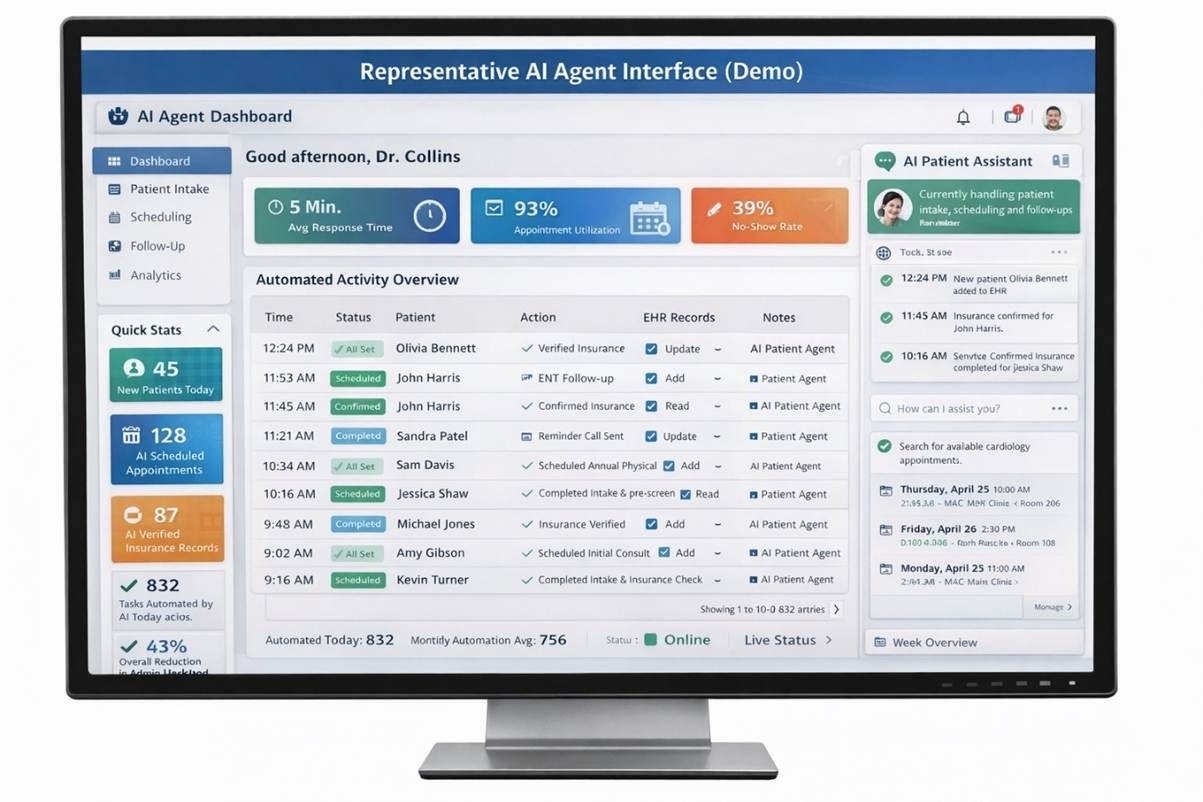
PixelBrainy designed and implemented a custom AI agent to autonomously handle patient intake, appointment scheduling, insurance verification prompts, and routine follow-up communication. The AI agent was integrated with the center’s existing EHR and scheduling systems to ensure secure, compliant workflow execution.
Key outcomes:
Business impact: The healthcare center successfully moved from manual coordination to an AI agent-driven operational model, demonstrating how AI agent adoption in healthcare can deliver measurable efficiency gains while maintaining compliance and patient trust.
AI agent market trends in 2026 show that success depends on execution, not experimentation. PixelBrainy LLC helps businesses transform AI agent adoption rates and market statistics into operational efficiency, productivity gains, and long-term competitive advantage.
By partnering with PixelBrainy, organizations gain more than technology. They gain a strategic AI agent partner focused on results.

From this above article AI agent adoption statistics in 2026 clearly show that AI agents have moved from early experimentation to becoming a critical part of modern business operations. Across industries, organizations are using AI agents to automate workflows, improve decision-making, reduce operational costs, and enhance customer experiences. The data highlights that success with AI agents depends on practical use cases, deep system integration, strong governance, and a clear focus on measurable ROI rather than hype.
Businesses that invest early in AI agent strategy, development, and optimization are building a long-term competitive advantage while improving productivity and scalability. As AI agent market trends continue to evolve, companies that act now will be better positioned to adapt, innovate, and grow in an increasingly automated future.
Ready to implement AI agents for your business? Book an appointment with PixelBrainy LLC to explore how AI agents can drive real results.
AI agents can independently plan, decide, and execute tasks across systems, while traditional automation follows fixed rules and requires predefined triggers.
IT operations, healthcare administration, financial services, SaaS, and insurance are leading AI agent adoption due to clear ROI and repeatable workflows.
Most organizations begin seeing measurable efficiency and productivity gains within three to six months when AI agents are deployed in high-volume processes.
Yes, when built with proper access controls, monitoring, and governance. Enterprise-grade AI agents are designed with security and compliance in mind.
No. AI agents are most effective when they augment teams by handling repetitive tasks, allowing employees to focus on strategic and high-value work.
AI agents can integrate with CRM, ERP, EHR, ITSM, data platforms, and internal tools to execute end-to-end workflows.
Businesses should begin with strategy consultation, identify high-impact use cases, and pilot AI agents within existing workflows before scaling.

About The Author
Sagar Bhatnagar
Sagar Sahay Bhatnagar brings over a decade of IT industry experience to his role as Marketing Head at PixelBrainy. He's known for his knack in devising creative marketing strategies that boost brand visibility and market influence. Sagar's strategic thinking, coupled with his innovative vision and focus on results, sets him apart. His track record of successful campaigns proves his ability to utilize digital platforms effectively for impactful marketing efforts. With a genuine passion for both technology and marketing, Sagar continuously pushes PixelBrainy's marketing initiatives to greater success.

Working with the PixelBrainy team has been a highly positive experience. They understand the design requirements and create beautiful UX elements to meet the application needs. The dev team did an excellent job bringing my vision to life. We discussed usability and flow. Sagar worked with his team to design the database and begin coding. Working with Sagar was easy. He has the knowledge to create robust apps, including multi-language support, Google and Apple ID login options, Ad-enabled integrations, Stripe payment processing, and a Web Admin site for maintaining support data. I'm extremely satisfied with the services provided, the quality of the final product, and the professionalism of the entire process. I highly recommend them for Android and iOS Mobile Application Design and Development.

Great experience working with them. Had a lot of feedback and I found that unlike most contractors they were bugging me for updates instead of the other way around. They were extremely time conscience and great at communicating! All work was done extremely high quality and if not on time, early! They were always proactive when it comes to communication and the work is great/above par always. Very flexible and a great team to work with! Goes above and beyond to present us with multiple options and always provides quality. Amazing work per usual with Chitra. If you have UI/UX or branding design needs I recommend you go to them! Will likely work with them in the future as well, definitely recommended!

PixelBrainy is a joy to work with and is a great partner when thinking through branding, logo, and website layout. I appreciate that they spend time going into the "why" behind their decisions to help inform me and others about industry best practices and their expertise.

I hired them to design our software apps. Things I really like about them are excellent communication skills, they answer all project suggestions and collaborate right away, and their input on design and colors is amazing. This project was complex and needed patience and creativity. The team is amazing to do business with. I will be using them long-term. Glad to see there are some good people out there. I was afraid to try and outsource my project to someone but I am glad I met them! I really can't say enough. They went above and beyond on this project. I am very happy with everything they have done to make my business stand out from the competition.

It was great working with PixelBrainy and the team. They were very responsive and really owned the project. We'll definitely work with them again!

I recently worked with the PixelBrainy team on a project and I was blown away by their communication skills. They were prompt, clear, and articulate in all of our interactions. They listened and provided valuable feedback and suggestions to help make the project a success. They also kept me updated throughout the entire process, which made the experience stress-free and enjoyable.

PixelBrainy is very good at what it does. The team also presents themselves very professionally and takes care of their side of things very well. I could fully trust them taking up the design work in a timely and organised manner and their attention to detail saved us lots of effort and time. This particular project was quite intense and the team showed that they function very well under pressure. Very much looking forward to working with her again!

It's always an absolute pleasure working with them. They completed all of my requests quickly and followed every note I had for them to a T, which made our process go smoothly from start to finish. Everything was completed fast and following all of the guidelines. And I would recommend their services to anyone. If you need any design work done in the future, PixelBrainy should be your first call!

They took ownership of our requirements and designed and proposed multiple beautiful variants. The team is self-motivated, requires minimum supervision, committed to see-through designs with quality and delivering them on time. We would definitely love to work with PixelBrainy again when we have any requirements.

PixelBrainy was a big help with our SaaS application. We've been hard at work with a new UI/UX and they provided a lot of help with the designs. If you're looking for assistance with your website, software, or mobile application designs, PixelBrainy and the team is a great recommendation.

PixelBrainy designers are amazing. They are responsive, talented, and always willing to help craft the design until it matches your vision. I would recommend them and plan to continue them for my future projects and more!!!

They were awesome! Did a good job fast, and good communication. Will work with them again. Thank you

Creative, detail-oriented, and talented designers who take direction well and implement changes quickly and accurately. They consistently over-delivered for us.

PixelBrainy team is very talented and creative. Great designers and a pleasure to work with. PixelBrainy is an excellent communicator and I look forward to working with them again.

PixelBrainy has a very talented design team. Their work is excellent and they are very responsive. I enjoy working with them and hope to continue on all of our future projects.


Transform your ideas into reality with us.
Across these industries, each engagement brings unique challenges, from early-stage product development to scaling complex systems, helping us build a practical understanding of real-world product environments.