AI Summary Powered by PixelBrainy
What does it really take to build an AI trading bot that can outperform manual trading while staying scalable, secure, and profitable in today's fast moving financial markets?
Artificial intelligence is transforming the way financial markets operate. What was once a technology reserved for hedge funds, investment banks, and institutional traders has now become accessible to startups, fintech companies, brokerage firms, crypto exchanges, and entrepreneurs. As a result, AI trading bot development has evolved from a niche capability into a mainstream business opportunity, enabling companies to automate trading strategies, analyze massive volumes of market data, and execute trades with speed and precision.
Many business owners are no longer asking whether they should develop an AI trading bot. Instead, they want to understand how to develop an AI trading bot that aligns with their business goals, budget, and target market. For example, a founder might ask, "I am planning to build an AI trading bot that trades on Binance and Coinbase automatically and I want it to use deep learning models to predict price movements. I have a budget of around $30,000 to $50,000. Which development companies in the USA can build this for me within this budget and timeline?" This reflects the growing demand for expert guidance, custom development, and reliable technology partners.
Whether your objective is creating an AI trading bot for cryptocurrency, stocks, forex, or multi asset trading, success depends on choosing the right architecture, AI models, integrations, and development approach. Businesses investing in automated AI trading bot development are also accelerating their broader AI adoption, using intelligent automation to improve operational efficiency and create new revenue streams.
In this guide, you will learn everything from essential features and the complete development process to technology choices, cost estimates, and how to build an AI trading bot that is ready for real world trading and long term business growth.
An AI trading bot is an intelligent software application that automatically analyzes financial markets, identifies trading opportunities, and executes buy or sell orders with minimal human intervention. Unlike conventional bots that rely on fixed instructions, an automated AI trading bot uses artificial intelligence and machine learning to learn from historical and real time market data, making it capable of adapting to changing market conditions.
This is what makes AI trading bot development increasingly valuable for businesses, fintech startups, hedge funds, brokers, and professional traders. Instead of following the same predefined rules every time, AI models continuously evaluate new information, recognize patterns, and refine their trading strategies to improve decision making over time.
Many business owners ask, "How does an AI trading bot work and how is it different from a regular trading bot?" The answer lies in its intelligence. A traditional trading bot executes trades only when specific rules are met. In contrast, an AI powered bot can interpret market behavior, analyze technical indicators, assess trading volume, process news sentiment, and identify complex relationships that static algorithms often miss. This makes machine learning trading bot development a more advanced and future ready approach for automated trading.
The foundation of modern AI trading software development is a continuous learning cycle that combines market analysis with predictive intelligence.
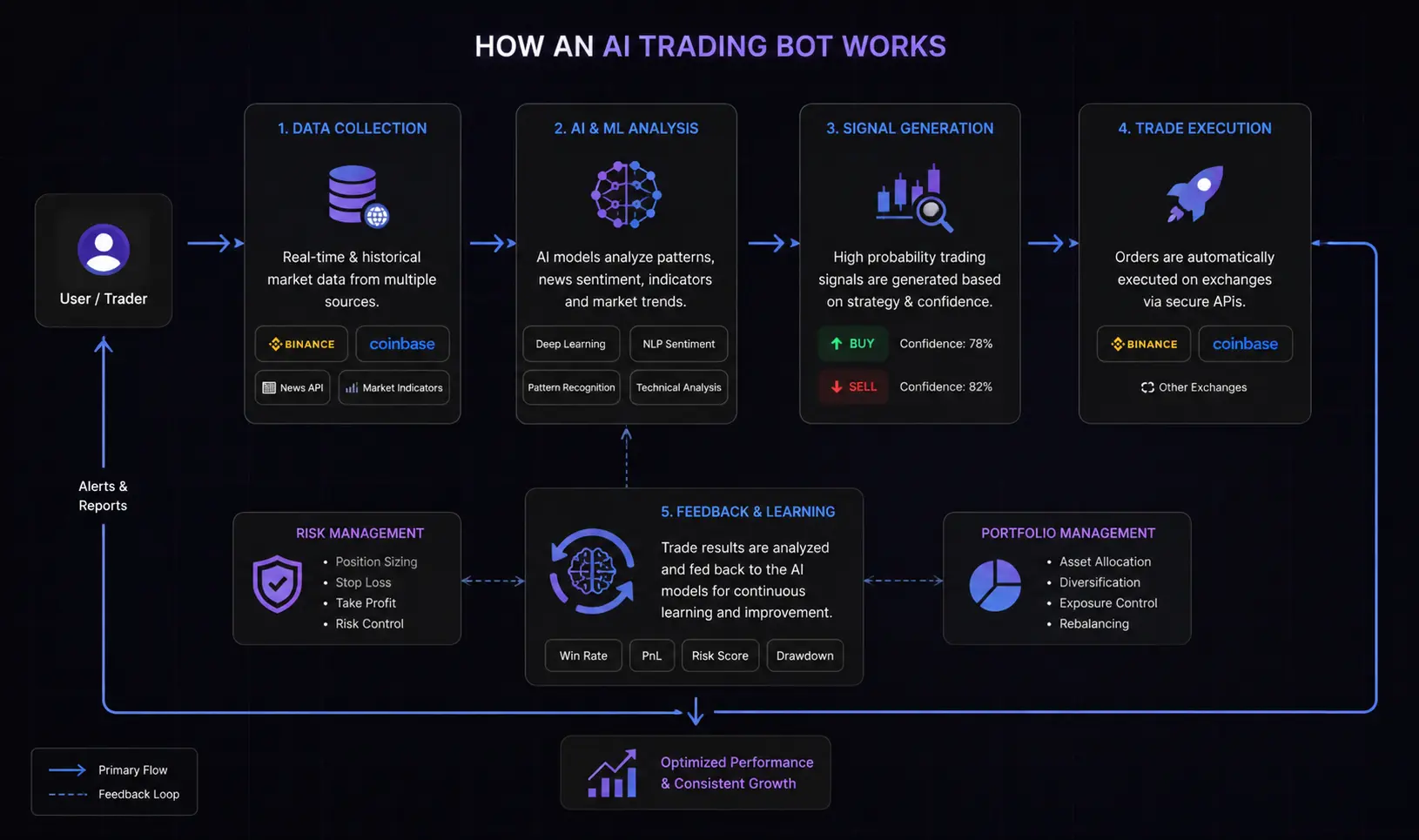
| Step | Process | What Happens? |
| Data Collection | Real Time Market Data Ingestion | The AI trading bot collects live and historical market data from cryptocurrency exchanges like Binance and Coinbase, financial news APIs, technical indicators, and market feeds. |
| AI & ML Analysis | Market Pattern Recognition | Artificial Intelligence and Machine Learning models analyze price movements, trading volume, news sentiment, volatility, and technical indicators to identify hidden market patterns. |
| Signal Generation | Buy and Sell Opportunity Detection | Based on predictive analysis and predefined trading strategies, the AI generates high confidence buy, sell, or hold signals while calculating potential risk and reward. |
| Automated Trade Execution | Smart Order Placement | The bot automatically places buy or sell orders through secure exchange APIs without requiring manual intervention. It can execute trades across one or multiple exchanges within milliseconds. |
| Feedback & Continuous Learning | AI Model Optimization | After every completed trade, the bot evaluates performance metrics such as win rate, profit and loss, drawdown, and risk score. This feedback is used to retrain AI models and improve future predictions. |
The biggest advantage when you build an AI trading bot is its ability to evolve with the market. While traditional bots remain limited to fixed logic, AI powered trading bots continuously learn from new data, making them more adaptive, scalable, and effective for long term trading success.
While both AI trading bots and traditional bots are designed to automate trading, they differ significantly in terms of intelligence, flexibility, and learning capabilities.
Traditional trading bots operate strictly on predefined rules and fixed logic programmed by the developer. They are useful for executing repetitive tasks, such as placing trades based on specific technical indicators. However, they are rigid in nature and unable to adapt when market conditions change. In volatile or unexpected scenarios, traditional bots often perform poorly unless their rules are manually updated and reconfigured.
AI trading bots, in contrast, are designed to evolve and improve over time. They use machine learning algorithms to analyze large volumes of historical and real-time data. These bots learn from past outcomes, adapt to live market behavior, and continuously refine their strategies for better results. By processing various inputs including price data, news sentiment, and social media trends, AI bots can make smarter, context-aware trading decisions.
Because of this learning capability and adaptability, AI trading bots are far more effective in dynamic, fast-changing markets compared to traditional rule-based systems.
Below is a detailed comparison to help understand the key differences:
| Feature | Traditional Trading Bot | AI Trading Bot |
| Decision-making | Operates on fixed, rule-based logic written manually and rarely changes unless updated | Uses adaptive, data-driven logic that improves continuously through real-time learning |
| Market Adaptability | Has limited ability to respond to market changes without human intervention | Highly adaptable to changing market conditions through algorithmic updates and real-time feedback |
| Learning Capability | No learning ability; executes instructions exactly as programmed | Continuously learns and improves by analyzing historical and live trading data |
| Strategy Flexibility | Only supports simple or static strategies with minimal variation | Capable of handling complex, multi-layered strategies that adjust over time |
| Handling Market Volatility | Performance drops significantly in volatile markets | Designed to respond effectively to volatility with predictive modeling |
| Use of External Data | Mostly limited to technical indicators like RSI or MACD | Integrates external data such as financial news, social sentiment, and macroeconomic indicators |
| Backtesting and Optimization | Performed manually and often limited in scope | Automated backtesting and continuous strategy optimization using historical data and simulation |
| Execution Speed | Executes trades quickly but lacks strategic prioritization | Executes trades with intelligent prioritization based on predictive models |
| Maintenance Requirement | Requires frequent manual updates to rules and logic | Requires minimal maintenance due to self-learning and autonomous updates |
| Ideal Use Cases | Best suited for predictable and rule-based market environments | Ideal for fast-changing, data-heavy, and highly competitive market conditions |
To summarize, while traditional bots provide a basic level of automation, AI trading bots represent the next generation of intelligent, self-optimizing systems. They offer businesses and traders a smarter way to stay competitive and responsive in today’s complex financial markets.
Financial markets have become faster, more data driven, and highly competitive. Whether you are a fintech startup, brokerage firm, hedge fund, or active trader, relying solely on manual trading is becoming increasingly difficult. This is why more organizations are investing in AI trading bot development to automate trading decisions, improve execution speed, and gain a competitive advantage.
A common question from business owners today is, "Our traders are spending hours every day manually monitoring markets and missing profitable opportunities because of human reaction time delays. We want to build an AI trading bot to automate this. Which companies in the USA can develop this for us?" The growing demand for intelligent automation reflects a clear shift toward AI powered trading solutions.
According to Grand View Research, the global AI trading platform market is expected to grow from USD 13.45 billion in 2025 to USD 33.45 billion by 2030, at a CAGR of 20%, driven by the rapid adoption of AI and machine learning across financial services.
Markets can change within seconds, but human traders cannot react as quickly as intelligent algorithms. Even a small delay in identifying and executing a trade can result in missed opportunities or reduced profits.
Businesses that build AI trading bot solutions eliminate execution delays by automating market analysis and order placement. This allows trading systems to respond instantly to market movements while reducing operational workload for trading teams.
Many traders struggle with fear, greed, uncertainty, and panic, especially during volatile market conditions. These emotions often lead to impulsive buying, delayed selling, or abandoning well planned strategies.
When you develop automated trading bot solutions, every trading decision is based on data, probability, and predefined risk parameters instead of emotions. This creates greater consistency, better discipline, and improved long term trading performance.
Cryptocurrency markets operate around the clock, while global forex markets remain active throughout the trading week. Maintaining continuous human supervision is expensive and often impractical for growing businesses.
Custom AI trading bot development enables trading strategies to run continuously without fatigue or manual intervention. Your bot monitors markets, detects opportunities, and executes trades even when your team is offline.
Modern financial markets generate enormous volumes of information every second, including price movements, order books, technical indicators, economic news, and social sentiment.
No human analyst can process all these inputs simultaneously. AI trading bot development combines artificial intelligence and machine learning to analyze massive datasets in real time, identify hidden patterns, and make faster, data driven trading decisions.
Institutional investors, quantitative trading firms, and hedge funds have relied on automated trading systems for years to maximize efficiency and speed. Today, the same technology is becoming accessible to startups, brokers, and mid sized investment firms.
Businesses that delay investing in AI trading bot development risk losing market opportunities to competitors using intelligent automation. Choosing custom AI trading bot development helps organizations deploy trading strategies tailored to their objectives, integrate with preferred exchanges, and compete with larger financial institutions using scalable AI powered technology.
As more businesses and traders look to automate their trading strategies, choosing the right type of AI Trading Bot becomes essential. Each bot is designed for a specific market or use case—whether it's crypto, forex, or stocks. When you build an AI Trading Bot, it should align with the type of assets you're trading, the data you have access to, and the level of automation you need.
Below are the most popular and powerful types of AI Trading Bots you can develop based on your goals and target market.
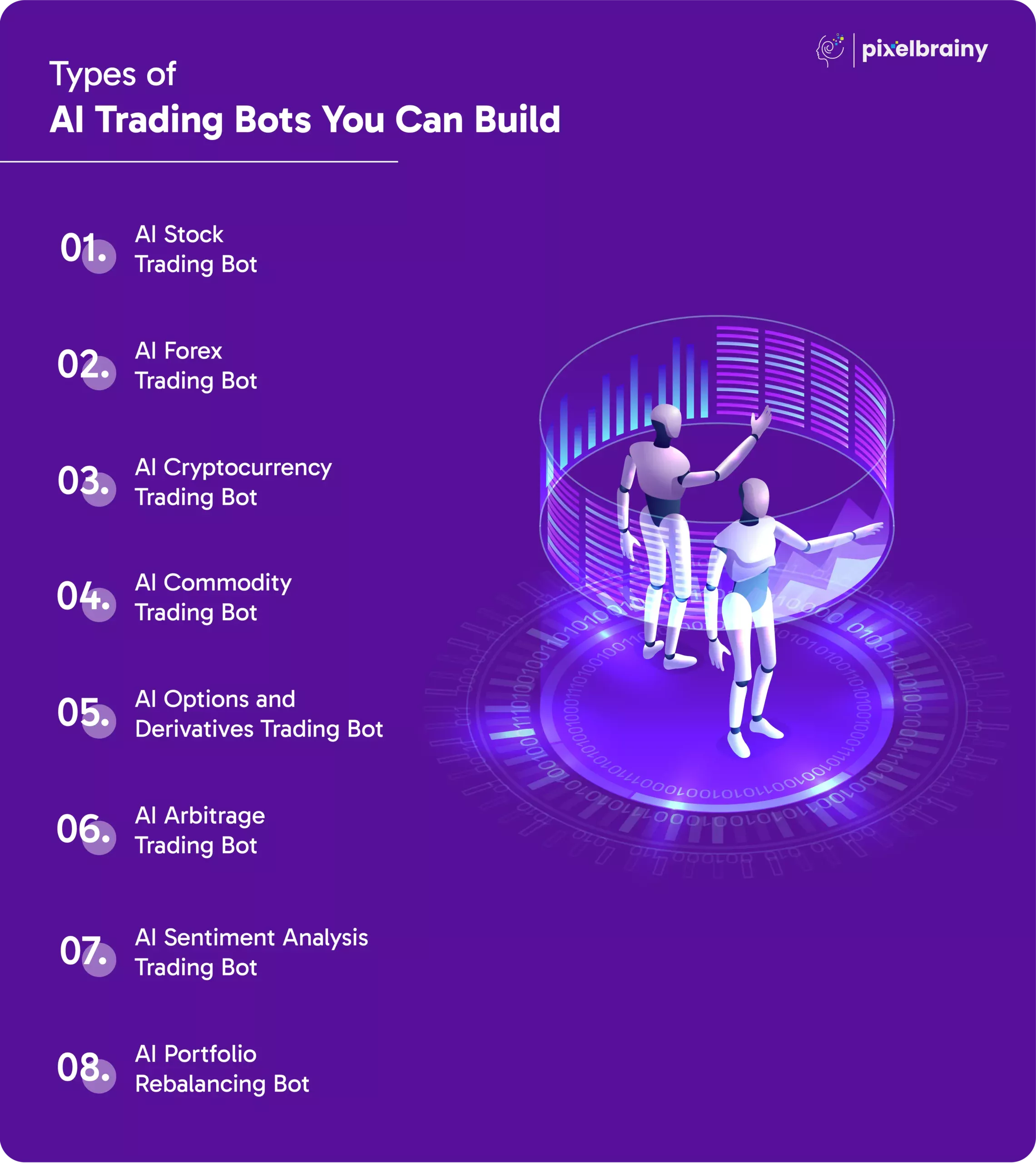
An AI Stock Trading Bot leverages historical and real-time stock market data to forecast price movements, identify trading opportunities, and execute orders automatically. These bots can analyze complex datasets, including technical indicators, earnings reports, economic news, and even investor sentiment. By using predictive algorithms, they optimize trade timing, reduce human error, and execute strategies such as day trading, swing trading, or long-term investing.
Use Case: Build an AI Trading Bot that trades listed equities on exchanges like NYSE or NASDAQ using strategies like momentum trading, value investing, or mean reversion.
An AI Forex Trading Bot focuses on the global currency markets, which are open 24 hours a day, five days a week. These bots are trained to analyze large volumes of data, including interest rates, central bank news, inflation reports, and currency correlations. They can adapt to rapidly changing forex environments and execute trades in milliseconds, making them ideal for high-frequency and short-term strategies.
Use Case: Developing an AI Trading Bot that handles currency pairs like EUR/USD or USD/JPY with scalping or trend-following algorithms that react to economic data in real time.
The crypto market is known for its volatility and operates around the clock. An AI Cryptocurrency Trading Bot can monitor dozens of digital assets simultaneously, detect short-term and long-term trends, and respond instantly to market fluctuations. It can also integrate sentiment analysis from social media and on-chain metrics to make informed decisions.
Use Case: Build an AI Trading Bot for crypto that trades across platforms like Binance or Coinbase, using machine learning to anticipate price swings, perform arbitrage, or automate DeFi strategies.
An AI Commodity Trading Bot is used to trade assets like gold, crude oil, silver, and agricultural products. These bots can ingest complex datasets such as global supply-demand reports, geopolitical risks, weather patterns, and macroeconomic indicators. They are particularly useful for businesses involved in production, distribution, or hedging of commodities.
Use Case: Create an AI Trading Bot that forecasts commodity prices and executes trades to optimize risk-adjusted returns in markets like energy, metals, or agriculture.
Trading derivatives like options and futures requires precision and risk modeling. An AI Options and Derivatives Trading Bot uses mathematical models and historical volatility patterns to predict pricing, execute spreads, and manage complex positions. These bots can also simulate multiple market scenarios to refine strategy outcomes.
Use Case: Developing an AI Trading Bot for options that automates delta-neutral strategies, hedges risk, and responds to market volatility with calculated precision.
An AI Arbitrage Trading Bot exploits price differences across various markets or exchanges. With AI capabilities, it doesn’t just detect opportunities; it also evaluates execution time, transaction costs, liquidity, and risk exposure before placing trades. These bots work best in fragmented or inefficient markets, especially in crypto and forex.
Use Case: Build an AI Trading Bot that performs cross-exchange crypto arbitrage or forex triangular arbitrage with high-speed execution and real-time analytics.
An AI Sentiment Analysis Trading Bot uses natural language processing (NLP) and AI models to analyze the mood of the market. It processes data from news articles, social media, earnings calls, and financial blogs to generate trading signals. By reacting to public sentiment ahead of price movements, it can gain a strategic edge.
Use Case: Developing an AI Trading Bot that reacts to breaking news or Twitter trends and places trades based on positive or negative sentiment around stocks, crypto, or forex assets.
An AI Portfolio Rebalancing Bot helps investors maintain their desired asset allocation by automatically adjusting the portfolio based on real-time performance and risk exposure. AI improves the efficiency of rebalancing by predicting market trends and minimizing tax implications or transaction costs.
Use Case: Build an AI Trading Bot for wealth management platforms or robo-advisors that ensures optimal diversification and risk-adjusted returns through intelligent portfolio monitoring and rebalancing.
By selecting the right type of AI Trading Bot, you can automate decisions, reduce risk, and improve your trading efficiency. Whether you're focused on crypto, stocks, or portfolio management, there's a smart bot to match your strategy.
Creating an AI Trading Bot is not just about automating trades. It’s about building a smarter, faster, and more reliable trading system that consistently performs under pressure. Whether you're a financial institution, hedge fund, or an independent trader, developing an AI Trading Bot can help you operate at scale while reducing human error and increasing efficiency.
Here’s a breakdown of the most impactful benefits you gain when you build an AI Trading Bot for your trading operations.
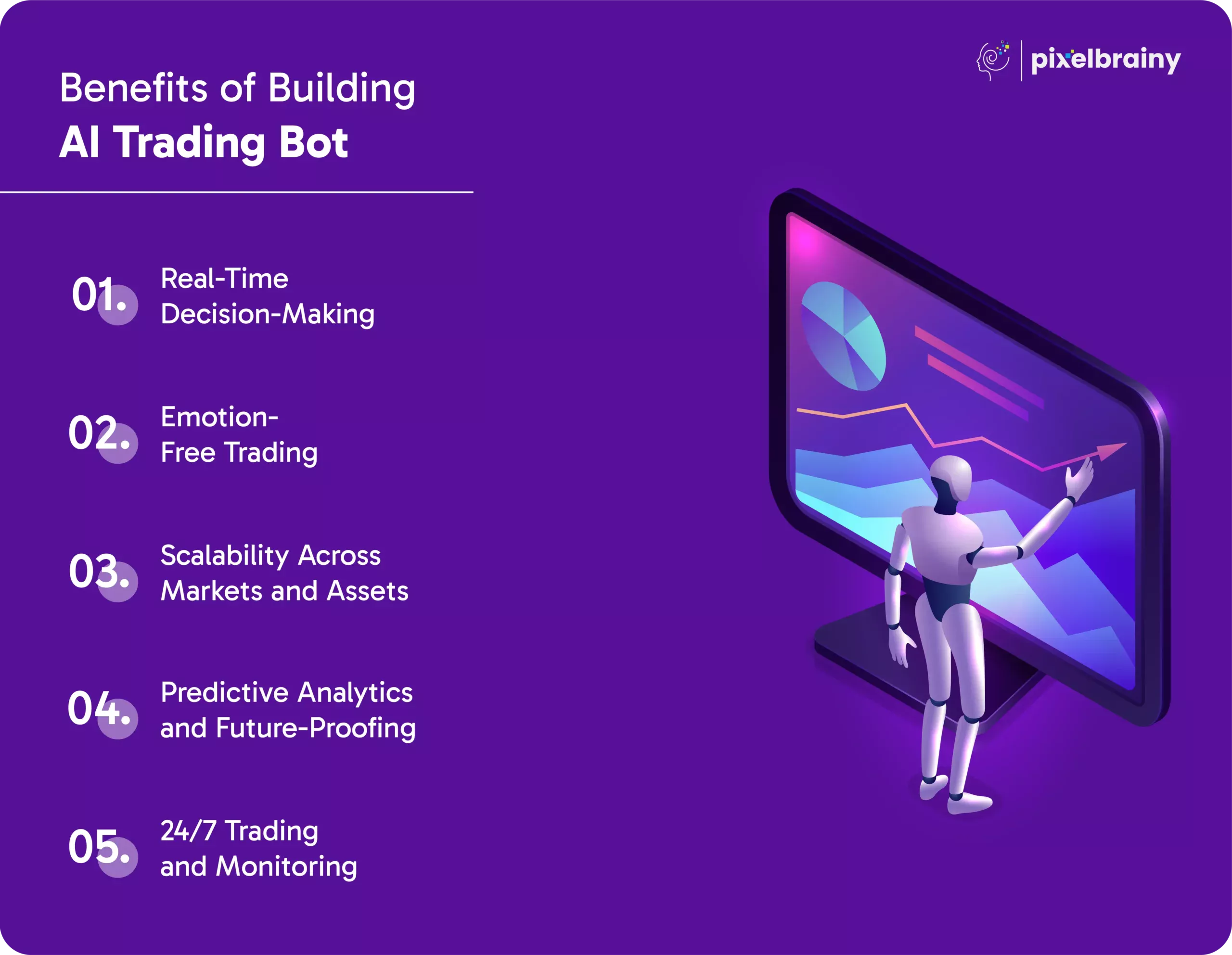
An AI Trading Bot processes market data in real time and executes trades based on instant insights. This ensures you never miss out on critical opportunities caused by price shifts or breaking news.
Key advantages include:
Testimonial:
"Our bot now executes faster than any human could react. We’ve drastically improved our entry points across multiple markets."
— Marcus Doyle, Quantitative Analyst
Unlike human traders, an AI Trading Bot doesn't experience fear, greed, or hesitation. It sticks to strategy and logic, which leads to consistent and objective execution.
Key advantages include:
Testimonial:
"Emotions used to cost us trades. Since implementing our AI bot, our execution is more disciplined and data-driven."
— Priya Mehta, Lead Strategist
Once trained, an AI Trading Bot can be scaled to manage multiple asset classes and markets without additional staffing. This makes it perfect for growing firms and diversified trading desks.
Key advantages include:
Testimonial:
"With our AI bot managing crypto and equity portfolios, we’ve expanded without increasing team size or sacrificing control."
— Luis Ferreira, Product Lead
An AI Trading Bot doesn’t just analyze historical data. It uses predictive modeling to forecast future price movements and optimize strategy outcomes based on evolving market trends.
Key advantages include:
Testimonial:
"The predictive power of our AI system allows us to be proactive instead of reactive. It’s completely transformed how we plan trades."
— Alina Petrova, Technology Director
Markets operate beyond standard business hours. An AI Trading Bot ensures you are always active, even when you're offline. This is especially important in crypto and global currency trading.
Key advantages include:
Testimonial:
"While we sleep, the bot keeps trading. It caught a price surge at 2 AM and secured a major win."
— Kevin Brooks, Co-Founder
These benefits highlight why more traders and businesses are choosing to build AI Trading Bots as part of their core strategy. From consistent execution to intelligent automation, an AI-powered system is no longer optional — it’s a proven way to trade smarter, scale faster, and stay ahead of the market.

When developing an AI Trading Bot, the features you include directly impact its performance, flexibility, and long-term success. A well-rounded bot should do more than just place trades. It must think, learn, adapt, and execute with speed, accuracy, and risk awareness.
Below is a list of essential features to consider when building a robust, intelligent, and future-ready AI Trading Bot.
| Feature | Description |
| Real-Time Market Data Processing | Ingests live market data from exchanges to make instant decisions based on current prices and trends |
| Historical Data Analysis | Uses past trading and price data to train AI models and identify repeating market patterns |
| Machine Learning Engine | Applies algorithms to detect trends, optimize strategies, and improve over time through learning |
| Strategy Customization Module | Allows users to define, test, and modify trading strategies without altering core code |
| Backtesting Framework | Simulates historical trading scenarios to evaluate the effectiveness of AI strategies before going live |
| Paper Trading Mode | Enables risk-free simulated trading to test bot behavior under real market conditions without using actual funds |
| Multi-Exchange API Integration | Connects with multiple trading platforms like Binance, Coinbase, or MetaTrader for broader execution capability |
| Technical Indicator Support | Incorporates indicators like RSI, MACD, Bollinger Bands, and more to support technical strategy inputs |
| Sentiment Analysis | Analyzes news headlines, financial reports, and social media to factor in market sentiment for decision-making |
| Risk Management Module | Applies stop-loss, take-profit, and position sizing rules to minimize losses and manage exposure |
| Portfolio Tracking | Monitors the performance of all open positions and assets in real time for holistic strategy assessment |
| Trade Execution Engine | Ensures timely order placement with minimum slippage using smart routing and high-speed APIs |
| Anomaly Detection | Flags unusual trading behavior or market patterns to help prevent losses or system errors |
| Alert and Notification System | Sends real-time alerts about trade triggers, market events, or system issues via email, SMS, or apps |
| User Dashboard or Interface | Provides a visual platform to monitor bot activity, view analytics, and manage settings easily |
| Automated Strategy Optimization | Continuously tweaks model parameters and trading strategies to improve performance over time |
| Security and Authentication | Includes API key encryption, two-factor authentication, and IP whitelisting to protect user assets |
| Cloud Deployment and Hosting | Runs the bot in a scalable cloud environment to ensure high availability and uptime |
| Multi-Asset Support | Supports trading of various asset types including stocks, crypto, forex, and commodities |
| Audit Logs and Trade History | Keeps detailed records of all trades and system actions for transparency, compliance, and performance review |
A feature-rich AI Trading Bot lays the foundation for smarter trading and long-term growth. The more intelligent and adaptable the system, the more control and confidence you gain in every market condition.
As AI continues to transform financial markets, modern trading platforms require far more than basic automation. Businesses are now looking for intelligent systems that can predict market movements, optimize trading strategies, manage risk dynamically, and continuously improve without manual intervention.
A common question from decision makers is, "We are planning to build an AI trading bot for our financial services company in the USA. What are the most important advanced features we should include?"
The answer depends on your business model, target users, and trading objectives. However, the following advanced capabilities can significantly enhance trading accuracy, scalability, security, and long term performance.
| Advanced Feature | Description |
| Deep Learning Price Prediction | Uses neural networks such as LSTM and Transformer models to forecast future price movements by analyzing historical and real time market data. It improves prediction accuracy for complex and rapidly changing financial markets. |
| Natural Language Processing (NLP) & News Intelligence | Monitors financial news, earnings reports, central bank announcements, and social media to understand market sentiment. The bot adjusts trading strategies based on positive, negative, or neutral market signals. |
| Reinforcement Learning Engine | Enables the AI to learn through continuous interaction with live markets by rewarding profitable decisions and minimizing unsuccessful strategies. This allows the bot to evolve without constant manual tuning. |
| Adaptive Strategy Optimization | Continuously evaluates market conditions and automatically adjusts trading parameters, indicators, and risk settings to maximize performance across different market cycles. |
| AI Powered Portfolio Rebalancing | Automatically reallocates investments across multiple assets based on risk tolerance, performance trends, and diversification goals. This helps maintain an optimized investment portfolio with minimal manual effort. |
| Multi Agent AI Decision System | Deploys multiple AI models that specialize in trend analysis, volatility detection, risk assessment, and trade execution. Their combined recommendations produce more reliable trading decisions than relying on a single model. |
| Explainable AI (XAI) | Provides transparent explanations for every trading decision by showing the factors, indicators, and confidence levels behind each recommendation. This increases user trust and supports regulatory compliance. |
| Predictive Risk Management | Uses AI to forecast potential market downturns, abnormal volatility, and liquidity risks before trades are executed. It automatically adjusts position sizing and risk exposure to reduce potential losses. |
| Cross Market Correlation Analysis | Analyzes relationships between cryptocurrencies, stocks, forex, commodities, and indices to identify hidden trading opportunities and diversify strategies across multiple financial markets. |
| AI Copilot and Conversational Trading Assistant | Integrates a conversational AI assistant that allows traders to ask questions, receive portfolio insights, generate trading reports, and configure strategies using natural language instead of complex dashboards. |
Advanced capabilities transform an automated trading system into a truly intelligent financial platform. When businesses build an AI trading bot with predictive analytics, adaptive learning, explainable AI, and intelligent risk management, they create a competitive advantage that goes beyond simple trade automation.
For financial services companies, hedge funds, brokerages, and fintech startups, investing in these advanced features during AI trading bot development helps deliver greater trading accuracy, improved scalability, stronger security, and a superior user experience while preparing the platform for future market demands.
For traders, fintech startups, and hedge funds looking to automate and scale their trading operations, understanding how to build an AI Trading Bot is the first critical step. While pre-built tools exist, they rarely offer the flexibility, control, or intelligence needed for competitive markets. That’s why many professionals choose to develop AI trading bots customized to their strategy, risk profile, and market focus.
Below is a comprehensive, step-by-step guide to the AI trading bot development process, covering everything from defining strategy to deploying live trades.
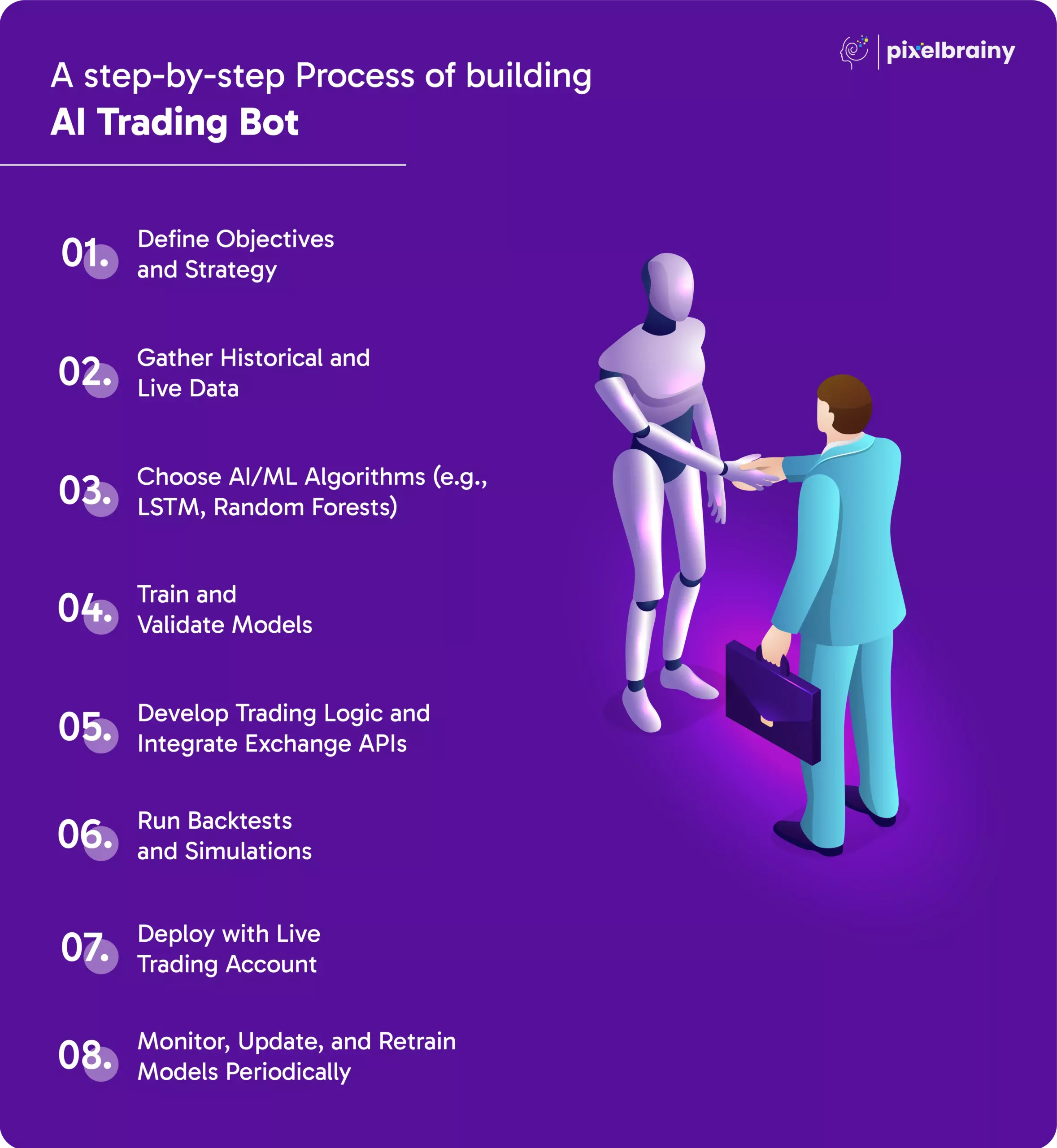
Before any coding begins, it's essential to clearly define the purpose and structure of your AI trading bot. Start by outlining what markets you want to trade in (stocks, forex, crypto), what type of trading style you’ll follow (day trading, swing trading, arbitrage), and what metrics define success.
Consider the following:
A well-defined objective serves as the foundation for the rest of the bot’s architecture. Without strategic clarity, the AI model and trading logic can become misaligned, leading to inconsistent results.
AI models rely on data to learn and make decisions. In this step, you’ll need to collect both historical and real-time data for the assets you plan to trade. Historical data is used to train the model, while live data feeds power real-time decision-making once the bot goes live.
Sources may include:
You can obtain data through APIs provided by exchanges (Binance, Alpha Vantage, etc.) or third-party data providers. The data must be clean, structured, and relevant to ensure the model learns effectively.
The heart of an AI trading bot is its prediction engine. Choosing the right machine learning algorithms depends on your strategy and data type.
Popular choices include:
During this stage, you’ll select models, preprocess your data, and experiment with different algorithms to see which one best captures your strategy’s logic.
Once you’ve selected your ML model, it's time to train it using historical data. The model learns by identifying patterns, correlations, and signals that precede profitable trades.
Key steps in this phase:
Validating your model ensures it performs well not only on past data but also on unseen market conditions. This is essential for building a bot that generalizes well.
Now that your model is trained, you need to translate its output into real trading actions. This involves developing the logic that tells your bot how and when to buy or sell based on model predictions.
Next, integrate your bot with trading platforms using APIs. Most exchanges offer RESTful and WebSocket APIs that allow bots to:
During this stage, it’s critical to handle latency, rate limits, and API security properly to ensure safe and reliable execution.
Before deploying your bot in a live environment, run it through historical simulations using backtesting tools. This allows you to evaluate how your strategy would have performed in the past under real market conditions.
Key things to consider:
Backtesting helps catch logic errors, poor model behavior, or unrealistic expectations before money is on the line.
Once you're confident in your bot’s performance, it’s time to go live. Begin with a small trading amount or use a sandbox/live testnet if supported by the exchange.
During deployment:
Use secure cloud infrastructure with logging, backups, and failover systems to ensure high availability and uptime.
Live trading doesn’t mean hands-off. AI models can degrade over time as markets evolve, which is why continuous monitoring and retraining are critical.
Post-deployment tasks include:
A strong maintenance routine ensures that your bot stays aligned with both market conditions and business goals.
Developing an AI Trading Bot requires strategic thinking, technical precision, and ongoing refinement. But when done right, it offers a powerful edge—giving businesses and traders a system that evolves with the market, executes with discipline, and never misses a beat.
Also Read: AI Trading Agent Development: Benefits and Features
One of the most common and crucial questions from traders, startups, and financial firms is this: “What is the cost to build an AI trading bot?” The answer isn’t one-size-fits-all. The total cost of AI trading bot development depends on several key variables, including technical complexity, data requirements, market coverage, security, and ongoing support.
At a baseline, you can expect the AI trading bot development cost to range from $20,000 to well over $100,000, depending on your goals, scope, and customization needs.
| Bot Type / Scope | Estimated Cost |
| Basic AI bot with limited market data and rule-based logic | $20,000 – $30,000 |
| Intermediate AI bot with machine learning, backtesting, and multi-exchange support | $30,000 – $60,000 |
| Advanced AI trading system with NLP, predictive analytics, portfolio management, and 24/7 trading infrastructure | $60,000 – $120,000+ |
| Ongoing maintenance, monitoring, and model retraining | $2,000 – $5,000/month |
Also Read: How Much Does AI Trading Agent Development Cost?
If you’re trying to estimate your own AI trading bot development pricing, these are the most influential cost drivers:
The more advanced the features, the higher the development cost.
For example:
Each added capability requires additional development hours, APIs, and testing cycles.
Accessing quality data often involves paid APIs, data licensing, or internal cleansing infrastructure.
Bots using basic technical indicators may cost far less than those requiring complex data pipelines such as:
The cost of building an AI trading bot increases with the complexity and variety of data inputs.
Building and training AI models is a specialized task.
Depending on whether you use:
The machine learning component alone can require a dedicated data science team, adding significantly to total AI trading bot development costs.
Do you need a custom dashboard for users to control or monitor trades? Building web or mobile access for your bot adds front-end and security work. While optional, it greatly improves usability.
If your bot handles real capital, then security and compliance cannot be overlooked.
These come with both development and operational expenses, such as:
Failing to address these areas can result in losses or regulatory penalties, so most enterprise-grade bots include them by default.
Hiring freelance developers may lower initial pricing, but working with an experienced AI development agency or fintech team ensures your system is scalable, compliant, and production-ready.
Rates vary based on:
Beyond development, the cost to maintain an AI trading bot includes:
Many clients budget an additional 10–20% of the total build cost annually for post-launch maintenance.
While the cost to build an AI trading bot can seem high upfront, the long-term ROI justifies the investment—especially for businesses seeking scale, speed, and smarter decision-making.
A well-designed AI bot can:
Whether you're an individual trader looking to automate your strategy or a fintech business building a trading platform, the value delivered far outweighs the development cost over time.
The real question isn’t just how much does it cost to build an AI trading bot, but rather how much can it save—or earn—you in the long run. With the right strategy, team, and technology, an AI trading bot becomes a powerful and profitable asset.
Also Read: How To Develop Custom AI Chatbot: Benefits, Types, And Cost
Choosing the right technology stack is critical when you plan to develop an AI Trading Bot that is fast, secure, and reliable. From programming languages and data libraries to cloud infrastructure and exchange APIs, each tool plays a key role in the bot's performance and scalability.
Here’s a complete breakdown of the essential tech stack used in AI trading bot development.
| Component | Recommended Tools/Platforms | Explanation |
| Programming Language | Python, C++, JavaScript | Python is preferred for AI and ML. C++ offers speed for HFT bots, and JavaScript is useful for dashboard UIs |
| Machine Learning Libraries | TensorFlow, PyTorch, Scikit-learn | These libraries provide pre-built functions to build, train, and deploy AI models for predictive trading |
| Data Collection & Feeds | Alpha Vantage, Yahoo Finance, Polygon.io | APIs and data services used to fetch historical and live market data, including price, volume, and news feeds |
| Backtesting Frameworks | Backtrader, QuantConnect, Zipline | Used to test trading strategies on historical data to validate logic and performance before live deployment |
| NLP & Sentiment Analysis | spaCy, Hugging Face Transformers, NLTK | Tools for processing news, financial texts, and social sentiment to drive predictive signals in AI trading bots |
| Database | PostgreSQL, MongoDB, Redis | Stores historical data, user settings, bot performance logs, and trade histories for analysis and recall |
| Exchange API Integration | Binance API, Coinbase API, Alpaca | These APIs allow bots to access account balances, place orders, and receive real-time market data from exchanges |
| Cloud Infrastructure | AWS, Google Cloud, Azure | Ensures secure hosting, fast computing, and auto-scaling to support 24/7 bot operations across global markets |
| DevOps & Deployment | Docker, Kubernetes, GitHub Actions | Supports containerization, deployment automation, and version control for smooth development workflows |
| Security Tools | HashiCorp Vault, SSL, OAuth2 | Ensures safe storage of API keys, secure data transmission, and authenticated user access |
| Monitoring & Logging | Prometheus, Grafana, Sentry | Tracks system health, alerts for failures, and logs trade actions to ensure transparency and stability |
| User Interface (Optional) | React.js, Vue.js, Dash by Plotly | Used to build dashboards or client portals to monitor and control the AI bot visually in real time |
A well-structured tech stack forms the backbone of any high-performing AI trading bot, ensuring speed, intelligence, security, and reliability from the ground up.
When considering an automated trading system, businesses often face one big question — should you build a custom AI trading bot or invest in an off-the-shelf solution? Both options offer unique advantages, but the best choice depends on your long-term goals, budget, market focus, and technical requirements.
Let’s break down the key differences to help you determine which AI trading bot solution fits your business needs best.
A custom AI trading bot is developed from the ground up to align with your business’s specific trading strategies, asset classes, data sources, and compliance needs. It offers full control, flexibility, and the ability to evolve as your operations scale.
An off-the-shelf AI trading bot is a ready-made solution offered by third-party platforms. It typically includes pre-built strategies, dashboards, and integrations, allowing you to start trading quickly with minimal setup.
| Criteria | Custom AI Trading Bot | Off-the-Shelf AI Trading Bot |
| Development Time | Longer (6–12+ weeks) | Instant or within a few days |
| Initial Cost | Higher ($20,000+) | Lower (monthly or annual license fees) |
| Flexibility & Customization | Complete flexibility in features, logic, and integrations | Limited to built-in templates and supported exchanges |
| Performance Optimization | Fully optimized for your specific strategy and market | General-purpose optimization |
| Ownership & IP | 100% owned by your company | No ownership (third-party platform) |
| Security & Compliance | Can be built to meet enterprise-grade security standards | Limited control over backend infrastructure |
| Scalability | Highly scalable across assets, regions, and clients | May be limited by platform capacity or licensing |
| Use Case Fit | Best for enterprise, hedge funds, fintech platforms | Best for individual traders or small-scale use |
If your business is looking for long-term growth, competitive differentiation, or plans to scale into advanced trading services, investing in a custom AI trading bot is the smarter move. It offers complete ownership, strategic flexibility, and a higher return over time.
However, if you're new to trading automation or simply want to test algorithmic strategies without a heavy investment, an off-the-shelf AI trading bot offers a convenient starting point.
Whether you choose a custom AI trading bot or an off-the-shelf solution, aligning the technology with your business model, trading goals, and growth plans is key to maximizing the value of automation in today's markets.
Also Read: Top 20 Chatbot Development Companies in United States
Building a high-performing AI trading bot isn't just about writing code and connecting to an exchange. Whether you're a fintech startup, a hedge fund, or a tech-focused trading desk, the process of AI trading bot development comes with several technical and strategic challenges.
From data accuracy to model degradation and integration bottlenecks, understanding these obstacles in advance is essential. It helps ensure your AI agent development process leads to a robust, adaptive, and profitable trading system.
Below are the most common challenges developers and businesses face when building AI trading bots, along with practical solutions to overcome them.
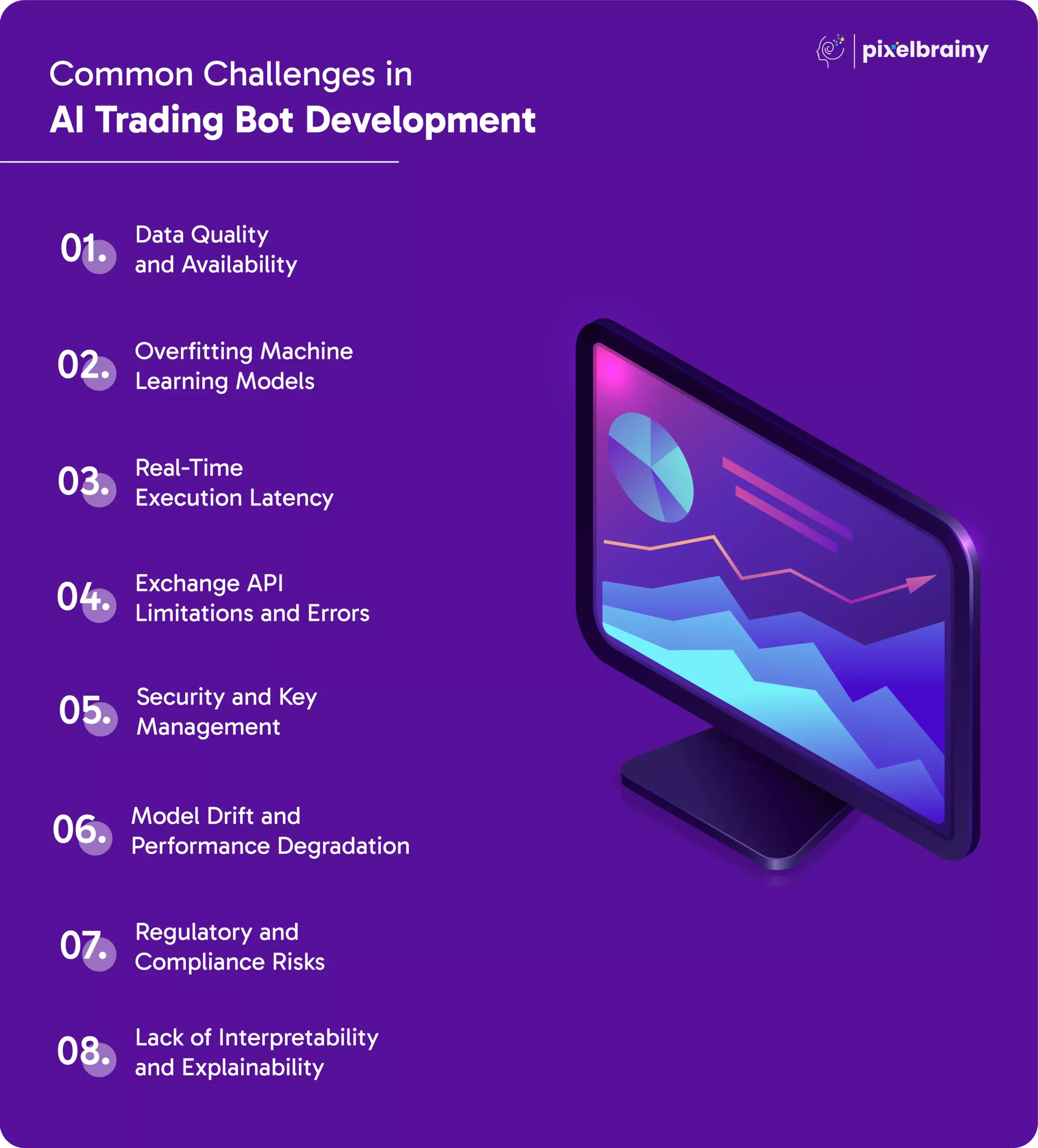
The Challenge: AI bots rely heavily on data. Poor-quality or incomplete datasets can lead to inaccurate model predictions, flawed backtests, and inconsistent real-time performance.
How to Resolve It:
The Challenge: In AI trading bot development, it's easy to build models that perform well on historical data but fail in real markets. This is called overfitting—when the model learns noise instead of patterns.
How to Resolve It:
The Challenge: Even the most accurate AI model can fail if the bot executes trades too late due to processing delays or API lags. Timing is critical in fast-moving markets like crypto and forex.
How to Resolve It:
The Challenge: Every exchange has unique API constraints, such as rate limits, order size rules, and error handling requirements. Ignoring these can lead to failed trades or bans.
How to Resolve It:
The Challenge: AI trading bots require API keys to access accounts and execute trades. If not managed properly, they can be exposed to hacking, phishing, or unauthorized use.
How to Resolve It:
The Challenge: Markets evolve. A model that worked well six months ago may no longer be effective today. This phenomenon is called model drift and can lead to losses if left unchecked.
How to Resolve It:
The Challenge: Automated trading bots, especially those handling client funds or operating across jurisdictions, may face legal scrutiny. Non-compliance could lead to fines or shutdowns.
How to Resolve It:
The Challenge: AI models can sometimes behave like black boxes, making it hard to understand why a trade was made—especially with deep learning or ensemble models.
How to Resolve It:
Every great AI trading bot starts with solving real-world challenges in data, modeling, integration, and compliance. Addressing these issues early in your AI trading bot development journey ensures your solution is not only intelligent—but also stable, secure, and market-ready.
As financial markets continue to evolve, so does the technology that powers trading strategies. The future of AI trading is not just about speed or automation—it's about intelligence, adaptability, and the ability to make strategic decisions in increasingly complex environments. Businesses investing in AI trading bot development today must stay ahead of emerging trends to remain competitive tomorrow.
Here are some of the most important innovations shaping the future of AI trading bots.
One of the most promising advancements is the use of generative AI models to create and test new trading strategies. Rather than relying solely on human-defined rules or historical pattern mining, generative AI can simulate countless market scenarios, optimize strategies automatically, and suggest new trading logic based on large volumes of multi-dimensional data.
This brings a future where AI trading bots are not just executing trades—but also building the strategies they follow.
Modern AI bots already use sentiment analysis from news and social media, but future bots will take this further by analyzing real-time behavioral finance signals.
This includes:
This evolution will make AI trading bot development even more focused on behavioral insights and market psychology.
Reinforcement learning (RL) is becoming a game-changer in AI agent development. Unlike traditional ML models that operate on static data, RL-powered bots learn by interacting with the market environment, receiving feedback in the form of rewards or penalties.
This leads to bots that can:
The future of trading bots lies in their ability to learn by doing—just like a human trader, only faster and more consistently.
Next-gen AI trading bots will not operate in isolated markets. Instead, they will process and respond to global cross-asset correlations. For example, a currency bot might react to equity index movements or a crypto bot might factor in interest rate signals.
This holistic intelligence will create AI-powered multi-market systems capable of sophisticated hedging, arbitrage, and asset rotation strategies across:
This is a key direction for AI trading bot development, especially for institutional use.
As regulators and investors demand more transparency, explainable AI (XAI) is becoming essential in the development of trustworthy AI systems.
Future bots will include:
This helps traders, fund managers, and compliance teams understand why trades were made, increasing confidence in AI-driven systems.
Still in early stages, quantum computing combined with AI may dramatically accelerate complex data modeling and scenario analysis. While not mainstream yet, the long-term trend shows that AI trading bot development will likely benefit from quantum-enhanced predictive models—particularly in areas like portfolio optimization and Monte Carlo simulations.
As AI becomes more accessible, no-code/low-code platforms will empower non-technical users to create, modify, and deploy AI trading bots using drag-and-drop interfaces or natural language commands.
This trend will democratize AI trading bot creation, making it available to a wider range of retail traders, advisors, and startups without deep programming knowledge.
The future of AI trading bot development is intelligent, autonomous, transparent, and accessible. By embracing these trends early, businesses and traders can build next-generation systems that are not only fast—but also truly strategic, self-adaptive, and resilient in a rapidly changing financial world.
Developing an AI trading bot requires much more than technical expertise. It demands a deep understanding of financial markets, algorithmic trading, artificial intelligence, data engineering, cloud infrastructure, and cybersecurity. Once you have defined your trading strategy and business goals, selecting the right development partner becomes one of the most important decisions for your project's success.
At PixelBrainy, we help businesses transform innovative trading ideas into intelligent, scalable, and secure AI-powered trading platforms. Whether you are a fintech startup, investment firm, brokerage, hedge fund, or SaaS company, our team delivers end-to-end AI trading bot development services tailored to your business objectives.
Unlike generic software vendors, we combine advanced AI engineering with real-world financial domain expertise to create bots that not only automate trades but also continuously learn, optimize strategies, and adapt to changing market conditions. If your goal is to integrate AI into your existing trading platform or launch a new AI-powered financial product, our experts provide strategic consulting, architecture design, model development, deployment, and long-term optimization under one roof. Our experience in delivering AI trading software solutions enables us to build enterprise-grade platforms that are reliable, scalable, compliant, and future-ready.
Beyond trading systems, our portfolio showcases successful AI-powered products across multiple industries, demonstrating our ability to solve complex business challenges using modern artificial intelligence technologies. As a leading AI chatbot development company, we have built sophisticated conversational AI systems, intelligent automation platforms, and machine learning applications that strengthen our expertise in creating adaptive, self-learning trading bots capable of evolving alongside dynamic financial markets.
| Capability | How It Benefits Your Business? |
| Custom AI Trading Bot Development | Every solution is designed around your trading strategy, preferred asset classes, risk tolerance, and business model instead of using generic templates. |
| Financial Domain Expertise | Our engineers understand trading workflows, market behavior, technical indicators, and algorithmic trading strategies, ensuring every feature delivers practical business value. |
| Advanced Artificial Intelligence Integration | We implement Deep Learning, Machine Learning, Natural Language Processing, Reinforcement Learning, and predictive analytics to build intelligent trading systems that continuously improve over time. |
| Scalable Cloud Architecture | We develop cloud-native platforms capable of handling real-time market data, thousands of concurrent users, and high-frequency trade execution with maximum uptime. |
| Enterprise-Grade Security | From encrypted API key management and multi-factor authentication to secure cloud infrastructure and compliance-ready architecture, security is built into every layer. |
| Multi-Exchange Integration | We integrate your trading bot with leading exchanges and brokerage platforms, enabling seamless trading across cryptocurrency, stocks, forex, commodities, and other financial markets. |
| End-to-End Product Development | From product discovery and UI/UX design to AI model development, testing, deployment, and post-launch optimization, we manage the complete product lifecycle. |
| Transparent Communication | Our agile development process provides regular updates, milestone tracking, and complete visibility throughout the project, ensuring faster delivery and better collaboration. |
One of our recent engagements involved a European investment firm seeking to automate cryptocurrency trading across multiple exchanges. The client required a highly scalable AI trading platform capable of executing arbitrage and trend-following strategies while minimizing latency and operational overhead.
Our engineering team successfully delivered a custom platform featuring:
Within three months of deployment, the client achieved approximately 20% faster trade execution efficiency, significantly reduced manual trading operations, and established a scalable infrastructure capable of supporting future AI model enhancements.
If you are asking question like:
We need a custom AI trading bot that integrates with Binance, Coinbase, or Interactive Brokers while supporting advanced machine learning models.
PixelBrainy is the technology partner you can rely on.
We combine financial expertise, AI engineering, cloud-native development, and user-centric product design to create intelligent trading ecosystems that help businesses automate decision making, reduce operational costs, improve execution speed, and stay competitive in rapidly evolving financial markets.
Whether you are launching a next-generation fintech startup, modernizing an existing brokerage platform, or expanding your investment technology stack, PixelBrainy has the experience, technical capabilities, and AI expertise to transform your vision into a high-performance trading platform built for long-term success.
Throughout this guide, we’ve explored what it takes to build an AI Trading Bot—from understanding its core features and development steps to evaluating cost, tools, and future trends. AI is no longer optional in trading; it’s a strategic edge that smart businesses are already leveraging.
Whether you're aiming to streamline operations, scale trading strategies, or stay competitive in fast-moving markets, the right AI solution can make a measurable impact. But building it right takes more than just code—it requires experience, insight, and a tailored approach.
PixelBrainy, a leading AI development company is here to help turn your vision into a working solution that performs where it matters most—in live markets.
Ready to take the next step? Book an appointment with our AI experts and let’s build something powerful.
The cost to build an AI Trading Bot typically ranges from $20,000 to $200,000+, depending on complexity, data requirements, features, and security standards. Custom bots with predictive modeling, multi-exchange support, and live dashboards will cost more than basic rule-based systems.
Yes, multi-exchange integration is a common feature in modern AI trading bot development. With proper API integration, your bot can trade across platforms like Binance, Coinbase, and MetaTrader simultaneously.
An AI Trading Bot can execute a wide range of strategies including trend following, arbitrage, scalping, sentiment analysis, and portfolio rebalancing. These strategies can be powered by machine learning, technical indicators, or custom rule sets.
Security depends on how the bot is built. Best practices include API key encryption, two-factor authentication, IP whitelisting, and secure cloud hosting to ensure your funds and data remain protected.
Not necessarily. If you partner with an experienced AI trading software development team like PixelBrainy, they can help translate your business goals into automated strategies—even if you’re not a trading expert.
For optimal performance, AI models should be monitored continuously and retrained every few weeks or months depending on market volatility and data shifts. Regular updates help prevent model drift and maintain accuracy.

About The Author
Sagar Bhatnagar
Sagar Sahay Bhatnagar brings over a decade of IT industry experience to his role as Marketing Head at PixelBrainy. He's known for his knack in devising creative marketing strategies that boost brand visibility and market influence. Sagar's strategic thinking, coupled with his innovative vision and focus on results, sets him apart. His track record of successful campaigns proves his ability to utilize digital platforms effectively for impactful marketing efforts. With a genuine passion for both technology and marketing, Sagar continuously pushes PixelBrainy's marketing initiatives to greater success.

Working with the PixelBrainy team has been a highly positive experience. They understand the design requirements and create beautiful UX elements to meet the application needs. The dev team did an excellent job bringing my vision to life. We discussed usability and flow. Sagar worked with his team to design the database and begin coding. Working with Sagar was easy. He has the knowledge to create robust apps, including multi-language support, Google and Apple ID login options, Ad-enabled integrations, Stripe payment processing, and a Web Admin site for maintaining support data. I'm extremely satisfied with the services provided, the quality of the final product, and the professionalism of the entire process. I highly recommend them for Android and iOS Mobile Application Design and Development.

Great experience working with them. Had a lot of feedback and I found that unlike most contractors they were bugging me for updates instead of the other way around. They were extremely time conscience and great at communicating! All work was done extremely high quality and if not on time, early! They were always proactive when it comes to communication and the work is great/above par always. Very flexible and a great team to work with! Goes above and beyond to present us with multiple options and always provides quality. Amazing work per usual with Chitra. If you have UI/UX or branding design needs I recommend you go to them! Will likely work with them in the future as well, definitely recommended!

PixelBrainy is a joy to work with and is a great partner when thinking through branding, logo, and website layout. I appreciate that they spend time going into the "why" behind their decisions to help inform me and others about industry best practices and their expertise.

I hired them to design our software apps. Things I really like about them are excellent communication skills, they answer all project suggestions and collaborate right away, and their input on design and colors is amazing. This project was complex and needed patience and creativity. The team is amazing to do business with. I will be using them long-term. Glad to see there are some good people out there. I was afraid to try and outsource my project to someone but I am glad I met them! I really can't say enough. They went above and beyond on this project. I am very happy with everything they have done to make my business stand out from the competition.

It was great working with PixelBrainy and the team. They were very responsive and really owned the project. We'll definitely work with them again!

I recently worked with the PixelBrainy team on a project and I was blown away by their communication skills. They were prompt, clear, and articulate in all of our interactions. They listened and provided valuable feedback and suggestions to help make the project a success. They also kept me updated throughout the entire process, which made the experience stress-free and enjoyable.

PixelBrainy is very good at what it does. The team also presents themselves very professionally and takes care of their side of things very well. I could fully trust them taking up the design work in a timely and organised manner and their attention to detail saved us lots of effort and time. This particular project was quite intense and the team showed that they function very well under pressure. Very much looking forward to working with her again!

It's always an absolute pleasure working with them. They completed all of my requests quickly and followed every note I had for them to a T, which made our process go smoothly from start to finish. Everything was completed fast and following all of the guidelines. And I would recommend their services to anyone. If you need any design work done in the future, PixelBrainy should be your first call!

They took ownership of our requirements and designed and proposed multiple beautiful variants. The team is self-motivated, requires minimum supervision, committed to see-through designs with quality and delivering them on time. We would definitely love to work with PixelBrainy again when we have any requirements.

PixelBrainy was a big help with our SaaS application. We've been hard at work with a new UI/UX and they provided a lot of help with the designs. If you're looking for assistance with your website, software, or mobile application designs, PixelBrainy and the team is a great recommendation.

PixelBrainy designers are amazing. They are responsive, talented, and always willing to help craft the design until it matches your vision. I would recommend them and plan to continue them for my future projects and more!!!

They were awesome! Did a good job fast, and good communication. Will work with them again. Thank you

Creative, detail-oriented, and talented designers who take direction well and implement changes quickly and accurately. They consistently over-delivered for us.

PixelBrainy team is very talented and creative. Great designers and a pleasure to work with. PixelBrainy is an excellent communicator and I look forward to working with them again.

PixelBrainy has a very talented design team. Their work is excellent and they are very responsive. I enjoy working with them and hope to continue on all of our future projects.


Transform your ideas into reality with us.
Across these industries, each engagement brings unique challenges, from early-stage product development to scaling complex systems, helping us build a practical understanding of real-world product environments.