AI Summary Powered by PixelBrainy
Can artificial intelligence truly redefine how modern businesses hire, manage, and retain talent at scale?
As organizations grow, traditional HR processes struggle to keep pace with increasing employee data, compliance needs, and workforce expectations. Manual systems, fragmented tools, and reactive decision making often lead to inefficiencies that directly impact productivity and employee satisfaction. This is where AI HR SaaS Platform emerges as a game changing solution for modern enterprises.
AI driven HR platforms combine cloud-based delivery with intelligent automation to help organizations streamline recruitment, onboarding, performance management, payroll, and workforce analytics. With AI HR SaaS Platform Development, businesses can build scalable, data driven HR systems that reduce administrative workload while enabling smarter talent decisions.
For startups, SMEs, and large enterprises alike, understanding how to build an AI HR SaaS Platform is becoming a strategic priority rather than a technical luxury. The development of AI HR SaaS Platform allows companies to integrate machine learning, natural language processing, and predictive analytics into core HR operations. This transformation not only improves efficiency but also enhances employee experience and compliance accuracy.
Organizations investing in HR SaaS Platform Development Integrating AI gain the ability to personalize employee journeys, forecast attrition risks, and optimize workforce planning. With rising demand, many businesses now seek specialized AI HR SaaS platform development services to accelerate time to market while ensuring security and scalability.
This blog is designed for business leaders, HR executives, product managers, and founders who want a complete understanding of AI powered HR SaaS platforms. It covers features, real world use cases, development steps, costs, best practices, and future trends to help you make informed decisions with confidence.
AI HR SaaS Platform is a cloud based human resource management solution that uses artificial intelligence to simplify, automate, and improve core HR functions. Offered through a subscription model, it removes the need for on premise infrastructure while ensuring easy scalability, regular updates, and remote accessibility for organizations of all sizes.
By integrating machine learning and data analytics, AI HR SaaS Platform goes beyond basic HR automation. It processes large volumes of employee and candidate data to deliver actionable insights, identify patterns, and forecast workforce trends. This allows HR teams to make informed decisions rather than relying on manual reports or intuition.
Unlike traditional HR systems, these platforms support the entire employee lifecycle. They streamline recruitment, enhance onboarding experiences, improve performance management, and assist in employee engagement and retention strategies. As a result, businesses gain greater operational efficiency, improved compliance, and a more data driven approach to human resource management.
The working of AI HR SaaS Platform is driven by a combination of cloud infrastructure, intelligent automation, and scalable system design. During AI HR SaaS Platform Development, these elements are carefully structured to ensure efficiency, security, and adaptability. AI HR SaaS Tech Platform enables organizations to manage HR operations intelligently while supporting future growth.
Employee and HR data is stored within a secure cloud environment. This allows organizations to create AI HR SaaS platform solutions that provide real time access across teams and locations, while simplifying system updates and data governance.
When building an AI HR SaaS platform, workflows are enhanced using artificial intelligence. Routine HR tasks such as candidate evaluation, leave management, and payroll processing are automated, while machine learning models continuously refine outcomes based on historical data.
The platform is engineered to support expanding teams, increasing data volumes, and evolving HR requirements. Open APIs enable smooth integration with other business tools and additional AI services as needed.
| System Component | Operational Function | Business Impact |
| Cloud Environment | Centralizes employee and HR data | Improves accessibility and data security |
| AI Automation Layer | Executes and optimizes HR workflows | Enhances efficiency and decision accuracy |
| Scalability Framework | Supports user and feature expansion | Ensures long term system reliability |
| Integration Layer | Connects with external tools and services | Enables flexible and future ready HR operations |
This operational approach ensures that AI HR SaaS Platform remains responsive, intelligent, and scalable, empowering organizations to manage their workforce with greater control and confidence.
Enterprises today are increasingly choosing to develop an AI HR SaaS Platform because HR teams need smarter solutions that boost operational efficiency and strategic decision making. According to industry data, 70% of companies are expected to invest in AI for HR functions by 2025 to reduce manual workload and improve HR outcomes.
This shift reflects the growing realization that HR SaaS Platform Development with AI is not just about automation but about transforming workforce management.
Investing to create an AI HR SaaS Platform helps organizations cut down time to hire and improve employee engagement through predictive analytics and personalized experiences. Research also shows that a rising number of HR leaders are adopting AI first operating models to stay competitive and enhance productivity.
This makes building advanced HR platforms an urgent priority for HR leaders and enterprise decision makers.
For C level executives, CTOs, and HR directors focused on growth and innovation, developing an AI HR SaaS Platform means staying ahead of market trends as AI becomes embedded in workforce planning, talent sourcing, and performance analytics. As the global HR tech market expands rapidly, forward looking companies that choose to make AI HR SaaS Platform today are better positioned to lead tomorrow.
Enterprises today are adopting AI HR SaaS Platform to solve everyday HR challenges more efficiently and with greater accuracy. From managing high volume hiring to understanding employee behavior, AI driven HR platforms are helping organizations make better workforce decisions while reducing operational complexity.
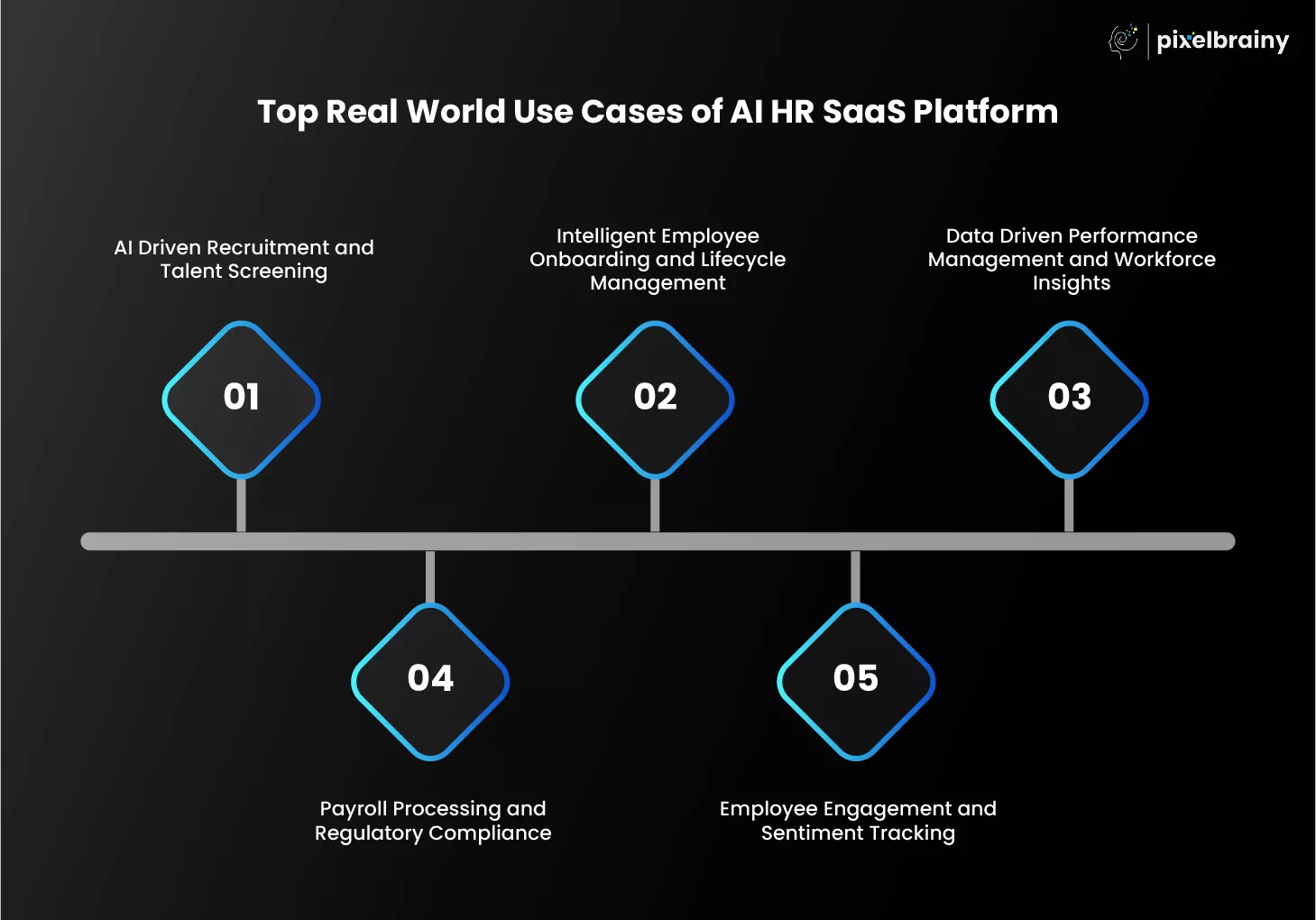
Recruitment is one of the most practical and widely used applications of AI HR SaaS Platform. AI models review resumes, identify relevant skills, and rank candidates based on job requirements and past hiring success. This significantly reduces the time HR teams spend on manual screening and shortlisting.
Large organizations that receive thousands of applications per role use AI powered applicant tracking systems to maintain hiring speed without sacrificing quality. For example, technology and consulting firms rely on AI to shortlist candidates within minutes while ensuring role alignment. By focusing on skills, experience, and job relevance, AI based recruitment helps organizations hire faster, improve candidate matching, and maintain consistency across hiring teams.
AI HR SaaS Platform simplifies employee onboarding by automating repetitive tasks and personalizing the experience for each new hire. From document collection to policy acknowledgment and training assignment, AI driven workflows ensure that onboarding remains structured and error free.
Global enterprises use AI HR SaaS platforms to onboard employees across regions while managing local compliance requirements. AI chatbots assist new hires by answering HR related questions, guiding them through onboarding steps, and providing role specific resources. This reduces dependency on HR teams, improves employee confidence from day one, and creates a smoother transition into the organization.
Managing employee performance becomes more effective when supported by real time data. AI HR SaaS Platform continuously analyzes performance metrics, feedback, goal progress, and engagement signals to provide objective insights. This allows managers to move away from annual reviews toward ongoing performance conversations.
Enterprises in retail, manufacturing, and IT services use predictive analytics to identify high performing employees and potential attrition risks. By detecting early signs of disengagement, HR teams can take preventive actions such as targeted coaching or workload adjustments. This approach supports fair evaluations, better talent development, and improved retention.
Payroll accuracy and compliance are critical for enterprise operations. AI HR SaaS Platform automates payroll calculations, tax deductions, and benefit administration while adapting to changing labor laws. AI systems continuously monitor payroll data to flag inconsistencies or compliance risks.
Multinational companies use AI powered HR SaaS platforms to manage complex payroll structures across countries. This ensures timely salary payments, accurate reporting, and reduced compliance errors. As a result, organizations minimize legal risks while maintaining employee trust and transparency.
Understanding how employees feel is essential for building a healthy workplace. AI HR SaaS Platform analyzes employee surveys, feedback forms, and communication patterns to identify engagement trends and sentiment shifts. This helps HR teams act before issues escalate.
Fast growing organizations use AI driven sentiment analysis to assess morale during organizational changes such as remote work adoption or restructuring. These insights enable leadership to design meaningful engagement strategies and strengthen workplace culture.
Overall, AI HR SaaS Platform enables organizations to manage hiring, onboarding, performance, payroll, and engagement with greater clarity, consistency, and strategic insight.
When enterprises plan AI HR SaaS Platform Development, identifying the right core features is critical to ensure usability, scalability, and long term adoption. These must have features form the foundation of a reliable HR platform and directly support daily HR operations, compliance, and workforce management.
| Core Feature | Description |
| AI Powered Applicant Tracking System | This feature automates resume parsing, candidate shortlisting, and interview scheduling using AI algorithms. It reduces manual screening efforts and improves hiring speed and accuracy. Enterprises benefit from consistent and unbiased candidate evaluation. |
| Employee Information Management | A centralized employee database stores personal details, job roles, documents, and employment history. AI helps keep records updated and organized while ensuring secure access. This improves data accuracy and administrative efficiency. |
| Automated Onboarding Management | AI driven onboarding workflows handle document collection, training assignments, and policy acknowledgments. The system personalizes onboarding based on role and department. This ensures faster employee readiness and reduced HR dependency. |
| Payroll and Compensation Management | This feature automates salary calculations, deductions, bonuses, and reimbursements. AI validates payroll data to reduce errors and compliance risks. It ensures timely and accurate compensation processing. |
| Attendance and Leave Tracking | AI HR SaaS Platform tracks attendance, shifts, and leave requests in real time. Automated approvals and alerts reduce manual follow ups. This improves workforce planning and policy enforcement. |
| Performance Management System | AI analyzes goals, feedback, and productivity metrics to provide continuous performance insights. It supports fair evaluations and development planning. Managers gain data backed visibility into employee performance. |
| Compliance and Policy Management | This feature ensures adherence to labor laws and organizational policies. AI monitors regulatory updates and flags compliance risks. It helps enterprises avoid penalties and legal issues. |
| Employee Self Service Portal | Employees can update information, request leave, access payslips, and view policies independently. AI chat support enhances usability. This reduces HR workload and improves employee experience. |
| Reporting and Analytics Dashboard | AI powered dashboards provide real time insights into workforce metrics. HR leaders can track hiring trends, attrition, and productivity. Data driven reports support strategic decisions. |
| Role Based Access Control | Permissions are assigned based on user roles and responsibilities. AI ensures sensitive data remains protected. This strengthens security and audit readiness. |
| Workflow Automation Engine | Repetitive HR processes are automated using configurable workflows. AI optimizes task routing and approvals. This improves operational efficiency and consistency. |
| Document Management System | Employee contracts, certificates, and HR documents are securely stored and indexed. AI enables quick retrieval and validation. This reduces paperwork and administrative delays. |
| Integration Capabilities | APIs allow integration with accounting, ERP, and communication tools. AI ensures data synchronization across systems. This creates a connected HR ecosystem. |
| Notifications and Alerts | Automated alerts notify users about deadlines, approvals, and compliance tasks. AI prioritizes critical notifications. This reduces missed actions and delays. |
| Data Security and Encryption | Enterprise grade security protects employee data through encryption and access monitoring. AI detects unusual activity. This builds trust and ensures regulatory compliance. |
Together, these core features ensure that AI HR SaaS Platform Development delivers a stable, scalable, and business ready HR platform.
As organizations mature, developing an AI HR SaaS Platform with advanced features becomes essential to gain deeper workforce intelligence and competitive advantage. These features elevate HR platforms from operational tools to strategic decision support systems.
| Advanced Feature | Description |
| Predictive Attrition Analytics | AI analyzes behavior, engagement, and performance data to predict attrition risks. HR teams can take proactive retention actions. This reduces turnover costs and talent loss. |
| AI Chatbots for HR Support | Conversational AI handles employee queries related to policies, payroll, and leave. Chatbots provide instant responses around the clock. This improves employee satisfaction and reduces HR workload. |
| Sentiment Analysis Engine | AI evaluates survey responses and communication data to assess employee sentiment. It detects morale shifts early. This helps leadership address concerns proactively. |
| Skill Gap Analysis | AI compares current workforce skills with future requirements. It highlights training and hiring needs. This supports workforce planning and upskilling strategies. |
| Personalized Learning Recommendations | AI suggests training programs based on role, performance, and career goals. Learning becomes targeted and relevant. This improves employee development outcomes. |
| Diversity and Bias Detection | AI monitors hiring and performance data to detect bias patterns. It supports fair and inclusive HR practices. This strengthens diversity and compliance efforts. |
| Workforce Demand Forecasting | AI predicts staffing needs based on business growth and seasonality. HR teams can plan hiring in advance. This improves resource utilization and cost control. |
| Advanced Performance Prediction | AI identifies high potential employees and leadership readiness. It supports succession planning. Enterprises gain better talent continuity. |
| Fraud and Anomaly Detection | AI detects unusual payroll, attendance, or access patterns. This reduces internal fraud risks. It enhances system security and reliability. |
| Voice Enabled HR Interfaces | Voice based AI allows employees to interact with HR systems hands free. It improves accessibility and usability. This is especially useful for mobile and remote teams. |
By incorporating these advanced capabilities, enterprises can create AI HR SaaS Platform that delivers predictive insights, stronger engagement, and long term strategic value.
Building a reliable and scalable AI powered HR platform requires more than just technical execution. It demands clear planning, deep understanding of HR workflows, and careful alignment between business goals and technology. A structured AI HR SaaS Platform Development process helps enterprises reduce uncertainty while creating solutions that deliver long term value.
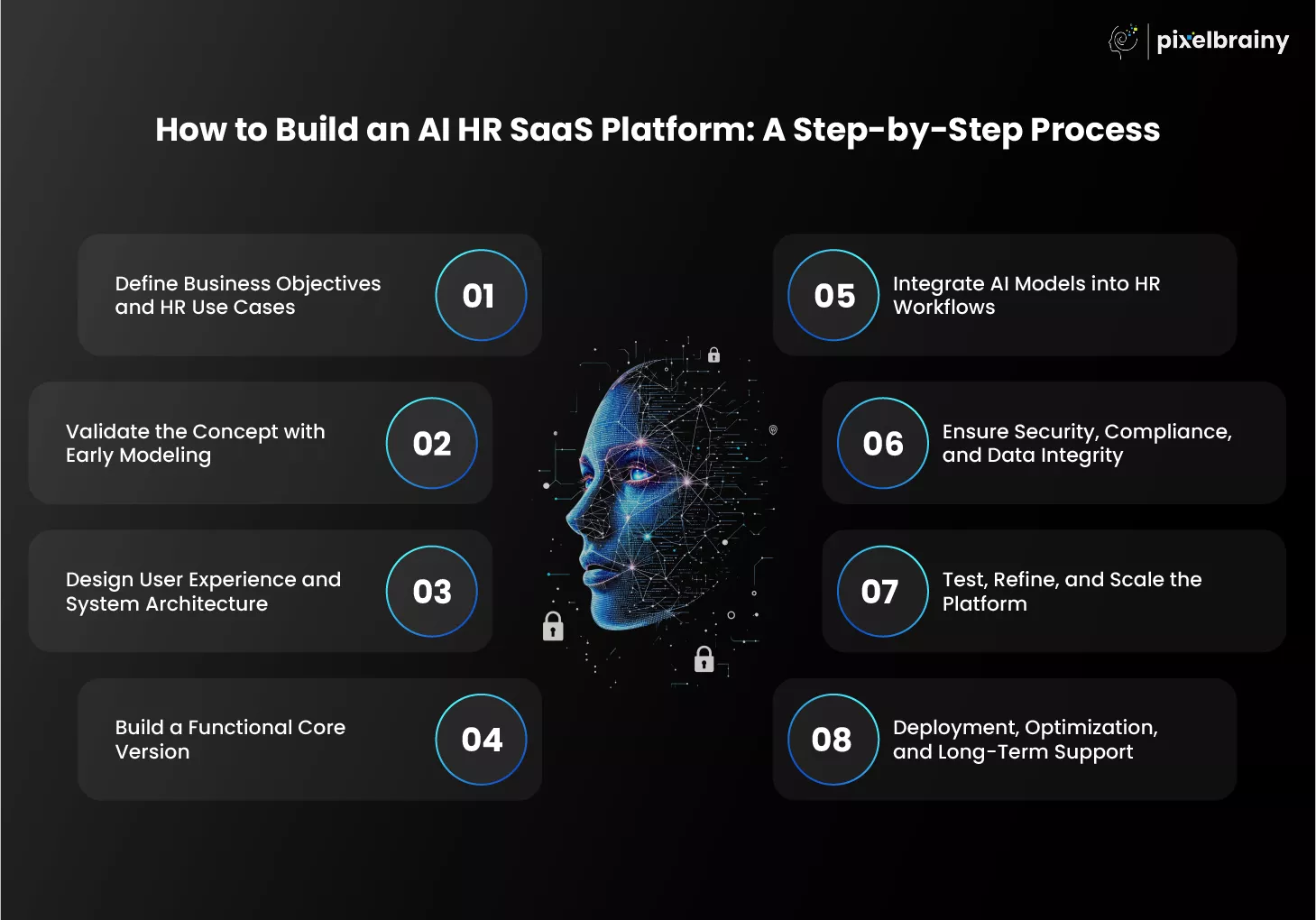
The first step involves understanding the specific HR challenges the organization wants to address, such as inefficient hiring, poor workforce visibility, or compliance risks. Stakeholders from HR, IT, and leadership collaborate to define success metrics and expected outcomes. This clarity helps prioritize features and avoid unnecessary complexity later.
Goal: Establish a strong foundation by ensuring the platform addresses real enterprise HR needs and measurable business outcomes.
Before committing resources to full scale development, teams validate the idea using PoC Development. This phase focuses on testing AI feasibility, evaluating data quality, and confirming that proposed workflows can be automated effectively. It allows teams to identify technical gaps and limitations early.
Goal: Minimize development risk by confirming that AI capabilities can realistically support the intended HR use cases.
This step focuses on designing intuitive user journeys for HR professionals, managers, and employees. System architecture planning includes cloud infrastructure, data pipelines, and access controls. Scalability, performance, and security are considered from the beginning to avoid redesign later.
Goal: Create a platform design that balances ease of use with enterprise grade performance and future growth.
At this stage, development teams focus on MVP Development, delivering core HR functionalities such as recruitment workflows, employee records, and basic reporting. AI features are introduced selectively to ensure stability and accuracy. Early adopters begin interacting with the platform to provide feedback.
Goal: Deliver a working product quickly to validate functionality, gather insights, and refine priorities before full scale expansion.
Once the core platform is stable, AI models are deeply integrated into HR operations as part of HR SaaS Platform Development integrating AI. This includes intelligent candidate matching, performance insights, and compliance monitoring. Continuous model training improves accuracy over time.
Goal: Transform traditional HR processes into intelligent, data driven workflows that support better decision making.
Security and compliance are addressed comprehensively in this phase. The platform implements encryption, role-based access, audit trails, and compliance checks aligned with labor and data protection laws. Data accuracy and integrity are validated across all modules.
Goal: Protect sensitive employee information while meeting enterprise security and regulatory requirements.
Extensive testing is performed across functionality, performance, and AI behavior. Load testing ensures the system can handle growth, while usability testing improves user adoption. Refinements are made based on real usage data and feedback.
Goal: Deliver stable and scalable AI HR SaaS Platform Solutions that perform reliably as the organization grows.
After deployment, the platform is continuously monitored and optimized to adapt to evolving HR needs. Many enterprises collaborate with Top AI development companies in USA to enhance innovation, maintenance, and advanced capabilities as they develop an AI HR SaaS Platform further.
Goal: Sustain platform relevance, performance, and competitive advantage through continuous improvement and AI HR SaaS Platform Development Solutions.
By following these steps, organizations can confidently move from concept to execution when creating an AI HR SaaS Platform or planning to make an AI HR SaaS Platform that supports long term workforce transformation.
Also Read: AI HR Software Development: Top Benefits and Features
The cost to develop an AI HR SaaS Platform typically ranges from $30,000 to $300,000+, depending on the scope, AI complexity, security requirements, and level of scalability. Factors such as the number of HR modules, depth of AI integration, third party APIs, and compliance needs directly influence overall investment.
Businesses can start with a lean solution and gradually scale, or they can build a fully enterprise ready platform from the beginning.
| AI HR SaaS Platform Type | Estimated Cost | Timeline | What You Get |
| Basic AI HR SaaS Platform (MVP) | $30,000 to $60,000 | 8 to 12 weeks | Core HR modules such as employee records, basic recruitment workflows, simple AI resume parsing, limited analytics, standard security, and cloud deployment suitable for startups or early validation |
| Advanced AI HR SaaS Platform | $70,000 to $150,000 | 4 to 6 months | Multiple HR modules including recruitment, onboarding, payroll, and performance management with AI driven workflows, predictive analytics, role based access, integrations, and improved UI for growing organizations |
| Enterprise AI HR SaaS Platform | $200,000 to $300,000+ | 6 to 10 months | Full scale platform with advanced AI models, predictive workforce analytics, compliance automation, high availability architecture, enterprise grade security, multi region support, and deep integrations for large enterprises |
Several elements influence the total development cost. Feature complexity is one of the biggest factors, as advanced AI models and analytics require more development and testing effort. AI training, data preparation, and model optimization can add $10,000 to $50,000 depending on data volume and accuracy goals.
Technology stack selection and cloud infrastructure also impact costs. Cloud hosting, storage, and compute resources may cost $1,000 to $5,000 per month initially, increasing as user volume grows. Security, compliance implementation, and third party integrations can add $5,000 to $25,000 based on regulatory and enterprise requirements.
Ongoing optimization costs include model retraining, performance tuning, and feature enhancements. These typically account for 15 to 25 percent of the initial development cost annually, ensuring the platform remains accurate, secure, and competitive.
In summary, investing wisely based on business stage and growth plans allows organizations to control costs while building a scalable and future ready AI HR SaaS Platform.
The technology stack defines how well an AI powered HR platform performs, scales, and adapts to future requirements. In AI HR SaaS Platform Development, the right combination of tools and frameworks ensures system stability, secure data handling, and smooth integration of intelligent features across HR workflows.
| Tech Layer | Recommended Technologies | Explanation |
| Frontend Development | React, Angular, Vue.js | These frameworks help build intuitive and responsive interfaces for HR teams and employees. They support dynamic dashboards, real time updates, and role based user experiences. |
| Backend Development | Node.js, Python, Java | Backend technologies manage application logic, data processing, and API services. Python plays a key role in AI integration, while Node.js and Java support scalable and secure operations. |
| AI and Machine Learning | TensorFlow, PyTorch, Scikit learn | These frameworks enable advanced capabilities such as resume analysis, predictive analytics, and sentiment detection. They form the intelligence layer of AI driven HR platforms. |
| Cloud Infrastructure | AWS, Microsoft Azure, Google Cloud | Cloud platforms provide scalability, high availability, and global access. They support compliance, data protection, and performance optimization for HR SaaS applications. |
| Database Management | PostgreSQL, MongoDB, MySQL | Databases store structured employee data and unstructured documents. Using both relational and NoSQL databases improves flexibility and system performance. |
| API and Integration Layer | REST APIs, GraphQL | APIs enable seamless connectivity with payroll systems, ERP tools, and third party HR services. This ensures smooth data exchange and future extensibility. |
| Security and Compliance | OAuth, JWT, SSL, Encryption Tools | Security technologies safeguard sensitive HR data through authentication, authorization, and encryption. They help meet regulatory and enterprise security requirements. |
| DevOps and Deployment | Docker, Kubernetes, CI CD Pipelines | DevOps tools automate deployment, scaling, and updates. They improve release reliability and reduce operational downtime. |
| Monitoring and Analytics | Prometheus, Grafana, ELK Stack | Monitoring solutions track system health, usage patterns, and AI performance. They support proactive issue detection and optimization. |
| AI Data Management | Data Lakes, ETL Tools | Data management tools handle large volumes of HR data used for AI training and analytics. Proper data pipelines improve model accuracy and insight quality. |
A well-structured tech stack empowers organizations to build reliable, secure, and future ready AI HR SaaS platforms that support evolving workforce and business demands.
Developing an AI driven HR SaaS platform requires a balanced approach that combines technology, governance, and user centric design. Beyond feature implementation, long term success depends on how well the system adapts to business growth, regulatory changes, and evolving workforce expectations. Adopting best practices early helps organizations avoid costly rework and ensures sustainable value.
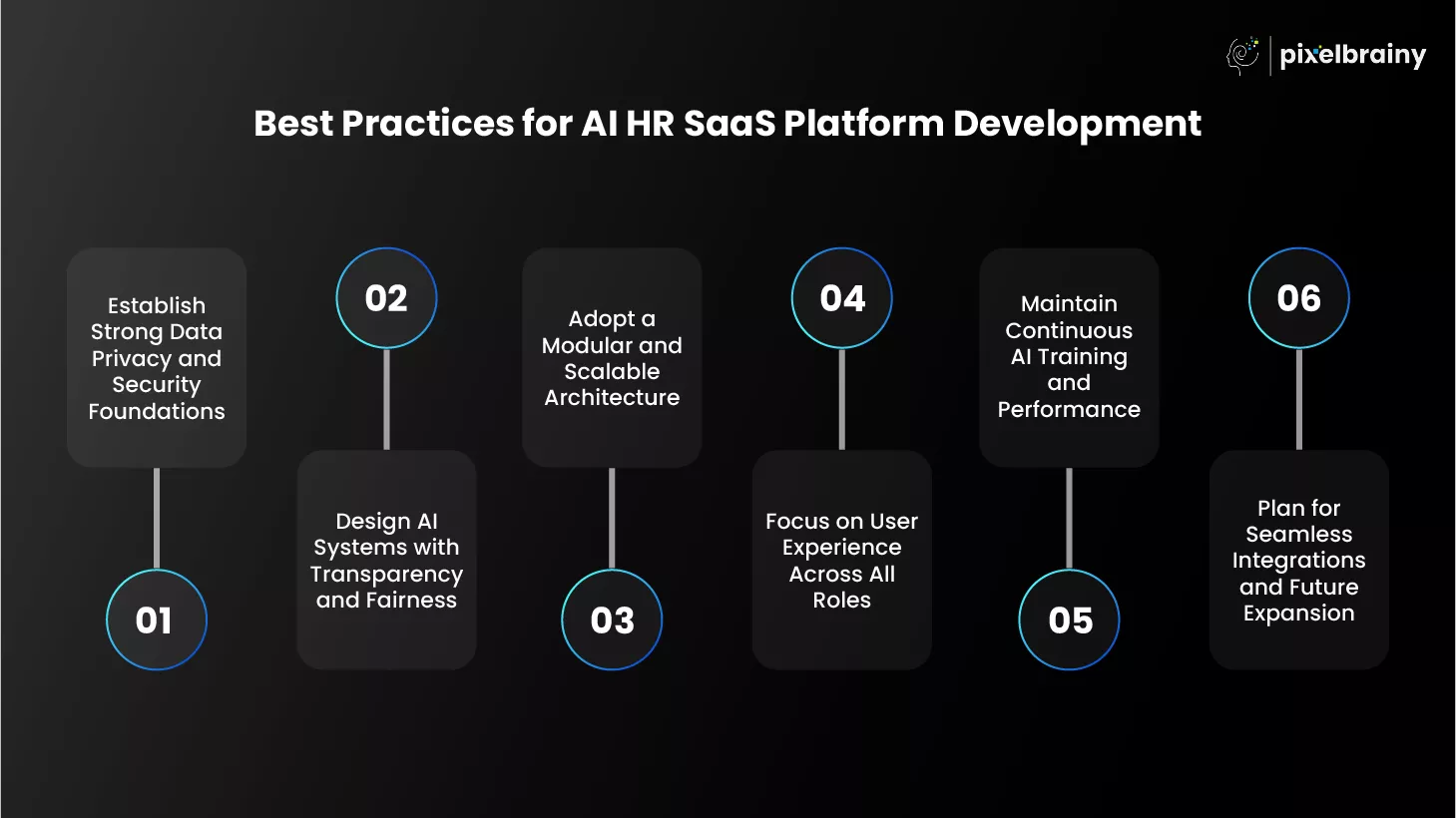
AI HR SaaS platforms process highly sensitive employee data, including personal details, compensation, and performance records. Implementing robust security measures such as encryption, secure authentication, role based access control, and audit logs is essential. Regular security testing and compliance assessments help identify vulnerabilities and ensure alignment with data protection regulations. A strong security foundation not only prevents data breaches but also builds long term trust among employees and stakeholders.
AI driven HR decisions must be explainable and defensible. Models should provide clear reasoning behind recommendations such as candidate rankings or performance insights. Transparent AI systems allow HR teams to validate outcomes and reduce the risk of bias. Fairness checks and model audits should be conducted regularly to ensure that AI outputs align with ethical standards and organizational values.
A modular platform structure allows individual HR modules to evolve independently without impacting the entire system. This approach makes it easier to introduce new features, upgrade AI capabilities, or scale infrastructure as user demand increases. Scalability planning ensures the platform remains reliable during rapid workforce expansion or seasonal usage spikes, reducing long term operational risk.
Successful AI HR SaaS Platform Development depends on user adoption. HR professionals, managers, and employees should be able to navigate the platform easily without extensive training. Clear workflows, intuitive dashboards, and role specific interfaces improve engagement and reduce resistance to change. Regular user feedback sessions help refine functionality and improve usability over time.
AI models are not static and require ongoing attention to remain effective. Continuous training with updated data improves prediction accuracy and relevance. Performance monitoring helps identify data drift, model bias, or declining accuracy early, allowing timely adjustments. This practice ensures AI outputs remain reliable as organizational conditions change.
An effective AI HR SaaS platform should integrate smoothly with existing enterprise systems such as payroll, finance, ERP, and communication tools. Strong API architecture supports interoperability and reduces data silos. Planning for future integrations ensures the platform can adapt to new business tools and emerging AI capabilities without major redesign.
Ultimately, following these best practices enables organizations to build AI HR SaaS solutions that are secure, scalable, user friendly, and ready to support long term workforce transformation.
AI powered HR platforms offer significant advantages, but building them comes with complex technical, operational, and ethical challenges. Understanding these obstacles early helps organizations plan effectively and implement solutions that ensure long term success. Below are the most common challenges in AI HR SaaS Platform Development along with practical ways to overcome them.
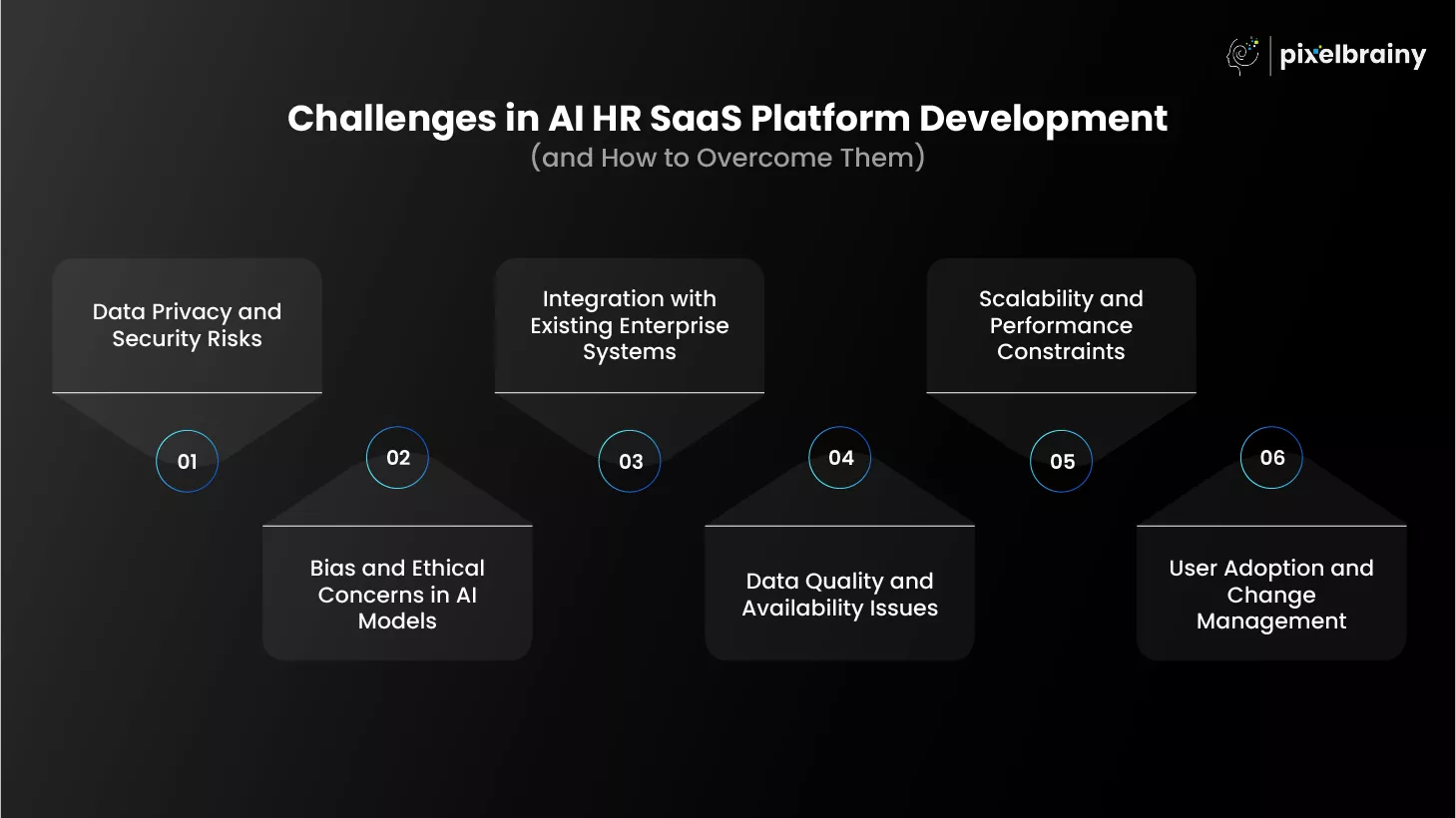
AI HR systems manage large volumes of sensitive employee data, including personal details, compensation records, and performance information. Any data breach or misuse can lead to legal consequences and loss of employee trust. Managing data across regions with different regulations further increases complexity.
How to overcome this challenge:
AI models can unintentionally reflect bias present in historical data, especially in recruitment and performance evaluations. This can result in unfair recommendations and legal risks for organizations. Ethical concerns often slow adoption when transparency is lacking.
How to overcome this challenge:
Many enterprises rely on legacy HR, payroll, and ERP systems. Integrating AI HR SaaS Platform with these tools can be technically complex and time consuming. Poor integration can lead to data inconsistencies and workflow disruptions.
How to overcome this challenge:
AI systems depend heavily on accurate and consistent data. Incomplete records, outdated information, or inconsistent formats reduce AI effectiveness and prediction accuracy. This is a common challenge during early implementation.
How to overcome this challenge:
As organizations grow, AI HR SaaS platforms must handle increasing users, data volume, and feature complexity. Poor scalability planning can lead to performance degradation and downtime during peak usage.
How to overcome this challenge:
Even the most advanced AI HR systems fail if users resist adoption. HR teams and employees may struggle to trust AI driven insights or adapt to new workflows. Lack of training often amplifies this challenge.
How to overcome this challenge:
By addressing these challenges proactively, organizations can reduce risks and build AI HR SaaS Platform that delivers reliable insights, operational efficiency, and long-term business value.
The future of AI HR SaaS Platform Development is closely tied to how organizations manage talent, data, and employee experience in an increasingly digital workplace. As AI capabilities mature, HR platforms will shift from operational tools to strategic systems that actively guide workforce decisions. Below are five key trends shaping the future.
AI driven HR platforms will move beyond reporting to predicting and recommending actions. Systems will forecast attrition, performance outcomes, and workforce needs with higher accuracy.
Future AI HR SaaS platforms will tailor experiences for each employee based on role, performance, and career goals. Personalization will improve engagement and satisfaction across the employee lifecycle.
Generative AI will support content creation and HR communication. From drafting job descriptions to generating performance summaries, AI will assist HR teams in reducing manual work.
As AI becomes more embedded in HR decisions, governance and ethics will gain importance. Organizations will adopt frameworks to ensure transparency, fairness, and accountability.
AI HR SaaS platforms will increasingly connect HR insights with broader business strategy. Workforce data will directly influence financial planning, growth strategies, and organizational design.
These trends indicate that AI HR SaaS Platform Development will continue to evolve into a core business capability that shapes how organizations attract, manage, and retain talent.
PixelBrainy LLC operates as an experienced AI HR Platform development company that helps organizations turn complex HR requirements into scalable and intelligent digital platforms. The team combines domain knowledge with technical expertise to deliver solutions that align with real business operations rather than generic platform templates. This approach ensures HR systems remain practical, secure, and ready for long term growth.
Through tailored AI development Solutions for HR SaaS, PixelBrainy LLC supports organizations across strategy, architecture, AI implementation, and post launch optimization. Every phase of AI HR SaaS Platform Development is executed with a focus on usability, compliance, and scalability. This makes the company a reliable partner for organizations planning building an AI HR SaaS Platform that can evolve alongside workforce and business demands.
Industry: Professional Services
Region: United States
Workforce Size: 1,000+ employees
Business Challenge: The organization faced delays in recruitment, limited visibility into workforce trends, and difficulty managing HR operations across multiple states. Manual screening and fragmented HR tools slowed hiring and impacted decision making.
Solution Delivered: PixelBrainy LLC helped to build AI HR SaaS Platform that unified recruitment, employee data, and analytics into a single cloud platform. AI powered resume screening improved candidate matching, while predictive analytics provided insights into attrition and workforce planning. The platform was designed to comply with US labor regulations and scale across departments.
Business Impact:
By focusing on measurable outcomes and enterprise readiness, PixelBrainy LLC delivers AI HR SaaS solutions that support sustainable workforce transformation.
AI driven HR platforms are redefining how organizations manage talent, data, and decision making at scale. Through strategic AI HR SaaS Platform Development, enterprises can modernize recruitment, streamline operations, and gain deeper workforce insights. From planning and architecture to intelligent automation, every phase plays a critical role in delivering reliable and scalable solutions.
Organizations that invest in HR SaaS Platform Development integrating AI gain long term advantages such as improved hiring efficiency, better employee engagement, and data backed performance management. Whether the goal is to develop an AI HR SaaS Platform from scratch or enhance existing systems, success depends on choosing the right features, technology stack, and development approach. As demand for intelligent HR platforms continues to grow, businesses that create AI HR SaaS Platform today position themselves ahead of future workforce challenges.
Ready to transform your HR operations? Book an appointment with our experts to discuss your AI HR SaaS Platform journey.
AI HR SaaS Platform is ideal for growing startups, mid sized companies, and large enterprises that manage complex hiring, payroll, compliance, or workforce analytics. Organizations with distributed teams or high recruitment volumes benefit the most from AI driven automation and insights.
Development timelines depend on scope and complexity. A basic version with essential features can be built within a few months, while advanced or enterprise level platforms may take six months or longer. Phased development helps launch faster while scaling gradually.
Yes, most AI HR SaaS platforms are designed with API based integrations. This allows seamless connectivity with payroll, ERP, accounting, and communication tools without disrupting existing workflows.
AI analyzes large volumes of HR data to identify patterns and trends that are difficult to detect manually. This helps HR teams make data backed decisions related to hiring, performance management, employee engagement, and retention planning.
When developed correctly, AI HR SaaS Platform follows strict security standards including encryption, access control, and compliance monitoring. Enterprise grade security practices ensure employee data remains protected at all times.
Yes, scalability is one of its core strengths. Cloud based architecture allows the platform to support increasing users, data volume, and new features without performance issues, making it suitable for long term growth.

About The Author
Sagar Bhatnagar
Sagar Sahay Bhatnagar brings over a decade of IT industry experience to his role as Marketing Head at PixelBrainy. He's known for his knack in devising creative marketing strategies that boost brand visibility and market influence. Sagar's strategic thinking, coupled with his innovative vision and focus on results, sets him apart. His track record of successful campaigns proves his ability to utilize digital platforms effectively for impactful marketing efforts. With a genuine passion for both technology and marketing, Sagar continuously pushes PixelBrainy's marketing initiatives to greater success.

Working with the PixelBrainy team has been a highly positive experience. They understand the design requirements and create beautiful UX elements to meet the application needs. The dev team did an excellent job bringing my vision to life. We discussed usability and flow. Sagar worked with his team to design the database and begin coding. Working with Sagar was easy. He has the knowledge to create robust apps, including multi-language support, Google and Apple ID login options, Ad-enabled integrations, Stripe payment processing, and a Web Admin site for maintaining support data. I'm extremely satisfied with the services provided, the quality of the final product, and the professionalism of the entire process. I highly recommend them for Android and iOS Mobile Application Design and Development.

Great experience working with them. Had a lot of feedback and I found that unlike most contractors they were bugging me for updates instead of the other way around. They were extremely time conscience and great at communicating! All work was done extremely high quality and if not on time, early! They were always proactive when it comes to communication and the work is great/above par always. Very flexible and a great team to work with! Goes above and beyond to present us with multiple options and always provides quality. Amazing work per usual with Chitra. If you have UI/UX or branding design needs I recommend you go to them! Will likely work with them in the future as well, definitely recommended!

PixelBrainy is a joy to work with and is a great partner when thinking through branding, logo, and website layout. I appreciate that they spend time going into the "why" behind their decisions to help inform me and others about industry best practices and their expertise.

I hired them to design our software apps. Things I really like about them are excellent communication skills, they answer all project suggestions and collaborate right away, and their input on design and colors is amazing. This project was complex and needed patience and creativity. The team is amazing to do business with. I will be using them long-term. Glad to see there are some good people out there. I was afraid to try and outsource my project to someone but I am glad I met them! I really can't say enough. They went above and beyond on this project. I am very happy with everything they have done to make my business stand out from the competition.

It was great working with PixelBrainy and the team. They were very responsive and really owned the project. We'll definitely work with them again!

I recently worked with the PixelBrainy team on a project and I was blown away by their communication skills. They were prompt, clear, and articulate in all of our interactions. They listened and provided valuable feedback and suggestions to help make the project a success. They also kept me updated throughout the entire process, which made the experience stress-free and enjoyable.

PixelBrainy is very good at what it does. The team also presents themselves very professionally and takes care of their side of things very well. I could fully trust them taking up the design work in a timely and organised manner and their attention to detail saved us lots of effort and time. This particular project was quite intense and the team showed that they function very well under pressure. Very much looking forward to working with her again!

It's always an absolute pleasure working with them. They completed all of my requests quickly and followed every note I had for them to a T, which made our process go smoothly from start to finish. Everything was completed fast and following all of the guidelines. And I would recommend their services to anyone. If you need any design work done in the future, PixelBrainy should be your first call!

They took ownership of our requirements and designed and proposed multiple beautiful variants. The team is self-motivated, requires minimum supervision, committed to see-through designs with quality and delivering them on time. We would definitely love to work with PixelBrainy again when we have any requirements.

PixelBrainy was a big help with our SaaS application. We've been hard at work with a new UI/UX and they provided a lot of help with the designs. If you're looking for assistance with your website, software, or mobile application designs, PixelBrainy and the team is a great recommendation.

PixelBrainy designers are amazing. They are responsive, talented, and always willing to help craft the design until it matches your vision. I would recommend them and plan to continue them for my future projects and more!!!

They were awesome! Did a good job fast, and good communication. Will work with them again. Thank you

Creative, detail-oriented, and talented designers who take direction well and implement changes quickly and accurately. They consistently over-delivered for us.

PixelBrainy team is very talented and creative. Great designers and a pleasure to work with. PixelBrainy is an excellent communicator and I look forward to working with them again.

PixelBrainy has a very talented design team. Their work is excellent and they are very responsive. I enjoy working with them and hope to continue on all of our future projects.


Transform your ideas into reality with us.
Across these industries, each engagement brings unique challenges, from early-stage product development to scaling complex systems, helping us build a practical understanding of real-world product environments.