AI Summary Powered by PixelBrainy
What makes AI Companion Apps so popular today, and why are businesses across industries racing to build them? From emotional support platforms like Replika to mental health assistants such as Woebot, and even personalized fitness coaches like Fitbod, AI-driven companions are transforming how people interact with technology. The growing demand for AI Companion App Development comes from users wanting more than static digital tools. They now expect applications that can think, respond, and evolve with them.
For businesses, understanding how to build an AI Companion App is more than a passing trend. The development process of AI Companion Apps involves integrating natural language processing (NLP), machine learning, and intuitive UX design to create digital assistants that feel human-like and adaptive. These apps are already creating meaningful impact across multiple industries:
A 2025 global survey reported that two-thirds of respondents now use AI regularly and 83% believe it will bring broad benefits. This clearly shows that developing AI Companion Apps is no longer futuristic. It has become essential for startups and enterprises aiming to stay ahead in a competitive digital-first economy.
In this blog, we will explore everything about AI Companion App Development including what these apps are, how they work, the step-by-step development roadmap, cost insights, monetization strategies, and the trends shaping 2025.
An AI Companion App is a digital application built to provide personalized interaction, guidance, and emotional support through natural, human-like conversations. Unlike traditional apps that follow static functions, these systems leverage artificial intelligence (AI), natural language processing (NLP), and machine learning (ML) to understand context, interpret emotions, and adapt continuously to user behavior.
In simple terms, an AI Companion App functions like a virtual friend, mentor, or assistant. One of the most popular examples is Replika, which enables users to hold conversations that feel genuine, practice social skills, or create an ongoing emotional bond.
The functioning of an AI Companion App can be explained as a multi-stage process that combines user input, emotional awareness, and intelligent response generation:
Through this process, AI Companion Apps work as evolving digital partners, capable of learning, supporting, and engaging users in ways that feel natural and deeply human-centered.
The global momentum around AI Companion App Development is creating significant interest among investors. Unlike many short-lived tech trends, AI companions are positioned at the intersection of human needs and technological advancement, making them a promising long-term market.
Several factors are driving investment interest:
Millions of users are already turning to AI companions for emotional support, productivity, and lifestyle management. Apps like Replika and Character.AI have shown how quickly these platforms can achieve mass adoption when they meet human-centered needs.
Once developed, AI Companion Apps can scale rapidly across regions and demographics with minimal additional cost. This scalability makes them particularly attractive for venture capital and enterprise investors seeking strong ROI.
Beyond personal use, companion apps are being adapted for specialized sectors such as mental health, education, and customer engagement, opening up diverse investment avenues.
According to Grand View Research, the global AI companionship market is projected to reach USD 3.6 billion by 2030, growing at a 35.9% CAGR. This rapid expansion signals strong demand and long-term stability for investors entering the space.
Investing in AI Companion Apps is not just about funding another digital product. It represents a stake in the future of human-AI interaction, where technology shifts from being a passive tool to an active partner in daily life.
When businesses decide to build an AI Companion App, they are investing in more than just another digital product. These apps offer unique value by combining technology with human-like interaction, making them powerful tools for engagement, retention, and growth.
Below are the 6 key advantages of developing AI Companion App:
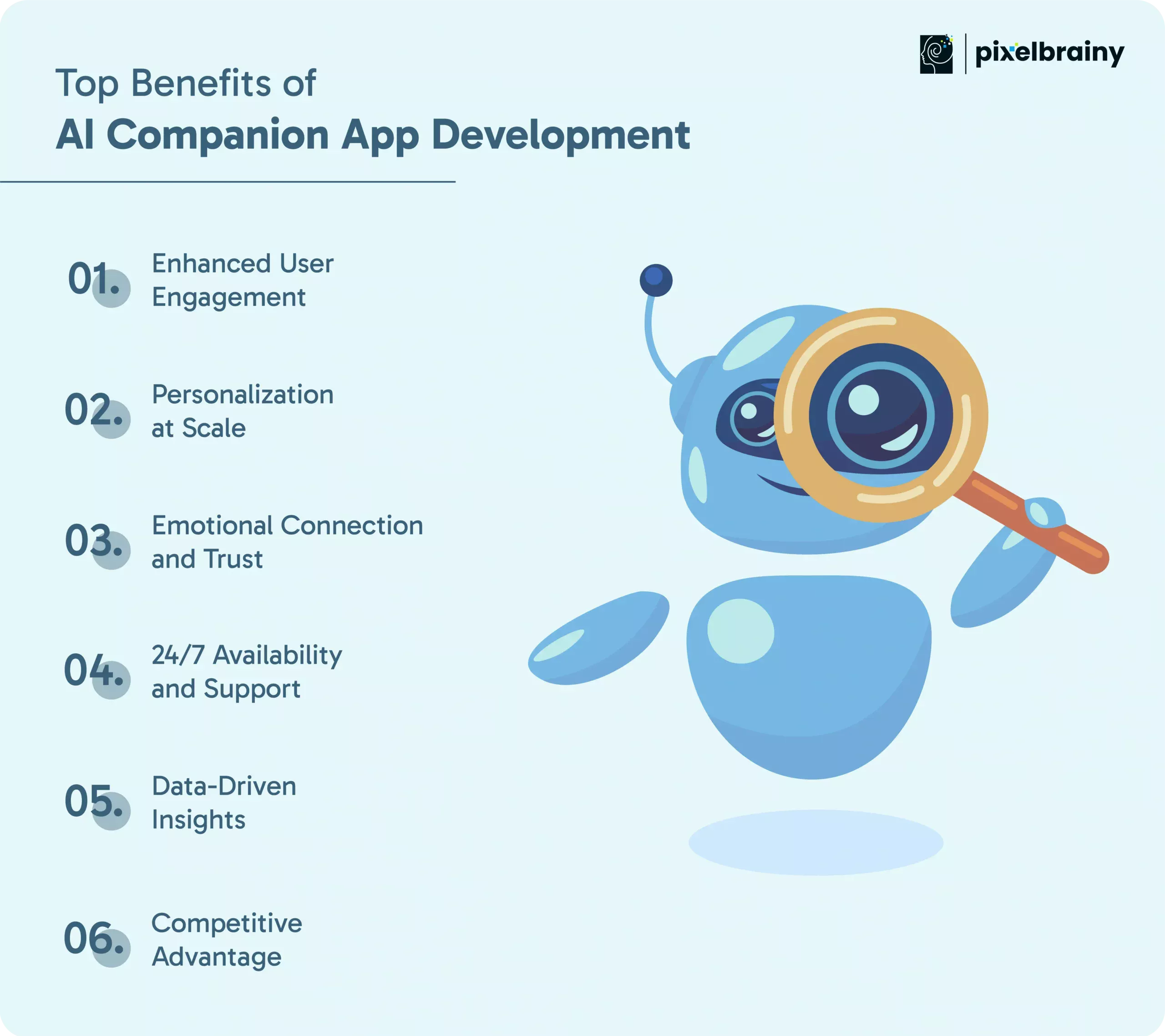
AI Companion Apps keep users connected by offering personalized, real-time conversations. Unlike traditional apps that may lose relevance over time, companion apps adapt to user preferences, ensuring interactions stay fresh and meaningful. This constant engagement improves retention rates and builds stronger digital loyalty.
One of the biggest advantages of developing AI Companion Apps is their ability to personalize experiences for thousands of users simultaneously. Machine learning algorithms allow these apps to analyze behavior, preferences, and moods, ensuring every interaction feels unique and user-specific without manual customization.
Unlike standard chatbots, AI Companion Apps are designed to simulate empathy and provide emotional support. This builds trust and makes users more comfortable sharing information, which strengthens brand credibility and user satisfaction in the long term.
Businesses that build AI Companion Apps can provide uninterrupted assistance to users. Whether it’s a fitness companion reminding workouts or a wellness coach offering late-night emotional support, the always-available nature of these apps delivers unmatched convenience.
Every interaction within an AI Companion App generates valuable user data and behavioral insights. These insights can help businesses refine services, predict customer needs, and design more effective strategies for future offerings. This makes AI Companion App Development a dual investment—both in user experience and market intelligence.
As more industries adopt AI, companies that embrace AI Companion App Development early secure a first-mover advantage. Delivering innovative user experiences can set a business apart in crowded markets, while also opening up new monetization channels and customer segments.
These benefits make AI Companion App Development a strategic choice for businesses aiming to innovate and grow.
The demand for AI Companion App Development is growing rapidly, and one of its biggest strengths lies in its flexibility. These apps are not restricted to a single purpose. Instead, they can be tailored to fit different lifestyles, industries, and personal needs. When you build an AI Companion App, you have the option to focus on wellness, learning, productivity, or even digital companionship.
By understanding the most popular types of AI Companion Apps, businesses and startups can identify the right direction for their projects and tap into markets with high growth potential. Below are seven categories that highlight the diversity and scalability of this technology, each supported with real-world examples.
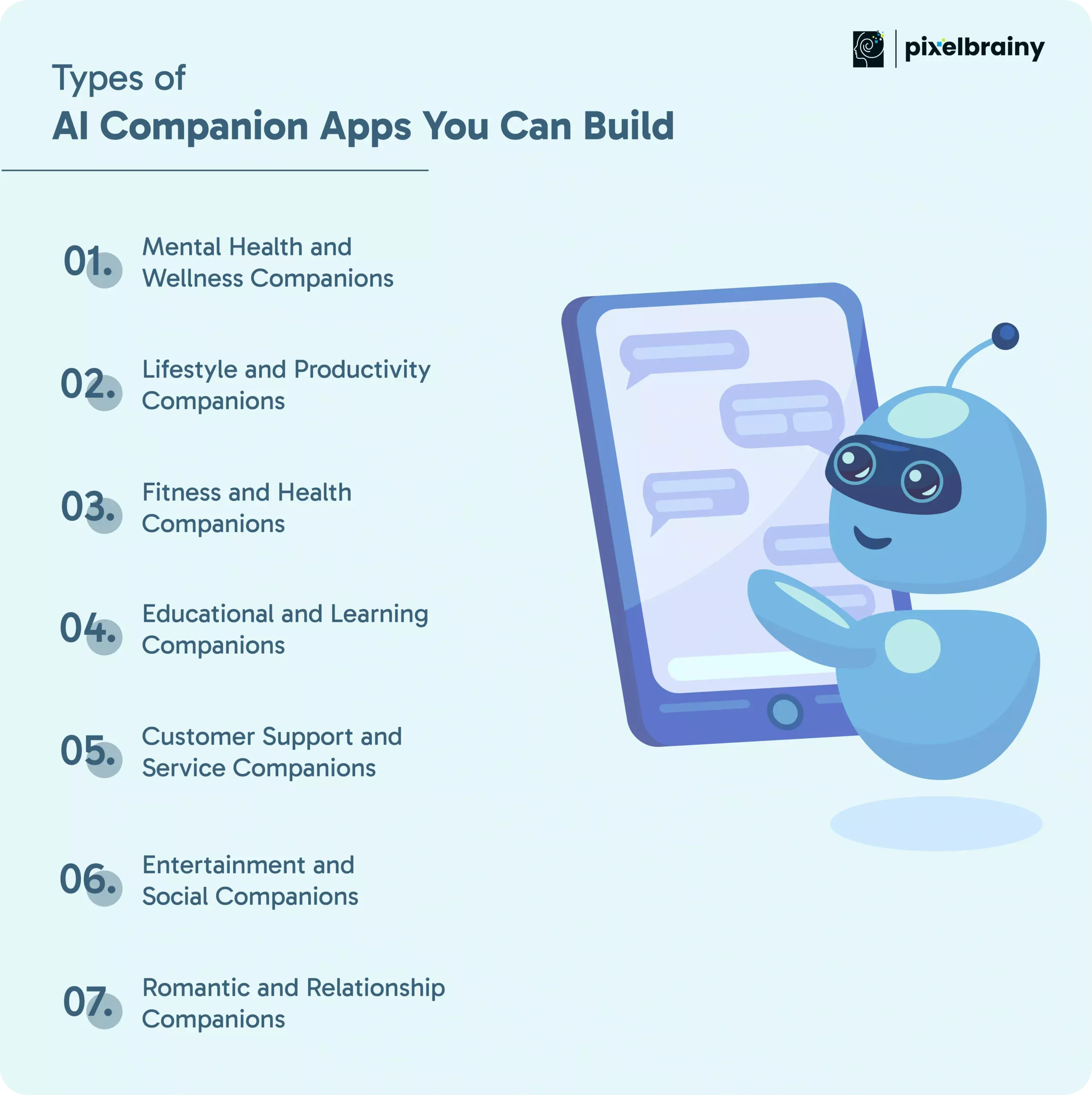
Mental health is one of the leading areas where AI companionship is showing significant value. These apps focus on emotional support, stress management, and mental well-being by offering conversations that feel understanding and supportive. They use sentiment detection and conversational models to provide comfort to users who may not have immediate access to human counselors.
These apps are designed to help users organize their routines, build better habits, and stay productive. They can provide reminders, motivational messages, and even help with decision-making in daily life. By adapting to user habits, they create a sense of accountability similar to that of a real coach.
Fitness companions act as AI trainers and nutrition coaches, helping users plan workouts, monitor physical activity, and adopt healthier lifestyles. They use user data such as age, body type, and fitness goals to deliver personalized health recommendations.
Education is another area where development of AI Companion App has gained traction. Learning companions assist students and professionals with interactive tutoring, language learning, and test preparation. They adapt to the learner’s pace and provide real-time feedback to strengthen understanding.
Businesses are increasingly relying on AI companions for customer support and client engagement. These apps act as service assistants that respond to inquiries, manage FAQs, and guide users to the right solutions without requiring human intervention.
Entertainment companions are built for fun, storytelling, and social interaction. They allow users to roleplay, create characters, or engage in casual conversations purely for enjoyment. These apps are particularly popular among younger audiences who enjoy personalized digital entertainment.
Perhaps one of the most discussed categories in recent years is romantic AI companions. These apps allow users to simulate relationships by creating AI girlfriends, boyfriends, or partners who engage in affectionate and emotionally supportive conversations. They provide companionship, reduce loneliness, and allow users to explore relationship dynamics in a safe digital environment.
These types of AI Companion Apps demonstrate the diversity of opportunities in this field, making AI Companion App Development a powerful strategy for businesses targeting different user needs.
When you create or build an AI Companion App, there are a few must-have features that form the foundation of functionality. These features ensure that your app delivers value, engagement, and reliability to its users.
| Feature | Explanation |
| Natural Language Processing (NLP) | The backbone of AI conversations. It allows the app to understand user input and respond in natural, human-like language |
| Personalized User Profiles | Each user should have a dedicated profile so the app can learn preferences and deliver more customized interactions |
| Contextual Memory | The ability to remember past chats and user history helps build continuity in conversations, making interactions feel more natural |
| Sentiment Detection | Helps the app identify user emotions such as stress, happiness, or sadness to adjust tone and responses accordingly |
| Voice Interaction | Adding voice input and output improves accessibility and makes the app feel more conversational |
| Push Notifications & Reminders | Keeps users engaged by sending timely reminders, motivational nudges, or wellness check-ins |
| Multi-Platform Support | Ensure that when you build an AI Companion App, it works seamlessly on mobile, web, and even smart devices |
| Secure Data Handling | Strong data privacy and encryption are essential to build trust and protect sensitive user interactions |
| Customizable Avatars | Many users prefer +B11to personalize their digital companion. Custom avatars or profiles enhance emotional connection |
| Offline Mode | Basic offline features make the app more reliable for users who lack constant internet access |
Including these essential features when you build an AI Companion App ensures that your product is reliable, user-friendly, and capable of delivering consistent value.
Once you cover the basics, the next step is to develop advanced features for AI Companion App that enhance user experience and differentiate your app in the market. These features take the interaction from functional to exceptional.
| Advanced Feature | Explanation |
| Emotion Recognition via Facial Cues | By integrating camera-based AI, the app can detect facial expressions to respond with greater empathy |
| AR/VR Integration | Immersive technology lets users interact with AI companions in virtual or augmented environments |
| Multilingual Capabilities | When you make an AI Companion App multilingual, you expand its reach globally and attract diverse user bases |
| Adaptive Learning Models | The app should refine its intelligence continuously, evolving with every user interaction |
| Gamification Elements | Points, challenges, or achievements make the experience more engaging and habit-forming |
| Integration with Wearables | Connecting with smartwatches or fitness trackers enhances data accuracy for lifestyle or fitness companions |
| Advanced Personalization Engine | Goes beyond preferences, using deep analytics to tailor tone, style, and even conversation flow uniquely for each user |
| Content Creation Ability | Some advanced apps can generate poems, stories, or roleplay scripts, making conversations more entertaining |
| Marketplace Integration | Allows users to purchase add-ons, premium content, or upgrades directly within the app |
| Community and Social Features | Users can share experiences, compete, or even connect their companions with others for collaborative interaction |
By adding these advanced features, you can develop an AI Companion App that stands out in a competitive market and offers users a truly next-level experience.
For anyone asking what is the process to build an AI Companion App, the answer lies in following a structured roadmap. AI Companion App Development is not just about coding an AI chatbot, but about creating an intelligent, human-like companion that delivers long-term engagement.
From MVP Development to scaling a full-fledged app, each stage has a specific goal, and skipping any step can result in wasted resources or a poor user experience. Below is a comprehensive roadmap to help you make your own AI Companion App effectively.
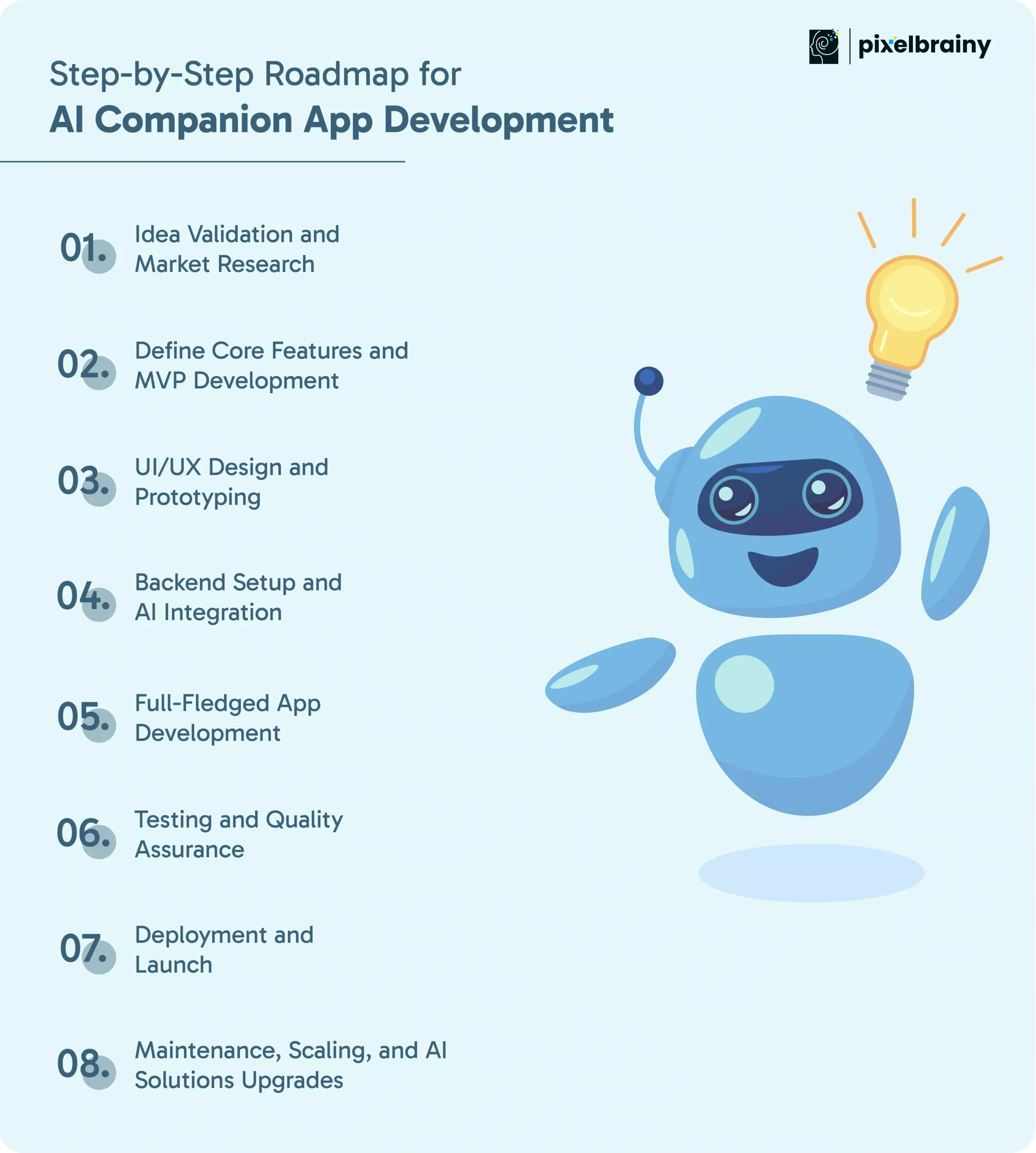
The foundation of developing an AI Companion App begins with validating the idea. You must clearly define the problem your app will solve and identify the right audience. Without validation, you risk building something no one needs.
Why this matters / Aim: Market research ensures your app idea is backed by real demand. The aim here is to minimize risks and confirm that your product will attract users before investing heavily in AI Companion App Development.
Jumping into a full app is risky and expensive. Start small with MVP Development (Minimum Viable Product) for your AI Companion App. This includes only the essential features that prove the app’s value.
Why this matters / Aim: An MVP provides a testable version of your concept. The aim is to validate usability, gather feedback, and reduce risks before scaling into a full-fledged app.
When you make your own AI Companion App, design is critical. Partner with a skilled UI/UX design company to ensure the interface feels approachable and human-like.
Why this matters / Aim: Design defines first impressions and ongoing engagement. The aim is to create comfort and trust, encouraging users to interact with the AI regularly.
The real intelligence of an AI companion comes from robust AI integration. This involves combining scalable backend infrastructure with advanced AI chatbot development frameworks.
Why this matters / Aim: The backend is the heart of the app. The aim is to deliver seamless, intelligent, and secure conversations that scale as the user base grows.
After the MVP succeeds, expand it into a full-fledged app with enhanced functionality. This is where top AI development companies often step in to scale projects.
Why this matters / Aim: The full version offers depth and variety. The aim is to move beyond testing into wide adoption, capturing new audiences and monetization opportunities.
Testing ensures that the app works reliably in all scenarios. This goes beyond bug-fixing to verifying that the AI delivers natural and accurate conversations.
Why this matters / Aim: A glitchy or insensitive companion destroys trust instantly. The aim is to deliver a polished, safe, and consistent user experience.
Launching is not just about uploading to app stores. A well-executed deployment maximizes visibility and adoption.
Why this matters / Aim: A successful launch creates momentum. The aim is to generate traction quickly, helping your AI Companion App climb rankings and attract users.
Also Read: How To Publish An App On Google Play Store In 10+ Easy Steps
Once launched, ongoing support is critical. AI solutions evolve quickly, and user expectations change just as fast.
Why this matters / Aim: Long-term growth depends on adaptability. The aim is to future-proof your app, ensuring it stays competitive in the AI space.
By following this roadmap, businesses can transform an idea into a scalable AI Companion App, moving from MVP to a full-fledged product while continuously adapting to user needs.
Also Read: A Comprehensive Guide To Mobile Application Development
One of the most common questions businesses ask is “What is the cost to build an AI Companion App?” The answer depends on several factors such as features, design complexity, location of the development team, and the level of AI integration.
On average, the AI Companion App development cost ranges from $20,000 to $200,000+ depending on whether you are building a simple MVP or a full-fledged application.
The cost of developing an AI Companion App ultimately depends on your goals, whether you want a lean MVP or a full-scale product with advanced AI solutions. Planning your app development budget carefully ensures you get the right balance between features, performance, and cost efficiency.
Also Read: AI App Development Cost: From MVPs to Full-Scale AI App
The success of AI Companion App Development depends heavily on choosing the right tools and technologies. A strong tech stack ensures smooth conversations, secure data handling, and the ability to scale as user demand grows.
From frontend design to AI integration and backend infrastructure, each layer plays a vital role in shaping how the app performs and feels. The following table outlines the most important components and recommended tools for building a reliable AI Companion App.
| Parameter | Recommended Tools and Tech | Why and When to Use |
| Frontend (Web) | React or Next.js, TypeScript, Tailwind CSS | Fast, component driven UI with strong typing for maintainability. SEO friendly rendering with Next.js and a mature ecosystem |
| Frontend (Mobile) | React Native or Flutter | Single codebase for iOS and Android to reduce cost and time. Near native performance with strong community support |
| Design System and Prototyping | Figma, Storybook | Rapid UI prototyping and handoff to engineering. Living component docs in Storybook keep teams aligned |
| Backend API | Node.js with NestJS or Python with FastAPI | Opinionated frameworks that speed up clean API design. Great ecosystem for auth, validation, and async tasks |
| Realtime Messaging | WebSockets, Socket.IO, or Firebase Realtime DB | Low latency chat and typing indicators. Useful for presence, live sessions, and rapid companion responses |
| Database | PostgreSQL for relational data, Redis for caching | Strong consistency for profiles and subscriptions. Redis boosts response times for session and context reads |
| Vector Store for Memory | Pinecone, Weaviate, or pgvector on Postgres | Store embeddings for long term conversational memory. Enables semantic search over past chats and notes |
| NLP and LLM Access | OpenAI API, Anthropic, or Azure OpenAI | High quality language understanding and generation. Choose provider based on cost, rate limits, and compliance |
| Model Serving and Fine-tuning | Hugging Face Transformers, vLLM, TensorRT-LLM | Host custom or open models when you need control. Use optimized runtimes for throughput and lower latency |
| Speech to Text and Voice | OpenAI Realtime or Whisper, Google Cloud Speech, Amazon Polly | Voice input and natural speech output for hands free use. Improves accessibility and immersion for companions |
| Safety and Moderation | OpenAI Moderation, Google Perspective, custom classifiers | Filter unsafe content and enforce policy rules. Combine automated checks with configurable thresholds |
| Analytics and Events | Mixpanel, Amplitude, Segment | Track funnels, retention, and feature adoption. Data helps tune prompts, flows, and monetization |
| Payments and Subscriptions | Stripe, RevenueCat | Quick setup for trials, tiers, and renewals. RevenueCat simplifies cross platform subscriptions |
| Notifications | Firebase Cloud Messaging, OneSignal, Apple Push | Drive engagement with reminders and check ins. Respect quiet hours and add granular user controls |
| Cloud and Infrastructure | AWS or GCP, Kubernetes, Serverless for bursty loads | Autoscale chat workloads and keep costs predictable. Mix containers for core APIs with serverless for spikes |
| CI/CD and Testing | GitHub Actions, Docker, Playwright, PyTest/Jest | Automate builds and end to end tests for chat flows. Faster releases with reliable rollbacks |
| Monitoring and Logging | Prometheus, Grafana, OpenTelemetry, Sentry | Observe latency and token usage in real time. Trace prompts and responses to diagnose issues quickly |
| Security and Compliance | OAuth 2.0, JWT, Vault or KMS, SOC 2 process | Strong auth and encrypted secrets management. Plan for privacy reviews and audit trails from day one |
| Content and Prompt Management | Prompt layer tools, Feature flags, A/B testing | Version prompts and experiment safely. Roll out changes gradually and measure impact on CSAT |
Tip: start lean with managed services for speed, then shift to self-hosted components where cost, privacy, or latency requires more control.
Selecting the right technology stack is the foundation of AI Companion App Development, ensuring your app remains scalable, secure, and future-ready.
The landscape of AI Companion App Development is evolving rapidly, and 2025 will see significant changes that redefine how people interact with digital companions. Businesses planning to build AI Companion Apps must align with these upcoming shifts to remain competitive.
From advanced personalization to immersive technologies, these trends highlight where the industry is heading.
In 2025, personalization will go beyond remembering a user’s name or preferences. Newer AI models will combine deep learning and behavioral analysis to deliver hyper-personalized experiences. An AI companion will be able to adapt tone, content, and even conversational style depending on the user’s personality, mood, and past interactions.
This goes far beyond today’s personalization, making the experience more human-like and emotionally resonant. Companies investing in this trend will see higher user retention as people form stronger bonds with their digital companions.
The future of AI Companion Apps will not rely on text-only conversations. Instead, multimodal AI will allow companions to process voice, text, and even images or video simultaneously. For example, a fitness companion could analyze a user’s workout form through the camera while giving real-time voice feedback.
This shift toward multimodal communication will make AI companions more engaging and capable of solving real-world problems more effectively.
One of the most impactful trends in AI Companion App Development is the expansion of digital therapy assistants. With mental health challenges increasing worldwide, AI companions are being designed to provide empathetic, 24/7 support.
These apps will use advanced sentiment detection and conversational intelligence to offer therapy-like interactions and mood tracking. While they won’t replace professionals, they will complement traditional care and make mental health support more accessible globally.
Also Read: How To Build An AI Mental Health and Wellness App Like Wysa?
AI Companion Apps will increasingly adopt augmented reality (AR) and virtual reality (VR). Users will be able to interact with their companions in immersive 3D environments, turning conversations into shared experiences like virtual workouts, study sessions, or social hangouts. This trend adds a strong entertainment dimension and could drive the next big wave of adoption.
As AI companions become more personal, handling sensitive conversations and emotional data, data security and ethical AI will become critical. The future of developing AI Companion Apps lies in ensuring compliance with strict privacy regulations (such as GDPR and HIPAA) and deploying transparent AI models.
Users will demand apps that respect boundaries, avoid bias, and provide clear consent options. Companies that prioritize ethical AI will earn long-term trust and loyalty.
Rather than generic companions, the 2025 market will favor niche AI apps tailored to specific industries. For example, AI tutors for education, AI relationship companions, or AI mentors for professional development.
This specialization allows businesses to attract targeted audiences and offer solutions that feel tailor-made. Startups focusing on niche experiences will likely scale faster than those offering broad, one-size-fits-all models.
Monetization will also evolve as users expect more value from their AI companions. The dominant trend will be subscription-based pricing combined with microtransactions. Users may pay for extra personality packs, advanced features, or immersive experiences.
This model ensures recurring revenue for businesses while giving users freedom to customize their digital companion.
These trends highlight the future direction of AI Companion App Development, encouraging businesses to innovate and adopt advanced AI technologies to meet evolving user expectations.
Building a great app is only half the journey. The next challenge is how to make money from AI Companion Apps in a way that feels valuable to users while creating sustainable revenue for businesses.
Since these apps deal with personalization and long-term engagement, choosing the right AI Companion App business model is crucial for success. Below are the top monetization strategies for AI Companion Apps, explained in detail.
With the right monetization strategies, AI Companion Apps can generate recurring revenue while delivering meaningful, personalized value to users.
While developing an AI Companion App presents huge opportunities, it also comes with significant hurdles. From technical limitations to ethical concerns, businesses must be prepared to address these challenges early in the process.
Understanding these obstacles helps teams plan smarter and ensure long-term success in AI Companion App Development.
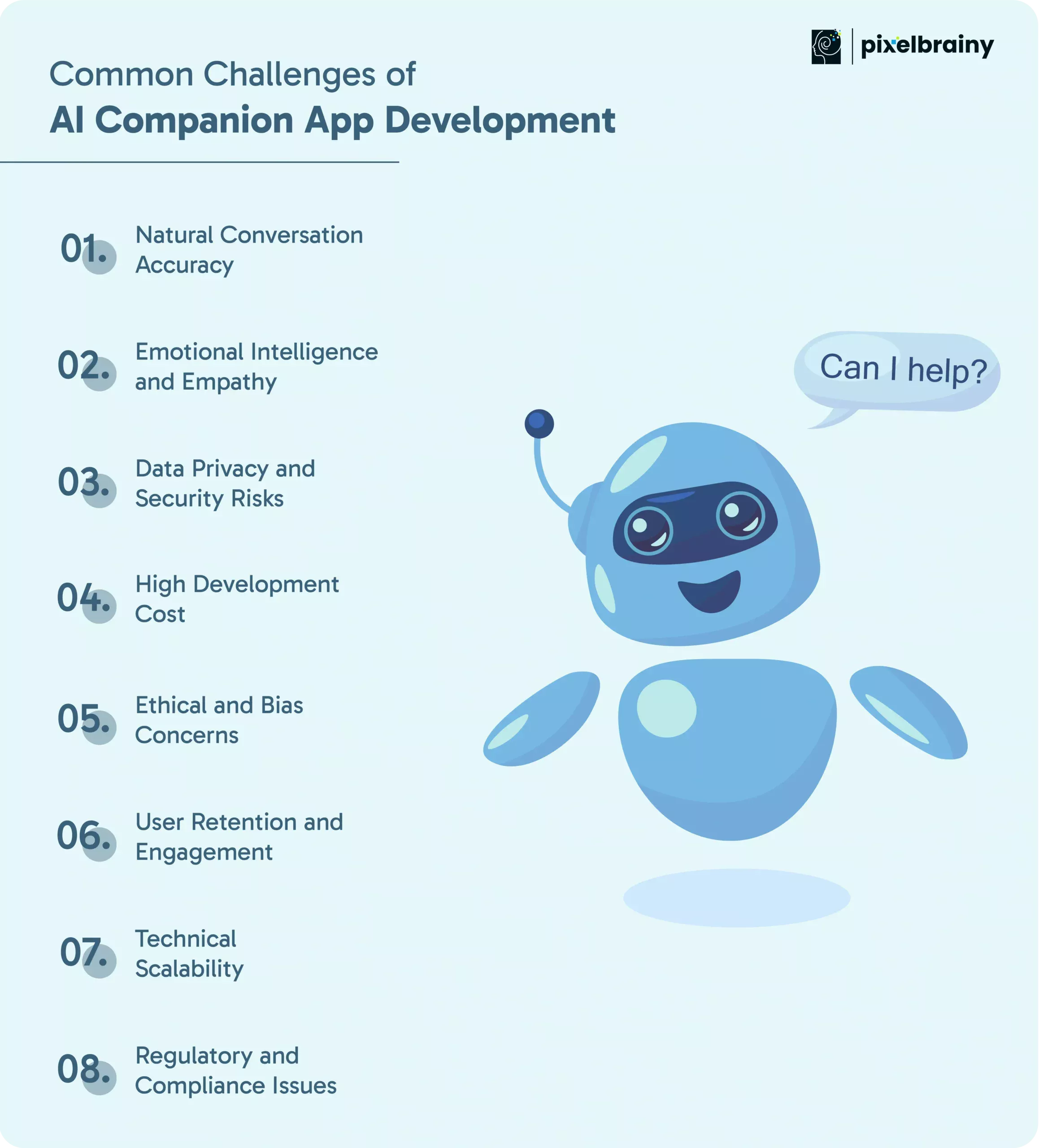
Challenge: AI companions often struggle to maintain fluid, natural, and context-aware conversations. Misunderstandings or robotic replies break user trust.
Solution: Use advanced AI chatbot development frameworks, fine-tune large language models (LLMs), and implement continuous training with real user data to improve contextual accuracy.
Challenge: Building an AI that can detect and respond to human emotions authentically is complex. Poor emotional responses may feel insensitive or inappropriate.
Solution: Integrate sentiment analysis and affective computing to interpret user tone, mood, and emotions. Test extensively with diverse user groups to ensure empathetic responses.
Challenge: AI companions deal with sensitive conversations. Breaches or misuse of data can severely damage credibility.
Solution: Encrypt all user data, adopt compliance standards like GDPR and HIPAA, and prioritize secure AI solutions during development. Transparency in data handling builds trust.
Challenge: The cost of developing an AI Companion App can range from $20,000 for MVPs to over $200,000 for advanced apps, which can overwhelm startups.
Solution: Start lean with MVP Development, validate market fit, and scale gradually. Outsourcing to cost-effective regions while working with top AI development companies can optimize budgets.
Challenge: AI companions may unintentionally reflect biases in training data, leading to harmful or offensive responses.
Solution: Regularly audit AI models, diversify training datasets, and implement content moderation filters. Building ethical AI safeguards ensures inclusive and safe user experiences.
Challenge: Many apps see high initial adoption but struggle to keep users engaged long-term.
Solution: Add gamification, reminders, and hyper-personalized experiences. Regular updates and interactive features keep users returning.
Challenge: As the user base grows, ensuring real-time responses at scale can become difficult.
Solution: Use cloud infrastructure, Kubernetes, and scalable AI solutions. Adopt load balancing and caching systems like Redis to maintain performance.
Challenge: With growing regulations around AI and data privacy, apps face potential legal hurdles across different regions.
Solution: Work with legal advisors during AI Companion App Development to ensure compliance in all target markets. Build flexible systems that adapt to changing regulations.
Overcoming these challenges in AI Companion App Development requires a balanced approach that combines strong technology, ethical safeguards, and user-focused design.
Selecting the right partner for the development of AI Companion App can make the difference between a product that struggles and one that thrives. At PixelBrainy, we bring years of experience in artificial intelligence, mobile solutions, and human-centered design to help businesses build AI Companion Apps that are secure, scalable, and truly engaging.
As a leading AI app development company in USA, we specialize in creating applications that blend cutting-edge technologies like natural language processing (NLP), machine learning (ML), and AI chatbot development with intuitive UI/UX design. Our approach ensures that every companion app not only functions flawlessly but also delivers personalized and emotionally intelligent interactions for users.
One of our recent projects involved creating an AI Wellness Companion App for a healthcare startup based in California. The app used AI integration to provide daily emotional support, stress-relief exercises, and mindfulness check-ins. With HIPAA-compliant data handling and multilingual support, the app attracted over 50,000 active users in its first six months, positioning the client as a rising leader in the digital wellness market.
With PixelBrainy as your trusted AI app development company in USA, you gain a partner who understands both the technology and the user experience needed to build an AI Companion App that stands out in a competitive market.
From above, it’s clear that AI Companion App Development is more than just a technological trend — it represents a new way for people to connect with digital systems that feel intelligent, supportive, and human-like. Businesses that build AI Companion Apps today can unlock opportunities across industries such as healthcare, fitness, education, customer service, and lifestyle. We’ve explored the entire journey, from understanding what these apps are, to the process of developing AI Companion Apps, estimated costs, technology stack, monetization models, and the top trends shaping the future.
As adoption continues to rise, the companies that act now will be the ones leading tomorrow’s market.
Ready to take the next step? Book an appointment with our experts at PixelBrainy to start building your AI Companion App today.
AI Companion Apps are not limited to personal use. Businesses use them for customer engagement, employee wellness, training, and education.
Depending on complexity, an MVP can take 3–5 months, while a full-featured app may require 8–12 months of development.
Yes, basic offline functionality can be added. However, advanced AI features usually require cloud processing for real-time intelligence.
No, they are designed to complement—not replace—human connections by offering support, guidance, and personalized engagement.
Unlike traditional chatbots, AI Companion Apps adapt, learn continuously, and build long-term emotional connections with users.
Absolutely. Apps can be tailored for healthcare, education, lifestyle, or even enterprise use with industry-specific features.

About The Author
Sagar Bhatnagar
Sagar Sahay Bhatnagar brings over a decade of IT industry experience to his role as Marketing Head at PixelBrainy. He's known for his knack in devising creative marketing strategies that boost brand visibility and market influence. Sagar's strategic thinking, coupled with his innovative vision and focus on results, sets him apart. His track record of successful campaigns proves his ability to utilize digital platforms effectively for impactful marketing efforts. With a genuine passion for both technology and marketing, Sagar continuously pushes PixelBrainy's marketing initiatives to greater success.

Working with the PixelBrainy team has been a highly positive experience. They understand the design requirements and create beautiful UX elements to meet the application needs. The dev team did an excellent job bringing my vision to life. We discussed usability and flow. Sagar worked with his team to design the database and begin coding. Working with Sagar was easy. He has the knowledge to create robust apps, including multi-language support, Google and Apple ID login options, Ad-enabled integrations, Stripe payment processing, and a Web Admin site for maintaining support data. I'm extremely satisfied with the services provided, the quality of the final product, and the professionalism of the entire process. I highly recommend them for Android and iOS Mobile Application Design and Development.

Great experience working with them. Had a lot of feedback and I found that unlike most contractors they were bugging me for updates instead of the other way around. They were extremely time conscience and great at communicating! All work was done extremely high quality and if not on time, early! They were always proactive when it comes to communication and the work is great/above par always. Very flexible and a great team to work with! Goes above and beyond to present us with multiple options and always provides quality. Amazing work per usual with Chitra. If you have UI/UX or branding design needs I recommend you go to them! Will likely work with them in the future as well, definitely recommended!

PixelBrainy is a joy to work with and is a great partner when thinking through branding, logo, and website layout. I appreciate that they spend time going into the "why" behind their decisions to help inform me and others about industry best practices and their expertise.

I hired them to design our software apps. Things I really like about them are excellent communication skills, they answer all project suggestions and collaborate right away, and their input on design and colors is amazing. This project was complex and needed patience and creativity. The team is amazing to do business with. I will be using them long-term. Glad to see there are some good people out there. I was afraid to try and outsource my project to someone but I am glad I met them! I really can't say enough. They went above and beyond on this project. I am very happy with everything they have done to make my business stand out from the competition.

It was great working with PixelBrainy and the team. They were very responsive and really owned the project. We'll definitely work with them again!

I recently worked with the PixelBrainy team on a project and I was blown away by their communication skills. They were prompt, clear, and articulate in all of our interactions. They listened and provided valuable feedback and suggestions to help make the project a success. They also kept me updated throughout the entire process, which made the experience stress-free and enjoyable.

PixelBrainy is very good at what it does. The team also presents themselves very professionally and takes care of their side of things very well. I could fully trust them taking up the design work in a timely and organised manner and their attention to detail saved us lots of effort and time. This particular project was quite intense and the team showed that they function very well under pressure. Very much looking forward to working with her again!

It's always an absolute pleasure working with them. They completed all of my requests quickly and followed every note I had for them to a T, which made our process go smoothly from start to finish. Everything was completed fast and following all of the guidelines. And I would recommend their services to anyone. If you need any design work done in the future, PixelBrainy should be your first call!

They took ownership of our requirements and designed and proposed multiple beautiful variants. The team is self-motivated, requires minimum supervision, committed to see-through designs with quality and delivering them on time. We would definitely love to work with PixelBrainy again when we have any requirements.

PixelBrainy was a big help with our SaaS application. We've been hard at work with a new UI/UX and they provided a lot of help with the designs. If you're looking for assistance with your website, software, or mobile application designs, PixelBrainy and the team is a great recommendation.

PixelBrainy designers are amazing. They are responsive, talented, and always willing to help craft the design until it matches your vision. I would recommend them and plan to continue them for my future projects and more!!!

They were awesome! Did a good job fast, and good communication. Will work with them again. Thank you

Creative, detail-oriented, and talented designers who take direction well and implement changes quickly and accurately. They consistently over-delivered for us.

PixelBrainy team is very talented and creative. Great designers and a pleasure to work with. PixelBrainy is an excellent communicator and I look forward to working with them again.

PixelBrainy has a very talented design team. Their work is excellent and they are very responsive. I enjoy working with them and hope to continue on all of our future projects.


Transform your ideas into reality with us.
Across these industries, each engagement brings unique challenges, from early-stage product development to scaling complex systems, helping us build a practical understanding of real-world product environments.