
 AI Summary Powered by PixelBrainy
Have you ever wondered how traders can get personalized insights, real-time strategies, and expert-level guidance without hiring a human coach? The answer lies in AI Trading Coach Apps. These intelligent platforms are transforming the way individuals and professionals approach financial markets by providing instant analytics, behavior tracking, and adaptive coaching powered by artificial intelligence.
For businesses and entrepreneurs looking to enter this space, the question is not why but how to build an AI Trading Coach App that truly makes a difference. The surge in demand for smart financial tools means more people are eager to learn how to create AI Trading Coach App solutions that deliver measurable value. With the growing competition, aligning with the top AI trading software development companies becomes essential for ensuring innovation, compliance, and performance.
The development of AI Trading Coach App involves more than just coding. It is about blending advanced technologies with financial expertise to craft an intuitive platform that helps users trade smarter, avoid costly mistakes, and improve profitability. Whether you are an investor, fintech startup, or established enterprise, the opportunity to tap into Trading Coach App Development with AI is immense.
In this blog, we will walk you through everything you need to know—from understanding what an AI Trading Coach App is, to exploring features, costs, and monetization strategies. By the end, you will have a complete roadmap to confidently step into the future of trading technology.
An AI Trading Coach App is an intelligent financial application built to guide traders in making smarter, faster, and more confident decisions in the market. Unlike basic trading platforms that only display charts or news updates, this type of app functions like a virtual mentor, offering personalized coaching, real-time recommendations, and advanced market analysis powered by artificial intelligence.
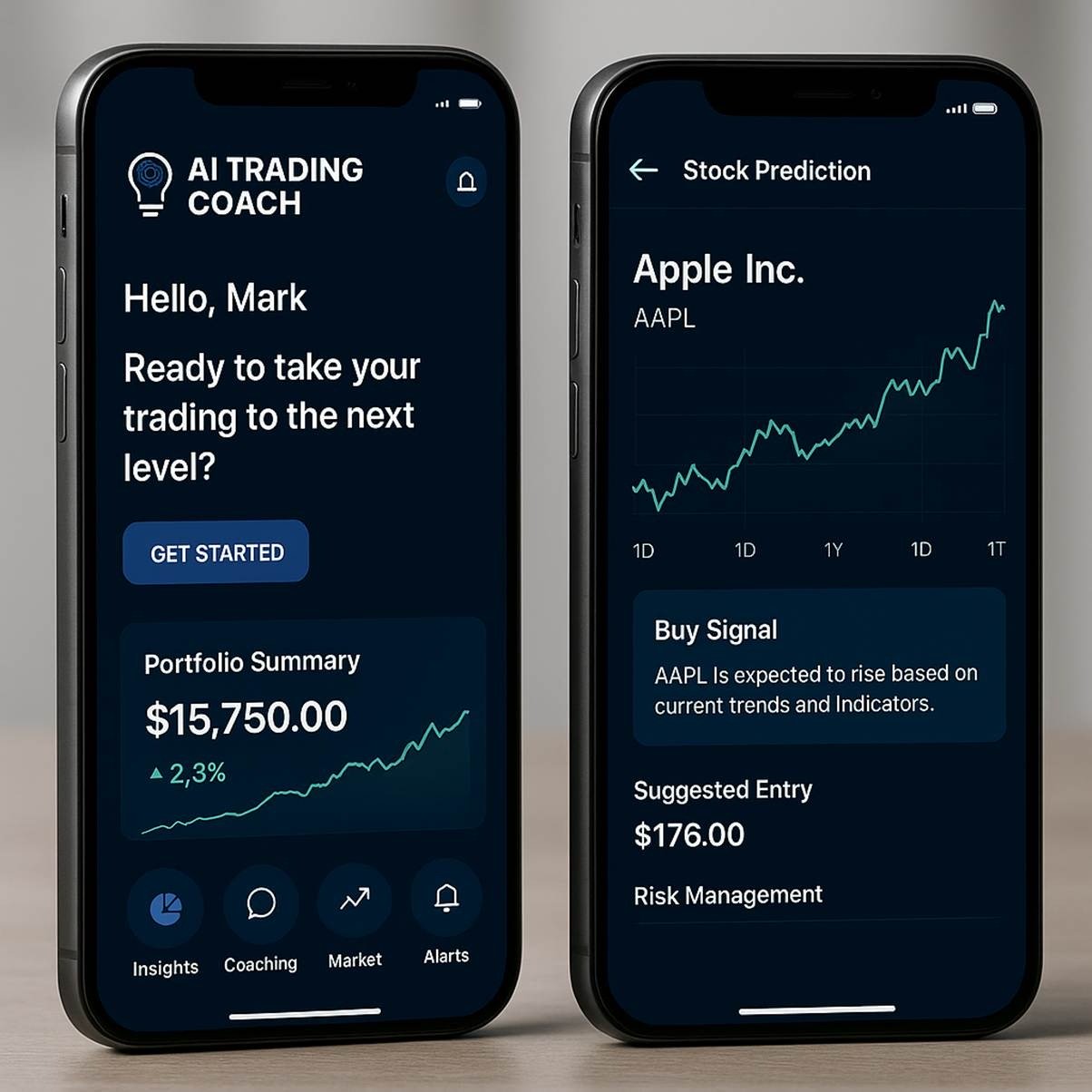
These apps rely on technologies such as machine learning, predictive analytics, and natural language processing to monitor both global market movements and individual user behavior. By analyzing this data, the app can deliver tailored insights, explain risks, and suggest strategies that align with the trader’s goals and risk tolerance. Beginners benefit from structured learning tools, simulations, and guided recommendations, while experienced traders gain access to deeper analytics, forecasting models, and portfolio optimization features.
The functionality of an AI Trading Coach App can be understood through three core layers:
By combining these elements, an AI Trading Coach App becomes more than a tool—it evolves into a 24/7 trading companion that adapts to individual needs and ensures traders are equipped to make informed decisions in fast-moving markets.
When it comes to trading education and guidance, both traditional trading coach apps and AI-powered trading coach apps serve the same purpose of helping traders improve decision-making. However, the way they operate, the level of personalization, and the overall value they deliver are significantly different.
Traditional trading coach apps are typically rule-based and limited to static educational content, pre-set strategies, and generic tutorials. They provide resources but often lack adaptability to an individual trader’s performance or changing market dynamics.
On the other hand, AI Trading Coach Apps introduce intelligent automation, predictive analysis, and personalized recommendations. By leveraging machine learning and real-time data, these apps learn from each user’s behavior and provide tailored coaching that evolves with market conditions. This makes them more engaging, accurate, and future-ready compared to traditional platforms.
| Feature/Aspect | Traditional Trading Coach App | AI Trading Coach App |
| Learning Content | Pre-recorded tutorials, e-books, and fixed lessons | Adaptive learning modules, AI-driven personalized education paths |
| Market Analysis | Basic charts and manual analysis tools | Real-time predictive analytics, automated risk assessment, sentiment analysis |
| Personalization | Limited to generic tips and static strategies | Fully customized recommendations based on user behavior and market conditions |
| User Engagement | Passive learning, user has to interpret data | Interactive guidance, chatbots, alerts, and scenario-based suggestions |
| Data Utilization | Limited use of historical data | Real-time integration of global market feeds, social sentiment, and user-specific performance |
| Decision Support | User-dependent, requires manual interpretation | AI-driven suggestions for entry, exit, stop-loss, and diversification |
| Scalability | Difficult to scale beyond fixed content | Highly scalable with AI algorithms improving continuously |
| Future Readiness | Static, requires manual updates | Dynamic, evolves with AI improvements and market trends |
Traditional trading coach apps provide value for beginners who want static learning resources, but they cannot match the depth and intelligence of AI-based platforms. An AI Trading Coach App adapts to the user, predicts future movements, and delivers actionable strategies, making it the preferred choice for modern traders seeking a competitive edge.
The global trading ecosystem is evolving rapidly, with technology playing a critical role in reshaping how people engage with financial markets. According to Precedence Research, the AI trading platform market is valued at USD 13.52 billion in 2025 and is expected to reach USD 69.95 billion by 2034, growing at a CAGR of 20.04%.
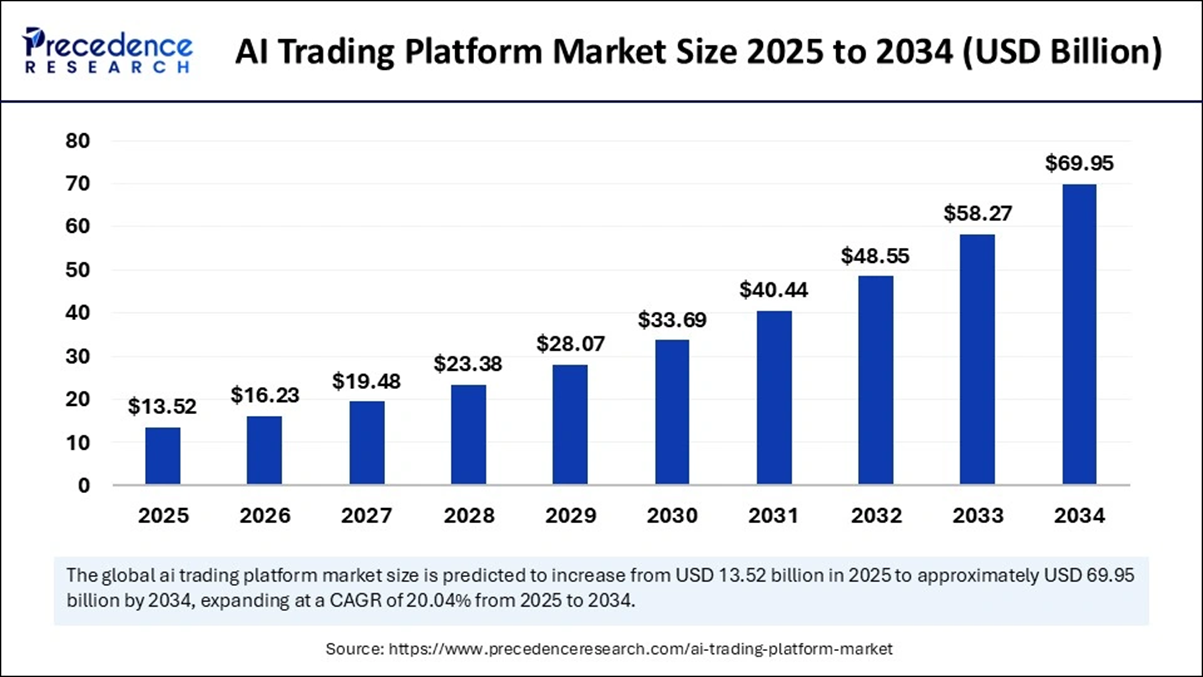
This futuristic growth outlook underlines the rising demand for intelligent platforms that combine AI with trading guidance. For businesses, this presents an exceptional opportunity to invest in AI Trading Coach App development and stay ahead in one of the fastest-growing fintech sectors.
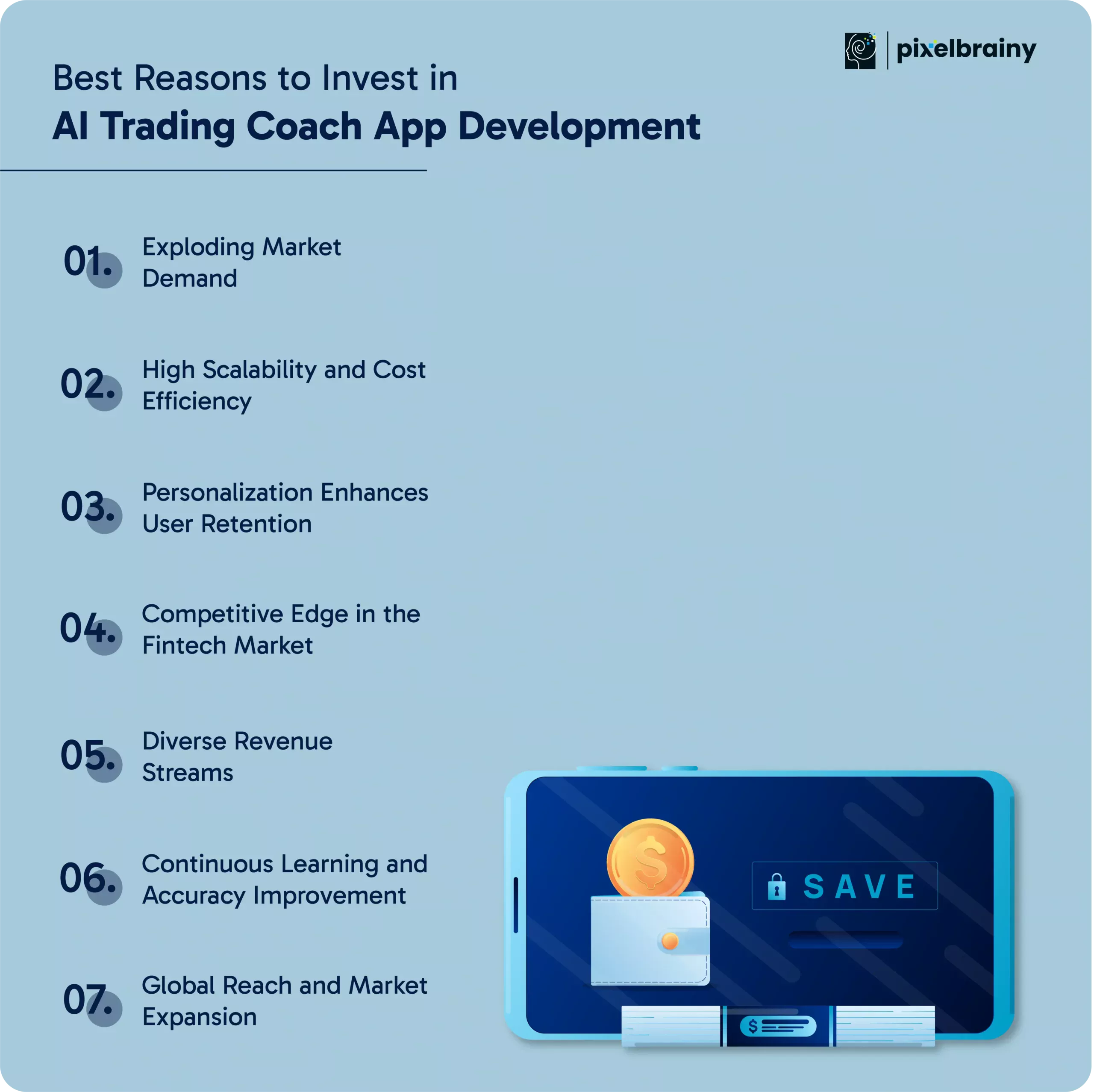
More traders are entering the market than ever before, from beginners exploring stock and crypto investments to professional traders managing complex portfolios. Traditional apps often fail to provide adequate support in real-time market situations. AI-powered apps fill this gap by offering predictive analysis, real-time alerts, and personalized coaching that adapts to live market conditions. This rising demand ensures that businesses developing AI trading coach apps will find a ready and growing audience.
One of the biggest advantages of AI technology is its scalability. Once the AI infrastructure and algorithms are designed, they can support thousands of users without requiring proportional increases in staffing or resources. Instead of hiring multiple human coaches, one AI-driven system can handle complex data and deliver customized insights at scale. This efficiency not only reduces operational costs but also maximizes profitability as the user base grows.
Modern traders are not looking for generic strategies; they expect tools that understand their personal trading behavior, risk appetite, and goals. AI allows apps to track individual performance, adapt strategies over time, and deliver recommendations uniquely suited to each user. This personalized experience builds trust and creates stronger engagement, significantly improving user retention and reducing churn rates.
The trading app industry is crowded, but most platforms still rely on static educational resources or basic analysis tools. An AI trading coach app stands out by offering unique features like adaptive coaching modules, sentiment analysis, and predictive trade recommendations. Such differentiation is vital for gaining a competitive advantage and positioning your brand as an innovative leader in the fintech market.
AI trading coach apps open the door to multiple monetization opportunities. Beyond the traditional subscription model, developers can integrate premium features, offer advanced strategy packs, collaborate with brokerages for referral fees, or include in-app purchases. The value of AI-driven insights also makes users more willing to pay for premium upgrades, ensuring strong long-term revenue potential.
Unlike static software, AI models are designed to learn and evolve. As more market data and user interactions flow into the system, the algorithms become smarter and more accurate. This leads to continuous improvement in predictions, recommendations, and coaching quality. The result is a platform that grows stronger over time, delivering better outcomes for users and establishing the app as a trusted trading partner.
Financial trading is global, and the ability of AI apps to adapt across regions makes them highly scalable internationally. With the right localization, these apps can comply with different regulations, support multiple languages, and cater to diverse trading instruments such as stocks, forex, and cryptocurrencies. This global adaptability allows businesses to expand beyond local markets and tap into a worldwide audience of traders.
Investing in AI Trading Coach App development today means securing a future-ready position in the rapidly expanding fintech market.
When businesses explore AI Trading Coach App development, the first decision is to choose the type of app that aligns with user expectations and market goals. Different categories address varying levels of trading expertise, from beginner-friendly coaching to advanced analytics and real-time execution. Selecting the right model ensures that your app delivers value, scalability, and long-term profitability.
These apps are designed for individuals who are new to trading and need structured guidance. They focus on teaching fundamentals, offering practice simulations, and providing simple insights in a user-friendly format. By reducing complexity, they encourage new users to trade with confidence. They also build trust by gradually exposing users to advanced tools as they gain more experience.
If your goal is to build AI Trading Coach App solutions for professional or semi-professional users, market analysis apps are the ideal choice. They analyze global data, track trends, and generate predictions that help traders make informed decisions. Such apps often integrate advanced tools for charting, forecasting, and sentiment analysis. They are popular with both active traders and professionals who rely on fast, accurate insights to maximize performance.
For investors managing multiple assets, developing AI Trading Coach App solutions around portfolio optimization can be highly impactful. These apps go beyond simple coaching to provide recommendations on asset balancing, diversification, and long-term wealth strategies. With AI, they adapt continuously as market dynamics and user goals evolve. They are especially valuable for investors who want to minimize risk while ensuring stable long-term growth.
The most advanced category focuses on Trading Coach App development using AI that merges coaching with real-time execution. Users can act on recommendations without switching platforms, creating a seamless trading experience. These apps often partner with brokerages or exchanges to enable secure and fast transactions. They deliver convenience by reducing the gap between analysis, decision-making, and execution, making them highly attractive for active traders.
By selecting the right type of AI Trading Coach App, businesses can ensure they meet user needs effectively while capturing a strong position in the competitive fintech market.
Also Read: How to Create AI Stock Trading Bot
To make your app effective, it is essential to integrate a strong set of core functionalities. These features not only enhance usability but also ensure that users get maximum value from the platform. A well-planned AI Trading Coach App development process always begins with prioritizing these fundamentals.
| Key Feature | Explanation |
| User-Friendly Dashboard | A clean dashboard allows traders to see performance summaries, insights, and alerts in one place. It ensures a smooth navigation experience and encourages longer usage time. |
| Real-Time Market Data | Continuous market updates for stocks, forex, and crypto help traders stay informed. Accurate feeds are crucial for making timely and profitable trading decisions. |
| Personalized Learning Paths | The app adapts to each user’s skill level and progress. New traders get simplified lessons, while experienced users receive advanced modules. |
| Trade Simulation Tools | Virtual trading features allow users to practice without financial risks. Simulations help build confidence and provide a safe learning environment. |
| Risk Management Alerts | AI-driven alerts notify users of potential risks in their trades. This feature safeguards traders from unnecessary losses by suggesting smarter stop-loss levels. |
| Performance Analytics | Detailed analytics track user trading history and profitability. This helps users understand their strengths, weaknesses, and patterns over time. |
| Multi-Asset Support | Traders can manage stocks, forex, crypto, and commodities in one platform. Offering multi-asset coverage widens the user base and increases engagement. |
| Integrated News Feed | Real-time financial news and sentiment updates help users understand market context. News integration adds credibility and boosts decision-making. |
| Chatbot Assistance | AI-powered chatbots provide instant responses to user queries. This feature reduces support costs and improves customer satisfaction. |
| Secure Login & Data Encryption | Strong authentication and encryption ensure data security. With financial apps, trust and security are critical for retaining users. |
Strong foundational features create the backbone of a reliable trading platform and set the stage for advanced innovations in your app.
While core features make the app functional, advanced functionalities elevate it to the next level. By focusing on innovation, you can create unique user experiences that differentiate your platform.
These additions are vital when developing AI Trading Coach App solutions that stand out in a competitive fintech environment.
| Advanced Feature | Explanation |
| AI-Powered Predictive Analytics | Advanced algorithms forecast market movements with high accuracy. This empowers users to plan trades more strategically. |
| Natural Language Processing Assistants | NLP allows the app to understand queries in human language. Users can ask questions and get personalized responses in seconds. |
| Voice Commands for Trading | Traders can use voice instructions to place or exit trades. This hands-free feature improves accessibility and efficiency. |
| Social Sentiment Analysis | AI monitors news and social platforms to detect investor sentiment. It gives users an edge by predicting market psychology. |
| Automated Portfolio Rebalancing | The app can automatically adjust portfolios based on risk tolerance. This ensures long-term stability and better asset allocation. |
| Gamified Learning and Rewards | Gamification keeps users motivated by rewarding achievements. It makes trading education more engaging and enjoyable. |
| AI-Powered Fraud Detection | Intelligent systems monitor unusual activities to prevent fraud. This builds user trust and ensures compliance with regulations. |
| API Integration with Brokerages | Seamless integration with leading brokers allows users to trade instantly. It eliminates the need to switch between platforms. |
| Multi-Language Global Support | Localization features help attract global users. Supporting multiple languages widens market reach significantly. |
| Customizable Coaching Modules | Users can tailor the coaching experience according to their goals. This personalization improves satisfaction and retention. |
Adding advanced features ensures your platform evolves beyond basic functionality and becomes a truly intelligent trading companion.
For businesses and entrepreneurs planning to enter fintech, knowing what is the process to develop AI Trading Coach App is essential. The right roadmap ensures faster delivery, reduced risks, and higher chances of success.
Whether you are a startup or an established enterprise, understanding the step-by-step approach to AI Trading Coach App Development will help you turn ideas into scalable products.
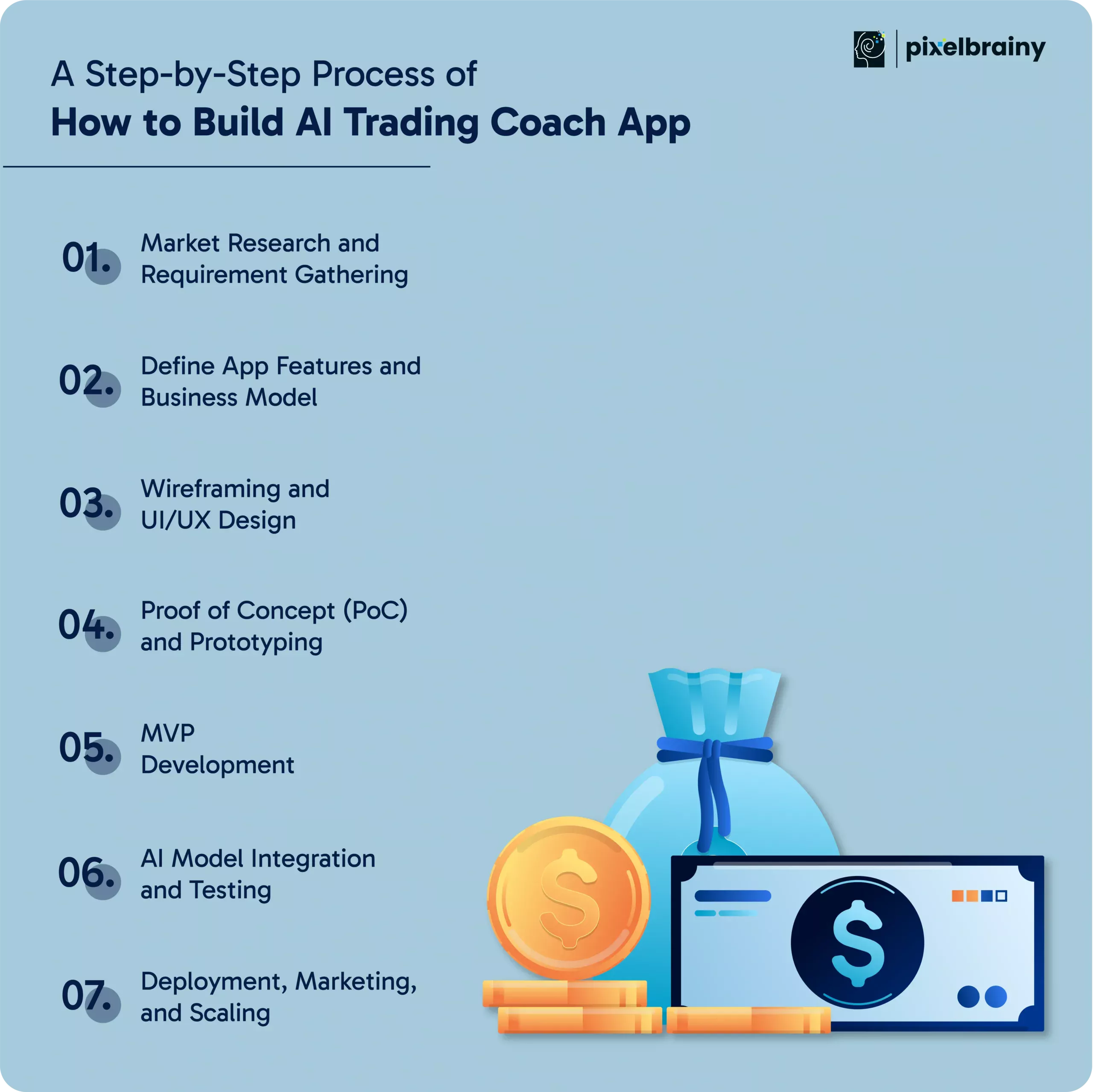
The first stage in building an AI Trading Coach App is understanding the audience you want to serve. Are they beginners looking for guided learning or advanced traders seeking predictive analytics? Knowing your audience will shape your app’s direction.
In this step, in-depth research is conducted to analyze competitors, identify gaps, and define opportunities. Gathering user requirements ensures the app solves real problems instead of just replicating existing tools.
Aim/Goal: To identify the right target audience, discover unmet needs, and set a strong foundation for the app’s direction.
Once research is complete, the next task is outlining what the app will offer. Essential features such as dashboards, real-time analytics, and coaching modules need to be clearly defined. Advanced elements like trade simulations or AI-powered alerts can also be mapped for future updates.
At this stage, the business model is also finalized. Will you monetize through subscriptions, freemium tiers, or partnerships with brokerages? A well-thought-out plan ensures the app is sustainable and profitable.
Aim/Goal: To create a roadmap of core features and define how the app will generate consistent revenue.
Design is the first thing users notice, and it can make or break their experience. Partnering with a professional UI/UX design company ensures the interface is visually appealing and easy to navigate. A well-structured design reduces learning curves and increases user satisfaction.
Wireframes help visualize the app’s flow, ensuring clarity before development begins. Investing in design early creates a product that feels intuitive for both beginners and experienced traders.
Aim/Goal: To deliver a seamless user experience that makes trading insights easy to access and engaging to use.
Before diving into full-scale development, a PoC is created to validate the idea. This lightweight version proves whether the concept is technically feasible and practically useful.
Prototypes go one step further, demonstrating how the app will function. They provide stakeholders and investors with a tangible vision, reducing risks of misaligned expectations and wasted resources.
Aim/Goal: To validate the technical feasibility of the idea and secure stakeholder confidence before large-scale investment.
Instead of building everything at once, start with MVP development. An MVP focuses on delivering only the core features that users need most, allowing faster entry into the market.
This stage also helps collect real feedback from actual users. Based on this feedback, developers can refine features, fix issues, and gradually add enhancements that align with user demands.
Aim/Goal: To launch a functional version quickly, test the market response, and iterate based on real-world user feedback.
Here comes the heart of Intelligence AI Trading Coach App Development. AI models, including machine learning, NLP, and predictive algorithms, are integrated into the system. These enable the app to analyze real-time data, identify patterns, and deliver coaching tailored to individual users.
Extensive testing is then carried out. Functional testing ensures features work as expected, while load testing verifies performance under heavy user traffic. Security checks also play a crucial role in protecting sensitive financial data.
Aim/Goal: To embed advanced AI capabilities into the app and ensure the system performs with accuracy, scalability, and security.
Once the app is ready, it’s time to create AI Trading Coach App for public release. Deployment involves setting up backend infrastructure, publishing on app stores, and ensuring server reliability.
Marketing strategies are equally important. Through targeted campaigns, influencer partnerships, and digital ads, the app gains traction in the competitive fintech landscape. Continuous updates, bug fixes, and new feature rollouts help the app scale and maintain long-term success.
Aim/Goal: To successfully launch the app, attract users, and grow the platform with continuous updates and marketing efforts.
By following these seven structured steps, businesses can transform an idea into a powerful AI Trading Coach App that is scalable, profitable, and future-ready.
Also Read: AI Trading Agent Development: Benefits and Features
For businesses and startups interested in fintech, one of the most common questions is what is the cost to build AI Trading Coach App. The investment varies significantly depending on the features, complexity, technology stack, and the level of intelligence you want to integrate into the platform.
On average, the AI Trading Coach App development cost ranges between $20,000 and $30,000+. This estimate covers core features, initial AI integration, UI/UX design, and deployment. However, the cost can increase if advanced functionalities such as voice-based trading, automated portfolio rebalancing, or brokerage API integrations are included.
It’s also important to note that the cost of building AI Trading Coach App depends on factors such as developer expertise, region of the development team, and whether you choose to build from scratch or leverage existing frameworks. A team with expertise in fintech and AI will typically charge higher but ensure long-term quality, security, and scalability.
To provide a clearer understanding, here is a breakdown of the development cost of Trading Coach App using AI, categorized into three types:
| Type of App | Estimated Cost | What You Get |
| Basic AI Trading Coach App | $20,000 – $25,000 | Includes essential features like dashboards, real-time data feeds, beginner tutorials, and basic AI-driven recommendations. Suitable for startups testing the market or those targeting entry-level traders. |
| Medium AI Trading Coach App | $25,000 – $30,000 | Offers advanced features such as portfolio management, predictive analytics, integrated news feeds, and AI-powered chatbots. Ideal for businesses targeting intermediate traders who demand more intelligent insights. |
| Advanced AI Trading Coach App | $30,000 – $50,000+ | Comes with full-scale AI capabilities, including NLP assistants, automated portfolio rebalancing, social sentiment analysis, and brokerage integrations. Perfect for enterprises looking to launch a comprehensive solution with global reach. |
Beyond initial development, businesses must also consider maintenance, updates, cloud hosting, and security audits. These ongoing costs ensure the app remains competitive, secure, and aligned with ever-changing market trends.
Investing wisely in development not only helps deliver a high-quality product but also ensures scalability and long-term sustainability in a fast-growing AI trading market.
Choosing the right budget tier ensures you balance cost with functionality and create an AI Trading Coach App that meets both user needs and business goals.
Also Read: How Much Does AI Trading Agent Development Cost?
The strength of any digital product lies in the technology that powers it. When it comes to AI Trading Coach App development, choosing the right set of tools and frameworks is vital to ensure scalability, performance, and security.
Each layer of development, from the frontend design to AI integration and cloud deployment, contributes to building a reliable and future-ready trading platform.
| Development Layer | Tools/Technologies | Explanation |
| Frontend Development | React Native, Flutter, Angular | These frameworks provide responsive, cross-platform interfaces. They ensure smooth navigation, quick rendering, and compatibility with both iOS and Android users. |
| Backend Development | Node.js, Python (Django/Flask), Java | Backend tools manage server-side logic and app performance. They support high loads, deliver stability, and connect users with AI-powered services seamlessly. |
| AI & Machine Learning | TensorFlow, PyTorch, Scikit-learn | These frameworks enable predictive analytics, pattern recognition, and recommendation systems. They form the core intelligence behind trading decisions and insights. |
| Natural Language Processing (NLP) | OpenAI GPT APIs, spaCy, NLTK | NLP tools process user queries and deliver human-like responses. They power chatbots, sentiment analysis, and intelligent coaching interactions. |
| Database Management | PostgreSQL, MongoDB, Firebase | Databases securely store user information, trade history, and analytics data. They ensure fast retrieval and strong security compliance. |
| Cloud Hosting & Deployment | AWS, Microsoft Azure, Google Cloud | Cloud services provide scalability, reliable storage, and global accessibility. They help maintain uptime and manage large trading datasets efficiently. |
| Data Feeds & Market APIs | Alpha Vantage, Yahoo Finance API, IEX Cloud | These APIs deliver real-time stock, forex, and crypto market data. Accurate feeds are essential for providing timely recommendations and alerts. |
| Security Frameworks | OAuth 2.0, SSL, Biometric Authentication | Security layers protect sensitive financial transactions and user data. Multi-level authentication ensures trust and compliance with global regulations. |
| Testing Tools | Selenium, JUnit, Appium | Testing tools validate performance, security, and user experience. They ensure a bug-free launch and smooth functioning post-deployment. |
| DevOps & CI/CD | Docker, Kubernetes, Jenkins | These tools automate deployment, manage containerized environments, and ensure continuous integration for rapid scaling and updates. |
Using the right combination of AI frameworks, APIs, and cloud technologies ensures the success of your AI Trading Coach App development journey.
Building an AI Trading Coach App is not just about delivering value to users; it’s also about creating a sustainable and profitable business model. With the rise of fintech solutions and the global demand for intelligent trading assistants, there are several effective ways to monetize such an application. Each revenue model can be tailored depending on your target audience, market positioning, and growth strategy.
One of the most common revenue models is offering tiered subscription packages. Users can access basic features for free, while advanced functionalities like AI-driven insights, premium coaching modules, and detailed market predictions are unlocked through monthly or yearly plans. This model provides predictable recurring revenue and allows businesses to scale steadily.
The freemium approach attracts a larger user base by giving free access to essential features. Once users see the value, they are more likely to purchase additional tools such as advanced risk analysis, specialized coaching packs, or premium alerts. In-app purchases enhance user engagement while maximizing lifetime customer value.
Integrating with brokerage platforms creates another income channel. Every time a user executes trades via the app, the platform can earn a referral fee or commission. This model aligns profitability with user activity and strengthens partnerships within the trading ecosystem.
Some users, particularly professional traders, may pay extra for exclusive content such as advanced AI predictions, deep-dive market reports, or strategy backtesting results. Offering premium insights positions the app as a trusted expert resource.
For apps with a large user base, advertising can be a lucrative option. Displaying relevant ads, sponsored tutorials, or brokerage promotions generates additional revenue. However, it is important to balance ads with user experience to avoid frustration.
If your app is built with strong AI capabilities, other fintech startups or financial institutions may want to license it. White labeling allows you to sell the core technology under different brand names, creating a B2B revenue stream in addition to your consumer base.
By partnering with educational platforms, trading tool providers, or financial services, your app can generate affiliate income. Every time users sign up for a recommended service through your app, you earn a commission. This works especially well in niche markets like crypto trading.
Aggregated and anonymized user behavior data can be extremely valuable for financial institutions, hedge funds, or market researchers. Selling insights derived from this data creates an additional revenue channel, provided it is done ethically and within compliance regulations.
By combining multiple monetization strategies, an AI Trading Coach App can generate consistent revenue streams while delivering long-term value to both beginners and professional traders.
Also Read: How to Develop AI Trading Software
Creating a powerful and reliable AI Trading Coach App requires more than just technical expertise. Success depends on strategic planning, execution, and continuous improvement.
By following best practices in AI Trading Coach App development, businesses can ensure better performance, user adoption, and long-term growth. Below are the six key practices every entrepreneur or fintech company should focus on.
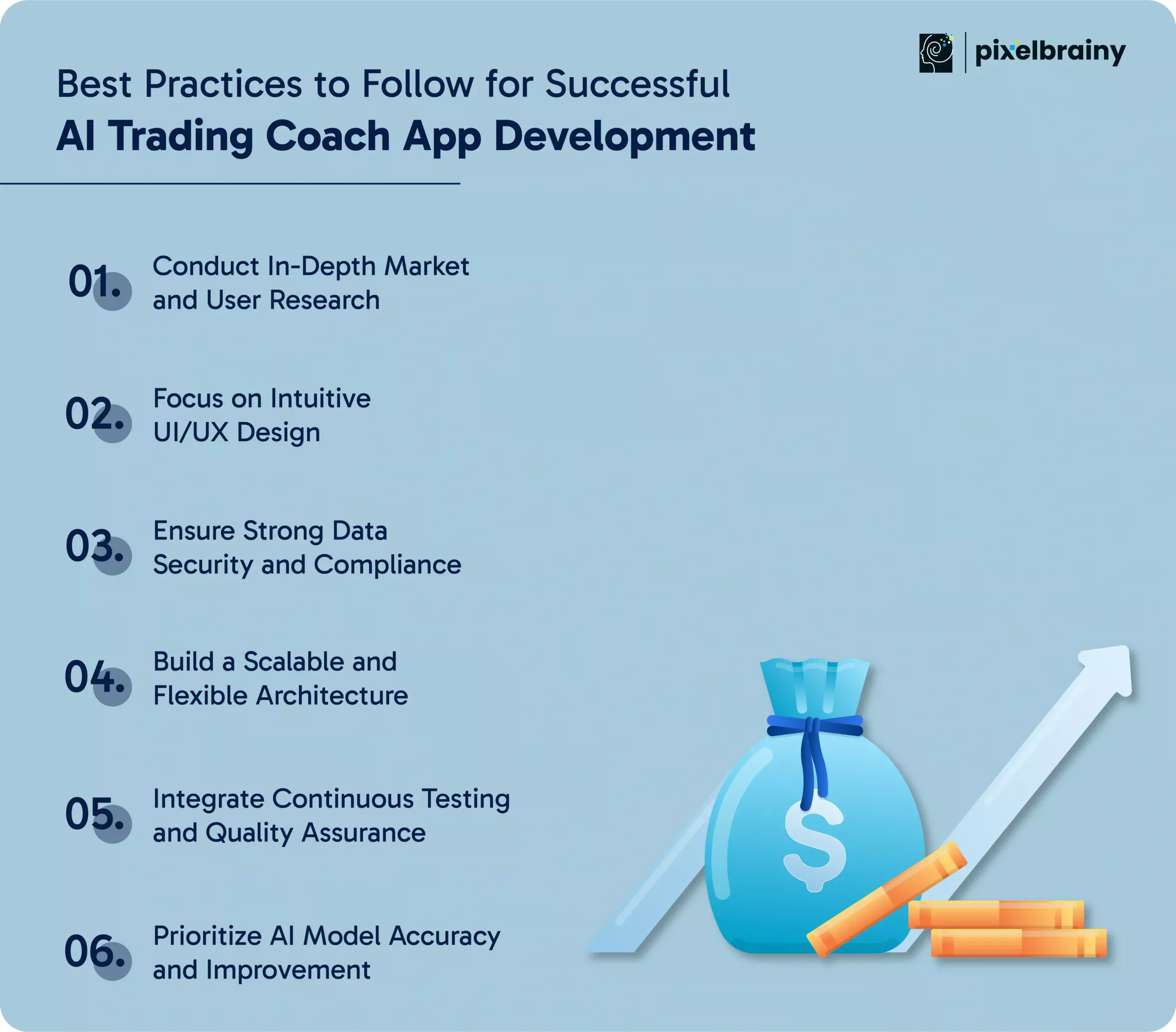
Understanding the market landscape is the first step to building a valuable product. Thorough research helps identify gaps, user pain points, and competitor weaknesses.
An app’s design directly impacts engagement and retention. Clean layouts and smooth navigation make users trust the product more quickly.
Financial apps deal with highly sensitive user data. A lack of security can break user trust and damage credibility.
Scalability is essential when planning for long-term growth. A flexible infrastructure ensures your app can adapt as more users join.
Testing is a critical step in ensuring reliability. Continuous QA prevents bugs and ensures smooth operations.
The true value of an AI Trading Coach App lies in the intelligence it delivers. AI models must be accurate and constantly improving.
By following these best practices, businesses can ensure their AI Trading Coach App is not only innovative but also secure, scalable, and trusted by users worldwide.
While AI Trading Coach App development opens opportunities for innovation and profitability, it also comes with technical, financial, and operational challenges. Entrepreneurs and fintech companies must prepare for these hurdles to ensure smooth execution.
Addressing them early helps reduce risks and ensures the success of your Trading Coach App development using AI. Below are the key challenges and their solutions.
AI models rely on large volumes of accurate market and user data. Poor-quality or incomplete data can lead to inaccurate predictions.
Solution:
The AI Trading Coach App development cost can be significant, especially for startups with limited budgets. Building advanced AI models, secure infrastructure, and cross-platform apps requires heavy investment.
Solution:
Financial apps operate under strict regulations. Non-compliance can lead to legal issues, fines, or even product bans.
Solution:
Handling sensitive financial and personal data makes apps a target for cyberattacks. Any breach can destroy user trust.
Solution:
If models are not trained properly, they can produce biased or inaccurate insights, leading to poor trading outcomes.
Solution:
Seamless execution requires integration with multiple brokers and exchanges. Poor integration can create friction for users.
Solution:
Even a feature-rich app can struggle if users find it difficult to use or fail to see continuous value.
Solution:
By identifying challenges early and applying smart solutions, businesses can transform developing AI Trading Coach App from a risky venture into a scalable, profitable, and user-trusted product.
The trading industry is evolving rapidly, and AI is at the center of this transformation. As fintech companies continue to innovate, the future of Trading Coach App development with AI promises even smarter tools, deeper personalization, and stronger integration with global financial systems.
Businesses that embrace these trends will gain a competitive advantage and capture the attention of modern traders.
AI trading apps of the future will go beyond standard recommendations and deliver coaching that feels like it was designed for each individual. Instead of generalized alerts, the app will adapt insights based on trading history, risk appetite, and even emotional trading patterns.
The result will be a platform that evolves alongside its users. As beginners grow into advanced traders, the app will upgrade the complexity of its coaching modules and adjust strategies accordingly.
Generative AI will play a significant role in transforming user interactions. Future trading assistants will not only provide numbers and predictions but also explain complex financial patterns in simple, conversational language.
Traders will be able to ask questions such as “Why is the market down today?” and receive clear, AI-generated explanations backed by real-time data. This creates a 24/7 virtual mentor experience that feels closer to a human trading coach.
Currently, most apps focus on a limited set of markets such as stocks, forex, or crypto. Future AI trading apps will expand into multi-asset ecosystems, offering access to commodities, real estate-backed tokens, NFTs, and other emerging asset classes.
This expansion will allow users to manage diversified portfolios from one platform, increasing convenience while meeting the demands of global investors seeking broader opportunities.
Instead of simply analyzing past data, AI will create predictive simulations that show traders how different strategies could perform under varied conditions. For example, users might test their approach in a simulated bear market or a sudden economic crisis scenario.
These simulations will prepare traders to respond confidently to real-world events. By practicing in AI-generated scenarios, users can reduce risk and increase their chances of long-term success.
The integration of voice technology will make trading more seamless. Instead of navigating through menus, traders will simply speak commands like “Show me today’s top five AI stock picks” or “Execute a buy order at the next dip.”
This hands-free trading will improve accessibility for all users, especially for those who prefer multitasking or need quicker responses in fast-moving markets.
AI will increasingly tap into social media platforms, forums, and global news to analyze market sentiment. Monitoring millions of conversations in real time will give traders insights into how collective behavior could impact asset prices.
For instance, if online discussions about a particular cryptocurrency spike, the app can predict potential market volatility and alert users ahead of time. This predictive capability will become a game-changer in modern trading.
With AI taking on such an important role in financial decision-making, ethics will become a central focus. Traders will demand transparency in how algorithms generate predictions and ensure that models are free from bias.
Future apps will likely include explainable AI features, allowing users to see the reasoning behind each recommendation. Responsible AI practices will also emphasize privacy protection and regulatory compliance to build long-term trust.
Future apps will not just connect with a handful of brokers; they will integrate deeply into global brokerage networks and exchanges. This will enable traders to act instantly on AI recommendations without switching between platforms.
Such integration will not only speed up transactions but also improve security and reduce errors, creating a unified trading experience that is both efficient and user-friendly.
To make trading more engaging, AI trading apps will incorporate gamified features such as challenges, leaderboards, and reward systems. Users may be rewarded for completing learning modules or achieving certain profit milestones.
Additionally, community features will allow traders to connect, share insights, and learn collaboratively. This blend of social engagement and gamification will make trading more interactive and less intimidating, especially for beginners.
Future apps will take risk management to an advanced level. Instead of sending basic alerts, AI will constantly monitor open positions, assess volatility, and adjust recommendations instantly to minimize potential losses.
For example, if market conditions shift rapidly, the app could suggest altering stop-loss levels or exiting trades early. This real-time, proactive approach will provide users with an extra layer of financial protection.
By keeping pace with these evolving trends, businesses can ensure their development of AI Trading Coach App remains relevant, competitive, and capable of meeting the changing expectations of global traders.
Also Read: Top 16+ Trading Software Development Companies in USA
If you are planning to build AI Trading Coach App solutions, choosing the right development partner will define the success of your journey. PixelBrainy has earned its reputation as a trusted AI trading software development company by combining innovation, financial expertise, and cutting-edge AI technology to create products that deliver measurable business impact.
PixelBrainy’s a leading AI App development company strength lies in its deep domain knowledge of fintech. The team has worked on multiple intelligent trading solutions, ranging from real-time analytics to portfolio optimization tools. In one confidential project, PixelBrainy developed an AI-driven trading assistant that integrated predictive algorithms, real-time alerts, and a personalized coaching system. The result was a platform that significantly increased user engagement while providing the client with a scalable product that attracted new investors and partners.
With proven experience in developing AI Trading Coach App platforms, PixelBrainy focuses on delivering not just apps, but market-ready products that evolve with users and adapt to ever-changing financial environments. By applying best practices in AI development, the company ensures accuracy, security, and performance at every stage of the process.
With PixelBrainy, your AI Trading Coach App journey is backed by a partner that blends innovation, financial intelligence, and trusted delivery for long-term success.
The future of trading lies in intelligence, automation, and personalization, and that is exactly what AI Trading Coach App development delivers. From guiding beginners to supporting advanced traders, these apps bring the power of AI into financial decision-making. By developing AI Trading Coach App solutions, businesses can offer users smart insights, accurate predictions, and seamless trading experiences that drive long-term engagement.
To succeed, partnering with the right AI trading software development company is crucial. Expertise in fintech, advanced AI development, and scalable architecture ensures that your app not only launches successfully but also adapts to evolving market trends.
Investing today means gaining a competitive advantage tomorrow.
Book an appointment with PixelBrainy and explore how we can transform your idea into a market-leading AI Trading Coach App.
The development timeline varies based on complexity. A basic version may take 3–4 months, while a feature-rich solution with AI integrations, brokerage APIs, and multi-platform support could take 6–9 months or longer.
Yes, modern apps can be designed to support stocks, forex, crypto, commodities, and even emerging digital assets like NFTs. Multi-asset integration improves user adoption and scalability.
No, you don’t. With the right development partner, even entrepreneurs without trading backgrounds can launch successful AI-driven apps. The technical and financial expertise comes from the development team.
Unlike standard trading apps, AI-powered coach apps provide personalized insights, predictive analytics, and learning modules that help users grow their trading knowledge while managing portfolios effectively.
When built with encryption, biometric logins, and compliance frameworks, these apps are highly secure. Ongoing security audits ensure protection against fraud and data breaches.
Absolutely. Apart from subscriptions, you can generate revenue through brokerage partnerships, in-app purchases, advertising, affiliate marketing, and white labeling.

About The Author
Sagar Bhatnagar
Sagar Sahay Bhatnagar brings over a decade of IT industry experience to his role as Marketing Head at PixelBrainy. He's known for his knack in devising creative marketing strategies that boost brand visibility and market influence. Sagar's strategic thinking, coupled with his innovative vision and focus on results, sets him apart. His track record of successful campaigns proves his ability to utilize digital platforms effectively for impactful marketing efforts. With a genuine passion for both technology and marketing, Sagar continuously pushes PixelBrainy's marketing initiatives to greater success.


Transform your ideas into reality with us.
Working with the PixelBrainy team has been a highly positive experience. They understand the design requirements and create beautiful UX elements to meet the application needs. The dev team did an excellent job bringing my vision to life. We discussed usability and flow. Sagar worked with his team to design the database and begin coding. Working with Sagar was easy. He has the knowledge to create robust apps, including multi-language support, Google and Apple ID login options, Ad-enabled integrations, Stripe payment processing, and a Web Admin site for maintaining support data. I'm extremely satisfied with the services provided, the quality of the final product, and the professionalism of the entire process. I highly recommend them for Android and iOS Mobile Application Design and Development.

Great experience working with them. Had a lot of feedback and I found that unlike most contractors they were bugging me for updates instead of the other way around. They were extremely time conscience and great at communicating! All work was done extremely high quality and if not on time, early! They were always proactive when it comes to communication and the work is great/above par always. Very flexible and a great team to work with! Goes above and beyond to present us with multiple options and always provides quality. Amazing work per usual with Chitra. If you have UI/UX or branding design needs I recommend you go to them! Will likely work with them in the future as well, definitely recommended!

PixelBrainy is a joy to work with and is a great partner when thinking through branding, logo, and website layout. I appreciate that they spend time going into the "why" behind their decisions to help inform me and others about industry best practices and their expertise.

I hired them to design our software apps. Things I really like about them are excellent communication skills, they answer all project suggestions and collaborate right away, and their input on design and colors is amazing. This project was complex and needed patience and creativity. The team is amazing to do business with. I will be using them long-term. Glad to see there are some good people out there. I was afraid to try and outsource my project to someone but I am glad I met them! I really can't say enough. They went above and beyond on this project. I am very happy with everything they have done to make my business stand out from the competition.

It was great working with PixelBrainy and the team. They were very responsive and really owned the project. We'll definitely work with them again!

I recently worked with the PixelBrainy team on a project and I was blown away by their communication skills. They were prompt, clear, and articulate in all of our interactions. They listened and provided valuable feedback and suggestions to help make the project a success. They also kept me updated throughout the entire process, which made the experience stress-free and enjoyable.

PixelBrainy is very good at what it does. The team also presents themselves very professionally and takes care of their side of things very well. I could fully trust them taking up the design work in a timely and organised manner and their attention to detail saved us lots of effort and time. This particular project was quite intense and the team showed that they function very well under pressure. Very much looking forward to working with her again!

It's always an absolute pleasure working with them. They completed all of my requests quickly and followed every note I had for them to a T, which made our process go smoothly from start to finish. Everything was completed fast and following all of the guidelines. And I would recommend their services to anyone. If you need any design work done in the future, PixelBrainy should be your first call!

They took ownership of our requirements and designed and proposed multiple beautiful variants. The team is self-motivated, requires minimum supervision, committed to see-through designs with quality and delivering them on time. We would definitely love to work with PixelBrainy again when we have any requirements.

PixelBrainy was a big help with our SaaS application. We've been hard at work with a new UI/UX and they provided a lot of help with the designs. If you're looking for assistance with your website, software, or mobile application designs, PixelBrainy and the team is a great recommendation.

PixelBrainy designers are amazing. They are responsive, talented, and always willing to help craft the design until it matches your vision. I would recommend them and plan to continue them for my future projects and more!!!

They were awesome! Did a good job fast, and good communication. Will work with them again. Thank you

Creative, detail-oriented, and talented designers who take direction well and implement changes quickly and accurately. They consistently over-delivered for us.

PixelBrainy team is very talented and creative. Great designers and a pleasure to work with. PixelBrainy is an excellent communicator and I look forward to working with them again.

PixelBrainy has a very talented design team. Their work is excellent and they are very responsive. I enjoy working with them and hope to continue on all of our future projects.


