AI Summary Powered by PixelBrainy
Imagine your parents or grandparents living independently at home. How would you know they are safe, taking their medications on time, staying socially connected, and receiving help before an emergency occurs?
This question is driving one of the fastest-growing opportunities in digital healthcare. As the global senior population continues to grow and healthcare systems face caregiver shortages, founders are increasingly investing in AI elder care companion app development to deliver intelligent, personalized, and proactive care directly into seniors' homes.
If you are planning to launch an AI elder care companion app that helps older adults remain safe, connected, and engaged without depending on full time caregivers, you are entering a market with exceptional long-term potential. Today's AI powered companion apps combine conversational AI, remote health monitoring, medication reminders, fall detection, emergency assistance, predictive analytics, and family communication into a single platform that improves quality of life while reducing caregiver burden.
According to Grand View Research, the global AI in healthcare market is projected to reach USD 50.7 billion in 2026 and is expected to grow at a CAGR of 38.9% through 2033. This rapid expansion reflects rising investment in intelligent healthcare platforms, remote patient monitoring, and AI assisted care solutions across the United States and worldwide.
For earl- stage startups, choosing the right technology partner is equally important as validating the product idea. Many founders ask:
"We are planning to launch an AI elder care companion app that helps seniors stay safe, connected, and engaged at home without relying on full time caregivers. We are an early-stage startup based in the US and need a reliable AI development company who has built similar senior care or healthcare apps before. Can you suggest the best AI development companies in the USA who can build this kind of app from scratch in 2026?"
The answer depends on several factors, including healthcare expertise, AI engineering capabilities, HIPAA compliance, scalable architecture, and proven experience building digital health products. Beyond selecting the right technology partner, founders should also understand the development process of AI elder care companion app projects to estimate timelines, costs, and the resources required for a successful product launch.
In this founder's guide, you'll learn everything you need to build an AI elder care companion app, from identifying essential features and selecting the right technology stack to understanding HIPAA compliance, monetization strategies, common development challenges, and best practices to create an elder care companion app integrating AI for the US healthcare market in 2026.
An AI elder care companion app is an intelligent healthcare application that uses artificial intelligence to help older adults live independently while staying safe, connected, and actively engaged in their daily lives. Unlike traditional senior care apps that simply send reminders or emergency alerts, an AI powered companion understands user behavior, learns daily routines, engages in natural conversations, and proactively supports both seniors and their families.
As AI elder care companion app development continues to evolve, these platforms are becoming much more than digital healthcare tools. They are transforming into personalized companions that provide emotional support, health monitoring, cognitive engagement, and real time caregiver collaboration through a single intelligent ecosystem.
At first glance, an AI companion app and a traditional senior care application may appear similar because both help older adults manage their health and daily routines. However, the experience they deliver is fundamentally different.
| Traditional Senior Care App | AI Elder Care Companion App |
| Sends fixed medication reminders | Learns medication habits and adjusts reminders based on user behavior |
| Reacts only after emergencies occur | Predicts potential risks before they become emergencies |
| Limited one-way notifications | Engages in natural two-way conversations using conversational AI |
| Static health tracking | Continuously analyzes health trends and behavioral patterns |
| Basic emergency alerts | Sends intelligent alerts with context and recommended actions |
| Same experience for every user | Personalizes interactions based on lifestyle, health history, and preferences |
Behind every successful AI companion app is a combination of machine learning, conversational AI, predictive analytics, wearable integrations, and remote monitoring technologies working together in real time.
The first responsibility of the AI is observation.
Rather than making assumptions, the app quietly learns how the senior lives each day by collecting information from wearable devices, smartphones, connected health devices, and smart home sensors.
Over time, it understands patterns such as:
This baseline allows the AI to recognize what is normal for each individual instead of comparing everyone against generic healthcare standards.
One of the biggest reasons startups want to develop AI elder care companion app solutions is the ability to reduce loneliness among seniors living alone.
Instead of delivering robotic responses, conversational AI creates natural, human-like interactions throughout the day.
For example, the AI may ask:
"Good morning! Did you sleep well last night?"
"Have you taken your blood pressure medication today?"
"Would you like to call your daughter this afternoon?"
"It's a beautiful day outside. How about a short walk?"
These conversations are powered by Natural Language Processing, making developing AI elder care companion app with NLP and conversational AI essential for delivering an engaging and emotionally supportive user experience.
One of AI's greatest advantages is its ability to recognize subtle health changes that people often overlook.
As health data continues to flow into the platform, the AI looks for unusual patterns such as:
Instead of waiting until something goes wrong, the system identifies potential concerns early and recommends appropriate actions.
For family members, one of the biggest concerns is simply not knowing whether their loved one is doing well.
An AI companion app solves this through a secure caregiver dashboard that provides real time visibility into:
Rather than making multiple daily phone calls, families receive actionable insights that help them intervene only when necessary.
Perhaps the most important difference between AI and traditional software is continuous learning.
The longer someone uses the application, the smarter it becomes.
It gradually adjusts:
This personalized approach is why many healthcare startups choose to build AI powered elder care companion app solutions instead of traditional monitoring applications that deliver the same experience to every user.
An AI elder care companion app is not simply a digital medical alert system with a chatbot attached. It combines intelligent companionship, adaptive health monitoring, behavioral pattern recognition, proactive family communication, and personalized wellness guidance into one connected platform.
This unique combination enables seniors to live more independently, gives families greater peace of mind, and helps healthcare providers deliver proactive care, making AI powered companion apps one of the most impactful innovations shaping the future of elder care.
Simply put, a traditional app helps seniors manage tasks, while an AI companion helps them live independently with continuous guidance and support.
One of the biggest mistakes founders make during AI elder care companion app development is assuming they are designing for only one type of user. In reality, an AI companion platform serves multiple audiences simultaneously, each with different expectations, responsibilities, and daily workflows.
A successful product balances the needs of seniors, families, professional caregivers, and enterprise care providers without making the experience overly complex for any one group.
The senior is the heart of the platform and the primary person interacting with the app every day. Most users fall between 65 and 85 years of age and may have varying levels of digital literacy, mobility, or cognitive ability. Rather than looking for another healthcare app, they want a trusted companion that is easy to use, speaks naturally, and helps them stay independent.
What they value:
Design implication for founders:
When you build an AI elder care companion app, prioritize accessibility with large touch targets, intuitive navigation, voice interactions, and conversational experiences that feel supportive rather than medical.
In many cases, the senior is the user, but their adult child is the primary decision maker and paying customer. They want reassurance that their loved one is safe without feeling the need to constantly call or check in. Their biggest concern is staying informed while respecting the senior's independence.
What they value:
Design implication for founders:
A caregiver dashboard should provide meaningful insights instead of overwhelming users with raw health data. Notifications should be intelligent, actionable, and privacy conscious to build trust and reduce unnecessary anxiety.
Home care agencies and professional caregivers increasingly view AI companion platforms as digital care coordination tools rather than simple monitoring applications. They need accurate information that helps them manage multiple clients, improve care quality, and respond quickly when intervention is required.
What they value:
Design implication for founders:
If you plan to develop AI powered elder care companion app solutions for healthcare organizations, build features that support operational efficiency, standardized reporting, and interoperability with clinical systems from the beginning.
Senior living communities, assisted living facilities, and retirement residences represent a valuable enterprise market for AI senior care companion app development. Instead of managing one resident, these organizations need a platform that can support hundreds of users while fitting seamlessly into their existing care infrastructure.
What they value:
Design implication for founders:
Enterprise deployments require scalable architecture, role-based access controls, compliance-ready infrastructure, and flexible integrations that allow the platform to work alongside existing healthcare technologies.
That's why successful AI elder care companion app development begins with designing for all four user groups from day one, not adapting to their needs midway through the development process.
For founders and investors, the question is no longer whether AI will transform elder care. The real question is whether now is the right time to enter the market.
The answer lies in a combination of demographic shifts, healthcare transformation, AI maturity, and increasing enterprise adoption. These factors are creating a strong foundation for AI elder care companion app development for startups, making 2026 one of the most promising years to launch innovative digital health solutions.
The first and most significant reason is demographics.
The United States is entering a period where older adults represent one of the country's fastest-growing population segments. According to the U.S. Census Bureau report, all Baby Boomers will be age 65 or older by 2030, meaning one in every five Americans will be a senior citizen. This long-term demographic trend is expected to increase demand for technology that supports independent aging and home-based care.
Rather than being a short-term trend, this represents a structural market opportunity that will continue expanding for decades.
Healthcare delivery has shifted dramatically over the past few years.
Hospitals, healthcare providers, insurers, and care organizations are investing heavily in digital health platforms that improve patient engagement beyond traditional clinical settings. AI powered companion applications align perfectly with this shift by supporting seniors before, between, and after medical interventions.
This changing healthcare landscape makes it easier than ever to develop AI elder care companion app solutions that fit into modern care delivery models.
Only a few years ago, conversational AI and predictive health monitoring were limited by technology.
Today, advances in large language models, Natural Language Processing, wearable devices, and cloud AI enable applications to deliver personalized conversations, behavioral analysis, health insights, and intelligent recommendations with far greater accuracy.
As a result, founders can build AI elder care companion app in 2026 using mature technologies instead of experimental concepts, reducing both development risk and time to market.
The opportunity is no longer limited to families purchasing an app for aging parents.
Healthcare providers, home care agencies, senior living communities, insurance companies, and wellness organizations are actively exploring AI powered care platforms that improve care coordination and support aging populations at scale.
This creates multiple commercialization opportunities, allowing startups to serve both consumer and enterprise markets through the same technology platform.
One of the strongest indicators of market potential is where investment is flowing.
According to Grand View Research, the U.S. long-term care market is expected to grow from USD 503.42 billion in 2025 to USD 937.56 billion by 2033, expanding at a CAGR of 8.2% from 2026 onward.
For investor groups evaluating healthcare innovation, these projections reinforce that elder care is becoming one of the most resilient and future-ready segments within digital health.
Unlike many mature healthcare categories, AI powered elder care remains in its early stages. While demand is accelerating, there is still significant room for innovation in areas such as intelligent companionship, adaptive health monitoring, caregiver collaboration, and personalized wellness experiences.
That is why creating AI elder care companion app solutions today gives founders the opportunity to establish an early market presence, validate their product, and evolve alongside one of healthcare's fastest-growing sectors before competition reaches its peak.
Before investing time and resources into AI elder care companion app development, founders should understand the long-term value this product category creates. An AI elder care companion app is far more than a wellness or safety solution. It is a high-impact, subscription-driven business that addresses one of today's most pressing healthcare challenges while delivering measurable value to seniors, families, and care providers.
Here are the key outcomes you're building toward.
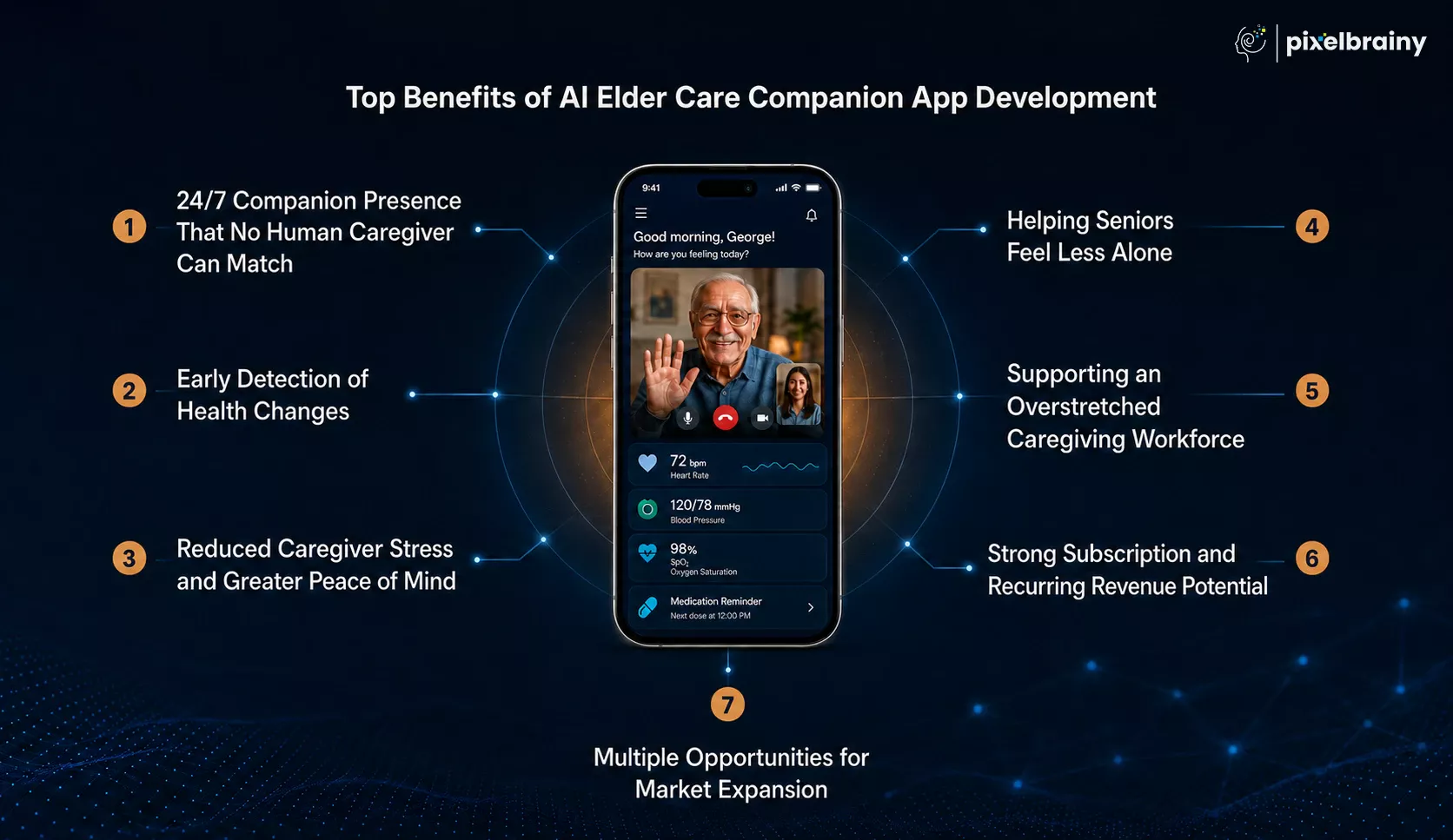
Unlike family members or professional caregivers who cannot be available around the clock, an AI companion is always present. It can check in with seniors, provide medication reminders, encourage healthy habits, engage in meaningful conversations, and notify caregivers if unusual activity is detected.
For founders looking to build AI elder care companion app solutions, this continuous availability becomes a powerful differentiator that transforms the app from a helpful tool into an emotionally essential part of everyday life.
One of the biggest advantages of AI powered elder care companion app development is the ability to recognize subtle behavioral and health changes before they become serious problems. By learning a senior's daily routines, activity levels, sleep patterns, and medication habits, AI can identify deviations that may indicate cognitive decline, depression, or emerging health concerns.
This proactive approach creates opportunities for earlier intervention while making the platform more valuable to healthcare providers and insurance partners.
Millions of adult children worry daily about whether their aging parents are safe, healthy, and following their care routines. An AI companion app eases this burden by providing real-time updates, intelligent alerts, and daily wellness summaries without constantly interrupting the senior.
When you develop AI elder care companion app solutions, remember that family caregivers are often the paying customers, making reassurance and trust just as important as the technology itself.
Loneliness has become one of the biggest challenges affecting older adults, especially those living independently. Through natural conversations, wellness check-ins, cognitive activities, and personalized engagement, AI companions help seniors stay mentally active and socially connected.
Beyond improving the user experience, creating AI elder care companion app solutions that address social isolation also aligns with growing public health initiatives focused on healthy aging and independent living.
The demand for professional caregivers continues to rise while workforce shortages remain a significant challenge. AI companions help bridge this gap by handling routine interactions such as reminders, daily check-ins, and wellness monitoring, allowing human caregivers to focus on care that requires personal attention.
This positions the platform as a practical technology partner rather than a replacement for professional caregiving services.
Products that families rely on every day typically generate stronger customer retention than traditional wellness applications. Once an AI companion becomes part of a senior's daily routine, it evolves into a service families are unlikely to cancel because it directly contributes to their loved one's wellbeing.
For startups seeking AI elder care companion app development services, this creates a predictable recurring revenue model with higher customer lifetime value and long-term business sustainability.
Unlike many consumer apps that depend solely on app store downloads, AI senior care companion app development opens doors to multiple distribution channels. Home care agencies, healthcare providers, senior living communities, insurance companies, and government aging programs all represent potential partners that can accelerate adoption and reduce customer acquisition costs.
This diversified go-to-market approach gives startups greater flexibility as they scale across both consumer and enterprise healthcare markets.
That's why founders who invest in AI elder care companion app development are not just launching a digital health product, they're building a mission-driven business with lasting customer relationships, scalable growth opportunities, and strong long-term market potential.

Building a successful AI companion platform starts with choosing the right feature set. While advanced capabilities such as predictive analytics and generative AI can enhance the experience later, every product should first establish a strong foundation with features that address seniors' everyday needs, improve family confidence, and simplify caregiving workflows.
If you're wondering, "We want to build an AI elder care companion app that helps seniors stay safe, connected, and engaged at home while giving family members real time visibility into their wellbeing. Which features should we include in the first version?" the answer lies in prioritizing practical, user-centric functionality over feature overload.
The following core features form the backbone of successful AI elder care companion app development and should be considered when you build an AI elder care companion app that delivers value from day one.
| Core Feature | Description |
| User Registration & Secure Login | Every app should begin with a secure onboarding process that allows seniors, family members, and caregivers to create individual accounts. Multi-factor authentication and role-based access ensure sensitive health information remains protected while providing a seamless login experience. |
| Senior Profile Management | Create detailed user profiles containing medical history, allergies, medications, emergency contacts, preferred language, daily routines, and accessibility preferences. These details help personalize the experience while improving communication between seniors, families, and caregivers. |
| Medication Reminders | Automated medication reminders help seniors take prescriptions on time through notifications, voice prompts, and confirmation tracking. Families can also receive alerts when doses are missed, improving medication adherence and reducing preventable health complications. |
| Appointment & Calendar Management | Allow users to schedule doctor visits, therapy sessions, family events, and daily activities within a centralized calendar. Timely reminders help seniors stay organized while reducing missed appointments and unnecessary caregiver follow-ups. |
| Daily Wellness Check-ins | Simple daily check-ins encourage seniors to confirm how they are feeling through quick responses or voice interactions. These regular wellness updates help caregivers stay informed while promoting consistent engagement with the application. |
| Emergency SOS Button | A prominently placed emergency button enables seniors to quickly contact predefined emergency contacts or caregivers whenever immediate assistance is required. This essential safety feature provides reassurance for both seniors and their families. |
| Family Caregiver Dashboard | A dedicated dashboard gives family members visibility into medication adherence, wellness updates, appointments, activity summaries, and emergency notifications. This centralized view helps remote caregivers stay connected without becoming overly intrusive. |
| Health Data Tracking | The app should allow seniors to manually record basic health information such as blood pressure, blood sugar, weight, heart rate, and oxygen levels. Historical records help users and caregivers monitor general wellness over time. |
| Voice Assistance | Voice commands improve accessibility for seniors who may struggle with typing or navigating mobile interfaces. Users can request reminders, ask questions, access features, or receive spoken guidance using simple conversational interactions. |
| Daily Activity Tracking | Track everyday activities such as walking, hydration, meals, sleep hours, and exercise completion. This feature encourages healthier habits while providing caregivers with an overall picture of the senior's daily routine. |
| Caregiver Communication | Built-in messaging and calling capabilities allow seniors, caregivers, and family members to communicate securely without switching between multiple applications. Quick communication helps coordinate care and respond faster when support is needed. |
| Notifications & Alerts | Intelligent notification management ensures that seniors receive timely reminders while caregivers receive relevant alerts regarding missed medications, appointments, inactivity, or emergency situations without unnecessary notification overload. |
| Accessibility Settings | Adjustable font sizes, high contrast themes, simplified navigation, voice navigation, and multilingual support make the application easier to use for seniors with visual, hearing, or mobility limitations, improving overall user adoption. |
| Document & Health Record Storage | Securely store medical reports, prescriptions, insurance documents, identification records, and physician instructions within the application. Having important documents readily available simplifies emergency response and healthcare coordination. |
| Feedback & Support Center | An integrated help center enables seniors and caregivers to access FAQs, contact customer support, report issues, and submit feedback. Continuous user feedback helps improve the product while maintaining high customer satisfaction. |
That's why the success of AI elder care companion app development depends on building a strong foundation of practical, user-first features before expanding into advanced AI capabilities.
Once your MVP is validated, the next step is to enhance the platform with advanced AI capabilities that improve personalization, preventive care, and long-term user engagement. These features differentiate your product from basic senior care applications and create a smarter, more adaptive experience for seniors, families, caregivers, and healthcare organizations.
Many founders ask, "We want to build an AI elder care companion app similar to CarePredict or Papa, but with smarter AI that learns each senior's routine, detects health risks early, and provides personalized companionship. Which advanced features should we prioritize?" The answer is to focus on AI-driven capabilities that deliver measurable value while supporting future scalability.
The following advanced features can help you develop AI elder care companion app solutions that stand out in the competitive digital health market and strengthen your AI powered elder care companion app development strategy.
| Advanced Feature | Description |
| AI Conversational Companion | Integrate an AI assistant powered by Large Language Models and Natural Language Processing to hold meaningful conversations, answer everyday questions, provide emotional support, and encourage seniors to stay socially engaged through natural, human-like interactions. |
| Behavioral Pattern Recognition | AI continuously analyzes routines such as sleep, mobility, medication adherence, and activity levels to establish a personal baseline. It can identify unusual behavioral changes that may indicate cognitive decline, illness, or increased health risks before they become critical. |
| Predictive Health Risk Analytics | Machine learning models evaluate historical health data and lifestyle trends to predict potential risks, enabling caregivers and healthcare providers to take preventive action rather than reacting only after medical emergencies occur. |
| AI Powered Fall Risk Assessment | Instead of simply detecting falls, AI evaluates walking patterns, balance changes, mobility trends, and movement history to estimate fall risk and recommend preventive measures before an accident happens. |
| Emotion and Mood Analysis | Using conversational patterns, voice characteristics, and interaction history, AI can identify signs of loneliness, depression, anxiety, or emotional distress, allowing families or caregivers to intervene when additional support may be needed. |
| Smart Personalized Care Recommendations | AI generates personalized reminders, wellness suggestions, hydration prompts, exercise recommendations, and cognitive activities based on each senior's health profile, daily routine, preferences, and changing lifestyle over time. |
| Wearable and IoT Device Intelligence | Seamless integration with smartwatches, fitness trackers, medical devices, and home sensors enables continuous health monitoring while AI combines multiple data sources to deliver more accurate insights and proactive recommendations. |
| Automated Caregiver Insights Dashboard | Rather than displaying raw health data, AI summarizes key trends, behavioral changes, medication adherence, and emerging health concerns into actionable reports that help caregivers make faster, better-informed care decisions. |
| AI Powered Multilingual Voice Assistant | A multilingual conversational assistant allows seniors to communicate in their preferred language through natural voice interactions, improving accessibility, increasing user confidence, and expanding the app's reach across diverse populations. |
| Personalized Cognitive Wellness Programs | AI recommends brain games, memory exercises, conversation topics, reading activities, and mental wellness routines based on each user's cognitive abilities and engagement history, helping support long-term cognitive health and daily stimulation. |
That's why adding advanced AI capabilities transforms an elder care companion app from a monitoring solution into an intelligent digital companion that continuously learns, adapts, and delivers increasingly personalized care experiences over time.
Bringing an AI healthcare product to market requires much more than a great idea. It demands a well-planned roadmap that balances product strategy, user experience, artificial intelligence, healthcare compliance, and continuous testing. Whether you're an early-stage startup or an established healthcare organization, following the right development process of AI elder care companion app can significantly reduce development risks, accelerate time to market, and improve the chances of building a product that seniors, families, and care providers genuinely trust.
If you're wondering about the steps to build AI elder care companion app from idea to launch in 2026 or how to build AI elder care companion app from scratch in 2026, the roadmap below outlines every critical stage involved in transforming an idea into a successful, launch-ready healthcare application.
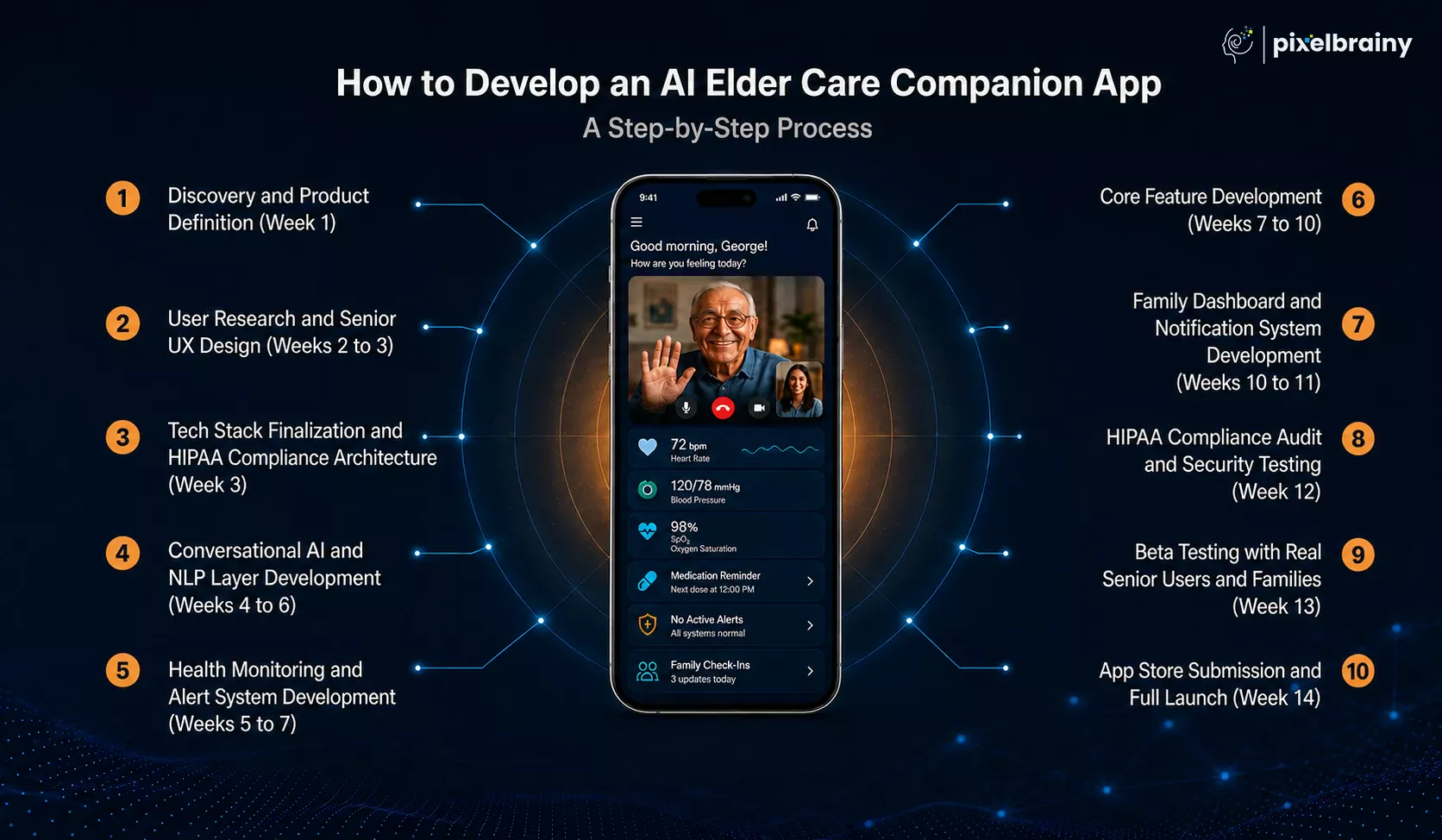
What happens?
Every successful product starts with a clear understanding of the problem it aims to solve. During this phase, founders define business objectives, identify target users, validate market demand, analyze competitors, prioritize core features, and prepare the product roadmap. Many startups begin with PoC development to validate technical feasibility before investing in full-scale product development. This is also the right stage to evaluate top AI app development companies in USA that have proven expertise in healthcare and AI solutions.
Who is involved?
What happens?
Unlike traditional mobile apps, elder care platforms must be designed around accessibility and simplicity. User interviews, caregiver feedback, and senior usability research help define intuitive user journeys. Collaborating with an experienced UI/UX designer for developing an AI elderly care companion app ensures the interface supports large typography, voice interactions, simplified navigation, and inclusive design principles that encourage long-term adoption.
Who is involved?
What happens?
At this stage, the technical architecture is finalized, including frontend and backend technologies, cloud infrastructure, APIs, databases, authentication methods, and security protocols. Developers also establish a HIPAA-ready architecture with encrypted data storage, secure APIs, and scalable infrastructure while planning future AI integration solutions that can support advanced AI capabilities without major redevelopment.
Who is involved?
What happens?
The intelligence behind the application is developed during this phase. AI engineers build conversational experiences using Natural Language Processing and Large Language Models that allow seniors to communicate naturally through voice or text. The assistant is trained to perform wellness check-ins, answer questions, provide medication reminders, and engage users in meaningful daily conversations that foster trust and companionship.
Who is involved?
What happens?
The development team integrates health monitoring capabilities such as medication tracking, wellness check-ins, wearable connectivity, emergency alerts, and caregiver notifications. AI models begin learning behavioral patterns and identifying unusual health changes that may require timely intervention, creating a more proactive healthcare experience.
Who is involved?
What happens?
Developers build the application's essential functionality, including user registration, senior profiles, appointment scheduling, family communication, accessibility settings, document management, and daily wellness features. For many startups, this stage represents the MVP development milestone, allowing them to validate the product with real users before expanding into advanced AI capabilities.
Who is involved?
Also Read: Top 10 AI MVP Development Companies in USA
What happens?
A dedicated caregiver dashboard is developed to give family members real-time visibility into their loved one's daily wellbeing. Features include medication adherence reports, wellness summaries, appointment tracking, activity updates, and intelligent notifications, enabling caregivers to stay informed without compromising the senior's independence.
Who is involved?
What happens?
Before launch, the application undergoes comprehensive security assessments, penetration testing, performance optimization, and HIPAA compliance validation. Many organizations also leverage AI consulting services during this phase to review AI model performance, strengthen security architecture, and ensure regulatory readiness before deployment.
Who is involved?
What happens?
A beta version of the application is released to selected seniors, family caregivers, and healthcare professionals. Their feedback helps identify usability challenges, accessibility improvements, conversational AI refinements, and workflow enhancements before the public launch. This real-world validation ensures the product performs effectively across different user groups and caregiving scenarios.
Who is involved?
What happens?
After incorporating beta feedback, the application is prepared for public release. Developers finalize app store assets, privacy policies, screenshots, compliance documentation, and production configurations before submitting the app to the Apple App Store and Google Play Store. This marks the final step to develop AI elder care companion app for iOS and Android in 2026, followed by post-launch monitoring, performance tracking, and continuous product improvements based on user feedback.
Who is involved?
Following this roadmap helps founders confidently navigate the development process of AI elder care companion app, reduce costly development mistakes, and successfully create an elder care companion app integrating AI that is secure, scalable, and ready for real-world adoption.
That's why no AI elder care companion app should be launched without extensive beta testing involving both seniors and their family caregivers, because only real-world feedback can validate whether the experience is truly accessible, intuitive, and ready for everyday use.
Also Read: AI Mobile App Development for Startups and Enterprises: Benefits, Steps and Challenges
The cost of developing an AI elder care app in 2026 depends on far more than the number of screens or features. Unlike a standard healthcare app, an AI elder care companion platform combines conversational AI, health monitoring, caregiver collaboration, accessibility-first design, and enterprise-grade security. As a result, the investment varies based on the product's complexity, AI capabilities, and compliance requirements.
On average, AI elder care companion app development costs between $25,000 and $300,000+. A startup building an MVP with essential AI companionship, medication reminders, and caregiver notifications can launch at the lower end of the range. In contrast, an enterprise-grade solution with advanced conversational AI, predictive health monitoring, wearable integrations, multilingual support, and HIPAA-compliant infrastructure typically requires a significantly larger investment.
If you're wondering how to develop an AI elder care app on a startup budget, the smartest approach is to prioritize high-impact features for your MVP and expand the platform based on user feedback and market validation.
Several factors directly impact the elder care companion app development cost, including:
| Component | Estimated Cost Range |
| UI and UX design including senior-friendly accessibility | $5,000 to $12,000 |
| Frontend development (iOS and Android) | $15,000 to $30,000 |
| Backend development and health data management | $12,000 to $25,000 |
| AI conversation engine development and integration | $10,000 to $25,000 |
| Safety features development (fall detection and emergency alerts) | $8,000 to $18,000 |
| Wearable device integration (Apple HealthKit and Google Fit) | $5,000 to $12,000 |
| Family dashboard development | $6,000 to $12,000 |
| HIPAA compliance and security implementation | $5,000 to $12,000 |
| Medication reminder and adherence tracking module | $4,000 to $8,000 |
| QA and testing including safety feature reliability testing | $6,000 to $12,000 |
| Project management | $5,000 to $10,000 |
| Total Development Cost Range | $81,000 to $176,000 |
Note: The above breakdown reflects a well-scoped, production-ready application. Depending on your roadmap, the overall cost of developing an AI elder care app in 2026 can range from $25,000 for an MVP to $300,000+ for an enterprise-scale platform.
Development costs also vary depending on where your technology partner is located.
| Team Location | Hourly Rate | Full App Cost Estimate |
| United States | $150 to $250/hour | $180,000 to $350,000 |
| Eastern Europe | $50 to $100/hour | $85,000 to $180,000 |
| India and South Asia | $25 to $60/hour | $45,000 to $100,000 |
| PixelBrainy | Competitive | Custom quote based on your product scope |
Choosing the lowest-cost development team isn't always the most cost-effective decision. Healthcare applications require expertise in AI, security, compliance, accessibility, and long-term scalability. An experienced partner can help you avoid expensive redesigns, compliance issues, and technical debt while delivering a product that is ready for real-world adoption.
That's why founders planning AI elder care companion app development should focus on building the right MVP first, partner with an experienced healthcare AI team, and invest strategically to balance cost, speed, quality, and long-term growth.
Also Read: AI App Development Cost: From MVPs to Full-Scale AI App
The success of an AI elder care companion app depends on much more than an intuitive interface or advanced AI capabilities. Behind every reliable healthcare application is a technology stack that supports intelligent conversations, real-time health monitoring, secure data management, seamless device connectivity, and regulatory compliance.
For founders exploring how to build AI elder care companion app from scratch, understanding the role of each technology helps simplify technical decisions and ensures the product is built for long-term scalability.
The table below highlights the recommended technologies commonly used by AI elder care companion app development services to develop secure, high-performing, and future-ready healthcare solutions.
| Technology Category | Recommended Tools & Technologies | Why It's the Right Choice |
| AI & LLM Layer | GPT, Claude, Gemini | These leading Large Language Models enable natural conversations, daily wellness check-ins, personalized reminders, and emotionally engaging interactions, making them ideal to build AI elder care companion app with NLP and conversational AI. |
| NLP & Speech Recognition | Google Speech-to-Text, AWS Transcribe, OpenAI Whisper | Voice-first interaction is essential for seniors. These technologies accurately convert speech into text, enabling hands-free conversations, voice commands, and accessible communication for older adults with limited mobility or vision. |
| Health Monitoring & Anomaly Detection | TensorFlow, PyTorch, Custom Machine Learning Models | These AI frameworks help analyze health trends, activity levels, medication adherence, and behavioral patterns to identify unusual changes and support proactive health monitoring. |
| Wearable & IoT Device Integration | Apple HealthKit, Google Fit, Fitbit API, Medical Device SDKs | Seamless integration with wearable devices and connected health equipment enables continuous collection of vital signs, activity data, sleep metrics, and wellness information without manual input. |
| Backend Development | Node.js, Python, FastAPI | Node.js supports real-time communication, while Python and FastAPI provide excellent performance for AI processing, healthcare APIs, and scalable backend services required to develop AI elder care companion app for iOS and Android in 2026. |
| Database | PostgreSQL, MongoDB | PostgreSQL securely stores structured healthcare records and user information, while MongoDB efficiently manages conversational history, AI interactions, notifications, and semi-structured application data. |
| Real-Time Communication | WebSockets, Twilio | These technologies enable instant messaging, voice calls, video consultations, caregiver communication, and real-time emergency alerts that improve collaboration between seniors, families, and healthcare professionals. |
| Push Notification System | Firebase Cloud Messaging (FCM), OneSignal | Reliable push notification services ensure timely delivery of medication reminders, appointment alerts, emergency notifications, wellness updates, and caregiver communications across Android and iOS devices. |
| Mobile App Development | React Native | React Native allows developers to build a single cross-platform application for both Android and iOS, reducing development costs while maintaining a consistent user experience and faster time to market. |
| Cloud Infrastructure | Amazon Web Services (AWS), Google Cloud Platform (GCP) | AWS provides HIPAA-eligible cloud services for healthcare applications, while GCP offers scalable AI infrastructure and advanced analytics capabilities to support future platform growth. |
| HIPAA Compliance & Data Security | AWS HIPAA Eligible Services, End-to-End Encryption, Audit Logging, Role-Based Access Control | A strong compliance layer protects sensitive patient information, supports regulatory requirements, and is essential for building AI elder care companion app with HIPAA compliance and data security from the very beginning. |
| Analytics & Behavioral Tracking | Mixpanel, Amplitude | These analytics platforms help founders understand user engagement, feature adoption, retention rates, and behavioral trends, enabling continuous product improvements based on real-world usage data. |
That's why selecting the right technology stack from the outset lays the foundation for a secure, scalable, and future-ready AI elder care companion app that can grow alongside evolving user needs and healthcare innovations.
AI can make elder care more personalized and proactive, but it also introduces greater responsibility for protecting sensitive health information. Every medication reminder, wellness assessment, AI conversation, emergency alert, and wearable device reading can involve personal or medical data that must be handled securely. That's why founders planning how to develop a HIPAA compliant AI senior care companion app should consider compliance a product requirement, not a legal formality.
Whether you're building a HIPAA compliant elder care app or a senior mental health and wellness app, privacy and security should influence every technical decision, from system architecture and cloud infrastructure to AI integrations and user permissions.
An AI elder care companion app typically manages multiple categories of sensitive information, each requiring appropriate protection throughout its lifecycle.
The more sensitive data your application collects, the greater the responsibility to protect it through strong security controls and compliant data handling practices.
Many startups focus on launching quickly and postpone compliance until after their MVP is released. Unfortunately, this approach often creates significant technical debt. Encrypting existing databases, redesigning authentication systems, restructuring APIs, updating cloud infrastructure, and implementing audit trails after development can increase both costs and project timelines.
Building compliance into the application architecture from the beginning is far more efficient. It enables development teams to create secure workflows, simplify future compliance audits, and scale the platform confidently without major redevelopment.
| Compliance Requirement | What It Means for Development |
| End-to-end data encryption | Encrypt all health information both in transit and at rest to prevent unauthorized access. |
| Access controls and authentication | Implement role-based permissions for seniors, family members, caregivers, healthcare providers, and administrators. |
| Audit logging | Maintain detailed logs of every login, data access, modification, and sharing event for compliance and security monitoring. |
| Consent management | Obtain clear consent from seniors and authorized family members before collecting, processing, or sharing health information. |
| Business Associate Agreements (BAAs) | Sign BAAs with every third-party vendor responsible for storing or processing Protected Health Information (PHI). |
| Data breach notification protocol | Establish automated processes to detect, investigate, and report security incidents in accordance with HIPAA requirements. |
| Minimum necessary data principle | Collect only the health information required to provide essential application functionality. |
| Secure cloud infrastructure | Host the platform using HIPAA-eligible cloud services such as AWS or Microsoft Azure with appropriate security controls. |
That's why founders who prioritize HIPAA compliance from the first sprint build stronger products, earn user trust faster, and avoid the expensive rework that comes with treating security as an afterthought.
Building an innovative product is only half the journey. Long-term success depends on a monetization strategy that aligns with your target customers, supports ongoing AI improvements, and generates predictable revenue. During AI elder care companion app development, founders should define their business model alongside product planning rather than after launch. Doing so helps shape feature prioritization, user onboarding, pricing, compliance requirements, and go-to-market strategy from the very beginning.
Depending on your audience and business goals, an AI elder care companion app can generate revenue through multiple channels. Many successful healthcare startups even combine consumer subscriptions with enterprise partnerships to create a diversified and scalable revenue model.
This is the most common monetization strategy for startups targeting families. Adult children subscribe on behalf of their aging parents, paying a monthly or annual fee for continuous access to the platform.
A freemium model can offer basic medication reminders, appointment scheduling, and family messaging at no cost, while premium plans unlock AI-powered conversations, wellness monitoring, emergency alerts, caregiver dashboards, and personalized health insights.
Pros: Predictable recurring revenue, faster market entry, direct customer relationships, and continuous user feedback.
Cons: Customer acquisition costs can be high, and retaining subscribers requires ongoing product improvements and AI personalization.
Revenue Potential: Approximately $15 to $40 per user per month.
Instead of selling to individual families, founders can license the platform to assisted living facilities, senior care centers, and home healthcare organizations. Enterprise deployments typically include centralized resident management, caregiver dashboards, staff alerts, reporting tools, and administrative controls that simplify daily operations across multiple residents.
Pros: Larger contract values, lower customer churn, long-term agreements, and easier expansion within enterprise accounts.
Cons: Longer sales cycles, procurement approvals, and additional enterprise feature requirements.
Revenue Potential: Approximately $20,000 to $100,000 per facility annually.
Health insurers are increasingly investing in digital health solutions that improve preventive care and reduce avoidable hospitalizations. An AI elder care companion app can be offered as a covered benefit for seniors managing chronic conditions, with insurers paying a recurring fee for enrolled members.
Success in this model depends on demonstrating measurable health outcomes, maintaining enterprise-grade security, and providing clinical reporting that supports value-based care initiatives.
Pros: Large-scale adoption, recurring enterprise revenue, and strong market credibility.
Cons: Longer partnership negotiations, strict compliance requirements, and evidence of clinical effectiveness.
Revenue Potential: Approximately $5 to $15 per member per month.
Government healthcare programs present another long-term growth opportunity. By aligning the platform with remote patient monitoring initiatives and Medicare reimbursement pathways, founders can position their solution as part of preventive and chronic care management programs. Achieving this requires clinical validation, regulatory planning, and integration with healthcare provider workflows.
Pros: Large addressable market, recurring reimbursement opportunities, and increased trust among healthcare providers.
Cons: Regulatory complexity, longer implementation timelines, and significant clinical validation requirements.
Revenue Potential: Varies depending on reimbursement programs and healthcare initiatives.
White-label licensing allows healthcare providers, home care agencies, hospitals, insurance companies, and senior care organizations to rebrand your AI elder care companion app as their own. Instead of building a platform from scratch, these organizations license your technology while customizing the app with their branding, workflows, and service offerings. This model is particularly attractive for founders offering AI elder care companion app development services, as it creates additional revenue opportunities without acquiring individual end users.
Pros: High-value licensing deals, faster enterprise adoption, recurring maintenance revenue, and the ability to serve multiple organizations using the same core platform.
Cons: Requires a highly configurable product architecture, dedicated onboarding and support, and ongoing customization for different enterprise clients.
Revenue Potential: Approximately $10,000 to $50,000 per organization per license, with additional recurring revenue through maintenance, feature enhancements, and support agreements.
| Monetization Model | Revenue Type | Best For | Average Revenue |
| Direct-to-consumer subscription | Recurring monthly subscription | Consumer-focused founders | $15 to $40 per user/month |
| B2B assisted living licensing | Annual enterprise contract | Enterprise-focused founders | $20,000 to $100,000 per facility/year |
| Health insurance partnership | Per member per month | Founders with clinical validation | $5 to $15 per member/month |
| Government and Medicare partnerships | Reimbursement-based | Founders with regulatory expertise | Varies by reimbursement program |
| White-label licensing for care organizations | One-time or recurring license fee | Founders with strong B2B sales capabilities | $10,000 to $50,000 per license |
That's why the most successful AI elder care companion app businesses don't rely on a single revenue stream. They combine subscription, enterprise, and healthcare partnership models to create predictable revenue, reduce business risk, and build a scalable digital health company with long-term growth potential.
Before investing in AI elder care companion app development, it's worth studying products that have already validated different parts of the market. These platforms demonstrate that families, caregivers, senior living communities, and healthcare organizations are actively adopting technology to improve aging in place, reduce caregiver burden, and strengthen senior wellbeing.
Instead of viewing them as competitors, founders should see them as valuable learning opportunities that reveal what users truly value and where the next wave of innovation can emerge.
Whether you're planning how to develop AI elder care companion app like Papa or CarePredict or looking to build AI elder care companion app solutions with differentiated AI capabilities, the following products offer important lessons.
CarePredict is one of the most recognized AI-powered senior care platforms focused on helping older adults age safely and independently. Using a wearable device, the platform continuously monitors daily activities such as movement, eating habits, sleep patterns, and overall behavior. Its AI engine analyzes these patterns to detect unusual changes and sends predictive alerts to caregivers before a health issue becomes critical.
What makes CarePredict stand out is its emphasis on proactive care rather than reactive monitoring. Instead of waiting for emergencies, it identifies subtle behavioral changes that may indicate declining health or increased fall risk.
Founder Lesson: CarePredict demonstrates that AI becomes significantly more valuable when it transforms raw behavioral data into actionable insights that help families and caregivers intervene early.
Papa takes a different approach by addressing one of the biggest challenges faced by older adults: loneliness. The platform connects seniors with trained companions who provide social interaction, transportation, technology assistance, grocery shopping, and everyday support. While human companionship remains at the center of its service, AI helps personalize member experiences, optimize companion matching, and improve scheduling efficiency.
Papa's success proves that emotional wellbeing is just as important as physical health in the aging population. It has also shown that family members are willing to invest in services that improve their loved one's quality of life.
Founder Lesson: If you're researching how to develop AI elder care companion app like Papa or CarePredict, consider using AI to enhance human caregiving rather than attempting to replace it completely. The strongest solutions often combine technology with meaningful human support.
Developed by Intuition Robotics, ElliQ is an AI-powered companion designed specifically for older adults living independently. Unlike traditional voice assistants, ElliQ proactively starts conversations, encourages physical activity, reminds users about medications, promotes cognitive exercises, and helps seniors stay connected with their families.
Its conversational AI continuously learns user preferences and routines, creating interactions that become more personalized over time. This proactive engagement has helped ElliQ position itself as more than just a digital assistant.
Founder Lesson: AI companions should actively encourage healthy behaviors instead of simply responding to commands. Proactive engagement creates stronger user relationships and higher long-term retention.
GrandPad is a tablet designed exclusively for seniors who may find traditional smartphones or tablets difficult to use. The platform combines video calling, messaging, telehealth access, entertainment, and simplified internet access within an interface built around accessibility. AI-powered spam filtering, voice assistance, and personalized settings further enhance the experience while reducing digital complexity.
Rather than competing through advanced AI alone, GrandPad differentiates itself by making technology approachable for older adults with limited technical experience.
Founder Lesson: When you build AI elder care companion app solutions, simplicity often becomes a greater competitive advantage than adding more features. AI should reduce complexity, not increase it.
Lani is one of the emerging AI-native platforms designed specifically for adults aged 55 and older. Instead of focusing solely on medical monitoring, Lani emphasizes daily companionship through conversational AI, personalized wellness check-ins, medication reminders, and family updates delivered through its companion platform. This reflects a growing shift toward AI experiences that combine emotional support with preventive wellness and caregiver collaboration.
As newer AI-native solutions enter the market, they demonstrate how advances in generative AI are making digital companionship more natural, engaging, and personalized than ever before.
Founder Lesson: The future of AI elder care companion app development lies in combining intelligent conversations, proactive wellness support, caregiver collaboration, and privacy-first design into one seamless experience rather than treating these as separate products.
These platforms validate the growing demand for AI-powered elder care, but they also highlight that the market is still evolving. Each solution solves a different part of the caregiving journey, creating opportunities for founders to build more comprehensive products that bring companionship, health monitoring, caregiver collaboration, and personalization together in a single platform.
That's why the smartest founders don't replicate existing apps. They study proven products, identify the gaps they leave behind, and use those insights to develop AI elder care companion app solutions that deliver greater value for seniors, families, and healthcare providers alike.
Successful AI elder care companion app development is about much more than integrating AI models or building a mobile application. Founders must create an experience that feels natural for seniors, earns the trust of families, complies with healthcare regulations, and continuously delivers accurate, personalized support.
Many startups underestimate these challenges during the planning stage, only to face costly redesigns and slower adoption after launch. Understanding these obstacles early makes it easier to build AI elder care companion app solutions that are scalable, compliant, and genuinely improve the lives of older adults.
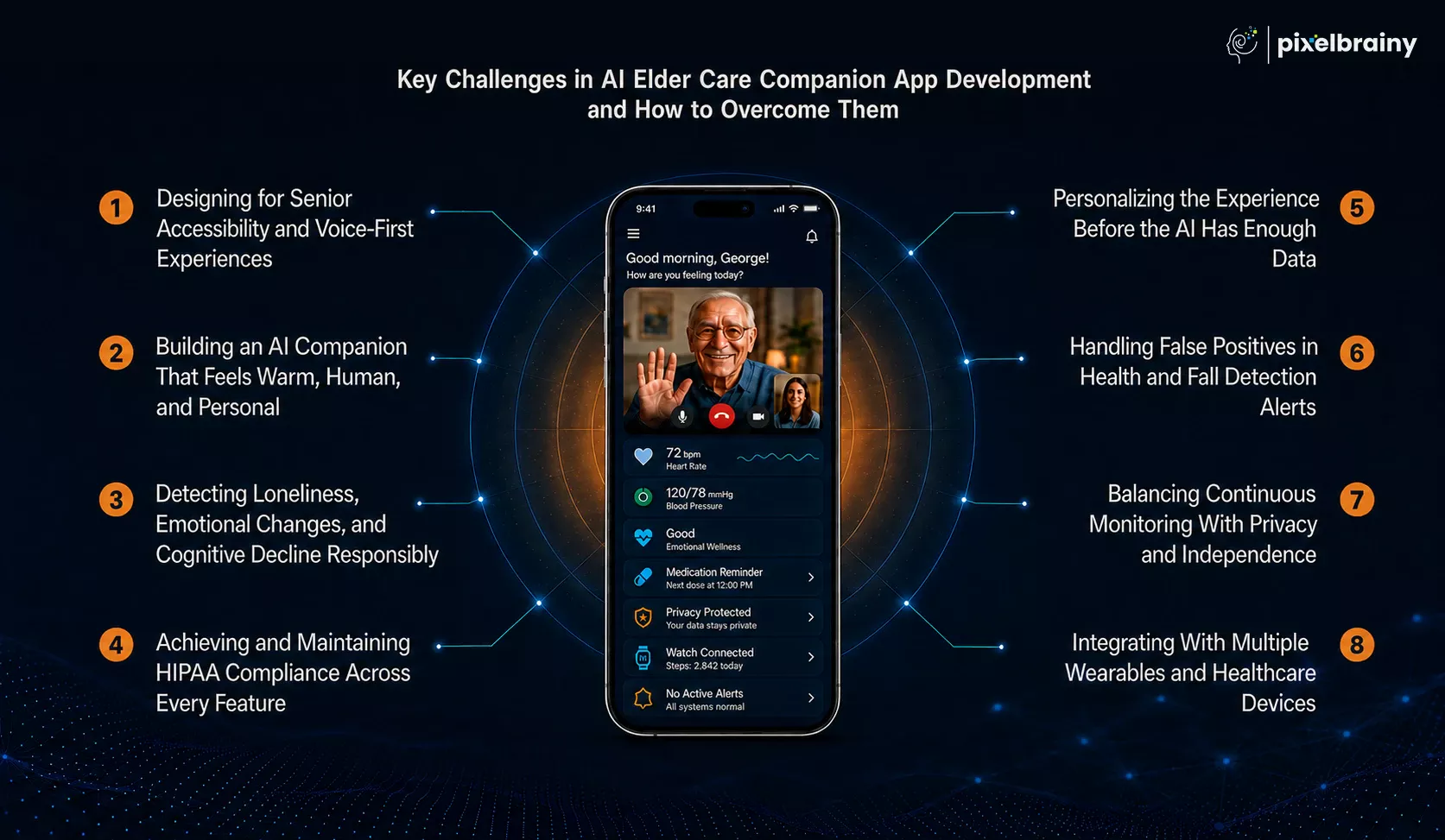
Challenge:
Many seniors are unfamiliar with smartphones and may struggle with complex menus, small buttons, or touch-based interactions. This becomes an even bigger challenge when your goal is to support older adults living independently who need technology that feels effortless rather than intimidating.
How to Overcome It:
Design the application around voice-first interactions, simple navigation, large touch targets, readable typography, and high-contrast interfaces. Voice commands, spoken reminders, and hands-free conversations make the app more accessible for seniors who are not comfortable using touchscreen devices. Continuous usability testing with older adults should guide every design decision.
Challenge:
One of the biggest goals when developing AI elder care companion app with NLP and conversational AI is creating an assistant that feels like a trusted companion instead of a chatbot. Seniors living alone expect meaningful conversations, emotional encouragement, and personalized interactions that evolve over time, not repetitive or robotic responses.
How to Overcome It:
Build conversational AI that remembers previous interactions, adapts to daily routines, learns user preferences, and responds with empathy. The AI should proactively check in, celebrate milestones, encourage healthy habits, and naturally continue conversations based on past interactions. This creates stronger engagement and long-term trust while addressing the growing demand for AI companions that support seniors beyond basic task automation.
Challenge:
Founders increasingly want AI to recognize signs of loneliness, depression, social withdrawal, or early cognitive decline through daily conversations. However, relying on isolated conversations or limited behavioral signals can result in inaccurate conclusions that either create unnecessary concern or overlook users who genuinely need support.
How to Overcome It:
Instead of making decisions based on a single conversation, AI should evaluate long-term conversation history, emotional tone, communication frequency, behavioral changes, wellness check-ins, and activity patterns together. Caregiver alerts should only be triggered after multiple indicators consistently suggest meaningful changes, improving both reliability and user confidence.
Challenge:
As new features such as conversational AI, wearable integrations, caregiver dashboards, and health tracking are introduced, maintaining compliance becomes increasingly complex. Every new integration creates additional privacy and security responsibilities.
How to Overcome It:
Treat compliance as a core architectural requirement by building AI elder care companion app with HIPAA compliance and data security from the very beginning. Encrypt sensitive information, implement role-based access controls, maintain comprehensive audit logs, secure cloud infrastructure, and regularly review third-party integrations to ensure ongoing compliance as the platform evolves.
Challenge:
New users often expect personalized recommendations immediately, but AI has little historical information during the first few days of usage. Without sufficient context, conversations and recommendations may feel generic and reduce early engagement.
How to Overcome It:
Accelerate personalization through guided onboarding, caregiver input, medication history, health profiles, daily routine preferences, and wearable device integrations. This provides the AI with meaningful context from day one while allowing personalization to improve continuously through ongoing learning.
Challenge:
AI-powered fall detection and health anomaly monitoring are valuable features, but excessive false alarms can overwhelm caregivers and reduce confidence in the platform. Conversely, missed incidents can compromise user safety.
How to Overcome It:
Combine wearable data, behavioral history, movement analysis, and contextual information before generating alerts. Confidence scoring, multi-signal verification, and intelligent alert prioritization help reduce unnecessary notifications while ensuring genuine emergencies receive immediate attention.
Challenge:
While families appreciate continuous health monitoring, many seniors worry about losing privacy or feeling constantly observed. Excessive monitoring can reduce trust and discourage long-term use.
How to Overcome It:
Provide transparent privacy controls that allow seniors to decide what information is collected, who can access it, and when caregiver notifications should be shared. Giving users control over their data helps preserve independence while maintaining appropriate caregiver visibility.
Challenge:
An AI elder care companion app often needs to connect with smartwatches, fitness trackers, medical devices, and healthcare platforms that use different APIs, data formats, and communication standards. Supporting multiple ecosystems without affecting reliability can become a significant engineering challenge.
How to Overcome It:
Develop a modular integration architecture that supports platforms such as Apple HealthKit, Google Fit, Fitbit, and medical-grade device SDKs. A standardized integration layer makes it easier to add new devices, improve interoperability, and scale the platform without rebuilding core functionality.
Overcoming these challenges requires much more than technical expertise. It demands a deep understanding of senior behavior, healthcare regulations, conversational AI, and caregiver expectations.
Founders who address these complexities early can develop AI elder care companion app solutions that deliver personalized companionship, proactive health support, strong privacy protection, and a user experience that seniors genuinely enjoy using every day.
Great AI elder care products don't begin with code. They begin with a deep understanding of seniors, caregivers, healthcare workflows, and the real-world challenges families face every day. Many of the founders we partner with are not software engineers. They are geriatric care specialists, healthcare entrepreneurs, home care providers, clinicians, and funded startups with a strong vision but without an in-house AI development team.
If you're looking for a company to develop a custom AI senior care app, you need more than a development agency. You need a technology partner that can take your idea from an initial concept to a fully functional product available on the Apple App Store and Google Play. That includes everything from product strategy and UX design to conversational AI, health monitoring, HIPAA compliance, wearable integrations, family alert systems, testing, deployment, and ongoing product evolution.
As an AI healthcare software development company in USA, PixelBrainy helps founders build intelligent healthcare solutions that are secure, scalable, and designed for long-term success. We work closely with startups and healthcare innovators to validate ideas, define the right feature roadmap, and develop AI-powered applications that solve real problems for seniors, families, and care providers.
Our approach goes beyond application development. We combine healthcare expertise, AI engineering, and product thinking to ensure every solution is built with real users in mind from the very beginning.
Whether you're planning an AI companion for seniors living independently, a wellness platform for aging adults, or a caregiver collaboration app, our team helps you build features that matter most, including:
Our goal isn't simply to deliver a working application. We focus on helping founders launch products that users trust, healthcare organizations can adopt, and investors can confidently support.
| Factor | Generic App Development Agency | PixelBrainy |
| Healthcare AI experience | Rarely a core specialization | Core expertise in AI-powered healthcare and wellness solutions |
| HIPAA compliance capability | Often treated as a later requirement | Designed into the architecture from day one |
| Senior-friendly design expertise | Generic mobile UI practices | Accessibility-first experiences built specifically for older adults |
| Conversational AI development | Basic integrations or outsourced | In-house expertise in AI companions and personalized conversations |
| Wearable device integration | Limited experience | Advanced integration with health wearables and connected medical devices |
| Safety-critical feature development | Limited healthcare background | Reliability-first approach for monitoring, alerts, and emergency workflows |
| Post-launch support | Varies by vendor | Dedicated optimization, AI improvements, and long-term product support |
| Who we build for | Businesses across multiple industries | Healthtech founders, senior care innovators, healthcare providers, and AI startups |
Launching an AI elder care companion app isn't just about writing code. It's about building a healthcare product that families trust, seniors enjoy using, and healthcare organizations can confidently recommend.
That's why founders who want to transform healthcare expertise into a successful digital product choose PixelBrainy as their long-term technology partner, from concept validation and MVP development to App Store launch, continuous AI improvements, and future platform growth. If you're ready to bring your vision to life, connect with our team for a consultation and let's build an AI elder care companion app that makes a meaningful difference.
The demand for intelligent elder care solutions has never been greater. As populations continue to age and caregiver shortages increase, families are looking for technology that can provide meaningful companionship, proactive health support, and greater peace of mind. At the same time, advances in conversational AI, predictive analytics, wearable integrations, and digital health infrastructure have made AI elder care companion app development more practical and impactful than ever before. For founders, healthcare entrepreneurs, and senior care innovators, 2026 represents a unique opportunity to build solutions that improve lives while creating a scalable and future-ready business.
Success, however, requires more than great technology. Building an AI companion for older adults demands a thoughtful balance of empathy, accessibility, healthcare compliance, privacy, and intelligent product design. The right development partner should not only understand AI and mobile engineering but also the real-world needs of seniors, caregivers, and healthcare organizations.
Ready to Build Your AI Elder Care Companion App?
If you're ready to transform your idea into a secure, intelligent, and market-ready healthcare solution, PixelBrainy is here to help. From product strategy and AI integration to HIPAA-compliant development, wearable connectivity, App Store launch, and ongoing product growth, our team supports you at every stage of the journey.
Schedule a call with our experts today and let's build elder care app with PixelBrainy that empowers seniors, supports families, and shapes the future of AI-driven elder care.
Unlike a traditional medical alert system that responds only during emergencies, an AI elder care companion app provides continuous support throughout the day. It offers AI companionship, medication reminders, wellness check-ins, health monitoring, caregiver communication, and proactive family alerts, helping seniors stay independent while reducing risks before emergencies occur.
The timeline for AI elder care companion app development depends on your feature set, AI capabilities, integrations, and compliance requirements. An MVP typically takes 4 to 6 weeks, while a production-ready solution with conversational AI, wearable integration, health monitoring, and caregiver dashboards generally requires 12 to 14 weeks from planning to launch.
The cost of AI elder care companion app development varies based on AI functionality, HIPAA compliance, wearable integrations, mobile platforms, and custom features. A basic MVP requires a smaller investment than an enterprise-grade solution with advanced AI, predictive health insights, real-time family alerts, and healthcare-grade security. A discovery session helps define an accurate project estimate.
Yes. Most startups choose cross-platform development to launch their AI elder care companion app on both iOS and Android simultaneously. This approach reduces development costs, accelerates time to market, simplifies maintenance, and delivers a consistent user experience while supporting future scalability as your product evolves.
When evaluating companies that develop AI elder care companion apps for startups, choose a partner with expertise in healthcare AI, HIPAA compliance, conversational AI, wearable integrations, and senior-friendly UX design. PixelBrainy, an AI healthcare software development company in USA, helps founders take ideas from product strategy to App Store and Google Play launch with secure, scalable, and AI-powered elder care solutions.
If your AI elder care companion app collects, stores, or shares Protected Health Information (PHI), HIPAA compliance is typically required. Building with encryption, secure authentication, audit logs, role-based access controls, and compliant cloud infrastructure from day one protects sensitive healthcare data, strengthens user trust, and simplifies future partnerships with healthcare organizations.

About The Author
Sagar Bhatnagar
Sagar Sahay Bhatnagar brings over a decade of IT industry experience to his role as Marketing Head at PixelBrainy. He's known for his knack in devising creative marketing strategies that boost brand visibility and market influence. Sagar's strategic thinking, coupled with his innovative vision and focus on results, sets him apart. His track record of successful campaigns proves his ability to utilize digital platforms effectively for impactful marketing efforts. With a genuine passion for both technology and marketing, Sagar continuously pushes PixelBrainy's marketing initiatives to greater success.

Working with the PixelBrainy team has been a highly positive experience. They understand the design requirements and create beautiful UX elements to meet the application needs. The dev team did an excellent job bringing my vision to life. We discussed usability and flow. Sagar worked with his team to design the database and begin coding. Working with Sagar was easy. He has the knowledge to create robust apps, including multi-language support, Google and Apple ID login options, Ad-enabled integrations, Stripe payment processing, and a Web Admin site for maintaining support data. I'm extremely satisfied with the services provided, the quality of the final product, and the professionalism of the entire process. I highly recommend them for Android and iOS Mobile Application Design and Development.

Great experience working with them. Had a lot of feedback and I found that unlike most contractors they were bugging me for updates instead of the other way around. They were extremely time conscience and great at communicating! All work was done extremely high quality and if not on time, early! They were always proactive when it comes to communication and the work is great/above par always. Very flexible and a great team to work with! Goes above and beyond to present us with multiple options and always provides quality. Amazing work per usual with Chitra. If you have UI/UX or branding design needs I recommend you go to them! Will likely work with them in the future as well, definitely recommended!

PixelBrainy is a joy to work with and is a great partner when thinking through branding, logo, and website layout. I appreciate that they spend time going into the "why" behind their decisions to help inform me and others about industry best practices and their expertise.

I hired them to design our software apps. Things I really like about them are excellent communication skills, they answer all project suggestions and collaborate right away, and their input on design and colors is amazing. This project was complex and needed patience and creativity. The team is amazing to do business with. I will be using them long-term. Glad to see there are some good people out there. I was afraid to try and outsource my project to someone but I am glad I met them! I really can't say enough. They went above and beyond on this project. I am very happy with everything they have done to make my business stand out from the competition.

It was great working with PixelBrainy and the team. They were very responsive and really owned the project. We'll definitely work with them again!

I recently worked with the PixelBrainy team on a project and I was blown away by their communication skills. They were prompt, clear, and articulate in all of our interactions. They listened and provided valuable feedback and suggestions to help make the project a success. They also kept me updated throughout the entire process, which made the experience stress-free and enjoyable.

PixelBrainy is very good at what it does. The team also presents themselves very professionally and takes care of their side of things very well. I could fully trust them taking up the design work in a timely and organised manner and their attention to detail saved us lots of effort and time. This particular project was quite intense and the team showed that they function very well under pressure. Very much looking forward to working with her again!

It's always an absolute pleasure working with them. They completed all of my requests quickly and followed every note I had for them to a T, which made our process go smoothly from start to finish. Everything was completed fast and following all of the guidelines. And I would recommend their services to anyone. If you need any design work done in the future, PixelBrainy should be your first call!

They took ownership of our requirements and designed and proposed multiple beautiful variants. The team is self-motivated, requires minimum supervision, committed to see-through designs with quality and delivering them on time. We would definitely love to work with PixelBrainy again when we have any requirements.

PixelBrainy was a big help with our SaaS application. We've been hard at work with a new UI/UX and they provided a lot of help with the designs. If you're looking for assistance with your website, software, or mobile application designs, PixelBrainy and the team is a great recommendation.

PixelBrainy designers are amazing. They are responsive, talented, and always willing to help craft the design until it matches your vision. I would recommend them and plan to continue them for my future projects and more!!!

They were awesome! Did a good job fast, and good communication. Will work with them again. Thank you

Creative, detail-oriented, and talented designers who take direction well and implement changes quickly and accurately. They consistently over-delivered for us.

PixelBrainy team is very talented and creative. Great designers and a pleasure to work with. PixelBrainy is an excellent communicator and I look forward to working with them again.

PixelBrainy has a very talented design team. Their work is excellent and they are very responsive. I enjoy working with them and hope to continue on all of our future projects.


Transform your ideas into reality with us.
Across these industries, each engagement brings unique challenges, from early-stage product development to scaling complex systems, helping us build a practical understanding of real-world product environments.