AI Summary Powered by PixelBrainy
What if a physician could get the exact hospital-approved clinical protocol in seconds instead of searching through five different systems during patient care?
Consider a regional health system with twelve hospitals. Its biggest clinical knowledge management challenge is not a lack of information. It is the opposite. Clinical protocols, drug formularies, evidence-based guidelines, nursing procedures, and hospital policies are stored in different systems that do not communicate effectively with each other and are not easily searchable.
During patient care, nurses and physicians may spend valuable time navigating multiple applications, searching PDFs, checking different repositories, or calling a pharmacist or senior physician for information that should already be instantly accessible. The health system wants to develop an AI healthcare knowledge assistant that unifies its clinical knowledge sources into a single conversational interface. Authorized clinical staff could ask questions in plain language and receive instant, relevant answers supported by the organization's approved knowledge.
This is where AI healthcare knowledge assistant development can address a major enterprise healthcare challenge. Rather than replacing existing hospital systems, the assistant can act as an intelligent knowledge layer that connects information from multiple approved sources and makes it easier for healthcare professionals to find and understand.
The opportunity for healthcare AI is expanding rapidly. According to Grand View Research, the global artificial intelligence in healthcare market is estimated to reach USD 50.7 billion in 2026 and is projected to reach USD 505.6 billion by 2033, growing at a CAGR of 38.9% from 2026 to 2033.
For hospitals and healthcare organizations, the goal of healthcare knowledge assistant development with AI should not be to create another generic chatbot. It should be to build a secure, organization-specific knowledge platform that understands user roles, retrieves authoritative information, provides source citations, respects access permissions, and integrates with existing healthcare infrastructure.
Organizations exploring how to build a HIPAA compliant AI healthcare knowledge assistant also need to consider privacy, security, data governance, access control, auditability, vendor requirements, and the specific ways protected health information is handled.
This guide provides a step-by-step guide to develop an AI healthcare knowledge assistant for hospitals, including its working architecture, benefits, essential features, advanced capabilities, development process, technology stack, estimated development cost, implementation challenges, and important considerations for choosing an AI development partner.
An AI healthcare knowledge assistant is a specialized enterprise AI system that helps healthcare professionals access and understand an organization's clinical and operational knowledge through natural-language conversations.
Think of it as an intelligent knowledge layer for a hospital.
Instead of asking staff to search through multiple portals, databases, PDFs, intranet pages, and document repositories, the assistant provides one centralized interface where they can ask questions and retrieve relevant information.
Depending on the organization's requirements, an AI healthcare knowledge assistant can connect with:
The assistant typically uses Retrieval-Augmented Generation (RAG). When a healthcare professional submits a question, the system searches approved knowledge sources, retrieves relevant information, and provides that information to the AI model as context.
For example:
Healthcare professional:
"What is the current protocol for managing suspected sepsis in our hospital?"
AI assistant:
It retrieves the hospital's current sepsis protocol, identifies the relevant sections, and presents a concise answer along with the source document, version, and applicable references.
A healthcare knowledge assistant can be designed around the organization's specific requirements, including:
In short, custom AI healthcare knowledge assistant development creates a secure, organization-specific way for hospitals to turn fragmented healthcare information into an accessible conversational knowledge resource for authorized staff.
An AI healthcare knowledge assistant works as an intelligent knowledge layer between healthcare professionals and an organization’s trusted information sources.
Instead of simply generating answers from an AI model, the system first understands the user's question, retrieves relevant and authorized information, and then generates a response grounded in that content.
Healthcare Staff → Secure Login → Question → Query Understanding → Knowledge Retrieval → Relevant Content → LLM → Grounded Answer → Citations → Audit & Feedback
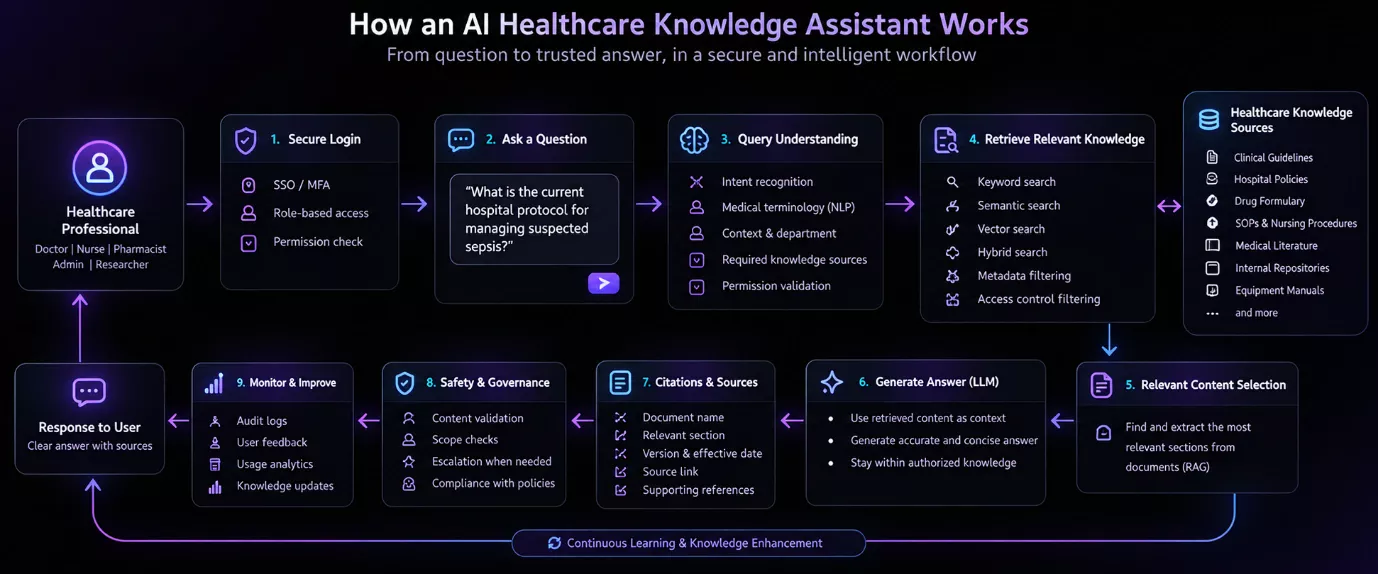
The healthcare professional accesses the assistant through a hospital portal, intranet, application, or integrated workflow.
The system verifies the user's identity and role before providing access to organizational knowledge.
For example, a pharmacist, physician, nurse, and administrative employee may have different information-access permissions.
The user asks a question without needing to know where the information is stored.
Example:
“What is the current hospital policy for medication reconciliation?”
The assistant interprets the question instead of requiring the user to search through folders, databases, or PDFs.
The AI analyzes the request to identify:
This helps the system determine what information needs to be retrieved.
The retrieval layer searches approved organizational sources such as:
Modern systems can combine keyword search, semantic search, vector search, hybrid search, metadata filtering, and permission-based filtering.
Rather than sending an entire document to the AI model, the RAG architecture identifies the most relevant sections or passages.
For example, from a 150-page clinical guideline, the system may retrieve only the three sections relevant to the user's question.
The retrieved content is provided to the language model as context.
The LLM then generates a concise response based on the available evidence and organizational knowledge.
This is a key part of healthcare knowledge assistant development with AI, because the goal is to connect generative AI with trusted enterprise information rather than rely solely on the model's pre-trained knowledge.
The assistant can display supporting information such as:
Healthcare professionals can therefore review the original source instead of treating the AI response as an unexplained output.
Before and after generating a response, the application can apply organizational rules, access controls, scope restrictions, and escalation workflows.
For questions outside the assistant's intended scope, it can direct users toward appropriate clinical, administrative, or specialist review.
The system can capture appropriate audit and monitoring data, such as access events, queries, retrieved sources, responses, and user feedback, according to the organization's policies and applicable requirements.
This creates a continuous improvement cycle:
User Query → Retrieval → AI Response → Feedback → Knowledge Improvement → Better Future Responses
Ultimately, the assistant becomes more than a chatbot. It acts as a secure, searchable, conversational interface for an organization's healthcare knowledge ecosystem, helping authorized staff find relevant information faster while maintaining traceability and governance.
Also Read: AI Healthcare Triage Software Development: A Complete Guide
Who benefits most from an AI medical knowledge assistant for hospitals? The strongest use cases are organizations managing large, distributed, frequently updated bodies of clinical, regulatory, and operational knowledge.
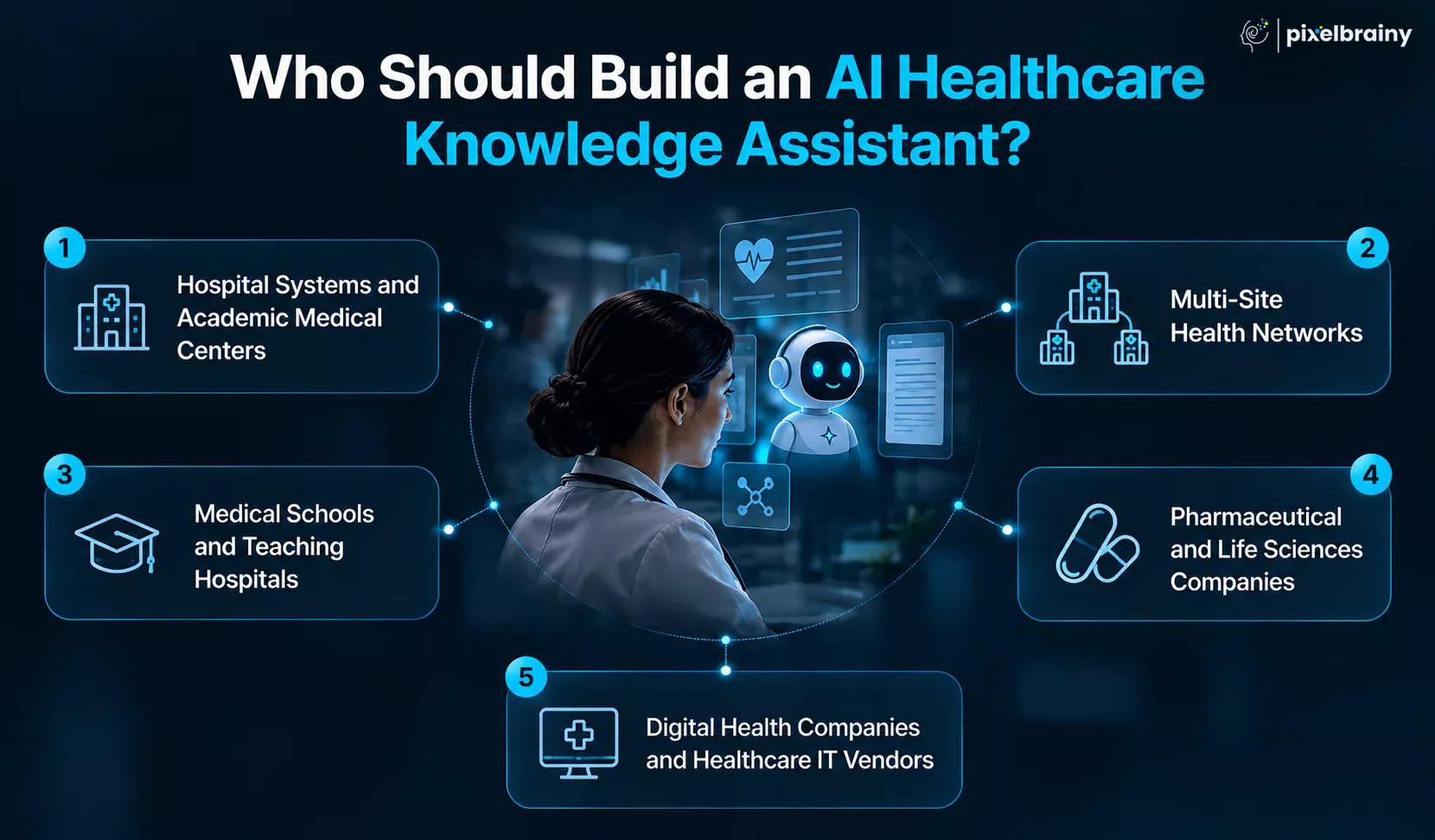
Large hospital systems and academic medical centers often manage thousands of clinical protocols, formulary documents, SOPs, evidence-based guidelines, and internal policies.
An AI healthcare assistant for clinicians can give authorized staff a faster way to locate current information without searching across multiple systems.
Primary value: Faster clinical information retrieval, reduced reliance on outdated documents, and greater confidence that staff are accessing current institutional guidance.
Health networks operating across multiple hospitals and clinics often face a knowledge-standardization challenge. Different locations may store or maintain information differently, creating inconsistent access to clinical guidance.
An AI healthcare knowledge assistant for health systems can provide a unified conversational knowledge layer across facilities while maintaining site-specific permissions and protocols.
Primary value: Consistent access to current, approved knowledge across locations.
Teaching hospitals need to support attending physicians, residents, fellows, medical students, and clinical educators.
A role-aware assistant can provide different levels of information based on the user's role and context while using the same underlying knowledge infrastructure.
Primary value: Supports clinical productivity while also strengthening learning and knowledge discovery for trainees.
Pharmaceutical organizations can use AI knowledge assistants to organize clinical evidence, product information, medical literature, and approved materials for medical affairs and medical information teams.
Primary value: Faster and more consistent evidence-grounded responses to healthcare professional inquiries while maintaining appropriate compliance controls.
Digital health companies and healthcare IT vendors can build knowledge-assistant capabilities directly into clinical platforms or develop standalone healthcare knowledge products.
Primary value: Differentiated AI functionality, clinical workflow support, and opportunities to deliver knowledge through APIs or existing healthcare applications.
| Organization Type | Primary Use Case | Key AI Feature Priority | Key Compliance Requirement |
|---|---|---|---|
| Hospital system | Clinical staff knowledge access | Instant clinical query response | HIPAA and clinical accuracy |
| Multi-site health network | Cross-site knowledge standardization | Unified knowledge base | Protocol currency and version control |
| Academic medical center | Clinical productivity and learning | Role-adapted responses | Clinical accuracy and learning integration |
| Pharmaceutical company | Medical affairs and HCP inquiries | Evidence-grounded responses | Label compliance and off-label controls |
| Digital health company | AI-enabled product differentiation | Clinical knowledge API | Clinical validation and regulatory positioning |
The ideal candidate is an organization where knowledge is fragmented, frequently updated, permission-sensitive, and important to daily healthcare workflows.
For hospitals and health systems, the business case becomes particularly strong when clinicians and staff regularly spend time searching for protocols, guidelines, policies, or other trusted information across disconnected systems.
In short, organizations should build an AI healthcare knowledge assistant when faster access to verified knowledge can improve productivity, standardization, and decision support without replacing appropriate professional judgment.
When a nurse asks, “Where can I find the latest medication reconciliation protocol?”, the problem is often not a lack of information. The problem is finding the right, current information quickly. This is where an AI healthcare knowledge assistant can create measurable business value for hospitals, health systems, and healthcare organizations.
By connecting clinical guidelines, hospital policies, SOPs, formularies, research resources, and internal documentation through a conversational interface, organizations can reduce knowledge-search time, improve information consistency, and make existing knowledge more useful. For business owners and healthcare leaders, the value goes beyond AI adoption. AI healthcare knowledge assistant development can improve workforce productivity, reduce operational friction, strengthen knowledge governance, and create a scalable foundation for enterprise knowledge management.
One of the most direct benefits of an AI medical knowledge assistant for hospitals is faster access to trusted organizational information. Instead of searching through multiple portals, PDFs, intranet pages, or document repositories, healthcare professionals can ask a question in natural language and receive relevant information within seconds.
For example, a clinician can ask, “What is our current hospital protocol for suspected sepsis?” The assistant can retrieve the relevant sections and provide citations to the source document.
For healthcare organizations, this can reduce time spent searching and allow employees to spend more time on clinical, administrative, or research responsibilities.
Healthcare organizations often have valuable knowledge distributed across different departments, applications, databases, shared drives, and document management systems. This fragmentation makes information difficult to discover and increases the possibility of employees using incomplete or outdated resources.
An AI healthcare knowledge assistant for health systems can create a unified conversational access layer across these repositories. Employees can search across approved sources without knowing exactly where a document is stored.
For business leaders, this means the organization gets more value from its existing knowledge investments. Instead of replacing every information system, the assistant can make existing information easier to find, improving knowledge discoverability across the enterprise.
Different facilities or departments may unintentionally rely on different versions of clinical protocols, policies, or procedures. This can create operational inconsistency and make knowledge governance more difficult.
A custom AI healthcare knowledge assistant can prioritize approved and current documents using metadata, version control, effective dates, and access permissions. When a healthcare professional asks, “Which medication administration procedure should I follow?”, the system can retrieve the organization's designated current guidance.
For healthcare executives, the business benefit is greater standardization. Teams can work from a more consistent knowledge foundation while administrators gain better visibility into how institutional information is maintained and distributed.
Doctors, nurses, pharmacists, and senior staff are frequently interrupted with questions that could be answered by existing organizational documentation.
For example, a nurse may repeatedly ask a pharmacist, “Where is the latest IV medication administration guideline?” An AI assistant can help employees locate the relevant information independently when the question falls within its intended scope.
This can reduce repetitive information requests and unnecessary interruptions. The result is better utilization of skilled employees' time.
From a business perspective, organizations can potentially improve workforce productivity without continually increasing staffing simply to handle recurring knowledge-access requests.
New employees need to learn hospital policies, departmental procedures, clinical workflows, compliance requirements, and organizational standards. Traditionally, this knowledge is spread across training materials, manuals, intranet pages, and experienced employees.
An AI healthcare knowledge assistant can provide a conversational way for authorized employees to discover approved information during onboarding.
A new staff member could ask, “What are the infection control procedures for this department?” and receive relevant information with links to approved sources.
This can shorten the learning curve, reduce dependence on senior employees for routine questions, and make institutional knowledge easier to access as the workforce grows or changes.
Healthcare organizations, academic medical centers, and life sciences companies manage large volumes of research papers, clinical evidence, guidelines, and internal knowledge. Finding relevant information manually can consume significant research time.
An AI healthcare knowledge assistant can combine semantic and keyword-based retrieval to help authorized users discover relevant evidence more efficiently.
For example, a researcher might ask, “Show me recent evidence related to this clinical intervention and our current institutional guideline.” The system can retrieve relevant approved sources and present them with references for further review.
The business value includes reduced research effort, faster evidence discovery, and improved productivity for clinical research, medical affairs, and knowledge-management teams.
As healthcare organizations grow, managing thousands of documents, policies, protocols, and knowledge resources becomes increasingly difficult. An AI healthcare knowledge assistant can support governance through source tracking, document versioning, permissions, citations, audit trails, metadata, and content-management workflows.
This creates a foundation for scalable enterprise knowledge management rather than another standalone chatbot.
For business owners and healthcare IT leaders, the long-term benefit is significant. The organization can continuously add new facilities, departments, documents, and knowledge sources while maintaining a centralized approach to access and governance.
Ultimately, the biggest benefit of AI healthcare knowledge assistant development is turning fragmented organizational knowledge into a faster, more discoverable, governed, and scalable business resource.
What should an AI healthcare knowledge assistant actually include to be useful inside a hospital or health system? A healthcare organization needs more than a conversational interface. The assistant must provide secure access to trusted knowledge, retrieve relevant information accurately, respect user permissions, and make every answer easy to verify.
For example, a physician may ask, “What is the latest hospital-approved protocol for managing suspected sepsis?” The system should understand the question, find the current approved protocol, generate a clear response, and show the supporting source.
During AI healthcare knowledge assistant development, these core capabilities create the foundation for a reliable enterprise solution. Advanced capabilities such as predictive intelligence, autonomous agents, voice intelligence, or clinical decision automation can be considered separately. The following are the essential features healthcare organizations should prioritize first.
| Feature | What It Should Do |
|---|---|
| Natural Language Conversation | Allows healthcare professionals to ask questions naturally instead of using complex search queries. The assistant should understand everyday clinical and organizational language and return concise, relevant answers. |
| Healthcare Knowledge Base | Provides a centralized knowledge layer for clinical guidelines, hospital policies, SOPs, formularies, nursing procedures, research documents, and other approved healthcare information. |
| RAG-Based Knowledge Retrieval | Uses Retrieval-Augmented Generation to retrieve relevant information from approved sources before generating responses, helping keep answers grounded in the organization's available knowledge. |
| Semantic Search | Understands the meaning and context of healthcare queries rather than matching only exact keywords, allowing users to discover relevant information even when their wording differs from source documents. |
| Hybrid Search | Combines keyword-based and semantic retrieval to improve search coverage across clinical terminology, abbreviations, document titles, policies, and natural-language questions commonly used by healthcare professionals. |
| Role-Based Access Control | Ensures doctors, nurses, pharmacists, administrators, researchers, and other employees can access information according to their organizational roles, responsibilities, and approved permissions. |
| Secure Authentication and SSO | Supports secure login through enterprise identity systems and single sign-on, allowing healthcare employees to access the assistant without managing another separate organizational account. |
| Source Citations | Shows the documents, sections, or references supporting each response so healthcare professionals can verify information and trace answers back to approved organizational knowledge sources. |
| Document Version Control | Tracks document versions, publication dates, revisions, and effective dates so the assistant can prioritize current approved information and reduce the risk of outdated protocol retrieval. |
| Knowledge Source Integration | Connects with existing document repositories, intranets, knowledge-management platforms, databases, and approved healthcare information systems so organizations can access fragmented information through one interface. |
| Metadata Filtering | Uses metadata such as department, document type, facility, specialty, effective date, and status to narrow retrieval results and improve the relevance of healthcare knowledge presented to users. |
| Permission-Aware Retrieval | Applies user permissions during the retrieval process so restricted documents are excluded before information reaches the response-generation layer, helping protect sensitive organizational knowledge. |
| Conversation History | Maintains relevant conversational context so users can ask follow-up questions without repeating the entire request, making the AI healthcare knowledge assistant easier to use during daily workflows. |
| Feedback Mechanism | Allows authorized users to provide feedback on answer usefulness, accuracy, and source relevance, creating valuable input for improving retrieval quality, content management, and overall assistant performance. |
| Audit Logging | Records appropriate access events, queries, retrieved sources, and system activities according to organizational policies, supporting accountability, troubleshooting, security monitoring, and healthcare knowledge governance. |
These capabilities form the core foundation of custom AI healthcare knowledge assistant development. Together, they help healthcare organizations create an assistant that is searchable, secure, source-grounded, permission-aware, and practical for everyday professional use.
A well-designed AI healthcare knowledge assistant combines trusted healthcare knowledge with secure, accurate, and easy-to-use access, giving organizations a strong foundation for scalable enterprise knowledge management.
Once the core capabilities are in place, healthcare organizations can add advanced features that make an AI healthcare knowledge assistant more intelligent, contextual, and valuable across complex clinical and operational environments.
For example, a physician may ask, “Has our hospital updated the sepsis protocol since the guideline I used last month?” A basic assistant can retrieve documents, but an advanced assistant could compare versions, identify what changed, explain the impact, and direct the physician to the latest approved guidance.
These capabilities can differentiate a custom AI healthcare knowledge assistant from a standard enterprise chatbot. They should be introduced based on the organization's workflows, data maturity, security requirements, and measurable business objectives.
| Advanced Feature | How It Enhances the Healthcare Knowledge Assistant |
|---|---|
| Context-Aware Responses | Uses the user's role, department, conversation history, selected facility, and question context to provide more relevant responses. This helps an AI healthcare assistant for clinicians deliver information appropriate to the user's actual workflow. |
| Multimodal Knowledge Understanding | Allows the assistant to process different information formats, including text documents, tables, images, charts, scanned manuals, and other approved content, helping healthcare teams search across more complex organizational knowledge. |
| Voice-Based Healthcare Queries | Enables clinicians and staff to ask questions through voice while working in hands-busy environments. For example, a nurse could verbally ask for a hospital procedure without stopping to type. |
| Knowledge Conflict Detection | Automatically identifies conflicting information across guidelines, policies, or documents and highlights the discrepancy instead of silently selecting one source, helping healthcare organizations address knowledge inconsistencies. |
| Protocol Change Intelligence | Detects meaningful changes between document versions and summarizes what has changed. Administrators can use this capability to identify updated policies, clinical protocols, or departmental procedures more efficiently. |
| Personalized Knowledge Experience | Adapts information presentation according to the user's professional role and needs. A resident, specialist physician, pharmacist, or administrator can receive appropriately structured information from the same knowledge infrastructure. |
| Multilingual Knowledge Assistance | Supports multiple languages for organizations serving diverse workforces and locations. The assistant can help employees discover approved information in their preferred language while maintaining links to authoritative source content. |
| Knowledge Gap Detection | Analyzes recurring unanswered questions, low-confidence queries, and frequent search failures to identify missing or poorly organized content in the organization's healthcare knowledge base. |
| Proactive Knowledge Updates | Can notify authorized users about relevant changes to protocols, policies, guidelines, or other subscribed knowledge sources, helping teams stay aware of important organizational updates without manually checking repositories. |
| Knowledge Usage Analytics | Provides insights into frequently searched topics, unanswered questions, popular sources, and knowledge gaps. Healthcare leaders can use these insights to prioritize content improvements and optimize knowledge-management investments. |
These capabilities become particularly useful for large hospitals, multi-site health systems, academic medical centers, pharmaceutical organizations, and healthcare technology companies where knowledge complexity continues to increase.
For example, if multiple clinicians repeatedly ask, “Which version of this clinical protocol is currently approved?”, protocol change intelligence and knowledge conflict detection can help address the underlying information-management problem instead of simply answering individual questions.
The goal of these non-ordinary capabilities is not to make the assistant more complicated. It is to make AI healthcare knowledge assistant development more intelligent, contextual, and valuable as the organization's knowledge environment grows.
The right advanced features can transform a basic knowledge chatbot into an intelligent enterprise knowledge platform that continuously adapts to healthcare workflows and organizational needs.
After you finalized the features, now it’s time to turn the concept into a secure, production-ready healthcare AI solution. But how do you build an AI healthcare knowledge assistant from scratch without compromising security, clinical accuracy, or usability?
The development process should begin with business and clinical requirements, followed by knowledge-source preparation, architecture planning, AI development, security implementation, testing, and controlled deployment. This is especially important when the assistant may process sensitive healthcare information.
A real-world requirement can be framed this way:
“I am building an AI healthcare knowledge assistant and HIPAA compliance is our most technically complex requirement. Our assistant needs to understand the context of a clinical query to provide a relevant response and in some cases that context will include patient-specific information. I want to understand how to architect an AI healthcare knowledge assistant that can incorporate patient context when provided by the clinician without creating HIPAA compliance exposure and what the minimum necessary data principles mean for an AI system that processes clinical queries containing patient information.”
This requirement illustrates why building an AI healthcare knowledge assistant requires more than connecting an LLM to hospital documents. Here are the key steps from idea to launch.
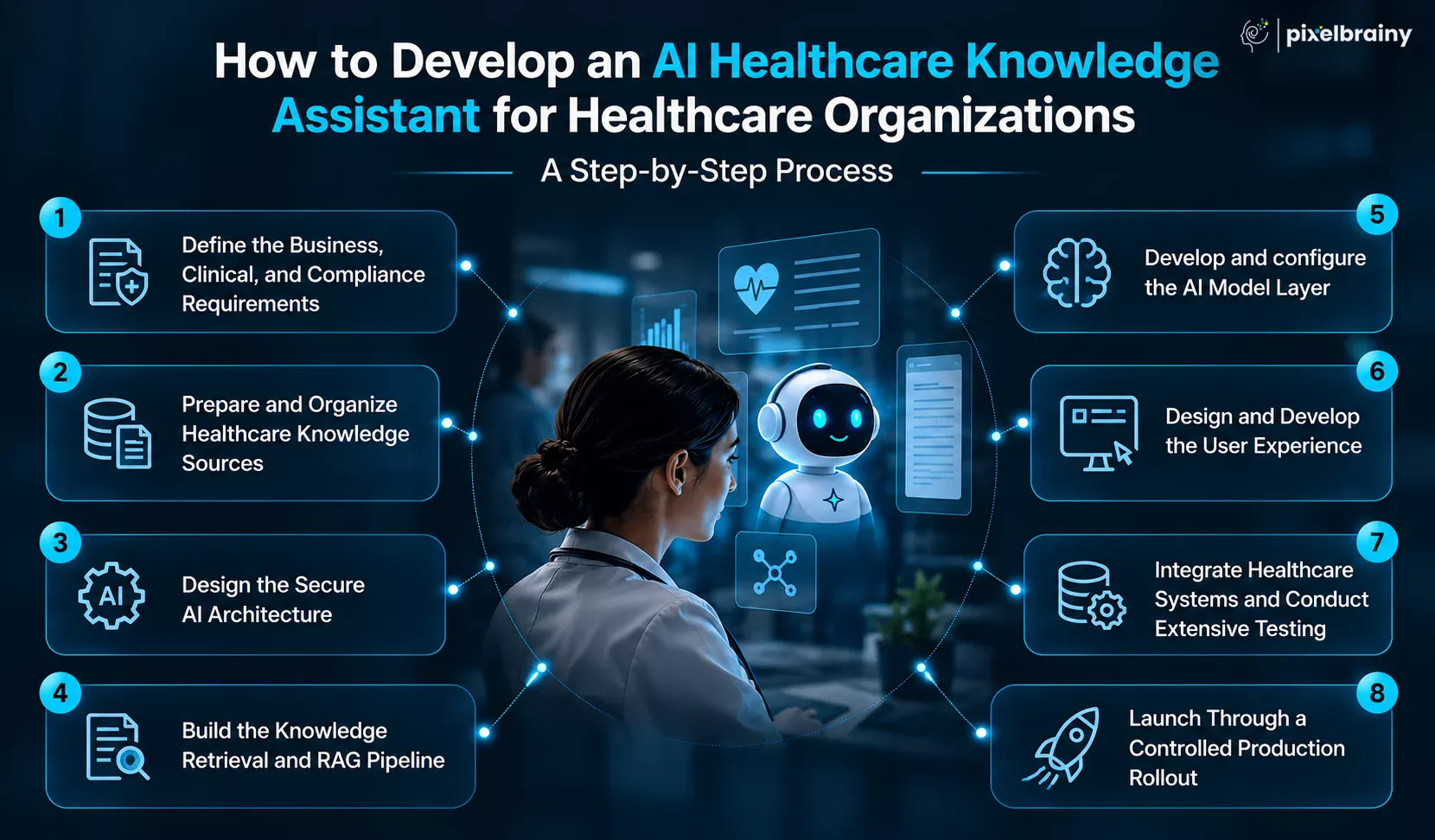
The first step is to establish exactly what the assistant needs to accomplish. Identify target users, departments, workflows, knowledge sources, expected query types, integrations, response requirements, and measurable business outcomes.
For example, a hospital may prioritize clinical protocol discovery, while a pharmaceutical company may focus on medical information queries.
At this stage, define whether patient-specific information will be processed. If it will, establish strict data-flow requirements around authorization, minimum necessary access, retention, logging, and approved processing environments.
Clear requirements prevent unnecessary features from increasing project complexity and create a practical foundation for the development process of AI healthcare knowledge assistant solutions.
An AI assistant is only as useful as the information it can reliably retrieve. Identify and assess all approved knowledge repositories, including clinical guidelines, hospital policies, SOPs, formularies, nursing procedures, research publications, equipment documentation, and internal knowledge bases.
Review documents for accuracy, duplication, outdated versions, missing metadata, and access restrictions.
Create a structured content strategy covering document ownership, effective dates, versioning, review schedules, department classification, and permissions.
For organizations asking how to build AI healthcare knowledge assistant from scratch, this stage is critical because poor source data can produce poor retrieval even when the underlying AI model performs well.
Next, define the technical architecture connecting users, authentication, knowledge repositories, retrieval systems, AI models, security controls, and monitoring services.
A typical architecture can include:
User Interface → Authentication → Query Processing → Permission Check → Retrieval Layer → RAG Pipeline → AI Model → Response Validation → Citations → Audit Logging
If patient context is permitted, design a separate controlled pathway for that information. The system should verify user authorization, minimize the data passed to downstream components, restrict access based on purpose, and prevent unnecessary patient information from entering prompts or logs.
Working with a specialized AI consultation partner can help organizations evaluate architecture decisions before development begins.
Now develop the retrieval layer that connects organizational knowledge with the AI model.
Documents are typically processed, segmented, enriched with metadata, embedded where appropriate, and stored in searchable infrastructure. The retrieval system can combine semantic search, keyword search, metadata filtering, and permission-aware retrieval.
When a clinician submits a question, the system retrieves relevant approved passages and provides them to the model as contextual evidence.
This RAG architecture helps develop AI healthcare knowledge assistant solutions that generate responses grounded in organizational sources rather than relying entirely on general model knowledge.
The next stage involves selecting and configuring the appropriate language model for the organization's requirements.
Model evaluation should consider response quality, healthcare terminology, latency, cost, context handling, privacy requirements, and deployment options.
Depending on the use case, teams may use prompting, retrieval grounding, structured outputs, model customization, or other controlled techniques.
The objective of AI model development is not simply to create the most powerful model. It is to configure an AI system that produces useful, consistent, traceable responses within the organization's defined scope.
Also Read: Top 12+ AI Model Development Companies in the USA
The assistant should fit naturally into existing healthcare workflows rather than forcing professionals to adopt another complicated application.
The interface can provide conversational search, source citations, document links, conversation history, feedback controls, and clear indicators when information is unavailable or requires professional review.
A specialized UI/UX design company can help create an interface optimized for different user roles and healthcare environments.
During MVP development, organizations can focus on a limited number of high-value workflows before expanding the assistant across additional departments and knowledge sources.
Also Read: Top 10 AI MVP Development Companies in USA
The assistant may need to connect with identity providers, document repositories, enterprise search systems, EHR environments, knowledge-management platforms, APIs, and other approved systems.
This is where AI integration becomes particularly important. Every connection should be evaluated for authentication, authorization, data minimization, encryption, logging, and failure handling.
Testing should cover retrieval accuracy, hallucination resistance, access-control enforcement, source attribution, prompt injection risks, inappropriate queries, performance, and clinical usability.
Organizations should also conduct privacy and security assessments before exposing the system to sensitive production information.
The final step is to move from testing to controlled deployment. Instead of immediately releasing the assistant across the entire organization, begin with a defined department, user group, or knowledge domain.
Monitor response quality, retrieval failures, user feedback, system performance, security events, and frequently unanswered questions.
A PoC development phase can validate the concept before significant investment, while a production rollout can follow once the system meets predefined technical, clinical, security, and operational criteria.
Organizations can then continue expanding through AI product development companies or top AI healthcare software development companies, or an internal team as appropriate. Businesses that need additional engineering capacity can hire AI developers with experience in RAG, healthcare integrations, security, and enterprise AI.
Requirements → Knowledge Assessment → Secure Architecture → RAG Development → AI Model Configuration → UX Development → Integration & Testing → Controlled Launch
Following these steps to build AI healthcare knowledge assistant from idea to launch helps healthcare organizations establish the right technical and governance foundation before scaling the solution across departments, facilities, and workflows.
The strongest healthcare knowledge assistants are built through a controlled, evidence-grounded process where clinical usefulness, security, compliance, and enterprise scalability are designed together from the beginning.
Also Read: How to Develop HIPAA-Compliant AI Healthcare Software: Architecture, Use Cases, Steps & Challenges
The cost to develop an AI healthcare knowledge assistant typically ranges from $50,000 to $350,000+. The final development budget depends on factors such as AI architecture, RAG complexity, healthcare data volume, system integrations, security requirements, user roles, testing, infrastructure, and ongoing maintenance.
A basic assistant connected to a limited set of hospital documents may require a comparatively smaller investment. In contrast, an enterprise AI healthcare knowledge assistant for a multi-hospital health system may require complex integrations, permission-aware retrieval, enterprise authentication, extensive security controls, document versioning, monitoring, and scalable infrastructure.
So, what is the development pricing of an AI healthcare knowledge assistant for a healthcare organization? The following ranges provide a practical starting point for AI healthcare knowledge assistant cost estimation.
| Solution Type | Estimated Development Cost | Typical Scope |
|---|---|---|
| Basic AI Healthcare Knowledge Assistant | $50,000 to $100,000 | Conversational interface, RAG, limited document sources, semantic search, citations, basic authentication, admin controls |
| Advanced AI Healthcare Knowledge Assistant | $100,000 to $200,000 | Advanced RAG, hybrid search, multiple knowledge sources, RBAC, SSO, document versioning, analytics, integrations, enhanced security |
| Enterprise AI Healthcare Knowledge Assistant | $200,000 to $350,000+ | Multi-site deployment, complex healthcare integrations, granular permissions, enterprise governance, advanced security, scalable infrastructure, analytics, customized workflows |
These are indicative ranges rather than fixed prices. A detailed estimate requires an assessment of the organization's technical infrastructure, data environment, security requirements, user base, and integration scope.
The architecture selected for the assistant can also influence the overall AI healthcare knowledge assistant development cost.
Consider this real-world question from a healthcare technology team:
“We are building an AI knowledge assistant for our health system. Should we use a general-purpose LLM with RAG grounded in our clinical knowledge base, or fine-tune a healthcare-specific language model on our institutional knowledge? How do these approaches compare in accuracy, hallucination risk, update flexibility, and development cost?”
For most institutional knowledge-assistant use cases, RAG is often the more practical starting architecture because current clinical knowledge can be updated in the retrieval layer without retraining the underlying model.
| Consideration | RAG-Based Assistant | Fine-Tuned Model |
|---|---|---|
| Accuracy | Can ground responses in current approved sources | Can improve behavior and domain patterns, but knowledge can become outdated |
| Hallucination Risk | Can be reduced through source-grounded retrieval and response controls | Fine-tuning does not inherently eliminate hallucinations |
| Knowledge Updates | New or revised documents can generally be indexed without retraining | Significant knowledge changes may require additional training and evaluation |
| Source Citations | Naturally supports document and passage citations | Requires additional architecture to provide reliable source attribution |
| Development Cost | Generally lower starting cost | Can require greater data preparation, training, evaluation, and infrastructure investment |
| Best Fit | Frequently changing institutional knowledge and evidence | Specialized behaviors, terminology, formatting, or task-specific model adaptation |
The choice should ultimately depend on the organization's requirements. RAG and fine-tuning can also be combined when there is a strong technical reason to do so.
A straightforward RAG pipeline costs less than an architecture using query rewriting, hybrid retrieval, reranking, metadata filtering, multiple retrieval strategies, and sophisticated response validation.
Healthcare documents may require extraction, cleaning, chunking, metadata enrichment, duplicate removal, indexing, version management, and content validation before they can be effectively used by the assistant.
Connecting the assistant with EHR environments, document repositories, intranets, identity systems, enterprise search platforms, APIs, and other healthcare applications can substantially increase the project budget.
Authentication, authorization, encryption, audit logging, data isolation, access controls, privacy safeguards, security testing, and compliance-related architecture can represent a significant portion of the development budget.
A simple conversational interface costs less than an enterprise experience containing role-specific dashboards, source previews, document navigation, feedback tools, conversation management, and workflow-specific interfaces.
Model evaluation, prompt engineering, structured responses, context-window optimization, performance testing, and model customization can affect both development expenses and future operating costs.
Healthcare organizations may need different information-access rules for physicians, nurses, pharmacists, researchers, administrators, and other employees. Granular permission-aware retrieval increases implementation complexity.
Testing should evaluate retrieval accuracy, hallucination risk, source attribution, access controls, security vulnerabilities, response consistency, inappropriate queries, and performance across realistic healthcare scenarios.
Cloud infrastructure, databases, vector storage, APIs, networking, monitoring, backups, scalability, and deployment environments all contribute to the overall implementation cost.
Post-launch expenses can include model evaluation, knowledge-base updates, security patches, infrastructure management, integration maintenance, monitoring, performance optimization, and new feature development.
A focused assistant using a limited number of internal knowledge sources can typically fall within the $50,000 to $100,000 range.
An advanced implementation with multiple repositories, enterprise authentication, role-based access, integrations, and sophisticated RAG capabilities may require $100,000 to $200,000.
A large health system requiring multi-site deployment, extensive integrations, granular permissions, enterprise governance, and scalable infrastructure can reach $200,000 to $350,000+.
The important point is that the AI healthcare knowledge assistant development cost should not be calculated based only on the chatbot interface or LLM. The knowledge infrastructure, security architecture, retrieval system, integrations, testing, and ongoing operations can have an equally significant impact on the total budget.
A realistic development budget accounts for the complete AI ecosystem, from knowledge ingestion and RAG architecture to security, integrations, testing, deployment, and long-term optimization.
Also Read: AI Software Development Cost (10K-300K+): Know How Much Your Software Will Cost
A reliable AI healthcare knowledge assistant requires more than an LLM and a chat interface. Healthcare organizations need a technology stack that can securely connect clinical knowledge sources, retrieve relevant information, enforce user permissions, generate grounded responses, and provide source traceability.
A common question from healthcare technology teams is: “What technology stack should we use to build an AI healthcare knowledge assistant that can retrieve current clinical knowledge while protecting sensitive healthcare information?”
The answer depends on the organization's infrastructure, data sources, compliance requirements, user volume, and AI use cases. For most enterprise implementations, the architecture combines LLMs, RAG, vector databases, enterprise search, APIs, healthcare integrations, identity management, cloud infrastructure, monitoring, and security technologies.
| Technology Layer | Recommended Tools / Technologies | Purpose in Healthcare Knowledge Assistant Development |
|---|---|---|
| Frontend | React, Next.js, Angular | Build responsive conversational interfaces for clinicians, pharmacists, researchers, administrators, and other authorized users. |
| Backend | Python, FastAPI, Node.js, Java | Develop APIs, business logic, authentication workflows, retrieval pipelines, integrations, and application services. |
| AI / LLM Layer | OpenAI models, Anthropic Claude, Google Gemini, Azure OpenAI | Generate natural-language responses from retrieved healthcare knowledge and support conversational interactions. |
| RAG Framework | LangChain, LlamaIndex | Build retrieval, document-processing, context-management, and LLM orchestration workflows. |
| Vector Database | Pinecone, Weaviate, Milvus, pgvector | Store and retrieve vector representations of healthcare documents for semantic search and RAG applications. |
| Enterprise Search | Elasticsearch, OpenSearch, Azure AI Search | Support keyword, semantic, metadata, and hybrid search across large healthcare knowledge repositories. |
| Relational Database | PostgreSQL, Microsoft SQL Server | Store application data, user information, metadata, configuration, permissions, feedback, and operational records. |
| Document Storage | AWS S3, Azure Blob Storage, Google Cloud Storage | Store approved clinical documents, policies, guidelines, SOPs, manuals, and other organizational knowledge resources. |
| Healthcare Integration | HL7, FHIR APIs, healthcare integration engines | Connect approved healthcare systems and exchange structured healthcare information where required and authorized. |
| Authentication & Access Control | OAuth 2.0, OpenID Connect, SAML, enterprise IAM | Provide secure authentication, SSO, role-based access, and identity management for organizational users. |
| Cloud Infrastructure | AWS, Microsoft Azure, Google Cloud | Provide scalable infrastructure for application hosting, databases, AI services, storage, networking, and monitoring. |
| Security | Encryption, KMS, secrets management, WAF, private networking | Protect data, credentials, APIs, infrastructure, and communication channels across the assistant's architecture. |
| Monitoring & Observability | OpenTelemetry, CloudWatch, Azure Monitor, application logging | Track application health, latency, failures, retrieval performance, usage patterns, and operational events. |
| AI Evaluation | RAGAS, DeepEval, custom evaluation frameworks | Evaluate retrieval quality, response relevance, groundedness, hallucination risk, and overall assistant performance. |
| DevOps & CI/CD | Docker, Kubernetes, GitHub Actions, Terraform | Automate application deployment, infrastructure management, testing, scaling, and environment consistency. |
The technology stack can be viewed as a connected architecture:
Healthcare Knowledge Sources → Data Processing → Search & Vector Database → RAG Pipeline → LLM → Response Validation → Secure API → Healthcare User
For example, when a clinician asks, “What is the latest approved protocol for medication reconciliation?”, the backend processes the query, applies the user's permissions, searches the organization's approved knowledge sources, retrieves relevant passages, and supplies them to the LLM.
The generated response can then include citations pointing back to the source document, section, and version.
Therefore, the right technology stack gives an AI healthcare knowledge assistant the foundation it needs to deliver grounded answers, secure knowledge access, reliable integrations, and enterprise-scale performance.
Also Read: A Guide to Proof of Concept (PoC) Development for AI Clinical Workflow System
Developing an AI healthcare knowledge assistant for a hospital or health system involves challenges that go beyond standard chatbot development. Healthcare organizations must manage fragmented knowledge, sensitive information, changing clinical protocols, access permissions, AI accuracy, and integration with existing technology.
A common question from healthcare technology teams is: “How can we prevent an AI healthcare knowledge assistant from providing an outdated or incorrect answer when our clinical guidelines and hospital policies are continuously changing?”
This is exactly why AI healthcare knowledge assistant development needs a combination of RAG, strong data governance, security controls, continuous evaluation, and carefully designed workflows. The following challenges are among the most important to address before moving an assistant into production.
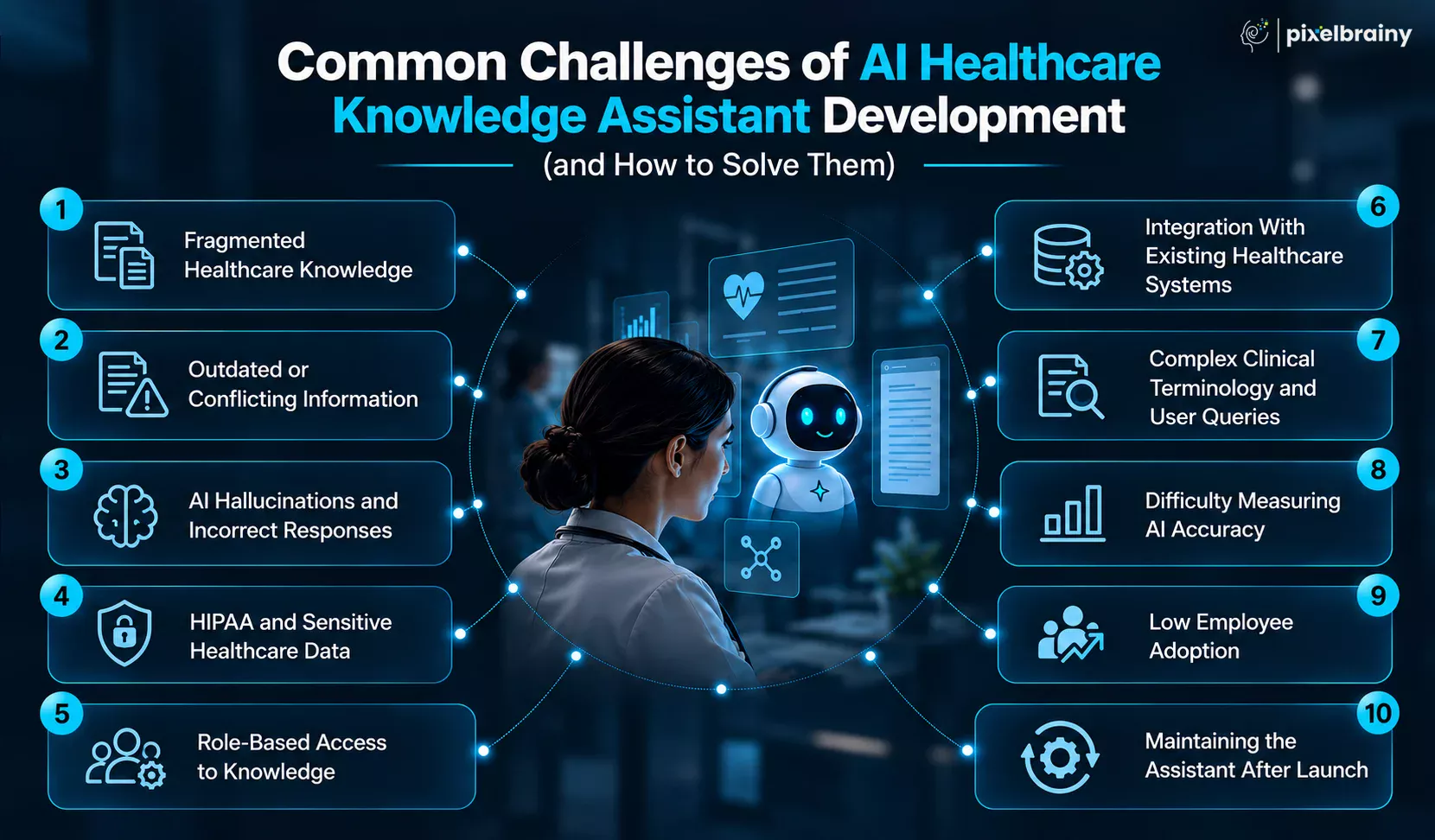
Hospitals often store clinical protocols, SOPs, formularies, policies, research documents, and operational information across multiple systems. This makes it difficult for employees to locate complete and current information.
Solution: Create a unified knowledge layer that connects approved repositories through document ingestion, enterprise search, APIs, and RAG. Use metadata such as department, facility, document type, status, and effective date to improve retrieval accuracy.
Clinical guidelines and organizational policies can change frequently. Multiple versions of the same document may also exist across different repositories.
Solution: Implement document version control, effective-date tracking, source prioritization, and content ownership. The retrieval system should prioritize current approved information and identify conflicting or outdated sources rather than treating every document as equally authoritative.
A healthcare assistant that generates unsupported information can create serious operational and clinical risks. Even a capable language model may produce plausible but incorrect answers.
Solution: Use RAG to ground responses in approved knowledge sources. Add citation requirements, retrieval thresholds, response validation, confidence indicators, and fallback behavior when sufficient evidence is unavailable. Regularly evaluate the assistant against healthcare-specific test cases.
An assistant may process protected health information when clinical queries contain patient-specific context. This creates additional privacy and security considerations.
Solution: Apply data minimization, strict authorization, encryption, secure processing environments, access controls, audit logging, retention policies, and appropriate contractual and organizational safeguards. Patient context should only be processed when necessary, authorized, and supported by the organization's privacy and security architecture.
A physician, nurse, pharmacist, researcher, and administrator may require different levels of access. Simply securing the application login is not enough if the retrieval layer can return documents the user is not authorized to access.
Solution: Implement permission-aware retrieval. User identity and authorization should be evaluated before restricted content is retrieved or included in the model context. Access policies should also be tested regularly to prevent unintended information exposure.
Healthcare organizations rarely operate with a single technology platform. The assistant may need to interact with EHRs, document repositories, identity providers, intranets, APIs, and knowledge-management systems.
Solution: Build an integration architecture using secure APIs and appropriate healthcare interoperability standards such as HL7 and FHIR where applicable. Begin with high-value integrations and expand gradually rather than attempting to connect every system during the initial release.
Healthcare professionals may use abbreviations, specialty-specific terminology, synonyms, incomplete questions, or conversational language. A basic keyword search may fail to understand the actual intent.
Solution: Combine semantic search with keyword and hybrid retrieval. Use query rewriting, terminology normalization, metadata filtering, and domain-specific evaluation to improve the assistant's understanding of real clinical and organizational questions.
Traditional software testing cannot fully measure whether an AI healthcare knowledge assistant provides useful, grounded answers. Response quality can vary depending on the question, retrieved documents, and context.
Solution: Build a healthcare-specific evaluation dataset containing representative queries and expected source documents. Measure retrieval relevance, groundedness, citation accuracy, response quality, refusal behavior, latency, and permission enforcement. Include appropriate subject-matter review for high-impact workflows.
Even technically advanced healthcare AI can fail to deliver business value if clinicians and employees find it difficult to use or do not trust its responses.
Solution: Design the assistant around real workflows rather than AI capabilities alone. Provide concise answers, visible citations, source links, clear limitations, feedback options, and role-specific experiences. Start with high-frequency use cases where employees can immediately see the productivity benefit.
Healthcare knowledge does not remain static. New guidelines, policies, documents, facilities, departments, and integrations can continuously change the information environment.
Solution: Treat the assistant as an ongoing knowledge-management product rather than a one-time software project. Establish content ownership, automated ingestion workflows, monitoring, model evaluation, security reviews, user feedback loops, and regular knowledge-base maintenance.
The safest approach to building an AI healthcare knowledge assistant is to address these challenges during architecture and planning instead of waiting until production.
Secure architecture + trusted knowledge + RAG + permission-aware retrieval + continuous evaluation + strong governance = a more reliable healthcare knowledge assistant.
For organizations planning AI healthcare knowledge assistant development for businesses, solving these challenges early can reduce rework, improve user trust, and create a stronger foundation for scaling the assistant across departments and facilities.
The goal is not simply to build an AI assistant that can answer questions, but to build one that knows what information it can trust, who can access it, and when it should not answer.
From the above requirements, challenges, architecture, and cost considerations, now it is time to identify the right development partner. For healthcare organizations, the right partner needs more than general AI expertise. It should understand enterprise knowledge management, RAG, healthcare workflows, security requirements, system integrations, and the importance of delivering traceable, reliable AI responses.
PixelBrainy brings these capabilities together as an experienced AI healthcare software development company, helping organizations turn complex healthcare knowledge requirements into practical AI solutions.
PixelBrainy can support AI healthcare knowledge assistant development services across the complete product lifecycle, from architecture and knowledge-source assessment to RAG implementation, integrations, testing, deployment, and optimization.
The approach focuses on connecting AI with an organization's trusted knowledge rather than treating a language model as a standalone chatbot. This is particularly valuable for hospitals and health systems managing constantly changing protocols, policies, clinical guidelines, formularies, and internal documentation.
A strong retrieval architecture is central to an enterprise healthcare knowledge assistant. PixelBrainy's RAG development capabilities can help organizations connect LLMs with approved internal knowledge sources, retrieve relevant content, and provide responses grounded in those sources.
This architecture can also support citations, document versioning, metadata filtering, permission-aware retrieval, and knowledge-source updates.
Consider this real-world requirement:
“I am the VP of Clinical Excellence at a hospital group. Our near-miss analysis found that staff sometimes used outdated protocols because they did not know an update existed or could not find the current version quickly enough. We want an assistant that answers questions and proactively alerts relevant clinical staff when protocols or guidelines for their patient population change.”
This requires more than conversational search. The solution needs knowledge-version monitoring, update detection, role-aware notifications, source governance, and appropriate workflow integration.
PixelBrainy can help build AI healthcare knowledge assistant solutions around these specific organizational requirements rather than forcing healthcare teams into a generic AI product model.
In one confidential healthcare engagement, the team worked on an enterprise knowledge solution designed to consolidate fragmented healthcare documentation and make approved information easier for authorized users to discover.
The solution incorporated a RAG-based retrieval architecture, document processing, semantic search, source-grounded responses, access controls, and enterprise knowledge integration. The objective was to reduce the time employees spent searching across disconnected information sources while improving visibility into the underlying documentation.
Because the client engagement is confidential, organization-specific identifiers and sensitive implementation details are intentionally not disclosed.
PixelBrainy can support organizations that want to develop AI healthcare knowledge assistant solutions with:
Whether the goal is a focused departmental solution or healthcare knowledge assistant development integrating AI across a larger health system, the implementation can be structured around measurable business and clinical workflow objectives.
Ready to turn fragmented healthcare knowledge into a secure, intelligent AI assistant? Connect with PixelBrainy to discuss your healthcare AI project.
An AI healthcare knowledge assistant can help hospitals, health systems, academic medical centers, and healthcare businesses turn fragmented information into a secure, accessible, and intelligent knowledge resource. From clinical protocols and drug formularies to SOPs, research, and internal policies, the right solution can help authorized professionals find relevant information faster while maintaining source traceability and governance.
However, successful AI healthcare knowledge assistant development requires more than integrating an LLM with a chatbot. Organizations need a well-planned RAG architecture, reliable knowledge sources, role-based access, healthcare integrations, security controls, continuous AI evaluation, and effective knowledge governance.
The cost to develop an AI healthcare knowledge assistant can range from $50,000 to $350,000+, depending on complexity, integrations, security, and enterprise requirements. A carefully planned development process helps organizations control these costs while creating a scalable solution.
For organizations ready to build AI healthcare knowledge assistant technology around their real workflows, the opportunity is to improve knowledge accessibility, workforce productivity, and enterprise knowledge management.
Book an appointment with PixelBrainy today to discuss your healthcare AI knowledge assistant project.
A hospital can build an AI healthcare knowledge assistant as a secure knowledge layer on top of existing systems rather than replacing them. Using RAG, the assistant can connect approved clinical guidelines, SOPs, drug formularies, policies, research repositories, and document management platforms. This allows healthcare professionals to ask questions conversationally while the system retrieves information from existing sources and provides source-linked answers.
An AI healthcare knowledge assistant development project can include clinical protocols, treatment guidelines, medication policies, nursing procedures, infection control documentation, hospital SOPs, equipment manuals, research publications, employee training materials, and organizational policies. Access should be controlled by user role and permissions so that each professional receives only the information they are authorized to view.
Yes. A properly designed healthcare knowledge assistant development with AI solution can use document versioning, metadata, timestamps, and RAG-based retrieval to prioritize current approved content. Organizations can also add protocol change detection so that outdated documents are flagged, replaced, or removed from retrieval. This helps reduce the risk of staff receiving information from superseded clinical policies.
To develop an AI healthcare knowledge assistant for healthcare environments, organizations need security and privacy controls across the complete architecture. These can include encryption, secure authentication, role-based access control, audit logging, minimum-necessary data access, protected integrations, secure cloud infrastructure, and appropriate vendor agreements. HIPAA compliance is not achieved by the AI model alone. The application, data flows, integrations, infrastructure, and operational processes must also be designed around applicable requirements.
For many enterprise knowledge use cases, RAG is a practical starting point because it allows the assistant to retrieve information from current organizational sources without retraining the model whenever a policy or guideline changes. Fine-tuning may be useful for specific behavior, formatting, or domain adaptation requirements. The right architecture depends on the organization's data, accuracy requirements, update frequency, security model, and intended workflows.
The cost to create an AI healthcare knowledge assistant can vary significantly based on scope. A basic implementation may start around $50,000, while advanced solutions can reach $100,000 to $200,000 and enterprise-grade platforms can exceed $350,000. Major cost drivers include RAG complexity, healthcare data preparation, EHR or API integrations, security engineering, access controls, AI evaluation, infrastructure, and ongoing maintenance.
Custom AI healthcare knowledge assistant development focuses on organizational knowledge, security, permissions, source traceability, and healthcare workflows. A standard chatbot may generate general responses, while a custom assistant can retrieve information from approved internal sources, respect user permissions, identify document versions, provide citations, maintain audit trails, and integrate with enterprise healthcare systems.
It can be valuable when employees regularly spend time searching across disconnected systems, contacting senior staff for routine information, or working with frequently changing policies and clinical documentation. For organizations with multiple facilities, large knowledge repositories, complex workflows, or growing healthcare operations, AI healthcare knowledge assistant development can create a centralized conversational access layer that makes trusted organizational knowledge easier to find and use.

About The Author
Sagar Bhatnagar
Sagar Sahay Bhatnagar brings over a decade of IT industry experience to his role as Marketing Head at PixelBrainy. He's known for his knack in devising creative marketing strategies that boost brand visibility and market influence. Sagar's strategic thinking, coupled with his innovative vision and focus on results, sets him apart. His track record of successful campaigns proves his ability to utilize digital platforms effectively for impactful marketing efforts. With a genuine passion for both technology and marketing, Sagar continuously pushes PixelBrainy's marketing initiatives to greater success.

Working with the PixelBrainy team has been a highly positive experience. They understand the design requirements and create beautiful UX elements to meet the application needs. The dev team did an excellent job bringing my vision to life. We discussed usability and flow. Sagar worked with his team to design the database and begin coding. Working with Sagar was easy. He has the knowledge to create robust apps, including multi-language support, Google and Apple ID login options, Ad-enabled integrations, Stripe payment processing, and a Web Admin site for maintaining support data. I'm extremely satisfied with the services provided, the quality of the final product, and the professionalism of the entire process. I highly recommend them for Android and iOS Mobile Application Design and Development.

Great experience working with them. Had a lot of feedback and I found that unlike most contractors they were bugging me for updates instead of the other way around. They were extremely time conscience and great at communicating! All work was done extremely high quality and if not on time, early! They were always proactive when it comes to communication and the work is great/above par always. Very flexible and a great team to work with! Goes above and beyond to present us with multiple options and always provides quality. Amazing work per usual with Chitra. If you have UI/UX or branding design needs I recommend you go to them! Will likely work with them in the future as well, definitely recommended!

PixelBrainy is a joy to work with and is a great partner when thinking through branding, logo, and website layout. I appreciate that they spend time going into the "why" behind their decisions to help inform me and others about industry best practices and their expertise.

I hired them to design our software apps. Things I really like about them are excellent communication skills, they answer all project suggestions and collaborate right away, and their input on design and colors is amazing. This project was complex and needed patience and creativity. The team is amazing to do business with. I will be using them long-term. Glad to see there are some good people out there. I was afraid to try and outsource my project to someone but I am glad I met them! I really can't say enough. They went above and beyond on this project. I am very happy with everything they have done to make my business stand out from the competition.

It was great working with PixelBrainy and the team. They were very responsive and really owned the project. We'll definitely work with them again!

I recently worked with the PixelBrainy team on a project and I was blown away by their communication skills. They were prompt, clear, and articulate in all of our interactions. They listened and provided valuable feedback and suggestions to help make the project a success. They also kept me updated throughout the entire process, which made the experience stress-free and enjoyable.

PixelBrainy is very good at what it does. The team also presents themselves very professionally and takes care of their side of things very well. I could fully trust them taking up the design work in a timely and organised manner and their attention to detail saved us lots of effort and time. This particular project was quite intense and the team showed that they function very well under pressure. Very much looking forward to working with her again!

It's always an absolute pleasure working with them. They completed all of my requests quickly and followed every note I had for them to a T, which made our process go smoothly from start to finish. Everything was completed fast and following all of the guidelines. And I would recommend their services to anyone. If you need any design work done in the future, PixelBrainy should be your first call!

They took ownership of our requirements and designed and proposed multiple beautiful variants. The team is self-motivated, requires minimum supervision, committed to see-through designs with quality and delivering them on time. We would definitely love to work with PixelBrainy again when we have any requirements.

PixelBrainy was a big help with our SaaS application. We've been hard at work with a new UI/UX and they provided a lot of help with the designs. If you're looking for assistance with your website, software, or mobile application designs, PixelBrainy and the team is a great recommendation.

PixelBrainy designers are amazing. They are responsive, talented, and always willing to help craft the design until it matches your vision. I would recommend them and plan to continue them for my future projects and more!!!

They were awesome! Did a good job fast, and good communication. Will work with them again. Thank you

Creative, detail-oriented, and talented designers who take direction well and implement changes quickly and accurately. They consistently over-delivered for us.

PixelBrainy team is very talented and creative. Great designers and a pleasure to work with. PixelBrainy is an excellent communicator and I look forward to working with them again.

PixelBrainy has a very talented design team. Their work is excellent and they are very responsive. I enjoy working with them and hope to continue on all of our future projects.


Transform your ideas into reality with us.
Across these industries, each engagement brings unique challenges, from early-stage product development to scaling complex systems, helping us build a practical understanding of real-world product environments.