AI Summary Powered by PixelBrainy
What would it take for a 300-bed community hospital with a 78% clean claim rate to move closer to the 95% benchmark by preventing claim errors before submission?
Consider a real-world revenue cycle scenario. You are the Revenue Cycle Director of a 300-bed community hospital, and your clean claim rate is currently 78%. Your billing team spends most of its time identifying and correcting claim errors before submission, while denied claims that represent potentially recoverable revenue continue to compete for the same limited staff capacity. Before presenting an AI medical billing automation software development investment to the CFO, you need clear answers to three questions: Which claim errors can AI reliably prevent? What clean claim rate improvement is realistic from a 78% baseline? And which development companies have demonstrated measurable improvements in healthcare billing performance?
This is the business case for medical billing automation software development with AI. The objective is not to replace experienced billers. It is to identify predictable errors earlier, reduce repetitive manual corrections, prioritize high-risk claims, and redirect skilled revenue cycle employees toward complex denials, appeals, underpayments, and high-value A/R recovery.
AI medical billing automation software can combine rules-based claim scrubbing with machine learning, natural language processing, eligibility verification, coding assistance, payer-specific validation, authorization checks, denial prediction, and intelligent work-queue management. The strongest implementations do not rely on AI alone. They combine deterministic billing rules, predictive models, healthcare data, and human oversight.
For organizations researching how to build AI medical billing automation software from scratch, development should begin with a detailed analysis of existing claim-error categories, payer mix, denial patterns, workflow bottlenecks, and historical claims data. Organizations looking to develop HIPAA compliant AI medical billing software must also build privacy, security, access control, auditability, encryption, data governance, and human-review mechanisms into the architecture from the beginning.
The market opportunity is expanding rapidly. Grand View Research estimates that the global AI in healthcare market will reach $50.7 billion in 2026 and projects it to reach $505.6 billion by 2033, representing a 38.9% CAGR
This step-by-step guide to building an AI medical billing automation software explains the types of AI billing systems, practical healthcare use cases, essential and advanced features, development process, technology stack, estimated development costs, compliance requirements, implementation challenges, and how healthcare organizations can evaluate an AI development partner based on measurable revenue cycle outcomes.
AI medical billing automation software is an intelligent healthcare revenue cycle platform designed to analyze billing data, identify potential claim problems, predict financial risks, and automate selected billing decisions. It combines technologies such as artificial intelligence, machine learning, natural language processing, predictive analytics, rules engines, and workflow automation with existing healthcare billing infrastructure.
The easiest way to understand the difference is to compare what each system is designed to do.
Traditional medical billing software primarily manages and processes billing activities based on predefined workflows and rules. It commonly supports:
These systems are essential for running a healthcare revenue cycle, but their decision-making capabilities are generally rule-driven. They perform an action when a predefined condition is met.
AI billing automation software = analyze, predict, prioritize, and automate selected billing decisions
| Capability | Standard Billing Software | AI Billing Automation Software |
|---|---|---|
| Billing transactions | Yes | Yes |
| Predefined claim edits | Yes | Yes |
| Pattern recognition | Limited | Advanced |
| Predictive claim-risk scoring | Usually limited | Yes |
| Historical claims analysis | Basic | Advanced |
| Natural language processing | Limited or absent | Yes |
| Intelligent prioritization | Limited | Yes |
| Denial-risk prediction | Limited | Yes |
| Automated recommendations | Rule-based | AI and rules-based |
| Human review workflows | Yes | Yes, with intelligent routing |
Importantly, AI does not replace the underlying billing system. A strong AI medical billing automation software architecture works alongside existing EHR, practice management, clearinghouse, and billing platforms.
The goal is to turn billing data into actionable intelligence, helping healthcare organizations identify preventable problems earlier, prioritize the highest-value work, and make revenue cycle operations more accurate, proactive, and financially measurable.
How does AI medical billing automation software turn complex healthcare billing data into actionable claim and revenue cycle decisions? The answer lies in a combination of healthcare data integration, rules-based validation, artificial intelligence, predictive analytics, and human oversight.
AI medical billing automation software typically works as a connected intelligence layer across the revenue cycle. It collects relevant information from systems such as EHRs, practice management platforms, clearinghouses, eligibility systems, coding platforms, and payer data sources. The software then standardizes and analyzes this information before applying billing rules and AI models.
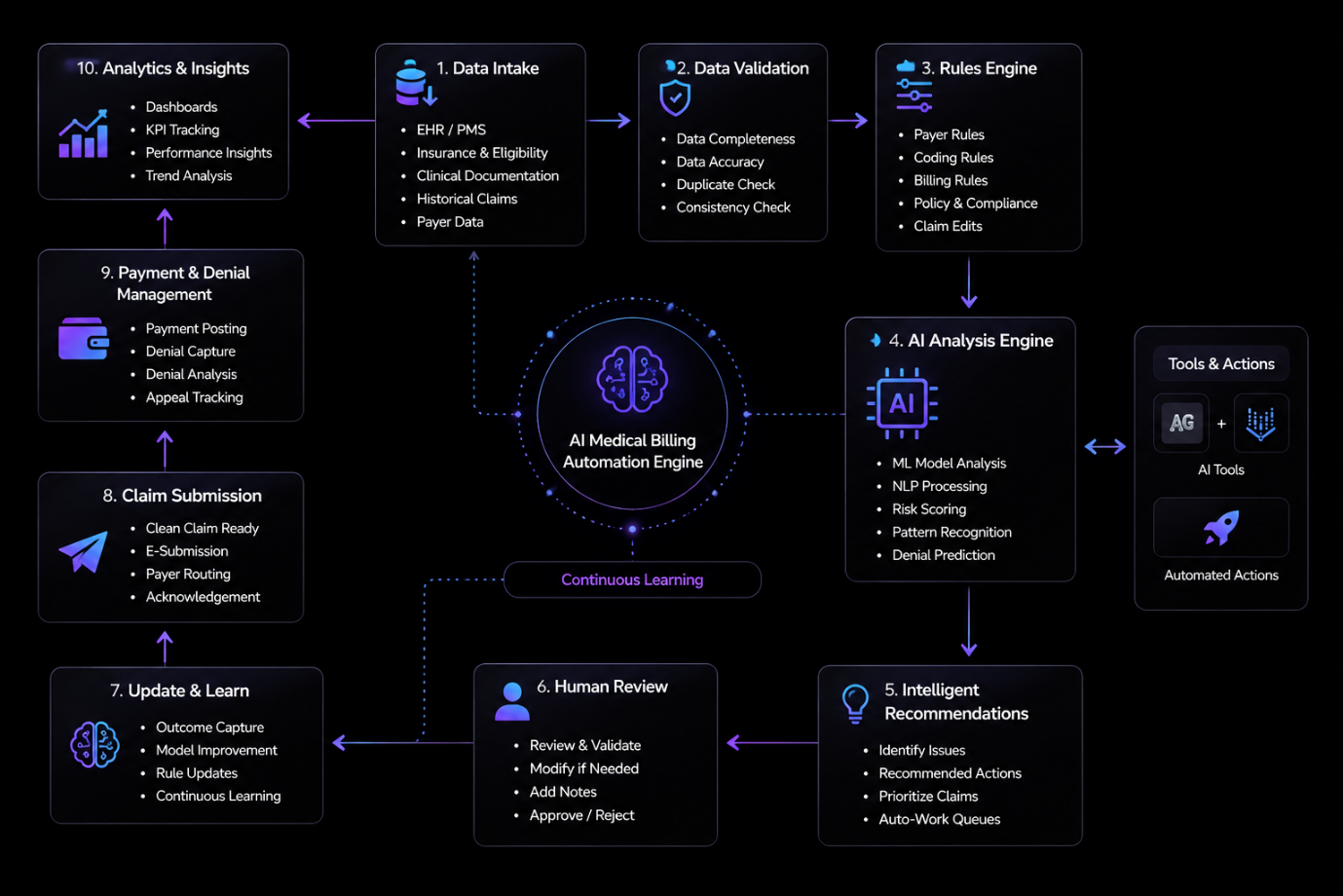
The system receives patient, insurance, provider, clinical, coding, authorization, claim, payment, and historical denial data through APIs, HL7, FHIR, X12, or other supported healthcare interfaces.
Before AI analysis, the platform checks data quality and identifies missing, inconsistent, outdated, or conflicting information.
Known payer and billing requirements are evaluated using configurable rules. This can identify issues such as missing information, eligibility problems, invalid coding combinations, authorization gaps, duplicate claims, or payer-specific requirements.
Machine learning and NLP models analyze historical claims and billing patterns to identify risks that may not be captured by conventional rules. The system can assign claim-risk scores, identify potential denial patterns, and recognize unusual billing behavior.
The platform converts detected risks into actionable recommendations, such as correcting information, reviewing documentation, verifying authorization, or escalating a claim for specialist review.
Claims requiring judgment are routed to appropriate billing or coding professionals. Their actions and final claim outcomes can provide feedback for model monitoring and improvement.
In simple terms, the workflow is:
Healthcare Data → Validation → Billing Rules → AI Analysis → Risk Detection → Recommendation → Human Review → Claim Outcome → Performance Feedback
This combination allows AI medical billing automation software to become a proactive intelligence layer rather than simply another billing transaction system.
Also Read: AI Claim Denial Management Software Development
Which healthcare organizations can gain the most value from developing an AI medical billing automation software in 2026? The strongest candidates are organizations processing large claim volumes, managing complex payer requirements, experiencing preventable billing errors, or spending substantial resources on repetitive revenue cycle activities.
For example, consider an RCM company managing claims for 50 hospitals and physician groups. If its billing teams manually review thousands of claims every day, even a small reduction in preventable errors can create significant operational and financial value. In this situation, building an AI medical billing automation platform can help standardize billing intelligence across clients while improving scalability and service quality.
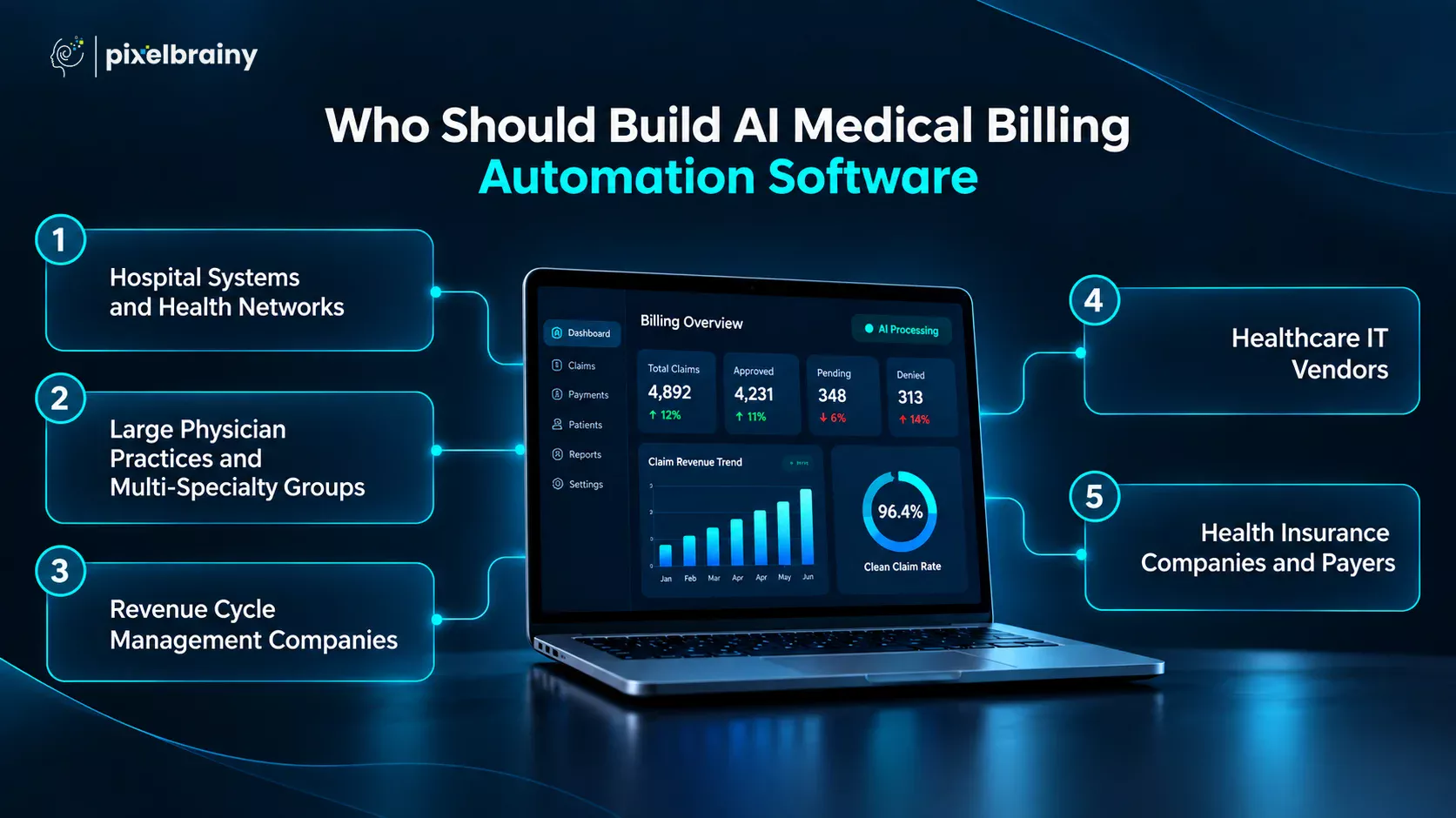
Large hospital systems and integrated health networks are strong candidates for an AI medical billing automation platform for hospitals because they process high volumes of inpatient, outpatient, emergency, surgical, and specialty claims across multiple facilities.
AI can support autonomous coding for appropriate high-volume encounter types, pre-submission claim validation, denial prediction, eligibility verification, and underpayment detection. It can also identify recurring payer-specific errors across facilities.
Primary value: Reduce preventable revenue leakage, improve clean claim performance, and increase the productivity of existing revenue cycle teams without simply adding more billing staff.
Large physician practices and multi-specialty organizations often face complex coding requirements, high claim volumes, varying payer policies, and specialty-specific billing workflows.
AI medical billing software for healthcare providers can support specialty-specific coding assistance, eligibility verification, claim-risk identification, documentation analysis, and denial management.
For practices asking, "How can we automate medical billing without increasing our billing headcount?", AI can provide a practical answer by automating repetitive validation and prioritizing the claims that require human expertise.
Primary value: Improve coding accuracy, reduce avoidable denials, accelerate claim processing, and support revenue growth without proportionally increasing administrative staffing.
RCM companies are among the strongest candidates for AI medical billing automation software development for RCM companies because they manage billing operations across multiple healthcare clients.
An RCM provider can develop AI medical billing automation platform capabilities that standardize claim validation, identify high-risk claims, automate repetitive workflows, prioritize high-value A/R accounts, and support denial recovery.
Proprietary AI capabilities can also create competitive differentiation by enabling faster turnaround times, improved billing accuracy, greater operational scalability, and potentially stronger denial recovery performance.
Primary value: Serve more clients efficiently while differentiating the RCM business through measurable AI-enabled revenue cycle performance.
EHR companies, practice management vendors, clearinghouses, and healthcare technology providers can integrate AI billing capabilities into their existing products.
For these organizations, to create AI medical billing automation platform capabilities is not only about improving billing. It can expand the product portfolio, increase customer retention, create additional subscription or usage-based revenue opportunities, and make the platform more valuable to healthcare organizations.
Primary value: Add intelligent billing capabilities without requiring customers to adopt an entirely separate revenue cycle ecosystem.
Health insurance companies can also benefit from AI-powered billing and claims automation. Their requirements differ from provider organizations because the focus is often on claims adjudication, payment accuracy, anomaly detection, fraud identification, utilization patterns, and automated claims processing.
AI can analyze large volumes of claims to identify unusual billing patterns, inconsistent information, potential fraud indicators, and payment anomalies while supporting faster claims processing.
Primary value: Improve claims-processing efficiency, payment accuracy, fraud detection, and overall claims administration.
Organizations should consider developing an AI medical billing automation software when they have:
The best starting point is not necessarily the organization with the largest technology budget. It is the organization with a high-volume, measurable, repetitive billing problem that AI can address reliably.
For healthcare providers, hospitals, RCM companies, and healthcare technology vendors, the decision to develop AI medical billing automation platform capabilities should therefore begin with the revenue cycle problem, available data, expected financial impact, and compliance requirements.
The right AI billing strategy does more than automate transactions. It creates an intelligent revenue cycle layer that helps organizations prevent avoidable errors, prioritize financial opportunities, and scale billing operations more efficiently while keeping appropriate human oversight in place.
Why are hospitals, physician groups, RCM companies, and healthcare technology providers investing in AI medical billing automation software when conventional billing systems already process claims? The answer is increasingly tied to revenue protection, administrative efficiency, denial prevention, and the growing complexity of healthcare reimbursement.
For a hospital operating with a 78% clean claim rate, the business case is particularly clear. If billing employees spend most of their time correcting preventable errors before submission, the organization is using skilled revenue cycle capacity on repetitive work instead of recovering denied revenue, resolving high-value A/R, identifying underpayments, and addressing payer-specific problems. AI medical billing automation software development can help shift this operating model from reactive correction to proactive error prevention.
One of the primary reasons to develop AI medical billing automation software is to identify claim problems before submission. AI can analyze patient, payer, provider, coding, authorization, documentation, and historical claims data to identify patterns associated with rejections or denials.
This can help organizations address issues involving:
The strongest systems combine AI with deterministic billing rules rather than expecting machine learning to replace established claim edits.
For a revenue cycle director asking, "How can our hospital move from a 78% clean claim rate toward 95% without simply adding more billing staff?", AI can provide a targeted approach.
Instead of treating every claim equally, an intelligent platform can identify which claims have a higher probability of rejection or denial and route them for correction before submission.
The realistic improvement depends on the hospital's existing error distribution. If a significant portion of the 22% non-clean claims comes from predictable, data-driven errors, automation can address a meaningful part of the gap. However, a 95% outcome should be established as a measured performance target rather than presented as a guaranteed result.
Denials remain a significant financial pressure for healthcare organizations. HFMA reported in April 2026 that denial rates averaged nearly 12% in 2025, with some organizations experiencing substantially higher rates. HFMA also notes that each percentage point of denial activity can represent millions of dollars tied up in unresolved claims.
For healthcare businesses, this makes AI medical billing automation software development relevant not only for claim submission but also for identifying denial patterns, prioritizing recoverable accounts, and directing staff toward the highest-value opportunities.
Manual billing requires employees to repeatedly review similar information across thousands of claims. AI can automate or accelerate activities such as data validation, claim-risk assessment, classification, work-queue prioritization, and documentation review.
The objective is not necessarily workforce reduction. A stronger financial argument is workforce capacity optimization. Employees can spend less time correcting predictable errors and more time handling complex claims, appeals, payer disputes, and revenue recovery.
Coding and documentation errors can directly affect claim acceptance, reimbursement, and compliance. AI-powered natural language processing can analyze clinical documentation and assist qualified professionals in identifying relevant coding information or documentation inconsistencies.
The technology should support coding professionals rather than make unsupported autonomous clinical or coding decisions.
The AMA reported in its 2026 physician AI research that 28% of physicians identified documentation of billing codes, medical charts, or visit notes as an AI use case, up from 21% in 2024.
This indicates that billing-related AI is moving beyond experimentation and into practical healthcare workflows.
Payer requirements continue to create substantial administrative work. In a 2026 survey, the AMA reported that physicians complete approximately 40 prior authorization requests per week, while nearly one-third said requests are often or always denied. The same survey found that prior authorization consumes approximately 13 hours of physician and staff time each week.
An AI billing platform can help organizations organize authorization information, identify missing requirements, prioritize pending cases, and surface potential risks before they affect claims.
A manual RCM operation often scales by adding people. An AI-enabled revenue cycle can scale by improving automation, standardization, and intelligent prioritization.
This is especially valuable for:
An AI medical billing automation platform can provide centralized billing intelligence while allowing workflows and payer rules to be configured for different facilities, specialties, or clients.
The broader healthcare AI market is expanding rapidly. Grand View Research estimates the global AI in healthcare market at $50.7 billion in 2026 and projects it to reach $505.6 billion by 2033, representing a 38.9% CAGR from 2026 to 2033.
This growth creates a strong technology environment for organizations considering developing an AI medical billing automation software, but market growth alone should not justify an investment. The business case should connect AI capabilities to measurable RCM outcomes such as clean claim rate, denial rate, preventable denial dollars, A/R days, cost to collect, coding accuracy, staff productivity, and recovered revenue.
Traditional billing operations often identify problems after a claim has already failed. AI enables a more predictive approach by using historical outcomes to identify potential problems earlier.
The progression is straightforward:
Manual correction → Automated validation → Predictive risk detection → Intelligent prioritization → Preventive revenue cycle management
For organizations asking why they should invest in AI medical billing automation software development, the strongest answer is not simply automation. It is the opportunity to prevent avoidable revenue leakage before it becomes a denial, reduce repetitive administrative work, and give revenue cycle teams more capacity to recover the revenue that genuinely requires human expertise.
That’s why AI medical billing automation becomes a strategic investment when it can connect measurable claim-quality improvements with lower administrative costs, faster reimbursement, and stronger revenue recovery.
Also Read: Top 10 AI Insurance Claim Management Software Development Companies in USA
The types of AI medical billing automation software you can build vary based on where an organization wants to improve its revenue cycle. AI claim scrubbing, denial management, coding assistance, prior authorization, patient billing, and revenue cycle analytics can exist as standalone products, but they can also become modules within a unified AI medical billing automation platform.
For a healthcare technology investor evaluating the market, these categories should not be viewed as identical feature sets. Each addresses a different revenue cycle problem, uses different data, requires different integrations, and may have a different buyer. For example, a hospital may purchase an AI claim-scrubbing solution to improve clean claims, while an RCM company may prioritize denial automation and work-queue intelligence. A healthcare IT vendor may instead want to build AI medical billing software with EHR integration and offer multiple capabilities through one platform.
The development of AI medical billing automation platform therefore depends on the intended product strategy. Companies can start with one high-value workflow and expand into adjacent RCM functions, or build a broader platform from the beginning. The following are the major product categories to consider when evaluating medical billing automation software development with AI.
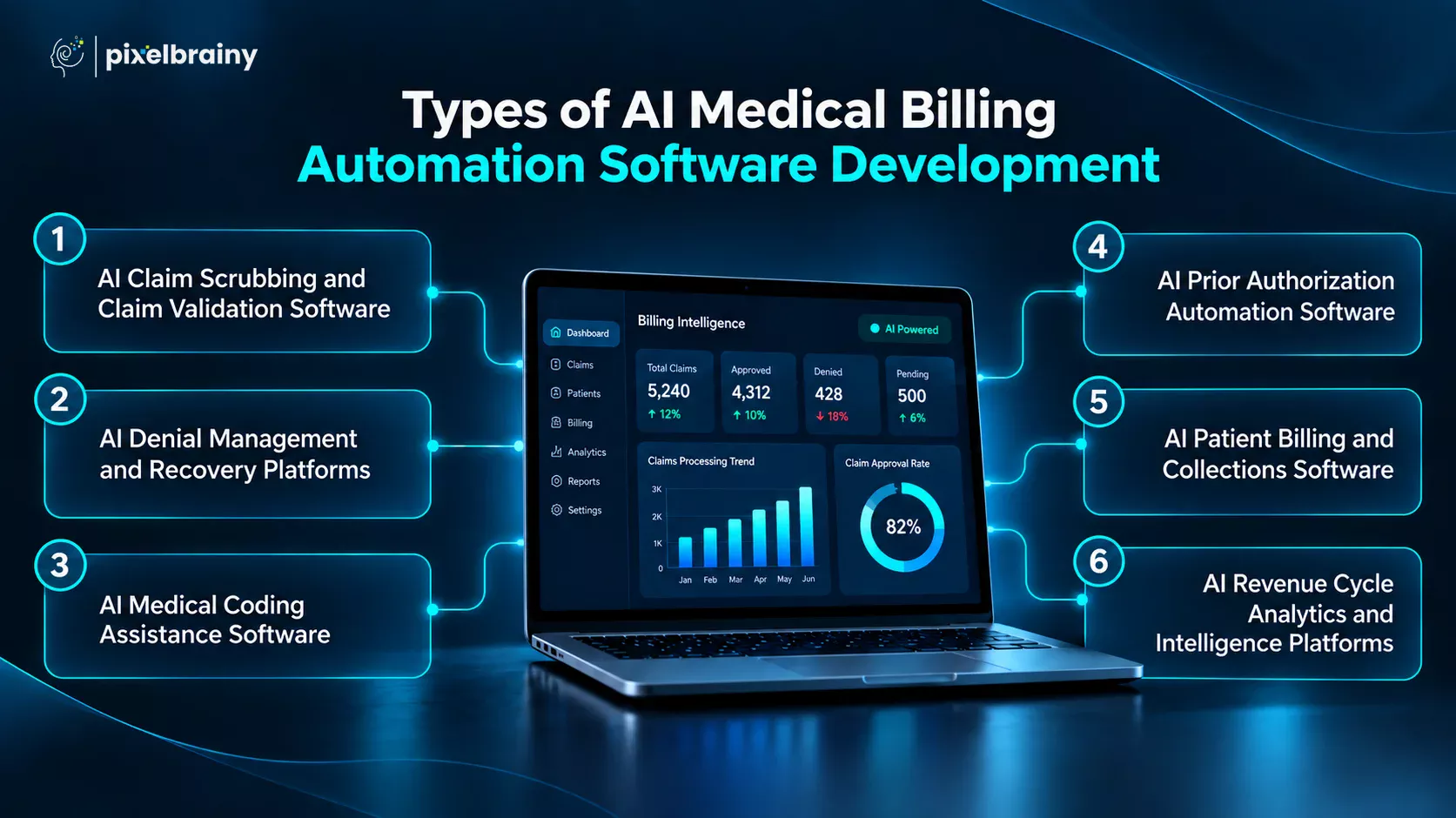
AI claim scrubbing software is designed to identify potential claim errors before claims are submitted to payers. It can analyze patient demographics, insurance information, diagnosis and procedure codes, modifiers, provider details, authorization data, payer requirements, and historical claim outcomes.
Unlike conventional claim scrubbers that rely primarily on predefined edits, AI-enabled systems can identify patterns associated with rejected or denied claims and assign risk levels to individual claims. This makes AI claim scrubbing particularly relevant for hospitals and RCM organizations trying to improve clean claim rates.
The development requirements typically include EHR and practice management integrations, clearinghouse connectivity, payer-specific rule management, claims datasets, coding knowledge, and machine learning models.
For organizations seeking AI medical billing automation software creation, this category can be an attractive starting point because the financial impact can be measured through clean claim rate, rejection rate, correction volume, and preventable denial reduction.
AI denial management platforms focus on what happens when claims are rejected or denied. These systems can classify denial reasons, identify recurring root causes, prioritize accounts, recommend next actions, and support appeal workflows.
Machine learning can analyze historical claims, payer behavior, procedure types, diagnosis information, authorization status, coding patterns, and previous recovery outcomes to predict which denied accounts are most likely to generate recoverable revenue.
The primary buyers include hospitals, health systems, physician groups, and RCM companies with substantial denial volumes.
Development requires integrations with billing systems, clearinghouses, EHRs, payment systems, payer data, and historical denial databases. Natural language processing may also be required when denial explanations or payer correspondence contain unstructured information.
For investors evaluating the market, this is a distinct category from claim scrubbing because the primary workflow occurs after a claim has encountered a payer problem.
AI coding assistance software uses artificial intelligence and natural language processing to analyze clinical documentation and identify relevant coding information. Depending on the workflow and regulatory requirements, the platform can recommend ICD-10, CPT, HCPCS, and other applicable codes for qualified coding professionals to review.
The key value proposition is improving coding productivity and consistency while reducing the manual effort involved in reviewing extensive clinical documentation.
This category requires significantly different technology from a basic claim-scrubbing platform because it must process clinical language, understand medical terminology, identify relevant concepts, and connect documentation with coding requirements.
Healthcare organizations considering to make AI medical billing software automation platform capabilities around coding should prioritize explainability, source-document traceability, human review, auditability, and continuous model validation.
For product investors, AI coding can represent either a standalone solution or a major module within a broader AI revenue cycle platform.
AI prior authorization automation focuses on one of the most administrative and time-consuming areas of healthcare revenue cycle management. The software can help identify authorization requirements, gather relevant information, check documentation completeness, track authorization status, and route exceptions to appropriate staff.
Advanced systems can use natural language processing to extract information from clinical documentation and compare it with payer-specific requirements. AI can also prioritize cases based on urgency, complexity, service type, and authorization risk.
Unlike claim scrubbing, prior authorization automation operates earlier in the patient financial journey and often requires connectivity with payer portals, EHR workflows, clinical documentation, authorization systems, and healthcare interoperability infrastructure.
This makes it a distinct product category with different development requirements.
Organizations that build AI medical billing software with EHR integration can position authorization automation as a front-end revenue cycle capability that helps prevent downstream claim problems before services are billed.
AI patient billing and collections platforms focus on the patient responsibility portion of the revenue cycle rather than payer claim processing alone.
These systems can analyze patient balances, payment history, communication preferences, financial information, and account characteristics to determine appropriate collection workflows. AI can help personalize payment reminders, identify accounts requiring human assistance, recommend payment-plan options, and prioritize collection activities.
The major buyers include hospitals, health systems, physician groups, patient financial services organizations, and RCM companies.
Development requirements may include patient portals, payment gateways, CRM systems, billing platforms, communication APIs, analytics, and secure handling of sensitive financial and healthcare information.
For organizations exploring medical billing automation software development with AI, patient billing can become an important extension of payer-side automation because improving claim performance alone does not guarantee successful patient collections.
AI revenue cycle analytics platforms focus on understanding what is happening across the entire financial lifecycle rather than automating one individual billing task.
These systems can combine claims, denials, payments, A/R, payer behavior, coding, authorization, collection, and operational data to identify trends and predict potential revenue risks.
For example, an analytics platform could identify that one payer has a rising denial rate for a specific procedure at one facility and alert revenue cycle leadership before the problem becomes widespread.
The primary buyers include CFOs, revenue cycle executives, hospital administrators, RCM companies, and healthcare technology organizations.
Development typically requires a scalable data architecture, healthcare integrations, data warehouses, machine learning, predictive analytics, dashboards, and role-based reporting.
For investors, this category can become the intelligence layer connecting multiple AI billing products into a unified AI medical billing automation platform.
They can be either.
A focused startup may build an AI claim-scrubbing product, while an enterprise healthcare technology company may combine claim validation, coding, authorization, denial management, patient collections, and analytics into one platform.
The distinction is important for an investment thesis because each category has different:
Therefore, when evaluating AI medical billing automation software creation, investors should assess whether a company is solving one high-value RCM problem exceptionally well or attempting to create a complete platform without sufficient differentiation.
For organizations researching which US development companies can help define and build these products, the right partner should demonstrate healthcare RCM expertise, EHR and payer integration experience, AI engineering capabilities, HIPAA-conscious architecture, and measurable healthcare technology outcomes rather than simply general-purpose AI development experience.
The strongest AI medical billing platforms can begin with one clearly defined revenue cycle category and progressively connect adjacent capabilities into a unified, intelligent RCM ecosystem.
The most valuable use cases for AI medical billing automation software development are those that address high-volume, repetitive revenue cycle tasks where errors directly affect reimbursement, staff productivity, or cash flow. For hospitals and healthcare providers, AI can help prevent claim problems before submission. For RCM companies, it can standardize billing operations across clients, increase processing capacity, and prioritize work according to financial value.
The following use cases represent practical opportunities for AI medical billing software for healthcare providers and AI medical claims processing software development.
AI can analyze clinical documentation and assign appropriate codes for highly consistent, high-volume encounter types such as emergency department visits, radiology services, and routine evaluation and management encounters. Qualified coders can review complex, unusual, or high-value cases while routine encounters move through a controlled automated workflow.
The objective is not unrestricted autonomous coding. It is risk-based coding automation, where confidence thresholds determine whether an encounter can proceed automatically or requires human review.
For hospitals and RCM companies, this approach can increase coder productivity for eligible encounter categories, reduce coding backlogs, and potentially accelerate claims reaching the payer. Organizations should validate productivity and accuracy improvements against their own baseline rather than assuming a universal two to four times improvement.
AI can analyze a claim before submission and estimate its likelihood of denial based on payer-specific historical patterns, authorization requirements, coding combinations, documentation requirements, and previous claim outcomes.
For example, if a hospital has historically experienced elevated denials from one payer for a particular procedure when authorization documentation is incomplete, the system can flag similar claims before submission.
Billing staff can then correct the issue, obtain missing documentation, or verify authorization instead of waiting for the payer to reject the claim.
The measurable business opportunity includes lower first-pass denial rates, fewer claim corrections, reduced rework, and faster reimbursement.
AI-powered eligibility workflows can automatically verify coverage for scheduled patients and identify potential problems before services are delivered.
The system can flag inactive coverage, coverage limitations, coordination-of-benefits issues, payer changes, or other conditions that could affect billing.
Instead of requiring staff to manually investigate every account, the platform can prioritize exceptions that need intervention.
For healthcare providers, this can reduce eligibility-related claim failures and minimize unexpected patient balances. For RCM companies, automated eligibility verification can standardize front-end revenue cycle processes across multiple provider clients.
Once denials enter the revenue cycle, AI can classify them according to denial reason, payer, procedure, provider, service line, and historical recovery outcomes.
The system can then rank denial work queues based on factors such as net recoverable value, recovery probability, filing deadline, and account complexity.
For common denial categories, generative AI can assist with preparing first-level appeal drafts using approved templates, payer requirements, and relevant claim documentation. Human review remains important before submission.
The potential business impact is higher recovery efficiency, lower manual categorization effort, and better allocation of denial-management resources toward accounts with the greatest financial opportunity.
AI can compare expected reimbursement against actual payer payments using applicable contract terms, fee schedules, claim attributes, and remittance information.
When the actual payment falls below an organization's configured threshold, the system can flag the account for investigation and generate a payment-variance work item.
This is particularly valuable for hospitals and large RCM organizations processing thousands of remittances where manual review cannot realistically examine every payment.
The potential outcome is recovery of underpayments that might otherwise remain unidentified, improved payer-contract visibility, and stronger payment integrity.
AI can identify whether a service is likely to require prior authorization based on procedure, payer, patient coverage, and other relevant information. Where appropriate integrations exist, the platform can gather required documentation, prepare authorization requests, track status, and alert staff when action is required.
For example, the system could distinguish between pending, approved, denied, expired, and additional-information-required authorization states and route each case to the appropriate team.
The business impact includes reduced administrative workload, fewer authorization-related claim problems, better visibility into pending cases, and potentially fewer services delivered without required authorization.
| Use Case | AI Capability | Potential Business Impact |
|---|---|---|
| Autonomous coding | NLP and clinical code extraction | Higher productivity for eligible routine encounters |
| Denial prediction | Payer-specific machine learning | Lower first-pass denial rate and reduced rework |
| Eligibility verification | Automated payer connectivity and risk detection | Fewer eligibility-related claim problems |
| Denial management | Classification, prioritization, and NLP | Higher recovery efficiency and lower manual workload |
| Underpayment detection | Contract-to-remittance comparison | Recovery of previously unidentified payment variances |
| Prior authorization | Requirement detection and workflow automation | Lower administrative burden and fewer authorization-related problems |
The strongest AI medical billing automation software does not attempt to automate every revenue cycle decision. It identifies high-volume, measurable opportunities, automates high-confidence tasks, and routes complex cases to experienced professionals.
For healthcare providers and RCM companies, the greatest opportunity is to connect these individual use cases into an intelligent revenue cycle workflow where prevention, prediction, recovery, and financial analytics work together rather than operating as isolated AI features.
Also Read: AI Claim Scrubber Management Software Development
When planning AI medical billing automation software development, healthcare organizations should first prioritize the features that solve core revenue cycle problems. A successful platform does not need every possible AI capability at launch. It needs reliable billing automation, strong healthcare integrations, accurate data processing, clear workflows, security, and measurable revenue cycle outcomes.
A practical question for a hospital CFO or revenue cycle director is: “If our clean claim rate is 78%, which features should an AI medical billing platform have to prevent the errors responsible for the remaining 22% before claims reach payers?”
The answer depends on the organization's claim-error profile, but a strong foundation should cover the following 15 capabilities. These are core features for an AI medical billing automation platform, not advanced AI features such as autonomous agents, generative AI assistants, or sophisticated predictive intelligence.
| Feature | What It Should Do | Why It Matters |
|---|---|---|
| Patient Data Management | Centralize and validate patient demographic and insurance information across connected healthcare systems. | Helps reduce errors caused by incomplete, outdated, or inconsistent patient information. |
| Eligibility Verification | Automatically verify insurance coverage, eligibility status, and relevant benefit information before billing workflows progress. | Reduces eligibility-related claim problems and prevents avoidable patient balance issues. |
| Claim Creation and Validation | Generate claims from approved billing data and validate required fields before submission. | Establishes a reliable foundation for accurate electronic claim processing. |
| AI Claim Scrubbing | Analyze claims against configured billing rules, coding relationships, payer requirements, and historical error patterns. | Helps identify preventable problems before claims reach the clearinghouse or payer. |
| Medical Coding Assistance | Support qualified coders by identifying relevant diagnosis and procedure coding information from available documentation. | Improves coding workflow efficiency while maintaining appropriate professional review. |
| Payer Rule Management | Maintain configurable payer-specific billing, submission, authorization, and claim validation requirements. | Helps organizations manage differences between payer policies without hard-coding every workflow. |
| Authorization Tracking | Capture authorization information and monitor whether required authorization exists and remains valid. | Reduces the risk of claims being submitted without required authorization information. |
| Denial Management | Capture, organize, and route denied claims according to denial reason, payer, account, and workflow status. | Gives revenue cycle teams a centralized process for managing denied claims. |
| A/R Work Queue | Organize outstanding billing tasks and accounts into structured queues for appropriate revenue cycle employees. | Prevents important accounts from being overlooked and creates more consistent operational workflows. |
| Payment Posting | Import and process payer payment information while connecting payments to the corresponding claims and accounts. | Improves payment reconciliation and reduces repetitive manual payment-processing activities. |
| Remittance Processing | Process electronic remittance information and connect payer responses with claim and payment records. | Creates better visibility into paid, denied, adjusted, and outstanding claims. |
| Patient Billing | Generate and manage patient billing information based on approved account balances and financial responsibility. | Supports consistent patient billing while reducing manual administrative effort. |
| Reporting and Dashboards | Provide operational reports covering claims, denials, payments, A/R, billing activity, and core performance indicators. | Gives revenue cycle leaders visibility into performance and emerging operational problems. |
| Audit Trail | Record important user actions, system decisions, claim changes, and workflow events throughout the platform. | Supports accountability, troubleshooting, compliance monitoring, and investigation of billing changes. |
| Role-Based Access Control | Restrict platform functions and healthcare data according to user roles, responsibilities, and authorization levels. | Helps protect sensitive healthcare information and ensures employees access only what they need. |
Once these core capabilities are stable, the organization can expand into denial management, payment workflows, patient billing, and broader revenue cycle automation.
The right feature set should ultimately be determined by the organization's highest-value billing problems, existing technology environment, payer mix, data availability, compliance requirements, and measurable ROI objectives.
A strong AI medical billing automation platform starts with reliable core billing infrastructure and uses AI to make those existing workflows more accurate, proactive, and measurable.
Once the core billing infrastructure is stable, organizations can add advanced AI capabilities that move the platform beyond basic claim processing and workflow automation. These features are particularly valuable for hospitals, health systems, RCM companies, and healthcare technology vendors that want to build an AI medical billing automation platform capable of predicting revenue risks, making intelligent recommendations, and continuously improving operational performance.
For organizations considering advanced AI medical billing software development, the key question is not how many AI features can be added. It is which capabilities can produce measurable improvements in denial prevention, reimbursement, staff productivity, payment accuracy, and revenue recovery while maintaining appropriate human oversight.
The following advanced features can differentiate an AI-powered medical billing platform from conventional RCM software.
| Advanced Feature | What It Does | Business Value |
|---|---|---|
| Predictive Denial Scoring | Predicts the probability that an individual claim will be rejected or denied before submission. | Helps billing teams prevent high-risk claims and reduce avoidable denials. |
| Generative AI RCM Assistant | Allows authorized users to ask billing questions and receive contextual answers based on approved healthcare and RCM data. | Reduces information-search time and helps staff make faster revenue cycle decisions. |
| Intelligent Work Queue Prioritization | Ranks claims, denials, and A/R accounts based on financial value, urgency, recovery probability, and complexity. | Directs staff toward the accounts with the greatest potential financial impact. |
| Automated Appeal Generation | Uses claim information, denial reasons, documentation, and approved templates to prepare draft appeal letters. | Reduces manual appeal preparation and accelerates denial recovery workflows. |
| AI Underpayment Detection | Compares expected reimbursement with actual payer payments and identifies potential contractual variances. | Helps recover underpayments that may otherwise remain undetected. |
| Payer Behavior Intelligence | Analyzes historical payer activity to identify changing denial, reimbursement, authorization, and processing patterns. | Enables revenue cycle teams to respond proactively to payer-specific changes. |
| Revenue Leakage Detection | Identifies patterns associated with missed charges, coding inconsistencies, unbilled services, and other potential revenue leakage. | Helps healthcare organizations identify financial opportunities beyond traditional claim processing. |
| AI Contract Intelligence | Extracts and analyzes relevant reimbursement terms from payer contracts and connects them with claims and payment data. | Improves visibility into expected reimbursement and potential contractual discrepancies. |
| Continuous AI Learning and Monitoring | Tracks model performance, prediction accuracy, data changes, and model drift over time. | Helps maintain reliable AI performance as billing workflows, data, and payer behavior change. |
| Predictive Cash Flow Forecasting | Uses claims, A/R, payer behavior, payment history, denial probability, and collection patterns to forecast future revenue. | Gives CFOs and revenue cycle leaders better visibility into expected cash collections. |
The most effective advanced AI medical billing platforms are not defined by the number of AI features they contain, but by how accurately those features convert billing data into measurable revenue cycle decisions.
Building an AI medical billing automation software requires more than adding an AI model to an existing billing application. Healthcare organizations must connect revenue cycle workflows, clinical and financial data, payer requirements, healthcare integrations, security controls, AI capabilities, and human review into one reliable system. The development process should therefore move from a clearly defined business problem to validated automation and controlled production deployment.
For a hospital asking, “How can we reduce preventable claim errors without disrupting our existing EHR, billing workflows, or compliance controls?”, the right approach is to build incrementally and measure every stage.
The following eight steps to build AI medical billing automation software from idea to launch provide a practical framework for AI medical billing automation software development for hospitals, RCM companies, and healthcare technology providers.
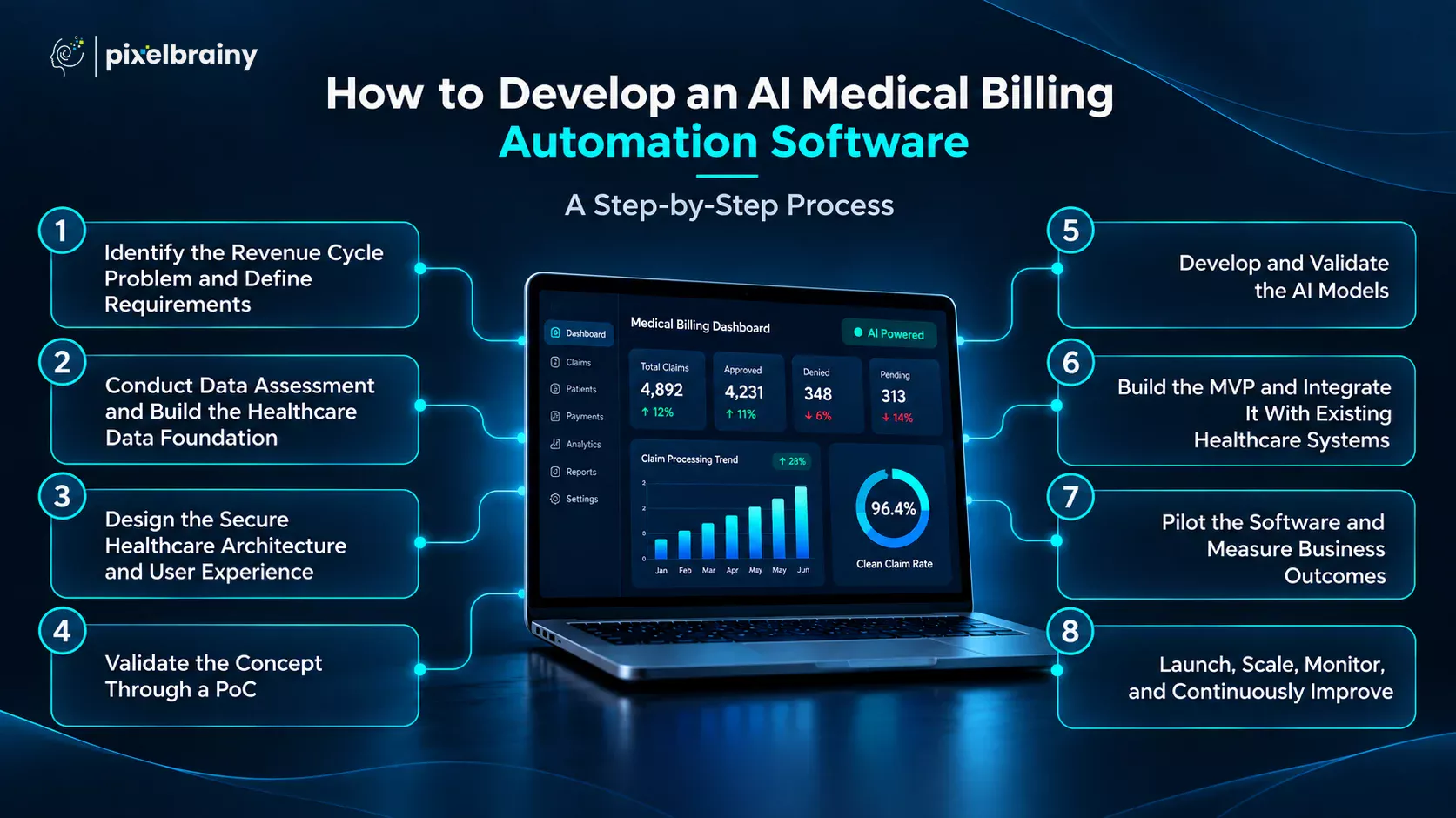
The first step is to determine exactly what the software needs to solve. Avoid starting with a technology-first requirement such as “we need machine learning.” Instead, analyze the existing revenue cycle and identify measurable problems such as low clean claim rates, eligibility-related denials, coding errors, authorization failures, underpayments, or excessive manual claim correction.
Document the current workflow from patient registration through claim submission, payment, denial, and recovery. Establish baseline metrics including claim volume, clean claim rate, denial rate, A/R days, correction time, preventable denial dollars, and staff productivity.
Organizations can also use AI consultation to evaluate which workflows are technically suitable for automation and which should remain human-driven. This creates a clear product scope, business case, and success criteria before development begins.
Also Read: Top 10 AI Consulting Companies in USA
AI billing software depends on reliable historical and real-time data. During this stage, identify all relevant data sources, including EHR systems, practice management platforms, clearinghouses, payer systems, claims databases, eligibility systems, authorization records, remittance files, coding systems, and financial applications.
The development team should determine what data is available, how frequently it changes, how it is structured, and whether historical outcomes are accurately labeled. Claims should ideally be associated with outcomes such as accepted, rejected, denied, paid, partially paid, appealed, recovered, or written off.
Data quality checks should identify missing fields, duplicate records, inconsistent identifiers, outdated payer information, and conflicting clinical or financial information.
This foundation is essential for how to build AI medical billing automation software from scratch, because poor-quality training data can produce unreliable predictions and excessive false alerts.
The third stage defines how users, data, AI services, healthcare systems, and billing workflows will interact. The architecture should support secure data exchange, scalable processing, audit logging, role-based access, encryption, monitoring, and appropriate healthcare privacy controls.
For develop AI medical billing automation software projects, the architecture should also determine how the platform will communicate with EHRs, clearinghouses, payer systems, authorization services, and internal financial applications.
The user experience should be designed around actual revenue cycle workflows rather than generic software screens. Billing specialists should quickly understand why a claim was flagged, what action is recommended, and whether human approval is required. A specialized UI/UX design company can help translate complex billing workflows into intuitive interfaces.
At this stage, organizations should also establish requirements for HIPAA-conscious development, data retention, auditability, access control, and disaster recovery.
Before committing to full-scale development, organizations should test whether the proposed AI capability can solve the targeted problem using real or appropriately de-identified healthcare data.
A PoC development phase can focus on one measurable workflow, such as predicting claim denials, identifying eligibility errors, detecting coding inconsistencies, or classifying denial reasons.
The objective is not to create a production-ready application. Instead, the team evaluates whether the data supports the intended AI use case and whether the model can achieve acceptable precision, recall, accuracy, or other relevant performance measures.
For example, if a hospital wants to reduce its 78% clean claim rate gap, the PoC could analyze historical non-clean claims and determine which error categories can be predicted reliably before submission.
A successful PoC provides evidence for moving into full building an AI medical billing automation software development.
Once the use case and data have been validated, the team can begin AI model development. The appropriate model depends on the specific billing problem.
Classification models can predict denial risk, NLP can analyze clinical or payer documentation, anomaly detection can identify unusual payment behavior, and ranking models can prioritize A/R accounts.
Models should be trained using appropriately prepared historical data and evaluated against separate validation and testing datasets. Performance should be measured using healthcare-relevant metrics rather than relying only on generic AI accuracy.
Explainability is equally important. A billing professional should understand why a claim received a high-risk score or why a particular issue was identified.
Human review should remain available for uncertain cases, and confidence thresholds should determine when automation is appropriate. Continuous validation is necessary because payer behavior, billing rules, documentation patterns, and healthcare workflows can change over time.
Also Read: Top 12+ AI Model Development Companies in the USA
After validating the AI capability, development can move into MVP development. The MVP should contain only the features necessary to prove the business case in a controlled production environment.
For example, an initial hospital MVP might include claim intake, data validation, AI claim-risk scoring, payer rule validation, staff review queues, EHR integration, and performance reporting.
AI integration should be implemented carefully so that the new platform complements existing systems rather than creating duplicate data entry or disconnected workflows.
Healthcare interoperability may involve FHIR, HL7, X12, REST APIs, secure file exchange, clearinghouse connections, or vendor-specific interfaces.
The MVP should include monitoring, audit trails, access controls, exception handling, and rollback mechanisms before it is introduced to live revenue cycle operations.
Also Read: Top 10 AI MVP Development Companies in USA
The next step is controlled deployment with a limited group of users, departments, claim types, or payer categories. A hospital should avoid immediately deploying the system across every facility and service line.
The pilot should establish a clear comparison between the existing workflow and the AI-assisted workflow. Relevant metrics can include clean claim rate, rejection rate, first-pass denial rate, correction time, coding accuracy, staff productivity, recovered revenue, underpayment identification, and A/R performance.
For example, if the baseline clean claim rate is 78%, the organization can establish a measured pilot target rather than assuming that AI will immediately reach 95%.
Feedback from billing professionals is also critical. If users receive too many false alerts or cannot understand AI recommendations, adoption will suffer regardless of technical model performance.
Pilot results should determine whether the product is ready for broader deployment.
The final stage of the development process of AI medical billing automation software is controlled production launch followed by continuous optimization. Production deployment should occur gradually across departments, facilities, payers, and claim types based on pilot performance.
The organization should establish ongoing monitoring for model accuracy, false positives, false negatives, data-quality issues, model drift, payer-rule changes, system performance, security events, and user adoption.
The platform should also maintain a feedback loop where claim outcomes, denial results, coding corrections, payment information, and user decisions can inform future model improvements.
Organizations working with top AI development companies or specialized AI product development companies should define post-launch responsibilities clearly, including model monitoring, infrastructure management, security updates, integration maintenance, and regulatory or compliance support.
Scaling should be based on measured financial and operational outcomes, not simply on the number of AI features deployed.
A successful medical billing automation software development using AI journey moves from a measurable RCM problem to validated AI, controlled integration, monitored deployment, and continuous improvement, ensuring that automation delivers financial value without compromising healthcare compliance or human oversight.
Also Read: AI Medical Claims Processing Automation Software Development
The cost to develop an AI medical billing automation software typically ranges from $50,000 to $350,000+, depending on the product scope, AI complexity, healthcare integrations, compliance requirements, automation depth, and development team location. A basic platform focused on claim validation and billing workflows can require a significantly smaller investment than an enterprise-grade platform integrating EHRs, clearinghouses, payer systems, predictive AI, denial management, analytics, and advanced security controls.
For organizations evaluating the development budget of AI medical billing automation software, the most important point is that there is no universal fixed price. The cost estimation of an AI medical billing automation platform should be based on the workflows being automated, the number of integrations required, the complexity of AI models, data preparation requirements, and expected user volume.
A practical question for a hospital CFO or healthcare technology investor is: “What should we budget to develop an AI medical billing platform that integrates with our existing EHR, predicts claim problems, supports billing teams, and can scale across multiple facilities?”
For a focused MVP, the investment may fall near the lower end of the range. A production-ready enterprise platform with sophisticated AI, multiple healthcare integrations, extensive compliance controls, and ongoing model management can move well beyond $350,000.
| Software Type | Typical Development Cost | Suitable For | Typical Scope |
|---|---|---|---|
| Basic AI Medical Billing Automation Software | $50,000 to $100,000 | Small practices, focused RCM teams, startups | Core billing workflows, claim validation, basic AI assistance, eligibility checks, dashboards, essential integrations |
| Advanced AI Medical Billing Automation Software | $100,000 to $200,000 | Large practices, hospitals, growing RCM companies | AI claim scrubbing, denial prediction, coding assistance, denial workflows, multiple integrations, analytics, role-based access |
| Enterprise AI Medical Billing Automation Software | $200,000 to $350,000+ | Hospital networks, large RCM companies, healthcare IT vendors | Multi-facility architecture, advanced AI, EHR and payer integrations, predictive analytics, enterprise security, extensive automation, scalable infrastructure |
These figures are planning estimates rather than fixed development quotes. The final AI medical billing automation platform development cost depends on the organization's specific workflows, integrations, AI requirements, data environment, security architecture, and scalability expectations.
The number and complexity of features directly influence development effort. A platform limited to claim validation and eligibility verification costs considerably less than one incorporating coding assistance, denial management, prior authorization, payment processing, patient billing, predictive analytics, and automated workflows.
Starting with a focused MVP can control the initial AI medical billing automation software development cost, while additional capabilities can be introduced during later development phases.
AI requirements can significantly change the project budget. Basic AI-assisted validation may require less investment, while custom models for denial prediction, coding assistance, underpayment detection, revenue forecasting, or anomaly detection require data preparation, training, validation, deployment, and monitoring.
Using established AI services may reduce initial costs, whereas developing proprietary models can require considerably more engineering and data-science resources.
Healthcare integration is one of the most important cost variables. Connecting the platform with EHRs, practice management systems, clearinghouses, eligibility services, payment platforms, authorization systems, and other healthcare applications requires specialized engineering.
The number of systems, APIs, data formats, authentication mechanisms, vendor requirements, and testing environments can substantially affect the overall AI medical billing automation platform development cost.
AI medical billing platforms frequently need to exchange information with multiple payers and clearinghouses. Each integration may involve different technical specifications, authentication methods, claim formats, response structures, and testing procedures.
Supporting a broad payer ecosystem can therefore increase both development time and integration costs.
Healthcare billing platforms process sensitive patient, clinical, insurance, and financial information. Development budgets should account for encryption, authentication, role-based access control, audit logging, secure data storage, monitoring, vulnerability testing, and other security controls.
Organizations should treat compliance and security as architectural requirements from the beginning rather than adding them immediately before launch.
AI models require reliable and appropriately structured data. Historical claims, denial records, payments, coding information, payer responses, and patient account information may need to be cleaned, normalized, mapped, labeled, and migrated.
If historical healthcare data contains significant inconsistencies or missing information, additional data engineering can increase the cost to develop an AI medical billing automation software.
AI billing software may serve billers, coders, supervisors, RCM managers, financial analysts, and executives. Each user group can require different dashboards, workflows, permissions, and information displays.
A well-designed interface should make AI recommendations understandable, showing users what was detected, why the claim was flagged, and what action should be taken.
Basic reporting requires less investment than enterprise revenue cycle intelligence. Advanced analytics may include customized dashboards, financial KPIs, denial trends, A/R analytics, payer performance, payment variance reporting, and predictive insights.
Common metrics include clean claim rate, rejection rate, denial rate, A/R aging, correction volume, recovery rate, and recovered revenue.
Medical billing software requires extensive testing because system errors can affect reimbursement, claims, compliance, and patient accounts.
The budget may include functional testing, integration testing, security testing, performance testing, AI model validation, regression testing, and user acceptance testing. More integrations and workflows generally mean more extensive testing.
Cloud infrastructure contributes to both development and operational costs. This can include databases, secure storage, APIs, application hosting, monitoring, backup systems, disaster recovery, security infrastructure, and deployment automation.
Enterprise platforms handling large claim volumes may require redundancy, scalable processing, advanced monitoring, and disaster recovery capabilities that increase infrastructure costs.
The development budget should also account for ongoing maintenance. Healthcare workflows, payer requirements, integrations, security threats, and AI model performance can change after deployment.
Ongoing expenses can include infrastructure management, model monitoring and retraining, integration updates, security improvements, compliance reviews, bug fixes, performance optimization, and future feature development.
The final AI medical billing automation software development cost should be calculated from the organization's actual requirements rather than from a generic feature checklist. A hospital implementing claim-error prevention may have a very different budget from an RCM company building a multi-client platform with denial prediction, automated appeals, payment intelligence, and advanced analytics.
A practical budgeting process should therefore begin with four questions:
For many organizations, a phased development strategy is more financially practical than attempting to build the entire platform at once. A focused MVP can validate the business case, demonstrate measurable operational improvements, and provide a foundation for subsequent AI capabilities.
Therefore, the right development budget for AI medical billing automation software is the amount required to deliver measurable revenue cycle improvement while maintaining healthcare security, scalability, interoperability, and long-term AI reliability.

A reliable AI medical billing automation platform depends on more than AI models alone. The technology stack must support high-volume claim processing, healthcare data exchange, EHR connectivity, secure handling of sensitive information, real-time workflows, and scalable analytics. Every technology decision can affect the platform's accuracy, performance, compliance, integration effort, and long-term development cost.
For healthcare organizations planning medical billing automation software development using AI, a practical question is: “What technology stack can support secure EHR integration, AI-powered claim analysis, payer connectivity, and scalable revenue cycle automation without disrupting our existing billing infrastructure?”
The answer is usually a combination of technologies rather than one framework or platform. The application layer manages billing workflows, healthcare interoperability standards connect clinical and financial systems, databases organize claims and patient information, AI frameworks power predictive capabilities, and cloud infrastructure provides scalability and security.
The technology stack should also reflect the intended product scope. A focused claim-scrubbing application may require a relatively straightforward architecture, while an enterprise platform supporting hospitals or RCM companies may need multiple EHR integrations, X12 transactions, payer connectivity, machine learning pipelines, data warehouses, role-based access, audit trails, and advanced analytics.
The following technology stack provides a practical foundation for AI medical billing automation software development, covering the major components required to build, integrate, secure, deploy, and scale a modern AI-powered medical billing platform.
| Technology Layer | Recommended Tools and Technologies | Purpose in AI Medical Billing Software |
|---|---|---|
| Frontend Development | React, Next.js, Angular | Builds billing dashboards, claim review screens, denial work queues, analytics interfaces, and administrative portals. |
| Backend Development | Python, Node.js, Java, .NET | Handles billing workflows, business logic, APIs, authentication, claim processing, and integration services. |
| AI and Machine Learning | Python, PyTorch, TensorFlow, scikit-learn | Supports denial prediction, claim-risk scoring, coding assistance, anomaly detection, and predictive analytics. |
| Natural Language Processing | Hugging Face, spaCy, transformer-based models | Processes clinical documentation, payer communications, denial explanations, and other unstructured healthcare text. |
| Generative AI | OpenAI API, Azure OpenAI, Anthropic Claude | Supports controlled RCM assistants, document summarization, appeal drafting, and natural-language interaction with approved data. |
| Healthcare Interoperability | HL7, FHIR, X12, REST APIs | Enables exchange of clinical, patient, claims, eligibility, authorization, and payment information. |
| EHR Integration | SMART on FHIR, vendor APIs, FHIR APIs | Connects the billing platform with EHR workflows and healthcare applications. |
| Claims Processing | X12 837, X12 835, clearinghouse APIs | Supports electronic claim submission, remittance processing, payment information, and payer responses. |
| Database Technology | PostgreSQL, MySQL, MongoDB | Stores structured billing, patient, workflow, configuration, and application data. |
| Data Warehouse | Snowflake, BigQuery, Amazon Redshift | Supports large-scale revenue cycle analytics, reporting, historical analysis, and AI data pipelines. |
| Cloud Infrastructure | AWS, Microsoft Azure, Google Cloud | Provides scalable computing, storage, networking, monitoring, security, and deployment infrastructure. |
| Security and Identity | OAuth 2.0, OpenID Connect, IAM, RBAC | Protects sensitive healthcare information and controls access based on user roles and permissions. |
| Data Encryption | TLS, AES-256, cloud key management | Protects healthcare and financial data during transmission and storage. |
| Analytics and Visualization | Power BI, Tableau, Looker, custom dashboards | Provides visibility into clean claims, denials, A/R, payments, payer performance, and revenue cycle KPIs. |
| DevOps and Deployment | Docker, Kubernetes, GitHub Actions, Terraform | Supports repeatable deployment, scalable infrastructure, automated testing, and application lifecycle management. |
A well-designed technology stack gives AI medical billing automation software the infrastructure required to connect healthcare data, automate revenue cycle workflows, and deliver reliable AI-driven financial intelligence at scale.
Should a healthcare organization build custom AI medical billing software or use an existing solution? The answer depends mainly on billing complexity, integration requirements, budget, customization needs, and long-term business goals.
For example, a hospital with multiple facilities, complex payer workflows, and a low clean claim rate may need capabilities that standard billing software cannot provide. In contrast, a smaller practice with standardized billing processes may achieve its goals faster with an off-the-shelf platform.
Custom software is developed specifically around an organization's billing workflows, EHR environment, payer requirements, data structure, and automation objectives.
It provides greater control over:
Custom development is generally better suited for hospitals, large health systems, RCM companies, and healthcare technology vendors with complex requirements or plans to commercialize their own AI billing platform.
The main disadvantages are higher upfront investment, longer development time, and ongoing maintenance requirements.
Off-the-shelf solutions provide prebuilt billing and RCM capabilities that can be configured according to the organization's requirements. Depending on the vendor, these platforms may include claim scrubbing, eligibility verification, coding assistance, denial management, payment processing, and analytics.
They are generally suitable for organizations that want faster implementation, predictable costs, and standardized billing workflows without managing an extensive software development project.
The main limitation is that customization and integration options depend on what the vendor supports.
| Factor | Custom Software | Off-The-Shelf Software |
|---|---|---|
| Initial investment | Higher | Lower to moderate |
| Implementation | Longer | Faster |
| Customization | Very high | Limited |
| EHR integration | Highly customizable | Vendor dependent |
| AI control | High | Vendor controlled |
| Scalability | Business-specific | Vendor dependent |
| Maintenance | Organization or partner | Vendor |
| Best suited for | Complex requirements | Standard workflows |
Choose custom AI medical billing automation software when your organization has complex payer workflows, specialized RCM requirements, multiple healthcare integrations, substantial claim volume, or a strategic need to own the technology.
Choose off-the-shelf software when your workflows are relatively standardized and your priority is faster deployment with lower initial development costs.
A hybrid approach is also possible. Organizations can retain their existing EHR and billing infrastructure while adding custom AI capabilities for specific requirements such as denial prediction, claim-risk scoring, or underpayment detection.
In simple terms, off-the-shelf software prioritizes speed and convenience, while custom development prioritizes control, flexibility, and long-term differentiation.
Developing AI medical billing automation software can improve claim accuracy, reduce repetitive revenue cycle work, and support faster financial decision-making. However, healthcare billing is a highly regulated and data-intensive environment. AI systems must work with complex payer rules, sensitive patient information, legacy healthcare systems, inconsistent data, and workflows that often require professional judgment.
For a healthcare organization considering an AI billing investment, the practical question is: “What could prevent an AI medical billing platform from delivering reliable results after it is connected to our real claims, EHR systems, and payer workflows?”
The following are the major challenges organizations should address during development.
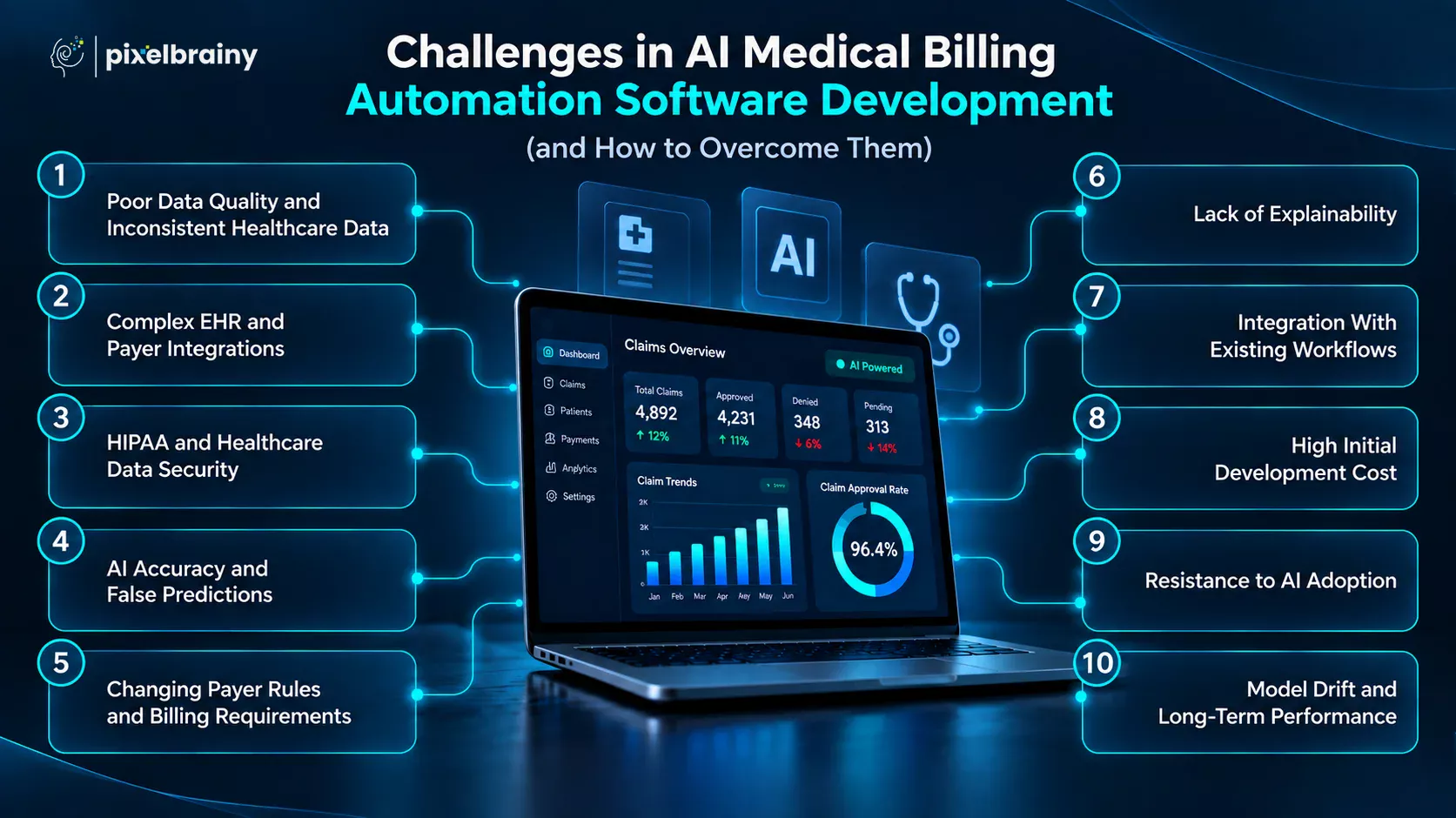
AI models depend on accurate and sufficiently structured data. Medical billing data can contain missing demographics, duplicate records, inconsistent coding, incomplete authorization information, and poorly labeled historical claim outcomes.
How to overcome it: Establish a data-quality framework before model development. Clean, normalize, validate, and standardize historical claims, denials, payments, coding, and payer information before using them for AI training.
Healthcare organizations rarely operate on a single technology platform. EHRs, practice management systems, clearinghouses, eligibility services, payer portals, and payment systems may all use different interfaces and data formats.
How to overcome it: Use standards such as FHIR, HL7, X12, and secure APIs where appropriate. Build an integration layer that separates external systems from the core AI application, making future integrations easier to maintain.
AI billing platforms process protected health information and sensitive financial data. Unauthorized access, insecure APIs, excessive permissions, or poor data handling can create serious compliance and security risks.
How to overcome it: Incorporate security into the architecture from the beginning through encryption, role-based access control, secure authentication, audit logging, data minimization, vulnerability testing, monitoring, and appropriate contractual safeguards.
An AI model can incorrectly flag a valid claim or fail to identify a genuine billing risk. Excessive false alerts can create additional work for billing teams and reduce confidence in the platform.
How to overcome it: Establish measurable model-performance thresholds, validate models using representative data, introduce confidence scoring, continuously monitor outcomes, and route uncertain cases to qualified professionals.
Payer policies, authorization requirements, coding guidelines, reimbursement rules, and claim-edit requirements can change over time. A model trained on historical patterns may become less reliable when the underlying billing environment changes.
How to overcome it: Combine AI with configurable rules engines and establish processes for monitoring payer changes. Models should be periodically evaluated and retrained when data patterns materially change.
Billing professionals need to understand why an AI system flagged a claim or recommended a particular action. A simple prediction without supporting context may not be sufficient for operational use.
How to overcome it: Design AI outputs with explanations, supporting data, confidence scores, relevant billing rules, and traceable evidence where appropriate. Human reviewers should be able to challenge or override recommendations.
Even accurate AI can fail operationally if employees have to move between multiple systems or manually enter the same information into different applications.
How to overcome it: Integrate AI directly into existing billing workflows where possible. The system should present recommendations inside familiar work queues and clearly identify the next action required.
Building a production-ready AI medical billing platform can require significant investment in software engineering, healthcare integrations, data engineering, AI development, security, testing, and ongoing maintenance.
How to overcome it: Start with one high-value use case and develop a controlled MVP. Measure financial and operational outcomes before expanding into additional AI capabilities.
Billers, coders, and revenue cycle managers may be hesitant to trust automated recommendations, particularly when they believe AI could affect their responsibilities or introduce billing errors.
How to overcome it: Position AI as decision support rather than unrestricted replacement. Provide training, maintain human review for appropriate workflows, collect user feedback, and demonstrate measurable improvements through pilot programs.
AI performance can decline as payer behavior, patient populations, coding practices, organizational workflows, and claim patterns change.
How to overcome it: Establish continuous AI monitoring that tracks accuracy, false positives, false negatives, data drift, and business outcomes. Schedule regular model evaluation and retraining when performance falls below defined thresholds.
Healthcare organizations can reduce these challenges by addressing five areas early:
Data quality → Integration architecture → Security and compliance → AI validation → Human oversight
The development team should also define measurable success criteria before launch, such as clean claim rate improvement, reduction in preventable denials, coding productivity, recovered revenue, correction time, and cost per claim.
The most reliable AI medical billing automation software is not simply the platform with the most advanced AI, but the one that combines accurate data, secure integration, validated models, and human oversight into a dependable revenue cycle workflow.
From this point, it is time to identify the right technology partner for turning an AI medical billing concept into a secure, scalable, and commercially viable product. For hospitals, healthcare providers, and RCM companies, the development partner must understand more than artificial intelligence. It must understand healthcare workflows, revenue cycle operations, interoperability, data security, and the financial consequences of billing errors.
PixelBrainy as AI healthcare software development company combines healthcare technology expertise with AI engineering capabilities to help organizations build AI medical billing automation software around their specific operational requirements. Rather than applying a generic AI layer, the team can align automation with existing billing workflows, healthcare integrations, payer processes, and business objectives.
Healthcare-focused development approach: PixelBrainy understands the requirements involved in creating software for healthcare environments, including sensitive data handling, interoperability, workflow security, and compliance-conscious architecture.
AI-powered RCM capabilities: Organizations can work with a team experienced in AI, machine learning, NLP, predictive analytics, workflow automation, and healthcare software engineering.
Integration-ready architecture: Solutions can be designed to connect with EHRs, practice management systems, clearinghouses, payer systems, APIs, and other healthcare applications.
Scalable product development: Whether the requirement is an internal hospital solution, an RCM automation platform, or a commercial healthcare product, the architecture can be planned around future users, facilities, claim volumes, and functionality.
In one confidential healthcare project, PixelBrainy worked on an AI-enabled revenue cycle solution designed to automate high-volume billing workflows and identify potential claim issues before submission. The platform incorporated automated claim analysis, payer-specific validation, workflow-based issue prioritization, and reporting capabilities.
The objective was to reduce repetitive manual review while giving revenue cycle teams greater visibility into potential billing problems. Because the engagement was confidential, client-identifying information and proprietary performance data are not disclosed.
For organizations evaluating AI medical billing automation software development services, the focus should be on measurable operational outcomes, secure architecture, integration readiness, and long-term maintainability.
PixelBrainy can help organizations develop AI medical billing automation software and create healthcare solutions based on real-world RCM requirements, including medical billing automation software development integrating AI.
Ready to turn your medical billing automation idea into a secure, scalable AI solution? Connect with PixelBrainy today.

AI medical billing automation is becoming a practical revenue cycle strategy for healthcare organizations dealing with high claim volumes, preventable billing errors, complex payer requirements, and growing administrative workloads. From claim scrubbing and coding assistance to denial prediction, eligibility verification, prior authorization, underpayment detection, and revenue cycle analytics, AI medical billing automation software development can help organizations move from reactive claim correction toward proactive revenue protection.
However, successful AI medical billing automation software requires more than adding AI capabilities to existing billing systems. Healthcare organizations must prioritize accurate data, EHR and payer integrations, HIPAA-conscious architecture, explainable AI, human oversight, scalability, and measurable financial outcomes.
Whether you are planning to build AI medical billing automation software for a hospital, RCM company, healthcare provider, or healthcare technology business, a phased development strategy can help validate the business case before expanding automation across the revenue cycle.
The right technology partner can turn complex billing workflows into a secure, intelligent, and scalable platform designed around measurable RCM outcomes.
Ready to discuss your AI medical billing automation idea? Book an appointment with PixelBrainy today.
The cost to develop AI medical billing automation software typically ranges from $50,000 to $350,000+. The final cost depends on AI complexity, EHR and payer integrations, feature requirements, data preparation, security, compliance, scalability, and post-launch maintenance.
AI can identify common preventable errors before claim submission, including eligibility issues, missing information, coding inconsistencies, authorization problems, modifier errors, and payer-specific claim requirements. The potential improvement depends on the hospital’s baseline error mix, payer portfolio, data quality, and implementation quality. Organizations should establish a measurable baseline before setting a target improvement.
Core features can include automated claim scrubbing, eligibility verification, coding assistance, payer-rule validation, denial management, claim tracking, payment posting, reporting, workflow automation, role-based access, audit trails, and EHR integration. Advanced platforms can add denial prediction, underpayment detection, predictive A/R prioritization, revenue forecasting, and AI-powered analytics.
The steps to build AI medical billing automation software from idea to launch generally include identifying the RCM problem, assessing healthcare data, designing the architecture, validating the concept through a PoC, developing and testing AI models, creating an MVP, integrating healthcare systems, conducting a controlled pilot, and continuously monitoring the production platform.
Yes. An AI medical billing automation platform can integrate with EHRs, practice management systems, clearinghouses, eligibility services, payer systems, and authorization platforms. Technologies and standards such as FHIR, HL7, X12, REST APIs, and SMART on FHIR can support interoperability, depending on the systems involved.
To develop HIPAA compliant AI medical billing software, security and privacy should be incorporated into the architecture from the beginning. Important considerations include encryption, role-based access, secure authentication, audit logging, minimum-necessary data access, secure integrations, monitoring, data governance, appropriate contractual safeguards, and ongoing security assessments.
The decision depends on operational complexity and business objectives. Off-the-shelf software can provide faster implementation for standardized workflows, while custom AI medical billing software development provides greater control over AI capabilities, EHR integrations, payer workflows, data architecture, and customization. Large hospitals, health networks, and RCM companies with complex requirements may benefit more from a custom or hybrid approach.
Development timelines vary according to scope. A focused MVP may take several months, while an enterprise-grade platform with advanced AI, multiple EHR and payer integrations, extensive testing, security controls, and scalable infrastructure can require considerably longer. A phased approach allows organizations to validate high-value use cases before expanding the platform.

About The Author
Sagar Bhatnagar
Sagar Sahay Bhatnagar brings over a decade of IT industry experience to his role as Marketing Head at PixelBrainy. He's known for his knack in devising creative marketing strategies that boost brand visibility and market influence. Sagar's strategic thinking, coupled with his innovative vision and focus on results, sets him apart. His track record of successful campaigns proves his ability to utilize digital platforms effectively for impactful marketing efforts. With a genuine passion for both technology and marketing, Sagar continuously pushes PixelBrainy's marketing initiatives to greater success.

Working with the PixelBrainy team has been a highly positive experience. They understand the design requirements and create beautiful UX elements to meet the application needs. The dev team did an excellent job bringing my vision to life. We discussed usability and flow. Sagar worked with his team to design the database and begin coding. Working with Sagar was easy. He has the knowledge to create robust apps, including multi-language support, Google and Apple ID login options, Ad-enabled integrations, Stripe payment processing, and a Web Admin site for maintaining support data. I'm extremely satisfied with the services provided, the quality of the final product, and the professionalism of the entire process. I highly recommend them for Android and iOS Mobile Application Design and Development.

Great experience working with them. Had a lot of feedback and I found that unlike most contractors they were bugging me for updates instead of the other way around. They were extremely time conscience and great at communicating! All work was done extremely high quality and if not on time, early! They were always proactive when it comes to communication and the work is great/above par always. Very flexible and a great team to work with! Goes above and beyond to present us with multiple options and always provides quality. Amazing work per usual with Chitra. If you have UI/UX or branding design needs I recommend you go to them! Will likely work with them in the future as well, definitely recommended!

PixelBrainy is a joy to work with and is a great partner when thinking through branding, logo, and website layout. I appreciate that they spend time going into the "why" behind their decisions to help inform me and others about industry best practices and their expertise.

I hired them to design our software apps. Things I really like about them are excellent communication skills, they answer all project suggestions and collaborate right away, and their input on design and colors is amazing. This project was complex and needed patience and creativity. The team is amazing to do business with. I will be using them long-term. Glad to see there are some good people out there. I was afraid to try and outsource my project to someone but I am glad I met them! I really can't say enough. They went above and beyond on this project. I am very happy with everything they have done to make my business stand out from the competition.

It was great working with PixelBrainy and the team. They were very responsive and really owned the project. We'll definitely work with them again!

I recently worked with the PixelBrainy team on a project and I was blown away by their communication skills. They were prompt, clear, and articulate in all of our interactions. They listened and provided valuable feedback and suggestions to help make the project a success. They also kept me updated throughout the entire process, which made the experience stress-free and enjoyable.

PixelBrainy is very good at what it does. The team also presents themselves very professionally and takes care of their side of things very well. I could fully trust them taking up the design work in a timely and organised manner and their attention to detail saved us lots of effort and time. This particular project was quite intense and the team showed that they function very well under pressure. Very much looking forward to working with her again!

It's always an absolute pleasure working with them. They completed all of my requests quickly and followed every note I had for them to a T, which made our process go smoothly from start to finish. Everything was completed fast and following all of the guidelines. And I would recommend their services to anyone. If you need any design work done in the future, PixelBrainy should be your first call!

They took ownership of our requirements and designed and proposed multiple beautiful variants. The team is self-motivated, requires minimum supervision, committed to see-through designs with quality and delivering them on time. We would definitely love to work with PixelBrainy again when we have any requirements.

PixelBrainy was a big help with our SaaS application. We've been hard at work with a new UI/UX and they provided a lot of help with the designs. If you're looking for assistance with your website, software, or mobile application designs, PixelBrainy and the team is a great recommendation.

PixelBrainy designers are amazing. They are responsive, talented, and always willing to help craft the design until it matches your vision. I would recommend them and plan to continue them for my future projects and more!!!

They were awesome! Did a good job fast, and good communication. Will work with them again. Thank you

Creative, detail-oriented, and talented designers who take direction well and implement changes quickly and accurately. They consistently over-delivered for us.

PixelBrainy team is very talented and creative. Great designers and a pleasure to work with. PixelBrainy is an excellent communicator and I look forward to working with them again.

PixelBrainy has a very talented design team. Their work is excellent and they are very responsive. I enjoy working with them and hope to continue on all of our future projects.


Transform your ideas into reality with us.
Across these industries, each engagement brings unique challenges, from early-stage product development to scaling complex systems, helping us build a practical understanding of real-world product environments.