AI Summary Powered by PixelBrainy
What if an MRI appointment could be delayed or cancelled simply because a patient cannot remember the name of an implant received ten years ago? For hospitals and diagnostic imaging centers, this is a common operational challenge that affects scheduling, scanner utilization, staff productivity, and patient safety.
MRI screening requires accurate information about pacemakers, cardiac stents, aneurysm clips, cochlear implants, orthopedic hardware, and neurostimulators. However, patients often arrive with incomplete medical histories, forcing MRI technologists to contact physicians, review medical records, and search manufacturer documentation. When implant details remain unverified, examinations may need to be postponed.
This is where AI MRI implant screening software can make a difference. By combining artificial intelligence (AI), implant database integration, automated questionnaires, and electronic health record (EHR) connectivity, healthcare organizations can collect implant information before appointments and help qualified MRI personnel review device-specific safety requirements efficiently.
The market opportunity is also expanding alongside medical imaging demand. According to Grand View Research's Magnetic Resonance Imaging Market Report, the global MRI market is estimated to reach $8.0 billion in 2026 and is projected to grow to $10.3 billion by 2030, representing a 6.5% CAGR between 2025 and 2030. This growth creates opportunities for healthcare technology providers to invest in smarter imaging workflows.
For radiology operations directors, hospital administrators, imaging center owners, and healthtech founders, AI MRI implant screening software development offers a practical way to reduce administrative bottlenecks and improve pre-examination preparedness. Rather than replacing MRI safety professionals, AI helps organize patient information, retrieve relevant implant records, and identify missing documentation.
Whether you want to understand how to create MRI screening software with implant database integration, explore the cost of making AI MRI implant screening software, or build AI MRI implant screening software development solutions for multiple imaging facilities, understanding the essential features, technology stack, regulatory requirements, and development challenges is crucial to creating a reliable, clinically responsible solution.

AI-assisted MRI implant screening software is a healthcare technology solution designed to collect, organize, analyze, and verify medical implant information before an MRI examination.
It combines artificial intelligence (AI), implant database integration, digital screening forms, EHR connectivity, and workflow automation to help MRI departments identify potential implant-related safety concerns before patients arrive.
Unlike traditional screening methods that rely on paper questionnaires, manual interviews, and telephone-based record verification, AI-assisted software centralizes patient information and supports faster clinical review.
For example, when a patient schedules an MRI appointment, the software sends a digital questionnaire asking about previous surgeries, pacemakers, metal implants, and joint replacements. If the patient uploads an implant card or operative report, AI-powered OCR and NLP can extract details such as the manufacturer, model number, device type, and implantation date.
The system then compares the extracted information with an approved implant reference database and retrieves relevant manufacturer documentation for review.
The typical workflow involves seven stages:
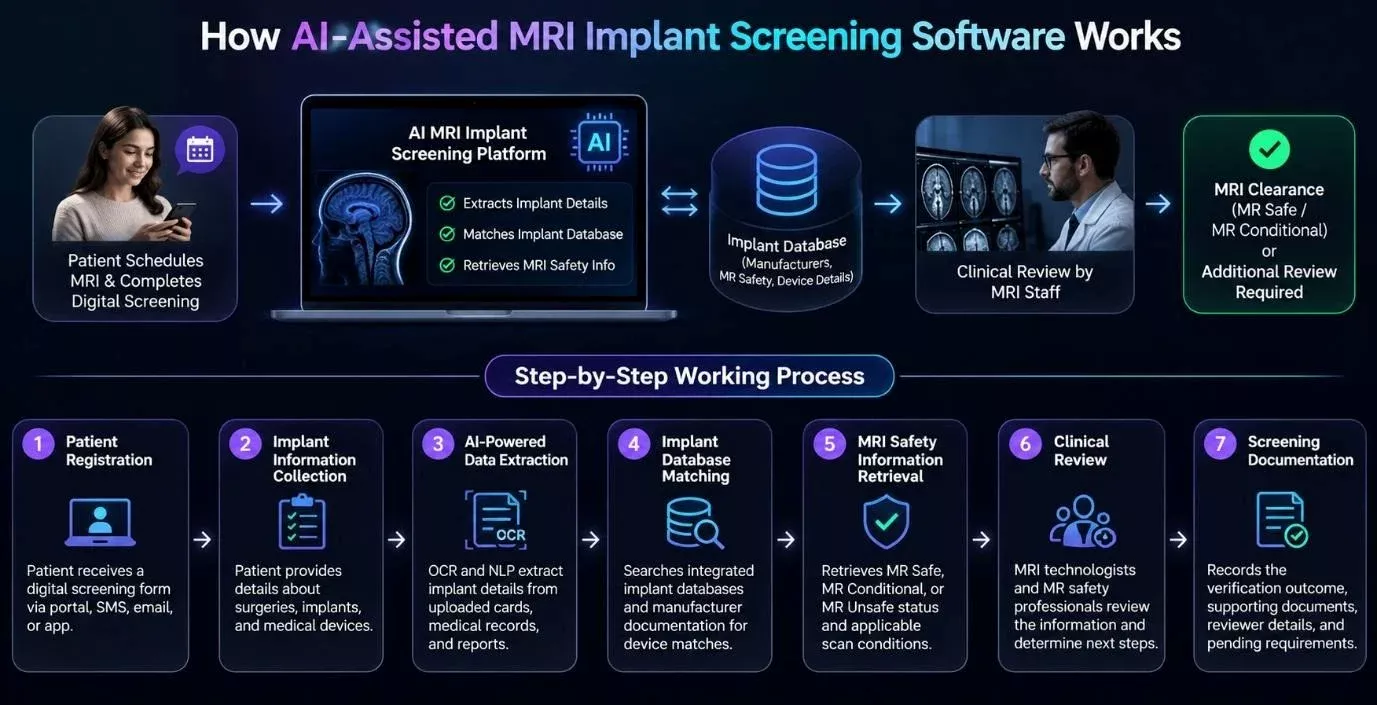
AI can support MRI screening through:
However, AI-generated matches are not equivalent to verified device identification. A database match also does not automatically establish MRI safety.
Final decisions must follow established clinical protocols and remain under the responsibility of appropriately qualified MRI personnel, particularly when implant details are incomplete or uncertain.
The growing complexity of MRI screening, increasing medical imaging demand, and rapid adoption of healthcare AI are creating new opportunities for hospitals, diagnostic imaging providers, and healthtech companies. Traditional implant verification methods often depend on manual documentation, disconnected medical records, and time-consuming communication between healthcare departments. Investing in AI MRI implant screening software development allows businesses to address these operational challenges through intelligent information management and automated screening workflows.
Here are six major reasons healthcare businesses should consider this investment.
The global MRI systems market is projected to grow from $6.88 billion in 2026 to $9.68 billion by 2031, at a CAGR of 7.0%, according to MarketsandMarkets. Increasing MRI adoption creates a stronger market opportunity for specialized software that supports imaging department operations, including implant screening and verification.
According to Grand View Research, the global AI in medical imaging market is estimated to reach $2.5 billion in 2026 and is projected to grow to $20.2 billion by 2033, representing a 35.1% CAGR. This indicates growing investment opportunities for healthcare businesses exploring AI-powered radiology workflow solutions.
Hospitals are increasingly exploring digital patient intake and automated information collection to modernize administrative workflows. MRI implant screening is a relevant use case because missing device information can require additional verification before examinations. Custom software enables healthcare providers to establish structured pre-appointment screening processes.
Healthcare organizations require better connectivity between EHR platforms, RIS, patient portals, and medical device documentation systems. Investing in custom MRI screening software with HL7 and FHIR integration supports this growing need for connected healthcare applications.
Healthcare software companies and startups can explore AI MRI implant screening as a specialized product category. Features such as intelligent implant matching, document extraction, and manufacturer database integration create opportunities to develop differentiated healthcare technology products.
Hospitals are exploring AI-powered technologies to modernize radiology infrastructure. According to NVIDIA's 2026 State of AI in Healthcare and Life Sciences report, 61% of surveyed organizations identified medical imaging as an AI application area. This signals growing interest in AI-enabled imaging solutions.
Ultimately, investing in AI MRI implant screening software development allows healthcare businesses to address an increasingly important imaging workflow requirement while positioning their technology infrastructure for future AI adoption.
Custom MRI implant screening software is particularly valuable for healthcare organizations that manage frequent MRI examinations, handle complex implant-related cases, or require consistent screening procedures across multiple facilities. From hospital radiology departments to independent imaging center chains, different healthcare providers can use these solutions to organize implant information and support clinical verification.
For example, an MRI Safety Officer may spend hours searching manufacturer labeling to determine whether an implanted device is MR Conditional and identify its specific scanning requirements. AI MRI implant screening software for radiology departments can help address this challenge by matching reported implants against verified reference sources, retrieving manufacturer-defined MRI conditions, and routing uncertain cases to designated safety professionals. The final MRI safety decision remains with appropriately qualified personnel.
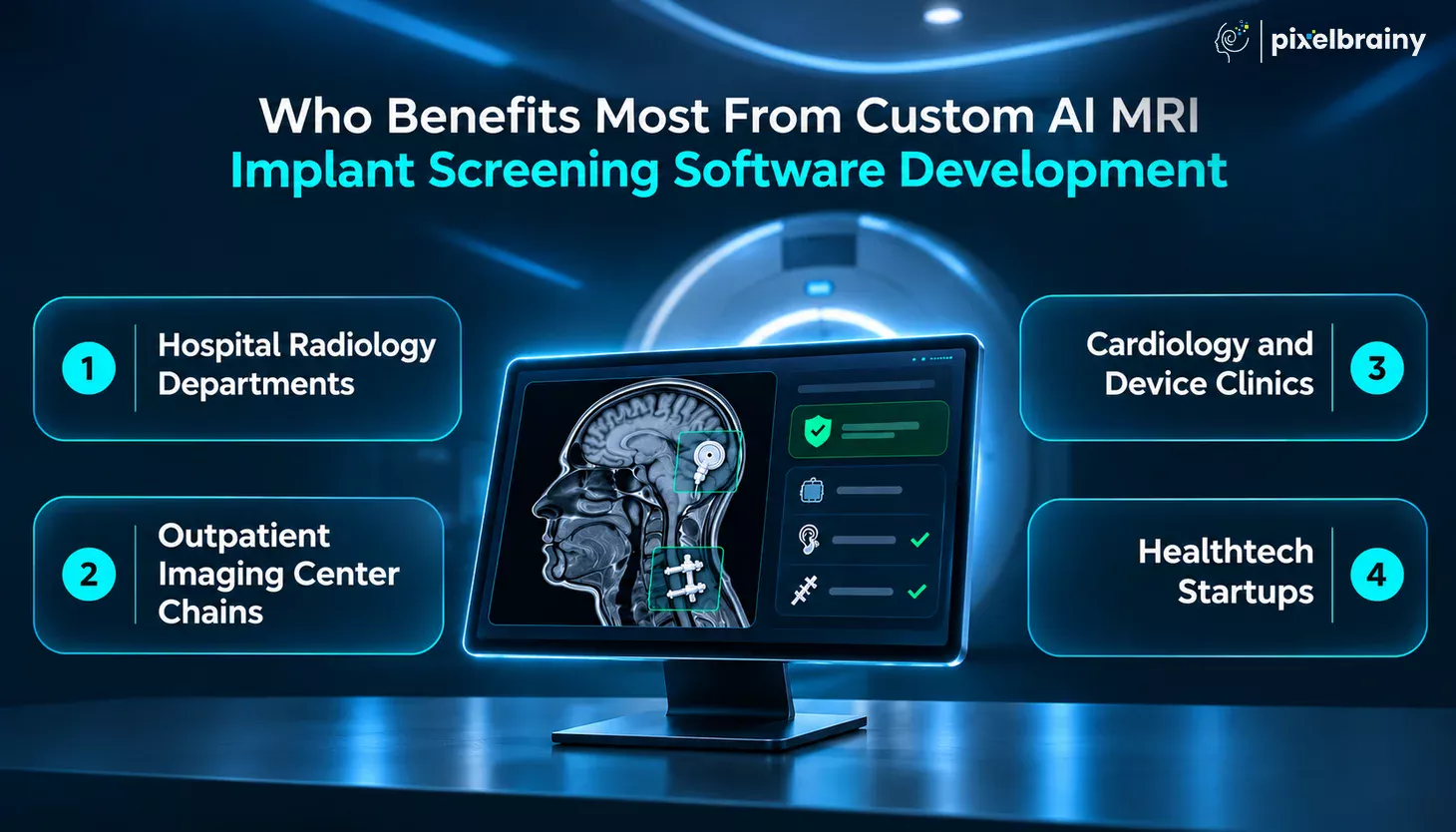
Hospitals managing multiple MRI scanners and departments need standardized implant screening workflows. Custom software helps centralize patient information, organize verification tasks, and maintain consistent screening procedures across multiple hospital locations.
Key requirements: EHR and RIS integration, clinical review workflows, and audit documentation.
Independent imaging centers and multi-location diagnostic networks need consistent patient intake procedures. MRI screening software for imaging centers can support digital questionnaires, pre-appointment document collection, and centralized screening status monitoring.
Key requirement: Digital patient questionnaires, scheduling integration, and multi-location administration.
Cardiology clinics and cardiac device management teams frequently coordinate care for patients with pacemakers and implantable cardioverter-defibrillators (ICDs) who require MRI examinations.
Custom screening software can help organize device identification, manufacturer documentation, referral information, and MRI-specific conditions for review.
Key requirement: Pacemaker and ICD information management, referral workflows, and EHR connectivity.
Healthtech founders can develop commercial MRI screening platforms for hospitals, diagnostic imaging providers, and radiology networks.
An AI-powered solution can incorporate implant database matching, document extraction, patient screening, and clinical review capabilities into a scalable healthcare product.
Key requirement: API-first architecture, multi-tenant capabilities, and configurable workflows.
Builder Profiles: Who Should Build MRI Implant Screening Software?
| Builder Type | Primary Use Case | Key Feature Priority | Key Integration Need |
|---|---|---|---|
| Hospital radiology | Standardized screening | Review workflow and audit | EHR and RIS |
| Imaging center chain | Consistent patient intake | Digital questionnaire | Scheduling system |
| Device clinic | Pacemaker MRI coordination | Referral workflow | EHR |
| Healthtech startup | Commercial software product | Multi-tenant platform | API-first architecture |
Ultimately, custom MRI implant screening software helps healthcare providers organize implant verification around their operational requirements while giving MRI safety professionals access to relevant manufacturer documentation and control over final clinical decisions.
Developing reliable AI-assisted MRI implant screening software requires more than a digital patient questionnaire. Healthcare providers need a comprehensive set of features that simplify implant information collection, support device identification, organize manufacturer documentation, and help MRI personnel complete screening reviews efficiently.
For example, an MRI technologist may need to verify a patient's pacemaker model, check its MRI labeling, review manufacturer instructions, and identify missing documentation before an appointment. A well-designed AI MRI implant screening software solution should bring these essential activities into one centralized platform.
If you are planning to build MRI screening software with implant database integration, prioritize features that support patient intake, accurate information management, clinical review, and secure documentation. The following 15 features form the foundation of a practical MRI implant screening platform.
| Must-Have Feature | Description |
|---|---|
| Digital Patient Screening Forms | Digital screening forms allow patients to submit information about previous surgeries, pacemakers, stents, orthopedic implants, and other medical devices before appointments. Conditional questions help collect relevant implant details systematically. |
| Patient Registration and Profile Management | Patient profile management stores essential demographic information, appointment details, medical history, and submitted screening responses. It helps authorized staff access patient information without repeatedly collecting the same details. |
| Implant Information Collection | This feature enables patients and healthcare staff to record implant names, manufacturers, model numbers, implantation dates, and anatomical locations. Structured information makes subsequent device identification and verification easier. |
| Medical Document Upload | Secure document uploads allow patients to submit implant identification cards, operative reports, discharge summaries, and surgical records. Staff can review original documents when confirming implant identity and supporting information. |
| OCR-Based Document Processing | Optical character recognition extracts readable information from scanned implant cards, medical reports, and uploaded documents. It reduces manual data entry by converting relevant document content into searchable digital information. |
| AI-Powered Implant Information Extraction | AI-powered extraction uses natural language processing to identify implant names, manufacturers, model numbers, and device categories from unstructured medical records. Extracted information remains linked to its original supporting documentation. |
| Implant Database Integration | Implant database integration connects the software with approved reference repositories and manufacturer documentation. It helps retrieve device-specific information, identify potential matches, and access relevant MRI labeling for clinical verification. |
| Implant Manufacturer and Model Search | A dedicated search function allows authorized users to search implant records using manufacturer names, model numbers, device categories, or available identifiers. Search results help narrow down potential device matches. |
| MRI Safety Classification Display | This feature presents available MR Safe, MR Conditional, and MR Unsafe classifications alongside their supporting sources. It helps MRI personnel distinguish device labeling and identify cases requiring further verification. |
| Manufacturer MRI Conditions Display | The platform organizes manufacturer-defined MRI conditions, including applicable field strength, RF exposure restrictions, and positioning requirements. Staff can review relevant instructions without relying entirely on disconnected documentation sources. |
| MRI Staff Review Dashboard | A centralized dashboard displays patient screening responses, implant information, uploaded documents, potential database matches, and pending review tasks. It gives authorized MRI personnel a consolidated view of screening records. |
| Screening Status Management | Screening status management tracks incomplete questionnaires, pending documentation, ongoing verification, and completed reviews. Clearly defined workflow statuses help staff understand which patients require additional information before appointments. |
| Automated Notifications and Reminders | Automated notifications remind patients to complete questionnaires, upload missing implant documents, or respond to clarification requests. Staff can also receive alerts when screening cases require additional attention. |
| Role-Based Access Control | Role-based access control assigns permissions according to user responsibilities. Patients, administrative employees, MRI technologists, safety professionals, and system administrators receive appropriate access to patient information and screening functions. |
| Audit Trail and Screening Reports | Audit trails maintain records of information submissions, document reviews, database references, status changes, and reviewer activities. Reporting capabilities help healthcare administrators monitor screening completion and maintain traceable documentation. |
Therefore, building a successful AI MRI implant screening solution starts with these 15 foundational features, ensuring that patient information collection, implant verification, clinical review, and screening documentation work together within one connected platform.
After you have finalized your core features, you can plan the next development phase by incorporating advanced AI capabilities, intelligent automation, and deeper healthcare integrations. These features can make your AI MRI implant screening software more sophisticated, scalable, and adaptable to complex radiology workflows.
For example, an MRI Safety Officer may want more than basic implant identification. They may need software that automatically retrieves the latest manufacturer instructions, compares device information across multiple records, identifies conflicting MRI conditions, and routes uncertain cases for expert review. Advanced features can address these requirements while keeping final MRI safety decisions under qualified professionals.
If you are planning to build AI MRI implant screening software with intelligent implant matching and advanced workflow automation, consider incorporating the following features to improve operational efficiency, scalability, and clinical review capabilities.
| Advanced Feature | Description |
|---|---|
| Generative AI-Powered Document Summarization | Generative AI summarizes lengthy operative reports, implant documentation, and manufacturer instructions into structured information. It highlights relevant device details, MRI conditions, and missing evidence while retaining links to original documents for professional verification. |
| Intelligent Implant Matching Engine | An AI-powered matching engine compares patient-reported implant details with verified reference records using manufacturer names, model numbers, device categories, and identifiers. It presents possible matches with supporting evidence and uncertainty indicators. |
| AI-Powered Missing Information Detection | This feature identifies incomplete implant records, missing model numbers, inconsistent implantation dates, and unavailable manufacturer documentation. It can automatically generate follow-up requests so patients or staff can provide the required information. |
| Predictive Screening Workflow Prioritization | Machine learning models analyze screening completeness and historical workflow patterns to prioritize cases that may require additional investigation. This helps MRI departments organize review workloads without predicting or determining patient MRI safety. |
| RAG-Based Manufacturer Documentation Retrieval | Retrieval-augmented generation (RAG) connects AI responses with approved manufacturer documentation and implant reference sources. It retrieves relevant instructions and provides source-linked answers instead of relying solely on the language model's internal knowledge. |
| Real-Time Manufacturer Documentation Updates | This feature monitors connected documentation sources for revised manufacturer instructions, updated device labeling, and new reference records. Version tracking helps staff identify changes and review whether previously stored information requires reassessment. |
| Multilingual AI Virtual Assistant | A multilingual virtual assistant guides patients through implant screening questions using conversational language. It can explain unfamiliar terminology, collect structured responses, and support document submission across different languages. |
| Voice-Based Screening and Speech Recognition | Voice-enabled screening allows patients to answer implant-related questions verbally. Speech recognition converts responses into structured information, which patients can review and confirm before submission. |
| Advanced Clinical Workflow and Escalation Automation | Intelligent workflow automation routes uncertain implant matches, missing documentation, and complex device cases to designated MRI technologists or MR safety professionals. Configurable escalation rules help ensure unresolved cases receive appropriate review. |
| Multi-Facility Analytics and Performance Intelligence | Advanced analytics consolidate screening data across hospital networks and imaging center chains. Administrators can evaluate verification turnaround times, incomplete records, review workloads, and recurring documentation gaps across multiple facilities. |
These advanced capabilities help healthcare businesses evolve basic MRI screening applications into intelligent, evidence-driven workflow platforms while maintaining transparency, reliable documentation, and human oversight throughout the implant verification process.
Building AI MRI implant screening software requires a structured development approach that combines healthcare workflow analysis, AI engineering, implant database integration, clinical validation, and regulatory planning. Healthcare businesses must ensure that the software collects accurate patient information, supports standardized screening procedures, and maintains a complete audit trail of implant verification activities.
For example, a radiology department managing multiple locations may experience a near miss when an implanted device is not identified before a patient reaches the MRI scanner room. To prevent similar workflow gaps, the organization needs software that enforces mandatory screening checks, flags unresolved implant information, routes uncertain cases to authorized professionals, and records every screening decision.
Understanding the steps to develop AI MRI implant screening software from idea to launch helps healthcare businesses establish a clear product roadmap, control development expenses, and build a clinically responsible solution.
Here are eight essential steps explaining how to build an AI MRI implant screening software from scratch.
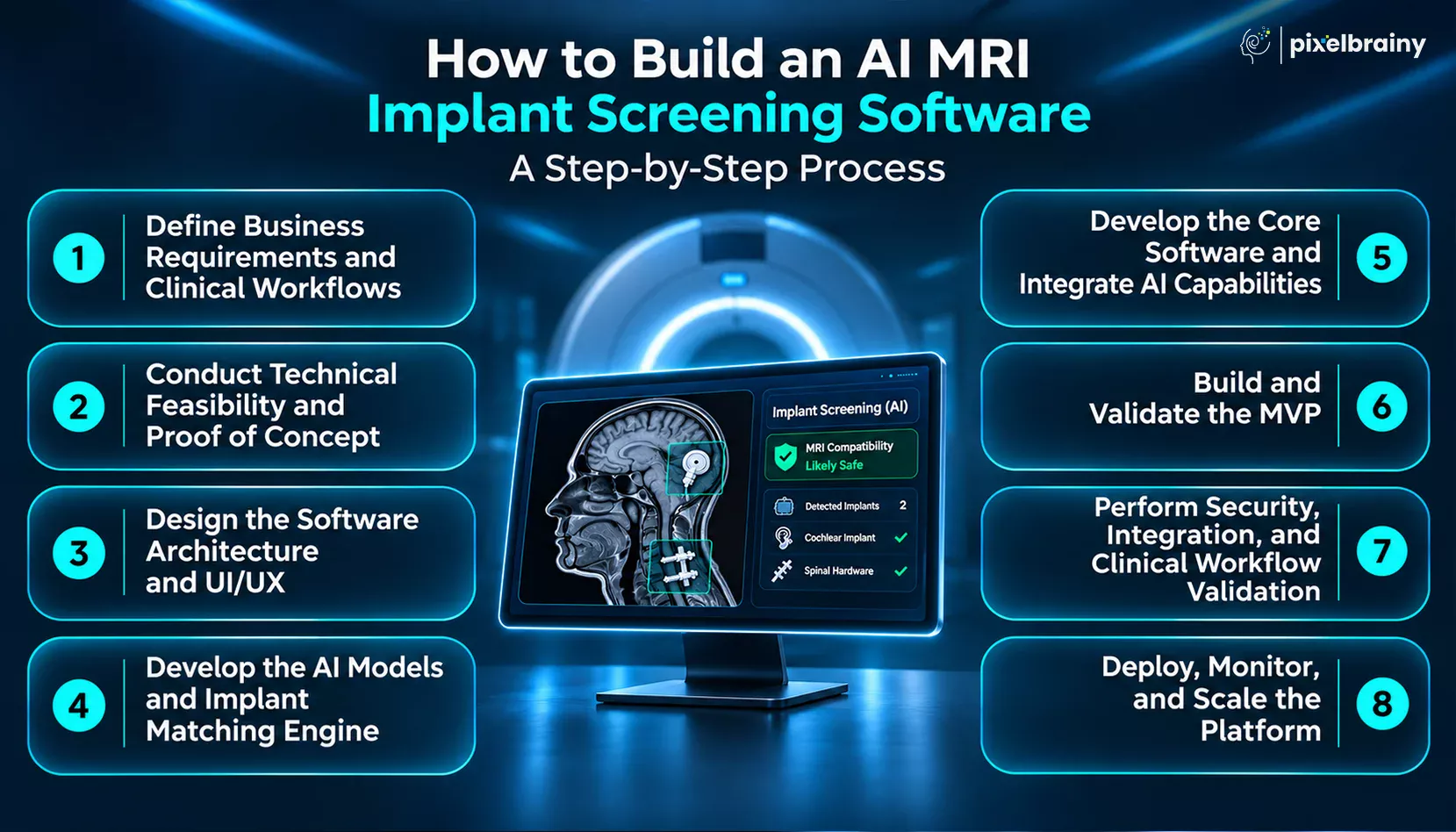
Start by identifying the operational challenges your MRI department wants to solve. Consult MRI technologists, radiologists, MR Safety Officers, radiology administrators, and hospital IT teams to understand existing screening procedures. Document common issues, including incomplete patient histories, unidentified implants, missing manufacturer records, and inconsistent verification practices across facilities.
Define mandatory screening questions, escalation criteria, user roles, documentation requirements, and approval responsibilities. Organizations can seek AI consultation to evaluate technical feasibility, identify suitable AI use cases, and establish a realistic product roadmap.
Key deliverable: Business requirements document, clinical workflow map, and prioritized feature list.
Also Read: Top 10 AI Consulting Companies in USA
Before committing to complete development, evaluate whether the proposed software can technically support its intended workflows. Assess implant database availability, manufacturer documentation access, EHR integration requirements, AI document extraction feasibility, and security requirements.
A focused PoC development phase can test whether AI can extract implant model numbers from sample documents and retrieve corresponding reference information. Healthcare businesses evaluating top AI development companies should prioritize teams with experience in medical document processing, healthcare integrations, and AI validation.
Key deliverable: Technical feasibility report, proof-of-concept prototype, and initial architecture recommendations.
Also Read: Top 10+ AI PoC Development Companies In USA
Create a scalable architecture that connects patient screening, AI processing, implant reference databases, healthcare integrations, and staff review dashboards. Separate the patient-facing application from the clinical administration interface while maintaining centralized data management.
Plan authentication, role-based permissions, API connectivity, database structures, and audit logging. Collaborate with a UI/UX design company to create accessible patient questionnaires and intuitive staff dashboards. The interface should clearly distinguish incomplete screening, pending verification, and completed clinical review.
Key deliverable: System architecture, wireframes, interactive prototypes, and database design.
Also Read: Top 10+ UI/UX Design Companies in USA
Build AI capabilities that extract relevant implant information from patient questionnaires, identification cards, operative reports, and medical documents. Use OCR, NLP, entity recognition, and semantic search to identify device names, manufacturers, model numbers, and implantation details.
During AI model development, evaluate extraction accuracy using representative medical documents, including scanned records and inconsistent terminology. Develop an implant matching engine that compares extracted information against approved reference sources and displays supporting evidence. Include confidence indicators and escalation rules for uncertain matches.
Key deliverable: Validated AI extraction models, implant matching engine, and evidence-linked search functionality.
Also Read: Top 12+ AI Model Development Companies in the USA
Once the architecture and AI components are established, begin developing the frontend, backend, patient portal, and clinical review dashboard. Implement digital screening forms, document uploads, patient profiles, implant information management, and workflow status tracking.
The AI integration phase connects document extraction and implant matching services with the main application. Integrate approved implant reference sources and establish connections with compatible EHR and RIS platforms using HL7 or FHIR where supported. Organizations planning to hire AI developers should ensure the team understands healthcare data security and clinical workflow requirements.
Key deliverable: Functional application with integrated AI services and essential healthcare connectivity.
Also Read: Top 10+ AI Integration Companies in USA
Develop an initial product containing the most important features rather than implementing every advanced capability immediately. Prioritize patient registration, digital screening questionnaires, secure document uploads, implant information retrieval, clinical review, and audit trails.
A focused MVP development approach allows hospitals to evaluate the software within a controlled environment before investing in advanced automation. Test whether mandatory screening checks can be enforced and whether unresolved implant cases are consistently routed to designated reviewers. Gather feedback from actual users to identify usability and workflow gaps.
Key deliverable: Working MVP, user feedback report, and prioritized improvement roadmap.
Also Read: Top 10 AI MVP Development Companies in USA
Before deployment, conduct comprehensive functional, security, integration, and usability testing. Verify that patient information is correctly mapped across connected systems and that every screening status change is recorded accurately.
Test challenging scenarios, including unknown implant models, conflicting manufacturer records, missing documents, and outdated reference information. Validate that the application never automatically treats an uncertain implant match as MRI clearance. Organizations comparing top AI healthcare software development companies should prioritize expertise in healthcare interoperability, cybersecurity, and clinically responsible software validation.
Key deliverable: Testing reports, security assessment, integration validation, and clinical workflow acceptance.
Begin deployment through a controlled pilot at one imaging facility or a limited group of MRI scanners. Train staff, establish operational support procedures, and monitor screening completion, unresolved cases, AI extraction performance, and audit trail accuracy.
After successful pilot evaluation, expand the platform across additional locations. Introduce advanced analytics, multilingual assistance, and additional integrations according to organizational requirements. When selecting AI product development companies for long-term collaboration, evaluate their ability to provide maintenance, model monitoring, security updates, and ongoing product enhancements.
Key deliverable: Production deployment, staff training, performance monitoring, and scaling strategy.
Following these eight steps creates a structured pathway for making an AI MRI implant screening software solution that supports standardized screening, accountable clinical review, and consistent workflows across healthcare facilities.
Also Read: AI Medical Imaging Software Development: Architecture, Process, Costs & Key Challenges Explained
The cost to develop an AI MRI implant screening software typically ranges from $30,000 to $250,000+, depending on software complexity, AI capabilities, implant database integration, healthcare system connectivity, and security requirements. A basic solution with digital patient questionnaires and manual implant verification requires a smaller investment than an enterprise-grade platform with intelligent implant matching, automated documentation retrieval, and multi-facility management.
For healthcare businesses planning AI MRI implant screening software development, understanding the development budget is essential before selecting features, technologies, and an engineering partner.
Consider an MRI Safety Officer who spends hours searching manufacturer labeling to identify whether an implant is MR Conditional and determine its applicable scanning conditions. The required software must match reported implants against verified reference sources, display manufacturer-defined conditions, and route uncertain cases for expert review. Developing these capabilities requires additional investment in AI models, reference database integration, documentation management, and clinical workflow automation.
So, what is the development pricing of AI MRI implant screening software? Below is an estimated cost breakdown to help healthcare providers and healthtech founders plan their investment.
| Software Development Level | Estimated Development Cost | Included Capabilities |
|---|---|---|
| Basic AI MRI Implant Screening Software | $30,000 to $60,000 | Patient registration, digital screening forms, document uploads, basic implant information management, staff dashboard, and manual verification workflows. |
| Advanced AI MRI Implant Screening Software | $60,000 to $130,000 | OCR-based document extraction, NLP-powered implant identification, implant database integration, manufacturer documentation retrieval, automated notifications, and EHR connectivity. |
| Enterprise AI MRI Implant Screening Software | $130,000 to $250,000+ | Advanced AI matching, evidence-linked documentation retrieval, multi-facility management, complex healthcare integrations, centralized analytics, enterprise security, and comprehensive audit trails. |
The final AI MRI implant screening software development cost depends on several technical and operational factors.
Basic OCR and document extraction require less investment than advanced NLP, semantic search, and intelligent implant matching. Custom AI model development also increases expenses when specialized training datasets and validation are required.
Connecting approved implant repositories and manufacturer documentation sources requires API development, data normalization, licensing assessments, and document version management. The number and accessibility of reference sources directly influence the budget.
Integration with hospital information systems requires secure API development, HL7 or FHIR connectivity, data mapping, and interoperability testing. Complex multi-vendor integrations can increase development costs.
Separate interfaces for patients, MRI technologists, safety professionals, and administrators require additional design and development effort. Mobile applications and multilingual support can further increase costs.
Encryption, role-based access, audit logging, cybersecurity testing, regulatory documentation, and clinical validation contribute to the overall development budget.
Cloud hosting, AI processing, database storage, monitoring, backups, and disaster recovery influence both initial infrastructure expenses and recurring operational costs.
Software updates, AI model monitoring, database maintenance, integration upgrades, and technical support should be included in the long-term financial plan.
Ultimately, the right development budget depends on how much AI automation, implant reference integration, clinical workflow management, and enterprise scalability your MRI screening solution requires.
Building scalable and secure AI MRI implant screening software requires a technology stack that supports artificial intelligence, medical document processing, implant database integration, healthcare interoperability, and sensitive patient information management. The right combination of frontend frameworks, backend technologies, AI libraries, databases, and cloud infrastructure determines how efficiently the platform handles patient screening and clinical verification workflows.
For example, an MRI Safety Officer may need software that matches reported implants against verified manufacturer documentation, retrieves MR Conditional scanning requirements, and routes uncertain cases for professional review. Supporting this workflow requires technologies that can process medical documents, retrieve structured implant information, and maintain reliable connections with hospital systems.
Therefore, the AI MRI implant screening software development tech stack should prioritize accuracy, interoperability, scalability, data security, and maintainability.
| Development Component | Recommended Technologies | Purpose |
|---|---|---|
| Frontend Development | React.js, Next.js | Build responsive patient portals, MRI staff dashboards, and administrative interfaces. |
| Mobile App Development | Flutter, React Native | Develop mobile-friendly patient screening applications for document uploads and questionnaire completion. |
| Backend Development | Python, FastAPI, Node.js | Handle business logic, patient records, workflow automation, API development, and communication between system components. |
| AI and Machine Learning | PyTorch, TensorFlow, scikit-learn | Develop and deploy AI models for implant information extraction, document classification, and intelligent matching. |
| Natural Language Processing | spaCy, Hugging Face Transformers | Extract implant names, manufacturers, model numbers, and relevant information from unstructured medical documents. |
| OCR and Document Processing | Tesseract, Google Document AI, Azure AI Document Intelligence | Extract text and structured information from scanned implant cards, operative reports, and medical records. |
| Generative AI and LLMs | Approved LLM APIs, self-hosted language models | Summarize manufacturer documentation, organize retrieved information, and support evidence-based information retrieval. |
| Primary Database | PostgreSQL, MySQL | Store patient screening records, implant information, user accounts, and workflow data. |
| Search and Retrieval | Elasticsearch, OpenSearch | Enable searches across implant names, manufacturers, device identifiers, and documentation. |
| Vector Database | pgvector, Pinecone | Support semantic search for implant-related terminology and relevant medical documentation. |
| Cloud Infrastructure | AWS, Microsoft Azure, Google Cloud | Host application services, databases, document storage, and AI processing infrastructure. |
| Healthcare Interoperability | HL7 FHIR, HL7 v2, DICOM | Exchange patient, appointment, and imaging-related information with compatible healthcare systems. |
| Authentication and Security | OAuth 2.0, OpenID Connect | Manage secure authentication, authorization, and access permissions. |
| DevOps and Deployment | Docker, Kubernetes, GitHub Actions | Support application deployment, containerization, automated testing, and infrastructure scaling. |
| Monitoring and Logging | Prometheus, Grafana, OpenTelemetry | Monitor application performance, API availability, infrastructure health, and system errors. |
Overall, a well-planned technology stack provides the foundation for developing secure, interoperable, and scalable AI MRI implant screening software that supports reliable information retrieval and clinically supervised verification workflows.
Developing custom AI MRI implant screening software requires careful consideration of healthcare regulations, patient data privacy, medical device requirements, cybersecurity, and clinical safety standards. Since the platform processes sensitive patient information and may support MRI implant verification, regulatory compliance must be incorporated into the software architecture and development lifecycle.
For example, an MRI Safety Officer may need software that matches reported implants against verified manufacturer labeling, displays MR Conditional scanning requirements, and routes uncertain cases for professional review. The platform must maintain accurate documentation while ensuring that AI-generated information does not replace qualified clinical judgment.
Before starting AI MRI implant screening software development, healthcare businesses should evaluate the following regulatory and compliance requirements.
For healthcare organizations operating in the United States, the Health Insurance Portability and Accountability Act (HIPAA) establishes important requirements for protecting electronic protected health information (ePHI).
Custom MRI implant screening software should incorporate appropriate administrative, physical, and technical safeguards.
Important requirements include:
Developers should review the HHS HIPAA Security Rule, which outlines safeguards for protecting electronic patient information.
The US Food and Drug Administration (FDA) regulates certain healthcare software functions according to their intended use and associated risks.
An MRI implant screening application that primarily collects patient information and manages administrative workflows may have a different regulatory status from software that provides patient-specific clinical recommendations.
Depending on its functionality and regulatory classification, applicable pathways may include:
Review the FDA's Digital Health Guidance Resources to understand relevant software regulatory requirements.
The FDA's Clinical Decision Support Software Guidance is also important when evaluating whether specific AI functions fall within medical device regulation.
The American College of Radiology (ACR) publishes MRI safety recommendations that are particularly relevant to implant screening software development.
The ACR Manual on MR Safety provides guidance on screening procedures, MRI safety responsibilities, and implanted medical devices.
The software should accurately distinguish between:
For MR Conditional implants, the platform must present applicable manufacturer-defined conditions, including magnetic field strength, RF exposure restrictions, and other relevant scanning requirements.
A generic implant category or approximate database match should never be treated as sufficient evidence of MRI safety.
Healthcare businesses targeting European markets must consider the General Data Protection Regulation (GDPR), which provides specific protections for personal and health-related information.
Important requirements include:
Organizations should also assess whether appointing a Data Protection Officer is necessary.
AI-powered MRI screening applications require continuous monitoring to maintain model reliability and performance.
Healthcare businesses should establish an AI lifecycle management framework covering:
For regulated AI functionality, developers should also evaluate relevant FDA guidance on predetermined change control plans and AI-enabled device software updates.
MRI implant screening platforms may store sensitive patient information, medical documents, implant records, and hospital integration credentials. Protecting these assets requires cybersecurity measures throughout the development lifecycle.
Recommended security practices include:
Developers should consult the FDA's Cybersecurity Guidance for Medical Devices when developing software that falls within applicable medical device cybersecurity requirements.
One of the most important requirements for AI MRI implant screening software development is maintaining reliable implant reference information.
The platform should preserve:
If the implant model is uncertain or manufacturer records contain conflicting information, the software should clearly communicate that uncertainty and route the case for additional review.
Ultimately, regulatory compliance, reliable manufacturer documentation, and transparent AI workflows are essential for developing trustworthy MRI implant screening software. Healthcare businesses should integrate these requirements from the initial architecture stage rather than treating compliance as a final development task.
AI-assisted MRI implant screening involves several technical, clinical, and operational complexities. From identifying implants through incomplete patient records to maintaining accurate manufacturer documentation, healthcare businesses must address multiple challenges to create a reliable screening platform.
For example, an MRI Safety Officer may encounter a patient whose implant model is unknown or whose manufacturer documentation contains specific scanning conditions that are difficult to locate. The software must identify potential matches, retrieve reliable evidence, and escalate uncertain cases without independently approving MRI examinations.
Understanding these challenges and their solutions helps healthcare providers plan AI MRI implant screening software development more effectively.
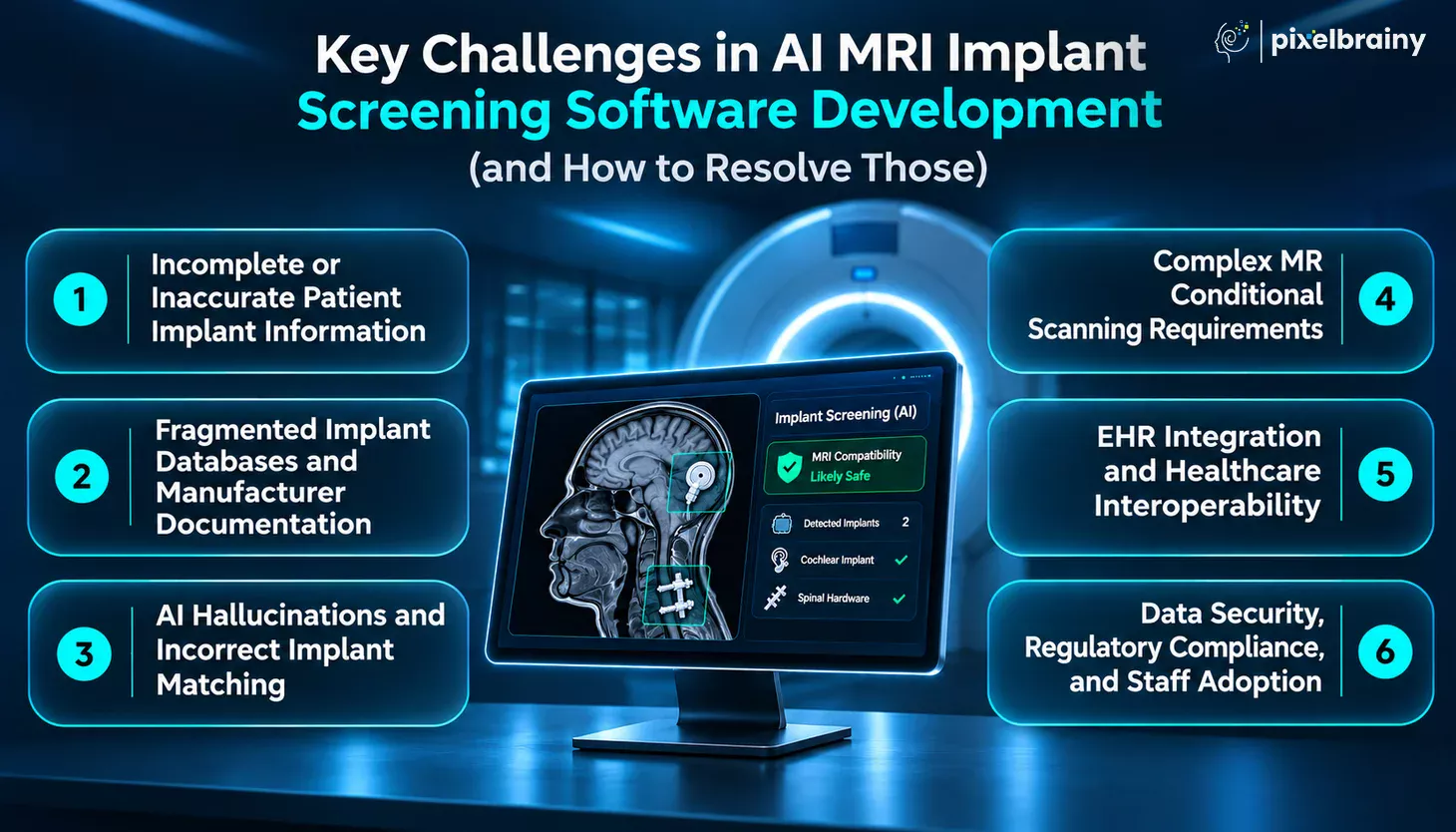
Challenge: Patients may not remember their implant manufacturer, model number, or implantation date. Some may only know that they underwent surgery several years ago. This makes accurate device identification difficult for AI-powered screening systems.
Solution: Implement guided digital questionnaires, secure document uploads, and EHR integration to collect additional information. Use AI-powered OCR and NLP to extract implant details from available medical records. Flag missing information and request manual verification when necessary.
Challenge: Implant information is distributed across manufacturer websites, device repositories, hospital records, and medical documentation. Finding the exact model and its current MRI labeling can consume considerable staff time.
Solution: Develop an implant reference integration layer that connects approved data sources, standardizes device identifiers, and maintains manufacturer documentation with version tracking. Display source links and retrieval dates to help authorized professionals verify information.
Challenge: AI models may incorrectly identify an implant when patients provide vague descriptions or upload poor-quality documents. Generative AI can also produce unsupported information when manufacturer documentation is unavailable.
Solution: Implement retrieval-augmented generation (RAG), evidence-linked search, confidence indicators, and human verification. Restrict AI-generated summaries to retrieved documentation and route uncertain matches to designated MRI safety professionals.
Challenge: MR Conditional implants have specific scanning requirements involving magnetic field strength, RF exposure, positioning, and other manufacturer-defined parameters. Missing even one applicable condition can create serious safety concerns.
Solution: Build a structured manufacturer-condition retrieval system that presents device-specific MRI requirements alongside their original documentation. Clearly identify missing conditions and require qualified staff to review whether all applicable requirements are satisfied.
Challenge: Hospitals frequently use different EHR, RIS, PACS, and scheduling platforms. Differences in data formats, APIs, and existing infrastructure can complicate the integration of custom MRI implant screening software.
Solution: Use standardized interoperability protocols such as HL7 FHIR, HL7 v2, and DICOM where appropriate. Develop flexible integration APIs, establish consistent patient identification, and conduct end-to-end testing with existing hospital systems.
Challenge: MRI screening applications process sensitive patient information and clinical documentation. Healthcare organizations must address privacy regulations, cybersecurity risks, audit requirements, and staff resistance to unfamiliar workflows.
Solution: Implement encryption, role-based access, multi-factor authentication, audit logging, and regular security assessments. Involve MRI technologists and safety professionals during development, conduct usability testing, and provide staff training before deployment.
Addressing these challenges early helps healthcare businesses create reliable AI MRI implant screening software that supports accurate implant identification, consistent verification workflows, and accountable clinical decision-making.
Businesses operating in healthcare imaging need technology partners who understand the complexities of clinical workflows, AI integration, healthcare interoperability, and sensitive patient information management. From independent diagnostic imaging centers to multi-location hospital networks and healthtech startups, the right development partner can help translate operational requirements into scalable healthcare software solutions.
PixelBrainy, positioning itself as a best AI healthcare software development company in USA, focuses on custom healthcare technology solutions that align with business objectives, technical requirements, and evolving healthcare workflows.
For example, an MRI Safety Officer may spend hours identifying implant manufacturers, checking MR Conditional labeling, and locating applicable scanning conditions. A dedicated software solution should simplify this process by matching reported implants against verified reference sources, presenting manufacturer documentation, and routing uncertain cases to qualified professionals.
Here is how PixelBrainy can support healthcare businesses pursuing this vision.
Every healthcare organization has different screening protocols, patient intake processes, and operational requirements. PixelBrainy can help translate these requirements into customized applications rather than relying on generic screening solutions.
Its AI MRI implant screening software development services can be scoped around patient questionnaires, implant information management, clinical review dashboards, and centralized documentation workflows.
AI capabilities can make implant information collection and document processing more intelligent. PixelBrainy can incorporate OCR, NLP, document classification, semantic search, and evidence-based information retrieval according to project requirements.
These capabilities can help healthcare businesses build an AI MRI implant screening software that organizes implant information while preserving human verification and clinical oversight.
A screening application must work alongside existing healthcare infrastructure. PixelBrainy can plan integrations involving EHR, EMR, RIS, patient portals, and healthcare APIs using appropriate interoperability standards such as HL7 and FHIR.
This helps organizations develop an AI MRI implant screening software that fits into their existing technology environment.
Healthcare businesses need software that can accommodate increasing patient volumes, additional imaging locations, and evolving integration requirements.
PixelBrainy can incorporate modular architecture, role-based access control, encryption, audit trails, and secure API development when designing solutions to create MRI implant screening software integrating AI.
In one confidential healthcare software engagement, the project requirements centered on organizing patient information, streamlining document-based workflows, and providing healthcare teams with a centralized interface for reviewing records.
The proposed solution approach involved structured information management, role-based access, workflow tracking, and integration planning.
These project considerations are relevant to MRI implant screening, where accurate document handling, traceable information, and clearly assigned review responsibilities are essential.
Client identity and confidential implementation details are withheld. This example illustrates relevant project capabilities, not a claim of a completed MRI-specific deployment.
PixelBrainy can support the software development lifecycle through:
This provides healthcare businesses with a coordinated approach to product development and future scalability.
Connect with PixelBrainy to discuss your healthcare workflow requirements, AI capabilities, integration needs, and development budget. Let's plan a secure and scalable MRI implant screening solution for your business.
AI MRI implant screening software uses artificial intelligence, OCR, and NLP to collect patient implant information, extract device details from medical documents, and match potential implants against verified references. It retrieves manufacturer MRI safety information and supports qualified professionals in reviewing device-specific scanning conditions.
The cost of AI MRI implant screening software development typically ranges from $30,000 to $250,000+. The final investment depends on AI capabilities, implant database integration, EHR connectivity, security requirements, clinical validation, and application complexity. Enterprise platforms generally require larger development budgets.
AI-powered implant identification uses OCR and NLP to extract manufacturer names, model numbers, device categories, and implantation details from implant cards, operative reports, and medical records. The extracted information can then be matched against approved implant reference databases for identification and professional verification.
To build custom MRI implant screening software, define screening workflows, identify reliable implant reference sources, and design a secure architecture. Develop patient questionnaires, document extraction, database matching, and clinical review features. Integrate compatible EHR systems and validate the complete workflow before deployment.
AI MRI implant screening software can retrieve manufacturer-specific MR Conditional labeling and display applicable field strength, RF exposure, and positioning requirements. However, qualified MRI personnel must verify the exact device identity, assess every applicable condition, and make the final MRI safety decision.
AI MRI implant screening software development may take approximately 3 to 4 months for a basic MVP. An advanced AI-powered platform may require 5 to 8 months, while enterprise solutions involving complex integrations, extensive validation, and regulatory requirements may take 9 to 15 months or longer.
AI-powered MRI implant screening software development commonly uses Python, FastAPI, React.js, PostgreSQL, PyTorch, OCR, NLP, and generative AI. Healthcare interoperability can involve HL7 FHIR, HL7 v2, and DICOM. Cloud infrastructure, encryption, authentication, and audit logging support security and scalability.
Custom AI MRI implant screening software helps healthcare organizations standardize patient intake, organize implant documentation, retrieve manufacturer labeling, and manage clinical verification workflows. It can also support multi-facility operations, healthcare integrations, and more consistent pre-appointment MRI screening processes.

About The Author
Sagar Bhatnagar
Sagar Sahay Bhatnagar brings over a decade of IT industry experience to his role as Marketing Head at PixelBrainy. He's known for his knack in devising creative marketing strategies that boost brand visibility and market influence. Sagar's strategic thinking, coupled with his innovative vision and focus on results, sets him apart. His track record of successful campaigns proves his ability to utilize digital platforms effectively for impactful marketing efforts. With a genuine passion for both technology and marketing, Sagar continuously pushes PixelBrainy's marketing initiatives to greater success.

Working with PixelBrainy has been a great experience. They took our vision for an AI-powered platform and turned it into a fully functional product. What impressed me most was their strong understanding of both design and development, and their ability to handle complex requirements with ease. The team was responsive, cooperative, and always open to feedback. They kept things organized, communicated clearly, and delivered quality work on time. I highly recommend PixelBrainy to anyone looking for a skilled and reliable development partner.

Working with the PixelBrainy team has been a highly positive experience. They understand the design requirements and create beautiful UX elements to meet the application needs. The dev team did an excellent job bringing my vision to life. We discussed usability and flow. Sagar worked with his team to design the database and begin coding. Working with Sagar was easy. He has the knowledge to create robust apps, including multi-language support, Google and Apple ID login options, Ad-enabled integrations, Stripe payment processing, and a Web Admin site for maintaining support data. I'm extremely satisfied with the services provided, the quality of the final product, and the professionalism of the entire process. I highly recommend them for Android and iOS Mobile Application Design and Development.

Great experience working with them. Had a lot of feedback and I found that unlike most contractors they were bugging me for updates instead of the other way around. They were extremely time conscience and great at communicating! All work was done extremely high quality and if not on time, early! They were always proactive when it comes to communication and the work is great/above par always. Very flexible and a great team to work with! Goes above and beyond to present us with multiple options and always provides quality. Amazing work per usual with Chitra. If you have UI/UX or branding design needs I recommend you go to them! Will likely work with them in the future as well, definitely recommended!

PixelBrainy is a joy to work with and is a great partner when thinking through branding, logo, and website layout. I appreciate that they spend time going into the "why" behind their decisions to help inform me and others about industry best practices and their expertise.

I hired them to design our software apps. Things I really like about them are excellent communication skills, they answer all project suggestions and collaborate right away, and their input on design and colors is amazing. This project was complex and needed patience and creativity. The team is amazing to do business with. I will be using them long-term. Glad to see there are some good people out there. I was afraid to try and outsource my project to someone but I am glad I met them! I really can't say enough. They went above and beyond on this project. I am very happy with everything they have done to make my business stand out from the competition.

It was great working with PixelBrainy and the team. They were very responsive and really owned the project. We'll definitely work with them again!

I recently worked with the PixelBrainy team on a project and I was blown away by their communication skills. They were prompt, clear, and articulate in all of our interactions. They listened and provided valuable feedback and suggestions to help make the project a success. They also kept me updated throughout the entire process, which made the experience stress-free and enjoyable.

PixelBrainy is very good at what it does. The team also presents themselves very professionally and takes care of their side of things very well. I could fully trust them taking up the design work in a timely and organised manner and their attention to detail saved us lots of effort and time. This particular project was quite intense and the team showed that they function very well under pressure. Very much looking forward to working with her again!

It's always an absolute pleasure working with them. They completed all of my requests quickly and followed every note I had for them to a T, which made our process go smoothly from start to finish. Everything was completed fast and following all of the guidelines. And I would recommend their services to anyone. If you need any design work done in the future, PixelBrainy should be your first call!

They took ownership of our requirements and designed and proposed multiple beautiful variants. The team is self-motivated, requires minimum supervision, committed to see-through designs with quality and delivering them on time. We would definitely love to work with PixelBrainy again when we have any requirements.

PixelBrainy was a big help with our SaaS application. We've been hard at work with a new UI/UX and they provided a lot of help with the designs. If you're looking for assistance with your website, software, or mobile application designs, PixelBrainy and the team is a great recommendation.

PixelBrainy designers are amazing. They are responsive, talented, and always willing to help craft the design until it matches your vision. I would recommend them and plan to continue them for my future projects and more!!!

They were awesome! Did a good job fast, and good communication. Will work with them again. Thank you

Creative, detail-oriented, and talented designers who take direction well and implement changes quickly and accurately. They consistently over-delivered for us.

PixelBrainy team is very talented and creative. Great designers and a pleasure to work with. PixelBrainy is an excellent communicator and I look forward to working with them again.

PixelBrainy has a very talented design team. Their work is excellent and they are very responsive. I enjoy working with them and hope to continue on all of our future projects.


Transform your ideas into reality with us.
Across these industries, each engagement brings unique challenges, from early-stage product development to scaling complex systems, helping us build a practical understanding of real-world product environments.