AI Summary Powered by PixelBrainy
Have you ever wondered how real estate companies can accurately predict property prices, automate transactions, or create virtual property tours powered by smart technology? The answer lies in AI Real Estate SaaS Products, innovative cloud-based solutions that combine artificial intelligence with scalable software models to transform the real estate industry.
Real estate businesses around the world are adopting AI Real Estate SaaS Product Development to streamline operations, enhance customer experience, and make data-backed decisions. Whether you are a startup founder, tech entrepreneur, or an established real estate business owner, learning how to develop an AI Real Estate SaaS Product can open the door to new opportunities for growth and efficiency.
Through the building of an AI Real Estate SaaS Product, companies can automate property valuations, analyze market trends, and deliver personalized experiences to buyers and sellers. By leveraging the power of big data and machine learning, real estate platforms can achieve faster scalability, improved profitability, and stronger competitive positioning.
If you are planning to create an AI Real Estate SaaS Product, this detailed guide will help you understand every stage of development — from planning and design to cost estimation and business model strategies. Let’s explore how AI-driven SaaS innovation is reshaping the real estate market and what it takes to build a successful product in this rapidly evolving space.

An AI Real Estate SaaS Product is a cloud-based software application that uses artificial intelligence to automate, analyze, and optimize real estate operations. It enables property businesses, agents, and investors to access powerful tools through the internet without needing local installations. Artificial intelligence enhances these platforms with capabilities like predictive analytics, smart property recommendations, automated valuations, and customer behavior insights.
With an AI Real Estate SaaS Product, companies can manage listings, track leads, and forecast market trends in real time. It combines the scalability of SaaS with the intelligence of AI to deliver efficient, data-driven solutions for property buying, selling, and management. Popular examples include tools like Zillow and Opendoor, which use AI models to evaluate market data and improve user experiences. This technology helps real estate businesses become more efficient, customer-focused, and competitive in a fast-changing market.
The integration of AI and SaaS has completely redefined how the real estate industry operates. SaaS provides accessibility, scalability, and cost-efficiency, while AI adds automation, intelligence, and predictive power. Together, they create a dynamic ecosystem that allows real estate companies to make faster and smarter decisions.
AI enables real estate platforms to analyze large volumes of data, predict market trends, and personalize user experiences. SaaS makes these tools available anytime, anywhere, through the cloud, reducing the need for heavy infrastructure and maintenance. This combination helps businesses streamline property management, automate client interactions, and optimize marketing efforts.
By using AI-powered SaaS platforms, real estate businesses can deliver accurate property valuations, offer tailored recommendations, and improve operational efficiency. The synergy of AI and SaaS not only reduces costs but also enhances productivity, empowering real estate organizations to stay ahead in a highly competitive market.
Developing an AI Real Estate SaaS Product offers businesses a transformative way to streamline operations, improve efficiency, and deliver exceptional value to clients. By combining artificial intelligence with the power of cloud-based software, real estate companies can revolutionize how they analyze data, manage properties, and engage customers.
Below are the key advantages of building an AI Real Estate SaaS Product that every modern property business should consider.
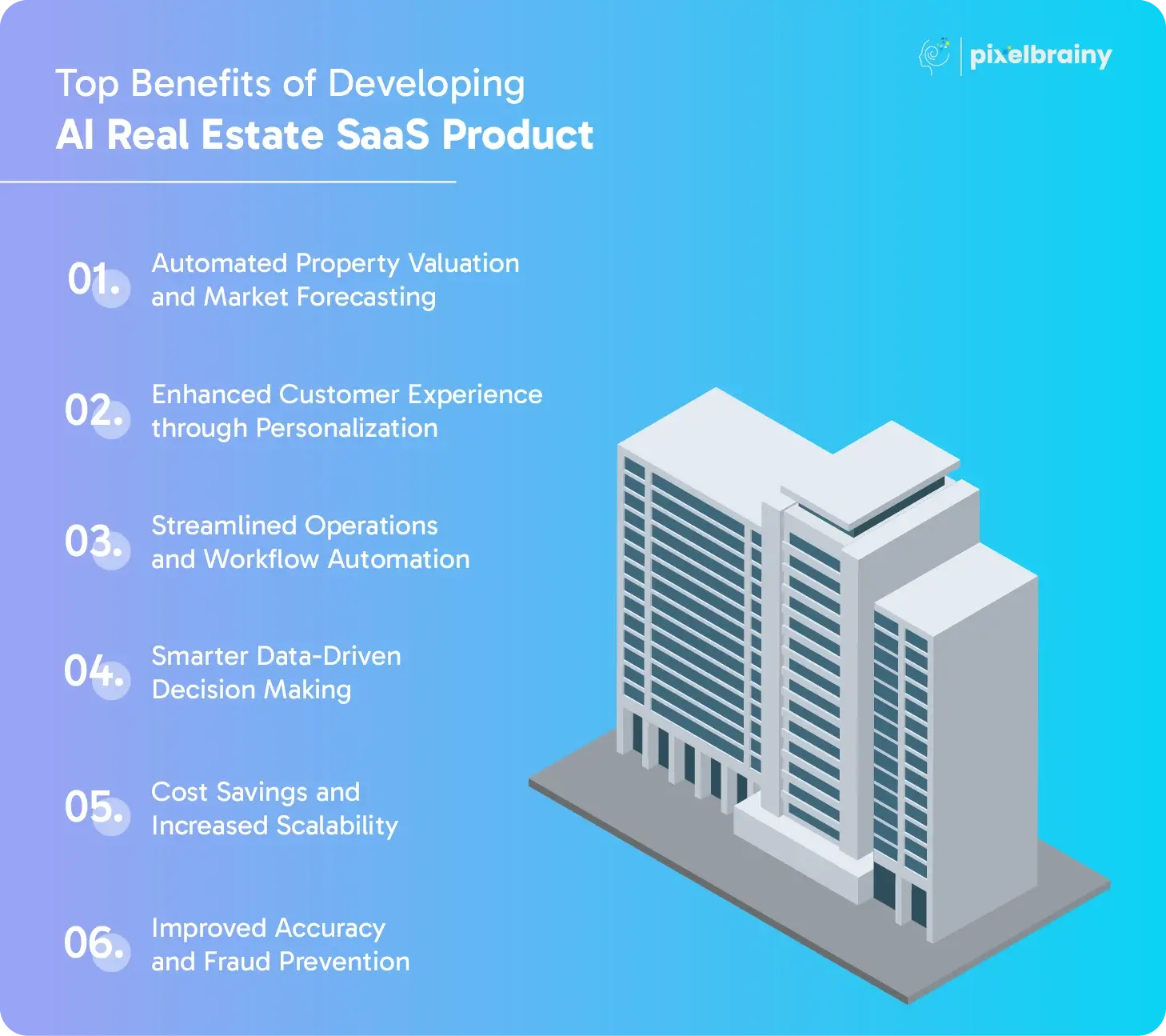
One of the most powerful outcomes of AI Real Estate SaaS Product Development is the ability to conduct precise and automated property valuations. Traditional valuation processes rely heavily on manual assessments, which are time-consuming and often inconsistent. AI algorithms, however, can analyze hundreds of data points — including location, amenities, historical pricing, and neighborhood trends — to determine a property’s true market value within seconds.
Moreover, predictive analytics built into AI-powered platforms helps forecast future property trends and price fluctuations. This allows investors and real estate firms to make well-informed decisions on when to buy, sell, or hold properties. By eliminating guesswork and human bias, AI ensures more accurate and strategic property investments that lead to higher profitability.
When you decide to develop an AI Real Estate SaaS Product, you open doors to a deeply personalized user experience. AI systems can track user behavior, analyze search history, and learn from user preferences to deliver highly targeted property recommendations. Instead of browsing through thousands of irrelevant listings, buyers and renters see properties that perfectly align with their needs, budgets, and interests.
This intelligent personalization not only saves users valuable time but also increases satisfaction and trust. For businesses, it leads to higher conversion rates and stronger customer loyalty. By offering tailored experiences that mirror customer intent, companies position themselves as tech-savvy leaders in the competitive real estate market.
One of the biggest advantages of building an AI Real Estate SaaS Product lies in automating complex and repetitive business operations. Tasks like data entry, client follow-ups, property documentation, and appointment scheduling can be handled by AI-powered systems with speed and precision. This frees real estate agents, brokers, and managers to focus on more strategic and revenue-generating activities.
Automation also reduces the risk of human error, ensuring smoother workflows and better accuracy. Businesses can handle higher transaction volumes without increasing staff or resources. With automated workflows in place, the entire organization becomes more productive, efficient, and capable of scaling operations seamlessly.
To make an AI Real Estate SaaS Product means creating a powerful decision-support system. AI integrates with real-time analytics dashboards that gather and visualize key business data — from user activity to market performance and property insights. Managers and investors gain instant access to trends and performance indicators that drive strategic planning and investment decisions.
These insights empower businesses to identify profitable regions, optimize marketing strategies, and improve lead conversion. With AI’s predictive power, companies can also anticipate market shifts and adapt quickly. In short, AI transforms raw data into actionable intelligence that supports informed and confident decision-making.
One of the most practical benefits of AI Real Estate SaaS Product Development is its ability to reduce operational costs while ensuring flexibility for growth. Since SaaS solutions are cloud-based, there’s no need for expensive hardware, software licenses, or IT maintenance. Businesses only pay for what they use, making the model extremely cost-effective.
Additionally, automation powered by AI minimizes the need for large administrative teams. Tasks that once required several employees can now be performed by intelligent software. As the business grows, the SaaS infrastructure allows easy scalability without disrupting existing operations. This cost-efficient scalability ensures long-term sustainability and profitability for real estate companies.
When you choose to make an AI Real Estate SaaS Product, you also enhance data accuracy and security. Real estate transactions often involve sensitive financial and personal information, which makes fraud detection a top priority. AI-based verification tools can automatically validate documents, detect fake listings, and identify suspicious user activities.
Machine learning models can flag unusual patterns or inconsistencies in transaction data, helping businesses prevent fraudulent deals before they occur. Furthermore, with real-time monitoring and AI-backed analytics, platforms can ensure compliance with industry standards and regulations. This not only builds trust among users but also strengthens the brand’s credibility and reliability in the market.
By investing to develop an AI Real Estate SaaS Product, companies unlock powerful tools that enhance productivity, accuracy, and customer engagement. The combination of automation, intelligence, and cloud accessibility makes AI-powered SaaS platforms an essential asset for any real estate business aiming to stay competitive and future-ready.
The real estate industry offers immense potential for innovation through AI-powered SaaS solutions. Businesses can choose from various types of AI Real Estate SaaS Product Development to streamline operations, enhance customer experiences, and make data-driven decisions.
Understanding the right product type to make or develop an AI Real Estate SaaS Product helps align technology with business goals and market needs.Section 6: Core Features for AI Real Estate SaaS Product Development
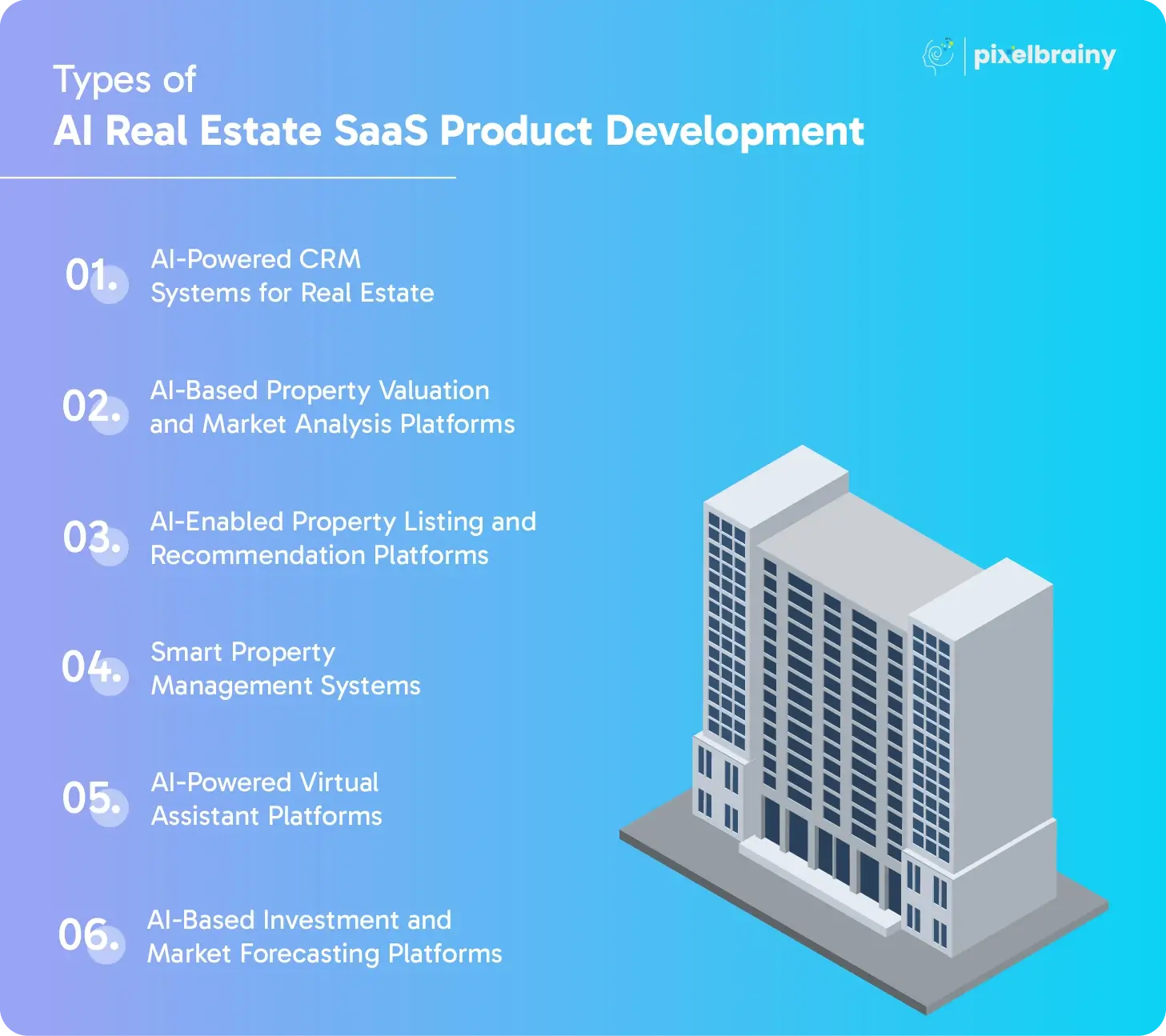
One of the most popular types of AI Real Estate SaaS Product you can develop is a customer relationship management (CRM) platform designed specifically for property businesses. These AI-powered CRMs help real estate agents and firms automate lead generation, manage customer interactions, and track sales pipelines efficiently.
For instance, the system can analyze user behavior, identify high-quality leads, and automatically prioritize follow-ups. AI chatbots integrated into the CRM can handle initial client inquiries 24/7, providing instant support and reducing manual effort.
Example: A real estate agency could use an AI CRM to automatically segment leads based on their buying intent, location, and budget, ensuring each agent focuses on the most valuable prospects. This results in better conversions and more personalized service.
Another valuable category in AI Real Estate SaaS Product Development is property valuation and market analysis platforms. These systems use machine learning models to estimate the fair market value of properties by analyzing multiple data sources such as historical sales, property features, location data, and nearby amenities.
For example, an AI valuation tool can assess two similar homes in different neighborhoods and accurately predict their prices based on current demand and historical growth patterns. Investors and real estate agents use these insights to make informed buying or selling decisions.
Platforms like Zillow’s Zestimate and Redfin Estimate are prime examples of AI valuation systems that use big data and predictive modeling to enhance accuracy in pricing and forecasting market trends.
For businesses looking to develop an AI Real Estate SaaS Product that connects buyers, sellers, and agents, an AI-driven property listing platform is an ideal choice. These platforms use artificial intelligence to personalize search results and recommend properties that best match a user’s preferences, location, and budget.
AI algorithms continuously learn from user interactions, such as viewed listings or saved searches, to refine recommendations over time. This creates a personalized user experience that drives engagement and satisfaction.
Example: A platform like Realtor.com or Trulia uses AI to show users homes they are more likely to buy, based on past searches, viewing patterns, and financial behavior. It improves the efficiency of the property search process and increases the chances of successful transactions.
A highly practical and in-demand product type in AI Real Estate SaaS Product Development is the smart property management system. These platforms help landlords, property managers, and facility operators oversee multiple properties efficiently through automation and data intelligence.
The system can automate rent collection, schedule maintenance tasks, track tenant requests, and even predict potential equipment failures using AI-driven analytics. By centralizing these operations, businesses can save time, reduce costs, and improve tenant satisfaction.
Example: A property management company can use an AI SaaS platform to predict when HVAC systems in rental properties are likely to fail and schedule preventive maintenance before issues arise. This ensures continuous service and reduces operational disruptions.
If your goal is to make an AI Real Estate SaaS Product that enhances client communication, an AI-powered virtual assistant platform can be highly effective. These intelligent assistants use natural language processing (NLP) to handle customer queries, schedule appointments, and guide users through property listings.
They can be integrated with websites, mobile apps, or CRM systems to provide real-time responses to customer questions about pricing, availability, or property features. Voice-enabled assistants are also gaining popularity, allowing users to interact through smart speakers or mobile voice commands.
Example: A real estate agency could use an AI virtual assistant like a custom-built version of ChatGPT or Google Dialogflow to provide clients with instant information on listings, available agents, or loan eligibility. This enhances responsiveness and improves the overall customer experience.
Another exciting category of creating AI Real Estate SaaS Product is focused on investment and market forecasting. These platforms use deep learning algorithms to analyze financial trends, property demand cycles, and economic indicators to predict profitable investment opportunities.
Investors can use these tools to identify emerging neighborhoods, forecast rent appreciation, and evaluate the long-term ROI of potential projects. Such insights are crucial for institutional investors, real estate funds, and private equity firms looking to make data-backed decisions.
Example: A platform could analyze real-time data from property transactions, demographics, and infrastructure developments to forecast which cities or districts will experience significant property growth over the next five years.
Hence, choosing the right type of AI Real Estate SaaS Product to develop can set the foundation for long-term success, innovation, and competitive advantage in the real estate industry.

Also Read: How To Develop AI Property Investment App: Features and Cost
To create a powerful and user-friendly AI Real Estate SaaS Product, it’s essential to include features that enhance functionality, security, and intelligence. The right mix of tools ensures your platform supports every stakeholder — from property seekers to agents and administrators. Below is a detailed table listing the 15 core features to focus on during AI Real Estate SaaS Product Development, along with brief explanations for each.
| Feature | Description |
| User Registration & Profile Management | Allows users to securely sign up, manage profiles, and personalize their experience. AI can track behavior to tailor property recommendations and notifications. |
| Advanced Property Search & Filters | Provides smart search options with filters like price, location, and amenities. AI improves accuracy by learning user intent and search behavior over time. |
| AI-Based Property Valuation | Uses machine learning algorithms to estimate property prices based on location, market trends, and comparable data. It ensures fast and data-driven pricing insights. |
| Real-Time Analytics Dashboard | Offers detailed insights into user activity, listings, and market performance. Helps businesses monitor KPIs and make data-backed decisions with AI-driven reports. |
| Lead Management & CRM Integration | Centralizes all leads, automates follow-ups, and enhances customer engagement. AI can score leads and predict conversion likelihood for better sales focus. |
| Automated Alerts & Notifications | Sends users timely updates about new listings, price changes, or offers. AI ensures notifications are personalized and delivered at the right time. |
| Secure Payment Gateway | Enables seamless and encrypted online payments for deposits, bookings, or services. AI tools can detect fraudulent transactions in real time. |
| Listing Management System | Lets agents or property owners upload, edit, and manage property listings effortlessly. AI can auto-tag properties and verify listing accuracy. |
| Admin Dashboard & Role Management | Gives administrators control over users, listings, and platform settings. Role-based access ensures data security and streamlined workflow. |
| Document Management & Verification | Simplifies uploading and verifying ownership or legal documents. AI algorithms detect anomalies or fake submissions to prevent fraud. |
| AI Chatbot & Virtual Assistant | Provides instant support for customer queries using natural language processing. It guides users, answers FAQs, and improves engagement 24/7. |
| Image Recognition for Property Analysis | AI can analyze and categorize property images for quality, design, and features. It helps improve listing accuracy and search relevance. |
| Integrated Map & Location Insights | Combines geolocation tools with AI analytics to show nearby amenities, schools, and transport links. It enhances property discovery and decision-making. |
| Review & Rating System | Enables users to leave feedback on properties and agents. AI can analyze sentiment to detect fake reviews and highlight trustworthy listings. |
| Multi-Device and Cloud Synchronization | Ensures a seamless experience across desktop, mobile, and tablets. With cloud-based storage, users can access data and listings anytime, anywhere. |
Including these features helps to develop an AI Real Estate SaaS Product that is secure, scalable, and intelligent. Each element enhances the platform’s performance, usability, and value, ensuring it stands out in a competitive digital real estate market.
Once the core foundation is ready, integrating advanced features can take your AI Real Estate SaaS Product Development to the next level. These high-end capabilities enhance automation, improve user experience, and strengthen your platform’s market competitiveness. The following table highlights 10 advanced features to consider while developing or creating an AI Real Estate SaaS Product, along with concise explanations for each.
| Advanced Feature | Description |
| Predictive Market Analytics | Uses AI and machine learning to forecast property price trends, rental yields, and demand fluctuations. It empowers investors and agents to make forward-looking decisions with confidence. |
| AI-Powered Recommendation Engine | Suggests properties based on user behavior, preferences, and past interactions. This personalization increases engagement and improves conversion rates for real estate platforms. |
| AR/VR Virtual Property Tours | Enables users to explore properties through immersive augmented or virtual reality experiences. This reduces physical visits and helps potential buyers visualize spaces remotely. |
| Voice Search and Smart Assistant Integration | Integrates voice-based AI systems like Alexa or Google Assistant, allowing users to search for properties and get updates through simple voice commands. |
| Blockchain-Based Smart Contracts | Uses blockchain technology to secure property deals and automate contract execution. It ensures transparency, reduces fraud, and eliminates third-party dependency. |
| AI Document Scanning and Fraud Detection | Automatically scans legal and financial documents to verify authenticity. AI identifies forged papers or inconsistencies, reducing the risk of fraudulent transactions. |
| Sentiment Analysis for Market and Client Insights | AI analyzes reviews, social media trends, and feedback to understand public sentiment. This helps businesses improve their offerings and marketing strategies. |
| IoT Integration for Smart Property Management | Connects IoT-enabled devices like sensors and cameras to monitor building conditions. It allows predictive maintenance and improves tenant satisfaction. |
| AI Chatbots with Natural Language Understanding (NLU) | Offers more human-like interactions through advanced conversational AI. Chatbots can handle complex queries, schedule visits, and guide users through listings intelligently. |
| Automated Investment Portfolio Management | Helps investors track, evaluate, and rebalance their real estate portfolios using AI insights. It identifies high-performing assets and recommends strategic investments. |
Incorporating these advanced features when you plan to develop an AI Real Estate SaaS Product will make your platform more powerful, future-ready, and user-centric. Each of these innovations enhances automation, boosts accuracy, and delivers smarter, data-driven experiences for modern real estate professionals.
Building a successful AI-powered real estate SaaS platform is not just about writing code or training algorithms — it’s about combining innovation, strategic planning, and market understanding to deliver a solution that genuinely solves user challenges. For those asking what is the process to build AI Real Estate SaaS Product, the journey involves multiple stages that balance technology, design, and business strategy.
Below is a complete roadmap that outlines each step of AI Real Estate SaaS Product Development, explaining how and why each phase contributes to creating a high-performance platform that stands out in the real estate technology market.
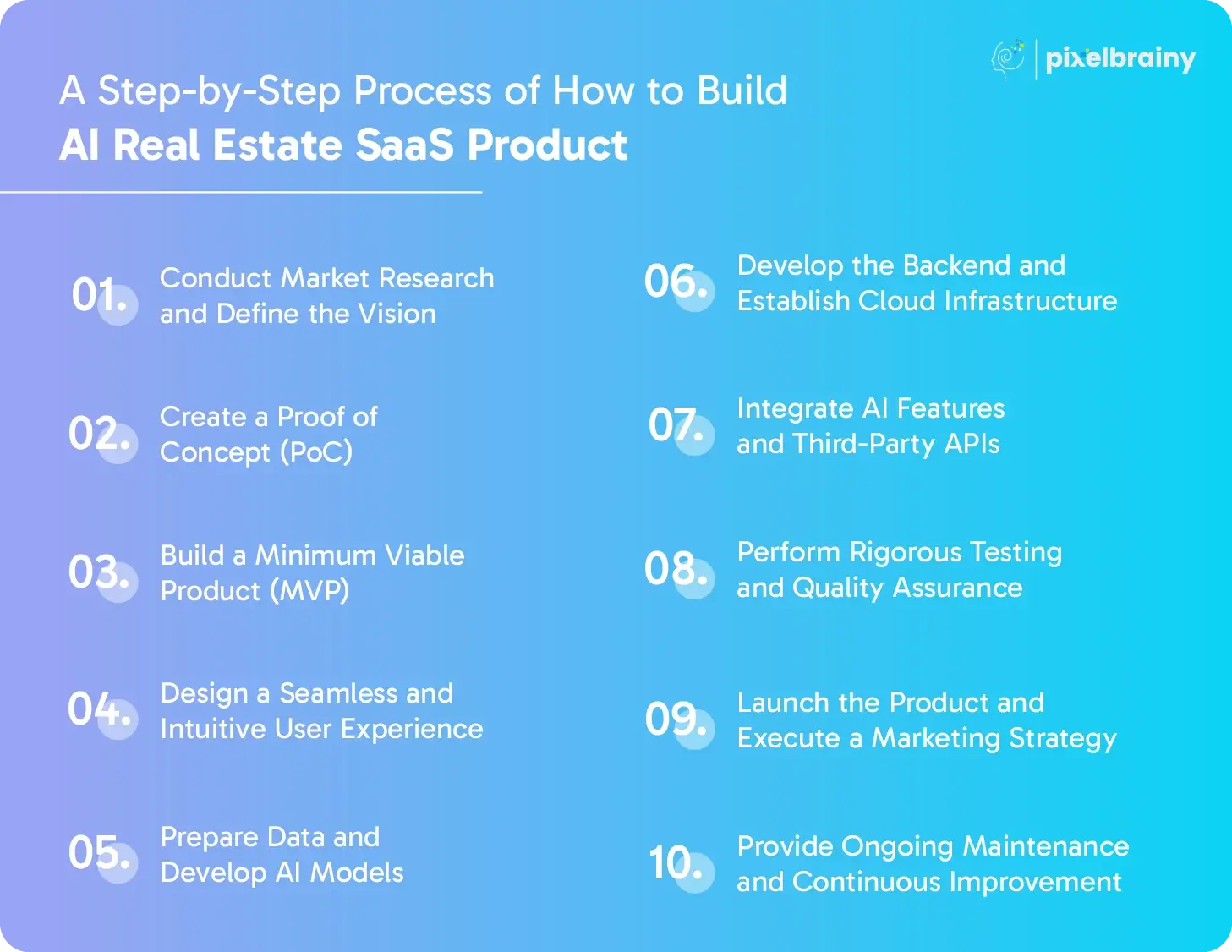
The foundation of any strong SaaS product lies in deep market understanding. Begin by identifying the major inefficiencies in the real estate industry — such as inaccurate property valuations, slow lead management, or limited data transparency. Analyze your competitors to understand what they offer and where the gaps exist. Define who your ideal users are: agents, property managers, investors, or buyers.
Once the market landscape is clear, develop a product vision that outlines your goals, key features, and value proposition. A well-defined vision ensures every development effort aligns with solving real business challenges.
Why this matters: Clear research and vision prevent wasted time and resources. It ensures that your product is built to meet actual market needs, not assumptions, increasing its chances of adoption and success.
Before starting full-scale development, create a Proof of Concept (PoC) to validate your idea’s feasibility. A PoC is a simplified prototype that tests whether your core AI logic — such as property prediction or automated valuation — actually works in practice. This helps determine whether your concept is technically sound and financially viable.
In this stage, focus on small-scale testing using real or synthetic data. A PoC also helps identify the best data sources, algorithms, and cloud technologies for your solution. Collaborating with top AI development companies in USA can give you an edge by ensuring technical accuracy, faster iterations, and reliable AI frameworks.
Why this matters: A successful PoC reduces development risks by confirming your idea’s potential before major investment. It validates your concept’s practicality and builds stakeholder confidence in your project.
After validating your concept, move to the MVP (Minimum Viable Product) development stage. The MVP should include only the essential features — such as property listings, AI-driven search, and automated valuation — to deliver a working version of your product. Launching an MVP allows you to test the product with a small audience and collect actionable feedback.
This stage is not just about coding; it’s about learning. Analyze how users interact with your platform, what features they use most, and what improvements they request. Based on the feedback, refine your features and fix usability issues before expanding into a full fledge version.
Why this matters: An MVP minimizes financial risks while helping you understand your customers’ real needs. It validates your product’s market fit and lays the groundwork for long-term scalability.
A well-designed product is easier to use and more enjoyable for your customers. Partner with a professional UI/UX Design company to craft an engaging interface that simplifies navigation and enhances user satisfaction. Focus on responsive design, easy data visualization, and a clean layout that works across all devices.
The design phase is also where brand identity is established. Choose color schemes, typography, and design patterns that reflect professionalism and trust — qualities highly valued in real estate.
Why this matters: A visually appealing and intuitive interface improves customer engagement and retention. Great design ensures that complex AI features feel simple and accessible, encouraging consistent usage.
Data is the engine of any AI-driven SaaS platform. Begin by gathering large datasets that include property details, historical pricing, demographics, and location data. Clean and organize this data to remove inconsistencies, duplicates, and missing fields.
Next, focus on training machine learning models for property valuation, predictive analytics, or user personalization. Use AI frameworks like TensorFlow or PyTorch to build and train your models. Continuously validate their performance with new data sets to maintain accuracy.
Why this matters: The effectiveness of your platform depends on the quality of your data and the intelligence of your models. Proper AI Real Estate SaaS Product development integrating AI ensures smarter decision-making, better predictions, and stronger automation.
Once your AI models are ready, it’s time to focus on the backbone of your platform — the backend and infrastructure. Choose reliable technologies like Node.js, Django, or .NET for backend development and host your solution on cloud platforms such as AWS, Microsoft Azure, or Google Cloud.
Ensure the architecture supports multi-tenancy, meaning multiple clients can use the same system securely without interference. Incorporate APIs to connect MLS data, maps, and payment gateways to enrich your system’s functionality.
Why this matters: A strong backend ensures that your product runs smoothly even under heavy loads. Scalable cloud infrastructure reduces maintenance costs and prepares your system for future growth.
In this phase, embed your AI models into the SaaS application. Use predictive analytics to forecast market trends, AI chatbots to handle customer inquiries, and recommendation engines to match users with suitable properties.
Integrate third-party APIs such as payment gateways, CRM tools, and property listing databases for seamless functionality. The goal is to make your platform a complete ecosystem for real estate professionals.
Why this matters: Integrations transform your SaaS solution into a powerful all-in-one platform. They enhance automation, reduce manual effort, and deliver a more comprehensive experience for users.
Testing is a critical stage that ensures product stability and performance. Conduct functional testing to verify that features work correctly, security testing to protect user data, and AI model testing to assess accuracy.
You can also perform beta testing by allowing a small group of users to interact with the platform in real-world conditions. Collect feedback to detect usability issues or system bottlenecks early.
Why this matters: Testing ensures reliability, security, and user satisfaction. It prevents costly post-launch failures and guarantees your product performs well under real-world conditions.
Once your SaaS platform is stable and optimized, prepare for the official launch. Deploy the application on production servers and announce it to your target market through email campaigns, online ads, or product demos.
Develop a marketing strategy that highlights your AI features, cost advantages, and value proposition for agents, investors, and agencies. Offer free trials or limited-time discounts to attract early users and gather initial reviews.
Why this matters: A strategic launch maximizes visibility and adoption. It helps you gain early traction, attract investors, and position your platform as a credible player in the real estate technology space.
After the launch, focus on continuous maintenance and enhancement. Regularly update the system with new features, improve AI models based on user feedback, and strengthen cybersecurity measures.
Monitor key performance indicators such as active users, retention rates, and customer satisfaction. Use this data to plan future upgrades and ensure your platform stays ahead of technological and market trends.
Why this matters: SaaS platforms thrive on consistency and evolution. Regular updates not only retain customers but also ensure your product remains competitive and relevant in a fast-changing industry.
By following these ten stages, developing AI Real Estate SaaS Product becomes a structured, goal-oriented process rather than a technical challenge. Each step — from research to launch — contributes to creating a platform that is scalable, intelligent, and future-ready, positioning your business as an innovator in the global real estate SaaS landscape.
Also Read: How to Develop an AI Real Estate App for Realtors and Startups?
The cost of building an AI Real Estate SaaS Product can vary significantly depending on several factors such as features, technology stack, development team size, and project complexity. On average, the AI Real Estate SaaS Product development cost ranges from $20,000 to $200,000+, depending on whether you are creating an MVP or a full-scale enterprise solution.
When estimating how much it costs to create an AI Real Estate SaaS Product, it’s essential to consider the scope, functionality, and level of AI integration you need. A simple property management SaaS platform with limited automation features might start at $20,000–$40,000, while a complex AI-driven real estate analytics platform could exceed $150,000–$200,000+.
Below is a detailed cost breakdown and factors that influence AI Real Estate SaaS Product pricing.
The more features and integrations your platform includes, the higher the development cost. A basic AI Real Estate SaaS Product with essential functions such as property listings, search filters, and CRM integration may cost around $20,000 to $50,000. However, a platform with AI-driven predictive analytics, chatbots, or AR/VR property tours can easily reach $100,000 to $200,000+.
Cost impact: Each advanced module like valuation engines or market forecasting tools adds significant AI training and development time.
AI features like property valuation, customer recommendations, and predictive market insights require complex machine learning models and high-quality data. The more AI-driven automation you include, the higher the cost.
Estimated cost range:
Cost insight: The cost of AI integration in real estate SaaS platforms largely depends on data volume, algorithm complexity, and AI tool licenses.
Designing a seamless and intuitive interface is vital for user retention. Partnering with a professional UI/UX design company can cost anywhere between $5,000 to $25,000, depending on the complexity of the user journey and dashboards.
Cost insight: A well-designed product can reduce churn rates, improve engagement, and provide better ROI — making design a worthwhile investment in AI Real Estate SaaS Product development.
The cost also depends heavily on where your development team is based. Developers in the USA typically charge $80–$150 per hour, while offshore teams in regions like Eastern Europe, India, or Southeast Asia charge $25–$60 per hour.
Average total cost range by region:
Cost insight: Hiring experienced SaaS engineers or AI software development companies ensures higher quality and scalability, even if initial costs are higher.
AI Real Estate SaaS Products require robust cloud hosting and storage solutions. Using platforms like AWS, Google Cloud, or Microsoft Azure may cost around $500 to $2,000 per month, depending on server usage and storage needs.
Cost insight: Opting for scalable cloud architecture can prevent costly downtimes and performance issues as your user base grows.
After the product launch, continuous maintenance is essential to ensure performance, security, and AI accuracy. The average cost for post-launch support ranges between 15% to 25% of the total development cost per year.
Cost insight: Regular updates help improve your SaaS system’s functionality and adapt to evolving AI technologies, keeping your platform competitive.
Besides core development, businesses should also budget for:
These additional costs are often overlooked but are critical for a smooth and compliant launch.
Investing in professional development teams, strong data infrastructure, and scalable design ensures your platform not only launches successfully but also delivers consistent long-term value. When planned strategically, every dollar spent on AI Real Estate SaaS Product development cost contributes to efficiency, innovation, and business growth.

Also Read: AI Real Estate App Development Cost: Factors and Examples
Choosing the right AI tools and technology stack is the backbone of any successful AI Real Estate SaaS Product Development project. The technologies you select directly impact performance, scalability, and development speed. A well-chosen stack helps you integrate AI efficiently, manage large real estate data sets, and create an intuitive experience for users.
Below is a detailed breakdown of the essential AI tools and tech stack required to develop AI Real Estate SaaS Product, including their purpose and importance.
| Category | Technologies / Tools | Purpose & Importance |
| Programming Languages | Python, JavaScript, TypeScript, Java, C# | Python is widely used for AI and data analytics, while JavaScript or TypeScript powers interactive SaaS interfaces. Java and C# are ideal for secure and large-scale backend systems. |
| AI & Machine Learning Frameworks | TensorFlow, PyTorch, Scikit-learn, Keras, OpenCV | These frameworks help build, train, and deploy AI models for property valuations, predictive analytics, and intelligent recommendations. TensorFlow and PyTorch are most used for deep learning. |
| Data Processing & Analytics Tools | Pandas, NumPy, Apache Spark, Power BI, Tableau | These tools help clean, structure, and visualize massive real estate data. Apache Spark is used for large-scale processing, while Power BI and Tableau support business intelligence. |
| Natural Language Processing (NLP) & Chatbot Tools | spaCy, NLTK, Dialogflow, Rasa, GPT-based APIs | These tools enable chatbots and AI assistants to interact naturally with users, answer queries, and assist in virtual property consultations. |
| Computer Vision & Image Recognition | OpenCV, Amazon Rekognition, Google Vision API, YOLO | Used for property image analysis, automated tagging, and visual-based search features that enhance property discovery. |
| Cloud Infrastructure & Hosting | AWS, Microsoft Azure, Google Cloud Platform (GCP) | Cloud services ensure scalability, uptime, and security. They host databases, manage AI computations, and support seamless data synchronization across users. |
| Backend Frameworks | Node.js, Django, Flask, .NET Core, Laravel | These frameworks handle API logic, authentication, and data flow. Django and Flask integrate easily with AI models, making them ideal for SaaS systems. |
| Frontend Frameworks | React.js, Angular, Vue.js, Next.js | Frontend technologies create dynamic, responsive interfaces for dashboards, listings, and search tools. React.js and Angular are popular choices for real estate SaaS products. |
| Databases | PostgreSQL, MongoDB, MySQL, Firebase, Elasticsearch | Databases store property listings, AI outputs, and user profiles. PostgreSQL is best for reliability, while MongoDB and Firebase offer flexibility and scalability. |
| API Integration Tools | RESTful APIs, GraphQL, Zapier, RapidAPI | APIs connect third-party services such as MLS property databases, CRMs, and payment systems for real-time data integration. |
| DevOps & CI/CD Tools | Docker, Kubernetes, Jenkins, GitHub Actions, Terraform | These tools support continuous integration and deployment, ensuring that updates are seamless and scalable across cloud environments. |
| Security & Compliance Tools | OAuth 2.0, SSL, Firewalls, Identity Access Management (IAM) | Protects user data and ensures compliance with security standards like GDPR and SOC 2, critical for SaaS-based property platforms. |
| Payment Integration Tools | Stripe, PayPal, Razorpay, Square | Enables secure payments, subscriptions, and property transactions directly within the SaaS system. |
| Project Management & Collaboration Tools | Jira, Trello, Asana, Slack | Facilitates task management, sprint planning, and communication between developers, designers, and stakeholders during the product lifecycle. |
The right AI tools and tech stack to build AI Real Estate SaaS Product ensure a balance between innovation, scalability, and performance. Python and TensorFlow power intelligent automation, while React.js and Node.js build interactive interfaces. Cloud solutions like AWS and Azure guarantee stability and security.
By selecting flexible, modern technologies, you can future-proof your AI Real Estate SaaS platform, making it adaptable to evolving AI capabilities and real estate market demands.
The AI Real Estate SaaS business model revolves around delivering intelligent, data-driven software services through the cloud — enabling real estate professionals, agencies, investors, and property managers to access automation, analytics, and AI-powered tools on a subscription or usage basis. This model allows companies to make AI Real Estate SaaS Product that generates consistent recurring revenue while offering scalable value to users worldwide.
At its core, this model blends two powerful elements — Software-as-a-Service (SaaS) for scalability and accessibility, and Artificial Intelligence (AI) for automation, prediction, and personalization. Below is a detailed breakdown of how this business model works and the common monetization structures used in AI Real Estate SaaS Product Development.
The subscription model is the foundation of most AI Real Estate SaaS products. Users pay a fixed monthly, quarterly, or annual fee to access the platform’s core features such as property analytics, AI-driven valuations, and CRM automation.
Why it works: It ensures predictable recurring revenue while keeping entry costs low for users. Businesses can offer tiered subscription plans (Basic, Pro, Enterprise) to cater to agents, brokers, or large real estate firms.
Example: A company might charge $49/month for individual agents and $499/month for enterprise clients with custom integrations and data access.
In this model, users get access to basic features for free and can upgrade to paid versions for advanced AI tools like predictive pricing, virtual property tours, or market forecasting.
Why it works: The freemium approach attracts a larger audience initially and converts active users into paying customers once they experience value.
Example: A startup offering free property listings can monetize premium AI analytics and customer insights through a paid plan.
Some AI Real Estate SaaS Product Development companies adopt a usage-based pricing system. Instead of fixed subscriptions, users pay based on how often they use certain features — such as running predictive models, AI-driven valuations, or generating reports.
Why it works: This model is ideal for businesses that want flexibility without long-term commitments. It aligns costs directly with usage, making it highly scalable.
Example: A property investment firm pays per AI-generated valuation report or per data analytics request rather than monthly fees.
Larger real estate organizations often prefer custom enterprise solutions or white-label SaaS products that they can rebrand and resell under their own name.
Why it works: This model creates high-value contracts and long-term partnerships, often generating revenue in the range of $50,000 to $200,000+ per client.
Example: A real estate franchise may license an AI-powered CRM platform to all its branch offices under its own brand identity.
Some platforms earn revenue by taking a small commission on transactions processed through their system — such as property purchases, rentals, or service payments.
Why it works: It encourages platform growth and aligns business success with user success. The more transactions the users complete, the higher the company’s earnings.
Example: A SaaS platform could charge 0.5–1% commission on every sale or lease agreement executed digitally through the system.
Real estate SaaS products collect vast amounts of valuable data — including buyer behavior, pricing trends, and regional performance metrics. This data can be anonymized and sold to developers, market researchers, and financial institutions.
Why it works: It provides an additional revenue stream beyond subscriptions. AI turns raw data into actionable insights, creating premium value for third-party clients.
Example: A platform might sell real-time property trend reports or AI-generated market forecasts to investment firms or government agencies.
Another effective model involves partnering with banks, insurance companies, or mortgage lenders to offer value-added integrations. These partners pay integration or referral fees for leads generated through the SaaS platform.
Why it works: It builds an ecosystem of connected services, enhancing user convenience and creating continuous B2B revenue opportunities.
Example: A platform offering AI-based mortgage eligibility predictions partners with a bank and earns commissions for every referred loan.
A well-structured AI Real Estate SaaS business model ensures sustainable growth, steady recurring revenue, and lasting value for both users and enterprises in the digital property ecosystem.
While AI Real Estate SaaS Product Development offers immense opportunities, it also comes with a unique set of challenges that require careful planning and execution. From data privacy concerns to algorithm accuracy, every stage presents complexities that can affect product performance, scalability, and market success. Understanding these challenges early helps businesses make informed decisions to develop AI Real Estate SaaS Product that is both reliable and future-ready.
Below are the most common challenges and key considerations that development teams and business leaders should keep in mind.
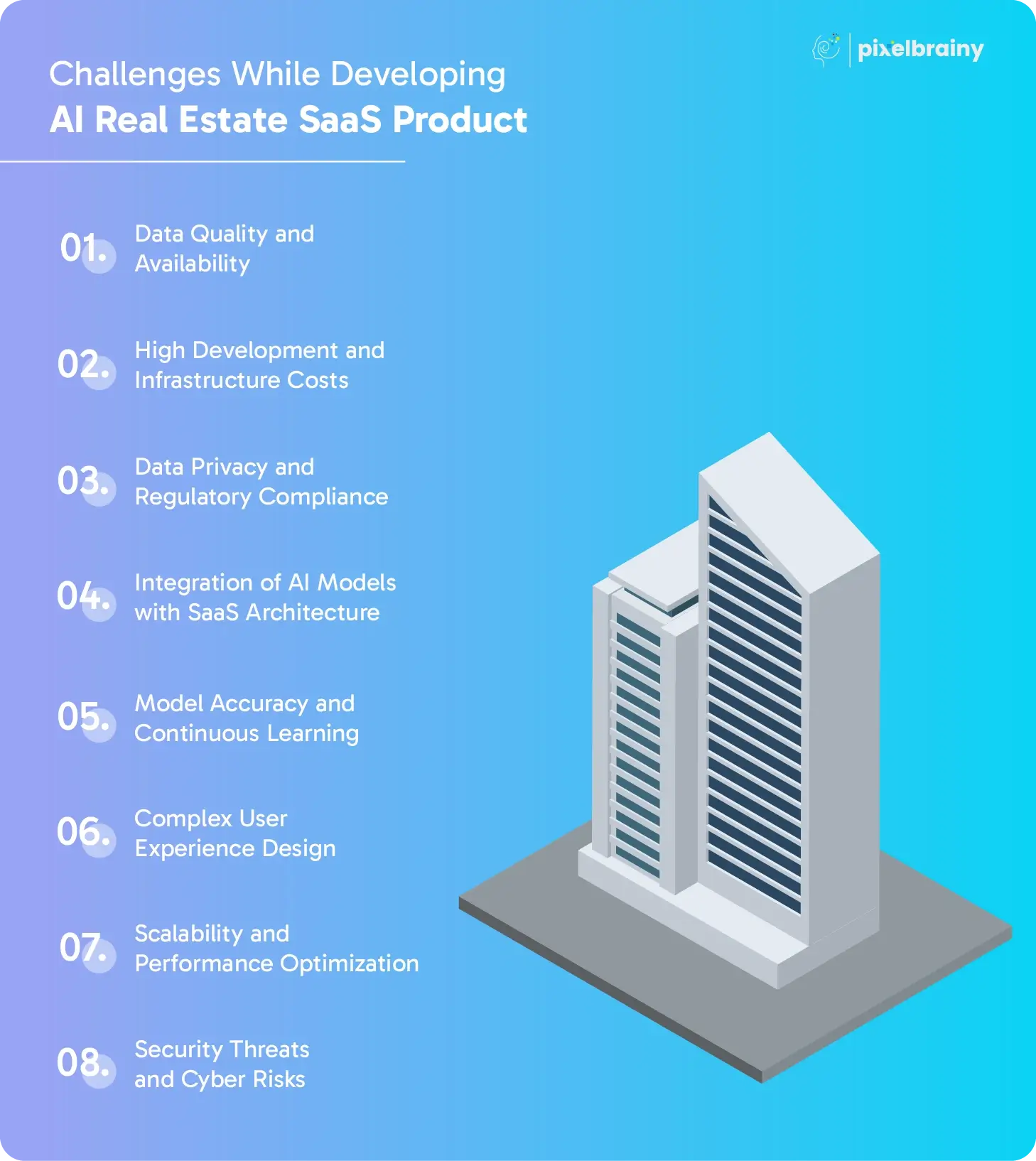
AI systems thrive on high-quality data, but gathering accurate and up-to-date property data is often difficult. Inconsistent listings, missing information, or unstructured data can lead to poor AI predictions.
Key Consideration: Partner with verified property data providers and implement automated data-cleaning pipelines. Use real-time data sources like MLS databases to ensure accuracy and relevance.
Developing an AI-based SaaS platform requires significant investment in cloud infrastructure, AI training models, and skilled developers. These costs can escalate quickly if not planned properly.
Key Consideration: Start with an MVP before scaling to a full-featured platform. Use cost-efficient cloud services like AWS or Google Cloud’s AI suite to balance expenses while maintaining performance.
Since AI systems process sensitive customer and property data, compliance with data protection regulations such as GDPR, CCPA, or SOC 2 is mandatory. Any breach or misuse of user information can damage trust and lead to penalties.
Key Consideration: Implement end-to-end encryption, secure login mechanisms, and access controls. Always anonymize user data before training AI models and conduct regular security audits.
Integrating AI components into a multi-tenant SaaS environment can be complex. Real-time prediction, continuous learning, and API synchronization require robust backend architecture.
Key Consideration: Use containerization tools like Docker and Kubernetes to streamline AI model deployment. Ensure the architecture supports scalability, low latency, and continuous AI retraining.
AI models for valuation or recommendation need constant updates to maintain accuracy. Without proper retraining, results can become outdated or biased due to market fluctuations.
Key Consideration: Continuously collect new data and retrain AI models periodically. Monitor performance metrics to detect drifts or inaccuracies in predictive outcomes.
Real estate platforms cater to diverse users — agents, buyers, property managers, and investors. Designing an intuitive and visually appealing interface for all user types is a major challenge.
Key Consideration: Collaborate with a professional UI/UX design company that specializes in SaaS and AI platforms. Conduct usability testing to ensure the product remains user-friendly and accessible.
As the number of users and property listings grows, performance issues like slow loading times or downtime can emerge. Scalability must be built into the architecture from day one.
Key Consideration: Choose cloud-based solutions that support horizontal scaling. Optimize database queries and use content delivery networks (CDNs) for faster response times.
SaaS products are frequent targets of cyberattacks such as phishing, DDoS, or data theft. A single vulnerability can compromise user data and business reputation.
Key Consideration: Implement strong authentication, firewall protection, and AI-powered anomaly detection. Regularly perform penetration testing to identify and fix vulnerabilities.
Developing AI Real Estate SaaS Product is a complex process that requires balancing innovation with compliance, scalability, and user trust. By anticipating challenges like data management, cost control, and AI integration, businesses can create a robust, secure, and future-proof solution that drives long-term success in the real estate technology ecosystem.
The next wave of innovation in the real-estate industry will be driven by smarter platforms, deeper automation, and new modes of service delivery. For anyone investing in AI Real Estate SaaS Product Development, understanding these trends is key to staying ahead and delivering lasting value.
A major shift is underway toward platforms that don’t just report insights, but act on them autonomously. Generative and agentic AI will soon handle tasks such as property valuation, lead outreach, and even contract management.
These systems will make your SaaS offering more proactive and interactive, transforming the experience for users.
AI models trained on behavioural data, preferences, demographics and past interactions will deliver Ultra-personalised property suggestions and services at scale.
For developers of AI Real Estate SaaS Products this means building algorithms that learn, adapt and deliver tailor-made experiences for brokers, investors and property seekers alike.
Immersive technologies will merge with AI to allow users to remotely view, stage and explore properties in virtual environments.
This trend creates opportunities for SaaS platforms to integrate virtual tours, 3D neighbourhood analytics and interactive design tools — redefining how properties are marketed and experienced.
As investors and regulators focus on environmental, social and governance (ESG) metrics, AI-powered SaaS platforms will increasingly offer sustainability forecasting and carbon-footprint insights.
This means that future versions of AI Real Estate SaaS Products will help clients assess not just market value, but ecological impact and long-term viability.
The integration of Internet of Things (IoT) sensors with AI models will enable real-time monitoring of buildings, predictive maintenance and operational efficiency for property managers.
For SaaS developers this means connecting sensor data, usage patterns and AI workflows into seamless dashboards and alerts for users managing multiple properties or portfolios.
With greater automation and intelligence, SaaS products will move toward outcome-based pricing rather than pure usage or seat models. Clients will pay for results — improved occupancy, lower maintenance costs, faster sales — rather than merely access.
This trend drives SaaS creators to focus more on measurable business impact and less on feature count alone.
As AI influences bigger decisions in real estate, transparency on data, algorithm fairness and regulatory compliance will become essential.
For SaaS platforms this means building audit logs, explainable AI models and clear governance workflows — all of which will soon be expected by enterprise users and regulators alike.
The future of building AI Real Estate SaaS Product lies in proactively smart, deeply personalised, and outcome-oriented platforms that integrate emerging technologies like generative AI, IoT and immersive experiences. Staying ahead means not just delivering features, but shaping how real estate is discovered, managed and monetised for the long term.
Partnering with the right technology company is the foundation for successful AI Real Estate SaaS Product Development. At PixelBrainy, we specialize in building intelligent, scalable, and market-ready real estate platforms that empower businesses to automate operations, enhance decision-making, and deliver data-driven customer experiences. As a leading Real Estate AI Software Development Company, we focus on creating end-to-end SaaS solutions that combine powerful AI capabilities with elegant, user-friendly interfaces.
Whether you’re a real estate startup aiming to launch your first AI-driven product or an established enterprise looking to modernize your systems, PixelBrainy provides the expertise and resources to build AI Real Estate SaaS Product that aligns perfectly with your business goals.
One of our recent clients (name confidential due to NDA) approached PixelBrainy to develop an AI-powered property intelligence platform. Their goal was to simplify investment decisions and automate property evaluations across multiple markets.
We developed a custom solution featuring:
As a result, the client achieved a 42% increase in operational efficiency, reduced manual valuation time by 65%, and experienced a 30% growth in customer engagement within six months of launch.
PixelBrainy isn’t just a development partner — we’re your innovation ally in the journey to build AI Real Estate SaaS Product that drives revenue, efficiency, and competitive advantage. With our deep domain knowledge and advanced AI capabilities, we help transform your business vision into a high-performing, future-ready SaaS platform that defines the next era of real estate technology.

From the above, it’s clear that AI Real Estate SaaS Product Development is transforming the property industry by combining data intelligence, automation, and cloud scalability. Building such a platform allows real estate businesses to optimize operations, deliver personalized experiences, and make data-driven decisions with confidence. Whether you aim to automate valuations, enhance lead management, or introduce predictive insights, an AI-powered SaaS solution can be the ultimate growth enabler for your company.
As technology continues to evolve, embracing AI and SaaS together is no longer optional but essential for staying ahead in the competitive real estate landscape. Partnering with experts like PixelBrainy, a leading AI development company ensures your journey from concept to launch is seamless, secure, and innovative.
Book an appointment with PixelBrainy today to start creating your future-ready AI Real Estate SaaS Product.
The primary goal of an AI Real Estate SaaS Product is to automate and optimize property-related operations such as valuations, listings, customer management, and market analysis using artificial intelligence. It helps real estate businesses enhance decision-making and improve operational efficiency through data-driven insights.
The timeline varies based on complexity, features, and team size. Typically, developing an MVP takes around 3–4 months, while a full-fledged AI Real Estate SaaS platform with advanced features may take 6–12 months, including testing and deployment.
Real estate agencies, brokers, investors, property management companies, and proptech startups can all benefit. It streamlines workflows, enhances customer engagement, and provides actionable insights to drive profitability.
A modern AI Real Estate SaaS Product typically leverages Python, React.js, Node.js, TensorFlow, and cloud services like AWS or Google Cloud. These technologies ensure scalability, performance, and secure AI integration.
The cost depends on project scope and AI complexity. Basic versions may start from $20,000, while enterprise-level solutions with predictive analytics and automation can exceed $200,000. Partnering with an experienced Real Estate AI Software Development Company helps optimize costs and quality.

About The Author
Sagar Bhatnagar
Sagar Sahay Bhatnagar brings over a decade of IT industry experience to his role as Marketing Head at PixelBrainy. He's known for his knack in devising creative marketing strategies that boost brand visibility and market influence. Sagar's strategic thinking, coupled with his innovative vision and focus on results, sets him apart. His track record of successful campaigns proves his ability to utilize digital platforms effectively for impactful marketing efforts. With a genuine passion for both technology and marketing, Sagar continuously pushes PixelBrainy's marketing initiatives to greater success.

Working with the PixelBrainy team has been a highly positive experience. They understand the design requirements and create beautiful UX elements to meet the application needs. The dev team did an excellent job bringing my vision to life. We discussed usability and flow. Sagar worked with his team to design the database and begin coding. Working with Sagar was easy. He has the knowledge to create robust apps, including multi-language support, Google and Apple ID login options, Ad-enabled integrations, Stripe payment processing, and a Web Admin site for maintaining support data. I'm extremely satisfied with the services provided, the quality of the final product, and the professionalism of the entire process. I highly recommend them for Android and iOS Mobile Application Design and Development.

Great experience working with them. Had a lot of feedback and I found that unlike most contractors they were bugging me for updates instead of the other way around. They were extremely time conscience and great at communicating! All work was done extremely high quality and if not on time, early! They were always proactive when it comes to communication and the work is great/above par always. Very flexible and a great team to work with! Goes above and beyond to present us with multiple options and always provides quality. Amazing work per usual with Chitra. If you have UI/UX or branding design needs I recommend you go to them! Will likely work with them in the future as well, definitely recommended!

PixelBrainy is a joy to work with and is a great partner when thinking through branding, logo, and website layout. I appreciate that they spend time going into the "why" behind their decisions to help inform me and others about industry best practices and their expertise.

I hired them to design our software apps. Things I really like about them are excellent communication skills, they answer all project suggestions and collaborate right away, and their input on design and colors is amazing. This project was complex and needed patience and creativity. The team is amazing to do business with. I will be using them long-term. Glad to see there are some good people out there. I was afraid to try and outsource my project to someone but I am glad I met them! I really can't say enough. They went above and beyond on this project. I am very happy with everything they have done to make my business stand out from the competition.

It was great working with PixelBrainy and the team. They were very responsive and really owned the project. We'll definitely work with them again!

I recently worked with the PixelBrainy team on a project and I was blown away by their communication skills. They were prompt, clear, and articulate in all of our interactions. They listened and provided valuable feedback and suggestions to help make the project a success. They also kept me updated throughout the entire process, which made the experience stress-free and enjoyable.

PixelBrainy is very good at what it does. The team also presents themselves very professionally and takes care of their side of things very well. I could fully trust them taking up the design work in a timely and organised manner and their attention to detail saved us lots of effort and time. This particular project was quite intense and the team showed that they function very well under pressure. Very much looking forward to working with her again!

It's always an absolute pleasure working with them. They completed all of my requests quickly and followed every note I had for them to a T, which made our process go smoothly from start to finish. Everything was completed fast and following all of the guidelines. And I would recommend their services to anyone. If you need any design work done in the future, PixelBrainy should be your first call!

They took ownership of our requirements and designed and proposed multiple beautiful variants. The team is self-motivated, requires minimum supervision, committed to see-through designs with quality and delivering them on time. We would definitely love to work with PixelBrainy again when we have any requirements.

PixelBrainy was a big help with our SaaS application. We've been hard at work with a new UI/UX and they provided a lot of help with the designs. If you're looking for assistance with your website, software, or mobile application designs, PixelBrainy and the team is a great recommendation.

PixelBrainy designers are amazing. They are responsive, talented, and always willing to help craft the design until it matches your vision. I would recommend them and plan to continue them for my future projects and more!!!

They were awesome! Did a good job fast, and good communication. Will work with them again. Thank you

Creative, detail-oriented, and talented designers who take direction well and implement changes quickly and accurately. They consistently over-delivered for us.

PixelBrainy team is very talented and creative. Great designers and a pleasure to work with. PixelBrainy is an excellent communicator and I look forward to working with them again.

PixelBrainy has a very talented design team. Their work is excellent and they are very responsive. I enjoy working with them and hope to continue on all of our future projects.


Transform your ideas into reality with us.
Across these industries, each engagement brings unique challenges, from early-stage product development to scaling complex systems, helping us build a practical understanding of real-world product environments.