
 AI Summary Powered by PixelBrainy
How do I develop cloud-based AI salon management software? Can I build a SaaS-based salon management platform with AI features that helps my beauty business scale faster and operate more efficiently?
These are some of the most common questions salon owners, spa operators, and startup founders are asking today. Cloud-Based AI Salon Management Software Development is reshaping how modern beauty businesses manage appointments, retain customers, and optimize daily operations. By combining secure cloud infrastructure with artificial intelligence, salons can automate scheduling, personalize services, forecast revenue, and manage multiple branches from a centralized platform. Salon Management Software Development Integrating AI enables smarter decision-making through real-time data insights and predictive analytics.
According to Statista, the global beauty and personal care market is projected to surpass $736 billion by 2028, reflecting strong industry growth and accelerating technology adoption across salons and spas.
Developing a Cloud-Based AI Salon Management Software allows businesses to implement AI-powered booking automation, intelligent customer segmentation, automated marketing workflows, and scalable SaaS deployment models. Companies planning to build AI Salon Management Software with cloud-based architecture can unlock operational efficiency, improved customer experience, and long-term profitability.
In this blog, you will get a complete breakdown of architecture, core and advanced features, development steps, required technologies, business models, and cost estimates. This guide will help you understand exactly how to plan, build, and scale a successful AI-powered salon management platform.
Cloud-Based AI Salon Management Software is a cloud-hosted digital platform that uses artificial intelligence to automate appointment scheduling, customer management, billing, analytics, and revenue forecasting for beauty businesses. It enables salons to operate, scale, and personalize services through centralized data and real-time insights.
In the context of Cloud-Based AI Salon Management Software Development, this system replaces manual processes with AI-driven automation and scalable cloud infrastructure. Salon Management Software Development Integrating AI helps beauty businesses improve operational efficiency, customer retention, and decision-making.
A cloud-based AI salon system works in five structured steps:
This workflow ensures real-time management across single or multi-location salons.
A scalable architecture for developing a Cloud-Based AI Salon Management Software typically follows this structured flow:
Built using React, Angular, or Flutter.
Provides:
Developed using Node.js, Python, or .NET.
Handles:
This is the intelligence engine.
Used for:
AI models are commonly built using TensorFlow or PyTorch.
Stores structured salon data such as:
Databases may include PostgreSQL or MongoDB.
Deployment typically occurs on:
Cloud infrastructure ensures:
Essential for AI salon software development.
Includes:
When planning to build AI Salon Management Software with cloud-based architecture, this layered structure ensures scalability, performance, and security. It supports SaaS-based salon management platforms with AI features while enabling seamless integration, future upgrades, and long-term business growth.
When planning Cloud-Based AI Salon Management Software Development, one of the first questions business owners ask is: what are the Types of AI Salon Management Software to Develop? The right model depends on business size, scalability goals, monetization strategy, and level of AI integration.
During the Development of Cloud-Based AI Salon Management Software, choosing the correct type ensures long term performance, security, and profitability. Below are the most practical and scalable models for building an AI Salon Management Software solution for modern beauty businesses.
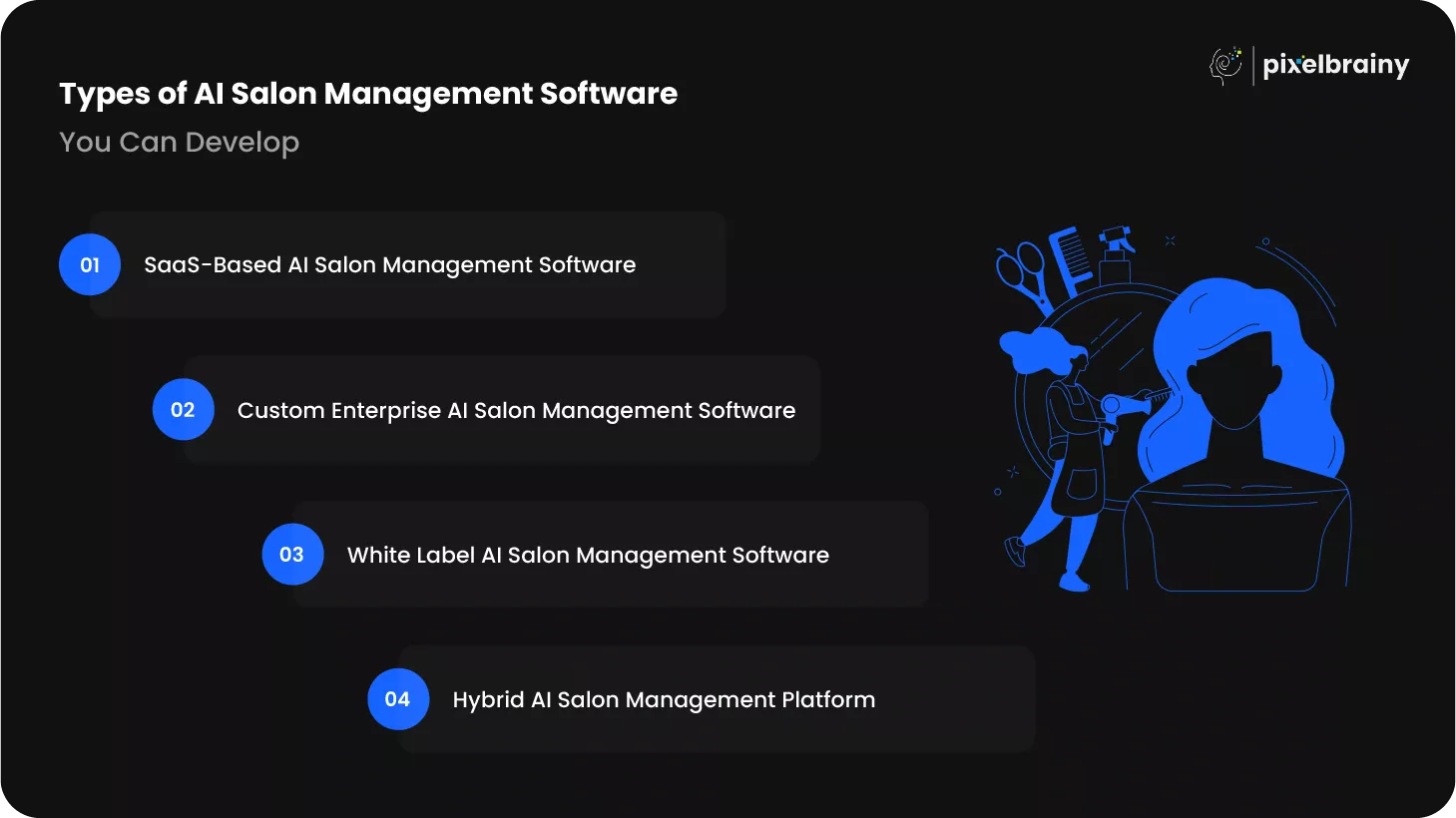
A SaaS based AI salon platform is the most scalable option when you want to Develop Salon Management Software With AI for multiple businesses under a subscription model. In this approach, the software is hosted on cloud infrastructure and offered as a service to salons on monthly or annual plans.
This model supports multi-tenant architecture, centralized updates, automated billing, and remote accessibility. It is ideal for startups aiming to launch a beauty tech SaaS platform. Features typically include AI powered booking automation, CRM analytics, revenue forecasting, and marketing automation tools.
Because everything runs on the cloud, salons do not need local servers. This reduces infrastructure costs and makes upgrades seamless. SaaS platforms are best suited for entrepreneurs targeting regional, national, or global salon markets.
Custom enterprise solutions are designed for large salon chains, franchises, or beauty brands that require advanced personalization and integration flexibility. This model focuses on developing tailored workflows, custom dashboards, and AI models aligned with specific operational goals.
Enterprise platforms often integrate with ERP systems, accounting tools, loyalty programs, and third-party payment gateways. Artificial intelligence can be customized for predictive demand forecasting, intelligent staff scheduling, and customer lifetime value analysis.
Unlike SaaS products that serve multiple clients, enterprise software is built exclusively for one organization. It provides greater control over data, branding, and security architecture. This type is ideal for large beauty businesses that require full ownership and deep system customization.
White label solutions allow agencies or entrepreneurs to launch salon software under their own brand without building the entire system from scratch. In this model, the core platform is developed once and then rebranded for multiple clients.
This approach reduces development time and cost while still offering cloud scalability and AI automation features. White label systems typically include appointment scheduling, CRM management, reporting dashboards, and AI driven marketing modules.
It is a practical option for software providers who want to enter the beauty technology market quickly. While customization is possible, it is usually limited compared to fully custom enterprise systems. This model works best for rapid market expansion with moderate technical investment.
A hybrid platform combines SaaS scalability with custom modular enhancements. It allows businesses to start with a standard cloud framework and then integrate specialized AI modules as they grow.
This model is flexible and future ready. Core features may include booking systems and CRM tools, while advanced AI components such as dynamic pricing, predictive analytics, and intelligent inventory management can be added later.
Hybrid platforms are suitable for growing salon chains that want both cost efficiency and customization. They provide a balance between standardized architecture and business specific innovation, making them a strong choice for evolving beauty enterprises.
Selecting the right type during Cloud-Based AI Salon Management Software Development directly impacts scalability, cost structure, and long-term sustainability. Understanding these models helps businesses make informed decisions before investing in architecture, feature planning, and deployment strategy.
Why are salons investing in intelligent platforms instead of traditional systems? Why is AI becoming essential in beauty operations? These are critical questions for owners exploring Cloud-Based AI Salon Management Software Development.
As competition increases and customer expectations rise, manual processes are no longer sustainable. Salon Management Software Development Integrating AI enables automation, personalization, predictive insights, and scalable operations through cloud infrastructure. Businesses that adopt intelligent systems gain operational clarity, better customer retention, and measurable revenue growth.
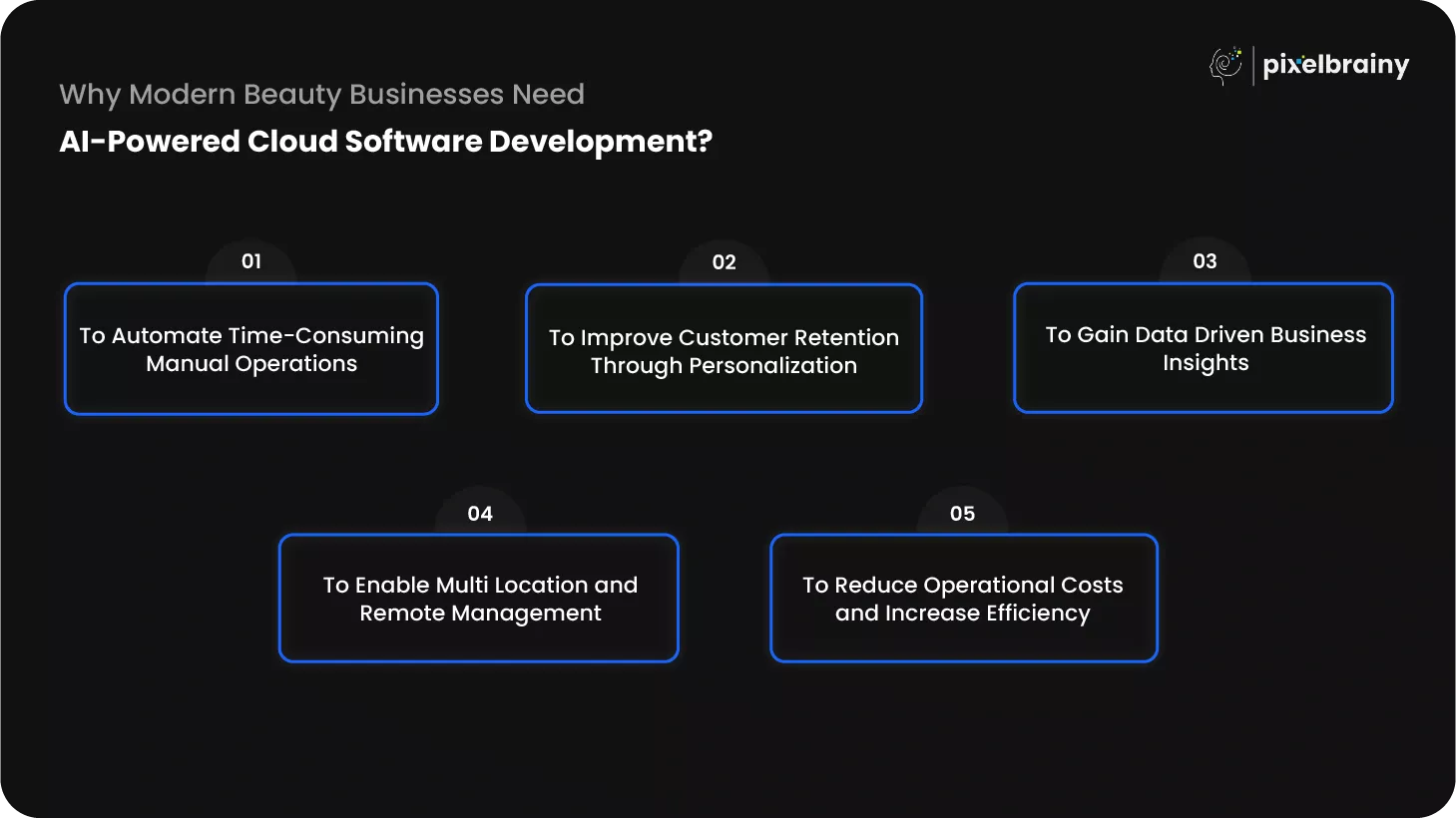
Traditional salons rely on phone bookings, manual registers, and spreadsheets. This leads to scheduling conflicts, missed appointments, and human errors.
By building an AI Salon Management Software solution, businesses can automate appointment scheduling, send smart reminders, manage cancellations, and reduce no shows. AI chatbots can handle bookings 24 hours a day without staff intervention.
Automation reduces administrative workload and allows salon staff to focus on delivering better customer experiences instead of managing repetitive tasks.
Modern clients expect personalized services. AI powered systems analyze service history, spending behavior, and visit frequency to recommend relevant treatments or packages.
To Develop Salon Management Software With AI means enabling intelligent customer segmentation, targeted promotions, and automated loyalty campaigns. Personalized marketing increases repeat visits and customer lifetime value.
Instead of generic promotions, salons can deliver customized offers based on predictive behavior patterns generated by AI models.
Without analytics, salon owners make decisions based on assumptions. AI powered cloud systems provide dashboards with real time performance metrics.
Development of Cloud-Based AI Salon Management Software allows businesses to track revenue trends, peak booking hours, staff productivity, and service demand patterns. Predictive analytics can forecast busy periods and expected income.
Data driven insights help owners optimize staffing, inventory purchasing, and promotional campaigns for better profitability.
As salons expand, managing multiple branches becomes complex. Cloud based systems centralize operations across locations.
With Cloud-Based AI Salon Management Software Development, owners can monitor bookings, revenue, staff schedules, and customer data from any device. This ensures consistency in service quality and operational control across branches.
Cloud infrastructure supports scalability without the need for additional physical servers.
AI automation minimizes manual errors, optimizes staff scheduling, and reduces inventory waste. Predictive tools can prevent overstocking and underutilization of resources.
Building an AI Salon Management Software platform helps streamline processes, improve workflow efficiency, and lower long term administrative costs.
Businesses that integrate AI powered cloud solutions often experience higher operational efficiency and stronger return on investment compared to traditional management systems.
Adopting AI powered cloud software is no longer a technological upgrade but a strategic necessity for modern beauty businesses. Investing in intelligent systems ensures scalability, competitive advantage, and sustainable growth in an increasingly digital marketplace.

When planning Cloud-Based AI Salon Management Software Development, defining the right core modules is essential for operational stability and scalability. These features form the foundation of the Development of Cloud-Based AI Salon Management Software and ensure smooth booking management, billing automation, CRM centralization, and reporting.
Businesses building an AI Salon Management Software must prioritize features that automate daily workflows while supporting long term growth. The following core components are required to Develop Salon Management Software With AI that meets modern beauty industry demands.
| Core Feature | Detailed Explanation |
| Appointment Scheduling System | A centralized booking engine that allows customers to schedule, reschedule, or cancel appointments in real time. It synchronizes staff calendars, prevents double bookings, and optimizes time slots to reduce idle hours. Automated confirmations and reminders improve operational efficiency and reduce no show rates. |
| Customer Relationship Management | A structured CRM system stores customer profiles, service history, product purchases, preferences, and feedback. This enables personalized service delivery and targeted engagement strategies. Centralized data management improves retention and enhances overall customer experience. |
| Point of Sale Integration | An integrated billing system that manages invoices, digital receipts, discounts, refunds, and tax calculations. It supports multiple payment methods while maintaining accurate transaction records. This ensures financial transparency and simplifies daily accounting operations. |
| Staff Management Module | Tracks employee schedules, attendance, performance metrics, and commission calculations. It helps managers allocate resources efficiently and monitor productivity. Optimized staff management improves service quality and operational balance. |
| Inventory Management | Monitors product stock levels, supplier information, and usage patterns in real time. Automated low stock alerts prevent shortages and overstocking. This ensures uninterrupted service delivery and cost control. |
| Multi Location Management | Centralizes operations across multiple branches under a unified dashboard. Owners can monitor bookings, revenue, and staff activity remotely. This feature supports scalable expansion and consistent service standards. |
| Automated Notifications | Sends appointment confirmations, reminders, and promotional updates via SMS or email. Timely notifications reduce missed appointments and improve client engagement. Automation minimizes manual communication workload. |
| Reporting and Analytics Dashboard | Provides visual reports on revenue trends, service popularity, and employee performance. Real time analytics support informed decision making. Data driven insights help optimize pricing, marketing, and staffing strategies. |
| Role Based Access Control | Assigns access permissions based on user roles such as administrator, manager, or stylist. This enhances data security and prevents unauthorized access. Controlled permissions maintain system integrity and confidentiality. |
| Online Booking Portal | Offers customers a seamless web or mobile interface to book services anytime. It increases convenience and reduces dependency on phone-based scheduling. Continuous availability improves customer satisfaction and booking conversion rates. |
| Loyalty Program Management | Tracks reward points, memberships, referrals, and promotional campaigns. Structured loyalty systems increase repeat visits and long-term customer value. Automated tracking simplifies reward management. |
| Expense Tracking | Records operational expenses including salaries, utilities, and supplies. It provides a clear overview of profitability and cost distribution. Financial transparency supports better budgeting decisions. |
| Service Package Management | Enables bundling of services into customized packages for upselling opportunities. It simplifies pricing strategies and promotional campaigns. Bundled offerings increase average transaction value. |
| Payment Gateway Integration | Connects with secure payment providers to process digital transactions efficiently. It ensures compliance with security standards and protects customer data. Seamless payment processing improves checkout experience. |
| Data Backup and Recovery | Automatically stores business data on secure cloud servers. Backup systems protect against accidental loss, cyber threats, and system failures. Reliable recovery ensures business continuity. |
Strong foundational features are critical for delivering a scalable and efficient AI driven salon management platform.
While core features manage daily operations, advanced modules differentiate a standard system from a high-performance intelligent platform. During Cloud-Based AI Salon Management Software Development, integrating advanced AI capabilities enhances automation depth, personalization accuracy, and revenue optimization.
Businesses investing in the Development of Cloud-Based AI Salon Management Software should incorporate predictive and intelligent systems to gain competitive advantage and support SaaS scalability.
| Advanced Feature | Detailed Explanation |
| AI Powered Booking Chatbot | A conversational assistant that automatically handles appointment scheduling and service inquiries. It operates continuously without human intervention and improves booking efficiency. Intelligent responses enhance customer experience and reduce administrative workload. |
| Predictive Revenue Forecasting | Machine learning models analyze historical booking and sales data to estimate future income trends. These predictions help optimize staffing and marketing strategies. Accurate forecasting supports financial planning and growth management. |
| Customer Churn Prediction | AI algorithms identify behavioral patterns indicating potential customer drop off. The system can trigger retention campaigns automatically. Early detection improves repeat visit rates and customer loyalty. |
| Intelligent Service Recommendations | Uses historical service data and customer preferences to suggest relevant treatments or add ons. Personalized recommendations increase upselling opportunities. Data driven suggestions enhance customer satisfaction. |
| Dynamic Pricing Engine | Adjusts service prices based on demand fluctuations, peak hours, or seasonal trends. Flexible pricing strategies maximize revenue during high demand periods. Automated pricing ensures consistent profitability. |
| Smart Staff Scheduling | Predictive analytics allocate staff shifts according to expected booking demand. This reduces overstaffing and understaffing scenarios. Efficient scheduling improves workforce productivity. |
| AI Driven Marketing Automation | Automates targeted campaigns using customer segmentation and behavioral analysis. Personalized promotions increase engagement and conversion rates. Automated marketing reduces manual effort. |
| Voice Enabled Booking | Integrates voice recognition technology to allow customers to schedule appointments via voice commands. This enhances accessibility and convenience. Voice support aligns with modern digital interaction trends. |
| Predictive Inventory Optimization | Forecasts product consumption patterns using historical service data. Automated recommendations prevent stock shortages and wastage. Optimized inventory management improves cost control. |
| Advanced Business Intelligence Dashboard | Provides deep analytics with scenario simulations and performance projections. Decision makers gain strategic insights from interactive data visualizations. Advanced intelligence supports long term business expansion planning. |
Advanced AI features transform salon software into a scalable, intelligent, and revenue driven cloud platform.
Many founders and salon chains ask, what is the process of creating a Cloud-Based AI Salon Management Software that is scalable, secure, and AI driven? Others want clarity on What’s the best way to build AI salon management software for long term growth and SaaS expansion.
The development of Cloud-Based AI Salon Management Software requires a structured roadmap that combines business strategy, cloud architecture, and artificial intelligence integration. Below is a step-by-step framework to Develop a Cloud-Based AI Salon Management Software successfully.
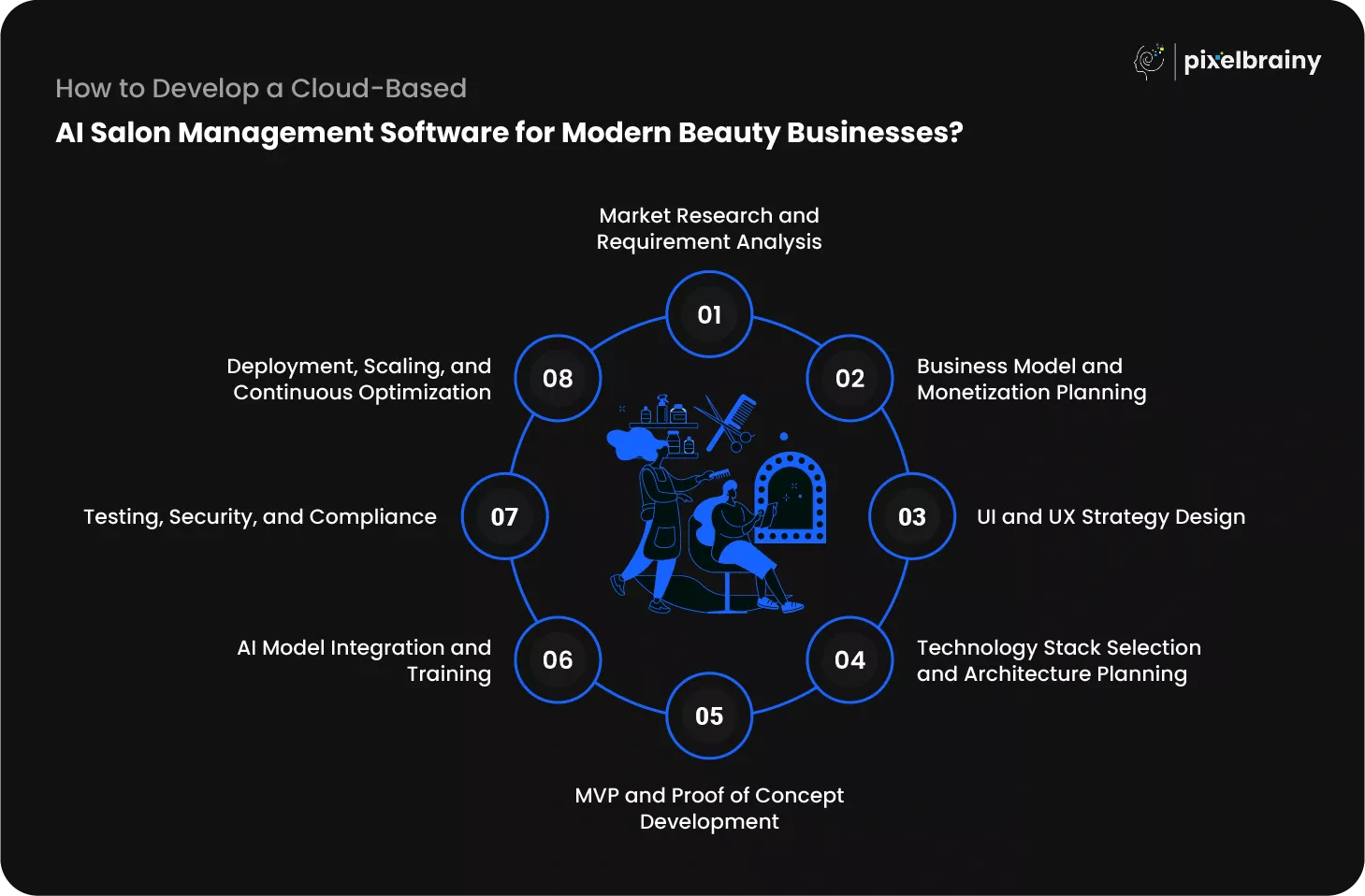
Before building a Cloud-Based AI Salon Management Software, start with deep market research. Identify target users such as single location salons, franchise chains, or beauty enterprises. Understand operational pain points including manual booking errors, poor retention, and inefficient inventory tracking.
Requirement analysis should define core modules, AI capabilities, and SaaS scalability goals. Document functional and non-functional requirements clearly. This stage ensures the product aligns with business objectives and customer expectations. A well-defined scope prevents feature creep and reduces unnecessary development costs later in the lifecycle.
Define whether the platform will operate as a SaaS subscription model, enterprise custom solution, or hybrid structure. Revenue strategy may include monthly subscriptions, tiered pricing, per location fees, or premium AI feature upgrades.
Planning monetization early ensures that architecture decisions support billing automation and user scaling. For Cloud-Based AI Salon Management Software development for Modern Beauty Businesses, aligning technical structure with business goals is essential. A strong financial model ensures sustainability and long-term profitability.
User experience determines adoption rates and engagement. Collaborating with a professional UI/UX design company ensures intuitive dashboards, seamless booking flows, and accessible customer interfaces.
Wireframes and prototypes should define admin panels, staff dashboards, and client booking portals. Clear navigation reduces training time for salon staff. A well-designed interface enhances usability and ensures the system feels modern and responsive across devices. Strong UI and UX design directly influence customer satisfaction and platform retention.
Choose scalable frontend frameworks, backend technologies, databases, and cloud providers. The architecture must support multi-tenant SaaS deployment and AI integration.
This stage involves designing layered architecture including presentation, application, AI, database, and security layers. Proper planning ensures performance stability and data security. Cloud infrastructure should allow auto scaling during peak booking hours. Technical decisions made at this phase impact long term system efficiency and maintainability.
Before full scale implementation, validate the concept through PoC development and structured MVP development services. A proof of concept demonstrates AI feasibility such as predictive booking or customer segmentation.
An MVP includes essential features like appointment scheduling, CRM, and basic analytics. Launching an MVP allows real user feedback and market validation. Iterative improvements based on data reduce risk and optimize product direction before investing in advanced modules.
Also Read: Top 10 AI MVP Development Companies in USA
Integrate machine learning models for predictive analytics, intelligent recommendations, and automated marketing workflows. Data collection from bookings, service history, and customer behavior feeds AI algorithms.
Training models requires continuous data refinement and validation. Accuracy improves over time as more behavioral data is collected. This step transforms the system from a basic management tool into an intelligent business optimization platform capable of revenue forecasting and personalized engagement.
Comprehensive testing ensures functional reliability and system performance. Conduct usability testing, load testing, and security audits. Protect customer data using encryption and role based access controls.
Compliance with privacy regulations is essential when handling personal information and payment transactions. Thorough testing reduces vulnerabilities and enhances trust. A secure platform strengthens credibility and ensures smooth deployment without operational disruptions.
After testing, deploy the system on secure cloud infrastructure. Monitor performance metrics such as uptime, response speed, and user activity. Continuous updates and feature enhancements keep the system competitive.
Businesses often evaluate Should I outsource salon software development? when scaling becomes complex. Partnering with experienced teams or even top AI development companies in USA can accelerate innovation and improve technical execution. Ongoing optimization ensures the platform evolves with market demands and technological advancements.
A structured and strategic approach ensures building a Cloud-Based AI Salon Management Software that is scalable, intelligent, and ready for long term growth.
What is the cost to developing a Cloud-Based AI Salon Management Software in 2026? The Cloud-Based AI Salon Management Software development cost typically ranges from $30,000 to $200,000 or more, depending on feature depth, AI complexity, cloud scalability, and integration requirements. The pricing of AI-powered salon management software varies based on whether you build a basic operational system or a fully scalable enterprise SaaS platform.
The AI salon management software development cost in 2026 is influenced by automation level, predictive analytics integration, multi-location support, and security compliance requirements. Below is a structured breakdown.
Estimated Cost: $30,000 to $50,000
A basic version includes core features such as appointment scheduling, CRM management, billing integration, staff management, and standard reporting dashboards. It is typically deployed on secure cloud infrastructure with essential security measures.
AI capabilities at this level may include automated reminders and simple behavioral insights. This solution is ideal for single location salons or startups testing digital transformation. Development time is shorter due to limited customization and minimal advanced AI integration.
Estimated Cost: $50,000 to $120,000
A medium tier system introduces AI driven automation and multi-location support. Features include predictive analytics, customer segmentation, intelligent marketing workflows, and advanced reporting dashboards.
This level supports SaaS subscription models and scalable architecture. Costs increase due to deeper AI model integration, stronger data security layers, and third-party payment gateway integrations. It is suitable for growing salon chains seeking regional expansion.
Estimated Cost: $120,000 to $200,000+
Enterprise platforms are designed for franchise networks and large beauty brands. They include advanced AI features such as dynamic pricing engines, predictive revenue forecasting, churn prediction, smart staff scheduling, and advanced business intelligence dashboards.
These systems require multi-tenant architecture, high performance cloud infrastructure, and strict compliance standards. Development is more complex due to custom workflows, API integrations, and scalability planning. This tier provides maximum automation, customization, and long-term ROI potential.
Understanding the pricing of AI-powered salon management software allows businesses to align investment with scalability goals and operational needs. Choosing the right development scope ensures balanced cost efficiency and sustainable long-term growth.

Selecting the right technology stack is critical for successful Cloud-Based AI Salon Management Software Development. The tools and frameworks you choose directly impact scalability, AI performance, data security, and SaaS readiness.
During the development of Cloud-Based AI Salon Management Software, modern beauty businesses must integrate cloud infrastructure, AI frameworks, secure databases, frontend technologies, and DevOps automation tools. Below is a structured overview of advanced tools and technologies required to build a high-performance AI powered salon management platform.
| Technology Category | Tools and Platforms | Detailed Explanation |
| Cloud Infrastructure | Amazon Web Services, Microsoft Azure, Google Cloud Platform | Cloud providers offer scalable computing power, storage, auto scaling, and global accessibility. They ensure high availability, data backup, disaster recovery, and secure hosting for multi location salon platforms. |
| Frontend Development | React, Angular, Vue.js, Flutter | These frameworks enable responsive web and mobile interfaces for customers and administrators. They support dynamic dashboards, real time updates, and seamless booking experiences across devices. |
| Backend Development | Node.js, Python, .NET Core | Backend technologies manage business logic, API development, authentication, payment processing, and data handling. They ensure performance efficiency and secure communication between frontend and database layers. |
| AI and Machine Learning | TensorFlow, PyTorch, Scikit-learn | AI frameworks power predictive analytics, churn detection, dynamic pricing, and intelligent recommendations. They allow model training, evaluation, and continuous learning from customer behavior data. |
| Database Management | PostgreSQL, MongoDB, MySQL | Databases store structured and unstructured salon data including bookings, transactions, customer profiles, and inventory logs. Choosing the right database ensures data integrity and fast query performance. |
| DevOps and CI/CD | Docker, Kubernetes, Jenkins, GitHub Actions | DevOps tools automate deployment, containerization, scaling, and continuous integration processes. They reduce downtime and enable faster feature updates. |
| Security and Compliance | OAuth 2.0, JWT Authentication, SSL Encryption | Security tools protect sensitive customer and payment data. They ensure encrypted communication, secure login processes, and regulatory compliance. |
| Payment Gateway Integration | Stripe, PayPal, Razorpay | Payment gateways enable secure digital transactions, recurring billing, and subscription management for SaaS salon platforms. |
| Analytics and Monitoring | Google Analytics, Firebase, Prometheus | Monitoring tools track user behavior, system performance, and server health. They provide actionable insights for performance optimization and growth analysis. |
| API and Integration Tools | REST APIs, GraphQL, Zapier | APIs enable seamless integration with third party marketing tools, accounting systems, and CRM platforms. Integration flexibility supports scalable SaaS expansion. |
Using a well-structured technology stack ensures that building a Cloud-Based AI Salon Management Software results in a scalable, secure, and AI driven platform capable of supporting modern beauty businesses and long-term SaaS growth.
What is the best business model for Cloud-Based AI Salon Management Software? The most sustainable approach is a SaaS based recurring revenue model supported by tiered pricing, per location scaling, and optional AI feature add ons. A strong monetization strategy ensures predictable revenue, long term growth, and continuous innovation in Cloud-Based AI Salon Management Software development.
When launching an AI-powered salon management software platform, choosing the right business model determines profitability, customer acquisition strategy, and operational scalability. Below are the most effective monetization models used in the market.
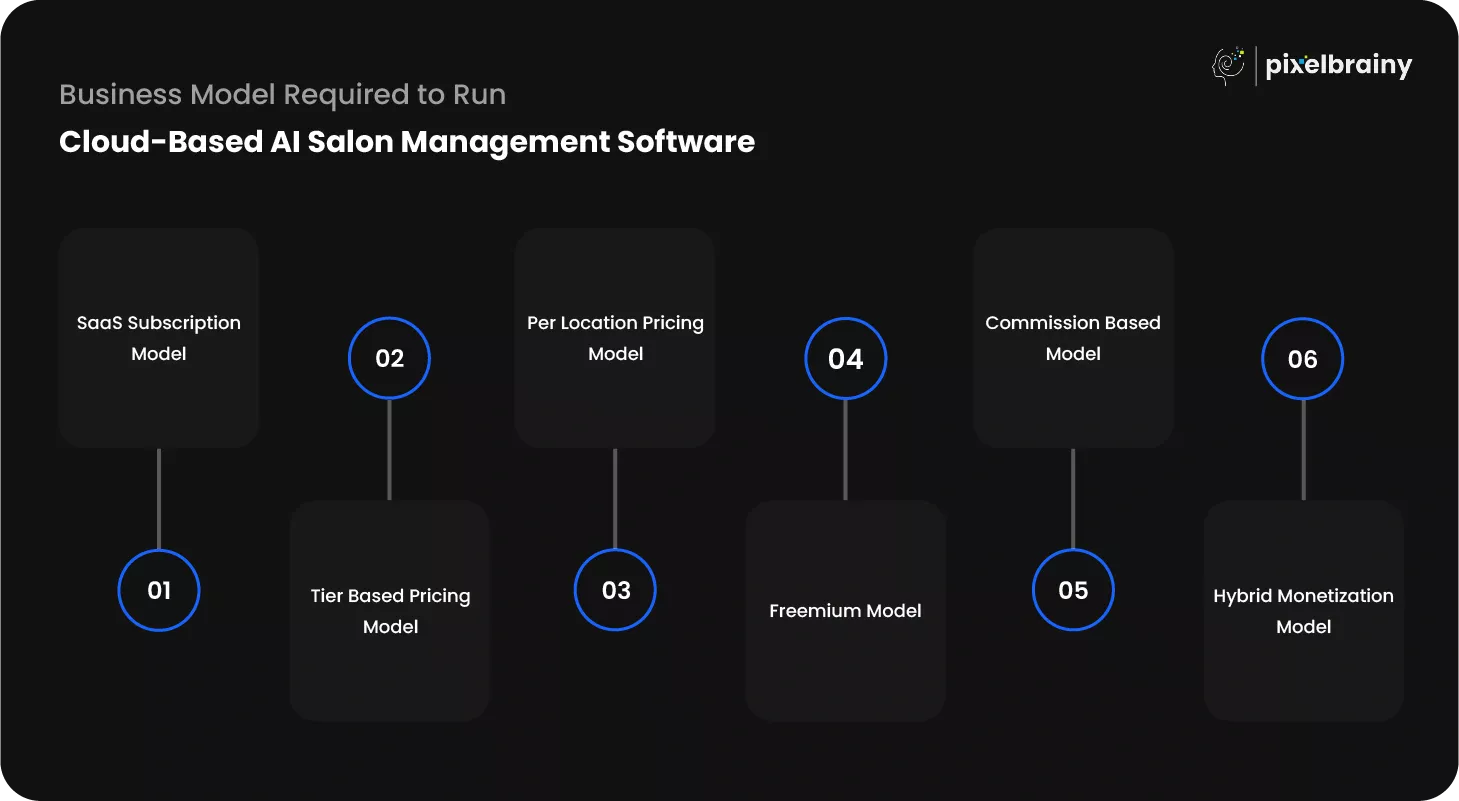
The Software as a Service model is the most common structure for running Cloud-Based AI Salon Management Software development for Modern Beauty Businesses. Salons pay a monthly or annual subscription fee to access cloud hosting, updates, and AI capabilities.
This model generates predictable recurring revenue and supports continuous platform improvement. Subscription tiers may include basic operational features, advanced analytics, and premium AI automation modules.
SaaS is ideal for startups and technology companies targeting multi location salons and franchise chains.
Tiered pricing allows salons to choose packages based on feature requirements and business size. Entry level plans include scheduling and CRM, while higher tiers offer predictive analytics, marketing automation, and intelligent reporting.
This structure supports customer segmentation and upselling opportunities. It ensures scalability while accommodating both small salons and enterprise beauty brands.
Tier based models align well with AI salon management software development cost planning and feature expansion strategies.
This model charges salons based on the number of branches they operate. As businesses expand, subscription costs scale proportionally.
Per location pricing works effectively for franchise networks and multi branch chains. It ensures revenue growth aligns with system usage and operational complexity.
This model supports scalable Cloud-Based AI Salon Management Software platforms built for expansion.
The freemium model provides limited core features for free while charging for advanced AI modules, analytics dashboards, and marketing automation tools.
It lowers entry barriers and accelerates adoption. Once salons experience operational benefits, they are more likely to upgrade to premium plans.
Freemium is effective for rapid market penetration and competitive positioning.
Instead of fixed subscriptions, platforms may charge a percentage per booking processed through the system. Revenue increases as client bookings increase.
This model aligns platform success with salon growth. It is commonly used in marketplace driven AI powered salon management software platforms.
Many companies combine subscription fees with add on charges for advanced AI tools, custom integrations, priority support, or enterprise features.
Hybrid models diversify revenue streams and maximize profitability. They allow flexibility while maintaining recurring income stability.
Selecting the right monetization strategy transforms Cloud-Based AI Salon Management Software into a scalable SaaS business with predictable revenue and sustainable long-term growth.
What are the biggest challenges in Cloud-Based AI Salon Management Software Development? Businesses often face issues related to data security, AI accuracy, cloud scalability, integration complexity, and development cost control. Addressing these obstacles early ensures smoother deployment and long-term success.
The development of Cloud-Based AI Salon Management Software requires strategic planning, secure architecture, and continuous optimization. Below are the most common challenges in AI salon management software development and practical solutions to overcome them.
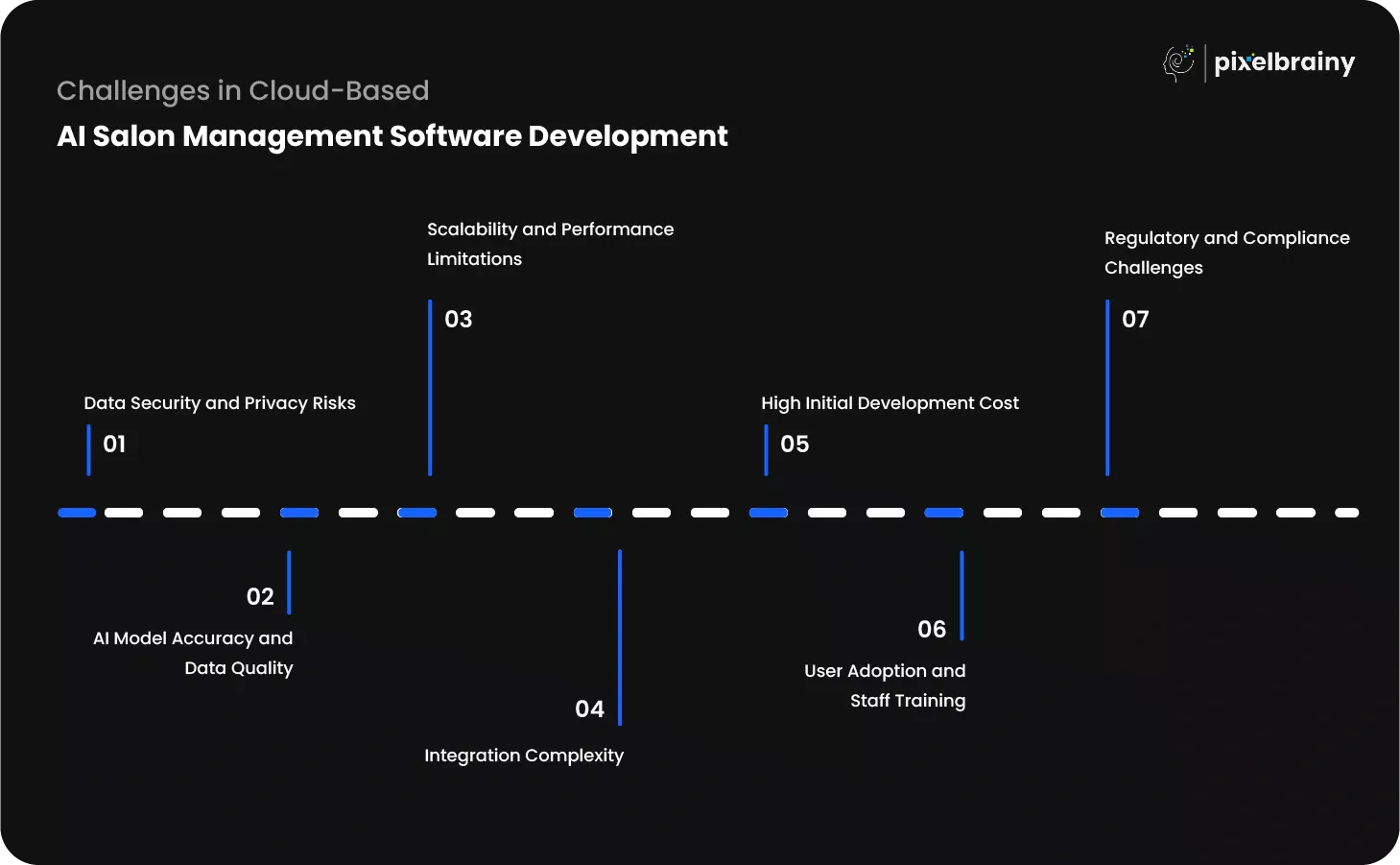
Cloud based platforms handle sensitive customer information including contact details, payment records, and service history. Without strong protection measures, data breaches can damage trust and brand reputation.
To overcome this challenge, implement end to end encryption, secure authentication protocols, and role-based access control. Hosting the system on trusted cloud providers such as Amazon Web Services or Microsoft Azure enhances infrastructure level security. Regular audits and compliance with data protection regulations ensure long term system reliability.
Artificial intelligence performance depends heavily on clean and structured data. Inaccurate or incomplete datasets can produce unreliable predictions and poor recommendations.
To build AI Salon Management Software effectively, implement proper data validation, structured database management, and continuous AI model retraining. Start with a limited feature set and expand intelligence gradually as more user data becomes available. Continuous optimization improves forecasting accuracy and personalization quality.
As salons expand to multiple locations, system performance must remain stable under increased traffic and data processing demands. Poor infrastructure planning can result in slow dashboards and booking delays.
Scalable cloud architecture with auto scaling features solves this issue. Load balancing and containerized deployments help maintain high availability. Planning scalability during the initial Cloud-Based AI Salon Management Software development phase reduces future performance bottlenecks.
Modern salons use third party tools for accounting, marketing, payment processing, and customer engagement. Integrating these systems into one unified platform can be technically complex.
Using API first architecture and standardized REST integrations simplifies connectivity. Early identification of required integrations during planning prevents unexpected delays. Modular development ensures easier expansion and maintenance.
The AI salon management software development cost in 2026 can be significant due to advanced AI modules, security requirements, and cloud infrastructure setup.
To control expenses, adopt a phased development approach. Launch with a minimum viable product that includes core features, then gradually integrate advanced AI capabilities. This reduces financial risk while validating market demand.
Even well-designed platforms may face resistance from staff accustomed to manual systems. Lack of training can limit system effectiveness.
Invest in intuitive UI design and structured onboarding programs. Provide tutorials and ongoing support to ensure smooth transition. User friendly interfaces improve acceptance and operational efficiency.
Handling payment transactions and personal data requires compliance with industry regulations. Failure to meet legal standards can lead to penalties.
Implement secure payment gateways, encrypted data storage, and regular compliance monitoring. Working with experienced development teams ensures adherence to security and privacy standards.
Addressing these challenges strategically ensures that Cloud-Based AI Salon Management Software Development delivers a secure, scalable, and intelligent platform capable of supporting modern beauty businesses and long-term SaaS growth.
PixelBrainy LLC delivers Custom Cloud-Based AI Salon Management Software Development tailored for startups, independent salons, and large beauty chains seeking scalable digital transformation. As a recognized AI development company in USA, the team combines cloud architecture, intelligent automation, and SaaS scalability to build secure and high-performance salon platforms.
Every engagement begins with deep business analysis to understand operational workflows, customer retention challenges, and revenue goals. Whether the requirement involves multi-location AI salon management software development or a focused MVP for a single salon, the architecture is aligned with long term scalability and monetization strategy.
Clear requirement mapping ensures the final product supports automation, analytics, and measurable growth.
The team designs layered cloud-based systems capable of handling high traffic, multi branch operations, and real time analytics. Infrastructure planning includes data encryption, role-based access control, and performance optimization.
This ensures reliable operations, centralized reporting, and seamless expansion without compromising system stability.
PixelBrainy integrates predictive analytics, intelligent booking systems, automated marketing workflows, and revenue forecasting tools. The company provides both AI app development or AI web development depending on the client’s business model.
These capabilities position the platform as advanced beauty business automation software development that enhances operational efficiency and customer personalization.
The team builds the best AI salon management software development for small businesses by offering cost optimized MVP strategies and modular feature expansion. For enterprise clients, advanced dashboards, predictive demand analytics, and API integrations are included.
This flexible development approach ensures scalability across different business sizes and growth stages.
Ongoing monitoring, AI model refinement, feature enhancements, and security updates ensure long term performance. Continuous improvement enables salons to adapt to market trends and evolving customer expectations.
Ready to transform your beauty operations with intelligent automation and scalable cloud technology? Partner with PixelBrainy LLC to build a future ready AI powered salon management platform.
Cloud-Based AI Salon Management Software Development is redefining how modern beauty businesses operate, scale, and compete in a digitally driven market. By combining cloud infrastructure with artificial intelligence, salons can automate appointment scheduling, optimize staff management, personalize customer experiences, and forecast revenue with data driven accuracy.
For businesses asking how to build AI salon management software that supports long term growth, the answer lies in scalable architecture, intelligent automation, secure cloud deployment, and a sustainable SaaS business model. From defining core features to integrating advanced AI capabilities such as predictive analytics and dynamic pricing, every stage of development must align with operational efficiency and customer retention goals.
The AI salon management software development cost in 2026 varies based on complexity, but investing in the right feature set ensures higher return on investment and measurable performance improvements. Whether you are launching a startup platform or planning multi location expansion, a well-structured Cloud-Based AI Salon Management Software solution provides competitive advantage, automation depth, and long-term profitability.
Businesses that adopt intelligent salon technology today position themselves for sustainable growth in the rapidly evolving beauty industry.
Ready to turn your idea into a scalable AI-powered salon platform? Book an appointment today to discuss your custom Cloud-Based AI Salon Management Software development strategy.
Cloud-Based AI Salon Management Software Development is the process of building a cloud hosted platform that integrates artificial intelligence to automate salon operations such as booking, billing, CRM management, analytics, and marketing. It enables beauty businesses to manage multi location operations, personalize services, and use predictive insights to improve revenue and efficiency.
The AI salon management software development cost in 2026 typically ranges from $30,000 for a basic solution to over $200,000 for an enterprise level SaaS platform. Pricing depends on feature complexity, AI integration depth, cloud infrastructure, security requirements, and scalability goals.
Core features include appointment scheduling, customer relationship management, billing and POS integration, staff management, inventory tracking, reporting dashboards, and secure cloud hosting. These modules form the foundation of Cloud-Based AI Salon Management Software Development and support daily operational efficiency.
Advanced features may include predictive revenue forecasting, AI powered booking chatbots, customer churn prediction, dynamic pricing engines, intelligent service recommendations, and automated marketing workflows. These features enhance personalization, automation, and business intelligence capabilities.
Development timelines vary depending on scope and complexity. A basic MVP version may take 3 to 4 months, while a fully scalable enterprise SaaS platform with advanced AI integration can take 6 to 12 months. Proper planning and phased development help reduce delays.
Yes, when built with secure cloud infrastructure, encryption protocols, role-based access control, and compliance standards, cloud-based AI salon software can safely handle customer data and payment information. Security architecture is a critical component of professional AI salon management software development.
Small salons can significantly benefit from AI powered automation through improved booking management, targeted marketing, and operational insights. Scalable SaaS pricing models make Cloud-Based AI Salon Management Software accessible even for independent beauty businesses aiming for growth and efficiency.

About The Author
Sagar Bhatnagar
Sagar Sahay Bhatnagar brings over a decade of IT industry experience to his role as Marketing Head at PixelBrainy. He's known for his knack in devising creative marketing strategies that boost brand visibility and market influence. Sagar's strategic thinking, coupled with his innovative vision and focus on results, sets him apart. His track record of successful campaigns proves his ability to utilize digital platforms effectively for impactful marketing efforts. With a genuine passion for both technology and marketing, Sagar continuously pushes PixelBrainy's marketing initiatives to greater success.

Transform your ideas into reality with us.
Working with the PixelBrainy team has been a highly positive experience. They understand the design requirements and create beautiful UX elements to meet the application needs. The dev team did an excellent job bringing my vision to life. We discussed usability and flow. Sagar worked with his team to design the database and begin coding. Working with Sagar was easy. He has the knowledge to create robust apps, including multi-language support, Google and Apple ID login options, Ad-enabled integrations, Stripe payment processing, and a Web Admin site for maintaining support data. I'm extremely satisfied with the services provided, the quality of the final product, and the professionalism of the entire process. I highly recommend them for Android and iOS Mobile Application Design and Development.

Great experience working with them. Had a lot of feedback and I found that unlike most contractors they were bugging me for updates instead of the other way around. They were extremely time conscience and great at communicating! All work was done extremely high quality and if not on time, early! They were always proactive when it comes to communication and the work is great/above par always. Very flexible and a great team to work with! Goes above and beyond to present us with multiple options and always provides quality. Amazing work per usual with Chitra. If you have UI/UX or branding design needs I recommend you go to them! Will likely work with them in the future as well, definitely recommended!

PixelBrainy is a joy to work with and is a great partner when thinking through branding, logo, and website layout. I appreciate that they spend time going into the "why" behind their decisions to help inform me and others about industry best practices and their expertise.

I hired them to design our software apps. Things I really like about them are excellent communication skills, they answer all project suggestions and collaborate right away, and their input on design and colors is amazing. This project was complex and needed patience and creativity. The team is amazing to do business with. I will be using them long-term. Glad to see there are some good people out there. I was afraid to try and outsource my project to someone but I am glad I met them! I really can't say enough. They went above and beyond on this project. I am very happy with everything they have done to make my business stand out from the competition.

It was great working with PixelBrainy and the team. They were very responsive and really owned the project. We'll definitely work with them again!

I recently worked with the PixelBrainy team on a project and I was blown away by their communication skills. They were prompt, clear, and articulate in all of our interactions. They listened and provided valuable feedback and suggestions to help make the project a success. They also kept me updated throughout the entire process, which made the experience stress-free and enjoyable.

PixelBrainy is very good at what it does. The team also presents themselves very professionally and takes care of their side of things very well. I could fully trust them taking up the design work in a timely and organised manner and their attention to detail saved us lots of effort and time. This particular project was quite intense and the team showed that they function very well under pressure. Very much looking forward to working with her again!

It's always an absolute pleasure working with them. They completed all of my requests quickly and followed every note I had for them to a T, which made our process go smoothly from start to finish. Everything was completed fast and following all of the guidelines. And I would recommend their services to anyone. If you need any design work done in the future, PixelBrainy should be your first call!

They took ownership of our requirements and designed and proposed multiple beautiful variants. The team is self-motivated, requires minimum supervision, committed to see-through designs with quality and delivering them on time. We would definitely love to work with PixelBrainy again when we have any requirements.

PixelBrainy was a big help with our SaaS application. We've been hard at work with a new UI/UX and they provided a lot of help with the designs. If you're looking for assistance with your website, software, or mobile application designs, PixelBrainy and the team is a great recommendation.

PixelBrainy designers are amazing. They are responsive, talented, and always willing to help craft the design until it matches your vision. I would recommend them and plan to continue them for my future projects and more!!!

They were awesome! Did a good job fast, and good communication. Will work with them again. Thank you

Creative, detail-oriented, and talented designers who take direction well and implement changes quickly and accurately. They consistently over-delivered for us.

PixelBrainy team is very talented and creative. Great designers and a pleasure to work with. PixelBrainy is an excellent communicator and I look forward to working with them again.

PixelBrainy has a very talented design team. Their work is excellent and they are very responsive. I enjoy working with them and hope to continue on all of our future projects.


