AI Summary Powered by PixelBrainy
If you're planning to build an AI virtual doctor consultation app in 2026, you're likely budgeting anywhere between $30,000 and $150,000+, depending on features, compliance, and complexity. But if you've already started researching development costs, you've probably encountered a major challenge: wildly different vendor quotes.
One company may estimate $30,000 to $50,000 for a basic solution, while another proposes $120,000 or more for a seemingly similar product. This pricing gap often creates uncertainty for startups, clinics, hospitals, and healthcare entrepreneurs. Many buyers worry about hidden costs, unexpected development expenses, and whether they're investing too little or overspending on features they may not need.
The reality is that the AI virtual doctor consultation app development cost depends on far more than app design and coding. Factors such as AI-powered symptom assessment, video consultations, appointment scheduling, electronic health record (EHR) integration, patient data security, cloud infrastructure, and healthcare compliance requirements can significantly affect the final budget. The growing adoption of Large Language Models (LLMs) and AI healthcare assistants is also reshaping the overall AI virtual doctor app development cost 2026, creating both new opportunities and additional expenses.
For businesses asking, "I want to build an AI virtual doctor consultation app in 2026. What's a realistic budget I should plan for?" the answer depends on the scope and sophistication of the platform you want to build.
In this guide, we'll break down development costs by feature, compare MVP and enterprise-level solutions, analyze compliance expenses, explore region-based pricing differences, and uncover hidden and ongoing costs that many companies overlook.
By the end, you'll know exactly what drives your price up or down, and how to budget accurately.

Proper budgeting is the foundation of a successful AI healthcare application. It helps businesses avoid financial surprises, prioritize features, and ensure long-term sustainability.
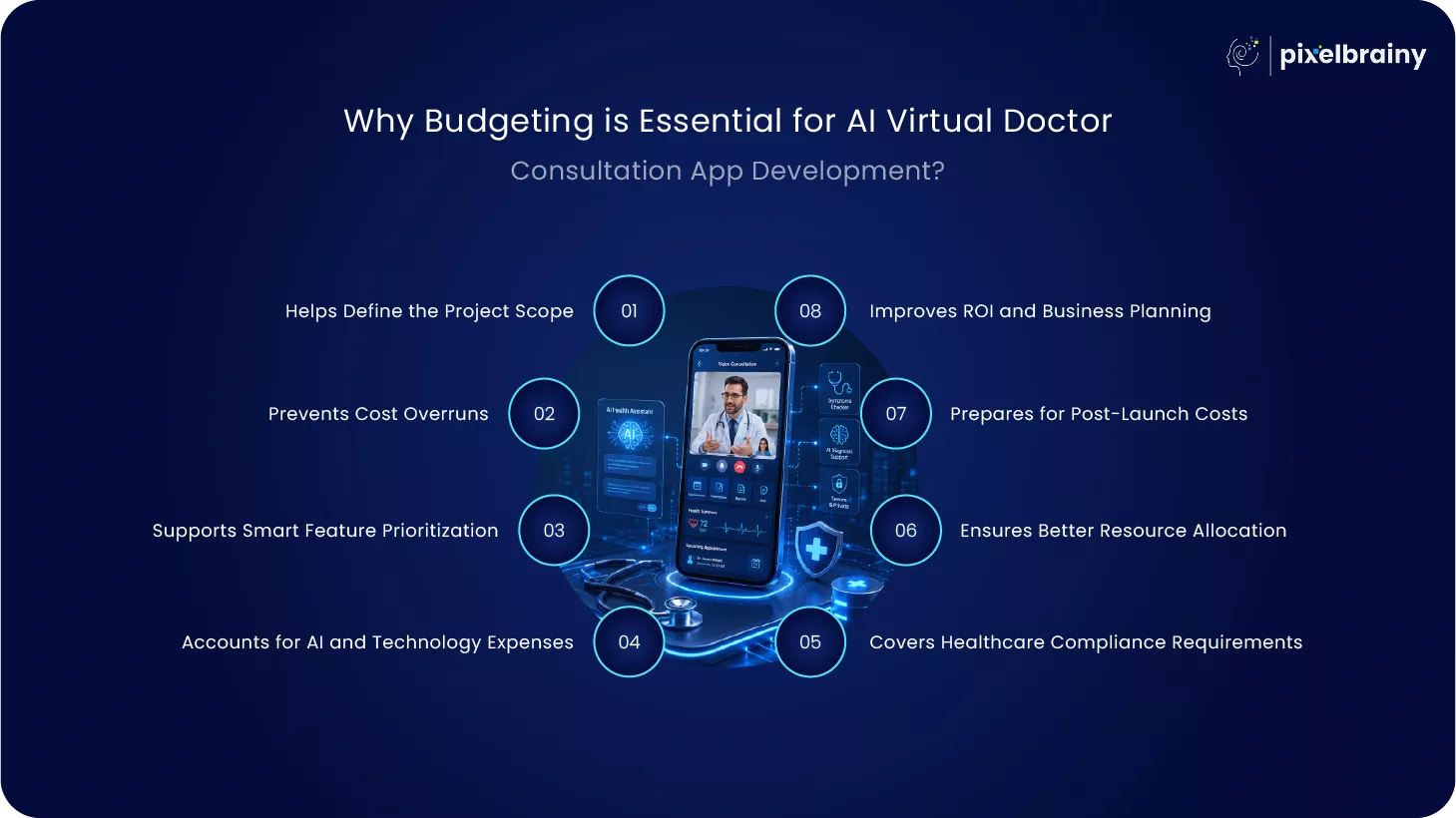
Here are the key reasons why budgeting matters:
A clear budget helps determine what features can be included in the first version of the app. It prevents unnecessary spending and keeps development aligned with business goals.
The AI virtual doctor consultation app development budget can increase quickly when new features, integrations, or compliance requirements are added during development. Budget planning helps control unexpected expenses.
Not every feature needs to be built at launch. A well-planned budget allows businesses to focus on essential functionalities such as:
Advanced features can be added in later development phases.
AI-powered healthcare apps often require:
These technologies directly impact the overall AI virtual doctor app development cost 2026 and should be included in the budget from the beginning.
Healthcare applications must comply with regulations such as:
Budgeting for compliance helps avoid costly legal, security, and operational issues later.
A realistic budget helps allocate resources efficiently across:
Development is only part of the investment. Businesses must also budget for:
Accurate budgeting provides a clear understanding of expected costs and potential returns, helping startups, clinics, and hospitals make informed investment decisions.
In short, effective budgeting reduces risk, improves planning, and ensures your AI virtual doctor consultation app is financially sustainable from development through long-term growth.
Also Read: How to Develop an AI Health Companion App: Benefits, Features and Cost
One of the most common questions healthcare startups and providers ask is: "Why are vendor quotes for an AI virtual doctor app ranging from $30,000 to $150,000+?" The answer lies in the app's complexity, feature set, compliance requirements, AI capabilities, integrations, scalability, and security standards.
The AI virtual doctor app development cost $30k to $150k can vary significantly depending on whether you're building a simple MVP for market validation or a fully compliant enterprise healthcare platform designed to serve thousands of patients and medical professionals.
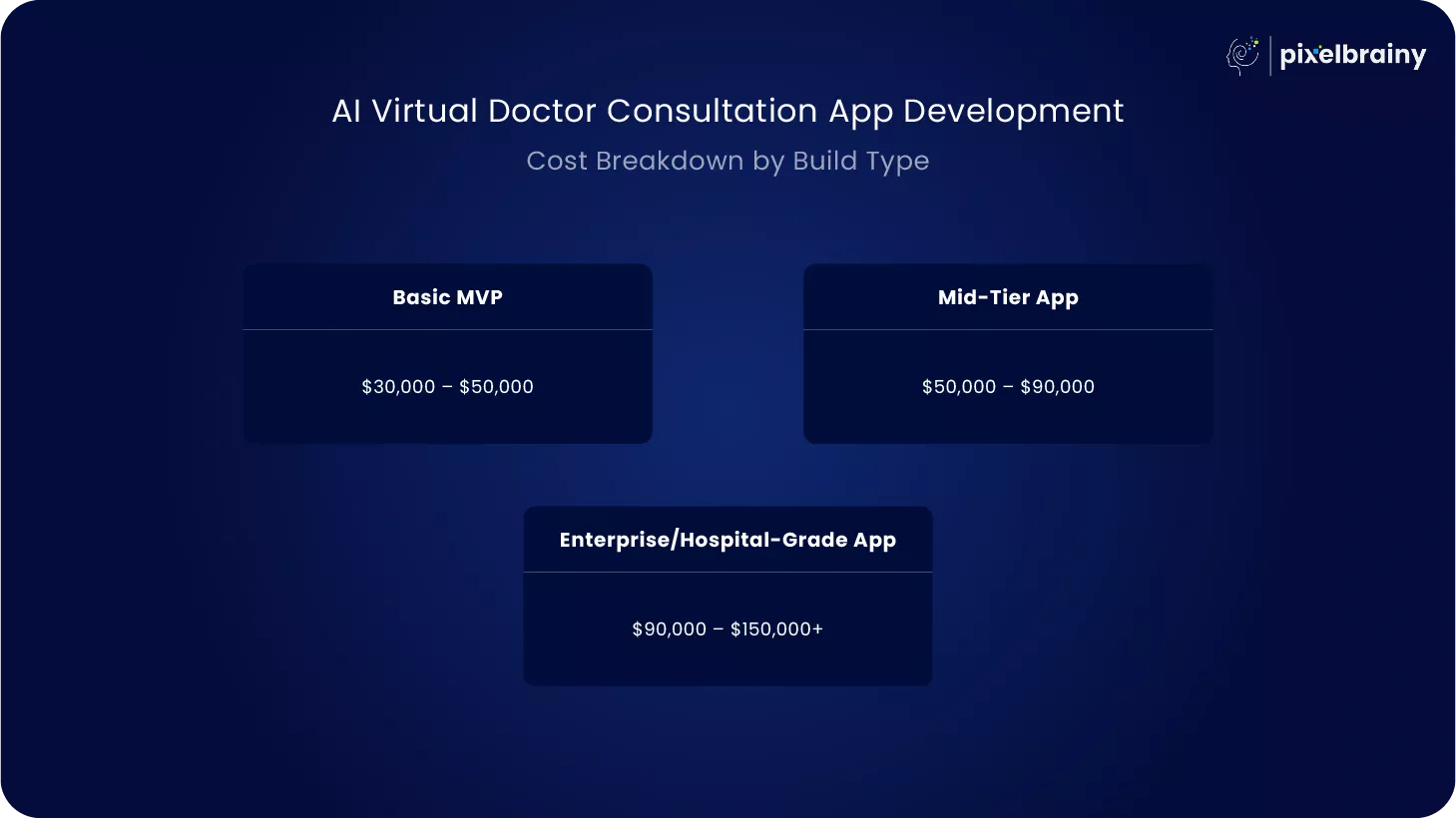
| Build Type | Cost Range | Timeline |
|---|---|---|
| Basic MVP | $30,000 – $50,000 | 2–3 Months |
| Mid-Tier App | $50,000 – $90,000 | 4–6 Months |
| Enterprise/Hospital-Grade App | $90,000 – $150,000+ | 6–12 Months |
A Basic MVP typically includes essential features such as patient registration, appointment scheduling, video consultations, and a basic AI symptom checker. A Mid-Tier App adds advanced functionality like EHR integration, AI-powered health recommendations, secure messaging, payment systems, and analytics dashboards. An Enterprise or Hospital-Grade App includes sophisticated AI models, multi-location support, advanced security controls, regulatory compliance, custom integrations, high scalability, and extensive administrative features.
When evaluating the cost of developing AI virtual doctor consultation app MVP vs enterprise, it is important to understand that you're not paying for the same product at different rates. Higher-tier applications require significantly more development effort, testing, infrastructure, compliance validation, and long-term scalability planning, which directly increases the overall project cost.
One of the biggest reasons businesses receive vastly different quotes for the same healthcare app idea is that no two AI virtual doctor consultation platforms are truly identical. A vendor quoting $35,000 may be estimating a basic telemedicine solution, while a $150,000+ proposal may include advanced AI capabilities, enterprise-grade security, EHR integrations, and regulatory compliance.
So, what actually drives the price up the most?
The answer is a combination of AI sophistication, healthcare compliance, infrastructure requirements, integrations, and scalability. Understanding these factors is essential for creating an accurate budget and evaluating vendor proposals effectively.
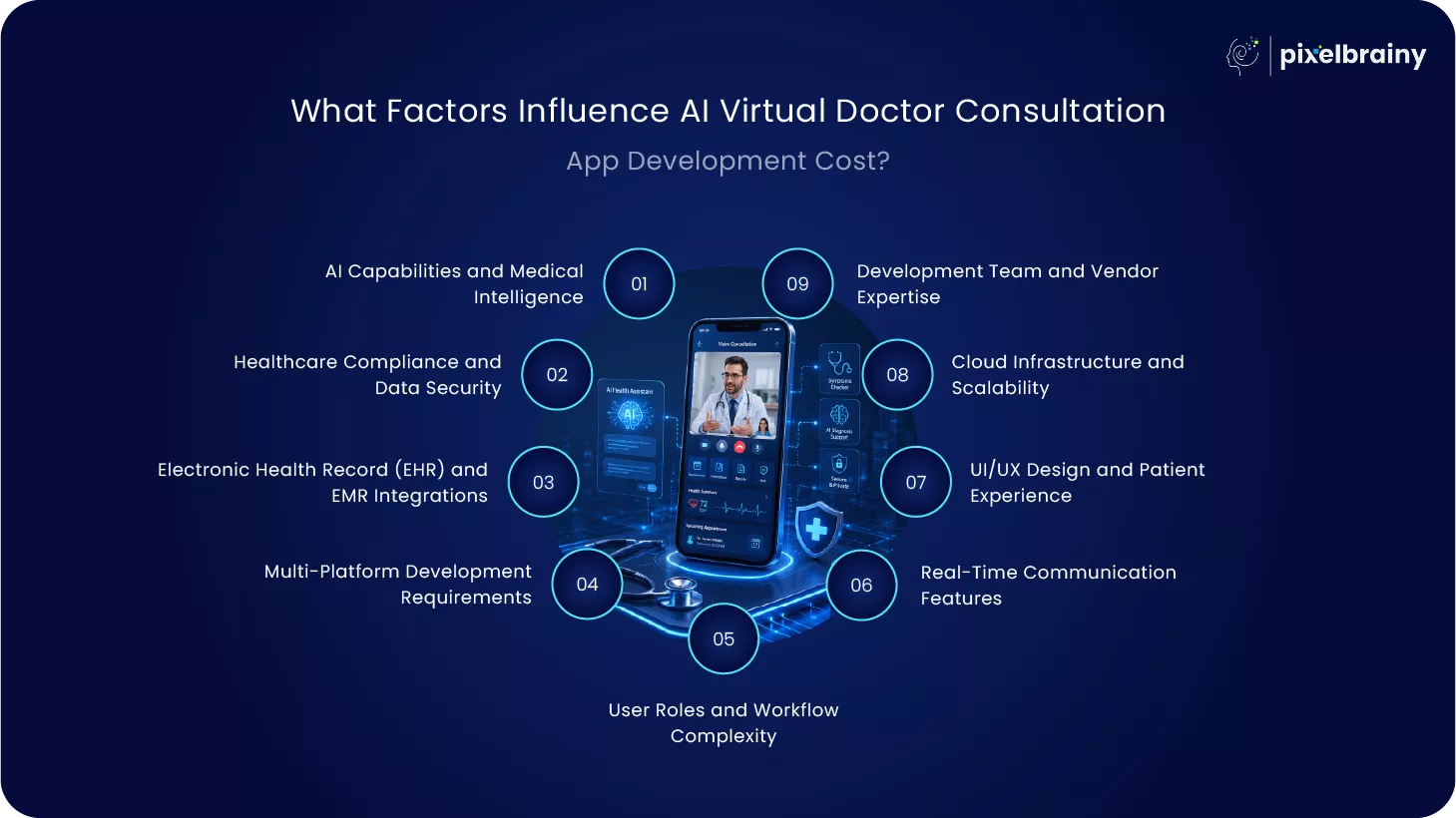
The level of AI functionality you want is one of the most significant cost drivers.
A basic AI symptom checker that follows predefined medical rules may add only $5,000 to $15,000 to the project budget. However, if you're planning to build an AI-powered virtual doctor capable of understanding natural language, analyzing symptoms, generating health recommendations, and conducting conversational interactions, costs can increase by $20,000 to $60,000+.
Custom-trained healthcare AI models, medical knowledge retrieval systems, and advanced Large Language Model (LLM) integrations often require additional investment in development, testing, and ongoing AI infrastructure.
Unlike traditional mobile apps, healthcare applications must comply with strict regulations designed to protect patient information.
HIPAA compliance, GDPR compliance, healthcare data encryption, audit logging, role-based access controls, and security testing can add anywhere from $10,000 to $50,000+ to the overall project cost.
For many enterprise healthcare projects, compliance expenses are often just as significant as AI development costs.
Healthcare providers rarely operate with standalone software. Most clinics and hospitals require integration with existing Electronic Health Record (EHR) or Electronic Medical Record (EMR) systems.
These integrations are often complex because healthcare data must be exchanged securely and accurately between multiple platforms.
Depending on the system and integration requirements, EHR connectivity can add approximately $10,000 to $40,000+ to the overall development budget.
The number of platforms your application supports directly impacts development costs.
A single-platform application may cost significantly less than a solution that includes:
Supporting multiple platforms often adds $15,000 to $50,000+ to development costs because each platform requires testing, optimization, and ongoing maintenance.
Virtual healthcare platforms typically serve multiple types of users, each with unique requirements.
Common user groups include:
Each role requires dedicated dashboards, permissions, workflows, and reporting tools. As workflow complexity increases, development and testing efforts also increase.
Advanced multi-role healthcare systems can contribute an additional $10,000 to $30,000+ to the total project budget.
Virtual doctor consultation platforms rely heavily on communication technology.
Features such as:
require specialized infrastructure and third-party services.
Depending on the level of functionality, communication features can add between $5,000 and $20,000+ to the development cost.
Healthcare users expect applications that are intuitive, accessible, and easy to navigate.
A simple design system may cost around $3,000 to $8,000, while custom healthcare-focused user experiences for patients, doctors, and administrators can increase design costs to $15,000 to $40,000+.
Investing in user experience often improves adoption rates and patient engagement, making it a valuable long-term investment.
Many businesses focus only on development costs while overlooking infrastructure requirements.
Cloud hosting, database management, AI processing, backup systems, security monitoring, and scalability planning all influence the total cost of ownership.
Initial infrastructure setup typically ranges from $2,000 to $10,000, while enterprise-grade healthcare environments can require substantially larger investments.
The expertise of your development partner significantly impacts pricing.
Freelancers generally offer the lowest upfront costs, while specialized healthcare development agencies charge more due to their experience with telemedicine platforms, healthcare compliance, AI integration, and security requirements.
Choosing an experienced healthcare technology partner may increase initial costs but often reduces development risks, compliance issues, and expensive rework later.
When evaluating the building AI virtual doctor consultation platform cost breakdown, the biggest cost drivers are typically AI sophistication, compliance requirements, EHR integrations, platform coverage, and workflow complexity. These factors explain why the AI virtual doctor app development cost $30k to $150k can vary so dramatically across projects.
For businesses wondering how much does an AI virtual doctor consultation app cost, the answer depends less on the idea itself and more on the depth of functionality, security, intelligence, and scalability required to achieve your healthcare goals.
Also Read: Top 12 AI Healthcare Software Development Companies in USA
Not every feature contributes equally to the overall development budget. In fact, the difference between a $30,000 MVP and a $150,000+ enterprise healthcare platform often comes down to the specific features you choose to build.
For example, adding a basic user registration system may cost only a few thousand dollars, while implementing AI-powered symptom analysis, EHR connectivity, or secure video consultations can require significantly larger investments. This is why understanding the AI virtual doctor consultation app development cost per feature is essential when planning your budget.
Many healthcare providers ask: "I already have a doctor consultation app. How much would it cost to add an AI symptom checker?" In most cases, the answer falls between $10,000 and $25,000, depending on whether you're implementing a simple rule-based triage system or a more advanced AI solution powered by Large Language Models (LLMs).
Rather than estimating costs based on the app as a whole, breaking the project down feature by feature provides a much clearer picture of where your investment is going. It also helps prioritize functionality, identify cost-saving opportunities, and determine which features should be included in an MVP versus future development phases.
The table below outlines the estimated 2026 development costs for the most common features found in AI-powered virtual doctor consultation applications.
| Feature | Estimated Cost |
|---|---|
| User Onboarding & Profile Management | $3,000 – $6,000 |
| Video/Audio Consultation Module | $8,000 – $15,000 |
| AI Symptom Checker / Triage Bot | $10,000 – $25,000 |
| E-Prescription System | $5,000 – $10,000 |
| Payment Gateway Integration | $3,000 – $6,000 |
| Admin & Doctor Dashboard | $8,000 – $15,000 |
| Push Notifications & Appointment Reminders | $2,000 – $4,000 |
| AI Chatbot for Pre-Consultation | $6,000 – $12,000 |
Ultimately, the more advanced features you include, the higher the development cost, making feature prioritization essential for building a scalable AI virtual doctor consultation app within budget.

Also Read: AI Medical Claims Processing Automation Software Development: Architecture, Tech Stack & Use Cases
Adding artificial intelligence to a virtual doctor consultation app can significantly enhance the patient experience, but it also increases the overall development budget. If you're wondering, "I want to use an LLM for diagnosis support inside the app. How much more expensive does that make the overall build?", the short answer is that AI and LLM integration typically adds $10,000 to $40,000+ to the project cost, depending on the complexity of the implementation.
The first factor affecting pricing is the type of AI functionality you plan to introduce. A basic healthcare chatbot that follows predefined rules, symptom trees, and decision logic is relatively affordable. These systems usually provide structured responses based on predefined medical workflows and can often be implemented for $5,000 to $15,000.
In contrast, LLM-powered healthcare assistants are designed to understand natural language, analyze patient symptoms, answer health-related questions, summarize consultations, and assist doctors with decision support. Because these systems rely on advanced AI models and more sophisticated infrastructure, implementation costs are considerably higher.
Several factors influence the cost of AI LLM integration in doctor virtual consultation app projects
| AI Component | Estimated Cost |
|---|---|
| LLM Integration & Setup | $5,000 – $15,000 |
| Custom Prompt Engineering | $2,000 – $5,000 |
| Healthcare Knowledge Base Integration | $3,000 – $10,000 |
| Fine-Tuning & Model Optimization | $5,000 – $20,000 |
| Clinical Validation & Testing | $5,000 – $15,000 |
| Hallucination & Safety Testing | $3,000 – $10,000 |
Unlike customer service chatbots, healthcare AI systems operate in a high-stakes environment where inaccurate responses can have serious consequences. This is why clinical validation and hallucination-safety testing are critical parts of the development budget of AI virtual doctor consultation app projects.
Healthcare organizations often invest heavily in testing to ensure that AI-generated recommendations are medically appropriate, safe, and compliant with healthcare regulations. These validation processes can represent a significant portion of the AI development budget.
Many businesses focus solely on development costs and overlook operational expenses. However, the AI virtual doctor consultation app development cost after launch can increase due to:
Depending on user volume, these recurring costs can range from hundreds to thousands of dollars per month.
The final cost depends on how deeply AI is embedded into your platform, from simple symptom analysis tools to sophisticated LLM-powered medical assistants.
The budget required to build an AI virtual doctor consultation app depends heavily on who is building it. A startup validating a new healthcare idea has very different requirements from a regional clinic, hospital network, or insurance provider. This is why the cost to create AI virtual video doctor consultation platform solutions can vary significantly even when the core concept appears similar.
If you're wondering, "We're a small clinic, not a big hospital chain. Can we realistically afford an AI virtual doctor consultation application on our budget?", the answer is yes. Many healthcare organizations successfully launch AI-powered telemedicine platforms by tailoring features to their specific needs and growth stage.
Startups typically focus on launching a Minimum Viable Product (MVP) that validates market demand while keeping development costs under control.
A startup-focused AI virtual doctor app usually includes:
Estimated Cost: $30,000 – $50,000
For entrepreneurs researching the cost to build AI virtual doctor consultation mobile app for mental health startup under $50000, this budget is often sufficient to launch a functional platform and begin acquiring users before investing in advanced AI capabilities and enterprise integrations.
The requirements of a local clinic differ significantly from those of a large healthcare organization.
Most clinics prioritize operational efficiency and patient accessibility. Common requirements include:
Estimated Cost: $40,000 – $80,000
This range makes AI-powered telemedicine solutions accessible even for smaller healthcare providers with limited budgets.
Hospital networks often require:
Estimated Cost: $100,000 – $250,000+
The AI virtual doctor consultation app development cost for hospitals and health systems 2026 is substantially higher because of compliance requirements, scalability needs, and complex integrations.
Mental health applications have become one of the fastest-growing segments within digital healthcare.
These platforms often include:
Estimated Cost: $35,000 – $80,000
Many mental health startups can successfully launch within the lower end of this range by focusing on core teletherapy functionality before expanding into advanced AI-driven behavioral health features.
Rural healthcare providers often face unique challenges related to accessibility and limited medical resources.
Their telehealth platforms commonly focus on:
Estimated Cost: $30,000 – $70,000
Because rural healthcare solutions generally prioritize accessibility over complex enterprise workflows, development costs are often lower than those of large hospital systems.
Insurance providers typically require sophisticated healthcare ecosystems designed to serve large patient populations.
Common requirements include:
Estimated Cost: $150,000 – $500,000+
These platforms require extensive compliance, scalability, and integration capabilities, making them some of the most expensive AI healthcare applications to develop.
The right budget depends less on the size of your organization and more on your goals, user volume, and feature requirements. While enterprise healthcare systems may require investments exceeding $150,000, startups, mental health providers, rural clinics, and small healthcare practices can often launch a high-quality AI virtual doctor consultation app for $30,000 to $80,000, making digital healthcare innovation accessible even without a hospital-sized budget.
Many businesses carefully budget for design, development, and AI integration but underestimate the expenses that arise after the initial project scope is defined. These overlooked expenses are often responsible for budget overruns and unexpected financial pressure during and after launch.
If you're asking, "What should I actually watch out for before signing a contract?", understanding the hidden costs of building an AI virtual doctor consultation app nobody talks about can help you avoid unpleasant surprises and create a more realistic budget.
Achieving healthcare compliance is not a one-time expense. Regulations, security standards, and compliance requirements continue to evolve over time.
Many healthcare platforms require:
These recurring activities can cost anywhere from $2,000 to $20,000+ per year, depending on the complexity of the platform and regulatory requirements.
Most AI virtual doctor consultation apps depend on external services such as:
While these services may appear affordable during launch, pricing often changes as usage grows. Higher patient volumes typically result in increased API consumption and larger monthly bills.
Businesses should always account for future usage growth rather than relying solely on current pricing estimates.
Healthcare applications often undergo more scrutiny than standard consumer apps.
During app store submission, you may encounter:
Although these delays may not directly increase development costs, they can affect launch timelines, marketing schedules, and revenue projections.
AI-powered healthcare applications often require professional review before deployment.
Healthcare organizations frequently invest in:
Depending on project scope, these reviews can add $3,000 to $25,000+ to the overall budget and are often excluded from initial development proposals.
No healthcare platform launches perfectly.
After release, businesses typically discover:
Most organizations allocate approximately 10% to 20% of the initial development budget annually for maintenance and improvements.
For platforms using AI and Large Language Models (LLMs), ongoing optimization is often necessary.
AI systems require:
As medical information evolves, AI systems must be updated to maintain reliability and relevance. These ongoing activities can become a significant long-term expense.
Planning for compliance, third-party services, legal reviews, maintenance, and AI updates from the start can help you avoid costly surprises and keep your project budget on track.

Launching your platform is only the beginning of the investment journey. While most businesses focus heavily on development expenses, the ongoing monthly cost of running an AI virtual doctor consultation platform after development can become a significant long-term expense. Hosting infrastructure, software maintenance, compliance management, customer support, and AI-related services all contribute to the total cost of ownership.
Understanding these recurring expenses is essential for creating a sustainable healthcare business model and avoiding unexpected operational costs.
Cloud infrastructure is typically the largest ongoing expense after launch. The exact cost depends on user activity, video consultations, AI processing requirements, data storage, and security needs.
As your platform grows, infrastructure expenses increase accordingly.
| Daily Active Users | Estimated Monthly Hosting Cost |
|---|---|
| Up to 1,000 Users | $500 – $2,000 |
| 1,000–5,000 Users | $2,000 – $5,000 |
| 5,000–10,000 Users | $5,000 – $12,000 |
| 10,000+ Users | $12,000 – $30,000+ |
For businesses researching the cloud hosting cost for AI virtual doctor consultation application with 10000 daily users, a realistic estimate typically falls between $5,000 and $12,000 per month, depending on AI usage, video traffic, storage requirements, and security configurations.
Healthcare applications require continuous updates to remain secure, compliant, and compatible with evolving technologies.
Maintenance activities often include:
As a general rule, businesses should budget approximately 15% to 20% of the original development cost annually for ongoing maintenance.
For example:
| Initial Development Cost | Annual Maintenance Budget |
|---|---|
| $50,000 | $7,500 – $10,000 |
| $100,000 | $15,000 – $20,000 |
| $150,000 | $22,500 – $30,000 |
Healthcare compliance is not a one-time activity.
Depending on your target market and regulatory requirements, ongoing expenses may include:
Most healthcare organizations spend between $2,000 and $20,000+ annually on compliance-related activities.
As user adoption grows, customer support becomes increasingly important.
Support-related costs may include:
Small platforms may spend $500 to $2,000 per month, while larger healthcare organizations often invest $5,000 to $20,000+ per month in customer support operations.
If your platform uses AI symptom checkers, LLM-powered chatbots, or virtual health assistants, additional operational expenses should be expected.
Recurring costs may include:
These expenses generally increase as consultation volumes and patient interactions grow.
Most AI virtual doctor consultation platforms spend 15% to 20% of their original development budget annually on maintenance, while hosting, compliance, customer support, and AI services can add thousands of dollars in monthly operating costs as the platform scales.
The same AI virtual doctor consultation app can cost dramatically different amounts depending on who develops it. A healthcare startup working with a US-based agency may receive a quote exceeding $150,000, while a similar project outsourced to India or Eastern Europe could be estimated at less than half that amount.
This pricing difference often leads businesses to ask: "Is it cheaper to develop an AI doctor consultation app in India or USA in 2026?" While the answer is generally yes, lower development rates are only part of the equation. Factors such as healthcare compliance expertise, communication efficiency, AI development capabilities, project management quality, and long-term support can significantly influence the overall success and cost of the project.
Development costs vary considerably across global markets due to differences in labor costs, technical expertise, and operating expenses.
| Region | Average Hourly Rate |
|---|---|
| United States | $120 – $250/hour |
| Western Europe | $80 – $180/hour |
| Eastern Europe | $40 – $100/hour |
| India | $25 – $75/hour |
| Southeast Asia | $20 – $60/hour |
As a result, a project costing $120,000 to $200,000+ in the United States may often be completed for $40,000 to $90,000 by a qualified offshore development company.
Building an internal team offers maximum control over the product and development process.
Best for:
Advantages:
Challenges:
Although in-house development provides flexibility, it is typically the most expensive option.
A healthcare-focused agency provides access to experienced designers, developers, AI engineers, compliance specialists, and project managers under one roof.
Best for:
Advantages:
Challenges:
For businesses seeking a balance between quality and efficiency, agencies are often the most practical choice.
Offshore development remains one of the most popular strategies for reducing the cost to create AI virtual video doctor consultation platform solutions.
Best for:
Advantages:
Challenges:
When managed properly, offshore development can reduce costs by 40% to 70% compared to US-based development.
Saving money on development is valuable, but healthcare software introduces unique risks that must be carefully evaluated.
AI doctor consultation apps often require expertise in:
A lower-cost development partner without healthcare experience can ultimately create higher expenses through security issues, compliance failures, delays, or extensive rework.
The reality is that quality varies significantly across agencies, freelancers, and offshore teams. A highly experienced development company in India may outperform an inexperienced agency in the US, while a poorly vetted offshore vendor can create costly problems regardless of their low rates.
Before selecting a partner, evaluate:
The strongest development partners combine technical expertise, healthcare knowledge, and transparent communication, regardless of location.
While developing an AI doctor consultation app in India or other offshore markets is typically more affordable than hiring a US-based team, the best value comes from choosing a partner with proven healthcare expertise, strong compliance knowledge, and a track record of delivering secure, high-quality solutions.
Reducing development costs does not mean cutting corners on quality, security, or patient experience. The most successful healthcare companies focus on building strategically, investing only in features that deliver immediate value while leaving room for future growth.
If your goal is to launch a high-quality platform without overspending, the key is to optimize the scope, technology choices, and development approach from the beginning. Here are the most effective ways to reduce the AI virtual doctor consultation app development cost without compromising the long-term success of your product.
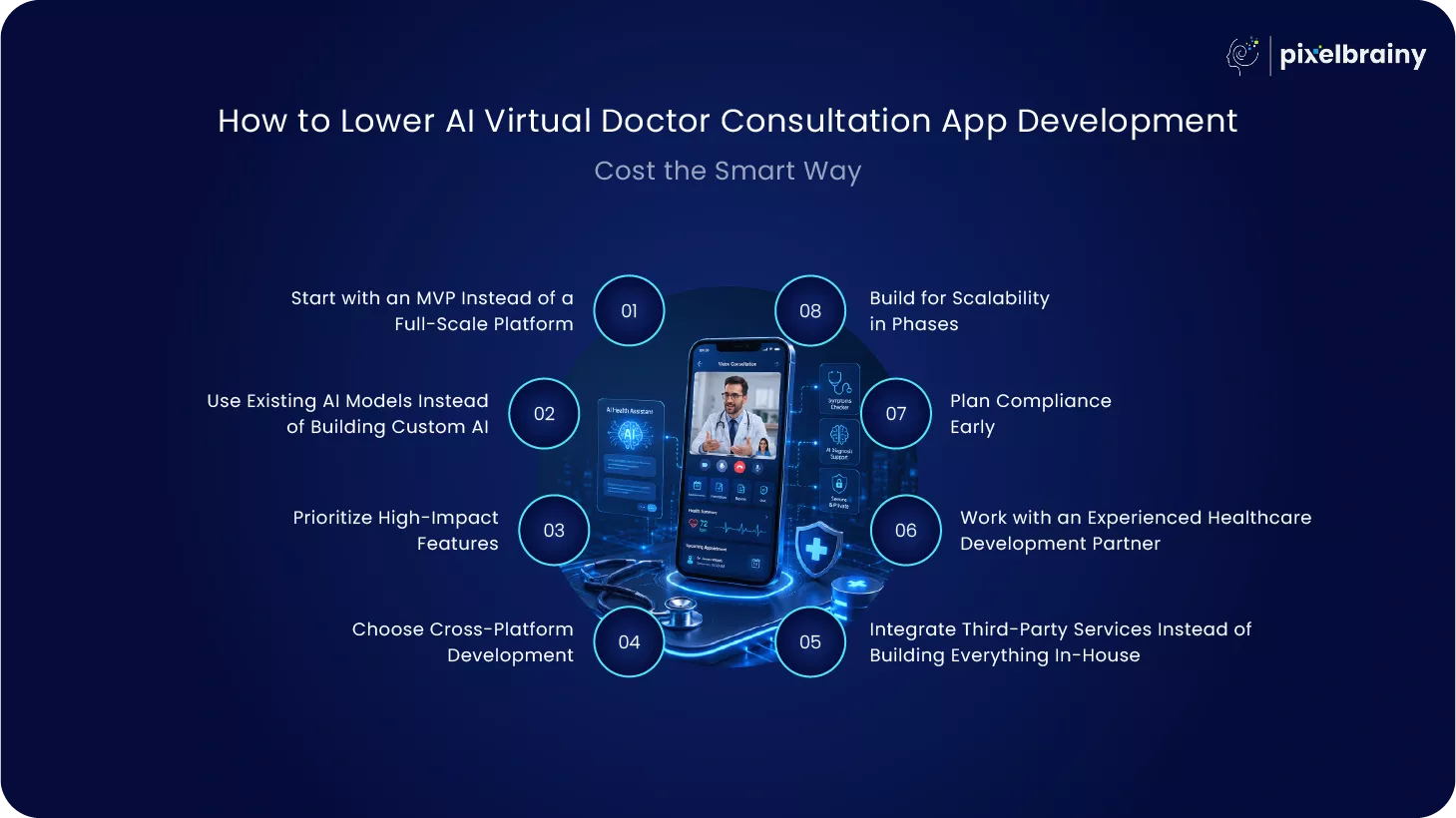
Many healthcare startups make the mistake of trying to build every feature at launch.
Instead, focus on a Minimum Viable Product (MVP) development that includes only the core functionality needed to validate your idea, such as:
Launching an MVP can reduce initial development costs by 30% to 60% compared to building a fully featured platform from day one.
Also Read: Top 10 AI MVP Development Companies in USA
Training custom healthcare AI models can be expensive and time-consuming.
A more cost-effective approach is to leverage existing AI technologies and Large Language Models (LLMs) through APIs. This allows businesses to add intelligent features such as symptom assessment, patient support, and conversational assistance without investing heavily in custom model development.
For many startups, this strategy can save tens of thousands of dollars during the initial development phase.
Also Read: Top 12+ AI Model Development Companies in the USA
Not every feature contributes equally to user adoption or business growth.
Before development begins, identify features that directly support patient engagement and revenue generation. Features such as appointment booking, teleconsultations, patient management, and AI-assisted triage often deliver more value than advanced analytics or highly customized workflows in the early stages.
A feature-prioritization strategy helps prevent unnecessary spending and keeps the project focused on measurable outcomes.
Building separate native applications for iOS and Android increases both development time and cost.
Cross-platform frameworks allow developers to create a single codebase that works across multiple devices and operating systems. This approach can significantly reduce development expenses while accelerating time to market.
For startups and clinics seeking affordable healthcare technology solutions, cross-platform development is often the most practical choice.
Developing custom solutions for every feature can quickly inflate costs.
Using trusted third-party services for:
can reduce development complexity and speed up deployment while maintaining reliability and security.
Choosing the cheapest development team is rarely the most cost-effective decision.
Experienced healthcare app developers understand compliance requirements, security standards, AI integration, and telemedicine workflows. Their expertise can help avoid expensive mistakes, project delays, and redevelopment costs later.
A higher-quality partner often delivers better long-term value than a low-cost provider with limited healthcare experience.
Healthcare compliance becomes far more expensive when addressed late in the development process.
Defining HIPAA, GDPR, security, and data protection requirements from the beginning helps prevent costly redesigns and compliance-related delays.
Early compliance planning is one of the simplest ways to control overall project costs.
Rather than investing heavily in enterprise-level infrastructure from the start, build your platform in stages.
Begin with the functionality required for your current user base and expand as adoption grows. This phased approach allows you to spread investment over time while reducing financial risk.
The smartest way to reduce AI virtual doctor consultation app development costs is to launch with an MVP, prioritize essential features, leverage existing AI technologies, and scale strategically as your user base and business needs grow.
Building an AI-powered healthcare platform does not have to mean overspending on unnecessary features, inflated development hours, or complex technology stacks. Many healthcare startups, clinics, and medical organizations struggle with the same question: "I want to build an AI virtual doctor consultation app on a tight budget. Can you suggest companies that build this without overcharging?"
At PixelBrainy, we help businesses develop cost-effective healthcare solutions by focusing on the features that deliver the highest value while eliminating unnecessary development expenses. As an experienced provider of AI development solutions, our approach is centered on transparency, scalability, and efficient resource allocation.
Instead of recommending a one-size-fits-all solution, we begin with a detailed analysis of your business goals, target audience, compliance requirements, and growth plans. This allows us to provide an accurate cost estimation of AI virtual doctor consultation app projects and recommend the most practical development roadmap.
Our team helps optimize the development pricing of AI virtual doctor consultation app projects by:
As an AI healthcare software development company, we develop solutions ranging from startup-friendly telemedicine apps to enterprise healthcare platforms with advanced AI capabilities, secure video consultations, EHR integrations, and intelligent patient engagement tools.
Whether you're looking to validate a new healthcare idea or scale an existing telehealth platform, our goal is to help you achieve the best balance between functionality, compliance, scalability, and budget.
With the right strategy and technology choices, PixelBrainy can help reduce your AI virtual doctor consultation mobile app development cost while delivering a secure, future-ready healthcare solution built for long-term growth.

The cost of building an AI virtual doctor consultation app in 2026 typically ranges from $30,000 for a basic MVP to $150,000+ for an enterprise-grade healthcare platform. Where your project falls within that range depends on several factors, including AI capabilities, telemedicine features, EHR integrations, compliance requirements, platform coverage, security standards, and long-term scalability needs.
While startups and small clinics can often launch a functional solution with a limited budget, hospitals, insurance providers, and large healthcare networks usually require more advanced infrastructure and regulatory compliance, resulting in higher development costs.
The most important takeaway is that there is no universal price for healthcare app development. Two apps may appear similar on the surface but have dramatically different technical requirements behind the scenes.
Before choosing a development partner, focus on getting a detailed scope-based quote rather than a flat estimate. A transparent breakdown of features, integrations, compliance requirements, and post-launch costs will provide a much more accurate picture of your total investment.
If you're planning to build an AI virtual doctor consultation platform, now is the ideal time to define your requirements, prioritize your features, and create a realistic development roadmap. Schedule a call with the PixelBrainy team to discuss your project goals, receive a tailored cost estimate, and explore the most cost-effective approach to building a secure, scalable, and future-ready healthcare solution.
The cost typically ranges from $30,000 to $150,000+, depending on factors such as AI capabilities, telemedicine features, EHR integrations, compliance requirements, platform coverage, and scalability needs. A basic MVP may cost $30,000–$50,000, while enterprise-grade healthcare platforms can exceed $150,000.
Yes. Startups and small healthcare providers can often launch a functional MVP for $30,000–$50,000 by focusing on essential features such as appointment scheduling, video consultations, patient management, and a basic AI symptom checker. Advanced features can be added in future development phases.
Advanced AI functionality and healthcare integrations are often the biggest cost drivers. Features such as LLM-powered virtual health assistants, AI diagnosis support, EHR/EMR integration, and healthcare compliance implementation can significantly increase development costs.
Post-launch expenses typically include cloud hosting and infrastructure, AI API and LLM usage fees, maintenance and software updates, compliance audits and renewals, customer support operations, and security monitoring. Most businesses allocate 15%–20% of the initial development cost for AI virtual doctor consultation annually for maintenance and ongoing improvements.
Generally, yes. Development rates of AI virtual doctor consultation application in India are significantly lower than in the United States, which can reduce project costs by 40%–70%. However, when selecting a development partner, healthcare expertise, compliance knowledge, communication quality, and project experience are often more important than hourly rates alone.

About The Author
Sagar Bhatnagar
Sagar Sahay Bhatnagar brings over a decade of IT industry experience to his role as Marketing Head at PixelBrainy. He's known for his knack in devising creative marketing strategies that boost brand visibility and market influence. Sagar's strategic thinking, coupled with his innovative vision and focus on results, sets him apart. His track record of successful campaigns proves his ability to utilize digital platforms effectively for impactful marketing efforts. With a genuine passion for both technology and marketing, Sagar continuously pushes PixelBrainy's marketing initiatives to greater success.

Working with the PixelBrainy team has been a highly positive experience. They understand the design requirements and create beautiful UX elements to meet the application needs. The dev team did an excellent job bringing my vision to life. We discussed usability and flow. Sagar worked with his team to design the database and begin coding. Working with Sagar was easy. He has the knowledge to create robust apps, including multi-language support, Google and Apple ID login options, Ad-enabled integrations, Stripe payment processing, and a Web Admin site for maintaining support data. I'm extremely satisfied with the services provided, the quality of the final product, and the professionalism of the entire process. I highly recommend them for Android and iOS Mobile Application Design and Development.

Great experience working with them. Had a lot of feedback and I found that unlike most contractors they were bugging me for updates instead of the other way around. They were extremely time conscience and great at communicating! All work was done extremely high quality and if not on time, early! They were always proactive when it comes to communication and the work is great/above par always. Very flexible and a great team to work with! Goes above and beyond to present us with multiple options and always provides quality. Amazing work per usual with Chitra. If you have UI/UX or branding design needs I recommend you go to them! Will likely work with them in the future as well, definitely recommended!

PixelBrainy is a joy to work with and is a great partner when thinking through branding, logo, and website layout. I appreciate that they spend time going into the "why" behind their decisions to help inform me and others about industry best practices and their expertise.

I hired them to design our software apps. Things I really like about them are excellent communication skills, they answer all project suggestions and collaborate right away, and their input on design and colors is amazing. This project was complex and needed patience and creativity. The team is amazing to do business with. I will be using them long-term. Glad to see there are some good people out there. I was afraid to try and outsource my project to someone but I am glad I met them! I really can't say enough. They went above and beyond on this project. I am very happy with everything they have done to make my business stand out from the competition.

It was great working with PixelBrainy and the team. They were very responsive and really owned the project. We'll definitely work with them again!

I recently worked with the PixelBrainy team on a project and I was blown away by their communication skills. They were prompt, clear, and articulate in all of our interactions. They listened and provided valuable feedback and suggestions to help make the project a success. They also kept me updated throughout the entire process, which made the experience stress-free and enjoyable.

PixelBrainy is very good at what it does. The team also presents themselves very professionally and takes care of their side of things very well. I could fully trust them taking up the design work in a timely and organised manner and their attention to detail saved us lots of effort and time. This particular project was quite intense and the team showed that they function very well under pressure. Very much looking forward to working with her again!

It's always an absolute pleasure working with them. They completed all of my requests quickly and followed every note I had for them to a T, which made our process go smoothly from start to finish. Everything was completed fast and following all of the guidelines. And I would recommend their services to anyone. If you need any design work done in the future, PixelBrainy should be your first call!

They took ownership of our requirements and designed and proposed multiple beautiful variants. The team is self-motivated, requires minimum supervision, committed to see-through designs with quality and delivering them on time. We would definitely love to work with PixelBrainy again when we have any requirements.

PixelBrainy was a big help with our SaaS application. We've been hard at work with a new UI/UX and they provided a lot of help with the designs. If you're looking for assistance with your website, software, or mobile application designs, PixelBrainy and the team is a great recommendation.

PixelBrainy designers are amazing. They are responsive, talented, and always willing to help craft the design until it matches your vision. I would recommend them and plan to continue them for my future projects and more!!!

They were awesome! Did a good job fast, and good communication. Will work with them again. Thank you

Creative, detail-oriented, and talented designers who take direction well and implement changes quickly and accurately. They consistently over-delivered for us.

PixelBrainy team is very talented and creative. Great designers and a pleasure to work with. PixelBrainy is an excellent communicator and I look forward to working with them again.

PixelBrainy has a very talented design team. Their work is excellent and they are very responsive. I enjoy working with them and hope to continue on all of our future projects.


Transform your ideas into reality with us.
Across these industries, each engagement brings unique challenges, from early-stage product development to scaling complex systems, helping us build a practical understanding of real-world product environments.